Tag: The Conversation

Herman Daly.

A recent article in The Conversation

I was short of time yesterday when I turned my mind to Tuesday’s post. So I hope you won’t mind if I leave you with this very interesting article.

ooOOoo

The inconvenient truth of Herman Daly: There is no economy without environment

The economy depends on the environment. Economics can seem to forget that point. Ines Lee Photos/Moment via Getty Images

Jon D. Erickson, University of Vermont

Herman Daly had a flair for stating the obvious. When an economy creates more costs than benefits, he called it “uneconomic growth.” But you won’t find that conclusion in economics textbooks. Even suggesting that economic growth could cost more than it’s worth can be seen as economic heresy.

The renegade economist, known as the father of ecological economics and a leading architect of sustainable development, died on Oct. 28, 2022, at the age of 84. He spent his career questioning an economics disconnected from an environmental footing and moral compass.


In an age of climate chaos and economic crisis, his ideas that inspired a movement to live within our means are increasingly essential.

The seeds of an ecological economist

Herman Daly grew up in Beaumont, Texas, ground zero of the early 20th century oil boom. He witnessed the unprecedented growth and prosperity of the “gusher age” set against the poverty and deprivation that lingered after the Great Depression.

To Daly, as many young men then and since believed, economic growth was the solution to the world’s problems, especially in developing countries. To study economics in college and export the northern model to the global south was seen as a righteous path.

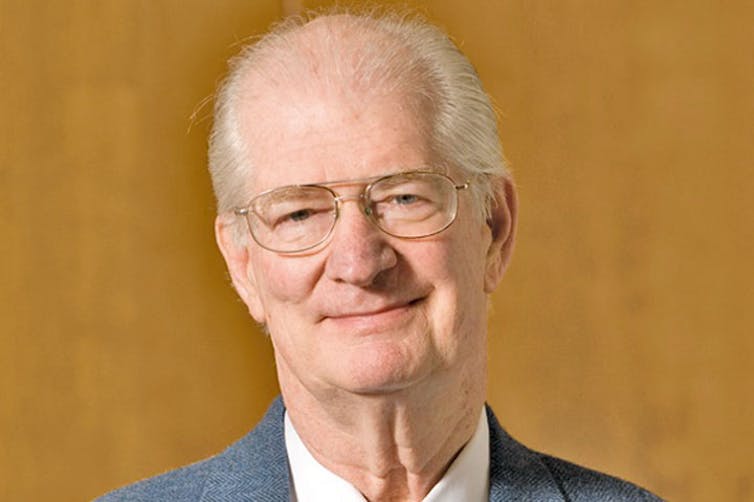
Headshot photo of Daly as an older man, with glasses and thinning hair,
Economist Herman Daly (1938-2022) Courtesy of Island Press

But Daly was a voracious reader, a side effect of having polio as a boy and missing out on the Texas football craze. Outside the confines of assigned textbooks, he found a history of economic thought steeped in rich philosophical debates on the function and purpose of the economy.

Unlike the precision of a market equilibrium sketched on the classroom blackboard, the real-world economy was messy and political, designed by those in power to choose winners and losers. He believed that economists should at least ask: Growth for whom, for what purpose and for how long?

Daly’s biggest realization came through reading marine biologist Rachel Carson’s 1962 book “Silent Spring,” and seeing her call to “come to terms with nature … to prove our maturity and our mastery, not of nature but of ourselves.” By then, he was working on a Ph.D. in Latin American development at Vanderbilt University and was already quite skeptical of the hyperindividualism baked into economic models. In Carson’s writing, the conflict between a growing economy and a fragile environment was blindingly clear.

After a fateful class with Nicholas Georgescu-Roegen, Daly’s conversion was complete. Georgescu-Roegen, a Romanian-born economist, dismissed the free market fairy tale of a pendulum swinging back and forth, effortlessly seeking a natural state of equilibrium. He argued that the economy was more like an hourglass, a one-way process converting valuable resources into useless waste.

Daly became convinced that economics should no longer prioritize the efficiency of this one-way process but instead focus on the “optimal” scale of an economy that the Earth can sustain. Just shy of his 30th birthday in 1968, while working as a visiting professor in the poverty-stricken Ceará region of northeastern Brazil, Daly published “On Economics as a Life Science.”

His sketches and tables of the economy as a metabolic process, entirely dependent on the biosphere as source for sustenance and sink for waste, were the road map for a revolution in economics.

Economics of a full world

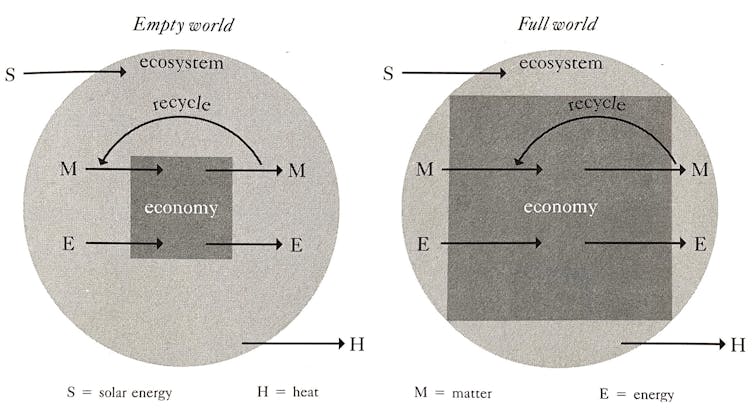
Daly spent the rest of his career drawing boxes in circles. In what he called the “pre-analytical vision,” the economy – the box – was viewed as the “wholly owned subsidiary” of the environment, the circle.

When the economy is small relative to the containing environment, a focus on the efficiency of a growing system has merit. But Daly argued that in a “full world,” with an economy that outgrows its sustaining environment, the system is in danger of collapse.

Illustrations of a square (economy) inside a circle (ecosystem). Energy and matter go into and out of the economy square, and some is recycled. Meanwhile solar energy enters the ecosystem circle and some heat escapes. In one, the square is too large.
Herman Daly’s conception of the economy as a subsystem of the environment. In a ‘full world,’ more growth can become uneconomic. Adapted from ‘Beyond Growth.’ Used with permission from Beacon Press.

While a professor at Louisiana State University in the 1970s, at the height of the U.S. environmental movement, Daly brought the box-in-circle framing to its logical conclusion in “Steady-State Economics.” Daly reasoned that growth and exploitation are prioritized in the competitive, pioneer stage of a young ecosystem. But with age comes a new focus on durability and cooperation. His steady-state model shifted the goal away from blind expansion of the economy and toward purposeful improvement of the human condition.

The international development community took notice. Following the United Nations’ 1987 publication of “Our Common Future,” which framed the goals of a “sustainable” development, Daly saw a window for development policy reform. He left the safety of tenure at LSU to join a rogue group of environmental scientists at the World Bank.

For the better part of six years, they worked to upend the reigning economic logic that treated “the Earth as if it were a business in liquidation.” He often butted heads with senior leadership, most famously with Larry Summers, the bank’s chief economist at the time, who publicly waved off Daly’s question of whether the size of a growing economy relative to a fixed ecosystem was of any importance. The future U.S. treasury secretary’s reply was short and dismissive: “That’s not the right way to look at it.”

But by the end of his tenure there, Daly and colleagues had successfully incorporated new environmental impact standards into all development loans and projects. And the international sustainability agenda they helped shape is now baked into the U.N. Sustainable Development Goals of 193 countries, “a plan of action for people, planet and prosperity.” In 1994, Daly returned to academia at the University of Maryland, and his life’s work was recognized the world over in the years to follow, including by Sweden’s Right Livelihood Award, the Netherlands’ Heineken Prize for Environmental Science, Norway’s Sophie Prize, Italy’s Medal of the Presidency, Japan’s Blue Planet Prize and even Adbuster’s person of the year.

Today, the imprint of his career can be found far and wide, including measures of the Genuine Progress Indicator of an economy, new Doughnut Economics framing of social floors within environmental ceilings, worldwide degree programs in ecological economics and a vibrant degrowth movement focused on a just transition to a right-sized economy.

I knew Herman Daly for two decades as a co-author, mentor and teacher. He always made time for me and my students, most recently writing the foreword to my upcoming book, “The Progress Illusion: Reclaiming Our Future from the Fairytale of Economics.” I will be forever grateful for his inspiration and courage to, as he put it, “ask the naive, honest questions” and then not be “satisfied until I get the answers.”

Jon D. Erickson, Professor of Sustainability Science and Policy, University of Vermont

This article is republished from The Conversation under a Creative Commons license. Read the original article.

ooOOoo

I found this to be absolutely fascinating and I am sure many besides me agree.

A fascinating article about Pit Bulls

The breed has come full circle!

We have had a couple of pit bull mixes here at home and they have been nothing but fabulous dogs.

So just three weeks ago The Conversation published an extensive account of the recent history of the breed. It is republished for you all today.

ooOOoo

Pit bulls went from America’s best friend to public enemy – now they’re slowly coming full circle.

A pit bull is not an official breed – it’s an umbrella term for a type of dog. Barbara Rich via Getty Images

Colin Dayan, Vanderbilt University

As recently as 50 years ago, the pit bull was America’s favorite dog. Pit bulls were everywhere. They were popular in advertising and used to promote the joys of pet-and-human friendship. Nipper on the RCA Victor label, Pete the Pup in the “Our Gang” comedy short films, and the flag-wrapped dog on a classic World War I poster all were pit bulls.

With National Pit Bull Awareness Day celebrated on Oct. 26, it’s a fitting time to ask how these dogs came to be seen as a dangerous threat.

A black and white dog runs with a tennis ball in its mouth
Stella, a pit bull owned by author Colin Dayan. Colin Dayan, CC BY-ND

Starting around 1990, multiple features of American life converged to inspire widespread bans that made pit bulls outlaws, called “four-legged guns” or “lethal weapons.” The drivers included some dog attacks, excessive parental caution, fearful insurance companies and a tie to the sport of dog fighting.

As a professor of humanities and law, I have studied the legal history of slaves, vagrants, criminals, terror suspects and others deemed threats to civilized society. For my books “The Law is a White Dog” and “With Dogs at the Edge of Life,” I explored human-dog relationships and how laws and regulations can deny equal protection to entire classes of beings.

In my experience with these dogs – including nearly 12 years living with Stella, the daughter of champion fighting dogs – I have learned that pit bulls are not inherently dangerous. Like other dogs, they can become dangerous in certain situations, and at the hands of certain owners. But in my view, there is no defensible rationale for condemning not only all pit bulls, but any dog with a single pit bull gene, as some laws do.

I see such action as canine profiling, which recalls another legal fiction: the taint or stain of blood that ordained human degradation and race hatred in the United States.

Painting of a black and white dog looking into the horn of a Victorian record player
English artist Francis Barraud (1856-1924) painted his brother’s dog Nipper listening to the horn of an early phonograph in 1898. Victor Talking Machine Co. began using the symbol in its trademark, His Master’s Voice, in 1900. Wikipedia

Bred to fight

The pit bull is strong. Its jaw grip is almost impossible to break. Bred over centuries to bite and hold large animals like bears and bulls around the face and head, it’s known as a “game dog.” Its bravery and strength won’t allow it to give up, no matter how long the struggle. It loves with the same strength; its loyalty remains the stuff of legend.

For decades pit bulls’ tenacity encouraged the sport of dogfighting, with the dogs “pitted” against each other. Fights often went to the death, and winning animals earned huge sums for those who bet on them.

But betting on dogs is not a high-class sport. Dogs are not horses; they cost little to acquire and maintain. Pit bulls easily and quickly became associated with the poor, and especially with Black men, in a narrative that connected pit bulls with gang violence and crime.

That’s how prejudice works: The one-on-one lamination of the pit bull onto the African American male reduced people to their accessories.

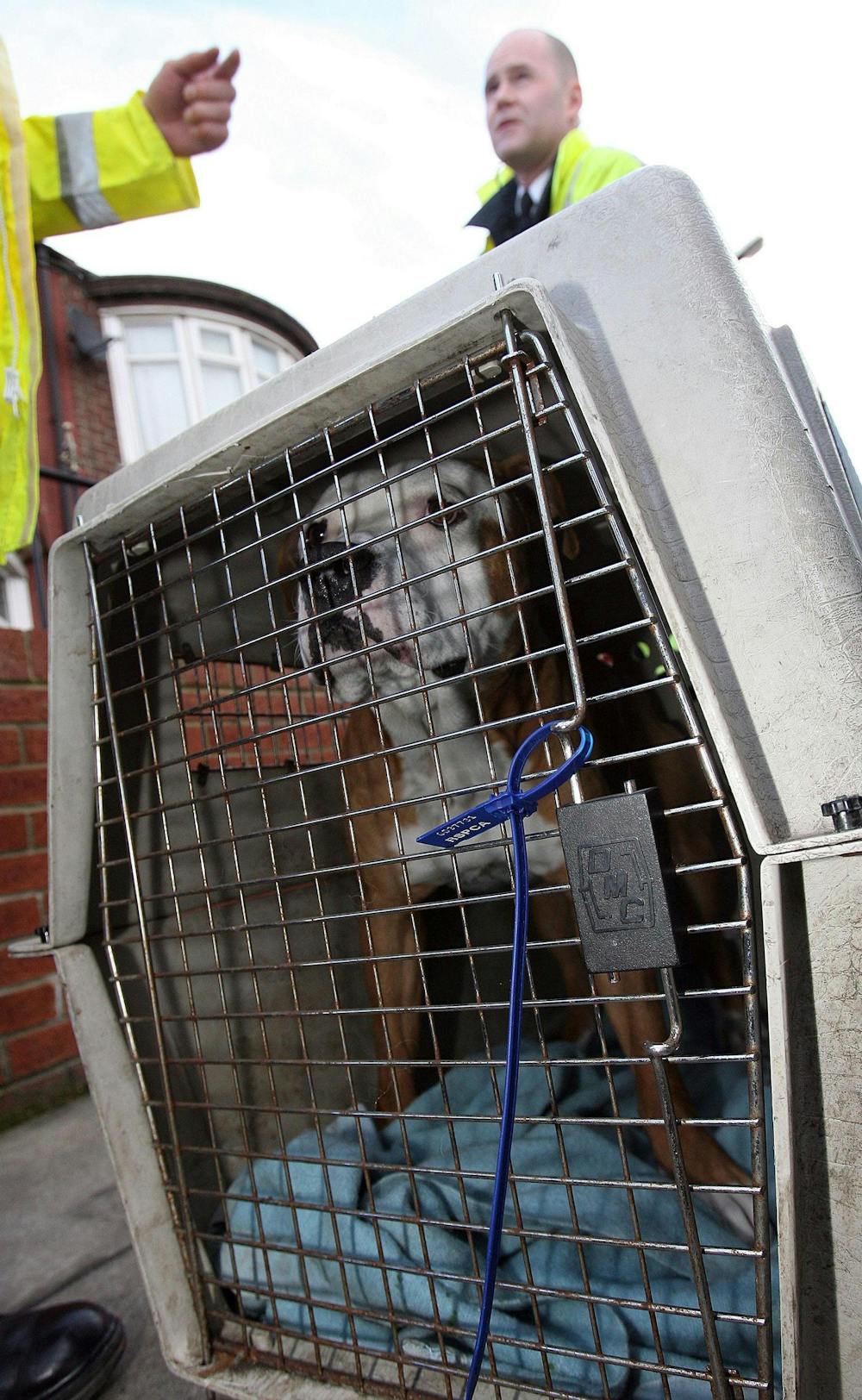
A dog confined in an animal crate, with police in the background.
A pit bull-type dog seized during a 2007 raid on an illegal dogfighting operation in East Cleveland, Ohio. Owen Humphreys – PA Images via Getty Images

Dogfighting was outlawed in all 50 states by 1976, although illegal businesses persisted. Coverage of the practice spawned broad assertions about the dogs that did the fighting. As breed bans proliferated, legal rulings proclaimed these dogs “dangerous to the safety or health of the community” and judged that “public interests demand that the worthless shall be exterminated.”

In 1987 Sports Illustrated put a pit bull, teeth bared, on its cover, with the headline “Beware of this Dog,” which it characterized as born with “a will to kill.” Time magazine published “Time Bombs on Legs” featuring this “vicious hound of the Baskervilles” that “seized small children like rag dolls and mauled them to death in a frenzy of bloodletting.”

Presumed vicious

If a dog has “vicious propensities,” the owner is assumed to share in this projected violence, both legally and generally in public perception. And once deemed “contraband,” both property and people are at risk.

This was evident in the much-publicized 2007 indictment of Atlanta Falcons quarterback Michael Vick for running a dogfighting business called Bad Newz Kennels in Virginia. Even the Humane Society of the United States and People for the Ethical Treatment of Animals – two of the nation’s leading animal welfare advocacy groups – argued that the 47 pit bulls recovered from the facility should be killed because they posed a threat to people and other animals.

If not for the intervention of Best Friends Animal Society, Vick’s dogs would have been euthanized. As the film “Champions” recounts, a court-appointed special master determined each dog’s fate. Ultimately, nearly all of the dogs were successfully placed in sanctuaries or adoptive homes.

This 2010 report describes the successful rehabilitation of dogs rescued from Michael Vick’s Bad Newz dogfighting operation.

Debating breed bans

Pit bulls still suffer more than any other dogs from the fact that they are a type of dog, not a distinct breed. Once recognized by the American Kennel Club as an American Staffordshire terrier, popularly known as an Amstaff, and registered with the United Kennel Club and the American Dog Breeders Association as an American pit bull terrier, now any dog characterized as a “pit bull type” can be considered an outlaw in many communities.

For example, in its 2012 Tracey v. Solesky ruling, the Maryland Court of Appeals modified the state’s common law in cases involving dog injuries. Any dog containing pit bull genes was “inherently dangerous” as a matter of law.

This subjected owners and landlords to what the courts call “strict liability.” As the court declared: “When an attack involves pit bulls, it is no longer necessary to prove that the particular pit bull or pit bulls are dangerous.”

Dissenting from the ruling, Judge Clayton Greene recognized the absurdity of the majority opinion’s “unworkable rule”: “How much ‘pit bull,’” he asked, “must there be in a dog to bring it within the strict liability edict?”

It’s equally unanswerable how to tell when a dog is a pit bull mix. From the shape of its head? Its stance? The way it looks at you?

Conundrums like these call into question statistics that show pit bulls to be more dangerous than other breeds. These figures vary a great deal depending on their sources.

Any statistics about pit bull attacks depend on the definition of a pit bull – yet it’s really hard to get good dog bite data that accurately IDs the breed

Prince George’s County, Md., is negotiating with advocates suing to revoke the county’s pit bull ban.

Over the past decade, awareness has grown that breed-specific legislation does not make the public safer but does penalize responsible owners and their dogs. Currently 21 states prohibit local government from enforcing breed-specific legislation or naming specific breeds in dangerous dog laws. Maryland passed a law reversing the Tracey ruling in 2014. Yet 15 states still allow local communities to enact breed-specific bans.

Pit bulls demand a great deal more from humans than some dogs, but alongside their bracing way of being in the world, we humans learn another way of thinking and loving. Compared with many other breeds, they offer a more demanding but always affecting communion.

Colin Dayan, Professor of English, Robert Penn Warren Professor in the Humanities, and Professor of Law, Vanderbilt University

This article is republished from The Conversation under a Creative Commons license. Read the original article.

ooOOoo

That is a very interesting account of the breed and shows the complexities of owning Pit Bulls in certain States, or rather local communities enacting breed-specific bans.

However, in our experience, we have found them to be smart, loving animals, and we know we are not alone in having those thoughts.

Ancient history of the climate.

Showing that droughts have been in evidence for 1,000 years or more!

It is very easy, well it is for me, to think that the changes we are seeing in the climate are purely recent. There is no question that we are experiencing changes in the global climate. But it would be too easy to think that these changes are only the result of recent times.

My way of an introduction to this post from The Conversation.

ooOOoo

1,000-year-old stalagmites from a cave in India show the monsoon isn’t so reliable – their rings reveal a history of long, deadly droughts.

Published on the 19th September, 2022 by:

  1. Gayatri Kathayat Associate Professor of Global Environmental Change, Xi’an Jiaotong University
  2. Ashish Sinha Professor of Earth and Climate Sciences, California State University, Dominguez Hills

In a remote cave in northeast India, rainwater has slowly dripped from the ceiling in the same spots for over 1,000 years. With each drop, minerals in the water accumulate on the floor below, slowly growing into calcium carbonate towers known as stalagmites.

These stalagmites are more than geological wonders – like tree rings, their layers record the region’s rainfall history. They also carry a warning about the potential for catastrophic multiyear droughts in the future. 

By analyzing the geochemistry of these stalagmites in a new study published Sept. 19, 2022, in the Proceedings of the National Academy of Sciences, we were able to create the most precise chronology yet of the summer Indian monsoon over the past millennium. It documents how the Indian subcontinent frequently experienced long, severe droughts unlike any observed in the last 150 years of reliable monsoon rainfall measurements. 

The drought periods we detected are in striking synchrony with historical accounts of droughts, faminesmass mortality events and geopolitical changes in the region.

They show how the decline of the Mughal Empire and India’s textile industries in the 1780s and 1790s coincided with the most severe 30-year period of drought over the millennium. The depth and duration of the drought would have caused widespread crop failures and the level of famine discussed in written documentsat the time. 

Another long drought encompasses the 1630-1632 Deccan famine, one of the most devastating droughts in India’s history. Millions of people died as crops failed. Around the same time, the elaborate Mughal capital of Fatehpur Sikri was abandoned and the Guge Kingdom collapsed in western Tibet.

Buland Darwaza (Door of Victory) at Fatehpur Sikri, India.

Our findings have important implications today for water planning in a warming world, particularly for India, which, with its vast monsoon-reliant agriculture industry, is on pace to soon be the most populous country on the planet.

Why the monsoon’s history matters

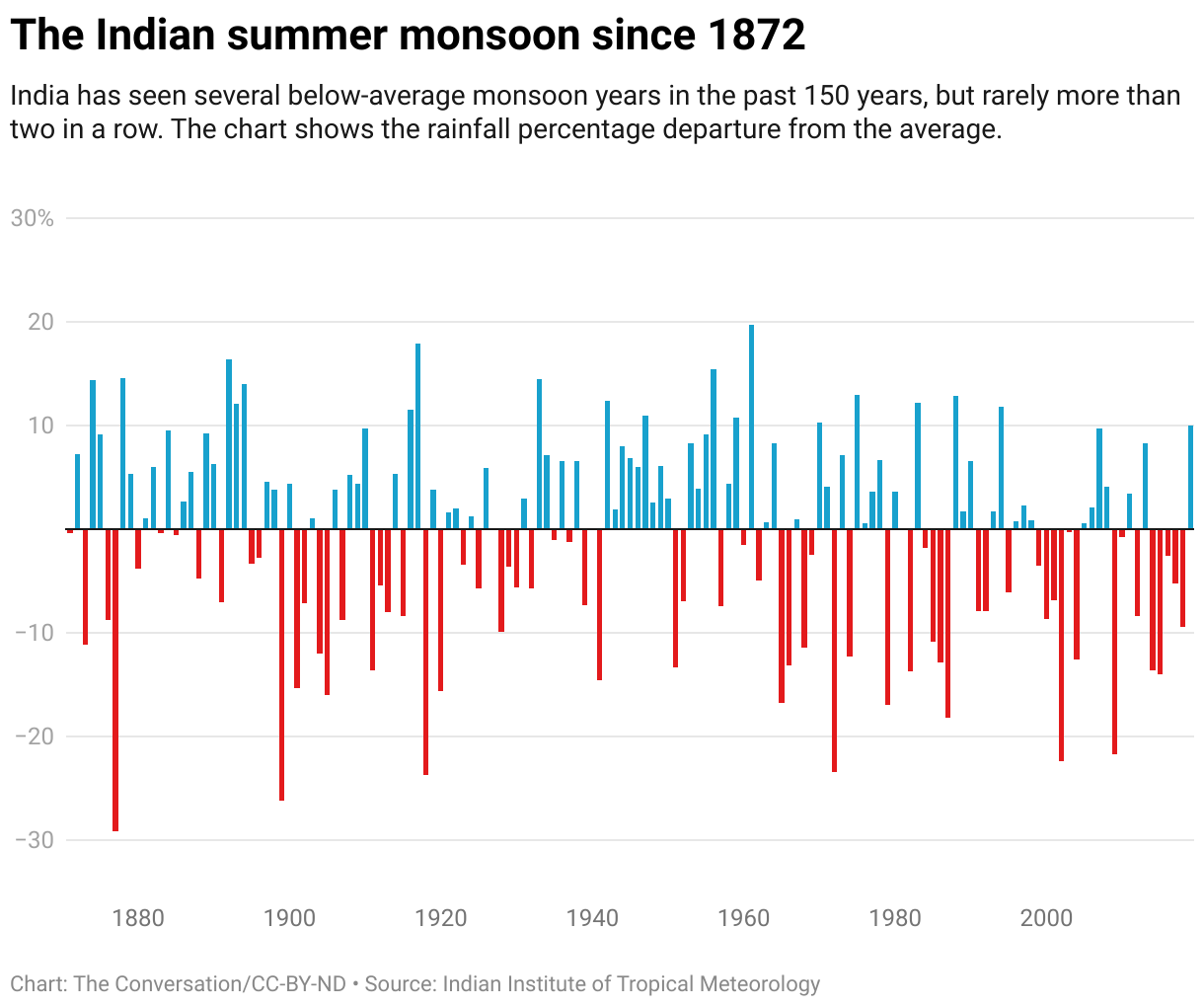
Scientists began systematically measuring India’s monsoon rainfall with instruments around the 1870s. Since then, India has experienced about 27 regionally widespread droughts. Among them, only one – 1985 to 1987 – was a three-year consecutive drought or worse.

The apparent stability of the Indian monsoon in that data might lead one to surmise that neither protracted droughts lasting multiple years nor frequent droughts are intrinsic aspects of its variability. This seemingly reassuring view currently informs the region’s present-day water resource infrastructure.

However, the stalagmite evidence of prolonged, severe droughts over the past 1,000 years paints a different picture.

It indicates that the short instrumental period does not capture the full range of Indian monsoon variability. It also raises questions about the region’s current water resources, sustainability and mitigation policies that discount the possibility of protracted droughts in the future.

Timeline of major societal and geopolitical changes in India and the oxygen isotope record from Mawmluh cave. Gayatri Kathayat

How do stalagmites capture a region’s monsoon history?

To reconstruct past variations in rainfall, we analyzed stalagmites from Mawmluh cave, near the town of Cherrapunji in the state of Meghalaya – one of the wettest locations in the world.

Stalagmites are conelike structures that grow slowly from the ground up, typically at a rate of about one millimeter every 10 years. Trapped within their growth layers are minute amounts of uranium and other elements that were acquired as rainwater infiltrated the rocks and soil above the cave. Over time, uranium trapped in stalagmites decays into thorium at a predictable pace, so we can figure out the age of each stalagmite growth layer by measuring the ratio of uranium to thorium.

The oxygen in rainwater molecules comes in two primary types of isotopes – heavy and light. As stalagmites grow, they lock into their structure the oxygen isotope ratios of the percolating rainwater that seeps into the cave. Subtle variations in this ratio can arise from a range of climatic conditions at the time the rainwater originally fell.

Stalagmite formation are marked inside Mawmluh Cave, where the new study was based. Gayatri Kathayat
A cross-section of a stalagmite shows differences in its ring formation as climate conditions changed. Gayatri Kathayat

Our previous research in this area showed that variations in oxygen isotope ratios in rainwater, and consequently, in stalagmites, track changes in the relative abundance of different moisture sources that contribute to summer monsoon rainfall.

During years when monsoon circulation is weak, rainfall here is primarily derived from the moisture that evaporated from the nearby Arabian Sea. During strong monsoon years, however, atmospheric circulation brings copious amounts of moisture to this area all the way from the southern Indian Ocean.

The two moisture sources have quite different oxygen isotope signatures, and this ratio is faithfully preserved in the stalagmites. We can use this clue to learn about the overall strength of the monsoon intensity at the time the stalagmite formed. We pieced together the monsoon rainfall history by extracting minute amounts of calcium carbonate from its growth rings and then measuring the oxygen isotope ratios. To anchor our climate record to precise calendar years, we measured the uranium and thorium ratio.

Stalagmites grow from the ground, and stalactites grow from above. These are in Mawmluh Cave, where the authors conducted their research. Gayatri Kathayat.

Next steps

The paleoclimate records can usually tell what, where and when something happened. But often, they alone cannot answer why or how something happened. 

Our new study shows that protracted droughts frequently occurred during the past millennia, but we do not have a good understanding of why the monsoon failed in those years. Similar studies using Himalayan ice cores, tree rings and other caves have also detected protracted droughts but face the same challenge. 

In the next phase of our study, we are teaming up with climate modelers to conduct coordinated proxy-modeling studies that we hope will offer more insight into the climate dynamics that triggered and sustained such extended periods of drought during the past millennium.

ooOOoo

So there we are. Droughts are a thing of the ancient past. But only a partial understanding for why the monsoons failed is known. Despite these modern times with so much general access to knowledge there are still things that we do not know!

Finally, one hopes that the next phase of their study will be along in reasonable time! I would love to report on it.

Our climate: Welcome to the New Normal!

An article read on Sunday is the motivation for today’s post.

The article, published by The Conversation blog site, was made public last Wednesday week.

I make no apologies for banging the climate change gong again, it is in my opinion the most important subject going.

Enough from me; now to the article.

(And it had been planned for last Tuesday but because of Pedi it is now today.)

ooOOoo

By Professor Shuang-Ye Wu

This article was written by Professor Shuang-Ye Wu. It is very good.

Professor Wu is the Professor of Geology and Environmental Geosciences at the University of Dayton, USA.

Looking back on America’s summer of heat, floods and climate change: Welcome to the new abnormal!

Much of the South and Southern Plains faced a dangerous heat wave in July 2022, with highs well over 100 degrees for several days. Brandon Bell/Getty Images

The summer of 2022 started with a historic flood in Montana, brought on by heavy rain and melting snow, that tore up roads and caused large areas of Yellowstone National Park to be evacuated.

It ended with a record-breaking heat wave in California and much of the West that pushed the power grid to the breaking point, causing blackouts, followed by a tropical storm that set rainfall records in southern California. A typhoon flooded coastal Alaska, and a hurricane hit Puerto Rico with more than 30 inches of rain.

In between, wildfires raged through California, Arizona and New Mexico on the background of a megadrought in Southwestern U.S. that has been more severe than anything the region has experienced in at least 1,200 years. Near Albuquerque, New Mexico, a five-mile stretch of the Rio Grande ran dry for the first time in 40 years. Persistent heat waves lingered over many parts of the country, setting temperature records.

At the same time, during a period of five weeks between July and August, five 1,000-year rainfall events occurred in St. Louis, eastern Kentucky, southern Illinois, California’s Death Valley and in Dallas, causing devastating and sometimes deadly flash floods. Extreme rainfall also led to severe flooding in Mississippi, Virginia and West Virginia.

The United States is hardly alone in its share of climate disasters.

In Pakistan, record monsoon rains inundated more than one-third of the country, killing over 1,500 people. In India and China, prolonged heat waves and droughts dried up rivers, disrupted power grids and threatened food security for billions of people.

In Europe, heat waves set record temperatures in Britain and other places, leading to severe droughts and wildfires in many parts of the continent. In South Africa, torrential rains brought flooding and mudslides that killed more than 400 people. The summer may have come to an end on the calendar, but climate disasters will surely continue.

This isn’t just a freak summer: Over the years, such extreme events are occurring in increasing frequency and intensity.

Climate change is intensifying these disasters

The most recent international climate assessment from the United Nations’ Intergovernmental Panel on Climate Change found significant increases in both the frequency and intensity of extreme temperature and precipitation events, leading to more droughts and floods.

A recent study published in the scientific journal Nature found that extreme flooding and droughts are also getting deadlier and more expensive, despite an improving capacity to manage climate risks. This is because these extreme events, enhanced by climate change, often exceed the designed levels of such management strategies.

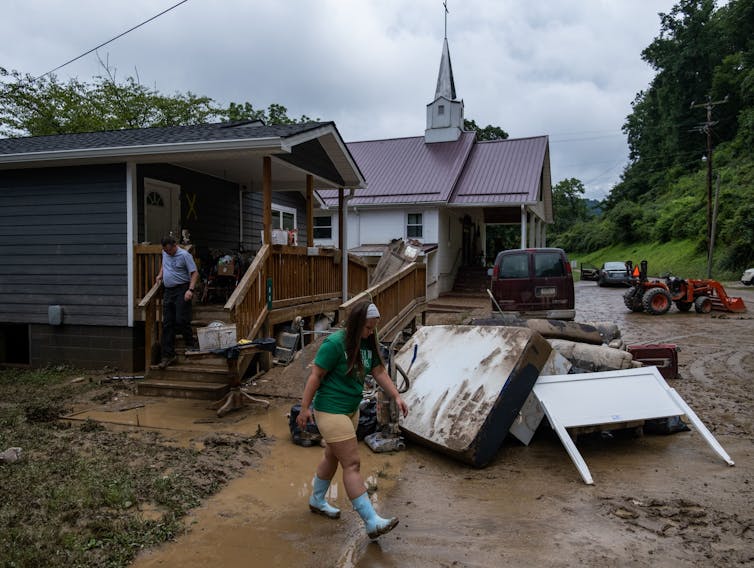
A girl in rain boots walks through a mud-filled yard. Damaged mattresses and other belongings from a flooded house are piled nearby.
Flash flooding swept through mountain valleys in eastern Kentucky in July 2022, killing more than three dozen people. It was one of several destructive flash floods. Seth Herald/AFP via Getty Images

Extreme events, by definition, occur rarely. A 100-year flood has a 1% chance of happening in any given year. So, when such events occur with increasing frequency and intensity, they are a clear indication of a changing climate state.

The term “global warming” can sometimes be misleading, as it seems to suggest that as humans put more heat-trapping greenhouse gases into the atmosphere, the world is going to get a bit warmer everywhere. What it fails to convey is that warming temperatures also lead to a more violent world with more extreme climate disasters, as we saw this past summer.

Climate models showed these risks were coming

Much of this is well-understood and consistently reproduced by climate models.

As the climate warms, a shift in temperature distribution leads to more extremes. The magnitudes of changes in extreme temperature are often larger than changes in the mean. For example, globally, a 1 degree Celsius increase in annual average temperature is associated with 1.2 C to 1.9 C (2.1 Fahrenheit to 3.4 F) of increase in the annual maximum temperature.

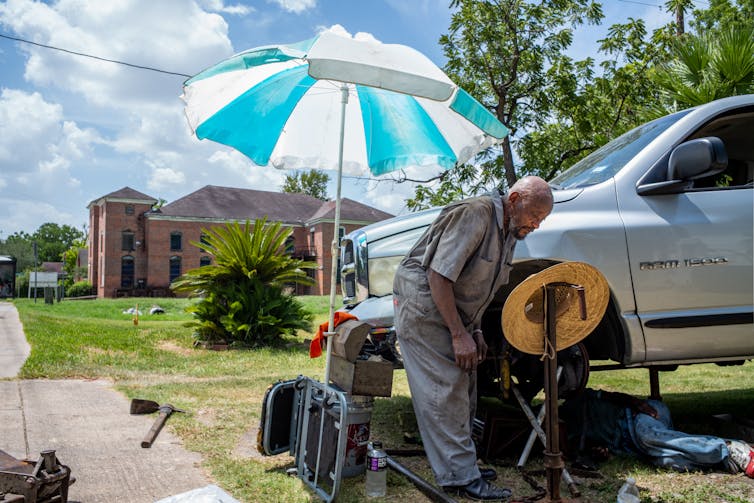
A man works on a car with an older mechanic in overalls standing next to him under the shade of a large beach umbrealla.
Heat waves, like the heat dome over the South in July 2022, can hit outdoor workers especially hard. Brandon Bell/Getty Images

In addition, global warming causes changes in the vertical profile of the atmosphere and equator-to-pole temperature gradients, leading to changes in how the atmosphere and ocean move. The temperature difference between equator and the poles is the driving force for global wind. As the polar regions warm at much higher rates then the equator, the reduced temperature difference causes a weakening of global winds and leads to a more meandering jet stream.

Some of these changes can create conditions such as persistent high-pressure systems and atmosphere blocking that favor more frequent and more intense heat waves. The heat domes over the Southern Plains and South in June and the West in September are examples.

The initial warming can be further amplified by positive feedbacks. For example, warming increases snow melt, exposing dark soil underneath, which absorbs more heat than snow, further enhancing the warming.

Warming of the atmosphere also increases its capacity to hold water vapor, which is a strong greenhouse gas. Therefore, more water vapor in the air leads to more warming. Higher temperatures tend to dry out the soil, and less soil moisture reduces the land’s heat capacity, making it easier to heat up.

These positive feedbacks further intensify the initial warming, leading to more heat extremes. More frequent and persistent heat waves lead to excessive evaporation, combined with decreased precipitation in some regions, causing more severe droughts and more frequent wildfires.

Higher temperatures increase the atmosphere’s capacity to hold moisture at a rate of about 7% per degree Celsius.

This increased humidity leads to heavier rainfall events. In addition, storm systems are fueled by latent heat, or the large amount of energy released when water vapor condenses to liquid water. Increased moisture content in the atmosphere also enhances latent heat in storm systems, increasing their intensity. Extreme heavy or persistent rainfall leads to increased flooding and landslides, with devastating social and economic consequences.

Even though it’s difficult to link specific extreme events directly to climate change, when these supposedly rare events occur with increasing frequency in a warming world, it is hard to ignore the changing state of our climate.

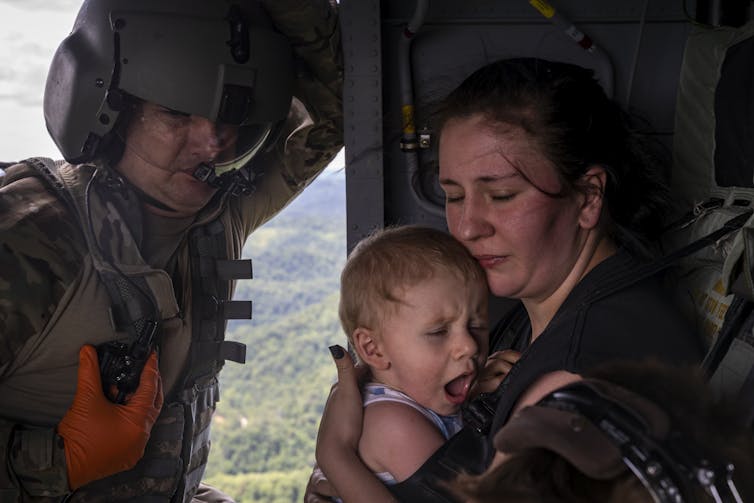
A woman with her eyes closed holds a screaming 1-year-old boy in a National Guard helicopter, with a guardsman standing in the open helicopter door.
A family had to be airlifted from their home in eastern Kentucky after it was surrounded by floodwater in July 2022. Michael Swensen/Getty Images

The new abnormal

So this past summer might just provide a glimpse of our near future, as these extreme climate events become more frequent.

To say this is the new “normal,” though, is misleading. It suggests that we have reached a new stable state, and that is far from the truth.

Without serious effort to curb greenhouse gas emissions, this trend toward more extreme events will continue. Things will keep getting worse, and this past summer will become the norm a few years or decades down the road – and eventually, it will seem mild, like one of those “nice summers” we look back on fondly with nostalgia.

This article is republished from The Conversation under a Creative Commons license. Read the original article.

ooOOoo

There is growing evidence that things are really changing globally. I used to say that I would be dead before the impacts of climate change really hit home. As in, it would be a good twenty years before things really took a hold. But it is now much more likely that the next five years are going to see a continuation of the changes and that there isn’t time to hang around.

I may not be as sharp as I used to be but the changing climate will affect me and Jean and all those in our area. Will our leaders grasp this nettle now? I wish I knew.

Searching for alien life

Another item about the James Webb Space Telescope (JWST).

I make no apologies for returning to the JWST in just a week after publishing my first article about the telescope. For I found the latest article, again published on The Conversation, to be incredible and that was all I needed to share it with you.

ooOOoo

To search for alien life, astronomers will look for clues in the atmospheres of distant planets – and the James Webb Space Telescope just proved it’s possible to do so

Published July 14th, 2022.

By Chris Impey University Distinguished Professor of Astronomy, University of Arizona and

Daniel Apai Professor of Astronomy and Planetary Sciences, University of Arizona.

The ingredients for life are spread throughout the universe. While Earth is the only known place in the universe with life, detecting life beyond Earth is a major goal of modern astronomy and planetary science.

We are two scientists who study exoplanets and astrobiology. Thanks in large part to next-generation telescopes like James Webb, researchers like us will soon be able to measure the chemical makeup of atmospheres of planets around other stars. The hope is that one or more of these planets will have a chemical signature of life.

There are many known exoplanets in habitable zones – orbits not too close to a star that the water boils off but not so far that the planet is frozen solid – as marked in green for both the solar system and Kepler-186 star system with its planets labeled b, c, d, e and f. NASA Ames/SETI Institute/JPL-Caltech/Wikimedia Commons

Habitable exoplanets

Life might exist in the solar system where there is liquid water – like the subsurface aquifers on Mars or in the oceans of Jupiter’s moon Europa. However, searching for life in these places is incredibly difficult, as they are hard to reach and detecting life would require sending a probe to return physical samples.

Many astronomers believe there’s a good chance that life exists on planets orbiting other stars, and it’s possible that’s where life will first be found.

Theoretical calculations suggest that there are around 300 million potentially habitable planets in the Milky Way galaxy alone and several habitable Earth-sized planets within only 30 light-years of Earth – essentially humanity’s galactic neighbors. So far, astronomers have discovered over 5,000 exoplanets, including hundreds of potentially habitable ones, using indirect methods that measure how a planet affects its nearby star. These measurements can give astronomers information on the mass and size of an exoplanet, but not much else.

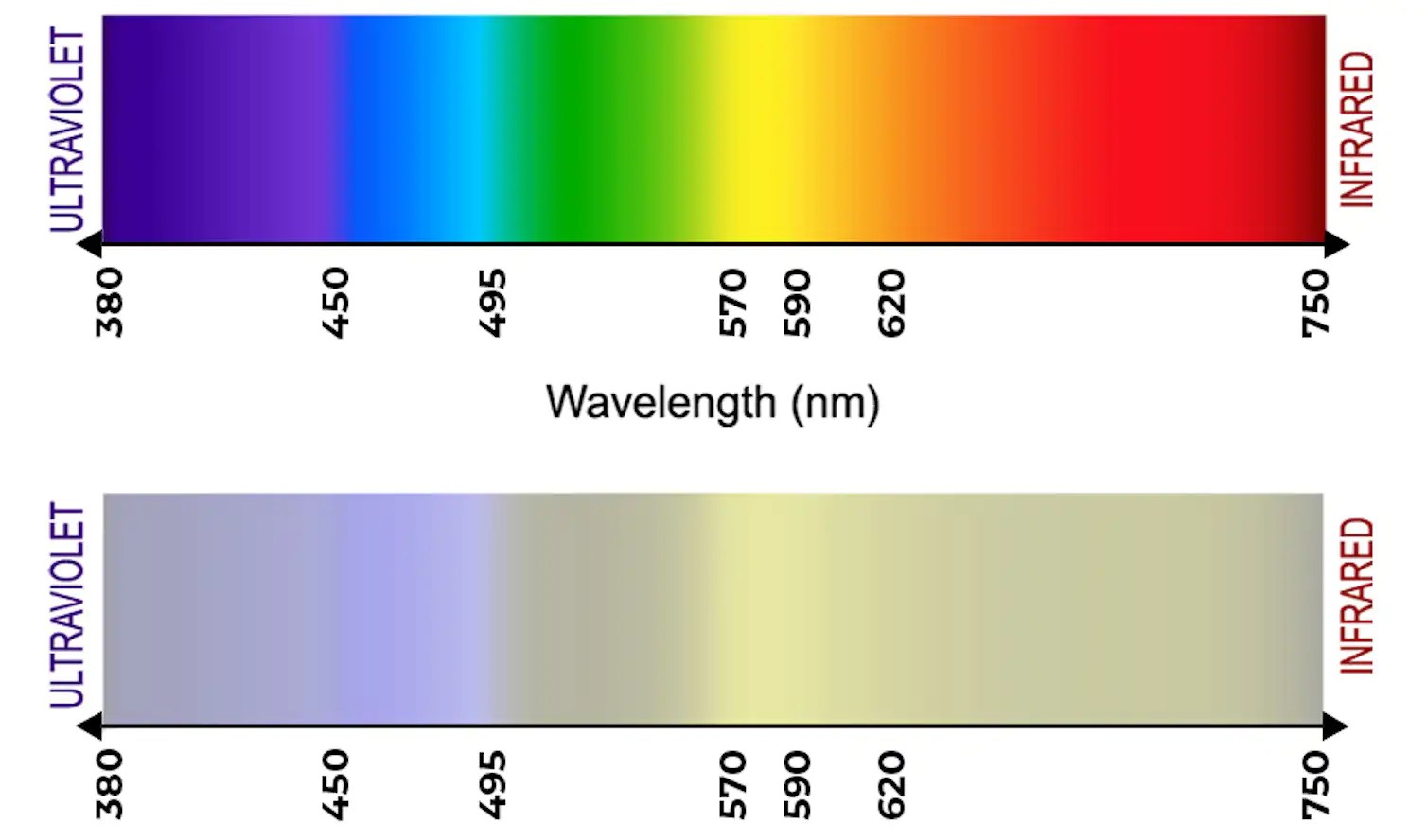
Every material absorbs certain wavelengths of light, as shown in this diagram depicting the wavelengths of light absorbed most easily by different types of chlorophyll. Daniele Pugliesi/Wikimedia CommonsCC BY-SA

Looking for biosignatures

To detect life on a distant planet, astrobiologists will study starlight that has interacted with a planet’s surface or atmosphere. If the atmosphere or surface was transformed by life, the light may carry a clue, called a “biosignature.”

For the first half of its existence, Earth sported an atmosphere without oxygen, even though it hosted simple, single-celled life. Earth’s biosignature was very faint during this early era. That changed abruptly 2.4 billion years ago when a new family of algae evolved. The algae used a process of photosynthesis that produces free oxygen – oxygen that isn’t chemically bonded to any other element. From that time on, Earth’s oxygen-filled atmosphere has left a strong and easily detectable biosignature on light that passes through it.

When light bounces off the surface of a material or passes through a gas, certain wavelengths of the light are more likely to remain trapped in the gas or material’s surface than others. This selective trapping of wavelengths of light is why objects are different colors. Leaves are green because chlorophyll is particularly good at absorbing light in the red and blue wavelengths. As light hits a leaf, the red and blue wavelengths are absorbed, leaving mostly green light to bounce back into your eyes.

The pattern of missing light is determined by the specific composition of the material the light interacts with. Because of this, astronomers can learn something about the composition of an exoplanet’s atmosphere or surface by, in essence, measuring the specific color of light that comes from a planet.

This method can be used to recognize the presence of certain atmospheric gases that are associated with life – such as oxygen or methane – because these gasses leave very specific signatures in light. It could also be used to detect peculiar colors on the surface of a planet. On Earth, for example, the chlorophyll and other pigments plants and algae use for photosynthesis capture specific wavelengths of light. These pigments produce characteristic colors that can be detected by using a sensitive infrared camera. If you were to see this color reflecting off the surface of a distant planet, it would potentially signify the presence of chlorophyll.

Telescopes in space and on Earth

It takes an incredibly powerful telescope to detect these subtle changes to the light coming from a potentially habitable exoplanet. For now, the only telescope capable of such a feat is the new James Webb Space Telescope. As it began science operations in July 2022, James Webb took a reading of the spectrum of the gas giant exoplanet WASP-96b. The spectrum showed the presence of water and clouds, but a planet as large and hot as WASP-96b is unlikely to host life.

However, this early data shows that James Webb is capable of detecting faint chemical signatures in light coming from exoplanets. In the coming months, Webb is set to turn its mirrors toward TRAPPIST-1e, a potentially habitable Earth-sized planet a mere 39 light-years from Earth.

Webb can look for biosignatures by studying planets as they pass in front of their host stars and capturing starlight that filters through the planet’s atmosphere. But Webb was not designed to search for life, so the telescope is only able to scrutinize a few of the nearest potentially habitable worlds. It also can only detect changes to atmospheric levels of carbon dioxide, methane and water vapor. While certain combinations of these gasses may suggest life, Webb is not able to detect the presence of unbonded oxygen, which is the strongest signal for life.

Animals, including cows, produce methane, but so do many geologic processes. Jernej Furman/Wikimedia CommonsCC BY

Is it biology or geology?

Even using the most powerful telescopes of the coming decades, astrobiologists will only be able to detect strong biosignatures produced by worlds that have been completely transformed by life.

Unfortunately, most gases released by terrestrial life can also be produced by nonbiological processes – cows and volcanoes both release methane. Photosynthesis produces oxygen, but sunlight does, too, when it splits water molecules into oxygen and hydrogen. There is a good chance astronomers will detect some false positives when looking for distant life. To help rule out false positives, astronomers will need to understand a planet of interest well enough to understand whether its geologic or atmospheric processes could mimic a biosignature

The next generation of exoplanet studies has the potential to pass the bar of the extraordinary evidence needed to prove the existence of life. The first data release from the James Webb Space Telescope gives us a sense of the exciting progress that’s coming soon.

The James Webb Space Telescope is the first telescope able to detect chemical signatures from exoplanets, but it is limited in its capabilities. NASA/Wikimedia Commons

ooOOoo

So despite the advances in technology that resulted in the JWST it will still not be possible to detect unbonded oxygen; a sure indicator of life. It will be able to detect many other fascinating aspects of stars and planets beyond the Milky Way. I do not know if “The first data release…” relates to software or whether further launches of Mk 2 ‘JWST’ will be required. I will try and find out!

Science on the business of loving our dogs (and cats).

A fascinating article!

I have long subscribed to The Conversation and shared quite a few stories with you good people. But this recent one was a terrific report.

Read it yourself and I am sure you will agree with me.

ooOOoo

New research suggests cat and dog ‘moms’ and ‘dads’ really are parenting their pets – here’s the evolutionary explanation why.

Pet parenting can provide love and companionship to both human and animal. Willie B. Thomas/DigitalVision via Getty Images

Shelly Volsche, Boise State University

old pug dog in a stroller and harness
A pup out for a stroll, without paws touching the ground. Shelly Volsche, CC BY-ND

Have you noticed more cats riding in strollers lately? Or bumper stickers that read, “I love my granddogs”? You’re not imagining it. More people are investing serious time, money and attention in their pets.

It looks an awful lot like parenting, but of pets, not people.

Can this kind of caregiving toward animals really be considered parenting? Or is something else going on here?

I’m an anthropologist who studies human-animal interactions, a field known as anthrozoology. I want to better understand the behavior of pet parenting by people from the perspective of evolutionary science. After all, cultural norms and evolutionary biology both suggest people should focus on raising their own children, not animals of a completely different species.

More child-free people, more pet parents

The current moment is unique in human history. Many societies, including the U.S., are experiencing major changes in how people live, work and socialize. Fertility rates are low, and people have more flexibility in how they choose to live their lives. These factors can lead people to further their education and value defining oneself as an individual over family obligations. With basics taken care of, people can focus on higher order psychological needs like feelings of achievement and a sense of purpose.

The scene is set for people to actively choose to focus on pets instead of children.

In earlier research, I interviewed 28 self-identified child-free pet owners to better understand how they relate to their animals. These individuals pointedly shared that they had actively chosen cats and dogs instead of children. In many cases, their use of parent-child relational terms – calling themselves a pet’s “mom” for instance – was simply shorthand.

They emphasized fulfilling the species-specific needs of their dogs and cats. For example, they might fulfill the animal’s need to forage by feeding meals using a food puzzle, while most children are fed at the table. These pet owners acknowledged differences in the nutrition, socialization and learning needs of animals versus children. They were not unthinkingly replacing human children with “fur babies” by treating them like small, furry humans.

woman with party hat with dog
Pet parents might celebrate their dog’s big day – but with a doggy treat and not chocolate cake. fotostorm/E+ via Getty Images

Other researchers find similar connections, showing that child-free pet owners perceive their companions as emotional, thinking individuals. This way of understanding the mind of the animal helps lead to the development of a parent identity toward companion animals. In other cases, uncertain individuals find their need to nurture sufficiently fulfilled by caring for pets, cementing their fertility decisions to remain child-free.

Nurturing others is part of being human

Yet, these findings still do not answer this question: Are people who choose pets over children truly parenting their pets? To answer, I turned to the evolution of parenting and caregiving.

Evolutionary anthropologist Sarah Hardy wrote in 2009 that humans are cooperative breeders. This means it is literally in our DNA and our ancestral history to help care for offspring who are not our own. Anthropologists and biologists call this trait alloparenting. It is an evolutionary adaptation that helped human beings who cooperatively raised children survive. For early humans, this ancient environment was likely made up of small, foraging societies in which some people exchanged child care for food and other resources.

I propose that it is this evolutionary history that explains pet parenting. If people evolved to alloparent, and our environment is now making caring for children more difficult or less appealing to some, it makes sense for people to alloparent other species entering their homes. Alloparenting companion animals can offer a way to fulfill the evolved need to nurture while reducing the investment of time, money and emotional energy compared to raising children.

two kids and dog bathing in tub
Do people relate to animals differently in families with children? Mayte Torres/Moment via Getty Images

Untangling differences in caring for pets

To further understand this phenomenon of child-free adults parenting pets, I launched an online survey via social media, seeking responses from U.S.-based dog and cat owners over the age of 18. The survey included questions about attachment and caregiving behaviors using the Lexington Attachment to Pets Scale. It also asked a series of questions I developed to probe specific human caretaking behaviors oriented toward pets – things like feeding, bathing and training – as well as how much autonomy companion animals had in the home.

The final sample of 917 respondents included 620 parents, 254 nonparents and 43 people who were undecided or did not answer. Most of the respondents were also married or in a domestic partnership for over one year (57%), between the ages of 25 and 60 (72%) and had at least a bachelor’s degree (77%). They were also mostly women (85%) and heterosexual (85%), a common situation in human-animal interactions research.

Both parents and nonparents reported high amounts of training and play with their pets. This finding makes sense given that all pet owners need to help their dogs and cats learn how to navigate a human world. Survey respondents reported socializing, training and enrichment, including play, for their animals.

Nonparents were more likely to be the one providing general care for the animal. This finding also makes sense since parents often adopt or purchase companion animals as a way to help their children learn responsibility and to care for others. Child-free animal owners invest time, money and emotional energy directly in their pets.

Nonparents reported higher rates of general attachment to their animals. They more frequently viewed their pets as individuals. Nonparents were also more likely to use family terms such as “parent,” “child,” “kids” and “guardians” when referring to their relationships with their pet.

woman on couch petting cat
Caring for another being can be fulfilling and rewarding. Delmaine Donson/E+ via Getty Images

It is this difference, combined with the evidence from my earlier research that these individuals address the species-specific needs of the dogs and cats in their care, that suggests pet parenting is, truly, parenting pets. Though the details may look quite different – attending training classes instead of school functions, or providing smell walks for dogs instead of coloring books for children – both practices fulfill the same evolved function. Whether child or pet, people are meeting the same evolved need to care for, teach and love a sentient other.

My colleagues and I continue to collect data from all over the world about how people live with animals. For now, this study provides evidence that, perhaps rather than being evolved to parent, humans are evolved to nurture. And as a result, who and when we parent is much more flexible than you might initially believe.

[Get our best science, health and technology stories. Sign up for The Conversation’s science newsletter.]

Shelly Volsche, Clinical Assistant Professor of Anthropology, Boise State University

This article is republished from The Conversation under a Creative Commons license. Read the original article.

ooOOoo

Shelly does a fabulous job of looking more closely at the science and it is a science that has a very wide appeal. For in the UK, according to the RSPCA, “In the UK, it’s estimated that 12 million (44 percent of) households have pets with around 51 million pets owned.

Here in America The Washington Post reported that: “Google the U.S. pet population, and you’re quickly confronted with two oft-cited, and contradictory, sources. The American Pet Products Association (APPA) found that 68 percent of U.S. households owned some sort of pet in 2016 — “equal to the highest level ever reported,” it gushed in the executive summary. Among those pets were about 90 million dogs and 94 million cats, the group said.

That is just two countries. The worldwide population of dogs and cats must be gigantic.

Darkness!

Chris Impey writes about his specialty in observational cosmology.

This has nothing to do with life, nothing that we are dealing with in our daily affairs, and has nothing to do with our dear dogs. BUT! This is incredibly interesting! Incredibly and beautifully interesting!

ooOOoo

The most powerful space telescope ever built will look back in time to the Dark Ages of the universe

Hubble took pictures of the oldest galaxies it could – seen here – but the James Webb Space Telescope can go back much farther in time. NASA

Chris Impey, University of Arizona

Some have called NASA’s James Webb Space Telescope the “telescope that ate astronomy.” It is the most powerful space telescope ever built and a complex piece of mechanical origami that has pushed the limits of human engineering. On Dec. 18, 2021, after years of delays and billions of dollars in cost overruns, the telescope is scheduled to launch into orbit and usher in the next era of astronomy.

I’m an astronomer with a specialty in observational cosmology – I’ve been studying distant galaxies for 30 years. Some of the biggest unanswered questions about the universe relate to its early years just after the Big Bang. When did the first stars and galaxies form? Which came first, and why? I am incredibly excited that astronomers may soon uncover the story of how galaxies started because James Webb was built specifically to answer these very questions.

A graphic showing the progression of the Universe through time.
The Universe went through a period of time known as the Dark Ages before stars or galaxies emitted any light. Space Telescope Institute

The ‘Dark Ages’ of the universe

Excellent evidence shows that the universe started with an event called the Big Bang 13.8 billion years ago, which left it in an ultra-hot, ultra-dense state. The universe immediately began expanding after the Big Bang, cooling as it did so. One second after the Big Bang, the universe was a hundred trillion miles across with an average temperature of an incredible 18 billion F (10 billion C). Around 400,000 years after the Big Bang, the universe was 10 million light years across and the temperature had cooled to 5,500 F (3,000 C). If anyone had been there to see it at this point, the universe would have been glowing dull red like a giant heat lamp.

Throughout this time, space was filled with a smooth soup of high energy particles, radiation, hydrogen and helium. There was no structure. As the expanding universe became bigger and colder, the soup thinned out and everything faded to black. This was the start of what astronomers call the Dark Ages of the universe.

The soup of the Dark Ages was not perfectly uniform and due to gravity, tiny areas of gas began to clump together and become more dense. The smooth universe became lumpy and these small clumps of denser gas were seeds for the eventual formation of stars, galaxies and everything else in the universe.

Although there was nothing to see, the Dark Ages were an important phase in the evolution of the universe.

A diagram showing different wavelengths of light compared to size of normal objects.
Light from the early universe is in the infrared wavelength – meaning longer than red light – when it reaches Earth. Inductiveload/NASA via Wikimedia Commons, CC BY-SA

Looking for the first light

The Dark Ages ended when gravity formed the first stars and galaxies that eventually began to emit the first light. Although astronomers don’t know when first light happened, the best guess is that it was several hundred million years after the Big Bang. Astronomers also don’t know whether stars or galaxies formed first.

Current theories based on how gravity forms structure in a universe dominated by dark matter suggest that small objects – like stars and star clusters – likely formed first and then later grew into dwarf galaxies and then larger galaxies like the Milky Way. These first stars in the universe were extreme objects compared to stars of today. They were a million times brighter but they lived very short lives. They burned hot and bright and when they died, they left behind black holes up to a hundred times the Sun’s mass, which might have acted as the seeds for galaxy formation.

Astronomers would love to study this fascinating and important era of the universe, but detecting first light is incredibly challenging. Compared to massive, bright galaxies of today, the first objects were very small and due to the constant expansion of the universe, they’re now tens of billions of light years away from Earth. Also, the earliest stars were surrounded by gas left over from their formation and this gas acted like fog that absorbed most of the light. It took several hundred million years for radiation to blast away the fog. This early light is very faint by the time it gets to Earth.

But this is not the only challenge.

As the universe expands, it continuously stretches the wavelength of light traveling through it. This is called redshift because it shifts light of shorter wavelengths – like blue or white light – to longer wavelengths like red or infrared light. Though not a perfect analogy, it is similar to how when a car drives past you, the pitch of any sounds it is making drops noticeably. Similar to how a pitch of a sound drops if the source is moving away from you, the wavelength of light stretches due to the expansion of the universe.

By the time light emitted by an early star or galaxy 13 billion years ago reaches any telescope on Earth, it has been stretched by a factor of 10 by the expansion of the universe. It arrives as infrared light, meaning it has a wavelength longer than that of red light. To see first light, you have to be looking for infrared light.

Telescope as a time machine

Enter the James Webb Space Telescope.

Telescopes are like time machines. If an object is 10,000 light-years away, that means the light takes 10,000 years to reach Earth. So the further out in space astronomers look, the further back in time we are looking.

A large golden colored disc with a sensor in the middle and scientists standing below.
The James Webb Space Telescope was specifically designed to detect the oldest galaxies in the universe. NASA/JPL-Caltech, CC BY-SA

Engineers optimized James Webb for specifically detecting the faint infrared light of the earliest stars or galaxies. Compared to the Hubble Space Telescope, James Webb has a 15 times wider field of view on its camera, collects six times more light and its sensors are tuned to be most sensitive to infrared light.

The strategy will be to stare deeply at one patch of sky for a long time, collecting as much light and information from the most distant and oldest galaxies as possible. With this data, it may be possible to answer when and how the Dark Ages ended, but there are many other important discoveries to be made. For example, unraveling this story may also help explain the nature of dark matter, the mysterious form of matter that makes up about 80% of the mass of the universe.

James Webb is the most technically difficult mission NASA has ever attempted. But I think the scientific questions it may help answer will be worth every ounce of effort. I and other astronomers are waiting excitedly for the data to start coming back sometime in 2022.

Chris Impey, University Distinguished Professor of Astronomy, University of Arizona

This article is republished from The Conversation under a Creative Commons license. Read the original article.

ooOOoo

The dark ages of the universe that lasted for millions of years until gravity started to form some order out of the ‘soup’.

I don’t know about you but the winter nights, when the sky is clear, have me waiting outside for the dogs to come in looking up at the night sky just lost in the sheer wonder of it all.

The very best of luck to NASA on December 18th!

Oh dear, I meant deer!

A timely reminder from The Conversation.

We live in a rural part of Southern Oregon. The number of deer hit on our roads is appalling. Not infrequently when out cycling I come across a deer that seems uninjured. Often I get off my bike and stroke the animal, or drag it from the centre of the road to the shoulder. But it is dead.

Once recently the deer was still warm. What surprises me is that they are always dead. There never seems to be a deer that has been wounded. Probably just as well as I wouldn’t want to leave the animal.

We feed the deer at home on a daily basis and there is a young stag that has become familiar with me and starts eating the COB (corn, oats and barley mixed together) even before I have finished setting out the six piles of food. They are very dear creatures.

So this article has to be shared with you!

ooOOoo

Fall means more deer on the road: 4 ways time of day, month and year raise your risk of crashes

Deer cross roads whenever they wish, but some time periods are higher risk than others. Josh Edelson/AFP via Getty Images

Tom Langen, Clarkson University

Autumn is here, and that means the risk of hitting deer on rural roads and highways is rising, especially around dusk and during a full moon.

Deer cause over 1 million motor vehicle accidents in the U.S. each year, resulting in more than US$1 billion in property damage, about 200 human deaths and 29,000 serious injuries. Property damage insurance claims average around $2,600 per accident, and the overall average cost, including severe injuries or death, is over $6,000.

While avoiding deer – as well as moose, elk and other hoofed animals, known as ungulates – can seem impossible if you’re driving in rural areas, there are certain times and places that are most hazardous, and so warrant extra caution.

Transportation agencies, working with scientists, have been developing ways to predict where deer and other ungulates enter roads so they can post warning signs or install fencing or wildlife passages under or over the roadway. Just as important is knowing when these accidents occur.

My former students Victor Colino-Rabanal, Nimanthi Abeyrathna and I have analyzed over 86,000 deer-vehicle collisions involving white-tailed deer in New York state using police records over a three-year period. Here’s what our research and other studies show about timing and risk:

Time of day, month and year matters

The risk of hitting a deer varies by time of day, day of the week, the monthly lunar cycle and seasons of the year.

These accident cycles are partly a function of driver behavior – they are highest when traffic is heavy, drivers are least alert and driving conditions are poorest for spotting animals. They are also affected by deer behavior. Not infrequently, deer-vehicle accidents involve multiple vehicles, as startled drivers swerve to miss a deer and collide with a vehicle in another lane, or they slam on the breaks and are rear-ended by the vehicle behind.

Car on road during the start of leaf colors with road sign reading: Caution: High Hit Area
A sign warns of deer traffic on Route 16 in Franklin County, Maine. Education Images/Universal Images Group via Getty Images

In analyzing thousands of deer-vehicle collisions, we found that these accidents occur most frequently at dusk and dawn, when deer are most active and drivers’ ability to spot them is poorest. Only about 20% of accidents occur during daylight hours. Deer-vehicle accidents are eight times more frequent per hour of dusk than daylight, and four times more frequent at dusk than after nightfall.

During the week, accidents occur most frequently on days that have the most drivers on the road at dawn or dusk, so they are associated with work commuter driving patterns and social factors such as Friday “date night” traffic.

Over the span of a month, the most deer-vehicle accidents occur during the full moon, and at the time of night that the moon is brightest. Deer move greater distances from cover and are more likely to enter roadways when there is more illumination at night. The pattern holds for deer and other ungulates in both North America and Europe.

Over a year, by far the highest numbers of deer-vehicle accidents are in autumn, and particularly during the rut, when bucks search and compete to mate with does. In New York state, the peak number of deer-vehicle accidents occurs in the last week of October and first weeks of November. There are over four times as many deer-vehicle accidents during that period than during spring. Moose-vehicle accidents show a similar pattern.

That high-risk period is also when daylight saving time ends – it happens on Nov. 7, 2021, in the U.S. Shifting the clock one hour back means more commuters are on the road during the high-risk dusk hours. The result is more cars driving at the peak time of day and during the peak time of the year for deer-vehicle accidents.

Overall, given that most U.S. states and more than 70 countries have seasonal “daylight saving” clock shifts, elevated ungulate-vehicle accident rates caused by clock shift may be a widespread problem.

[Over 100,000 readers rely on The Conversation’s newsletter to understand the world. Sign up today.]

There is a longstanding debate about the benefit of a daylight saving clock shift, given how it disrupts humans’ circadian rhythms, causing short-term stress and fatigue. Risk of deer-vehicle accidents may be another reason to reconsider whether clock shifts are worthwhile.

Deer still cross roads at any time

It’s important to remember that deer-vehicle accidents can occur at any time of day or night, on any day of the year – and that deer can show up in urban areas as well as rural ones.

The insurance company State Farm found that on average, U.S. drivers have a 1 in 116 chance of hitting an animal, with much higher rates in states such as West Virginia, Montana and Pennsylvania. Over the 12 months ending in June 2020, State Farm counted 1.9 million insurance claims for collisions with wildlife nationwide. Around 90% of those involved deer.

Where deer or other ungulates are likely to be present, drivers should always be alert and cautious, especially at dawn, dusk, on bright moonlit nights and during the fall rut.

Tom Langen, Professor of Biology, Clarkson University

This article is republished from The Conversation under a Creative Commons license. Read the original article.

ooOOoo

Nothing else to say but we drivers need to slow down and extra vigilant. Driving safely means always allowing for the unexpected and never following the vehicle in front too close. The minimum safe distance is one vehicle length for every 10 miles per hour in speed!

Yet more of the big question.

Time!

I wasn’t going to publish a post for today but then yesterday I read this article on The Conversation and wanted to share it with you. In fact it shares much of what I posted on the 1st, The Big Question. Because time and infinity are beautifully connected.

ooOOoo

What is time – and why does it move forward?

By Thomas Kitching, Lecturer in Astrophysics, UCL

Imagine time running backwards. People would grow younger instead of older and, after a long life of gradual rejuvenation – unlearning everything they know – they would end as a twinkle in their parents’ eyes. That’s time as represented in a novel by science fiction writer Philip K Dick but, surprisingly, time’s direction is also an issue that cosmologists are grappling with.

While we take for granted that time has a given direction, physicists don’t: most natural laws are “time reversible” which means they would work just as well if time was defined as running backwards. So why does time always move forward? And will it always do so?

Does time have a beginning?

Any universal concept of time must ultimately be based on the evolution of the cosmos itself. When you look up at the universe you’re seeing events that happened in the past – it takes light time to reach us. In fact, even the simplest observation can help us understand cosmological time: for example the fact that the night sky is dark. If the universe had an infinite past and was infinite in extent, the night sky would be completely bright – filled with the light from an infinite number of stars in a cosmos that had always existed.

For a long time scientists, including Albert Einstein, thought that the universe was static and infinite. Observations have since shown that it is in fact expanding, and at an accelerating rate. This means that it must have originated from a more compact state that we call the Big Bang, implying that time does have a beginning. In fact, if we look for light that is old enough we can even see the relic radiation from Big Bang – the cosmic microwave background. Realising this was a first step in determining the age of the universe (see below).

But there is a snag, Einstein’s special theory of relativity, shows that time is … relative: the faster you move relative to me, the slower time will pass for you relative to my perception of time. So in our universe of expanding galaxies, spinning stars and swirling planets, experiences of time vary: everything’s past, present and future is relative. 

So is there a universal time that we could all agree on?

The universe’s timeline. Design Alex Mittelmann, Coldcreation/wikimedia, CC BY-SA

It turns out that because the universe is on average the same everywhere, and on average looks the same in every direction, there does exist a “cosmic time”. To measure it, all we have to do is measure the properties of the cosmic microwave background. Cosmologists have used this to determine the age of the universe; its cosmic age. It turns out that the universe is 13.799 billion years old. 

Time’s arrow

So we know time most likely started during the Big Bang. But there is one nagging question that remains: what exactly is time? 

To unpack this question, we have to look at the basic properties of space and time. In the dimension of space, you can move forwards and backwards; commuters experience this everyday. But time is different, it has a direction, you always move forward, never in reverse. So why is the dimension of time irreversible? This is one of the major unsolved problems in physics. 

To explain why time itself is irreversible, we need to find processes in nature that are also irreversible. One of the few such concepts in physics (and life!) is that things tend to become less “tidy” as time passes. We describe this using a physical property called entropy that encodes how ordered something is.

Imagine a box of gas in which all the particles were initially placed in one corner (an ordered state). Over time they would naturally seek to fill the entire box (a disordered state) – and to put the particles back into an ordered state would require energy. This is irreversible. It’s like cracking an egg to make an omelette – once it spreads out and fills the frying pan, it will never go back to being egg-shaped. It’s the same with the universe: as it evolves, the overall entropy increases.

Unfortunately that’s not going to clean up itself. Alex Dinovitser/wikimediaCC BY-SA

It turns out entropy is a pretty good way to explain time’s arrow. And while it may seem like the universe is becoming more ordered rather than less – going from a wild sea of relatively uniformly spread out hot gas in its early stages to stars, planets, humans and articles about time – it’s nevertheless possible that it is increasing in disorder. That’s because the gravity associated with large masses may be pulling matter into seemingly ordered states – with the increase in disorder that we think must have taken place being somehow hidden away in the gravitational fields. So disorder could be increasing even though we don’t see it.

But given nature’s tendency to prefer disorder, why did the universe start off in such an ordered state in the first place? This is still considered a mystery. Some researchers argue that the Big Bang may not even have been the beginning, there may in fact be “parallel universes” where time runs in different directions

Will time end?

Time had a beginning but whether it will have an end depends on the nature of the dark energy that is causing it to expand at an accelerating rate. The rate of this expansion may eventually tear the universe apart, forcing it to end in a Big Rip; alternatively dark energy may decay, reversing the Big Bang and ending the Universe in a Big Crunch; or the Universe may simply expand forever.

But would any of these future scenarios end time? Well, according to the strange rules of quantum mechanics, tiny random particles can momentarily pop out of a vacuum – something seen constantly in particle physics experiments. Some have argued that dark energy could cause such “quantum fluctuations” giving rise to a new Big Bang, ending our time line and starting a new one. While this is extremely speculative and highly unlikely, what we do know is that only when we understand dark energy will we know the fate of the universe.

So what is the most likely outcome? Only time will tell.

ooOOoo

Let me explain, in part, entropy. Because while I and many others sort of understand it, the principle behind entropy is much more detailed.

It is explained pretty well on WikiPedia, from which I reproduce the first paragraph.

Entropy is a scientific concept, as well as a measurable physical property that is most commonly associated with a state of disorder, randomness, or uncertainty. The term and the concept are used in diverse fields, from classical thermodynamics, where it was first recognized, to the microscopic description of nature in statistical physics, and to the principles of information theory. It has found far-ranging applications in chemistry and physics, in biological systems and their relation to life, in cosmologyeconomicssociologyweather scienceclimate change, and information systems including the transmission of information in telecommunication.[1]

There’s a little bit more to read … 😉

Again, I am going to finish with sharing that image from Unsplash.

Imagine the universe is constant whichever direction one looks in, to 1 in 10,000. That is truly amazing!

The big question!

That I wonder if it will ever be answered?

For the first day of September I wanted to change the topic to an item that was recently published by The Conversation.

Space has always been fascinating to me. One of my enduring memories was standing on the roof of my Land Rover in 1969 during a long journey around the interior of Australia. We were in the Nullabor desert and it was flat, and lonely, for miles and miles. This particular night I clambered up onto the roof and just took in the night sky. There was not a single spot of human-caused light pollution and the night sky was beautiful beyond words.

Later on when I was sailing I used to regard the North Star as my friend.

Anyway, here’s a little question for this day.

ooOOoo

Does outer space end – or go on forever?

It can stretch your mind to ponder what’s really out there. Stijn Dijkstra/EyeEm via Getty Images

Jack Singal, University of Richmond


What is beyond outer space? – Siah, age 11, Fremont, California


Right above you is the sky – or as scientists would call it, the atmosphere. It extends about 20 miles (32 kilometers) above the Earth. Floating around the atmosphere is a mixture of molecules – tiny bits of air so small you take in billions of them every time you breathe.

Above the atmosphere is space. It’s called that because it has far fewer molecules, with lots of empty space between them.

Have you ever wondered what it would be like to travel to outer space – and then keep going? What would you find? Scientists like me are able to explain a lot of what you’d see. But there are some things we don’t know yet, like whether space just goes on forever.

Planets, stars and galaxies

At the beginning of your trip through space, you might recognize some of the sights. The Earth is part of a group of planets that all orbit the Sun – with some orbiting asteroids and comets mixed in, too.

A diagram of the solar system, showing the sun and its orbiting planets.
A familiar neighborhood. Mark Garlick/Science Photo Library via Getty Images

You might know that the Sun is actually just an average star, and looks bigger and brighter than the other stars only because it is closer. To get to the next nearest star, you would have to travel through trillions of miles of space. If you could ride on the fastest space probe NASA has ever made, it would still take you thousands of years to get there.

If stars are like houses, then galaxies are like cities full of houses. Scientists estimate there are 100 billion stars in Earth’s galaxy. If you could zoom out, way beyond Earth’s galaxy, those 100 billion stars would blend together – the way lights of city buildings do when viewed from an airplane.

Recently astronomers have learned that many or even most stars have their own orbiting planets. Some are even like Earth, so it’s possible they might be home to other beings also wondering what’s out there.

An image showing detail of one galaxy, but visually implying there are many more.
A galaxy among many other galaxies. Michael Miller/Stocktrek Images via Getty Images

You would have to travel through millions of trillions more miles of space just to reach another galaxy. Most of that space is almost completely empty, with only some stray molecules and tiny mysterious invisible particles scientists call “dark matter.”

Using big telescopes, astronomers see millions of galaxies out there – and they just keep going, in every direction.

If you could watch for long enough, over millions of years, it would look like new space is gradually being added between all the galaxies. You can visualize this by imagining tiny dots on a deflated balloon and then thinking about blowing it up. The dots would keep moving farther apart, just like the galaxies are.

Is there an end?

If you could keep going out, as far as you wanted, would you just keep passing by galaxies forever? Are there an infinite number of galaxies in every direction? Or does the whole thing eventually end? And if it does end, what does it end with?

These are questions scientists don’t have definite answers to yet. Many think it’s likely you would just keep passing galaxies in every direction, forever. In that case, the universe would be infinite, with no end.

Some scientists think it’s possible the universe might eventually wrap back around on itself – so if you could just keep going out, you would someday come back around to where you started, from the other direction.

One way to think about this is to picture a globe, and imagine that you are a creature that can move only on the surface. If you start walking any direction, east for example, and just keep going, eventually you would come back to where you began. If this were the case for the universe, it would mean it is not infinitely big – although it would still be bigger than you can imagine.

In either case, you could never get to the end of the universe or space. Scientists now consider it unlikely the universe has an end – a region where the galaxies stop or where there would be a barrier of some kind marking the end of space.

But nobody knows for sure. How to answer this question will need to be figured out by a future scientist.

Jack Singal, Associate Professor of Physics, University of Richmond

This article is republished from The Conversation under a Creative Commons license. Read the original article.

ooOOoo

“But nobody knows for sure. How to answer this question will need to be figured out by a future scientist.”

I wonder if that future scientist will ever be able to answer the question.

Then there’s the thought that the universe may be infinite. That is an astounding idea, that it goes on forever.

There’s only one way to close this post. With this photograph from Unsplash.