Tag: The Conversation

The history of Oxygen!

A fascinating subject.

We take it for granted! Of that I am sure. But the question of how oxygen first came to be built up in our atmosphere is fascinating. There was a recent article written by Elizabeth Swanner, who is Associate Professor of Geology, Iowa State University that was published in The Conversation. It makes for a very interesting read.

ooOOoo

A layered lake is a little like Earth’s early oceans − and lets researchers explore how oxygen built up in our atmosphere billions of years ago

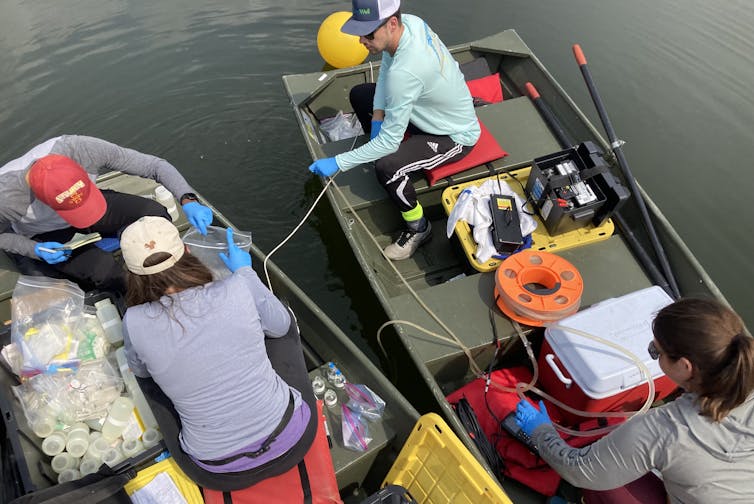
Researchers sample water from various layers to analyze back in the lab. Elizabeth Swanner, CC BY-ND

Elizabeth Swanner, Iowa State University

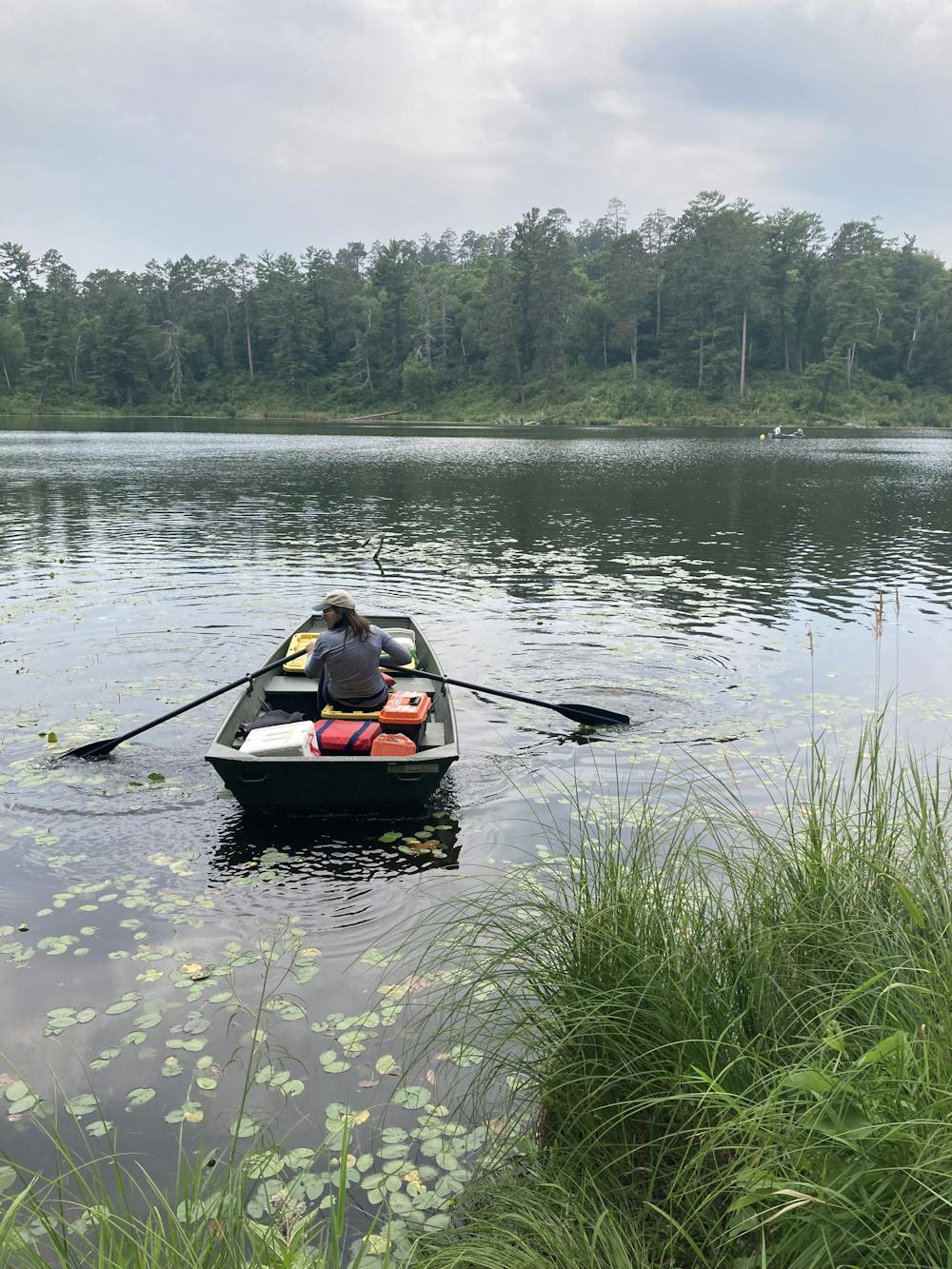
Little Deming Lake doesn’t get much notice from visitors to Itasca State Park in Minnesota. There’s better boating on nearby Lake Itasca, the headwaters of the Mississippi River. My colleagues and I need to maneuver hundreds of pounds of equipment down a hidden path made narrow by late-summer poison ivy to launch our rowboats.

But modest Deming Lake offers more than meets the eye for me, a geochemist interested in how oxygen built up in the atmosphere 2.4 billion years ago. The absence of oxygen in the deep layers of Deming Lake is something this small body of water has in common with early Earth’s oceans.

On each of our several expeditions here each year, we row our boats out into the deepest part of the lake – over 60 feet (18 meters), despite the lake’s surface area being only 13 acres. We drop an anchor and connect our boats in a flotilla, readying ourselves for the work ahead.

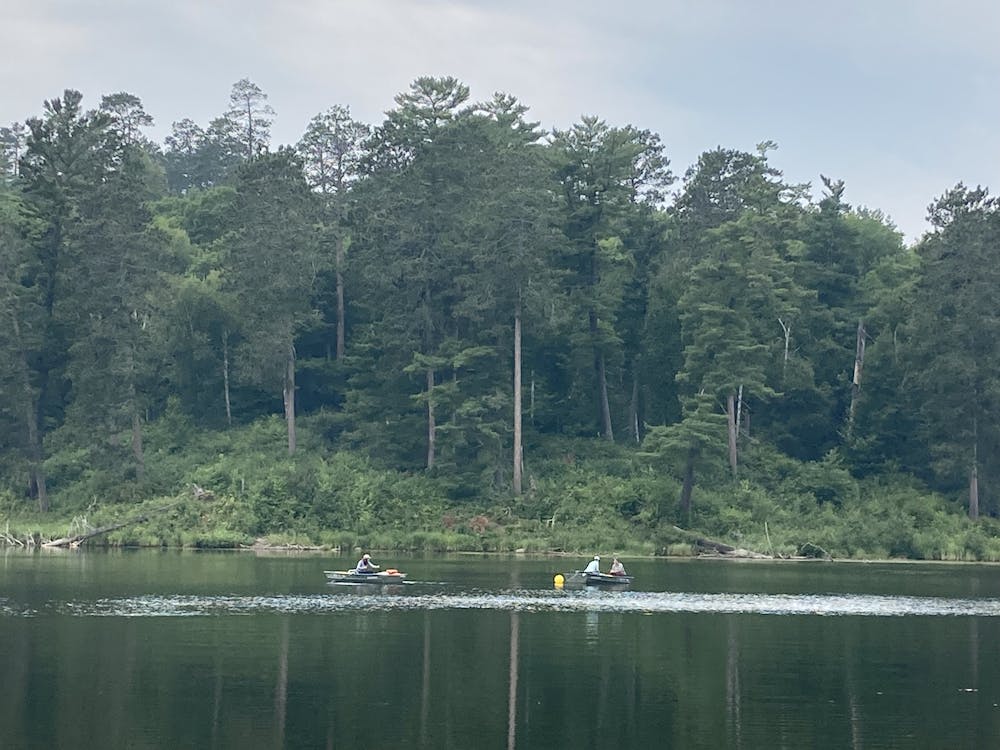
Smooth lake with boats in the distance against woodsy shoreline
Researchers’ boats on Deming Lake. Elizabeth Swanner, CC BY-ND

Deming Lake is meromictic, a term from Greek that means only partially mixing. In most lakes, at least once a year, the water at the top sinks while the water at the bottom rises because of wind and seasonal temperature changes that affect water’s density. But the deepest waters of Deming Lake never reach the surface. This prevents oxygen in its top layer of water from ever mixing into its deep layer.

Less than 1% of lakes are meromictic, and most that are have dense, salty bottom waters. Deming Lake’s deep waters are not very salty, but of the salts in its bottom waters, iron is one of the most abundant. This makes Deming Lake one of the rarest types of meromictic lakes.

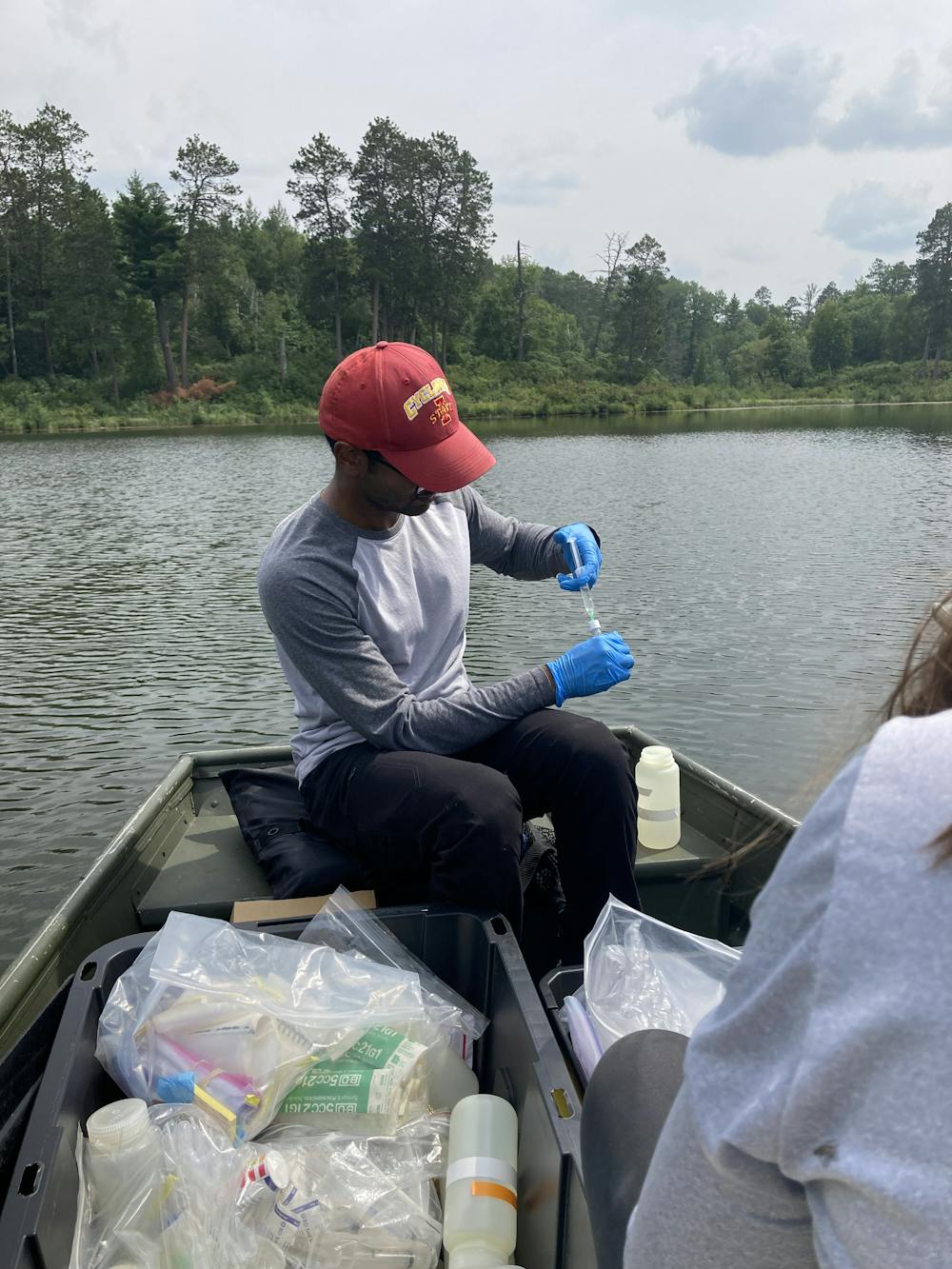
man seated in small boat wearing gloves injecting water into a collection tube
Postdoc researcher Sajjad Akam collects a water sample for chemical analysis back in the lab. Elizabeth Swanner, CC BY-ND

The lake surface is calm, and the still air is glorious on this cool, cloudless August morning. We lower a 2-foot-long water pump zip-tied to a cable attached to four sensors. The sensors measure the temperature, amount of oxygen, pH and amount of chlorophyll in the water at each layer we encounter. We pump water from the most intriguing layers up to the boat and fill a myriad of bottles and tubes, each destined for a different chemical or biological analysis.

My colleagues and I have homed in on Deming Lake to explore questions about how microbial life adapted to and changed the environmental conditions on early Earth. Our planet was inhabited only by microbes for most of its history. The atmosphere and the oceans’ depths didn’t have much oxygen, but they did have a lot of iron, just like Deming Lake does. By investigating what Deming Lake’s microbes are doing, we can better understand how billions of years ago they helped to transform the Earth’s atmosphere and oceans into what they’re like now.

Layer by layer, into the lake

Two and a half billion years ago, ocean waters had enough iron to form today’s globally distributed rusty iron deposits called banded iron formations that supply iron for the modern global steel industry. Nowadays, oceans have only trace amounts of iron but abundant oxygen. In most waters, iron and oxygen are antithetical. Rapid chemical and biological reactions between iron and oxygen mean you can’t have much of one while the other is present.

The rise of oxygen in the early atmosphere and ocean was due to cyanobacteria. These single-celled organisms emerged at least 2.5 billion years ago. But it took roughly 2 billion years for the oxygen they produce via photosynthesis to build up to levels that allowed for the first animals to appear on Earth.

water concentrated on a filter looks pale green
Chlorophyll colors water from the lake slightly green. Elizabeth Swanner, CC BY-ND

At Deming Lake, my colleagues and I pay special attention to the water layer where the chlorophyll readings jump. Chlorophyll is the pigment that makes plants green. It harnesses sunlight energy to turn water and carbon dioxide into oxygen and sugars. Nearly 20 feet (6 meters) below Deming’s surface, the chlorophyll is in cyanobacteria and photosynthetic algae, not plants.

But the curious thing about this layer is that we don’t detect oxygen, despite the abundance of these oxygen-producing organisms. This is the depth where iron concentrations start to climb to the high levels present at the lake’s bottom.

This high-chlorophyll, high-iron and low-oxygen layer is of special interest to us because it might help us understand where cyanobacteria lived in the ancient ocean, how well they were growing and how much oxygen they produced.

We suspect the reason cyanobacteria gather at this depth in Deming Lake is that there is more iron there than at the top of the lake. Just like humans need iron for red blood cells, cyanobacteria need lots of iron to help catalyze the reactions of photosynthesis.

A likely reason we can’t measure any oxygen in this layer is that in addition to cyanobacteria, there are a lot of other bacteria here. After a good long life of a few days, the cyanobacteria die, and the other bacteria feed on their remains. These bacteria rapidly use up any oxygen produced by still photosynthesizing cyanobacteria the way a fire does as it burns through wood.

We know there are lots of bacteria here based on how cloudy the water is, and we see them when we inspect a drop of this water under a microscope. But we need another way to measure photosynthesis besides measuring oxygen levels.

Long-running lakeside laboratory

The other important function of photosynthesis is converting carbon dioxide into sugars, which eventually are used to make more cells. We need a way to track whether new sugars are being made, and if they are, whether it’s by photosynthetic cyanobacteria. So we fill glass bottles with samples of water from this lake layer and seal them tight with rubber stoppers.

We drive the 3 miles back to the Itasca Biological Station and Laboratories where we will set up our experiments. The station opened in 1909 and is home base for us this week, providing comfy cabins, warm meals and this laboratory space.

In the lab, we inject our glass bottle with carbon dioxide that carries an isotopic tracer. If cyanobacteria grow, their cells will incorporate this isotopic marker.

We had a little help to formulate our questions and experiments. University of Minnesota students attending summer field courses collected decades worth of data in Itasca State Park. A diligent university librarian digitized thousands of those students’ final papers.

My students and I pored over the papers concerning Deming Lake, many of which tried to determine whether the cyanobacteria in the chlorophyll-rich layer are doing photosynthesis. While most indicated yes, those students were measuring only oxygen and got ambiguous results. Our use of the isotopic tracer is trickier to implement but will give clearer results.

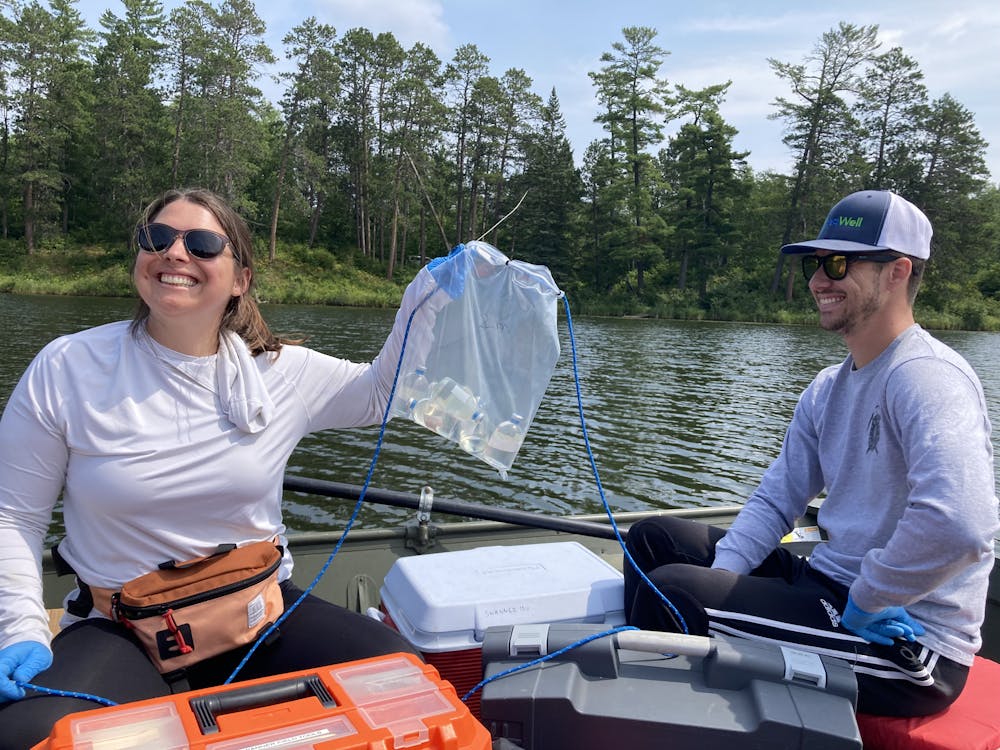
woman holds a clear plastic bag aloft, she and man are seated in boat
Graduate students Michelle Chamberlain and Zackry Stevenson about to sink the bottles for incubation in Deming Lake. Elizabeth Swanner, CC BY-ND

That afternoon, we’re back on the lake. We toss an anchor; attached to its rope is a clear plastic bag holding the sealed bottles of lake water now amended with the isotopic tracer. They’ll spend the night in the chlorophyll-rich layer, and we’ll retrieve them after 24 hours. Any longer than that and the isotopic label might end up in the bacteria that eat the dying cyanobacteria instead of the cyanobacteria themselves. We tie off the rope to a floating buoy and head back to the station’s dining hall for our evening meal.

Iron, chlorophyll, oxygen

The next morning, as we wait for the bottles to finish their incubation, we collect water from the different layers of the lake and add some chemicals that kill the cells but preserve their bodies. We’ll look at these samples under the microscope to figure out how many cyanobacteria are in the water, and we’ll measure how much iron is inside the cyanobacteria.

That’s easier said than done, because we have to first separate all the “needles” (cyanobacteria) from the “hay” (other cells) and then clean any iron off the outside of the cyanobacteria. Back at Iowa State University, we’ll shoot the individual cells one by one into a flame that incinerates them, which liberates all the iron they contain so we can measure it.

rowboat with one woman in it on a lake with woodsy shoreline
Biogeochemist Katy Sparrow rows a research vessel to shore. Elizabeth Swanner, CC BY-ND

Our scientific hunch, or hypothesis, is that the cyanobacteria that live in the chlorophyll- and iron-rich layer will contain more iron than cyanobacteria that live in the top lake layer. If they do, it will help us establish that greater access to iron is a motive for living in that deeper and dimmer layer.

These experiments won’t tell the whole story of why it took so long for Earth to build up oxygen, but they will help us to understand a piece of it – where oxygen might have been produced and why, and what happened to oxygen in that environment.

Deming Lake is quickly becoming its own attraction for those with a curiosity about what goes on beneath its tranquil surface – and what that might be able to tell us about how new forms of life took hold long ago on Earth.

Elizabeth Swanner, Associate Professor of Geology, Iowa State University

This article is republished from The Conversation under a Creative Commons license. Read the original article.

ooOOoo

Nothing I can add to this very erudite article. Please read it and be fascinated by the findings.

Keeping healthy in old age.

One has to work at it!

For most of us these days old age is part of the scene (and I am classifying old age as being over 70 years). Here are a few facts from the website of the World Health Organization.

Key facts

  • Worldwide obesity has nearly tripled since 1975.
  • In 2016, more than 1.9 billion adults, 18 years and older, were overweight. Of these over 650 million were obese.
  • 39% of adults aged 18 years and over were overweight in 2016, and 13% were obese.
  • Most of the world’s population live in countries where overweight and obesity kills more people than underweight.
  • 39 million children under the age of 5 were overweight or obese in 2020.
  • Over 340 million children and adolescents aged 5-19 were overweight or obese in 2016.
  • Obesity is preventable.

What are obesity and overweight Overweight and obesity are defined as abnormal or excessive fat accumulation that may impair health.

Body mass index (BMI) is a simple index of weight-for-height that is commonly used to classify overweight and obesity in adults. It is defined as a person’s weight in kilograms divided by the square of his height in meters (kg/m2).

Adults

For adults, WHO defines overweight and obesity as follows:

  • overweight is a BMI greater than or equal to 25; and
  • obesity is a BMI greater than or equal to 30.

BMI provides the most useful population-level measure of overweight and obesity as it is the same for both sexes and for all ages of adults. However, it should be considered a rough guide because it may not correspond to the same degree of fatness in different individuals.

World Health Organisation

This is the link for anyone who wants to use the BMI Calculator.

Now this is not a post about obesity or being overweight. It is a post taken from The Conversation about staying as healthy as one can in one’s older years.

ooOOoo

Steep physical decline with age is not inevitable – here’s how strength training can change the trajectory

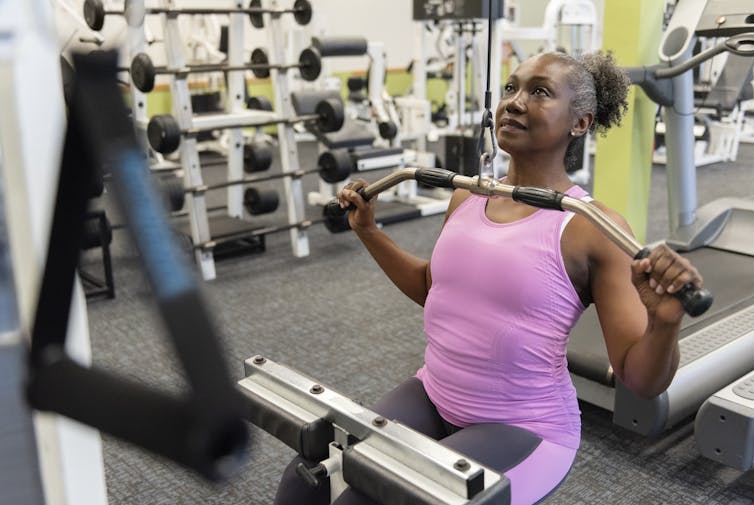
Resistance training can take many forms and can be individualized to suit a person’s needs as they age. Jamie Grill/Tetra Images via Getty Images

Zachary Gillen, Mississippi State University

Raise your hand if you regularly find yourself walking up a flight of stairs. What about carrying heavy bags of groceries? How about picking up your child or grandchild? Most of us would raise our hands to doing at least one of those weekly, or even daily.

As people age, it can become more and more difficult to perform some physical tasks, even those that are normal activities of daily living. However, prioritizing physical fitness and health as you get older can help you go through your normal day-to-day routine without feeling physically exhausted at the end of the day.

It can also help you continue to have special memories with your family and loved ones that you might not have been able to have if you weren’t physically active. For example, I ran two half-marathons with my dad when he was in his 60s!

I am an exercise physiologist who studies how people can use resistance training to improve human performance, whether it be in sports and other recreational settings, in everyday life, or both. I am also a certified strength and conditioning specialist. My career has given me the opportunity to design exercise programs for kids, college athletes and elderly adults.

Staying physically active as you get older doesn’t need to include running a half-marathon or trying to be a bodybuilder; it could be as simple as trying to get through the day without feeling winded after you go up a flight of stairs. Although our muscles naturally get weaker as we age, there are ways we can combat that to help improve quality of life as we get older.

Man in his 60s, a middle-aged woman and a middle-aged man, all wearing race medals and running gear.
From left are the author’s father, who was age 61 at the time, the author’s wife and the author after completing the Lincoln Half Marathon. Zachary Gillen, CC BY-NC-ND

Muscle loss and chronic disease

One of the most important parts of exercise programming, no matter who I am working with, is proper resistance training to build muscle strength. Some amount of age-related loss of muscle function is normal and inevitable. But by incorporating resistance training that is appropriate and safe at any ability level, you can slow down the rate of decline and even prevent some loss of muscle function.

The medical term for a condition that involves age-related loss of muscle function and mass is sarcopenia. Sarcopenia can begin as early as age 40, but it tends to be more common in adults age 60 and older. Sarcopenia is associated with a number of health issues such as increased risk of falling, cardiovascular disease and metabolic disease, among others.

In one of our team’s previous studies, we saw that otherwise healthy individuals with sarcopenia had issues delivering vital nutrients to muscle. This could lead to greater likelihood of various diseases, such as Type 2 diabetes, and slow down recovery from exercise.

Recent estimates suggest that sarcopenia affects 10% to 16% of the elderly population worldwide. But even if a person doesn’t have clinically diagnosed sarcopenia, they may still have some of the underlying symptoms that, if not dealt with, could lead to sarcopenia.

Strength training is key

So the question is, what can be done to reverse this decline?

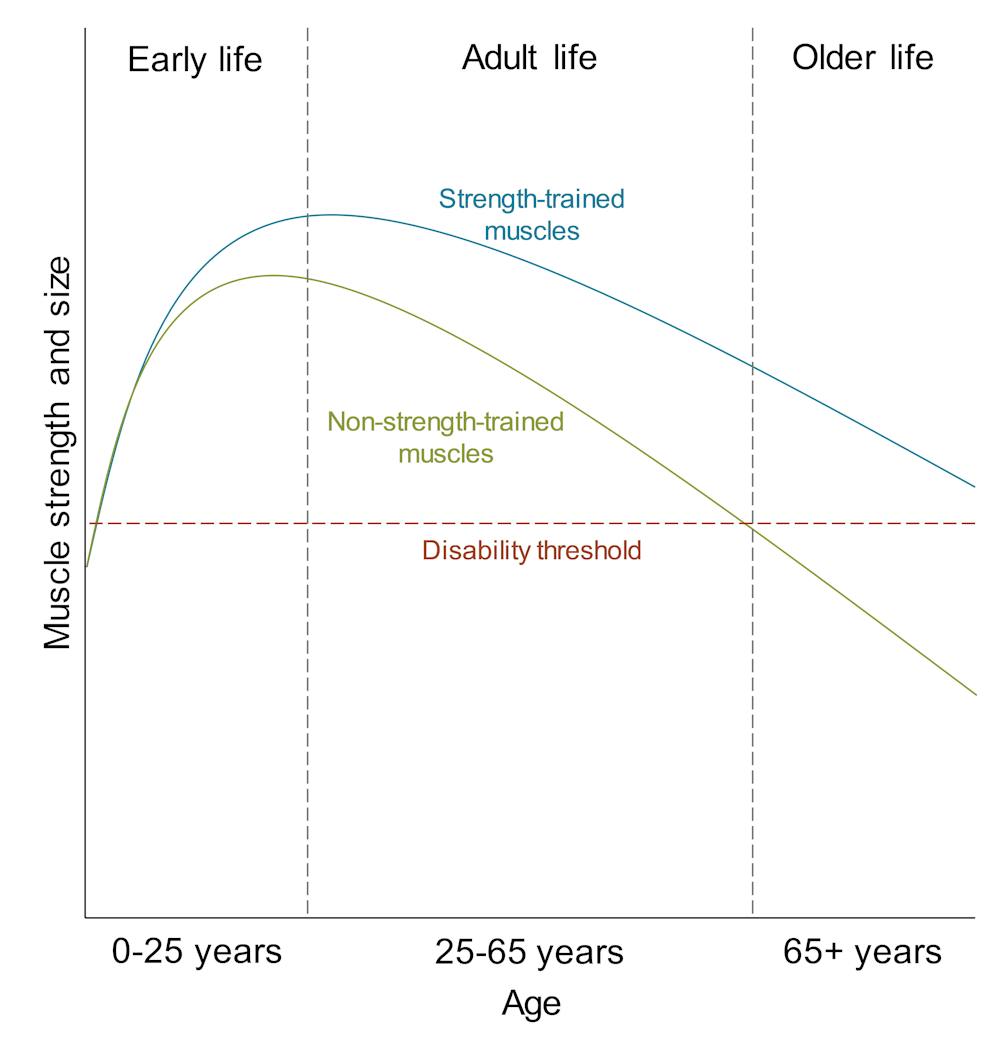
Recent evidence suggests that one of the key factors leading to sarcopenia is low muscle strength. In other words, combating or reversing sarcopenia, or both, may be best done with a proper resistance-training program that prioritizes improving strength. In fact, the decline in muscle strength seems to occur at a much faster rate than the decline in muscle size, underscoring the importance of proper strength training as people age.

Chart showing the general pattern for changes in muscle strength and size across stage of life.
Typical age-related changes in muscle strength and size with and without strength training. Zachary Gillen

Continuing to regularly strength train with moderate to heavy weights has been shown to be not only effective at combating the symptoms of sarcopenia but also very safe when done properly. The best way to make sure you are strength training properly is to seek out guidance from a qualified individual such as a personal trainer or strength and conditioning specialist.

Despite the clear benefits of strength training, it’s been shown that only about 13% of Americans age 50 and older do some form of strength training at least twice a week.

Finding what works for you

So how does a person properly strength train as they age?

The National Strength and Conditioning Association, a leading organization in advancing strength and conditioning around the world, states that for older adults, two to three days per week of strength training can be incredibly helpful for maintaining healthy muscle and bone and combating a number of chronic conditions.

The organization recommends that these workouts involve one to two exercises involving multiple joints per major muscle group, with six to 12 repetitions per set. These are done at an intensity of 50% to 85% of what’s known as one-repetition maximum – the most weight you could handle for a single repetition – with the exception of body weight exercises that use one’s own body weight as the resistance, such as pushups.

I would also recommend resting for about two to three minutes between sets, or even up to five minutes if the set was challenging. For older adults, particularly those age 60 and older, the National Strength and Conditioning Association guidelines suggest that a program like this be performed two to three days per week, with 24 to 48 hours between sessions.

An example of a strength training routine for older adults based on the National Strength and Conditioning Association guidelines

There are a great variety of exercises that could be done interchangeably in a strength training program like this.

ExerciseNumber of setsRepetitions per setIntensity
Barbell squat3670-85%
Barbell bench press3670-85%
Dumbbell lunges38 per leg50-70%
Dumbbell bent over row31050-70%
Double-leg hops212Body weight
Pushups212Body weight

Table: The Conversation Source: Zachary Gillen Get the data Created with Datawrapper

Making life’s tasks lighter

The guidelines above are only one example out of many options, but they provide a framework that you can use to build your own program. However, I would highly recommend seeking out a professional in the field to give specific exercise programming advice that can be tailored to your own needs and goals as you age.

Following such a program would give your muscles an excellent stimulus to enhance strength, while also allowing enough recovery, a very important consideration as people age. You might think it looks like a huge time commitment, but an exercise routine like this can be done in less than an hour. This means that in less than three hours of strength training per week you can help improve your muscle health and reduce the risk of getting sarcopenia and associated health issues.

It’s also important to note that there is no one right way to do resistance training, and it needn’t involve traditional weight equipment. Group classes like Pilates and yoga or those that involve circuit training and work with resistance bands can all produce similar results. The key is to get out and exercise regularly, whatever that entails.

Zachary Gillen, Assistant Professor of Exercise Physiology, Mississippi State University

This article is republished from The Conversation under a Creative Commons license. Read the original article.

ooOOoo

My wife, Jean, was diagnosed with Parkinson’s Disease (PD) in December, 2015. Many of you know that.

Fortunately at our local Club Northwest there was a group of PD sufferers who twice a week held a ‘Rock Steady Class’ under the instruction of a professional coach; Jean joined the group. It was a brilliant move for Jean and she gets a huge amount of care from being with them.

Luckily for me having to drive Jean into Club Northwest it made sense for me to sign up to a fitness class at the same time so I am put through a regular fitness routine under the coaching of Bruce. Plus I try and go bike riding three times a week.

In other words, we both try and stay as fit as we can.

The brain

A fascinating account

I was struggling with the post for tomorrow and then saw this article on The Conversation. It may not be everyone’s cup of tea but nevertheless I find it sufficiently interesting to publish it.

ooOOoo

Psychedelics plus psychotherapy can trigger rapid changes in the brain − new research at the level of neurons is untangling how

New research hints at how psychedelics can trigger rapid, lasting change. wildpixel/iStock via Getty Images Plus

Edmund S. Higgins, Medical University of South Carolina

The human brain can change – but usually only slowly and with great effort, such as when learning a new sport or foreign language, or recovering from a stroke. Learning new skills correlates with changes in the brain, as evidenced by neuroscience research with animals and functional brain scans in people. Presumably, if you master Calculus 1, something is now different in your brain. Furthermore, motor neurons in the brain expand and contract depending on how often they are exercised – a neuronal reflection of “use it or lose it.”

People may wish their brains could change faster – not just when learning new skills, but also when overcoming problems like anxiety, depression and addictions.

Clinicians and scientists know there are times the brain can make rapid, enduring changes. Most often, these occur in the context of traumatic experiences, leaving an indelible imprint on the brain.

But positive experiences, which alter one’s life for the better, can occur equally as fast. Think of a spiritual awakening, a near-death experience or a feeling of awe in nature.

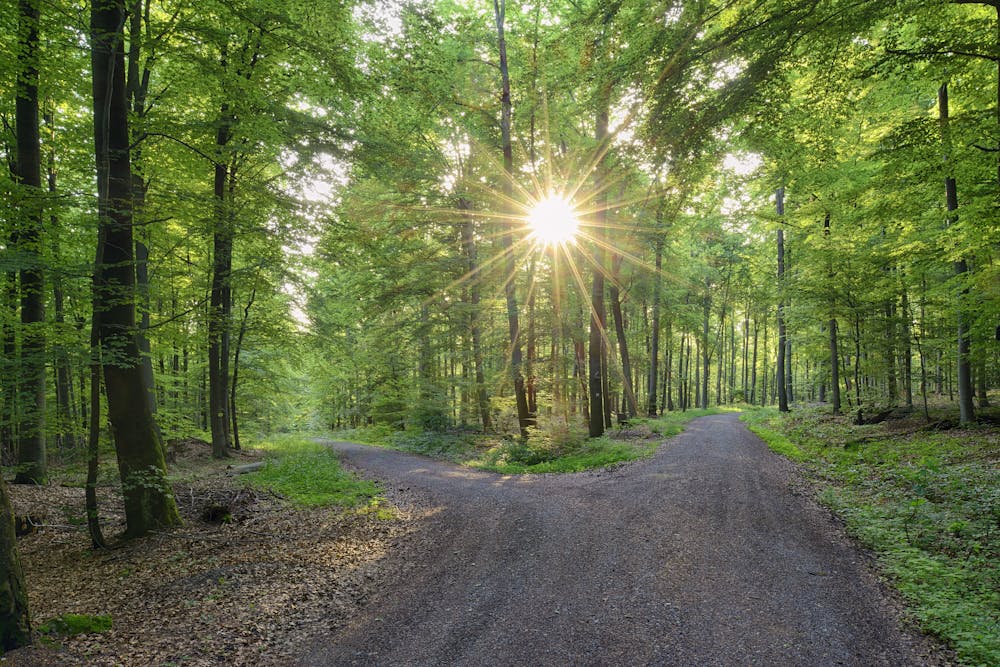
a road splits in the woods, sun shines through green leafy trees
A transformative experience can be like a fork in the road, changing the path you are on. Westend61 via Getty Images

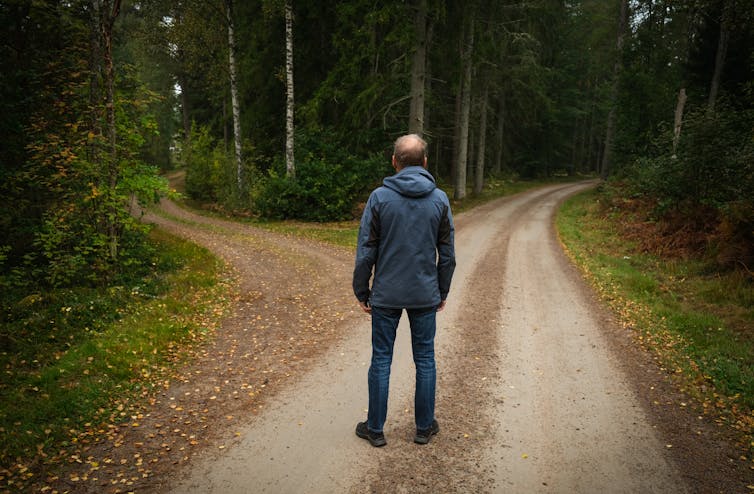
Social scientists call events like these psychologically transformative experiences or pivotal mental states. For the rest of us, they’re forks in the road. Presumably, these positive experiences quickly change some “wiring” in the brain.

How do these rapid, positive transformations happen? It seems the brain has a way to facilitate accelerated change. And here’s where it gets really interesting: Psychedelic-assisted psychotherapy appears to tap into this natural neural mechanism.

Psychedelic-assisted psychotherapy

Those who’ve had a psychedelic experience usually describe it as a mental journey that’s impossible to put into words. However, it can be conceptualized as an altered state of consciousness with distortions of perception, modified sense of self and rapidly changing emotions. Presumably there is a relaxation of the higher brain control, which allows deeper brain thoughts and feelings to emerge into conscious awareness.

Psychedelic-assisted psychotherapy combines the psychology of talk therapy with the power of a psychedelic experience. Researchers have described cases in which subjects report profound, personally transformative experiences after one six-hour session with the psychedelic substance psilocybin, taken in conjunction with psychotherapy. For example, patients distressed about advancing cancer have quickly experienced relief and an unexpected acceptance of the approaching end. How does this happen?

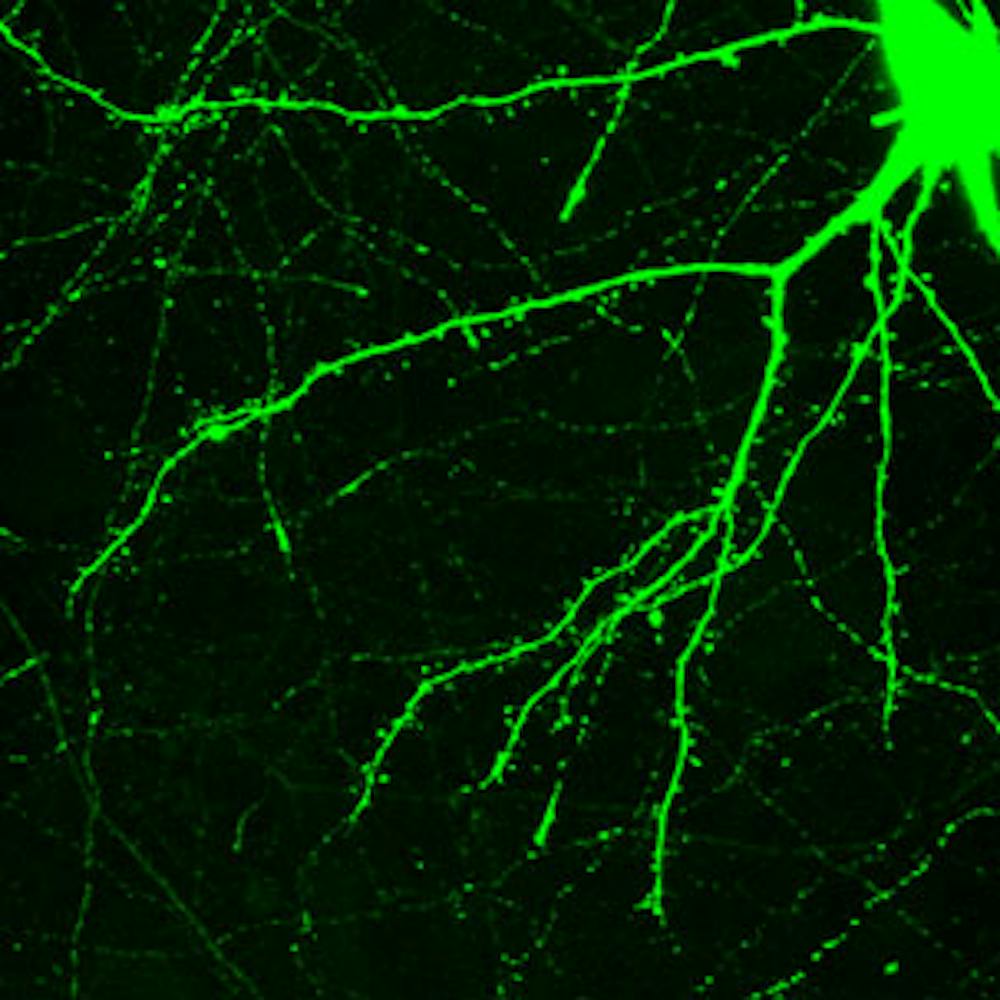
glowing green tendrils of a neuron against a black background
Neuronal spines are the little bumps along the spreading branches of a neuron. Patrick Pla via Wikimedia Commons, CC BY-SA

Research suggests that new skills, memories and attitudes are encoded in the brain by new connections between neurons – sort of like branches of trees growing toward each other. Neuroscientists even call the pattern of growth arborization.

Researchers using a technique called two-photon microscopy can observe this process in living cells by following the formation and regression of spines on the neurons. The spines are one half of the synapses that allow for communication between one neuron and another.

Scientists have thought that enduring spine formation could be established only with focused, repetitive mental energy. However, a lab at Yale recently documented rapid spine formation in the frontal cortex of mice after one dose of psilocybin. Researchers found that mice given the mushroom-derived drug had about a 10% increase in spine formation. These changes had occurred when examined one day after treatment and endured for over a month.

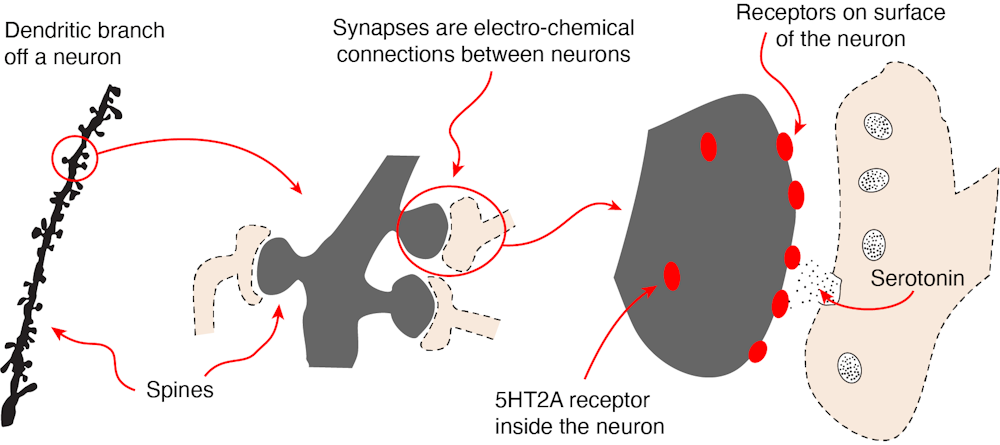
diagram of little bumps along a neuron, enlarged at different scales
Tiny spines along a neuron’s branches are a crucial part of how one neuron receives a message from another. Edmund S. Higgins

A mechanism for psychedelic-induced change

Psychoactive molecules primarily change brain function through the receptors on the neural cells. The serotonin receptor 5HT, the one famously tweaked by antidepressants, comes in a variety of subtypes. Psychedelics such as DMT, the active chemical in the plant-based psychedelic ayahuasca, stimulate a receptor cell type, called 5-HT2A. This receptor also appears to mediate the hyperplastic states when a brain is changing quickly.

These 5-HT2A receptors that DMT activates are not only on the neuron cell surface but also inside the neuron. It’s only the 5-HT2A receptor inside the cell that facilitates rapid change in neuronal structure. Serotonin can’t get through the cell membrane, which is why people don’t hallucinate when taking antidepressants like Prozac or Zoloft. The psychedelics, on the other hand, slip through the cell’s exterior and tweak the 5-HT2A receptor, stimulating dendritic growth and increased spine formation.

Here’s where this story all comes together. In addition to being the active ingredient in ayahuasca, DMT is an endogenous molecule synthesized naturally in mammalian brains. As such, human neurons are capable of producing their own “psychedelic” molecule, although likely in tiny quantities. It’s possible the brain uses its own endogenous DMT as a tool for change – as when forming dendritic spines on neurons – to encode pivotal mental states. And it’s possible psychedelic-assisted psychotherapy uses this naturally occurring neural mechanism to facilitate healing.

A word of caution

In her essay collection “These Precious Days,” author Ann Patchett describes taking mushrooms with a friend who was struggling with pancreatic cancer. The friend had a mystical experience and came away feeling deeper connections to her family and friends. Patchett, on the other hand, said she spent eight hours “hacking up snakes in some pitch-black cauldron of lava at the center of the Earth.” It felt like death to her.

Psychedelics are powerful, and none of the classic psychedelic drugs, such as LSD, are approved yet for treatment. The U.S. Food and Drug Administration in 2019 did approve ketamine, in conjunction with an antidepressant, to treat depression in adults. Psychedelic-assisted psychotherapy with MDMA (often called ecstasy or molly) for PTSD and psilocybin for depression are in Phase 3 trials.

Edmund S. Higgins, Affiliate Associate Professor of Psychiatry & Family Medicine, Medical University of South Carolina

This article is republished from The Conversation under a Creative Commons license. Read the original article.

ooOOoo

This is not for the innocents and it requires someone of the ilk of Professor Higgins to advise.

Plus one needs to stay close to the U.S. Food and Drug Administration. To close, I will repeat the phrase above, psychedelics are powerful.

Dogs and scents

A fascinating article about our unique body odour.

I was researching stories that I could republish and was concentrating at first on The Conversation. Then I saw the post for today and went no further. It is primarily about the odour that each of us has.

ooOOoo

Your unique body odor could identify who you are and provide insights into your health – all from the touch of a hand

The scent emitted from your hands could offer clues about who you are. Siro Rodenas Cortes/Moment via Getty Images

Chantrell Frazier, Framingham State University; Kenneth G. Furton, Florida International University, and Vidia A. Gokool, Lawrence Livermore National Laboratory

From the aroma of fresh-cut grass to the smell of a loved one, you encounter scents in every part of your life. Not only are you constantly surrounded by odor, you’re also producing it. And it is so distinctive that it can be used to tell you apart from everyone around you.

Your scent is a complex product influenced by many factors, including your genetics. Researchers believe that a particular group of genes, the major histocompatibility complex, play a large role in scent production. These genes are involved in the body’s immune response and are believed to influence body odor by encoding the production of specific proteins and chemicals.

But your scent isn’t fixed once your body produces it. As sweat, oils and other secretions make it to the surface of your skin, microbes break down and transform these compounds, changing and adding to the odors that make up your scent. This scent medley emanates from your body and settles into the environments around you. And it can be used to track, locate or identify a particular person, as well as distinguish between healthy and unhealthy people.

We are researchers who specialize in studying human scent through the detection and characterization of gaseous chemicals called volatile organic compounds. These gases can relay an abundance of information for both forensic researchers and health care providers.

Science of body odor

When you are near another person, you can feel their body heat without touching them. You may even be able to smell them without getting very close. The natural warmth of the human body creates a temperature differential with the air around it. You warm up the air nearest to you, while air that’s farther away remains cool, creating warm currents of air that surround your body.

Researchers believe that this plume of air helps disperse your scent by pushing the millions of skin cells you shed over the course of a day off your body and into the environment. These skin cells act as boats or rafts carrying glandular secretions and your resident microbes – a combination of ingredients that emit your scent – and depositing them in your surroundings.

Your scent is composed of the volatile organic compounds present in the gases emitted from your skin. These gases are the combination of sweat, oils and trace elements exuded from the glands in your skin. The primary components of your odor depend on internal factors such as your race, ethnicity, biological sex and other traits. Secondary components waver based on factors like stress, diet and illness. And tertiary components from external sources like perfumes and soaps build on top of your distinguishable odor profile.

Identity of scent

With so many factors influencing the scent of any given person, your body odor can be used as an identifying feature. Scent detection canines searching for a suspect can look past all the other odors they encounter to follow a scent trail left behind by the person they are pursuing. This practice relies on the assumption that each person’s scent is distinct enough that it can be distinguished from other people’s.

Researchers have been studying the discriminating potential of human scent for over three decades. A 1988 experiment demonstrated that a dog could distinguish identical twins living apart and exposed to different environmental conditions by their scent alone. This is a feat that could not be accomplished using DNA evidence, as identical twins share the same genetic code.

The field of human scent analysis has expanded over the years to further study the composition of human scent and how it can be used as a form of forensic evidence. Researchers have seen differences in human odor composition that can be classified based on sex, gender, race and ethnicity. Our research team’s 2017 study of 105 participants found that specific combinations of 15 volatile organic compounds collected from people’s hands could distinguish between race and ethnicity with an accuracy of 72% for whites, 82% for East Asians and 67% for Hispanics. Based on a combination of 13 compounds, participants could be distinguished as male or female with an overall 80% accuracy.

Researchers have trained dogs to sniff out COVID-19 infections.

Researchers are also producing models to predict the characteristics of a person based on their scent. From a sample pool of 30 women and 30 men, our team built a machine learning model that could predict a person’s biological sex with 96% accuracy based on hand odor.

Scent of health

Odor research continues to provide insights into illnesses. Well-known examples of using scent in medical assessments include seizure and diabetic alert canines. These dogs can give their handlers time to prepare for an impending seizure or notify them when they need to adjust their blood glucose levels.

While these canines often work with a single patient known to have a condition that requires close monitoring, medical detection dogs can also indicate whether someone is ill. For example, researchers have shown that dogs can be trained to detect cancer in people. Canines have also been trained to detect COVID-19 infections at a 90% accuracy rate.

Similarly, our research team found that a laboratory analysis of hand odor samples could discriminate between people who are COVID-19 positive or negative with 75% accuracy.

Forensics of scent

Human scent offers a noninvasive method to collect samples. While direct contact with a surface like touching a doorknob or wearing a sweater provides a clear route for your scent to transfer to that surface, simply standing still will also transfer your odor into the surrounding area.

Although human scent has the potential to be a critical form of forensic evidence, it is still a developing field. Imagine a law enforcement officer collecting a scent sample from a crime scene in hopes that it may match with a suspect.

Further research into human scent analysis can help fill the gaps in our understanding of the individuality of human scent and how to apply this information in forensic and biomedical labs.

Chantrell Frazier, Assistant Professor of Chemistry and Food Science, Framingham State University; Kenneth G. Furton, Professor of Chemistry and Biochemistry, Florida International University, and Vidia A. Gokool, Postdoctoral Researcher, Lawrence Livermore National Laboratory

This article is republished from The Conversation under a Creative Commons license. Read the original article.

ooOOoo

This is so interesting and I, for one, learnt a great deal more about the human body and in particular the scent glands.

Plus, it was a joy to read about the role of canines in all of this.

An insight into religious leaders who do not have a religion.

I would not have believed this had I not read it with my own eyes.

I have been an atheist all my life. My mother and father were all those years ago when being an atheist was not something one promoted.

But a recent article from The Conversation told a very surprising account: “These spiritual caregivers can be found working in hospitals, universities, prisons and many other secular settings, serving people of all faiths and those with no faith tradition at all.

Here’s the full article.

ooOOoo

Religious leaders without religion: How humanist, atheist and spiritual-but-not-religious chaplains tend to patients’ needs

Chaplains talk with anyone, regardless of whether or not the patient has a religious affiliation – and some chaplains themselves are not religious. Jacob Wackerhausen/iStock via Getty Images Plus

Amy Lawton, Brandeis University

Published: September 7th, 2023

In times of loss, change or other challenges, chaplains can listen, provide comfort and discuss spiritual needs. These spiritual caregivers can be found working in hospitals, universities, prisons and many other secular settings, serving people of all faiths and those with no faith tradition at all.

Yet a common assumption is that chaplains themselves must be grounded in a religious tradition. After all, how can you be a religious leader without religion?

In reality, a growing number of chaplains are nonreligious: people who identify as atheist, agnostic, humanist or “spiritual but not religious.” I am a sociologist and research manager at Brandeis University’s Chaplaincy Innovation Lab, where our team researches and supports chaplains of all faiths, including those from nonreligious backgrounds. Our current research has focused on learning from 21 nonreligious chaplains about their experiences.

A changing society

Thirty percent of Americans are religiously unaffiliated. Research suggests that people who are atheists or otherwise nonreligious sometimes reject a chaplain out of wariness, or shut down a conversation if they feel judged for their beliefs. But this research has not accounted for a new, increasingly likely situation – that the chaplain might also be nonreligious.

No national survey has been done, so the number of nonreligious chaplains is unknown. But there is plenty of reason to think that as more Americans choose not to affiliate with any particular religion, so too do more chaplains.

Nonreligious chaplains have been a part of hospital systems and universities for years, but they came into the national spotlight in August 2021 when Harvard University’s organization of chaplains unanimously elected humanist and atheist Greg Epstein as president. Humanists believe in the potential and goodness of human beings without reference to the supernatural.

Other recent reporting on humanist chaplains has also focused on school campuses, but nonreligious chaplains are not limited to colleges and universities. Eighteen of the 21 nonreligious chaplains we spoke with in our study work in health care, including hospice. The Federal Bureau of Prisons allows nonreligious chaplains, but we were unable to find any of them to participate in the current study.

A middle-aged man and woman seated in a row of chairs turn around to talk with a handful of college-age kids.
Humanist chaplain Bart Campolo, center, and his wife, Marty, right, mingle with students at the University of Southern California in 2015. AP Photo/Jae C. Hong

Not all settings allow nonreligious chaplains, however, including the U.S. military.

Authentic calling

The idea of a “call” from God is central to many religious vocations: a strong impulse toward religious leadership, which many people attribute to the divine.

Chaplains who are atheists, agnostics, humanists or who consider themselves spiritual but not religious also can feel called. But they do not believe that their calls come from a deity.

Joe, for example, an atheist and a humanist whom we interviewed, has worked as a chaplain in hospitals and hospices. He says that his “light bulb moment” came after a history professor told him that beliefs are the source of a community’s power. While atheists do not believe in God or gods, many do have strong beliefs about ethics and morality, and American atheists are more likely than American Christians to say they often feel a sense of wonder about the universe. Joe’s call was not “from a divine source,” but nonetheless, he says this experience “kind of filled me with a sense of control, and confidence, and presence” in his life that grounded his sense of a calling.

Sunil, another chaplain our team interviewed, was inspired by his college chaplain, whom he calls “a really influential presence.” The chaplain helped Sunil answer questions about identity and values without “necessarily having any religious or spiritual leanings to it,” and encouraged him to go to divinity school.

Today, Sunil tries to help others answer those same questions in his work as a health care chaplain – and to offer deeply thoughtful, meaningful spiritual care to people who aren’t religious.

Education and training

Most chaplaincy jobs require a theological degree. Along with coursework in sacred scriptures and religious leadership, chaplaincy training usually involves clinical pastoral education, where students learn about hands-on, care-oriented aspects of their profession. This involves learning to provide care to everyone, regardless of their religious background.

Although coursework is broadly the same for all students, religious or nonreligious, the actual experience of earning a degree is very different for nonreligious students. In the United States, Christian students are easily able to enroll in a seminary or divinity school that shares their faith identity and spend their years of study learning about their own tradition.

Chaplaincy programs that focus on non-Christian traditions are available, but scarcer, and our team does not know of an overtly nonreligious chaplaincy program. In recent years, more seminaries have welcomed nonreligious students, but nonetheless, nonreligious students often find themselves focusing their study on traditions to which they have no personal connection.

Yet there is a surprising bright side.

‘I am here to support you’

Being deeply immersed in traditions that are not one’s own is one of the reasons that nonreligious chaplains can be so effective.

A poster that says 'We are with you,' with an illustration of someone sitting in scrubs as dozens of ghostly figures hold them.
Artwork posted by a chaplain in a break room in the trauma surgery ICU at Harborview Medical Center in Seattle. David Ryder/Getty Images

For example, our team asked Kathy, a health care chaplain, how she approaches prayer with religious and nonreligious patients. “My goal is to try to meet that person where they are and pray in a way that’s helpful and comforting for them, or meets whatever the need is that’s arisen during the conversation that we’ve had,” she said. Like all chaplains, Kathy is there to accompany, not proselytize. While she herself prays to the “great mystery,” she is comfortable facilitating whatever prayer is needed.

Claire, a chaplaincy student, agreed with Kathy and described her own first experience meeting an evangelical Christian patient. It was easy, she said, because “you’re not trying to fix anything. You’re just trying to meet them where they are. So that’s it.”

Nonreligious chaplains are used to thinking outside the box. Having learned about major world religions, many of them can find overlapping values and beliefs with their patients, such as finding beauty and meaning in the natural world or finding strength in their conviction that human beings are inherently good.

Cynthia works in the palliative care department in a hospital and tells her patients, “I am here to support you in whatever is meaningful to you right now and whatever is most important in your life in this moment.” She asks patients: “What are you struggling with right now? What are your goals? What do you hope for? What are you afraid of?” – trying to “unpack that with a spiritual lens rather than a medical lens.”

Cynthia is an example of why spiritual care by nonreligious chaplains may be surprising, but is likely here to stay. Based on our research, nonreligious chaplains are as capable as religious chaplains of meeting a person in their darkest hour and taking them by the hand.

Amy Lawton, Research Manager, Chaplaincy Innovation Lab, Brandeis University

This article is republished from The Conversation under a Creative Commons license. Read the original article.

ooOOoo

That last sentence may be opened up even more. In that the article speaks of chaplains, both religious and nonreligious. But as someone who was a counsellor with the Prince’s Youth Business Trust some years ago, now The Prince’s Trust, it is my opinion that anyone who is an active listener can undertake the role.

The article has many fine points including one that I had not considered before. “That American atheists are more likely than American Christians to say they often feel a sense of wonder about the universe.” I am certain that this isn’t confined to Americans.

Dogs learn things in a way we may not realise.

A fascinating article in The Conversation.

I was very short of time yesterday so my apologies for going straight into this post. Plus, it is a post that talks about the learning process for dogs and, as such, looking more thoroughly will discover more material.

ooOOoo

Canines go to college in this class that seeks to give shelter dogs a fresh start

By Shlomit Flaisher-Grinberg

Associate Professor of Psychology, Saint Francis University

Published August 24th, 2023

Shelter animals often display problematic behaviors. Can they be retrained? Shlomit Flaisher-Grinberg

What prompted the idea for the course?

When I was growing up, my love for animals led me to volunteer at animal shelters. But it wasn’t until I started teaching psychology that I found another way to support the well-being of shelter animals. During my first year of teaching a psychology course about learning, I realized that the course’s content could be used to train shelter dogs.

Since some shelter dogs display problematic behaviors, such as fearfulness, destructiveness and disobedience, they are less likely to get adopted. I wanted my students to use their knowledge, passion and care to train shelter dogs and improve their chances of finding a permanent home.

What does the course explore?

The course teaches students how to apply behavioral analysis and modification techniques toward the training of shelter dogs. Students work with dogs on learning to follow cues such as “sit,” “down,” “stay” and “come”; perform tricks such as “high-five,” and “roll over”; and complete agility courses made of tunnels, hoops and weaving poles.

The course also explores the emotional, psychological and physiological benefits of the human-animal bond, such as reduced stress, by integrating the dogs into educational and therapeutic environments. For instance, the students train the dogs to sit by them calmly for the entire duration of a lecture. This skill may be important for future adopters who work within an educational setting or need their dog to accompany them into the classroom.

The students also train the dogs to visit our clinical educational facility, the Experiential Learning Commons, which was built as a mock hospital. Within our simulated emergency room, intensive care room, patient room, maternity room and exam room, students train the dogs to walk next to simulated patients’ wheelchairs, sit by patients’ beds and provide them with affectionate and nurturing companionship.

Finally, the course instructs students on how to apply for grants for nonprofits, with the idea being to secure funding to support animal shelters.

Why is this course relevant now?

This course creates a collaborative and reciprocal partnership between a university and the community in which it is located. Focusing on the care for shelter dogs, it allows for faculty, students and a shelter’s staff and volunteers to exchange knowledge and resources. As such, it uses an instructional approach known as community engagement.

What’s a critical lesson from the course?

Working alongside our animal shelter community partners, and under the direction of my co-instructor, talented dog trainer Megan Mills, students learn that they can make a true and visible impact on society, one dog at a time.

What materials does the course feature?

Michael Domjan’s “The Principles of Learning and Behavior

Cynthia K. Chandler’s “Animal-Assisted Therapy in Counseling

Handbook on Animal-Assisted Therapy,” edited by Aubrey H. Fine

What will the course prepare students to do?

Students will learn to use psychological learning principles to work effectively with shelter dogs – and this knowledge can later be translated to other domains of their lives. I believe that by training shelter dogs and learning to write nonprofit grant proposals, my students will develop into ethical and responsible citizens – both locally and globally.

Shlomit Flaisher-Grinberg, Associate Professor of Psychology, Saint Francis University

This article is republished from The Conversation under a Creative Commons license. Read the original article.

ooOOoo

Further to my introduction I want to explore the links in the article for I’m sure they have a great deal more to say about dogs.

The more that we explore what dogs mean to us humans the more I find out about the incredible qualities of Canis familiaris or Canis lupus familiaris.

These Heat Waves?

What is the truth?

Today, August 14th, here in Southern Oregon we are expecting 111 degrees Fahrenheit or 43.8 degrees C. That is really hot! (And at home it reached 108 deg. F. at 3pm.)

So it seems pertinent to republish a post from The Conversation that was published on July 21st, 2023.

ooOOoo

Is it really hotter now than any time in 100,000 years?

By Darrell Kaufman

Professor of Earth and Environmental Sciences, Northern Arizona University

As scorching heat grips large swaths of the Earth, a lot of people are trying to put the extreme temperatures into context and asking: When was it ever this hot before?

Globally, 2023 has seen some of the hottest days in modern measurements, but what about farther back, before weather stations and satellites?

Some news outlets have reported that daily temperatures hit a 100,000-year high. 

As a paleoclimate scientist who studies temperatures of the past, I see where this claim comes from, but I cringe at the inexact headlines. While this claim may well be correct, there are no detailed temperature records extending back 100,000 years, so we don’t know for sure.

Here’s what we can confidently say about when Earth was last this hot.

This is a new climate state

Scientists concluded a few years ago that Earth had entered a new climate state not seen in more than 100,000 years. As fellow climate scientist Nick McKay and I recently discussed in a scientific journal article, that conclusion was part of a climate assessment report published by the Intergovernmental Panel on Climate Change (IPCC) in 2021.

Earth was already more than 1 degree Celsius (1.8 Fahrenheit) warmer than preindustrial times, and the levels of greenhouse gases in the atmosphere were high enough to assure temperatures would stay elevated for a long time.

Earth’s average temperature has exceeded 1 degree Celsius (1.8 F) above the preindustrial baseline. This new climate state will very likely persist for centuries as the warmest period in more than 100,000 years. The chart shows different reconstructions of temperature over time, with measured temperatures since 1850 and a projection to 2300 based on an intermediate emissions scenario. D.S. Kaufman and N.P. McKay, 2022, and published datasets, Author provided

Even under the most optimistic scenarios of the future – in which humans stop burning fossil fuels and reduce other greenhouse gas emissions – average global temperature will very likely remain at least 1 C above preindustrial temperatures, and possibly much higher, for multiple centuries.

This new climate state, characterized by a multi-century global warming level of 1 C and higher, can be reliably compared with temperature reconstructions from the very distant past.

How we estimate past temperature

To reconstruct temperatures from times before thermometers, paleoclimate scientists rely on information stored in a variety of natural archives.

The most widespread archive going back many thousands of years is at the bottom of lakes and oceans, where an assortment of biological, chemical and physical evidence offers clues to the past. These materials build up continuously over time and can be analyzed by extracting a sediment core from the lake bed or ocean floor.

University of Arizona scientist Ellie Broadman holds a sediment core from the bottom of a lake on Alaska’s Kenai Peninsula. Emily Stone

These sediment-based records are rich sources of information that have enabled paleoclimate scientists to reconstruct past global temperatures, but they have important limitations.

For one, bottom currents and burrowing organisms can mix the sediment, blurring any short-term temperature spikes. For another, the timeline for each record is not known precisely, so when multiple records are averaged together to estimate past global temperature, fine-scale fluctuations can be canceled out.

Because of this, paleoclimate scientists are reluctant to compare the long-term record of past temperature with short-term extremes.

Looking back tens of thousands of years

Earth’s average global temperature has fluctuated between glacial and interglacial conditions in cycles lasting around 100,000 years, driven largely by slow and predictable changes in Earth’s orbit with attendant changes in greenhouse gas concentrations in the atmosphere. We are currently in an interglacial period that began around 12,000 years ago as ice sheets retreated and greenhouse gases rose.

Looking at that 12,000-year interglacial period, global temperature averaged over multiple centuries might have peaked roughly around 6,000 years ago, but probably did not exceed the 1 C global warming level at that point, according to the IPCC reportAnother study found that global average temperatures continued to increase across the interglacial period. This is a topic of active research.

That means we have to look farther back to find a time that might have been as warm as today.

The last glacial episode lasted nearly 100,000 years. There is no evidence that long-term global temperatures reached the preindustrial baseline anytime during that period.

If we look even farther back, to the previous interglacial period, which peaked around 125,000 years ago, we do find evidence of warmer temperatures. The evidence suggests the long-term average temperature was probably no more than 1.5 C (2.7 F) above preindustrial levels – not much more than the current global warming level.

Now what?

Without rapid and sustained reductions in greenhouse gas emissions, the Earth is currently on course to reach temperatures of roughly 3 C (5.4 F) above preindustrial levels by the end of the century, and possibly quite a bit higher.

At that point, we would need to look back millions of years to find a climate state with temperatures as hot. That would take us back to the previous geologic epoch, the Pliocene, when the Earth’s climate was a distant relative of the one that sustained the rise of agriculture and civilization.

ooOOoo

It is difficult to know what to say other than one hopes that Governments and country leaders recognise the situation and DO SOMETHING!

As Dr. Michael Mann put it in the last issue of The Humanist: “The only obstacles aren’t the laws of physics, but the flaws in our politics.

I have a son and a daughter in their early 50’s and a grandson who is 12. They, along with millions of other younger people, need action now.

Please!

The Earth became very quiet!

An essay from The Conversation aimed at our youngsters but highly relevant to us all!

I sense we are living in very strange times. As an extract from recent essay from George Monbiot said:

Above all, our ability to adapt to massive change depends on what practitioners call “metacognition” and “meta-skills”. Metacognition means thinking about thinking. In a brilliant essay for the Journal of Academic Perspectives, Natasha Robson argues that while metacognition is implicit in current teaching – “show your working”, “justify your arguments” – it should be explicit and sustained. Schoolchildren should be taught to understand how thinking works, from neuroscience to cultural conditioning; how to observe and interrogate their thought processes; and how and why they might become vulnerable to disinformation and exploitation. Self-awareness could turn out to be the most important topic of all.

Thinking about Thinking

That is why I want to share a recent post from The Conversation with you.

ooOOoo

If humans went extinct, what would the Earth look like one year later?

A glimpse of a post-apocalyptic world. Bulgar/E+ via Getty Images

Carlton Basmajian, Iowa State University


If humans went extinct, what would the Earth look like one year later? – Essie, age 11, Michigan


Have you ever wondered what the world would be like if everyone suddenly disappeared?

What would happen to all our stuff? What would happen to our houses, our schools, our neighborhoods, our cities? Who would feed the dog? Who would cut the grass? Although it’s a common theme in movies, TV shows and books, the end of humanity is still a strange thing to think about.

But as an associate professor of urban design – that is, someone who helps towns and cities plan what their communities will look like – it’s sometimes my job to think about prospects like this.

So much silence

If humans just disappeared from the world, and you could come back to Earth to see what had happened one year later, the first thing you’d notice wouldn’t be with your eyes.

It would be with your ears.

The world would be quiet. And you would realize how much noise people make. Our buildings are noisy. Our cars are noisy. Our sky is noisy. All of that noise would stop.

You’d notice the weather. After a year without people, the sky would be bluer, the air clearer. The wind and the rain would scrub clean the surface of the Earth; all the smog and dust that humans make would be gone.

An illustration of a large city park with a deer standing in the middle of a tree-lined path.
It wouldn’t be long before wild animals visited our once well-trodden cities. Boris SV/Moment via Getty Images

Home sweet home

Imagine that first year, when your house would sit unbothered by anyone.

Go inside your house – and hope you’re not thirsty, because no water would be in your faucets. Water systems require constant pumping. If no one’s at the public water supply to manage the machines that pump water, then there’s no water.

But the water that was in the pipes when everyone disappeared would still be there when the first winter came – so on the first cold snap, the frigid air would freeze the water in the pipes and burst them.

There would be no electricity. Power plants would stop working because no one would monitor them and maintain a supply of fuel. So your house would be dark, with no lights, TV, phones or computers.

Your house would be dusty. Actually, there’s dust in the air all the time, but we don’t notice it because our air conditioning systems and heaters blow air around. And as you move through the rooms in your house, you keep dust on the move too. But once all that stops, the air inside your house would be still and the dust would settle all over.

The grass in your yard would grow – and grow and grow until it got so long and floppy it would stop growing. New weeds would appear, and they would be everywhere.

Lots of plants that you’ve never seen before would take root in your yard. Every time a tree drops a seed, a little sapling might grow. No one would be there to pull it out or cut it down.

You’d notice a lot more bugs buzzing around. Remember, people tend to do everything they can to get rid of bugs. They spray the air and the ground with bug spray. They remove bug habitat. They put screens on the windows. And if that doesn’t work, they swat them.

Without people doing all these things, the bugs would come back. They would have free rein of the world again.

Surrounded by hills and mountains is an isolated two-lane road, cracked and crumbling.
Given enough time, roads would start to crumble. Armastas/iStock via Getty Images Plus

On the street where you live

In your neighborhood, critters would wander around, looking and wondering.

First the little ones: mice, groundhogs, raccoons, skunks, foxes and beavers. That last one might surprise you, but North America was once rich with beavers.

Bigger animals would come later – deer, coyotes and the occasional bear. Not in the first year, maybe, but eventually.

With no electric lights, the rhythm of the natural world would return. The only light would be from the Sun, the Moon and the stars. The night critters would feel good they got their dark sky back.

Fires would happen frequently. Lightning might strike a tree or a field and set brush on fire, or hit the houses and buildings. Without people to put them out, those fires would keeping going until they burned themselves out.

Around your city

After just one year, the concrete stuff – roads, highways, bridges and buildings – would look about the same.

Come back, say, a decade later, and cracks in them would have appeared, with little plants wiggling up through them. This happens because the Earth is constantly moving. With this motion comes pressure, and with this pressure come cracks. Eventually, the roads would crack so much they would look like broken glass, and even trees would grow through them.

Bridges with metal legs would slowly rust. The beams and bolts that hold the bridges up would rust too. But the big concrete bridges, and the interstate highways, also concrete, would last for centuries.

The dams and levees that people have built on the rivers and streams of the world would erode. Farms would fall back to nature. The plants we eat would begin to disappear. Not much corn or potatoes or tomatoes anymore.

Farm animals would be easy prey for bears, coyotes, wolves and panthers. And pets? The cats would go feral – that is, they would become wild, though many would be preyed upon by larger animals. Most dogs wouldn’t survive, either.

An asteroid hit and a solar flare are two of the ways the world could end.

Like ancient Rome

In a thousand years, the world you remember would still be vaguely recognizable. Some things would remain; it would depend on the materials they were made of, the climate they’re in, and just plain luck. An apartment building here, a movie theater there, or a crumbling shopping mall would stand as monuments to a lost civilization. The Roman Empire collapsed more than 1,500 years ago, yet you can see some remnants even today.

If nothing else, humans’ suddenly vanishing from the world would reveal something about the way we treated the Earth. It would also show us that the world we have today can’t survive without us and that we can’t survive if we don’t care for it. To keep it working, civilization – like anything else – requires constant upkeep.


Hello, curious kids! Do you have a question you’d like an expert to answer? Ask an adult to send your question to CuriousKidsUS@theconversation.com. Please tell us your name, age and the city where you live.

And since curiosity has no age limit – adults, let us know what you’re wondering, too. We won’t be able to answer every question, but we will do our best.

Carlton Basmajian, Associate Professor of Community and Regional Planning, Urban Design, Iowa State University

This article is republished from The Conversation under a Creative Commons license. Read the original article.

ooOOoo

Returning to that George Monbiot essay and his closing paragraphs:

Meta-skills are the overarching aptitudes – such as self-development, social intelligence, openness, resilience and creativity – that help us acquire the new competencies that sudden change demands. Like metacognition, meta-skills can be taught. Unfortunately, some public bodies are trapped in the bleak and narrow instrumentalism we need to transcend. For example, after identifying empathy as a crucial meta-skill, a manual by Skills Development Scotland reports that: “Empathy has been identified as a key differentiator for business success, with companies such as Facebook, Google and Unilever being recognised as excelling in this area.” I’ve seldom read a more depressing sentence.

Schooling alone will not be enough to lead us out of the many crises and disasters we now face. Those who are adult today must take responsibility for confronting them. But it should at least lend us a torch.

Thinking about Thinking

We live in a very strange world now. One truly wonders how those who are younger will respond to the demands.

When the music stops!

One of the few things that is common to us all!

Death!

Hate to say it but it is the great leveller. Some believe in some form of afterlife but not me (nor Jeannie). But how we all get to that final state is far from being simple or straightforward.

That’s why I am republishing, with permission, a recent article in The Conversation.

ooOOoo

Aging is complicated – a biologist explains why no two people or cells age the same way, and what this means for anti-aging interventions

While some people may be older in chronological age, their biological age might be much younger. FangXiaNuo/E+ via Getty Images

Ellen Quarles, University of Michigan

Assistant Professor in Molecular, Cellular, and Developmental Biology.

You likely know someone who seems to age slowly, appearing years younger than their birth date suggests. And you likely have seen the opposite – someone whose body and mind seem much more ravaged by time than others. Why do some people seem to glide though their golden years and others physiologically struggle in midlife?

I have worked in the field of aging for all of my scientific career, and I teach the cellular and molecular biology of aging at the University of Michigan. Aging research doesn’t tend to be about finding the one cure that fixes all that may ail you in old age. Instead, the last decade or two of work points to aging as a multi-factoral process – and no single intervention can stop it all.

What is aging?

There are many different definitions of aging, but scientists generally agree upon some common features: Aging is a time-dependent process that results in increased vulnerability to disease, injury and death. This process is both intrinsic, when your own body causes new problems, and extrinsic, when environmental insults damage your tissues.

Your body is comprised of trillions of cells, and each one is not only responsible for one or more functions specific to the tissue it resides in, but must also do all the work of keeping itself alive. This includes metabolizing nutrients, getting rid of waste, exchanging signals with other cells and adapting to stress.

The trouble is that every single process and component in each of your cells can be interrupted or damaged. So your cells spend a lot of energy each day preventing, recognizing and fixing those problems.

Aging can be thought of as a gradual loss of the ability to maintain homeostasis – a state of balance among body systems – either by not being able to prevent or recognize damage and poor function, or by not adequately or rapidly fixing problems as they occur. Aging results from a combination of these issues. Decades of research has shown that nearly every cellular process becomes more impaired with age.

Repairing DNA and recycling proteins

Most research on cellular aging focuses on studying how DNA and proteins change with age. Scientists are also beginning to address the potential roles many other important biomolecules in the cell play in aging as well.

One of the cell’s chief jobs is to maintain its DNA – the instruction manual a cell’s machinery reads to produce specific proteins. DNA maintenance involves protecting against, and accurately repairing, damage to genetic material and the molecules binding to it.

Proteins are the workers of the cell. They perform chemical reactions, provide structural support, send and receive messages, hold and release energy, and much more. If the protein is damaged, the cell uses mechanisms involving special proteins that either attempt to fix the broken protein or send it off for recycling. Similar mechanisms tuck proteins out of the way or destroy them when they are no longer needed. That way, its components can be used later to build a new protein.

Aging disrupts a delicate biological network

The cross-talk between the components inside cells, cells as a whole, organs and the environment is a complex and ever-changing network of information.

When all processes involved in creating and maintaining DNA and protein function are working normally, the different compartments within a cell serving specialized roles – called organelles – can maintain the cell’s health and function. For an organ to work well, the majority of the cells that make it up need to function well. And for a whole organism to survive and thrive, all of the organs in its body need to work well.

Aging can lead to dysfunction at any of these levels, from the sub-cellular to the organismal. Maybe a gene encoding an important protein for DNA repair has become damaged, and now all of the other genes in the cell are more likely to be repaired incorrectly. Or perhaps the cell’s recycling systems are unable to degrade dysfunctional components anymore. Even the communication systems between cells, tissues and organs can become compromised, leaving the organism less able to respond to changes within the body.

Random chance can lead to a growing burden of molecular and cellular damage that is progressively less well-repaired over time. As this damage accumulates, the systems that are meant to fix it are accruing damage as well. This leads to a cycle of increasing wear and tear as cells age.

Anti-aging interventions

The interdependence of life’s cellular processes is a double-edged sword: Sufficiently damage one process, and all the other processes that interact with or depend on it become impaired. However, this interconnection also means that bolstering one highly interconnected process could improve related functions as well. In fact, this is how the most successful anti-aging interventions work.

There is no silver bullet to stop aging, but certain interventions do seem to slow aging in the laboratory. While there are ongoing clinical trials investigating different approaches in people, most existing data comes from animals like nematodes, flies, mice and nonhuman primates.

One of the best studied interventions is caloric restriction, which involves reducing the amount of calories an animal would normally eat without depriving them of necessary nutrients. An FDA-approved drug used in organ transplantation and some cancer treatments called rapamycin seems to work by using at least a subset of the same pathways that calorie restriction activates in the cell. Both affect signaling hubs that direct the cell to preserve the biomolecules it has rather than growing and building new biomolecules. Over time, this cellular version of “reduce, reuse, recycle” removes damaged components and leaves behind a higher proportion of functional components.

Other interventions include changing the levels of certain metabolites, selectively destroying senescent cells that have stopped dividing, changing the gut microbiome and behavioral modifications.

What all of these interventions have in common is that they affect core processes that are critical for cellular homeostasis, often become dysregulated or dysfunctional with age and are connected to other cellular maintenance systems. Often, these processes are the central drivers for mechanisms that protect DNA and proteins in the body.

There is no single cause of aging. No two people age the same way, and indeed, neither do any two cells. There are countless ways for your basic biology to go wrong over time, and these add up to create a unique network of aging-related factors for each person that make finding a one-size-fits-all anti-aging treatment extremely challenging.

However, researching interventions that target multiple important cellular processes simultaneously could help improve and maintain health for a greater portion of life. These advances could help people live longer lives in the process.

Ellen Quarles, Assistant Professor in Molecular, Cellular, and Developmental Biology, University of Michigan

This article is republished from The Conversation under a Creative Commons license. Read the original article.

ooOOoo

I was born in London towards the tail end of 1944. I was the product of an affair between my father and mother. I came before my younger sister, Elizabeth, born in 1948. Then my father died on December 20th, 1956 and eventually my mother remarried my stepfather but he died in 1979 and then my mother died in 2016.

Elizabeth is still alive and so is my step-sister, Eleanor. I also had two half-sisters, Rhona, Corinne, born of my father and his first wife, but they are long dead.

But my family still continue and with a bit of luck I have a few years left; I shall be 80 in November, 2024.

When the music stops it will have been a fabulous life!

And speaking of music:

Thank you, Alan!

Meditation

About keeping oneself mentally healthy.

I follow the website The Conversation and read most of their posts on a very regular basis. Back in May they published the following. It caught my eye because my own mental health is drifting downwards, or so it seems, due to age, I shall be 80 in November, 2024, plus a couple of brain bleedings that occurred in 2017 that were attended to by the Regional Trauma Center in Eugene.

I then had two sub-durnal (sp?) operations overnight before being put onto the ICU ward. The lead surgeon explained that I was within 24 hours of dying! As in if I had not gone back to hospital.

I find that difficult to realise that it was 6 years ago! Anyway, to the post published by The Conversation.

ooOOoo

Mindfulness, meditation and self-compassion – a clinical psychologist explains how these science-backed practices can improve mental health

Studies show that consistent meditation practice is key. pixdeluxe/E! via Getty Images

Rachel Goldsmith Turow, Seattle University

Mindfulness and self-compassion are now buzzwords for self-improvement. But in fact, a growing body of research shows these practices can lead to real mental health benefits. This research – ongoing, voluminous and worldwide – clearly shows how and why these two practices work.

One effective way to cultivate mindfulness and self-compassion is through meditation.

For more than 20 years, as a clinical psychologist, research scientist and educator, I taught meditation to students and clinical patients and took a deep dive into the research literature. My recent book, “The Self-Talk Workout: Six Science-Backed Strategies to Dissolve Self-Criticism and Transform the Voice in Your Head,” highlights much of that research.

I learned even more when I evaluated mental health programs and psychology classes that train participants in mindfulness and compassion-based techniques.

Defining mindfulness and self-compassion

Mindfulness means purposefully paying attention to the present moment with an attitude of interest or curiosity rather than judgment.

Self-compassion involves being kind and understanding toward yourself, even during moments of suffering or failure.

Both are associated with greater well-being.

But don’t confuse self-compassion with self-esteem or self-centeredness, or assume that it somehow lowers your standards, motivation or productivity. Instead, research shows that self-compassion is linked with greater motivation, less procrastination and better relationships.

Could mindfulness meditation be the next public health revolution?

Be patient when starting a meditation practice

I didn’t like meditation – the specific practice sessions that train mindfulness and self-compassion – the first time I tried it as a college student in the late ‘90s. I felt like a failure when my mind wandered, and I interpreted that as a sign that I couldn’t do it.

In both my own and others’ meditation practices, I’ve noticed that the beginning is often rocky and full of doubt, resistance and distraction.

But what seem like impediments can actually enhance meditation practice, because the mental work of handling them builds strength.

For the first six months I meditated, my body and mind were restless. I wanted to get up and do other tasks. But I didn’t. Eventually it became easier to notice my urges and thoughts without acting upon them. I didn’t get as upset with myself.

After about a year of consistent meditation, my mind seemed more organized and controllable; it no longer got stuck in self-critical loops. I felt a sense of kindness or friendliness toward myself in everyday moments, as well as during joyful or difficult experiences. I enjoyed ordinary activities more, such as walking or cleaning.

It took a while to understand that anytime you sit down and try to meditate, that’s meditation. It is a mental process, rather than a destination.

How meditation works on the mind

Just having a general intention to be more mindful or self-compassionate is unlikely to work.

Most programs shown to make meaningful differences involve at least seven sessions. Studies show these repeated workouts improve attention skills and decrease rumination, or repeated negative thinking.

They also lessen self-criticism, which is linked to numerous mental health difficulties, including depression, anxiety, eating disorders, self-harm and post-traumatic stress disorder.

Meditation is not just about sustaining your attention – it’s also about shifting and returning your focus after the distraction. The act of shifting and refocusing cultivates attention skills and decreases rumination.

Trying repeatedly to refrain from self-judgment during the session will train your mind to be less self-critical.

An interconnected group of brain regions called the default mode network is strikingly affected by meditation. Much of this network’s activity reflects repetitive thinking, such as a rehash of a decadeslong tension with your sister. It’s most prominent when you’re not doing much of anything. Activity of the default mode network is related to rumination, unhappiness and depression.

Research shows that just one month of meditation reduces the noise of the default mode network. The type of meditation practice doesn’t seem to matter.

https://youtu.be/rqoxYKtEWEc

Don’t be discouraged if your mind wanders as you meditate.

Establishing the formal practice

A common misconception about mindfulness is that it’s simply a way to relax or clear the mind. Rather, it means intentionally paying attention to your experiences in a nonjudgmental way.

Consider meditation the formal part of your practice – that is, setting aside a time to work on specific mindfulness and self-compassion techniques.

Cultivating mindfulness with meditation often involves focusing on paying attention to the breath. A common way to start practice is to sit in a comfortable place and bring attention to your breathing, wherever you feel it most strongly.

At some point, probably after a breath or two, your mind will wander to another thought or feeling. As soon as you notice that, you can bring your attention back to the breath and try not to judge yourself for losing focus for five to 10 minutes.

When I was just getting started meditating, I would have to redirect my attention dozens or hundreds of times in a 20-to-30-minute session. Counting 10 breaths, and then another 10, and so on, helped me link my mind to the task of paying attention to my breathing.

The most well-established technique for cultivating self-compassion is called loving-kindness meditation. To practice, you can find a comfortable position, and for at least five minutes, internally repeat phrases such as, “May I be safe. May I be happy. May I be healthy. May I live with ease.”

When your attention wanders, you can bring it back with as little self-judgment as possible and continue repeating the phrases. Then, if you like, offer the same well wishes to other people or to all beings.

Every time you return your focus to your practice without judging, you’re flexing your mental awareness, because you noticed your mind wandered. You also improve your capacity to shift attention, a valuable anti-rumination skill, and your nonjudgment, an antidote to self-criticism.

These practices work. Studies show that brain activity during meditation results in less self-judgment, depression and anxiety and results in less rumination.

Mindfulness also occurs when you tune into present-moment sensations, such as tasting your food or washing the dishes.

An ongoing routine of formal and informal practice can transform your thinking. And again, doing it once in a while won’t help as much. It’s like situps: A single situp isn’t likely to strengthen your abdominal muscles, but doing several sets each day will.

When thoughts pop up during meditation, no worries. Just start again … and again … and again.

Meditation reduces self-criticism

Studies show that mindfulness meditation and loving-kindness meditation reduce self-criticism, which leads to better mental health, including lower levels of depression, anxiety and PTSD. After an eight-week mindfulness program, participants experienced less self-judgment. These changes were linked with decreases in depression and anxiety.

One final point: Beginning meditators may find that self-criticism gets worse before it gets better.

After years or decades of habitual self-judgment, people often judge themselves harshly about losing focus during meditation. But once students get through the first few weeks of practice, the self-judgment begins to abate, both about meditation and about oneself in general.

As one of my students recently said after several weeks of mindfulness meditation: “I am more stable, more able to detach from unhelpful thoughts and can do all of this while being a little more compassionate and loving toward myself.”

Rachel Goldsmith Turow, Adjunct Assistant Professor in Population Health Science and Policy, Seattle University

This article is republished from The Conversation under a Creative Commons license. Read the original article.

ooOOoo

I do not meditate; have never done so.

In reading this article I think I should try and find a way to start the process. There are a great number of articles and websites. I will share my journey with you.

Time will tell!