Tag: California University

Back in business

And I want to republish this article.

I am slowly getting to know my new Mac, and there are many features that make it an improvement over my old Mac.

So to today’s post. It is an article published by The Conversation about the cosmos.

ooOOoo

An overlooked era of cosmology is stealing the show in the quest to understand the cosmos
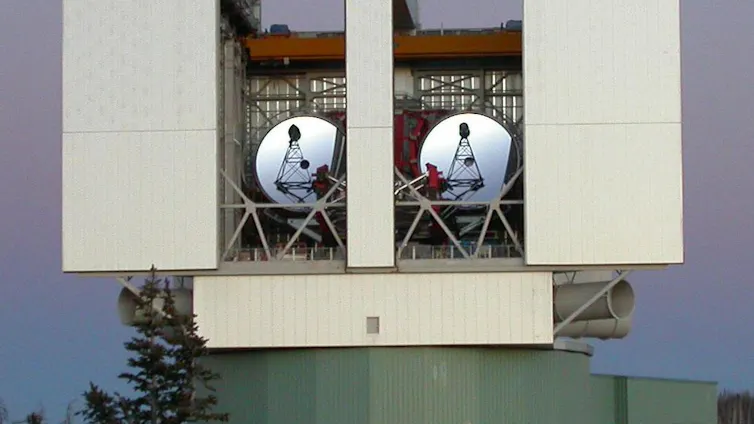
A telescope on a mountaintop set in a box with two antenna disks
The Large Binocular Telescope was used to take the new measurement of primordial helium-4. NASA

Cara Giovanetti, University of California, Berkeley

Could you imagine if pagers made a comeback? Sure, your smartphone would still be your notepad-flashlight-camera-personal assistant-MP3 player-wallet-social media browser. But imagine if pagers made it so easy to do that one important thing – pinging your friends and associates – that we all brought them back into our lives, or adopted them for the first time.

A redemption arc like this is happening in cosmology, the study of the history of our universe. The hero – rather than old technology – is an epoch of cosmological history called Big Bang Nucleosynthesis, or BBN.

Some cosmologists have thought that BBN is too old-school to be as good a tool for cosmology as other probes of the early universe. But BBN is the darling of my research program, where I use cosmology to learn more about particle physics. I have seen firsthand how recent results from this old cosmological epoch can guide new research about our universe.

The smartphone of cosmology

Cosmology’s superstar is the Cosmic Microwave Background, or CMB, which formed some 400,000 years after the Big Bang. It’s an all-sky mosaic of hot and cold patches of light, which appeared while electrons and nuclei combined into the first neutral atoms. Viewed from Earth, each hot or cold patch is small enough for the Moon to block out.

The CMB’s intricate patterning has been the subject of several intense observational campaigns, and for good reason. The key scientific model in cosmology has six major unknown quantities that researchers must measure to understand the universe. All of these quantities can be inferred with good measurements of the CMB.

But the CMB’s much older, less famous cousin is starting to steal some of its limelight.

A game of musical chairs

The universe started with a bang – the Big Bang – and about 10 minutes later, the largest game of musical chairs in history began. By that time, the universe was still dense, and hotter than the Sun. But it had cooled just enough for formerly freewheeling protons and neutrons to fuse into nuclei, which make up the centers of atoms.

The game started, and every proton searched for neutrons to fuse with. A proton lucky enough to find a neutron partner formed deuterium. That couple could snatch either another neutron to make tritium, or another proton to make helium-3. One more proton or neutron each finally made helium-4, which has a remarkably stable nucleus with two protons and two neutrons.

A diagram showing a proton and neutron fusing into deuterium, two deuteriums fusing into helium-3 or tritium, and those fusing into helium-4
Particles fused together in the first few minutes of the universe to create larger and more complicated particles. Cara Giovanetti, CC-BY-SA

The catch is that the number of neutrons in the universe plummeted during the game, like chairs being yanked out of line. Neutrons are unstable when they’re not bound in nuclei, spontaneously spitting out lighter particles in about 15 minutes to become the slightly lighter proton.

The music stopped for good when the universe became too cold for these particles to continue fusing. By that time – just 20 minutes after the game started – nearly all neutrons had either turned into protons or ended up in helium-4. Any proton that wasn’t lucky enough to partner up probably remained single for millennia, and might even be wandering the universe alone today.

This process is called Big Bang Nucleosynthesis. Astrophysicists can actually measure the quantities of helium-4 and deuterium that formed by the time it ended, referred to as primordial abundances.

But a new measurement of the primordial helium-4 abundance, published in September 2026, has reached stunning precision, providing information about the universe during BBN at a level of detail never before known.

A window to the early universe

Just a few seconds after the Big Bang, neutrons could absorb lighter particles and become protons, setting the stage for Big Bang Nucleosynthesis in processes distinct from the decays that happened toward the end of BBN 15 minutes later. This conversion could occur as long as the universe was very dense and hot. The longer that condition was satisfied, the more neutrons could turn into protons before BBN began.

But the universe expanded quickly after the Big Bang. The stretching of the fabric of the universe was propelled by radiation, where “radiation” refers to hot particles with tiny masses. The rate of expansion – and, by proxy, the amount of radiation – determined how quickly the universe became less dense.

It’s harder for neutrons to absorb particles and convert into protons in a diluted universe, because everybody’s so far away. The quicker the universe expanded, the less time there was to turn neutrons into protons, and so the more neutrons there would be the start of BBN. More neutrons at the beginning of musical chairs means more helium-4 by the end of it.

A diagram showing two images. The left, labeled 'dense,' shows a universe full of particles, while the right, labeled 'diluted,' shows a universe with particles scattered thinly.
In a dense universe, particles interact easily, and neutrons (blue) turn into protons (red). If the universe is not very dense, interaction becomes much harder, and more neutrons stick around. Cara Giovanetti, CC-BY-SA

The amount of radiation therefore determines the final helium-4 abundance. By measuring that abundance, my colleagues and I work backward to find the precise amount of radiation in the early universe.

That’s an important quantity to measure. Among other reasons, particle physicists can use it to learn more about dark matter, a largely invisible substance that constitutes 80% of the matter in the universe.

Many models of dark matter, or other hypothetical physics, call for slightly more or slightly less radiation than what’s expected in standard cosmology. Measuring this quantity precisely helps particle physicists differentiate these predictions from the truth.

Looking ahead

BBN now determines the amount of radiation in the early universe better than the CMB. And its newfound prowess doesn’t stop at helium-4. Measurements of primordial deuterium, taken throughout the 21st century, tell cosmologists the density of particles like protons and neutrons with extreme precision. The precision with which BBN determines this quantity rivals, though does not yet exceed, that of the CMB.

The CMB isn’t quite ready to give up its spotlight. Even more precise measurements of all of the major unknowns in cosmology are already underway, as the Simons Observatory – a new high precision CMB telescope – makes its first observations. But there’s no clear path to improved measurements after the Simons Observatory finishes taking data, since the next-generation experiment CMB-S4 was suspended indefinitely last year.

Maybe it’s good timing, then, for BBN to be making its comeback. Getting even better BBN data doesn’t require dedicated observatories. Instead, observers only need more time on existing or planned telescopes. With near-term improvements to astronomical observations, physicists may get closer than ever to understanding the makeup – and therefore history and future – of our universe.

Cara Giovanetti, Postdoctoral Researcher in Physics, University of California, Berkeley

This article is republished from The Conversation under a Creative Commons license. Read the original article.

ooOOoo

Now there’s another thing I have just learnt (on the 26th). That is to copy and paste I now have to use the Command key plus the appropriate letter key.
The expansion of the Universe

I am reproducing a recent article published by The Conversation.

It is a reflection of the latest research undertaken by NASA, it is beyond fascinating!

ooOOoo

The universe is expanding faster than theory predicts – physicists are searching for new ideas that might explain the mismatch

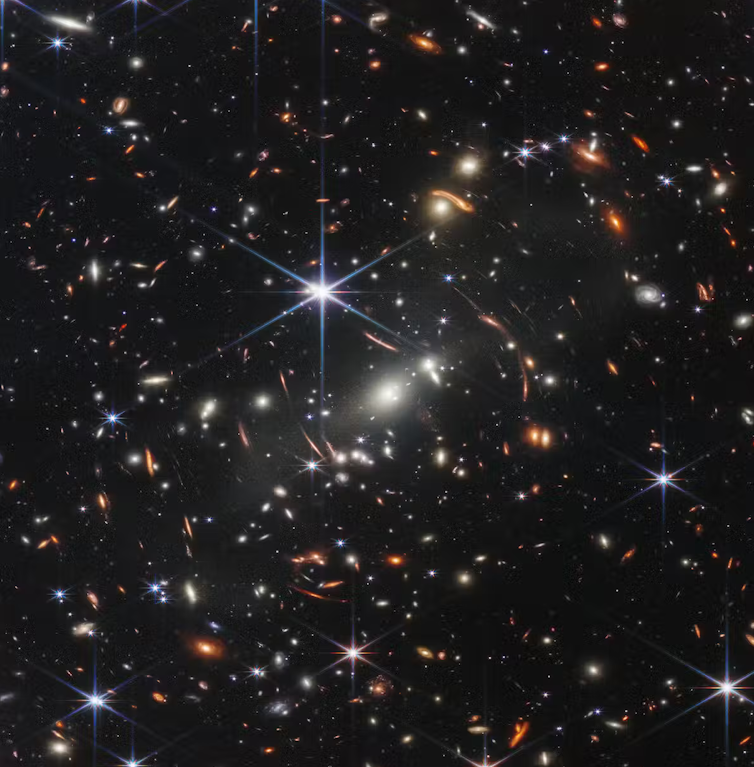
The James Webb Space Telescope’s deep field image shows a universe full of sparkling galaxies. NASA/STScI

Ryan Keeley, University of California, Merced

Astronomers have known for decades that the universe is expanding. When they use telescopes to observe faraway galaxies, they see that these galaxies are moving away from Earth.

To astronomers, the wavelength of light a galaxy emits is longer the faster the galaxy is moving away from us. The farther away the galaxy is, the more its light has shifted toward the longer wavelengths on the red side of the spectrum – so the higher the “redshift.”

Because the speed of light is finite, fast, but not infinitely fast, seeing something far away means we’re looking at the thing how it looked in the past. With distant, high-redshift galaxies, we’re seeing the galaxy when the universe was in a younger state. So “high redshift” corresponds to the early times in the universe, and “low redshift” corresponds to the late times in the universe.

But as astronomers have studied these distances, they’ve learned that the universe is not just expanding – its rate of expansion is accelerating. And that expansion rate is even faster than the leading theory predicts it should be, leaving cosmologists like me puzzled and looking for new explanations.

Dark energy and a cosmological constant

Scientists call the source of this acceleration dark energy. We’re not quite sure what drives dark energy or how it works, but we think its behavior could be explained by a cosmological constant, which is a property of spacetime that contributes to the expansion of the universe.

Albert Einstein originally came up with this constant – he marked it with a lambda in his theory of general relativity. With a cosmological constant, as the universe expands, the energy density of the cosmological constant stays the same.

Imagine a box full of particles. If the volume of the box increases, the density of particles would decrease as they spread out to take up all the space in the box. Now imagine the same box, but as the volume increases, the density of the particles stays the same.

It doesn’t seem intuitive, right? That the energy density of the cosmological constant does not decrease as the universe expands is, of course, very weird, but this property helps explain the accelerating universe.

A standard model of cosmology

Right now, the leading theory, or standard model, of cosmology is called “Lambda CDM.” Lambda denotes the cosmological constant describing dark energy, and CDM stands for cold dark matter. This model describes both the acceleration of the universe in its late stages as well as the expansion rate in its early days.

Specifically, the Lambda CDM explains observations of the cosmic microwave background, which is the afterglow of microwave radiation from when the universe was in a “hot, dense state” about 300,000 years after the Big Bang. Observations using the Planck satellite, which measures the cosmic microwave background, led scientists to create the Lambda CDM model.

Fitting the Lambda CDM model to the cosmic microwave background allows physicists to predict the value of the Hubble constant, which isn’t actually a constant but a measurement describing the universe’s current expansion rate.

But the Lambda CDM model isn’t perfect. The expansion rate scientists have calculated by measuring distances to galaxies, and the expansion rate as described in Lambda CDM using observations of the cosmic microwave background, don’t line up. Astrophysicists call that disagreement the Hubble tension.

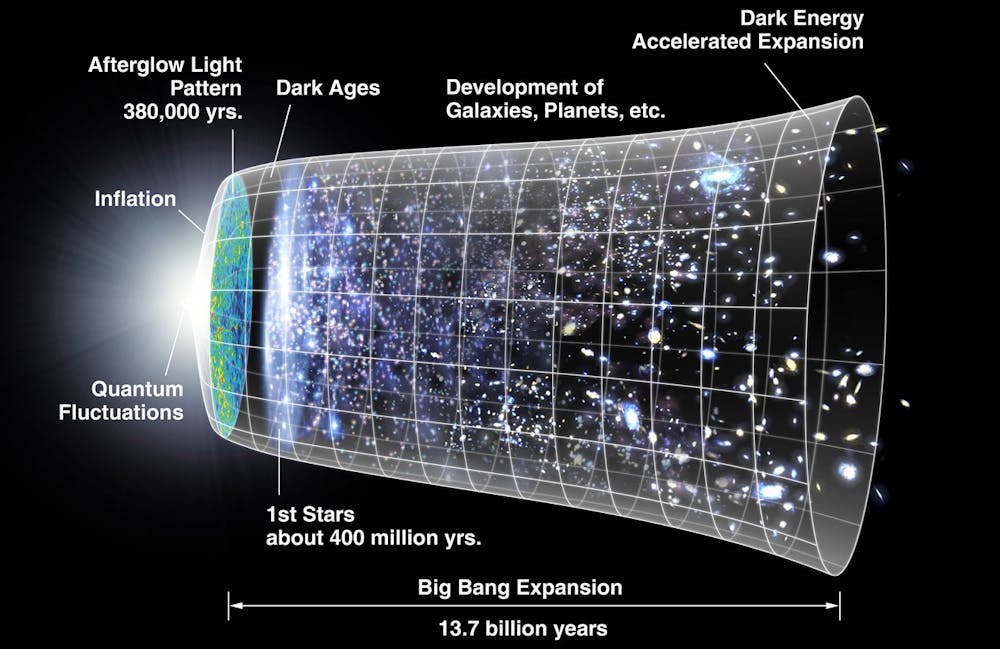
An illustration showing the progression of the Universe's expansion after the Big Bang. The Universe is depicted as a cylindrical funnel with labels along the bottom showing the first stars, the development of planets, and now the dark energy acceleration
The universe is expanding faster than predicted by popular models in cosmology. NASA

The Hubble tension

Over the past few years, I’ve been researching ways to explain this Hubble tension. The tension may be indicating that the Lambda CDM model is incomplete and physicists should modify their model, or it could indicate that it’s time for researchers to come up with new ideas about how the universe works. And new ideas are always the most exciting things for a physicist.

One way to explain the Hubble tension is to modify the Lambda CDM model by changing the expansion rate at low redshift, at late times in the universe. Modifying the model like this can help physicists predict what sort of physical phenomena might be causing the Hubble tension.

For instance, maybe dark energy is not a cosmological constant but instead the result of gravity working in new ways. If this is the case, dark energy would evolve as the universe expands – and the cosmic microwave background, which shows what the universe looked like only a few years after its creation, would have a different prediction for the Hubble constant.

But, my team’s latest research has found that physicists can’t explain the Hubble tension just by changing the expansion rate in the late universe – this whole class of solutions falls short.

Developing new models

To study what types of solutions could explain the Hubble tension, we developed statistical tools that enabled us to test the viability of the entire class of models that change the expansion rate in the late universe. These statistical tools are very flexible, and we used them to match or mimic different models that could potentially fit observations of the universe’s expansion rate and might offer a solution to the Hubble tension.

The models we tested include evolving dark energy models, where dark energy acts differently at different times in the universe. We also tested interacting dark energy-dark matter models, where dark energy interacts with dark matter, and modified gravity models, where gravity acts differently at different times in the universe.

But none of these could fully explain the Hubble tension. These results suggest that physicists should study the early universe to understand the source of the tension.

Ryan Keeley, Postdoctoral Scholar in Physics, University of California, Merced

This article is republished from The Conversation under a Creative Commons license. Read the original article.

ooOOoo

Ryan Keeley explains it above. Hopefully most of you who read this understand the physics involved. Ryan has a website here.

As I said at the start it is beyond fascinating! In the truest sense, out of this world!