Tag: Reflections

Celebrating Who I Am.

The journey towards knowing better who we are.

This may seem like a bit of an ‘odd-ball’ after Celebrating Ben and Ranger on Monday and Celebrating Pharaoh yesterday.  Indeed, when I had in mind those two posts, writing about self-awareness was nowhere on my mental horizon.  Then along came Shakti Ghosal after Monday’s post who left this comment:

Hi Paul,

Just came a visiting and was halted by these glorious photographs. Horses embody such great qualities of trust, grace and power don’t they? What is it that makes them such a great friend of Man, I wonder? Specially when the latter species, as we know it (and we should know!), can choose to behave quite contrary to those Equine qualities above….

Shakti

As Shakti was a new visitor inevitably I went across to his blog site, ESGEE musings, and then to the About page. Where I read, in part,

About Shakti Ghosal

Shakti

Born in New Delhi, India, Shakti Ghosal is an Engineer and Management Post Graduate from IIM, Bangalore. Apart from Management theory, Shakti remains fascinated with diverse areas ranging from World History, Global trends to Human Psychology & Development.

I was intrigued and starting reading some of Shakti’s posts.  That is how I came across The Audacity of Who I am and a day later had been offered permission to republish it.

However, before going on to Shakti’s post let me recap a little from yesterday’s post Celebrating Pharaoh.  This section:

The biggest, single reward of having Pharaoh as my friend goes back a few years.  Back to my Devon days and the time when Jon Lavin and I used to spend hours talking together.  Pharaoh always contentedly asleep in the same room as the two of us. It was Jon who introduced me to Dr. David Hawkins and his Map of Consciousness. It was Jon one day who looking down at the sleeping Pharaoh pointed out that Dr. Hawkins offered evidence that dogs are integrous creatures with a ‘score’ on that Map of between 205 and 210. (Background story is here.)

So this blog, Learning from Dogs, and my attempt to write a book of the same name flow from that awareness of what dogs mean to human consciousness and what Pharaoh means to me.  No, more than that!  From that mix of Jon, Dr. David Hawkins, and experiencing the power of unconditional love from an animal living with me day-in, day-out, came a journey into my self.  Came the self-awareness that allowed me to like who I was, be openly loved by this dog of mine, and be able to love in return.  As is said: “You cannot love another until you love yourself.

I will speak a little more about this but, first, to Shakti’s post.

ooOOoo

The Audacity of Who I am

“High above the noise and fear mongering of critics and cynics softly speaks your true self.”

– Mollie Marti, Psychologist, Lawyer & Coach, USA

The other day, I watched the Bollywood movie Queen. In it Rani, a girl from Delhi, travels to Europe after being spurned by her fiancé. The movie then goes on to explore Rani’s ‘World view’ as dictated by her Indian middle class values and how that alters, as her biases and prejudices fall away, as she is confronted by radically different value systems and perspectives. A journey of self discovery in surroundings where she is no longer weighed down by others’ expectations and diktats. As she morphs, she confuses and pisses off many people including herself. Rani emerges from this crucible of experience as a more authentic human being. As she chooses to be ‘who she is for herself and for others’, she symbolises courage as well as resistance. Walking out of the theatre, I could not help but acknowledge how Rani’s awareness and acceptance of ‘who she is for herself and for others’ left her more empowered and in control of her destiny.
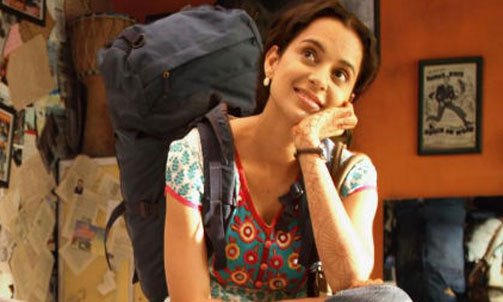
Kangana Ranaut in Queen

Who I am for myself and for others? How many of us are willing to make this query a daily practice as we loosen the constraints imposed by our world-view, let go of who we believe we should show up as and embrace who we really are?

What is it that makes me avoid being who I am for myself and for others? I can see this stemming from my desperation to be admired, liked and looking good. My life experiences have conditioned me to avoid being straightforward and veer towards being diplomatic if I perceive it is the latter which makes me look good. I have also been guilty of the corporate lie. On occasions I have stretched the truth about my company and its services, hidden what could have been embarrassing. On other occasions I have manipulated situations and people. All this to succeed, be admired, look good.

I muse. Have my efforts to gain admiration and look good empowered me to greater heights? Have I succeeded in engaging in my life from a place of worthiness? I remain increasingly unsure.

So if avoiding ‘who I am for myself and for others’ has not worked for me, how could I embrace it? As I think of this, I begin to see what being who I am for myself and for others could mean for me.

Shakti 2

It would mean the audacity to show up as the ‘imperfect me’ that I am and the willingness to be vulnerable.

It would mean the audacity to let my hair down and allow myself to truly belong with the folks I choose.

It would mean the audacity to be compassionate and loving even when I hold the fear of not being good enough.

It would mean the audacity to be authentic about my own inauthenticities.

Am I committed to being this audacious?

***

“Real isn’t how you are made,’ said the Skin Horse.’ It’s a thing that happens to you. When a child loves you for a long, long time, not just to play with, but REALLY loves you, then you become Real.’

‘Does it hurt?’ asked the Rabbit.

‘Sometimes,’ said the Skin Horse, for he was always truthful. ‘When you are Real you don’t mind being hurt.’

‘Does it happen all at once, like being wound up,’ he asked, ‘or bit by bit?’

‘It doesn’t happen all at once,’ said the Skin Horse. ‘You become. It takes a long time. That’s why it doesn’t happen often to people who break easily, or have sharp edges, or who have to be carefully kept. Generally, by the time you are Real, most of your hair has been loved off, and your eyes drop out and you get loose in the joints and very shabby. But these things don’t matter at all, because once you are Real you can’t be ugly, except to people who don’t understand.”

Excerpt from ‘The Velveteen Rabbit’ by Margery Williams

In Learning….. Shakti Ghosal

ooOOoo

Now Shatki’s post is spot on.  But it assumes one thing.  That is that each of us has sufficient self-awareness “to show up as the ‘imperfect me’”.  Sometimes, as in my case, that ‘imperfect me’ was well-hidden from the self.  Stay with me a little longer.

My father died of cancer in 1956.  Just 5 days before Christmas, 1956.  He was 55 and I had turned 12 just 6 weeks previously. I had completed my first term at the local (Preston Road, Wembley) grammar school.

For many reasons that do not need to be shared here, the effect of my father’s death and my subsequent decline in my school performance, left me with a long-term psychological ‘dysfunction’; namely a feeling that I had been emotionally rejected.  But that feeling was deeply hidden from me.  In fact, that hidden belief remained with me until 2007 when Jon Lavin brought it to the surface. (Jon is a UKCP accredited therapist and NLP Practitioner).

Reflect on that for just a moment.  For the thick end of fifty years, this psychological characteristic remained totally below my consciousness yet, nonetheless, influenced me in very real and tangible ways.

The negative influence was that I was drawn to any woman who offered me love and affection and, therefore, was emotionally unable to understand how good a partner she might or might not be for me. (Jean is my fourth wife!)

The positive influence was that I tried very hard to please others, to avoid their rejection, and had successful careers in selling for IBM UK, starting and building a successful business in the early days of personal computing and, later, when my company was sold in 1986 becoming a freelance journalist and business coach.

So back to Shakti’s essay.

I agree one-hundred-percent with what he says. With the proviso that in certain cases, spending time with a qualified counsellor could be your best investment ever.

How to round this off.

If you have been influenced by any of this then do give yourself time and space to counsel yourself.  Let your inner person reach out in peace to your outer person.

If that inner person suggests you could be a happier, more peaceful person then reach out to someone properly qualified to hold your hand as you open up to your inner feelings.

Which is why loving a dog and being loved in return by that beautiful creature means so much.  For in that private bond that animals offer us lays the truth.

I can do no better than offer this personal reason why being audacious about who you are is the supreme ‘investment’ of all in yourself.

A few months after Jon Lavin brought my fear of emotional rejection to my conscious surface, I met Jean in Mexico, Christmas 2007.  I have never loved a person as I love Jean.  I have never been loved by a person as Jean loves me.
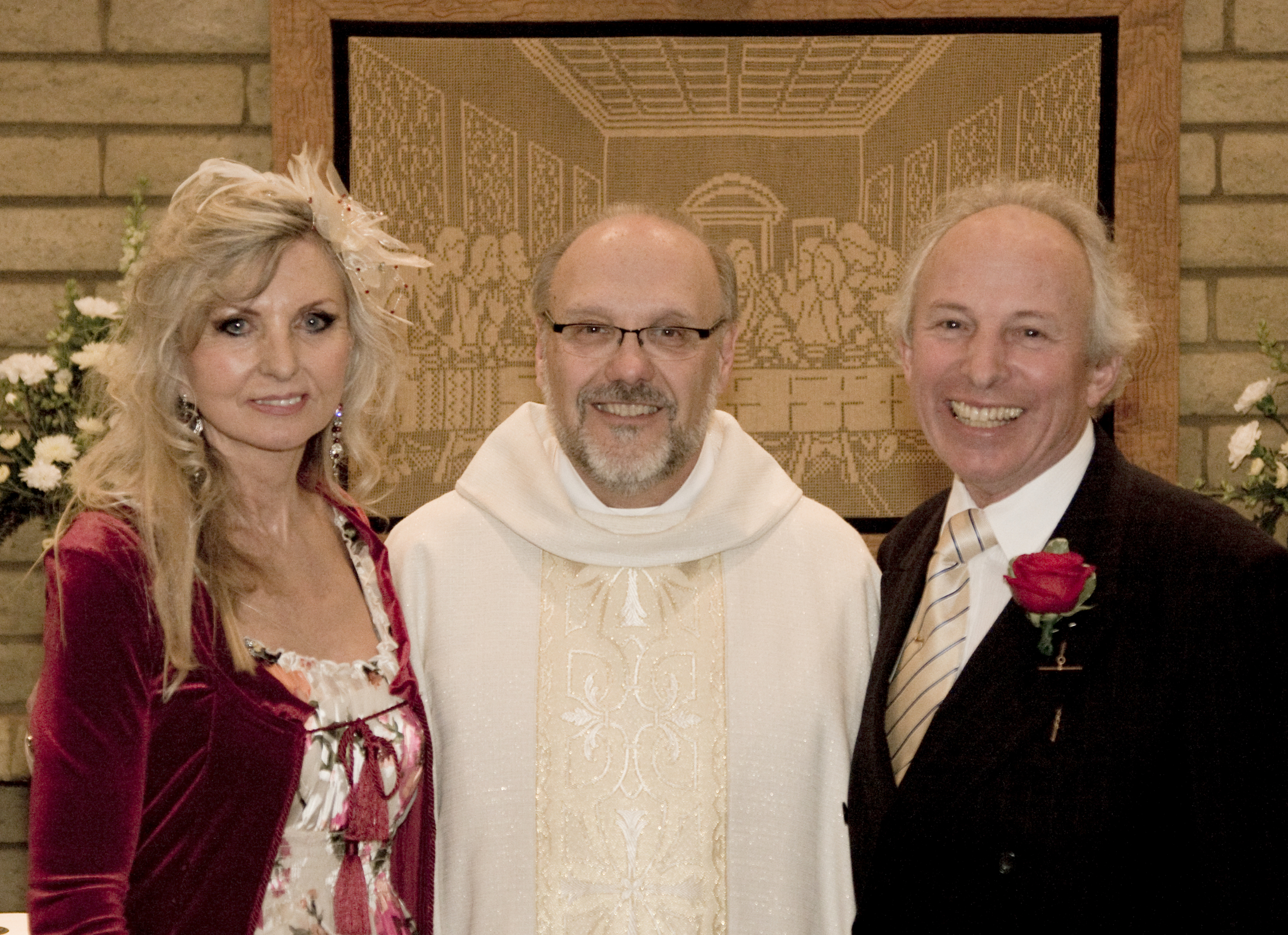
Jean, Father Dan and yours truly. St Paul's Episcopal Church, Payson, AZ. November 20th, 2010.
Jean, Father Dan and yours truly. St Paul’s Episcopal Church, Payson, AZ. November 20th, 2010.

Being at peace with who you are is the most important celebration.

Say no more!

Celebrating Pharaoh.

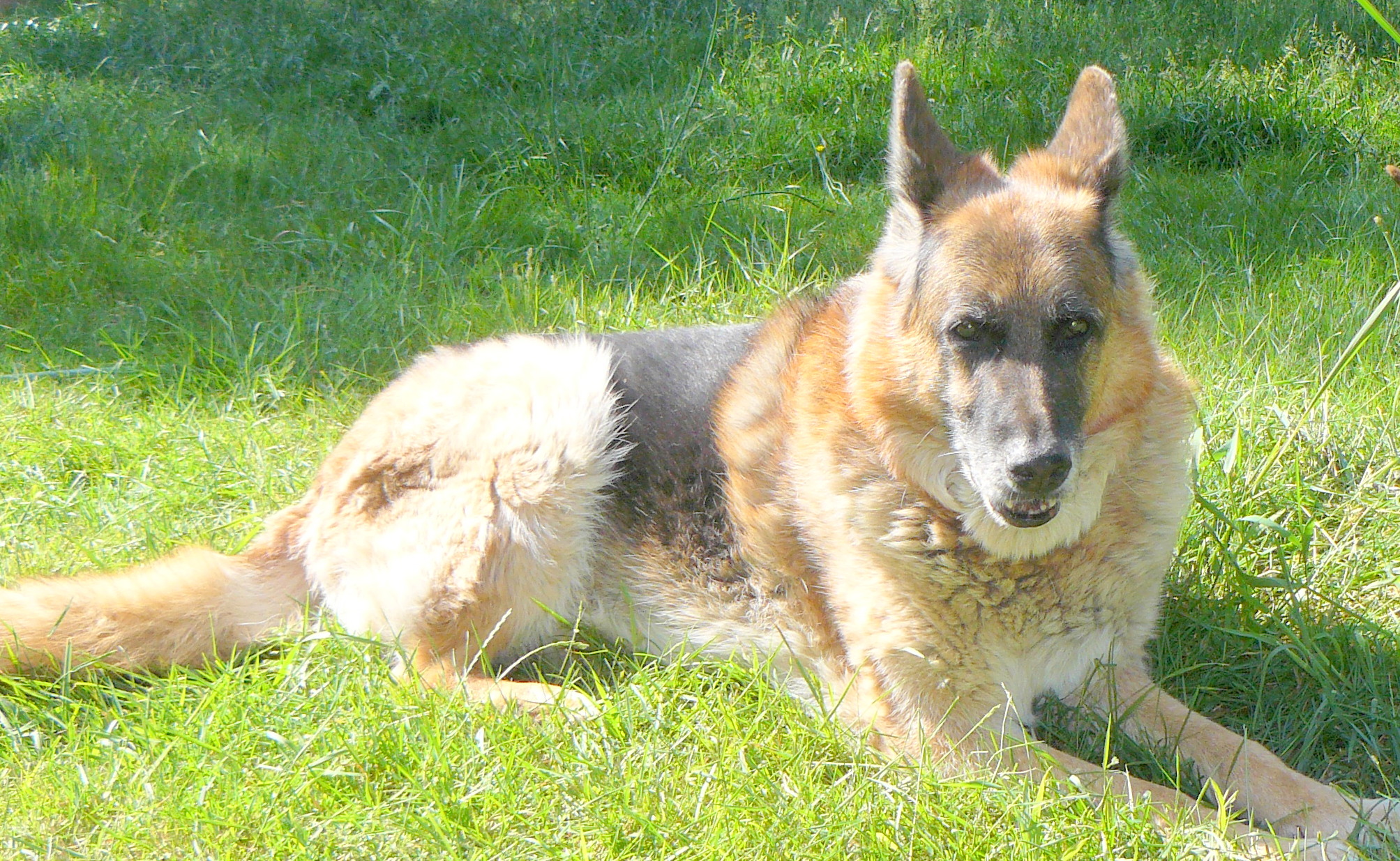
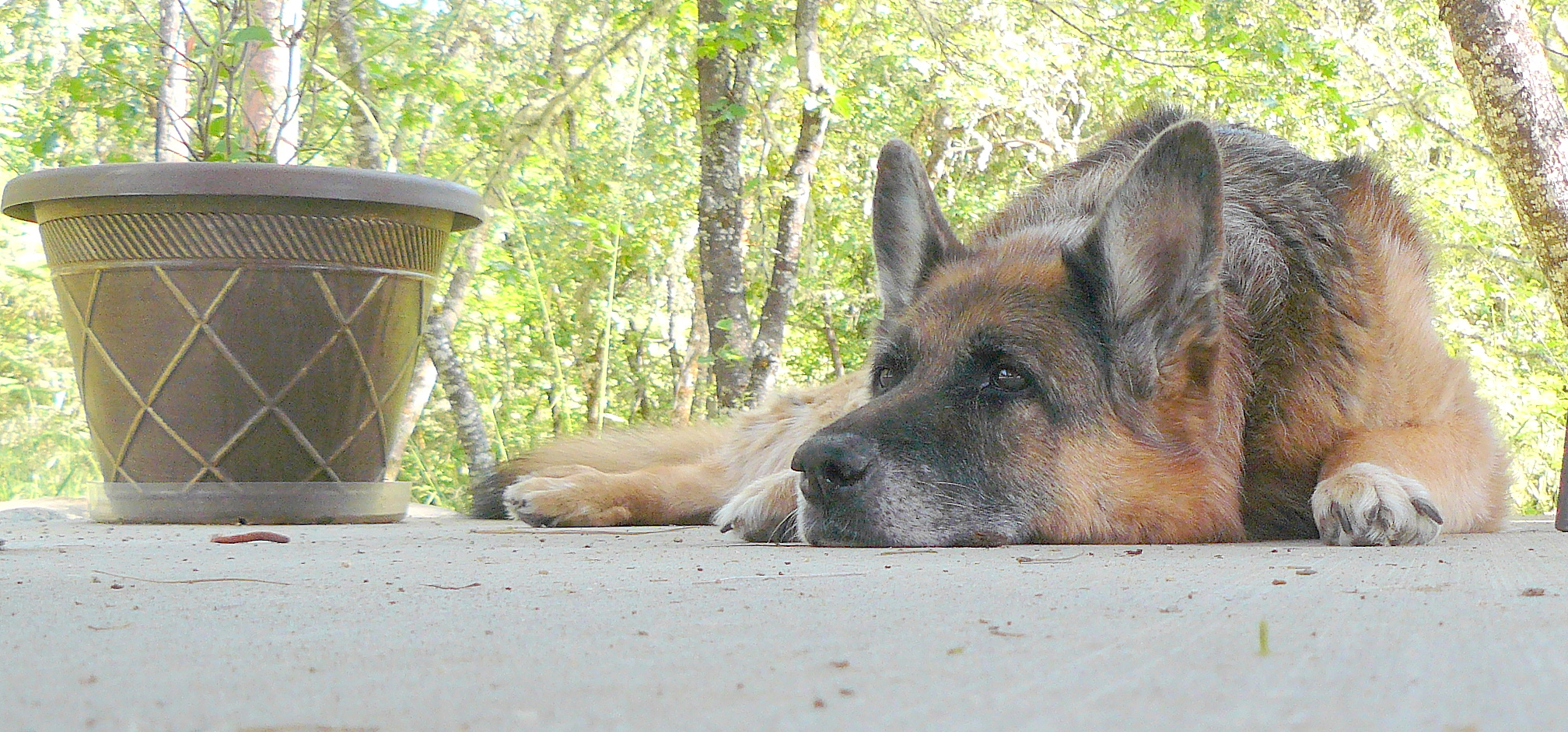
Today is the eleventh anniversary of the day Pharaoh was born.

Yes, Pharaoh was born on the 3rd June, 2003.

Last year, I celebrated Pharaoh’s tenth birthday with posts over two days.  Being ten seemed such a significant milestone for him.

So rather than repeat those two posts, as much as I am tempted to so do 😉 , I will just offer you the links and repost one photograph. Thus here is that first post, Meet the dogs – Pharaoh (pt 1) and the second part is here.

Here’s the photograph of Sandra Tucker, owner of Jutone Kennels in Devon, England, holding puppy Pharaoh the day I first met him: 12th August, 2003.

OLYMPUS DIGITAL CAMERA

It would be so easy for me to gush over having Pharaoh in my life these last eleven years.  But I shall resist, dear reader! Will just repeat a few words that were said a year ago.

The biggest, single reward of having Pharaoh as my friend goes back a few years.  Back to my Devon days and the time when Jon Lavin and I used to spend hours talking together.  Pharaoh always contentedly asleep in the same room as the two of us. It was Jon who introduced me to Dr. David Hawkins and his Map of Consciousness. It was Jon one day who looking down at the sleeping Pharaoh pointed out that Dr. Hawkins offered evidence that dogs are integrous creatures with a ‘score’ on that Map of between 205 and 210. (Background story is here.)

So this blog, Learning from Dogs, and my attempt to write a book of the same name flow from that awareness of what dogs mean to human consciousness and what Pharaoh means to me.  No, more than that!  From that mix of Jon, Dr. David Hawkins, and experiencing the power of unconditional love from an animal living with me day-in, day-out, came a journey into my self.  Came the self-awareness that allowed me to like who I was, be openly loved by this dog of mine, and be able to love in return.  As is said: “You cannot love another until you love yourself.

Which, serendipitously, brings me to tomorrow’s post: Celebrating Who I Am.

Obviously, I wanted to include some current photographs of the birthday boy but, try as I did, the perfect image wasn’t captured.

Thus will leave you with these two, both taken yesterday afternoon.

P1140667

oooo

P1140663

Happy Birthday, my dear friend!

Celebrating Ben and Ranger.

The joy these horses have given us.

It’s almost impossible, at times, to get one’s mind around life’s events.  I’m not wishing to be overly philosophical but, nonetheless, it doesn’t do any harm to muse from time to time about the nature of things.

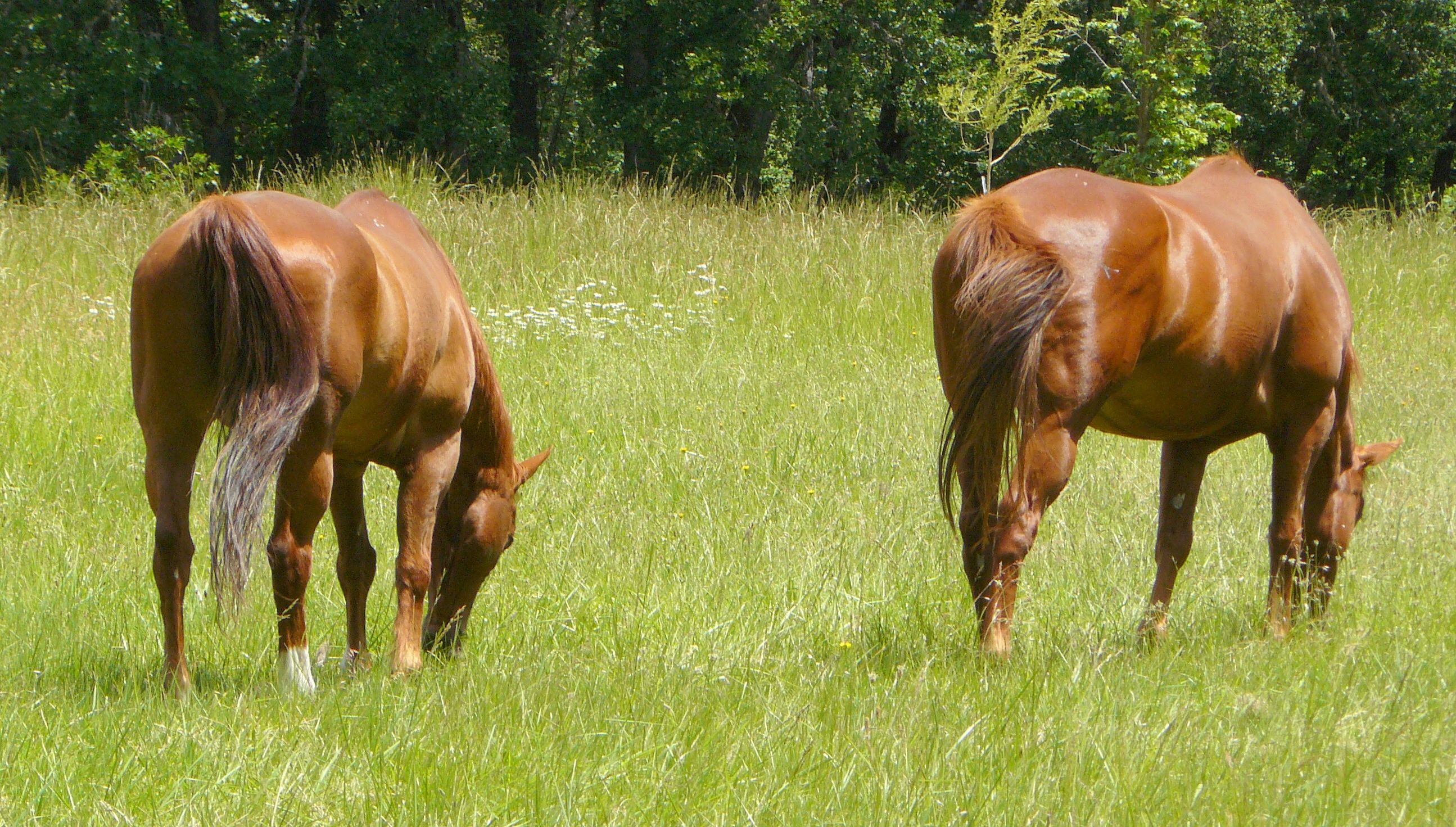
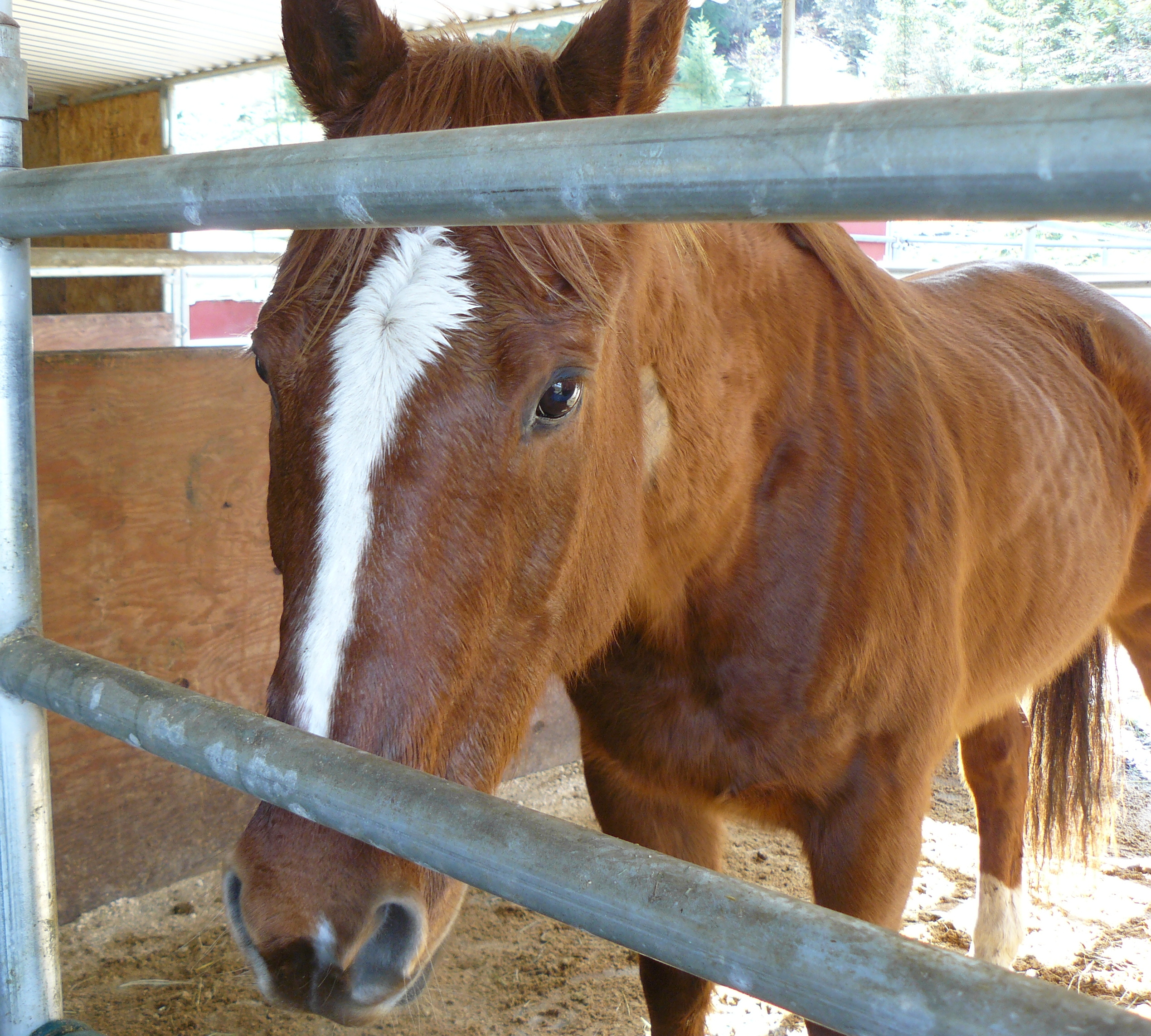
Take our two rescue horses: Ben and Ranger.

They have now been with us for coming up to three months.  Considering how terribly they were treated before being rescued by Darla Clark of Strawberry Mountain Mustangs, it’s a privilege to experience the way that these two horses have so rapidly put their past behind them.

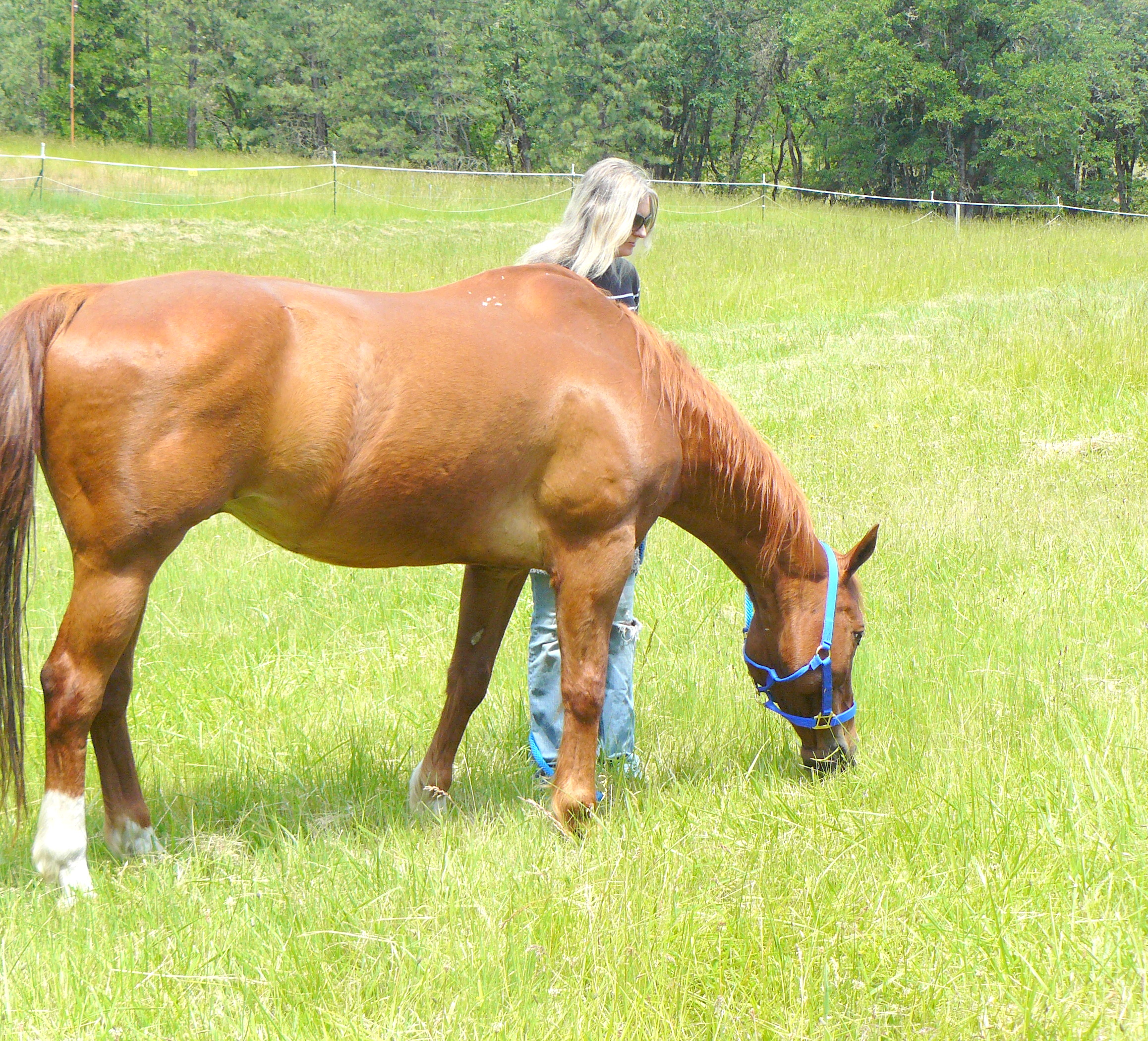
All of which is a preamble to this photograph taken just a couple of days ago.

Ranger (LHS) and Ben enjoying our open grassland.

Just look at their shiny coats!  Just look at them so happily munching away on the grass.

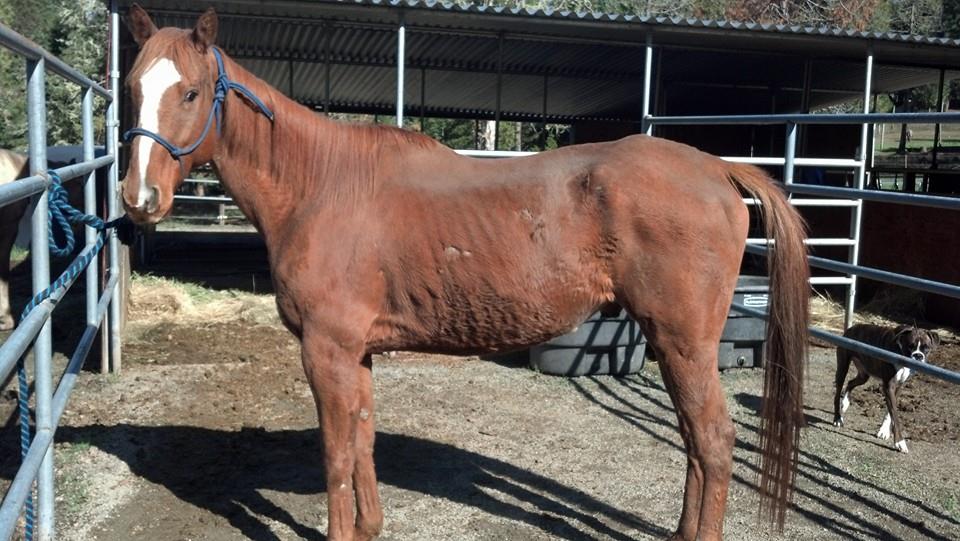
Now look at how they were not so long ago.

Ranger, when first seen in February.

Ranger, when first seen in February.

oooo

Ben2 when found
Ben as seen last October.

So back to present, happy times.

The last photograph is of Jean having just put a halter on Ranger so that the two of them can be taken in at the end of the day.  Ben follows Ranger in without the need of a halter.  Ben and Ranger are inseparable!

P1140659

oooo

Tomorrow, the celebration of another beautiful animal!

Picture parade forty-six.

Going to spoil you today! The complete set of pictures sent to me by Suzann.

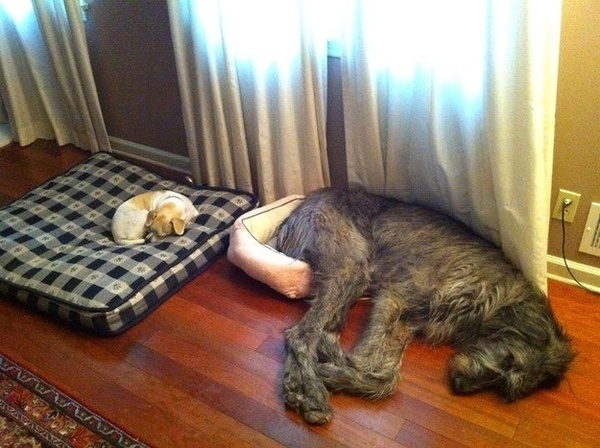
Why it's good to be tall!
Why it’s good to be tall!

oooo

Are you sure this is my bed?

oooo

Can I keep it?
Can I keep it?

oooo

I can't wait till they deliver the new stove! We need a new box!
I can’t wait till they deliver the new stove! We need a new box!

oooo

Bake for 20 minutes, then turn over...
Bake for 20 minutes, then turn over…

oooo

Everybody needs a good sleep toy!

oooo

Frankly, I don't think it's funny!
Frankly, I don’t think it’s funny!

oooo

I'm ready for my walk!
I’m ready for my walk!

oooo

I love my new human! I think I'€™ll keep it.
I love my new human! I think I’ll keep it.

oooo

Suz10

oooo

Always check before putting on your shoes!

oooo

Thanks Su!

All of you have a good week.

Is it just me?

Some days, one just wonders about a world that appears to be stark, raving mad!

One of the fundamental things that mankind is not learning from dogs, or from other animals for that fact, is having a sensitivity to danger.

Even happy, domesticated dogs, as with cats, are incredibly quick to pick up on something that just doesn’t ‘feel right’!

For example, take what was written here last Wednesday. About the extreme madness of our dependency on oil for our food!

Why is there no outcry?

Just recently, NOAA reported that “April 2014 was tied with April of 2010 as being the warmest April on record globally for land and ocean surface combined. NOAA also said that – globally – the January 2014 to April 2014 period was the 6th warmest Jan-Apr period on record.”

Why is there no outcry?

Just ten days ago, I wrote a post under the title of The nature of delusions. Included in that post was an essay from George Monbiot he called Are We Bothered? His proposition being, “The more we consume, the less we care about the living planet.

Part of me hates the way that this blog often touches on pain and negativity but my motivation is simply that doing nothing, ignoring what is so wrong in the world, would be the height of irresponsibility.

All of which is a preamble to another George Monbiot essay. Mr. Monbiot is a powerful writer as his many essays demonstrate. But this latest one from him is one of the most powerful essays in a very long time.

It’s not a comfortable read. But sure as hell, it’s a must read!

ooOOoo

The Impossibility of Growth

May 27, 2014

Why collapse and salvation are hard to distinguish from each other.

By George Monbiot, published in the Guardian 28th May 2014

Let us imagine that in 3030BC the total possessions of the people of Egypt filled one cubic metre. Let us propose that these possessions grew by 4.5% a year. How big would that stash have been by the Battle of Actium in 30BC? This is the calculation performed by the investment banker Jeremy Grantham (1).

Go on, take a guess. Ten times the size of the pyramids? All the sand in the Sahara? The Atlantic ocean? The volume of the planet? A little more? It’s 2.5 billion billion solar systems (2). It does not take you long, pondering this outcome, to reach the paradoxical position that salvation lies in collapse.

To succeed is to destroy ourselves. To fail is to destroy ourselves. That is the bind we have created. Ignore if you must climate change, biodiversity collapse, the depletion of water, soil, minerals, oil; even if all these issues were miraculously to vanish, the mathematics of compound growth make continuity impossible.

Economic growth is an artefact of the use of fossil fuels. Before large amounts of coal were extracted, every upswing in industrial production would be met with a downswing in agricultural production, as the charcoal or horse power required by industry reduced the land available for growing food. Every prior industrial revolution collapsed, as growth could not be sustained (3). But coal broke this cycle and enabled – for a few hundred years – the phenomenon we now call sustained growth.

It was neither capitalism nor communism that made possible the progress and the pathologies (total war, the unprecedented concentration of global wealth, planetary destruction) of the modern age. It was coal, followed by oil and gas. The meta-trend, the mother narrative, is carbon-fuelled expansion. Our ideologies are mere subplots. Now, as the most accessible reserves have been exhausted, we must ransack the hidden corners of the planet to sustain our impossible proposition.

On Friday, a few days after scientists announced that the collapse of the West Antarctic ice sheet is now inevitable (4), the Ecuadorean government decided that oil drilling would go ahead in the heart of the Yasuni national park (5). It had made an offer to other governments: if they gave it half the value of the oil in that part of the park, it would leave the stuff in the ground. You could see this as blackmail or you could see it as fair trade. Ecuador is poor, its oil deposits are rich: why, the government argued, should it leave them untouched without compensation when everyone else is drilling down to the inner circle of hell? It asked for $3.6bn and received $13m. The result is that Petroamazonas, a company with a colourful record of destruction and spills (6), will now enter one of the most biodiverse places on the planet, in which a hectare of rainforest is said to contain more species than exist in the entire continent of North America (7).

The UK oil company Soco is now hoping to penetrate Africa’s oldest national park, Virunga, in the Democratic Republic of Congo (8); one of the last strongholds of the mountain gorilla and the okapi, of chimpanzees and forest elephants. In Britain, where a possible 4.4 billion barrels of shale oil has just been identified in the south-east (9), the government fantasises about turning the leafy suburbs into a new Niger delta. To this end it’s changing the trespass laws to enable drilling without consent and offering lavish bribes to local people (10,11). These new reserves solve nothing. They do not end our hunger for resources; they exacerbate it.

The trajectory of compound growth shows that the scouring of the planet has only just begun. As the volume of the global economy expands, everywhere that contains something concentrated, unusual, precious will be sought out and exploited, its resources extracted and dispersed, the world’s diverse and differentiated marvels reduced to the same grey stubble.

Some people try to solve the impossible equation with the myth of dematerialisation: the claim that as processes become more efficient and gadgets are miniaturised, we use, in aggregate, fewer materials. There is no sign that this is happening. Iron ore production has risen 180% in ten years (12). The trade body Forest Industries tell us that “global paper consumption is at a record high level and it will continue to grow.” (13) If, in the digital age, we won’t reduce even our consumption of paper, what hope is there for other commodities?

Look at the lives of the super-rich, who set the pace for global consumption. Are their yachts getting smaller? Their houses? Their artworks? Their purchase of rare woods, rare fish, rare stone? Those with the means buy ever bigger houses to store the growing stash of stuff they will not live long enough to use. By unremarked accretions, ever more of the surface of the planet is used to extract, manufacture and store things we don’t need. Perhaps it’s unsurprising that fantasies about the colonisation of space – which tell us we can export our problems instead of solving them – have resurfaced (14).

As the philosopher Michael Rowan points out, the inevitabilities of compound growth mean that if last year’s predicted global growth rate for 2014 (3.1%) is sustained, even if we were miraculously to reduce the consumption of raw materials by 90% we delay the inevitable by just 75 years(15). Efficiency solves nothing while growth continues.

The inescapable failure of a society built upon growth and its destruction of the Earth’s living systems are the overwhelming facts of our existence. As a result they are mentioned almost nowhere. They are the 21st Century’s great taboo, the subjects guaranteed to alienate your friends and neighbours. We live as if trapped inside a Sunday supplement: obsessed with fame, fashion and the three dreary staples of middle class conversation: recipes, renovations and resorts. Anything but the topic that demands our attention.

Statements of the bleeding obvious, the outcomes of basic arithmetic, are treated as exotic and unpardonable distractions, while the impossible proposition by which we live is regarded as so sane and normal and unremarkable that it isn’t worthy of mention. That’s how you measure the depth of this problem: by our inability even to discuss it.

http://www.monbiot.com

References:

1. http://www.theoildrum.com/node/7853

2. Grantham expressed this volume as 1057 cubic metres. In his paper We Need To Talk About Growth, Michael Rowan translated this as 2.5 billion billion solar systems. (http://persuademe.com.au/need-talk-growth-need-sums-well/). This source gives the volume of the solar system (if it is treated as a sphere) at 39,629,013,196,241.7 cubic kilometres, which is roughly 40 x 1021 cubic metres. Multiplied by 2.5 billion billion, this gives 1041 cubic metres.

Since posting this, I’ve received the following clarifications:

From Jacob Bayless:

“… about the volume of the solar system — there is no agreed-upon definition of its diameter, which is why the figures vary wildly. (There are also two definitions of ‘a billion’, which adds to the confusion). Using the radius of Neptune’s orbit, as the farthest ‘planet’ from the sun, gives the 2.5 billion billion figure:

The orbit of Neptune is 4.5 x 10^12 m radius, which yields a 4 x 10^38 cubic m sphere. Multiplying this by 2.5 x 10^18, or “2.5 billion billion”, gives 10^57 cubic m. So that calculation checks out.

The heliopause radius would be another possible way to measure the solar system radius; it’s 4 times as far and thus 64 times the volume.”

From Geoff Briggs:

“Michael Rowan has taken the size of the solar system to be the orbit of Neptune, which is kind of understandable, but the sun’s influence extends a LOT further than that, so his estimate is correspondingly significantly overstated (ie the extra billion).

The 39,629,… cubic km figure from yahoo answers is based on a correct calculation in light years, but then a massive cock-up in the conversion to cubic km. The author seems to have assumed that a light year is about 21,000,000m, which is off by about eight orders of magnitude. 4.2 cubic light years is about 3.6 x 10^39 cubic km (and hence about 3.6 x 10^48 cubic metres).”

From Andrew Bryce:

“Starting volume of Egyptian possessions = 1 m3

after 3000 years volume = 1 x (1.045)^3000

= 2.23 x 10^57 m3

Assume the radius of the solar system is 50 AU (the distance to the Kuiper belt)

1 AU = 1.496 x 10^11 m

radius of the solar system = 50 AU = 7.48 x 10^12 m

volume of solar system = 4/3 x pi x r^3

= 1.75 x 10^39 m3

so the Egyptian possessions would require 2.23 x 10^57 / 1.75 x 10^39 solar systems

= 1.27 x 10^18

= about 1.27 billion billion solar systems

If you consider the radius of the solar system to be 40 AU (about the mid point of the orbit of Pluto), then you would get a figure of about 2.5 billion solar systems.”

But: “if you round off the volume of possessions to exactly 10^57 m3, and you assume the radius of the solar system to be 30 AU (the orbit of Neptune), then you would also get a figure of around 2.5 billion billion solar systems (well, 2.64 billion billion), which might be where the calculation came from. That would be a better definition for the size of the solar system, because it has a neatly defined edge.”

3. EA Wrigley, 2010. Energy and the English Industrial Revolution. Cambridge University Press.

4. http://www.theguardian.com/environment/2014/may/12/western-antarctic-ice-sheet-collapse-has-already-begun-scientists-warn

5. http://www.theguardian.com/environment/2014/may/23/ecuador-amazon-yasuni-national-park-oil-drill

6. http://www.entornointeligente.com/articulo/2559574/ECUADOR-Gobierno-concede-licencia-para-la-explotacion-de-dos-campos-del-ITT-23052014

7. http://www.theguardian.com/world/2013/aug/16/ecuador-approves-yasuni-amazon-oil-drilling

8. http://www.wwf.org.uk/how_you_can_help/virunga/

9. http://www.theguardian.com/environment/2014/may/23/fracking-report-billions-barrels-oil-government-cynicism

10. http://www.telegraph.co.uk/earth/energy/fracking/10598473/Fracking-could-be-allowed-under-homes-without-owners-permission.html

11. http://www.theguardian.com/environment/2014/may/23/fracking-report-billions-barrels-oil-government-cynicism

12. Philippe Sibaud, 2012. Opening Pandora’s Box: The New Wave of Land Grabbing by the Extractive Industries and the Devastating Impact on Earth. The Gaia Foundation. http://www.gaiafoundation.org/opening-pandoras-box

13. http://www.forestindustries.fi/industry/paper_cardboard_converted/paper_pulp/Global-paper-consumption-is-growing-1287.html

14. https://www.globalonenessproject.org/library/articles/space-race-over

15. Michael Rowan, 2014. We Need To Talk About Growth (And we need to do the sums as well.) http://persuademe.com.au/need-talk-growth-need-sums-well/

ooOOoo

Why is there no outcry!


Lest we forget!

Today is Memorial Day for all Americans that have died while serving their country.

Just a short preamble.

I was born in London six months to the day before the day on which the second world war ended.  On that day in early May, 1945 my mother breathed a sigh of relief and knew I was going to live!  The fact that I am writing this post does rather confirm that! 😉

Not only is this the year of my seventieth birthday (but, PLEASE, don’t remind me!) but my mother is also still alive and well and is coming to see Jean and me in our Oregon home in ten weeks time.

I served as a Radio Operator in the Royal Naval Reserve between 1963 and 1968. That is the totality of my military experiences.  Ergo, I have been more than fortunate not to have experienced military conflict at any time in my life.

So today’s post is just something gentle to remind us all of the advantages of freedom for humans and animals alike.

http://www.youtube.com/watch?v=z4xueqvdb-8

The Bear

An orphan bear cub hooks up with an adult male as they try to dodge human hunters.

Director: Jean-Jacques Annaud
Writers: James Oliver Curwood (novel), Gérard Brach (screenplay)
Stars: Tchéky Karyo, Bart the Bear, Youk the Bear

See full cast and crew details here.

Sometimes less says more: a growl or a snarl can be worth a thousand words. Without any verbal dialogue, the raw emotions of the wilderness are vivid in this segment of The Bear, a film about the actions of animals in relation to humans. In this suspenseful part of the story, a cub is hunted by a mountain lion who shows no mercy. Without any verbal dialogue, the raw emotions of the wilderness shine through.

Film Reviews:

Storytelling doesn’t get much purer than this–a film with virtually no dialogue and not a minute that isn’t fascinating, either for the plot it pursues or the way director Jean-Jacques Annaud gets his ursine stars to do what he wants. The story deals with a young cub who, after his mother is killed in a landslide, bonds to a lumbering male Kodiak. The two of them then must cope with an invasion of hunters into their territory – and Annaud makes it clear whose side he’s on. Aside from stunning scenery, the film offers startlingly close-up looks at bear behavior. They say the best actors are the ones that let you see what they’re thinking, a trick Annaud manages with his big, furry stars. – Marshall Fine

The Bear has all the marks of a classic. Lauded by animal rights groups for its respect for the integrity of all species, it manages to speak out eloquently against the senseless hunting of wildlife without having to depict killing to make its point. Instead, it emphasizes the ties that bind the human and animal worlds together. – Frederic and Mary Ann Brussat

May your day wherever you are in the world be a peaceful one.

Picture parade forty-five.

Just a few this week for you that have caught my eye.

From Suzann:

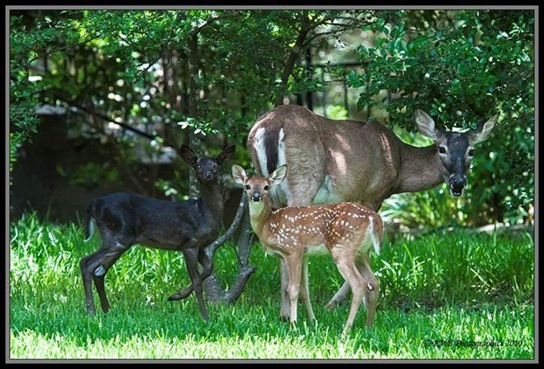
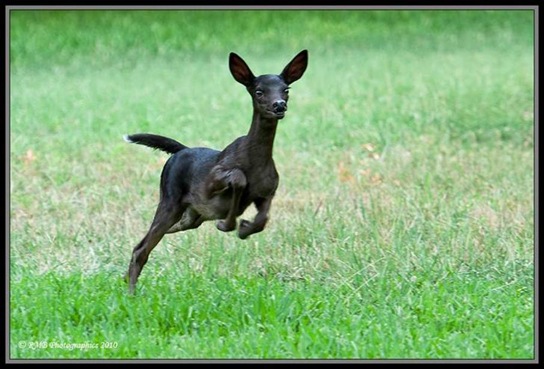
A black deer – unbelievably gorgeous!

All three pictures taken by RJ Verge near Beamsville, Ontario, Canada. Black deer are more rare than albinos.

Deer1

oooo

deer2

oooo

deer3

oooo

For all animal lovers a rare and beautiful set of pictures.

ooOOoo

Now three ‘nanosecond’ pictures sent to me by John Hurlburt.

nano3

oooo

nano10a

oooo

nano12

oooo

More of these another Sunday.

ooOOoo

Finally, one from a great set that Dan Gomez sent me.

Dan1

ooOOoo

More from Dan and John over the coming Sundays.

The genuine you!

Do you or I know you or I?

OK, I accept that the sub-heading is slightly provocative but so what!

The fascination in truly knowing who we are is endless!

Back in January of this year, I penned an essay under the title of 20:20 self-awareness.  Here’s a snippet from that post:

The single biggest problem in communication is the illusion that it has taken place.” George Bernard Shaw is reputed to have once said!

Today’s essay on the challenges of speaking clearly to another, perhaps better described as communicating in a clear and unambiguous fashion, came out of a recent conversation with Jon Lavin, a good friend from my Devon days.  (Jon offers services for business owners and entrepreneurs under his business banner of The People Workshop.)

Jon was explaining that the number one hurdle for businesses that are managing change, and for so many businesses managing change is practically a constant, is having clear communications within the team.

The essence of that, and other posts over the years, is that knowing others, communicating with others, is so much easier when we know ourself well.

Not just relevant to us humans, by the way.  Dogs love knowing us sufficiently well that they can trust and understand our behaviours.

So all of that is an introduction to an article that was recently on the website of London-based Harley Therapy. The article is called How to Be Your Authentic Self. I have taken the liberty of republishing it in full here on Learning from Dogs. (See copyright statement at the end.)

ooOOoo

It’s a little after 6am.

I awoke this morning with the terrible realisation that I didn’t have permission to republish that article and, therefore, have ‘amended’ today’s post and removed the item..

Apologies to my readers.

Paul.

Not seeing the wood for the trees!

A postscript to the last two days.

This week is taking on a life of it’s own, so far as Learning from Dogs is concerned!

For when I penned Monday’s post, Running on Empty, I had not yet read George Monbiot’s essay Are We Bothered?. When I did so, it struck me as the perfect sequel to Monday’s post and formed the crux of yesterday’s post The nature of delusions.  That second post also included a personal account of my delusion with regard to ocean sailing and seemed sufficiently wordy not to be extended by my further reflections.

Thus the decision to run over to a third day!

Let me offer, first of all, my own reflections to George Monbiot’s concerns. That I distill, using his words, to: “The more we consume, the less we care about the living planet.” Expanded in his concluding paragraph:

So the perennially low level of concern, which flickers upwards momentarily when disaster strikes, then slumps back into the customary stupor, is an almost inevitable result of a society that has become restructured around shopping, fashion, celebrity and an obsession with money. How we break the circle and wake people out of this dreamworld is the question that all those who love the living planet should address. There will be no easy answers.

When I first read Mr. Monbiot’s essay, I found myself nodding in agreement. Yet, upon further reflection, I became less sure that “a society that has become restructured around shopping, fashion, celebrity and an obsession with money.” was the core of the issue.  I think it is a symptom.

Stay with me awhile I take a small deviation. To dogs, and other animals.

Many creatures have a powerful and instinctive means of assessing danger.  One only needs to observe the wild black-tailed deer that frequent our property to know that the slightest hint of danger or the unknown has them dashing away to safety.

A young black-tailed deer seen at home last September.

Dogs are the same in that they will run early on from a danger.

Humans also have the propensity to be cautious about a clear and present danger.  However, it’s my proposition that when the danger is unclear and when that danger threatens the very essence of who we are and the world that we have constructed around us, we can be blind to the point of madness. I can think of many examples in support of that thesis and I’m sure you can too.

Yes, we have “a society that has become restructured around shopping, fashion, celebrity and an obsession with money.” But I contend only because of the power of capitalism, of the power of modern marketing and advertising and the allure of being ‘one of the crowd’.

So back to my proposition.  It is this.

That when our lives are threatened by something unclear, complex and, ultimately, of devastating impact, we are very reluctant to embrace it and even more reluctant to both embrace it and escape to safety; whatever the latter implies.

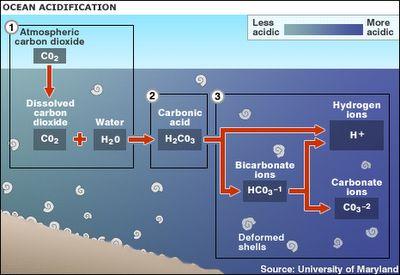
Mankind’s effect on the environment, the rising CO2 levels in the atmosphere, the increasing acidification of the oceans, the growing concerns about global weather, and on and on, are the most unclear, the most complex and the most devastating of futures to embrace.

(Thanks to Patrice for using this recently.)
(Thanks to Patrice for referring to this recently.)

So it really is no surprise to see mankind in general behaving as though this is a bit of a hangover, and an aspirin and a good night’s sleep will sort it! Especially when there is so much money and control invested in selling the same message; the message that there really is nothing to worry about.

There will be a so-called ‘tipping point’. A point in our awareness where the urgency to prevent the destruction of the biosphere will be paramount. And it will be a miracle if when that point arrives it isn’t far too late to save us.

I truly hope that I am wrong.

oooo

Remember what I wrote in yesterday’s post? About experiencing an Atlantic gale?

Fewer than 48-hours before my estimate of coming into Horta Marina on the Azores island of Faial, Songbird of Kent was struck by an early, fierce Winter gale. I seem to recall it was touching Force 10 Beaufort Scale (54 – 63 mph or 48 – 55 knots).

Anyway, it just about finished me off: literally as well as psychologically! I was so frightened, so utterly scared that I could think of nothing else other than getting to Horta and never going sailing again.

It revealed my delusion!

That was my ‘tipping point’ when it came to ocean sailing.

The gale subsided and I motor-sailed the 150-odd miles to Horta without any break for sleep or rest. Came into the harbour early in the morning after the second night since the gale. As soon as I was securely berthed, I closed the boat up and found a local hotel where a hot shower and a clean bed could restore a part of me.

Within a week, I had engaged a crew to sail the boat to Plymouth in South-West England and I flew back to England on a commercial airline.

Once Songbird of Kent arrived at Plymouth, she was put up for sale at a price that wouldn’t delay matters and that was that!

Oh, and I have never read any more books about single-handed ocean sailing. (But see my P.S.!)

oooo

P.S.

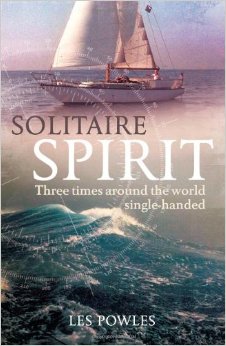
In yesterday’s post, I referred to Les Powells. Remember when I was in Larnaca, Cyprus? This is what I wrote:

Living on a boat close to me was Les Powles. Many will not have heard of Les but this quiet, softly-spoken man knows a thing or two about solo ocean sailing. As an article in The Guardian newspaper explained (in part):

In the 1980s and 90s a British man called Les Powles sailed three times round the world – always single-handedly, once non-stop. He couldn’t afford a radio transmitter, and on his greatest adventure he didn’t speak to anyone for 329 days. At 84, his ­circumnavigating days are now behind him, but he still lives on his boat, the Solitaire. What’s the ­appeal of sailing, I asked him. “It’s the solitude. When you’re out at sea on your own, there’s no government or bankers to worry about. You’re not ­responsible to anyone but yourself.”

Three times around the world – solo!

Thus getting to know Les was a great inspiration in getting me over the hurdle of can I really do this! (Les once said to me “the first three days are the worst!”)

Anyway, I have discovered that Les is living happily on his boat in Lymington, England and has written a book about his sailing life.

Les Powells book

It has been ordered and arrives today. This one will be read – from the comfort and safety of our rural home in Oregon!

The nature of delusions.

Sometimes the truth isn’t so obvious!

Yesterday, I wrote a post under the title of Running on empty!  I listed just a few recent items that had left me feeling very dispirited.  Trust me, not a familiar place!

I also raised the question ……

All of this is sending out a message. The message that if we are not very, very careful this could be the end-game for human civilisation on this Planet.

But do you know what really puzzles me?

It’s that this message is increasingly one that meets with nods of approval and words of agreement from more and more people that one sees going about one’s normal life.

…… then didn’t expand on what was puzzling me!

Let me come at this again; in full!

But do you know what really puzzles me?  It is the terrible lethargy across so many societies. The lack of any substantial social and political force for change. Especially, when so many scientists involved in climate research are warning we are leaving it dangerously late.

I’m no psychologist; far from it. But I want to recount a true story that gave me an insight into one of my own delusions.  Please stay with me because it does have a message at the end of it! 😉

oooo

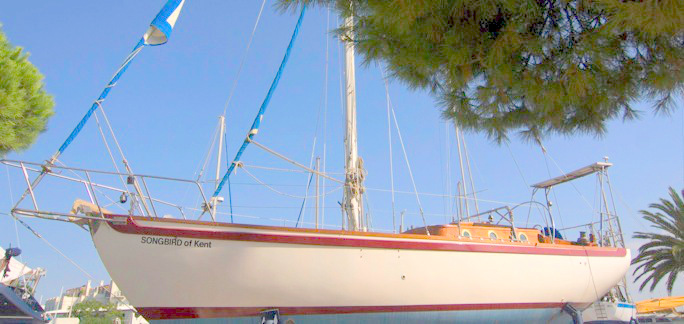
Many years ago, I spent 5 years living on a boat in Larnaca in Cyprus.  My boat was a wonderful heavy-displacement ocean-going yacht.  A type known as a Tradewind 33.  Here is a picture of my boat.

Tradewind 33 - Songbird of Kent.
Tradewind 33 – Songbird of Kent.

For years I had devoured all the books written by the great yacht sailors who had sailed the oceans, many of them completing solo circumnavigations of the world.  Part of me wanted to sail the oceans.

Living on a boat close to me was Les Powles.  Many will not have heard of Les but this quiet, softly-spoken man knows a thing or two about solo ocean sailing. As an article in The Guardian newspaper explained (in part):

In the 1980s and 90s a British man called Les Powles sailed three times round the world – always single-handedly, once non-stop. He couldn’t afford a radio transmitter, and on his greatest adventure he didn’t speak to anyone for 329 days. At 84, his ­circumnavigating days are now behind him, but he still lives on his boat, the Solitaire. What’s the ­appeal of sailing, I asked him. “It’s the solitude. When you’re out at sea on your own, there’s no government or bankers to worry about. You’re not ­responsible to anyone but yourself.”

Three times around the world – solo!

Thus getting to know Les was a great inspiration in getting me over the hurdle of can I really do this!  (Les once said to me “the first three days are the worst!”)

Thus it came about that I departed Larnaca and worked my way Westwards along the Mediterranean, eventually arriving in Gibraltar.  After a few days getting ‘Songbird’ ready for my first ocean leg, Gibraltar to the Azores, I took a deep breath and headed West out into the Atlantic Ocean. Frankly, I was a tad too late to be starting out but the thought of spending a Winter in and around Gibraltar was too much to contemplate and, anyway, it was only 8 or 9 days sailing to the Azores; a distance of 1,125 land miles or 980 nautical miles.

Fewer than 48-hours before my estimate of coming into Horta Marina on the Azores island of Faial, Songbird of Kent was struck by an early, fierce Winter gale.  I seem to recall it was touching Force 10 Beaufort Scale (54 – 63 mph or 48 – 55 knots).

Anyway, it just about finished me off: literally as well as psychologically! I was so frightened, so utterly scared that I could think of nothing else other than getting to Horta and never going sailing again.

It revealed my delusion!

It proved that I had been in love with the courageousness of those many ocean sailors that I had read about. In love with the idea of a solo Atlantic crossing and being seen as a courageous hero. But, in truth, utterly in denial about what ocean sailing was really about!

So with the theme of delusion in your head, have a read of a recent post by George Monbiot. The post is called Are We Bothered? It is republished with the kind permission of George.

ooOOoo

Are We Bothered?

May 16, 2014

The more we consume, the less we care about the living planet.

By George Monbiot, published on the Guardian’s website, 9th May 2014

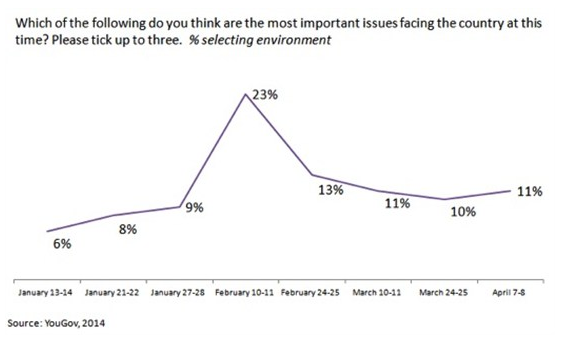
That didn’t take long. The public interest in the state of the natural world stimulated by the winter floods receded almost as quickly as the waters did. A YouGov poll showed that the number of respondents placing the environment among their top three issues of concern rose from 6% in mid-January to 23% in mid-February. By early April – though the Intergovernmental Panel on Climate Change had just published two massive and horrifying reports – the proportion had fallen back to 11%.

CarbonBrief has plotted the results on this graph:

GM1

Sustaining interest in this great but slow-burning crisis is a challenge no one seems to have mastered. Only when the crisis causes or exacerbates an acute disaster – such as the floods – is there a flicker of anxiety, but that quickly dies away.

Why is it so difficult to persuade people to care about our wonderful planet, the world that gave rise to us and upon which we wholly depend? And why do you encounter a barrage of hostility and denial whenever you attempt it (and not only from the professional liars who are paid by coal and oil and timber companies to sow confusion and channel hatred)?

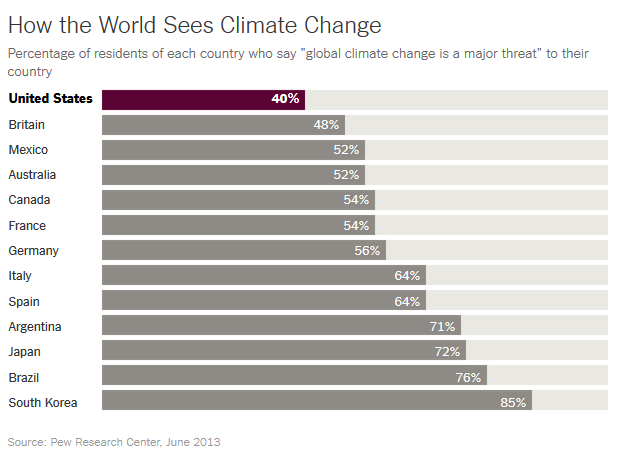
The first thing to note, in trying to answer this question, is that the rich anglophone countries are anomalous. In this bar chart (copied from the website of the New York Times) you can see how atypical the attitudes of people in the US and the UK are. Because almost everything we read in this country is published in rich, English-speaking nations, we might get the false impression that the world doesn’t care very much.

GM2

This belief is likely to be reinforced by the cherished notion that we lead the world in knowledge, sophistication and compassion. The bar chart puts me in mind of the famous quote perhaps mistakenly attributed to Gandhi. When asked by a journalist during a visit to Britain, “What do you think of Western civilization?”, he’s reputed to have replied, “I think it would be a good idea.”

Our erroneous belief that we are more concerned about manmade climate change than the people of other nations informs the sentiment, often voiced by the press and politicians, that there’s no point in acting if the rest of the world won’t play its part. For example, last year the Chancellor, George Osborne, remarked:

“I don’t want us to be the only people out there in front of the rest of the world. I certainly think we shouldn’t be further ahead of our partners in Europe.”

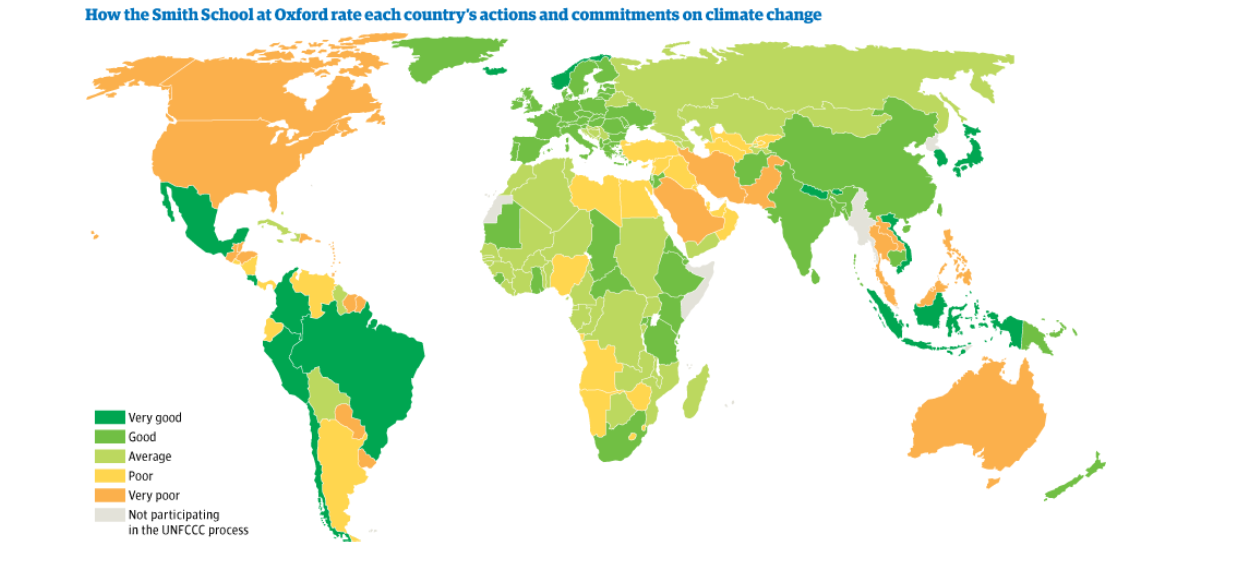
But we’re not “the only people out there in front of the rest of the world.” In fact we’re not in front at all. As this map produced by Oxford University’s Smith School suggests, we are some way behind not only some other rich nations but also a number of countries much poorer than ours.

GM3

As for the US, Australia and Canada, they are ranked among the worst of all: comprehensively failing to limit their massive contribution to a global problem. We justify our foot-dragging with a mistaken premise. Our refusal to stop pumping so much carbon dioxide into the atmosphere is pure selfishness.

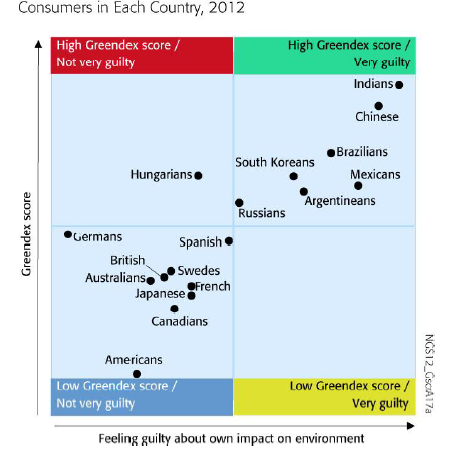
Both the map and the bar chart overlap to some degree with the fascinating results of the Greendex survey of consumer attitudes.

For years we’ve been told that people cannot afford to care about the natural world until they become rich; that only economic growth can save the biosphere, that civilisation marches towards enlightenment about our impacts on the living planet. The results suggest the opposite.

As you can see from the following graph, the people consulted in poorer countries feel, on average, much guiltier about their impacts on the natural world than people in rich countries, even though those impacts tend to be smaller. Of the nations surveyed, the people of Germany, the US, Australia and Britain feel the least consumer guilt; the people of India, China, Mexico and Brazil the most.

GM4

The more we consume, the less we feel. And maybe that doesn’t just apply to guilt.

Perhaps that’s the point of our otherwise-pointless hyperconsumption: it smothers feeling. It might also be the effect of the constant bombardment of advertising and marketing. They seek to replace our attachments to people and place with attachments to objects: attachments which the next round of advertising then breaks in the hope of attaching us to a different set of objects.

The richer we are and the more we consume, the more self-centred and careless of the lives of others we appear to become. Even if you somehow put aside the direct, physical impacts of rising consumption, it’s hard to understand how anyone could imagine that economic growth is a formula for protecting the planet.

So what we seem to see here is the turning of a vicious circle. The more harm we do, the less concerned about it we become. And the more hyperconsumerism destroys relationships, communities and the physical fabric of the Earth, the more we try to fill the void in our lives by buying more stuff.

All this is accompanied in the rich anglophone nations with the extreme neoliberalism promoted by both press and politicians, and a great concentration of power in the hands of the financial and fossil fuel sectors, which lobby hard, in the public sphere and in private, to prevent change.

So the perennially low level of concern, which flickers upwards momentarily when disaster strikes, then slumps back into the customary stupor, is an almost inevitable result of a society that has become restructured around shopping, fashion, celebrity and an obsession with money. How we break the circle and wake people out of this dreamworld is the question that all those who love the living planet should address. There will be no easy answers.

http://www.monbiot.com

ooOOoo

Tomorrow I will offer my own reflection on all of this – and finish off the story of me and ocean sailing!