President John F. Kennedy's May 25, 1961 Speech before a Joint Session of Congress
On the 25th May, 1961, President John Kennedy summoned a joint session of Congress and asked America to commit itself to a goal – that of landing a man on the moon and returning him safely to Earth before the decade was out.
There’s a good link on the NASA site to the speech.
MY print column this week notes that it is half a century next week since John Kennedy called for sending a man to the moon and returning him safely to Earth. The bottom line, I think:
If we can send a man to the moon, people ask, why can’t we [fill in the blank]? Lyndon Johnson tried to build a “great society”, but America is better at aeronautical engineering than social engineering. Mr Obama, pointing to competition from China, invokes a new “Sputnik moment” to justify bigger public investment in technology and infrastructure. It should not be a surprise that his appeals have gone unheeded. Putting a man on the moon was a brilliant achievement. But in some ways it was peculiarly un-American—almost, you might say, an aberration born out of the unique circumstances of the cold war. It is a reason to look back with pride, but not a pointer to the future.
55:55:20 – Swigert: “Okay, Houston, we’ve had a problem here.”
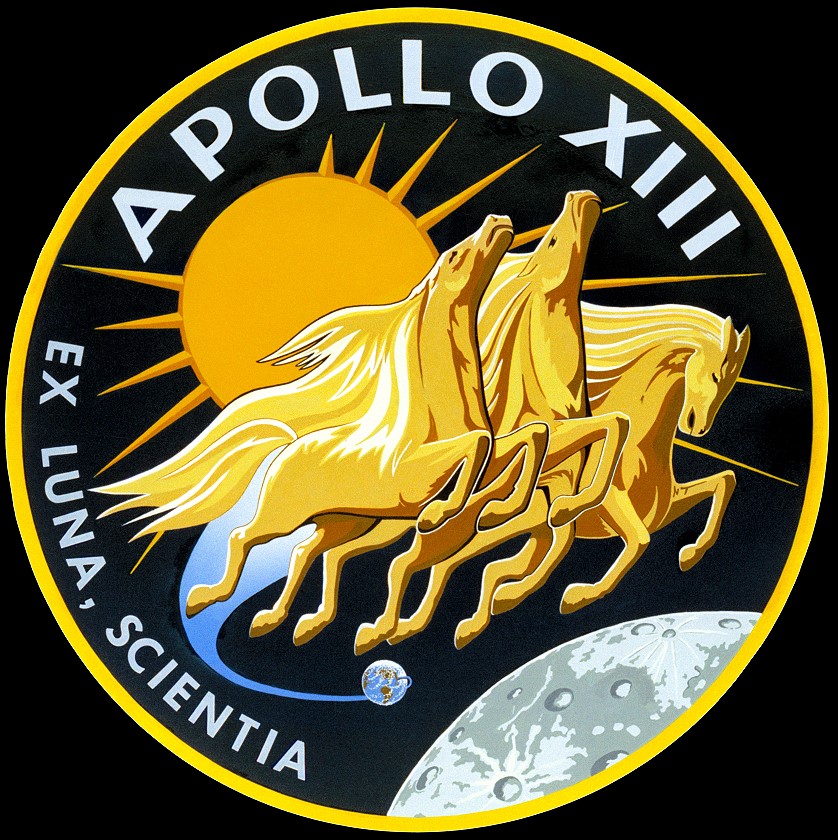
Apollo 13
Probably one of the most famous phrases from the whole Apollo program, these immortal words were uttered shortly before 10.10 PM EST on April 13th, 1970.
There is so much material around that it would be pointless covering too much ground in this Post. So why the Post today?
Because today, too, is the 13th April. So on this day, 41 years ago, the world came together held its collective breath and prayed for a successful outcome to this scary disaster.
There are some wonderful archives around from NASA. Here’s one that covers the chronology of events of that famous accident.
The following includes events from 2.5 minutes before the accident to about 5 minutes after. Times given are in Ground Elapsed Time (G.E.T.), that is, the time elapsed since liftoff of Apollo 13 on April 11, 1970, at 2:13 PM Eastern Standard Time (EST). 55:52:00 G.E.T. is equal to 10:05 PM EST on April 13, 1970.
Also, those who want more information, may wish to go here, here and here
And 41 years ago, this coming Sunday, i.e. April 17th 1970, with the whole world praying for their safe return, Apollo 13 splashed down near Samoa.
Four hours before landing, the crew shed the service module; Mission Control had insisted on retaining it until then because everyone feared what the cold of space might do to the unsheltered CM heat shield. Photos of the Service Module showed one whole panel missing, and wreckage hanging out, it was a sorry mess as it drifted away. Three hours later the crew left the Lunar Module Aquarius and then splashed down gently in the Pacific Ocean near Samoa. From here.
In a very real sense, Apollo 13, like a number of the other historic Apollo flights, is a wonderful reminder of something that this Planet needs right now. A coming together of all the peoples of this beautiful planet, a unity of mankind, to remind us in these fragile and difficult times of the saying, ‘United we stand, divided we fall.’
Finally, this Post is published, not only on the 41st anniversary of that memorable Apollo Flight but the day after the 50th anniversary of Yuri Gagarin’s first flight of a human into space, the 12th April, 1961.
I have referred yesterday to the series on the BBC hosted by Professor Brian Cox called Wonders of the Universe. Well we managed to watch the last episode last night, entitled Messengers. Like the other three episodes, it was breath-taking.
In this last episode, Prof. Cox speaks of the universe still expanding with the outer edge, if edge is the appropriate word, being about 8.7 billion light years away. Thus the age of the Universe is about that; 8.7 billion light years. Note: NASA has a piece that suggests that this figure may not be confirmed. But let’s not worry too much about the precise value. But we will take a short detour to understand a little more about the ‘light year’.
So to measure really long distances, people use a unit called alight year. Light travels at 186,000 miles per second (300,000 kilometers per second). Therefore, a light second is 186,000 miles (300,000 kilometers). A light year is the distance that light can travel in a year, or:
A light year is 5,865,696,000,000 miles (9,460,800,000,000 kilometers). That’s a long way!
That is a single light-year. Now reflect on the outer edge of the universe being, say, 8,700,000,000 multiplied by 5,865,696,000,000 miles away. Don’t know about your mind, but my mind has no ‘feel’ for that distance whatsoever.
OK, next proposition put forward by Prof. Cox. That is that scientists believe that ‘The Big Bang’ was the instant that the universe erupted, if that’s an appropriate word, from a single point, smaller than the size of a grain of sand.
That has no rational meaning whatsoever. Now my mind just goes into la, la land! But at the level of magic, mysticism, the spiritual, then one does experience the deep meaning of the creation. Our creation. For we are part of the universe and the universe is part of us.
Just like the rose. Trying to describe it cuts nothing compared to closing one’s eyes and simply breathing in the perfume.
Here is that last episode, in four parts from YouTube. Watch and prepared to be transformed.
MISH’s website pointed me to the website Space.com where there was this interesting reflection.
The massive earthquake that struck northeast Japan Friday (March 11) has shortened the length Earth’s day by a fraction and shifted how the planet’s mass is distributed.
A new analysis of the 8.9-magnitude earthquake in Japan has found that the intense temblor has accelerated Earth’s spin, shortening the length of the 24-hour day by 1.8 microseconds, according to geophysicist Richard Gross at NASA’s Jet Propulsion Laboratory in Pasadena, Calif.
Gross refined his estimates of the Japan quake’s impact – which previously suggested a 1.6-microsecond shortening of the day – based on new data on how much the fault that triggered the earthquake slipped to redistribute the planet’s mass. A microsecond is a millionth of a second.
“By changing the distribution of the Earth’s mass, the Japanese earthquake should have caused the Earth to rotate a bit faster, shortening the length of the day by about 1.8 microseconds,” Gross told SPACE.com in an e-mail. More refinements are possible as new information on the earthquake comes to light, he added.
The scenario is similar to that of a figure skater drawing her arms inward during a spin to turn faster on the ice. The closer the mass shift during an earthquake is to the equator, the more it will speed up the spinning Earth.
I was also interested to read in that article more confirmation that the earthquake moved Japan! (I had mentioned it in an earlier post on Learning from Dogs.)
The initial data suggests Friday’s earthquake moved Japan’s main island about 8 feet, according to Kenneth Hudnut of the U.S. Geological Survey. The earthquake also shifted Earth’s figure axis by about 6 1/2 inches (17 centimeters), Gross added.
The Earth’s figure axis is not the same as its north-south axis in space, which it spins around once every day at a speed of about 1,000 mph (1,604 kph). The figure axis is the axis around which the Earth’s mass is balanced and the north-south axis by about 33 feet (10 meters).
“This shift in the position of the figure axis will cause the Earth to wobble a bit differently as it rotates, but will not cause a shift of the Earth’s axis in space – only external forces like the gravitational attraction of the sun, moon, and planets can do that,” Gross said.
So if you are the sort of person that likes to be precisely on time ….. take note!
As many of you know, I wrote a piece last Monday about how close the moon will be to the Earth on the 19th, and some ideas about whether there was a correlation between close full moons and natural disasters.
Well tomorrow is the 19th and I wanted to remind everyone to take time off, be outside and just admire this wondrous object in our night sky.
A reader, thanks Suzann, pointed me to the NASA Science website where there is some good factual information about how special this moon is. From that website, I quote:
Mark your calendar. On March 19th, a full Moon of rare size and beauty will rise in the east at sunset. It’s a super “perigee moon”–the biggest in almost 20 years.
“The last full Moon so big and close to Earth occurred in March of 1993,” says Geoff Chester of the US Naval Observatory in Washington DC. “I’d say it’s worth a look.”
Full Moons vary in size because of the oval shape of the Moon’s orbit. It is an ellipse with one side (perigee) about 50,000 km closer to Earth than the other (apogee): diagram. Nearby perigee moons are about 14% bigger and 30% brighter than lesser moons that occur on the apogee side of the Moon’s orbit.
“The full Moon of March 19th occurs less than one hour away from perigee–a near-perfect coincidence1that happens only 18 years or so,” adds Chester.
A perigee full Moon brings with it extra-high “perigean tides,” but this is nothing to worry about, according to NOAA. In most places, lunar gravity at perigee pulls tide waters only a few centimeters (an inch or so) higher than usual. Local geography can amplify the effect to about 15 centimeters (six inches)–not exactly a great flood.
(The Moon looks extra-big when it is beaming through foreground objects–a.k.a. “the Moon illusion.”)
Indeed, contrary to some reports circulating the Internet, perigee Moons do not trigger natural disasters. The “super moon” of March 1983, for instance, passed without incident. And an almost-super Moon in Dec. 2008 also proved harmless.
Okay, the Moon is 14% bigger than usual, but can you really tell the difference? It’s tricky. There are no rulers floating in the sky to measure lunar diameters. Hanging high overhead with no reference points to provide a sense of scale, one full Moon can seem much like any other.
The best time to look is when the Moon is near the horizon. That is when illusion mixes with reality to produce a truly stunning view. For reasons not fully understood by astronomers or psychologists, low-hanging Moons look unnaturally large when they beam through trees, buildings and other foreground objects. On March 19th, why not let the “Moon illusion” amplify a full Moon that’s extra-big to begin with? The swollen orb rising in the east at sunset may seem so nearby, you can almost reach out and touch it.
Don’t bother. Even a super perigee Moon is still 356,577 km away. That is, it turns out, a distance of rare beauty. Author: Dr. Tony Phillips | Credit: Science@NASA
Footnote: Less-perfect perigee moons occur more often. In 2008, for instance, there was a full Moon four hours from perigee. Many observers thought that one looked great, so the one-hour perigee moon of 2011 should be a real crowd pleaser.
Mixed emotions about those other worlds out there.
In recent times, Learning from Dogs has been reflecting on the magic, and fragility, of the planet we all live on.
There was the photograph of the Earthrise that attracted quite a few comments. That was followed up by the amazing photograph of the Earth from Voyager 1 taken in 1990 from 3,762,136,324 miles away! Then the lovely poem from Sue.
So it was interesting to note my mixed emotions to a piece on the BBC News website yesterday. Here’s a flavour.
Worlds away
Astronomers have identified some 54 new planets where conditions may be suitable for life.
Five of the candidates are Earth-sized.
The announcement from the Kepler space telescope team brings the total number of exoplanet candidates they have identified to more than 1,200.
The data release also confirmed a unique sextet of planets around a single star and 170 further solar systems that include more than one planet circling far-flung stars.
Read the rest of the item here. (and there’s a fuller version on NetworkWorld)
So here are those mixed emotions.
Man has been, and still continues to be, wonderfully curious to the point of spending huge sums of money on projects that appear to do nothing more than satisfy that curiosity. (The (Kepler) mission‘s life-cycle cost is estimated at US$600 million, including funding for 3.5 years of operation, from here.) That’s a beautiful trait, in my humble opinion.
Homo Sapiens is a wonderfully innovative and creative species, as so wonderfully presented by Alan Alda on a recent PBS Programme called The Human Spark. (See the YouTube intro at the end of this Post.)
Look at all the inventions and incredible advances to our species that are all around us – including the PC I am using and the World Wide Web that is aiding this message!
For such an intelligent species as us, why is it that we are treating Planet Earth in such a suicidal manner through greed, pollution and over-consumption!
As was reported yesterday, we could be on the verge of total and utter chaos in terms of food. Then also yesterday was a small item about food prices reaching a new global record.
It always struck me as absurd to conclude that this planet is the only habitable planet in the universe – ‘Astronomers estimate there are 1021 stars in the universe. With a conservative estimate of three planets per star (some could have many more, some would have none at all) this puts the estimated number of planets into millions of billions.‘ From here.
So the data coming in from Kepler is truly astounding and, personally, underlines this era as a great time to be alive.
But there simply is no choice in that for decades ahead, if not centuries ahead, Planet Earth is all there is for us. So why do we do it so much harm!
Our civilisation is likely to go to the very limits of survivability before the message that the existing ‘model’ is broken is picked up by every major political party in the world. That is very, very scary to contemplate.
So it looks as though, soon, mankind will face the ultimate decision of all time. Give up and let the chaos overwhelm us all, or … or what? In other words millions of us will have to live with the consequences of our greed.
The ‘or what?’ can only be a faith that it will be OK.
A faith that mankind will use the power of dreams, imagination and energy to create a new future that will, at long last, be a new dawn of democratic and just, integrous existence.
And maybe, just maybe, that could be the Second Coming and maybe, just maybe, the world’s Churches and religions will be our saving grace.
But of that day and hour knoweth no man, no, not the angels of heaven, but my Father only. Matthew 24:36
Fascinating times – a Chinese proverb, ‘It’s better to be a dog in a peaceful time than be a man in a chaotic period.’
Finally, here’s that video of the series preview to The Human Spark.
Yesterday’s post It’s all we have showing the famous Earthrise picture taken from Apollo 8 generated a lovely follow-up.
One of the comments was from Mike Turner who wrote,
It’s all we have and it’s so insignificant!
The Pale Blue Dot
Mike included a link to an entry on WikiPedia about the tiny, small dot of light in the universe that is Earth, shown in a photograph taken by spaceship Voyager 1 from the edge of the Solar System on February 14th, 1990. Here’s that photograph,
Planet Earth from 3,762,136,324 miles
Can you see our planet home? Earth appears as a tiny dot (the blueish-white speck approximately halfway down the brown band to the right) within the darkness of deep space. In a 2001 article by Space.com, STScI‘s Ray Villard and JPL‘s Jurrie Van der Woude selected this photograph as one of the top ten space science images of all time.
Carl Sagan later wrote about his deep feelings about this photograph. That was almost 20 years ago and, as I reflected just a few days ago, human insanity still seems alive and well; it’s about time that the majority of us recognised the fragility and vulnerability of where we live.
Sagan’s words are reproduced here and should be read by every inhabitant of this planet.
From this distant vantage point, the Earth might not seem of particular interest. But for us, it’s different. Look again at that dot. That’s here, that’s home, that’s us. On it everyone you love, everyone you know, everyone you ever heard of, every human being who ever was, lived out their lives. The aggregate of our joy and suffering, thousands of confident religions, ideologies, and economic doctrines, every hunter and forager, every hero and coward, every creator and destroyer of civilization, every king and peasant, every young couple in love, every mother and father, hopeful child, inventor and explorer, every teacher of morals, every corrupt politician, every “superstar,” every “supreme leader,” every saint and sinner in the history of our species lived there – on a mote of dust suspended in a sunbeam.The Earth is a very small stage in a vast cosmic arena. Think of the rivers of blood spilled by all those generals and emperors so that, in glory and triumph, they could become the momentary masters of a fraction of a dot. Think of the endless cruelties visited by the inhabitants of one corner of this pixel on the scarcely distinguishable inhabitants of some other corner, how frequent their misunderstandings, how eager they are to kill one another, how fervent their hatreds.
Our posturings, our imagined self-importance, the delusion that we have some privileged position in the Universe, are challenged by this point of pale light. Our planet is a lonely speck in the great enveloping cosmic dark. In our obscurity, in all this vastness, there is no hint that help will come from elsewhere to save us from ourselves. [my italics, Ed]
The Earth is the only world known so far to harbor life. There is nowhere else, at least in the near future, to which our species could migrate. Visit, yes. Settle, not yet. Like it or not, for the moment the Earth is where we make our stand.
It has been said that astronomy is a humbling and character-building experience. There is perhaps no better demonstration of the folly of human conceits than this distant image of our tiny world. To me, it underscores our responsibility to deal more kindly with one another, and to preserve and cherish the pale blue dot, the only home we’ve ever known.
A bit tight on time for today’s Post so just feast your eyes on this image.
Earthrise, from the cabin of Apollo 8
This view of the rising Earth greeted the Apollo 8 astronauts as they came from behind the Moon after the lunar orbit insertion burn. The photo is displayed here in its original orientation, though it is more commonly viewed with the lunar surface at the bottom of the photo. Earth is about five degrees left of the horizon in the photo. The unnamed surface features on the left are near the eastern limb of the Moon as viewed from Earth. The lunar horizon is approximately 780 kilometers from the spacecraft. Height of the photographed area at the lunar horizon is about 175 kilometers.
The Apollo 8 mission was the first time man had left the orbit of the Earth.
The photograph was taken on the 24th December 1968 by NASA astronaut William Anders. Within 18 months of this image being published, the environmental movement had started. Wilderness photographer Galen Rowell called it “the most influential environmental photograph ever taken.”
If you want to see this solar eclipse then read the times carefully – to assist, I am publishing this Post much earlier than normal, at 18:00 US Mountain Time (UTC -7hrs) on Monday, 20th December. Oh, and more information at Spacedex here.
Dec. 17, 2010: Everyone knows that “the moon on the breast of new-fallen snow gives the luster of mid-day to objects below.”
That is, except during a lunar eclipse.
The luster will be a bit “off” on Dec. 21st, the first day of northern winter, when the full Moon passes almost dead-center through
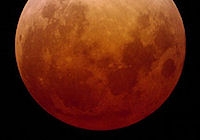
A similar lunar eclipse in Nov. 2003. Credit: Jim Fakatselis.
Earth’s shadow. For 72 minutes of eerie totality, an amber light will play across the snows of North America, throwing landscapes into an unusual state of ruddy shadow.
The eclipse begins on Tuesday morning, Dec. 21st, at 1:33 am EST (Monday, Dec. 20th, at 10:33 pm PST). At that time, Earth’s shadow will appear as a dark-red bite at the edge of the lunar disk. It takes about an hour for the “bite” to expand and swallow the entire Moon. Totality commences at 02:41 am EST (11:41 pm PST) and lasts for 72 minutes.
If you’re planning to dash out for only one quick look — it is December, after all — choose this moment: 03:17 am EST (17 minutes past midnight PST). That’s when the Moon will be in deepest shadow, displaying the most fantastic shades of coppery red.
Credit: F. Espenak, NASA/GSFC.
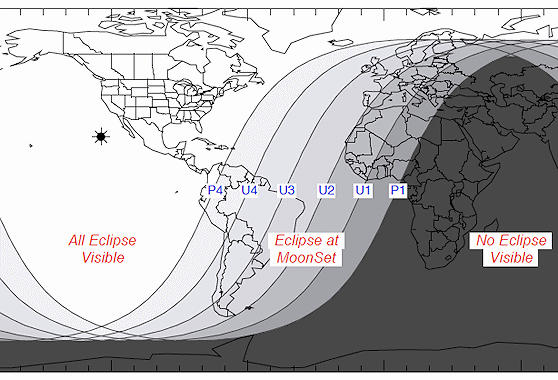
From first to last bite, the eclipse favors observers in North America. The entire event can be seen from all points on the continent. Click to view a world map of visibility circumstances. Credit: F. Espenak, NASA/GSFC.
Why red?
A quick trip to the Moon provides the answer: Imagine yourself standing on a dusty lunar plain looking up at the sky. Overhead hangs Earth, nightside down, completely hiding the sun behind it. The eclipse is underway. You might expect Earth seen in this way to be utterly dark, but it’s not. The rim of the planet is on fire! As you scan your eye around Earth’s circumference, you’re seeing every sunrise and every sunset in the world, all of them, all at once. This incredible light beams into the heart of Earth’s shadow, filling it with a coppery glow and transforming the Moon into a great red orb.
Back on Earth, the shadowed Moon paints newly fallen snow with unfamiliar colors–not much luster, but lots of beauty.
Enjoy the show.
Coincidences (UPDATED): This lunar eclipse falls on the date of the northern winter solstice. How rare is that? Total lunar eclipses in northern winter are fairly common. There have been three of them in the past ten years alone. A lunar eclipse smack-dab on the date of the solstice, however, is unusual. Geoff Chester of the US Naval Observatory inspected a list of eclipses going back 2000 years. “Since Year 1, I can only find one previous instance of an eclipse matching the same calendar date as the solstice, and that is 1638 DEC 21,” says Chester. “Fortunately we won’t have to wait 372 years for the next one…that will be on 2094 DEC 21.“
There is so much information around us these days that it’s easy to forget how incredibly advantaged are those today that wish to learn about everything and anything. It was just such a meander around the internet that brought me to a website called Science Daily, a wonderful daily digest of top science news items.
And a browse through that web site brought me to this piece on the creation of the very first stars in the universe.
June 1, 2007 — Astronomers removed light from closer and better known galaxies and stars from pictures taken with the Spitzer Space Telescope. The remaining images are believed to be the first objects in space, 13 billion light years away.
The first stars in our universe are long gone, but their light still shines, giving us a peek at what the universe looked like in its early years.
Astrophysicists believe they’ve spotted a faint glow from stars born at the beginning of time. Harvey Moseley, Ph.D., an astrophysicist at the NASA Goddard Space Flight Center in Greenbelt, Maryland, says, “The reason they’re faint is just because they’re very, very far away, they’re over at the far edge of the universe.”
I don’t know about you but I find this so deeply inspiring – a reminder of the instinctive nature of man to enquire and explore. And it is this exploratory instinct that will pull us all through from the challenges that we all face today.
Anyway, I’m wandering off the subject!
Do read the piece in full here and then watch the following video from Avi Loeb.
Oh, want to know how far 13 billion light years is? Brace yourself!
Light travels at 186,000 miles per second or more properly expressed 299,792.458 km/sec. See here. (Brilliant website by the way) That is 10 trillion kilometres a year.
So 13 billion light years is simply! 10 trillion multiplied by 13 billion kilometres. Anyone got a larger calculator?



 Learning from Dogs
