Tag: NASA

Solstice Lunar Eclipse

(Again, thanks to Dan G for highlighting this.)

If you want to see this solar eclipse then read the times carefully – to assist, I am publishing this Post much earlier than normal, at 18:00 US Mountain Time (UTC -7hrs) on Monday, 20th December.  Oh, and more information at Spacedex here.

SOLSTICE LUNAR ECLIPSE
by Dr. Tony Phillips
Reprinted from http://science.nasa.gov ( but this link address is better. Ed.)

Dec. 17, 2010:  Everyone knows that “the moon on the breast of new-fallen snow gives the luster of mid-day to objects below.”

That is, except during a lunar eclipse.

The luster will be a bit “off” on Dec. 21st, the first day of northern winter, when the full Moon passes almost dead-center through
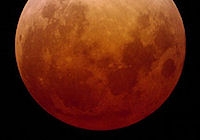
A similar lunar eclipse in Nov. 2003. Credit: Jim Fakatselis.

Earth’s shadow. For 72 minutes of eerie totality, an amber light will play across the snows of North America, throwing landscapes into an unusual state of ruddy shadow.

The eclipse begins on Tuesday morning, Dec. 21st, at 1:33 am EST (Monday, Dec. 20th, at 10:33 pm PST). At that time, Earth’s shadow will appear as a dark-red bite at the edge of the lunar disk. It takes about an hour for the “bite” to expand and swallow the entire Moon. Totality commences at 02:41 am EST (11:41 pm PST) and lasts for 72 minutes.

If you’re planning to dash out for only one quick look — it is December, after all — choose this moment: 03:17 am EST (17 minutes past midnight PST). That’s when the Moon will be in deepest shadow, displaying the most fantastic shades of coppery red.
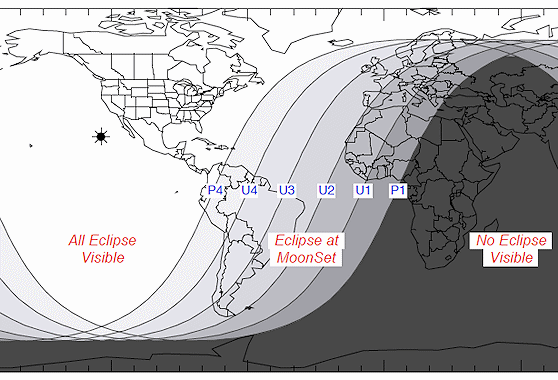
Credit: F. Espenak, NASA/GSFC.

From first to last bite, the eclipse favors observers in North America. The entire event can be seen from all points on the continent. Click to view a world map of visibility circumstances. Credit: F. Espenak, NASA/GSFC.

Why red?

A quick trip to the Moon provides the answer: Imagine yourself standing on a dusty lunar plain looking up at the sky. Overhead hangs Earth, nightside down, completely hiding the sun behind it. The eclipse is underway. You might expect Earth seen in this way to be utterly dark, but it’s not. The rim of the planet is on fire! As you scan your eye around Earth’s circumference, you’re seeing every sunrise and every sunset in the world, all of them, all at once. This incredible light beams into the heart of Earth’s shadow, filling it with a coppery glow and transforming the Moon into a great red orb.

Back on Earth, the shadowed Moon paints newly fallen snow with unfamiliar colors–not much luster, but lots of beauty.

Enjoy the show.

Coincidences (UPDATED): This lunar eclipse falls on the date of the northern winter solstice. How rare is that? Total lunar eclipses in northern winter are fairly common. There have been three of them in the past ten years alone. A lunar eclipse smack-dab on the date of the solstice, however, is unusual. Geoff Chester of the US Naval Observatory inspected a list of eclipses going back 2000 years. “Since Year 1, I can only find one previous instance of an eclipse matching the same calendar date as the solstice, and that is 1638 DEC 21,” says Chester. “Fortunately we won’t have to wait 372 years for the next one…that will be on 2094 DEC 21.“
It almost goes on for ever.

The almost everlasting heavens above us.

There is so much information around us these days that it’s easy to forget how incredibly advantaged are those today that wish to learn about everything and anything.  It was just such a meander around the internet that brought me to a website called Science Daily, a wonderful daily digest of top science news items.

And a browse through that web site brought me to this piece on the creation of the very first stars in the universe.

June 1, 2007 — Astronomers removed light from closer and better known galaxies and stars from pictures taken with the Spitzer Space Telescope. The remaining images are believed to be the first objects in space, 13 billion light years away.

The first stars in our universe are long gone, but their light still shines, giving us a peek at what the universe looked like in its early years.

Astrophysicists believe they’ve spotted a faint glow from stars born at the beginning of time. Harvey Moseley, Ph.D., an astrophysicist at the NASA Goddard Space Flight Center in Greenbelt, Maryland, says, “The reason they’re faint is just because they’re very, very far away, they’re over at the far edge of the universe.”

I don’t know about you but I find this so deeply inspiring – a reminder of the instinctive nature of man to enquire and explore.  And it is this exploratory instinct that will pull us all through from the challenges that we all face today.

Anyway, I’m wandering off the subject!

Do read the piece in full here and then watch the following video from Avi Loeb.

Oh, want to know how far 13 billion light years is?  Brace yourself!

Light travels at 186,000 miles per second or more properly expressed 299,792.458 km/sec.  See here.  (Brilliant website by the way) That is 10 trillion kilometres a year.

So 13 billion light years is simply! 10 trillion multiplied by 13 billion kilometres.  Anyone got a larger calculator?

By Paul Handover

To the heavens

Life is about journeys – here’s a spectacular example

Yesterday while I was travelling the 5,450 flight miles between London Heathrow and Los Angeles airports, another marvel of flight technology approached a small lump of rock far out in space.  I speaking of NASA’s Deep Impact/EPOXI spacecraft passing within 450 miles of the Comet Hartley 2.

“There are billions of comets in the solar system, but this will be only the fifth time a spacecraft has flown close enough to one to snap pictures of its nucleus,” says Lori Feaga of the EPOXI science team. “This one should put on quite a show!”

Cometary orbits tend to be highly elongated; they travel far from the sun and then swing much closer. At encounter time, Hartley 2 will be nearing the sun and warming up after its cold, deep space sojourn. The ices in its nucleus will be vaporizing furiously – spitting dust and spouting gaseous jets.

“Hartley 2’s nucleus is small, less than a mile in diameter,” says Feaga. “But its surface offgasses at a higher rate than nuclei we’ve seen before. We expect more jets and outbursts from this one.”

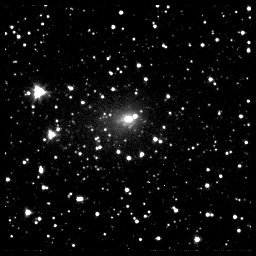
The EPOXI Mission website is here, from which has been selected this photograph of the Comet.

The details of this photograph are:

Caption: This EPOXI mission image of comet 103P/Hartley 2 was taken 34 days from Encounter (E-34d) using the Medium Resolution Instrument (MRI) and a clear filter. Science Team member Dr. Dennis Wellnitz combined three successive one-minute exposures to make this single image. The mid-exposure time was 2010/10/01 16:22:51 UTC. The comet was 1.12 AU from the Sun and 0.23 AU (35 million km) from the spacecraft.

Of course, when this Post is published, automagically, you will have to go onto the mission website to see the very latest information.

I will be more interested in catching a South-West airline flight into Phoenix.

By Paul Handover

The entombed Chilean miners

Advice and support includes NASA

The BBC reported last Wednesday (1st) the fact that NASA are now advising the Chilean authorities with regard to the trapped miners.

At first, I did a double-take.  NASA?  Why?

But, of course, it make complete sense.  Astronauts clearly have had to face the most extreme form of loneliness – that of being alone in outer space.

Here’s an extract from that BBC piece, which has been widely reported elsewhere:

A team of Nasa experts advised officials to be honest with the miners and not to give them “false hopes”.

The miners, who are 700m (2,300ft) underground, have been told it could take a long time to get them out of the San Jose mine, but have not been given dates.

The Nasa team, which includes a doctor, nutritionist, and engineer and a psychologist, arrived in Santiago after a request by the Chilean authorities. They are due to travel to the mine site on Wednesday.

All we can do is to keep these miners in our minds and hearts.

By Paul Handover

Night shining clouds

Better known as Noctilucent Clouds

(Hoping this link is still available on the BBC web site)

Just watch this and be inspired!

From that BBC link:

Each summer, high in the night skies of the far northern and southern hemispheres a unique phenonmenon occurs – noctilucent clouds. Little is known about them, but now an amateur astronomer from north Wales is trying to predict when they are likely to appear.

Here, John Rowlands, one of four finalists in the BBC’s search for the Amateur Scientist of the Year So You Want To Be A Scientist? – and his mentor, Professor Nick Mitchell from the University of Bath – take a closer look at these mysterious silver and blue waves at the edge of space.

John has his own Facebook page here with plenty more information.

And a quick Google images search found this:

Noctilucent clouds

And there’s still more. This delightful video on YouTube, courtesy of NASA.

Described thus:

The Aeronomy of Ice in the Mesosphere (AIM) mission will provide the first detailed exploration of Earth’s unique and elusive noctilucent or night shining clouds that are found literally on the “edge of space.” Located near the top of the Earth’s mesosphere (the region just above the stratosphere), very little is known about how these polar mesospheric clouds form or why they vary. They are being seen at lower latitudes than ever before and have been growing brighter and more frequent, leading some scientists to suggest that this recent increase may be the direct result of human-induced climate change. The mission is led by Dr. James Russell of the Center for Atmospheric Sciences at Hampton University.

By Paul Handover

(with thanks to the UK Flyer List for bringing this to my attention.)

Happy Birthday, Hubble!

The Hubble Space Telescope (HST) has been in space for 20 years!

This week, twenty years ago, the HST was launched into orbit.  There’s much online if you want to read about it both on WikiPedia and on the Hubble web site so this post is going to offer just two items.

A beautiful picture

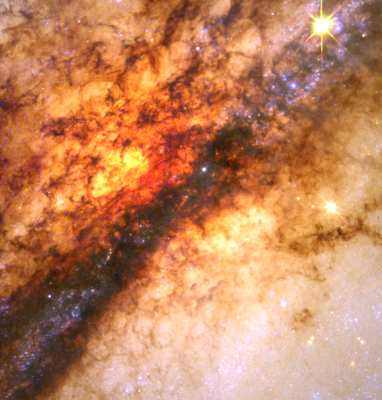
Nucleus of Galaxy Centaurus A

And an interesting audio slideshow tribute from the BBC – click here, introduced thus:

Take a look at some of the sights it has seen in that time with Professor Alec Boksenberg from the Institute of Astronomy in Cambridge – who was on the European team that helped build Hubble.

By Paul Handover (in awe of what is beyond our skies)

Man on the moon

How many remember this?

Very early on in the life of this Blog, indeed on the second day, I wrote a short article about the NASA mission to the moon, some 40 years after the event.  You see, for me that has been the historic event of my lifetime.

I believe that this nation should commit itself to achieving the goal, before this decade is out, of landing a man on the Moon and returning him safely to the Earth. No single space project in this period will be more impressive to mankind, or more important in the long-range exploration of space; and none will be so difficult or expensive to accomplish.
Apollo 11 badge

That speech before Congress by President Kennedy was on the 25th May, 1961.  I was 16 and was enthralled by the idea of being alive when man first set foot on another planetary body.  That came about on July 20th, 1969 at which time I was living and working in Sydney, Australia.  I took three days off work, rented a TV and watched every minute of the event.

Exploration is a core need of man.  By pushing out the boundaries of our knowledge we continue to offer hope to mankind.

So it is with great disappointment that it has been announced by President Obama that the manned mission programs to the moon are to be severely curtailed – that sounds terribly like political speak for cancelled!

As Eugene Cernan (last astronaut to set foot on the moon) said:

I’m quite disappointed that I’m still the last man on the Moon. I thought we’d have gone back long before now.
I think America has a responsibility to maintain its leadership in technology and its moral leadership… to seek knowledge. Curiosity’s the essence of human existence.

Curiosity is indeed the essence of human existence.

That curiosity and the investment in space exploration by NASA on behalf of the whole world has shown us some remarkable findings about Saturn and it’s majestic rings.  Just watch the video segments in this piece from the BBC.

The one-time cost of Cassini-Huygens mission was $3.26 billion. Just 0.3% of the cost of one year’s expenditure on U.S. defense spending.

Science missions like Cassini enhance cooperation between nations, and greatly contribute to scientific progress which benefits everyone.

Perhaps the big Banks would like to pick up the cost of further manned missions to the Moon?

By Paul Handover

The Moon and water!

NASA reveals that there is a significant amount of water on the Moon.

In a rather awful pun, NASA published update on the LCROSS Mission starts with the words, “The argument that the moon is a dry, desolate place no longer holds water.”

LCROSS
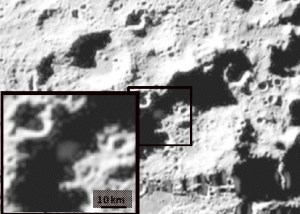
The visible camera image showing the ejecta plume at about 20 seconds after impact.

Anyway, the significance of the update is enormous.  As the NASA release goes on to say,

Scientists have long speculated about the source of vast quantities of hydrogen that have been observed at the lunar poles. The LCROSS findings are shedding new light on the question of water, which could be more widespread and in greater quantity than previously suspected.

Permanently shadowed regions could hold a key to the history and evolution of the solar system, much as an ice core sample taken on Earth reveals ancient data. In addition, water, and other compounds represent potential resources that could sustain future lunar exploration.

The BBC also reports the NASA data but, I am bound to say, in a rather more reader-friendly format.

By Paul Handover