Tag: Middle East

Truth and integrity

“Honesty is the first chapter in the book of wisdom.”

Thus spoke Thomas Jefferson who died nearly 200 years ago (April 13th, 1743 – July 4th, 1826).

But some essays that have passed my eyes in the last few days have profoundly disturbed me.  Because they illustrate, well to me anyway, the parlous state of wisdom in today’s world.  Or better put, the parlous state of truth and integrity in today’s world.

The first essay was the latest one from Tom Engelhardt over at TomDispatch. Normally I republish TomDispatch essays in full, with permission I hasten to add, because they seem such a fine commentary of where we are as a ‘modern’ society.  I used the word ‘we’ in the context of a global ‘we’.

But the latest essay was so disheartening that I couldn’t bring myself to republish it in full.  Plus, if I am to be brutally honest (in line with the theme of today’s blog post!) I didn’t want to ‘make waves’ as a non-US citizen albeit a valid US resident (Green Card holder).  I want to live freely and openly in the USA for the rest of my natural days!

Then in the last twenty-four hours up popped the latest essay from George Monbiot and I was struck by the harmony, the terrible harmony, between Tom and George.

See if you agree with me.

Tom Engelhardt published on Tuesday a TomGram about American Intelligence.  It was called Failure Is Success – How American Intelligence Works in the Twenty-First Century.

Here’s a flavour of Tom’s essay.

What are the odds? You put about $68 billion annually into a maze of 17 major intelligence outfits. You build them glorious headquarters. You create a global surveillance state for the ages. You listen in on your citizenry and gather their communications in staggering quantities. Your employees even morph into avatars and enter video-game landscapes, lest any Americans betray a penchant for evil deeds while in entertainment mode. You collect information on visits to porn sites just in case, one day, blackmail might be useful. You pass around naked photos of them just for… well, the salacious hell of it. Your employees even use aspects of the system you’ve created to stalk former lovers and, within your arcane world, that act of “spycraft” gains its own name: LOVEINT.

You listen in on foreign leaders and politicians across the planet. You bring on board hundreds of thousands of crony corporate employees, creating the sinews of an intelligence-corporate complex of the first order. You break into the “backdoors” of the data centers of major Internet outfits to collect user accounts. You create new outfits within outfits, including an ever-expanding secret military and intelligence crew embedded inside the military itself (and not counted among those 17 agencies). Your leaders lie to Congress and the American people without, as far as we can tell, a flicker of self-doubt. Your acts are subject to secret courts, which only hear your versions of events and regularly rubberstamp them — and whose judgments and substantial body of lawmaking are far too secret for Americans to know about.

Then a few paragraphs later, Tom holds up his mirror:

Whatever the case, while taxpayer dollars flowed into your coffers, no one considered it a problem that the country lacked 17 overlapping outfits bent on preventing approximately 400,000 deaths by firearms in the same years; nor 17 interlocked agencies dedicated to safety on our roads, where more than 450,000 Americans have died since 9/11. (An American, it has been calculated, is 1,904 times more likely to die in a car accident than in a terrorist attack.) Almost all the money and effort have instead been focused on the microscopic number of terrorist plots — some spurred on by FBI plants — that have occurred on American soil in that period. On the conviction that Americans must be shielded from them above all else and on the fear that 9/11 bred in this country, you’ve built an intelligence structure unlike any other on the planet when it comes to size, reach, and labyrinthine complexity.

It’s quite an achievement, especially when you consider its one downside: it has a terrible record of getting anything right in a timely way. Never have so many had access to so much information about our world and yet been so unprepared for whatever happens in it.

Tough words indeed!

But it gets worse.

Let’s focus for a moment, however, on a case where more is known. I’m thinking of the development that only recently riveted the Obama administration and sent it tumbling into America’s third Iraq war, causing literal hysteria in Washington. Since June, the most successful terror group in history has emerged full blown in Syria and Iraq, amid a surge in jihadi recruitment across the Greater Middle East and Africa. The Islamic State (IS), an offshoot of al-Qaeda in Iraq, which sprang to life during the U.S. occupation of that country, has set up a mini-state, a “caliphate,” in the heart of the Middle East. Part of the territory it captured was, of course, in the very country the U.S. garrisoned and occupied for eight years, in which it had assumedly developed countless sources of information and recruited agents of all sorts. And yet, by all accounts, when IS’s militants suddenly swept across northern Iraq, the CIA in particular found itself high and dry.

The IC seems not to have predicted the group’s rapid growth or spread; nor, though there was at least some prior knowledge of the decline of the Iraqi army, did anyone imagine that such an American created, trained, and armed force would so summarily collapse. Unforeseen was the way its officers would desert their troops who would, in turn, shed their uniforms and flee Iraq’s major northern cities, abandoning all their American equipment to Islamic State militants.

Nor could the intelligence community even settle on a basic figure for how many of those militants there were. In fact, in part because IS assiduously uses couriers for its messaging instead of cell phones and emails, until a chance arrest of a key militant in June, the CIA and the rest of the IC evidently knew next to nothing about the group or its leadership, had no serious assessment of its strength and goals, nor any expectation that it would sweep through and take most of Sunni Iraq. And that should be passing strange. After all, it now turns out that much of the future leadership of IS had spent time together in the U.S. military’s Camp Bucca prison just years earlier.

All you have to do is follow the surprised comments of various top administration officials, including the president, as ISIS made its mark and declared its caliphate, to grasp just how ill-prepared 17 agencies and $68 billion can leave you when your world turns upside down.

Leaving Tom to offer the following sorry conclusions:

Clearly, having a labyrinth of 17 overlapping, paramilitarized, deeply secretive agencies doing versions of the same thing is the definition of counterproductive madness. Not surprisingly, the one thing the U.S. intelligence community has resembled in these years is the U.S. military, which since 9/11 has failed to win a war or accomplish more or less anything it set out to do.

On the other hand, all of the above assumes that the purpose of the IC is primarily to produce successful “intelligence” that leaves the White House a step ahead of the rest of the world. What if, however, it’s actually a system organized on the basis of failure? What if any work-product disaster is for the IC another kind of win.

Perhaps it’s worth thinking of those overlapping agencies as a fiendishly clever Rube Goldberg-style machine organized around the principle that failure is the greatest success of all. After all, in the system as it presently exists, every failure of intelligence is just another indication that more security, more secrecy, more surveillance, more spies, more drones are needed; only when you fail, that is, do you get more money for further expansion.

Keep in mind that the twenty-first-century version of intelligence began amid a catastrophic failure: much crucial information about the 9/11 hijackers and hijackings was ignored or simply lost in the labyrinth. That failure, of course, led to one of the great intelligence expansions, or even explosions, in history. (And mind you, no figure in authority in the national security world was axed, demoted, or penalized in any way for 9/11 and a number of them were later given awards and promoted.) However they may fail, when it comes to their budgets, their power, their reach, their secrecy, their careers, and their staying power, they have succeeded impressively.

You could, of course, say that the world is simply a hard place to know and the future, with its eternal surprises, is one territory that no country, no military, no set of intelligence agencies can occupy, no matter how much they invest in doing so. An inability to predict the lay of tomorrow’s land may, in a way, be par for the course. If so, however, remind me: Why exactly are we supporting 17 versions of intelligence gathering to the tune of at least $68 billion a year?

So over to George Monbiot. Yesterday, he published an essay in the UK’s Guardian newspaper entitled: Bomb Everyone. I am going to republish this in full, with the kind permission of George.

ooOOoo

Bomb Everyone

Humanitarian arguments, if consistently applied, could be used to flatten the entire Middle East

By George Monbiot, published in the Guardian 1st October 2014

Let’s bomb the Muslim world – all of it – to save the lives of its people. Surely this is the only consistent moral course? Why stop at blowing up Islamic State, when the Syrian government has murdered and tortured so many? This, after all, was last year’s moral imperative. What’s changed?

How about blasting the Shia militias in Iraq? One of them selected 40 people from the streets of Baghdad in June and murdered them for being Sunnis(1). Another massacred 68 people at a mosque in August(2). They now talk openly of “cleansing” and “erasure”(3), once Islamic State has been defeated. As a senior Shia politician warns, “we are in the process of creating Shia al-Qaida radical groups equal in their radicalisation to the Sunni Qaida.”(4)

What humanitarian principle instructs you to stop there? In Gaza this year, 2,100 Palestinians were massacred: including people taking shelter in schools and hospitals. Surely these atrocities demand an air war against Israel? And what’s the moral basis for refusing to liquidate Iran? Mohsen Amir-Aslani was hanged there last week for making “innovations in the religion” (suggesting that the story of Jonah in the Qu’ran was symbolic rather than literal)(5). Surely that should inspire humanitarian action from above? Pakistan is crying out for friendly bombs: an elderly British man, Mohammed Asghar, who suffers from paranoid schizophrenia, is, like other blasphemers, awaiting execution there after claiming to be a holy prophet(6). One of his prison guards has already shot him in the back.

Is there not an urgent duty to blow up Saudi Arabia? It has beheaded 59 people so far this year, for offences that include adultery, sorcery and witchcraft(7). It has long presented a far greater threat to the west than Isis now poses. In 2009 Hillary Clinton warned in a secret memo that “Saudi Arabia remains a critical financial support base for al-Qa’ida, the Taliban … and other terrorist groups.”(8) In July, the former head of MI6, Sir Richard Dearlove, revealed that Prince Bandar bin Sultan, until recently the head of Saudi intelligence, told him: “The time is not far off in the Middle East, Richard, when it will be literally ‘God help the Shia’. More than a billion Sunnis have simply had enough of them.”(9) Saudi support for extreme Sunni militias in Syria during Bandar’s tenure is widely blamed for the rapid rise of Isis(10,11). Why take out the subsidiary and spare the headquarters?

The humanitarian arguments aired in parliament last week(12), if consistently applied, could be used to flatten the entire Middle East and West Asia. By this means you could end all human suffering, liberating the people of these regions from the vale of tears in which they live.

Perhaps this is the plan: Barack Obama has now bombed seven largely-Muslim countries(13), in each case citing a moral imperative. The result, as you can see in Libya, Iraq, Pakistan, Afghanistan,Yemen, Somalia and Syria, has been the eradication of jihadi groups, of conflict, chaos, murder, oppression and torture. Evil has been driven from the face of the earth by the destroying angels of the west.

Now we have a new target, and a new reason to dispense mercy from the sky, with similar prospects of success. Yes, the agenda and practices of Isis are disgusting. It murders and tortures, terrorises and threatens. As Obama says, it is a “network of death”(14). But it’s one of many networks of death. Worse still, a western crusade appears to be exactly what it wants(15).

Already Obama’s bombings have brought Isis and Jabhat al-Nusra, a rival militia affiliated to Al Qaeda, together(16). More than 6,000 fighters have joined Isis since the bombardment began(17). They dangled the heads of their victims in front of the cameras as bait for war planes. And our governments were stupid enough to take it.

And if the bombing succeeds? If – and it’s a big if – it manages to tilt the balance against Isis, what then? Then we’ll start hearing once more about Shia death squads and the moral imperative to destroy them too – and any civilians who happen to get in the way. The targets change; the policy doesn’t. Never mind the question, the answer is bombs. In the name of peace and the preservation of life, our governments wage perpetual war.

While the bombs fall, our states befriend and defend other networks of death. The US government still refuses – despite Obama’s promise – to release the 28 redacted pages from the Joint Congressional Inquiry into 9/11, which document Saudi Arabian complicity in the attack on America(18). In the UK, in 2004 the Serious Fraud Office began investigating allegations of massive bribes paid by the British weapons company BAE to Saudi ministers and middlemen. Just as the crucial evidence was about to be released, Tony Blair intervened to stop the investigation(19). The biggest alleged beneficiary was Prince Bandar, mentioned above. The Serious Fraud Office was investigating a claim that, with the approval of the British government, he received £1bn in secret payments from BAE(20).

And still it goes on. Last week’s Private Eye, drawing on a dossier of recordings and emails, alleges that a British company has paid £300m in bribes to facilitate weapons sales to the Saudi National Guard(21). When a whistleblower in the company reported these payments to the British ministry of defence, instead of taking action it alerted his bosses. He had to flee the country to avoid being thrown into a Saudi jail. Smirking, lying, two-faced bastards – this scarcely begins to touch it.

There are no good solutions that military intervention by the UK or the US can engineer. There are political solutions in which our governments could play a minor role: supporting the development of effective states that don’t rely on murder and militias, building civic institutions that don’t depend on terror, helping to create safe passage and aid for people at risk. Oh, and ceasing to protect and sponsor and arm selected networks of death. Whenever our armed forces have bombed or invaded Muslims nations, they have made life worse for those who live there. The regions in which our governments have intervened most are those which suffer most from terrorism and war. That is neither coincidental nor surprising.

Yet our politicians affect to learn nothing. Insisting that more killing will magically resolve deep-rooted conflicts, they scatter bombs like fairy dust.

http://www.monbiot.com

References:

1. http://www.theguardian.com/guardianweekly/story/0,,1818778,00.html

2. http://www.theguardian.com/world/2014/aug/22/shia-attack-sunni-mosque-iraq

3. http://www.theguardian.com/world/2014/aug/24/iraq-frontline-shia-fighters-war-isis

4. http://www.theguardian.com/world/2014/aug/24/iraq-frontline-shia-fighters-war-isis

5. http://www.theguardian.com/world/2014/sep/29/iran-executes-man-heresy-mohsen-amir-aslani

6. http://www.theguardian.com/commentisfree/2014/sep/29/stand-up-for-blasphemers-like-mohammed-asghar-frankie-boyle

7. http://www.amnesty.se/upload/apps/webactions/urgentaction/2014/09/23/52302414.pdf

8. http://www.theguardian.com/world/us-embassy-cables-documents/242073

9. http://www.independent.co.uk/voices/comment/iraq-crisis-how-saudi-arabia-helped-isis-take-over-the-north-of-the-country-9602312.html

10. http://www.theatlantic.com/international/archive/2014/06/isis-saudi-arabia-iraq-syria-bandar/373181/

11. http://www.independent.co.uk/news/world/politics/islamic-state-us-failure-to-look-into-saudi-role-in-911-has-helped-isis-9731563.html

12. http://www.publications.parliament.uk/pa/cm201415/cmhansrd/cm140926/debtext/140926-0001.htm#1409266000001

13. https://firstlook.org/theintercept/2014/09/23/nobel-peace-prize-fact-day-syria-7th-country-bombed-obama/

14. http://www.publications.parliament.uk/pa/cm201415/cmhansrd/cm140926/debtext/140926-0001.htm#1409266000001

15. http://www.theguardian.com/commentisfree/2014/sep/26/west-isis-crusade-britain-iraq-syria

16. http://www.theguardian.com/world/2014/sep/28/isis-al-qaida-air-strikes-syria

17. http://www.haaretz.com/news/middle-east/1.616730

18. http://nypost.com/2013/12/15/inside-the-saudi-911-coverup/

19. http://www.theguardian.com/world/bae

20. http://www.theguardian.com/world/2010/feb/05/bae-saudi-yamamah-deal-background

21. Richard Brooks and Andrew Bousfield, 19th September 2014. Shady Arabia and the Desert Fix. Private Eye.

ooOOoo

Two journalists reporting from two very different countries separated by thousands of miles.

Yet together they illustrate the very low regard for truth, for truth and integrity I should add, held by two major western Governments.  That old saying of never underestimate the power of unintended consequences is hammering inside my head.

What very strange times we live in just now.

The sooner the concepts of truth and integrity are adopted by those with the power, money and influence, the sooner this world will turn away from what looks eminently like future self-destruction.

Let’s turn to dogs for some examples of beautiful ways of living.

Truth and integrity: It’s in those eyes!

The lure of patterns.

Is this present era really coming to an end?

Somewhere in my aged brain cells is the memory of having heard that humans are great lovers of patterns.  In other words, patterns are deemed to be very important for the progress and evolution of homo sapiens.  Of course, it is not just humans who learn from patterns; I’m sure most of the animals who live around us are great pattern matchers.  To support that proposition, anyone who has owned a dog or cat will have spotted how quickly they learn patterns.  (As an aside, some months ago our puppy German Shepherd, Cleo, work me at around 4am because she needed to go outside for a ‘call of nature’.  I now get woken every single night variously between 2am and 5am for Cleo’s benefit!)

The British mathematician G. H. Hardy who lived from the last quarter of the 19th Century well into the 20th Century, reputedly said (and I cheated and looked it up!):

A mathematician, like a painter or poet, is a maker of patterns. If his patterns are more permanent than theirs, it is because they are made with ideas.

So why has this post opened with the theme of patterns?  Because, call it coincidence or what, within the last couple of weeks there have been three articles, each from very a different source, predicting that the present levels of inequality in society are both unsustainable and the beginning of the end.

First, on Michael Robert’s blog there was a post eleven days ago about global wealth inequality. From which I quote:

Global wealth inequality: top 1% own 41%; top 10% own 86%; bottom half own just 1%

—–

Just 8.4% of all the 5bn adults in the world own 83.4% of all household wealth (that’s property and financial assets, like stocks, shares and cash in the bank).  About 393 million people have net worth (that’s wealth after all debt is accounted for) of over $100,000, that’s 10% own 86% of all household wealth!  But $100,000 may not seem that much, if you own a house in any G7 country without any mortgage.  So many millions in the UK or the US are in the top 10% of global wealth holders.  This shows just how little two-thirds of adults in the world have – under $10,000 of net wealth each and billions have nothing at all.

This is not annual income but just wealth – in other words, 3.2bn adults own virtually nothing at all.  At the other end of the spectrum, just 32m people own $98trn in wealth or 41% of all household wealth or more than $1m each.  And just 98,700 people with ‘ultra-high net worth’ have more than $50 million each and of these 33,900 are worth over $100 million each.  Half of these super-rich live in the US.

Michael Robert’s essay closes:

All class societies have generated extremes of inequality in wealth and income.  That is the point of a rich elite (whether feudal landlords, Asiatic warlords, Incan and Egyptian religious castes, Roman slave owners, etc) usurping control of the surplus produced by labour.  But past class societies considered that normal and ‘god-given’. Capitalism on the other hand talks about free markets, equal exchange and equality of opportunity.  But the reality is no different from previous class societies.

Secondly, just last Friday I was drawn to an essay on, of all places, The Permaculture Research Institute blog.  The essay, by Chris Hedges (**), was called On Inequality and the Collapse of Globalization.  Chris Hedges opened his essay, thus:

The uprisings in the Middle East, the unrest that is tearing apart nations such as the Ivory Coast, the bubbling discontent in Greece, Ireland and Britain and the labor disputes in states such as Wisconsin and Ohio presage the collapse of globalization. They presage a world where vital resources, including food and water, jobs and security, are becoming scarcer and harder to obtain. They presage growing misery for hundreds of millions of people who find themselves trapped in failed states, suffering escalating violence and crippling poverty. They presage increasingly draconian controls and force—take a look at what is being done to Pfc. Bradley Manning—used to protect the corporate elite who are orchestrating our demise.

We must embrace, and embrace rapidly, a radical new ethic of simplicity and rigorous protection of our ecosystem—especially the climate—or we will all be holding on to life by our fingertips. We must rebuild radical socialist movements that demand that the resources of the state and the nation provide for the welfare of all citizens and the heavy hand of state power be employed to prohibit the plunder by the corporate power elite. We must view the corporate capitalists who have seized control of our money, our food, our energy, our education, our press, our health care system and our governance as mortal enemies to be vanquished.

The PRI editor’s preamble to the Chris Hedges essay included a couple of videos that he recommended watching.  One was a talk by Robert Reich: How Unequal Can America Get Before We Snap?

The other one was a recent TED Talk by Richard Wilkinson (his profile is here).

Mr. Wilkinson explains that for the majority of people there is an instinctive feeling that societies with huge income gaps and corresponding high levels of social inequality are somehow going wrong. He charts the hard data on such economic inequality and shows what gets worse when rich and poor are too far apart: ergo, the very real effects on health, lifespan, and even such basic values as trust.

Just 16 minutes long, it’s a very revealing talk.  Do watch it.

oooo

The final, third piece of the pattern was me coming across an essay on the blog DeflationLand, not a blog I had come across before, on the same day that I saw the PRI article.  This essay, published just two days before the PRI article, was about patterns; the patterns of the centuries.  More specifically, how the characteristics of a century generally evolve to a new culture within the first 10 to 15 years of the following century.  It was a most interesting proposition and, to my delight, I was given permission to republish that essay here on Learning from Dogs.  So here it is.

oooOOOooo

Why I stopped worrying and learned to love the currency collapse

For the past 300 years, the historical pattern has been for the era marked by a century to continue into the following century by fourteen or fifteen years. Let me explain.  Everyone knows that the 19th Century, its uprightness, its optimism and sense of purpose, the halcyon days of British Empire, came to an end with World War I, starting in 1914 and building to a nasty crescendo by 1916.  The 20th Century had arrived, and it had some real horrors in store for us.

Germans before Kraftwerk

But if we return back another hundred years, we notice that the 18th Century ends in 1815 with the final defeat of Napoleon, that final project of the Enlightenment and of the French Revolution.  With the Congress of Vienna in 1814-1815, we have a new Europe along the lines of Metternich’s plan, and the 19th Century at last is here.

"Sorry, guys.  My bad."
“Sorry, guys. My bad.”

In 1713 and 1714, we have the Treaties of Utrecht, Baden, and Rastatt, bringing an end to the era of Spain as a major power, and the rise of the Habsburgs.  Louis XIV dies in 1715, after reigning for 72 years.  The Baroque period is over, and we are now firmly in the 18th Century.

War of Spanish Succession

We still live in the 20th Century.  Nothing much significant has changed in our lives in the past twenty years.  Symptoms of a deeper rot are appearing here and there, foreshadowing a larger crisis, but the crisis itself has not arrived yet.  We still live in an era of Pax Americana, the old republic very much a strained and tired Empire now, with the U.S. Dollar as the world’s reserve currency.

That is going to change.

The next task for History is to dismantle the untenable structures and institutions put in place by late Modernity, which have been extended now as far as they can go.  Our debt-based monetary system will collapse, our unbacked fiats will be worthless.  The debts and unmeetable obligations will all default.

There are ironies and great contradictions as the former home and hope of Liberty becomes viciously unfree and increasingly despotic.  Our leaders no longer govern, but try instead to rule us — they are less legitimate with each passing day, their laws corrupt or worse.  They are nearly finished, and will be swept away with the tide.

Just as in 1914, the internationalist system will break down, dashing the hopes of the would-be first-world nations.  We will probably have a pretty good war as well, or many local ones worldwide.  These transitions tend to involve war.

Deflation first — it clears the way for the complete loss of faith and hyperinflation that will follow.  The next big wave down in the financial markets is the battering ram.  The U.S. national debt is about faith, so is quantitative easing, and so is the very idea of magical coins that could ever be “worth” a trillion dollars.  When this faith breaks, in concert with loss of faith in perpetual growth and unlimited cheap energy, then things will move very, very quickly.

There is nothing any of us can do at this point, except navigate the rapids as well as possible, and to stay out of the way of a dying empire, which is still very dangerous in its death throes.  We are actually very privileged to be alive and witnessing this next transition, to what we do not know just yet.  But what an honor to live at this time, not in ignorance but with an existential resolve to come out of it alive and much the wiser.

Ass Americana.
Ass Americana.

oooOOOooo

** Chris Hedges is a Pulitzer Prize–winning author and former international correspondent for the New York Times. His latest book is The World As It Is: Dispatches on the Myth of Human Progress.

I am neither a scientist nor a historian; just someone who has lived in and observed the world for coming on for 60 years.

So you have to understand that my prediction is hardly worth the ‘paper I write upon’ (which certainly dates me!).  But, undaunted, here are my predictions for the 21st Century:

  • That the power of internet communications will allow more people, more quickly, to find their soul-mates wherever they are on this planet.
  • That the realisation of how dysfunctional many Governments are, of how truly poorly they serve the majorities of their citizens, will lead to mass rejections of these so-called Governments’ policies.  Such rejections predominantly peaceful, as in taking the horse to water but being unable to make it drink.
  • That there will be a new form of localism.  At two levels.  Literally, people geographically close to each other creating 21st C. versions of local communities.  Virtually, those local communities linking to other like-minded communities right across the world resulting in highly effective and innovative learning, accelerated common-sense, (call it wisdom if you wish), and extraordinarily efficient and sustainable ways of living on this planet.

What do you think?

What goes up?

Civilizations die from suicide, not by murder. Arnold J Toynbee

I’m not sure where to start but as a result of finishing a particular book, plus a recent essay on Tom Dispatch, then another recent essay from Simon Johnson of Baseline Scenario fame, there were so many thoughts bumping around this aged brain that I had no alternative than to offer them to you, dear reader.  You should also be warned that this is going to be two posts, covering today and tomorrow.

So let’s start with the book: The United States of Fear by Tom Engelhardt.  To be brutally honest, I purchased the book more as a gesture of support to Tom who has been very supportive of Learning from Dogs, in particular allowing me permission to reproduce any essays that were published on TomDispatch, as a number have so been.  What an error of judgment!  Tom’s book provided another one of those rare but inspirational occasions where you know the world will never look quite the same again!

The back cover page of the book sets out the theme, thus,

Published 2011

In 2008, when the US National Intelligence Council issued its latest report meant for the administration of newly elected President Barack Obama, it predicted that the planet’s “sole superpower” would suffer a modest decline and a soft landing fifteen years hence. In his new book The United States of Fear, Tom Engelhardt makes clear that Americans should don their crash helmets and buckle their seat belts, because the United States is on the path to a major decline at a startling speed. Engelhardt offers a savage anatomy of how successive administrations in Washington took the “Soviet path”—pouring American treasure into the military, war, and national security—and so helped drive their country off the nearest cliff.This is the startling tale of how fear was profitably shot into the national bloodstream, how the country—gripped by terror fantasies—was locked down, and how a brain-dead Washington elite fiddled (and profited) while America quietly burned.

Think of it as the story of how the Cold War really ended, with the triumphalist “sole superpower” of 1991 heading slowly for the same exit through which the Soviet Union left the stage twenty years earlier.

One of the fascinating aspects of the book is that it was put together from 32 essays previously published online by Tom; the complete list with titles and dates is on pps. 205 & 206.  So giving you a real feel for the book is easy!  I’m going to do that by linking to one of those essays available in the archives of TomDispatch here.  That essay was called Washington’s Echo Chamber and appears in the book starting on page 170 under the sub-heading of Five Ways to Be Tone Deaf in Washington. Let me quote you a little,

So much of what Washington did imagine in these last years proved laughable, even before this moment swept it away.  Just take any old phrase from the Bush years.  How about “You’re either with us or against us”?  What’s striking is how little it means today.  Looking back on Washington’s desperately mistaken assumptions about how our globe works, this might seem like the perfect moment to show some humility in the face of what nobody could have predicted.

It would seem like a good moment for Washington — which, since September 12, 2001, has been remarkably clueless about real developments on this planet and repeatedly miscalculated the nature of global power — to step back and recalibrate.

As it happens, there’s no evidence it’s doing so.  In fact, that may be beyond Washington’s present capabilities, no matter how many billions of dollars it pours into “intelligence.”  And by “Washington,” I mean not just the Obama administration, or the Pentagon, or our military commanders, or the vast intelligence bureaucracy, but all those pundits and think-tankers who swarm the capital, and the media that reports on them all.  It’s as if the cast of characters that makes up “Washington” now lives in some kind of echo chamber in which it can only hear itself talking.

As a result, Washington still seems remarkably determined to play out the string on an era that is all too swiftly passing into the history books.  While many have noticed the Obama administration’s hapless struggle to catch up to events in the Middle East, even as it clings to a familiar coterie of grim autocrats and oil sheiks, let me illustrate this point in another area entirely — the largely forgotten war in Afghanistan.  After all, hardly noticed, buried beneath 24/7 news from Egypt, Bahrain, Libya, and elsewhere in the Middle East, that war continues on its destructive, costly course with nary a blink.

That was published by Tom a little over 18 months ago!  Seems as relevant today as then!  Let me stay with perspectives from 2011.

Chomsky, visiting Vancouver, Canada in March 2004

On the 24th August 2011 Noam Chomsky wrote an essay entitled American Decline: Causes and Consequences.  Chomsky, as Wikipedia relates, is Professor (Emeritus) in the Department of Linguistics & Philosophy at MIT, where he has worked for over 50 years.  Here is how that essay opens,

In the 2011 summer issue of the journal of the American Academy of Political Science, we read that it is “a common theme” that the United States, which “only a few years ago was hailed to stride the world as a colossus with unparalleled power and unmatched appeal — is in decline, ominously facing the prospect of its final decay.” It is indeed a common theme, widely believed, and with some reason. But an appraisal of US foreign policy and influence abroad and the strength of its domestic economy and political institutions at home suggests that a number of qualifications are in order. To begin with, the decline has in fact been proceeding since the high point of US power shortly after World War II, and the remarkable rhetoric of the several years of triumphalism in the 1990s was mostly self-delusion. Furthermore, the commonly drawn corollary — that power will shift to China and India — is highly dubious. They are poor countries with severe internal problems. The world is surely becoming more diverse, but despite America’s decline, in the foreseeable future there is no competitor for global hegemonic power.

So, according to Chomsky, it’s not as ‘black and white’ as Engelhardt sets out.  But do read the full essay.

Nevertheless, the idea that the USA is ‘fiddling while Rome burns’ is supported in an essay published by Mattea Kramer on TomDispatch on the last day of September.  I’m going to end Part One by republishing the essay in full.  (Note that this is being published here after the first ‘debate’ had taken place.)

oooOOOooo

Tough Talk for America

A Guide to the Presidential Debates You Won’t Hear 
By Mattea Kramer

Five big things will decide what this country looks like next year and in the 20 years to follow, but here’s a guarantee for you: you’re not going to hear about them in the upcoming presidential debates. Yes, there will be questions and answers focused on deficits, taxes, Medicare, the Pentagon, and education, to which you already more or less know the responses each candidate will offer. What you won’t get from either Mitt Romney or Barack Obama is a little genuine tough talk about the actual state of reality in these United States of ours. And yet, on those five subjects, a little reality would go a long way, while too little reality (as in the debates to come) is a surefire recipe for American decline.

So here’s a brief guide to what you won’t hear this Wednesday or in the other presidential and vice-presidential debates later in the month. Think of these as five hard truths that will determine the future of this country.

1. Immediate deficit reduction will wipe out any hope of economic recovery: These days, it’s fashionable for any candidate to talk about how quickly he’ll reduce the federal budget deficit, which will total around $1.2 trillion in fiscal 2012. And you’re going to hear talk about the Simpson-Bowles deficit reduction plan and more like it on Wednesday. But the hard truth of the matter is that deep deficit reduction anytime soon will be a genuine disaster. Think of it this way: If you woke up tomorrow and learned that Washington had solved the deficit crisis and you’d lost your job, would you celebrate? Of course not. And yet, any move to immediately reduce the deficit does increase the likelihood that you will lose your job.

When the government cuts spending, it lays off workers and cancels orders for all sorts of goods and services that would generate income for companies in the private sector. Those companies, in turn, lay off workers, and the negative effects ripple through the economy. This isn’t atomic science. It’s pretty basic stuff, even if it’s evidently not suitable material for a presidential debate. The nonpartisan Congressional Research Service predicted in a September report, for example, that any significant spending cuts in the near-term would contribute to an economic contraction. In other words, slashing deficits right now will send us ever deeper into the Great Recession from which, at best, we’ve scarcely emerged.

Champions of immediate deficit reduction are likely to point out that unsustainable deficits aren’t good for the economy. And that’s true — in the long run. Washington must indeed plan for smaller deficits in the future. That will, however, be a lot easier to accomplish when the economy is healthier, since government spending declines when fewer people qualify for assistance, and tax revenues expand when the jobless go back to work. So it makes sense to fix the economy first. The necessity for near-term recovery spending paired with long-term deficit reduction gets drowned out when candidates pack punchy slogans into flashes of primetime TV.

2. Taxes are at their lowest point in more than half a century, preventing investment in and the maintenance of America’s most basic resources: Hard to believe? It’s nonetheless a fact. By now, it’s a tradition for candidates to compete on just how much further they’d lower taxes and whether they’ll lower them for everyone or just everyone but the richest of the rich. That’s a super debate to listen to, if you’re into fairy tales. It’s not as thrilling if you consider that Americans now enjoy the lightest tax burden in more than five decades, and it happens to come with a hefty price tag on an item labeled “the future.” There is no way the U.S. can maintain a world-class infrastructure — we’re talking levees, highways, bridges, you name it — and a public education system that used to be the envy of the world, plus many other key domestic priorities, on the taxes we’re now paying.

Anti-tax advocates insist that we should cut taxes even more to boost a flagging economy — an argument that hits the news cycle nearly every hour and that will shape the coming TV “debate.” As the New York Times recently noted, however, tax cuts might have been effective in giving the economy a lift decades ago when tax rates were above 70%. (And no, that’s not a typo, that’s what your parents and grandparents paid without much grumbling.) With effective tax rates around 14% for Mitt Romney and many others, further cuts won’t hasten job creation, just the hollowing out of public investment in everything from infrastructure to education. Right now, the negative effects of tax increases on the most well-off would be small — read: not a disaster for “job creators” — and those higher rates would bring in desperately-needed revenue. Tax increases for middle-class Americans should arrive when the economy is stronger.

Right now, the situation is clear: we’re simply not paying enough to fund the basic ingredients of prosperity from highways and higher education to medical research and food safety. Without those funds, this country’s future won’t be pretty.

3. Neither the status quo nor a voucher system will protect Medicare (or any other kind of health care) in the long run: When it comes to Medicare, Mitt Romney has proposed a premium-support program that would allow seniors the option of buying private insurance. President Obama wants to keep Medicare more or less as it is for retirees. Meanwhile, the ceaseless rise in health-care costs is eating up the wages of regular Americans and the federal budget. Health care now accounts for a staggering 24% of all federal spending, up from 7% less than 40 years ago. Governor Romney’s plan would shift more of those costs onto retirees, according to David Cutler, a health economist at Harvard, while President Obama says the federal government will continue to pick up the tab. Neither of them addresses the underlying problem.

Here’s reality: Medicare could be significantly protected by cutting out waste. Our health system is riddled with unnecessary tests and procedures, as well as poorly coordinated care for complex health problems. This country spent $2.6 trillion on health care in 2010, and some estimates suggest that a staggering 30% of that is wasted. Right now, our health system rewards quantity, not quality, but it doesn’t have to be that way. Instead of paying for each test and procedure, Medicare could pay for performance and give medical professionals a strong incentive to provide more efficient and coordinated care. President Obama’s health law actually pilot tests such an initiative. But that’s another taboo topic this election season, so he scarcely mentions it. Introducing such change into Medicare and the rest of our health system would save the federal government tens of billions of dollars annually. It would truly preserve Medicare for future generations, and it would improve the affordability of health coverage for everyone under 65 as well. Too bad it’s not even up for discussion.

4. The U.S. military is outrageously expensive and yet poorly tailored to the actual threats to U.S. national security: Candidates from both parties pledge to protect the Pentagon from cuts, or even, in the case of the Romney team, to increase the already staggering military budget. But in a country desperate for infrastructure, education, and other funding, funneling endless resources to the Pentagon actually weakens “national security.” Defense spending is already mind-numbingly large: if all U.S. military and security spending were its own country, it would have the 19th largest economy in the world, ahead of Saudi Arabia, Taiwan, and Switzerland. Whether you’re counting aircraft carriers, weapons systems, or total destructive power, it’s absurdly overmatched against the armed forces of the rest of the world, individually or in combination. A couple of years ago, then-Secretary of Defense Robert M. Gates gave a speech in which he detailed that overmatch. A highlight: “The U.S. operates 11 large carriers, all nuclear powered. In terms of size and striking power, no other country has even one comparable ship.” China recently acquired one carrier that won’t be fully functional for some time, if ever — while many elected officials in this country would gladly build a twelfth.

But you’ll hear none of this in the presidential debates. Perhaps the candidates will mention that obsolete, ineffective, and wildly expensive weapons systems could be cut, but that’s a no-brainer. The problem is: it wouldn’t put a real dent in national defense spending. Currently almost one-fifth of every dollar spent by the federal government goes to the military. On average, Americans, when polled, say that they would like to see military funding cut by 18%.

Instead, most elected officials vow to pour limitless resources into more weapons systems of questionable efficacy, and of which the U.S. already owns more than the rest of the world combined. Count on one thing: military spending will not go down as long as the U.S. is building up a massive force in the Persian Gulf, sending Marines to Darwin, Australia, and special ops units to Africa and the Middle East, running drones out of the Seychelles Islands, and “pivoting” to Asia. If the U.S. global mission doesn’t downsize, neither will the Pentagon budget — and that’s a hit on America’s future that no debate will take up this month.

5. The U.S. education system is what made this country prosperous in the twentieth century — but no longer: Perhaps no issue is more urgent than this, yet for all the talk of teacher’s unions and testing, real education programs, ideas that will matter, are nonexistent this election season. During the last century, the best education system in the world allowed this country to grow briskly and lift standards of living. Now, from kindergarten to college, public education is chronically underfunded. Scarcely 2% of the federal budget goes to education, and dwindling public investment means students pay higher tuitions and fall ever deeper into debt. Total student debt surpassed $1 trillion this year and it’s growing by the month, with the average debt burden for a college graduate over $24,000. That will leave many of those graduates on a treadmill of loan repayment for most or all of their adult lives.

Renewed public investment in education — from pre-kindergarten to university — would pay handsome dividends for generations. But you aren’t going to hear either candidate or their vice-presidential running mates proposing the equivalent of a GI Bill for the rest of us or even significant new investment in education. And yet that’s a recipe for and a guarantee of American decline.

Ironically, those in Washington arguing for urgent deficit reduction claim that we’ve got to do it “for the kids,” that we must stop saddling our grandchildren with mountains of federal debt. But if your child turns 18 and finds her government running a balanced budget in an America that’s hollowed out, an America where she has no chance of paying for a college education, will she celebrate? You don’t need an economist to answer that one.

Mattea Kramer is senior research analyst at National Priorities Project and a TomDispatch regular. She is lead author of the new book A People’s Guide to the Federal Budget.

Copyright 2012 Mattea Kramer

oooOOOooo

Let me close with another quote from Arnold J. Toynbee:

Of the twenty-two civilizations that have appeared in history, nineteen of them collapsed

when they reached the moral state the United States is in now.

Part Two continues tomorrow.

Integrity, part two.

A lifting of the importance of integrity is the key to our survival.

Let me start by reflecting on the difference between ‘truth’ and ‘integrity’.

Here’s one of the definitions of Truthconformity with fact or reality; verity: the truth of a statement.

Here’s one of the definitions of Integrityadherence to moral and ethical principles; soundness of moral character; honesty.

So while in yesterday’s article, I frequently referred to the word ‘truth‘, determining the ‘fact or reality‘ of a wide range of issues associated with anthropogenic climate change is not always straightforward.  Many of us probably have a strong intuition of the ’cause and effect’ of man’s footprint on this planet but a strong intuition is not the same as truth.

Then let’s turn to the notion of integrity. This is a much bigger issue, to my mind, the appalling lack of integrity!  Illustrated by one simple example.  How many leading politicians from any number of countries have demonstrated soundness of moral character; honesty with regard to the changing climate, even offering something as simple as “I don’t know!

There’s a saying that pilots use, “If there’s any doubt, there’s no doubt!”  Come on, politicians and leaders, at the very least there is doubt!

OK, let me move on!

If integrity is partly defined as honesty, then while it’s easy to take a pot-shot at the world’s politicians maybe we need to look closer at home; ourselves.  Are we as honest with our own self as we now need to be?

Here’s an example that supports that question.

A few days ago there was a report on the website The Daily Impact about the crash of US fisheries.  Let me show you how that report opens,

Report: US Fisheries Crashing

We live in a country in which every household has two TV sets, most of them receiving hundreds of channels, and two cell phones, many of them “smart.” One of every two households has a computer connected to the Internet. This country is currently in the middle of a hotly contested presidential election. And yet among the things that have almost completely escaped public attention is this: last week the US government declared fisheries disasters on four coasts.

Reflect on that paragraph.  Surely it’s a reflection about the lack of integrity, of honesty, about our society?

The report ends thus,

The disaster declaration covering all these dire situations makes them eligible for Congressional aid, along with drought-stricken farmers in the Midwest and Southwest, flooded-out homeowners in New Orleans and along the Gulf, the fire-ravaged states of the far West, and the derecho-pounded Northeast. Congress will no doubt be delighted by the opportunity to help.

We eat nearly five billion pounds of seafood every year — about 16 pounds for each of us — and 85 per cent of it is imported (according to NOAA). Yet in the wake of this grim assessment of a large proportion of the domestic industry, and the questions it raises about the future sources of seafood, there is no discussion of “fisheries independence” or “peak fish” in politics or the media. Only in such outposts as this website and Mother Jones will the dire warning from the Commerce Department be reported as what it is — a dire warning.

Then there was a recent article on the Australian Permaculture news website about the US food and dairy industry.  Here’s how that opened,

Americans’ right to access fresh, healthy foods of their choice is under attack. Farmageddon tells the story of small, family farms that were providing safe, healthy foods to their communities and were forced to stop, sometimes through violent action, by agents of misguided government bureaucracies, and seeks to figure out why.

Filmmaker Kristin Canty’s quest to find healthy food for her four children turned into an educational journey to discover why access to these foods was being threatened. What she found were policies that favor agribusiness and factory farms over small family-operated farms selling fresh foods to their communities. Instead of focusing on the source of food safety problems — most often the industrial food chain — policymakers and regulators implement and enforce solutions that target and often drive out of business small farms that have proven themselves more than capable of producing safe, healthy food, but buckle under the crushing weight of government regulations and excessive enforcement actions.

I’m not going to insert that YouTube video into this post but you can link to both the full article and the film here.  For anyone interested in the fate of the family farm in the USA, the film is a ‘must see’!  Once again, the theme of integrity, of adherence to moral and ethical principles; honesty, comes to mind!

How I do want to close this rather personal reflection on present times (some may call it an indulgent reflection!) is by including a video from this seasons TED Talks.  It was brought to my attention by Christine over at her excellent blog 350 or bust.  The video is about resolving conflict,

William Ury, author of “Getting to Yes,” offers an elegant, simple (but not easy) way to create agreement in even the most difficult situations — from family conflict to, perhaps, the Middle East.

The reason why this seems like a very appropriate way to close this is because the way things are going at the moment, avoiding conflict could become rather important, rather soon!

Options for the future

That damn edge, embrace it or ….. or what?

It’s some ago that I read Lester Brown’s book World on the Edge but I still recall the effect it had on me.  Namely, this is not some environmentalist’s ‘willy waving’ but something that has the potential to hurt, I mean HURT!  Since the book was published the stream of information and evidence has turned into a flood of awareness that if we don’t change our ways soon then we, as in the vastness of human life, will go over the edge.

So it was a good reminder to come across a recent extract on the Earth Policy Institute website that is republished in full, as follows:

No previous civilization has survived the ongoing destruction of its natural supports. Nor will ours. Yet economists look at the future through a different lens. Relying heavily on economic data to measure progress, they see the near 10-fold growth in the world economy since 1950 and the associated gains in living standards as the crowning achievement of our modern civilization. During this period, income per person worldwide climbed nearly fourfold, boosting living standards to previously unimaginable levels. A century ago, annual growth in the world economy was measured in the billions of dollars. Today, it is measured in the trillions. In the eyes of mainstream economists, our present economic system has not only an illustrious past but also a promising future.

Mainstream economists see the 2008–09 global economic recession and near-collapse of the international financial system as a bump in the road, albeit an unusually big one, before a return to growth as usual. Projections of economic growth, whether by the World Bank, Goldman Sachs, or Deutsche Bank, typically show the global economy expanding by roughly 3 percent a year. At this rate the 2010 economy would easily double in size by 2035. With these projections, economic growth in the decades ahead is more or less an extrapolation of the growth of recent decades.

But natural scientists see that as the world economy expanded some 20-fold over the last century, it has revealed a flaw—a flaw so serious that if it is not corrected it will spell the end of civilization as we know it. At some point, what had been excessive local demands on environmental systems when the economy was small became global in scope.

A study by a team of scientists led by Mathis Wackernagel aggregates the use of the earth’s natural assets, including carbon dioxide overload in the atmosphere, into a single indicator—the ecological footprint. The authors concluded that humanity’s collective demands first surpassed the earth’s regenerative capacity around 1980. By 2007, global demands on the earth’s natural systems exceeded sustainable yields by 50 percent. Stated otherwise, it would take 1.5 Earths to sustain our current consumption. If we use environmental indicators to evaluate our situation, then the global decline of the economy’s natural support systems—the environmental decline that will lead to economic decline and social collapse—is well under way.

How did we get into this mess? Our market-based global economy as currently managed is in trouble. The market does many things well. It allocates resources with an efficiency that no central planner could even imagine, much less achieve.

However the market, which sets prices, is not telling us the truth. It is omitting indirect costs that in some cases now dwarf direct costs. Consider gasoline. Pumping oil, refining it into gasoline, and delivering the gas to U.S. service stations may cost, say, $3 per gallon. The indirect costs, including climate change, treatment of respiratory illnesses, oil spills, and the U.S. military presence in the Middle East to ensure access to the oil, total $12 per gallon. Similar calculations can be done for coal.

We delude ourselves with our accounting system. Leaving such huge costs off the books is a formula for bankruptcy. Environmental trends are the lead indicators telling us what lies ahead for the economy and ultimately for society itself. Falling water tables today signal rising food prices tomorrow. Shrinking polar ice sheets are a prelude to falling coastal real estate values.

Beyond this, mainstream economics pays little attention to the sustainable yield thresholds of the earth’s natural systems. Modern economic thinking and policymaking have created an economy that is so out of sync with the ecosystem on which it depends that it is approaching collapse. How can we assume that the growth of an economic system that is shrinking the earth’s forests, eroding its soils, depleting its aquifers, collapsing its fisheries, elevating its temperature, and melting its ice sheets can simply be projected into the long-term future? What is the intellectual process underpinning these extrapolations?

We are facing a situation in economics today similar to that in astronomy when Copernicus arrived on the scene, a time when it was believed that the sun revolved around the earth. Just as Copernicus had to formulate a new astronomical worldview after several decades of celestial observations and mathematical calculations, we too must formulate a new economic worldview based on several decades of environmental observations and analyses.

The archeological record indicates that civilizational collapse does not come suddenly out of the blue. Archeologists analyzing earlier civilizations talk about a decline-and-collapse scenario. Economic and social collapse was almost always preceded by a period of environmental decline.

For past civilizations it was sometimes a single environmental trend that was primarily responsible for their decline. Sometimes it was multiple trends. For Sumer, rising salt concentrations in the soil, as a result of an environmental flaw in the design of their otherwise extraordinary irrigation system, led to a decline in wheat yields. The Sumerians then shifted to barley, a more salt-tolerant crop. But eventually barley yields also began to decline. The collapse of the civilization followed.

For the Mayans, it was deforestation and soil erosion. As more and more land was cleared for farming to support the expanding empire, soil erosion undermined the productivity of their tropical soils. A team of scientists from the National Aeronautics and Space Administration has noted that the extensive land clearing by the Mayans likely also altered the regional climate, reducing rainfall. In effect, the scientists suggest, it was the convergence of several environmental trends, some reinforcing others, that led to the food shortages that brought down the Mayan civilization.

Although we live in a highly urbanized, technologically advanced society, we are as dependent on the earth’s natural support systems as the Sumerians and Mayans were. If we continue with business as usual, civilizational collapse is no longer a matter of whether but when. We now have an economy that is destroying its natural support systems, one that has put us on a decline and collapse path.

The reality of our situation may soon become clearer for mainstream economists as we begin to see some of the early economic effects of overconsuming the earth’s resources, such as rising world food prices. On the social front, the most disturbing trend is spreading hunger.

As rapid population growth continues, cropland becomes scarce, wells go dry, forests disappear, soils erode, unemployment rises, and hunger spreads. As environmental degradation and economic and social stresses mount, the more fragile governments are losing their capacity to govern. They become failing states—countries whose governments can no longer provide personal security, food security, or basic social services, such as education and health care. As the list of failing states grows longer each year, it raises a disturbing question: How many states must fail before our global civilization begins to unravel?

How much longer can we remain in the decline phase, whether measured in natural asset liquidation, spreading hunger, or failing states, before our global civilization begins to break down? We are dangerously close to the edge. Peter Goldmark, former Rockefeller Foundation president, puts it well: “The death of our civilization is no longer a theory or an academic possibility; it is the road we’re on.”

Adapted from World on the Edge by Lester R. Brown.  The message is clear.

But if you haven’t read the book it’s available online, for free!  Just go here and not only will you find the link to the book but also links to other valuable materials.

Founder and President of the Earth Policy Institute, Lester Brown, speaks about his new book World on the Edge: How to Prevent Environmental and Economic Collapse. The issues, says Brown, are critical — and the big question is whether we can change direction before “we go over the edge.” Among his points: solar, wind and geothermal energy, with energy efficiency, can provide all the power we need, but a massive effort must be made now to fully shift to these clean, safe, renewable energy technologies. He strongly rejects nuclear power.

This is rocket science!

A timely video from the International Space Station (ISS)

Little did I realise when I posted yesterday’s item that a couple of subsequent actions would make today’s article easy to write (trust me it isn’t always this easy!).

Mike T., a flying buddy from my old days in England, sent me this link to a 5-minute video made up of a series of films shot from the ISS.  DO WATCH THE VIDEO IN FULL SCREEN MODE!

The details of how the film was taken and much more interesting information is at the very end of this article.

Then Martin Lack who writes the blog, Lack of Environment, submitted a comment with a link to a piece that he had written on the 19th August that I would like to re-publish in full.

Why are we still waiting for the EU to act?

What can we learn from the fact that the EU has still not stopped buying over 90% of Syria’s oil exports? If nothing else, it tells me that we need fossil fuel too much!

But I think the problem of wrong priorities goes much deeper than that… This is because the Limits to Growth argument (which underlies my concern over AGW) is, even though the protestor-in-the-street may not realise it, the root cause of all the problems we are now seeing in Afghanistan, Bahrain, Cairo, Damascus etc., etc… right through to Zimbabwe: Treating the symptoms of food shortages or corruption (or whatever they may be) will not succeed unless we address the root cause, which is the inevitable consequences of perpetual growth in consumption of resources and/or waste production on a finite planet [see E.F. Schumacher’s Small is Beautiful (1973)].

This 5 minute video makes sobering viewing, but it also perfectly summarises everything I have learnt in the last 12 months; and all I have posted on my oldMyTelegraph blog in the last 5 months!

It may not be rocket science, but can we reach Escape Velocity?

This stuff is not rocket science, but it is very unwelcome news to people with a vested interest in the continuance of “business as usual”. Unfortunately, we literally cannot go on the way we are; something has got to change…

The fact that AGW may suffer from issue fatigue, and the fact that I sometimes feel like an old-style street preacher being completely ignored by passers-by, does not change the fact that, on well above the balance of probability, we face an environmental catastrophe if we fail to take significant action within the next 5 years. Furthermore, every year we fail to act, makes taking effective action much, much harder. This is because it is the total (i.e. cumulative) amount of fossilised carbon that we (have and will) put into the atmosphere that will determine the temperature change we will see over the next 50 years or so.

Extract of paper presented by Dr Myles Allen at 4 Degrees and Beyond Conference (2009)

So a big thank you to Mike T. and Martin Lack for a number of lessons:

  • how clever man is in terms of space technology besides much more
  • the beauty of our planet – it’s all we have to live on
  • the amount of electric light that shines into outer space, as seen by the ISS.
  • how much of that lighting might be generated by coal and oil!
  • if we don’t learn to live in harmony, as in sustainably, with this planet of ours, the implications are going to be very serious.

Finally, as mentioned earlier the details of that video on Vimeo.

Time lapse sequences of photographs taken with a 4K-camera by Ron Garan fragileoasis.org/​bloggernauts/​Astro_Ron and the crew of expedition 28 & 29 onboard the International Space Station from August to October, 2011. All credit goes to them, who to my  knowledge shot these pictures at an altitude of around 350 km.  I intend to upload a FullHD-version presently.

HD, refurbished, smoothed, retimed, denoised, deflickered, cut, etc.  All in all I tried to keep the looks of the material as original as possible, avoided adjusting the colors and the like, since in my opinion the original footage itself already has an almost surreal and aestethical visual nature.

Music: Jan Jelinek | Do Dekor, faitiche back2001 w+p by Jan Jelinek, published by Betke Edition janjelinek.com | faitiche.de

Image Courtesy of the Image Science & Analysis Laboratory, NASA Johnson Space Center, The Gateway to Astronaut Photography of Earth eol.jsc.nasa.gov

Editing: Michael König | koenigm.com

Shooting locations in order of appearance:

1. Aurora Borealis Pass over the United States at Night
2. Aurora Borealis and eastern United States at Night
3. Aurora Australis from Madagascar to southwest of Australia
4. Aurora Australis south of Australia
5. Northwest coast of United States to Central South America at Night
6. Aurora Australis from the Southern to the Northern Pacific Ocean
7. Halfway around the World
8. Night Pass over Central Africa and the Middle East
9. Evening Pass over the Sahara Desert and the Middle East
10. Pass over Canada and Central United States at Night
11. Pass over Southern California to Hudson Bay
12. Islands in the Philippine Sea at Night
13. Pass over Eastern Asia to Philippine Sea and Guam
14. Views of the Mideast at Night
15. Night Pass over Mediterranean Sea
16. Aurora Borealis and the United States at Night
17. Aurora Australis over Indian Ocean
18. Eastern Europe to Southeastern Asia at Night

Blood and Oil

Continuing the thoughts of Michael Klare.

(My apologies, this is a difficult week for me as I prepare for a course that starts on the 11th May.  So posts may be a little thinner than usual.)

Yesterday, I wrote about an article by Michael Klare on the theme of the avenging planet.  While researching for that piece, I came across a film that Klare has produced called Blood and Oil.  It seemed worth mentioning it on Learning from Dogs.

Here’s the synopsis,

The notion that oil motivates America’s military engagements in the Middle East has long been dismissed as nonsense or mere conspiracy theory. Blood and Oil, a new documentary based on the critically-acclaimed work of Nation magazine defense correspondent Michael T. Klare, challenges this conventional wisdom to correct the historical record. The film unearths declassified documents and highlights forgotten passages in prominent presidential doctrines to show how concerns about oil have been at the core of American foreign policy for more than 60 years – rendering our contemporary energy and military policies virtually indistinguishable. In the end, Blood and Oil calls for a radical re-thinking of US energy policy, warning that unless we change direction, we stand to be drawn into one oil war after another as the global hunt for diminishing world petroleum supplies accelerates.

Here’s a trailer for the film.

The modern internet – a perspective.

A very thoughtful article from an interesting website.

By definition, everyone reading this article will be doing it as a result of the incredible advances in digital communications.  Thus it was that from today’s issue of Naked Capitalism there was reference to an article on a website called The Scholarly Kitchen, a site that I hadn’t come across before.  I won’t reproduce the article in full – that doesn’t seem right.  But I will present extracts to give you an idea of the thrust of the article.

The article is called The Battle for Control – What People who worry about the Internet are really worried about. Here’s how it starts:

Over the past few years, we’ve been witness to a parade of partisans in the debate over whether the Internet is making us smarter and more capable or turning us into shallow and superficial information parasites.

Nicholas Carr carries the most water for this argument, but others have joined in. Usually, their arguments that we’re going too far, becoming too fragmented, or becoming distracted are positioned to seem as if they have our best interests at heart — concern for our minds, our families, our communities, our culture.

Adam Gopnik, writing recently in theNew Yorker, breaks down the more typical partisans in the following manner:

. . . the Never-Betters, the Better-Nevers, and the Ever-Wasers. The Never-Betters believe that we’re on the brink of a new utopia, where information will be free and democratic. . . . The Better-Nevers think that we would have been better off if the whole thing had never happened, that . . . books and magazines create private space for minds in ways that twenty-second bursts of information don’t. The Ever-Wasers insist that at any moment in modernity something like this is going on, and that a new way of organizing data and connecting users is always thrilling to some and chilling to others.

A recent post by Jeff Jarvis puts what he calls “the distraction trope” into perspective. Instead of worrying about whether our brains, families, or communities are changing, Jarvis strips away that sophistry and lays bare something more primal that seems to be at stake:

And isn’t really their fear . . . that they are being replaced? Control in culture is shifting. We triumphalists — I don’t think I am one but, what the hell, I’ll don the uniform — argue that these tools unlock some potential in us, help us do what we want to do and better. The catastrophists are saying that we can be easily led astray to do stupid things and become stupid. One is an argument of enablement. One is an argument of enslavement. Which reveals more respect for humanity? That is the real dividing line. I start with faith in my fellow man and woman. The catastrophists start with little or none.

Throughout history, this fear of losing control has been consistently masked as concerns for higher, even altruistic interests. Jarvis quotes Erasmus (via Elizabeth Eisenstein’s new book, “Divine Art, Infernal Machine“), who said during the proliferation of books:

To what corner of the world do they not fly, these swarms of new books? . . . the very multitude of them is hurting scholarship, because it creates a glut, and even in good things satiety is most harmful. [The minds of men,] flighty and curious of anything new [are lured] away from the study of old authors.

Erasmus was worried about losing control over a world he’d mastered through his knowledge of old authors and stable cultural touchstones, and Carr is worried about losing control over a way of studying and thinking and processing information he’s become adept with. These are not the political leaders of the Middle East who are concerned about destabilization at an entirely different level (but for some of the same basic reasons, and from some of the same fundamental causes). Control has a softer side than anything we’d associate with authoritarianism.

Control can be channeled from competence and tradition. Change threatens both of these.

Do cut across and read the full article – it really is worth reading. It concludes thus:

It’s not that one is all good and one is all bad. There is a trade-off, an elusive balance, a mix of benefits and traits. In writing that seems prescient to both the pros and cons of humanity’s continuing exploration of its boundaries, Sigmund Freud once wrote:

Man has, as it were, become a kind of prosthetic god. When he puts on all his auxiliary organs he is truly magnificent; but those organs have not grown on to him and they still give him much trouble at times.

We may argue again and again whether the Internet is changing our brains, elevating us, lowering us, making us smarter, or making us stupid. But at the end of the day, it seems the real argument is about control — who has it, who shares it, and who wants it.

So, despite all the partisans, sophistry, and essays about our brains, our culture, our souls, it’s important to remember that what we’re really arguing about is control.

Sometimes, a cigar is just a cigar.

Israel and the Palestinians

ISRAEL – Can anyone tell me which of these statements is not true?

  • Fatah, long-time sworn enemy of Israel, no longer sponsors attacks on Israel.
  • Fatah poses no military danger to Israel.
  • Fatah has accepted the right of Israel to exist; threats to obliterate it from the map have come from Iran, but that is not Fatah’s fault.
  • Palestinians in general are among the best-educated and most democratic of Arabs.
  • A democratic Palestinian State trading freely with Israel would greatly increase prosperity in both states, but especially in Palestine.
  • Free, democratic and prosperous states do not in general cause conflict.
  • A free, democratic and prosperous Palestine would cause ordinary people in Gaza and elsewhere in the Arab world to wonder why the hell they were bothering to support extremists and “terrorists”.  Hamas, Hezbollah, Al Qaeda and Iran would have the ground cut totally from under them. The latter are terrified of anything free and democratic, so it is no wonder that their main aims are to foment disorder and chaos. Israel sometimes seems to play their game for them.

I believe all the above to be true, though am willing to stand corrected. And so the next question is, Why does Israel still occupy the West Bank and impose roadblocks on ordinary Palestinians trying to create some sort of normal and prosperous life for themselves?

West Bank and Gaza

It seems to me that Israel’s policy here is potty. In all walks of life, you encourage good behaviour (assuming you want progress, peace and prosperity). I am unclear how the good behaviour of Fatah in the last few years has been rewarded. On the contrary, there is endless talk as ever but little action on the ground.

One understands Israel’s existential fears, but the dangers no longer come from Fatah and Palestinians in the West Bank. They should and could become the allies of Israel.

Has Israel become so accustomed to battering its enemies with force that it cannot learn the humility of victory and take a longer vision?

The major sticking points?

  • Jerusalem? This has to become a shared city in some form. Israel has no right to claim it as its own. We all share the planet; I can see no fundamental problem with sharing a city.
  • The exiles? There has to be some sort of justice. We – I believe – empathize with Jews. We understand their fears for their existence. We support their right to exist. But they do not seem to empathize with those Arabs whose land was taken from them first in 1948 and then later by conquest. EMPATHY – this is sorely lacking in the current Israeli leadership.

Israel Blockade Challenged

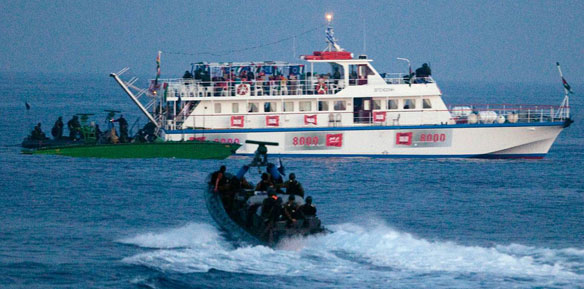
The Aid Ship Fiasco? Once again, Israel is its own worst enemy. The critical thing is to establish the truth, so if Israel has nothing to hide then why does it not permit an independent enquiry?

It seems pretty clear to me that the majority of activists on the first ship were peaceful but you only have to have a few prepared to use violence and this will cause big trouble, which seems to have been the case here. And everyone knows that if Israel or Israelis are attacked then they respond with overwhelming force.

But “winning hearts and minds” CANNOT be done without the truth being known, and nobody who matters (ordinary Arabs, Iranians and Turks in particular) is going to trust an enquiry carried out solely by the Israelis. This is so obvious that one wonders if – as often seems the case – Israel has taken leave of its senses.

by Chris Snuggs