Tag: Maya civilization

Ancient times

This attracted me very much, and I wanted to share it with you.

The opening paragraph of this article caught my eye so I read it fully. As it was published in The Conversation then that meant I could republish it.

ooOOoo

Centuries ago, the Maya storm god Huracán taught that when we damage nature, we damage ourselves
James L. Fitzsimmons, Middlebury

The ancient Maya believed that everything in the universe, from the natural world to everyday experiences, was part of a single, powerful spiritual force. They were not polytheists who worshipped distinct gods but pantheists who believed that various gods were just manifestations of that force.

Some of the best evidence for this comes from the behavior of two of the most powerful beings of the Maya world: The first is a creator god whose name is still spoken by millions of people every fall – Huracán, or “Hurricane.” The second is a god of lightning, K’awiil, from the early first millennium C.E.

As a scholar of the Indigenous religions of the Americas, I recognize that these beings, though separated by over 1,000 years, are related and can teach us something about our relationship to the natural world.

Huracán, the ‘Heart of Sky’

Huracán was once a god of the K’iche’, one of the Maya peoples who today live in the southern highlands of Guatemala. He was one of the main characters of the Popol Vuh, a religious text from the 16th century. His name probably originated in the Caribbean, where other cultures used it to describe the destructive power of storms.

The K’iche’ associated Huracán, which means “one leg” in the K’iche’ language, with weather. He was also their primary god of creation and was responsible for all life on earth, including humans.

Because of this, he was sometimes known as U K’ux K’aj, or “Heart of Sky.” In the K’iche’ language, k’ux was not only the heart but also the spark of life, the source of all thought and imagination.

Yet, Huracán was not perfect. He made mistakes and occasionally destroyed his creations. He was also a jealous god who damaged humans so they would not be his equal. In one such episode, he is believed to have clouded their vision, thus preventing them from being able to see the universe as he saw it.

Huracán was one being who existed as three distinct persons: Thunderbolt Huracán, Youngest Thunderbolt and Sudden Thunderbolt. Each of them embodied different types of lightning, ranging from enormous bolts to small or sudden flashes of light.

Despite the fact that he was a god of lightning, there were no strict boundaries between his powers and the powers of other gods. Any of them might wield lightning, or create humanity, or destroy the Earth.

Another storm god

The Popol Vuh implies that gods could mix and match their powers at will, but other religious texts are more explicit. One thousand years before the Popol Vuh was written, there was a different version of Huracán called K’awiil. During the first millennium, people from southern Mexico to western Honduras venerated him as a god of agriculture, lightning and royalty.

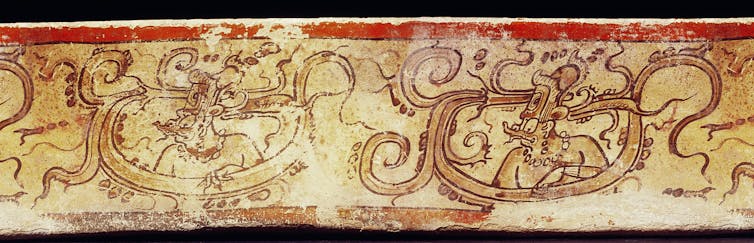
A drawing showing a reclining god-like figure with a large snake around him.
The ancient Maya god K’awiil, left, had an ax or torch in his forehead as well as a snake in place of his right leg. K5164 from the Justin Kerr Maya archive, Dumbarton Oaks, Trustees for Harvard University, Washington, D.C.

Illustrations of K’awiil can be found everywhere on Maya pottery and sculpture. He is almost human in many depictions: He has two arms, two legs and a head. But his forehead is the spark of life – and so it usually has something that produces sparks sticking out of it, such as a flint ax or a flaming torch. And one of his legs does not end in a foot. In its place is a snake with an open mouth, from which another being often emerges.

Indeed, rulers, and even gods, once performed ceremonies to K’awiil in order to try and summon other supernatural beings. As personified lightning, he was believed to create portals to other worlds, through which ancestors and gods might travel.

Representation of power

For the ancient Maya, lightning was raw power. It was basic to all creation and destruction. Because of this, the ancient Maya carved and painted many images of K’awiil. Scribes wrote about him as a kind of energy – as a god with “many faces,” or even as part of a triad similar to Huracán.

He was everywhere in ancient Maya art. But he was also never the focus. As raw power, he was used by others to achieve their ends.

Rain gods, for example, wielded him like an ax, creating sparks in seeds for agriculture. Conjurers summoned him, but mostly because they believed he could help them communicate with other creatures from other worlds. Rulers even carried scepters fashioned in his image during dances and processions.

Moreover, Maya artists always had K’awiil doing something or being used to make something happen. They believed that power was something you did, not something you had. Like a bolt of lightning, power was always shifting, always in motion.

An interdependent world

Because of this, the ancient Maya thought that reality was not static but ever-changing. There were no strict boundaries between space and time, the forces of nature or the animate and inanimate worlds.

People walking through knee-deep water on a flooded street with building on either side and electric wires overhead.
Residents wade through a street flooded by Hurricane Helene, in Batabano, Mayabeque province, Cuba, on Sept. 26, 2024. AP Photo/Ramon Espinosa

Everything was malleable and interdependent. Theoretically, anything could become anything else – and everything was potentially a living being. Rulers could ritually turn themselves into gods. Sculptures could be hacked to death. Even natural features such as mountains were believed to be alive.

These ideas – common in pantheist societies – persist today in some communities in the Americas.

They were once mainstream, however, and were a part of K’iche’ religion 1,000 years later, in the time of Huracán. One of the lessons of the Popol Vuh, told during the episode where Huracán clouds human vision, is that the human perception of reality is an illusion.

The illusion is not that different things exist. Rather it is that they exist independent from one another. Huracán, in this sense, damaged himself by damaging his creations.

Hurricane season every year should remind us that human beings are not independent from nature but part of it. And like Hurácan, when we damage nature, we damage ourselves.

James L. Fitzsimmons, Professor of Anthropology, Middlebury

This article is republished from The Conversation under a Creative Commons license. Read the original article.

ooOOoo

It is such a powerful message, that when we damage nature, we damage ourselves.

But I am unaware, no we are both unaware of a solution, and there doesn’t appear to be a government desire to make this the number one topic.

Please, if there is anyone who reads this post and has a more positive message then we would be very keen to hear from you.

Options for the future

That damn edge, embrace it or ….. or what?

It’s some ago that I read Lester Brown’s book World on the Edge but I still recall the effect it had on me.  Namely, this is not some environmentalist’s ‘willy waving’ but something that has the potential to hurt, I mean HURT!  Since the book was published the stream of information and evidence has turned into a flood of awareness that if we don’t change our ways soon then we, as in the vastness of human life, will go over the edge.

So it was a good reminder to come across a recent extract on the Earth Policy Institute website that is republished in full, as follows:

No previous civilization has survived the ongoing destruction of its natural supports. Nor will ours. Yet economists look at the future through a different lens. Relying heavily on economic data to measure progress, they see the near 10-fold growth in the world economy since 1950 and the associated gains in living standards as the crowning achievement of our modern civilization. During this period, income per person worldwide climbed nearly fourfold, boosting living standards to previously unimaginable levels. A century ago, annual growth in the world economy was measured in the billions of dollars. Today, it is measured in the trillions. In the eyes of mainstream economists, our present economic system has not only an illustrious past but also a promising future.

Mainstream economists see the 2008–09 global economic recession and near-collapse of the international financial system as a bump in the road, albeit an unusually big one, before a return to growth as usual. Projections of economic growth, whether by the World Bank, Goldman Sachs, or Deutsche Bank, typically show the global economy expanding by roughly 3 percent a year. At this rate the 2010 economy would easily double in size by 2035. With these projections, economic growth in the decades ahead is more or less an extrapolation of the growth of recent decades.

But natural scientists see that as the world economy expanded some 20-fold over the last century, it has revealed a flaw—a flaw so serious that if it is not corrected it will spell the end of civilization as we know it. At some point, what had been excessive local demands on environmental systems when the economy was small became global in scope.

A study by a team of scientists led by Mathis Wackernagel aggregates the use of the earth’s natural assets, including carbon dioxide overload in the atmosphere, into a single indicator—the ecological footprint. The authors concluded that humanity’s collective demands first surpassed the earth’s regenerative capacity around 1980. By 2007, global demands on the earth’s natural systems exceeded sustainable yields by 50 percent. Stated otherwise, it would take 1.5 Earths to sustain our current consumption. If we use environmental indicators to evaluate our situation, then the global decline of the economy’s natural support systems—the environmental decline that will lead to economic decline and social collapse—is well under way.

How did we get into this mess? Our market-based global economy as currently managed is in trouble. The market does many things well. It allocates resources with an efficiency that no central planner could even imagine, much less achieve.

However the market, which sets prices, is not telling us the truth. It is omitting indirect costs that in some cases now dwarf direct costs. Consider gasoline. Pumping oil, refining it into gasoline, and delivering the gas to U.S. service stations may cost, say, $3 per gallon. The indirect costs, including climate change, treatment of respiratory illnesses, oil spills, and the U.S. military presence in the Middle East to ensure access to the oil, total $12 per gallon. Similar calculations can be done for coal.

We delude ourselves with our accounting system. Leaving such huge costs off the books is a formula for bankruptcy. Environmental trends are the lead indicators telling us what lies ahead for the economy and ultimately for society itself. Falling water tables today signal rising food prices tomorrow. Shrinking polar ice sheets are a prelude to falling coastal real estate values.

Beyond this, mainstream economics pays little attention to the sustainable yield thresholds of the earth’s natural systems. Modern economic thinking and policymaking have created an economy that is so out of sync with the ecosystem on which it depends that it is approaching collapse. How can we assume that the growth of an economic system that is shrinking the earth’s forests, eroding its soils, depleting its aquifers, collapsing its fisheries, elevating its temperature, and melting its ice sheets can simply be projected into the long-term future? What is the intellectual process underpinning these extrapolations?

We are facing a situation in economics today similar to that in astronomy when Copernicus arrived on the scene, a time when it was believed that the sun revolved around the earth. Just as Copernicus had to formulate a new astronomical worldview after several decades of celestial observations and mathematical calculations, we too must formulate a new economic worldview based on several decades of environmental observations and analyses.

The archeological record indicates that civilizational collapse does not come suddenly out of the blue. Archeologists analyzing earlier civilizations talk about a decline-and-collapse scenario. Economic and social collapse was almost always preceded by a period of environmental decline.

For past civilizations it was sometimes a single environmental trend that was primarily responsible for their decline. Sometimes it was multiple trends. For Sumer, rising salt concentrations in the soil, as a result of an environmental flaw in the design of their otherwise extraordinary irrigation system, led to a decline in wheat yields. The Sumerians then shifted to barley, a more salt-tolerant crop. But eventually barley yields also began to decline. The collapse of the civilization followed.

For the Mayans, it was deforestation and soil erosion. As more and more land was cleared for farming to support the expanding empire, soil erosion undermined the productivity of their tropical soils. A team of scientists from the National Aeronautics and Space Administration has noted that the extensive land clearing by the Mayans likely also altered the regional climate, reducing rainfall. In effect, the scientists suggest, it was the convergence of several environmental trends, some reinforcing others, that led to the food shortages that brought down the Mayan civilization.

Although we live in a highly urbanized, technologically advanced society, we are as dependent on the earth’s natural support systems as the Sumerians and Mayans were. If we continue with business as usual, civilizational collapse is no longer a matter of whether but when. We now have an economy that is destroying its natural support systems, one that has put us on a decline and collapse path.

The reality of our situation may soon become clearer for mainstream economists as we begin to see some of the early economic effects of overconsuming the earth’s resources, such as rising world food prices. On the social front, the most disturbing trend is spreading hunger.

As rapid population growth continues, cropland becomes scarce, wells go dry, forests disappear, soils erode, unemployment rises, and hunger spreads. As environmental degradation and economic and social stresses mount, the more fragile governments are losing their capacity to govern. They become failing states—countries whose governments can no longer provide personal security, food security, or basic social services, such as education and health care. As the list of failing states grows longer each year, it raises a disturbing question: How many states must fail before our global civilization begins to unravel?

How much longer can we remain in the decline phase, whether measured in natural asset liquidation, spreading hunger, or failing states, before our global civilization begins to break down? We are dangerously close to the edge. Peter Goldmark, former Rockefeller Foundation president, puts it well: “The death of our civilization is no longer a theory or an academic possibility; it is the road we’re on.”

Adapted from World on the Edge by Lester R. Brown.  The message is clear.

But if you haven’t read the book it’s available online, for free!  Just go here and not only will you find the link to the book but also links to other valuable materials.

Founder and President of the Earth Policy Institute, Lester Brown, speaks about his new book World on the Edge: How to Prevent Environmental and Economic Collapse. The issues, says Brown, are critical — and the big question is whether we can change direction before “we go over the edge.” Among his points: solar, wind and geothermal energy, with energy efficiency, can provide all the power we need, but a massive effort must be made now to fully shift to these clean, safe, renewable energy technologies. He strongly rejects nuclear power.

H’mmm

The way the world is – now!

There has been a wealth of information going past my ‘desk’ in the last couple of days that gives plenty of cause to worry.  But I’m going to spend a few days mulling it all over rather than react in some ‘knee-jerk’ fashion.

However, a couple of stories caught my eye a few days ago on the BBC News website and seemed worthy of sharing with you.

The first was,

Mild drought caused Maya collapse in Mexico, Guatemala

Relatively mild drought conditions may have been enough to cause the collapse of the Classic Maya civilisation, which flourished until about AD950 in what is now southern Mexico and Guatemala.

Scientists have long thought that severe drought caused its collapse.

But Mexican and British researchers now think that a sustained drop in rainfall of only 25-40% was enough to exhaust seasonal water supplies in the region.

The findings were published in the journal Science.

The research was conducted by the Yucatan Centre for Scientific Research in southern Mexico and the University of Southampton in the UK.

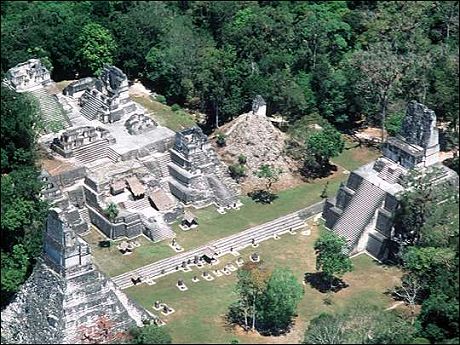
Mayan pyramids of Tikal

Read the full news piece here.

The second piece published by the BBC within 24 hours went as follows,

Drought conditions in England ‘set to widen’

Ongoing dry weather over the spring and summer threatens to place more areas of England in a state of drought, the Environment Agency (EA) has warned.

It singled out parts of western, central and south western England and parts of south east Yorkshire.

The agency said time was running out for rain to restore groundwater levels before the new growing season begins.

Earlier this week the South East joined most of East Anglia in a state of official drought.

In parts of south-east England groundwater levels are lower than in the infamously dry summer of 1976.

Again, read the full article on the BBC website here.

And closer to home?

The historical (30-year average) precipitation for Payson up here in the Rim Country is 2.30 inches for January, and 2.41 inches for February.  Today, February 29th 2012, we have had less than 0.5 inches for the whole of 2012 so far!  Interesting times!

The Granite Dells Wilderness

Where are we off to?

More musings on how this present civilisation is going to change, as change it must.

I have a sense that this article is going to spread across a number of posts.  Regular readers of Learning from Dogs will be aware that I am summarising Lester Brown’s excellent book, World on the Edge.  If you have missed those summaries, the last one, Part 4, was here. (Part 3 here, Part 2 here, Part 1 here.)

Details of this excellent book are on the Earth Policy Institute website including the opportunity to download the book for free.

OK, back to the theme of this article, very much connected with the mission of the EPI.

Jean and I watched a video last night from the website Top Documentary Films; great site by the way.  It was called 2210: The Collapse.  This was how the film was described on that website.

Imagine if hundreds of years from now, scientists excavated the abandoned ruins of some of our largest cities, what conclusions would they come to?

It happened to the Romans, the Anasazi, and the Mayans and, inevitably, one day our own modern civilization will also fall. In this two hour special discover how a future civilization might be baffled as to why the population of these once-great cities would suddenly abandon their technology and architecture, and turn their homes into ghost towns.

Some experts believe that there is a very real risk this could happen, and the collapse of the world as we know it is closer than we think.

Examining the parallels between cultures separated by hundreds of years, explore whether the key to preventing such a global collapse today could lie in finding renewable alternatives to our dwindling energy supplies and sustainable resources. Can we learn from the mistakes of the past before it’s too late?

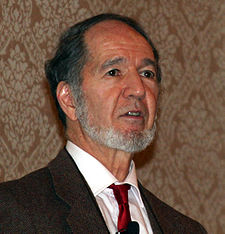
Jared Diamond

In some ways the film didn’t cover any new ground despite it being an interesting way of approaching the subject of the future of our present civilisation.  But what was really worthwhile were the clips from three experts in their various fields.  They were the author Jared Diamond, Daniel Gilbert who is Professor of Psychology at Havard, and Joseph Tainter also an author.  There is much material around from these three gentlemen.

So I am going to start with Jared Diamond.  WikiPedia has Jared’s details.  The following is a video going back to 2003 which is no less relevant in terms of where we are in 2011.  (If you want more of Jared’s ideas, just let me know and they will be included in a future Post.)

“I’ve set myself the modest task of trying to explain the broad pattern of human history, on all the continents, for the last 13,000 years. Why did history take such different evolutionary courses for peoples of different continents? This problem has fascinated me for a long time, but it’s now ripe for a new synthesis because of recent advances in many fields seemingly remote from history, including molecular biology, plant and animal genetics and biogeography, archaeology, and linguistics.”

JARED DIAMOND is Professor of Geography at the University of California, Los Angeles. Until recently he was Professor of Physiology at the UCLA School of Medicine. He is the author of the recently published Collapse: How Societies Choose to Fail or Succeed, and the Pulitzer Prize-winning author of the widely acclaimed Guns, Germs, and Steel: the Fates of Human Societies, which also is the winner of Britain’s 1998 Rhone-Poulenc Science Book Prize.  (From here)