Tag: Jon Lavin

Meet the dogs – Pharaoh (pt 2)

The concluding part-two of meeting Pharaoh 
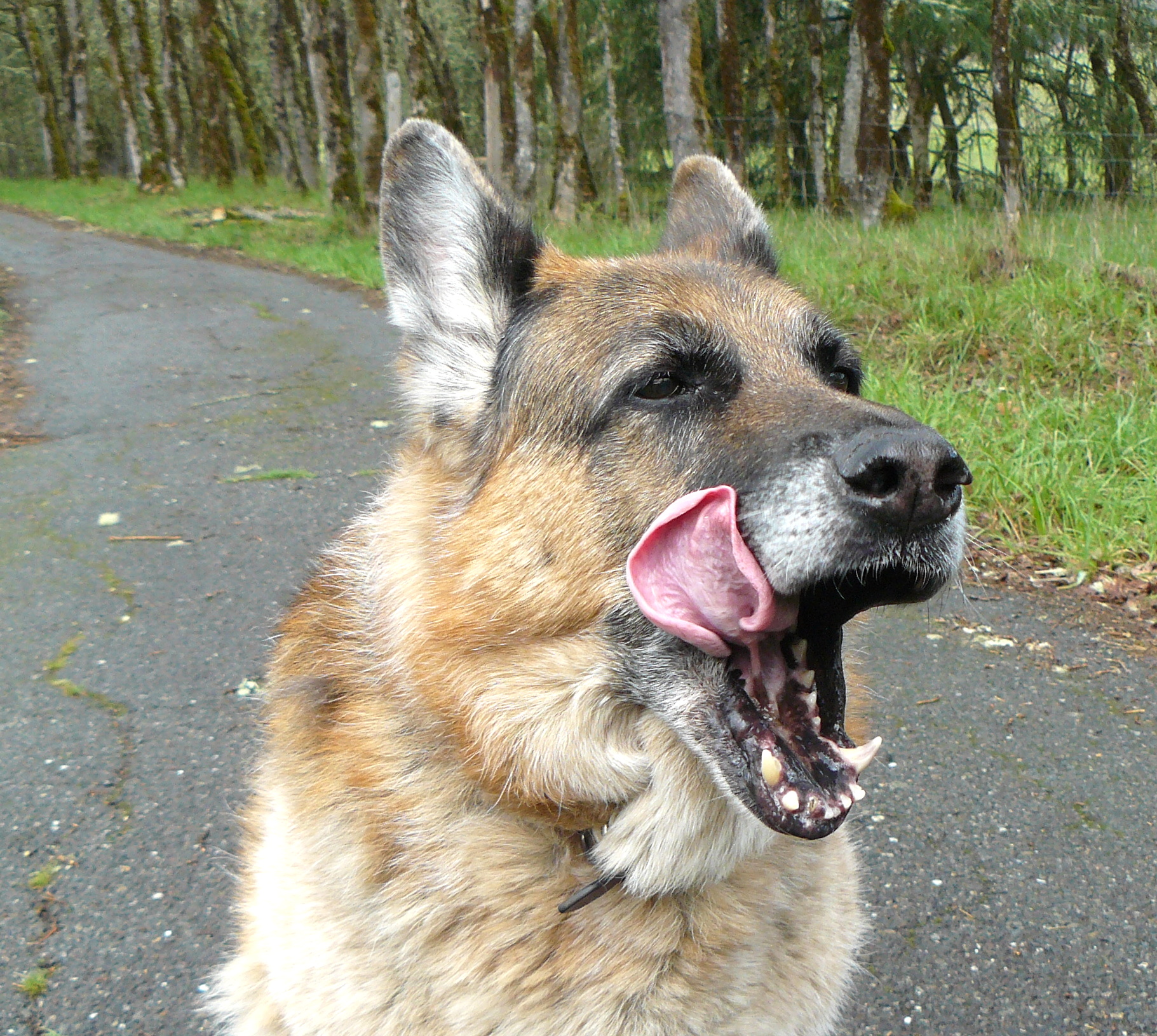
Pharaoh, as of yesterday afternoon!

In yesterday’s first part of my recollection of having Pharaoh in my life for over ten years, I focussed on the early days.  Today, I want to take a more philosophical view of the relationship, right up to the present day.

The biggest, single reward of having Pharaoh as my friend goes back a few years.  Back to my Devon days and the time when Jon Lavin and I used to spend hours talking together.  Pharaoh always contentedly asleep in the same room as the two of us. It was Jon who introduced me to Dr. David Hawkins and his Map of Consciousness. It was Jon one day who looking down at the sleeping Pharaoh pointed out that Dr. Hawkins offered evidence that dogs are integrous creatures with a ‘score’ on that Map of between 205 and 210. (Background story is here.)

So this blog, Learning from Dogs, and my attempt to write a book of the same name flow from that awareness of what dogs mean to human consciousness and what Pharaoh means to me.  No, more than that!  From that mix of Jon, Dr. David Hawkins, experiencing the power of unconditional love from an animal living with me day-in, day-out, came a journey into my self.  Came the self-awareness that allowed me to like who I was, be openly loved by this dog of mine, and be able to love in return.  As is said: “You cannot love another until you love yourself.

Moving on.

Trying to pick out a single example of the bond that he and I have is practically impossible.  I have to rely on photographs to remind me of the thousands of times that a simple look or touch between Pharaoh and me ‘speaks’ to me in ways that words fail. Here’s an extract from my celebration of Pharaoh’s tenth birthday  last June 3rd; written the following day. It comes pretty close to illustrating the friendship bond.

oooo

For many years I was a private pilot and in later days had the pleasure, the huge pleasure, of flying a Piper Super Cub, a group-owned aircraft based at Watchford Farm in South Devon.  The aircraft, a Piper PA-18-135 Super Cub, was originally supplied to the Dutch Air Force in 1954 and was permitted by the British CAA to carry her original military markings including her Dutch military registration, R-151, although there was a British registration, G-BIYR, ‘underneath’ the Dutch R-151.  (I wrote more fully about the history of the aircraft on Learning from Dogs back in August 2009.)

Piper Cub R151
Piper Cub R151

Anyway, every time I went to the airfield with Pharaoh he always tried to climb into the cockpit.  So one day, I decided to see if he would sit in the rear seat and be strapped in.  Absolutely no problem with that!
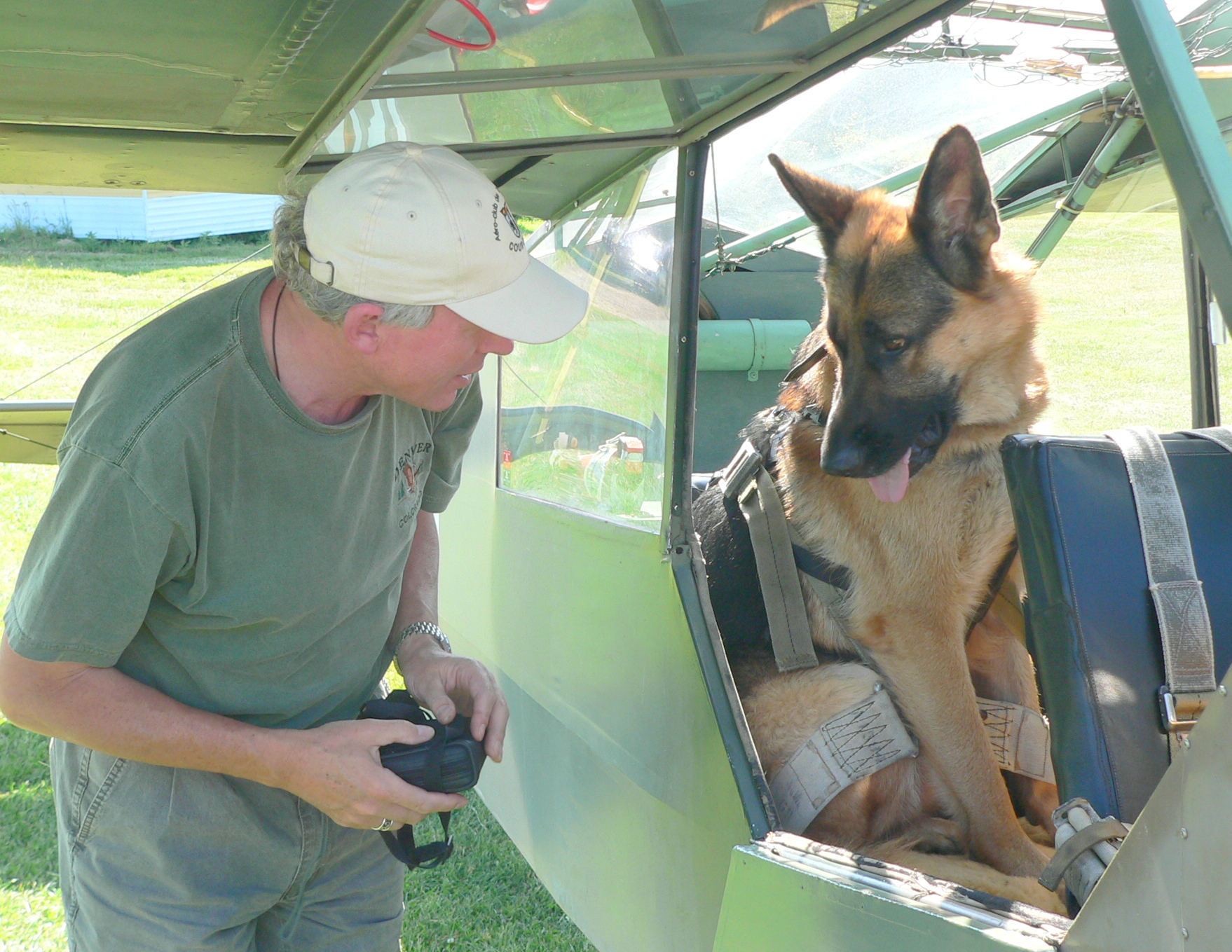
Come on Dad, let's get this thing off the ground!
Come on Dad, let’s get this thing off the ground!

My idea had been to fly a gentle circuit in the aircraft.  First I did some taxying around the large grass airfield that is Watchford to see how Pharaoh reacted.  He was perfectly behaved.

Then I thought long and hard about taking Pharaoh for a flight.  In the Cub there is no autopilot so if Pharaoh struggled or worse it would have been almost impossible to fly the aircraft and cope with Pharaoh.  So, in the end, I abandoned taking him for a flight.  The chances are that it would have been fine.  But if something had gone wrong, the outcome just didn’t bear thinking about.

So we ended up motoring for 30 minutes all around the airfield which, as the next picture shows, met with doggie approval.  The date was July 2006.
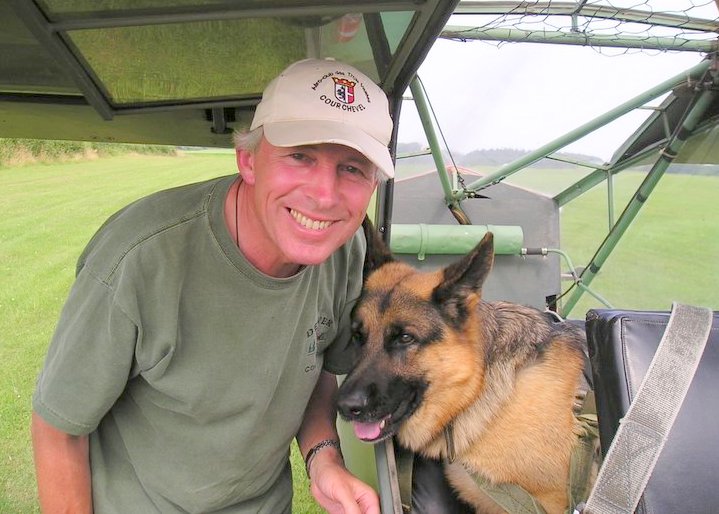
That was fun!
That was fun!

oooo

Moving on again.  This time to another flying experience.  To the day when Pharaoh and I flew out of London bound for Los Angeles and a new life with Jeannie and all her dogs (16 at that time) down in San Carlos, Sonora County, Mexico.  The date: September 15th, 2008.  Just ten months after I had met Jean in Mexico and realised that this was the woman that I was destined to love! (Now you will understand why I described earlier the Jon Lavin, Dr. Hawkins, Pharaoh mix as the biggest, single reward of having Pharaoh as my friend!)

There followed wonderful happy days for me and Pharaoh.  Gorgeous to see how Pharaoh became so much more a dog, if that makes sense, from having his own mini-pack around him.  Those happy days taking us all forwards to Payson, AZ, where Jean and I were married, and then on to Merlin, Oregon arriving here in October, 2012.
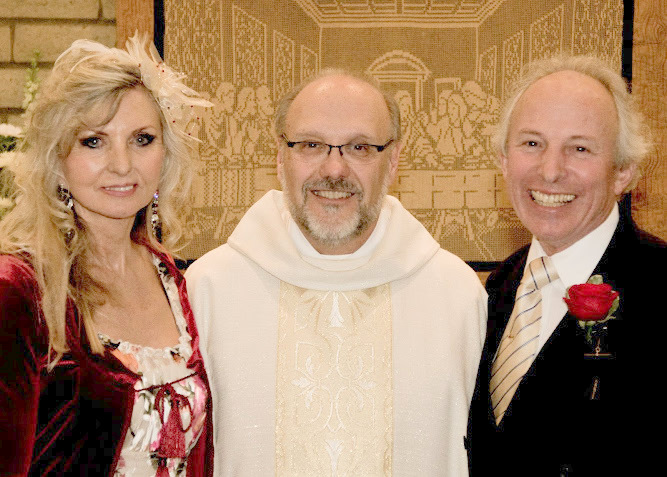
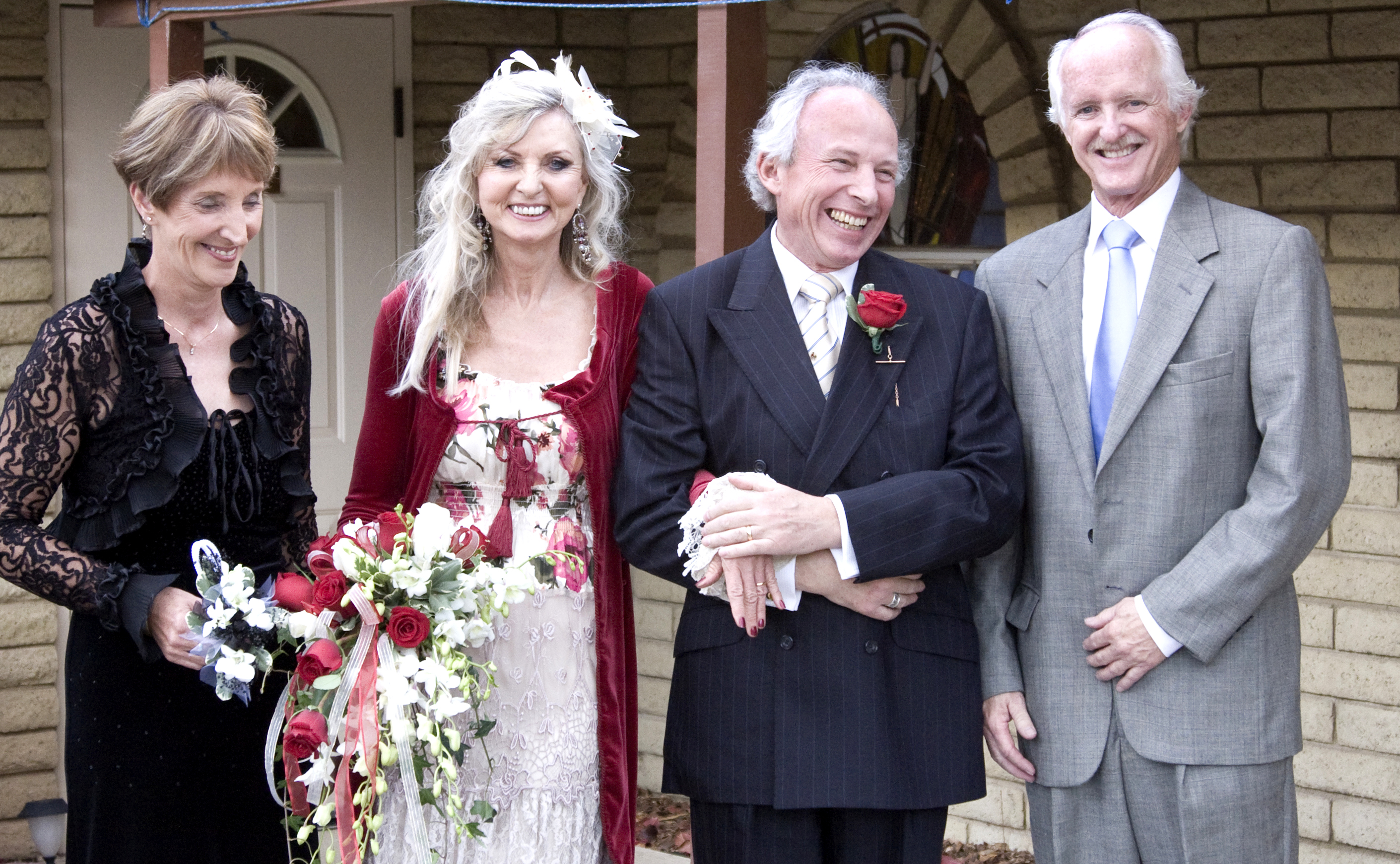
Fr. Dan Tantimonaco with the newly weds!

oooo

Pharaoh 'married' to his dearest friends. December, 2013.
Pharaoh ‘married’ to his dearest friends. December, 2013.

oooo

Perfect closeness. Pharaoh and Cleo with Hazel in the middle.  Taken yesterday.
Smelling the flowers! Pharaoh and Cleo with Hazel in the middle. Taken yesterday.

I could go on!  Hopefully, you get a sense, a very strong sense, of the magical journey that both Pharaoh and I have experienced since I first clasped him in my arms back in September, 2003.

Both Pharaoh and I are in the Autumn of our lives, he is 11 in June; I am 70 in November, and we both creak a little. But so what! Pharaoh has been my greatest inspiration of the power of unconditional love; of the need to smell the flowers in this short life of ours.
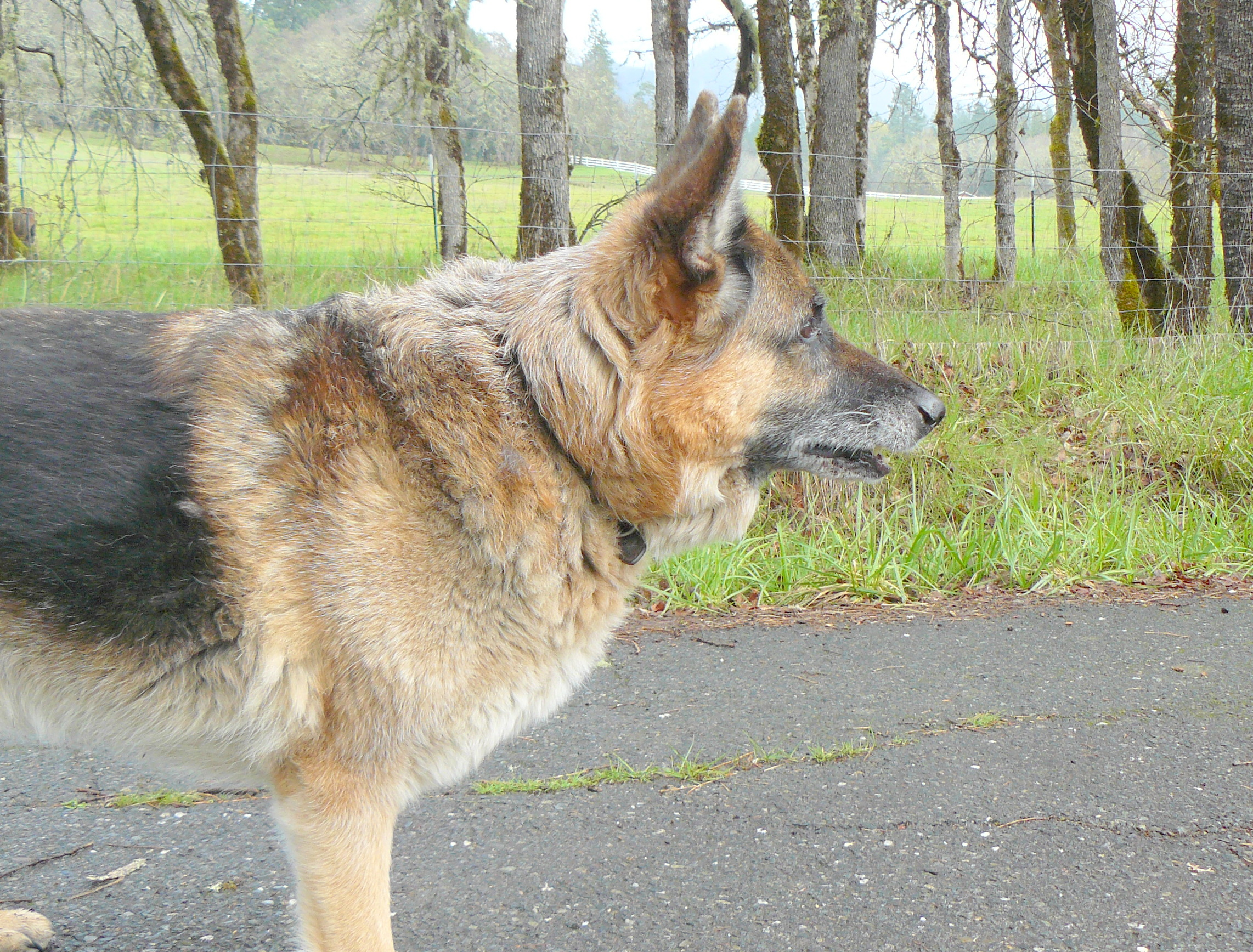
One very great animal! (March 25th, 2014)

Thank you, my dear, dear friend!

The scent of danger.

A reflection on our reptilian brains.

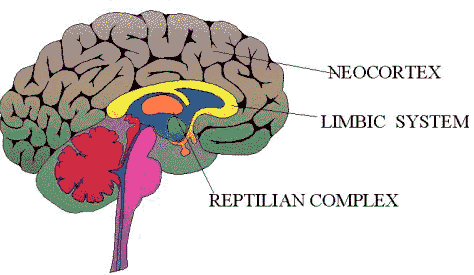
Now of all the things I am not, I am neither a biologist nor a scientist of any description.  However, general knowledge told me years ago that the human brain is composed of three areas, as the following diagram shows.

The constituents of the human brain.

A quick web search brings up THE EVOLUTIONARY LAYERS OF THE HUMAN BRAIN, from which I quote:

The first time you observe the anatomy of the human brain, its many folds and overlapping structures can seem very confusing, and you may wonder what they all mean. But just like the anatomy of any other organ or organism, the anatomy of the brain becomes much clearer and more meaningful when you examine it in light of the evolutionary processes that created it.

The most efficient model for understanding the brain in terms of its evolutionary history is the famous triune brain theory developed by Paul MacLean. According to this theory, the following three distinct brains emerged successively in the course of evolution and now co-inhabit the human skull:

The reptilian brain, the oldest of the three, controls the body’s vital functions such as heart rate, breathing, body temperature and balance. Our reptilian brain includes the main structures found in a reptile’s brain: the brainstem and the cerebellum. The reptilian brain is reliable but tends to be somewhat rigid and compulsive.

The limbic brain emerged in the first mammals. It can record memories of behaviours that produced agreeable and disagreeable experiences, so it is responsible for what are called emotions in human beings. The main structures of the limbic brain are the hippocampus, the amygdala, and the hypothalamus. The limbic brain is the seat of the value judgments that we make, often unconsciously, that exert such a strong influence on our behaviour.

The neocortex first assumed importance in primates and culminated in the human brain with its two large cerebral hemispheres that play such a dominant role. These hemispheres have been responsible for the development of human language, abstract thought, imagination, and consciousness. The neocortex is flexible and has almost infinite learning abilities. The neocortex is also what has enabled human cultures to develop.

These three parts of the brain do not operate independently of one another. They have established numerous interconnections through which they influence one another. The neural pathways from the limbic system to the cortex, for example, are especially well developed.

I’m well into reading the book Waking The Tiger: Healing Trauma authored by Peter A. Levine.  As early as Chapter One, Peter Levine explains [my emphasis]:

The involuntary and instinctual portions of the human brain and nervous system are virtually identical to those of mammals and even reptiles. Our brain, often called the ‘triune brain,’ consists of three integral systems. The three parts are commonly known as the ‘reptilian brain’ (instinctual), the ‘mammalian or limbic brain (emotional), and the ‘human brain or neo-cortex’ (rational). Since the parts of the brain that are activated by a perceived life threatening situation are the parts we share with animals, much can be learned by studying how certain animals, like the impala, avoid traumatization. To take this one step further, I believe that the key to healing traumatic symptoms in humans lies in our being able to mirror the fluid adaptation of wild animals as they ‘shake out’ and pass through the immobility response and become fully mobile and functional.

Unlike wild animals, when threatened, we humans have never found it easy to resolve the dilemma of whether to fight or flee. This dilemma stems, at least in part, from the fact that our species has played the role of both predator and prey. Prehistoric peoples, though many were hunters, spent long hours each day huddled together in cold caves with the certain knowledge that they could be snatched up at any moment and torn to shreds.

Anyway, to get back to what triggered today’s post.

If you read yesterday’s post you will recall me chatting with Jon Lavin and Jon reminding me that humans are drawn to positive messages.  But in stark contrast, the news media industry excels in promoting ‘doom and gloom’.  Why is this?  Why are we so fascinated by danger?

Well here’s my theory.

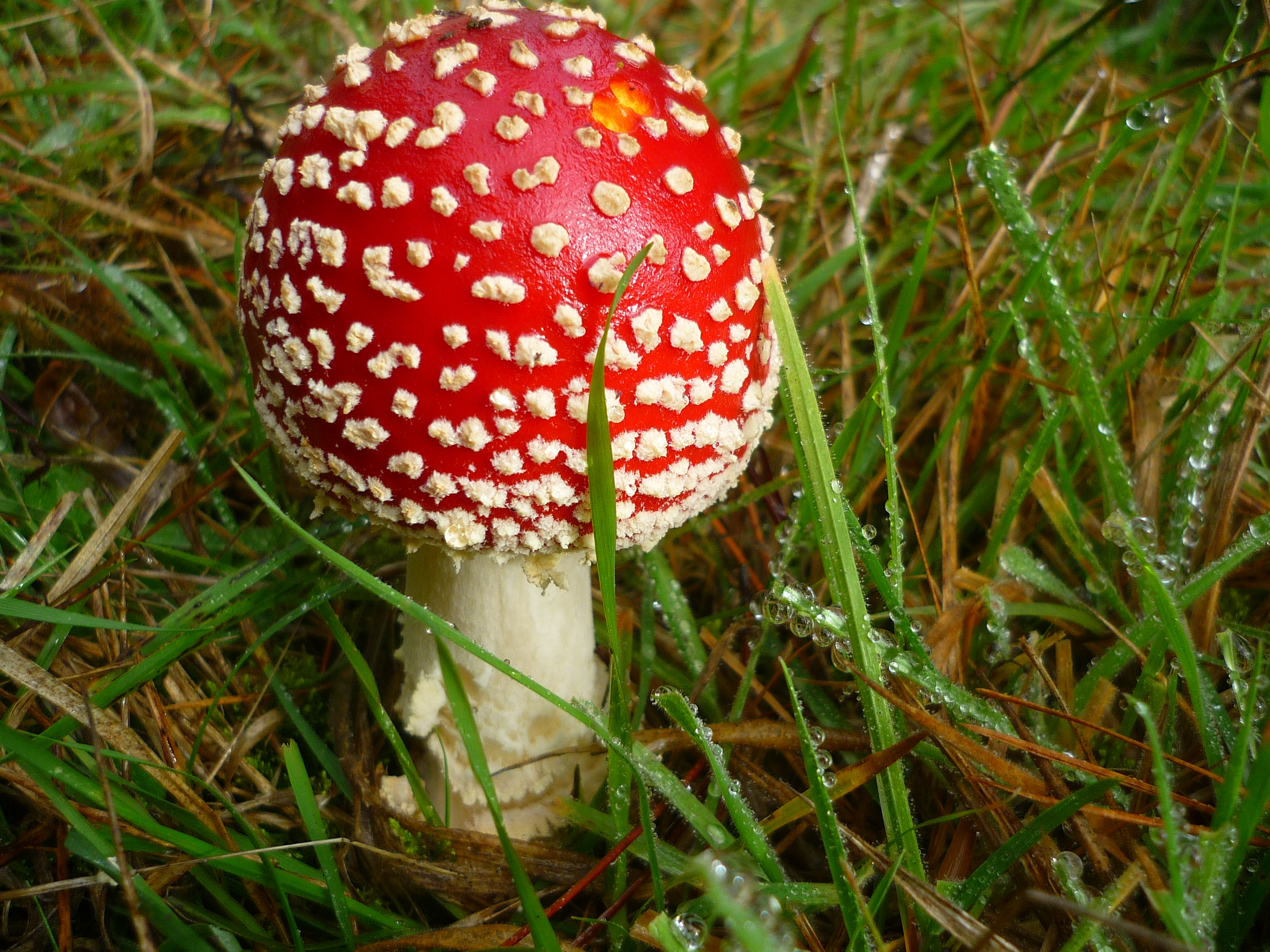
That is our evolution would not have succeeded if early man didn’t become pretty smart at identifying animal behaviours and plants and fruits that had the capacity to harm or even kill.  For example, what parent hasn’t made it a priority to teach their children the difference between harmful fungi and edible mushrooms.  Indeed to the extent that most of us would think long and hard before eating any fungi found in the wild unless we were 150% certain it was edible.  Look at the following picture.  Your instinct tells you if it’s safe to eat or not – it’s not!

Amanita muscaria photo © Michael Wood

So early man became over-sensitised to dangers to his health for his own good and continued existence. While modern man functions in ways almost unrecognisable from early man, that good old reptilian brain still is doing it’s best to protect us (flight, fight or freeze).  Think how we all respond to a sudden alarming sound, such as a gun shot or a scream, to know that the old reptilian brain is still alive and well.

Thus while all of us hate negativity we all seem to have this fascination with doom and gloom – just in case it helps us and our loved ones survive.

Back to Jon Lavin.  He makes it very clear that anything more than a small amount of ‘doom and gloom’ speaking to our consciousness increases the odds of depression and introversion.

Thus the message is that we humans should allow our Neocortex to tell our Reptilian ‘neighbour’ to go easy on the bad news, go and open a beer and watch the world go by! Whoops! Watch the world go by with a smile!

Oh, and Happy Valentine’s Day to you all.

The spirit in all life.

There are things that are beyond rational explanation.

Warning – this post is rather more ‘touchy-feely’ than you are used to seeing on Learning from Dogs.  So if it wanders about in ways that you struggle to follow then just stifle your yawn and come back tomorrow!

It goes back to an earlier plan that I had in terms for a couple of posts.  Both focussing on the myriad of examples of the appalling decline in our world.  I had been collecting a number of essays to support the proposition that if we don’t learn from dogs the qualities of integrity and unconditional love then our world was doomed.  I had collected the essay from Ellen Cantaro over on TomDispatch about the incredible stupidity of fracking. Or the one from Tom’s own pen in an essay about climate change being the new ‘Anti-News’.  I had saved the recent essay from George Monbiot discussing the madness of the so-called dredging practices in the UK’s Somerset Levels.  I had fumed at another George Monbiot essay Bring It On that included this incredible statement:

It is hard to think of a more serious allegation. For six months an undercover officer working for the Metropolitan Police was instrumental in planning a major demonstration, which ended up causing injuries and serious damage to property. Yet the police appear to have failed to pass this intelligence to the City of London force, leaving the target of the protest unprotected.

I had many more examples but you get the message!

So what stopped me?

I was chatting to Jon Lavin on Monday about a variety of things.  Jon asked how the book was coming along.  I replied by saying that a recent NaNoWriMo webinar had persuaded me that the book wasn’t a novel and should be re-written as a non-fiction story.  Going on to add that I might include some of the appalling examples of what was going wrong in our society to strengthen the argument that we truly have much to learn from dogs.

Jon, who had read the first, very rough draft of the book that appeared on this blog, cautioned me against doing that.  He went on to say that in the world of solutions focussed therapy, the area that Jon practices in professionally, the way forward was always to focus “on what’s working“.  Jon continued by saying that while one would initially allow the problems to be voiced, this negativity would always be a tiny piece of the overall process, say less than 5% of the session.  That even if a client’s whole world seemed to be failing, there would always be something that was alright, always a 1% that was working, and that would be the place to start.  A quick web search endorsed that as the website of Good Therapy revealed, from where I read:

Solution focused brief therapy (SFBT) targets the desired outcome of therapy as a solution rather than focusing on the symptoms or issues that brought someone to therapy. This technique only gives attention to the present and the future desires of the client, rather than focusing on the past experiences. The therapist encourages the client to imagine their future as they want it to be and then the therapist and client collaborate on a series of steps to achieve that goal. This form of therapy involves reviewing and dissecting the client’s vision, and determining what skills, resources, and abilities the client will develop and use to attain his desired outcome. Solution focused therapy was developed by Steve De Shazer, Insoo Kim Berg, and their team at the Brief Family Therapy Family Center in Milwaukee, USA.

Thus coming back to the book rewrite, Jon said that people wanted to read ‘good news’ not negativity.  It was a key reminder for me and an incredibly inspiring call that in these challenging times, whether on this blog or in a potential book, I need to write about all the powerfully, positive lessons that dogs, and all warm-blooded creatures, offer mankind.  The lessons of integrity, love, trust, balance, loyalty, faithfulness, affection, forgiveness and more.

OK, moving on.

On the evening of February 7th Jean and I settled down to watch a YouTube video.  It had been featured in a post from LadyBlueRose that had been published on the 6th.  The post was called His Name is Spirit and it was the story of a woman, Anna Breytenbach, who has dedicated her life to what she calls interspecies communication.

We had reached the six-minute point in the film, already captivated by it, when the telephone rang.  I paused the film and answered the phone.  It was neighbour Dordie from next door ringing to say that when she had seen us earlier in the day she had forgotten to mention that there was this incredible film that we really had to watch …… yes, you guessed it!  The film that Jean and I were watching at that moment.

Here is that film.

Now here is Anna’s website Animal Spirit where one learns:

ENHANCING THE RELATIONSHIP BETWEEN HUMANS, OTHER ANIMALS AND THE NATURAL WORLD

Welcome to an exploration of interspecies communication – a journey of discovering ways to restore a deep relationship with all of life.

Human and animal communication creates a valuable bridge between human and non-human animals. By connecting with our intuition, we can engage in meaningful dialogue and remember how to hear the subtle messages from those whose space we share in our lives and our natural environment. Coming from a place of respect and reverence for all life, we can learn to understand our wilder relatives, honour their truths and live in greater harmony.

and where one also can watch the short introductory film that is on her home page; as below.

A web search then came across a fascinating interview with Anna.

So where does this all end up?

Simply, that in a world dominated by media of all types that favour ‘doom and gloom’ it can be incredibly difficult to hang on to the message offered by Jon and by Anna, and by many others no doubt, the message that our individual health, and by implication the health of this planet, is afforded through staying positive.

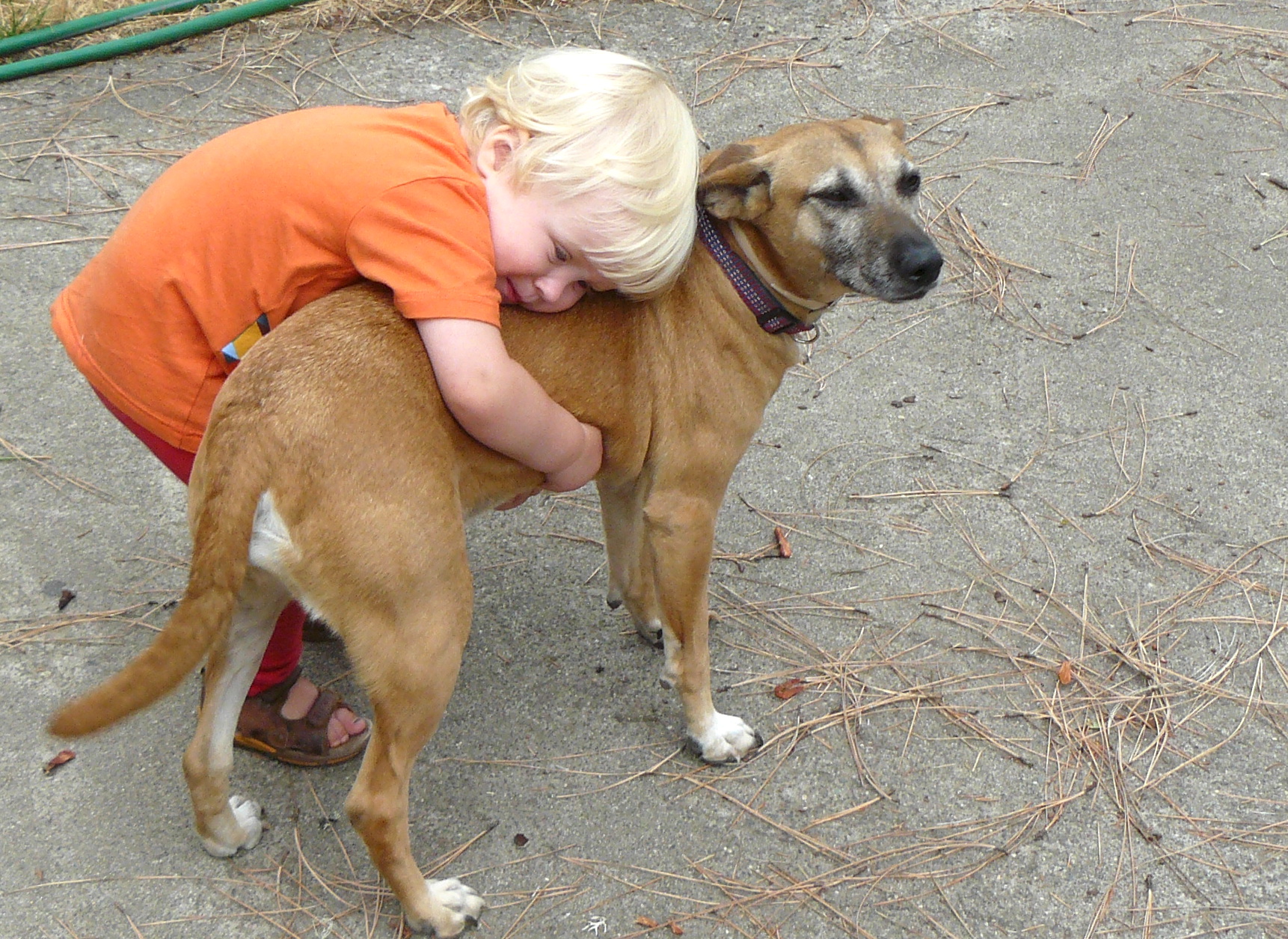
Or put more basically, if you are feeling low go and hug a dog!  So I can do no better than to close with the same picture that closed Tuesday’s post Meet the dogs – Dhalia.

Love and Trust - Grandson Morten hugging Dhalia.
Love and Trust – Grandson Morten hugging Dhalia

20:20 self-awareness.

How something so fundamental as humans talking with each other can so often be mysterious.

When I composed this sub-heading, I wasn’t sure of what word to use to end the sentence.  Some of the words that sped through my mind were: complex, distorted, difficult, obtuse and …. well, you get the message.

The single biggest problem in communication is the illusion that it has taken place.” George Bernard Shaw is reputed to have once said!

Today’s essay on the challenges of speaking clearly to another, perhaps better described as communicating in a clear and unambiguous fashion, came out of a recent conversation with Jon Lavin, a good friend from my Devon days.  (Jon offers services for business owners and entrepreneurs under his business banner of The People Workshop.)

Jon was explaining that the number one hurdle for businesses that are managing change, and for so many businesses managing change is practically a constant, is having clear communications within the team.

Seems clear enough to me! 😉

Yet, what we hear and what we say are both modified, frequently unconsciously, by past events, experiences and trauma.  That being the case, then it is key, critically so, that we achieve the best possible self-awareness.  Because it is only through an understanding of our past that we come to learn of our sensitivities and our associated ‘tender spots’ and their potential for ‘pulling our strings’.  Here’s a personal story.

In 1956, when I was 12, I experienced a trauma that was interpreted by my consciousness as emotional rejection.  By the age of 14 that sensitivity to rejection had descended into my subconscious.  For fifty years, that sensitivity remained hidden yet continued to influence my life in many unseen ways, not all of them negatively by a long measure. In 2007 a period of counselling revealed that hidden emotional rejection; brought it to the surface.  It changed beyond imagination how I felt, how I behaved, how I was.  Nonetheless, that sensitivity to rejection is still there, albeit now visible.  Thus when I hear or experience something that tickles that sensitivity I still react.  But because I can now see and feel myself reacting, I can sidestep the emotional strings.

The following is a short, twenty-minute, documentary film about fear.  Do watch it.  The message that we are so profoundly a product of our past is beautifully presented.

On being honest.

A reposting of an article by Jon Lavin, first published on the 3rd July, 2010.)

Conscientiousness isn’t all it’s cracked out to be!

(Foreword from Paul.)

Jon is one of those rare individuals who not only has been committed to a path of self-awareness for more than 30 years but who has also studied incredibly hard so as to be able to help others and do so from a base of real competence, as his own Blog describes.

But then I realised the great strength in what Jon has written.  It is this.

There are many notable teachers to whom thousands upon thousands have turned to for a deeper understanding of what life is all about.  As far back as time itself, teachers have surfaced and given spiritual guidance to those that come in need.  But it’s very difficult to read or listen to these great teachers and connect with the fact that they were born, as we are all born, with nothing.  And all of them, like many of us, went through Hell on wheels to come out the other side with a greater self-awareness and a deeper understanding of the real truths in nature.  Like all of us who wish to rise above our present place they first acknowledged their own frailties. It is the starting point.

So, let me get to the point.  Jon has the awareness and understanding to offer real help to those that seek answers that are currently beyond reach.  Jon’s article is an wonderful illustration that he experiences the same fears and feelings of helplessness that you and I feel.  You and I and Jon and all of humanity are much more closely connected than we realise.

Paul H.

oooOOOooo

To see in is to see out!

I’ve been running my own business for about 12 years now. In the beginning it started because I had a thirst for wanting to make a difference in small business in our local area and a passion for wanting to do it through working with people directly, on their behaviours. Still have, really.

I think this came as a form of acknowledgement to the few exceptional people managers I experienced while I was employed, and the all too common, terrible ones.

I was also mentored by a group of people to whom no developmental tool was barred. My eyes were well and truly opened to how a change of view could change outcomes.

The final boot up the backside was redundancy in the late 90s. I was all ready to go and just needed a kick.

My work ethic, trained at home and then through an engineering apprenticeship, was to conscientiously work hard and try hard and to treat people the way you want to be treated. Nothing wrong with that. I assumed automatic reward would follow as long as I did those things.

Over time I wised up and became a bit less idealistic and a little more politically aware but carried on in much the same way.

Much later I found myself embarking on a whole new adventure, with a lovely wife and family, all dependent on me, with a few contacts to start getting work from!

It took a year before the first jobs came in that didn’t necessitate robbing the almost non-existent savings and redundancy payment just to keep food on the table. Then, work slowly picked up and it started to get quite good for a one-man band. We were able to go on holiday once a year, camping, but still great, and then abroad.

All the time, I beavered away, trying hard, being very conscientious, as I’d been brought up to be, but slowly getting very stressed.

Time was when it took Friday night to de-stress, then 3 days, then 10 days and recently, not at all.

So faced with this present downturn, which is likely to go on for much longer than any of the others I’ve seen and survived, I’m wondering just what new strategy to adopt. Money is already getting very tight and everything is feeling very ‘hand to mouth’. Can’t really see one month in front of the other.

I notice our local farmer who I went to school with but didn’t really know.

I’ve got degrees, lived abroad, can speak Finnish fluently, (what use is that, I hear you say!), and can turn my hand to most things, but I still feel quite dis-empowered and at a bit of a loss.

My farmer friend is always smiling, he’s got a flock of geese he’s fattening up, the same with his beef cattle, does livery for half a dozen horses or so, has fields planted with various cereal crops, and has his finger in lots of different pies – and definitely does not look stressed. He is also renting his land plus another farm.

I honestly don’t know what to make of this all except for a few really important things – the importance of diversification, relationships and appreciating what you’ve got, especially people things, here, in the now.

I have also come to the realisation that I still haven’t cracked the main thing with being self-employed, and that is replacing fear with trust.

It’s been said by various enlightened people that we see a reflection of the world we hold in mind. Going forward into this brave new world I would like to see opportunities rather than fear, I will diversify into things which make more use of my wide range of talents, and I will swap fear for trust.

By Jon Lavin

Transformation

(A reposting of an article by Jon Lavin, first published on the 9th October, 2009.)

These are hard times for millions – transformation is the only practical option.

I’ve been working with most of my clients recently through painful transformation brought about by the recession.

deep riverAn interesting metaphor really because, since the first wave of uncertainty in the UK banking system triggered panic, I have been picking up on that uncertainty.
That uncertainty feels like it’s stalking the globe at the moment; one has been aware of an underlying fear that was difficult to name and source in me. It has been rather like a deep river in that whilst the surface feels slow moving, currents are moving things powerfully below.

For example, we now are the proud owners of 6 Light Sussex chickens. Our youngest son, Sam, and I have dug up the back lawn and planted vegetables and built a poly-tunnel. We are also planning to install a wood burning cooker. Right back down to the base of Maslow’s pyramid.

Maslow's Pyramid of Needs
Maslow’s Pyramid of Needs

These feelings have brought about such change everywhere and I wonder seriously whether we will ever return to what was, indeed, would we want to?

I might not have mentioned it in previous Posts but as well as an engineering background, in latter years, I have focussed on the interpersonal and success in business founded on quality relationships, integrity and, vitally, awareness.

To inform this, some 6 years ago, I embarked on an MA in Core Process Psychotherapy, primarily to work on myself so that I could be the best I could be in my relationships in and out of work.

The point I’m trying to make is that the same panic I notice in many of the companies I work in, and in me, is based on fear of the unknown and on a lack of trust in abundance in all it’s forms.

We get more of what we focus on. So we can choose to focus on the constant news of more difficulties, hardship and redundancies or, we can focus on what is working. In the workplace it has been pulling people together across functions and sites and pooling resources and ideas.

When we realise we’re not doing this alone it’s amazing how much lighter a load can feel and how much more inspired we feel. I also notice how humour begins to flow and what a powerful antidote for doom and gloom that is.

Transformation is never easy but the rewards exceed the effort put in ten fold.

So what is it going to be? Are we all going to bow down to the god of Doom & Gloom, fear and anxiety, heaping more and more gifts around it; as most media focusses on, or are we going to start noticing and focussing on the other neglected god of relationship; joy, trust, abundance and light?

Whatever the future holds for us, a belief in our inherent ability to adapt and change and focus on the greater good rather than fear, anxiety, greed and selfishness is the only sustainable way forward.

By Jon Lavin

Footnote from Paul: Considering that this was first published nearly four years ago, the level of uncertainty across the world seems practically undiminished!

Journey into (inner) space

(A reposting of an article by Jon Lavin, first published on the 11th September, 2009.)

The journey into inner space is just as fascinating as the one into outer space.

Tony Buzan
Tony Buzan

Many, many years ago, 1973 to be precise, an English author, Tony Buzan, was involved in presenting a series on BBC television called Use Your Head.  Tony released a book to accompany the television series.  There is not a lot that I remember about that book but one thing I never forgot.  That was the number of neurons in the brain, 10 to the power 200, give or take.  I will return to this aspect in a later Post but now to the main point of this, my introductory Post.

I was working with a telephone coaching client this week who I’ve been with for over a year now.

He differs from my normal clients in that he’s paralysed from the shoulders down. About 8 years ago he was involved in a horrendous car accident which 99% of us would probably not have survived. He was in hospital for 18 months and now with the aid of his PAs (Personal Assistants), as he calls them, who get him up in the morning and put him to bed in the evening, he manages on his own.

He’s been working on a novel for sometime now and his optimism and faith in his own inherent sense of well-being is truly inspirational. He works at the novel every moment he can.

He has had to overcome many other setbacks in life but still manages to live a life which is far fuller than most able bodied people.

He frequently gives motivational talks and says things to me that wake me up from the trance state that I seem to occupy too much of the time, generally worrying about things that statistically are highly unlikely to happen. He is one of the most awake people I have ever come across.

I’m reading a book at the moment called, “Journey of Souls”, by Michael Newton, Phd. His research carried out on numerous clients under hypnosis has shown that we choose the conditions of our lives.

In order to learn the maximum amount in life, we might opt to experience life in a body that only barely functions in order to learn to overcome extreme difficulties and gain a fresh insight into what is really important.

The book is analytical to a certain extent so suits my engineer’s mind but certainly encourages reflection on decisions we make, their impact on others and the level of integrity of those decisions. The book reminds me frequently of my coaching client.

By Jon Lavin

(John may be contacted at jon.lavin (at) peopleworkshop(dot)co(dot)uk – PH)

Footnote: Recently we were driving back after being a week away.  We were on the motorway (Freeway to North Americans), quite relaxed and looking forward to being home soon.

Out of nowhere, a car 70 to 100yds in front suddenly swerved violently to the left then back to the right, hit the central metal reservation, bounced off again and, as we drove past, missed the side of our car by a few yards. This whole drama unfolded in a matter of an instant in time.

As if in slow motion, I steered the car to the inside lane and drove past – at 75mph. We were so shaken up that we were 1/4 of a mile on before I looked in the rear-view mirror and saw cars stopping and people getting out. The few seconds that this all happened in are now etched in my mind.

I wonder if it has to be like this to truly wake us from our trance?

Share

Finding one’s true self.

A personal journey

In some ways, it is surprising that I haven’t written about my own counselling experiences before.  Perhaps it has never felt like the right moment.

But the guest post from Peter Bloch that I had the honour of publishing yesterday so strongly resonated with the ‘Fergus’ inside me that I was compelled to offer my own journey.  So if you are not into bouts of personal introspection, look away and come back tomorrow! 😉

The fickle finger of fate

I was born in Acton, North London, just 6 months before the end of World War II.  Nothing remarkable about that.  Just another one of the millions of soon-to-be post-war babies.  My father was an architect; my mother a teacher.  Indeed, at the age of 93 my mother is still teaching music!

In 1956 when my father was 55 years-old he developed lung cancer.  I and my sister were blissfully unaware of our father’s terminal condition until the evening of December 19th, 1956.  That evening Mum came into my bedroom and said that father was very ill and may not live for very much longer.  To be honest, it didn’t really register and off I went to sleep.  I was 12 and looking forward to Christmas in 5 days time.

My father died in the night hours of December 19th/20th.  I had slept through not even wakening when his body was removed from the house.  On the morning of the 20th he was just gone!

It was felt by the family doctor, who had been attending my father, that it would be too upsetting for me and my younger sister to attend the funeral.  That funeral was a cremation and therefore no grave.

The good and the not so good.

The only obvious effect of the trauma of my father’s death was that I bombed out at school.  I had passed my ’11+’ exams at my primary school and in September, 1956, become a pupil at Preston Manor County Grammar School near Preston Road, Wembley where we were living; Wembley Stadium could be seen from the back windows of the 2nd floor of our house.

I struggled with schooling, the victim of much bullying as I recall, sat 8 ‘O-level’ exams, passed 2, struggled to get another couple of ‘O-levels’ but it was clear that a University place was not going to be for me.

From then on, in stark contrast, I enjoyed a wonderfully varied life, working as a business salesman, freelance journalist and ending up starting my own company in Colchester in 1978 which became surprisingly successful.

But when it came to relationships, that wasn’t so successful.  If I tell you that Jeannie is my 4th wife, you will get the message!

A little more background.

When running my own business back in the 1980s I had a network of overseas distributors.  My US West Coast distributor was Cimarron, a company owned and run by Daniel Gomez out of Los Angeles.  Dan and I became good friends and still are some 35 years later.  I’ll come back to this highly relevant relationship with Dan.

I sold my business in 1986 and went overseas for 5 years, actually living on a boat based in Larnaca, Cyprus.  (The boat was a Tradewind 33 named ‘Songbird of Kent‘.)

In the early 1990s upon returning to England I chose to live in the South Hams area of South Devon, ending up in the small village of Harberton, pop. 300, near Totnes.  Once settled I took up business mentoring.  In previous years, I had gained Chartered Membership of the Institute of Marketing.  In addition, I became a youth mentor with the Prince’s Youth Business Trust, a really fabulous organisation that does so much good for young people.

One of my personal mentees was Jon Lavin, the founder of The People Workshop.  (Yes, and Jon is aware that his website is a tad out-of-date!)

Out of sight, but not out of mind.

In time I became married to wife number three.  Seemingly happy living in a tranquil part of rural Devon, keeping busy, not thinking too much about life.

Pharaoh became an important part of my life in 2003.  At the time, I had no idea how important!

Pharaoh, relaxing in a Devon garden.

On the evening of December 20th, 2006, 50 years to the day that my father died, my wife announced that she had met another man. The implications of this casually delivered bombshell were obvious and catastrophically painful.

I will spare you the details but, trust me, the next few weeks were tough!

High on my priorities were letting close friends know what was happening.  Dan, in characteristic Daniel fashion, said over the phone, “Hey, Handover, you get your arse over to Southern California pronto! Like now!”  I replied that it was much too difficult to do that now but maybe later on in 2007.

Realising that I might need some psychological support, I spoke with Jon Lavin.  However, Jon made it clear that as we already had a working relationship with me as his mentor, he couldn’t now, in turn, be my psychotherapist.  I pleaded with Jon.  He said he would only work with me on the strict understanding that he would terminate the counselling relationship if our past workings interfered.  Of course, I agreed. [See footnote.]

Finding one’s true self after 50 years!

Jon, quite naturally, started into understanding my past experiences. Right back to that fateful day in 1956 when my father died.  And, guess what!

Unbeknownst to me, the lack of time to adjust to my father’s cancer, his sudden death, being unable to ‘say goodbye‘; all had been emotionally interpreted as acute and profound emotional rejection.  Buried deep within me with both strong positive and negative emotional consequences.  Negatively, making me very vulnerable to emotional rejection; positively, causing me to strive for outward success in so many ways.  Those sessions with Jon brought it all to the surface bringing with it deep and peaceful calm.

Yet, the true implications of finding myself were still to come.

In the Summer of 2007, I took up Dan’s offer to ‘get my arse to Southern California!‘  I had a fabulous time with Dan and his dear wife, Cynthia.  It also included a visit to Dan’s sister, Suzann, and her husband, Don, in their home in Los Osos, California.  Su fussed over me restoring my sense of self-worth as Dan and Cynthia had been doing.

One morning over breakfast Suzann said, “Hey Paul, what are you doing for Christmas?

I replied, “Oh, give me a break, Suzann, it’s the middle of June.  Long time before I have to think about dealing with Christmas!

Su then made the offer that was to change my life irrevocably.  “Don and I have a house down in San Carlos, Mexico where we shall be at Christmas.  Why don’t you come and have Christmas with us in Mexico?

And I did.  And it was in San Carlos, Mexico that I met Jean.  Suzann and Jean were great buddies. Jean had been living there since she and her late husband, Ben, had moved there many years ago.  Ben, an American, and Jean had been married for 26 years with Ben, sadly, having died in 2005.

Jean and I spent hundreds of hours chatting and getting to know each other, including the fact that she and I had both been born Londoners within 23 miles of each other.  Jean had been rescuing Mexican feral dogs for years and there were 14 dogs in her house in San Carlos.  So many of those dogs loved me from the start.  It seemed like the most beautiful Christmas I could have wished for.  In such stark contrast to just a year ago.

Mexican sunset! San Carlos, 2nd January, 2008.

In September, 2008 after selling the house in Devon, I moved out to San Carlos, Mexico.  Just me and Pharaoh who had been such a devoted friend, companion and confidant over the previous months.

In 2010, we moved to Payson in Arizona, some 80 miles NE of Phoenix. On November 20th, 2010 Jean and I were married.

The marriage of Jean and Paul wonderfully supported by Diane, maid of honour, and best man, Dan Gomez.

Releasing the Fergus in me and all of us.

What Peter Bloch wrote yesterday was so true.  A dog can only be a happy, fulfilled dog, if allowed to be the true dog that is in him or her.  Despite the fact that humans are primates and dogs are canids like wolves, coyotes, and foxes, it still holds as true for us humans as it did for Fergus.

We can only be happy, to put it in the words of Fergus, “happy, energised, purposeful and fulfilled in every way.” if we are given the freedom to be our self.

So if you find that you, like Fergus, suffer from digestive problems, possibly have skin disorders and sometimes behave a little strangely take note – you need to find your healer!

oooOOOooo

Footnote

Back in 2008 when Jon Lavin was working with me, I would take Pharaoh and he would lay on the floor behind my seat.  On one occasion Jon was talking about the findings of Dr. David Hawkins and his Scale of Consciousness; from falsehood to truthfulness. (See here and here for more details.)

Anyway that fateful day, Jon mentioned that Dr. Hawkins had measured dogs as being integrous animals.  That notion stayed with me and later I registered the domain name learningfromdogs (dot) com leading to – yes, you guessed it – this blog.  Funny old world.

Sanity anchors.

The importance of staying grounded in the face of the oncoming storm.

A few days ago, I exchanged emails with Jon Lavin.  In the early days of Learning from Dogs, Jon used to write the occasional post, one of which seems highly relevant some three years later.  I will republish it tomorrow.

jon-lavin

Jon and I go back a few years and most who know me know that it was Jon’s counselling back in 2007 that opened my eyes to something that, literally, changed my life.  For the better, I hasten to add!

In our recent email exchange, Jon wrote this:

Just started back at work today. A bit of a shock to the old system! Am wondering what to set my sanity sights on for this coming year in the middle of almost total uncertainty.

Of course!  How obvious! The need to ensure that our lives contain anchors of stability, safe places to curl up in, metaphorically speaking, where we can seek refuge from the winds of change.  Otherwise, we run the very real risk of being overcome by the uncertainty of the future.

The resonance with small boats and the sea is obvious, and unavoidable in the case of yours truly.

songbird-of-kent1
Tradewind 33, Songbird of Kent

For five years I lived on and sailed a Tradewind 33, Songbird of Kent; my base being Larnaca on the island of Cyprus at the Eastern end of the Mediterranean Sea.  Contrary to the image of the Mediterranean, it wasn’t uncommon to experience some ‘interesting’ weather; there were times when it could turn very nasty!

The comfort, physical and mental, offered by being tucked up in a small bay, listening to the storm about one, while riding securely to your anchor was beyond imagination.

Jon’s comment underscores the incredible importance of each of us knowing what anchors us to a secure place.  So, like any sailor, always keep a weather eye open for those early signs of a storm, and cast your anchor in good time.

Needless to say, having a loving dog or two in one’s life provides a wonderful storm-proof anchor.

P1120182

Looking down the wrong end of the telescope.

Trying to make sense of the utter nonsense of the Rio+G20 summit.

I share the deep frustration that must be felt by millions around the globe at the outcome of the Rio summit meeting, if outcome is the appropriate word!  Martin Lack summarised his anger in a post last Friday and I’m going to publish an extract from his writings because they so perfectly reflect not only his anger but, I suspect, the anger of millions of others.

Adam Vaughan’s blog from Rio for the Guardian newspaper is not for the faint-hearted.  At 2:07 pm today, [Friday 22 June 2012 12.23 EDT, Ed] he quoted David Nussbaum (WWF-UK) as follows:

“It would have been naïve to pin too many hopes on a single conference, but undeniably we expected more from the outcome document. Entitled ‘The Future We Want’, the text doesn’t live up to the aspirations of the title – it’s more a case of ‘The Future We’ll Get If We Rely On Politicians’. Full of weak phrases, and re-confirmations of previous aspirations which they haven’t realised, the text fails to commit governments to actions, targets, timeframes and finance to which we can hold them accountable….What we have is an agreement within the bounds of what they thought politically possible; what we needed was an agreement to address what is scientifically necessary. This is no way to manage our planet!”

Neither would I recommend George Monbiot’s column today – Rio+20 draft text is 283 paragraphs of fluff; unless you are feeling brave:

“World leaders have spent 20 years bracing themselves to express ‘deep concern’ about the world’s environmental crises, but not to do anything about them…Several of the more outrageous deletions proposed by the United States – such as any mention of rights or equity or of common but differentiated responsibilities – have been rebuffed. In other respects the Obama government’s purge has succeeded, striking out such concepts as “unsustainable consumption and production patterns” and the proposed decoupling of economic growth from the use of natural resources.”

I would like to be able to dismiss this as facile criticism from the liberal left. However, in reality, to do so would be to second-guess the scientists who have been telling us for decades that we need action not words. Our children and grandchildren will not forgive us for failing to act.

BUT a conversation I had with Lew L. here in Payson last Friday afternoon helped crystalise some thoughts that I would like to share with you.

Representative democracy a la British House of Commons

The first is about democracy, or more accurately representative democracy.  Lew pointed out that some US Towns still employ direct democratic processes where all the people who attend a Town meeting vote in person for or against the motion.  The challenge for a representative democratic process is that those elected representatives are vulnerable to a wide range of influences and between elections may be taking decisions that the people would neither support nor approve of.

The idea of direct democracy goes back a very long time, as Wikipedia reveals,

The earliest known direct democracy is said to be the Athenian Democracy in the 5th century BC,

So it could be argued that the fundamental flaw in the Rio+G20 meeting was not the lack of any real progress by our ‘leaders’, but in our expectations, as in the expectations of ‘you and me’, all across the world.  The money and power that must be intertwined in such games of international politics doesn’t bear thinking about.  It was Lord Acton, the British historian, who said: ‘Power tends to corrupt, absolute power corrupts absolutely‘.

So rather than expecting our representatives and leaders to do what we what them to do and being bitterly disappointed, time and time again, there is another equally valid way of bringing about change – create the change you desire by changing yourself.

As my friend Jon Lavin expressed in a very recent email,

People like something solid to relate to in such changing and unpredictable times and a dogs view is brilliant because dogs just are because they are in the present. All that matters is the ‘now’. Most of our problems can be traced back to our lack of ability to be in the ‘now’. Driven by regrets about the past, and a fear of what the future holds, we carry on hoping that all our problems can be solved by amassing material possessions.

Oh, well. The best way to save the world is to work on our selves.

So that leads on to my second thought, the urgency in tackling what is happening to the Earth’s climate.  In Martin’s second angry post over at Lack of Environment, he writes,

Here in the UK, the weather is literally unbelievable. 100mm of rain falling in one day. At the end of June. It’s ridiculous. Just one problem: It is exactly what the climate models predicted.

Global average temperatures are rising. Since the 1980s, every decade has been warmer than the last. 1998 was a very warm year, but global warming has not stopped; it has morphed into Anthropogenic Climate Disruption (ACD). Some even suggest we should call it Human Induced Rapid Global Overheating (HIRGO) but I prefer ACD, because that is what we are experiencing: It will be decades before it becomes obvious that HIRGO is happening and, if we wait for it to be obvious, there will be no way to stop it.

We need to accept that ACD is a reality; it is an inevitable consequence of a warming atmosphere; one with more moisture in it more of the time and – as I said – it is exactly what the climate models have being tell us would happen for decades. That being the case, how is it that our politicians – seemingly led by members of a supposedly left-of-centre Democratic Party administration in the USA – can have such monumental tunnel vision as to offer up the planet itself as a sacrifice upon the altar of the god of Growth?

But do you see the fundamental error?  The idea that our leaders have to create change: “.. how is it that our politicians …. can have such monumental tunnel vision as to offer up the planet itself as a sacrifice upon the altar of the god of Growth?

As Jon Lavin revealed in his email to me, the agency of change is within each of us. It is not a “thing.” There’s a huge amount of information revealed by a simple Google search on change, the change process, change management process, etc., etc., so I’m not going to add to the noise by quoting the experts.  It’s as simple as Jon wrote:

“The best way to save the world is to work on our selves.”

OK, moving on to my second thought, and for this I want to play a little mind-game.

That is what would be the impact if 50% of the combined populations of North America and Europe decided to save the power of one 60-watt lamp, or equivalent, for 36 hours a year, i.e. turning off one 60-watt lamp for less than one hour a day for a year!

Let’s take this a step at a time.

The combined population of the USA, Canada and Europe is 1,090,487,000 people, i.e. a little over 1 billion.

Thus half that population is 545,243,500 persons.

Saving 60 watts for 36 hours a year is 60 X 36 = 2,160 watts.

Thus 545,243,500 people times 2,160 watts = 1,177,725,960,000 watts.  Which is 1.178 trillion watts. (rounded up)

 I say again: 1.178 trillion watts.

How can one get any notion of what that means?  The best I could find from a web search was this:

The U.S. electric power industry’s total installed generating capacity was 1,119,673 megawatts (MW) as of December 31, 2009—a 1.0-percent increase from 2008.

Ergo, in 2009 the USA had the capability of generating 1,119,673 megawatts.  A megawatt is one million watts so 1,119,673 megawatts is 1,119,673,000,000 watts, or 1.119 trillion watts.

Wow! switching off a 60-watt lamp for less than an hour a day would save 1.178 trillion watts, more than the combined generating capacity of the entire USA in 2009 of 1.119 trillion watts.

I suspect that the current USA generating capacity isn’t that much different and, of course, one can’t run away with the idea that all of that is generated by fossil fuels.

But if I have done my mathematics correctly (and do please check my sums), the simple expediency of turning off one 60-watt lamp for 36 hours a year, if done by just half the populations of North America and Europe, would be the equivalent of saving 105% of the total US generating capacity!

So think about the change you want in your life, and  the lives of your children and grandchildren, and get on with it.  Turn out that light!

“The best way to save the world is to work on our selves.”

And I can do no better in terms of reflecting on the power of our minds, than courtesy of this fabulous video which Christine of 350orbust had last Saturday:

Remembering Fred Rogers.

Final thought!  If one thinks of the way that we trust the Internet for so much these days, and the huge number of people that are now ‘wired’, it doesn’t seem to be beyond the wit of man to come up with a reliable, secure method of direct voting electronically.  Wonder why that hasn’t caught on?