Tag: History

The Natural order.

Back to the basics of life.

Regular readers of Learning from Dogs will recall that just under a week ago I published an essay under the title of A bedtime story for mankind.  The post centred around an essay from Patrice Ayme.  Patrice’s essay could be summarised as follows: “At the present rate of greenhouse gases emissions, within nine years, massively lethal climate and oceanic changes are guaranteed.

Then just last Sunday, Patrice published a second essay reinforcing that first one.  The subsequent essay was called Ten Years to Catastrophe.  I was minded to republish that but upon reflection thought that there was a better option.  That was to explore the deep, core questions that both of Patrice’s essays raised in my mind and, presumably, must be raised in the minds of countless thousands of others.  Questions along the lines of a comment I submitted to that subsequent post from Patrice.

Do you have an idea, even a sense, of when global leaders, elected Governments, the ‘movers and shakers’ in societies, will truly embrace the global catastrophe that is heading our way?

And a supplementary question: What would be the indicators that Governments were acknowledging the task ahead?

Frankly, they weren’t especially good questions but they were an attempt by me to open up a debate on whether or not this is the “beginning of the end” of life for us humans.  Central to what was going through my mind was the core question of how did it all go wrong?

Welcome to Payson, AZ

On Monday evening, I rang John Hurlburt, a close friend of Jean and me from our Payson, Arizona days and kicked around those questions .  It was a most enlightening conversation.  John is an active founder member of Transition Town Payson and Payson recently welcomed the Great March for Climate Action in their walk from Los Angeles to Washington D.C. (An essay on that event coming soon.)

Anyway, from out of that conversation with John came the idea of a series of essays here on Learning from Dogs about the past, present and future of man’s relationship with Nature.  The aim is to offer an essay on a weekly basis but we’ll see how it goes.  Wherever possible, I will use the essays and posts from other bloggers that reinforce the vision. As always, your feedback in the form of ‘Likes’ or comments will reflect on the value of the essays to you.

After John and I finished the call, he sent me an email with what could be best described as his vision for these essays.  Here is that email [my emphasis].

Integral Vision

Everything fits together. Otherwise, we’d simply be disassociated atoms.

Human beings are a consciously aware component of Nature. We have a DNA-level directive to survive as a species and as individual members of a species …. in that order!

We are consciously aware components of the conscious interaction between energy and matter in a predominently smoothly emerging cyclic universe with departures from time to time into pockets of chaos.

We disconnect from reality when we become self-centered, often during the various stages of our lives. When we are blessed we continue to live and learn.

Issues of ideology, rational thought, economics, politics, religion, history and science become insignificant in comparison to the whelming power of Nature.

Such is life. It comes with the territory. Spirituality, Nature and Science describe the metanexus in which we live.

Maintain an even strain,

an old lamplighter

Ref: Episcopal “Catechism of Creation”

Ideas, feedback and comments, as always, hugely welcomed.
Trust, truth and community, Pt. 3.

How a very ancient concept has modern attributes.

One might be forgiven for thinking that community is an odd bed-fellow with trust and truth.  Many might think that faith would be a more logical third leg, so to speak.

However, I hope to show that in today’s world where trust and truth are beleaguered qualities a rethinking of community is critically vital for the long-term health of mankind.

Community

Can’t resist a third look-up in Roget’s Thesaurus.

community noun

Persons as an organised body: people, public, society.

For me two words jump out from that definition: persons; organised.

The challenge is that the word organised is easily interpreted as an organisation with leaders and followers.  But that’s not how community is regarded in the context of this third essay.

“No man is an island”, John Donne wrote in 1624.

This is a quotation from John Donne (1572-1631). It appears in Devotions upon emergent occasions and seuerall steps in my sicknes – Meditation XVII, 1624:

“All mankind is of one author, and is one volume; when one man dies, one chapter is not torn out of the book, but translated into a better language; and every chapter must be so translated…As therefore the bell that rings to a sermon, calls not upon the preacher only, but upon the congregation to come: so this bell calls us all: but how much more me, who am brought so near the door by this sickness….No man is an island, entire of itself…any man’s death diminishes me, because I am involved in mankind; and therefore never send to know for whom the bell tolls; it tolls for thee.”

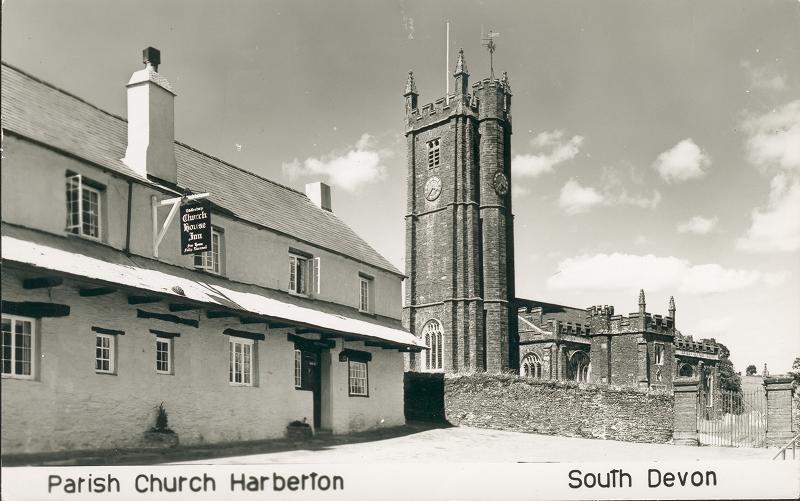
Thus for the vast majority of people on the face of this planet, we are linked to others and how we live our lives is fundamentally influenced by those others about us.  In a past life, I lived in the village of Harberton in South Devon.  The population of Harberton was 300 persons.

An E. M. Morison (Totnes) postcard, bearing a 3p stamp, which gives a sending date between Feb 1971 and Sept 1973.

Now I was lucky when I moved into Harberton because my two sisters, Rhona and Corinne, had lived in the area for many years and it was easy for me to be positioned as ‘the brother’.  Nevertheless, the way that the village embraced all newcomers was wonderful and within a very short time one felt a settled member of the community.

Same for Jean and me as relative newcomers to our property just 4 miles from Merlin, Oregon. All of our neighbours have embraced us and helped us understand this new rural life that we have embarked on.  We feel part of the local community.

Yet it doesn’t stop there.

Obviously, I’m a WordPress user!  Learning from Dogs is a WordPress blog!  But were you aware of the size of the WordPress community? (As of now!)

How many posts are being published?

Users produce about 44.5 million new posts and 56.7 million new comments each month.

How many people are reading blogs?

Over 409 million people view more than 14.7 billion pages each month.

Even my funny little blog has 959 followers!

What that figure doesn’t reveal is how many of my followers have offered support, openness and real loving friendship. None better demonstrated than by the comments left by readers when I announced the recent death of Dhalia.

Think of the way that untold numbers of internet users rely on that ‘worldwide web’ for referrals, opinions or knowledge about anything ‘under the sun’.

So while there might be many aspects of our new technological world that create unease, the opportunities for having ‘virtual’ friends to complement our social friends make this era unprecedented.

I would go so far as to say this. That the way that knowledge and information can be shared around the world in no time at all may be our ultimate protection against those who would seek to harm us and this planet.

How to close these essays? Perhaps no better than as follows:

On Wednesday evening we were joined by neighbours, Dordie and Bill.  My post on truth came up in discussion. Bill mentioned that he had read about a person who had spent many years studying the texts of all the world’s major religions.  What had emerged was that across all those great religions there was a common view as to what the long-term health and survival of societies requires.

It is this: the telling of truth and the keeping of promises!


Nostalgia isn’t what it used to be!

The sirens of past lives take some silencing.

Going to relate to you a true story.

In 1968 I emigrated to Australia; to the city of Sydney.  It was an easy move in many ways.  For before I left I was working in the sales office of British Visqueen Ltd in Stevenage in Hertfordshire. ‘BVL’ were part of Imperial Chemical Industries (ICI).

On Day Three of my new life in Sydney I noticed that ICIANZ (Australia & New Zealand) had their headquarters building on Macquarie Street near North Circular Quay.  On impulse I went in and two hours later had been offered a job in the sales office of ICI’s Inorganic Chemicals Division.

From the window of my office I had a stupendous view of the Sydney Harbour Bridge. This is a picture taken the other side of the Bridge looking back at the office complex to the right of the Sydney Opera House; the office block partially obscured by the top curve of the bridge.

Sydney_Harbour_Bridge

Anyway, back to the story.

I was dating a Finnish woman who with her sister and parents had emigrated from Finland some years previously.  That woman’s name was Britta and later we were married and then upon returning to England in 1970 we had two children; a son and a daughter. In Australia I didn’t miss England and when back in England I didn’t miss Australia.

I was 26 when we returned to England.

Fast forward forty-four years to now.

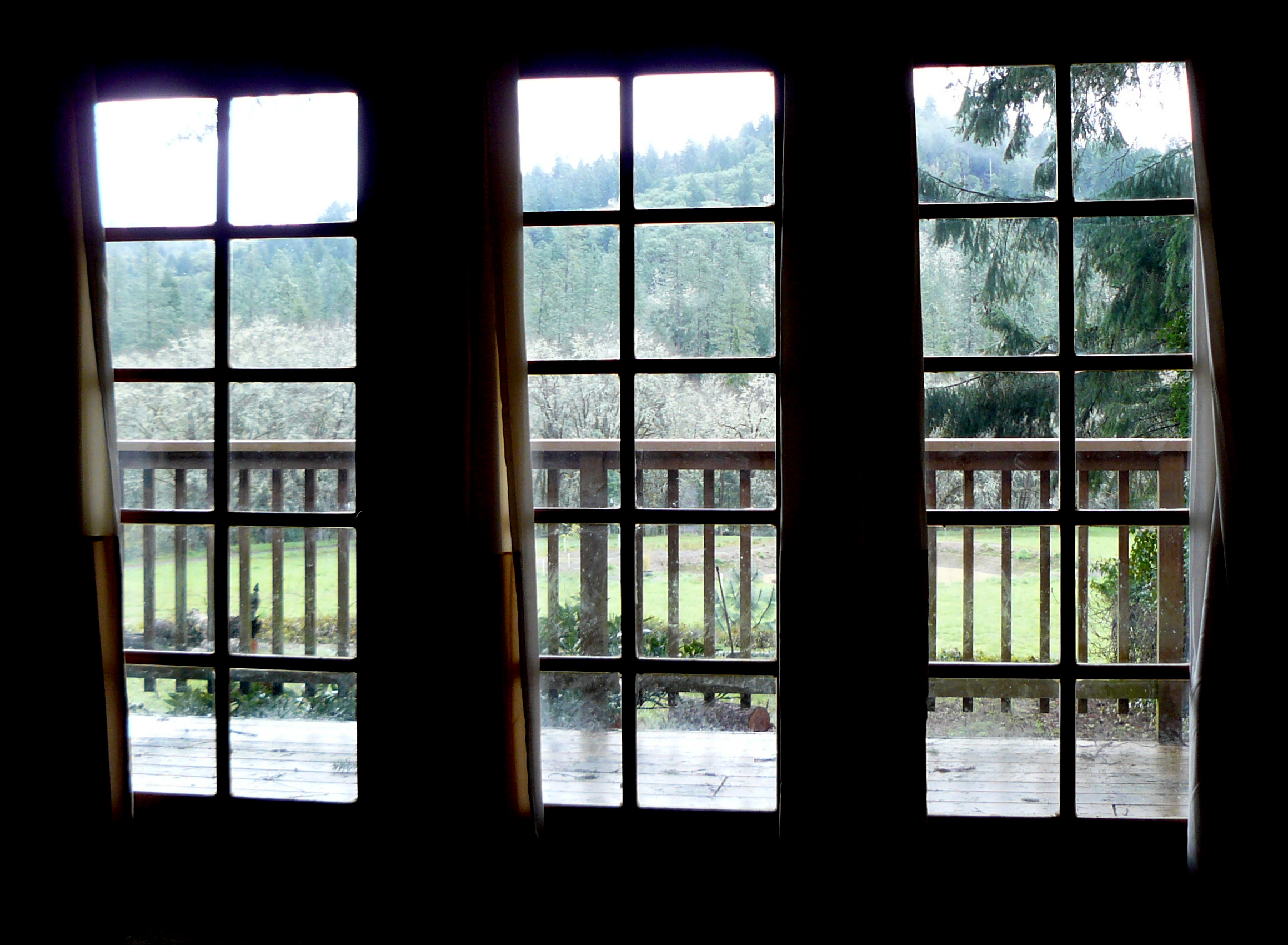
This is the view through our bedroom window in the morning when Jean and I awake.

Morning

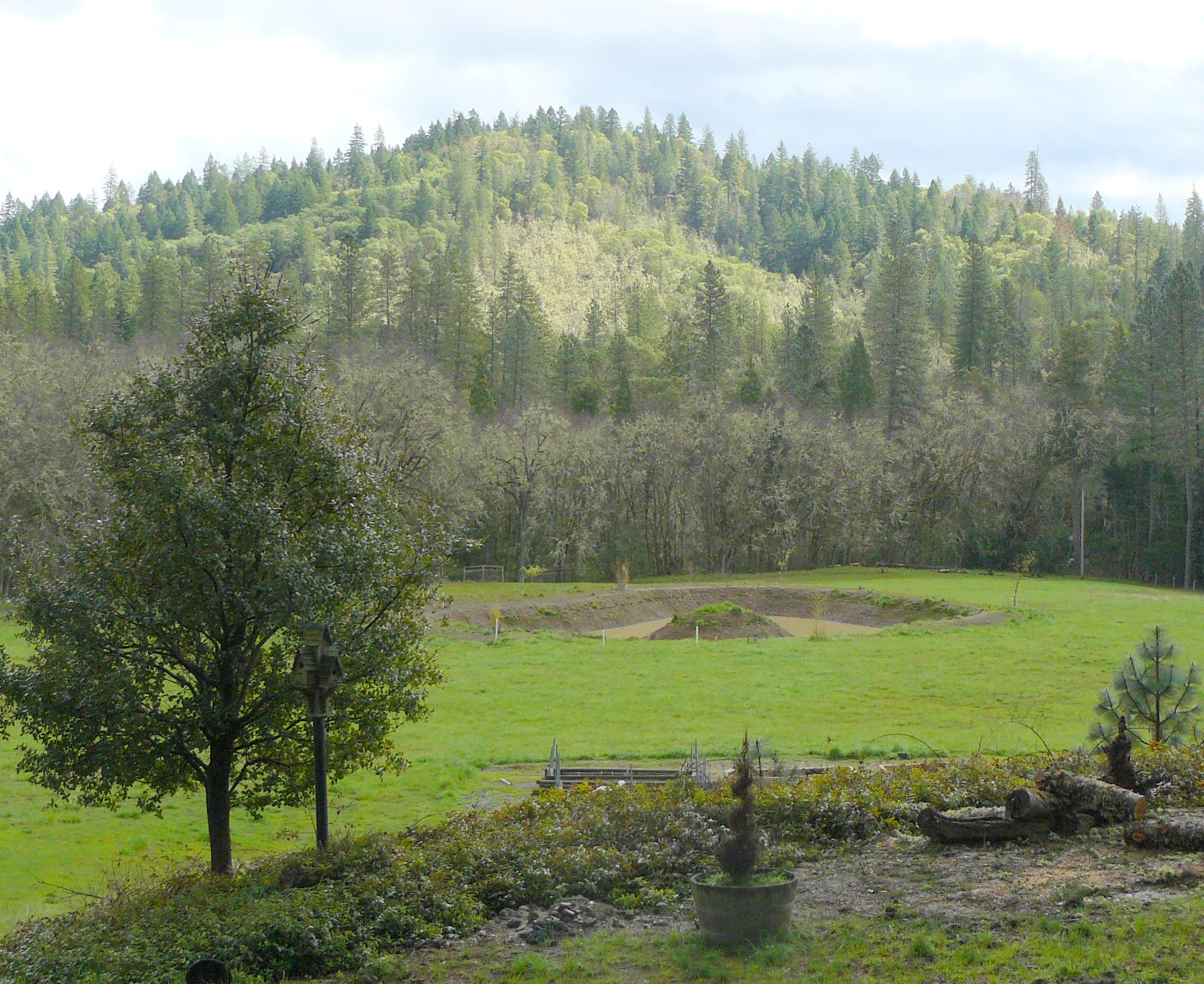
This is another view of the same scene but taken from outside the windows.

Morning2

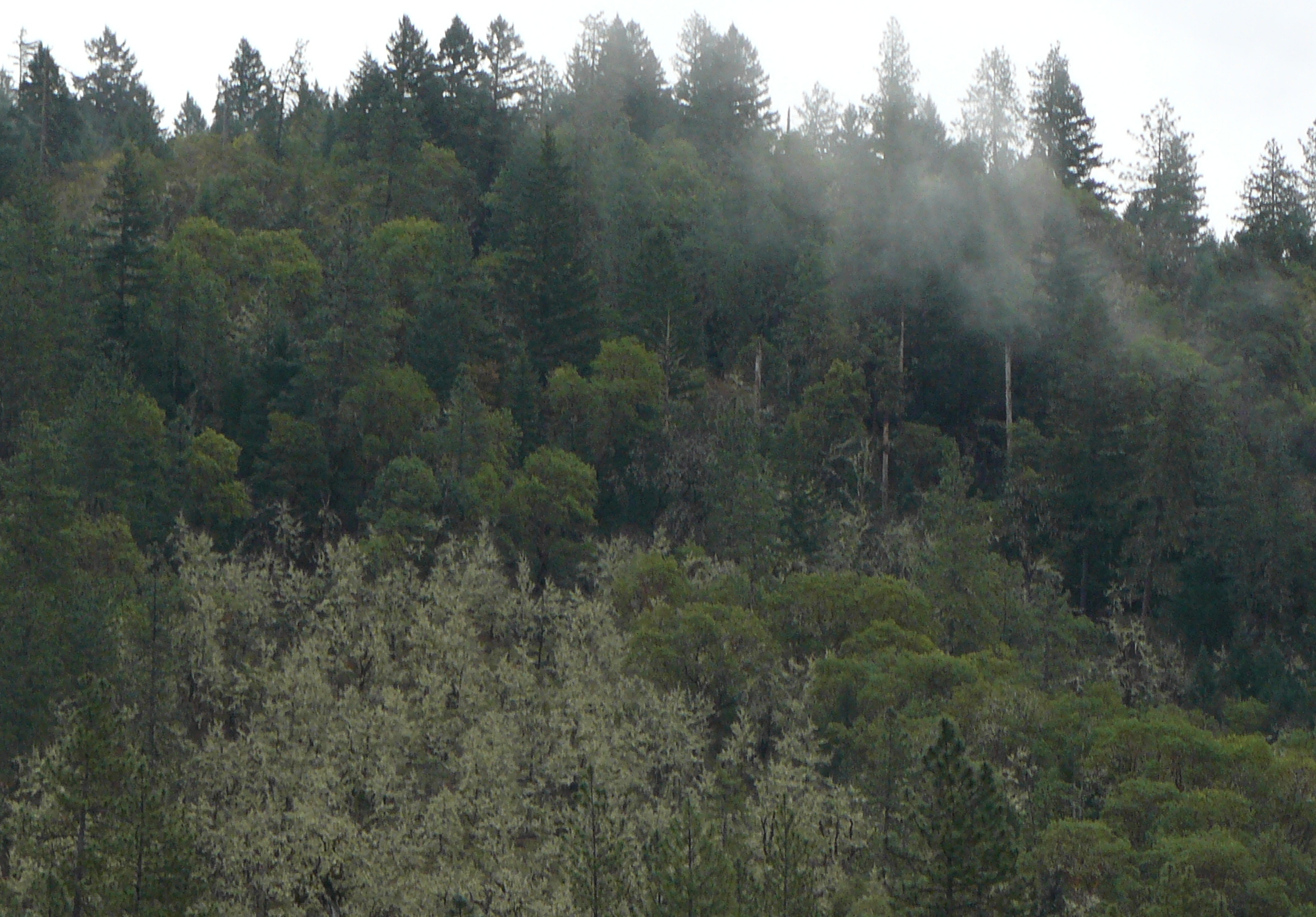
When the air is really moist and there are clouds hanging low over the ridge, it’s common to see mist swirling through the trees.

Morning mist

It is a beautiful place to live, for us and for all our animals …. yet …. we don’t feel perfectly settled.

Back to Britta’s parents.  After they had been living in Australia for quite a few years, in Brisbane in those days, and all settled with jobs and their own house, they still didn’t feel perfectly settled.  So they gave up their jobs, sold the house and transported themselves and their belongings all the way back to Helsinki, Finland.

Only to find that in less than three months that they had made a ghastly mistake and so, yes you know what’s coming, they transported themselves and all their belongings all the way back to Australia; this time settling in Sydney.

OK, to the point of this tale.

In many, many ways this life that Jean and I have here in Oregon is better than anything we have previously experienced.

Yet, there are times when I hear the sirens of Devon calling out to me and for Jean there are times when she hears the sirens of Mexico calling out to her; Jean lived in San Carlos, Mexico for twenty-five years, off and on, with her late American husband, Ben, who died in 2005.

I’m 70 in November this year.

What does it all mean?

When Jean and I were living in Payson, Arizona we were talking one day to a woman who in previous times had been a personal counsellor.  She asked how we were settling in.  We mentioned that we were not yet settled.  The woman went on to say that people over the age of 60 frequently had a much more difficult time adjusting to major moves and changes in their lives than younger persons.

Jean and I wouldn’t rewind our lives for all the tea in China but what, dear reader, do you think?

Anyone out there the ‘wrong’ side of 60 who can relate to this?


Meet the dogs – Pharaoh (pt 1)

‘Meeting’ this dog deserves two posts!

Almost two months ago, January 30th to be exact, the first of this ‘Meet the dogs‘ series was published.  It came out of an idea from Jean and that January 30th post introduced Paloma to you, dear reader.  Since then we have told you about Lilly, Dhalia, Ruby, Casey, Hazel, Sweeny, and Cleo.

So today’s post is the last of the Meet the dogs stories; it is about Pharaoh.  I’m going to indulge myself and tell you the story of this most wonderful of dogs over today and tomorrow.

ooOOoo

Pharaoh

OLYMPUS DIGITAL CAMERA
Photograph taken on the 12th August, 2003, the first day I saw Pharaoh.

This is Sandra Tucker, owner of Jutone Kennels in Devon, England, where Pharaoh was born on June 3rd, 2003.  Here’s something written elsewhere that conveys my feelings that first day that I met this puppy.

oooo

In no time at all I was turning into the farm driveway, noticing the painted sign for Jutone & Felsental German Shepherds alongside the open, wooden gate.

I turned off the engine and was about to swing my legs out of the open driver’s door when I saw a woman coming towards me.

“Hi, you must be Paul, I’m Sandra. Did you have any trouble finding us?”

I shook hands with her.

“Not at all. I did as you recommended when we spoke on the phone and went in to the local store and got final directions.”

Sandra smiled, her glasses almost slipping off the end of her nose.

“Dear Beth. She’s been running that local store since God was a boy.”

She continued with a chortle in her voice, “Some say that Beth was at the store before our local pub, The Palk Arms, opened for business. And the pub’s been in the village for well over four-hundred years.” Sandra’s laugh was infectious and I caught myself already taking a liking to her. The sense of a strong, confident person struck me immediately. Indeed, a working woman evidenced by her brown slacks, revealing plenty of dog hairs, topped off with a blue T-shirt under an unbuttoned cotton blouse.

“Anyway, enough of me, Paul, you’ve come to get yourself a German Shepherd puppy.”

She turned towards a collection of grey, galvanised-sheeted barns and continued chatting as I fell into step alongside her.

“After we discussed your circumstances over the phone; where you live down there in Harberton, why you specifically wanted a German Shepherd dog, I thought about the last set of puppies that were born, just a few weeks ago.”

Sandra paused and turned towards me.

“While, of course, you can select whatever puppy you feel drawn to, my advice is to go for a male. Listening to your experiences of befriending a male German Shepherd when you were a young boy, I have no doubt that a male dog would result in you and the dog building a very strong bond. Indeed, I have a young male puppy that I want to bring out to you. Is that OK?”

Sandra turned and walked out of sight around the corner of the first barn leaving me standing there, my response presumably being taken for granted.

Something in her words struck me in a manner that I hadn’t anticipated; not in the slightest. That was her use of the word bond. I was suddenly aware of the tiniest emotional wobble inside me from Sandra’s use of that word. Somewhere deep inside me was the hint that my decision to have a dog in my life was being driven by deeper and more ancient feelings.

My introspection came to an immediate halt as Sandra re-appeared. She came up to me, a beige-black puppy cradled under her left arm, her left hand holding the pup across its mid-riff behind his front legs, her right arm across her waist supporting the rear of the tiny animal.

I stood very still, just aware of feelings that I couldn’t voice, could hardly even sense, as I looked down at this tiny black, furry face, outsized beige ears flopping down either side of his small head.

It was unusually warm this August day and I had previously unbuttoned my cuffs and folded the shirt sleeves of my blue-white, checked cotton shirt back above both elbows leaving my forearms bare.

Sandra offered me the young, fragile creature. As tenderly as I could, I took the pup into my arms and cradled the gorgeous animal against my chest. The pup’s warm body seemed to glow through its soft fur and as my bare arms embraced the flanks of this quiet, little dog I realised the magic, the pure magic, of the moment. Something was registering in me in ways utterly beyond words but, nonetheless, as real as a rainbow might be across the green, Devon hills.

“How old is he, Sandra?”

“This little lad was born on June 3rd. So what are we today? August 12th. So he is ten weeks old as of today.”

June 3rd, 2003. I knew that this date had now entered my life in just the same way as had the birth-dates of my son and daughter; Alex and Maija.

The power of this first meeting was beyond anything I had expected, or even imagined. I thought that it was going to be a fairly pleasant but, nonetheless, unsurprising process of choosing a puppy. How wrong could I have been! What was captivating me was the pure and simple bodily contact between this young dog and me. No more than that. I was sensing in some unspoken manner that this was equally as captivating for this precious puppy-dog. For even at the tender age of ten weeks, the tiny dog appeared to understand that me holding him so longingly was bridging a divide of many, many years.

Sandra motioned with her arm, pointing out a bench-seat a few yards away alongside a green, well-manicured, lawn.

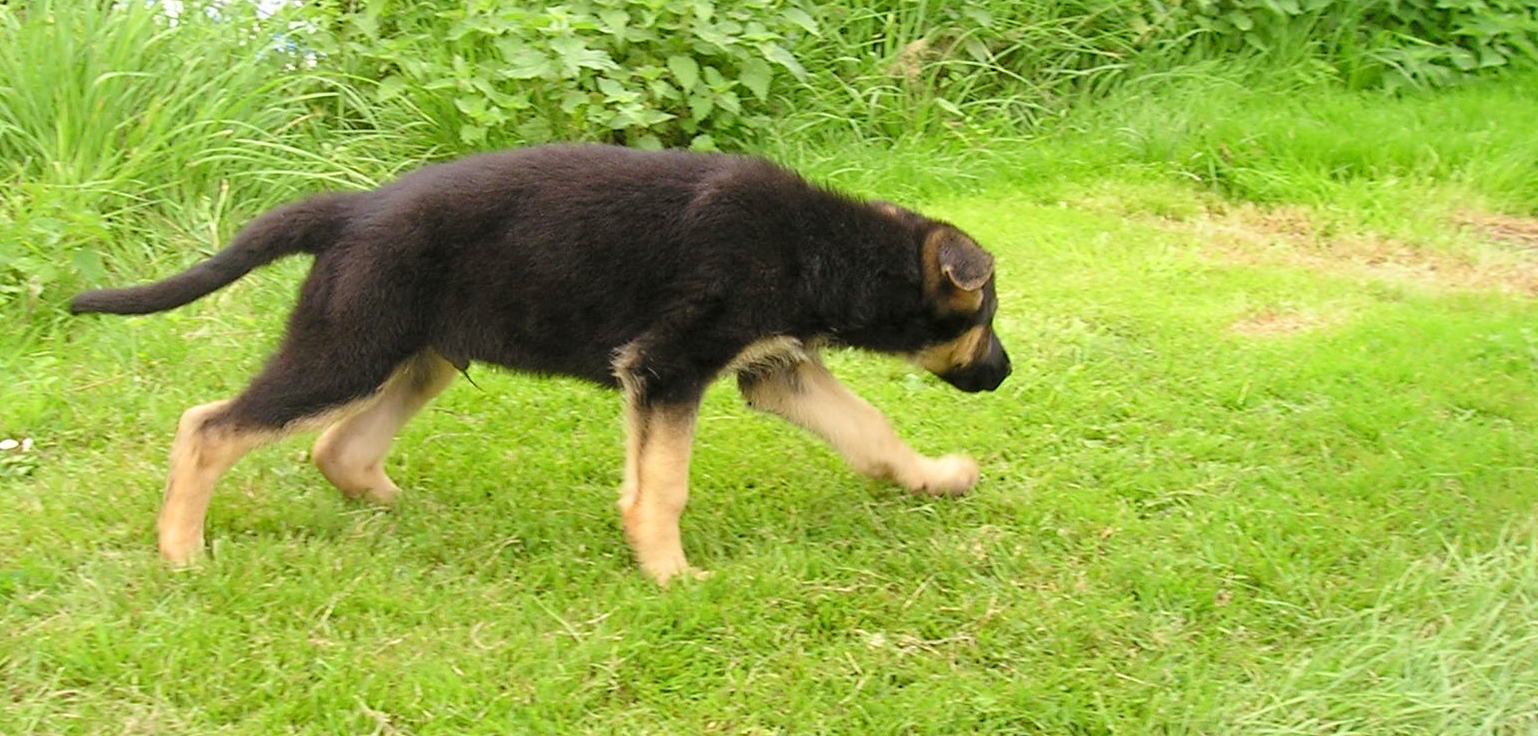
I very carefully sat down on the wooden-slatted bench and rested the beautiful animal in my lap. The puppy was adorable. Those large, over-sized ears flopping across the top of his golden black-brown furry head. His golden-brown fur morphing into black fur across his shoulders and then on down to the predominantly beige-cream colour of his soft, gangling, front legs. That creamy fur continuing along the little creature’s underbelly.

The puppy seemed almost to purr with contentment, its deep brown eyes gazing so very intently into mine. I was entranced. I was spellbound.

Never before had I felt so close to an animal. In a life-time of nearly sixty years including having cats at home when I was a young boy growing up in North-West London, and much later the family owning a pet cat when Alex and Maija were youngsters, I had never, ever sensed the stirrings of such a loving bond as I was sensing now. As this young puppy was clearly sensing as well. This was to be my dog. Of that I was in no doubt.

oooo

OLYMPUS DIGITAL CAMERA
Early days at home in South Devon.


Let me leave you with a couple of other photographs taken from his early days.

Pharaoh, nine months old.
Pharaoh, nine months old, taken in my Devon home in 2004.

oooo

One year old: June 3rd 2004.
First birthday: June 3rd 2004.  Again, picture taken in Devon.


Never in my wildest dreams did I imagine that in the year 2014 I would be writing about Pharaoh from a home-office desk in Southern Oregon sharing a happy life with a wonderful London lady, Jean, and more gorgeous animals than one could throw a stick at.

More on that shared journey with Pharaoh tomorrow!

The history of everything – In just three minutes.

The history of life on Earth  – quicktime!

A whole clutch of things happened yesterday to conspire in me running out of creative time.  Indeed, it was after 4pm when I sat down in front of my computer wondering about today’s LfD blog post.

Luckily (well for me!), amongst the list of draft posts was this one from January 1st, 2014.  So I cheated by grabbing it and offering it for you today. I just hope you find it of interest.  It was originally presented on Big Think on the 1st January, 2014.

ooOOoo

The History of Life on Earth in Three Minutes

by BIG THINK EDITORS
JANUARY 1, 2014, 12:00 AM

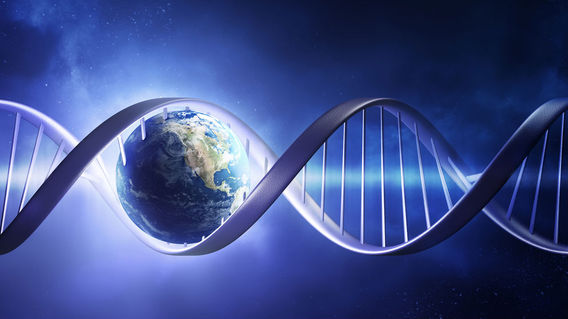
earth_dna

Happy New Year, planet Earth!

According to the Anno Domini designation, the year is now 2014. But the Earth has been around a lot longer than that – about 4.567 billion years. The first evidence of life dates back to around 3.8 billion years ago. Homo sapiens first appeared on the planet around two hundred thousand years – or ten thousand generations – ago.

How’s that for perspective?

Kirk Johnson, director of the National Museum of Natural History, calls this perspective “deep time.” This is the story of our planet preserved in “the DNA of living things,” Johnson explains, as well as “in the fossils we find, in the geologic structures of our planet, in the meteorites we scavenge from the ice fields in Antarctica. Those things together give us an incredible manual for thinking about the planet.”

Why is this manual useful? We are facing a century that will be an incredibly challenging one for humanity. We now live on a planet with seven billion people, which is up from 1.7 billion people just three or four generations ago. So we have more people, and a greater need for resources.

Fortunately we have the bodies of extinct plants and animals that lived for the last three-and-a-half billion years. These fossils are not only a source of energy, but also a source of knowledge about how this planet works. Over its history the Earth has seen an incredible diversity of life – maybe as many as fifty million species. Johnson says we’re learning “as much about the evolution of life on Earth by looking at what happened in the past as we are at looking at the breakthroughs in genomics and DNA of living things.” Furthermore, Johnson sees the sequencing of the human genome as the vanguard for what will eventually be “the study of the genomics of all living things.”

We have the opportunity right now, Johnson says, to choose what our future will be. Our understanding of the diversity of life on this planet, he says, will be our guide. This story is being told at a current exhibition at the National Museum of Natural History called “Genome: Unlocking Life’s Code.”

In the video below, Johnson shares a unique perspective on deep time in the form of a timeline of life on this planet in just three minutes.

ooOOoo

Don’t know about you but I found the video fascinating.

Dogs and humans – fascinating research.

Serendipity, or just coincidence?

Yesterday, I published a post and called it Dogs and wolves – fascinating research.  Then blow me down in yesterday’s online BBC News, there was an article headlined: Dogs’ brain scans reveal vocal responses  This is how it opened.

Dogs’ brain scans reveal vocal responses

By Rebecca Morelle, Science reporter, BBC World Service

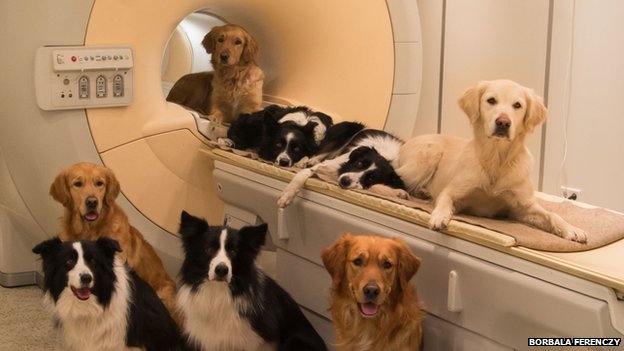
Pet dogs took part in the MRI scanning study.

Devoted dog owners often claim that their pets understand them. A new study suggests they could be right.

By placing dogs in an MRI scanner, researchers from Hungary found that the canine brain reacts to voices in the same way that the human brain does.

Emotionally charged sounds, such as crying or laughter, also prompted similar responses, perhaps explaining why dogs are attuned to human emotions.

The work is published in the journal Current Biology.

Lead author Attila Andics, from the Hungarian Academy of Science’s Eotvos Lorand University in Budapest, said: “We think dogs and humans have a very similar mechanism to process emotional information.”

Eleven pet dogs took part in the study; training them took some time.

Going across to that Current Biology link, one reads:

Summary

During the approximately 18–32 thousand years of domestication [1], dogs and humans have shared a similar social environment [2]. Dog and human vocalizations are thus familiar and relevant to both species [3], although they belong to evolutionarily distant taxa, as their lineages split approximately 90–100 million years ago [4]. In this first comparative neuroimaging study of a nonprimate and a primate species, we made use of this special combination of shared environment and evolutionary distance. We presented dogs and humans with the same set of vocal and nonvocal stimuli to search for functionally analogous voice-sensitive cortical regions. We demonstrate that voice areas exist in dogs and that they show a similar pattern to anterior temporal voice areas in humans. Our findings also reveal that sensitivity to vocal emotional valence cues engages similarly located nonprimary auditory regions in dogs and humans. Although parallel evolution cannot be excluded, our findings suggest that voice areas may have a more ancient evolutionary origin than previously known.

Back to the BBC news item.

The canine brain reacted to voices in the same way that the human brain does.

“There were 12 sessions of preparatory training, then seven sessions in the scanner room, then these dogs were able to lie motionless for as long as eight minutes. Once they were trained, they were so happy, I wouldn’t have believed it if I didn’t see it.”

For comparison, the team looked at the brains of 22 human volunteers in the same MRI scanners.

The scientists played the people and pooches 200 different sounds, ranging from environmental noises, such as car sounds and whistles, to human sounds (but not words) and dog vocalisations.

The researchers found that a similar region – the temporal pole, which is the most anterior part of the temporal lobe – was activated when both the animals and people heard human voices.

“We do know there are voice areas in humans, areas that respond more strongly to human sounds that any other types of sounds,” Dr Andics explained.

“The location (of the activity) in the dog brain is very similar to where we found it in the human brain. The fact that we found these areas exist at all in the dog brain at all is a surprise – it is the first time we have seen this in a non-primate.”

Emotional sounds, such as crying and laughter also had a similar pattern of activity, with an area near the primary auditory cortex lighting up in dogs and humans.

Likewise, emotionally charged dog vocalisations – such as whimpering or angry barking – also caused a similar reaction in all volunteers,

Dr Andics said: “We know very well that dogs are very good at tuning into the feelings of their owners, and we know a good dog owner can detect emotional changes in his dog – but we now begin to understand why this can be.”

However, while the dogs responded to the human voice, their reactions were far stronger when it came to canine sounds.

They also seemed less able to distinguish between environmental sounds and vocal noises compared with humans.

About half of the whole auditory cortex lit up in dogs when listening to these noises, compared with 3% of the same area in humans.

Commenting on the research, Prof Sophie Scott, from the Institute of Cognitive Neuroscience at University College London, said: “Finding something like this in a primate brain isn’t too surprising – but it is quite something to demonstrate it in dogs.

“Dogs are a very interesting animal to look at – we have selected for a lot of traits in dogs that have made them very amenable to humans. Some studies have show they understand a lot of words and they understand intentionality – pointing.”

But she added: “It would be interesting to see the animal’s response to words rather than just sounds. When we cry and laugh, they are much more like animal calls and this might be causing this response.

For the full report, as it was posted on the BBC website, click here.

Plus, do watch this five-minute video abstract.

Published on Feb 20, 2014

The video presents the first study to compare brain function between humans and any non-primate animal. Scientists at MTA-ELTE Comparative Ethology Research Group in Hungary found that dogs and humans use similar neural mechanisms to process social information in voices. The fact that dogs can be trained to lie motionless during fMRI tests opens up the space for a new branch of comparative neuroscience.

Paper in Current Biology: http://dx.doi.org/10.1016/j.cub.2014….

Group home page: http://mta-etologia.elte.hu/

The first study to compare brain function between humans and any non-primate animal shows that dogs have dedicated voice areas in their brains just as people do. Dog brains, like those of people, are also sensitive to acoustic cues of emotion, according to a study in the Cell Press journal Current Biology.

The findings suggest that voice areas evolved at least 100 million years ago, the age of the last common ancestor of humans and dogs, the researchers say. It also offers new insight into humans’ unique connection with our best friends in the animal kingdom, perhaps explaining how our two species have lived and worked together so effectively for tens of thousands of years.

“Our findings suggest that dogs and humans not only share a similar social environment, but they also use similar brain mechanisms to process social information,” said Atilla Andics of MTA-ELTE Comparative Ethology Research Group in Hungary. “This may help the successfulness of vocal communication between the two species.”

Andics and his colleagues trained eleven dogs to lay motionless in an fMRI brain scanner. That made it possible to run the very same neuroimaging experiment on dog and human participants — something that had never been done before. They captured both dogs’ and humans’ brain activities while they listened to dog and human sounds, ranging from whining or crying to playful barking or laughing.

The images show that dog and human brains include voice areas in similar locations. Not surprisingly, the voice area of dogs responds more strongly to other dogs, while that of humans responds more strongly to other humans. The researchers also noted striking similarities in the ways the dog and human brain processes emotionally loaded sounds. In both species, an area near the primary auditory cortex lit up more with happy sounds than unhappy ones. Andics said they were most struck by the common response to emotion across species.

There were some differences too: in dogs, 48 percent of all sound-sensitive brain regions respond more strongly to sounds other than voices. That’s in contrast to humans, in which only three percent of sound-sensitive brain regions show greater response to non-vocal versus vocal sounds.

The study is the first step to understanding how it is that dogs can be so remarkably good at tuning into the feelings of their human owners. “This method offers a totally new way of looking at neural processing in dogs,” Andics said. “At last we begin to understand how our best friend is looking at us and navigating in our social environment.”

Dogs and wolves – fascinating research.

Something new to learn every day!

I have been saving this report for a few weeks.  Following yesterday’s great news about the latest concerning wolves in Oregon, today seemed a perfect follow-on with a report first published in online journal PLOS ONE. However, what follows is a full republication of the report as I read it on the Science Daily website.

ooOOoo

Teaching young wolves new tricks: Wolves are considerably better imitators than dogs

Date: January 31, 2014

Source: Veterinärmedizinische Universität Wien

Summary: Although wolves and dogs are closely related, they show some striking differences. Scientists have undertaken experiments that suggest that wolves observe one another more closely than dogs and so are better at learning from one another. The scientists believe that cooperation among wolves is the basis of the understanding between dogs and humans.

Wolves are considerably better imitators than dogs. Credit: Walter Vorbeck
Wolves are considerably better imitators than dogs.
Credit: Walter Vorbeck

Although wolves and dogs are closely related, they show some striking differences. Scientists from the Messerli Research Institute at the University of Veterinary Medicine, Vienna have undertaken experiments that suggest that wolves observe one another more closely than dogs and so are better at learning from one another. The scientists believe that cooperation among wolves is the basis of the understanding between dogs and humans.

Their findings have been published in the online journal PLOS ONE.

Wolves were domesticated more than 15,000 years ago and it is widely assumed that the ability of domestic dogs to form close relationships with humans stems from changes during the domestication process. But the effects of domestication on the interactions between the animals have not received much attention. The point has been addressed by Friederike Range and Zsófia Virányi, two members of the University of Veterinary Medicine, Vienna (Vetmeduni Vienna) who work at the Wolf Science Center (WSC) in Ernstbrunn, Niederösterreich.

Wolves copy other wolves solving problems

The scientists found that wolves are considerably better than dogs at opening a container, providing they have previously watched another animal do so. Their study involved 14 wolves and 15 mongrel dogs, all about six months old, hand-reared and kept in packs. Each animal was allowed to observe one of two situations in which a trained dog opened a wooden box, either with its mouth or with its paw, to gain access to a food reward. Surprisingly, all of the wolves managed to open the box after watching a dog solve the puzzle, while only four of the dogs managed to do so. Wolves more frequently opened the box using the method they had observed, whereas the dogs appeared to choose randomly whether to use their mouth or their paw.

Watch closely …

To exclude the possibility that six-month old dogs fail the experiment because of a delayed physical or cognitive development, the researchers repeated the test after nine months. The dogs proved no more adept at opening the box than they were at a younger age. Another possible explanation for the wolves’ apparent superiority at learning is that wolves might simply be better than dogs at solving such problems. To test this idea, the researchers examined the animals’ ability to open a box without prior demonstration by a dog. They found that the wolves were rarely successful. “Their problem-solving capability really seems to be based on the observation of a dog performing the task,” says Range. “The wolves watched the dog very closely and were able to apply their new knowledge to solve the problem. Their skill at copying probably relates to the fact that wolves are more dependent on cooperation with conspecifics than dogs are and therefore pay more attention to the actions of their partners.”

The researchers think that it is likely that the dog-human cooperation originated from cooperation between wolves. During the process of domestication, dogs have become able to accept humans as social partners and thus have adapted their social skills to include interactions with them, concomitantly losing the ability to learn by watching other dogs.

—-

Story Source: The above story is based on materials provided by Veterinärmedizinische Universität WienNote: Materials may be edited for content and length.

—-

Journal Reference:

  1. Friederike Range, Zsófia Virányi. Wolves Are Better Imitators of Conspecifics than DogsPLoS ONE, 2014; 9 (1): e86559 DOI: 10.1371/journal.pone.0086559

ooOOoo

So if you, like me, are one of many people who believe that your dog knows what you are thinking, then we need to thank the wolf!

Saturday smile!

Yet another wonderful opportunity to chuckle at the world.

Sent to me by dear Cynthia Gomez.

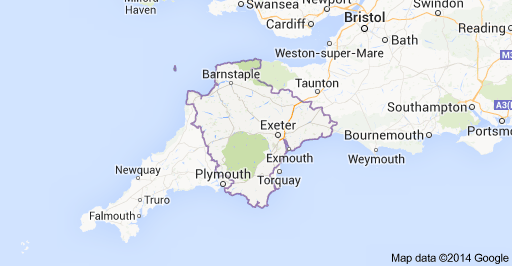
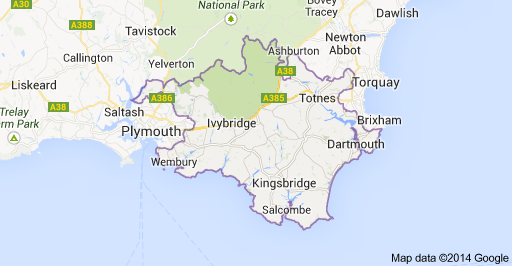
This wonderful collection of sayings from America’s ‘South’ reminded me of the incredibly rich local accents that one experienced all over Britain.  Despite being born a Londoner, I spent many of the years before switching home countries from England to America living in the County of Devon in the South-West of England.  Here are two images to show those unfamiliar with England where I was living.

Devon
County of Devon. Cornwall to the West. Somerset to the East.

oooo

Home used to be in the village
Home used to be in the village of Harberton, 3 miles South-West of Totnes.

Thus anyone born and bred in this part of Devon frequently had a strong South Devon accent.  My brother-in-law, John, used to chat to some old Devon fella’s in the local pubs that had accents impossible to understand by such newcomers as me.

So with no further ado, enjoy the following.

ooOOoo

Florida

A Florida senior citizen drove his brand new Corvette convertible out of the dealership. Taking off down the road, he pushed it to 80 mph, enjoying the wind blowing through what little hair he had left. “Amazing,” he thought as he flew down I-95, pushing the pedal even more.

Looking in his rear view mirror, he saw a Florida State Trooper, blue lights flashing and siren blaring. He floored it to 100 mph, then 110, then 120. Suddenly he thought, “What am I doing? I’m too old for this!” and pulled over to await the trooper’s arrival.

Pulling in behind him, the trooper got out of his vehicle and walked up to the Corvette. He looked at his watch, then said, “Sir, my shift ends in 30 minutes. Today is Friday. If you can give me a new reason for speeding — a reason I’ve never before heard — I’ll let you go.

“The old gentleman paused then said: “Three years ago, my wife ran off with a Florida State Trooper. I thought you were bringing her back.

“Have a good day, Sir,” replied the trooper.

Georgia

The owner of a golf course in Georgia was confused about paying an invoice, so he decided to ask his secretary for some mathematical help.

He called her into his office and said, “Y’all graduated from the University of Georgia and I need some help. If I wuz to give yew $20,000, minus 14%, how much would you take off?”

The secretary thought a moment, and then replied, “Everthang but my earrings.”

Louisiana

A senior citizen in Louisiana was overheard saying … “When the end of the world comes, I hope to be in Louisiana .”When asked why, he replied, “I’d rather be in Louisiana ’cause everythang happens in Louisiana 20 years later than in the rest of the world.”

Mississippi

The young man from Mississippi came running into the store and said to his buddy, “Bubba, somebody just stole your pickup truck from the parking lot!”

Bubba replied, “Did y’all see who it was?”

The young man answered, “I couldn’t tell, but I got the license number.”

North Carolina

A man in North Carolina had a flat tire, pulled off on the side of the road, and proceeded to put a bouquet of flowers in front of the car and one behind it. Then he got back in the car to wait.

A passerby studied the scene as he drove by, and was so curious he turned around and went back. He asked the fellow what the problem was.

The man replied, “I got a flat tahr.”

The passerby asked, “But what’s with the flowers?”

The man responded, “When you break down they tell you to put flares in the front and flares in the back. I never did understand it neither.”

Tennessee

A Tennessee State trooper pulled over a pickup on I-65. The trooper asked, “Got any ID?”

The driver replied, “Bout whut?”

Texas

The Sheriff pulled up next to the guy unloading garbage out of his pick-up into the ditch. The Sheriff asked, “Why are you dumping garbage in the ditch? Don’t you see that sign right over your head.”

“Yep,” he replied. “That’s why I’m dumpin’ it here, ’cause it says: ‘Fine For Dumping Garbage.’

ooo

“Y’all kin say whut y’all want ’bout the South, but y’all never heard o’ nobody retirin’ an’ movin’ North.

Have a great week-end.

The saga of Bummer Ck, part One!

The next couple of weeks are going to be ‘interesting’.

You will have been aware from my post last Saturday, The naming of creeks!, that heavy rains washed away the supports to the bridge that crosses Bummer Creek inside our property.

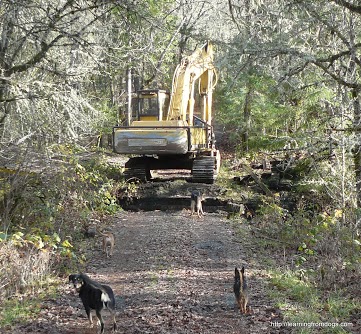
So apologies for taking a break from writing something more substantial for today but yesterday (I’m writing this at 5pm on the 6th, i.e. yesterday) the crew that will be repairing the damage arrived and got to work.  It has not been a normal day!

Three pictures to explain why!

bridge1

This seriously large digger was delivered around 9am!

bridge2

Then in what seemed a matter of moments, the bridge was no more!

bridge3

Pharaoh, of course, was getting involved.  Let’s face it, even bridge construction people can always learn from dogs!

Final message in a bottle

The concluding part of what we might care to leave for the next generation

Mankind over the next few years is facing the start of an interval of economic chaos and social stress between the end of the fossil fuel age and whatever follows.  That interval could well last a lifetime or more.  Some might argue that the economic challenges that have been the mark of 2011 are, indeed, the first signs of this economic chaos.

How well we cope, adapt and survive is not going to be down to those of my age (born 1944) but to the bright youngsters who have been born in the 21st century.

That was the motivation behind publishing, on December 1st, the speech given by Steve Jobs, the 2005 Stanford Commencement Speech, and on December 6th, the famous and fabulous speech given by Sir Ken Robinson at the 2005 TED Talks conference.

The third and concluding message is a subsequent speech given by Sir Ken, this time in May 2010.  It isn’t as stirring as his speech in 2005 but still a wonderful focus on what is our, as in homo sapiens, only chance of surviving – the innovation and creativity of the next  generations.

In this poignant, funny follow-up to his fabled 2006 talk, Sir Ken Robinson makes the case for a radical shift from standardized schools to personalized learning — creating conditions where kids’ natural talents can flourish.