Tag: Health

YOU are responsible

An intriguing guest post from Schalk Cloete.

Introduction

Schalk is the author of the Blog One in a Billion which describes itself as ‘A DIY guide to saving our world while building a happy, healthy and wealthy life.‘  The Billion in the title refers to ‘the billion wealthiest world citizens, are creating serious global problems through our unsustainable consumption habits.’

As the Blog’s About page explains,

My name is Schalk Cloete, a South African research scientist currently living and working in Norway. Officially, my research is centered around the mathematical modelling of fluidized bed reactors; something which makes nice pictures, but which is not exactly the most brilliant blog material. I will therefore not bore you with further details about the kinetic theory of granular flows.

Nope, the material I write about here; building a happy, healthy, wealthy and sustainable life within our affluent modern society, should be much more interesting. I use the word “building” quite a lot because that is exactly what needs to be done. One literally needs to build the environment within which one functions from day to day with the same level of diligence and attention to detail one would use to build a house.

Anyway, with no further ado, let me go to Schalk’s guest post.

oooOOOooo

YOU are responsible

Not so long ago, Paul left a very thought-provoking comment on my blog: the One in a Billion project, and suggested that my response to that comment was worth publishing as a guest post on Learning from Dogs. Needless to say, I gratefully accepted this generous offer!  Before we go any further though, I’d just like briefly to describe my blog so that the comment can be seen in perspective.

The principle objective of my blog is to advocate personal lifestyle change as a lasting solution to the pressing sustainability problems we are facing today.

The rationale behind this overall theme is threefold:

  1. Our current systems are fundamentally guaranteed to collapse (more about this here)
  2. A personal lifestyle change is the one and only sustainable solution to this impending crisis (further detail can be found here)
  3. Such personal lifestyle changes towards sustainable living are the one and only road to lasting health, wealth and happiness.

So, on that backdrop, here was Paul’s comment:

Any successful attempt at reversing and correcting the perilous journey humanity is on has to focus on the nature of change, how humans change, why the change required in this case is psychologically complex, and how the reward feedback process has to work. In my opinion these are the core issues to be tackled.

And my response:

Change is driven by a complex set of internal and external triggers that influence our consciousness every second of every day. If these triggers collectively indicate to a person (based on his or her unique subjective interpretations and subconscious filters) that some alternative is more attractive or that the current reality is unacceptable, motivation for change is granted. The exact nature of the change that this project requests is a change in day-to-day lifestyle choices which stems from shaping a person’s interpretation and filtering of the various internal and external triggers to accurately represent the reality that a lifestyle aimed at sustainable happiness is infinitely more attractive than one focused on consumerism.

This project tries to motivate people to take action by strongly emphasizing on the immediate personal benefits of making these lifestyle changes, the ease with which these changes can be made (and made permanent), the short and long term hazards of not making these changes and the moral obligation we have to the poor and to future generations to make these changes.

The change is psychologically complex because the entire environment we live in today just begs us to consume at ever increasing rates. This is the reason why this project repeatedly emphasizes on the construction of micro-environments to protect against this toxic macro-environment and make the correct actions natural and automatic. On a higher level, change is psychologically complex because we now have to abandon a system that has raised our standard of living tremendously while we still had abundant cheap fossil fuels and a limitless planet. Our most powerful weapon has turned into our greatest threat and it should come as no surprise that we seem totally unable to handle that.

The reward-feedback process in the One in a Billion initiative is actually quite interesting. As stated before, a lot of emphasis is placed on the immediate rewards of making certain lifestyle choices, but the thing that makes it really interesting is the holistic and complementary nature of this plan. Because it covers such a broad spectrum of areas, one quickly finds that gains in one area start to enhance gains in other areas. From personal experience, this truly is an extremely exciting journey and even becomes addictive, thereby all but guaranteeing further lifestyle changes. As soon as this spiral is started, the mind becomes a lot more open to the wealth of information on sustainability out there and this understanding then stimulates further action. In the end, you end up with a completely self-sustaining upwards spiral towards happy, healthy, wealthy and sustainable living.

In closing, the change that is needed within the developed world today can basically be summarized as follows: hundreds of millions of people must be reconditioned away from a debilitating and self-destructive culture of consumerism and entitlement towards a healthy and fulfilling culture of contribution and personal responsibility. It is my sincere hope that the One in a Billion project can contribute to this change and help overcome the great challenges discussed above.

This really is a dream of mine which I have recently described in more detail under my Dream heading for anyone who might be interested. Please spend a minute or two to think about this philosophy and whether you might consider developing a similar dream of your own.

oooOOOooo

Trust me, Schalk’s blog is full of very interesting propositions.  Yet another sign that opinions are changing across this great interconnected world.

Funny things us humans!

Ten things we don’t understand about being human, from New Scientist magazine.

Thanks to Naked Capitalism for pointing me towards this fascinating piece in New Scientist.  The article discusses 10 outwardly frivolous behaviours and attributes that have scientists scratching their head.  They are:

  • Blushing
  • Laughter
  • Pubic hair
  • Teenagers’ behavioursNew Scientist skeleton
  • Dreams
  • Altruism
  • Art
  • Superstition
  • Kissing, and
  • Nose-picking

The article links each of the above to a further examination of why it is so strange.  It’s a good read and the accompanying photograph heading up the article, reproduced across, is rather clever.

Reminds me of that lovely English ditty:

The whole world is rather queer,

except thee and me,

and I have my doubts about thee!

The truth about exercise!

A powerful new look at exercise from a recent BBC Horizon programme.

The first 15 seconds of the BBC Horizon Programme – The Truth About Exercise – sum it up in a nutshell.

Exercise!  I know I should but I don’t particularly enjoy it, I begrudge the time and I never seem to make much progress!

So say many of us!

I’m 68 next birthday and while I try and watch my weight and eat a healthy diet I know my overall fitness is far from what it should be.  A neighbour lent me a bicycle the other day because I had this notion that riding into town, just over a mile away, would make a great healthy difference.  In my younger days, I would ride dozens of miles on a bike and think nothing of it.  But when I jumped on the bike and set off up the road, in less than 300 yards I had come to a halt stumped by the very first incline!  So much for my fitness!

Thus when we watched this BBC Horizon programme, I could hardly believe what was being proposed.  That surprising new research suggests many of us could benefit from just three minutes of high intensity exercise a week.  Yes, I did write three minutes a week!

Here’s how the video is introduced,

Like many, Michael Mosley want to get fitter and healthier but can’t face hours on the treadmill or trips to the gym. Help may be at hand.

He uncovers the surprising new research which suggests many of us could benefit from just three minutes of high intensity exercise a week.

He discovers the hidden power of simple activities like walking and fidgeting, and finds out why some of us don’t respond to exercise at all

Using himself as a guinea pig, Michael uncovers the surprising new research about exercise, that has the power to make us all live longer and healthier lives.

The video is 58 minutes long and I thoroughly recommend that you find a comfortable seat and remain undisturbed while you watch every minute of this mind-blowing programme.

P.S. Jean and I were down in Phoenix last week and a local fitness store had a sale of exercise bikes.  I purchased what looked like a well-built bike, listed at $249, for $159.  Now a week later, I can confirm that 20 seconds of ‘flat out’ pedalling really does have one heaving for breath.  So watch the video!!

P.P.S.  Doesn’t need to be said but if any reader is motivated by the video to buy a bike and adopt the exercise regime they should take into account their own health and, if in any doubt, see a doctor first.

A healing world?

Modern medical practices raise questions about healing.

I am motivated to write today’s Post because a week ago, last Tuesday 24th April, I went to see my local doctor here in Payson.  I don’t want to rabbit on too much about that doctor’s appointment because that isn’t the thrust of this ‘essay’.  But let me just say this about that experience on the 24th, because it’s relevant to what I’m trying to convey.

A few years back, I was diagnosed with vestibular migraine but the reason for going to see the doctor was motivated by the realisation that over the last few months my memory was getting a little sporadic, for want of a more technical description!  But I felt that the vestibular migraine, that I still suffer from, was relevant to my assessment.  I should further add that the health clinic where this doctor is based have only seen me once before, for something minor.  In other words, they do not have a good understanding of me from a medical perspective.

So I enter the doctor’s room and in comes the medical assistant with her wireless-connected laptop.   Her fingers are poised to enter details.

I said, “Before we get going on my memory, can I talk about my vestibular migraine?

The assistant replied, “Well I’m on the memory page, not the migraine page.  Which do you want to talk about?

I sighed and indicated that she should ask me questions about my memory!

Ergo, this human that wanted to be seen as a human had to conform to the relevant medical label!

So with this still reverberating inside me, I was positively tuned to something recently published by Michele of Dogkisses Blog.  It was a very recent post called Green Healing – Horticultural Notes.  Let me ‘borrow’ a few words from that Post.

We always begin Horticulture Therapy by gathering in a circle to share plant news.  This time together is good, interesting and takes us in many directions.  We often visit our past of garden or plant memories and look to the future with hopeful or creative garden dreams and ideas.

Last week I arrived just in time to hear another participant sharing his idea for a creative planting container.  The young man was more engaged than usual and when he smiled and became excited about what plants to choose and where he would put his new container, I felt like I saw the heart of horticulture therapy.

I like to call these times Healing Happenings, which are moments in time when hope or happiness fills my heart and mind.  I’m not talking about everything being right or all problems being fixed.  I’m talking about a little piece of time when worry and stress take a back seat and the beauty of life emerges.

This got me thinking.  Is there a schism these days in modern medicine between curing and healing?  Have we created a situation where we rely on chemical and pharmaceutical technology to find a whole range of cures but, in parallel, is medicine losing sight of the need for healing?  Maybe some would argue that such a distinction is irrelevant; if one is sick then one is very needy for a cure.  But, overall, perhaps the evidence of better and better healing in our societies is pretty hard to find.    Take this that I read recently,

There is a growing epidemic of obesity, type II diabetes, cardiovascular disease, and predictions that 15,000,000 people in the United States alone will have Alzheimer’s Disease by the year 2050.

Back to Dogkisses blog,

Personally, ‘healing happenings’ include moments when I enjoy what I imagine most Mothers do, which is seeing our children, no matter what age they are, smile and be happy.  They’re also moments when I feel that my family will be okay.

There is always hope in a garden.  We hope it grows.  We hope it rains.  We hope to have a good harvest of food or lively blooming flowers that paint our world pretty.   I’m sure hope is part of why it feels good to work in a garden, whether you have a large field or a modest arrangement of containers on your porch.  Each day you have hope.

“When I’m in my garden, life’s troubles crumble away with the rich black soil between my fingers. I’m fully in my body, out of my head, my worries banished. My garden is my church, my time there sacred.”  (Garden your troubles away, by Amy Karon, PsycheScoop).

Here’s what I wrote as a comment to DK’s Post,

You using the phrase ‘green healing’ touches on the essence on what we all need to do to ‘survive’ in this crazy world. And, of course, I’m using the word ‘survive’ in a mental rather than physical sense.

It reminds me of the odd moments during the day when I hug one of the dogs and really give in to the feeling; almost as though the dog and I recognise it could be the very last hug in our lives. The emotional intimacy that flows from that private bonding across the two different (very different!) species is truly breath-taking!

So forgive my meanderings today but you may share my fear that by losing touch of the very powerful curative aspects of communing with nature, whether it be a garden, a walk in the woods, a swim in the sea or the warmth of an animal body, we may be missing real healing.  As Michele wrote, “Each day you have hope.”  Without hope there is nothing left.

Who am I?

An intriguing examination of how we build our sense of self.

Note: This article goes back to 2007, part of a programme that I was involved in back then.  However, re-reading the article shows it to be timeless, so trust you find it interesting.  There is a fascinating test, still online, details provided at the end of the article – but if you can’t wait, it’s here.

Finding the self.

What is Self?

Edited by Fiona Kerr from original text by Dorothy Miell

So what is self and how do we study its development? As we grow older we become aware of differences between ourselves and others, for example: what I look like; my gender; what makes me happy or sad. A sense of self is not achieved in a single step; we don’t emerge from our mother’s womb as fully formed adults. As our bodies grow and change we also learn more and more about ourselves. How we describe ourselves to others changes as we get older. This process is not necessarily constant – some aspects of self may stay the same for many years, others may change rapidly.

There may also be big differences to how you feel and how you want others to think you are. This may colour your choices in self-description.

A sense of self is also a cultural construction – in some societies individual uniqueness and self-expression is seen as vulgar and uncivilised. In Open2.net’s “Who Am I?” test we will be examining self in a Western sense, the gradual formation of becoming a self-aware individual. We’ll be grouping the results in age groups, so you can see how the self-descriptions change as people get older. Although self development is most significant in childhood, we’ve decided to keep the results going to see how things change into adulthood (if at all!).

I exist!

A child’s first step to self-understanding is the recognition that she or he exists. As an infant explores the world and interacts with caregivers, she becomes aware that she has power – she is an agent of change within her own environment. She is able to cause things to happen and control objects. This awareness is known as “self-as-subject”, “I” or the “existential self”:

There are thought to be four elements to the existential self:

  1. an awareness of one’s own agency (i.e. one’s power to act) in life events,
  2. an awareness of the uniqueness of one’s own experience, of one’s distinctiveness from other people,
  3. an awareness of the continuity of one’s identity,
  4. an awareness of one’s own awareness, the element of reflexiveness.

For example, if a child closes his or her eyes, the world goes dark. If a toy is touched, it moves. The interaction with the world is physical, external and, in developmental terms, it helps the child differentiate between self and other.

What Makes Me?

At around a child’s second birthday, many children recognise themselves in a mirror or in a photograph. In Western cultures, from the age of 18 months to 3 years of age, infants start to display self-awareness through the use of the word “me” or “mine”. This self-sense isn’t a passive, self-reflective discovery, but is often the result of effort, particularly in rivalry with others. It arises from striving in the face of obstacles.

These are the second steps in establishing a full sense of self, the acquisition and elaboration as “self-as-object” or “me”, now often referred to as the “categorical self”. This aspect of self concerns the qualities that define oneself as a person, e.g. gender, name and relationships with others. Once a child has gained a certain level of self-awareness (of the existential self) he or she begins to place herself (or is placed by others) into a set of categories. This aspect of self is the most influenced by social factors, since it is made up of social roles (such as being a student, a sister, a friend) and characteristics that come from a comparison with others (such as trustworthiness, shyness or sporting ability). Social context is an important feature in self-development.

Self-Esteem

Measuring self-esteem is difficult. We might feel good about ourselves in one aspect of our lives, but not so good in others. One way of measuring self-esteem in children is to ask questions about how they feel in the different aspects of their life, such as: scholastic competence; athletic competence; social acceptance; behavioural conduct; physical appearance.

How we feel about ourselves overall may bear little or no relationship to how we feel about ourselves in these different areas. It’s the importance we place on our areas of achievement or failure that leads to an overall level of self-esteem. A child who is anxious to succeed at sport would have a high level of self-esteem if she did well at sport, but low self-esteem if her performance in sport was poor, even if the child was good academically or socially. The match between our aspirations and performance is one important factor in determining self-esteem. Another factor which might influence a child’s overall feeling of self-esteem is the regard in which they are held by “significant others”, people whose opinion the child values, such as parents, teachers and peers.

Gender identity

Children by the age of about two are able to correctly label themselves as a boy or a girl. But it is not until later that they understand that gender is a stable concept, e.g. that boys cannot become mothers. Being able to identify themselves in terms of gender helps children develop a sense of categorical self and helps define appropriate behaviour for boys and girls. Children develop their gender roles in part through imitation of models, so parents’ reactions to the behaviour of children are an important influence on children’s developing sense of gender identity. Parents who try to raise their children in a non-sexist way have encountered difficulties, as other influences such as the media and society itself can counter their attempts.

If children are shown individual differences between people, that different people believe different things, they can see that contradictory beliefs and behaviours can co-exist, that the rules for their family may not be true of the family next door, but both are valid.

Describing self changes as we grow older

A child uses comparison with others to see how he or she fits into different categories. In order to evaluate if he or she is short, tall, clever or shy, a child either has to compare themselves physically with others, or consider their evaluation by others.

This contrast between self and others helps the child to develop an increasingly complex understanding about self. Children’s self-descriptions change as they become more able to evaluate themselves and develop a sense of self-worth and self-esteem. Children seem to think about themselves in different ways as they get older. Younger children seem to focus more on physical features, activities and behaviours, whereas older children mention more psychological characteristics. So, by the age of about 18, individuals are able to describe themselves in terms of the world of emotions, attitudes, secrets and wishes. Self-reflection is focused inwards, on their inner, private world.

OpenLearn, part of The Open University, have designed a test to illustrate how people of different ages define themselves. Once you take the test, you can then compare yourself to the database of other people who have taken the test to see how you compare with others in your age group, how you compare with people from other age groups and how people differ according to gender. Alternatively you can view the database without taking the test first. Try taking the test with a child and see how your results compare. So why not take the test to find out “Who Am I?”

That test link is here.

References
MIELL, D. (1995) ‘Developing a Sense of Self’
BARNES, P. (ed.) Personal, Social and Emotional Development of Children, Oxford, Blackwell Publishers

The above article was published by the BBC as part of their Child of our Time series, unfortunately no longer available online.

The results of the Who Am I test based on 53,345 entries as at October 30th, 2011, show overwhelmingly that both sexes at all ages describe their relationships and inner emotions as more important than their physical or character descriptions. For men from the age of 16-19 until 61+ their description of their relationships scores more important than their inner self but the margin is slight. For women over the same age span the situation is reversed; inner emotions score marginally higher than relationships.

What is very revealing is that for both sexes across the whole of their adult life, their physical and character identities are significantly less important than their social and emotional selves.

Don’t you just love this Doctor!

With grateful thanks from Neil K. in Devon for another gem.

Q: Doctor, I’ve heard that cardiovascular exercise can prolong life. Is this true? 
A: Heart only good for so many beats, and that it… Don’t waste on exercise. Everything wear out eventually. Speeding up heart not make you live longer; it like saying you extend life of car by driving faster. Want to live longer? Take nap.

Q: Should I reduce my alcohol intake?
A: Oh no. Wine made from fruit. Brandy distilled wine, that mean they take water out of fruity bit so you get even more of goodness that way. Beer also made of grain. Bottom up!

Q: How can I calculate my body/fat ratio?
A: Well, if you have body and you have fat, your ratio one to one. If you have two body, your ratio two to one.

Q: What are some of the advantages of participating in a regular exercise program?
A: Can’t think of single one, sorry. My philosophy: No pain…good!

Q: Aren’t fried foods bad for you?

A: YOU NOT LISTENING! Food fried in vegetable oil. How getting more vegetable be bad?

Q
 : Will sit-ups help prevent me from getting a little soft around the middle? 
A: Oh no! When you exercise muscle, it get bigger. You should only be doing sit-up if you want bigger stomach.

Q: Is chocolate bad for me?
A: You crazy?!? HEL-LO-O!! Cocoa bean! Another vegetable! It best feel-good food around!

Q: Is swimming good for your figure?
A: If swimming good for figure, explain whale to me.

Q: Is getting in shape important for my lifestyle?
A: Hey! ‘Round’ is shape!

Well… I hope this has cleared up any misconceptions you may have had about food and diets.

Being Present!

Being in the present is the key message that we can learn from dogs. Why is this so important?

‘Drink your tea slowly and reverently, as if it is the axis
on which the world earth revolves – slowly, evenly, without
rushing toward the future. Live the actual moment.
Only this moment is life.’ ~Thich Nhat Hanh

[my blue emboldening]

Unlike Jon, I muse as an ‘amateur’ when I sense that the human psyche is attracted to fear.  I use that word ‘attracted’ simply because some stimuli that touch our consciousness seem to have more force than others. Ergo, the response to the simple question of asking someone how they are, is likely to me more engaging if they come up with some form of crisis reply than by saying, “Everything’s fine, thanks!”  Look at how the news media use the power of fear to capture our attention.

There is a strong biological explanation for this.  From the Science daily website,

The amygdala (Latin, corpus amygdaloideum) is an almond-shape set of neurons located deep in the brain’s medial temporal lobe. Shown to play a key role in the processing of emotions, the amygdala forms part of the limbic system.

In humans and other animals, this subcortical brain structure is linked to both fear responses and pleasure. Its size is positively correlated with aggressive behaviour across species.  In humans, it is the most sexually-dimorphic brain structure, and shrinks by more than 30% in males upon castration.

Conditions such as anxiety, autism, depression, post-traumatic stress disorder, and phobias are suspected of being linked to abnormal functioning of the amygdala, owing to damage, developmental problems, or neurotransmitter imbalance.

For more information about the topic Amygdala, read the full article at Wikipedia.org

I am going to get to the point of this article but stay with me a little longer.  Let’s look some more at the ‘fight or flight’ aspect of our brains.  From the website, How Stuff Works,

It’s dark out, and you’re home alone. The house is quiet other than the sound of the show you’re watching on TV. You see it and hear it at the same time: The front door is suddenly thrown against the door frame.  Your breathing speeds up. Your heart races. Your muscles tighten.

An instant later, you know it’s the wind. No one is trying to get into your home.

For a split second, you were so afraid that you reacted as if your life were in danger, your body initiating the fight-or-flight response that is critical to any animal’s survival. But really, there was no danger at all. What happened to cause such an intense reaction? What exactly is fear? In this article, we’ll examine the psychological and physical properties of fear, find out what causes a fear response and look at some ways you can defeat it.

What is Fear?
Fear is a chain reaction in the brain that starts with a stressful stimulus and ends with the release of chemicals that cause a racing heart, fast breathing and energized muscles, among other things, also known as the fight-or-flight response. The stimulus could be a spider, a knife at your throat, an auditorium full of people waiting for you to speak or the sudden thud of your front door against the door frame.

The brain is a profoundly complex organ. More than 100 billion nerve cells comprise an intricate network of communications that is the starting point of everything we sense, think and do. Some of these communications lead to conscious thought and action, while others produce autonomic responses. The fear response is almost entirely autonomic: We don’t consciously trigger it or even know what’s going on until it has run its course.

Because cells in the brain are constantly transferring information and triggering responses, there are dozens of areas of the brain at least peripherally involved in fear. But research has discovered that certain parts of the brain play central roles in the process:

  • Thalamus – decides where to send incoming sensory data (from eyes, ears, mouth, skin)
  • Sensory cortex – interprets sensory data
  • Hippocampus – stores and retrieves conscious memories; processes sets of stimuli to establish context
  • Amygdala – decodes emotions; determines possible threat; stores fear memories
  • Hypothalamus – activates “fight or flight” response

Now I originally called this article Present Perfect but WordPress quickly indicated that the title had already been used. Once again, the old memory cells are failing me!  In fact the post of the name Present Perfect was published on the 8th June, just a couple of months ago.  Glad that I was reminded because from that article in June,

Did you see Mr. Holland’s Opus? About Glenn Holland’s lifetime of teaching music to a high school band. In one scene he is giving a private lesson to Gertrude. She is playing clarinet, making noises that can only be described as other-worldly. He is clearly frustrated. As is she. Finally Mr. Holland says, “Let me ask you a question. When you look in the mirror what do you like best about yourself?”

“My hair,” says Gertrude.

“Why?”

“Well, my father always says that it reminds him of the sunset.”

After a pause, Mr. Holland says, “Okay.  Close your eyes this time. And play the sunset.”

And from her clarinet? Music. Sweet music.

Sometime today, I invite you to set aside the manual, or the list, or the prescription.

Take a Sabbath moment. . . close your eyes and play the sunset.

Mary Oliver describes such a moment this way, “. . .a seizure of happiness. Time seemed to vanish. Urgency vanished.”

Because, in such a moment, we are in, quite literally, a State of Grace.  In other words, what we experience here is not as a means to anything else.

If I am to focused on evaluating, I cannot bask in the moment.

If I am measuring and weighing, I cannot marvel at little miracles.

If I am anticipating a payoff, I cannot give thanks for simple pleasures.

If I am feeling guilty about not hearing or living the music, I cannot luxuriate in the wonders of the day.

Beautiful thoughts all woven around the power of focusing on the moment (if you want to catch up on the full article it is here).

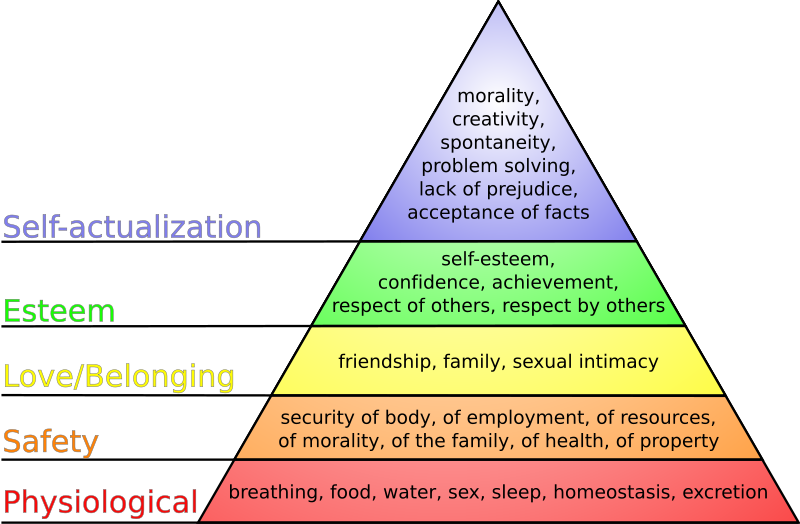
Jon’s article last Monday was all about the way forward in a positive, well-being sense.  In that article Jon showed the Maslow Hierarchy of Needs pyramid.  It’s reproduced again below; spend a few moments absorbing the nature and sense of each level in that hierarchy.

Now ponder on that fear – ‘fight or flight’ – response.  Most likely it’s going to be initiated in the ‘Safety’ level but flick straight down one level to the ‘Physiological’ layer.  All very primitive stuff and utterly out of our control!  Remember from the extract above, “The fear response is almost entirely autonomic.

Even modest amounts of these fear responses is very wearying, very unsettling.  Remember Jon touched on that when he wrote,

The point I’m trying to make is that the same panic I notice in many of the companies I work in, and in me, is based on fear of the unknown and on a lack of trust in all its forms.  I’ve deliberately underlined that last phrase because it is so incredibly important. The truth is that we get more of what we focus on. So we can choose to focus on the constant news of more difficulties, hardship and redundancies, or we can focus on what is working.

So because our fear response is entirely autonomic and because there is so much out there, all around us, pulling those autonomic strings we have to actively, quite deliberately, do what dogs (and many other animals) do quite naturally.  We deliberately have to focus on spending time being in the present!

There was a recent piece from Leo Babauta about being in the present.  While he doesn’t touch on the underlying biology of why we humans are so ‘attracted’ to fear, he does offer some excellent advice about being in the present.

No matter how out-of-control your day is, no matter how stressful your job or life becomes, the act of being present can become an oasis. It can change your life, and it’s incredibly simple.

Look at Lorraine’s website (a recent visitor to Learning from Dogs).  In particular this piece, from which I quote,

3. The Serenity Prayer – all about accepting the things I cannot change and changing the things I can.

4. People are always more important than things. Things can mostly be replaced but people cannot.

5. Do it now – if there is something to be done, then what is stopping me from doing it straight away?

6. If I appreciate and look after what I have now, there will be a positive flow back to me in the future. If I am neglectful and ungrateful with what I have now, I cannot expect to be rewarded with more in the future.

7. Be quiet and keep breathing – no one will know how crazy I feel inside :-)

8. Don’t hold on to people or things too tightly. Be open to letting go and letting be.

9. It is really important to let others know that I love them. They need to know now and often. Love isn’t just a beautiful feeling – show it by how I act and speak with those I love.

10. I can’t make anyone love me and I can’t fix anyone by loving them. I may have a script for how life should be but I have no control over other people, places or things. Go with the flow and accept what is.

(The blue emboldening is mine – highlighting the power of now.)

Grandson Morten - peace in the present

Live the actual moment. Only this moment is life.”

The way forward?

A big vote of thanks to Paul for plugging away for so long without any contribution from me.  Unlike Paul who is retired, well retired in the sense of a paying job, I have a family, a dog (Jess) and the usual set of household overheads to cover, so the week is very much a working week for me.  Ergo, I shall never be able to contribute to Learning from Dogs in the same manner as Paul but a regular contribution is assured. To get things rolling again, I want to re-publish an article that I wrote on my business blog the other day.

Removing the fear of the unknown

Seeing the light

I’ve been working with most of my clients recently through painful transformations brought about by the economic downturn.

An interesting metaphor really because since the first wave of uncertainty triggered panic, first noticed in the UK banking system, I have been picking up on that uncertainty that feels like it’s stalking the globe and has been for some time. Recent stock market crashes have simply exacerbated this and that, coupled with the riots taking place in major cities in the UK, make for pretty disturbing reading.

Interestingly, I, too, have been aware of an underlying fear that was difficult either to name or source.

It has been rather like a deep river in that whilst the surface feels slow-moving, currents are moving things powerfully below.

So this ‘fear’ has caused a few household changes.

1) We now are the proud owners of 12 chickens. Our youngest son and I have dug up the back lawn and planted vegetables and built a poly tunnel.

2) We have also installed a wood burning cooker. Right back down to the base of Maslow’s triangle really!

Maslow's triangle of needs

These feelings have brought about such change everywhere and I wonder seriously whether we will ever return to what was; indeed would we want to?

I might not have mentioned it in previous blogs but as well as an engineering background, in latter years, I have focused on how success in business is linked directly to aspects of relationships and how we are in our relationships with others, so things like integrity, self-awareness and the ability to see the point of view of others, and modify our approach appropriately.

To inform this, some 7 years ago, I embarked on an MA in Core Process Psychotherapy, primarily to work on myself so that I could be the best I could be in my relationships, in and out of work.

The point I’m trying to make is that the same panic I notice in many of the companies I work in, and in me, is based on fear of the unknown and on a lack of trust in all its forms.  I’ve deliberately underlined that last phrase because it is so incredibly important.

The truth is that we get more of what we focus on.

So we can choose to focus on the constant news of more difficulties, hardship and redundancies, or we can focus on what is working.

In the workplace this positive focus has been pulling people together across functions and sites and pooling resources and ideas.

When we realise we’re not doing this alone it’s amazing how much lighter a load can feel and how much more inspired we all feel.

I also notice how humour begins to flow and what a powerful antidote for doom and gloom that is.

Transformation is never easy but the rewards far exceed the effort put in ten fold.

So what is it going to be? Are we all going to bow down to the god of Doom & Gloom, fear and anxiety, heaping more and more gifts around it, or are we going to start noticing and focusing on the other neglected god – that of relationship, joy, trust, abundance and lightness?

Whatever the future holds for us all a belief in our inherent ability to adapt and change and focus on the greater good rather than fear, anxiety, greed and selfishness is the only sustainable way forward.

By Jon Lavin

More on the unconditional love of dogs

Another example of the astounding bond between dog and man.

Regular supporters of Learning from Dogs will be aware that yesterday I wrote, under the heading of Paws of Love, about two examples of the most amazing bond that develops between the dog and man, one of them a very personal account.

Moving on.

We subscribe to the website, Top Documentary Films, and the other night we watched a 48-minute program about The Grim Reaper Dog.  The link to the TDF programme is here.  (It includes three separate films.)

Scamp

The Grim Reaper Dog is about Scamp, a little Schnauzer who resides at The Pine nursing home in Canton, Ohio. Like many live-in pets at nursing homes, Scamp brings companionship to the residents but he also does more than that. Scamp seems to have a gift that tells him when the end is near for one of the residents and he loyally stays with them during their final hours.

So if you want to watch the film in full within the TDF website, then go here.

If you want to watch it directly from YouTube then the three parts of the film are below – prepared to be amazed!  Or perhaps those of you who live emotionally close to a dog will just find the film as confirmation of what you already know!

and then here’s part 2

and concluding part

2011!

A very Happy New Year to everyone!

I started writing this new Post on the 30th December with my mind full of predictions of a terribly difficult year ahead for millions of people.  Indeed, there is no question that there are endless accounts of what calamities may be ahead of us in this New Year.  But, as is said, it is what it is!  The challenge, as always, is how we deal with it.  As my fellow author, Jon, has often said, “The world reflects back what we think about most!

In other words how we relate to the exterior world is really, and fundamentally, a reflection of how we relate to ourselves.  Jon has penned a few words on this theme for tomorrow.

But serendipitously I came across a nice piece on Leo Babauta’s blog, Zen Habits called ‘you’re already perfect’.  The link to it is here.

Here are some extracts:

A lot of people come to Zen Habits (and read other personal development blogs and books) because they want to improve something about themselves. They’re not satisfied with their lives, they’re unhappy with their bodies, they want to be better people.

I know, because I was one of those people.

This desire to improve myself and my life was one of the things that led to Zen Habits. I’ve been there, and I can say that it leads to a lot of striving, and a lot of dissatisfaction with who you are and what your life is.

A powerful realization that has helped me is simply this: You’re already good enough, you already have more than enough, and you’re already perfect.

and later Leo writes:

The thing I’ve learned, and it’s not some new truth but an old one that took me much too long to learn, is that if you learn to be content with who you are and where you are in life, it changes everything.

Consider what changes:

  • You no longer feel dissatisfied with yourself or your life.
  • You no longer spend so much time and energy wanting to change and trying to change.
  • You no longer compare yourself to other people, and wish you were better.
  • You can be happy, all the time, no matter what happens in the world around you.
  • Instead of trying to improve yourself, you can spend your time helping others.
  • You stop spending so much money on things that will supposedly improve your life.

Read the full article here, and ponder.

And have a very, very happy (and perfect) New Year.