Tag: George Monbiot

Britain before humans.

A remarkable look at the extraordinary history of the British Isles.

Now on first sight, any reasonable follower of my scribblings who lived outside Britain might wonder why this post was so focussed on one particular country, the country of my birth: Great Britain.

My justification, however, for including this George Monbiot essay is that many residents of many other countries, not just North Americans, have roots and family ties in GB. Plus, so typical of a Monbiot essay, the subject will be of interest to anyone, wherever they live in the world, who wonders about time before we shaped our environment. (I have converted some of the figures used in the essay within square brackets [ …] )

Could I also mention that from Thursday through to the end of the year, my posts in this place are going to be a mix of trivial, humorous and repeat posts. I need a bit of a break as much as you good people need a break from Learning from Dogs! 😉

Monbiot’s essay is republished here with the kind permission of George Monbiot.

ooOOoo

Walk on the Wild Side

17th December 2015

Rewilding, hillwalking and the extraordinary history of these islands.

George Monbiot, interviewed by Dan Bailey for UKHillwalking.com, 11th December 2015

What would a natural upland habitat have looked like in Britain before humans started having the dominant influence?

This is a particularly interesting question, because we have two completely different baselines in Britain. The more recent one is the situation that prevailed after the ice retreated, and a temperate climate returned. I’m talking about parts of the Boreal and Atlantic stages, roughly between 9000 and 5000 years ago. It seems that during this period, Britain was more or less covered by closed canopy rainforest from top to toe. I’m using the term rainforest precisely: to denote forests that are wet enough to support epiphytes, plants that grow on other plants. Wherever you see polypody, the many-footed fern, growing along the branches of a tree, it’s a reminder that you are looking at rainforest fragment.

Hardly any land in this country would have been treeless at this time. With the exception of the summits of the Cairngorms, Ben Nevis and one or two other mountains, there is nowhere here that is too high for them to grow. Our bare and rocky hills are an artefact of deforestation, heavy grazing and the subsequent loss of soil.

But even that state arguably reflected the dominant influence of humans. To see what the land would have been like without them, you would have to go back to the previous interglacial period, the Eemian. At this time, the climate was almost identical to ours, but for some reason the people driven out by the previous ice age appear not to have returned to this country. At this stage, there was plenty of forest, but it seems that it was not continuous. The closed canopy rainforest was punctuated by more open forest, as well as wood pasture and savannah. Why? Because humans had not wiped out the dominant species. During the Eemian, Britain had a fairly similar collection of wildlife to the one we know today. You know: foxes, badgers, hedgehogs, deer, robins, jackdaws, elephants, rhinos, hippos, scimitar cats, hyenas and lions.

Ah yes, not the same in all respects. Like everywhere else on earth, we had a megafauna, and this shaped the ecosystem. The large herbivores were driven out of Britain by the ice, then driven to extinction in southern Europe about 30,000 years ago when modern humans arrived. (The hyenas and lions, incidentally, persisted throughout the ice age, hunting reindeer across the frozen tundra, and it seems that they survived here until about 10,000 years ago, when Mesolithic hunters turned up).

What does a typical British upland habitat look like now, and how does it differ from uplands in Mainland Europe?

In almost all other European countries (Ireland is an exception), the pattern of tree cover is what you would expect to see. The lowlands, where the land is worth farming, are largely treeless. The uplands, where the land is infertile and the climate is harsh, largely forested. This is why Europe has an average forest cover of 37%. In Britain, the lowlands are largely treeless, as you might expect, but the uplands are even barer. This peculiarity explains the fact that Britain has only 13% tree cover. Instead of a rich ecosystem in the hills, a mosaic of trees, scrub and glades (which is what would occur now, on our depleted soils, if the land were allowed to recover), the uplands are almost entirely treeless, and therefore remarkably poor in birds, insects and all the other lifeforms you might expect to find there. The parts of the country which would otherwise function as our great wildlife reserves – those places, in other words, where hardly anyone lives and there is almost no economic activity – have even less wildlife than the places that are intensely habited and farmed.

What are the people and processes responsible for keeping our hills bare in England and Wales? Who’s more to blame in Scotland?

In England and Wales, the cause is simply stated. Sheep, which originated in Mesopotamia, are wildly, disproportionately destructive. In many of our hills, they are kept at densities of no more than one per hectare or even less. But because they selectively browse out tree seedlings, they ensure that no recovery can take place. Even where remaining woods exist, they are often dying on their feet, because there are no young trees with which to replace the old ones. In terms of food production, upland sheep farming makes a minuscule contribution. It is hard to think of any industry where there is a higher ratio of destruction to production.

The denuding of our hills by sheep is supplemented by the burning of grouse moors, a fantastically destructive activity carried out for the benefit of a very small number of exceedingly rich people. These two activities ensure that in England and Wales there are scarcely any trees above around 200 m. [Ed: 656 feet]

Both are also important factors in Scotland, but in the Highlands the dominant cause of destruction is the deer stalking estates. By keeping the numbers of red deer very high, so that a banker waddling up the hillside in tweed pantaloons is almost guaranteed to make a kill, these estates have a similar effect to sheep farms. Like sheep, deer seek out the seedlings, and when their numbers rise above five or ten per square kilometre, they ensure that no forest can grow.

So why the difference between Britain and the rest of Europe? The answer seems to be the size of land holdings. Because, unlike most other European countries, Britain never had a successful revolution, we have, on one estimate, the second highest concentration of landholding in the world, after Brazil. This grants landowners inordinate power. It also leads to the situation I’ll describe in the next answer.

Where does subsidy farming come in?

People farming the uplands claimed to make their money by raising sheep. But in economic terms, sheep are ornamental. Sheep farming throughout our hills is a loss-making activity, and persists only as a result of public money, that takes the form of farm subsidies. We pay £3.6 billion [Ed: 5.33 billion US dollars] a year in this country to have our watersheds destroyed and our wildlife wiped out. The reason why the hills are kept bare here but not in the rest of Europe is that the landholdings in Britain are big enough to make subsidy harvesting a worthwhile activity: you are paid by the hectare. The more land you own, the more public money you receive. Some people take millions of pounds in these benefit payments every year. It’s extraordinary, when such restrictions are placed upon the ordinary recipients of social security, that this situation has not yet become politically explosive.

And culturally – how does our idealised view of the upland landscape feed into land management?

Our idealised, romanticised view of sheep farming, that bears almost no relationship to reality, but that is constantly drilled into our minds by programmes like Countryfile, makes it hard for us to see what is really going on. It’s because of this view that we fail to grasp a vast and obvious fact. That by denuding our hills, this economically-tiny industry has done more damage to our ecosystems and wildlife than all the building that has taken place in Britain.

Can you explain, in a nutshell, what you mean by re-wilding, and why you’d like to see it in the British hills?

Rewilding is the mass restoration of ecosystems and the re-establishment of missing species. I’m not arguing for the blanket rewilding of our hills by any means. But I believe that Britain would be greatly enriched, in terms of both wildlife and human experience, if significant areas were allowed to recover; if trees were allowed to grow in some of our denuded places, and some of the wonderful species we have lost were permitted to return. In particular, I’m thinking of beavers, boar, lynx, wolves and species that we retain in small numbers but that were once widespread, such as wildcat, pine martens, capercaillie, eagles and goshawks.

The other great benefit of allowing trees to return to the hills is the restoration of watersheds. In one study in Wales, the soil beneath woodland was found to absorb water at 67 times the rate of the soil beneath sheep pasture. The rain flashes off sheep pasture as if it were concrete, instantly causing floods downstream. Trees hold back the water and release it gradually, smoothing out the cycle of flood and drought.

Could you talk us through the stages of a habitat restoration process that could take a bare hillside and return it to woodland?

Many of our hillsides have been so thoroughly sheepwrecked that there are now no remaining seed sources. In these circumstances, we would need to plant islands of trees, using seed taken from the nearest surviving pockets of woodland in order to sustain local genetic diversity. Short of greatly reducing stocking levels or temporarily keeping herbivores off altogether, there is not a lot more that needs to be done. In some places, all that is required is temporary exclusion of grazing animals.

What is a trophic cascade, and how is this idea relevant in the British context?

A trophic cascade is an ecological process that tumbles from the top of the foodchain to the bottom. It turns out that in many places, large carnivores regulate the entire ecosystem; ecosystems that retain them behave in radically different ways to ecosystems from which they have been lost. This presents a powerful challenge to British models of conservation, as we have lost all our large carnivores here, with the result that ecological processes, and their dynamic and ever-shifting successional patterns, have been curtailed.

Critics sometimes suggest that proponents of re-wilding are advocating turning the clock back to an arbitrary point in history and then keeping things permanently fixed in this state. Is that fair?

It is precisely the opposite. Our current model of conservation fixes ecosystems at an arbitrary point and then keeps them in a state of arrested development through extreme management of the kind that everywhere else on earth we recognise as destruction, not protection: namely cutting, burning and grazing. There is no intelligible reason behind the choices that have been made by conservationists of the ecosystems and species they choose to maintain by these means. Rewilding, by contrast, has no fixed outcomes. It seeks to restore ecological processes by bringing back some of the key elements of ecosystems and the key drivers: species that trigger trophic cascades. To the greatest extent possible, it then seeks to stand back and allow natural processes to take their course.

What would a healthy population of deer look like? How about sheep – do you have a figure for environmentally supportable grazing densities?

In the infertile uplands, it is roughly 5 per square kilometre (in other words per 100 ha). [Ed: 247 acres] Beyond that point, there is almost no regeneration of trees.

The debate often seems to be framed in absolute terms – either we re-wild everywhere, and get rid of all the farmers and deer, or not at all. How big would be big enough to please you? Are you talking about re-foresting every hill, moor and mountain, from valley to summit?

The aim of the group Rewilding Britain, that I helped to found but do not run, is to allow natural ecological processes and key species to return to at least one million hectares (4.5%) of Britain’s land and 30% of our territorial waters over the next 100 years. It would like to see at least one large rewilded area to connect both land and sea – descending from the mountaintops to our coastal waters.

In somewhere as crowded as Britain are vast re-created wildernesses a viable prospect, or would it be more realistic to go for smaller scale projects in which re-wilding is just part of a mixed land use picture – projects such as Wild Ennerdale perhaps, where habitat restoration is being managed in conjunction with forestry, leisure, water extraction and livestock?

The British population is highly concentrated. Some parts of the country are exceedingly crowded; others remarkably empty. Most British uplands have a far lower population density than many parts of Europe in which wolves, lynx, bear and other species are found. Wolves have even been appearing in countries such as Belgium, the Netherlands and Denmark, where there is very little land that is unsuitable for intensive farming, and the rural population density tends to be much higher. Their arrival has been greeted by most sectors of society with delight.

Many hill-goers will recognise your picture of the degraded upland environment, but some may simply be making a different aesthetic judgement to you, valuing the barren wide open spaces for the experience they provide. If they just happen to prefer grass and heather landscape on some romantic level, and don’t much care about botany and wildlife, how might you seek to convert them?

I believe we should have both. At the moment those who value a wild, self-willed landscape have nowhere to turn in Britain. We have to travel abroad to find it and to experience magnificent encounters with wildlife. I believe this deprives us of the wonder and delight that can enhance our lives and of choice and freedom. We have nowhere in which to escape the order and control that governs all other aspects of our lives.

Hillwalkers and climbers have fought long and hard against vested landowning interests for our right to roam. There is a worry that conservation could be used to curtail these freedoms, and some evidence to support that concern. What place does public access on open upland have in a re-wilded landscape, and which would take precedence – amenity or conservation?

I was heavily involved in campaigns for the right to roam, through another group I helped to found, The Land Is Ours, and I would be dismayed by any scheme which sought to keep people out of the hills. I believe that rewilding and access are entirely compatible. While it may be necessary in some places temporarily to fence out grazing animals, the fencing required is no different from that which is already found across the uplands, and exactly the same arrangements can be made to cross it as are used today. My hope is that in some places, as a result of rewilding, in some places there will one day be no fencing at all: in other words it will mean better access than there is today.

On a related note, could public support for re-wilding have unintended consequences? Might it, for instance, be a gift to landowners and conservation bodies with priorities quite other than public access?

I would be surprised if there were no unintended consequences. But if problems arise, the policies should be modified. No good policy emerges from the egg mature and complete. It must be constantly assessed and adjusted to head off any problems that emerge.

What sort of reception have your ideas met from folk in rural communities such as hill farmers and shooting estate workers?

I think it’s fair to say that they have been mixed. There has been a fair bit of hostility from some farming and shooting groups, but also support from surprising quarters, including landowners’ representatives and a large number of individual farmers and estate owners. In the wider countryside, there is often strong support. We would do well to remember that farmers are a very small minority even of the rural population, though this often gets forgotten because of their powerful influence on policy.

Can you offer a fully thought-through transition from sheep farming and shooting to an alternative model for the rural economy, one in which rural residents still have a secure place in a re-wilded countryside? Can you understand people’s aversion to risking this?

I certainly can understand people’s concerns. But there is going to be a major transition in the countryside before long, with or without rewilding, when farm subsidies are either scrapped or greatly reduced, as they inevitably will be. When essential public services are being cut, giving €55 billion [Ed: 61 billion USD] a year from the public purse across the EU to landowners, while helping to destroy both human communities and ecological resilience is surely as unsustainable politically as it is environmentally. So what are farmers whose livelihood is sustained only as a result of farm subsidies going to do?

I have two proposals. The first is that we start campaigning for the retention of some subsidies, whose purpose would be changed to that of ecological restoration and the support of communities. Landowners and tenants would be paid to restore watersheds, woodlands, rivers and wildlife. It’s hard to see how else continued subsidies could remain publicly acceptable. Rewilding could be a way out for struggling rural communities.

The second proposal is to start investigating means by which rural people can enhance their livelihoods by enhancing the ecosystem. There are plenty of examples from around the world of eco-tourism and associated activities reviving communities by generating income and employment. Given that the traditional industries have manifestly failed to sustain jobs and incomes, in some cases it will not be hard to show the alternatives might work better. But more research is needed, and we have to remember that the same approach is not going to work everywhere. Different local circumstances demand different strategies.

“We have an incredibly narrow and restrictive vision of cultural heritage and cultural landscapes” – your words. What would a broader vision look like?

I would love to see rural culture becoming more inclusive. It’s often highly hierarchical, with the landowners and farmers sitting at the top of the pyramid, dictating policy. In some respects, democracy is a stranger to the countryside; the old, landed powers still wield disproportionate influence over the lives of others. But I don’t want to invent a new culture. I believe that democratisation and pluralism creates its own cultures, that will evolve and develop independently in different places. I’m calling on people to challenge cultural hegemony in the countryside – perhaps we could call it agricultural hegemony – and for a much wider range of voices to be heard.

Farming and shooting are supported by the current dominant countryside culture. But wouldn’t a shift to re-wilding simply be replacing this set of special interests with another, a sort of cultural colonisation of the countryside by urbanites?

That’s certainly not how I see it. And this has nothing whatever to do with the presumed urban-rural divide. Many of rewilding’s most ardent proponents live in the countryside, perhaps unsurprisingly. We are repeatedly told that the countryside is at war with the towns and vice versa. But I see no evidence of this. What I see is certain dominant interests in the countryside in conflict with other rural interests. And those dominant interests often have either one or both feet in the cities.

A few years ago there was an article in the Telegraph that sought to characterise authentic rural people. These people apparently don’t care about “newts, trees and bats”: such matters are of interest only in London. It described David Cameron as “at heart, a rural Tory”, who “still grumbles to his wife about what, for him, are ‘banned activities’ – notably shooting”. Authentic rural people, in other words, spend their adult lives in Notting Hill and drive out to their second homes for a shooting party at the weekend. People who live in the countryside and care about wildlife, on the other hand, are, “at heart”, Londoners. The rural-urban divide, as characterised in such papers, has nothing to do with location. It’s really about class.

What chance is there of significant progress being made in the current funding climate? You’ve recently written about the ‘toothless’ Environment Agency in this regard. Given the squeeze on public bodies would it be more effective to promote the out-sourcing of re-wilding to non-governmental organisations, private philanthropists and large corporate landowners such as water companies?

There is a real problem here. Government agencies are being gutted and re-centralised. Cameron’s devolution agenda is a con: he is even more of a micromanager than Tony Blair was. The current environment secretary, Liz Truss, has put her department’s head on the block, volunteering for early execution. Statutory bodies like the Environment Agency are now, in terms of what they can do, almost dead. But the crazy situation that prevails today might not – should not – last forever. It is true to say however, that we cannot rely on government alone to deliver these changes, whatever form a government might take.

Are our National Park Authorities a help or a hindrance?

At the moment, they are a real drag on progress. This is partly because of policy, such as the Lake District National Park’s application for World Heritage status, which, as currently framed, will ensure that destructive practices are locked in (and continue to contribute to flooding). And it’s partly because of the way they frame the issues. They go to great lengths to persuade us that current land management is not only compatible with the protection of nature, but actually essential to it! All their brochures and display boards and websites create the impression that these ecological disaster zones are rich and thriving ecosystems, so people are constantly misled and misdirected. They are led to believe that all is well in our national parks, that these wastelands, which are in most cases little more than sheep ranches, are magnificent wildernesses. Our national parks are a disgrace, a shame upon the nation, and park authorities with an ounce of intellectual honesty would recognise this and seek to address it.

Re-wilding seems to be moving up the agenda of the large conservation organisations, and gaining a space in the public discourse. Do you see grounds for optimism?

It certainly is. Before Feral was published, I visited all the principal conservation groups, and received responses that varied from mild interest to outright rejection. The change over the past three years has been astonishing. Rewilding appears to have moved from the fringe of the mainstream, and I’m delighted to see how these groups have begun to pick it up and engage with it. There’s still a long way to go, and plenty of daft practices still in play, but change among the conservation groups is certainly happening, albeit slowly. We will see rewilding in this country. The question is how far and how fast it will go.

ooOOoo

Much of my adopted country, the United States, is still wild and the Bureau of Land Management state that they manage “over 245 million surface acres ..”. However, to put that into perspective the area of the USA is 2.436 billion acres so the BLM managed area is just a fraction over 10%.

Finally, Monbiot refers to his book Feral. I have read it and can recommend it.

Feral-665x1024

More details of his book may be found here.

This is much more than an issue for just Great Britain.

You couldn’t make it up!

However hard one tried to!

LfDFrontCoverebook
In Chapter Eight, Behaviours and Relationships, I speak of how the development of humans has been, unsurprisingly, the result of our human behaviours. Adding that it is likely that our behaviours have been damaging, in varying degrees, to the survival of our species and countless others for a very long time. Continuing:

But 2,000 years ago, the global population of man was only 300 million persons[1]. It took 1,200 years for that global population to become 1 billion persons; in 1800. Now track the intervals as we come forward in time.

In 1927, just 127 years later, the two-billionth baby was born. In 1960, only 33 years on, came the birth of the three-billionth baby. Just 16 years later, in 1974, the four-billionth baby was born. In 1987, now only 13 years later, we have a population of five billion persons. Around October 1999, the sixth-billionth baby was born.
The growth rate of global population is slowing[2] but nevertheless it is trending to a billion additional persons every decade. In other words, a 100-million population growth every year, or about 270,000 more persons every single day.

Combine man’s behaviours rooted in times way back with this growth in population and we have the present situation. A totally unsustainable situation for one basic and fundamental reason. We all live on a finite planet.

[1] http://en.wikipedia.org/wiki/Population_growth
[2] According to UN’s 2010 revision to its population projections, world population will peak at 10.1bn in 2100 compared to 7bn in 2011. A 2014 paper by demographers from several universities and the United Nations Population Division forecast that the world’s population will reach about 10.9 billion in 2100 and continue growing thereafter. However, some experts dispute the UN’s forecast and have argued that birthrates will fall below replacement rate in the 2020s. According to these forecasters, population growth will be only sustained till the 2040s by rising longevity but will peak below 9bn by 2050.

A growth of about 270,000 more persons every single day!

I am sure that I am not alone in seeing this growth in our population as something that is both unsustainable and a critical component of long-term damage to our planet.

But George Monbiot in a recent essay, in true Monbiot style, highlights an aspect of our human population and the damage resulting that would have never previously occurred to me.

Read it and see if you don’t agree likewise. (Again, there are just too many links in George’s essay to reconstruct in this republishing and, as the other day, I have highlighted those phrases that are a link to other material in red. Go here if you wish to further investigate those links.)

ooOOoo

Pregnant Silence

19th November 2015

It’s about time we discussed the real population crisis.

By George Monbiot, published in the Guardian 18th November 2015

This column is about the population crisis. About the breeding that’s laying waste to the world’s living systems. But it’s probably not the population crisis you’re thinking of. This is about another one, that we seem to find almost impossible to discuss.

You’ll hear a lot about population in the next three weeks, as the Paris climate summit approaches. Across the airwaves and on the comment threads it will invariably be described as “the elephant in the room”. When people are not using their own words, it means they are not thinking their own thoughts. Ten thousand voices each ask why no one is talking about it. The growth in human numbers, they say, is our foremost environmental threat.

At their best, population campaigners seek to extend women’s reproductive choices. Some 225 million women have an unmet need for contraception. If this need were answered, the impact on population growth would be significant, though not decisive: the annual growth rate of 83 million would be reduced to 62m (1). But contraception is rarely limited only by the physical availability of contraceptives. In most cases, it’s about power: women are denied control of their wombs. The social transformations they need are wider and deeper than donations from the other side of the world are likely to achieve.

At their worst, they seek to shift the blame from their own environmental impacts. Perhaps it’s no coincidence that so many post-reproductive white men are obsessed with human population growth, as it’s about the only environmental problem of which they can wash their hands. Nor, I believe, is it a coincidence that of all such topics this is the least tractable. When there is almost nothing to be done, there is no requirement to act.

Such is the momentum behind population growth, an analysis in the Proceedings of the National Academy of Sciences discovered, that were every government to adopt the one-child policy China has just abandoned, there would still be as many people on Earth at the end of this century as there are today. If two billion people were wiped out by a catastrophe in mid-century, the planet would still hold a billion more by 2100 than it does now.

If we want to reduce our impacts this century, the paper concludes, it’s consumption we must address. Population growth is outpaced by the growth in our consumption of almost all resources. There is enough to meet everyone’s need, even in a world of 10 billion people. There is not enough to meet everyone’s greed, even in a world of 2 billion people.

So let’s turn to a population crisis over which we do have some influence. I’m talking about the growth in livestock numbers. Human numbers are rising at roughly 1.2% a year. Livestock numbers are rising at around 2.4% a year. By 2050, the world’s living systems will have to support about 120m tonnes of extra human, and 400m tonnes of extra farm animals(2).

Raising them already uses three quarters of the world’s agricultural land. One third of our cereal crops are used to feed them. This may rise to roughly half by 2050. More people will starve as a result, because the poor rely mainly on grain for their subsistence, and diverting it to livestock raises the price. Now the grain that farm animals eat is being supplemented by oil crops, particularly soya, for which the forests and savannahs of South America are being cleared at shocking rates.

This might seem counter-intuitive, but were we to eat soya, rather than meat, the clearance of natural vegetation required to supply us with the same amount of protein would decline by 94%. Producing protein from chickens requires three times as much land as protein from soybeans. Pork needs nine times, beef 32 times.

A recent paper in the journal Science of the Total Environment suggests that our consumption of meat is likely to be “the leading cause of modern species extinctions”. Not only is livestock farming the major reason for habitat destruction and the killing of predators, but its waste products are overwhelming the world’s capacity to absorb them. Factory farms in the US generate 13 times as much sewage as the human population. The dairy farms in Tulare county, California produce five times as much as New York City.

Freshwater life is being wiped out across the world by farm manure. In England, as I reported last week, the system designed to protect us from the tide of crap has comprehensively broken down. Dead zones now extend from many coasts, as farm sewage erases ocean life across thousands of square kilometres.

Livestock farming causes around 14% of the world’s greenhouse gas emissions: slightly more than the output of the world’s cars, lorries, buses, trains, ships and planes. If you eat soya, your emissions per unit of protein are 20 times lower than eating pork or chicken, and 150 times lower than eating beef.

So why is hardly anyone talking about the cow, pig, sheep and chicken in the room? Why are there no government campaigns to reduce the consumption of animal products, just as they sometimes discourage our excessive use of electricity? A survey by the Royal Institute of International Affairs found that people are not unwilling to change their diets, once they become aware of the problem, but that many have no idea that livestock farming damages the living world.

It’s not as if eating less meat and dairy will harm us. If we did as our doctors advise, our environmental impacts would decline in step with heart disease, strokes, diabetes and cancer. British people eat, on average, slightly more than their bodyweight in meat every year, while Americans consume another 50%: wildly more, in both cases, than is good for us or the rest of life on Earth.

But while plenty in the rich world are happy to discuss the dangers of brown people reproducing, the other population crisis scarcely crosses the threshold of perception. Livestock numbers present a direct moral challenge, as in this case we have agency. Hence the pregnant silence.

www.monbiot.com

Footnotes:

  1. While the number of unintended pregnancies would fall by 52m (or 70%), this does not mean that the number of babies would fall by the same amount. The Guttmacher/UNFPA report breaks down the outcome thus: “21 million fewer unplanned births; 24 million fewer abortions; six million fewer miscarriages; and 0.6 million fewer stillbirths.”
  2. Additional global meat consumption by this date is estimated to be roughly 200 million tonnes. Boned meat comprises roughly half the weight of a living animal. So total additional livestock biomass will be in the order of 400 million tonnes, or 400 billion kg. The average human weight is 52 kg and the anticipated rise in population by 2050 is 2.3 billion (the median estimate is 9.7 billion by that date). So the additional human weight is likely to be somewhere around 120 billion kg.

ooOOoo

Powerful reasons to turn vegetarian or vegan. And well done if you are already there. Well done, indeed!

Don’t let your dog swim in these waters!

Sometimes, one just has to hold one’s head in shame ….

… at the madness that we humans are capable of.

I included this sub-heading in the draft of this post last Thursday intending to make it Friday’s post then changed my mind. Hence the reason behind me writing in Friday’s post:

I was looking at a recent George Monbiot essay and getting myself all wound up about it, thinking that it should be today’s post. Then I thought, “Come on, Paul, end the week on a gentle tone.”

In the light of events in Paris last Friday, I had no idea how pertinent my sub-heading was!

What wound me up, so to speak, was a recent essay from George Monbiot about the damage being done to a Devon river; the River Culm. This river was known to me in the days that I lived in South Devon and had my Piper Super Cub based at Dunkeswell Airfield that was not far from the Culm.

Dunkeswell Airfield
Dunkeswell Airfield

So with no further ado, here is George Monbiot’s essay republished with Mr. Monbiot’s kind permission.

ooOOoo

Strategic Incompetence

12th November 2015

The agencies supposed to protect the living world have been neutered, and polluters and wildlife destroyers now have a free hand.

By George Monbiot, published on the Guardian’s website 12th November 2015

It could scarcely have been a starker case. The river I came across in Devon six weeks ago, and described in the Guardian, was so polluted that I could smell it from 50 metres away. Farm slurry pouring into the water, from a pipe that I traced back to a dairy farm, had wiped out almost all the life in the stretch of River Culm I explored.

All that now grew on the riverbed were long, feathery growths of sewage fungus. An expert on freshwater pollution I consulted told me that the extent of these growths showed the poisoning of the river was “chronic and severe”.

Here, as a reminder of what I saw, are some of the pictures I took:

Sewage fungus covering the river bed.

Slurry pouring from a pipe cut into the riverbank:

Slurry outfall just above the river.

And mingling with the clear water of the river:

The slurry entering the river.

I reported the pollution to the Environment Agency’s hotline. It told me it was taking the matter seriously. So when I received its report on the outcome of its investigation, I nearly fell off my chair.

It had decided to take no action against the farmer, as “the long term ecological impacts on the environment were fortunately low”. How did it know? Because there was “no evidence of a fish kill”.

Why in the name of all that’s holy should there be evidence of a fish kill? This is a chronic pollution case, not an acute one. Fish kills are what you see when a sudden poisoning occurs, as pollutants are flushed into a healthy living system. Chronic pollution deprives fish of their habitats and prey, but no investigator in their right mind would expect to see them floating belly up in the river as a result. They are simply absent from places where you would otherwise have found them.

And if a riverbed covered in nothing but sewage fungus suggests a “low” ecological impact, I dread to think what a high one looks like.

The same inability to distinguish between an acute event and a chronic one was revealed by another of the agency’s statements: the pollution “had a short term impact”. The slurry had plainly been pouring out of the pipe for months, as the luxuriant growths of sewage fungus show. It would doubtless have continued, had I not reported it.

The Environment Agency also told me that it had inspected the farm, and found no problems with the infrastructure, as there was plenty of space for slurry storage under the floor of the barn where the cows were kept. But, the problem, as I had explained to them, had nothing to do with slurry storage in the barn. It was caused by leakage from the outdoor slurry lagoons, where I found cow manure pouring down the hill.

They could scarcely have made a bigger mess of their investigation if they had tried. The mistakes the agency made are so fundamental and so obvious that it makes me wonder whether they are mistakes at all. What does a farmer have to do to get prosecuted these days, detonate an atom bomb?

If this were an isolated case, you could put it down to ineptitude, albeit ineptitude raised to the status of an Olympic sport. But responses like this are now the norm at the Environment Agency. It has been so brutally disciplined by cuts and by ministers’ demands that it leave farms and other businesses alone that it is now almost incapable of enforcement.

Even when the fish kills it appears to see as the only real proof of pollution do occur, in the great majority of cases it doesn’t even bother to assess them, let alone investigate and prosecute. Freedom of information requests by the environmental group Fish Legal reveal that the agency sent its investigators to visit just 16% of reported fish kills.

There was massive regional variation. While in the Anglian Central region, covering parts of Norfolk, Cambridgeshire and surrounding counties, the agency inspected 61% of these events, in Devon they investigated only 3%. (I suspect that it was only because I’m a journalist for a national newspaper that they came out at all in the case I reported). In the fishery areas on either side of it – Cornwall and Wessex – the inspection rate was, er, 0%. If you want to pollute rivers in these regions, there’s nothing stopping you.

The Environment Agency no longer prosecutes even some of the most extreme pollution events. In 2013, a farmer in Somerset released what the agency called a “tsunami of slurry” into the Wellow Brook. One inspector said it was the worst pollution she had seen in 17 years. But the agency dithered for a year before striking a private agreement with the farmer, allowing him to avoid prosecution, a criminal record, a massive fine and court costs, by giving £5000 to a local charity.

New rules imposed by the government means that such under-the-counter deals, which now have a name of their own – enforcement undertakings – are likely to become more common. They are a parody of justice: arbitrary, opaque and wide open to influence-peddling, special pleading and corruption.

I see the agency’s farcical investigation of the pollution incident I reported as strategic incompetence, designed to avoid conflict with powerful landowners. Were it to follow any other strategy, it would run into trouble with the government.

These problems are likely to become even more severe, when the new cuts the environment department (Defra) has just agreed with the Treasury take effect. An analysis by the RSPB and the Wildlife Trusts reveals that, once the new reductions bite, the government’s spending on wildlife conservation, air quality and water pollution will have declined by nearly 80% in real terms since 2009/10.

It’s all up for grabs now: if you want to wreck the living world, the government is not going to stop you. Those who have power, agency, money or land can – metaphorically and literally – dump their crap on the rest of us.

Never mind that the government is now breaking European law left right and centre, spectacularly failing, for example, to ensure that all aquatic ecosystems are in good health by the end of this year, as it is supposed to do under the water framework directive. It no longer seems to care. It would rather use your tax money to pay fines to the European Commission than enforce the law against polluters.

I’ve heard the same description of Liz Truss, the secretary of state for environment, who oversees the work of the Environment Agency, from several people over the past few months. “Worse than Owen Paterson”. At first, I refused to take it seriously. It’s the kind of statement that is usually employed as hyperbole, such as “somewhere to the right of Genghis Khan”, or “more deluded than Tony Blair”. But in this case, they aren’t joking. Preposterous as the notion of any environment secretary being worse than Mr Paterson might seem, they mean it.

Nowhere, as far as I can discover, in Liz Truss’s speeches or writing before she was appointed, is there any sign of prior interest in the natural world or its protection. What we see instead is perhaps the most extreme manifestation of market fundamentalism on this side of the Atlantic. She founded the Conservative Free Enterprise Group, and was co-author of the book Britannia Unchained, that laid out a terrifying vision of a nation run by raw economic power, without effective social or environmental protection. Now she has a chance to put that vision into practice.

Those who have tried to engage with her describe her as indissolubly wedded to a set of theories about how the world should be, that are impervious to argument, facts or experience. She was among the first ministers to put her own department on the block in the latest spending review, volunteering massive cuts. She seems determined to dismantle the protections that secure our quality of life: the rules and agencies defending the places and wildlife we love.

Bureaucracy and regulation are concepts we have been taught to hate, through relentless propaganda in the media. But they are essential pillars of civilisation. They make the difference between a decent society and a barbarous one.

www.monbiot.com

ooOOoo

While this essay from Monbiot clearly concerns a river in the South-West of England and may therefore not relate to readers in other parts of the UK or the world, those closing sentences [my emphasis] do relate to all of us wherever we are on this planet.

Bureaucracy and regulation are concepts we have been taught to hate, through relentless propaganda in the media. But they are essential pillars of civilisation. They make the difference between a decent society and a barbarous one.

Tomorrow, I will return to Piper Cubs flying out of Dunkeswell!

Indonesia – another example of kakistocracy?

What is happening in beautiful Indonesia is beyond imagination.

I am indebted to John Zande for introducing me to the word kakistocracy, that he explained means: “government by the worst persons; a form of government in which the worst persons are in power.”

For what is happening in Indonesia could well be an awful example of kakistocracy in action.

Like numerous others I knew that there were fires burning in Indonesia and that it was all somehow caught up in illegal logging, but knew little over and above that. And that is the crux of the title of a recent essay from George Monbiot: Nothing to See Here. It really is a “must read” essay and is republished below with Mr. Monbiot’s very kind permission. As with most of his essays, they are published in the Guardian newspaper. In this case, the Guardian version includes photographs that vividly underline the terrible situation out there. I agonised about copying them from the Guardian article, without explicit permission to so do, but have nevertheless done so on the basis of this story needing to make the maximum impact on readers. The photographs are inserted in Monbiot’s essay very closely to the format that is presented in the Guardian article.

ooOOoo

Nothing to See Here

30th October 2015

'Children are being prepared for evacuation in warships already some have choked to death. Species are going up in smoke at an untold rate.’ Photograph: Ulet Ifansasti/Getty Images
‘Children are being prepared for evacuation in warships already some have choked to death. Species are going up in smoke at an untold rate.’ Photograph: Ulet Ifansasti/Getty Images

In the greatest environmental disaster of the 21st Century (so far), Indonesia has been blotted out by smoke. And the media.

By George Monbiot, published in the Guardian 30th October 2015.

I’ve often wondered how the media would respond when eco-apocalypse struck. I pictured the news programmes producing brief, sensational reports, while failing to explain why it was happening or how it might be stopped. Then they would ask their financial correspondents how the disaster affected share prices, before turning to the sport. As you can probably tell, I don’t have an ocean of faith in the industry for which I work.

What I did not expect was that they would ignore it.

A great tract of the Earth is on fire. It looks as you might imagine hell to be. The air has turned ochre: visibility in some cities has been reduced to 30 metres. Children are being prepared for evacuation in warships; already some have choked to death. Species are going up in smoke at an untold rate. It is almost certainly the greatest environmental disaster of the 21st Century – so far.

[NB: The video that is embedded in the Guardian version is without sound. I have added one that is also a Greenpeace video, with sound, further on in the post.]

And the media? It’s talking about the dress the Duchess of Cambridge wore to the James Bond premiere, Donald Trump’s idiocy du jour and who got eliminated from the Halloween episode of Dancing with the Stars. The great debate of the week, dominating the news across much of the world? Sausages: are they really so bad for your health?

What I’m discussing is a barbeque on a different scale. Fire is raging across the 5000-kilometre length of Indonesia. It is surely, on any objective assessment, more important than anything else taking place today. And it shouldn’t require a columnist, writing in the middle of a newspaper, to say so. It should be on everyone’s front page.

It is hard to convey the scale of this inferno, but here’s a comparison that might help: it is currently producing more carbon dioxide than the US economy. In three weeks the fires have released more CO2 than the annual emissions of Germany.

 ‘The great debate of the week, dominating the news across much of the world? Sausages: are they really so bad for your health?’ Photograph: Abdul Qodir/AFP/Getty
‘The great debate of the week, dominating the news across much of the world? Sausages: are they really so bad for your health?’ Photograph: Abdul Qodir/AFP/Getty

But that doesn’t really capture it. This catastrophe cannot be measured only in parts per million. The fires are destroying treasures as precious and irreplaceable as the archaeological remains being levelled by Isis. Orang utans, clouded leopards, sun bears, gibbons, the Sumatran rhinoceros and Sumatran tiger, these are among the threatened species being driven from much of their range by the flames. But there are thousands, perhaps millions, more.

One of the burning islands is West Papua, a nation that has been illegally occupied by Indonesia since 1963. I spent six months there when I was 24, investigating some of the factors that have led to the current disaster. At the time, it was a wonderland, rich with endemic species in every swamp and valley. Who knows how many of those have vanished in the past few weeks? This week I have pored and wept over photos of places I loved, that have now been reduced to ash.

Nor do the greenhouse gas emissions capture the impact on the people of these lands. After the last great conflagration, in 1997, there was a missing cohort in Indonesia of 15,000 children under the age of three, attributed to air pollution. This, it seems, is worse. The surgical masks being distributed across the nation will do almost nothing to protect those living in a sunless smog. Members of parliament in Kalimantan (Indonesian Borneo) have had to wear face masks during debates. The chamber is so foggy that they must have difficulty recognising each other.

It’s not just the trees that are burning. It is the land itself. Much of the forest sits on great domes of peat. When the fires penetrate the earth, they smoulder for weeks, sometimes months, releasing clouds of methane, carbon monoxide, ozone and exotic gases like ammonium cyanide. The plumes extend for hundreds of miles, causing diplomatic conflicts with neighbouring countries.

Why is this happening? Indonesia’s forests have been fragmented for decades by timber and farming companies. Canals have been cut through the peat to drain and dry it. Plantation companies move in to destroy what remains of the forest to plant monocultures of pulpwood, timber and palm oil. The easiest way to clear the land is to torch it. Every year, this causes disasters. But in an extreme El Niño year like this one, we have a perfect formula for environmental catastrophe.

The current president, Joko Widodo, is – or wants to be – a democrat. But he presides over a nation in which fascism and corruption flourish. As Joshua Oppenheimer’s documentary The Act of Killing shows, leaders of the death squads that helped murder around a million people during Suharto’s terror in the 1960s, with the approval of the West, have since prospered through other forms of organised crime, including illegal deforestation.

They are supported by a paramilitary organisation with three million members, called Pancasila Youth. With its orange camo-print uniforms, scarlet berets, sentimental gatherings and schmaltzy music, it looks like a fascist militia as imagined by JG Ballard. There has been no truth, no reconciliation; the mass killers are still greeted as heroes and feted on television. In some places, especially West Papua, the political murders continue.

Those who commit crimes against humanity don’t hesitate to commit crimes against nature. Though Joko Widodo seems to want to stop the burning, his reach is limited. His government’s policies are contradictory: among them are new subsidies for palm oil production that make further burning almost inevitable. Some plantation companies, prompted by their customers, have promised to stop destroying the rainforest. Government officials have responded angrily, arguing that such restraint impedes the country’s development. That smoke blotting out the nation, which has already cost it some $30 billion? That, apparently, is development.

Our leverage is weak, but there are some things we can do. Some companies using palm oil have made visible efforts to reform their supply chains; but others seem to move slowly and opaquely. Starbucks, PepsiCo, Kraft Heinz and Unilever are examples. Don’t buy their products until they change.

On Monday, Widodo was in Washington, meeting Barack Obama. Obama, the official communiqué recorded, “welcomed President Widodo’s recent policy actions to combat and prevent forest fires”. The ecopalypse taking place as they conferred, that makes a mockery of these commitments, wasn’t mentioned.

Governments ignore issues when the media ignores them. And the media ignores them because … well there’s a question with a thousand answers, many of which involve power. But one reason is the complete failure of perspective in a deskilled industry dominated by corporate press releases, photo ops and fashion shoots, where everyone seems to be waiting for everyone else to take a lead. The media makes a collective non-decision to treat this catastrophe as a non-issue, and we all carry on as if it’s not happening.

At the climate summit in Paris in December, the media, trapped within the intergovernmental bubble of abstract diplomacy and manufactured drama, will cover the negotiations almost without reference to what is happening elsewhere. The talks will be removed to a realm with which we have no moral contact. And, when the circus moves on, the silence will resume. Is there any other industry that serves its customers so badly?

www.monbiot.com

ooOOoo

Here is that Greenpeace video I referred to above.

Published on Oct 30, 2015
URGENT: Forest fires are raging through Indonesia, putting endangered orangutans and human health at risk.

Join the call to stop the fires and prevent them from ever happening again – http://www.greenpeace.org.uk/forestfires

A quick web search will offer endless pictures of this great tragedy but I will leave you with three; two showing the extent of the smoke and one that is much more an intimate photograph of the suffering animals.

indonesia-fire-map

oooo

indonesian_haze

oooo

In this Thursday, March 1, 2012, Indonesian veterinarian Yenni Saraswati, top center, of Sumatran Orangutan Conservation Programme (SOCP) examines the condition of an injured Sumatran orangutan found by environmental activists at a palm oil plantation in Rimba Sawang village, Aceh province, Indonesia. Conservationists say fires in an Indonesian swamp forest may have killed a third of the rare Sumatran orangutans living there and all of them may be lost this year. Binsar Bakkara, Associated Press.
In this Thursday, March 1, 2012, Indonesian veterinarian Yenni Saraswati, top center, of Sumatran Orangutan Conservation Programme (SOCP) examines the condition of an injured Sumatran orangutan found by environmental activists at a palm oil plantation in Rimba Sawang village, Aceh province, Indonesia. Conservationists say fires in an Indonesian swamp forest may have killed a third of the rare Sumatran orangutans living there and all of them may be lost this year.
Binsar Bakkara, Associated Press.

Monbiot wrote: “Those who commit crimes against humanity don’t hesitate to commit crimes against nature.”

One cannot avoid reflecting that this would not have happened if there hadn’t been, “government by the worst persons; a form of government in which the worst persons are in power.”

Welcome to kakistocracy.


There’s nowt so queer as folk!

George Monbiot offers some surprising ideas.

The title to today’s post is an old British expression that harks back to the days when “queer” meant strange. This blog has published no shortage of posts giving many examples of how “queer” we humans can be at times.

So the latest essay from Mr Monbiot is rather refreshing. I’ll say no more, apart from confirming that Monbiot’s post is republished with his kind permission.

ooOOoo

Human Kind

14th October 2015

Fascinating new lines of research suggest that we are good people, tolerating bad things.

By George Monbiot, published in the Guardian 14th October 2015

Do you find yourself thrashing against the tide of human indifference and selfishness? Are you oppressed by the sense that while you care, others don’t? That because of humankind’s callousness, civilisation and the rest of life on earth are basically stuffed? If so, you are not alone. But neither are you right.

A study by the Common Cause Foundation, due to be published next month, reveals two transformative findings. The first is that a large majority of the 1000 people they surveyed – 74% – identify more strongly with unselfish values than with selfish values. This means that they are more interested in helpfulness, honesty, forgiveness and justice than in money, fame, status and power. The second is that a similar majority – 78% – believes others to be more selfish than they really are. In other words, we have made a terrible mistake about other people’s minds.

The revelation that humanity’s dominant characteristic is, er, humanity will come as no surprise to those who have followed recent developments in behavioural and social sciences. People, these findings suggest, are basically and inherently nice.

A review article in the journal Frontiers in Psychology points out that our behaviour towards unrelated members of our species is “spectacularly unusual when compared to other animals”. While chimpanzees might share food with members of their own group, though usually only after being plagued by aggressive begging, they tend to react violently towards strangers. Chimpanzees, the authors note, behave more like the Homo economicus of neoliberal mythology than people do.

Humans, by contrast, are ultra-social: possessed of an enhanced capacity for empathy, an unparalleled sensitivity to the needs of others, a unique level of concern about their welfare and an ability to create moral norms that generalise and enforce these tendencies.

Such traits emerge so early in our lives that they appear to be innate. In other words, it seems that we have evolved to be this way. By the age of 14 months, children begin to help each other, for example by handing over objects another child can’t reach. By the time they are two, they start sharing things they value. By the age of three, they start to protest against other people’s violation of moral norms.

A fascinating paper in the journal Infancy reveals that reward has nothing to do with it. Three to five-year-olds are less likely to help someone a second time if they have been rewarded for doing it the first time. In other words, extrinsic rewards appear to undermine the intrinsic desire to help. (Parents, economists and government ministers, please note). The study also discovered that children of this age are more inclined to help people if they perceive them to be suffering, and that they want to see someone helped whether or not they do it themselves. This suggests that they are motivated by a genuine concern for other people’s welfare, rather than by a desire to look good. And it seems to be baked in.

Why? How would the hard logic of evolution produce such outcomes? This is the subject of heated debate. One school of thought contends that altruism is a logical response to living in small groups of closely related people, and evolution has failed to catch up with the fact that we now live in large groups, mostly composed of strangers. Another argues that large groups containing high numbers of altruists will outcompete large groups which contain high numbers of selfish people. A third hypothesis insists that a tendency towards collaboration enhances your own survival, regardless of the group in which you might find yourself. Whatever the mechanism might be, the outcome should be a cause of celebration.

So why do we retain such a dim view of human nature? Partly, perhaps, for historical reasons. Philosophers from Hobbes to Rousseau, Malthus to Schopenhauer, whose understanding of human evolution was limited to the Book of Genesis, produced persuasive, influential and catastrophically mistaken accounts of “the state of nature” (our innate, ancestral characteristics). Their speculations on this subject should long ago have been parked on a high shelf marked “historical curiosities”. But somehow they still seem to exert a grip on our minds.

Another problem is that – almost by definition – many of those who dominate public life have a peculiar fixation on fame, money and power. Their extreme self-centredness places them in a small minority, but, because we see them everywhere, we assume that they are representative of humanity.

The media worships wealth and power, and sometimes launches furious attacks on people who behave altruistically. In the Daily Mail last month, Richard Littlejohn described Yvette Cooper’s decision to open her home to refugees as proof that “noisy emoting has replaced quiet intelligence” (quiet intelligence being one of his defining qualities). “It’s all about political opportunism and humanitarian posturing,” he theorised, before boasting that he doesn’t “give a damn” about the suffering of people fleeing Syria. I note with interest the platform given to people who speak and write as if they are psychopaths.

The consequences of an undue pessimism about human nature are momentous. As the Common Cause Foundation’s survey and interviews reveal, those who have the bleakest view of humanity are the least likely to vote. What’s the point, they reason, if everyone else votes only in their own selfish interests? Interestingly, and alarmingly for people of my political persuasion, it also discovered that liberals tend to possess a dimmer view of other people than conservatives do. Do you want to grow the electorate? Do you want progressive politics to flourish? Then spread the word that other people are broadly well-intentioned.

Misanthropy grants a free pass to the grasping, power-mad minority who tend to dominate our political systems. If only we knew how unusual they are, we might be more inclined to shun them and seek better leaders. It contributes to the real danger we confront: not a general selfishness, but a general passivity. Billions of decent people tut and shake their heads as the world burns, immobilised by the conviction that no one else cares.

You are not alone. The world is with you, even if it has not found its voice.

www.monbiot.com

ooOOoo

Speaking of nice, happy souls, there’s only one way to close off this post.

One happy, loving dog!

You all have a very happy, loving weekend.

The power of hope!

It really is about good people refusing to let evil dominate our world.

The response to yesterday’s post was incredible and very gratifying.

For I was conscious that many would simply reject the proposition that I saw in John Zande’s book, namely that, “there was an evil origin to the universe and, more directly, that the deep, and growing, suffering of the pinnacle of evolution, us humans, can be traced back to that evil origin.”

The emotional challenge, of which I am acutely aware, is recognising that core proposition, that as we humans evolve so too does the capacity for human suffering, yet not wanting to give up on my personal core belief that better times ahead are possible, given sufficient people sharing that power of hope. Echoing what Sue wrote as a response to yesterday’s post that motivated me to reply, in part, thus:

If there was one sentence of yours that struck me as spot on, it was your declaration that what we think is what we create. Or as I often reflect, we are what we think.

Jean and I last night watched the latest BBC Panorama report about the migrant/refugee crisis in Europe. It was profoundly upsetting for reasons that many will understand.

George Monbiot’s essay that follows shortly is also profoundly upsetting.

But if hope is to be translated into a determination to make a difference, then it demands that we don’t ignore the pain but use our anger to fuel our passion to behave appropriately: We are what we think! Or in the much more eloquent words of Albert Einstein:

Learn from yesterday, live for today, hope for tomorrow. The important thing is not to stop questioning.

George Monbiot is to be saluted for his commitment to questioning and I am privileged to have his permission to republish the following.

ooOOoo

Inhospitable Planet

29th September 2015

There may be water on Mars. But is there intelligent life on Earth?

By George Monbiot, published in the Guardian 30th September 2015

Evidence for flowing water on Mars – this opens up the possibility of life; of wonders we cannot begin to imagine. Its discovery is an astonishing achievement. Meanwhile, Martian scientists continue their search for intelligent life on Earth.

We might be captivated by the thought of organisms on another planet, but we seem to have lost interest in our own. The Oxford Junior Dictionary has been excising the waymarks of the living world. Adders, blackberries, bluebells, conkers, holly, magpies, minnows, otters, primroses, thrushes, weasels and wrens are now surplus to requirements.

In the past four decades, the world has lost 50% of its vertebrate wildlife. But across the latter half of this period, there has been a steep decline in coverage. In 2014, according to a study at Cardiff University, there were as many news stories broadcast by the BBC and ITV about Madeline McCann (who went missing in 2007) as there were about the entire range of environmental issues.

Think of what would change if we valued terrestrial water as much as we value the possibility of water on Mars. Only three percent of the water on this planet is fresh, and of that two-thirds is frozen. Yet we lay waste to the accessible portion. Sixty percent of the water used in farming is needlessly piddled away by careless irrigation. Rivers, lakes and aquifers are sucked dry, while what remains is often so contaminated that it threatens the lives of those who drink it. In the UK, domestic demand is such that the upper reaches of many rivers disappear during the summer. Yet still we install clunky old toilets and showers that gush like waterfalls.

As for salty water of the kind that enthralls us when apparently detected on Mars, on Earth we express our appreciation with a frenzy of destruction. A new report suggests that fish numbers have halved since 1970. Pacific bluefin tuna, that once roamed the seas in untold millions, have been reduced to an estimated 40,000, yet still they are pursued. Coral reefs are under such pressure that most could be gone by 2050. And in our own deep space, our desire for exotic fish rips through a world scarcely better known to us than the red planet’s surface. Trawlers are now working at depths of 2000 metres. We can only guess at what they might be destroying.

A few hours before the Martian discovery was announced, Shell terminated its Arctic oil prospecting in the Chukchi Sea. For the company’s shareholders, it’s a minor disaster: the loss of $4 billion. For those who love the planet and the life it sustains, it is a stroke of great fortune: it happened only because the company failed to find sufficient reserves. Had Shell succeeded, it would have exposed one of the most vulnerable places on Earth to spills that are almost inevitable, where containment is almost impossible. Are we to leave such matters to chance?

At the beginning of September, two weeks after he granted Shell permission to drill in the Chukchi Sea, Barack Obama travelled to Alaska to warn Americans about the devastating effects that climate change, caused by the burning of fossil fuels, might catalyse in the Arctic. “It’s not enough just to talk the talk”, he told them. “We’ve got to walk the walk.” We should “embrace the human ingenuity that can do something about it.” Human ingenuity is on abundant display at Nasa, which released those astounding images. But when it comes to policy, the search for intelligent life goes on.

Let the market decide: this is the way in which governments seek to resolve planetary destruction. Leave it to the conscience of consumers, while that conscience is muted and confused by advertising and corporate lies. In a near-vacuum of information, we are each left to decide what we should take from other species and other people; what we should allocate to ourselves or leave to succeeding generations. Surely there are some resources and some places – such as the Arctic and the deep sea – whose exploitation should simply stop?

All this drilling and digging and trawling and dumping and poisoning – what is it for anyway? Does it enrich human experience, or stifle it? A couple of weeks ago, I launched the hashtag #extremecivilisation, and invited suggestions. They have flooded in. Here are just a few of the products my correspondents have found. All of them, as far as I can tell, are real.

An egg tray for your fridge, that syncs with your phone to let you know how many eggs are left. A gadget for scrambling them – inside the shell. Wigs for babies, to allow “baby girls with little or no hair at all the opportunity to have a beautifully realistic hair style”. The iPotty, that permits toddlers to keep playing on their iPads while toilet training. A £2000 spider-proof shed. A snow sauna, on sale in the United Arab Emirates, in which you can create a winter wonderland with the flick of a switch. A refrigerated watermelon case on wheels: indispensable for picnics. Or perhaps not, as it weighs more than the melon. Anal bleaching cream, for … to be honest, I don’t want to know. An “automatic watch rotator” that saves you the bother of winding your luxury wrist candy. A smart phone for dogs, with which they can take pictures of themselves. Pre-peeled bananas, in polystyrene trays covered in clingfilm. Just peel back the packaging …

Every year, clever new ways of wasting stuff are devised, and every year we become more inured to the pointless consumption of the world’s precious resources. With each subtle intensification, the baseline of normality shifts. It should not be surprising to discover that the richer a country becomes, the less its people care about their impacts on the living planet.

Our alienation from the world of wonders with which we evolved has only intensified since David Bowie described a girl stumbling through a “sunken dream”, on her way to be “hooked to the silver screen”, where a long series of distractions diverts her from life’s great questions. The song, of course, was Life on Mars.

www.monbiot.com

ooOOoo

David Bowie’s track Life on Mars from the album Hunky Dory was released in 1971. Courtesy of YouTube, here it is again:

Never stop fighting for a better world.

Protecting our right to breathe good, clean air.

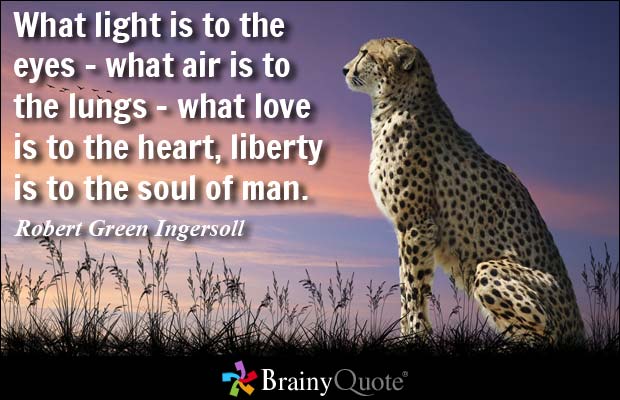
robertgreeningersoll118442

Fundamentally, today’s post is not about dogs. But it is about the qualities that we can see in our dogs: trust, honesty, openness, and the core quality that inspires my writings about dogs: integrity.

I’m speaking of the disgusting news that has been headlined in the world’s media in recent days, no better summarised than by this extract from a current (1pm PDT yesterday)) BBC news report:

Volkswagen chief executive Martin Winterkorn has resigned following the revelation that the firm manipulated US diesel car emissions tests.

Mr Winterkorn said he was “shocked” by recent events and that the firm needed a “fresh start”.

He added that he was “not aware of any wrongdoing on my part” but was acting in the interest of the company.

VW has already said that it is setting aside €6.5bn (£4.7bn) to cover the costs of the scandal.

The world’s biggest carmaker admitted last week that it deceived US regulators in exhaust emissions tests by installing a device to give more positive results.

The company said later that it affected 11 million vehicles worldwide.

As ever, the voice of George Monbiot speaks a little clearer than most, and I am referring to his recent essay published both on his blog and in The Guardian newspaper.  I am very pleased to have Monbiot’s permission to republish his essay here on Learning from Dogs.

ooOOoo

Smoke and Mirrors

22nd September 2015

Pollution, as scandals on both sides of the Atlantic show, is a physical manifestation of corruption.
By George Monbiot, published in the Guardian 23 September 2015

In London, the latest figures suggest, it now kills more people than smoking. Worldwide, a new study estimates, it causes more deaths than malaria and HIV-Aids together. I’m talking about the neglected health crisis of this age, that we seldom discuss or even acknowledge. Air pollution.

Heart attacks, strokes, asthma, lung and bladder cancers, low birth weight, low verbal IQ, poor memory and attention among children, faster cognitive decline in older people and – recent studies suggest – a link with the earlier onset of dementia: all these are among the impacts of a problem that, many still believe, we solved decades ago. The smokestacks may have moved to China, but other sources, whose fumes are less visible, have taken their place. Among the worst are diesel engines, sold, even today, as the eco-friendly option, on the grounds that their greenhouse gas emissions tend to be lower than those of petrol engines. You begin to wonder whether any such claims can still be trusted.

Volkswagen’s rigging of its pollution tests is an assault on our lungs, our hearts, our brains. It is a classic example of externalisation: the dumping of costs that businesses should carry onto other people. The air that should have been filtered by its engines is filtered by our lungs instead. We have become the scrubbing devices it failed to install.

Who knows how many people have paid for this crime already, with their health or with their lives? In the USA, 200,000 deaths a year are attributed to air pollution. For how many of those might Volkswagen be responsible? Where else was the fraud perpetrated? Of what proportion of our health budgets has this company robbed us?

The fraud involves the detection of nitrogen oxides (NOx), of which diesel engines are the major source in many places. This month, for the first time in our history, the UK government estimated the impact of NOx emissions on public health, and discovered that they are likely almost to double the number of deaths from air pollution, adding 23,000 to the 29,000 attributed to particulates (tiny particles of soot).

The government released this discovery, alongside its useless proposals for dealing with the problem, on Saturday 12 September, a few minutes before Jeremy Corbyn’s election as Labour leader was announced. How many government press releases are published on a Saturday? How many are published on a Saturday during an event on which everyone is focused? In other words, as a Labour press officer once notoriously advised, this was “a good day to bury bad news”. Not only was the number of deaths buried by this means, but so was the government’s consultation on its feeble plans for reducing this pollution: a consultation to which it evidently wanted as few respondents as possible. Liz Truss, the environment secretary, has some explaining to do.

She has her reasons for keeping us in the dark. In April, the Supreme Court ruled that the UK is in breach of the European air quality directive, and insisted that the government draw up a plan for compliance by the end of this year. Instead, Truss produced a plan to shed responsibility. Local authorities, her consultation suggests, should create clean air zones in at least eight cities, in which diesel engines are restricted or banned. But she has given them neither new money nor new powers. Nor has she offered an explanation of how this non-plan is going to address the issue in the rest of the country, as the ruling demands.

Already, the UK has missed the European deadline by six years. Under Truss’s proposals, some places are likely still to be in breach by 2025: 16 years after the original deadline. I urge you to respond to the consultation she wanted you to miss, which closes on November 6.

The only concrete plan the government has produced so far is to intensify the problem, through a new programme of airport expansion. This means more nitrous oxides, more particulates, more greenhouse gas emissions.

Paradoxically, the Volkswagen scandal may succeed where all else has failed, by obliging the government to take the only action that will make a difference: legislating for a great reduction in the use of diesel engines. By the time this article is published, we might know whether the company’s scam has been perpetrated in Europe as well as North America: new revelations are dripping by the hour. But whether or not this particular deception was deployed here, plenty of others have been.

Last week the Guardian reported that nine out of ten new diesel cars break European limits on nitrous oxides – not by a little but by an average of sevenfold. Every manufacturer whose emissions were tested had cars in breach of the legal limit. They used a number of tricks to hotwire the tests: “stripping components from the car to reduce weight, using special lubricants, over-inflating tyres and using super-smooth test tracks.” In other words, the emissions scandal is not confined to Volkswagen, not confined to a single algorithm and not confined to North America: it looks, in all its clever variants, like a compound global swindle.

There are echoes here of the ploys used by the tobacco industry: grand deceptions smuggled past the public with the help of sophisticated marketing. Volkswagen sites advertising the virtues of “clean diesel” have been dropping offline all day. In 2009, the year in which its scam began, the TDI engine at the centre of the scandal won the Volkswagen Jetta 2.0 the green car of the year award. In 2010, it did the same for the Audi A3.

There’s plenty that’s wrong with corporate regulation in the United States, but at least the fines, when they occur, are big enough to make a corporation pause, and there’s a possibility of guilty executives ending up in prison. Here, where corruption, like pollution, is both omnipresent and invisible, major corporations can commit almost any white-collar crime and get away with it. Schemes of the kind that have scandalised America are, in this country, both commonplace and unremarked. How can such governments be trusted to defend our health?

www.monbiot.com

ooOOoo

I found myself having two emotional reactions to Monbiot’s essay. The first was that for many years, when I was living and working in England, I drove diesel-powered cars on the (now false) belief that they were better for the environment.

My second reaction was to Monbiot listing the likely impacts from air pollution,”Heart attacks, strokes, asthma, lung and bladder cancers, low birth weight, low verbal IQ, poor memory and attention among children, faster cognitive decline in older people and – recent studies suggest – a link with the earlier onset of dementia. . . “, for the reason that at the age of 70, I am already noticing the creeping onset of reduced verbal IQ, cognitive decline, and worry about the onset of dementia. To think that my earlier decisions about what cars to drive might be a factor in this is disturbing.

I am going to close this post by highlighting how fighting for what we want is important, critically so. By republishing an item that was posted on AmericaBlog just over a year ago, that fortuitously is a reward for living in the State of Oregon.

ooOOoo

Climate win: Appeals court in Oregon rules state court must decide if atmosphere is a “public trust”

6/16/14 10:00am by Gaius Publius

Two teenagers from Eugene, Ore. filed suit against Governor Kitzhaber and the State of Oregon for failing to protect the “atmosphere, state waters, and coast lines, as required under the public trust doctrine.”

They lost the first round, where the state court said that climate relief was not a judicial matter. But they won on appeal. The case goes back to the original court, which now has orders to decide the case on its merits and not defer to the executive or legislature.

The gist of the appeals court decision:

Their lawsuit asked the State to take action in restoring the atmosphere to 350 ppm of CO2 by the end of the century. The Oregon Court of Appeals rejected the defenses raised by the State, finding that the youth could obtain meaningful judicial relief in this case.

That’s quite a nice victory. Here’s the full story, from the Western Environmental Law Center (my emphasis throughout):

Keeling-curve_CO2_ppm_Mauna_Loa_Carbon_Dioxide_Apr2013.svg_-300x201

In a nationally significant decision in the case Chernaik v. Kitzhaber, the Oregon Court of Appeals ruled a trial court must decide whether the atmosphere is a public trust resource that the state of Oregon, as a trustee, has a duty to protect. Two youth plaintiffs were initially told they could not bring the case by the Lane County Circuit Court. The trial court had ruled that climate change should be left only to the legislative and executive branches. Today, the Oregon Court of Appeals overturned that decision.

Two teenagers from Eugene, Kelsey Juliana and Olivia Chernaik, filed the climate change lawsuit against Governor Kitzhaber and the State of Oregon for failing to protect essential natural resources, including the atmosphere, state waters, and coast lines, as required under the public trust doctrine. Their lawsuit asked the State to take action in restoring the atmosphere to 350 ppm of CO2 by the end of the century. The Oregon Court of Appeals rejected the defenses raised by the State, finding that the youth could obtain meaningful judicial relief in this case. …

In reversing the Lane County trial court, the Oregon Court of Appeals remanded the case ordering the trial court to make the judicial declaration it previously refused to make as to whether the State, as trustee, has a fiduciary obligation to protect the youth from the impacts of climate change, and if so, what the State must do to protect the atmosphere and other public trust resources.

The implications of this are broad, and similar cases are pending in other states, as the article describes.

Make no mistake; decisions like this matter. It places the court squarely in the mix as a power player in the climate war, the fight for “intergenerational justice” as James Hansen puts it — or the war against intergenerational betrayal, as I put it.

This is a cornerstone decision from the Oregon Court of Appeals in climate change jurisprudence. The court definitively ruled that the question of whether government has an obligation to protect the atmosphere from degradation leading to climate change is a question for the judiciary, and not for the legislative or executive branches. The Court did not opine as to how that question should be answered, only that it should be answered by the judiciary.

We can win this; it’s not over. If we reach 450 ppm and we’re still not stopping with the CO2, then it’s over and I become a novelist full-time. But we’re not there yet, and please don’t surrender as if we were.

The courts are now a powerful tool, as is divestment. James Hansen has a way to restore the atmosphere to 350 ppm CO2 in time to stop slow feedbacks from kicking in. It’s a doable plan, but we’ll need to use force. Using the courts, as with using divestment campaigns, counts as force. Stay tuned.

(Want to use force at the national level? Find a way to challenge Obama publicly to stop leasing federal land to coal companies. He’s a hypocrite until he stops federal coal from being mined and sold abroad. A simple and obvious challenge for him. You too can be the activist.)

GP

Twitter: @Gaius_Publius
Facebook: Gaius Publi

(Facebook note: To get the most from a Facebook recommendation, be sure to Share what you also Like. Thanks.)

ooOOoo

 Never forget that you, me and every other good-minded person on this planet can make a positive difference. Need inspiration? Gain it from our dogs! Let’s use the liberty we enjoy to make a difference.

Two views of the United Kingdom

The very good and the very ugly.

Yesterday was the moment when Queen Elizabeth II became the longest-reigning UK monarch. As the BBC reported (in part) yesterday:

Queen Elizabeth II becomes longest-reigning UK monarch

The Queen has thanked well-wishers at home and overseas for their “touching messages of kindness” as she becomes Britain’s longest-reigning monarch.

Speaking in the Scottish Borders, the 89-year-old monarch said the title was “not one to which I have ever aspired”.

At 17:30 BST she had reigned for 23,226 days, 16 hours and approximately 30 minutes – surpassing the reign of her great-great-grandmother Queen Victoria.

David Cameron said the service the Queen had given was “truly humbling”.

Dressed in turquoise with her trusty black handbag at her side, the Queen spoke briefly to the gathered crowds earlier.

“Inevitably a long life can pass by many milestones – my own is no exception – but I thank you all and the many others at home and overseas for your touching messages of great kindness,” she said.

Newly released official photographs show the Queen with her official red box, containing the day's policy papers, cabinet documents, Foreign Office papers and other letters.
Newly released official photographs show the Queen with her official red box, containing the day’s policy papers, cabinet documents, Foreign Office papers and other letters.

Here’s a video that is worth viewing:

So that was the ‘good’ news.

Now here is the ‘ugly’ news; the latest essay by George Monbiot republished here with Mr. Monbiot’s kind permission.

ooOOoo

Britain’s Mafia State

8th September 2015

Where does legitimate business end and organised crime begin?

By George Monbiot, published in the Guardian 9th September 2015

Be reasonable in response to the unreasonable: this is what voters in the Labour election are told. Accommodate, moderate, triangulate, for the alternative is to isolate yourself from reality. You might be inclined to agree. If so, please take a look at the reality to which you must submit.

To an extent unknown since before the First World War, economic relations in this country are becoming set in stone. It’s not just that the very rich no longer fall while the very poor no longer rise. It’s that the system itself is protected from risk. Through bail-outs, quantitative easing and delays in interest rate rises, speculative investment has been so well cushioned that, as Larry Elliott puts it, financial markets are “one of the last bastions of socialism left on earth.”

Public services, infrastructure, the very fabric of the nation: these too are being converted into risk-free investments. Social cleansing is transforming inner London into an exclusive economic zone for property speculation. From a dozen directions, government policy converges on this objective. The benefits cap and the bedroom tax drive the poor out of their homes. The forced sale of high-value council houses creates a new asset pool. An uncapped and scarcely regulated private rental market turns these assets into gold. The freeze on council tax banding since 1991, the lifting of the inheritance tax threshold and £14 billion a year in breaks for private landlords all help to guarantee stupendous returns.

And for those who wish simply to sit on their assets, the government can help here too, by ensuring that there are no penalties for leaving buildings empty. As a result, great tracts of housing are removed from occupation. Agricultural land has proved an even better punt for City money: with the help of capital gains, inheritance and income tax exemptions, as well as farm subsidies, its price has quadrupled in 12 years.

Property in this country is a haven for the proceeds of international crime. The head of the National Crime Agency, Donald Toon, notes that “the London property market has been skewed by laundered money. Prices are being artificially driven up by overseas criminals who want to sequester their assets here in the UK.”

It’s hardly surprising, given the degree of oversight. Private Eye has produced a map of British land owned by companies registered in offshore tax havens. The holdings amount to 1.2 million acres, including much of our prime real estate. Among those it names as beneficiaries are a cast of Russian oligarchs, oil sheikhs, British aristocrats and newspaper proprietors. These are the people for whom government policy works, and the less regulated the system that enriches them, the happier they are.

The speculative property market is just one current in the great flow of cash that sluices through Britain while scarcely touching the sides. The financial sector exploits an astonishing political privilege: the City of London is the only jurisdiction in the UK not fully subject to the authority of parliament. In fact, the relationship seems to work the other way. Behind the Speaker’s chair in the House of Commons sits the Remembrancer, whose job is to ensure that the interests of the City of London are recognised by the elected members. (A campaign to rescind this privilege – Don’t Forget the Remembrancer – will be launched very soon). The City has one foot in the water: it is a semi-offshore state, a bit like the UK’s Crown dependencies and overseas territories, tax havens legitimised by the Privy Council. Britain’s financial secrecy undermines the tax base while providing a conduit into the legal economy for gangsters, kleptocrats and drug barons.

Even the more orthodox financial institutions deploy a long succession of scandalous practices: pension mis-selling, endowment mortgage fraud, the payment protection insurance con, Libor rigging. A former minister in the last government, Lord Green, ran HSBC while it engaged in money laundering for drugs gangs, systematic tax evasion and the provision of services to Saudi and Bangladeshi banks linked to the financing of terrorists. Sometimes the UK looks to me like an ever-so-civilised mafia state.

At next month’s Conservative party conference, corporate executives will pay £2,500 to sit with a minister. Doubtless, because we are assured that there is no link between funding and policy, they will spend the day discussing the weather and the films they have seen. If we noticed such arrangements overseas, we might be inclined to regard them as corruption. But that can’t be the case here, not least because the invitation explains that “fees associated with business day & dinner are considered a commercial transaction and therefore do not constitute a political donation.”

The government also insists that there is no link between political donations and seats in the House of Lords. But a study by researchers at Oxford University found that the probability of so many major donors arriving there by chance is 1.36 x 10-38: roughly “equivalent to entering the National Lottery and winning the jackpot 5 times in a row”. Why does the Lords remain unreformed? Because it permits plutocratic power to override democracy. Both rich and poor are kept in their place.

Governed either by or on behalf of the people who fleece us, we cannot be surprised to discover that all public services are being re-engineered for the benefit of private capital. Nor should we be surprised when governments help to negotiate, without public consent, treaties such as TTIP and CETA (the Comprehensive Economic and Trade Agreement), which undermine the sovereignty of both parliament and the law. Aesop’s observation that “we hang the petty thieves and appoint the great ones to public office” remains true in spirit, though hanging has been replaced by community payback.

Wherever you sniff in British public life, something stinks: I could fill this newspaper with examples. But, while every pore oozes corruption, our task, we are told, is merely to trim the nails of the body politic.

To fail to confront this system is to collaborate with it. Who on the left would wish to stand on the sidelines as this carve-up continues? Who would vote for anything but sweeping change?

www.monbiot.com

ooOOoo

Going to close with this picture:

Ma'am's best friend: The Queen has owned corgis for more than 60 years. Picture seen on in the UK's Daily Mail newspaper.
Ma’am’s best friend: The Queen has owned corgis for more than 60 years. Picture seen in the UK’s Daily Mail newspaper.

Taking the two stories together, all that comes to mind is that we could do much better if the United Kingdom, and other countries, were governed by dogs!

Habituated to eating

A startling and counter-intuitive essay from George Monbiot.

Hariod Brawn, she of the blog Contentedness.net, left a response to yesterday’s post in this place. Here is what Hariod said:

Yes Paul, I too recognise the value in understanding the neural substrates involved, regardless of what may in any case be reliably inferred and readily apparent in behavioural evidence. The social intelligence of the dog seems remarkably advanced of course, and so naturally provides a rich source for such research. Having said that, I am struck by the amount of academic funding that goes into confirming what is already self-evident, and wonder if the apportioning of funds is done quite as effectively as it could be. Much is determined by commercial interests of course.

“Much is determined by commercial interests …”

I have been a resident of the United States since April 2011. There has been much to take in and embrace at so many levels. However, one of the things that has seemed very foreign to my eyes was the extent of the obesity seen almost everywhere that one is out and about. At first it seemed more of an American issue, but over the last few years watching news items from the UK and seeing other general items on the internet from ‘the old country’ I came to realise that countries both ‘sides of the pond’ are grappling with what could be fairly described as an epidemic.

Yesterday, George Monbiot published an essay called Slim Chance. As with so many of Mr. Monbiot’s essays this one highlights issues that I am sure are not widely appreciated. It is republished here with Mr. Monbiot’s kind permission.

ooOOoo

Slim Chance

11th August 2015

New evidence suggests that obesity might be incurable. So why does the government propose to punish sufferers?

By George Monbiot, published in the Guardian 12th August 2015

Is overeating more addictive than crack cocaine? It’s hard to compare addiction rates, or to produce a clear definition that holds true across all substances and behaviours. But consider this crude contrast. Between 10 and 20% of people who use crack cocaine become addicted to it. Across a 9-year study of 176,000 obese people, 98.3% of the men and 97.8% of the women failed to return to a healthy weight. Once extreme overeating begins, it appears to be almost impossible to stop.

A paper published in the journal Neuroscience and Biobehavioral Reviews proposed that “food addiction” is a less accurate description of this condition than “eating addiction”. There is little evidence that people who are driven to overeat become dependent on a single ingredient; instead they tend to seek out a range of highly palatable, energy-dense foods, of the kind with which we are now surrounded.

The activation of reward systems in the brain and the loss of impulse control are similar to those involved in dependency on drugs. But eating addiction appears to be more powerful. As the same paper notes, in laboratory experiments “a majority of rats will prefer a sweet reward over a cocaine reward.”

Once you become obese, an article published in the Lancet this year explains, biological changes lock you in. Fat cells proliferate. The brain becomes habituated to dopamine signalling (the reward pathway), driving you to compensate by increasing your consumption. If you try to lose weight, the body perceives that it is being starved, and powerful adaptations (such as an increase in metabolic efficiency) try to bounce you back to your previous state. People who manage, against great odds, to return to a normal weight must consume 300 fewer calories per day than those who have never been obese, if they are not to put the weight back on. “Once obesity is established, … bodyweight seems to become biologically stamped in”. The more weight you lose, the stronger the biological pressure to get back to your former, excessive size.

The researchers find that “these biological adaptations often persist indefinitely”: in other words, if you have once been obese, staying slim means sticking to a strict diet for life. The best you can hope for is not a dietary cure, but “obesity in remission”. The only effective, long-term treatment for obesity currently available, the same paper says, is bariatric surgery. This can cause a number of grim complications.

I know this statement will be unwelcome. I too hate the idea that people cannot change their circumstances. But the terrible truth is that, except through surgery, for the great majority of sufferers, obesity is an incurable disease. In one respect it resembles cancer: the changes in lifestyle that might have prevented it are unlikely to be of use in curing it.

Fat-shaming is worse than useless. Another paper found that the more weight-conscious people are, the more likely they are to overeat: the stress it induces is a trigger for comfort eating. As Sarah Boseley points out in her book The Shape We’re In, “the diet industry … is one of the biggest frauds of our time”. For the obese, temporary reductions in weight will almost inevitably be reversed.

People who are merely overweight, rather than obese (in other words who have a BMI of between 25 and 30) appear not to suffer from the same biochemical adaptations: their size is not “stamped in”. For them, changes of diet and exercise are likely to be effective. But urging obese people to buck up produces nothing but misery.

The crucial task is to reach children before they succumb to this addiction. As well as help and advice for parents, this surely requires a major change in what scientists call “the obesogenic environment” (high energy foods and drinks and the advertising and packaging that reinforces their attraction). Unless children are steered away from overeating from the beginning, they are likely to be trapped for life.

You might have expected this knowledge to lead to acceptance, empathy and an end to stigmatisation. Fat chance. A fortnight ago, just after the figures I mentioned at the top of this article were published, David Cameron announced a review that could lead to obese people being deprived of social security payments if they fail to accept “treatment” for their condition.

This review, conducted by Dame Carol Black, has already pre-empted its conclusions: eight times it describes obesity as “treatable”. Really? How? It will consider the case “for linking benefit entitlements to take up of appropriate treatment”. Are Cameron and Black proposing that benefit claimants will be forced to undergo surgery? Or will they be pressed into a useless and punitive dietary regime? These proposals look to me like a transfer of blame for the disease away from food manufacturers and advertisers and onto those afflicted.

Why do we have an obesity epidemic? Has the composition of the human species changed? Have we suffered a general collapse in willpower? No. The evidence points to high-fat, high-sugar foods that overwhelm the impulse control of children and young adults, packaged and promoted to create the impression that they are fun, cool and life-enhancing. Many are placed in the shops where children are bound to encounter them: around the tills, at grasping height.

The disease will keep ravaging the population (and slowly overwhelm the health service) until these circumstances change. But the government’s sole contribution has been to tear down mandatory controls, replacing them with a voluntary – and therefore useless – “responsibility deal” with manufacturers and retailers. It allows them to choose whether or not to use the traffic light system, which is the most effective way of informing people about the likely impact of what they eat. And many corporations, unsurprisingly, choose not to. As far as nutritional content is concerned, food manufacturing is effectively unregulated.

Industry and government will resist the obvious solutions until they can be resisted no longer. Eventually, the change will have to happen: similar restrictions on advertising, sponsorship, display and accessibility to those imposed on the tobacco pedlars. One day, though not before many thousands have needlessly died, it will become illegal to advertise any food or drink that merits a red traffic light warning. They will be sold only in plain packaging, with health warnings, on high shelves.

Does this seem draconian to you? If so, remember that obesity afflicts a quarter of the adult population, and is rising rapidly. It causes a range of hideous conditions, just one of which – diabetes – accounts for one sixth of NHS admissions and 10% of its budget. If smoking demands fierce intervention, why not overeating?

This is the choice we face. To recognise that the only humane and effective means of addressing the obesity epidemic is to prevent more people from being hooked, by restricting the pushers. Or to continue a programme of fat-shaming, bullying and compulsory treatment, whose only likely outcome is unhappiness. Now ask yourself again: which of these two options is draconian?

www.monbiot.com

ooOOoo

Let me close with an image. The image that George Monbiot believes will be seen very widely and representing the same common-sense in eating that we have been used to with regard to No Smoking signs.

9129948_orig

A return to the topic of rewilding.

Lessons from the wild

At the end of 2013, I published a post under the title of We must rewild. The core of that post was an essay from Patrice Aymes called Rewilding Us. Here’s a small extract from that essay:

In Africa, there are about 500,000 elephants. 25,000 to 30,000 are killed, a year, to send the ivory to east Asia (China, Vietnam). So African elephants may disappear. This is beyond tragic, it’s irreplaceable. Elephants understand people’s gestures, without any learning (they apparently learn to use trunk gestures among themselves). One is talking about extremely intelligent animals here. (In contrast, chimpanzees have great difficulties understanding human gestures.)

My post also included this photograph of young Cleo, just five months old, showing that her innate skills of being in the wild were alive and well, despite thousands of years of dogs being domesticated animals. Ergo, humans could manage just as well.

Photograph taken 25th April, 2012.

Last Friday, George Monbiot published an essay in The Guardian newspaper that stays with the theme of loving the wild.  It is republished here with Mr. Monbiot’s very kind permission.

ooOOoo

Falling in Love Again

17th July 2015

Rebuilding our relationship with the natural world can re-animate our own lives, as well as the ecosystem.

When the robin was voted the UK’s national bird last month, we chose to celebrate half of a broken relationship. The robin is to the wild boar what the oxpecker is to the Cape buffalo: it has evolved to catch the worms and insects exposed by their grubbing. But boar are mostly absent from the UK, so its survival often depends on finding the next best thing: human gardeners. This is why the robin is so tame in this country. As far as the bird is concerned, you and I are just fake pigs.

We are surrounded by such broken relationships, truncated natural processes, cauterised ecologies. In Britain we lack almost all large keystone species: ecological engineers that drive the fascinating dynamics which allow other lifeforms to flourish. Boar, beavers, lynx, wolves, whales, large sharks, pelicans, sturgeon: all used to be abundant here, all, but for a few small populations or rare visitors, are missing.

The living systems that conservationists seek to protect in some parts of this country are a parody of the natural world, kept, through intensive management, in suspended animation, like a collection in a museum. An ecosystem is not just a place. It is also a process.

I believe their diminished state also restricts the scope of human life. We head for the hills to escape the order and control that sometimes seem to crush the breath out of us. When we get there, we discover that the same forces prevail. Even our national parks are little better than wet deserts.

Our seas were once among the richest on earth. A few centuries ago, you could have watched fin whales and sperm whales hammering the herring within sight of the shore. Shoals of bluefin tuna thundered up the North Sea. Reefs of oysters and other sessile animals covered the seabed, over which giant cod, skate and halibut cruised. But today, industrial fishing rips up the living fabric of all but 0.01% of our territorial waters. To walk or dive in rich environments we must go abroad.

Though not, I hope, for long. On Wednesday, a new organisation, Rewilding Britain, was launched. (It was inspired by my book Feral and I helped to found it, but I don’t have a position there). Its aim is to try to catalyse the mass restoration of the living world, bring trees back to bare hills, allow reefs to form once more on the seabed and to return to these shores the magnificent, entrancing animals of which we have so long been deprived. Above all it seeks to enhance and enrich the lives of the people of this nation. I hope that it might help to change the face of Britain.

Already, local projects hint at what could be achieved. In the southern uplands of Scotland, the Borders Forest Trust has bought 3000 hectares of bare mountainside and planted hundreds of thousands of native trees. The community of Arran seabed trust in the Firth of Clyde managed, after 13 years of campaigning, to persuade the government to exclude trawlers and scallop dredgers from one square mile of seabed. The result, in this tiny reserve, is an explosion of lobsters, crabs, scallops and fish. It’s now trying to extend the project to a larger area.

In Sussex, the Knepp Castle estate gave up its unprofitable wheat farming, released a few cattle and pigs and let natural processes take over. Now it hosts some of Britain’s highest populations of nightingales, purple emperor butterflies and turtle doves. Partly through ecotourism and accommodation and selling high-grade meat, it has become profitable. In south London, the Wandle Trust has turned a mangled and polluted urban river back into a beautiful chalkstream, supporting kingfishers and wild trout. Wonderful as these projects are, until now they have lacked a national voice. Britain remains in a state of extreme depletion.

Some people argue that we should not seek to re-establish missing species until we’ve protected existing wildlife. But nothing better protects our ecosystems than keystone species. Beaver dams provide habitats for fish, invertebrates, amphibians and waterbirds. In Ireland, resurgent pine martens appear to have pushed back the grey squirrel, allowing red squirrels to recolonise. One study suggests that our woodland ecology cannot recover unless half the country’s deer are culled every year. Lynx could do it for nothing. Functional ecosystems, in which dynamic living processes prevail once more, are likely to be more resistant to climate change than stagnant collections in virtual glass cases.

Over the past two years, there has been a surge of enthusiasm for change. A poll in Scotland found that 60% support the reintroduction of beavers, with only 5% opposed. 91% of respondents to a survey by the Lynx UK Trust supported a trial reintroduction. Researchers at the University of Cumbria digitally altered photographs of Borrowdale in the Lake District, adding or subtracting trees. 69% of the people who saw them favoured the images with extra trees. A video extracted from my TED talk, about the relationship between wolves and other wildlife, has been watched 18 million times.

But the interests of local people must never be overruled. Rewilding must take place only with active consent. Already, landowners are coming forward, proposing to rewild their own property. Community groups, such as Cambrian Wildwood in mid-Wales, are seeking to buy and restore surrounding land. What rewilding offers is a new set of options in places where traditional industries can no longer keep communities alive, where schools and shops and chapels and pubs are closing and young people are leaving the land to find work elsewhere.

In the hills of southern Norway, the return of trees has been accompanied by a diversification and enrichment of the local economy. There, the small income from farming is supplemented with eco-tourism, forest products, rough hunting, fishing, outdoor education, skiing and hiking. The governments of Britain now claim to be willing to pay for the protection of soils and watersheds. These are likely to be more resilient sources of income than the current farm subsidy system upon which all hill farming in this country depends, whose gross injustice – transferring vast sums from the poor to the rich simply for owning land – is as unsustainable politically as it is ecologically.

Perhaps most importantly, rewilding offers hope. It offers the hope of recovery, of the enhancement of wonder and enchantment and delight in a world that often seems crushingly bleak. My involvement with rewilding, to my own amazement, has made me much happier and more optimistic than I was before. I feel an almost evangelical sense of excitement about the prospects for change. I want other people to be able to experience it too.

In 2009, the rewilding pioneers Trees for Life released some wild boar into an enclosure at Dundreggan, in the Scottish Highlands. Within twenty minutes, robins came down from the trees and started following them. Their ecological memory was intact. When I’ve accompanied children from deprived London boroughs to the woods and rockpools for the first time in their lives, I have seen something similar: an immediate, instinctive re-engagement, the restoration of a broken ecological relationship. Once we have richer wild places to explore, we won’t need much prompting to discover their enchantments.

www.monbiot.com

ooOOoo

In the copy of George Monbiot’s essay that was published on his blogsite there were 25 links to other materials. I feel very bad that I just didn’t have the time to copy across all those links so my strong recommendation is that if you enjoyed reading this here then you go across to the essay on his blogsite and check out all the additional material available to you. My only exception was to insert the link to the organisation Rewilding Britain that was referred to in the sixth paragraph.