The President of the United States recently pressured the heads of the nations’ largest banks to increase lending to
Pres. Obama
small business and home-owners. Obama claimed that the banks, as recipients of federal bailout funds, had an unusually heavy responsibility to take such measures in order to create more jobs and help nurse the economy back to health. All of this was done very publicly and with much fanfare. Worldwide press coverage was universally favorable.
Seems reasonable, doesn’t it?
But it is not. You are being duped. I can’t tell whether whoever writes this stuff for Obama knows the truth and skilfully skirts it, or just writes flowing prose with no connection to the truth that curries voter buy-in by blaming Wall Street and Corporate America for all that’s wrong in the world.
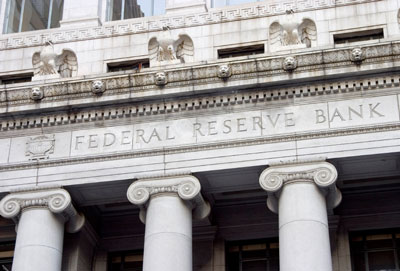
The US Federal Reserve, or Central Bank, is the banking system’s bank. It is the lender of last resort.
It is through the Central Bank that banks settle their accounts with each other. The central bank serves as a clearinghouse for checks written by depositors, and it holds the commercial banks’ reserves.
Bank reserves (vault cash, and deposits by banks at the Central Bank or the Fed) are monies held out of circulation by banks to satisfy the Fed’s reserve requirements and the currency demand by the public. Excess reserves are those held above the legal reserve requirements to handle uncertain demand. Bank deposits not held in (required plus excess) reserves are used to make loans and earn interest.
When banks make loans, they do not actually lend out the equivalent in cash but instead create on their balance sheet a loan asset and an equal liability called a demand deposit. Such lending by banks is limited only by reserve requirements (set by the Fed) and the cash they need to satisfy cash withdrawal demand by their customers.
As these loans are then re-deposited by the borrower, the multiplier process continues as fractional reserves are held back and the balance is “lent” out again.
Okay. If you tried this ploy on your parents, you wouldn’t get away with it. If your kids tried it on you, you wouldn’t fall for it either. So why are the American people letting the Government get away with this ploy? I don’t know. And I don’t get it. Maybe there is just so much going on that it gets lost in the mix. Maybe it’s because of the deceptive and disingenuous way it’s being presented by Pelosi, Reid, and Obama.
Here’s the ruse: “Give us more of your money today, and we will reduce tomorrow’s health care costs. We will increase efficiency. And we will do all of this without increasing the budget deficit!”
Yeah, right.
What exactly is stopping them from reducing health care costs and improving the efficiency of health care delivery now? Why do they need more money today to accomplish these things tomorrow? What magical powers does the next dollar of tax collections have that the current ones don’t?
Exactly. None. So when Congress asks to increase taxes and the deficit in order to fix health care tomorrow, let’s respond to them as we would our clever but errant children: Ask to see some proof today first.
You know how that will turn out. And so does Congress. That’s why they just keep promising the moon. What I don’t get is why we continue to let them get away with it.
[Not just the US Government plays on the roundabout – I’m sure they learnt from the Brits! Ed.]
The US poor pay czar is lamenting his task: how to limit the pay of executives at companies receiving a bailout without undercutting the ability of the firm to secure talented management. “It’s a delicate balance! Very difficult indeed.” Well, Mr. Czar, difficult for you, maybe, but a piece of cake for the labor market. That’s exactly what the labor market does, day in and day out, quite naturally.
Compensation should not be the purview of an appointed administrator serving at the pleasure of the executive branch of the U.S. Government.
Perhaps the housing market is the best economic indicator?
As an economist, I am frequently asked for my predictions on when the economy is going to turn around. Have we reached the bottom? Have we begun to recover? Might we go into a second, perhaps more severe recession?
Those are tough questions to answer. Business cycles are notoriously difficult to predict. In fact, about the only thing we know for sure is that no two business cycles are alike. Each is unique in some significant way.
Changes in the housing market may be one of the most meaningful indicators of a recovery, because housing stability is such a fundamental indicator of how households are budgeting their income. Notice that I did not say that the level of homeownership was a useful indicator; instead, I look to changes in the housing market, either away from or toward an apparently sustainable and affordable supply of homes, for evidence of where in the business cycle the economy may be.
Despite record low mortgage rates and first-time home buyer credits, the U.S. housing market remains anemic. Rising foreclosures in several major metropolitan areas will keep housing prices low for some time to come.
The U.S. currently has about 1.7 million excess housing units available. Typically, about 1.3 million new households are formed in the U.S. per year. But with the unemployment rate topping 10%, new household formation will fall to about 1 million per year. If new home construction remains at its current level of about 600,000 units per year, it will take over 4 years (1.7 million/400,000) for the excess supply of housing to be absorbed and housing prices to recover.
Recovery rates will be much slower in some markets, such as in Florida, Nevada, and California, but I believe that the rest of the U.S. along with most other developed economies are looking at a three- to four-year period of time before housing and thus the overall levels of output return to their pre-recession levels.
The U.S. banking system remains vulnerable to sizeable potential losses as the housing market struggles to recover.
Estimates of these losses range from $500 billion to $1 trillion (£312 bn – £625 bn). The Federal Reserve Board is especially concerned about the impact of commercial real estate on many regional and small banks across the country. Occupancy and rental rates continue to decline dramatically as 2009 draws to a close, and the worst seems yet to come.
Commercial real estate loans on banks’ balance sheets total almost $1.1 trillion dollars. With near-term commercial real estate losses topping $100 billion, the Wall Street Journal estimates that as many as one-third of small and mid-size U.S. banks could experience financial distress.
Troubled banks restrict lending until they can raise more capital. In this illiquid market, expect banks to fight for survival by raising lending rates, shortening maturities, and lowering loan amounts. Credit will continue to shrink in the U.S., which spells big trouble for any economic recovery.
A small challenge to a Nobel prize winner in Economics!
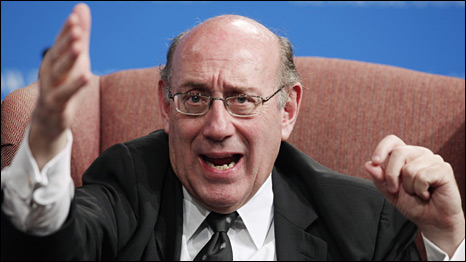
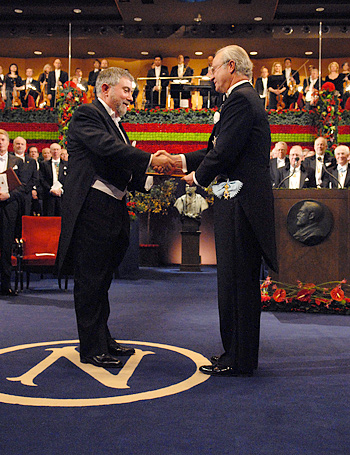
In a recent New York Times op-ed, Paul Krugman continues his boundless quest to become the “it” guy in the world of economics. I have taken issue with his command of basic economic facts in the past — a gutsy, if not insane thing to do given the man was awarded a Nobel Prize in Economics.
Krugman accepting the Nobel Prize
This post is more about ego than economics, however.
In this op-ed, Mr. Krugman says (and I kid you not),
…But after the debacle of the past two years, there’s broad agreement — I’m tempted to say, agreement on the part of almost everyone not on the financial industry’s payroll — with Mr. Turner’s assertion that a lot of what Wall Street and the City do is “socially useless.” And a transactions tax could generate substantial revenue, helping alleviate fears about government deficits. What’s not to like?
Well, I disagree with the idea that what Wall Street does is socially useless. And I am not on the financial industry’s payroll.
Nope, I’m just a simple economist, using my head, training, and experience to consider this idea, map out the pros and cons, and analyze the logical end-game of such a tax. I conclude that it is a really bad idea.
Why? There are lots of reasons, but I will mention only two.
One, raising taxes reduces private economic activity, which will curtail growth, reduce tax revenues and increase the deficit.
Two, taxes distort the price signal between suppliers and demanders of goods and services, including financial capital, reducing economic efficiency.
His reasons? Other than citing one academic study (while ignoring the many others that reach a different conclusion), he gives no economic reasons for his views. Instead, he make claims. He claims, for example, that “socially damaging behavior … caused our current crisis.” He says that the financial services industry is “bloated” and needs to be cut down to size. He says that the new tax is okay because it raises revenues for the government which, he claims, should make us all feel better about the deficit and, apparently, the size and nature of government spending under Obama. And, the lamest of all, for no other reason than to hide behind their skirt, he claims the existence of some phantom majority, apparently to create the impression that anyone with a different view is clearly in the minority. A tactic that should be beneath a Noble Prize winner, but one that runs through his work with increasing frequency over time.
But, Mr. Krugman, I so disagree with you. And even in an op-ed piece — perhaps especially in an op-ed piece – I believe that one needs to reign in an ego that would parade claims as facts, especially when each of those claims is disputed by your fellow economists, none of whom stooped so low as to imply that you were paid for your views.
These are very strange times: thank goodness for Blogs.
Learning from Dogs is a relatively young Blog (first Post was July 15th, 2009) but already it has opened the eyes of all the authors to the power of plain speaking. All of us involved in bringing you a dozen Posts a week find inspiration for our creative juices from the corners, far and wide, of the virtual world of digital communications, the World Wide Web.
Because we are in the midst of huge turmoil it’s very difficult to see the underlying trends of change at work. But see them we must if we are to be smart and work out, for the best, what needs to be done at the scale of the individual and the family.
So with that theme in mind, go to the Blog called Jesse’s Café Américain and read a recent Post about the behaviour of the price of gold. But also read beyond the subject of gold and reflect on the deeper message.
The Commerce Department has revised downward its estimate of the U.S. growth rate from the third quarter of 2009, see this report.
Citing weaker consumer spending than originally estimated (discussed in an earlier post here) the annualized growth rate is now 2.8%, down from 3.5%, far too weak to make any progress on the employment front.
It came up again in conversation today: someone was offended and upset over the level of compensation of some senior executives in the U.S. economy. I have to admit I just do not understand the anger. And I have a fundamental lack of respect for the arguments that have been served up thus far in support of the position.
I have tried to resist drawing the conclusion that the anger is born of envy, but I am very close to throwing in the towel on that one. Why should we begrudge anyone who earns a healthy salary, especially in an economy that provides each of us the opportunity to aspire to the same?
Even if there were reasonable ways around the practical issues and costs associated with legislative caps on salaries — how to set them, who sets them, using what measures, what value judgements — it simply makes no sense. It is the antithesis of a competitive market economy where individuals have the incentive to learn, grow, work hard, and succeed. It ignores the role played by capitalism in creating a strong and vibrant private economy that provides endless opportunities for all who want to put in the hours and the effort to succeed.
U.S. corporate governance rules provide the framework for determining the compensation for senior executives, and it works remarkably well. Each shareholder, or owner of the company, gets one vote on material issues such as reorganization. The Board of Directors is responsible for hiring and firing senior management on behalf of the shareholders. If the shareholders do not like the decisions of the board, including those that set the level and form of compensation for senior management, they have at least two, very effective choices. They can either sell their shares in the company or they can vote to replace the board members. The board can take several steps if, after negotiating the compensation package for senior management, the executive fails to perform. The board can withhold the bonus, renegotiate the terms of the contract, or fire the executive. Then the long, mostly objective arm of the competitive labor market will determine the market-clearing value for the skills and experience of the recently fired executive.
One thing I’ve never quite understood is why the market doesn’t seem to exact more punishment on senior executives who run their companies into the ground. Maybe there is an old boys network that looks out for ex-executives; maybe my observations are biased; maybe I notice only those cases where failed executives rise again. But it’s an empirical question, in any case; we can gather data on the issue and study it objectively.
Regardless of the conclusions of such an analysis, however, decisions about executive compensation must remain in the labor market where your ability to produce economic value still reigns supreme over your ability to curry votes and political favor.



 Learning from Dogs