Tag: Dolphin

Man is very, very close to Dolphin

Dolphin DNA very close to Human DNA

I had real trouble in writing yesterday’s Post about the appalling slaughter of the dolphins in Japan. Perhaps there was something out there in the ether that recognised the pain that I was sharing with so many thousands of other dolphin lovers.

Because while I was writing the article, into my in-box came something from Save Japan Dolphins about how close dolphins are to mankind, in DNA terms.

The article opened thus:

Seema Kumar, of Discovery Channel Online, writes that scientists have discovered that the genetic make-up of dolphins is amazingly similar to humans. They’re closer to us than cows, horses, or pigs, despite the fact that they live in the water.

David Busbee of Texas A&M University is then quoted as saying:

Busbee says, “If we can show that humans are similar to dolphins, and anything that endangers dolphins is an equal concern for humans, it may be easier to persuade governments to keep oceans clean.

And make it easier for all honest and loving people to join the fight to stop that most dastardly murdering of dolphins in Taiji, Japan.

If you do nothing else, at least sign up to receiving the latest news from Save Japan Dolphins – which is how this Post was conceived.
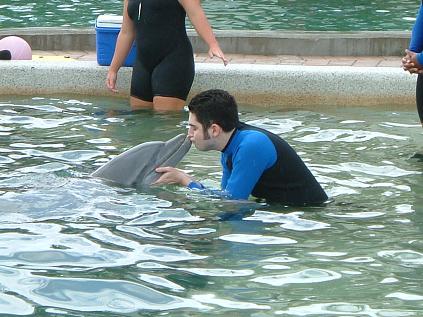
 

Kissing not killing, please.


By Paul Handover

Dolphins – truly innocent victims

This just makes me weep!

Watch.

Read and be Educated.

In Japan, fishermen round up and slaughter hundreds and even thousands of dolphins and other small whales each year.In the small fishing village of Taiji, entire schools of dolphins are driven into a hidden cove after a prolonged chase. Once trapped inside the cove, the fishermen kill the dolphins, slashing their throats with knives or stabbing them with spears. The water turns red with their blood, and the air fills with their screams.

Now go here and here.

Take action.

By going here.

Not for your sake, not for my sake but for the sake of this magnificent creature.

I tried to insert a picture of dolphins being slaughtered in Japan but just couldn’t handle the negativity that the picture sent out.

Read this and focus on the beauty of these creatures – and let that inspire you to take action. Please.

By Paul Handover

So I said to this dolphin …

Fascinating research on how dolphins develop ‘speech’

Once again, I am indebted to Yves Smith for posting a link in the edition of Naked Capitalism published on the 1st October that really caught my eye.  This follows nicely after my piece a couple of days ago about how the stray dogs in Moscow are learning new ways to survive.

It was a piece on the BBC Earth website about how dolphins attempt to learn the language of other dolphin groups.

The BBC article starts thus:

Just magnificent

When two dolphin species come together, they attempt to find a common language, preliminary research suggests.

Bottlenose and Guyana dolphins, two distantly related species, often come together to socialise in waters off the coast of Costa Rica.

Both species make unique sounds, but when they gather, they change the way they communicate, and begin using an intermediate language.

That raises the possibility the two species are communicating in some way.

Biologist Dr Laura May-Collado of the University of Puerto Rico in San Juan made the discovery studying dolphins swimming in the Gandoca-Manzanillo Wildlife Refuge of the southern Caribbean coast of Costa Rica.

Later the article says:

As yet, Dr May-Collado cannot be sure if both species are changing the way they communicate, or whether it is one species attempting to call more like the other.

That is because her sound equipment could only record the total calls produced by mixed species groups of dolphins, and could not separate out sounds made by individuals.

“This limits how much I can say about how much they are communicating,” says Dr May-Collado.

However, dolphins are known to have an extraordinary ability to change their calls when ‘talking’ to other individuals, or to ensure they are heard over the din of background noise pollution.

So “I wouldn’t be surprised that they can modify their signals to mimic, and even possibly communicate with other species. Particularly when their home ranges force them to interact on a daily basis, which is the case of this study,” she says.

Read the full piece here or access details of the publication here.

And, finally, enjoy this:

By Paul Handover