PUBLISHED: 19:45 EST, 9 January 2013 | UPDATED: 02:56 EST, 10 January 2013
Was there ever a government quango quite so useless as the Met Office?
From its infamous ‘barbecue summer’ washout of 2009 to the snowbound winter it failed to predict in 2010 and the recent forecast-defying floods, our £200 million-a-year official weather forecaster has become a national joke.
But of all its recent embarrassments, none come close to matching the Met Office’s latest one.
Without fanfare — apparently in the desperate hope no one would notice — it has finally conceded what other scientists have known for ages: there is no evidence that ‘global warming’ is happening.
Needless to say the UK Met Office published a detailed rebuttal. One of the comments that I spotted following that rebuttal was this lovely one from MD Dalgleish:
The Daily Mail does not let the facts get in the way of a story! Nothing new there, they’ve been doing that since before the war. What baffles me is why so many people buy this paper.
Quite so!
It would all be a bit of a laugh if it were not for what follows.
Last Friday, Naked Capitalism, the fabulous blog run by Yves Smith published in her set of links this item, “Climate change set to make America hotter, drier and more disaster-prone.” Newly living here in Southern Oregon, that obviously caught my eye!
The item referred to a detailed account in the British Guardian newspaper by Suzanne Goldenberg, the newspaper’s US Environment Correspondent.
Climate change set to make America hotter, drier and more disaster-prone
Draft report from NCA makes clear link between climate change and extreme weather as groups urge Obama to take action
The report says steps taken by Obama to reduce emissions are ‘not close to sufficient’ to prevent the most severe consequences of climate change. Photo: Saul Loeb/AFP
Future generations of Americans can expect to spend 25 days a year sweltering in temperatures above 100F (38C), with climate change on course to turn the country into a hotter, drier, and more disaster-prone place.
The National Climate Assessment, released in draft form on Friday , provided the fullest picture to date of the real-time effects of climate change on US life, and the most likely consequences for the future.
The 1,000-page report, the work of the more than 300 government scientists and outside experts, was unequivocal on the human causes of climate change, and on the links between climate change and extreme weather.
“Climate change is already affecting the American people,” the draft report said. “Certain types of weather events have become more frequent and/or intense including heat waves, heavy downpours and in some regions floods and drought. Sea level is rising, oceans are becoming more acidic, and glaciers and Arctic sea ice are melting.”
Here’s a pithy question for Mr. James Delingpole of The Daily Mail, “Which part of this sentence are you having trouble with – The 1,000-page report, the work of the more than 300 government scientists and outside experts, was unequivocal on the human causes of climate change, and on the links between climate change and extreme weather.?” [my emphasis]
Suzanne goes on to say:
The report will be open for public comment on Monday.
Environmental groups said they hoped the report would provide Barack Obama with the scientific evidence to push for measures that would slow or halt the rate of climate change – sparing the country some of the worst effects.
The report states clearly that the steps taken by Obama so far to reduce emissions are “not close to sufficient” to prevent the most severe consequences of climate change.
“As climate change and its impacts are becoming more prevalent, Americans face choices,” the report said. “Beyond the next few decades, the amount of climate change will still largely be determined by the choices society makes about emissions. Lower emissions mean less future warming and less severe impacts. Higher emissions would mean more warming and more severe impacts.”
As the report made clear: no place in America had gone untouched by climate change. Nowhere would be entirely immune from the effects of future climate change.
One might argue that it won’t be very long before no sane person on this planet would swallow that crap from The Daily Mail. But when we get to that stage of every person being aware of the forces at work upon our fair planet it will be a tad too late.
The only home we have.
That’s why this report is to be encouraged, nay embraced. Of all the nations in the world, the one that should be setting the lead is the United States of America. As the banner on that globalchange.gov website proclaims: Thirteen Agencies, One Vision: Empower the Nation with Global Change Science
So go and read the report. For your sake and all our sakes.
Because the more informed you and I are, the better the chances of real political leadership taking place in this fine nation.
Download Chapters of the NCADAC DraftClimate Assessment Report!
Download the Full Report (warning, 147Mb. Very large file)Between chapters, there are some page numbers that are not used. This is intentional and does not reflect missing pages.or download each chapter separately:
I have mentioned the website of the Permaculture Research Institute of Australia before. It’s a fabulous resource for many aspects of moving towards a more sustainable lifestyle, and not just for Australians.
A few days ago, their regular posting included a link to this:
Dirt: The Movie
DIRT! The Movie — directed and produced by Bill Benenson and Gene Rosow — takes you inside the wonders of the soil. It tells the story of Earth’s most valuable and underappreciated source of fertility — from its miraculous beginning to its crippling degradation. The opening scenes of the film dive into the wonderment of the soil. Made from the same elements as the stars, plants and animals, and us, “dirt is very much alive.” Though, in modern industrial pursuits and clamor for both profit and natural resources, our human connection to and respect for soil has been disrupted. “Drought, climate change, even war are all directly related to the way we are treating dirt.”
DIRT! the Movie — narrated by Jaime Lee Curtis — brings to life the environmental, economic, social and political impact that the soil has. It shares the stories of experts from all over the world who study and are able to harness the beauty and power of a respectful and mutually beneficial relationship with soil.
DIRT! the Movie is simply a movie about dirt. The real change lies in our notion of what dirt is. The movie teaches us: “When humans arrived 2 million years ago, everything changed for dirt. And from that moment on, the fate of dirt and humans has been intimately linked.” But more than the film and the lessons that it teaches, DIRT the Movie is a call to action.
I hasten to add that I am not the author of these wonderful words; just been aware of them for many years.
OK, to the muse!
I subscribe to Christine’s excellent blog 350 or bust. Last Friday, Christine published a post that she called: Despite Pleas In Doha, Our Governments Have Failed Us & Our Children.
In that post, Christine included this video,
The lead negotiator for the Philippines at the Climate Conference in Doha, Naderev Saño, could not keep back the tears as he made a passionate appeal for real action on climate change.
“I appeal to all, please, no more delays, no more excuses. Please, let Doha be remembered as the place where we found the political will to turn things around…
The outcome of our work is not about what our political masters want. It is about what is demanded of us by 7 billion people…
I ask of all of us here, if not us, then who? If not now, then when? If not here, then where?”
Christine also included a short video of 19-year-old Syrian-American student Munira Sibai addressing the delegates.
“So let me now speak beyond the negotiators in this room to the people who I represent. Your governments are failing you. They are afraid that offering visionary pathways to low-carbon economies will make them look foolish, that taking responsibility will make them look weak, that standing up to the money and power of polluters will cost them political support. Unchecked, this cowardice will cost lives. Here in the halls of the United Nations, the voices of global citizens are limited, regulated and relegated to these short, symbolic statements. Outside these walls, these walls, there is a global movement, growing up from the grassroots, calling for climate justice. Join us.”
So young Munira Sibai offered the answer to Naderev Saño’s plea, “I ask of all of us here, if not us, then who? If not now, then when? If not here, then where?” That answer being so beautifully encompassed in the opening self-affirmation. Stay with me a little longer.
Many of you readers know that a little over 5 weeks ago Jean and I and our 11 dogs and 5 cats moved from Payson in Arizona up to Merlin, Southern Oregon. The reason I refer to Payson is that not long before we left, a group concerned about the environment and climate change decided to form Transition Town Payson.
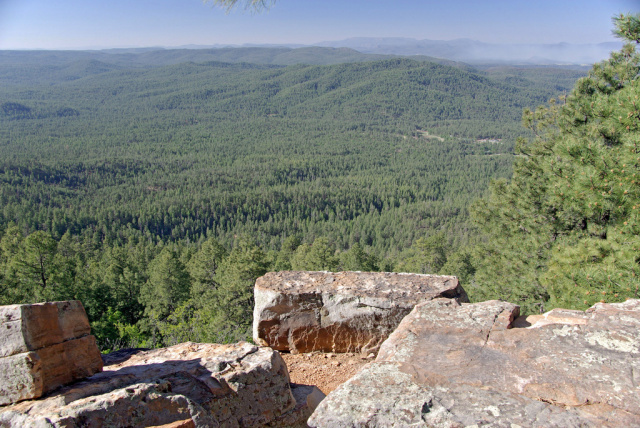
If you go to the ‘About‘ page of their website, you will see this beautiful photograph.
It’s a view from the Mogollon Rim Trail that would inspire anyone to want to care for our planet. The trail passes close to Payson and is a very popular walking area.
Back to TTP. If you go to their website and start browsing the articles and seeing what information is already there, you get a clear idea of what a group of people can do. That key word ‘DO‘!
Last Thursday, I offered a reflection on Learning from Dogs about what feels like a new world order. The penultimate paragraph offered this:
I sense that we, as in the peoples on this planet, are well into a period of such change that even by the end of 2013, a little over 50 weeks away, the precipice for humanity will be within sight. I hold out zero hope that any time soon our leaders and politicians will stop ‘playing games’ and focus on doing what’s right. The time for truth, for integrity, for sound debate is NOW!
However, all the truth, integrity and debate in the world comes to nothing without ACTION.
That pesky ‘law’ regarding the power of unintended consequences.
As many of you are aware, last week was an unusual format for Learning from Dogs in that the whole of the week was dedicated to republishing Dr. Samuel Alexander’s essay The Sufficiency Economy – Envisioning a Prosperous Way Down. If you missed that, the first chapter was a week ago today under the title of Where less is so much more.
Moving on. Many living in Northern California and South-West Oregon will have had a timely reminder that nature is tapping mankind on the shoulder in new and challenging ways. I’m referring to the massive storm that was featured in a recent Climate Crocks article that delivered over a foot of rainfall in recent days. Here in Southern Oregon we received over 10 inches! Hence the growing awareness that we have to do something!
So with those musings in mind, read the following essay written by Gail Tverberg of the website Our Finite World. Gail describes herself, thus:
I am an actuary interested in finite world issues – oil depletion, natural gas depletion, water shortages, and climate change. The financial system is also likely to be affected.
I’m very grateful to Gail for so promptly giving me written permission to republish her work. It is very relevant to all of us.
World leaders seem to have their minds made up regarding what will fix world CO2 emissions problems. Their list includes taxes on gasoline consumption, more general carbon taxes, cap and trade programs, increased efficiency in automobiles, greater focus on renewables, and more natural gas usage.
Unfortunately, we live in a world economy with constrained oil supply. Because of this, the chosen approaches have a tendency to backfire if some countries adopt them, and others do not. But even if everyone adopts them, it is not at all clear that they will provide the promised benefits.
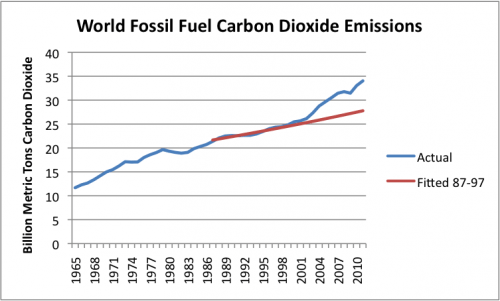
Figure 1. Actual world carbon dioxide emissions from fossil fuels, as shown in BP’s 2012 Statistical Review of World Energy. Fitted line is expected trend in emissions, based on actual trend in emissions from 1987-1997, equal to about 1.0% per year.
The Kyoto Protocol was adopted in 1997. If emissions had risen at the average rate that they did during the 1987 to 1997 period (about 1% per year), emissions in 2011 would be 18% lower than they actually were. While there were many other things going on at the same time, the much higher rise in emissions in recent years is not an encouraging sign.
The standard fixes don’t work for several reasons:
1. In an oil-supply constrained world, if a few countries reduce their oil consumption, the big impact is to leave more oil for the countries that don’t. Oil price may drop a tiny amount, but on a world-wide basis, pretty much the same amount of oil will be extracted, and nearly all of it will be consumed.
2. Unless there is a high tax on imported products made with fossil fuels, the big impact of a carbon tax is to send manufacturing to countries without a carbon tax, such as China and India. These countries are likely to use a far higher proportion of coal in their manufacturing than OECD countries would, and this change will tend to increase world CO2 emissions. Such a change will also tend to raise the standard of living of citizens in the countries adding manufacturing, further raising emissions. This change will also tend to reduce the number of jobs available in OECD countries.
3. The only time when increasing natural gas usage will actually reduce carbon dioxide emissions is if it replaces coal consumption. Otherwise it adds to carbon emissions, but at a lower rate than other fossil fuels, relative to the energy provided.
4. Substitutes for oil, including renewable fuels, are ways of increasing consumption of coal and natural gas over what they would be in the absence of renewable fuels, because they act as add-ons to world oil supply, rather than as true substitutes for oil. Even in cases where they are theoretically more efficient, they still tend to raise carbon emissions in absolute terms, by raising the production of coal and natural gas needed to produce them.
5. Even using more biomass as fuel does not appear to be a solution. Recent work by noted scientists suggests that ramping up the use of biomass runs the risk of pushing the world past a climate change tipping point.
It is really unfortunate that the standard fixes work the way they do, because many of the proposed fixes do have good points. For example, if oil supply is limited, available oil can be shared far more equitably if people drive small fuel-efficient vehicles. The balance sheet of an oil importing nation looks better if citizens of that nation conserve oil. But we are kidding ourselves if we think these fixes will actually do much to solve the world’s CO2 emissions problem.
If we really want to reduce world CO2 emissions, we need to look at reducing world population, reducing world trade, and making more “essential” goods and services locally. It is doubtful that many countries will volunteer to use these approaches, however. It seems likely that Nature will ultimately provide its own solution, perhaps working through high oil prices and weaknesses in the world financial system.
Elastic Versus Inelastic Supply
It seems to me that many bad decisions have been made because many economists have missed the point that crude oil supply tends to be very inelastic, while other fuels are fairly elastic. Let me explain.
Elastic supply is the usual situation for most goods. Plenty of the product is available, if the price is high enough. If there is a shortage, prices rise, and in not too long a time, the market is well-supplied again. If supply is elastic, if you or I use less of it, ultimately less of the product is produced.
Coal and natural gas usually are considered to be elastic in their supply. To some extent, they are still “extract it as you need it” products. Supply of natural gas liquids (often grouped with crude oil, but acting more like a gas, so it is less suitable as a transportation fuel) is also fairly elastic.
Crude oil is the one product that is in quite short supply, on a world-wide basis. Its supply doesn’t seem to increase by more than a tiny percentage, no matter how high the price rises. This is a situation of inelastic supply.
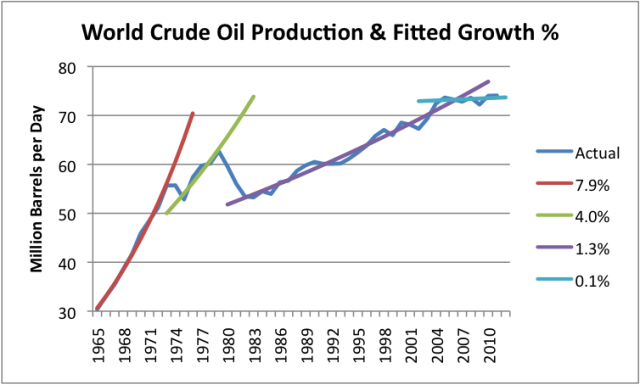
Figure 2. World crude oil production (including condensate) based primarily on US Energy Information Administration data, with trend lines fitted by the author.
Even though oil prices have been very high since 2005 (shown in Figure 3, below), the amount of crude oil has increased by only 0.1% per year (Figure 2, above).
Figure 3. Historical average annual oil prices, (“Brent” or equivalent) in 2011$, from BP’s 2012 Statistical Review of World Energy.
In the case of oil, both supply and demand are quite inelastic. No matter how high the price, demand for oil doesn’t drop back by much. No matter how high the price of oil, world supply doesn’t rise very much, either.1
In a situation of inelastic supply, the usual actions a person might take appear to work when viewed on a local basis, but backfire on a world basis, if not everyone participates. When one country tries to conserve crude oil (whether through a carbon tax, gasoline tax, or higher automobile mileage requirement), it may reduce its own consumption, but there are still plenty of other buyers in the market for the oil that was saved. So the oil gets used by someone else, perhaps at a slightly lower price. World oil production remains virtually unchanged. Thus, a reduction in oil usage by an OECD country can translate to more oil consumption by China or India, and ultimately more development of all types by those countries.
Adding Substitutes Adds to Carbon Emissions
If we don’t have enough crude oil, one approach is to create substitutes. Because crude oil supply is inelastic, though, these substitutes aren’t really substitutes, though. They are “add ons” to world oil supply, and this is one source of our problem with increasing world emissions.
What do we use to make the substitutes? Basically, natural gas and coal, and to a limited extent oil (because we can’t avoid using oil). The catch is, that to make the substitutes, we need to burn natural gas and coal more quickly than we would, if we didn’t make the oil substitutes. Since the supply of coal and natural gas is elastic, it is possible to pull them out of the ground more quickly. Thus, making the substitutes tends to increase carbon dioxide emissions over what they would have been, if we had never come up with the idea of substitutes.
The increased use of coal and natural gas is pretty clear, if a person thinks about coal-to-liquids or gas-to-liquids. Here, we need to first build the plants used in production, and then with each barrel of substitute made, we need to use more natural gas or coal. So it is very clear that we are extracting a lot of additional coal and natural gas, to make a relatively smaller amount of oil substitute. There is often a substantial need for water to make the process work as well, adding another stress on the system.
But the same issue comes up with biofuels, and with other renewables. These too, are add-ons to the world oil supply, not substitutes. While theoretically they might produce energy with less CO2 per unit than fossil fuel systems, in absolute terms they lead to natural gas and coal being pulled out of the ground more quickly to be used in making fertilizer, electricity, concrete, and other inputs to renewables.2
Carbon Taxes and Competitiveness
Each country competes with others in the world market place. Adding a carbon tax makes products made by the local company less competitive in the world marketplace. It also signals to potential coal users that the countries adopting the carbon taxes are willing to a leave a greater proportion of world coal exports to those who are not adopting the tax, thus helping to keep the cost of imported coal down.
Asian countries already have a competitive edge over OECD countries in terms of lower wages and lower fuel costs (because of their heavy coal mix), when it comes to manufacturing. Adding a carbon tax tends to add to the Asian competitive edge. This tends to shift production offshore, and with it, jobs.
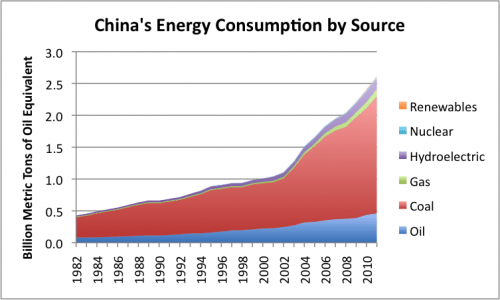
Figure 4. China’s energy consumption by source, based on BP’s Statistical Review of World Energy data.
China joined the World Trade Organization in 2001. Figure 4 shows clearly that its fuel consumption ramped up rapidly thereafter. It seems likely that the number of Chinese manufacturing jobs and spending on Chinese infrastructure increased at the same time.
Economists seem to have missed the serious worldwide deterioration in CO2 emissions in recent years by looking primarily at individual country indications, including CO2 emissions per unit of GDP. Unfortunately, this narrow view misses the big picture–that total CO2 emissions are rising, and that CO2 emissions relative to world GDP have stopped falling. (See my posts Is it really possible to decouple GDP growth from energy growth and Thoughts on why energy use and CO2 emissions are rising as fast as GDP. See also Figure 1 at the top of the post.)
Figure 5. Employment is the total number employed at non-farm labor as reported by the US Census Bureau. Energy consumption is the total amount of energy of all types consumed (oil, coal, natural gas, nuclear, wind, etc.), in British Thermal Units (Btu), as reported by the US Energy Information Administration.
There are several reasons why a connection between energy consumption and the number of jobs is to be expected:
(1) The job itself in almost every situation requires energy, even if it is only electricity to operate computers, and fuel to heat and light buildings.
(2) Equally importantly, the salaries that employees earn allow them to buy goods that require the use of energy, such as a car or house. (“Energy demand” is what people canafford; jobs allow “demand” to rise.)
(3) The lowest salaried people can be expected to spend the highest proportion of their salaries on energy-related services (such as food and gasoline for commuting). The wealthy spend their money on high priced goods and services, such as financial planning services and designer clothing that require much less energy per dollar of expenditure.
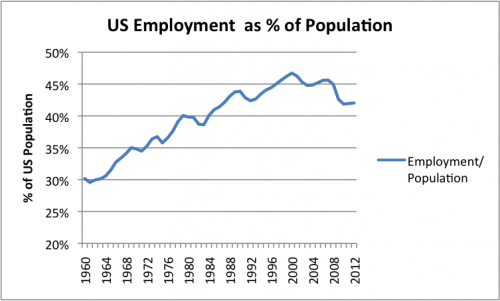
The thing I find concerning is the close timing between the ramp-up of Asian coal use and thus jobs using coal, and the drop-off of US employment as a percentage of US population, as illustrated in Figure 6 below. Arguably, the ramp up in world trade is just as important, but some aspects of programs that are intended to save CO2 emissions also seem to encourage world trade.
Figure 6. US Number Employed / Population, where US Number Employed is Total Non_Farm Workers from Current Employment Statistics of the Bureau of Labor Statistics and Population is US Resident Population from the US Census. 2012 is partial year estimate.
Of course, the US did not sign the Kyoto Protocol or enact a carbon tax, and it is its jobs that I show falling as a percentage of population. It is more that the CO2 solutions act as yet another way to encourage more international trade, and with it more “growth”, and more CO2.
Using More Biomass is Not a Fix Either
Burning more wood for fuel and creating “second generation” biofuels from biomass seems like a fix, until a person realizes that we are reaching limits there, as well.
In June 2012, twenty noted scientist published a paper in the journal Nature called Approaching a State Shift in the Earth’s Biosphere. This report indicates that humans have already converted as much as 43% of Earth’s land to urban or agricultural uses. In total, 20% to 40% of Earth’s primary productivity has been taken over by humans. The authors are concerned that we may now be reaching a tipping point leading to a state shift, because of loss of ecosystem services as use of biological products increases. With this state change would come a change in climate. Simulations indicate that this tipping point may occur when as little as 50% of land use is disturbed. This tipping point may be even lower, if world-wide synergies take place.
On Our Current Path – Lacking Good Solutions
While this list of problems relating to current proposed solutions is not complete, it gives a hint of the problems with reducing CO2 emissions using approaches suggested to date. There are many issues I have not covered.
While the problems noted in these articles are probably solvable, the cost of these solutions has not been built into energy balance analyses. Energy balances (or EROEI estimates) as currently reported do not vary with the proportion of intermittent renewables added to the grid. If energy balance analyses were adjusted to reflect the high cost of adding an increasing proportion of wind or solar PV to the grid, they would likely show a rapidly declining energy balance, above a certain threshold. This would indicate that while adding a little intermittent renewables (as we have done to date) can be a partial solution, adding a lot is likely to have serious cost and energy balance issues.
Another issue that is difficult to deal with is the fact that we are not dealing with a temporary problem with CO2 emissions. The idea is not to slow down the burning of fossil fuels, and burn more later; what we really need to do is to leave unburned fossil fuels in the ground for all time. This is a problem, because there is no way that we can impose our will on people living 10 or 50 years from now. The Maximum Power Principle of H. T. Odum would seem to indicate that any species will make use of whatever energy sources are available to it, to the extent that it can. Even if we temporarily defeat this tendency with respect to humans’ use of fossil fuels, I don’t see any way that we can defeat this tendency for the long term.
Considering all of these issues, it does not appear that most of the “standard” solutions will really work.3 What other options do we have?
Nature’s Solution
The Earth has been handling the problem of shifting conditions for over 4 billion years. The earth is a finite system. Nature provides that finite systems, such as the Earth, will cycle to new states of equilibrium over time, as conditions change. While we would like to defeat Earth’s tendency in this regard, it is not at all clear that we can. Part of this cycling to a new state is likely to be a change in climate.
A state change is a cause for concern to humans, but not necessarily to the Earth itself. The Earth has moved from state to state many times in its existence, and will continue to do so in the future. The changes will bring the Earth back into a new equilibrium. For example, if CO2 levels are high, species that can make use of higher CO2 levels (such as plants) are likely to become dominant, rather than humans.
Exactly how this state change might occur is subject to different views. One view is that changing CO2 levels will be a primary driver. The Nature article referenced previously suggested that increased disturbance of natural ecosystems (as with greater use of biomass) might force a state change. My personal view is that a financial collapse related to high oil price may be part of Nature’s approach to moving to a new state. It could bring about a reduction in world trade, a scale back in CO2 emissions, and a general contraction of human systems.4
However the change takes place, it could be abrupt. It will not be to many people’s liking, since most will not be prepared for it.
Steps That Might Work to Slow CO2 Emissions
It would be convenient if we could slow CO2 emissions by working to produce energy with less CO2. This option does not seem to be working well though, so I would argue that we need to work in a different direction: toward reducing humans’ need for external energy. In order to do this, I would suggest two major steps:
(1) Reduce the world’s population, through one-child policies and universal access to family planning services. This step is necessary because rising population adds to demand. If we are to reduce demand, lower population needs to play a role.
(2) Change our emphasis to producing essential goods locally, rather than outsourcing them to parts of the world that are likely use coal to produce them. I would suggest starting with food, water, and clothing, and the supply chains necessary to produce these items.
Changing our emphasis to producing essential goods locally will have a multiple benefits. It will (a) add local jobs, and (b) lead to less worldwide growth in coal usage, (c) save on transport fuel, and (d) add protection against the adverse impact of declining world oil supply, if this should happen in the not too distant future. It should also help reduce CO2 emissions. The costs of goods will likely be higher using this approach, leading to less “stuff” per person, but this, too, is part of reaching reduced CO2 emissions.
It is hard to see that the steps outlined above would be acceptable to world leaders or to the majority of world population. Thus, I am afraid we will end up falling back on Nature’s plan, discussed above.
Notes:
[1] Michael Kumhof and Dirk Muir recently prepared a model of oil supply and demand (IMF working paper: Oil and the World Economy: Some Possible Futures). In it, they assume a long run price-elasticity of oil supply of 0.03, and remark that a paper by Benes and others indicates a range of 0.005 to 0.02 for this variable. The long term price elasticity of oil demand is assumed to be .08 in the Kumhof and Muir analysis.
[2] I would argue that standard EROEI measurements are defined too narrowly to give a true measure of the amount of energy used in making a particular substitute. For example, EROEI measures do not consider the energy costs associated with labor (even though workers spend their salaries on clothing, and commuting costs, and many other good and services that use fossil fuels), or with financing costs, or of indirect impacts like wear and tear on the roads by transporting corn for biofuel.
Other types of analysis have ways of dealing with this known shortfall. For example, when the number of jobs that a new employer can be expected to add to a community is evaluated, the usual approach seems to be to take the number of jobs that can be directly counted and multiply by three, to estimate the full impact. I would argue that with substitutes, some similar adjustment is needed. This adjustment which would act to increase the energy use associated with renewables, and reduce the EROEI. For example, the adjustment might divide directly calculated EROEI by three.
A calculation of the true net benefit of renewables also needs to recognize that nearly the full energy cost is paid up front, and only over time is recovered in energy production. When renewable production is growing rapidly, society tends to be in a long-term deficit position. Typically, it is only as growth slows that society reaches as net-positive energy position.
[3] I obviously have not covered all potential solutions. Nuclear power is sometimes mentioned, as is space solar power. There are new solutions being proposed regularly. Even if these solutions would work, ramping them up would take time and require use of fossil fuels, so it is wise to consider other options as well.
[4] The way that limited oil supply could interfere with world trade is as follows: High oil prices cause consumers to cut back on discretionary goods. This leads to layoffs in discretionary sectors of the economy, such as vacation travel. It also leads to secondary effects, such as debt defaults and lower housing prices. The financial effects “concentrate up” to governments of oil importing nations, because they receive less tax revenue from laid-off workers at the same time that they pay out more in unemployment benefits, stimulus, and bank bailouts. (We are already at this point.)
Eventually, countries will find that deficit spending is spiraling out of control. If countries raise taxes and cut benefits, this is likely to lead to more lay offs and debt defaults. One possible outcome is that citizens will become increasingly unhappy, and replace governments with new governments that repudiate old debt. The new governments may have difficulty establishing financial relationships with other governments, given that most are major debt defaulters. Such issues could reduce world trade substantially. With the drop of world trade would come much more limited ability to maintain our current systems, such as electricity and long distance transport.
oooOOOooo
Reminds me of that old saying, “The best laid plans of mice and men …” Or as Robbie Burns wrote in 1785,
But Mousie, thou art no thy lane,
In proving foresight may be vain:
The best-laid schemes o’ mice an’ men
Gang aft agley,
An’ lea’e us nought but grief an’ pain,
For promis’d joy!
World leaders seem to have their minds made up regarding what will fix world CO2 emissions problems. Their list includes taxes on gasoline consumption, more general carbon taxes, cap and trade programs, increased efficiency in automobiles, greater focus on renewables, and more natural gas usage.
Unfortunately, we live in a world economy with constrained oil supply. Because of this, the chosen approaches have a tendency to backfire if some countries fail to adopt them. But even if everyone adopted them, it is not at all clear that they would provide the promised benefits.
The Kyoto Protocol was adopted in 1997. If emissions had risen at the average rate that they did during the 1987 to 1997 period (about 1% per year), emissions in 2011 would be 18% lower than they actually were. While there were many other things going on at the same time, the much higher rise in emissions in recent years is not an encouraging sign.
The standard fixes don’t work for several reasons ….
Not going any further because the author, Gail Tverberg has given me permission to reproduce her article and I shall be doing that next Monday. If you can’t wait until then the article may be read on Gail’s website.
So yesterday, Dr. Alexander set out a series of aspects that showed just how challenging is the present global predicament. The fundamental argument being that growth is now utterly inappropriate for where mankind now is at the end of 2012. Part three of the essay examines how, whether we like it or not, change is on its way.
oooOOOooo
THE SUFFICIENCY ECONOMY ENVISIONING A PROSPEROUS WAY DOWN Samuel Alexander
Simplicity Institute Report 12s, 2012
Dr Samuel Alexander is co-director of the Simplicity Institute and a lecturer with the Office for Environmental Programs, University of Melbourne.
3. Embracing Life After Growth (Before it Embraces Us)
Earlier I mentioned that eventually we are likely to have a sufficiency economy whether we choose it or not. It should now be clearer why this is so. The growth paradigm has reached, more or less, the ‘limits to growth,’ and this means that we must move away from growth-based economies if we are to avoid exacerbating existing ecological crises to the point of catastrophe. Billions of lives are at stake, as are the biodiversity and climatic balance of our planet. But even if we do not choose to give up on growth, energy and resource constraints are in the process of bringing growth to an end all the same, and no amount of ‘quantitative easing’ or technological advances are going to provide an escape from this biophysical reality. When, in the foreseeable future, the world reaches the ‘end of growth,’ we will have a form of ‘sufficiency economy’ imposed upon us, in the sense at least that we will have to make do, as best we can, without further growth. This may well imply radically reduced consumption, compared to levels prevalent in consumer societies today, because when growth-based economies do not grow, debts cannot be repaid, and economic contraction, not merely stagnation, tends to ensue. If this situation is not well managed – for example, if we persist blindly with expectations of limitless growth and continue to structure our economies accordingly – then this phase in history is probably going to mark the beginning of civilisational collapse, although it is impossible to be sure whether this would be a rapid breakdown of the existing order (Korowics, 2012) or a slow deterioration over many decades (Greer, 2008).
Nevertheless, the fact that there are biophysical limits to growth from which we cannot escape sometimes obscures the fact that living within those limits is something that we should want to do, simply to be good stewards of Earth. It is obviously in our self-interest to preserve the life-support systems upon which all life depends, a point that is too often overlooked. Furthermore, the social and psychological evidence noted immediately above implies that ‘the good life’ does not actually consist in the consumption of material things, contrary to the promises of advertisements, and this means that denying ourselves consumer lifestyles need not be considered a hardship, as the ‘voluntary simplicity’ movement, for example, already understands (Alexander and Ussher, 2012). Certainly, consumer culture must not be accepted as the peak of civilisation. We must explore alternative ways to flourish without relying on material abundance, and I will argue that embracing a sufficiency economy is one means of doing so, and probably a necessary means. I will now briefly elaborate on some of the values underlying the sufficiency economy then proceed to unpack their practical implications in some detail.
3.1. The Principle of Sufficiency – ‘Enough, for Everyone, Forever’
The fundamental aim of a sufficiency economy, as I define it, is to create an economy that provides ‘enough, for everyone, forever.’ In other words, economies should seek to universalise a material standard of living that is sufficient for a good life but which is ecologically sustainable into the deep future. Once that is achieved, further growth in material wealth would not be an economic priority. As noted above, for individuals and economies that are already overconsuming, the attainment of sufficiency implies not merely resisting further growth, but first entering a phase of planned economic contraction. Once sustainable sufficiency has been attained, prosperity should be sought in various low-impact, non-materialistic forms of well being, such as enjoying social relationships, experiencing connection with nature, engaging in meaningful work or spiritual practice, or exploring various forms of peaceful, creative activity. There are no limits to the scale or diversity of qualitative improvement of life in a sufficiency economy, but to achieve sustainability in a world of seven billion people (and counting), material standards of living must not aim for consumer affluence but only for what is minimally sufficient for a good life. The basic economic reasoning here is that once basic material needs are met, human beings are not so strictly bound by materialistic concerns and are thus free to dedicate more of their energy and attention to things other than increasing material living standards. ‘As wealth increases,’ John Hicks (1959: xiii) once wrote, ‘wealth itself becomes (or should become) less important,’ a dynamic that Hicks mischievously called ‘the diminishing marginal significance of economics.’
These broad comments obviously require (and will receive below) more concrete expression, but they nevertheless provide a normative starting point that contrasts sharply with the materialistic ‘more is better’ ethos underpinning existing growth economies. The sufficiency economy is based on an alternative economic perspective that accepts that ‘just enough is plenty,’ and this alternative perspective implies that producing more than is sufficient is not required for an individual or society to flourish. In the words of Henry Thoreau (1982: 568): ‘Superfluous wealth can buy superfluities only.’ Furthermore, we have already seen that the growth paradigm has produced high-impact economic systems that are grossly unsustainable and certainly not universalisable, so the sufficiency economy treats consumer lifestyles, and the growth economies that are required to support them, as neither desirable nor sustainable.
Determining exactly what level of material provision is ‘sufficient’ cannot be defined with any analytical precision, and will always be context and culturally specific (Sen, 1998). But material sufficiency can be broadly understood to include meeting basic biophysical needs for food and water, shelter, and clothing, as well as having access to basic medical services and some minimal level of social education. Access to extra energy supplies for heating will also be required in certain climates, and since energy is required to sustain any level of social complexity, some indeterminate level of energy supply, beyond food, fire, and labour, should also be considered a basic requirement for a full, human life. (Only those anarcho-primitivists, I presume, who think hunter-gathering is the only acceptable form of social organisation, would object to there being a basic need for energy beyond food, fire, and labour.) Sustainability may not necessarily mean living like the Amish – I am sure people will creatively salvage the wastes of industrial civilisation to live in ways that lie beyond the Amish lifestyles for some time. But using the Amish as a rough touchstone or benchmark may not be so far from the truth. At least this evokes a serious image of what low-consumption ‘simple living’ could look like in an energy descent context, a scenario that is entirely absent from mainstream sustainability discourse (perhaps because such simplicity of life is politically unpalatable). The most important point to understand is that nothing much resembling consumer lifestyles today are sustainable or universalisable.
Although these comments on sufficiency remain highly indeterminate – especially with respect to the amount of energy required – my position is that the concept of sufficiency is so important to sustainability discourse that its indeterminacy must not be a reason to reject it. I contend that universal sufficiency, like justice, is a fuzzy goal towards which humanity should be moving, and the most important thing is that there is a debate over the meaning of sufficiency and an attempt to practice our theory as best we can (Princen, 2005). Currently, in the developed nations, at least, sufficiency does not enter our economic or political vocabulary, which is why so few are asking the question, ‘How much is enough?’, and why fewer still are trying to answer it.
In an age that has done so much to link ‘the good life’ with material abundance, some will think the pursuit of sufficiency means giving up happy and fulfilling lives, but such an objection is based on a particular conception of human beings that the sufficiency perspective I am outlining rejects (Alexander, 2012d). If it were true that happiness and fulfilment consisted in the consumption and accumulation of ever more material things, then, admittedly, a sufficiency economy would seem to be inconsistent with ‘the good life.’ But that is far too narrow a conception of the good life and it is based on a misunderstanding of human beings. It may be that affluence can produce well being, but that does not prove that well being depends on affluence. Indeed, the conception of human beings upon which the sufficiency economy is based is one in which there are an infinite variety of fulfilling lives that can be lived while consuming no more than an equitable share of nature. Put more directly, the sufficiency economy is based on the premise that ‘a simple life’ can be ‘a good life,’ a truth that is obscured only to those who have not sufficiently explored their imaginations. Since consumerist conceptions of ‘the good life’ are causing devastating social and ecological problems, it follows that our economies should promote conceptions of the good life based on far lower resource and energy consumption, and that is the defining characteristic of the sufficiency economy.
3.2. The Macro-Economic and Lifestyle Implications of Energy Descent
The necessity of highly reduced energy consumption is perhaps the critical issue (Odum and Odum, 2001). Such a reduction will arise whether it is enforced by declining oil supplies or voluntarily embraced as a response to climate change. However, even the most progressive ecological economists who argue for decarbonising the economy do not seem to realise quite how revolutionary this proposal is – which is not to say the proposal is misconceived (Hansen et al, 2008), only that its economic implications may be misunderstood. If the global economy managed to wean itself off fossil fuels over the next few decades in response to climate change, then a ‘steady state’ economy would be impossible, if a steady state is meant to imply maintaining anything like existing levels of affluence. It would be impossible because fossil fuels currently make up around 80% of global energy supply (IEA, 2010b: 6), and given the close relationship between energy and economics, nothing like existing production or distribution could be maintained when we are talking about that level of energy reduction. Without fossil fuels, the world just would not have the energy supply to maintain a steady state of economic output; the economy would have to contract significantly. This is not a consequence many people seem to understand or dare to acknowledge, but it is a reality that we must not shy away from if a post-carbon world is indeed what we seek.
The implications of drastically reduced energy consumption primarily means two things for economies. First, it means significantly reduced production and consumption, commensurate with the available energy supply. In order to meet basic needs for all, this will require much more efficient use of energy and a radical reassessment of how best to use what limited energy is available (Alexander 2012b). Secondly, energy descent will mean an inevitable transition to highly localised forms of economic activity, for the reason that trade over large distances would be simply too energy-intensive and costly to afford, especially in an era of stagnating or declining oil supplies and rising prices (Rubin, 2009).
In short, a sufficiency economy is an economy that has low energy and resource requirements (relative to developed economies) but which sufficiently provides for mostly local needs using mostly local resources. These defining features of a sufficiency economy may receive some vague support in certain areas of the ‘deep green’ literature on sustainability, but to date almost no attention has been given to describing in any detail what economic life would be like if such an economy were ever to arise (but see Morris, 2004; Trainer, 2010; Burch, 2012a). Accordingly, the remainder of this essay is dedicated to providing some of those details, in the hope of advancing the debate on what real sustainability actually means for daily life. Until we have some clearer vision of the alternative society, it is very difficult to work effectively and prosperously toward its realisation.
(The full set of references will be included in the concluding Part Five to be published on Friday.)
Part Four – Envisioning a Prosperous Way Down will be published on Learning from Dogs tomorrow.
Southwest forests are already in the early stages of a mega drought brought on by climate change.
Southwest forests are already in the early stages of a mega drought brought on by climate change that will result in massive tree die-offs and sweeping changes in Rim Country forests, according to an analysis published in the scientific journal Climate Change.
Severe drought will dominate much of this century, creating stresses on forests not seen for more than 1,000 years, according to the research that used tree ring samples from 13,000 trees, historical rainfall records and computer projections of future climate change.
The shifts will likely dramatically shrink the world’s largest ponderosa pine forest in northern Arizona, replacing pines with junipers at elevations like Payson and replacing junipers with chaparral and cactus at lower elevations.
The article concludes,
Unfortunately, the team’s climate prediction models suggest that within the next 40 years the region will fall deep into mega drought conditions. The models predict that even the wettest, coolest years in the late 21st century will exceed mega drought levels. In that case, the drought conditions of the past decade will prove the new normal rather than a bad stretch.
Williams noted that while winters in the past decade haven’t been exceptionally dry, summer temperatures have soared. As a result, the stress on the trees in the past 13 years has exceeded mega drought levels about 30 percent of the time — conditions not matched for the previous 1,000 years.
One of the clean little secrets about dealing with climate change, is that if we make our cities more efficient, and reduce their carbon footprint, we will also make them more resilient, quieter, more comfortable, more human scaled, more inviting, and more fun.
As global temperatures rise, urban areas are facing challenges in keeping their infrastructure and their residents cool. Chicago is tackling that problem with a green design makeover. This report is part of our Coping with Climate Change series.
I started writing this post back on the 25th September. Why so far back? Because that day something came into my in-box that deserved the widest circulation. It’s an event being held just under a month from today, November 14th. But it seemed worthwhile to give this amount of notice. However, the reason why I wanted to start it back in September was because in the last 24 hours of that day, the 25th, the UK offered very good evidence of the significant increase in severe weather.
From the UK’s Met Office blog on the 25th September, 2012, (I have included the inches equivalent of the mm figures)
Rainfall figures: over a month’s worth of rain in two days
Rainfall totals for the past few days – from 1:00 am Sunday morning to 8:00 am this morning [Tuesday] – show some areas have already had more than twice their usual September rainfall. Ravensworth, in North Yorkshire, has seen the highest total, with 107.8 mm [4.24 in] falling, over 200 % of its average September rainfall.
The rainfall has been widespread, with many areas across the United Kingdom receiving large totals. Killylane, in Antrim Northern Ireland saw 98.2 mm [3.87 in], and high totals were also recorded in the south-west, with 72.4 mm [2.85 in] in Filton and 65.2 mm [2.57 in] at Dunkeswell Aerodrome.
Dunkeswell Aerodrome in Devon was where I used to fly our group-owned Piper Super Cub, still in military markings.
Piper Super Cub at Dunkeswell AerodromeA carriage made for two!
Anyway, back to the plot!
Also on that day (September 25th) the website Think Progress released this item,
Markey/Waxman Report: Carbon Pollution Creating A ‘Cocktail Of Heat And Extreme Weather’
By Climate Guest Blogger and Stephen Lacey on Sep 25, 2012 at 3:31 pm
by Katie Valentine and Stephen Lacey
Two House Democrats have released a report that aims to connect the dots on climate change and extreme weather events.
The staff report, issued by Henry Waxman (D-Calif.) and Edward Markey (D-Mass.), outlines the past year’s record-setting temperatures, storms, droughts, water levels and wildfires, and is being circulated in an attempt to rebuild congressional momentum to address climate change.
“The evidence is overwhelming — climate change is occurring and it is occurring now,” said Rep. Waxman, a Ranking Member of the Energy and Commerce Committee, in a statement.
The report outlines the stunning array of record-breaking extreme weather events throughout 2012 within five categories:
Extreme temperatures
July was the hottest month ever recorded in the continental U.S. Some areas were 8 degrees warmer than average, with the average temperature in the lower 48 states at 77.6 degrees Fahrenheit, 3.3 degrees above the 20th century average.
Spring 2012 saw the warmest March, third-warmest April and second-warmest May in history, and was approximately 5.2 degrees Fahrenheit above average overall.
Through late June 2011, daily record highs were outnumbering daily record lows by 9-to-1.
Drought
As of September, 64 percent of the continental U.S. is experiencing drought, with August and September 2012 comparable to the worst months of the 1930s Dust Bowl.
By the beginning of August, more than half the counties in the U.S. had been designated disaster zones because of drought.
As of August, 51 percent of corn and 38 percent of soybeans grown in the U.S. were rated as poor or very poor by the U.S. Department of Agriculture. Some states’ corn fared worse – Indiana had 70 percent of its corn rated as poor or very poor, and Missouri had 84 percent.
Wildfires
This fire season 8.6 million acres – roughly the size of Connecticut and New Jersey combined – have burned in the U.S., with fires still burning in parts of the West.
Wildfires in Colorado have killed six people, destroyed 600 homes and caused about $500 million in property damage.
There has been nearly a four-fold increase in large wildfires in the West in recent decades, with fires burning longer and more intensely and wildfire seasons lasting longer.
Storms
Tropical Storm Debby caused Florida to have its wettest June on record. The storm killed at least seven people and also damaged more than 7,500 homes and businesses.
In July, the “derecho” storm system killed at least 23 people and left more than 3.7 million people without power.
In August, Hurricane Isaac caused storm surges of up to 15 feet in some places and contributed to Louisiana and Mississippi experiencing their second-wettest August on record and to Florida experiencing its wettest summer on record.
Extreme water levels and water temperatures
In July, water in the Great Lakes reached temperatures of 60 and 65 degrees Fahrenheit – more than 10 degrees warmer than the same time last year.
In August, water temperatures of up to 97 degrees and low water levels caused tens of thousands of fish to die in Midwestern lakes and rivers.
Low water levels in the Mississippi watershed have caused some barge companies to reduce their loads by 25 percent and have caused harbor closures in Tennessee, Missouri, Arkansas and Mississippi.
According to the report, 2012 natural disasters (not including wildfires or drought) have caused $22 billion in insured losses and more than 220 deaths as of August. The full cost of 2012’s extreme weather events isn’t yet known, but it’s expected to rival 2011’s record-breaking $55 billion.
The document outlines what scientists following the link between extreme weather and climate change have been saying for years: more carbon pollution adds extra energy in the atmosphere, thus warming the planet and making extreme weather events more likely.
We’ll move between our home studio in New York City and into each region of the world, bringing voices, news and multimedia content across all 24 time zones. We’ll feature videos from around the globe, man-on-the-street reports, music, and most importantly, stories from communities moving forward with solutions.
Most of all, we’ll generate new energy and urgency around the fact that we must — and we can — work together to address the climate crisis.
GET INVOLVED
Sign up today to be a part of the global community taking part in 24 Hours of Reality. RSVP on Facebook. Share this event with your friends. Submit your own videoabout the impacts of climate change where you live. And keep checking this page: We’ll post further details as the event draws closer.
Millions of people around the world know that the weather, their climate is changing. But if you can take some more powerful evidence of just how it’s all changing then go and read a recent report on the Grist website, entitled ‘Deadly connection: New report on extreme weather and climate change’
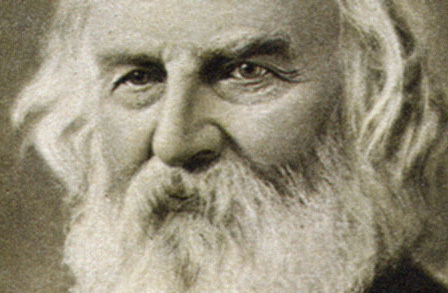
“Lives of great men all remind us, we can make our lives sublime, and, departing, leave behind us, footprints on the sands of time.” Longfellow.
Longfellow, the only American writer honored in the Poets’ Corner of Westminster Abbey.
Longfellow has been dead for 130 years, as of last March, but of his many wonderful words that have stayed with us over the last century and more, these must be some of the more familiar. (Or am I showing my appalling lack of literary knowledge?)
Following on from yesterday’s post about the scary mathematics of climate change, this really is the ONE thing that we have to learn from dogs; from nature. If we don’t live in harmony with our planet pretty damn soon, then this particular civilisation is not far from extinction. Let me remind you of a key paragraph from yesterday,
It’s simple math: we can burn 565 more gigatons of carbon and stay below 2°C of warming — anything more than that risks catastrophe for life on earth. The only problem? Fossil fuel corporations now have 2,795 gigatons in their reserves, five times the safe amount. And they’re planning to burn it all — unless we rise up to stop them.
Ergo, we do not have endless time available to us!
Otherwise the footprints left on those sands of time will be nothing more than the next civilisation pondering from time to time why those Atlantacists that sunk beneath the waves were unable to do anything to save their world!
If you think I’m being a tad excitable, then see what Rob Hopkins wrote recently over at Transition Culture.
New Economics Foundation’s ’100 Months’ campaign today reaches its midway point. It was launched in August 2008 based on the understanding that the time that remains to us to avoid the likelihood of runaway climate change is limited, and based on the science at the time, there was a closing window of opportunity to do something meaningful about it.
Then adding,
“The question here is “what should we do differently?” The answer is “pretty much just about everything”. Nationally and internationally, while the scale and pace of climate change are accelerating, meaningful responses are dwindling. Part of our collective paralysis comes from the fact that we struggle to imagine a world with less energy, less consumerism, less annual GDP growth. What will it look like, sound like, feel like? Does it inevitably mean that you should start seeking out your cave on Dartmoor [Devon in South-West England, PH] as we speak, and developing a taste for slugs? Of course not.
Shortly before the 100 Months campaign began, I was part of initiating an experiment to see what a self-organised response to climate change might look like, one based on rebuilding community, on the belief that what is needed is people, everywhere, making their communities happier, healthier, lower-carbon, and more resilient, in a huge variety of ways.
Rob Hopkins was also asked to write a piece for the UK’s Guardian Newspaper in recognition that we are half-way through that 100-month campaign. Here’s how Rob concluded that piece,
Transition Bath set up an energy company which has raised £250,000 in shares from local people. Transition town Totnes’ Transition Streets programme has enabled almost 700 local householders to reduce their carbon emissions while rediscovering a sense of community on their streets. Bristol soon sees the launch of the Bristol Pound, the UK’s first citywide transition complementary currency. Transition Brixton’s Brixton Energy is installing community-owned renewables supported by local people. Check out transitionnetwork.org to get a sense of the amazing projects under way.
At its core, this is about the belief that our best way forward is for communities to build local resilience in order to be able to better face the shocks of the present and the uncertainties of the future, from economic crisis to climate change, seeing increased community resilience as economic development. It’s a process of plugging the leaks in our local economies, seeing every leak as a potential new business, new livelihood, new apprenticeship opportunity.
Of course we need government responses, and international responses, but all of those will struggle without a vibrant bottom-up movement of ordinary people showing what’s possible and how thrilled they are by those possibilities. So although the answer is “pretty much just about everything”, I would argue that seeing this as a once-in-a-lifetime opportunity for entrepreneurship, vision and action is where our successful navigation of the next 50 months lies.
I am indebted to Peter Sinclair for his permission to reproduce the graph below. It was embedded in his post on Climate Crocks on the 20th September, a post he not unreasonably called The Planetary Emergency.
As Peter wrote,
As you can see from the graphic above, the actual observations of arctic sea ice melt are far outstripping the climate model predictions of just a few years ago, that the denial-sphere continues to call “alarmist”. Apparently, not alarming enough.
The point of publishing this on Learning from Dogs is simply as an introduction to a post coming out tomorrow called Hear no evil; or is that hear no climate change?, the purpose of which is to ask a very simple question of the two gentlemen wishing to reside in the White House as President of the USA for another four years. All revealed tomorrow!
This is not the first time that I have wandered through this subject. Indeed, Learning from Dogs would never have seen the light of day if, all those years ago, Jon Lavin hadn’t raised the fascinating idea that dogs are integrous animals. As the quote says in the sidelink Purpose of Learning from Dogs;
There is nothing to fear except the persistent refusal to find out the truth, the persistent refusal to analyse the causes of happenings. Dorothy Thompson.
So what is it that has rocked my boat again? A number of things, to be honest. So much so, please forgive me for running these musings over to tomorrow!
Regular readers may have noticed that both Tuesday’s post Modelling the future and yesterday’s A study of man’s behaviours explored determining truth; frequently a fickle beast to track down! Then last Monday, I read the latest post from Climate Denial Crock of the Week that was about Sea Ice Slowing to Minimum. It was yet another reminder that embracing the truth of what is happening to our planet is vital, I mean VITAL, for anyone who has a reasonable expectation to be alive in 20 years time.
Here’s how Peter opened that post (published with Peter’s kind permission):
Not there yet, but in an interview with Dr. Jennifer Francis of Rutgers last week, the message was clear – the ice has retreated so much that at this point, we will already be experiencing the impacts of a low or no-ice arctic minimum, including “very interesting” weather in the northern hemisphere this fall and winter. Wow. I can’t wait.
Peter then included an update in that post, a reference to a report published in the Australian newspaper The Sydney Morning Herald. I requested permission to republish the SMH article but that wasn’t granted, well to be factual it was offered at a fee of $420.75 – say no more. Here is how that report from on board the Greenpeace ice-breaker Arctic Sunrise opened,
We are a few hundred miles from the north pole. The air temperature is -3C, the sea freezing. All around us in these foggy Arctic waters at the top of the world are floes – large and small chunks of sea ice that melt and freeze again with the seasons.
Arne Sorensen, our Danish ice pilot, is 18 metres up in the crow’s nest of the Arctic Sunrise vessel. Visibility is just 200 metres and he inches the 1,000-tonne Greenpeace ice-breaker forward at two knots through narrow passages of clear water.
A few paragraphs later come this:
More than 600,000 sq km more ice has melted in 2012 than ever recorded by satellites. Now the minimum extent has nearly been reached and the sea is starting to refreeze.
‘‘This is the new minimum extent of the ice cap,’’ [Sorensen] says – the frontline of climate change. ‘‘It is sad. I am not doubting this is related to emitting fossil fuels to a large extent. It’s sad to observe that we are capable of changing the planet to such a degree.’’
British, Italian and American scientists on the Arctic Sunrise say they are shocked at the speed and extent of the ice loss.
Over at the Guardian newspaper, their reporter John Vidal, also aboard the Arctic Sunrise, reports:
One of the world’s leading ice experts has predicted the final collapse of Arctic sea ice in summer months within four years.
In what he calls a “global disaster” now unfolding in northern latitudes as the sea area that freezes and melts each year shrinks to its lowest extent ever recorded, Prof Peter Wadhams of Cambridge University calls for “urgent” consideration of new ideas to reduce global temperatures.
In an email to the Guardian he says: “Climate change is no longer something we can aim to do something about in a few decades’ time, and that we must not only urgently reduce CO2 emissions but must urgently examine other ways of slowing global warming, such as the various geoengineering ideas that have been put forward.”
Professor Peter Wadhams is head of the Cambridge University Polar Ocean Physics Group, from which one may learn,
Sea ice covers 7% of the surface of our planet. It is one of the most important and variable components of the planetary surface and is the key to understanding many basic questions about the energy balance of the Earth. The ice-covered seas represent the cold end of the enormous heat engine that enables the Earth to have temperatures suitable for human life over most of its surface.
Just go back and re-read, “.. the enormous heat engine that enables the Earth to have temperatures suitable for human life over most of its surface.”
So determining the truth of what is happening to our planet is not some elegant academic exercise, it is about determining the likelihood of human life surviving or not!
Doesn’t that put everything else we are doing into some form of perspective? Let me rant on tomorrow!









 Learning from Dogs