Tag: BBC

What is freedom? Part Two

The Trap – 2 – The Lonely Robot

Part One of The Trap is available to watch in my Post of the 4th, US Independence Day.  It also provides some background thoughts.  It really is a most powerful set of programmes so, if you haven’t already done so, best to watch Part One first.

This is Part 2 of the brilliant Adam Curtis documentary originally produced for the BBC. It talks about the modern political realities, where the policies came from and the massive failures of those ideals and how they have ended up exactly where they did not want to be. This episode focuses on the 1990’s and how the politicians decided to apply the model of a free market economy to the rest of society and consequences of these actions being felt all over the world in western democracies.

What is freedom?

As a US resident since just mid-April, perhaps no better day than July 4th to pose this question.

As a British citizen, born in London towards the end of WWII, I am well aware that Britain has had a long tradition of ‘owning’ colonies.  In 1770 explorer James Cook charted the East coast of Australia and returned to Britain recommending colonisation in the area that became known as Botany Bay, now part of Sydney.  Britain’s response was to set up a penal colony in 1778.

In 1617 the British East India Company was given permission by an Indian rajah to trade in India.  Via lots of convolutions that I don’t understand, that led to the British Crown taking over in 1857.

So far as America is concerned, the British ended up with 13 colonies along the Eastern seaboard during the period 1607 to 1733.  Then we had the British West Indies and Canada and …… well, you get the message!

Wikipedia has a summary of the US independence timetable,

During the American Revolution, the legal separation of the Thirteen Colonies from Great Britain occurred on July 2, 1776, when the Second Continental Congress voted to approve a resolution of independence that had been proposed in June by Richard Henry Lee of Virginia.  After voting for independence, Congress turned its attention to the Declaration of Independence, a statement explaining this decision, which had been prepared by a Committee of Five, with Thomas Jefferson as its principal author. Congress debated and revised the Declaration, finally approving it on July 4. A day earlier, John Adams had written to his wife Abigail:

The second day of July, 1776, will be the most memorable epoch in the history of America. I am apt to believe that it will be celebrated by succeeding generations as the great anniversary festival. It ought to be commemorated as the day of deliverance, by solemn acts of devotion to God Almighty. It ought to be solemnized with pomp and parade, with shows, games, sports, guns, bells, bonfires, and illuminations, from one end of this continent to the other, from this time forward forever more.

Adams’s prediction was off by two days. From the outset, Americans celebrated independence on July 4, the date shown on the much-publicized Declaration of Independence, rather than on July 2, the date the resolution of independence was approved in a closed session of Congress.

Thomas Jefferson April 13, 1743 – July 4, 1826

Thomas Jefferson became the third President of the United States of America.  As one of the founding fathers, Jefferson envisioned America as an “Empire of Liberty”.

So it came to pass that Independence Day is annually celebrated on July 4.   The celebrations have deep roots in the American tradition of political freedom.

Reflect then on that notion of liberty and freedom as you watch the first episode from a most compelling series from Adam Curtis that was broadcast by the BBC in 2007. The series is called The Trap, the first programme entitled “F**k You Buddy” (11 March 2007)

Individual freedom is the dream of our age. It’s what our leaders promise to give us, it defines how we think of ourselves and, repeatedly, we have gone to war to impose freedom around the world. But if you step back and look at what freedom actually means for us today, it’s a strange and limited kind of freedom.

Politicians promised to liberate us from the old dead hand of bureaucracy, but they have created an evermore controlling system of social management, driven by targets and numbers. Governments committed to freedom of choice have presided over a rise in inequality and a dramatic collapse in social mobility. And abroad, in Iraq and Afghanistan, the attempt to enforce freedom has led to bloody mayhem and the rise of an authoritarian anti-democratic Islamism. This, in turn, has helped inspire terrorist attacks in Britain. In response, the Government has dismantled long-standing laws designed to protect our freedom.

The Trap is a series of three films by Bafta-winning producer Adam Curtis that explains the origins of our contemporary, narrow idea of freedom. It shows how a simplistic model of human beings as self-seeking, almost robotic, creatures led to today’s idea of freedom. This model was derived from ideas and techniques developed by nuclear strategists during the Cold War to control the behavior of the Soviet enemy.

Part Two of this article is being published on the 7th, next Thursday, and Part Three next Monday, the 11th.

The Trap, Adam Curtis

This coming next couple of weeks is going to see me reflecting on some of the powerful messages that flow from three one-hour documentaries by Adam Curtis during a series of programmes for the BBC in 2007.

For today, just enjoy the BBC trailer. (Assuming ‘enjoy’ is the right expression!)

The Winston Churchill effect?

Forgive me for making this a much shorter contribution but the efforts of the previous two posts took rather a long time!

This is about the debt situation in the United States of America and, as always, Learning from Dogs trying to get to the underlying truth.

It’s from the BBC and it’s a radio programme that is included in this Post.

But why the headline referring to Churchill?  Well in the programme Justin Webb, of the BBC, reminds the world of a characteristic of the American Nation noted by Sir Winston Churchill, “Americans can always be counted on to do the right thing…after they have exhausted all other possibilities.”  (But caution about the precise wording of that quote – see here!)

Here’s the article that accompanied the BBC broadcast, the radio programme is after this article,

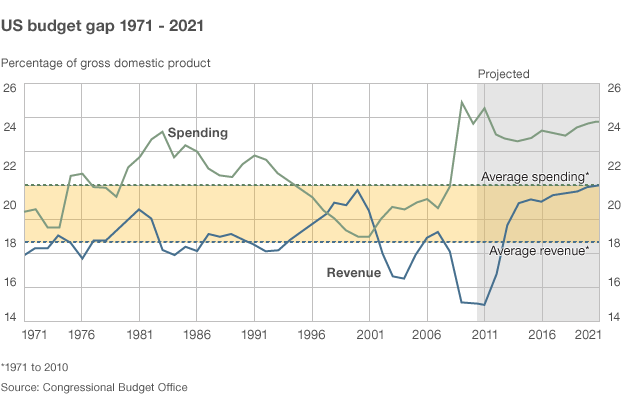
Is the US in denial over its $14tn debt?

Is America in denial about the extent of its financial problems, and therefore incapable of dealing with the gravest crisis the country has ever faced?

This is a story of debt, delusion and – potentially – disaster. For America and, if you happen to think that American influence is broadly a good thing, for the world.

The debt and the delusion are both all-American: $14 trillion (£8.75tn) of debt has been amassed and there is no cogent plan to reduce it.

The figure is impossible to comprehend: easier to focus on the fact that it grows at $40,000 (£25,000) a second. Getting out of Afghanistan will help but actually only at the margins. The problem is much bigger than any one area of expenditure.

The economist Jeffrey Sachs, director of Columbia University’s Earth Institute, is no rabid fiscal conservative but on the debt he is a hawk: “I’m worried. The debt is large. It should be brought under control. The longer we wait, the longer we suffer this kind of paralysis; the more America boxes itself into a corner and the more America’s constructive leadership in the world diminishes.”

The author and economist Diane Coyle agrees. And she makes the rather alarming point that the acknowledged deficit is not the whole story.

The current $14tn debt is bad enough, she argues, but the future commitments to the baby boomers, commitments for health care and for pensions, suggest that the debt burden is part of the fabric of society:

“You have promises implicit in the structure of welfare states and aging populations that mean there is an unacknowledged debt that will have to be paid for by future taxpayers, and that could double the published figures.”

Richard Haass of the Council on Foreign Relations acknowledges that this structural commitment to future debt is not unique to the United States.  All advanced democracies have more or less the same problem, he says, “but in the case of the States the figures are absolutely enormous”.

Mr Haass, a former senior US diplomat, is leading an academic push for America’s debt to be taken seriously by Americans and noticed as well by the rest of the world.

He uses the analogy of Suez and the pressure that was put on the UK by the US to withdraw from that adventure. The pressure was not, of course, military. It was economic.

Britain needed US economic help. In the future, if China chooses to flex its muscles abroad, it may not be Chinese admirals who pose the real threat, Mr Haass tells us. “Chinese bankers could do the job.”

Because of course Chinese bankers, if they withdrew their support for the US economy and their willingness to finance America’s spending, could have an almost overnight impact on every American life, forcing interest rates to sky high levels and torpedoing the world’s largest economy.

Not everyone accepts the debt-as-disaster thesis.

David Frum is a Republican intellectual and a former speech writer to President George W Bush.

He told me the problem, and the solution, were actually rather simple: “If I tell you you have a disease that will absolutely prostrate you and it could be prevented by taking a couple of aspirin and going for a walk, well I guess the situation isn’t apocalyptic is it?

“The things that America has to do to put its fiscal house in order are not anywhere near as extreme as what Europe has to do. The debt is not a financial problem, it is a political problem.”

Mr Frum believes that a future agreement to cut spending – he thinks America spends much too big a proportion of its GDP on health – and raise taxes, could very quickly bring the debt problem down to the level of quotidian normality.

‘Organised hypocrisy’

I am not so sure. What is the root cause of America’s failure to get to grips with its debt? It can be argued that the problem is not really economic or even political; it is a cultural inability to face up to hard choices, even to acknowledge that the choices are there.

I should make it clear that my reporting of the United States, in the years I was based there for the BBC, was governed by a sense that too much foreign media coverage of America is negative and jaundiced.

The nation is staggeringly successful and gloriously attractive. But it is also deeply dysfunctional in some respects.

Take Alaska. The author and serious student of America, Anne Applebaum makes the point that, as she puts it, “Alaska is a myth!”

People who live in Alaska – and people who aspire to live in Alaska – imagine it is the last frontier, she says, “the place where rugged individuals go out and dig for oil and shoot caribou, and make money the way people did 100 years ago”.

But in reality, Alaska is the most heavily subsidised state in the union. There is more social spending in Alaska than anywhere else.

To make it a place where decent lives can be lived, there is a huge transfer of money to Alaska from the US federal government which means of course from taxpayers in New York and Los Angeles and other places where less rugged folk live. Alaska is an organised hypocrisy.

Too many Americans behave like the Alaskans: they think of themselves as rugged individualists in no need of state help, but they take the money anyway in health care and pensions and all the other areas of American life where the federal government spends its cash.

The Tea Party movement talks of cuts in spending but when it comes to it, Americans always seem to be talking about cuts in spending that affect someone else, not them – and taxes that are levied on others too.

And nobody talks about raising taxes. Jeffrey Sachs has a theory about why this is.

America’s two main political parties are so desperate to raise money for the nation’s constant elections – remember the House of Representatives is elected every two years – that they can do nothing that upsets wealthy people and wealthy companies.

So they cannot touch taxes.

In all honesty, I am torn about the conclusions to be drawn. I find it difficult to believe that a nation historically so nimble and clever and open could succumb to disaster in this way.

But America, as well as being a place of hard work and ingenuity, is also no stranger to eating competitions in which gluttony is celebrated, and wilful ignorance, for instance regarding (as many Americans do) evolution as controversial.

The debt crisis is a fascinating crisis because it is about so much more than money. It is a test of a culture.

It is about waking up, as the Americans say, and smelling the coffee. And – I am thinking Texas here – saddling up too, and riding out with purpose.

NB: Copyright BBC © 2011 The BBC is not responsible for the content of external sites. Read more.
Here’s the 30 minute broadcast under the Analysis series from Radio 4 on the BBC.(Just click on this link) analysis_20110628-1024a

The BBC

A remarkably fine institution

Having now been living in Arizona for 18 months, I can say with some degree of certainty that there are few British things that I miss.  One of them is draft English beer, of course, but another one is the BBC.  Luckily modern internet technology means that quite a few of the great BBC television programmes ‘leak’ outside the UK.

The BBC Horizon science series has been one such example of a really well-produced programme.

Recently, a BBC Horizon programme about genetically modified (GM) foods aired by the BBC found its way onto YouTube and thence to the website Top Documentary Films.  Not only is it an interesting programme but it also reveals how the facts of new advances in science are often difficult to understand by us; the general public.

The link to the film on the TDF website is here but if you want to watch it directly from YouTube then here it is.

Edward Stobart, RIP.

Sad to read the loss of a giant of the UK’s hauliers.

I have no personal knowledge or experience of Eddie Stobart’s haulage firm.  But as someone who for many years operated as a salesman in the UK, with the associated high annual car mileages, seeing Eddie Stobart trucks on the road was a familiar experience.

This week’s copy of The Economist carried an obituary telling of the death, at the young age of 56, of Edward Stobart.

A Stobart truck, always spotlessly clean.

The UK Independent newspaper carried a report of Eddie’s death on the 31st March, as well as the BBC.  Here’s a flavour of the Independent’s report.

Edward Stobart, the trucking legend who brought the phenomenon of “Stobart spotting” to Britain’s motorways, has died from heart problems at the age of 56.

Mr Stobart turned his father Eddie’s agricultural seeds business into a multimillion-pound haulage empire and quirk of British culture.

“Edward built Eddie Stobart into the iconic brand and business we know today,” his brother William Stobart, who now runs the business, told staff yesterday with “great sadness and regret”.

Edward Stobart took over the business in the late 1960s and within a decade spotting the green-and-red livery of Eddie Stobart lorries had become a favourite way to while away long journeys.

As a sign of the company’s cult appeal, Twitter was flooded with condolences and messages of appreciation within minutes of the announcement of Mr Stobart’s death in hospital in Coventry

Great man, great entrepreneur, great loss.

Eddie Sobart.


All in the meaning, postscript!

Life is without meaning. You bring the meaning to it.

The meaning of life is whatever you ascribe it to be.

Being alive is the meaning.

On the 28th March I wrote what I thought was a concluding piece on the subject of ‘meaning’.  I used some of the most amazing details about the universe to highlight the fact that, in the end, if our civilisation doesn’t get it’s collective act together then from the perspective of the universe it is all pretty irrelevant.  In that piece I quoted from Prof. Brian Cox, “Everything we are, everything that’s ever been and everything that will ever be was all forged in the same moment of creation 13.7bn years ago from an unimaginably hot and dense volume of matter less than the size of an atom.

Now, in fairness, Prof. Cox did allude to scientists exploring the notion of what might have happened before the Big Bang.  Anyway, a couple of nights ago we watched a BBC Horizon programme, now on YouTube, that looked much more closely into this fascinating topic.  The link came to us from the website Top Documentary Films that set out the introduction to the BBC programme.

They are the biggest questions that science can possibly ask: where did everything in our universe come from? How did it all begin? For nearly a hundred years, we thought we had the answer: a big bang some 14 billion years ago.

But now some scientists believe that was not really the beginning. Our universe may have had a life before this violent moment of creation.

Horizon takes the ultimate trip into the unknown, to explore a dizzying world of cosmic bounces, rips and multiple universes, and finds out what happened before the big bang.

Neil Turok, Director of Perimeter Institute for Theoretical Physics in Canada, working with Paul Steinhardt at Princeton, has proposed a radical new answer to cosmology’s deepest question: What banged?

Answer: Instead of the universe inexplicably springing into existence from a mysteriousinitial singularity, the Big Bang was a collision between two universes like ours existing as parallel membranes floating in a higher-dimensional space that we’re not aware of.

One bang is followed by another, in a potentially endless series of cosmic cycles, each one spelling the end of a universe and the beginning of a new one. Not one bang, but many.

Sir Roger Penrose has changed his mind about the Big Bang. He now imagines an eternal cycle of expanding universes where matter becomes energy and back again in the birth of new universes and so on and so on.

Here’s that programme.  Enjoy!

The day after April 1st!

When it all gets real close and personal.

I have been a great fan of the BBC’s business editor, Robert Peston, and read his Blog as often as I can.  Recently, the focus has been on Ireland.

A few days ago, before the announcement by the Irish premier and finance minister as to their vision for the future of Ireland’s banks, Robert penned a post that started as follows:

The unbelievable truth about Ireland and its banks
Ireland’s central bank and new government will confirm on Thursday that the hole in the country’s banks is even wider, deeper and darker than seemed to be the case last November, when those bust banks forced the country to go with a begging bowl to the eurozone’s rescue funds and the International Monetary Fund (IMF) for 67.5bn euros (£59bn) of rescue loans.

That article then led me to Paul Mason, BBC Newsnight’s economics editor, who also writes a Blog.  He wrote on the 30th March,

A short summary of the Euro snafu that’s about to happen:

1) Tomorrow Ireland publishes the results of bank stress tests. It has to find – or the EU has to find – another E18-25bn to shore up its failing banks.

etc., etc.

Again, while the article is interesting, the whole point of this Post was one comment made to that Paul Mason piece.  Here it is,

At 00:47am on 31st Mar 2011, tawse57 wrote:

I am bored with all these posts about the economy now. Can we go back to cheese and crackers and the mysterious case of Paul Mason’s mobo contacts?

I was just talking with a 35 year old young man who is married and has a young child.

His wife, quite rightly, does not wish to move away from the place where she was born and brought up – Cornwall.

But he tells me that, despite almost saving £100,000 by putting in every hour they could in working and saving, that they stand no chance of ever owning their own home.

He says the house that he rents have asking prices of about £450,000 despite most of them just sitting on the market for years because no one, no one local anyhow, can afford them. What does sell goes to rich Londoners.

He is destined to pay out most of his wages in private landlord rents. He can’t get into a Council house or a Housing Association property because they either no longer exist or the waiting lists are measured in decades.

He is not prepared to have such a millstone of stress, worry and financial drain around his neck. It would kill him. I don’t blame him.

His story is one of hundreds of thousands, perhaps millions, of people in the UK today.

I mention this as the bank stress tests are directly connected with the massive credit bubble, much of it a housing bubble of liar loans, that brought the global economy to its knees, bankrupted banks and still threatens to bankrupt nations.

All of us on here know this. We are an enlightened bunch.

But I think it is worth remembering that the affects of the global credit binge are still directly affecting so many in this country.

The UK is almost alone in the World in not yet seeing a massive housing crash. The Government and the Bank of England have gone out of their way stop it happening in order to protect the banks who so stupidly, but also so greedily, loaned so many liar loans on bricks and mortar not in other countries but here in the UK.

Those UK banks that keep threatening to leave our shores are up to their eyeballs in global liar loans. You name a country in trouble and you can bet your bottom dollar, which might be the only thing most of us have left soon, that British banks are at the heart of it all.

It is long overdue that this giant house of cards came crashing down. It is long over-due that, as a Society, we cut out the cancer of dirty banks and dirty bankers from our lives and from these shores.

They are leeches on the souls of Men. Gosh, I am getting poetic in my anger. It must be that teaspoon of Jack Daniels I put in my midnight cocoa.

So what if the banks fail their stress tests today, next week or next year. It won’t make a squat of difference to that couple in Cornwall. It won’t make a squat of difference to most of us.

The worst thing that can happen is, as Alistair Darling so panicked, that the ATM machines run empty. Well, what would happen then? Would the sky fall in? Would us polite British all sit at home and do nothing.

Or would we take our cue from the Egyptians, the Tunisians and all the rest?

Perhaps what this country needs most of all is for another even bigger banking crisis? If it happens I think I would feel safer being one of the masses instead of one of the banking elite.

I do hope the banks fail the stress tests. I do hope it brings about another crisis. I do hope that, this time, the People say enough is enough and that this rotting cancer within Humanity is lanced with a fiery lancie thingy.

I could murder a bit of cheese on a nice cracker now.

Whoever you are tawse57, I like your style.  Very powerful words.

“It is error alone which needs the support of government.  Truth can stand by itself.”

~Thomas Jefferson (third President of the United States from 1801 to 1809)

Sciences becomes magic.

Only a mystical view can speak to the soul.


The Helix nebula

(More on the Helix nebula here.)

I have referred yesterday to the series on the BBC hosted by Professor Brian Cox called Wonders of the Universe.  Well we managed to watch the last episode last night, entitled Messengers.  Like the other three episodes, it was breath-taking.

In this last episode, Prof. Cox speaks of the universe still expanding with the outer edge, if edge is the appropriate word, being about 8.7 billion light years away.  Thus the age of the Universe is about that; 8.7 billion light years.  Note: NASA has a piece that suggests that this figure may not be confirmed.  But let’s not worry too much about the precise value.  But we will take a short detour to understand a little more about the ‘light year’.

From here.

So to measure really long distances, people use a unit called alight yearLight travels at 186,000 miles per second (300,000 kilometers per second). Therefore, a light second is 186,000 miles (300,000 kilometers). A light year is the distance that light can travel in a year, or:

186,000 miles/second * 60 seconds/minute * 60 minutes/hour * 24 hours/day * 365 days/year = 5,865,696,000,000 miles/year

A light year is 5,865,696,000,000 miles (9,460,800,000,000 kilometers). That’s a long way!

That is a single light-year. Now reflect on the outer edge of the universe being, say, 8,700,000,000 multiplied by 5,865,696,000,000 miles away.  Don’t know about your mind, but my mind has no ‘feel’ for that distance whatsoever.

OK, next proposition put forward by Prof. Cox.  That is that scientists believe that ‘The Big Bang’ was the instant that the universe erupted, if that’s an appropriate word, from a single point, smaller than the size of a grain of sand.

That has no rational meaning whatsoever. Now my mind just goes into la, la land!  But at the level of magic, mysticism, the spiritual, then one does experience the deep meaning of the creation.  Our creation.  For we are part of the universe and the universe is part of us.

Just like the rose.  Trying to describe it cuts nothing compared to closing one’s eyes and simply breathing in the perfume.

Here is that last episode, in four parts from YouTube. Watch and prepared to be transformed.

All in the meaning, conclusion

Life is without meaning. You bring the meaning to it.

The meaning of life is whatever you ascribe it to be.

Being alive is the meaning.

It would be so easy to stay with this theme for a very long time, perhaps to the end of one’s mortal days.

Anyway, my topic has taken sufficient shape for me to conclude with this article and then leave these ideas with you, or just out there in the universe. The ‘shape’ being that whether the facts about the way we treat Planet Earth depress you, or whether taking a mystic, spiritual view is more your scene, it’s up to you.  Let’s recap.

The first article was to show that there are very strong and valid reasons to take an incredibly dim view of where it’s all heading.  In fact, those that stay with Learning from Dogs over the weeks, you hardy lot!, will know that the premise that we, as in mankind, are well and truly in the midst of a massive transition, unlike anything ever experienced before, is an idea that crops up here every so often.  This piece on the 22nd is just an example, and there are many more articles resonating around this theme on the Blog.

Then the second article was to show that a simple change of perspective can make all the difference to how we see the world. (Oh, and such a big thank-you to Sue Dreamwalker for that beautiful poem from her.)

OK, to the point of this article!

The BBC have been showing the most beautiful episodes in recent weeks from a massive production hosted by Professor Brian Cox- The Wonders of the Universe.  Here’s the BBC trailer.

Did you pick up on that key sentence?  “Ultimately, we are part of the universe.”

Here’s a recent piece from the British Guardian newspaper, I think written by Brian Cox, the presenter of the series.

The universe is amazing. You are amazing. I am amazing. For we are all one. Everything we are, everything that’s ever been and everything that will ever be was all forged in the same moment of creation 13.7bn years ago from an unimaginably hot and dense volume of matter less than the size of an atom. And that is amazing. [Understatement! Ed.] What happened before then in the Planck epoch is a matter of conjecture; we lack a theory of quantum gravity, though some believe the universe was formed from a collision of two pieces of space and time floating forever in an infinite space, but I feel I’m losing you at this point, which isn’t so amazing.

Read it in full here, but it concludes, almost poetically, as,

Time feels human, but we are only part of Cosmic Time and we can only ever measure its passing. As I stand in front of the great glacier that towers over Lake Argentino, time seems to almost stand still, yet as I explain the effects of entropy in the Namibian desert as sandcastles crumble around me, you can see that the transition from order to chaos can happen almost in the blink of an eye. One day, perhaps in 6bn years, our universe will stop expanding, the sun will cool and die, as all stars must, and everything will collapse in on itself, back into a black hole singularity. I leave you with this last thought: that we, too, will only really die when the universe dies, for everything within it is intrinsically the same.

Brian Cox takes an almost mystical perspective of the size of the universe and the almost unimaginable number of stars and planets it contains.

So, how many stars are out there?  From here, I quote,

It’s a great big Universe out there, with a huge numbers of stars. But how many stars are there, exactly? How many stars are there in the Universe? Of course it’s a difficult question to answer, because the Universe is a vast place and our telescopes can’t reach every corner to count the number of stars. But we can make some rough estimates. Almost all the stars in the Universe are collected together into galaxies. They can be small dwarf galaxies, with just 10 million or so stars, or they can be monstrous irregular galaxies with 10 trillion stars or more. Our own Milky Way galaxy seems to contain about 200 billion stars; and we’re actually about average number of stars.

So an average galaxy contains between 1011 and 1012 stars. In other words, galaxies, on average have between 100 billion and 1 trillion numbers of stars.

Now, how many galaxies are there? Astronomers estimate that there are approximately 100 billion to 1 trillion galaxies in the Universe. So if you multiply those two numbers together, you get between 1022 and 1024 stars in the Universe. How many stars? There are between 10 sextillion and 1 septillion stars in the Universe. That’s a large number of stars.

Even if one writes down in longhand the number, 1022 , as in 10,000,000,000,000,000,000,000 it still has no real meaning whatsover.  That, of course, does not even get close to estimating how many planets there are out there.

Let’s say, just as a muse, that each sun only had a single planet.  Let us also continue this musing and say that only one in a billion planets had life on it.  In other words, if we divide 1022 by a billion, we still get the eye-watering result of there being 1013 or, longhand, 10,000,000,000,000 planets with life forms. That’s 10 trillion, by the way!

OK, cut it down some more, and then some more, and even more.

But whichever way you cut it, the conclusion is inescapable, the universe must be teeming with life and much of that life intelligent and wise.

So let me leave you with this thought about the meaning of it all.  It’s this.

It is said that the world reflects back what we think about most.  As I hope to have shown, we can think our way into extinction, or we can think our way to more mystic and spiritual outcomes. The meaning of life is whatever you ascribe it to be.

In the end, if we screw up this planet as place for mankind to prosper and grow, it’s no big deal.  There will be many other humankinds out there in the universe who have taken a different route.

Sleep well tonight!