Animal rights campaigners in France are celebrating after a wild boar facing the threat of death was allowed to stay with its owner.
The boar, named Rillette, was found in 2023 as a piglet by Elodie Cappé on her horse-breeding smallholding in Chaource, central France, after apparently being abandoned by its mother.
Back in the late 1950s when my mother remarried after my father’s death, ‘Dad’, as he was called when he came to live at Toley Avenue, Preston Road, London, taught me how to construct a radio receiver made from a crystal, a crystal set. I have this memory of listening to Quincy Jones on my crystal set and loving the rhythm.
“Music is sacred to me,” Quincy Jones once said. “Melody is God’s voice.”
He certainly had the divine touch.
Jones, who had died at the age of 91, was the right-hand man to both Frank Sinatra and Michael Jackson, and helped to shape the sound of jazz and pop over more than 60 years.
His recordings revolutionised music by crossing genres, promoting unlikely collaborations and shaping modern production techniques.
“The Future of Democracy” is, for me, incredibly interesting.
I haven’t a clue as to how long I have been listening to the annual Reith Lecture on BBC Radio 4. It has been many years.
As Wikipedia explains:
The Reith Lectures is a series of annual BBCradiolectures given by leading figures of the day. They are commissioned by the BBC and broadcast on Radio 4 and the World Service. The lectures were inaugurated in 1948 to mark the historic contribution made to public service broadcasting by Lord Reith, the corporation’s first director-general.
Reith maintained that broadcasting should be a public service that aimed to enrich the intellectual and cultural life of the nation. It is in this spirit that the BBC each year invites a leading figure to deliver the lectures. The aim is to advance public understanding and debate about issues of contemporary interest.
Wikipedia
From the BBC’s History of the BBC.
As the BBC explains on the BBC Sounds website:
Released On: 29 Nov 2023
Available for over a year
This year’s BBC Reith Lecturer is Ben Ansell, Professor of Comparative Democratic Institutions at Nuffield College, Oxford University.
He will deliver four lectures called “Our Democratic Future,” asking how we can build a politics that works for all of us with systems which are robust to the challenges of the twenty first century, from climate change to artificial intelligence. In this first lecture, recorded at New Broadcasting House in London in front of an audience, Professor Ansell asks whether we are in a ‘democratic recession’, where longstanding democracies are at risk of breakdown and authoritarianism is resurgent. And he examines how resilient democracies are to the challenges of artificial intelligence, social media and if they can effectively address core challenges from climate change to inequality.
The Reith Lectures are presented by Anita Anand and produced by Jim Frank. The Editor is China Collins. Reith Co-ordinator is Brenda Brown. The series is mixed by Rod Farquhar and Neil Churchill.
Welcome to my website. I am Professor of Comparative Democratic Institutions at Nuffield College, University of Oxford. My work focuses on a variety of issues in political economy, including both comparative politics and international relations.
I am also co-editor (with David Samuels) of Comparative Political Studies.
My 2010 book, From the Ballot to the Blackboard, published by Cambridge University Press, is available here. My 2014 book (with David Samuels), Inequality and Democratization: An Elite-Competition Approach, published by Cambridge University Press, is available here.
This site contains a variety of working papers, syllabi, my biography, and other information about my academic work. My CV is available here.
Whatever age we are and in many different cultures the New Year holds out so much hope. It seems an opportunity to start anew, to put the habits of last year behind us, to embrace a new start. Yet all the evidence is that a New Year’s Resolution will not make it through to February.
That is why I picked up on a recent article in The Conversation, that they kindly allow to be republished.
ooOOoo
Why you should give the gift of mindfulness this New Year
The start of another year can feel magical to many of us. Even though the days remain short and dark, the flip of the calendar can make it seem new beginnings with new resolutions are possible.
Mindfulness scholars and teachers like me call resolutions “habit breakers,” as they can overcome patterns that no longer serve individuals. However, research suggests that many resolutions fail by the end of January.
But a key to ensuring that resolutions stick is to choose one that will make a meaningful difference in your life. Seeing a real, tangible benefit can provide inspiration to keep going when all of life is telling us to let things go back to how they were before.
Living more mindfully is a common New Year’s resolution. This year, try gifting it to others.
The practice is based on an insight first described by ancient Buddhist texts that human beings have the capacity to observe experience without being caught up in it. This means, simply and wonderfully, that it is possible to observe ourselves having a craving, or a happy thought, or even a scary emotion, without reacting in the moment in a way that amplifies the feeling or sends the mind spiraling off into thinking about old memories or anticipating events.
This practice can help calm the mind and the body as we learn not to react to experience with likes and dislikes or judgments of good and bad. It does not make us cold or apathetic but more fully present.
Mindfulness in a distracted world
One of the challenges of practicing mindfulness in our contemporary world is that there has been a profound transformation in human attention. The artist Jenny Odell argues that in our “attention economy” human attention has been transformed into a commodity that big corporations buy and sell. This economy rests on a technological revolution of mobile phones and social media that makes it possible for corporations to reach us with content that can capture and monetize our focus, at every moment, every day, and no matter where we may be.
The needy little devices most people carry in their pockets and wear on their wrists, incessantly beeping and buzzing and chirping, are a perpetual diversion from the present moment. The result is that it can feel as though our ability to focus, and be fully present, has been stolen.
But mindfulness can help us resist the attention economy and savor the things that make life special, like being together with those we love.
The gift of mindfulness
While most mindfulness research focuses on the individual benefits of the practice, scholars like me argue that we not only practice mindfulness for ourselves but that we can also practice it for others. It can help us build stronger, healthier relationships.
The sad truth is that living in the attention economy, most of us have become bad listeners. However, just as it is possible to watch ourselves having an experience without reacting, it’s possible to watch another person have an experience without getting tied up in reactivity and judgment. It’s possible simply to be present.
The gift of mindfulness is a practice of listening with compassion to another person describe their experiences. To give this gift means putting away your phone, turning off social media, and setting aside other common distractions. It means practicing being fully present in another person’s presence and listening to them with complete attention, without reacting with judgment, while resisting the urge to make the interaction about you.
It is not a gift that you will wrap, or put inside a card; it’s not one you will have to name as a gift or draw attention to. It’s something you can do right now.
ooOOoo
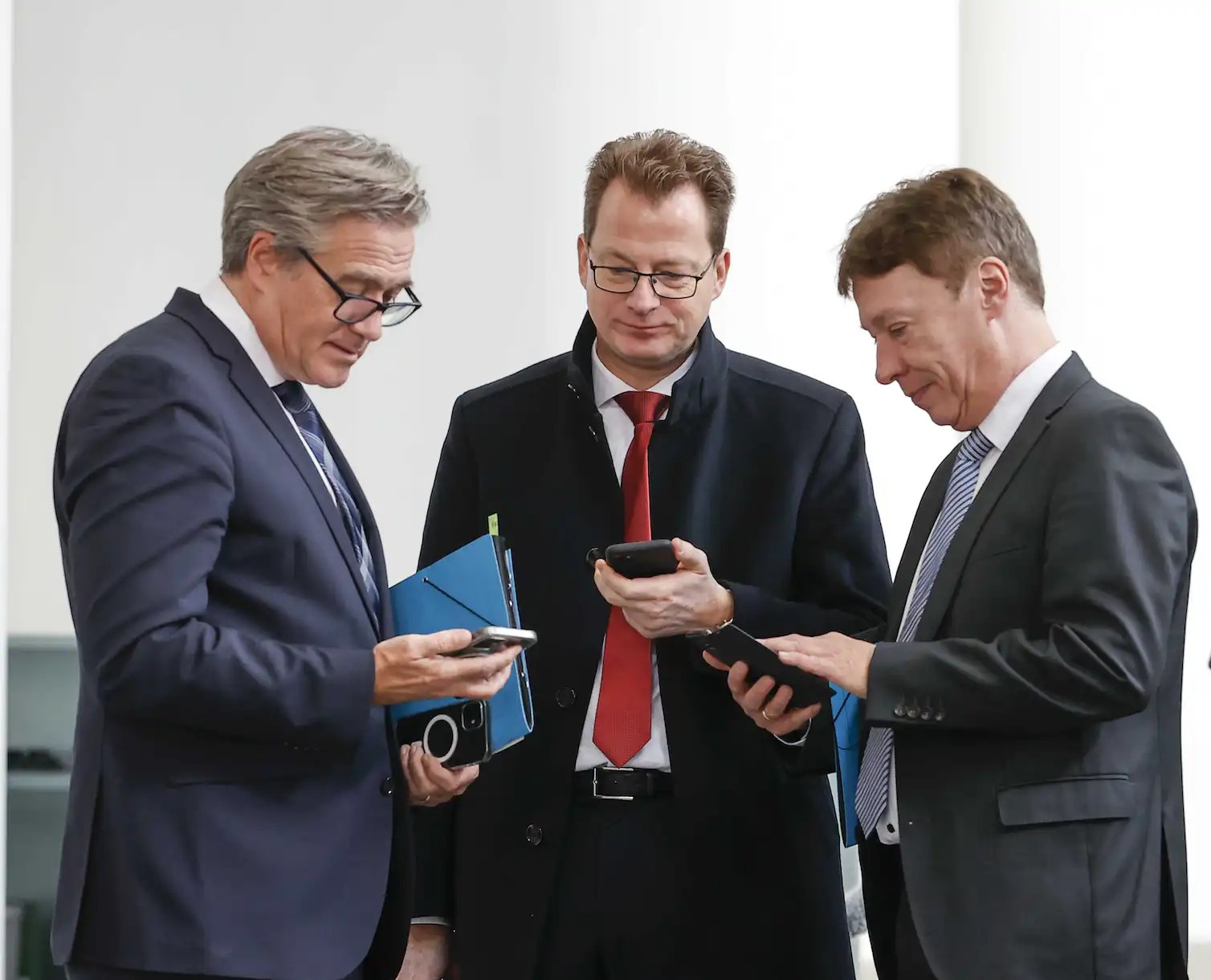
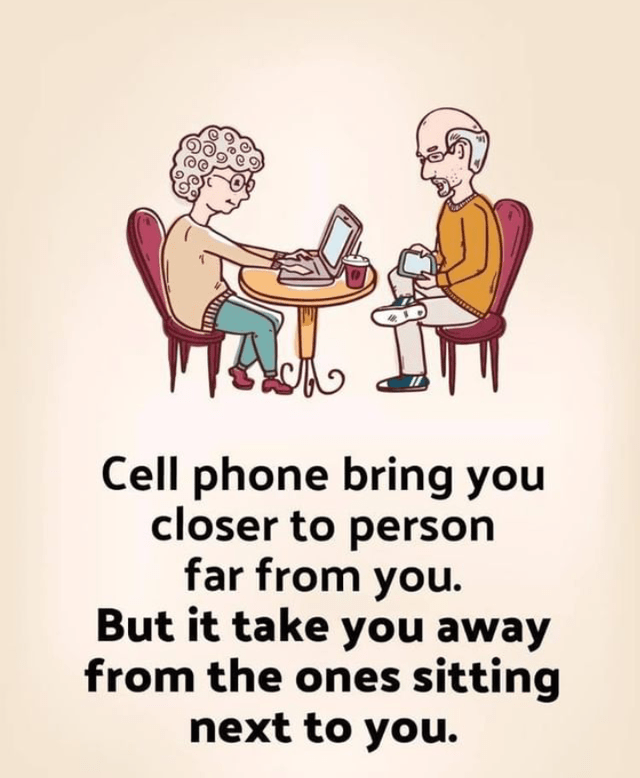
Professor David Engels is spot on. The number of people who are wedded to their cell phone, especially the younger ones of us, is frightening. Many years ago I was fortunate to have a counsellor who was into mindfulness and some of the good practices have stayed with me.
So, please, if you are thinking that your use of a cell phone is intrusive, even slightly, then let this New Year present a new you!
P.S.
Belinda sent in the following attached to one of her comments. It’s perfect! Thank you, Belinda!
And while we are on the subject of New Year’s Resolutions try this one. It is not a long video but it is extremely important; it concerns our diet and our health!
I am sure that many of you have seen the latest images but still for those that have not…
ooOOoo
First the BBC presented a report on the 25th December, 2022. This is part of what they described:
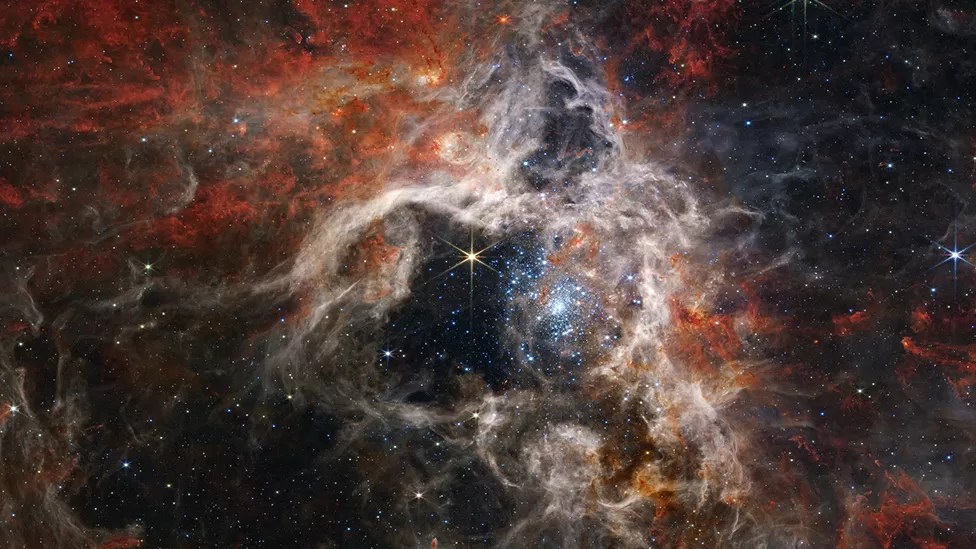
James Webb telescope: Amazing images show the Universe as never before
The Tarantula Nebula: Only 161,000 light years from Earth, this is a place where thousands of stars were born
By Jonathan Amos, BBC Science Correspondent
It was the $10bn gift to the world. A machine that would show us our place in the Universe.
The James Webb Space Telescope (JWST) was launched exactly a year ago, on Christmas Day. It had taken three decades to plan, design and build.
Many wondered whether this successor to the famed Hubble Space Telescope could actually live up to expectations.
We had to wait a few months while its epic 6.5m primary mirror was unpacked and focused, and its other systems tested and calibrated.
The first thing you have to remember about James Webb is that it is an infrared telescope. It sees the sky at wavelengths of light that are beyond what our eyes are able to discern.
Astronomers use its different cameras to explore regions of the cosmos, such as these great towers of gas and dust. The Pillars were a favourite target of Hubble. It would take you several years travelling at the speed of light to traverse this entire scene.
Now we go to the NASA site for more of the JWST:
First Images from the James Webb Space Telescope
The dawn of a new era in astronomy has begun as the world gets its first look at the full capabilities of NASA’s James Webb Space Telescope, a partnership with ESA (European Space Agency) and CSA (Canadian Space Agency). The telescope’s first full-color images and spectroscopic data were released during a televised broadcast at 10:30 a.m. EDT (14:30 UTC) on Tuesday, July 12, 2022, from NASA’s Goddard Space Flight Center in Greenbelt, Maryland. These listed targets below represent the first wave of full-color scientific images and spectra the observatory has gathered, and the official beginning of Webb’s general science operations. They were selected by an international committee of representatives from NASA, ESA, CSA, and the Space Telescope Science Institute.
Credits: NASA, ESA, CSA, and STScI
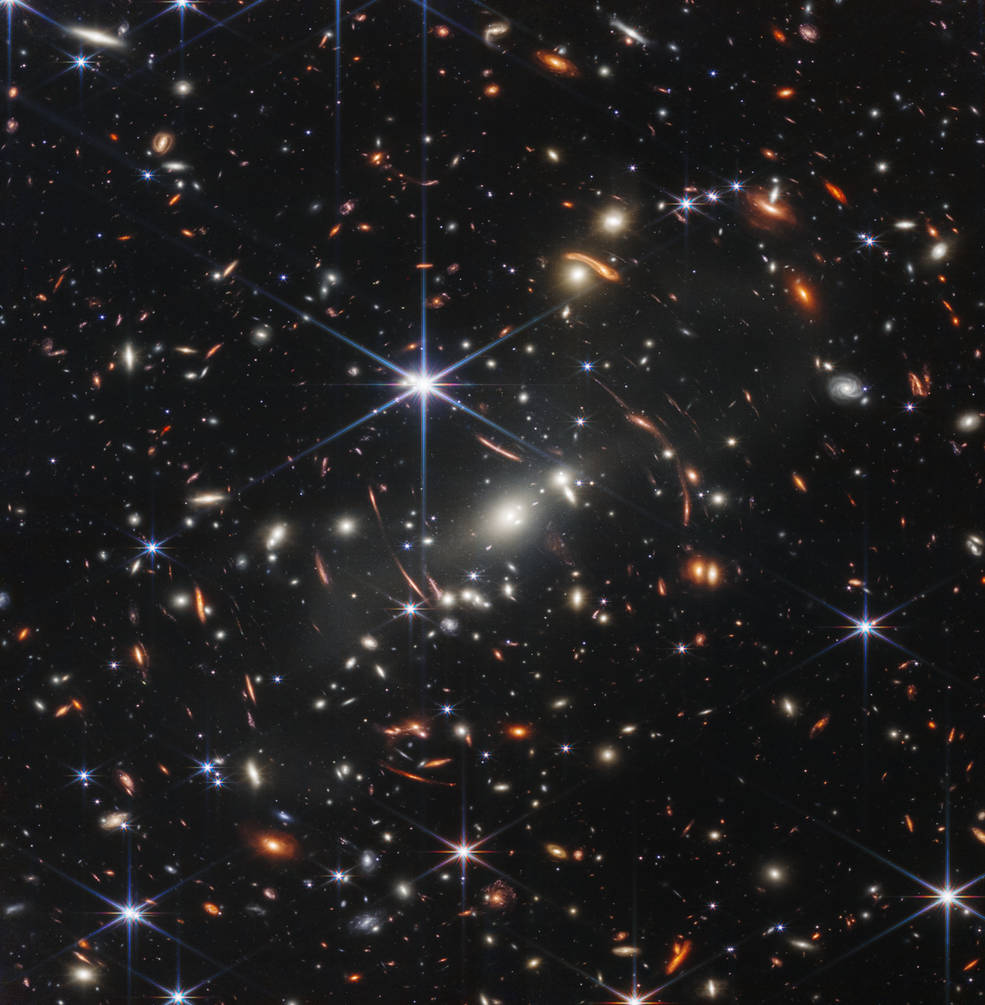
NASA’s James Webb Space Telescope has produced the deepest and sharpest infrared image of the distant universe to date. Known as Webb’s First Deep Field, this image of galaxy cluster SMACS 0723 is overflowing with detail.
Thousands of galaxies – including the faintest objects ever observed in the infrared – have appeared in Webb’s view for the first time. This slice of the vast universe covers a patch of sky approximately the size of a grain of sand held at arm’s length by someone on the ground.
Credits: NASA, ESA, CSA, and STScI
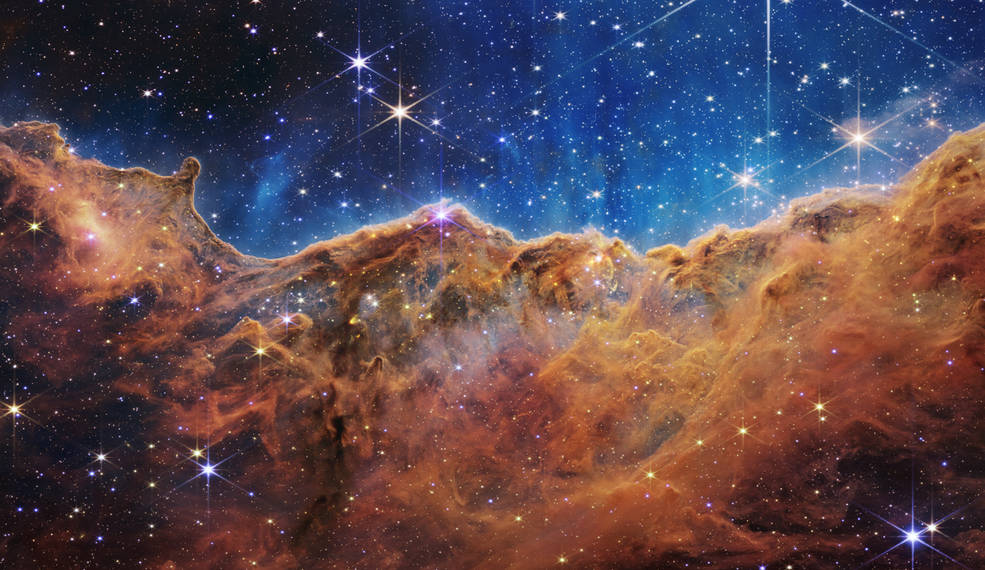
This landscape of “mountains” and “valleys” speckled with glittering stars is actually the edge of a nearby, young, star-forming region called NGC 3324 in the Carina Nebula. Captured in infrared light by NASA’s new James Webb Space Telescope, this image reveals for the first time previously invisible areas of star birth.
Called the Cosmic Cliffs, Webb’s seemingly three-dimensional picture looks like craggy mountains on a moonlit evening. In reality, it is the edge of the giant, gaseous cavity within NGC 3324, and the tallest “peaks” in this image are about 7 light-years high. The cavernous area has been carved from the nebula by the intense ultraviolet radiation and stellar winds from extremely massive, hot, young stars located in the center of the bubble, above the area shown in this image.
Credits: NASA, ESA, CSA, and STScI
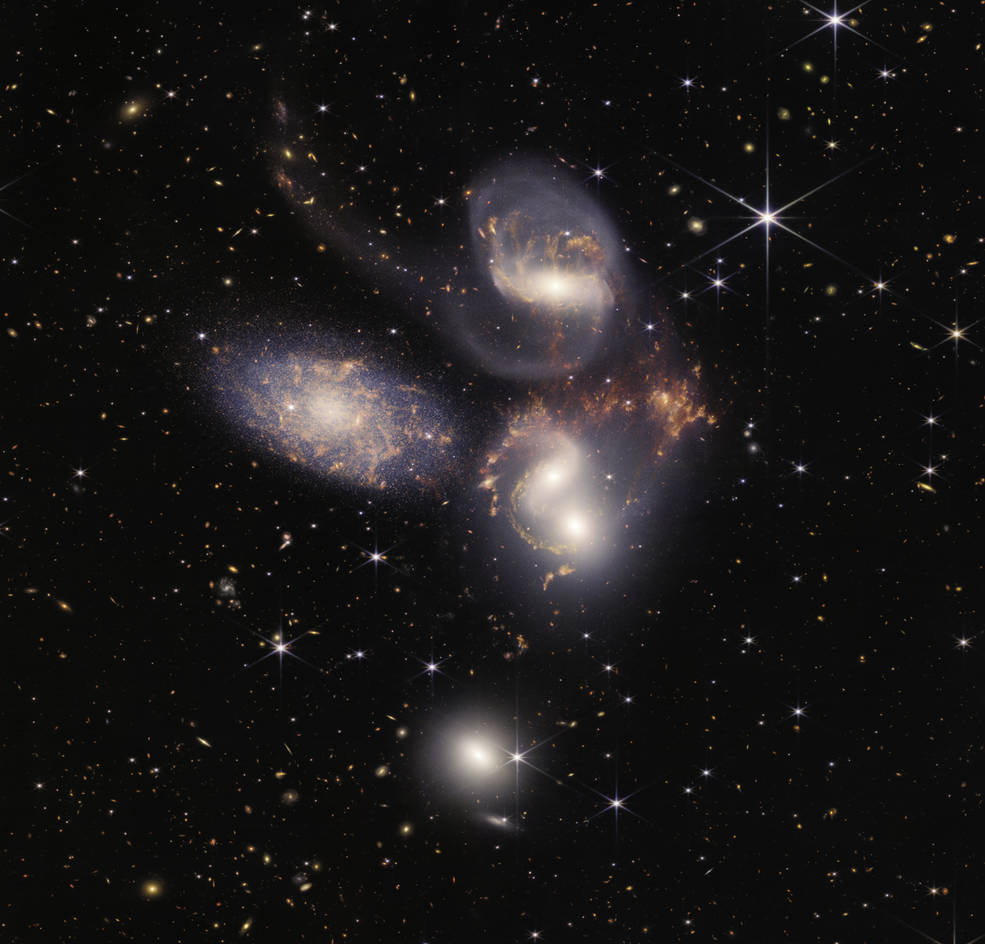
Stephan’s Quintet, a visual grouping of five galaxies, is best known for being prominently featured in the holiday classic film, “It’s a Wonderful Life.” Today, NASA’s James Webb Space Telescope reveals Stephan’s Quintet in a new light. This enormous mosaic is Webb’s largest image to date, covering about one-fifth of the Moon’s diameter. It contains over 150 million pixels and is constructed from almost 1,000 separate image files. The information from Webb provides new insights into how galactic interactions may have driven galaxy evolution in the early universe.
With its powerful, infrared vision and extremely high spatial resolution, Webb shows never-before-seen details in this galaxy group. Sparkling clusters of millions of young stars and starburst regions of fresh star birth grace the image. Sweeping tails of gas, dust and stars are being pulled from several of the galaxies due to gravitational interactions. Most dramatically, Webb captures huge shock waves as one of the galaxies, NGC 7318B, smashes through the cluster.
Credits: NASA, ESA, CSA, and STScI
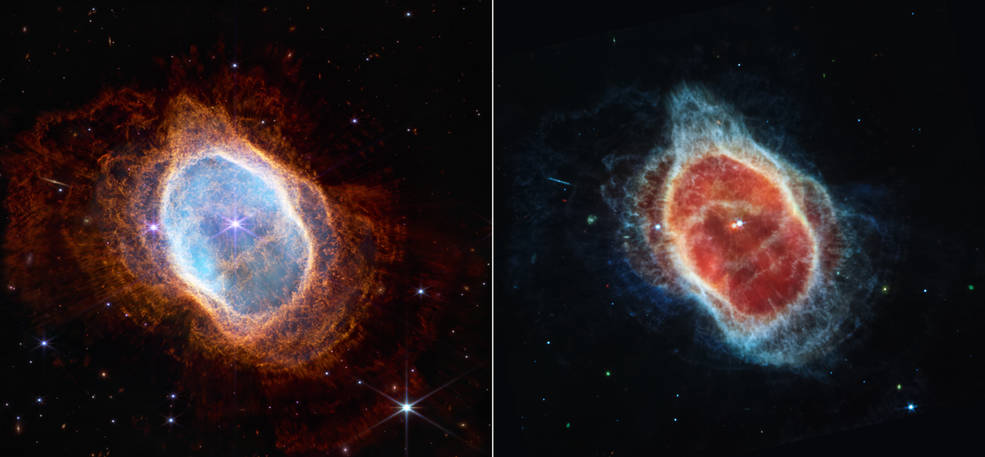
Some stars save the best for last.
The dimmer star at the center of this scene has been sending out rings of gas and dust for thousands of years in all directions, and NASA’s James Webb Space Telescope has revealed for the first time that this star is cloaked in dust.
Two cameras aboard Webb captured the latest image of this planetary nebula, cataloged as NGC 3132, and known informally as the Southern Ring Nebula. It is approximately 2,500 light-years away.
Webb will allow astronomers to dig into many more specifics about planetary nebulae like this one – clouds of gas and dust expelled by dying stars. Understanding which molecules are present, and where they lie throughout the shells of gas and dust will help researchers refine their knowledge of these objects.
Credits: NASA, ESA, CSA, and STScI
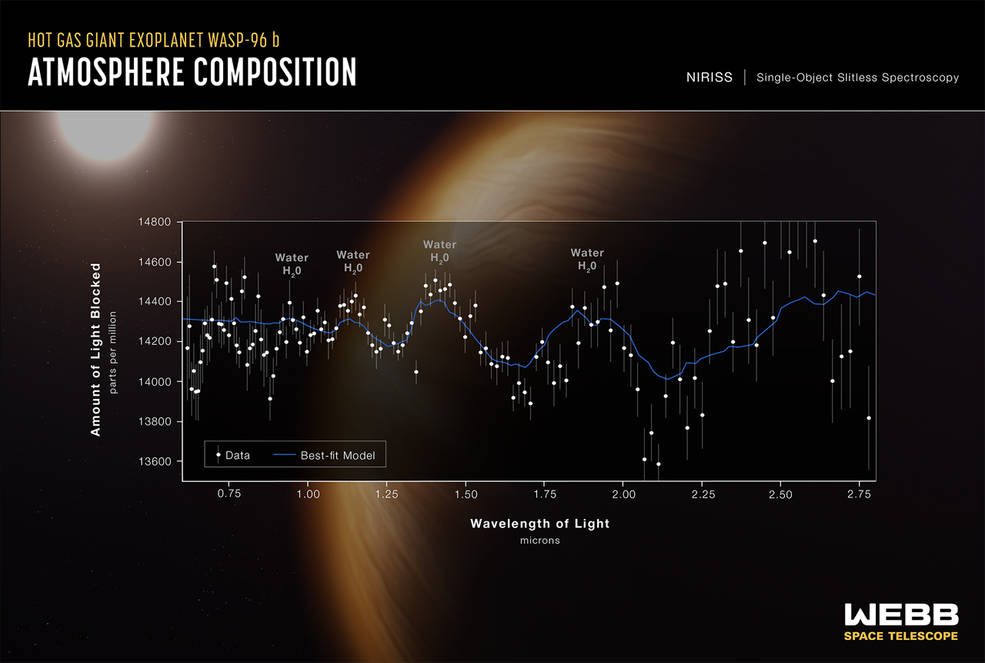
NASA’s James Webb Space Telescope has captured the distinct signature of water, along with evidence for clouds and haze, in the atmosphere surrounding a hot, puffy gas giant planet orbiting a distant Sun-like star.
The observation, which reveals the presence of specific gas molecules based on tiny decreases in the brightness of precise colors of light, is the most detailed of its kind to date, demonstrating Webb’s unprecedented ability to analyze atmospheres hundreds of light-years away.
While the Hubble Space Telescope has analyzed numerous exoplanet atmospheres over the past two decades, as in capturing the first clear detection of water in 2013, Webb’s immediate and more detailed observation marks a giant leap forward in the quest to characterize potentially habitable planets beyond Earth.
ooOOoo
Just a few of the very special photographs. They are remarkable!
December’s issue of the Science magazine had an article in which there was a paragraph that described:
The first data and images beamed back to Earth by JWST suggest it was all worthwhile. They are “beautiful” and ‘mind-blowing,” according to astronomers who have spoken with Science. It was like putting on infrared glasses, one said, and seeing the universe anew.
The GOLDEN EYE, by Daniel Clery
Imagine that just, say, 25 years ago these images and this mission would have been science fiction and now it is a reality.
I will leave you with a quotation from that SCIENCE magazine (16th December): “Politicians and pundits often make up whatever suits their political goals about science, but scientists recognize how little we understand about the Universe. As Kennedy said, “The greater our knowledge increases, the greater our ignorance unfolds.“”
Ukrainian soldiers were inspecting abandoned homes on the frontline near Kyiv, in an area that has been reclaimed from the Russians. The troops came across a lonely dog in an apartment and after finding identification documents, they discovered her name was Bavaria. A volunteer has taken the dog in and hopes to reunite it with its owner.
There was a short film also and I am delighted to find this video on YouTube.
With so much disruption and cruelty going on in Ukraine it is a real delight that compassion and love are still very much alive.
What is happening to Earth’s climate needs attention NOW!
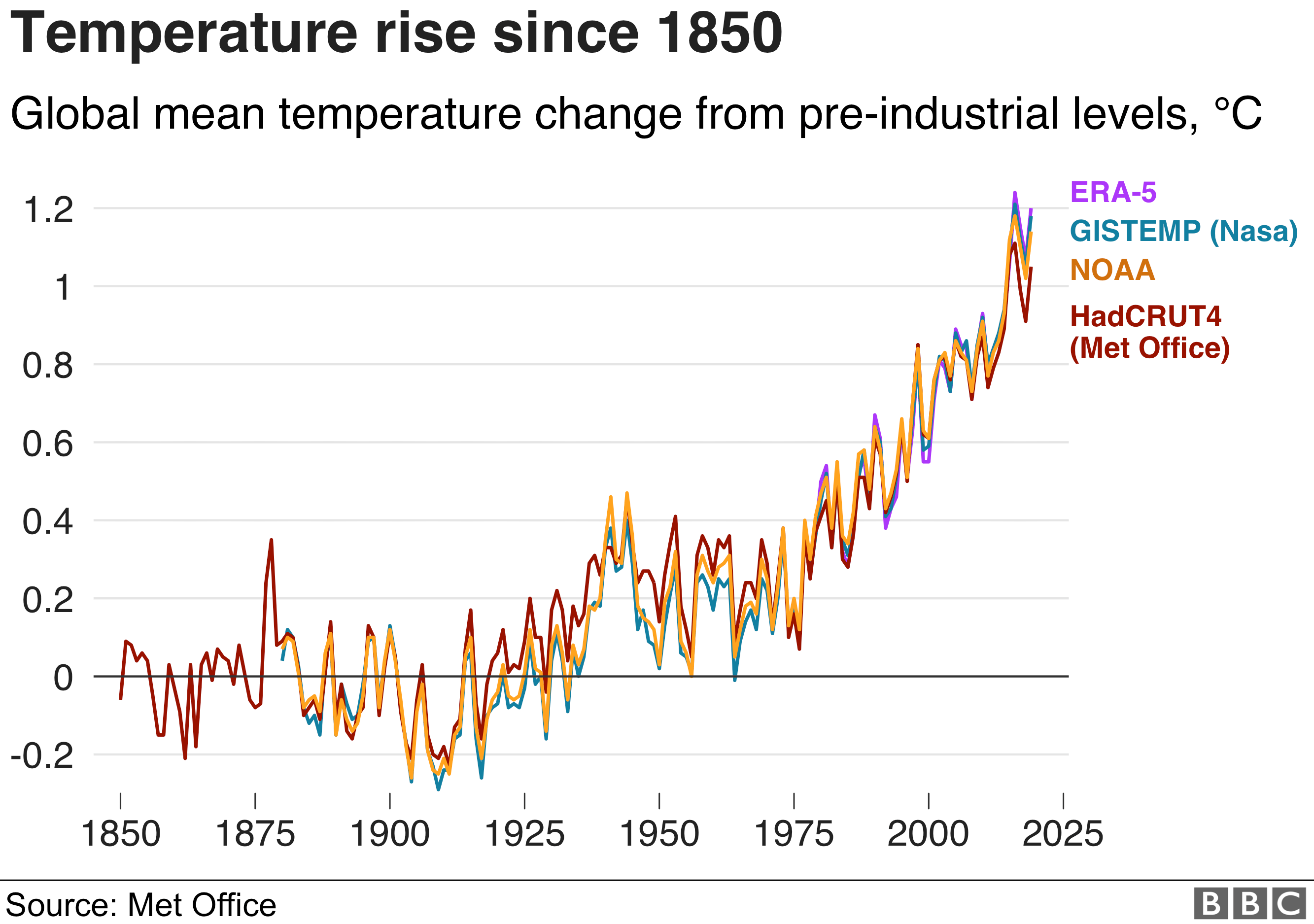
Two charts recently from the BBC News.
The 10 years to the end of 2019 have been confirmed as the warmest decade on record by three global agencies.
According to Nasa, Noaa and the UK Met Office, last year was the second warmest in a record dating back to 1850. The past five years were the hottest in the 170-year series, with the average of each one more than 1C warmer than pre-industrial.
The Met Office says that 2020 is likely to continue this warming trend.2016 remains the warmest year on record, when temperatures were boosted by the El Niño weather phenomenon.
This is the reality.
It affects every part of the world and it affects everyone. BUT! We, as in you and me, and everyone else, still haven’t got it.
The recent COP26 was progress and, especially, the next convention being held in a year’s time is important. But it is a long way from where we need to be. A very long way.
Patrice Ayme is someone that I follow and there have been times when I have gladly republished his posts. With his permission I should add.
Recently he published a post called Cataclysmic Seven Degree Centigrade Rise and I wanted to share it with you. Here is is:
ooOOoo
CATACLYSMIC SEVEN DEGREES CENTIGRADE RISE
Abstract: Expected rise of temperature in mountains correspond to a seven degree C rise. This informs global heating: in the long run, it will also be 7C. Large systems (Antarctica, Greenland) have greater thermal inertia, so their temperatures rise slower… But they will rise as much. In other words the so-called “forcing” by man-made greenhouse gases (which corresponds to 600 ppm of CO2) is universal, but the smaller the system, the faster the temperature rise…
****
Geographical systems with little thermal inertia (mountain glaciers) show an accelerated rate of heating of these parts which is only compatible with a seven (7) degrees rise in Celsius by 2100… A rise the IPCC of the UN considers impossible… But INERTIA says that it IS happening. The first thing this implies is that most forests will burn… worldwide. Then the ice shelves in Antarctica will follow.
TEMPS RISING ULTRA FAST IN MOUNTAINS
Anybody familiar with mountains worldwide know that temperatures are rising extremely fast: large glaciers I used to know have completely disappeared.. As in Chacaltaya, Bolivia. Or Portage, Alaska. The closest glacier to an Alpine village I went to as a child has been replaced by a larch forest (melezes)… One reason for this is that mountains are smaller in frozen mass than immense ensembles like Greenland and Antarctica. Moreover, the mountains’ permafrost is not as cold.
From 1984 to 2017, the upper reaches of the fires in the Sierra Nevada of California rose more than 1,400 feet. Now the temperature in the lower atmosphere decreases by 7C every 1,000 meters. There are many potential factors to explain why fires go higher (although some contradict each other). To avoid paralysis by analysis, I will assume the rise in fires is all due to temperature rise. So what we have here is a 2.5C rise in 33 years.
….FROM SMALLER THERMAL INERTIA:
Mountain thermal capacity is accordingly reduced relative to those of Greenland and Antarctica. The proportionality factors are gigantic. Say the permafrost of a mountain range is of the order of 10^4 square kilometers, at a depth of one kilometer (typical of the Sierra Nevada of California or the Alps at a temp of -3C. By comparison, Antarctica is 14x 10^6 sq km at a depth of 4 kilometers of permafrost at a temp of -30C. Thinking in greater depth reveals the proportions to be even greater: individual mountains are of the order of square kilometers. This means that (using massively simplified lower bounds), Antarctica has a mass of cold which is at least 4 orders of magnitude higher than a mountain range: to bring Antarctica to seriously melt, as mountain ranges are right now, would require at least 10,000, ten thousand times, as much heat (or maybe even a million, or more, when considering individual mountains).
As it is, mountains are exposed to a heat bath which makes their permafrost unsustainable. From their small thermal inertia, mountains warm up quickly. Greenland and Antarctica, overall, are exposed to the same bath, the same “forcing”, but because they are gigantic and gigantically cold, they resist more: they warm up, but much slower (moreover as warmer air carries more snow, it snows more while Antarctica warms up).
I have looked, in details at glaciologists records, from the US to Europe… Everywhere glaciologists say the same thing: expect a rise of the permafrost line of 1,000 meters… That corresponds to a SEVEN DEGREE CENTIGRADE RISE. Basically, while glaciers were found down to 2,500 meters in the Alps (some can still be seen in caves)… Expect that, in a few decades, none will occur below 3,500 meters… Thus speak the specialists, the glaciologists…
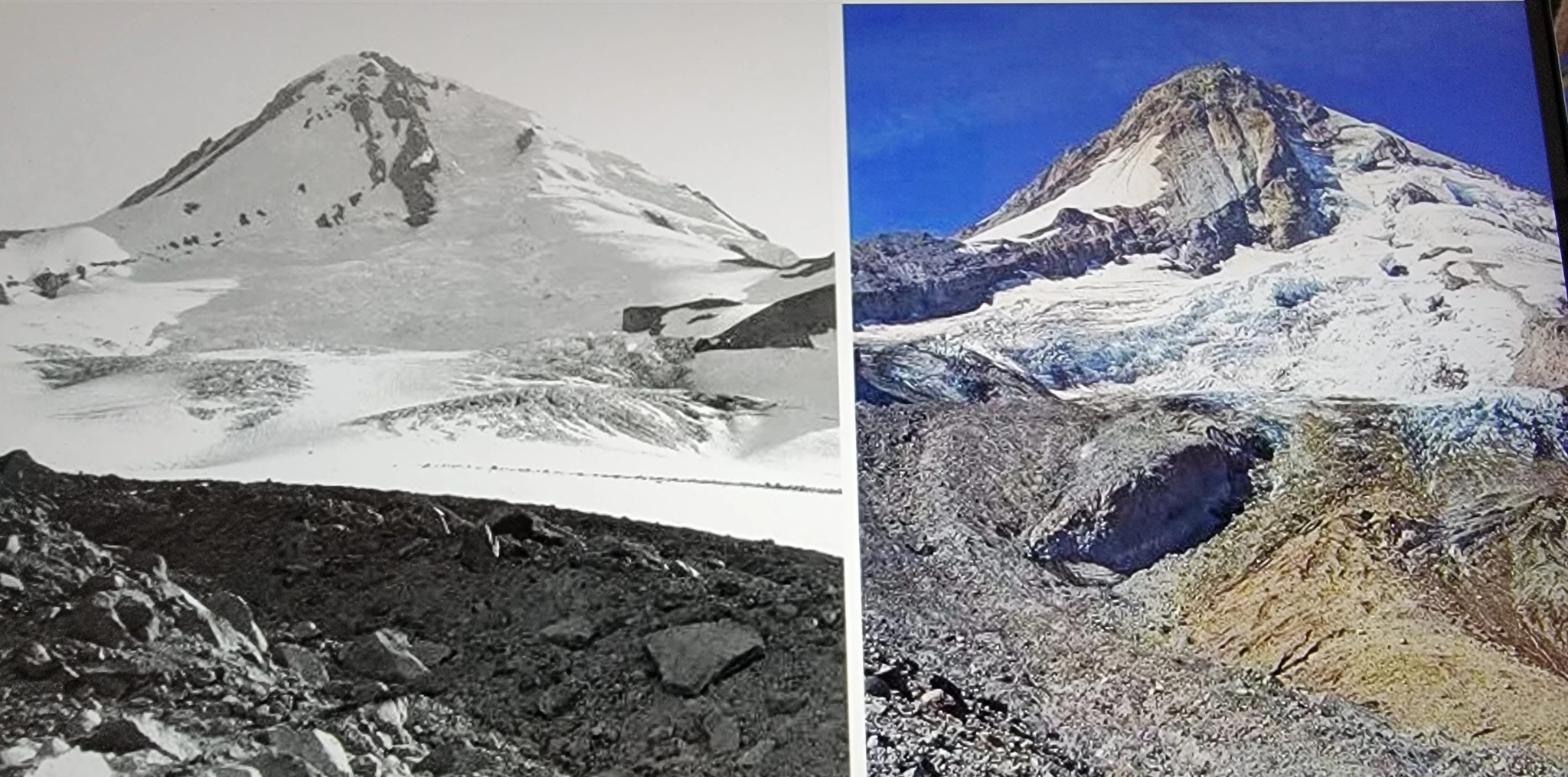
Mount Hood, Oregon, in August 1901 on the left, and August 2015, on the right. The Eliot glacier, front and center, which used to sprawl for miles, is in the process of disappearing completely.
What is happening then, when most climate scientists speak of holding the 1.5 C line (obviously completely impossible, even if humanity stopped emitting CO2 immediately)???… Or when they admit that we are on a 2.7C future in 2100? Well, those scientists have been captured by the establishment… They say what ensure their prosperous careers… At a global rise of 2.7 C, we get a migration of the permafrost line of around 500 kilometers towards the poles… Catastrophic, yes, but still, Antarctica will not obviously start to melt, big time.
If it came to light that a seven degree centigrade rise is a real possibility, authorities would turn around and really do some things, which may destabilize the worldwide plutocratic establishment: carbon tariffs are an obvious example. Carbon tariffs could be imposed next week… and they would have a big impact of the CO2 production. So why are carbon tariffs not imposed? Carbon tariffs would destabilize the deindustrialization gravy train: by employing who are basically slaves in poor countries, plutocrats make themselves ever wealthier, while making sure there would be no insurrection at home… A trick already used in imperial Rome, by the Senatorial aristocracy/plutocracy. That would be highly effective… By the way, without saying so, of course, and maybe even unwittingly, this is basically what Trump had started to do…
The devil has these ways which the commons do not possess…
That would stop the crafty, dissembling nonsense that countries such as France are at 4.6 tons per capita of CO2 emissions per year… That’s only true when all the CO2 emitted to produce the goods the French need is NOT counted.. including deforestation in Brazil to grow soybean. With them counted, one gets to 11 tons or so, more than double… The wonderful graph of CO2 emissions collapsing in Europe is the same graph as collapsing industrial production…
The devil has these ways the commons have not even detected…
Carbon tariffs would be a way to solve two wrongs in one shot: the wrong of deindustrialization, of corrupt pseudo-leaders not putting the most advanced countries, their own countries, first… And the wrong of producing too much CO2.
Little fixes will go a long way, as long as they incorporate hefty financing fundamentally researching new energy (it does not really matter which type, as long as it is fundamental…)
Patrice Ayme
ooOOoo
Now this isn’t some academic treatise that doesn’t affect the likes of you and me. This is, as I have said, the harsh reality of NOW!
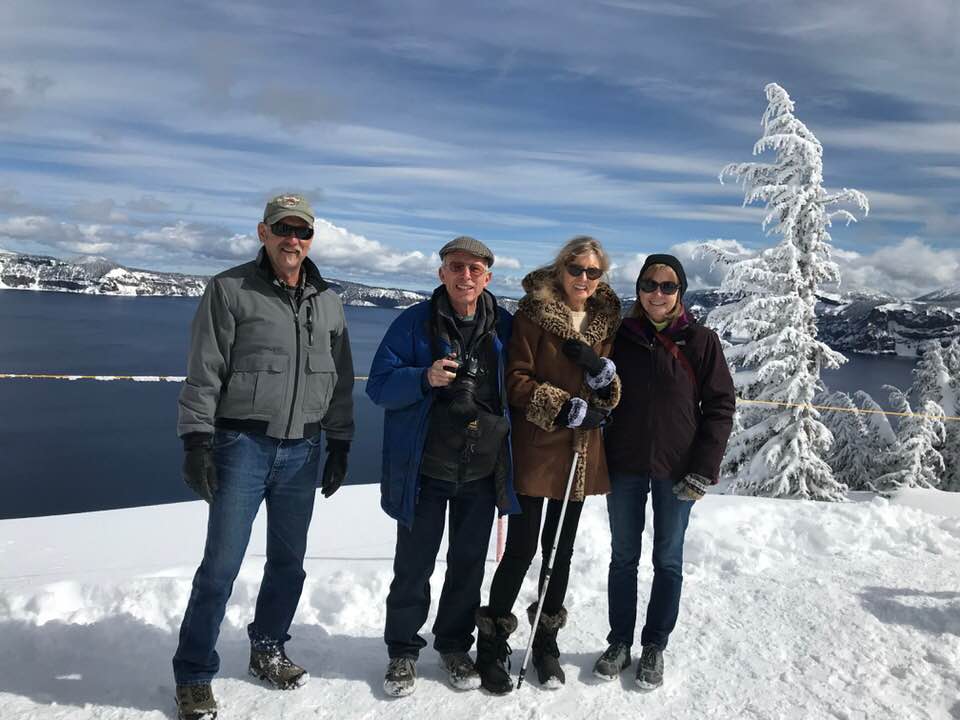
Here’s a photo of me and Jeannie together with Andy and Trish taken in March, 2018. On the edge of Crater Lake.
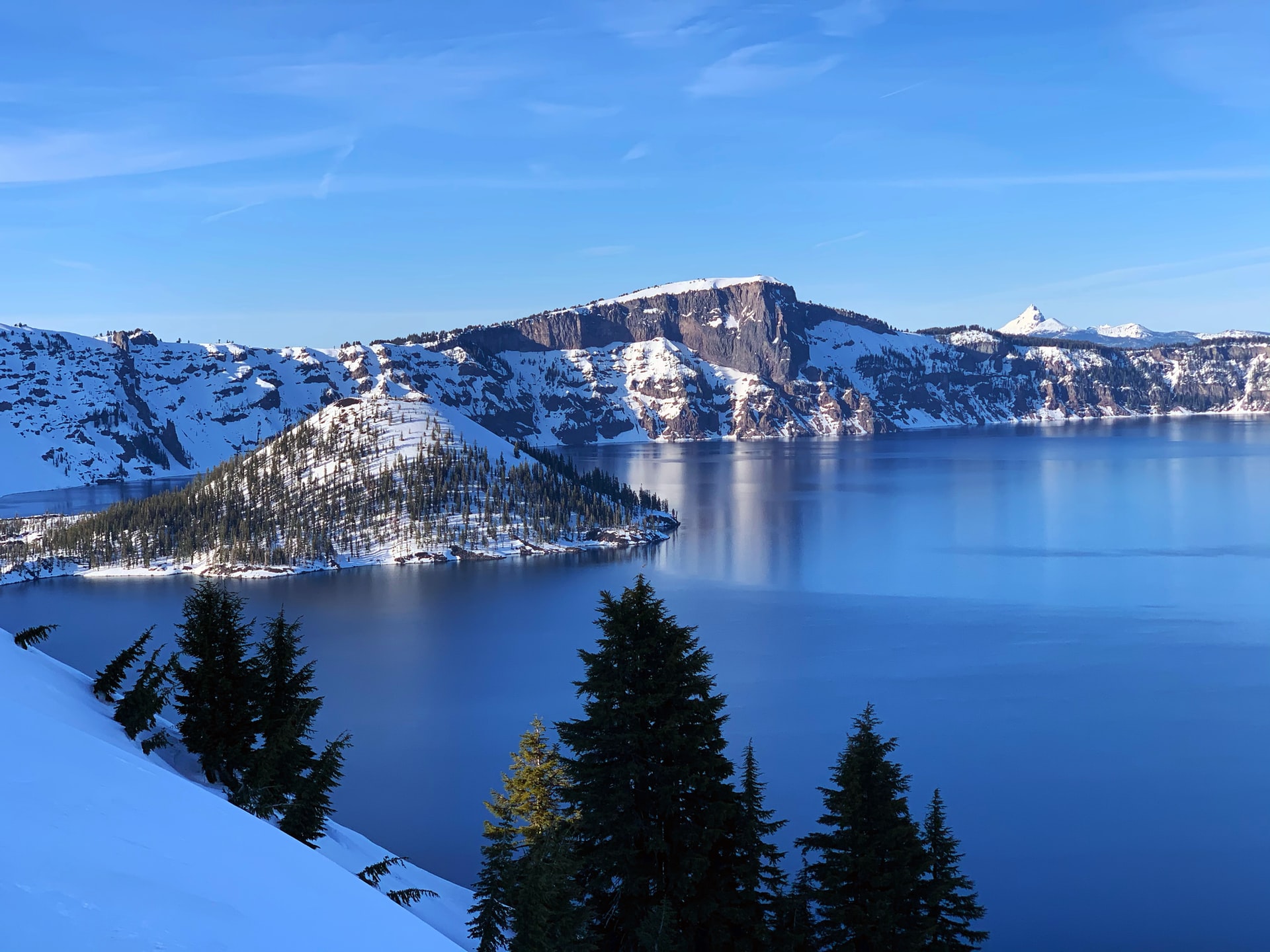
Then this is a stock photograph of Crater Lake taken in March, 2020.
Taken by Valerie Little
Not a great deal of difference but the trees in the photo above aren’t encased in snow as is the tree in the 2018 photo.
Now there is important news to bring you from COP 26. On Sunday Boris Johnson said:
Scientists say this would limit the worst impacts of climate change.
During a Downing Street news conference, Mr Johnson said:
“We can lobby, we can cajole, we can encourage, but we cannot force sovereign nations to do what they do not wish to do”
“For all our disagreements, the world is undeniably heading in the right direction”
The “tipping point has been reached in people’s attitudes” – with leaders “galvanised and propelled by their electorates”
But “the fatal mistake now would be to think that we in any way cracked this thing”
Mr Johnson said that despite the achievements of the summit, his reaction was “tinged with disappointment”.
He said there had been a high level of ambition – especially from countries where climate change was already “a matter of life and death”.
And “while many of us were willing to go there, that wasn’t true of everybody”, he admitted.But he added the UK could not compel nations to act. “It’s ultimately their decision to make and they must stand by it.”
That point about attitudes is interesting. Who would have thought, say, five years ago, that attitudes had changed so dramatically by late-2021.
One hopes that we will come to our collective senses but I can’t see the CO2 index being returned to its normal range without machines taking the excessive CO2 out of the atmosphere. Because, as was quoted on The Conversation nearly a year ago:
On Wednesday this week, the concentration of carbon dioxide in the atmosphere was measured at at 415 parts per million (ppm). The level is the highest in human history, and is growing each year.
Finally, my daughter, Maija, and my son-in-law, Marius, had a child some ten years ago. He is my grandson and I left England before he was born. He is Morten and he is a bright young spark.
Morten
Morten and all the hundreds of thousands of young persons like him are going to have to deal with the world as they find it!
They are incredibly intuitive but not in such a broad way as us humans.
On Friday morning Oliver got lifted up onto the bed. It’s a daily routine and one that Jeannie and I love.
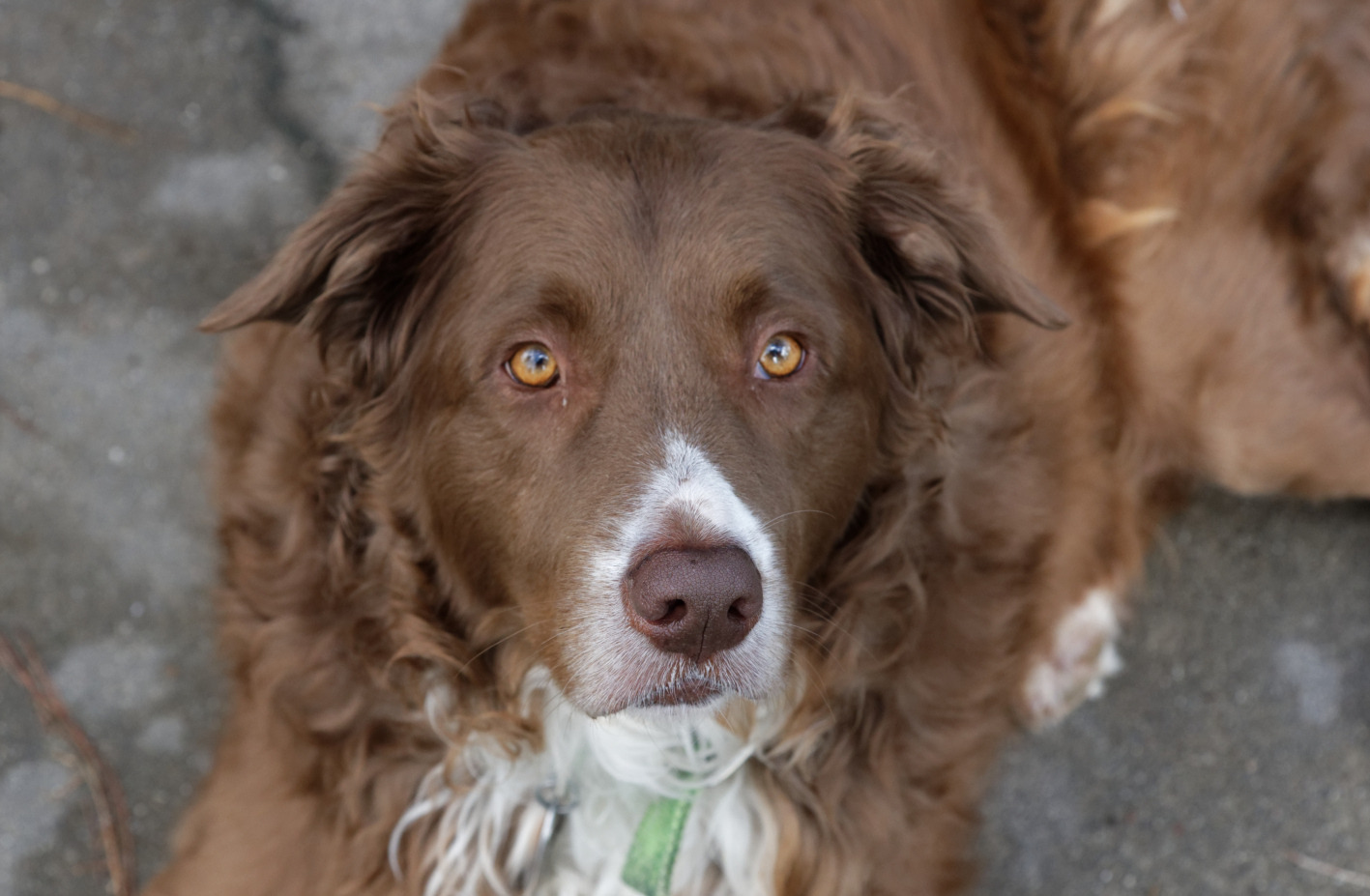
Oliver – He has magnificent eyes.
On this particular early morning I decided to switch the lamp off next to me and snuggle under the covers for a bit more shuteye. At the moment the light went out Oliver moved from his regular position somewhere over my knees to the bottom of the bed in between me and Jean. He has never done that before.
Of all our dogs Oliver is the one that seems to sense what is happening. That is not to say that the other dogs are dumb, far from it, but that Oliver is extra intuitive.
So that’s why this from Science magazine is being republished today. Because it is right on the money, so to speak.
ooOOoo
Dogs Know When You’re Lying to Them
By the BEC Crew, 25th February, 2015
We all know that dogs can sense our emotions, whether happy, sad or angry, but now researchers have found that they can also tell when you’re lying, and will stop following the cues of someone they deem untrustworthy.
Researchers led by Akiko Takaoka from Kyoto University in Japan figured this out by using the old ‘point and fetch’ trick – a human points at the location of something, like a ball, a stick, or some food, and the dog runs off to find it. They wanted to figure out if dogs were just blindly following these cues, or if they were adjusting their behaviour based on how reliable they perceived the person giving the cues to be. And if they didn’t perceive this person as being reliable, how quickly would they learn to mistrust and disobey the humans who pointed in the wrong direction?
Working with 34 dogs, the team went through three rounds of pointing. The first round involved truthfully pointing out to the dogs where their treats and toys were hidden in a container. In the second round, after showing the dogs what’s in the container, they pointed out the location again, but this time, it was a trick – the container was empty. In the third round, the team pointed to the location of the box, which was filled with treats again.
They found that the dogs were following the age-old adage, “Fool me once, shame on you, fool me twice, shame on me,” because by round three, many of them were done believing the actions of the pointing volunteers.
A second experiment was performed in exactly the same way as the first one, except the person was replaced by an entirely new one. The dogs happily started the process all over again, and were fully open to trusting their new ‘friend’. “That suggests, says Takaoka, that the dogs could use their experience of the experimenter to assess whether they were a reliable guide,” Melissa Hogenboom writes for BBC News. “After these rounds, a new experimenter replicated the first round. Once again, the dogs followed this new person with interest.”
What’s going on here, the researchers report in the journal Animal Cognition, is that the dogs were ‘devaluing’ the reliability of the human when they experienced their lies. “Dogs have more sophisticated social intelligence than we thought,” Takaoka told Hogenboom. “This social intelligence evolved selectively in their long life history with humans.”
The experiment reaffirms what we know about the nature of dogs – they love routine, but they also love new things. In round one, they learnt how the activity goes: the human points, I sniff out something great. But in round two, the rules changed and the dogs became stressed out. But when round three came along, the human who broke the rules was replaced by a different human, and the dogs were happy to trust this one because of their love of trying new things.
“Dogs are very sensitive to human behaviour but they have fewer preconceptions,” Bradshaw told the BBC. “They live in the present, they don’t reflect back on the past in an abstract way, or plan for the future.” And they certainly don’t approach a situation by “thinking deeply about what that entails”, he said.
Something to think about when you consider inflicting the ‘fake tennis ball’ game on your dog. It might work a few times for hilarious effect, because your dog trusts you way more than the dogs in the experiment trusted the strangers they just met, but how long will it last?
It also explains why dogs are so unsure about magicians:
ooOOoo
So to all the dogs in the world I say this: “Keep on trusting us humans!” And to the millions of dog owners in the world, I say this: “Never lie, especially to a dog!”
Lulu the border collie was left $5 million (£3.6 million) after her owner died last year.
Bill Dorris left the dog in the care of his friend, Martha Burton. The will states that Burton is to be reimbursed for Lulu’s reasonable monthly expenses.
There was such a good response to the article on the Hubble that I published on April 27th that it was an easy decision to republish the article that was presented on the BBC website on the 24th, and this time the photographs can be downloaded.
By Jonathan Amos, Science correspondent, 24 April 2020
It’s 30 years ago to the day that the Hubble telescope was launched – and to celebrate its birthday, the veteran observatory has produced another astonishing image of the cosmos.
This one is of a star-forming region close to our Milky Way Galaxy, about 163,000 light-years from Earth.
The larger object is the nebula NGC 2014; its companion is called NGC 2020.
But astronomers have nicknamed the scene the “Cosmic Reef” because it resembles an undersea world.
[There is an audio by Antonella Nota that is a little under 10 minutes long. I cannot embed it into this post for some unclear reason. Go here if you want to listen to it! It’s well worth listening to.]
Antonella Nota: “It’s called the people’s telescope because it brought the Universe to the people”
Famously blighted by blurred vision at the outset of its mission in 1990, Hubble was eventually repaired and upgraded.
The remarkable pictures it has taken of planets, stars, and galaxies have transformed our view of the cosmos.
Indeed, there are those who think Hubble is the most important scientific tool ever built.
It’s still far from retirement.
The US space agency (Nasa), which runs the observatory in partnership with the European Space Agency (Esa), says operations will be funded for as long as they remain productive.
Last year, its data resulted in almost 1,000 scientific papers being published – so it continues to stand at the forefront of discovery.
For its 25th birthday, Hubble imaged a giant cluster of stars called Westerlund 2
Engineers obviously keep a watching brief on the health of Hubble’s various systems. Pleasingly, all four instruments onboard – the two imagers and two spectrographs – work at full tilt.
In the past, the telescope’s Achilles heel has been the six gyroscopes that help turn and point the facility, maintaining a rock-steady gaze at targets on the sky.
These devices have periodically failed down the years, and during their final servicing mission in 2009 space shuttle astronauts were tasked with replacing all six.
Three have subsequently shut down again, but Nasa project scientist Dr Jennifer Wiseman says this is not yet an issue for serious concern.
“Nominally, we need three gyroscopes, but we can operate on just one due to the ingenuity of the engineers,” she asserted.
There’s a quiet confidence that Hubble can keep working well into the 2020s. Its supposed “successor” – the James Webb Space Telescope (JWST) – is due for launch next year, but the presence in orbit of this more modern observatory will in truth merely just extend capability; it won’t make Hubble redundant.
That’s because the new facility has been designed to see the cosmos at longer wavelengths of light than Hubble. The duo will be complementary and will on occasion actually pursue targets together to get a fuller perspective.
This is an exciting prospect for astronomers everywhere – but especially for those in Europe where Hubble has been such a rewarding endeavour, says Esa project scientist Dr Antonella Nota.
“From the memorandum of understanding there was a guarantee that European astronomers would get 15% of observing time for the duration of the mission. If I look back at how much time European astronomers got – on average it’s 22%. And it is a peer-reviewed process so we never needed to put a finger on the scales. European astronomers are creative; they’re smart; they’re doing leading-edge science,” she told BBC News.
What has Hubble contributed to science?
It’s a bit of a cliche, but Hubble has truly been a “discovery machine”.
Before the telescope launched in 1990, astronomers didn’t know whether the Universe was 10 billion years old or 20 billion years old.
Hubble’s survey of pulsating stars narrowed the uncertainty, and we now know the age extremely well, at 13.8 billion.
The observatory played a central role in revealing the accelerating expansion of the cosmos – a Nobel Prize-winning breakthrough – and it provided the definitive evidence for the existence of super-massive black holes at the centre of galaxies.
The Deep Field images require Hubble to stare at the same patch of sky for days on end
It’s amazing to think that when Hubble launched, scientists had yet to detect the first exoplanet, the name given to a planet orbiting a star other than our Sun. Today, Hubble is pioneering the study of these far-off worlds, examining their atmospheres to try to gauge their nature.
And although the sparkling eight-metre-class ground-based telescopes can now match – and even exceed – Hubble’s skill in certain fields of study, the space telescope remains peerless in going super-deep.
Its so-called Deep Field observations in which it stared at a small patch of sky for days on end to identify the existence of very distant, extremely faint galaxies is one of the towering achievements in astronomy.
These studies have shown us what the Universe was like just a few hundred million years after the Big Bang. Only JWST, with its finely-tuned infrared detectors, will go deeper still.
A Hubble classic: The Veil Nebula is the expanding debris of an exploded star
Kathryn Sullivan was one of the astronauts onboard Space Shuttle Discovery when it released Hubble into its 612km-high orbit on 25 April, 1990 – a day she recounts in a recent book, Handprints On Hubble.
“Hubble’s scientific impact has just been immense. But what I had not really appreciated until I started writing my book was the extent to which Hubble – because of its gorgeous images and their mind-bending implications – has really permeated popular culture,” she told BBC News.
“I see Hubble on the side of U-Haul (rental) trailers, on tattoos, on lunchboxes, on shirts, in advertisements, almost ubiquitously.
“And I think part of that is down to Hubble coming into service just as the internet was becoming the thing we now know it to be.
“That’s put the pictures right in front of people.”
JWST will study the Universe at longer wavelengths of light
ooOOoo
This is the most amazing invention and regular missions to service the telescope including regular updates to the technology have kept it current.
It has produced the most distant and beautiful photographs. It has also refined our knowledge of when the universe came into existence – 13.8 billion years ago.




 Learning from Dogs
