Whatever one’s view is about the significance of CO2 levels in the Earth’s atmosphere, this blog is about integrity. As the byline states, “Dogs are integrous animals. We have much to learn from them.” Regular readers (and thank you for being one) know that this blog ranges far and wide in pursuit of stories, essays and examples of integrity, all the more better when they involve a dog!
All dog owners know that one of the prime things we can learn from our dogs is the ability to remain in the present. No, more than that! To value and cherish the present. Dogs manage this in an effortless manner, in a way that humans can only dream of achieving.
This came to me as a result of a recent post on Damn the Matrix, Mike Stasse’s fascinating blog. The post was about what we humans regret at the end of our days, which I will come to in a moment.
Mike had taken the theme from a recent book by Australian author Bronnie Ware. Her website is here from where one learns:
Picture from The Sunday Mail (Qld)
Bronnie Ware is an inspiring and creative soul from Australia.
Through her work Bronnie weaves delightful tales of real life observations and experience. Using gentleness, honesty, and humour, Bronnie celebrates both the strength and vulnerability of human nature. Her message is a positive and inspiring one.
Bronnie is the author of the full-length memoir, The Top Five Regrets of the Dying– A Life Transformed by the Dearly Departing, released worldwide, with translations in 27 languages. She also runs an online personal growth and songwriting course, has released two albums of original songs, and writes a well-loved blog called Inspiration and Chai.
Every challenge brings its own gifts. Sometimes though it is not always easy to see those gifts at first. Suffering and wounds can blind us. We have all been there. It is at times like these that Inspiration and Chai is needed. Inspiration to soothe the heart. Chai to soothe the body.
Even during happier cruising chapters, being inspired is still a beautiful thing. It keeps us going. It reminds us of what we already know.
Inspiration and Chai is an ongoing journey. The aim of this site is to share inspirational stories and motivational thoughts and for it to reach more and more people in need, seekers on their path. It is a positive environment to revisit whenever you feel it calling. It is also somewhere for me to share my love of story telling and to share memories of life.
Jean is no stranger to the death of a dog. Over her many years of rescuing dogs Jean has seen far too many deaths. I have been living with Jean since 2008. In that short time five of our dogs have died.
Of course, we have no idea of what goes through a dog’s mind in those last stages of life. Dogs appear to embrace death in an uncomplicated way but we will never know for sure.
What about humans? On Bronnie’s blogsite there is a post under the title of Regrets of the dying. Whatever age you are, read what Bonnie wrote and ponder:
REGRETS OF THE DYING
For many years I worked in palliative care. My patients were those who had gone home to die. Some incredibly special times were shared. I was with them for the last three to twelve weeks of their lives.
People grow a lot when they are faced with their own mortality. I learnt never to underestimate someone’s capacity for growth. Some changes were phenomenal. Each experienced a variety of emotions, as expected, denial, fear, anger, remorse, more denial and eventually acceptance. Every single patient found their peace before they departed though, every one of them.
When questioned about any regrets they had or anything they would do differently, common themes surfaced again and again. Here are the most common five:
1. I wish I’d had the courage to live a life true to myself, not the life others expected of me.
This was the most common regret of all. When people realise that their life is almost over and look back clearly on it, it is easy to see how many dreams have gone unfulfilled. Most people had not honoured even a half of their dreams and had to die knowing that it was due to choices they had made, or not made.
It is very important to try and honour at least some of your dreams along the way. From the moment that you lose your health, it is too late. Health brings a freedom very few realise, until they no longer have it.
2. I wish I didn’t work so hard.
This came from every male patient that I nursed. They missed their children’s youth and their partner’s companionship. Women also spoke of this regret. But as most were from an older generation, many of the female patients had not been breadwinners. All of the men I nursed deeply regretted spending so much of their lives on the treadmill of a work existence.
By simplifying your lifestyle and making conscious choices along the way, it is possible to not need the income that you think you do. And by creating more space in your life, you become happier and more open to new opportunities, ones more suited to your new lifestyle.
3. I wish I’d had the courage to express my feelings.
Many people suppressed their feelings in order to keep peace with others. As a result, they settled for a mediocre existence and never became who they were truly capable of becoming. Many developed illnesses relating to the bitterness and resentment they carried as a result.
We cannot control the reactions of others. However, although people may initially react when you change the way you are by speaking honestly, in the end it raises the relationship to a whole new and healthier level. Either that or it releases the unhealthy relationship from your life. Either way, you win.
4. I wish I had stayed in touch with my friends.
Often they would not truly realise the full benefits of old friends until their dying weeks and it was not always possible to track them down. Many had become so caught up in their own lives that they had let golden friendships slip by over the years. There were many deep regrets about not giving friendships the time and effort that they deserved. Everyone misses their friends when they are dying.
It is common for anyone in a busy lifestyle to let friendships slip. But when you are faced with your approaching death, the physical details of life fall away. People do want to get their financial affairs in order if possible. But it is not money or status that holds the true importance for them. They want to get things in order more for the benefit of those they love. Usually though, they are too ill and weary to ever manage this task. It is all comes down to love and relationships in the end. That is all that remains in the final weeks, love and relationships.
5. I wish that I had let myself be happier.
This is a surprisingly common one. Many did not realise until the end that happiness is a choice. They had stayed stuck in old patterns and habits. The so-called ‘comfort’ of familiarity overflowed into their emotions, as well as their physical lives. Fear of change had them pretending to others, and to their selves, that they were content. When deep within, they longed to laugh properly and have silliness in their life again.
When you are on your deathbed, what others think of you is a long way from your mind. How wonderful to be able to let go and smile again, long before you are dying.
Life is a choice. It is YOUR life. Choose consciously, choose wisely, choose honestly. Choose happiness.
I hesitated to write anything more because that last sentence should be the one that continues to resonate.
So just a reflection on how easy it is for a dog to wag its tail – dogs so easily choose happiness.
Yesterday, I published a soft little item showing some reflective pictures and rather appropriate words of attachment. Little did I know that some very powerful word forces were planning same day to really thump me around the head. Here’s what happened.
The church that Jean and I go to on a regular basis is very inspiring. Two reasons come to mind. The first is the love and friendship that the congregation offer, both to regulars and visitors alike. The second is the spiritual inspiration gifted to the priest and, boy oh boy, does that come out through his sermons. Indeed, the rest of this article was motivated by yesterday’s sermon.
Take a look at the American railway ticket above. Turn your head and look at the right-hand part. What do you read? ‘This check is not good if detached‘. Now let me quote a little from the sermon,
It is difficult to care for people in the world when we are not a caring community. It is totally absurd to speak of peace in a world when we do not have peace in our community. It is impossible to be an instrument of love in the world if we are not a community of love.
What is true in the Church is of course true in the world as a whole. We do need to learn to live together. Railway tickets used to carry the words, “Not good if detached.” That is true of life in general. Our survival and progress as people on this planet are dependent on our interrelatedness.
See the beautiful spiritual inspiration that comes from those gifted to draw such powerful word pictures. Take that last word ‘interrelatedness’. Jean and I are studying at the local college for a Master Gardener’s Certificate. For the simple reason that we have to find a way to tame our wild garden, comprised mainly of decomposed granite granules, so that we can grown our own vegetables, have some chickens, that sort of thing.
The last session was about botany. To a complete non-gardener like me it was, nonetheless, fascinating. What moved me beyond measure was the detail and complexity of all things botanical; grasses, trees, shrubs, flowering plants, you name it. It was the interconnectedness of it all. Here’s an example.
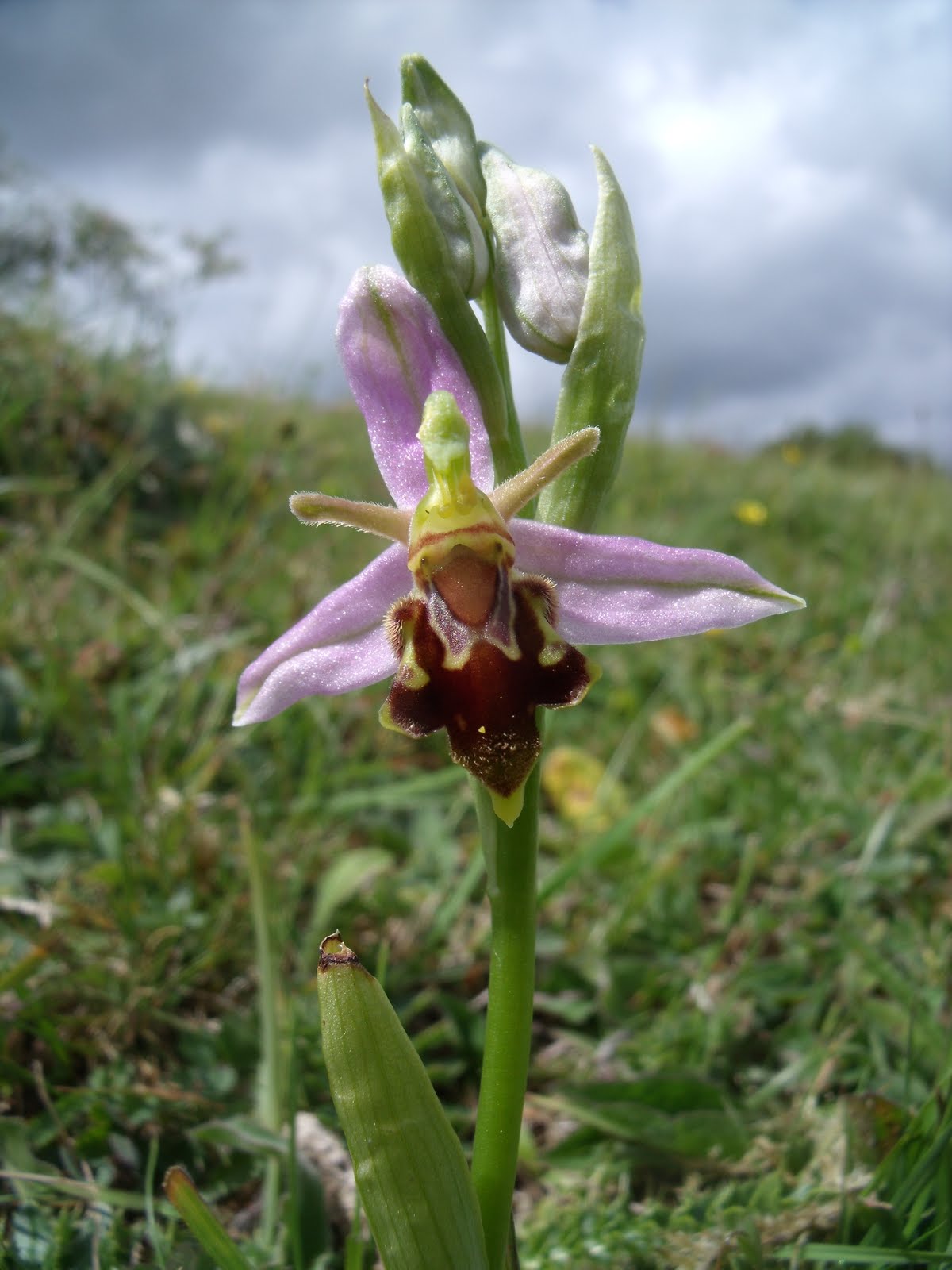
Not a female wasp, just an orchid.
Certain orchids dupe male wasps into trying to mate with them. Here are a few extracts from a piece in the New Scientist website,
Few can resist the allure of a beautiful rose, but some wasps outdo even the most ardent flower lover. Presented with the right specimen, a male orchid dupe wasp ejaculates right on the petals.
Many insects mistake flowers for femmes, but few go as far as these wasps, says Anne Gaskett, a biologist at Macquarie University in Sydney, Australia, who led a study of the insects’ amorous intentions toward two species of Australian tongue orchids. “It’s just so hard [for the wasps] to resist,” she says.
Now have a quick watch of this video extract from the BBC,
OK, let me get back to that botany class. As our teacher pointed out, lose that particular species of wasp and the planet probably loses that species of orchid. Think about the interconnectedness of that, and much more in the beautiful planet all around us. It is such a marvellous, beautiful, complex and interconnected world. We need constant reminding of that fact. Which is where yesterday’s sermon hit the mark again.
Inspired by the pictures from a flight to the moon in 1968, American poet Archibald MacLeish spoke these beautiful words:
“To see the earth as it truly is, small, blue, beautiful in the eternal silence where it floats, is to see ourselves as riders on the earth together …“
That is a wonderful image, riders on the earth together. It speaks of our togetherness as a human race, brothers and sisters on this fragile island within the vastness of the universe. Brothers and sisters … that really need to know … that we are brothers and sisters.
We need to do all that we can to build bridges, to mend bridges, to stay together as a true community… because we are:
Not good if detached. Amen.
What a powerful sermon. What inspired power in those words. Real words.
Earthrise, from Apollo 8, 1968
Forgive me for holding your attention just a tad longer. This is the full Archibald MacLeish’s quotation, referred to in the sermon above.
To see the earth as it truly is, small and blue and beautiful in that eternal silence where it floats, is to see ourselves as riders on the earth together, brothers on that bright loveliness in the eternal cold—brothers who know now they are truly brothers.
— Archibald MacLeish, American poet, ‘Riders on earth together, Brothers in eternal cold,’ front page of the New York Times, Christmas Day, 25 December 1968
This is what Frank Borman, who was on Apollo 8, had published in Newsweek, 23 December 1968,
When you’re finally up at the moon looking back on earth, all those differences and nationalistic traits are pretty well going to blend, and you’re going to get a concept that maybe this really is one world and why the hell can’t we learn to live together like decent people.
This is what Frank Borman was reported as saying in the press in early 1969,
I think the one overwhelming emotion that we had was when we saw the earth rising in the distance over the lunar landscape . . . . It makes us realize that we all do exist on one small globe. For from 230,000 miles away it really is a small planet.
and this,
The view of the Earth from the Moon fascinated me—a small disk, 240,000 miles away. It was hard to think that that little thing held so many problems, so many frustrations. Raging nationalistic interests, famines, wars, pestilence don’t show from that distance.
The power in those words. The power of the truth about our interconnectedness and the power of Not good if detached.
Let me leave you with a fragment from another Blogsite that I came across quite by chance while researching for this piece.
A blog is a voice, the inner voice, telling, in this case, what is going on, inside and out. And in me, that means it should also be about my spiritual path. My spiritual life is as important to me as breathing. Without connection with the One, what is life? What is it for?
Let’s all pray to keep the flame of hope burning brightly for these guys.
On the 24th August, Learning from Dogs published a piece about 33 Chilean miners trapped underground. I’m sure many read that.
Well the BBC are still covering the event and their news web site has an informative update on what is happening.
The plan to rescue the 33 men trapped 700m (2,300ft) underground in the San Jose copper mine in Chile is a complex undertaking that could take engineers until the end of the year to achieve.
In a similar operation in 2002, American rescuers spent two days drilling a hole just wide enough to fit a man to rescue nine miners trapped underground.
The Americans had to drill down just 74m. By comparison, the plan to rescue the 33 men in Chile nearly three quarters of a kilometre underground is a much greater challenge. But, says John Urosek, who took part in the 2002 Quecreek mine rescue in Pennsylvania, it is not “mission impossible.”
“I would put this at the tough end of things. It’s not mission impossible but it’s a difficult mission,” says Mr Urosek who is now chief of mine emergency operations for the US Mine Safety and Health Administration.
The key to the operation is the use of a specialist drilling machine, designed to bore deep narrow holes through any rock to a depth of just over a kilometre.













 Learning from Dogs