Category: Writing

Haircut!

How hard could it be, really? Just a few snips here and there should do it.

I hadn’t intended to publish a post for today. But then I saw Stephen Messenger’s post over at The Dodo and I thought that it was far too good not to share with you.

ooOOoo

Well-Meaning Mom Decides To Try Cutting Dog’s Hair Herself

“I fell on the floor laughing.”

By Stephen Messenger
Published on 8/15/2020

How hard could it be, really? Just a few snips here and there should do it.

That, apparently, was what one well-meaning dog mom thought when she decided to cut her dog’s overgrown hair herself at home.

And, well, you’ll see how that turned out.

SUSANA SOARES

The other week, Susana Soares was hanging out with her dog, Mano, when she realized his hair had gotten rather overgrown. It’d been a while since Mano had been to the groomers, and his shag was becoming a bit of an issue.

“Hair was getting in his eyes,” Soares told The Dodo.

Mano wasn’t loving it.

SUSANA SOARES

Soares, who’s actually worked as a hair stylist for humans, figured that taming Mano’s unruly mane would be no sweat.

“I decided to cut his hair at home,” she said.

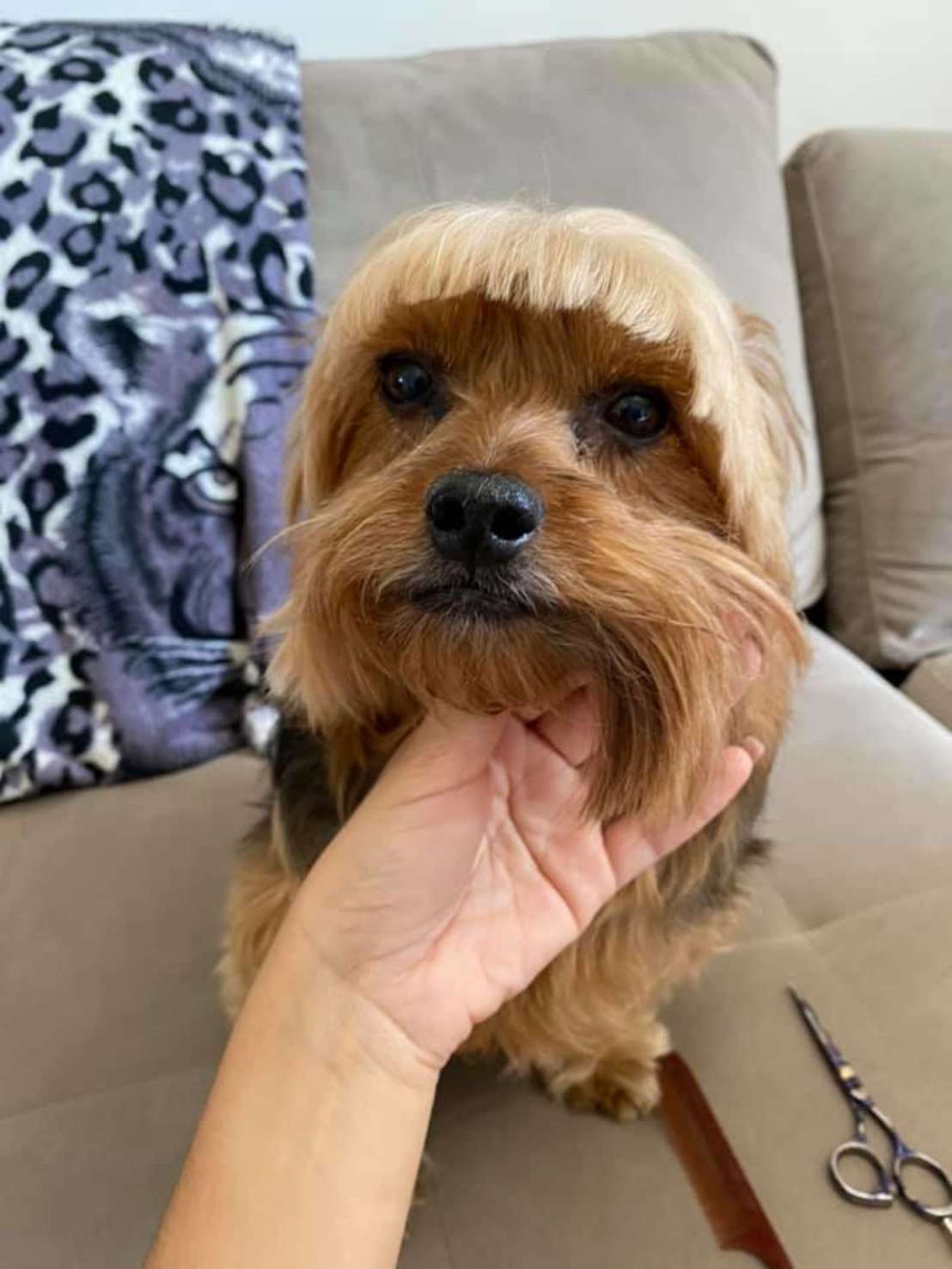
So, Soares grabbed some scissors and got down to business — and this is what resulted:

SUSANA SOARES

Soares had solved Mano’s hair-in-the-eyes issues sure enough.

She gave him bangs — bangs that inadvertently gave Mano a questionable new look.

It was almost as if the little dog had cut his bangs himself. Without a mirror.

SUSANA SOARES

Mano didn’t have to ask Soares how she thought his new ‘do’ turned out.

“I fell on the floor laughing,” she said.

SUSANA SOARES

Did the cut look ridiculous? Yes, of course it did. But Mano’s not vain. He could see clearly again, after all.

“He likes it,” Soares said.

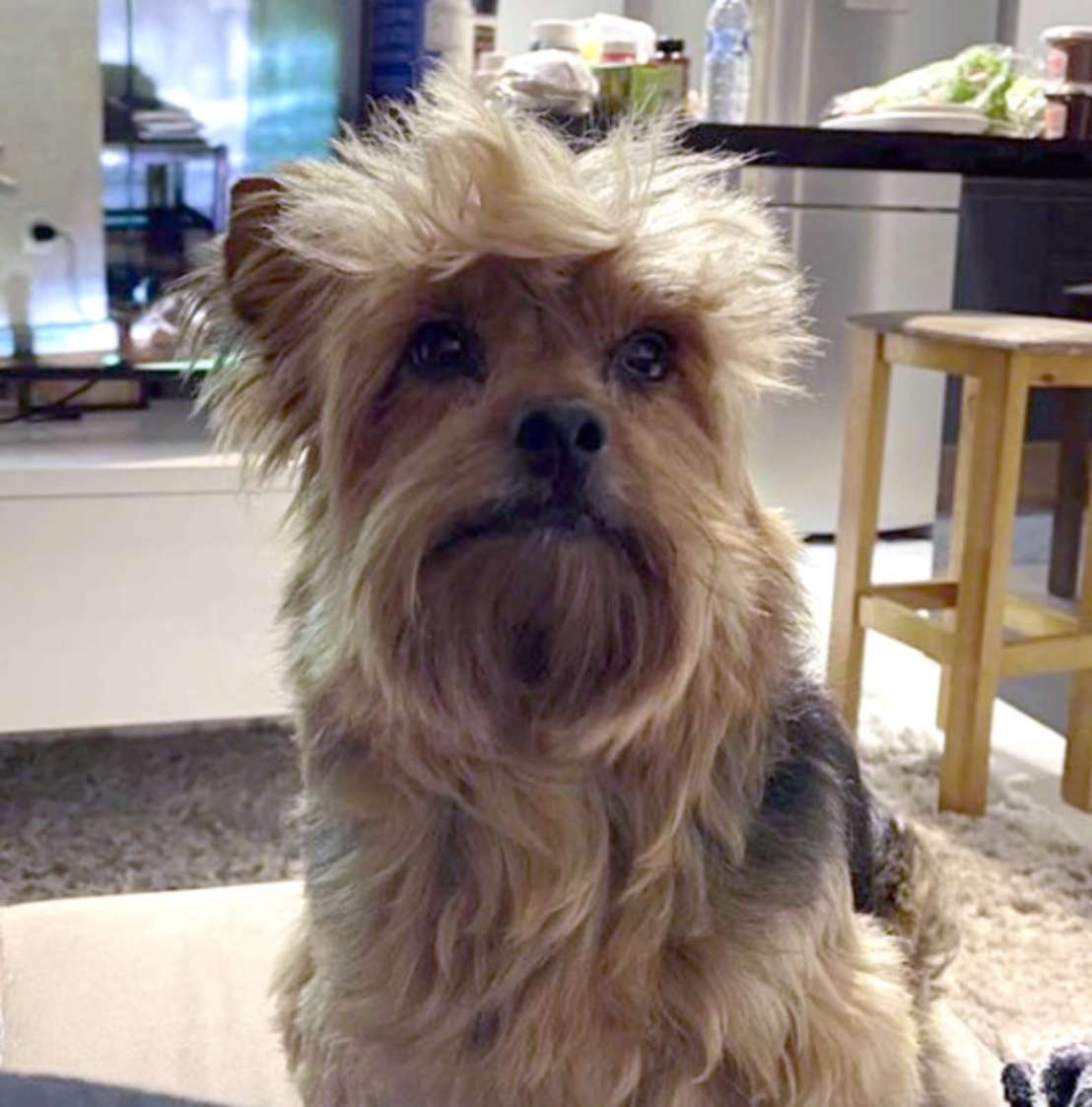
Fortunately, when tussled, Mano’s haircut looks less silly. If only slightly so.

SUSANA SOARES

Despite how things turned out, Soares did have the best intentions — and that’s what matters most.

SUSANA SOARES

Bad haircuts come and go. And thankfully, in time, Mano’s bangs will grow back into a more natural look.

When it comes time to trim them again, Soares plans to keep her scissors in the drawer and leave it to the pros.

“I will not be repeating that!” she said.

ooOOoo

See what I mean. This was a delightful story and I really have nothing to add other than joining in with the laughter!

Wonderful story of a reunited dog and its owner.

This is just a beautiful story!

Dog lovers have two fears in their hearts: their dog dying and their dog going missing.

I think in many ways a dog going missing is the more difficult of the two to handle. There are so many questions unanswered!

So when The Dodo published this story earlier this Summer I immediately put it in my ‘blog’ folder. Somehow I overlooked the story but that is remedied today!

ooOOoo

Dog Is Overjoyed To Reunite With His Mom After 2 Years Apart.

“[He] looked me straight in the eyes as if he was saying, ‘I gotta see that this is really you.’”

By Lily Feinn
Published on 7/1/2020.
Two years ago, Linda Harmon’s beloved dog Twixx went missing from her yard.

Twixx had been a bit of an escape artist, known for digging tunnels under the fence. That’s how he ended up with a little scar on the top of his head.

Harmon’s husband had recently installed metal posts around the fence making it impossible for Twixx to get out. After checking the gate and the fence, they couldn’t find any signs of tampering — it was as if Twixx had just disappeared.

Linda Harmon

Harmon began searching the neighborhood, making posters, posting on Facebook and checking with the local animal control. Then a woman who had been following Twixx’s story on Facebook reached out to Harmon via text.

“She said, ‘I’m so sorry to send you this, but I found your Twixx. He’s been hit on the side of the road and here’s his picture,’” Harmon told The Dodo. The woman sent Harmon a photo of the top of the dog’s head, and there was Twixx’s little scar.

Linda Harmon

Harmon reported Twixx as deceased to the microchip company, but still had difficulty accepting that he was really gone. “I never truly believed it in my heart,” Harmon said. “My husband said, ‘You’ve got to let this go. You’re grieving over him.’ But I said I would never get another dog and I didn’t for two years.”

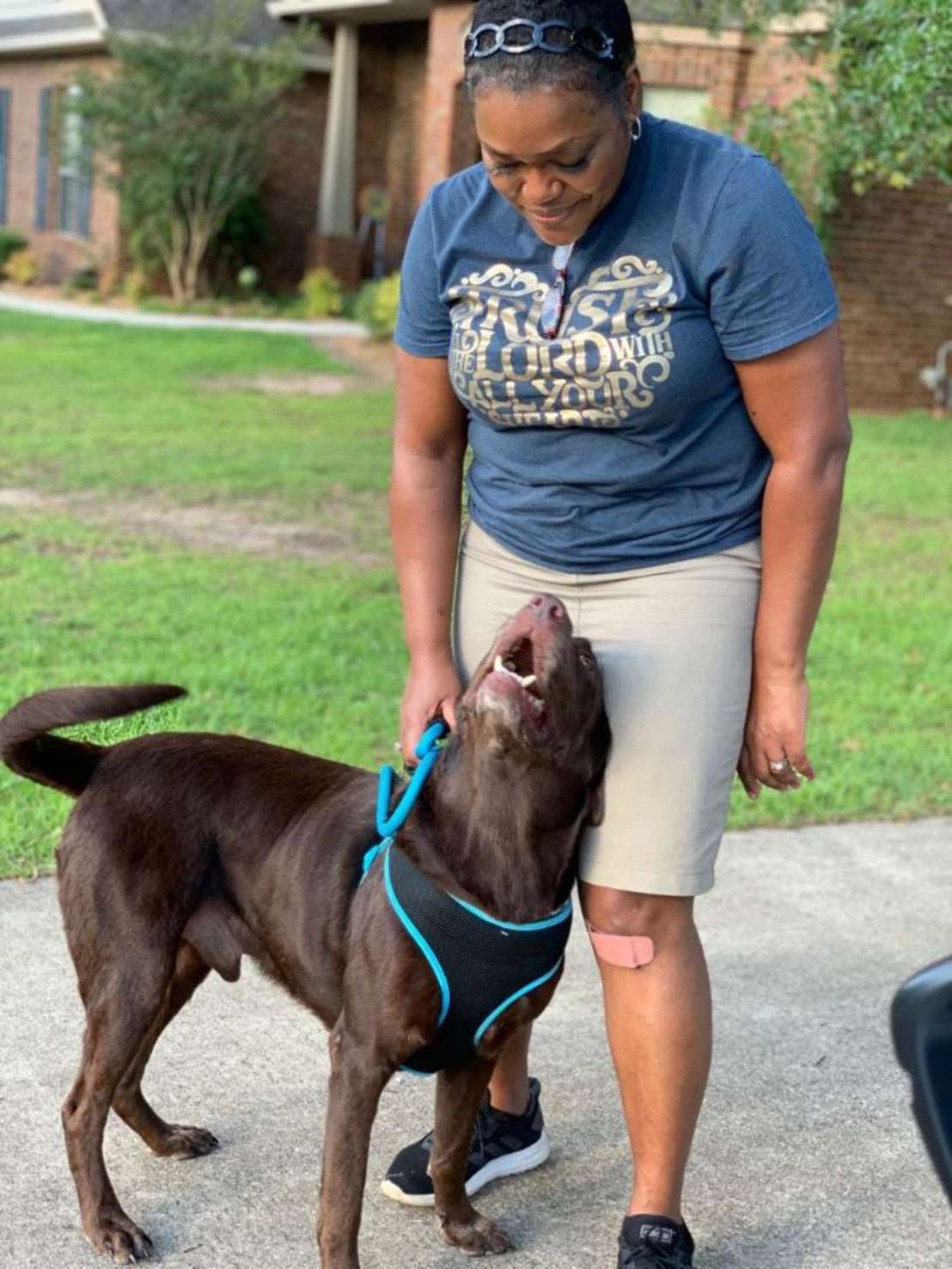
Then, earlier this month, Harmon was sitting with her church group when a miracle happened — she received a call from the local animal shelter asking if she had ever owned a chipped pet.

“I just started bawling. I was crying endlessly, and I was around quite a few church members and they rushed to me, thinking I had bad news,” Harmon said. “But when they looked at me I was smiling.”

FACEBOOK/MOBILE COUNTY ANIMAL SHELTER

After so long apart, Harmon worried that Twixx wouldn’t remember her. And the last thing she wanted was to make her dog feel scared or uncomfortable.

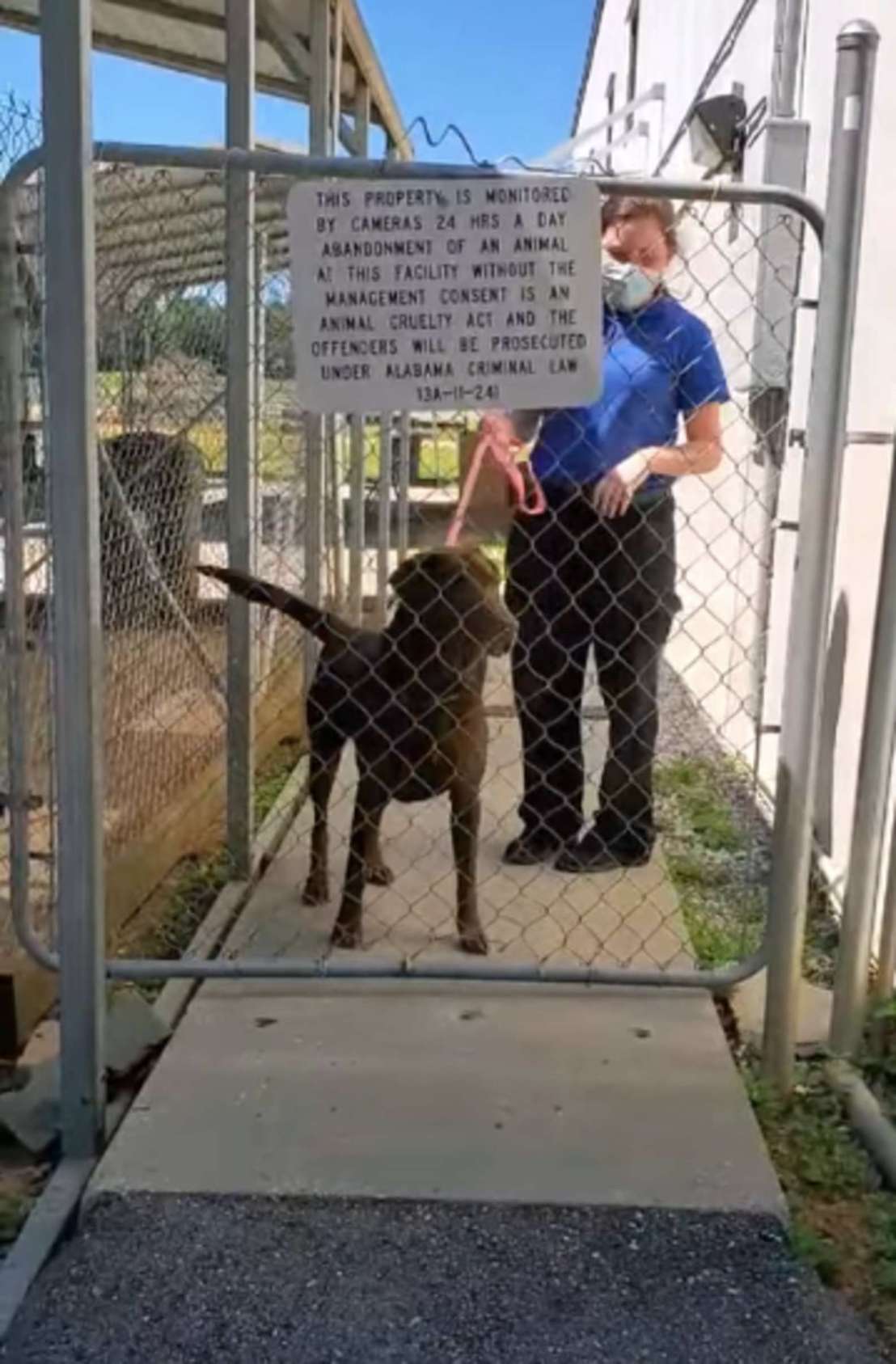
So the shelter came up with a plan: When Harmon came to pick up Twixx, they would hold him behind the gate while she called his name, and shelter staffers would watch the dog’s reaction.

FACEBOOK/MOBILE COUNTY ANIMAL SHELTER

When Twixx arrived at the shelter gate, Harmon began to gently say his nickname — Tootaroota — and as soon as the dog heard her, he put his snout on the ground as if sniffing for his mom.

“Finally, when I bellowed out ‘Twixx’ he ran to the gate and stood at attention,” Harmon said. “And I heard the lady say, ‘Let him out because he’s trying to find her.’”

As soon as they opened the gate, Twixx turned the corner and ran straight to his mom. It was as if he remembered every minute they had spent together, and the two years apart faded away.

“He couldn’t stop wiggling — oh my goodness — and he just jumped on me,” Harmon said. “Then he laid his head in my arms and looked me straight in the eyes as if he was saying, ‘I gotta see that this is really you.’”

FACEBOOK/MOBILE COUNTY ANIMAL SHELTER

Soon everyone watching the reunion had tears in their eyes — including Harmon.

Now, Twixx is home safe and sound with the family that loves him. And he hasn’t dug another hole since.

ooOOoo

Dogs store the scents of humans that have loved them forever. In a very real sense it is part of their memory system albeit it is very different to the memories that you and I have. For dogs have a scenting ability, call in a nose, that is 100 million times better than ours. It is impossible for us humans to truly comprehend what that means to a dog.

But Twixx demonstrated this superbly because the first thing he did was to “put his snout on the ground as if sniffing for his mom.

So many stories about our wonderful dogs!


The science of dog learning.

A very interesting article in The Smithsonian Magazine.

There are countless breeds of dogs and they represent thousands of years of breeding.

But recent work in determining the genetic background behind the many different features of dogs has revealed so much.

The Smithsonian Magazine published an article nearly a month ago and hopefully it is alright to share it with you.

ooOOoo

What a Crowdsourced Study Taught Us About How Dogs Learn

A new study looks at the genes that underlie traits from self control to communication


Three dogs sit at attention ( MediaProduction

By Viviane Callier, July 31, 2020

Thousands of years of selective dog breeding has created a fantastic diversity of domestic canine companions, from the workaholic border collie to the perky Pomeranian. In cultures around the world, humans bred different dogs to be good at tasks including guarding, hunting and herding. Later, in Victorian England, kennel clubs established breed standards related not only to their behavior, but also their appearance.

As genomic sequencing has become more affordable, scientists have begun to understand the genes behind physical features such as body shape and size. But understanding the genes behind dog cognition—the mental processes that underlie dogs’ ability to learn, reason, communicate, remember, and solve problems—is a much trickier and thornier task. Now, in a pair of new studies published in Animal Cognition and in Integrative and Comparative Biology, a team of researchers has begun to quantify just how much variation in dog cognition exists, and to show how much of it has a genetic basis.

To study canine cognition, the studies’ authors turned to publicly available genetic information from a 2017 study, and a large community science project, Dognition.com, in which dog owners tested their own pets. “These papers offer an exciting integration of two forms of big data,” says Jeff Stevens, a psychologist at the University of Nebraska-Lincoln who was not involved in the study.

Previous studies often compared cognition in one breed against another using small sample sizes of dogs from each. This study, by contrast, is the first to examine the variation in cognition across three dozen breeds, and the genetic basis of that variation, explains Evan MacLean, a comparative psychologist at the University of Arizona who oversaw the pair of new studies. MacLean says dog breeds may be an ideal way to study the heritability of cognitive traits because breeds—all part of the same species—represent close genetic relatives with an incredibly diverse range of appearances and behaviors.

To gather a sufficient amount of data on how dogs reason and solve problems, the researchers looked to the Dognition.com portal. The initiative, created by Duke University dog researcher Brian Hare, started with tests in the lab. Researchers developed methods to understand how dogs think. They then stripped those methods down, and simplified them for dog owners to do themselves. In an earlier project, the researchers tested dogs in the lab and compared their results to those from owners testing the same dog at home. The results were the same, giving them confidence that the results from the citizen science project were reliable.

To participate in this project, dog owners tested their pups on 11 standardized tasks used by animal behaviorists on a variety of species that reflect four aspects of cognition: inhibitory control, communication, memory and physical reasoning. One task that measured inhibitory control, for example, involved having an owner put a treat on the floor in front of the dog and then verbally forbidding the dog from taking it. The owner then measured how long the dog would wait before eating the treat. In a task to assess communication skills, the dog owner placed two treats on the ground and gestured towards one of them. The owner then determined if the dog approached the indicated treat. To assess memory, the owner visibly placed food under one of two cups, waited for a few minutes, and then determined if the dog remembered which cup the food was placed under. To test physical reasoning, the owner hid food under one of two cups, out of view of the dog. The owner lifted the empty cup to show the dog that there was no food and then assessed whether the dog approached the cup with the food underneath.

The participating dog owners reported their dog’s scores and breed, producing a dataset with 1,508 dogs across 36 breeds. The researchers analyzed the scores and found that about 70 percent of the variance in inhibitory control was heritable, or attributable to genes. Communication was about 50 percent heritable, while memory and physical reasoning were about 20 percent heritable.

“What’s so cool about that is these two traits that are highly heritable [control and communication] are those that are thought to be linked to dogs’ domestication process,” says Zachary Silver, a graduate student in the Canine Cognition Center at Yale who was not involved in the study.

Dogs are better at following humans’ communicative cues than wolves, and this is something that seems to be highly heritable, explains Silver. In contrast, there’s some evidence that wolves are better than dogs at physical reasoning.

Some of these traits are also influenced by environment and how the dog was handled as a puppy, so there are both genetic and environmental components. In fact, there is so much environmental and experiential influence on these traits that Gitanjali Gnanadesikan, a graduate student in MacLean’s lab and lead author of the new studies, cautions against the idea that these findings support certain breed restrictions or stereotypes. “Even the highly heritable traits have a lot of room for environmental influence,” she says. “This shouldn’t be interpreted as, ‘each of these breeds is just the way they are, and there’s nothing that can be done about it.’”

In the same way that women are on average shorter than men, but there’s quite a lot of overlapping variation within each sex, dog breeds also show a lot of variation within each breed that overlaps with variation among breeds.

Previous work has linked differences in inhibitory control to the estimated size of dogs’ brains. Comparative studies across many different species, ranging from tiny rodents to elephants and chimpanzees, also show that some aspects of self-control are strongly related to brain size. The bigger the brain size, the more self-control the animals seem to have, MacLean says.

Stevens notes that a lot of things—not just inhibitory control—correlate with brain size across species. And brain size, metabolic rate, lifespan, home range size are all correlated with body size. When many traits are correlated with each other, it is not clear which of these factors may underlie the cognitive differences. So there are a number of questions remaining to be explored.

After showing the degree to which different aspects of dog cognition are heritable, Gnanadesikan and MacLean used publicly available information on the genomes of dog breeds to search for genetic variation that was associated with the cognitive traits of interest. The researchers found that, like many other complex traits, there were many genes, each with small effect, that contribute to dogs’ cognitive traits. That is in contrast to morphological features in dogs; about 50 percent of variation in dog body size can be accounted for by variation in a single gene.

One of the limitations of the study is that the researchers did not have cognitive and genetic information from the same dogs; the genomes were breed averages. In the future, the researchers are planning to collect genetic data from the very same dogs that are completing the cognitive tests, to get measures of cognitive and genetic variation at the level of individual dogs. “This gives us a roadmap for places that we might want to look at more carefully in the future,” MacLean explains.

ooOOoo

Now this is an article that deserves to be read carefully so if you are in a hurry bookmark this and wait until you can sit and absorb the messages the article contains.

I was minded to look up Gitanjali’s details and I am glad I did. These are the details:

Gitanjali Gnanadesikan
I am an evolutionary biologist and comparative psychologist who is interested in social behavior and cognition. I work with Evan MacLean in the Arizona Canine Cognition Center studying the development and evolution of behavior and cognition in dogs and wolves.

I think I will reach out to her and see if she has more information she would like to share with us all.

Magnetic rivers!

Yes, you heard that correctly.

There was an article on the website EarthSky News yesterday that, literally, took me out of this world. It described the role of magnetic rivers in newly forming star clusters.

There’s not a dog in sight but nevertheless I wanted to share this article with you.

ooOOoo

Magnetic rivers feed star birth

Astronomers have learned that the pull of gravity can sometimes overcome the strong magnetic fields found in great star-forming clouds in space. The resulting weakly magnetized gas flow can feed the growth of new stars.

See the lines – called streamlines by scientists – in this composite image of the Serpens South star cluster? They’re from magnetic fields in this great star-forming cloud. Notice the lower left, where magnetic fields have been dragged into alignment with a narrow, dark filament. In that area, astronomers say, material from interstellar space is flowing into the star-forming cloud and fueling star formation. Image via NASA/ SOFIA/ T. Pillai/ JPL-Caltech/ L. Allen/ USRA.

Astronomers have known for decades that stars like our sun form when giant clouds of gas and dust in space – sometimes called molecular clouds – collapse under their own gravity. But how does the material from interstellar space flow into these clouds, and what controls the collapse? The image above helps illustrate an answer to these questions. It’s a composite, made with data from SOFIA – an airborne telescope designed for infrared astronomy – overlaid on an image from the now-retired Spitzer Space Telescope. This composite shows that the pull of gravity can sometimes overcome the strong magnetic fields found in great star-forming clouds in space. And it shows that, when that happens, weakly magnetized gas can flow – as on a conveyor belt – to feed the growth of newly forming star clusters.

A statement from the Max Planck Institute in Bonn, Germany, explained:

A major finding in the last decade has been that extensive networks of filaments permeate every molecular cloud. A picture has emerged that stars like our own sun form preferentially in dense clusters at the intersection of filaments.

Now look back at the image above, which shows the Serpens South star cluster, a star-forming region located some 1,400 light-years from Earth. In that image, you see a dark filament in the lower left. Now notice the “stripes” on the image, which astronomers call streamlines. They represent magnetic structures, discovered by SOFIA. The astronomers said these magnetic structures act like rivers, channeling material into the great star-forming cloud.

As you can see in the image, these magnetic streamlines have been dragged by gravity to align with the narrow, dark filament on the lower left. Astronomers say this configuration helps material from interstellar space flow into the cloud.

This is different from the upper parts of the image, where the magnetic fields are perpendicular to the filaments; in those regions, the magnetic fields in the cloud are opposing gravity.

Astrophysicist Thushara Pillai led the study showing that magnetic rivers feed star birth in the Serpens South star-forming region.

The scientists said in a statement from Universities Space Research Association (USRA) that they are:

… studying the dense cloud to learn how magnetic fields, gravity and turbulent gas motions contribute to the creation of stars. Once thought to slow star birth by counteracting gravity, SOFIA’s data reveals magnetic fields may actually be working together with gravity as it pulls the fields into alignment with the filaments, nourishing the birth of stars.

The results were published in the peer-reviewed journal Nature Astronomy on August 17. The lead author of the new study is Thushara Pillai of Boston University and the Max Planck Institute for Radio Astronomy in Bonn, Germany.

In 1835, the French philosopher Auguste Comte wrote of the unknowable nature of stars:

On the subject of stars, all investigations which are not ultimately reducible to simple visual observations are … necessarily denied to us. While we can conceive of the possibility of determining their shapes, their sizes, and their motions, we shall never be able by any means to study their chemical composition or their mineralogical structure … Our knowledge concerning their gaseous envelopes is necessarily limited to their existence, size … and refractive power, we shall not at all be able to determine their chemical composition or even their density…

He was, famously, wrong.

He couldn’t have envisioned the range of tools available to modern astronomers. It’s a beautiful thing that, nowadays, astronomers can not only learn about the compositions of stars via their studies of their spectra, but also probe the deeper mysteries, going all the way to the births of these colossal, self-luminous balls in space.

SOFIA, the Stratospheric Observatory for Infrared Astronomy. The HAWC+ polarimeter on board SOFIA was used for the observations of the magnetic field in the Serpens South star-forming region. Image via NASA/ C. Thomas/ Max Planck Institute.

Bottom line: Astronomers have learned that the pull of gravity can sometimes overcome the strong magnetic fields found in great star-forming clouds in space. The resulting weakly magnetized gas flow can feed the growth of new stars.

Source: Magnetized filamentary gas flows feeding the young embedded cluster in Serpens South

ooOOoo

Just read that paragraph just before the end of the article: “He couldn’t have envisioned the range of tools available to modern astronomers. It’s a beautiful thing that, nowadays, astronomers can not only learn about the compositions of stars via their studies of their spectra, but also probe the deeper mysteries, going all the way to the births of these colossal, self-luminous balls in space.”

What a long way we have come from just, say, 50 years ago.

It would be easy to get lost in the article in a scientific manner, and that would be entirely appropriate.

But there’s another beautiful way to get lost in the article; by dreaming of outer space and forgetting just for a moment or two this Earthly planet we all live on!


Creative thinking!

Now that’s what I call a good idea!

And not one that would immediately have occurred to me. For I am not the world’s greatest thinker in the sense of thinking around the problem.

So this post captures the essence of that ‘alternative’ view; for and on behalf of their dog.

It comes from the Daily Dodo.

ooOOoo

Family Decorates Dog’s Special Spot To Entertain All The Neighbors

“People walk up and take selfies with the fence and Burger.”

A few months after he was adopted last year, Burger started digging under his family’s fence. He wanted to be able to watch all the people going by, and after thinking about it for a while, his dad came up with the best idea.

He decided to cut a hole in the fence to make a little window for Burger so he could watch the world go by, and Burger instantly fell in love with it.

BRIAN STANLEY

“As soon as I was done, Burger had his head through it and immediately stopped digging,” Brian Stanley, Burger’s dad, told The Dodo. “Best decision ever!”

Now, every time he goes outside, Burger goes straight to his little window. He loves greeting people as they pass by, and he definitely brings a smile to all his neighbors whenever they see his little head peeking out through the window.

BRIAN STANLEY

When the coronavirus pandemic forced things to shut down in March, Stanley and his family noticed that there were suddenly a lot more people out and about walking past their fence than there had been before. The family hoped that seeing Burger would help bring a smile to everyone’s faces during such a hard time — and then Stanley had an idea to take it to the next level.

Brian Stanley

“At first it started as a joke with my wife that I was going to paint something on the street side of the fence around the dog window, but then the idea of painting an actual picture and hanging it up to frame the hole started to form in my mind,” Stanley said. “The shutdown brought an obvious black cloud along with it. Even though more people were out on the street walking or biking, we knew it was due to job loss and uncertain times. I first talked about it to my son who was 100% behind the idea of putting something up on the fence to hopefully bring a smile to people’s faces.”

BRIAN STANLEY

With the idea cemented in their minds, Stanley and his 7-year-old son Cameron got to work on their first painting. They decided to create a version of the famous painting “The Scream” and call it “The Bark.” They hung up the painting and admired their work. They hadn’t been planning on making any more paintings, but after the first one, the ideas just kept coming — and now the artwork framing Burger’s window is constantly changing.

So far they’ve done “Paws” …

Brian Stanley

… “Jurassic Bark” …

BRIAN STANLEY

… and even a Pac-Man-themed painting.

BRIAN STANLEY

Every time his family puts up a new creation, Burger is always right there, and quickly sticks his head out of his window to admire their work.

Of course, the initial goal of the paintings was to help brighten people’s days, and so far that’s absolutely been achieved.

BRIAN STANLEY

“People have told us that they plan their walks and bike rides to go by our fence and some people will even alter their drives so it takes them past it,” Stanley said. “I have been outside on multiple days with the dogs and see people walk up and take selfies with the fence and Burger. People bring treats to him and he just soaks up the attention. Both my wife and I have been stopped by people when they see us outside so they can tell us how much they love what we are doing and that they hope we don’t stop.”

BRIAN STANLEY

Stanley and his family currently have new painting ideas planned all the way through January 2024. They’re so happy that their paintings and Burger are able to bring a little joy to their community. Of course, Burger probably loves the paintings most of all, because they’ve brought so many new people to his fence who he can watch and say hello to.

“All in all, it’s brought us closer to the community and the community closer to us while making everyone happy … it doesn’t get much better than that,” Stanley said.

ooOOoo

This post comes with a good number of fabulous photographs. Makes one really think of Burger as the dog next door. And it shows the ingenuity of Brian Stanley and his wife and son, Cameron; first class!

It is a very nice article. A’hh, that’s too tame. It’s a brilliant article! Much better.

Weddings!

Thought this would get your attention but read on:

There is no end to the love that so many people bestow on their dogs. I have said it before and there’s absolutely no doubt that I will say it again; many times!

One could go deeper into the human psychology to understand why, about the joy of having an animal who is sensitive to our moods but never rejects us. About the devotion and loyalty that dogs give us, well the vast majority of us, and who never expect anything in return other than a stroke or a cuddle.

I’m minded to be in this mood because today (ergo yesterday) I had to deal with an infestation of ants in the house. Luckily we had an unopened packet of Diatomaceous earth and, hopefully, that has put a stop to it. One of the issues of living in a rural part of the world.

So the following post spoke to me!

ooOOoo

Kids Hold A Wedding For Senior Dog So He Can Marry His Best Friend

Photo Credit: Jennifer Burke

When Toby first arrived at Newman Nation: Senior Pets United, he needed a lot of help. He was 15 and had been severely neglected for most of his life. His fur was extremely matted. The rescue knew he would need a special family to foster him, and immediately thought of Jennifer Burke.

Burke and her family have experience with hospice animals, and were immediately on board to take in Toby.

“When Toby first joined our family, he was really scared and timid, in addition to being very sick,” Burke told The Dodo. “He was such a little pathetic mess and we fell in love with him immediately. Shortly after getting Toby, we discovered he was blind, and deaf, which was quite a surprise.”

They soon discovered that he had cancer, but the little dog recovered surprisingly well after treatment, and the family quickly decided he’d be staying with them forever.

Photo Credit: Jennifer Burke

Toby quickly fell in love with every member of his new family — especially Zoey.

Zoey was rescued from a puppy mill where she had been bred over and over again. She was never properly socialized so she’s often a little awkward around other dogs, but for some reason, she and Toby just work. Over the past two and a half years the two dogs have fallen completely in love with each other, and do absolutely everything together.

“It was really poignant to see two misfits start to figure out friendship and eventually fall in love,” Burke said. “They really are an awkward match made in heaven.”

Toby is now 17 years old, and his family recently discovered that he has cancer again. This time, he was only given a few months to live. His family knew this day would come eventually, but they were still so heartbroken — and then they had the best idea.

Photo Credit: Jennifer Burke

“After giving my kids the devastating news of his prognosis, my 8-year-old son, Dillon, said, ‘Well, I think Toby and Zoey should get married before Toby dies,’” Burke said. “Immediately, our family agreed. It was a perfect way to celebrate Toby and the really meaningful role he has played in our lives.”

All five family members began planning out the wedding together, as everyone wanted to be involved in making sure Toby and Zoey had the most perfect day.

“My daughter helped pick out Zoey’s wedding dress and she wrote the dogs’ vows,” Burke said. “My boys helped prep the backyard for the ceremony. My husband suggested throwing the wedding on the date of our 12-year anniversary, making the day even more special.”

Finally, everything was ready. The backyard was decorated, the cake was made and the entire family was dressed up and ready to celebrate the love of Toby and Zoey.

Photo Credit: Jennifer Burke

The wedding was absolutely perfect. While Toby and Zoey maybe weren’t as huge fans of getting dressed up and posing for pictures, they absolutely loved getting to kiss each other, eating cake and of course being together. That’s always been their most favorite thing of all.

Toby may not have a ton of time left, but his family is determined to make sure that what time he does have is filled with so much love. Toby has meant so much to his family over the past few years, especially to Zoey, and they’re so glad they were able to spend a day celebrating him and his best friend.

“Toby has enhanced our family so much in the last 2.5 years, but we had never realized the impact it could have on Zoey,” Burke said. “She is the one who has gained the most by having Toby in our lives. And I have no doubt that having Zoey in his life has enabled Toby to live so long. While I know Zoey will have a sad and difficult adjustment after Toby’s death, he has made her life so much fuller than we could have ever expected.”

ooOOoo

Just read that last paragraph again: “Toby has enhanced our family so much in the last 2.5 years, but we had never realized the impact it could have on Zoey,” That was said by Jennifer Burke. Then she said how beneficial Toby was on the life of fellow dog Zoey.

It is a very lovely story and, once again, we have to thank The Daily Dodo.

Our very dear, beloved dogs!

Who are you? How did you get here?

That is to the United States of America.

We tend to watch many of the TED Talks that come our way.

But this one had me riveted to my seat. It’s a very powerful, nearly 9 minutes long, talk given by a person who doesn’t have legal citizenship.

Speaking on a personal basis, I was a person who went through the Citizenship test, successfully I might add, in March, 2019. So I watched this video with more than just academic interest.

See if you sense the feelings I had.

At age 16, journalist and filmmaker Jose Antonio Vargas found out he was in the United States illegally. Since then, he’s been thinking deeply about immigration and what it means to be a US citizen — whether it’s by birth, law or otherwise. In this powerful talk, Vargas calls for a shift in how we think about citizenship and encourages us all to reconsider our personal histories by answering three questions: Where did you come from? How did you get here? Who paid?
Jose Antonio Vargas, author of “Dear America: Notes of an Undocumented Citizen,” is the founder of Define American, a nonprofit organization that uses stories to shift the narrative on immigrants.

In the 10th July issue of Science magazine there was an Editorial written by Sudip Parikh, CEO of the American Association for the Advancement of Science (AAAS).

I am taking the liberty of republishing that Editorial here. For I think it needs to be widely shared.

ooOOoo

Immigrants help make America great

Sudip Parikh

Science  10 Jul 2020:
Vol. 369, Issue 6500, pp. 120
DOI: 10.1126/science.abd6868

I am a scientist. I am an American. And I am the product of special expert visas and chain migration—among the many types of legal immigration into the United States. On 22 June, President Trump issued a proclamation that temporarily restricts many types of legal immigration into the country, including that of scientists and students. This will make America neither greater nor safer—rather, it could make America less so.

The administration claims that these restrictions are necessitated by the coronavirus disease 2019 (COVID-19) outbreak to prevent threats to American workers. This reasoning is flawed for science and engineering, where immigrants are critical to achieving advances and harnessing the resulting economic opportunity for all Americans.

For decades, the United States has inspired both immigrants and nonimmigrants to make substantial contributions to science and technology that benefit everyone. Preventing highly skilled scientists and postdocs from entering the United States directly threatens this enterprise.

My uncle, a geologist, came to the United States in the 1960s to work at NASA. He then taught at Appalachian State University in North Carolina and later served as lead geochemist for the state of California. He sponsored my father to come to America in 1968. Leaving Mumbai, a city of millions, and arriving in Hickory, a town of thousands in North Carolina, my father came home to a place he had never been before. My parents worked in furniture factories and textile mills to put us though college and ensure we had opportunities. Today, my sister works at the U.S. Centers for Disease Control and Prevention, and I have the privilege of leading the American Association for the Advancement of Science (AAAS, the publisher of Science). We exist because of the Immigration and Nationality Act of 1965 and our parents’ belief in the vision of the United States as a shining city on a hill. My family’s story is repeated by thousands of American scientists.

These stories include uncertainty when an immigrant’s status in America is in question. This uncertainty causes stress and the possibility that immigrants will leave and take their skills, talents, and humanity elsewhere. For the successful, these stories culminate with relief, celebration, and the pride of becoming a naturalized citizen. As President Reagan said, the United States is the one place in the world where “anybody from any corner of the world can come…to live and become an American.” Naturalized citizens love the United States deeply because they chose to be American. They and other immigrants make huge contributions to science and engineering.

According to the National Science Foundation, more than 50% of postdocs and 28% of science and engineering faculty in the United States are immigrants. Of the Nobel Prizes in chemistry, medicine, and physics awarded to Americans since 2000, 38% were awarded to immigrants to the United States. I don’t know the number of prizes given to second-generation Americans but Steven Chu—current chair of the AAAS Board of Directors—is among them. The incredible achievements of the American scientific enterprise speak volumes about the vision and forethought of the American people who have worked to create a more perfect union.

Suspending legal immigration is self-defeating and breaks a model that is so successful that other nations are copying it. As Thomas Donohue, chief executive officer of the U.S. Chamber of Commerce, said regarding the administration’s proclamation, “Putting up a ‘not welcome’ sign for engineers, executives, IT experts, doctors, nurses, and other workers won’t help our country, it will hold us back. Restrictive changes to our nation’s immigration system will push investment and economic activity abroad, slow growth, and reduce job creation.”

To develop treatments and vaccines for COVID-19, cure cancers, go to Mars, understand the fundamental laws of the universe and human behavior, develop artificial intelligence, and build a better future, we need the brain power of the descendants of Native Americans, Pilgrims, Founding Mothers and Fathers, Enslaved People, Ellis Island arrivals, and immigrants from everywhere. The United States has thrived as a crossroads where people are joined together by ideas and contribute by choice to the freedom and opportunity provided by this wonderful, inspiring, and flawed country that is always striving to live up to its aspirations.

Scientists, look around your labs and offices. Think about your collaborations and friendships. We must ensure that this “temporary” restriction on legal immigration does not become permanent. Now is the time to speak up for your immigrant colleagues and for America.

ooOOoo

I hope you read it!

Dogs’ homing instincts!

This article in The Smithsonian is well worth reading.

I think that strictly speaking I should not be republishing articles from The Smithsonian and if I am instructed to take the post down then all you will read is this introduction.

But hopefully they will look kindly towards me.

For there was an article recently that spoke about dogs and their ability to find their way across often strange land. Very interesting!

Here it is!

ooOOoo

Keeping you current

How Do Dogs Find Their Way Home? They Might Sense Earth’s Magnetic Field

Our canine companions aren’t the only animals that may be capable of magnetoreception
A terrier fitted with GPS remote tracking device and camera (Kateřina Benediktová / Czech University of Life Sciences

By Courtney Sexton

SMITHSONIANMAG.COM
July 27, 2020, JULY 27, 2020

Last week, Cleo the four-year-old yellow Labrador retriever showed up on the doorstep of the home her family moved away from two years ago, reports Caitlin O’Kane for CBS News. As it turns out, Cleo traveled nearly 60 miles from her current home in Kansas to her old one in Missouri. Cleo is just one of many dogs who have made headlines for their homing instincts; in 1924, for example, a collie known as “Bobbie the Wonder Dog” traveled 2,800 miles in the dead of winter to be reunited with his people.

Now, scientists suggest these incredible feats of navigation are possible in part due to Earth’s geomagnetic field, according to a new study published in the journal eLife.

Researchers led by biologists Kateřina Benediktová and Hynek Burda of the Czech University of Life Sciences Department of Game Management and Wildlife Biology outfitted 27 hunting dogs representing 10 different breeds with GPS collars and action cameras, and tracked them in more than 600 excursions over the course of three years, Michael Thomsen reports for Daily Mail. The dogs were driven to a location, led on-leash into a forested area, and then released to run where they pleased. The team only focused on dogs that ventured at least 200 meters away from their owners.

But the researchers were more curious about the dogs’ return journeys than their destinations. When called back to their owners, the dogs used two different methods for finding their way back from an average of 1.1 kilometers (about .7 miles) away. About 60 percent of the dogs used their noses to follow their outbound route in reverse, a strategy known as “tracking,” while the other 30 percent opted to use a new route, found through a process called “scouting.”
According to the study authors, both tactics have merits and drawbacks, and that’s why dogs probably alternate between the two depending on the situation.

“While tracking may be safe, it is lengthy,” the authors write in the study. “Scouting enables taking shortcuts and might be faster but requires navigation capability and, because of possible errors, is risky.”
Data from the scouting dogs revealed that their navigation capability is related to a magnetic connection (Kateřina Benediktová / Czech University of Life Sciences)

Data from the scouting dogs revealed that their navigation capability is related to a magnetic connection. All of the dogs who did not follow their outbound path began their return with a short “compass run,” a quick scan of about 20 meters along the Earth’s north-south geomagnetic axis, reports the Miami Herald’s Mitchell Willetts. Because they don’t have any familiar visual landmarks to use, and dense vegetation at the study sites made “visual piloting unreliable,” the compass run helps the dogs recalibrate their own position to better estimate their “homing” direction.

Whether the dogs are aware that they are tapping into the Earth’s magnetic field is unclear. Many dogs also poop along a north-south axis, and they certainly are not the only animals to use it as a tool. Chinook salmon have magnetoreceptors in their skin that help guide their epic journeys; foxes use magnetism to hone in on underground prey; and, sea turtles use it to find their beachside birthplaces.

Catherine Lohmann, a biologist at the University of North Carolina, Chapel Hill, who studies magnetoreception and navigation in such turtles tells Erik Stokstad at Science that the finding of the compass run, however, is a first in dogs. This newfound ability means that they can likely remember the direction they had been pointing when they started, and then use the magnetic compass to find the most efficient way home.

To learn more about how magneto-location works for the dogs, the study authors will begin a new experiment placing magnets on the dogs’ collars to find out if this disrupts their navigational skills.

ooOOo

Courtney Sexton, a writer and researcher based in Washington, DC, studies human-animal interactions. She is a 2020 AAAS Mass Media Fellow and the co-founder and director of The Inner Loop, a nonprofit organization for writers.


This is, as I mentioned earlier, a most interesting article. I can’t wait to read more in The Smithsonian. We actually subscribe to the paper version of the magazine. So fingers crossed that in time there will be a further report from Catherine Lohmann.

What a nose, again!

Why should we not be surprised!

At the power of smell that a dog has.

I have written about the dog’s nose before. Or rather I have written about the dog’s sense of smell;

Dogs’ noses just got a bit more amazing. Not only are they up to 100 million times more sensitive than ours, they can sense weak thermal radiation—the body heat of mammalian prey, a new study reveals. The find helps explain how canines with impaired sight, hearing, or smell can still hunt successfully.

But I wanted to draw your attention to an article in 2017; June 26th to be precise. In an article called What a nose!

Here’s how that post opened.

Two items that recently caught my eye.

The power of a dog’s nose is incredible and it is something that has been written about in this place on more than one occasion.

But two recent news items reminded me once again of the way we humans can be helped by our wonderful canine partners.

The first was a report that appeared on the Care2 website about how dogs are being used to search for victims in the burnt out ruins following that terrible Grenfell Tower fire. That report opened, thus:

By: Laura Goldman June 24, 2017
About Laura Follow Laura at @lauragoldman

Wearing heat-proof booties to protect their feet, specially trained dogs have been dispatched in London’s Grenfell Tower to help locate victims and determine the cause of last week’s devastating fire that killed at least 79 people.

Because they’re smaller and weigh less than humans, urban search-and-rescue dogs with the London Fire Brigade (LFB) are able to access the more challenging areas of the charred 24-story building, especially the upper floors that sustained the most damage.

Because I read recently, on the EarthSky website, about dogs in Australia that are being trained to detect Covid-19 in humans.

ooOOoo

These dogs are trained to sniff out the coronavirus

Posted by in Human World, August 10, 2020

Scientists have been working with professional trainers in South Australia, Victoria and New South Wales to train dogs to sniff out Covid-19. Most of the dogs have a 100% success rate.

Image via Shutterstock/ The Conversation.

Susan Hazel, University of Adelaide and Anne-Lise Chaber, University of Adelaide

What does a pandemic smell like? If dogs could talk, they might be able to tell us.

We’re part of an international research team, led by Dominique Grandjean at France’s National Veterinary School of Alfort, that has been training detector dogs to sniff out traces of the novel coronavirus (SARS-CoV-2) since March.

These detector dogs are trained using sweat samples from people infected with Covid-19. When introduced to a line of sweat samples, most dogs can detect a positive one from a line of negative ones with 100% accuracy.

Across the globe, coronavirus detector dogs are being trained in the United Arab Emirates (UAE), Chile, Argentina, Brazil and Belgium.

In the UAE, detector dogs – stationed at various airports – have already started helping efforts to control Covid-19’s spread. This is something we hope will soon be available in Australia too.

A keen nose

Our international colleagues found detector dogs were able to detect SARS-CoV-2 in infected people when they were still asymptomatic, before later testing positive.

On average, dogs have about 220 million scent receptors. Image via Shutterstock/ The Conversation .

When it comes to SARS-CoV-2 detection, we don’t know for sure what the dogs are smelling.

The volatile organic compounds (VOCs) given off in the sweat samples are a complex mix. So it’s likely the dogs are detecting a particular profile rather than individual compounds.

Sweat is used for tests as it’s not considered infectious for Covid-19. This means it presents less risk when handling samples.

Covid-19 sniffing dogs in Australia

Here in Australia, we’re currently working with professional trainers of detector dogs in South Australia, Victoria and New South Wales. The most common breed used for this work so far has been the German shepherd, with various other breeds also involved.

We are also negotiating with health authorities to collect sweat samples from people who have tested positive for the virus, and from those who are negative. We hope to start collecting these within the next few months.

We will need to collect thousands of negative samples to make sure the dogs aren’t detecting other viral infections, such as the common cold or influenza. In other countries, they’ve passed this test with flying colors.

Once operational, detector dogs in Australia could be hugely valuable in many scenarios, such as screening people at airports and state borders, or monitoring staff working in aged care facilities and hospitals daily (so they don’t need repeat testing).

To properly train a dog to detect SARS-CoV-2, it takes:

– 6-8 weeks for a dog that is already trained to detect other scents, or
– 3-6 months for a dog that has never been trained.

Coronavirus cases recently peaked in Victoria, Australia. Having trained sniffer dogs at hand could greatly help manage future waves of Covid-19. Image via Daniel Pockett/ AAP/ The Conversation.

Could the dogs spread the virus further?

Dogs in experimental studies have not been shown to be able to replicate the virus (within their body). Simply, they themselves are not a source of infection.

Currently, there are two case reports in the world of dogs being potentially contaminated with the Covid-19 virus by their owners. Those dogs didn’t become sick.

To further reduce any potential risk of transmission to both people and dogs, the apparatus used to train the dogs doesn’t allow any direct contact between the dog’s nose and the sweat sample.

The dog’s nose goes into a stainless steel cone, with the sweat sample in a receptacle behind. This allows free access to the volatile olfactory compounds but no physical contact.

Furthermore, all the dogs trained to detect Covid-19 are regularly checked by nasal swab tests, rectal swab tests and blood tests to identify antibodies. So far, none of the detector dogs has been found to be infected.

Dogs are not susceptible to the negative effects of the novel coronavirus. Image via Eyepix/ Sipa USA/ The Conversation.

Hurdles to jump

Now and in the future, it will be important for us to identify any instances where detector dogs may present false positives (signaling a sample is positive when it’s negative) or false negatives (signaling the sample is negative when it’s positive).

We’re also hoping our work can reveal exactly which volatile olfactory compound(s) is/are specific to Covid-19 infection.

This knowledge might help us understand the disease process resulting from Covid-19 infection – and in detecting other diseases using detector dogs.

This pandemic has been a huge challenge for everyone. Being able to find asymptomatic people infected with the coronavirus would be a game-changer – and that’s what we need right now.

A Covid-19 detector dog enrolled in the NOSAIS program led by professor Dominique Grandjean and Clothilde Julien from the Alfort Veterinary School (France). Image via The Conversation.

A friend to us (and science)

Perhaps we shouldn’t be surprised about dogs’ ability to detect Covid-19, as we already know their noses are amazing.

Dogs can help detect hypoglycemia in diabetics, warn people who are about to have an epileptic seizure and have been used to sniff out some cancers.

Their great potential in dealing with the current pandemic is just one of myriad examples of how dogs enrich our lives.

We acknowledge Professor Riad Sarkis from the Saint Joseph University (Beirut) and Clothilde Lecoq-Julien from the Alfort Veterinary School (France) for first conceiving the idea underpinning this work back in March.

Susan Hazel, Senior Lecturer, School of Animal and Veterinary Science, University of Adelaide and Anne-Lise Chaber, One Health Lecturer, School of Animal and Veterinary Science, University of Adelaide

This article is republished from The Conversation under a Creative Commons license. Read the original article.

Bottom line: Dogs are being trained to use their sense of smell to detect the novel coronavirus that causes Covid-19.

ooOOoo

To be honest, we humans just cannot fathom out what it is like to have a sense of smell that is 100 million times more sensitive than us!

So I can republish articles, such as this one, and we can be amazed, or whatever. But in truth we don’t have a clue. Not a clue!

I hope those scientists down under have a smooth experience with their very clever dogs!

The Unknown Future.

The latest essay from Tom Engelhardt!

You all know that for a great percentage of my time I write about dogs and republish other articles about dogs.

For dogs are precious. Dogs are sensitive. Dogs read us humans. Dogs play. They sleep. And much more!

Pharaoh enjoying Bummer Creek, March 20th, 2013. He was born on June 3rd., 2003 and died on June 19th., 2017.

But just occasionally I like to republish an essay from Tom Engelhardt.

Maybe because years ago he gave me blanket permission to republish his essays. Maybe because he and I are more or less the same age. Maybe because in my more quieter, introspective moments I wonder where the hell we are going. And Tom seems to agree.

Have a read of this.

ooOOoo

Tomgram: Engelhardt, The Unexpected Past, the Unknown Future

Posted by Tom Engelhardt at 3:50pm, August 9, 2020.
Follow TomDispatch on Twitter @TomDispatch.

[Note for TomDispatch Readers: Even in this terrible moment, TD does its best to continue offering an alternate view of this increasingly strange planet of ours. And I can only do so because of the ongoing support of readers. (I just wish I could actually thank each of you individually!) If you have the urge to continue to lend a hand in keeping TomDispatch afloat, then do check out our donation page. For a donation of $100 ($125 if you live outside the U.S.), I usually offer a signed, personalized book from one of a number of TD authors listed on that page and you can certainly ask, but no guarantees in this pandemic moment. Still, you really do make all the difference and I can’t thank you enough for that! Tom]

It Could Have Been Different

My World and (Unfortunately) Welcome to It
By Tom Engelhardt

Let me be blunt. This wasn’t the world I imagined for my denouement. Not faintly. Of course, I can’t claim I ever really imagined such a place. Who, in their youth, considers their death and the world that might accompany it, the one you might leave behind for younger generations? I’m 76 now. True, if I were lucky (or perhaps unlucky), I could live another 20 years and see yet a newer world born. But for the moment at least, it seems logical enough to consider this pandemic nightmare of a place as the country of my old age, the one that I and my generation (including a guy named Donald J. Trump) will pass on to our children and grandchildren.

Back in 2001, after the 9/11 attacks, I knew it was going to be bad. I felt it deep in my gut almost immediately and, because of that, stumbled into creating TomDispatch.com, the website I still run. But did I ever think it would be this bad? Not a chance.

I focused back then on what already looked to me like a nightmarish American imperial adventure to come, the response to the 9/11 attacks that the administration of President George W. Bush quickly launched under the rubric of “the Global War on Terror.” And that name (though the word “global” would soon be dropped for the more anodyne “war on terror”) would prove anything but inaccurate. After all, in those first post-9/11 moments, the top officials of that administration were thinking as globally as possible when it came to war. At the damaged Pentagon, Secretary of Defense Donald Rumsfeld almost immediately turned to an aide and told him, “Go massive — sweep it all up, things related and not.” From then on, the emphasis would always be on the more the merrier.

Bush’s top officials were eager to take out not just Osama bin Laden’s al-Qaeda, whose 19 mostly Saudi hijackers had indeed attacked this country in the most provocative manner possible (at a cost of only $400,000-$500,000), but the Taliban, too, which then controlled much of Afghanistan. And an invasion of that country was seen as but the initial step in a larger, deeply desired project reportedly meant to target more than 60 countries! Above all, George W. Bush and his top officials dreamed of taking down Iraqi autocrat Saddam Hussein, occupying his oil-rich land, and making the United States, already the unipolar power of the twenty-first century, the overseer of the Greater Middle East and, in the end, perhaps even of a global Pax Americana. Such was the oil-fueled imperial dreamscape of George W. Bush, Dick Cheney, Donald Rumsfeld, and crew (including that charmer and now bestselling anti-Trump author John Bolton).

Who Woulda Guessed?

In the years that followed, I would post endless TomDispatch pieces, often by ex-military men, focused on the ongoing nightmare of our country’s soon-to-become forever wars (without a “pax” in sight) and the dangers such spreading conflicts posed to our world and even to us. Still, did I imagine those wars coming home in quite this way? Police forces in American cities and towns thoroughly militarized right down to bayonets, MRAPs, night-vision goggles, and helicopters, thanks to a Pentagon program delivering equipment to police departments nationwide more or less directly off the battlefields of Washington’s never-ending wars? Not for a moment.

Who doesn’t remember those 2014 photos of what looked like an occupying army on the streets of Ferguson, Missouri, after the police killing of a Black teenager and the protests that followed? And keep in mind that, to this day, the Republican Senate and the Trump administration have shown not the slightest desire to rein in that Pentagon program to militarize police departments nationwide. Such equipment (and the mentality that goes with it) showed up strikingly on the streets of American cities and towns during the recent Black Lives Matter protests.

Even in 2014, however, I couldn’t have imagined federal agents by the hundreds, dressed as if for a forever-war battlefield, flooding onto those same streets (at least in cities run by Democratic mayors), ready to treat protesters as if they were indeed al-Qaeda (“VIOLENT ANTIFA ANARCHISTS”), or that it would all be part of an election ploy by a needy president. Not a chance.

Or put another way, a president with his own “goon squad” or “stormtroopers” outfitted to look as if they were shipping out for Afghanistan or Iraq but heading for Portland, Albuquerque, Chicago, Seattle, and other American cities? Give me a break! How un-American could you get? A military surveillance drone overhead in at least one of those cities as if this were someone else’s war zone? Give me a break again. Never in my wildest dreams did I think I’d live to witness anything quite like it or a president — and we’ve had a few doozies — even faintly like the man a minority of deeply disgruntled Americans but a majority of electors put in the White House in 2016 to preside over a failing empire.

How about an American president in the year 2020 as a straightforward, no-punches-pulled racist, the sort of guy a newspaper could compare to former segregationist Alabama governor and presidential candidate George Wallace without even blinking? Admittedly, in itself, presidential racism has hardly been unique to this moment in America, despite Joe Biden’s initial claim to the contrary. That couldn’t be the case in the country in which Woodrow Wilson made D.W. Griffith’s Birth of a Nation, the infamous silent movie in which the Ku Klux Klan rides to the rescue, the first film ever to be shown in the White House; nor the one in which Richard Nixon used his “Southern strategy” — Republican presidential candidate Barry Goldwater had earlier labeled it even more redolently “Operation Dixie” — to appeal to the racist fears of Southern whites and so begin to turn that region from a Democratic stronghold into a Republican bastion; nor in the land where Ronald Reagan launched his election campaign of 1980 with a “states’ rights” speech (then still a code phrase for segregation) near Philadelphia, Mississippi, just miles from the earthen dam where three murdered civil rights workers had been found buried in 1964.

Still, an openly racist president (don’t take that knee!) as an autocrat-in-the-making (or at least in-the-dreaming), one who first descended that Trump Tower escalator in 2015 denouncing Mexican “rapists,” ran for president rabidly on a Muslim ban, and for whom Black lives, including John Lewis’s, have always been immaterial, a president now defending every Confederate monument and military base named after a slave-owning general in sight, while trying to launch a Nixon-style “law and (dis)order” campaign? I mean, who woulda thunk it?

And add to that the once unimaginable: a man without an ounce of empathy in the White House, a figure focused only on himself and his electoral and pecuniary fate (and perhaps those of his billionaire confederates); a man filling his hated “deep state” with congressionally unapproved lackies, flacks, and ass-kissers, many of them previously flacks (aka lobbyists) for major corporations. (Note, by the way, that while The Donald has a distinctly autocratic urge, I don’t describe him as an incipient fascist because, as far as I can see, his sole desire — as in those now-disappeared rallies of his — is to have fans, not lead an actual social movement of any sort. Think of him as Mussolini right down to the look and style with a “base” of cheering MAGA chumps but no urge for an actual fascist movement to lead.)

And who ever imagined that an American president might actually bring up the possibility of delaying an election he fears losing, while denouncing mail-in ballots (“the scandal of our time”) as electoral fraud and doing his damnedest to undermine the Post Office which would deliver them amid an economic downturn that rivals the Great Depression? Who, before this moment, ever imagined that a president might consider refusing to leave the White House even if he did lose his reelection bid? Tell me this doesn’t qualify as something new under the American sun. True, it wasn’t Donald Trump who turned this country’s elections into 1% affairs or made contributions by the staggeringly wealthy and corporations a matter of free speech (thank you, Supreme Court!), but it is Donald Trump who is threatening, in his own unique way, to make elections themselves a thing of the past. And that, believe me, I didn’t count on.

Nor did I conceive of an all-American world of inequality almost beyond imagining. A country in which only the truly wealthy (think tax cuts) and the national security state (think budgets eternally in the stratosphere) are assured of generous funding in the worst of times.

The World to Come?

Oh, and I haven’t even mentioned the pandemic yet, have I? The one that should bring to mind the Black Death of the fourteenth century and the devastating Spanish Flu of a century ago, the one that’s killing Americans in remarkable numbers daily and going wild in this country, aided and abetted in every imaginable way (and some previously unimaginable ones) by the federal government and the president. Who could have dreamed of such a disease running riot, month after month, in the wealthiest, most powerful country on the planet without a national plan for dealing with it? Who could have dreamed of the planet’s most exceptional, indispensable country (as its leaders once loved to call it) being unable to take even the most modest steps to rein in Covid-19, thanks to a president, Republican governors, and Republican congressional representatives who consider science the equivalent of alien DNA? Honestly, who ever imagined such an American world? Think of it not as The Decameron, that fourteenth century tale of 10 people in flight from a pandemic, but the Trumpcameron or perhaps simply Trumpmageddon.

And keep in mind, when assessing this world I’m going to leave behind to those I hold near and dear, that Covid-19 is hardly the worst of it. Behind that pandemic, possibly even linked to it in complex ways, is something so much worse. Yes, the coronavirus and the president’s response to it may seem like the worst of all news as American deaths crest 160,000 with no end in sight, but it isn’t. Not faintly on a planet that’s being heated to the boiling point and whose most powerful country is now run by a crew of pyromaniacs.

It’s hard even to fully conceptualize climate change since it operates on a time scale that’s anything but human. Still, one way to think of it is as a slow-burn planetary version of the atomic bombings of Hiroshima and Nagasaki. And by the way, if you’ll excuse a brief digression, in these years, our president and his men have been intent on ripping up every Cold War nuclear pact in sight, while the tensions between two nuclear-armed powers, the U.S. and China, only intensify and Washington invests staggering sums in “modernizing” its nuclear arsenal. (I mean, how exactly do you “modernize” the already-achieved ability to put an almost instant end to the world as we’ve known it?)

But to return to climate change, remember that 2020 is already threatening to be the warmest year in recorded history, while the five hottest years so far occurred from 2015 to 2019. That should tell you something, no?

The never-ending release of greenhouse gases into the atmosphere has been transforming this planet in ways that have now become obvious. My own hometown, New York City, for instance, has officially become part of the humid subtropical climate zone and that’s only a beginning. Everywhere temperatures are rising. They hit 100 degrees this June in, of all places, Siberia. (The Arctic is warming at twice the rate of much of the rest of the planet.) Sea ice is melting fast, while floods and mega-droughts intensify and forests burn in a previously unknown fashion.

And as a recent heat wave across the Middle East — Baghdad hit a record 125 degrees — showed, it’s only going to get hotter. Much hotter and, given how humanity has handled the latest pandemic, how will it handle the chaos that goes with rising sea levels drowning coastlines but also affecting inland populations, ever fiercer storms, and flooding (in recent weeks, the summer monsoon has, for instance, put one third of Bangladesh underwater), not to speak of the migration of refugees from the hardest-hit areas? The answer is likely to be: not well.

And I could go on, but you get the point. This is not the world I either imagined or would ever have dreamed of leaving to those far younger than me. That the men (and they are largely men) who are essentially promoting the pandemicizing and over-heating of this planet will be the greatest criminals in history matters little.

Let’s just hope that, when it comes to creating a better world out of such a god-awful mess, the generations that follow us prove better at it than mine did. If I were a religious man, those would be my prayers.

And here’s my odd hope. As should be obvious from this piece, the recent past, when still the future, was surprisingly unimaginable. There’s no reason to believe that the future — the coming decades — will prove any easier to imagine. No matter the bad news of this moment, who knows what our world might really look like 20 years from now? I only hope, for the sake of my children and grandchildren, that it surprises us all.

Tom Engelhardt is a co-founder of the American Empire Project and the author of a history of the Cold War, The End of Victory Culture. He runs TomDispatch and is a fellow of the Type Media Center. His sixth and latest book is A Nation Unmade by War.

Follow TomDispatch on Twitter and join us on Facebook. Check out the newest Dispatch Books, John Feffer’s new dystopian novel (the second in the Splinterlands series) Frostlands, Beverly Gologorsky’s novel Every Body Has a Story, and Tom Engelhardt’s A Nation Unmade by War, as well as Alfred McCoy’s In the Shadows of the American Century: The Rise and Decline of U.S. Global Power and John Dower’s The Violent American Century: War and Terror Since World War II.

Copyright 2020 Tom Engelhardt

ooOOoo

This is such a powerful essay written from the heart of a good man.

I, too, wonder and worry about the next twenty years. Indeed, there are the stirrings of a book in my head. How that younger generation are reacting to the present and, more importantly, how they will react and respond to the next few years?

I’m 75 and really hope to live for quite a few more years. Jean is just a few years younger.

But much more importantly I have a son, Alex, who is 49, and a daughter, Maija, who is 48, and a grandson, Morten, of my daughter and her husband, who is 9.

They cannot escape the future!