Category: Writing

We live in interesting times!

The impending ‘banquet of consequences’.

The Welcome page of this blog includes this:

Dogs ‘teaching’ man to be so successful a hunter enabled evolution, some 20,000 years later, to farming,  thence the long journey to modern man.  But in the last, say 100 years, that farming spirit has become corrupted to the point where we see the planet’s plant and mineral resources as infinite.  Mankind is close to the edge of extinction, literally and spiritually.

I continue that theme in Part Two of my book (Chapter 7: This Twenty-First Century)

Bad news sells! Bad news also causes stress and worry. In my previous explanation, I explained that the last thing you want is a catalogue of all the things that have that power to cause you stress and worry. However, I do see three fundamental aspects of this new century that have their roots in that loss of principles that I referred to in the previous chapter. They are

1. the global financial system,
2. the potential for social disorder, and
3. the process of government.

Because they are at the heart of how the coming years will pan out.

The first aspect, our global financial system, was selected because it underpins all our lives in so many ways. When I was living in southwest England I was a client of Kauders Portfolio Services[1]. The founder of the company, David Kauders, published[2] a book, The Greatest Crash, in 2011. It was an obvious read for me at that time and I still have the book on my shelves here in Oregon.
David explained that whether we like it or not, our lives are inextricably caught up in the twin dependencies of the global financial system: credit and debt. As he wrote in his opening chapter:

Households can barely afford their existing debts, let alone take on more. Since households now prefer not to borrow, indeed some even choose to pay back debt, it follows that those who have already borrowed, as a group, can no longer contribute to economic expansion.
People can be divided into borrowers and savers. With existing borrowers unable to afford or unwilling to take on extra debt, can new borrowers be found instead? Those who do not need to borrow are unlikely to volunteer. Except for the young wishing to buy houses, facing the reality that house prices are beyond their pockets, where are the new borrowers?
Businesses are also under pressure. There has been an inadequate recovery from recession, business prospects are poor as households cut back their spending. Lack of bank lending is a symptom rather than a cause, for if existing businesses were to be given more credit, they would probably be unlikely to find profitable growth opportunities in a world of austerity.

Later on in the book David describes this as “the financial system limit”. In other words, the period of growth and expansion, especially of financial and economic expansion, has come to an end in a structural sense. This was his perspective from 2011.

Recently, I chose to reread The Greatest Crash. What struck me forcibly, reading the book again some four years later on, was how visible this “system limit” appeared in the world today. Everywhere there are signs that the era of growth has come to an end. Many countries are now indebted to a point that reinforces the proposition of there being a financial system limit. The United States is greatly in debt[3] but the only thing mitigating that situation, for the time being anyway, is that the American dollar is the quasi dominant global currency.
The changing nature of the global population is also reinforcing the fact that this is the end of a long period of growth. Even without embracing the question of how much longer we can increase the number of people living on a finite planet, the demographics spell out a greater-than-even chance of a decline in consumption and economic activity. Simply because in all regions of the planet, except for India where there is still a growing youth element in the country, people are ageing. To state the obvious, ageing persons do not consume as much as middle-aged and younger persons.
Thus, the world’s economy that is just around the corner is certainly going to be very different to what it has been in the past. It is not being widely discussed. Worse than that, there is a widespread assumption adopted by many governments that a return to the “normal” economic growth of previous times is a given. Many do not share that assumption.

The second aspect that isn’t being spoken about is the potential for massive, widespread social disorder. All summed up in just three words: greed, inequality, and poverty. Just three words that metaphorically appear to me like a round, wooden lid hiding a very deep, dark well. That lifting this particular lid, the metaphorical one, exposes an almost endless drop into the depths of where our society appears to have fallen.
Even the slightest raising of awareness of where this modern global world is heading is scary. I have in mind the author Thomas Piketty who warned[4] that, “the inequality gap is toxic, dangerous.” Then there was the news in 2015[5] that, “Billionaires control the vast majority of the world’s wealth, 67 billionaires already own half the world’s assets; by 2100 we’ll have 11 trillionaires, while American worker income has stagnated for a generation.”

The third and final aspect that isn’t being widely discussed is the process of government. Not from the viewpoint of “left” or “right”, Labour or Conservative, Democratic or Republican (insert the labels appropriate to your own country), that is being discussed ad nauseum, but from the viewpoint of good government. It might be a terrible generalisation but it is still a fair criticism to say that many peoples of many countries have lost faith in their governments.
There appears to be a chronic absence of open debate about the need for good government, what that good government would look like, and how do societies bring it about.

If we were a dog pack, then our leader, our female mentor dog, would have moved us all to a new, pristine territory!


[1] My relationship was terminated when I became a resident of the United Staes in 2011.
[2] 2011, Sparkling Books.
[3] http://www.usgovernmentdebt.us offers on the 14th November, 2014 that the Federal Debt of the United States was about $18,006,100,032,000.
[4] In his book Capital in the Twenty-First Century (Belknap Press, 2014).
[5] http://www.marketwatch.com/story/capitalism-is-killing-americas-morals-our-future-2015-05-22.

Yes, these are indeed very interesting times!

So, dear reader, you can understand why a recent article over on Naked Capitalism spoke to me. It was penned by Satyajit Das, a former banker and the author of a number of books. Both Satyajit and Yves, of Naked Capitalism, were delighted to offer me permission to republish the full post.

ooOOoo

Satyajit Das: Age of Stagnation or Something Worse?

Yves here. If you’ve read Das regularly, one of the characteristics of his writing is wry detachment. The shift to a sense of foreboding is a big departure.

By Satyajit Das, a former banker and author whose latest book, The Age of Stagnation, is now available. The following is an edited excerpt from Age of Stagnation (published with the permission of Prometheus Books)

If you look for truth, you may find comfort in the end; if you look for comfort you will not get either comfort or truth, only . . . wishful thinking to begin, and in the end, despair. C.S. Lewis

The world is entering a period of stagnation, the new mediocre. The end of growth and fragile, volatile economic conditions are now the sometimes silent background to all social and political debates. For individuals, this is about the destruction of human hopes and dreams.

One Offs

For most of human history, as Thomas Hobbes recognised, life has been ‘solitary, poor, nasty, brutish, and short’. The fortunate coincidence of factors that drove the unprecedented improvement in living standards following the Industrial Revolution, and especially in the period after World War II, may have been unique, an historical aberration. Now, different influences threaten to halt further increases, and even reverse the gains.

Since the early 1980s, economic activity and growth have been increasingly driven by financialisation – the replacement of industrial activity with financial trading and increased levels of borrowing to finance consumption and investment. By 2007, US$5 of new debt was necessary to create an additional US$1 of American economic activity, a fivefold increase from the 1950s. Debt levels had risen beyond the repayment capacity of borrowers, triggering the 2008 crisis and the Great Recession that followed. But the world shows little sign of shaking off its addiction to borrowing. Ever-increasing amounts of debt now act as a brake on growth.

Growth in international trade and capital flows is slowing. Emerging markets that have benefited from and, in recent times, supported growth are slowing.

Rising inequality and economic exclusion also impacts negatively upon activity.

Financial problems are compounded by lower population growth and ageing populations; slower increases in productivity and innovation; looming shortages of critical resources, such as water, food and energy; and manmade climate change and extreme weather conditions.

The world requires an additional 64 billion cubic metres of water a year, equivalent to the annual water flow through Germany’s Rhine River. Agronomists estimate that production will need to increase by 60–100 percent by 2050 to feed the population of the world. While the world’s supply of energy will not be exhausted any time soon, the human race is on track to exhaust the energy content of hundreds of millions years’ worth of sunlight stored in the form of coal, oil and natural gas in a few hundred years. 10 tons of pre-historic buried plant and organic matter converted by pressure and heat over millennia was needed to create a single gallon (4.5 litres) of gasoline.

Europe is currently struggling to deal with a few million refugees fleeing conflicts in the Middle East. How will the world deal with hundreds of millions of people at risk of displacement as a resulting of rising sea levels?

Extend and Pretend

The official response to the 2008 crisis was a policy of ‘extend and pretend’, whereby authorities chose to ignore the underlying problem, cover it up, or devise deferral strategies to ‘kick the can down the road’. The assumption was that government spending, lower interest rates, and the supply of liquidity or cash to money markets would create growth. It would also increase inflation to help reduce the level of debt, by decreasing its value.

It was the grifter’s long con, a confidence trick with a potentially large payoff but difficult to pull off. Houses prices and stock markets have risen, but growth, employment, income and investment have barely recovered to pre-crisis levels in most advanced economies. Inflation for the most part remains stubbornly low.

In countries that have ‘recovered’, financial markets are, in many cases, at or above pre-crisis prices. But conditions in the real economy have not returned to normal. Must-have latest electronic gadgets cannot obscure the fact that living standards for most people are stagnant. Job insecurity has risen. Wages are static, where they are not falling. Accepted perquisites of life in developed countries, such as education, houses, health services, aged care, savings and retirement, are increasingly unattainable.

In more severely affected countries, conditions are worse. Despite talk of a return to growth, the Greek economy has shrunk by a quarter. Spending by Greeks has fallen by 40 percent, reflecting reduced wages and pensions. Reported unemployment is 26 percent of the labour force. Youth unemployment is over 50 percent. One commentator observed that the government could save money on education, as it was unnecessary to prepare people for jobs that did not exist.

Future generations may have fewer opportunities and lower living standards than their parents. A 2013 Pew Research Centre survey conducted in thirty-nine countries asked whether people believed that their children would enjoy better living standards: 33 percent of Americans believed so, as did 28 percent of Germans, 17 percent of British and 14 percent of Italians. Just 9 percent of French people thought their children would be better off than previous generations.

The Deadly Cure

Authorities have been increasingly forced to resort to untested policies including QE forever and negative interest rates. It was an attempt to buy time, to let economies achieve a self-sustaining recovery, as they had done before. Unfortunately the policies have not succeeded. The expensively purchased time has been wasted. The necessary changes have not been made.

There are toxic side effects. Global debt has increased, not decreased, in response to low rates and government spending. Banks, considered dangerously large after the events of 2008, have increased in size and market power since then. In the US the six largest banks now control nearly 70 percent of all the assets in the US financial system, having increased their share by around 40 percent.

Individual countries have sought to export their troubles, abandoning international cooperation for beggar-thy-neighbour strategies. Destructive retaliation, in the form of tit-for-tat interest rate cuts, currency wars, and restrictions on trade, limits the ability of any nation to gain a decisive advantage.

The policies have also set the stage for a new financial crisis. Easy money has artificially boosted prices of financial assets beyond their real value. A significant amount of this capital has flowed into and destabilised emerging markets. Addicted to government and central bank support, the world economy may not be able to survive without low rates and excessive liquidity.

Authorities increasingly find themselves trapped, with little room for manoeuvre and unable to discontinue support for the economy. Central bankers know, even if they are unwilling to publicly acknowledge it, that their tools are inadequate or exhausted, now possessing the potency of shamanic rain dances. More than two decades of trying similar measures in Japan highlight their ineffectiveness in avoiding stagnation.

Heart of the Matter

Conscious that the social compact requires growth and prosperity, politicians, irrespective of ideology, are unwilling to openly discuss the real issues. They claim crisis fatigue, arguing that the problems are too far into the future to require immediate action. Fearing electoral oblivion, they have succumbed to populist demands for faux certainty and placebo policies. But in so doing they are merely piling up the problems.

Policymakers interrogate their models and torture data, failing to grasp that ‘many of the things you can count don’t count [while] many of the things you can’t count really count’. The possibility of a historical shift does not inform current thinking.

It is not in the interest of bankers and financial advisers to tell their clients about the real outlook. Bad news is bad for business. The media and commentariat, for the most part, accentuate the positive. Facts, they argue, are too depressing. The priority is to maintain the appearance of normality, to engender confidence.

Ordinary people refuse to acknowledge that maybe you cannot have it all. But there is increasingly a visceral unease about the present and a fear of the future. Everyone senses that the ultimate cost of the inevitable adjustments will be large. It is not simply the threat of economic hardship; it is fear of a loss of dignity and pride. It is a pervasive sense of powerlessness.

For the moment, the world hopes for the best of times but is afraid of the worst. People everywhere resemble Dory, the Royal Blue Tang fish in the animated film Finding Nemo. Suffering from short-term memory loss, she just tells herself to keep on swimming. Her direction is entirely random and without purpose.

Reckoning Postponed

The world has postponed, indefinitely, dealing decisively with the challenges, choosing instead to risk stagnation or collapse. But reality cannot be deferred forever. Kicking the can down the road only shifts the responsibility for dealing with it onto others, especially future generations.

A slow, controlled correction of the financial, economic, resource and environmental excesses now would be serious but manageable. If changes are not made, then the forced correction will be dramatic and violent, with unknown consequences.

During the last half-century each successive economic crisis has increased in severity, requiring progressively larger measures to ameliorate its effects. Over time, the policies have distorted the economy. The effectiveness of instruments has diminished. With public finances weakened and interest rates at historic lows, there is now little room for manoeuvre. Geo-political risks have risen. Trust and faith in institutions and policy makers has weakened.

Economic problems are feeding social and political discontent, opening the way for extremism. In the Great Depression the fear and disaffection of ordinary people who had lost their jobs and savings gave rise to fascism. Writing of the period, historian A.J.P. Taylor noted: ‘[the] middle class, everywhere the pillar of stability and respectability . . . was now utterly destroyed . . . they became resentful . . . violent and irresponsible . . . ready to follow the first demagogic saviour . . .’

The new crisis that is now approaching or may already be with us will be like a virulent infection attacking a body whose immune system is already compromised.

As Robert Louis Stevenson knew, sooner or later we all have to sit down to a banquet of consequences.

ooOOoo
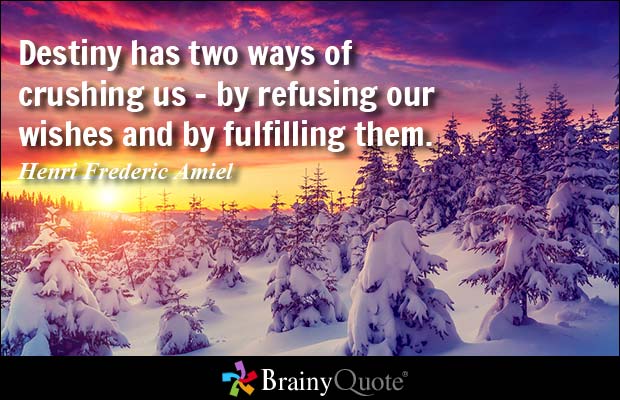
henrifredericamiel148210Very interesting times indeed!
Loving our wilderness

Loving our wilderness is another vital loving relationship

I quite deliberately named today’s post so that it would extend the theme of loving relationships posted yesterday.

So the recent announcement from the White House, “White House announced President Obama signed proclamations Friday to protect almost 2 million acres of pristine lands.” is to be welcomed with open arms. The article published in The Press Enterprise explained that those millions of acres were in California.

 The Castle Mountains, shown, will be declared a national monument in the Mojave Desert, along with Sand to Snow and Mojave Trails. KURT MILLER, STAFF PHOTOGRAPHER

The Castle Mountains, shown, will be declared a national monument in the Mojave Desert, along with Sand to Snow and Mojave Trails.
KURT MILLER, STAFF PHOTOGRAPHER

President Barack Obama established three national monuments today, Feb. 12, that cover almost 2 million acres in the Mojave Desert, the White House announced.

Obama used his power under the Antiquities Act to sign a proclamation designating the Mojave Trails, Sand to Snow and Castle Mountains national monuments. The move bypasses similar legislation, introduced by Sen. Dianne Feinstein, D-Calif., that has languished for years in Congress.

Feinstein asked the president in August to use his executive power to create the monuments. She praised the action in a statement: “I’m full of pride and joy knowing that future generations will be able to explore these national monuments and that the land will remain as pristine and as it is today. To a city girl like me, this expanse of desert, with its ruggedness and unique beauty, is nothing short of awe-inspiring.”

While on the subject of California, there is more good news from the Canis lupus 101 blog.

ooOOoo

Wolves get a grudging welcome from Northern California ranchers

By Tim Holt February 11, 2016
Photo: Oregon Fish And Wildlife
Wolves such as OR 25, a 3-year-old male, have crossed the Oregon border, and Northern California ranchers are preparing to accommodate them.

We are going to have a viable population of wolves in the far northern reaches of California, and it will be with the grudging cooperation of our ranchers.

That was the takeaway from a public hearing held last month in Yreka (Siskiyou County), where the state’s Department of Fish and Wildlife invited public comment on its draft plan for accommodating our new four-footed residents, and where there were as many Stetsons in the audience as you’d see at a cowboy poetry convention.

Where are the wolves?

premium_landscapeYes, there was some foaming at the mouth, some evidence of the government-hating libertarianism this region is known for. “We don’t want people in Sacramento telling us how to live our lives,” grumbled one rancher.
But on the whole, there was a lot of thoughtful comment by those in attendance, and the beginnings of a dialogue between those who are charged with facilitating the wolves’ re-entry, and those who will be most affected by it. There was a focus on practical, down-to-earth matters — the threat to one’s livelihood when livestock are killed by predators, and the impracticality of maintaining 24-hour surveillance on sprawling ranch lands.

There was not much discussion of the nonlethal methods that can be used to ward off wolf depredations, although a number of speakers strongly urged that radio collars be put on wolves so ranchers can be warned if they’re getting near their cattle or sheep. That idea is already in the draft wolf management plan, as well as hazing techniques that include spotlights and air horns, as well as guard dogs and mobile electric fences.

Suzanne Asha Stone was on hand as the Rocky Mountain field representative for Defenders of Wildlife. After listening to some of the ranchers’ comments, she said, “This is verbatim what we heard in Idaho 20 years ago,” when wolves were introduced in Yellowstone National Park. Ranchers in that state were naturally concerned about the impact those wolves would have on their livelihoods. Two decades later, through programs Stone and her organization have helped implement, nonlethal strategies have reduced wolf kills of livestock in Idaho to “near zero,” she said. And that’s with a wolf population than now totals 770.

According to Stone, “It takes a while living with wolves before people realize that their worst fears won’t come true.”

I think most ranchers in California’s far north respect the wildlife around them, but their relationship with it is complicated by the need to make a living. Looking closely at the strategies used in Idaho would be a good first step in helping convince them that there are ways to reconcile ranching with the presence of this new predator.

John Wayne has long been a conservative icon, the personification of rugged individualism in the Wild West. In the 1963 movie “McLintock,” made late in his career, Wayne plays a cattle rancher and land baron. At one point he tells his daughter what he plans to do with his holdings after he dies: “I’m gonna leave most of it to the nation, really, for a park, where no lumber mill (can) cut down all the trees for houses with leaky roofs, nobody’ll kill all the beavers for hats for dudes, nor murder the buffalo for robes.”

John Wayne was no tree hugger. But neither, like the ranchers up here, should he be reduced to a simple stereotype.

ooOOoo

Back to Governments or is this case the U.S. Government and a little-known unit known as Wildlife Services. Another arm reaching out to love our wilderness? H’mmm. Not according to Wolves of Douglas County blog:

PUBLISHED FEBRUARY 12, 2016

Wildlife Services—ever heard of it? No, not the U.S. Fish and Wildlife Service. That’s something different. The Fish and Wildlife Service is part of the Department of the Interior, charged with enforcing wildlife laws, restoring habitat, and protecting fish, plants, and animals. Wildlife Services isn’t your state fish and game commission, either, which issues hunting and fishing licenses and manages local wildlife.
Wildlife Services is a federal agency under the U.S. Department of Agriculture, and it specializes  in killing wild animals that threaten livestock—especially predators such as coyotes, wolves, and cougars. Outside the ranching community, Few have heard of Wildlife Services.
Since 2000, the agency has killed at least two million mammals and 15 million birds. Although it’s main focus is predator control in the West, Wildlife Services also does things like bird control nationwide at airports to prevent crashes and feral pig control in the South.

What one hand gives out, the other takes away.

Funny old world!

Loving relationships

A very Happy Valentine’s Day to all of you.

(And that, of course, means all you humans and your pets.)

I am sharing three very appropriate items for today.

Firstly, a recent article over on the Care2 site.

ooOOoo

Showing Love for the Animals This Valentine’s Day

1374408.largeBy: Katie Medlock February 8, 2016

About Katie Follow Katie at @offbeatherbivor

Whether you’re on board with celebrating a “traditional” Valentine’s Day this year—chocolates, cards, romance—or not, this year should be the year we also show some extra love to the animals in our lives. Whether we focus on our own companion animals or forgotten creatures out there in the world who also need compassion, this Valentine’s Day could be the start of a new tradition. Here are a few ideas to really bring the love to our furry and feathered friends this year:

1. Plan a trip to an animal sanctuary

Animal sanctuaries are wonderful places to visit solo, with your partner or with the kids. Most, if not all, states have at least one farmed animal sanctuary where pigs, cows, goats, chickens, geese, horses and many others have found a permanent home after being rescued on the way to slaughter or from their terrifying lives in the animal industries. There are few ways to connect with an animal and appreciate all they have been through in their lives that shine brighter than spending time petting a goat or cuddling a pig.

 There are also other types of sanctuaries open to the public with different types of animals to behold, such as bats, tortoises, exotic birds, wolves and wild cats. The difference between reputable and respectable animal sanctuaries and zoos is, in many cases, the dedication to the animals’ needs. Some zoos may have great conservation programs, yet any profit-driven establishment who puts animals on display in unnatural living environments and social groupings does not have the animals’ true interests at heart. Sanctuaries strive toward giving the animals the best lives they can have—public observation is not at the heart of the matter. By supporting reputable animal sanctuaries, you are showing immense love and compassion to animals.

2. Dine on a meatless meal

To have a truly animal-friendly Valentine’s Day, don’t serve any of them on your plate! By choosing to dine on a plant-based meal full of fresh vegetables, hearty legumes, sweet fruits, wholesome grains and satisfying nuts and seeds, you are showing the animals the utmost respect. Try these Valentine’s recipe ideas, ethical wine suggestions and delicious vegan chocolate truffles for the big day! And, if you are interested in reducing the amount of animal products you consume beyond V-Day, visit the Meatless Monday website to learn how to tip the scales gradually toward regular vegan meals.

3. Reach out to an animal in need

Do you have a friend who could use a dogsitter for an upcoming trip? Does your local animal shelter or adoption agency need an extra hand with walking the dogs, cleaning cages and spending time with furry friends? Have you spoiled your own companion critter lately with a new toy, extra play time or some homemade treats? Valentine’s Day is the perfect time to extend our love to our own companion animals and to those around us who also need a little extra love. The rewards from reaching out to a pet in need are tenfold what we expend putting forth the effort. Use this February as an excuse to spend more time with some critters!

ooOOoo

The second was recently seen over on Mother Nature Network.
ooOOoo

9 ways dogs say ‘I love you’

Laura Moss February 10, 2016
 This dog is serious about keeping the title of 'man's best friend.' (Photo: Best Friends Animal Society)
This dog is serious about keeping the title of ‘man’s best friend.’ (Photo: Best Friends Animal Society)

Dogs have lived alongside us for thousands of years, earning the reputation as “man’s best friend” for good reason. But while some people may be quick to dismiss a dog’s devotion as simply a relationship based on need, experts say that’s just not true.

“Dogs have developed the strongest ability of all animals on Earth to form affectionate bonds with humans,” says Dr. Frank McMillan D.V.M., director of well-being studies at Best Friends Animal Society, an organization helping adopters find loving companions. “Dogs don’t just love us — they need us, but not just for food and physical care. They need us emotionally. This is why the attachment bond a dog feels for his human is one of deep devotion and is, as has been often stated, unconditional.”

But how exactly does a dog say, “I love you”? Read on to find out.

Your dog wants to be close to you.

If your dog is always in your lap, leaning against you or following you room to room, it’s clear your pooch is attached to you.

“A dog’s affection is most evident in their desire to be physically close to you. This can sometimes appear to be a clinginess, and it isn’t always easy to distinguish healthy positive clinginess from insecurity, but in both cases your dog is deeply attached to you,” McMillan says.

Your dog gazes into your eyes.

When you and your pup share a long look, your dog is “hugging you with his eyes,” according to Brian Hare, a professor at Duke University who studies canine cognition, and research shows that this “hug” has a profound effect on both man and animal.

When scientists at Japan’s Azabu University took urine samples from dogs and their owners before and after 30 minutes of interacting, they found that the pairs that spent the most time gazing into each others’ eyes showed significantly higher levels of the hormone oxytocin, the same hormonal response that bonds us to human infants. “It’s an incredible finding that suggests that dogs have hijacked the human bonding system,” Hare told Science.

Loving glances like this can say a lot. (Photo: Best Friends Animal Society)

Your dog excitedly greets you.

Does your pup jump up, wag his tail and barely seem able to contain his excitement when you arrive home? If so, that’s a sure sign of affection.

“This becomes even more obvious when your dog learns, like Pavlov’s dogs, that some sound signals your upcoming arrival, like the garage opener or sound of your car, and they show excitement upon hearing that sound,” McMillan says.

Your dog sleeps with you.

Dogs are pack animals that often huddle together at night for warmth and protection, so when your dog snuggles up with you, it means he considers you to be part of the family. And these canine cuddles may even help you get a better night’s sleep.

You are your dog’s safe haven.

“Much affection in animals and humans is based on how much you can be relied on as a source of comfort and support in scary situations,” McMillan says. “If your dog seeks your comfort during thunderstorms, car rides, vet visits or other frightening occurrences, then you are seeing another aspect of her attachment bond to you.”

Your dog ‘reads’ you and reacts accordingly.

A close bond with your dog may enable him to sense your mood and respond with affection. “Many dogs who sense that you are upset or not feeling well will demonstrate their affection by spending even more time by your side. They might give you licks or rest their head or paws on some part of your body,” McMillan says.

dog snuggling sick owner
A cuddly canine can make the day a little better. (Photo: Brian Goodman/Shutterstock)

Your dog yawns when you yawn.

If you’ve ever yawned after witnessing another person’s yawn, you’re aware how contagious the act can be. This contagious yawning is unique to only a few species, and man’s best friend is one of them.

Researchers have even found that not only are dogs more likely to yawn after watching familiar people yawn, but also that dogs will yawn when hearing only the sound of a loved one’s yawn. So if your canine companion yawns in response to your yawns, odds are good that his affection for you enables him to empathize with you.

Your dog focuses on you.

It’s not unusual for dogs to delight in positive attention from virtually anyone, but just because your pooch loves on everyone, doesn’t mean he doesn’t love you most. Pay attention to how your dog acts when in a room full of people. If he stays focused on you or ignores others while awaiting your return, you know you hold a special place in your dog’s heart.

Your dog forgives you.

“Part of the affectionate feelings your dog has for you shows up in their willingness to forgive you for things you do that make them feel bad, such as raising your voice, or misplacing your frustration on your dog by ignoring them,” McMillan says. “Forgiveness is your dog’s attempt to maintain the loving bond they share with you.”

However, even if your canine best friend doesn’t show affection in these ways, it certainly doesn’t mean your pooch doesn’t love you. Just as some people can care deeply without expressing their feelings, so can your pup.

“Be sure not to go through the list above and think that because your dog shows very few or even none of these things, he or she doesn’t love you. Odds are, love is very much there. After all, we’re talking about a dog here,” McMillan says.

And how can you show your dog some love? Engage in playtime, take a long walk, bake some yummy dog treats, or give your pup a homemade toy. Above all, McMillan says the best thing you can do is simply give your dog more of you because that’s what man’s best friend wants most of all.

ooOOoo

Finally, enjoy this fabulous video. (Thanks Sue Dreamwalker)

Published on Oct 20, 2014

As humans animals can be also friends. If animals live together they became often friends. Friendship between different species can be cold as unlikely animals friendship. In this you can see friendship between dogs and cats, Lion tiger and bear friends, Baby Chick and Chihuahua best friends, cat and own friendship etc.

So many loving relationships! So many lessons for us to learn from our dogs!

In defence of sovereignty and democracy.

The challenges facing the European Union ripple out across the whole of the free world.

I note that this is the second Friday where there is an abrupt change from the run of posts during the previous few days. For last Friday I republished a George Monbiot article on Rigging the Market and today there is another Monbiot article that I want to share with you; shared with you with the kind permission of Mr. Monbiot.

Unlike last Friday’s Monbiot article that clearly had global implications, at first sight this article about the European Union has no relevance to those of us not living with EU boundaries. But that would be wrong. For the importance of protecting a country’s sovereignty and the democratic processes within that country is supreme across all democratically elected governments.

ooOOoo

The Lesser Evil

MaxMello – We Can All Help

This is a very simple message – please help MaxMello.

(Please note: To ensure the widest readership of this post I am running it for two days. I.e. the next post will be on Thursday, 11th.)

Yesterday I republished a post from John Zande. It explained how Sandra Guilarducci and her husband, Francisco, in Ibiuna, Brazil were caring for over 350 dogs and 32 cats. If you haven’t read that post then go no further in today’s post until you have read about the desparate need for funds.

Here’s a section from yesterday’s post (but please do read it in full):

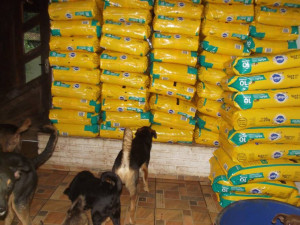
food-e1454493203915Today, MaxMello burns through 5 tonnes of food every month, and a small army of vets help with reduced fees. But it all adds up. It has added up, and over this past weekend, Sandra was forced to admit that she and Francisco (weighed down with over 30,000 reis debt, about $10,000 US, to vets and pet food suppliers) had reached the point beyond which they simply could no longer afford to keep the shelter open. Sandra put out an urgent call to other NGO’s, saying she will keep the sick, the crippled, and the old (the one’s that stand little to no chance of adoption) but new shelter-homes would have to be found for the hundreds of other rescues under their care. With every NGO we know of here in Sao Paulo being already full, this is, in all honesty, an impossible situation. These are good people, and they (and their keep) are in genuine need of a hand.

Please, help keep MaxMello open and donate to the MaxMello PayPal account: associacaomaxmello@gmail.com.

But just as important as making whatever donation you can is letting Sandra and Francisco know you care.

Yesterday, Jean and I sent a letter to John for John’s wife to translate from English into Portugese as Sandra and Francisco do not speak English. We wanted them to read our letter in this post.

So this is the letter in Portugese:

Sandra e Francisco,

Aqui no sul do Oregon, hoje temos 9 cachorros e 4 gatos; há três anos, quando viemos para cá, eram 14 cães e 7 gatos. Eu simplesmente não consigo imaginar o que deve ser cuidar de 350 cachorros e 32 gatos, ainda mais divididos entre duas propriedades diferentes, separadas por 200 km!

Entretanto, Jean sabe bem o tamanho do amor e da dedicação que movem sua paixão por esses animais maravilhosos – porque ela vivia em San Carlos, no México (na Península Baja) e dedicava a vida a recolher os cachorros de rua de lá, tratando de sua saúde, dando-lhes amor e conseguindo adotantes para eles nos EUA. Ao longo de vários anos, Jean acredita ter resgatado mais de 200 cães. A alimentação e tratamento de todos esses animais foram custeados por ela e o marido, Ben, que morreu em 2005.

Foi meio por acaso que a conheci, em San Carlos, no Natal de 2007, e me via com os olhos cheios de lágrimas ao ver a afeição que os cachorros dela demonstravam ao me ver, toda vez que ia visitá-la em sua casa. E essa afeição deve ter causado um efeito profundo em mim, pois, quando voltei para a Inglaterra, em janeiro de 2008, Jean e eu percebemos que queríamos ficar juntos para o resto da vida. Mais tarde, nesse mesmo ano, ao lado do meu pastor alemão, Pharaoh, voltei para San Carlos. Não demorou muito, com 14 cachorros e 7 gatos, fomos para o Arizona, onde nos casamos, e por fim, no segundo semestre de 2012, viemos para o Oregon, onde estamos até hoje.

Pouco antes de sairmos de San Carlos, em 2010, uma cachorra foi deixada na porta de nossa casa. Era uma mestiça de rottweiler e devia ter acabado de dar cria porque ainda estava cheia de leite. Nós a batizamos de Hazel e quase de cara ela mostrou sua natureza amorosa para Jean, para mim e os outros animais. Hazel é uma inspiração para a humanidade graças ao perdão e ao amor incondicional que oferece ao mundo.

Por isso, aceite essas poucas palavras minhas e de Jean, endereçadas aos dois, como uma pequena amostra de amor e gratidão que sentimos por vocês e que certamente também serão sentidos pelos leitores e seguidores do Learning from Dogs

And here is the letter in English:

Sandra and Francisco,

Here in Southern Oregon we have 9 dogs and 4 cats, down from the 14 dogs and 7 cats when we moved here some 3 years ago. I cannot simply imagine what it must entail to care for 350 dogs and 32 cats let alone care for them in two locations seperated by 200 kms!


However Jean can imagine the level of love and commitment that fuels your passion for looking after these wonderful animals. For Jean, when she lived in San Carlos, Mexico (on the Baja Peninsula) devoted her life to rescuing Mexican street dogs, loving them back to health and then finding homes for them in the USA. Over the many years Jean believes she found homes for well over 200 dogs. The feeding and caring of these animals was funded personally by Jean and her late husband, Ben, who died in 2005.


Quite by chance, I met Jean in San Carlos the Christmas of 2007 and was moved to tears on numerous occasions by the loving affection shown by her dogs to this visitor to Jean’s home. That affection must have rubbed off on me for by the time I returned to England in January, 2008 Jean and I wanted to be together for the rest of our lives. Later in 2008, together with my German Shepherd, Pharaoh, I travelled out to San Carlos. Subsequently, with 14 dogs and 7 cats, we moved to Arizona to be married and then, in the Autumn of 2012, came up here to our home in Oregon.


Shortly before we left San Carlos in 2010 to go to Arizona, a female dog was dumped outside the house. She was a Rottweiler crossbreed and must have just given birth to puppies for she was still in milk. We named her Hazel and she very quickly showed her most beautiful and loving nature to Jean and me and to the other animals. Hazel is an inspiration to humankind of what flows from offering forgiveness and unconditional love to the world.


So please take these few words from Jean and me, sent to you both, as a small measure of the love and gratitude that we feel for you, and I know will be felt by many of the readers and followers of Learning from Dogs.

I also want to republish a comment from yesterday’s post, left by Mr. Merveilleux, because it speaks such perfect common-sense:

As Zande’s explained, the current exchange rate means donations go a very long way. Keep in mind the minimum wage in Brazil is only around £130 p/month. By skipping one little luxury this month, like going out for a meal today, and sending what one would have spent on that to the shelter, we can all make make a substantial difference to the lives of these animals.
My suggestion is for people not to just reach for the change they’ve got in the car ashtray, but consider a little, insignificant sacrifice that will do one no harm, but will have a disproportionately positive effect.
Skip one bottle of champagne, or a bottle of wine, or don’t buy flowers this week… skip any little thing that one doesn’t really *need*, and put that money to good use.

Let me move on a tad.

As is obvious to any visitors to this place in the last 6 weeks, I have just published my first book. It learningfromdogs_3dbook_500xis called Learning from Dogs, the same name as this blog. I am also donating 50% of the net proceeds from all sales of my book to our local Rogue Valley Humane Society.

However, for the whole of the month of February I shall be donating the other 50% of net proceeds to MaxMello.

So, please, buy the book and help two fabulous charities. The book is available as a paperback, priced $15.95, or either of two eBook formats, MOBI and EPUB, priced at $5:39. Full details here: Buy the Book.

Of course, you may also buy the book from Amazon or you can order it from most booksellers.

If you prefer to purchase it direct from me but do not wish to pay online, then mail me (as in Paul Handover) a cheque for $18.67 ($15.95 + P&P of $2.72) and I will send it to any part of the USA. (For overseas paperback purchasers who do not wish to pay online then email me your address details and I will respond within 48 hours.) My email address is learningfromdogs (at) gmail (dot) com

All of this is part of never forgetting how important it is to care for our dogs – they are man’s oldest companion and have devoted themselves to caring for us for possibly 40,000 years. Is it asking too much to help these dogs in Brazil in return!

P1150895
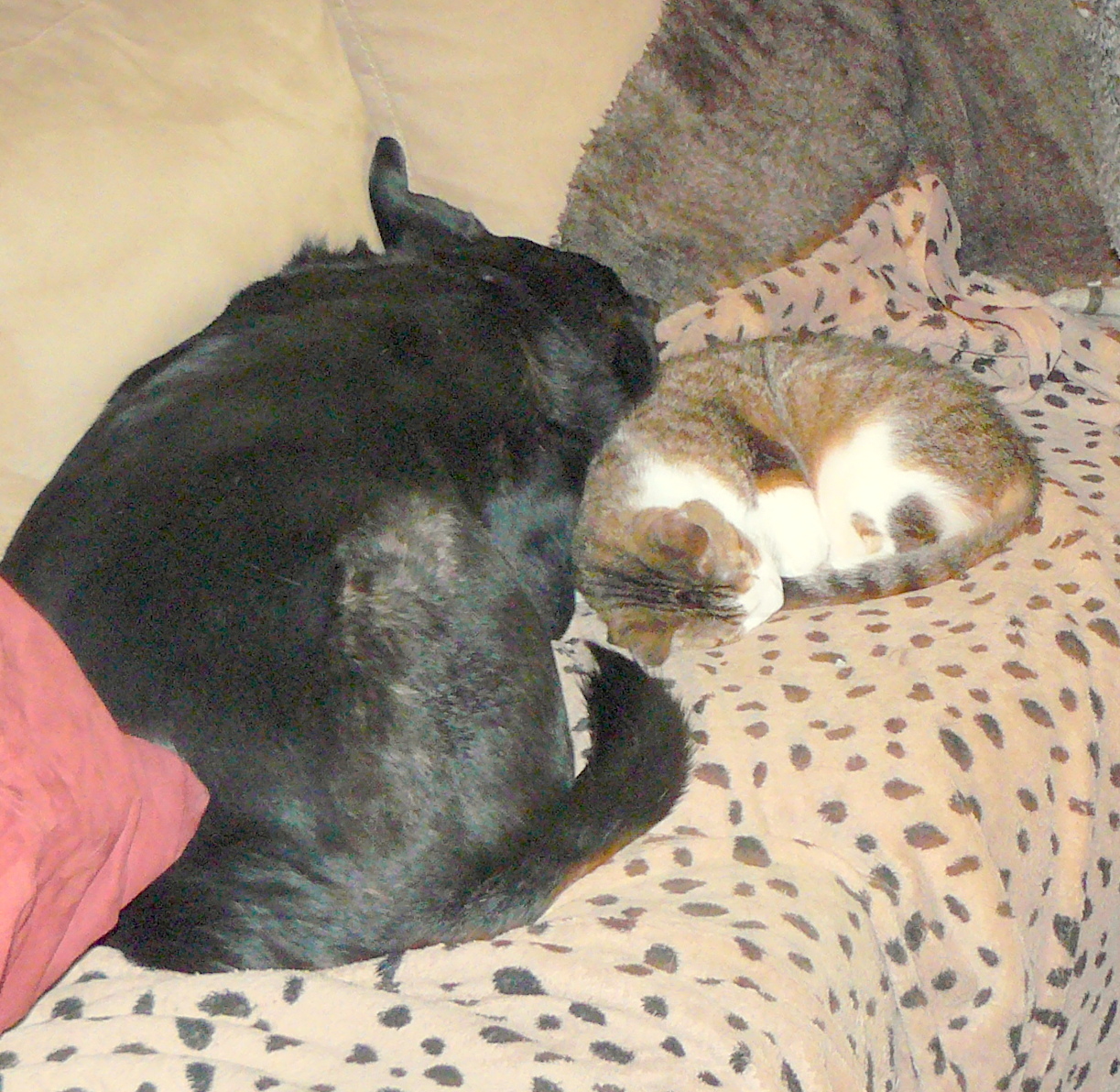
Hazel showing her love and caring for our cat, George. Both animals are ex rescues from Mexico. Picture taken last Sunday evening.


A bottomless font of love.

A wonderful story of the love for dogs and cats shown by two people in Brazil.

As is the way in this world of blogging, a few months ago I connected with John Zande. He is an Australian living in Brazil and blogs under the name of The Superstitious Naked Ape. John is also the author of the book The Owner of All Infernal Names, which I reviewed last October (and greatly enjoyed!).

John Zande cover_zpsz7wuq9ccAll the proceeds from the sale of John’s book go towards animal rescue and shelter in Brazil and that offers a strong clue to the purpose of today’s post.

So with that in mind, please read the following post published by John on February 3rd and republished here with John’s permission. (And please make a note to return tomorrow and read the sequel that will explain how you and I can make a positive difference.)

ooOOoo

The MaxMello Association for the Support of Animal Life needs an urgent hand

Oil, corruption and public money.

Nothing at all to do with dogs, or with integrity if it comes to that!

Regular followers of this place know that I am a tremendous fan of George Monbiot, the Englishman who so regularly exposes stuff that needs to be aired and discussed. As his About page explains:

Here are some of the things I love: my family and friends, salt marshes, arguments, chalk streams, Russian literature, kayaking among dolphins, diversity of all kinds, rockpools, heritage apples, woods, fishing, swimming in the sea, gazpacho, ponds and ditches, growing vegetables, insects, pruning, forgotten corners, fossils, goldfinches, etymology, Bill Hicks, ruins, Shakespeare, landscape history, palaeoecology, Gavin and Stacey and Father Ted.

Here are some of the things I try to fight: undemocratic power, corruption, deception of the public, environmental destruction, injustice, inequality and the misallocation of resources, waste, denial, the libertarianism which grants freedom to the powerful at the expense of the powerless, undisclosed interests, complacency.

Here is what I fear: other people’s cowardice.

I still see my life as a slightly unhinged adventure whose perpetuation is something of a mystery. I have no idea where it will take me, and no ambitions other than to keep doing what I do. So far it’s been gripping.

Way back in the early days of Learning from Dogs, the blog that is, not the book, George was very gracious in giving me blanket permission to republish his posts, and many of them have appeared in this place.

So now read George Monbiot’s latest Rigging the Market. It is yet another example of what is going wrong in these times.

ooOOoo

Rigging the Market

Life is a terminal disease!

What can we learn from the world’s oldest dog?

I’m seventy-one years old and aware that the ageing process is “alive and well” within me. It primarily is revealed by a degree of brain atrophy that is evidenced by very poor recall. There is no question that it worries Jean and, at times, worries me as well.  Adding to the recognition that these are my “senior” years is the awareness that the people that one knows all tend to be a similar sort of age and, inevitably, you don’t have to go far to hear of someone who is very ill, or has recently died.

So the motivation is very strong to stay as fit and healthy; both in body and mind.

Thus a recent article over on the Care2 site about the world’s oldest dog seemed more than a tad relevant to yours truly and will hopefully connect with others who know they are never going to see twenty-one again!

ooOOoo

World’s Oldest Dog Reveals 3 Secrets to Long Life

3165238.largeBy: Laura S. January 24, 2016

About Laura

It’s often said that happiness is the key to a long life, but is the same true in the lives of dogs?

Let’s take a look at the world’s oldest living dog. His name was Bluey and he lived to be an astounding 29 1/2 years old. As a puppy in 1910, Bluey joined the household of Les Hall in Victoria, Australia.

Every morning, Bluey went to work among the cattle and sheep. He enjoyed the great outdoors and had constant companionship. He ate a diet that largely consisted of wild kangaroo and emu (not unhealthy animals raised in factory farms). Retiring from his official ‘job’ several years before his death, Bluey remained valued and respected even though he was no longer “useful.”

Oldest_Animals_2a12Ask Yourself These Three Questions

 So what about your dog? Are you providing the essential building blocks for a long life? It all boils down to these three questions. Answer honestly, and if you don’t like what you find, today may be the day to turn over a new “leash.”

1. Am I Listening to My Dog?

ThinkstockPhotos-200359349-0011No, your dog can’t speak in full sentences but how hard is it to understand his needs? Chances are, it’s pretty easy. Is your dog full of anxiety because you’ve worked a 10 hour day leaving him alone in the house, or worse yet, locked in a cage? When your dog greets you with excitement at the door, do you take the time to grab the leash and go for a long walk or do you scold him for bothering you? Is your dog getting up very, very slowly from painful joints?

Try listening, really listening, to the things your dog is telling you over and over again. Try this exercise. Think of two memories of times when your dog was happiest. Chances are that you were being active outdoors together. Could you re-create those experiences, even on a small scale, each week?

2. Do I Break My Promises?

ThinkstockPhotos-1224645481Are you guilty of breaking promises to yourself and to your dog?  Do you procrastinate? Make a dedicated practice of fulfilling your promises to your dog, the same way as you would care for your own needs. It’s just like brushing your teeth. Schedule in items like these:
  • A  20 minute walk in the morning before you leave for work.
  • A neighbor to come and let your dog outside at lunchtime.
  • Adhering to a schedule of six month veterinary check-ups, especially for mature dogs.
  • Washing food and water bowls daily.
  • A long walk at the end of the day.
  • And most of all, doing those things you know your dog loves most.

3. Am I Putting My Stress Onto My Dog?

piIf you’ve had a bad day, do you let it spill over? Can you check your troubles at the front door or do you bring them with you and spread your grief? Although it is difficult, take a few deep breaths and remind yourself that your truest friend in the world is not the one you want to hurt today.
ooOOoo
This business of learning from our dogs just goes on and on!

Being more aware of dog flu!

This article was recently seen on Mother Nature Network and is shared with you all.

ooOOoo

What you need to know about dog flu

Jenn Savedge

January 29, 2016
Most dogs in the U.S. don't have the immunity to fight off the Asian-based dog flu. (Photo: Lindsay Helms/Shutterstock)
Most dogs in the U.S. don’t have the immunity to fight off the Asian-based dog flu. (Photo: Lindsay Helms/Shutterstock)

As animal experts around the country amplify their warnings about dog flu outbreaks, pet owners are scrambling to understand the illness and learn how they can protect their pets. Here’s what you need to know about this potentially deadly disease.

What is the dog flu?

Dog flu — or canine influenza — is an infection caused by one of two virus strains: H3N2 and H3N8. Of the two, H3N2 is more commonly seen in pets in the U.S. It is thought that the strain came from Asia, possibly originating as an avian flu that was transferred to a dog.

Dog flu symptoms

Like the flu that affects humans, the symptoms of the dog flu hit the respiratory system causing coughing, a runny nose, watery eyes and a sore throat. It’s also usually accompanied by a high fever and loss of appetite. But unlike with humans, your dog won’t be able to tell you how bad she is feeling, and you may not notice the symptoms right away. Animal experts say to watch your dog for changes in behavior. If your normally hyper dog seems lethargic or if your pup who is usually enthusiastic about eating starts skipping meals, it’s time to take a closer look.

Dogs who spend a lot of time around other dogs are more likely to be exposed to the virus. (Photo: Dalibor Sosna/Shutterstock)

How does the dog flu spread?

The dog flu virus spreads just like the human flu virus does — through bodily fluids that are released into the air via a sneeze or cough or by touching objects or surfaces that have been contaminated. The dog flu virus can live in the environment for two days.

Dogs that spend a lot of time around other dogs — in dog parks, kennels, shelters, groomers or veterinary clinics — are the most likely to contract the illness.

What to do if your dog gets the flu

Older dogs, younger dogs and dogs that are already sick are the most vulnerable when it comes to the dog flu, not because of the virus itself, but because these dogs are the most likely to develop complications, like pneumonia, that could be fatal. If you think your dog may have the flu, it’s important to check in with your vet to make sure he isn’t getting any worse.

At home, you can keep track of your dog’s temperature by placing a thermometer under her armpit, or for a more accurate reading, in her backside. According to the American Kennel Club the normal range for a dog’s temperature should be between 101 and 102.5 degrees Fahrenheit (38.3 to 39.2 degrees Celsius.)

Keep the fluids going as much as possible and try to entice your pooch to keep eating. Check with your vet about foods that may prompt him to eat without giving him a stomachache.

More than anything, give your pet plenty of time for R&R. Give her a week or so off from running, walking and other forms of exercise and just let her rest and sleep as much as she needs. Just make sure that she is still drinking, eating a little, and relieving herself.

How you can keep your dog from getting the flu?

The best way to minimize your dog’s risk of getting the flu is to keep her away from other dogs. If you spend time with other dogs, be sure to wash your hands and even change your clothes before interacting with your own dog. While humans can’t contract canine influenza, we can carry the virus on our hands and clothing for up to 24-hours after handling an infected dog.

You could also talk to your vet about a dog flu vaccine, although there is some question about its effectiveness as the vaccine for H3N8 may not offer protection from H3N2 and vice versa.

ooOOoo

If any readers have anything to add to this article, I would love to hear from you.

Let’s please keep all our dogs safe!

Embracing all those who care for our wild animals!

So many who devote so much time and energy, and money no doubt!

Let me state quite clearly my position with regard to hunting wild animals – I abhor it! Technically speaking if someone’s only means of feeding themselves, as in staying alive, is through hunting then I guess that is acceptable. But hunting for any other purposes is beyond the pale. I know that many people, including friends, who live in this part of America would heartedly disagree with my position on hunting. So be it.

Thus when Jean and I look at those who work so hard to protect, sustain and support wild animals we are almost speachless with our admiration for them.

So what’s brought all this on today?

For a long time I have been a follower of the blogsite Canis Lupus 101. On the home page of Canis Lupus 101, on the left-hand sidebar, one can read a plea from Maggie Caldwell, Press Secretary for @Earthjustice, that, in part, says:

For centuries, wolves have been viewed with suspicion and hostility, based in humankind’s deep-rooted fear of the unknown and need to control the natural world.

“The Fable of the Wolf,” a new animated short film produced by Earthjustice, explores this idea, celebrating the wild nature of a deeply misunderstood species.

The film offers an abbreviated history of the relationship between wolves and people—told from the wolf’s perspective—from a time when they coexisted to an era in which people began to fear and exterminate the wolves.

The return of wolves to the northern Rocky Mountains has been called one of America’s greatest conservation stories. But wolves are facing new attacks by members of Congress who are gunning to remove Endangered Species Act protections before the species has recovered.

The film encourages viewers to “join the pack” and sound the alarm about the political threats to this species. Please help us spread the message that wolves are to be celebrated, not feared, by watching this film and sharing it with your friends.

Sincerely,

Maggie Caldwell

Our millions of magnificient and adorable dogs owe their place in today’s world to the wolf. The fact that those who care are still fighting hard to save the wild wolf shows how disgraceful it is for those that see no harm in hunting wolves. Hunting a wolf in my book is hardly any different than going out and hunting a dog!

So with all that out of me, now read about the following glorious efforts to save the wild Mexican wolf. Originally published over on Canis Lupus 101.

ooOOoo

Thursday, January 28, 2016

Poaching slows Mexican wolf population recovery (video)

Brandon Loomis, The Republic | January 27, 2016

After the wild Mexican wolf population tops 100 for the first time, 15 illegal shootings may slow recovery.

(Photo: Mark Henle, Mark Henle/The Republic)

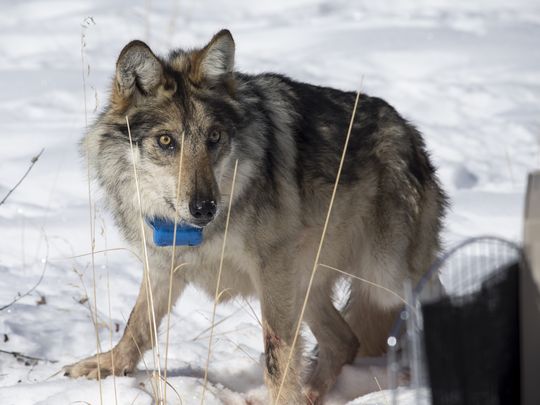
ALPINE — Biologists hauled a 60-pound Mexican gray wolf from the chopper on Monday, limp but healthy with a lush winter mane. They called it the wolf’s worst day in months — dazed from having been darted from above, still rapidly licking his nose through a blindfold muzzle — but the male wolf was one of the fortunate among a divisive and still-embattled breed that has weathered an especially perilous year of poachings.

Unknown shooters have illegally killed at least 15 Mexican wolves since officials reported a year ago that a record 110 were roaming wild in eastern Arizona and western New Mexico, according to a lead state biologist on the recovery program.

The poaching losses tripled from 2014, and were likely unprecedented in the 18 years since the first captive-bred lobos brought their once-exiled howls back to the Blue Range spanning the Apache and Gila national forests.

Wolf-recovery specialists, like those in Alpine this week, are working to make sure the survivors flourish instead of backsliding to a more critically endangered status.

The team of federal and state biologists carried Wolf No. M1342 on a mesh sling. They brought the wolf inside their pine-ringed Alpine field station and slid him onto a slab wooden table for a checkup and shots to keep him robust for an important breeding season this spring. They injected a second sedative that would put the wolf out cold for about an hour.

The scientists gathered round the Elk Horn pack’s would-be alpha male, prodding veins for intravenous fluids and pushing an oxygen tube up his black nostrils.They were counting on the wolf to return healthy to his young mate on snowy Escudilla Mountain, and produce their first successful litter to help extend recent annual gains in a slow-recovering population.

As recently as five years ago, there were an estimated 50 Mexican wolves in the wild, less than half of last year’s count. Whether this year’s survey finds the population continuing to grow will depend on the 40 or so pups observed since last spring. Historically, about half of pups have survived their first year.

Besides the wolves that were shot, about a dozen more adults are missing, “fate unknown.”
M1342 was lucky to have a dart dangling from his paw, and not a trail of lead fragments through his chest. Shootings have always been a key threat since the 1998 reintroduction.

The anti-wolf mentality commonly known as “shoot, shovel and shut up” is hard to combat. Bullets typically pass through a wolf’s body and leave little useful evidence, said Jeff Dolphin, Mexican wolf field supervisor for the Arizona Game and Fish Department. “You just can’t be everywhere at once,” Dolphin said.

Only a handful of what may be dozens of shooters have faced charges related to killing one of the protected wolves since 1998. Federal, state and non-governmental organizations offer a combined reward of up to $58,000 for information leading to the arrest and conviction of a wolf poacher.

A controversial task

Susan Dicks, a U.S. Fish and Wildlife veterinarian examines Wolf No. M1342. (Photo: Mark Henle/The Republic)

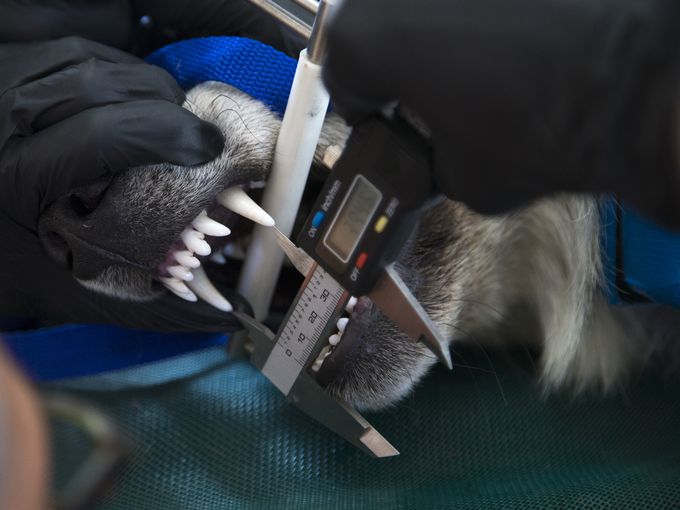
U.S. Fish and Wildlife Service veterinarian Susan Dicks coached the team of biologists and field technicians tending to M1342: how to draw blood for DNA and other tests; where to inject a rabies vaccine; how to determine age by measuring teeth; how to increase fluids or pour cooling alcohol on the paws if his temperature rises past 103 or so.

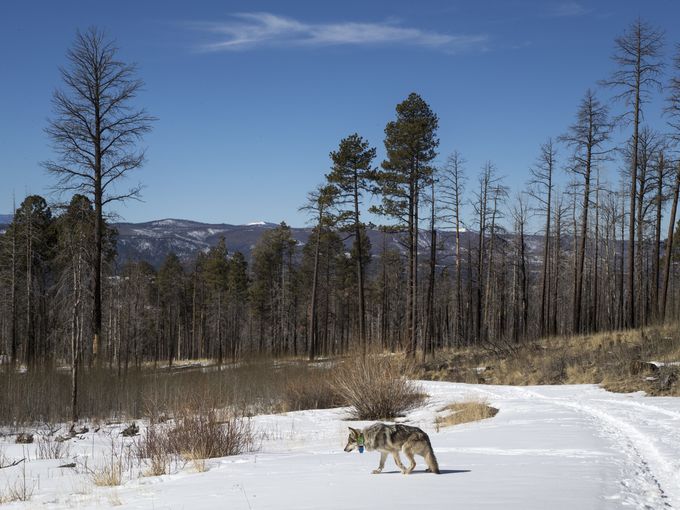
Besides the preventive medicine and data collection, the prime objective for M1342’s capture during a yearly aerial wolf survey was to fit it with a new transmitter collar. The collar he had received in a similar operation last year hadn’t functioned, so biologists only knew the wolf’s whereabouts by occasional observation. Uncollared wolves are difficult to track to ensure they’re not getting into trouble, such as by attacking livestock.

Not every wild Mexican wolf is collared, but scientists like to have them on a wolf of every generation in a pack. Last year’s survey counted 19 packs, including eight known to have a breeding pair.

Studies show that these free-ranging wolves eat elk upward of 80 percent of the time, but cows are also occasionally on the menu. A government and non-profit fund pays for the losses. So far, the wolf program has paid out $68,000 for 50 confirmed livestock losses in 2015, and another $25,000 in claims is awaiting action by a compensation council. “It’s such a controversial program, and (people) want us to manage these animals,” Dicks explained. “The way we manage is with that collar. It communicates and tells us what they’re doing.”

The latest in a string of political struggles over the lightweight cousin of more plentiful northern gray wolves involves where they should be allowed.
Wolf advocates say they need unoccupied territory such as the forests around the Grand Canyon to sustain a population large and dispersed enough to withstand sudden die-offs. The governors of Arizona, New Mexico, Colorado and Utah recently co-signed a letter to the federal program opposing such a northern expansion into previously undocumented wolf territory and instead backing a push south into Mexico.

The number of wolves needed to ensure long-term survival also is in dispute. Some want to hold the line around today’s numbers, but others say at least a sevenfold increase is needed.