Vanessa Keating, Theresa Burge and Aubrey Metropulos, a group of full-time RVers and Vanlifers, were wandering around Bulldog Canyon in Arizona one day, looking for a specific type of cactus. They weren’t far from their campsite when they spotted someone tiny and furry, and quickly realized it was a dog out in the desert all alone.
They immediately knew they couldn’t leave the pup out there by himself and began the process of trying to win him over. Thankfully, it didn’t end up taking very long. The sweet dog was more than ready to be rescued.
“He growled at us at first and took some convincing to come over,” Keating told The Dodo. “It only took a few minutes for him to come up to my sister, Theresa, first, but he was still nervous. We quickly realized he had a cholla cactus stuck to the side of him, and once she pulled it off, he warmed up and got excited. So many kisses, and he even had the zoomies!”
Vanessa Keating
Once the cactus was safely removed from his fur, the lost dog felt so much better and jumped for joy that he’d finally be found. His new friends gave him all the cuddles he’d been missing and started asking around their campsite about him, trying to find his family. Unfortunately, they didn’t have any luck, but they refused to stop trying.
Vanessa Keating
The next day, they took the lost dog to get scanned for a microchip and were overjoyed when they discovered he had one. They got in touch with his dad, who told them the pup’s name was Echo, and quickly made arrangements for a long-awaited reunion.
“The reunion was amazing,” Keating said. “Lots of tears. He thought Echo had been eaten by a coyote and was giving up hope … He was so grateful and relieved.”
Echo had only been lost in the desert for a few days before he was found, thankfully, and he was so excited once he was back in his dad’s arms. He knew once the three women found him that they would be the ones to get him back home safely, and he was right.
ooOOoo
Echo is a lucky dog and being reunited with his Dad must have been magical. But then again, the three women that stopped to gain the attention of this lost dog, and then cuddled him and gave him perfect love are really special
So here’s to Vanessa, Theresa, and Aubrey. Well done all three of you.
Bob Derham is someone I met many years ago, when I was living on my yacht in Larnaca, Cyprus, and I can do no better than to repeat what I wrote in my autobiography.
ooOOoo
I negotiated what I thought was a good deal and sold the company. Inevitably I resigned from what was now not my company; it was the end of November in the year of 1988.
In Tollesbury, I had my annual tax returns done by Peter Michael, also living in the village. Peter was an accountant who also taught accountancy at the nearby Essex University. I saw Peter and we discussed the recent agreement for the sale of the business.
“Paul, there is not a lot you can do, to be honest. You will be liable in broad terms for the tax in the difference between the opening price and the closing price. In your case the opening price was near enough zero and the closing price…” Peter did not need to finish the sentence. I got the picture and stood up to leave. Just has I was going out of the room, Peter added: “Unless you can leave the country before April 15th next year, and stay away for a minimum of four tax years. In other words, leave before April 15th, 1989.”
I walked home from Peter Michael’s house that November, 1988 with the advice I had been given ringing in my ears. I would worry about the tax implications in a day or two. But once again fate intervened.
I was a subscriber to the boating magazine Practical Boat Owner (PBO). In a late 1988 issue I read in the classifieds:
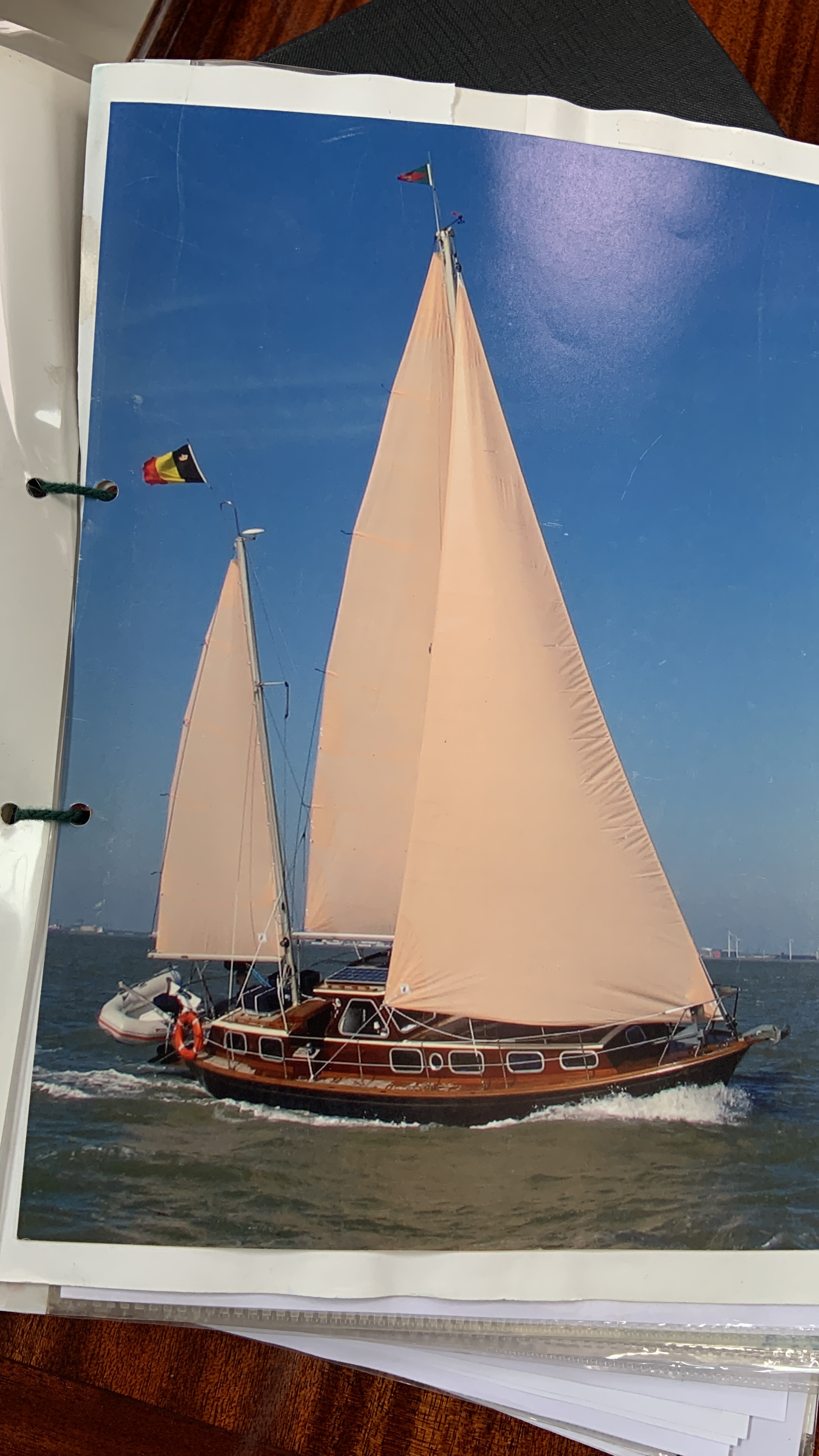
Songbird of Kent – Tradewind 33
Great opportunity to purchase a long-distance ocean yacht designed by John Rock for sea-kindly short-handed sailing.
Well kitted out, continually updated and maintained Songbird of Kent is the yacht for you if you dream of blue waters and serious long distance cruising.
Lying Larnaca, Cyprus.
I knew about Tradewind yachts, was familiar with John Rock. (As the designer of Tradewind yachts he had been featured several times in Practical Boat Owner magazine), and knew how many of his yachts had made world circumnavigations, and, finally, I deserved a holiday. I arranged to go out to Larnaca as soon as I could.
About a week later I caught a flight to Larnaca International Airport; upon arriving I rented a car and drove the few miles to the Marina.
The yacht was easy to find as it was out of the water. I met the owners, Michael and Betty Hughes, who were still living onboard Songbird of Kent. They explained why they were selling. Simply because, as Michael put it, they had been living on the boat for many years and it was time to return to their native Wales. Songbird had been extensively cruised the length of the Mediterranean Sea using Larnaca Marina as the base.
I quietly inspected the boat. Because it was lifted out viewing the boat in detail was much easier than had it still been floating. It was in good condition; very good condition in fact. Then I climbed up the ladder and entered the boat. Again I found everything that I expected, and more. It was clear to me that Michael and Betty had had the boat as their home and, consequently, everything was in order. Or to use the phrase; shipshape and Bristol fashion!
I excused myself, left the yacht and went and sat on a nearby seawall. I wanted to think. To be honest, it was pretty easy thinking. I loved the boat; it was a purchase I could afford, and if everything went to plan and I left the UK before April 15th, 1989, and stayed away for four tax years, there would be no UK tax to pay on the sale of my company Dataview. Nothing: Nada!
So that is exactly what I did!
I went back to Songbird, where Michael and Betty were still sitting in the cockpit, and told them I would buy it. They drew up a contract there and then and I signed it!
My autobiography
ooOOoo
Here is Bob’s story:
Paul and I first met in 1992, when I was working as a contract pilot on the BAC 1-11 for Cyprus Airways.
My last flying post was down in New Zealand, a wonderful place to be, with it’s natural beauty, and lack of aggression and oppression. The joy of life is set around being outdoors, so road trips, camping, sailing, and skiing all feature, but less on big houses, and possessions.
Although I have travelled widely in my career, I now want a simple life, and that amounts to being free of ties to a property, such that all I really need is a warm, dry place to sleep, a suitable place to prepare food, and a place to relax, it is no longer about the big house, which brings it’s own issues, and expenses.
Following on from my time living on Paul’s boat, I was then drawn to living on a boat. I owned a smaller Westerley Centaur, for a few years, and even though small, I had a very happy time when I lived on that. It was down in Lymington, a small market town on the south coast of England opposite Yarmouth, on the Isle of Wight, that I kept my first boat.
The reason for this was simple 🙂
One of the interesting people I met in Cyprus was a man called Les Powles. Paul and I would regularly go out and have a mezze in a side street of Larnaca. Les would be very easy company, and found fun in the most silly situations. I was invited to call by on his boat any time, and have a “ cuppa” What I was intrigued with onboard was a picture of the globe, but cut in half, and opened up. There were a series of lines around the world. I asked Les what this was. His reply was “It’s where I have been when sailing round the world.“
So why I asked are their three lines ?
“Because I have done it three times!“
Les was a most unusual character in that he had started building his boat in 1970. It took him 5 years to complete, and apart from a few short sea trials, Les actually had no other sailing experience, but in 1975, with barely enough rice and water onboard, he headed west. Actually he had intended to go to the Caribbean, but he had applied the variation to his navigation the wrong way, and made land fall 1500 miles from his intended destination. Les only died last year, 96, and his home had been his boat for all those years.
It’s that bit that has been the big thing for me.
Having a home has been ongoing hassle, the fun and enjoyment has been removed, because you are in a trap.
It is important to have a home, but I started to question the point of having a physical building. That brings all the ongoing costs and expenses, where the authorities can milk you for a lot of money!
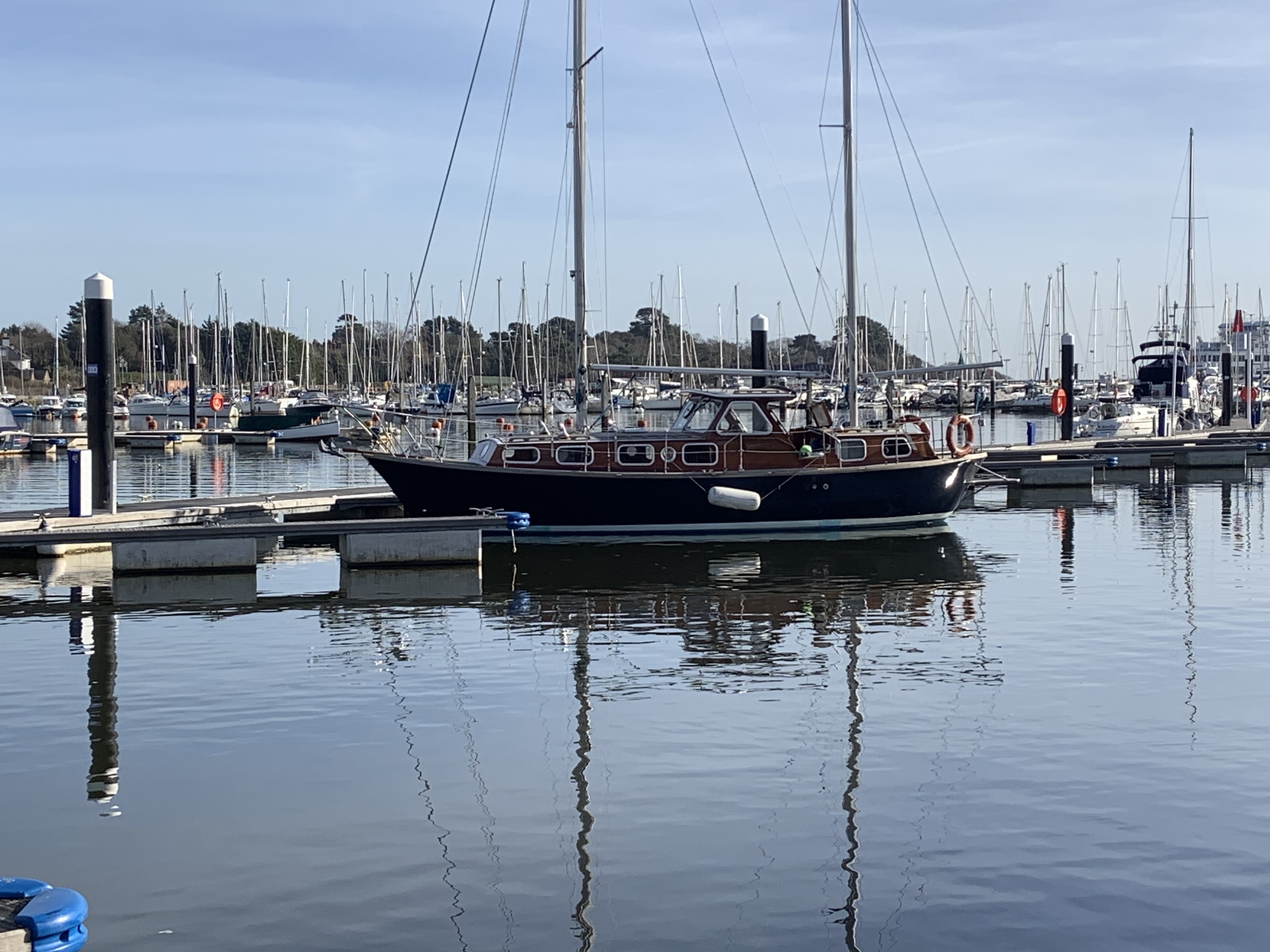
I first saw Antoinette, in Lymington, and from the first moment I saw the boat, I knew I could make the boat my “home.”
She went to Southwold in Suffolk, England for a major refit, and so there is a new engine, gearbox, and propeller, replaced decking, and repairs have been carried out to the hull.
Inside, I can stand up, and although only 37 foot long, being beamy, there is a lot of room.
There are double cabins both fore and after, with “heads” (bathrooms). The main cabin and galley is very comfortable. It has a lot of mahogany wood, so looks homely, and the “dog house” (bit in the middle), is a very open useable space, either enclosed when cold and wet, or if the weather permits, opened up to enjoy the sun.
The key is that this is “my home”.
I can now travel, and go where I like, but I have my home with me. It has heating, but normally when you arrive somewhere, part of the mooring fees offer a shower unit and facilities. I have space to entertain, but above all, I am free of all the ties that we adopt by following the life society offers us as “the norm“.
It is only now that I see the traps that others face, because I can up anchor and head off, and can see where Les Powles got his freedom, and lived his dream.
In the cabin of Antoinette with Finn the dog belonging to Natalie (on the left).
The collie is “Finn”, Natalie’s dog. I think Paul was one of the first to see her when she was born, so 31 years later, Natalie wants to enjoy the alternative life.
As for Finn, he loves it. Fresh air, plenty going on, and a lot to see.
“Tiny living”, but the release from the way most people live is amazing.
No speeding tickets for me. 🤪
ooOOoo
Thank you, Bob for the story of you and me. That last thirty years have flown by and those years on Songbird of Kent were really special albeit the end of my cruising days were pretty scary.
As Stephen Messenger, the author of the article, says: “It was a moment of pure awe.” I am not going to waffle on in a prelude to this story, that was taken from The Dodo, so I am going straight into it.
ooOOoo
Animal Shelter Finds A Crate At The Door — And Most Touching Handwritten Note
Earlier this week, staff at North Carolina’s Fayetteville Animal Protection Society arrived to find that a crate has been placed outside their door, covered in a blanket.
In an instant, their hearts sank.
“Our first thought was, ‘Oh no, not another case of irresponsible pet ownership,’” Jackie Peery, executive director of the shelter, told The Dodo. “We were bracing for an accidental litter dumped at our doorstep due to not spaying/neutering, or someone moving and not willing to bring their pet.”
Inside the crate was indeed a litter of bouncy puppies. But there was more.
“Then we saw the note,” Peery said. “It was a moment of pure awe.”
As the note explained, this wasn’t an act of abandonment.
It was an act of love.
The letter reads as follows:
“Please help! I found these puppies sadly after noticing a local stray dog that I would often feed when I could, dead by the road. She had been hit by a car. I knew from feeding her that she had puppies somewhere and after searching where I would usually see her I found them. I’m sorry for leaving them like this but I myself am homeless and cannot afford to care for them …”
“My heart shatters for them and their mother. I just want them to be given the chance their mother, like myself, was never given. Please do not think poorly of me but it felt wrong leaving them alone in the cold waiting on a mother that would not be coming home. Sincerely, nameless man.”
He’d saved them.
Reading the note, Peery was stunned.
“This nameless man made it his mission to find these puppies to ensure their safety,” she said. “He remains a mystery — our very own nameless hero.”
Meanwhile, the puppies he rescued are now thriving, thanks to him.
“When they first arrived, you could tell they weren’t in the best shape. But now, it’s a whole different story,” Peery said. “It’s like they understand they’ve been given a second chance and are just soaking up all the love and joy.”
In time, Peery has no doubt that each of the puppies will be adopted into loving homes. But she hopes the unnamed hero will make himself known so he can be the recipient of the same sort of kindness he’s shown.
“We’re keeping our fingers crossed that he comes forward,” Peery said. “There’s a whole community here ready to support him just as I have supported these puppies. It would be wonderful to thank him in person and perhaps even help him in return.”
ooOOoo
I am almost lost for words that this event, that was written in 2024, is so beautiful.
Are there any persons who would like to adopt a puppy? Because I want to leave you with the address, email address and contact telephone number for the Fayetteville Animal Protection Society.
There have been so many disastrous activities on climate change, and I am not belittling them, but it was amazing to come across a TED Talk last Saturday that I watched. But first the speaker, Asmeret Asefaw Berhe, who was born in Asmara, Eritrea. Her bio (in part):
From WikiPedia:
ooOOoo
Asmeret Asefaw Berhe is a soil biogeochemist and political ecologist who is the current Director of the Office of Science at the US Department of Energy. She was previously the Professor of Soil Biogeochemistry and the Ted and Jan Falasco Chair in Earth Sciences and Geology in the Department of Life and Environmental Sciences; University of California, Merced.[1] Her research group worked to understand how soil helps regulate the Earth’s climate.
Advocacy and global impact work
Berhe’s work at the intersection of soil, climate change, and political ecology lends itself well to a number of global issues. During her graduate career, she was a member of the working group that produced the Millennium Ecosystem Assessment, which was called for by the United Nations Secretary Kofi Annan to assess the impact of humans on the environment. She was one of the lead authors on the 2005 report’s chapter on “Drivers of Change in Ecosystem Condition and Services.”[19] The Assessment received the Zayed International Prize for the Environment in 2005.[20]
In 2018, Berhe was selected as part of the inaugural National Academies of Sciences, Engineering, and Medicine New Voices in Sciences, Engineering, and Medicine cohort, as an early career leader working to advance the conversation around key emerging global issues and communicate the evidence base around those challenges.[21]
An advocate for women in science, Berhe is currently a co-Principal Investigator of ADVANCEGeo, which is working to transform the workplace climate of the geosciences to increase retention of women in the field and develop a sustainable model that can be transferred to other scientific domains. Currently, the Earth Science Women’s Network (ESWN), the Association for Women Geoscientists, and the American Geophysical Union (AGU) have partnered to address the issue of sexual harassment in the earth, space and environmental sciences.[22] The program led by Erika Marín-Spiotta and is run with support from a four-year $1.1 million grant from the National Science Foundation.[23]
She currently serves as an advisory board member of 500 Women Scientists, a grassroots organization working to make science open, inclusive, and accessible, and is on the leadership board of the Earth Science Women’s Network.
Earth’s soil can store vast amounts of carbon. Biogeochemist Asmeret Asefaw Berhe says soil could be a powerful tool for fighting climate change – if only we stopped treating it like dirt.
About Asmeret Asefaw Berhe
Asmeret Asefaw Berhe is a soil biogeochemist and President Biden’s nominee to lead the Department of Energy Office of Science. She is a professor of soil biogeochemistry at University of California, Merced. Her research group works to understand how soil helps regulate the earth’s climate.
Berhe’s work exists at the intersection of soil, climate change, and political ecology. During her graduate career, she was a member of the working group that produced the Millennium Ecosystem Assessment, which was called for by the United Nations to assess the impact of humans on the environment.
Berhe received a B.Sc. in Soil and Water Conservation at the University of Asmara in Eritrea. She has an M.Sc. in Political Ecology from Michigan State University and a Ph.D. in Biogeochemistry from University of California, Berkeley.
This segment of the TED Radio Hour was produced by Matthew Cloutier and Sylvie Douglis and edited by Rachel Faulkner and Katie Simon. You can follow us on Facebook @TEDRadioHour and email us at TEDRadioHour@npr.org.
Now that positive TED Talk:
We wish Asmeret the very best of fortune in bringing about these changes.
In our case our (remaining) dogs, Oliver and Cleopatra, are able to go outside but still remain on our land. But plenty of dog owners are not in such a privileged position and need to take their dogs on public pavements and the like.
Thus for all you dog owners in that position then Erik’s advice is for you.
ooOOoo
Dog care below freezing − how to keep your pet warm and safe from cold weather, road salt and more this winter
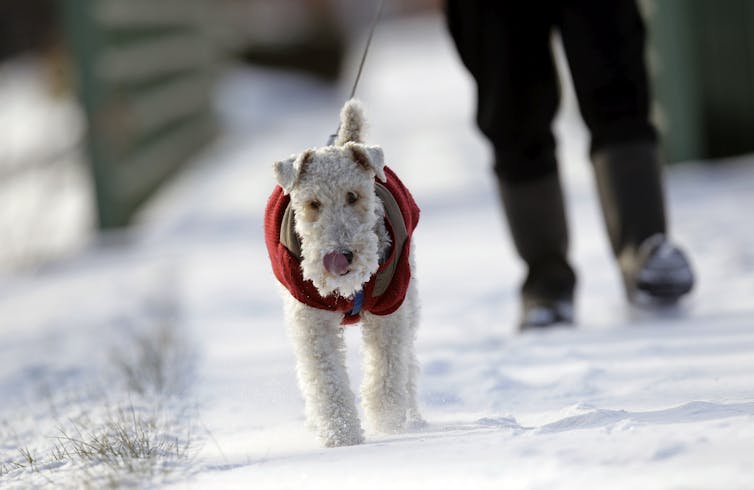
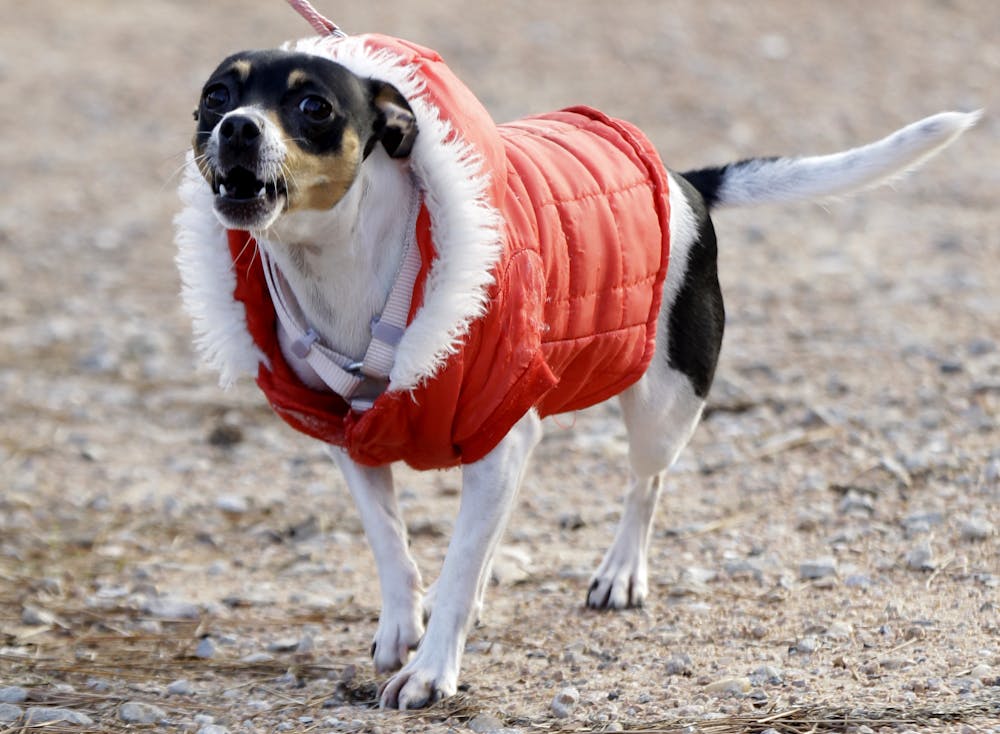
Dogs get cold in the winter too, but there are things pet owners can do to help them feel comfortable. AP Photo/David Duprey
Time outside with your dog in the spring, summer and fall can be lovely. Visiting your favorite downtown café on a cool spring morning, going to a favorite dog park on a clear summer evening or going on walks along a river when the leaves are changing color are all wonderful when the weather is favorable. But in much of the country, when winter rolls around, previously hospitable conditions can quickly turn chilly and dangerous for people and pups alike.
Winter brings some unique challenges for dog owners, since dogs still need activity and socialization during colder seasons. Studies have shown that dog owners are almost 50% less likely to walk their dogs when the weather gets cold. Knowing the basics of winter safety is critical to maintaining a healthy lifestyle for your dog.
I am an assistant professor at the University of California Davis School of Veterinary Medicine who weathered polar vortexes with my dog while living in Michigan early in my career. While I’ve since moved to sunny California, I’ve seen how quickly frigid temperatures can turn dangerous for pets.
Breed and age differences
Not all dogs have the same abilities to deal with cold weather. A short-coated dog like a Chihuahua is much more susceptible to the dangers of cold weather than a thick-coated husky. When the weather dips below 40 degrees Fahrenheit (4 degrees Celsius), the well-acclimated husky may be comfortable, whereas the Chihuahua would shiver and be at risk of hypothermia.
Additionally, if your dog is used to warm weather, but you decide to move to a colder region, the dog will need time to acclimate to that colder weather, even if they have a thick coat.
Age also affects cold-weather resilience. Puppies and elderly dogs can’t withstand the chill as well as other dogs, but every dog is unique – each may have individual health conditions or physical attributes that make them more or less resilient to cold weather.
Pet owners should be able to recognize the symptoms of a dog that is getting too cold. Dogs will shiver, and some may vocalize or whine. Dogs may resist putting their feet down on the cold ground, or burrow, or try to find warmth in their environment when they are uncomfortable.
Just like people, dogs can get frostbite. And just like people, the signs can take days to appear, making it hard to assess them in the moment. The most common sites for frostbite in dogs are their ears and the tips of their tails. Some of the initial signs of frostbite are skin discoloring, turning paler than normal, or purple, gray or even black; red, blistered skin; swelling; pain at the site; or ulceration.
Other serious signs of hypothermia include sluggishness or lethargy, and if you observe them, please visit your veterinarian immediately. A good rule to live by is if it is too cold for you, it is too cold for your dog.
Getting your dog a sweater or jacket and paw covers can provide them with protection from the elements and keep them comfortable. Veterinarians also recommend closely monitoring your dog and limiting their time outside when the temperature nears the freezing point or drops below it.
Road salt dangers
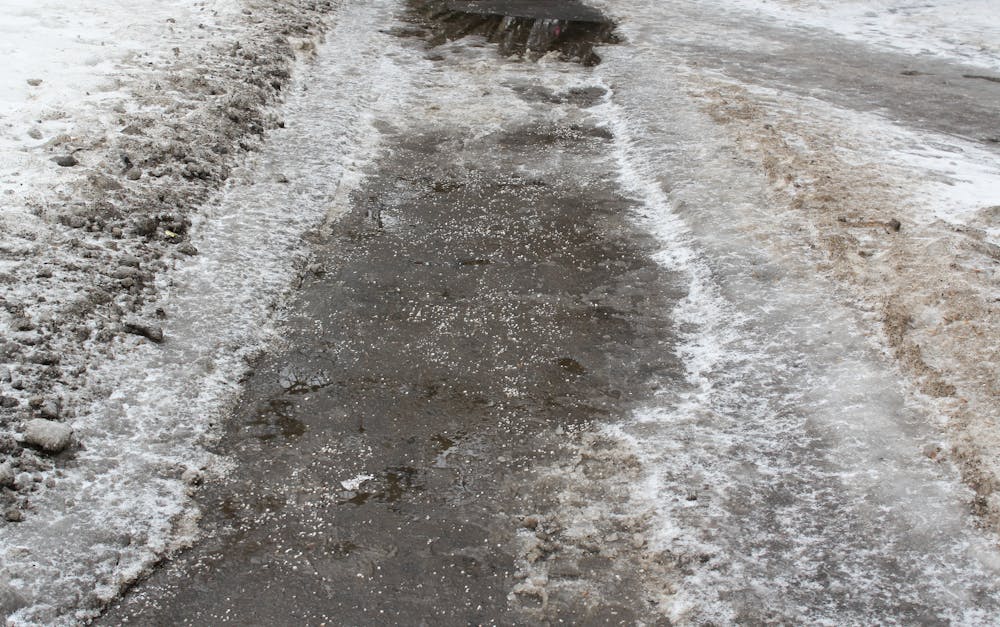
Road salt that treats ice on streets and sidewalks can also harm dogs. When dogs walk on the salt, the sharp, rough edges of the salt crystals can irritate the sensitive skin on their paws.
Paw covers for dogs can keep their feet warm and protected from road salt. AP Photo/Jim Cole
Dogs will often lick their feet when they’re dirty, wet or irritated, and if they ingest any salt doing that, they may face GI upset, dehydration, kidney failure, seizures or even death. Even small amounts of pure salt can disrupt critical body functions in dogs.
Some companies make pet-safe salt, but in public it can be hard to tell what type of salt is on the ground. After walking your dog, wash off their feet or boots. You can also keep their paw fur trimmed to prevent snow from balling up or salt collecting in the fur. Applying a thin layer of petroleum jelly or paw pad balm to the skin of the paw pads can also help protect your pet’s paws from irritation.
Antifreeze, or ethylene glycol, is in most vehicles to prevent the fluids from freezing when it gets cold out. Some people pour antifreeze into their toilets when away from their home to prevent the water in the toilet from freezing.
Antifreeze is an exceptionally dangerous chemical to dogs and cats, as it tastes sweet but can be deadly when ingested. If a pet ingests even a small amount of antifreeze, the substance causes a chemical cascade in their body that results in severe kidney damage. If left untreated, the pet may have permanent kidney damage or die.
There are safer antifreeze options on the market that use ingredients other than ethylene glycol. If your dog ingests antifreeze, please see your veterinarian immediately for treatment.
When temperatures dip below freezing, the best thing pet owners can do is keep the time spent outside as minimal as possible. Try some indoor activities, like hide-and-seek with low-calorie treats, fetch or even an interactive obstacle course. Food puzzles can also keep your dog mentally engaged during indoor time.
Although winter presents some unique challenges, it can still be an enjoyable and healthy time for you and your canine companion.
Erik’s comments about ethylene glycol (EG), or antifreeze as it more commonly known, and the incredible dangers to dogs EG possesses are vital to understand.
Please, please keep your dogs very safe in Winter! If Erik’s advice helps save even a single dog then me republishing this will have been worthwhile.
The atmospheric river in California is reaching up to Southern Oregon
After we had the thick end of twelve inches of rain in January, February has kept up the downpours; as of yesterday morning we had had 0.52 inches (1.32 cm) for the month and it was still raining. (And 0.8 in at 08:00 this morning.)
Here’s an item from yesterday about the situation in California.
Plus the BBC News had an item on the California flood.
So it seemed opportune to present this article on atmospheric rivers.
ooOOoo
What is an atmospheric river? A hydrologist explains the good and bad of these flood-prone storms and how they’re changing
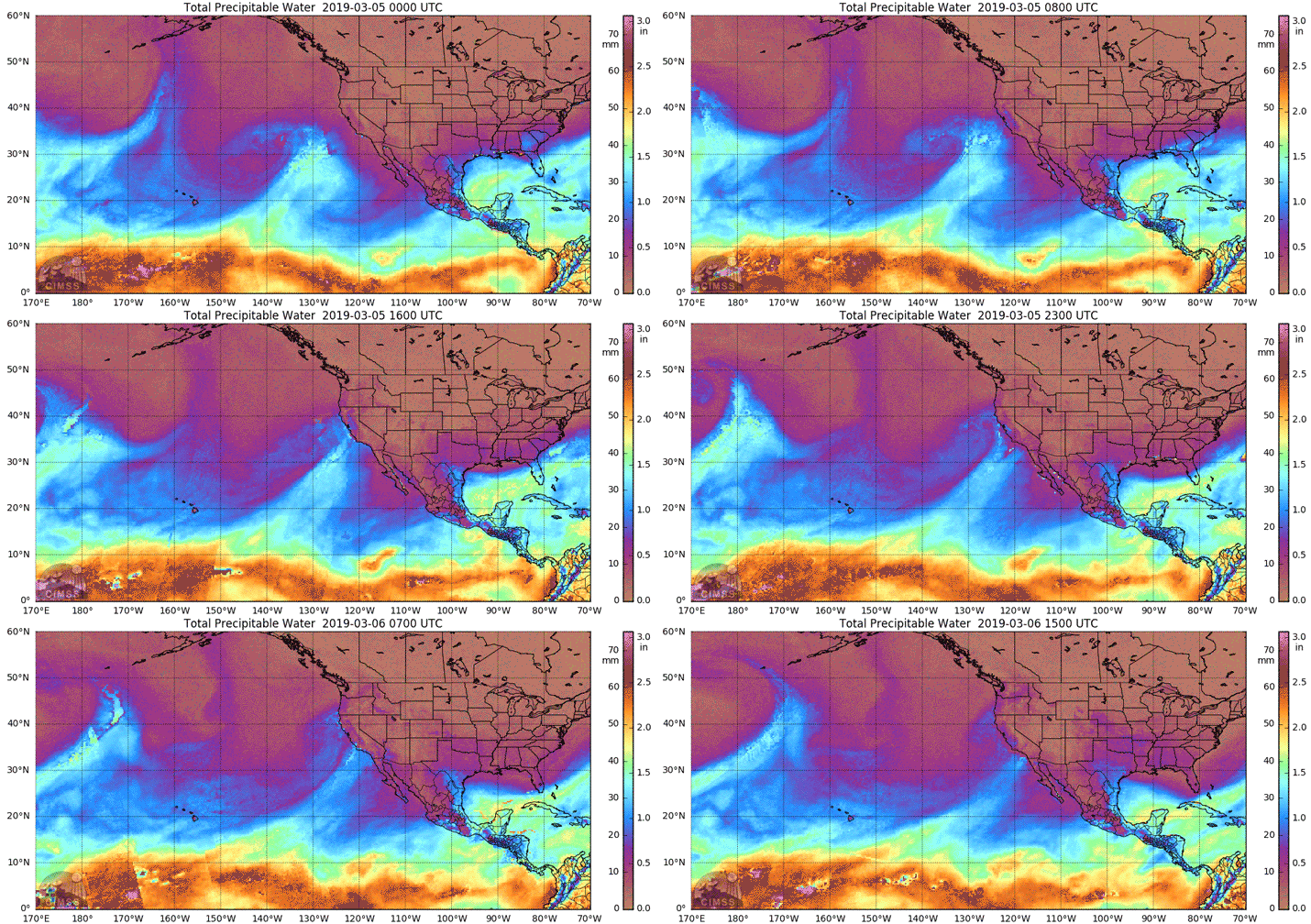
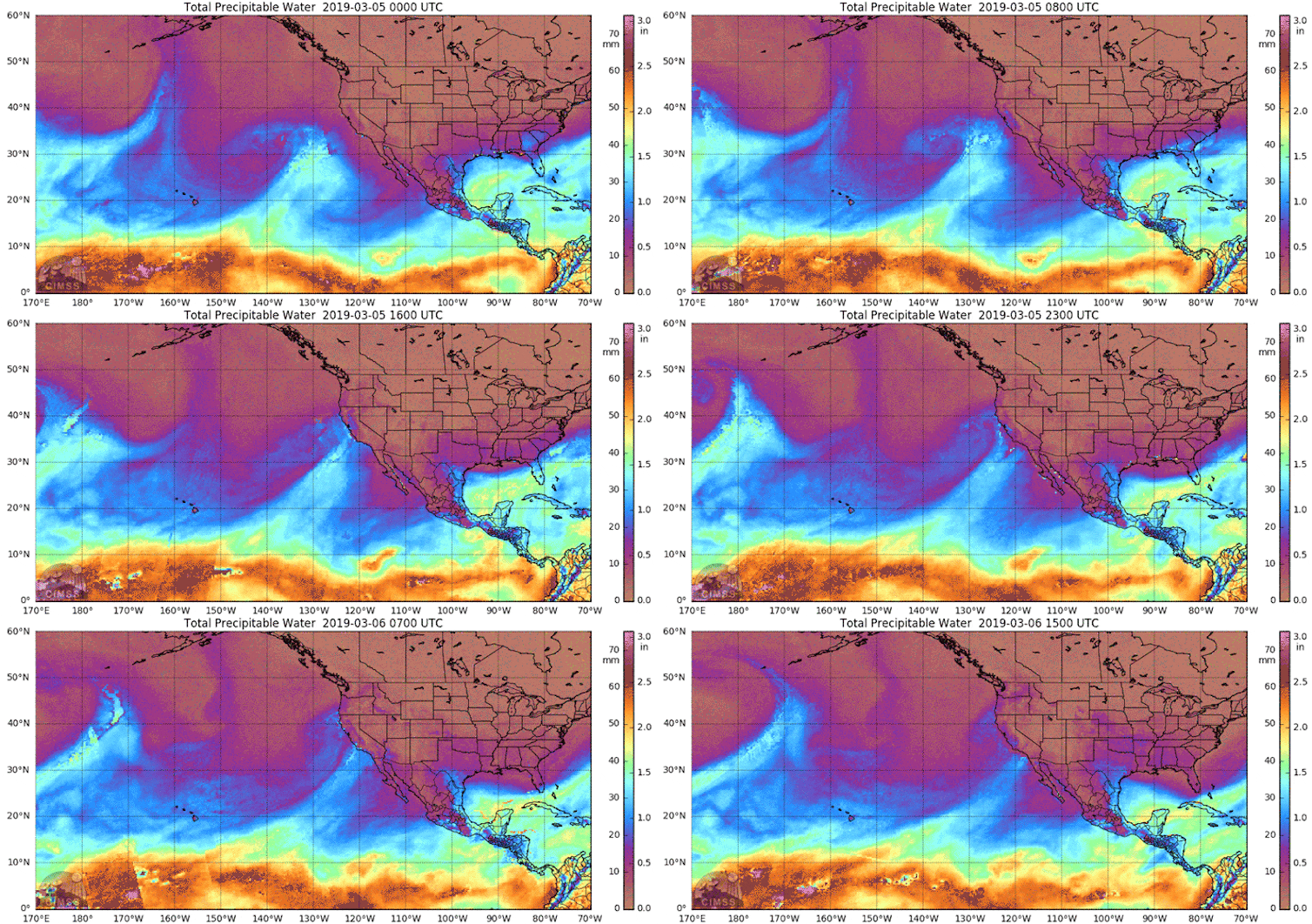
A satellite image shows a powerful atmospheric river hitting the Pacific Northwest in December 2023. Darker greens are more water vapor. Lauren Dauphin/NASA Earth Observatory
A series of atmospheric rivers is bringing the threat of heavy downpours, flooding, mudslides and avalanches to the Pacific Northwest and California this week. While these storms are dreaded for the damage they can cause, they are also essential to the region’s water supply, particularly in California, as Qian Cao, a hydrologist at the University of California, San Diego, explains.
What are atmospheric rivers?
An atmospheric river is a narrow corridor or filament of concentrated water vapor transported in the atmosphere. It’s like a river in the sky that can be 1,000 miles long. On average, atmospheric rivers have about twice the regular flow of the Amazon River.
When atmospheric rivers run up against mountains or run into local atmospheric dynamics and are forced to ascend, the moisture they carry cools and condenses, so they can produce intense rainfall or snowfall. https://www.youtube.com/embed/w3rtYM0HtIM?wmode=transparent&start=0 A satellite view of atmospheric rivers.
Atmospheric rivers occur all over the world, most commonly in the mid-latitudes. They form when large-scale weather patterns align to create narrow channels, or filaments, of intense moisture transport. These start over warm water, typically tropical oceans, and are guided toward the coast by low-level jet streams ahead of cold fronts of extratropical cyclones.
Along the U.S. West Coast, the Pacific Ocean serves as the reservoir of moisture for the storm, and the mountain ranges act as barriers, which is why the western sides of the coastal ranges and Sierra Nevada see so much rain and snow.
Why are back-to-back atmospheric rivers a high flood risk?
The first heavy downpours saturate the ground. As consecutive storms arrive, their precipitation falls on soil that can’t absorb more water. That contributes to more runoff. Rivers and streams fill up. In the meantime, there may be snowmelt due to warm temperatures, further adding to the runoff and flood risk.
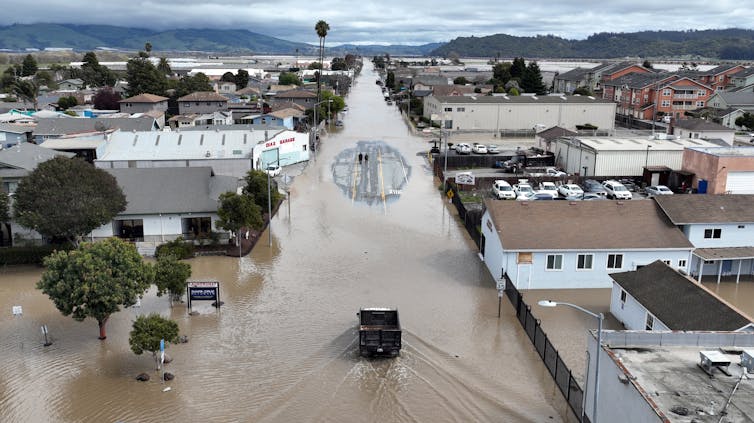
California experienced a historic run of nine consecutive atmospheric rivers in the span of three weeks in December 2022 and January 2023. The storms helped bring most reservoirs back to historical averages in 2023 after several drought years, but they also produced damaging floods and debris flows.
Atmospheric rivers forming over the tropical Pacific Ocean head for the U.S. West Coast. NOAA
The cause of AR families is an active area of research. Compared with single atmospheric river events, AR families tend to be associated with lower atmospheric pressure heights across the North Pacific, higher pressure heights over the subtropics, a stronger and more zonally elongated jet stream and warmer tropical air temperatures.
Large-scale weather patterns and climate phenomena such as the Madden-Julian Oscillation, or MJO, also play an important role in the generation of AR families. An active MJO shift occurred during the early 2023 events, tilting the odds toward increased atmospheric river activity over California.
An aerial view shows a flooded neighborhood in the community of Pajaro in central California on March 11, 2023, after a series of atmospheric rivers. Josh Edelson/AFP via Getty Images
A recent study by scientists at Stanford and the University of Florida found that storms within AR families cause three to four times more economic damage when the storms arrive back to back than they would have caused by themselves.
How important are atmospheric rivers to the West Coast’s water supply?
I’m a research hydrologist, so I focus on hydrological impacts of atmospheric rivers. Although they can lead to flood hazards, atmospheric rivers are also essential to the Western water supply. Atmospheric rivers have been responsible for ending more than a third of the region’s major droughts, including the severe California drought of 2012-16.
They also contribute to the snowpack, which provides a significant portion of California’s year-round water supply.
In an average year, one to two extreme atmospheric rivers with snow will be the dominant contributors to the snowpack in the Sierra Nevada. Together, atmospheric rivers will contribute about 30% to 40% of an average season’s total snow accumulation there.
After several winter storms brought record snowfall to California’s Sierra Nevada in early 2023, Lake Oroville, California’s second-largest reservoir, was at 100% capacity. The previous year, much of the state had faced water restrictions. Justin Sullivan/Getty Images
That’s why my colleagues at the Center for Western Weather and Water Extremes at the Scripps Institution of Oceanography, part of the University of California, San Diego, work on improving atmospheric river forecasts and predictions. Water managers need to be able to regulate reservoirs and figure out how much water they can save for the dry season while still leaving room in the reservoirs to manage flood risk from future storms.
How is global warming affecting atmospheric rivers?
My research also shows that more atmospheric rivers are likely to occur concurrently during already wet conditions. So, the chance of extreme flooding also increases. Another study, by scientists from the University of Washington, suggests that there will be a seasonal shift to more atmospheric rivers earlier in the rainy season.
There will likely also be more year-to-year variability in the total annual precipitation, particularly in California, as a study by my colleagues at the Center for Western Weather and Water Extremes projects.
Penny Martin offers another post, but first comment on the rain.
With this day being the 1st February I can tell you what we received in rainfall for January: it was 11.99 inches (30.45 cms). That is a record for the years that we have been living here.
Now over to Penny.
Penny Martin is now a regular contributor to these pages, and I am grateful for that. Simply because I have been blogging for a long time and having this resource is most welcome. Not that I consider Penny a ‘resource’ she is much more than that: Penny is a brilliant contributor.
Here is her latest offering, talking about the new world so many of us are now living in.
Laptop and Leash: Succeeding as a Pet-Loving Digital Nomad
By Penny Martin.
In today’s interconnected world, the allure of becoming a digital nomad resonates with many. This lifestyle promises the freedom to explore the world while staying professionally active. However, for those who cherish the company of their pets, this dream presents unique challenges. This guide from Learning from Dogs is designed to navigate the complexities of adopting a digital nomad lifestyle with your pet, ensuring a seamless transition that caters to both your needs and those of your animal companion.
Establishing a Financial Foundation
Embarking on a journey with your pet as a digital nomad begins with the fundamental step of securing a reliable income. This financial stability is the cornerstone of your nomadic life, ensuring that both you and your pet’s needs are adequately met. Whether it’s through remote employment, freelance work, or managing an online business, a consistent income stream is essential. It provides peace of mind and the freedom to fully embrace the nomadic lifestyle with your furry friend.
Advancing Digital Skills
In today’s rapidly changing digital environment, the skills you possess are of paramount importance. It’s essential to devote time to bolstering your digital expertise. One way to do this is by pursuing further education, such as enrolling in online courses that offer specialized training. Notably, a cybersecurity degree can be earned online, providing an avenue to deepen your understanding of protecting data and computer networks. Additionally, acquiring skills in fields like digital marketing or web development can be immensely beneficial. These skills are invaluable not just for career growth and stability but also for ensuring you can work effectively from any corner of the globe.
Finding Pet-Friendly Living Spaces
Transitioning to a nomadic lifestyle with a pet requires thoughtful planning, particularly when it comes to accommodations. It is essential to find living spaces that are not just comfortable for you but also welcoming to your pet. This means prioritizing pet-friendly hotels, apartments, and co-living spaces in your travel planning. Ensuring a comfortable and safe environment for your pet is key to a successful journey, allowing both of you to settle in and adapt to new surroundings with ease.
Navigating Legalities and Regulations
As you traverse different regions and countries, it’s important to stay informed about the varying legal requirements related to pet travel and ownership. This includes understanding entry regulations, quarantine rules, and local leash laws. Being well-versed in these legalities ensures that you avoid any complications or surprises during your travels. It also demonstrates a commitment to responsible pet ownership, reflecting a respect for the regulations of each place you visit.
Emphasizing Pet Health and Safety
The health and safety of your pet should always be a top priority. This includes ensuring that all vaccinations are up-to-date and that your pet has a microchip with current contact information. Additionally, researching veterinary services and emergency clinics in each new location provides peace of mind. Being proactive about your pet’s health needs and prepared for any emergencies are crucial aspects of traveling safely and responsibly with your pet.
Access to Veterinary Services
Before setting off on your nomadic adventure, investigate the availability of veterinary care in your planned destinations. Identifying reputable clinics and hospitals ensures that you have access to necessary health services for your pet. In addition, carrying a basic first-aid kit for pets can help manage minor health issues that may arise during your travels. Being prepared in this regard is a testament to your commitment to your pet’s well-being.
Efficient Management of Pet Documents
Organizing your pet’s documents is as important as managing your own. This includes keeping a digital record of your pet’s medical history, identification, and travel permits. Utilizing mobile applications for document scanning and storage offers a convenient solution to keep these vital records accessible at all times. Efficient document management streamlines the process of crossing borders and accessing services, ensuring a smoother travel experience for both you and your pet.
The journey of a digital nomad with a pet is a path filled with rewarding experiences and unique challenges. By laying a solid financial foundation, enhancing your digital capabilities, and meticulously planning for your pet’s needs, this lifestyle becomes not only feasible but deeply fulfilling. It’s a journey that goes beyond mere travel – it’s about building a life rich with experiences and memories, shared with your loyal companion every step of the way.
ooOOoo
These are key tips from Penny and ones that all people who are regular users of digital devices should employ; and that is a huge number these days.
Jean and I are still coming to terms with Monday’s loss of Brandy. We will never forget the incident for the rest of our lives. Hearing that Brandy’s body had been found would be very helpful but, personally, I think that is very unlikely.
Patrice Ayme is a writer who lives in France and is a person of extreme breadth of knowledge, and very clever to boot.
He writes blog posts on a variety of topics. His latest post is breathtakingly powerful and could be the way we all go over the future years. Read it for yourself online or as follows:
ooOOoo
How Solar System Colonization Will Save Earth
By Patrice Ayme
Saving Earth and colonizing the Solar System are basically the same problem and have the same solution: much more advanced technology [1].There is no contradiction, far from it. There is complementarity, as technology that will have to be developed for space will be found to be useful for Earth. For psycho-political reasons those technologies won’t be developed directly for Earth. So those who complain about space, while claiming we should focus on Earth, get it only half right.
Colonizing Mars with present technology is not going to happen anymore than the technology of the 1960s enabled to colonize the Moon. A visit from a human crew on Mars with the technology SpaceX wants to develop is imaginable… Barely. And those will just be visits, multi-year commitments full of lethal radiation and worse living accommodations than the highest maximum security prison: basically what was done on the Moon in the 1960s, but much more daunting.
It’s much more feasible to establish bases on the Moon. First, there is plenty of oxygen and hydrogen (so water) on the Moon, imprisoned in rocks: one only needs energy to extract them, and the Moon has plenty of that (solar panels!) Second, the gravity well of the Moon is also half that of Mars. Third, the Moon is close by and one can go there all the time (whereas Mars can be visited with present fossil fuel tech only every two years, when the planets align; serious commuting of goods and people between Earth and Mars will require nuclear propulsion).Monitoring robots on the Moon is possible, whereas on Mars, with up to twenty minutes delay, one will have to use advanced, autonomous AI. Fixing problems caused by dust in robots on the Moon with roaming human crews… A solution that won’t exist on Mars, for decades.
Thus AI is the first order solution: AI just needs energy, not shelter, air, water and food. AI colonies on the Moon, and then, later, Mars could build environments that humans could then inhabit. Say pressurized lava tubes…
Skeptics could object that I didn’t roll out specific techs. But space colonization, especially if robot and AI driven, will require much higher tech. For example solar energy, which works wonderfully, was led by its usage in space… where it has long worked splendidly. The solar cells used in space have an efficiency more than twice that of the ones used on the ground… from using more advanced (but expensive) materials, like Gallium… That has invited researchers and companies to boost the efficiency of the silicon and now perovskites cells used on the ground. SpaceX uses Reliable Reusable Rockets (RRR), lowering the cost of space access… That is revolutionary, but actually follows the tech used to land on the Moon in the first place. But the first landing rockets, the LEMS, were Lunar Exploration Modules… They showed the way…
Technology is impossible without wisdom, and wisdom impossible without technology. One can’t grow without the other. The quest for tech is a quest for wisdom.
We don’t need AI on Earth, at least so many “leaders” will think (and they would be very wrong)… However, for space colonization, clearly, we need AI. Space AI will then bring in the Earth AI we need to solve countless problems, including the ones we didn’t think we had.
NASA picture from Curiosity rover on a rather barren, poisonous, irradiated, dusty and dry Mars
P/S: Scifi novels are an old genre: The Birds of Aristophanes, making fun of the colonies Athens established everywhere, by establishing one in the sky, preceded the space colonization of Lucian by seven centuries…
***
[1] The European solution to the Earth Crisis has been Mathusianism: use less energy. This weakens Europe and encourages its dictatorial enemies. Actually the best solution is rather the opposite: to use more ABSOLUTE WORTH ENERGY. Use, much more EFFICIENT energy. In particular, we have to leverage fossil fuels to get out of them… using the energy they provide to invent new science and tech….
ooOOoo
Yet another masterpiece from Mr. Ayme. I cannot add anything to this post except to applaud it.
Recovery from addiction is a complex and emotionally taxing process that involves much more than simply abstaining from substance use. It necessitates a holistic approach to healing, which often includes medical treatment, psychotherapy, lifestyle changes, and, for many people, the support of loved ones.
Another source of support that is increasingly recognized for its therapeutic benefits is the companionship of pets. Whether it’s a dog, a cat, or even a bird, pets offer emotional sustenance, non-judgmental companionship, and numerous practical advantages. In this article from Learning from Dogs, we delve into how the presence of a pet can be a transformative experience.
It’s All About a Good Routine
Establishing a stable routine is a cornerstone of addiction recovery. A routine not only provides structure to the day but also instills a sense of responsibility and purpose. Owning a pet naturally requires a routine for feeding, exercise, and care.
This routine can help an individual in recovery stay focused and reduce the void or emptiness often cited as a relapse trigger. Technologies like automated pet feeders can further support this routine, ensuring that your responsibilities are met even when you’re dealing with emotional ups and downs.
Pets Just Make You Feel Better
PsychCentral notes that interacting with pets has been scientifically shown to improve emotional health. Simple actions such as petting a dog or cat trigger the release of “feel-good” hormones like oxytocin, reducing stress and elevating mood.
These emotional benefits are invaluable, especially during the psychologically taxing phases of withdrawal and detoxification. Mental health tracking apps can provide real-time data on your emotional state, often reflecting an improvement correlated with increased time spent with your pet.
Pet-Friendliness and Rehab
Selecting the appropriate rehab facility is an essential step toward a successful recovery journey. An important criterion to consider is the availability of pet-friendly options or the incorporation of pet therapy in the facility’s treatment approach.
Many centers, including local resources for treatment and recovery, are increasingly acknowledging the multifaceted therapeutic advantages that pets can offer and are thus integrating them into their treatment regimens. Specialized online platforms provide comprehensive data about such pet-amicable facilities, empowering individuals to make a well-informed decision.
Diverting from Destructive Urges
Engaging with pets can provide a crucial distraction from cravings and negative thoughts. Whether it’s going for a walk, playing fetch, or simply cuddling on the sofa, these activities require engagement that diverts attention away from destructive patterns. There are even interactive pet toys available now, controlled via smartphone apps, that can keep both the pet and the owner engaged, further reducing idle time that might otherwise lead to cravings.
Pets Make You Social
HABRI points out that owning a pet often encourages social interaction, which can be particularly beneficial during recovery. Whether it’s through meeting other dog owners during walks or engaging in community pet events, these interactions foster a sense of community and belonging. These newly formed social connections can be a significant supportive element in staying sober. Social platforms and apps for pet owners offer a virtual space to connect, share experiences, and seek advice, contributing to a broader support system.
Enhancing Self-Image
Successfully caring for a pet significantly boosts self-esteem and self-worth. Taking responsibility for the well-being of another life generates a sense of accomplishment and purpose, which are foundational in rebuilding one’s life after addiction. Virtual training modules and online courses offer valuable insights into pet care, further increasing competence and confidence in this area.
The journey through addiction recovery is seldom straightforward. It’s a path fraught with challenges, emotional turbulence, and setbacks. However, the simple act of caring for a pet offers an unmatched emotional and practical support system that aids significantly in the recovery process. From establishing routine and boosting emotional well-being to providing a sense of purpose, the benefits are multi-layered and profound. As you navigate through the trials of addiction recovery, the companionship of a pet can become one of your most significant sources of comfort, strength, and hope.
Learning from Dogs serves as a reminder of the values of life and the power of unconditional love – as so many, many dogs prove each and every day. Read more informative articles today!
ooOOoo
HABRI stands for The Human Animal Bond Research Institute and their website is available if you click on the title. I am going to see if I can republish some of HABRI’s articles.
Anyway, thanks to Penny for another great guest post.
It just goes to show the importance of loving an animal, especially a cat or a dog.
This is a guest post, from Penny Martin. Penny has written guest posts previously, and I welcome another one for your reading.
ooOOoo
How To Style Your Home for a Successful Sale As a Pet Owner
By Penny Martin
Photo via Pexels
Selling a home is a pivotal moment, and it’s often laden with challenges, especially for pet owners. Pets are integral to many families, yet their presence in a home can affect its market appeal. The key to success lies in presenting a home that is inviting to a broad range of buyers, creating a balance where your pet-friendly environment is subtly perceptible but not overtly dominant. This comprehensive guide, presented by Learning From Dogs, delves into effective strategies for preparing your home for sale, ensuring it is welcoming and appealing to potential buyers while accommodating your pets in an understated manner.
Refurbish Pet-Caused Damages
Initiate the home staging process by addressing any visible pet-related damage. This includes repairing scratched floors, restoring torn carpets, and replacing chewed baseboards or door frames. Undertaking these repairs is essential, as it enhances the aesthetic appeal of your home and demonstrates to potential buyers that the property has been meticulously cared for. This attention to detail not only increases the home’s visual appeal but also instills confidence in buyers about the overall maintenance of the property. It’s also a good idea to take proactive measures that will prevent your pet from exhibiting destructive behaviors in your new place.
Deep Cleaning for a Pristine Look
The importance of a thoroughly cleaned home cannot be overstated. This means going beyond the usual cleaning routine to focus on eradicating pet hair, dander, and any trace of pets. Consider the benefits of a professional cleaning service to ensure a comprehensive and meticulous result. A spotlessly clean home not only presents well but also communicates a sense of pride and care in property maintenance. It’s a visual reassurance to buyers that the home has been well-loved and looked after.
Market Research for Competitive Edge
Conducting thorough market research is a pivotal step in the home-selling process. Investigate how comparable homes in your locality are presented in the market. Pay close attention to their staging techniques, pricing strategies, and how they highlight their homes’ best features. This research will arm you with knowledge and insights, enabling you to position your home competitively in the market. Understanding the local real estate landscape helps in making informed decisions about how to best showcase your home to attract the right buyers.
Eliminating Pet Odors
Neutralizing pet odors is a critical aspect of home staging. Utilize air purifiers, scented candles, and specialized odor-neutralizing products to ensure your home smells inviting. Regularly airing out the house also plays a crucial role in maintaining a pleasant and fresh atmosphere. Remember, the olfactory experience can greatly influence a buyer’s first impression, so a fresh-smelling home is key to creating a positive and lasting impact.
Stowing Away Pet Supplies
During property viewings, it’s advisable to temporarily remove all visible pet supplies, including food bowls, toys, beds, and litter boxes. You can also do this with personal items such as family photos. This tactic helps potential buyers focus on the space itself without distractions. Creating an environment where buyers can easily envision their own life and belongings in the space is crucial for forming an emotional connection with the property.
Clearing Out Pet Furniture
Consider storing or temporarily replacing pet-specific furniture, such as cat trees, dog beds, and pet crates, as well as large pieces of your own furniture. This not only declutters the space but also allows potential buyers to appreciate the full potential and size of each room. Clearing these items creates an impression of more space and versatility, appealing to a wider range of buyer preferences.
Selecting Pet-Friendly Fabrics
Switch to fabrics that are less prone to trapping pet hair and odors. Opt for easy-to-clean furniture covers that complement your home’s decor. Neutral tones and textures can make a significant difference, as they help potential buyers envision their own furniture and style in the space. This subtle change can enhance the overall appeal of your home, making it more attractive to a diverse group of buyers.
Navigating the home-selling journey as a pet owner requires a strategic and thoughtful approach. By implementing these tailored strategies, you can ensure your home is showcased as a welcoming, pet-neutral space, appealing to a broad spectrum of buyers. A well-prepared, immaculately clean, and thoughtfully staged home increases the likelihood of attracting serious buyers and achieving a successful sale. Remember, the goal is to present a home that resonates with buyers’ aspirations, creating an environment where they can easily envision building their future.
Learning From Dogs offers a unique perspective on how to live life with honesty and integrity. Follow the blog today to learn more!
ooOOoo
Thank you, Penny.
Hopefully this will be on interest to our readers. I, certainly, found it so. Plus, I was more than grateful for the LfD references in the article. Once again, thank you, Penny.












 Learning from Dogs