All known human languages display a surprising pattern: the most frequent word in a language is twice as frequent as the second most frequent, three times as frequent as the third, and so on. This is known as Zipf’s law.
Researchers have hunted for evidence of this pattern in communication among other species, but until now no other examples have been found.
In new research published today in Science, our team of experts in whale song, linguistics and developmental psychology analysed eight years’ of song recordings from humpback whales in New Caledonia. Led by Inbal Arnon from the Hebrew University, Ellen Garland from the University of St Andrews, and Simon Kirby from the University of Edinburgh, We used techniques inspired by the way human infants learn language to analyse humpback whale song.
We discovered that the same Zipfian pattern universally found across human languages also occurs in whale song. This complex signalling system, like human language, is culturally learned by each individual from others.
Learning like an infant
When infant humans are learning, they have to somehow discover where words start and end. Speech is continuous and does not come with gaps between words that they can use. So how do they break into language?
Thirty years of research has revealed that they do this by listening for sounds that are surprising in context: sounds within words are relatively predictable, but between words are relatively unpredictable. We analysed the whale song data using the same procedure.
A breaching humpback whale in New Caledonia. Operation Cetaces
Unexpectedly, using this technique revealed in whale song the same statistical properties that are found in all languages. It turns out both human language and whale song have statistically coherent parts.
In other words, they both contain recurring parts where the transitions between elements are more predictable within the part. Moreover, these recurring sub-sequences we detected follow the Zipfian frequency distribution found across all human languages, and not found before in other species.
Whale song recording (2017) Operation Cetaces 916 KB (download)
Close analysis of whale song revealed statistical structures similar to those found in human language. Operation Cetaces
How do the same statistical properties arise in two evolutionarily distant species that differ from one another in so many ways? We suggest we found these similarities because humans and whales share a learning mechanism: culture.
A cultural origin
Our findings raise an exciting question: why would such different systems in such incredibly distant species have common structures? We suggest the reason behind this is that both are culturally learned.
Cultural evolution inevitably leads to the emergence of properties that make learning easier. If a system is hard to learn, it will not survive to the next generation of learners.
There is growing evidence from experiments with humans that having statistically coherent parts, and having them follow a Zipfian distribution, makes learning easier. This suggests that learning and transmission play an important role in how these properties emerged in both human language and whale song.
So can we talk to whales now?
Finding parallel structures between whale song and human language may also lead to another question: can we talk to whales now? The short answer is no, not at all.
Our study does not examine the meaning behind whale song sequences. We have no idea what these segments might mean to the whales, if they mean anything at all.
A competitive pod of humpback whales on the New Caledonian breeding grounds. Operation Cetaces
It might help to think about it like instrumental music, as music also contains similar structures. A melody can be learned, repeated, and spread – but that doesn’t give meaning to the musical notes in the same way that individual words have meaning.
Next up: birdsong
Our work also makes a bold prediction: we should find this Zipfian distribution wherever complex communication is transmitted culturally. Humans and whales are not the only species that do this.
We find what is known as “vocal production learning” in an unusual range of species across the animal kingdom. Song birds in particular may provide the best place to look as many bird species culturally learn their songs, and unlike in whales, we know a lot about precisely how birds learn song.
Equally, we expect not to find these statistical properties in the communication of species that don’t transmit complex communication by learning. This will help to reveal whether cultural evolution is the common driver of these properties between humans and whales.
The research scientists have led to a prediction: … we should find this Zipfian distribution wherever complex communication is transmitted culturally. Humans and whales are not the only species that do this.
Since then, information overload continues unabated, and many people are rightfully confused by an onslaught of conflicting health information. Even expert advice is often contradictory.
On top of that, people sometimes deliberately distort research findings to promote a certain agenda. For example, trisodium phosphate is a common food additive in cakes and cookies that is used to improve texture and prevent spoilage, but wellness influencers exploit the fact that a similarly named substance is used in paint and cleaning products to suggest it’s dangerous to your health.
Such claims can proliferate quickly, creating widespread misconceptions and undermining trust in legitimate scientific research and medical advice. Social media’s rise as a news and information source further fuels the spread of pseudoscientific views.
Misinformation is rampant in the realm of health and nutrition. Findings from nutrition research is rarely clear-cut because diet is just one of many behaviors and lifestyle factors affecting health, but the simplicity of using food and supplements as a cure-all is especially seductive.
I am an assistant professor specializing in medical education and science communication. I also train scientists and future health care professionals how to communicate their science to the general public.
In my view, countering the voices of social media influencers and health activists promoting pseudoscientific health claims requires leaning into the science of disease prevention. Extensive research has produced a body of evidence-based practices and public health measures that have consistently been shown to improve the health of millions of people around the world. Evaluating popular health claims against the yardstick of this work can help distinguish which ones are based on sound science.
To parse pseudoscientific claims from sound advice about health and nutrition, it’s crucial to evaluate the information’s source. tadamichi/Getty Images
Navigating the terrain of tangled information
Conflicting information can be found on just about everything we eat and drink.
That’s because a food or beverage is rarely just good or bad. Instead, its health effects can depend on everything from the quantity a person consumes to their genetic makeup. Hundreds of scientific studies describe coffee’s health benefits and, on the flip side, its health risks. A bird’s-eye view can point in one direction or another, but news articles and social media posts often make claims based on a single study.
Things can get even more confusing with dietary supplements because people who promote them often make big claims about their health benefits. Take apple cider vinegar, for example – or ACV, if you’re in the know.
Apple cider vinegar has been touted as an all-natural remedy for a variety of ailments, including digestive issues, urinary health and weight management. Indeed, some studies have shown that it might help lower cholesterol, in addition to having other health benefits, but overall those studies have small sample sizes and are inconclusive.
Advocates of this substance often claim that one particular component of it – the cloudy sediment at the bottom of the bottle termed “the mother” – is especially beneficial because of the bacteria and yeast it contains. But there is no research that backs the claim that it offers any health benefits.
It’s also important to keep in mind that the global dietary supplements industry is worth more than US$150 billion per year, so companies – and wellness influencers – selling supplements have a financial stake in convincing the public of their value.
Misinformation about nutrition is nothing new, but that doesn’t make it any less confusing.
How nutrition science gets twisted
There’s no doubt that good nutrition is fundamental for your health. Studies consistently show that a balanced diet containing a variety of essential nutrients can help prevent chronic diseases and promote overall well-being.
However, pseudoscientific claims often twist such basic facts to promote the idea that specific diets or supplements can prevent or treat illness. For example, vitamin C is known to play a role in supporting the immune system and can help reduce the duration and severity of colds.
Some companies overstate the benefits while underplaying the hazards.
For example, wellness influencers have promoted raw milk over pasteurized milk as a more natural and nutritious choice, but consuming it is risky. Unpasteurized milk can contain harmful bacteria that leads to gastrointestinal illness and, in some cases, much more serious and potentially life-threatening diseases such as avian influenza, or bird flu.
The lure of dietary myths has led people with cancer to replace proven science-backed treatments, such as chemotherapy or radiation, with unproven and misleading nutrition programs.
How to spot less-than-solid science
Pseudoscience exploits your insecurities and emotions, taking advantage of your desire to live the healthiest life possible.
While the world around you may be uncertain and out of your control, you want to believe that at the very least, you have control over your own health. This is where the wellness industry steps in.
What makes pseudoscientific claims so confusing is that they use just enough scientific jargon to sound believable. Supplements or powders that claim to “boost immunity” often list ingredients such as adaptogens and superfoods. While these words sound real and convincing, they actually don’t mean anything in science. They are terms created by the wellness industry to sell products.
I’ve researched and written about reliable ways to distinguish science facts from false health claims. To stay alert and find credible information, I’d suggest you follow a few key steps.
First, check your emotions – strong emotional reactions, such as fear and anger, can be a red flag.
Next, check that the author has experience or expertise in the field of the topic. If they’re not an expert, they might not know what they are talking about. It’s always a good idea to make sure the source is reputable – ask yourself, would this source be trusted by scientists?
Finally, search for references that back up the information. If very little or nothing else exists in the science world to back up the claims, you may want to put your trust in a different source.
Following these steps will separate the facts from fake news and empower you to make evidence-based decisions.
Pratyush has been very patient with me. He first contacted me regarding sending in a guest post many months ago. At first I thought it was a spam email and then realised that was a mistake. Then stuff my end got in the way, and so on.
But I’m delighted to publish this today, and should add that Pratyush is based in India!
ooOOoo
Winter is here — When you have a golden retriever at home.
Golden Retrievers are great family dogs with a lovely personality, good intelligence, and adaptability. Golden Retrievers are built for colder climates and have plenty of thick, insulating double coats to keep them warm; however, special considerations should still be taken in winter weather to promote the health, comfort, and happiness of your Golden. Below is a complete guide outlining things to be aware of when looking after Golden Retrievers in winter.
Keep Their Paw Pads Safe From Cold and Salt
Although Golden Retrievers enjoy an outdoor adventure, winter can be tough on the pads of their sensitive paws. Winter storms bring snow and ice, which lead to dry skin, cracking and irritation — not to mention the damage from road salt. When they return from walks, be sure to wash their paws properly to get rid of salt or other chemicals. You can apply a paw balm to protect and moisturize your puppy’s paws, make sure you opt for a non-toxic product. Depending on how cold it gets where you live, you may resort to dog booties for their feet when they go outside.
Change Their Diet with the Seasons
Golden Retrievers are energetic, active dogs, and if they’re out in the cold playing during winter, they might need a boost in energy levels. This additional energy expenditure may require you to make minor adjustments in their calorie intake. Over feeding allows them to gain weight, so, consult your Veterinarian to make any alternate diet plan. And they have free fresh water forever, as well during chills when dehydration is possible.
Keep Them Warm Indoors
Golden Retrievers do have a thick double coat which insulates them against the cold but they still need an indoor space to feel warm and comfortable. Give them a warm bed in a wind-free part of your home. If your floors are tiled or wooden, place a blanket or mat under them when they sleep for additional warmth. Do not shave or trim coats too short in winter, it is their natural protection against the cold.
Limit Bathing During Winter
Now, bathing your Golden Retriever too often in winter will remove the natural oils on your dog’s skin which can cause drying of the skin and irritations. Rather, give them a bath only when needed and use a conditioning dog shampoo that helps restore their skin. If your kitty has a bath, be sure to dry them off well so that they don’t catch a chill. Until they are allowed to roam free, blow them dry using a pet safe hair dryer on low or towel drying set properly.
Monitor Their Time Outdoors
Golden Retrievers love to romp and play in the snow, however too much time spent out in freezing conditions can cause hypothermia or frostbite. Do not leave them outside too long and keep an eye on them for signs that they may be feeling cold like shivering or lifting their feet off the ground. On very cold days, keep them busy with something indoors, puzzle toys or activities.
Regular Grooming is Essential
The thick coat of a Golden Retriever can mat and tangle in winter weather. Grooming is also a great way to keep the insulation quality of their coat intact and helps to avoid skin problems. Groom at least three times a week to minimize loose fur, matting,and spread natural oils. Look for any possible drying or skin irritation and when in doubt contact your vet.
Ensure Proper Exercise
Golden Retrievers are energetic dogs that enjoy getting out, and they still need exercise in the winter. On the flip side — snowy or slick conditions may elevate the risk of injuries. Keep them on a leash so they cannot run onto frozen surfaces and only walk in safe areas. If you cannot take them outdoors for exercise, make opportunities indoors to play– fetch or hide-and-seek can help expend some energy.
Watch for Signs of Illness
Cold climates could contribute to Golden Retrievers developing a cold or respiratory infection. Look out for any coughing, sneezing or lethargy. If you observe unusual behavior or signs of illness, take action and contact your veterinarian. Make sure they are vaccinated against seasonal diseases.
Offer Enrichment and Mental Stimulation
When the weather grows chilly, it can restrain outdoor actions that need to be carried out in the hot sun so exercise for a Golden Retriever should be maintained indoor as well. Keep their mind active with interactive toys, treat-dispensing puzzles or by teaching them new tricks. Physical exercise is very important, especially during the colder season when outdoor playtime becomes scarce, but so does mental stimulation.
Watch Over Older Dogs
For older Golden Retrievers, the cold can aggravate any existing joint problems e.g. arthritis. Keep them a warm, cozy resting space and try orthopedic beds to relieve them of joint problems. Consider discussing with your vet promoting joint health, supplements that help in the cold months or medications.
Conclusion
Taking care of a Golden Retriever in winter is all about comfort, health and happiness. However, though their double coat does provide some protection against the cold, they need you to help them get through winter safely and comfortably. With the right protection for their paws, some diet changes, and keeping them warm and active, your golden retriever can enjoy the winter just like humans. Take good care of them and they will love the winter season as much as you do!
ooOOoo
There is great advice in this guest post and for anyone with Golden Retrievers this post is spot on. To be honest, the advice presented is applicable to all breeds of dogs.
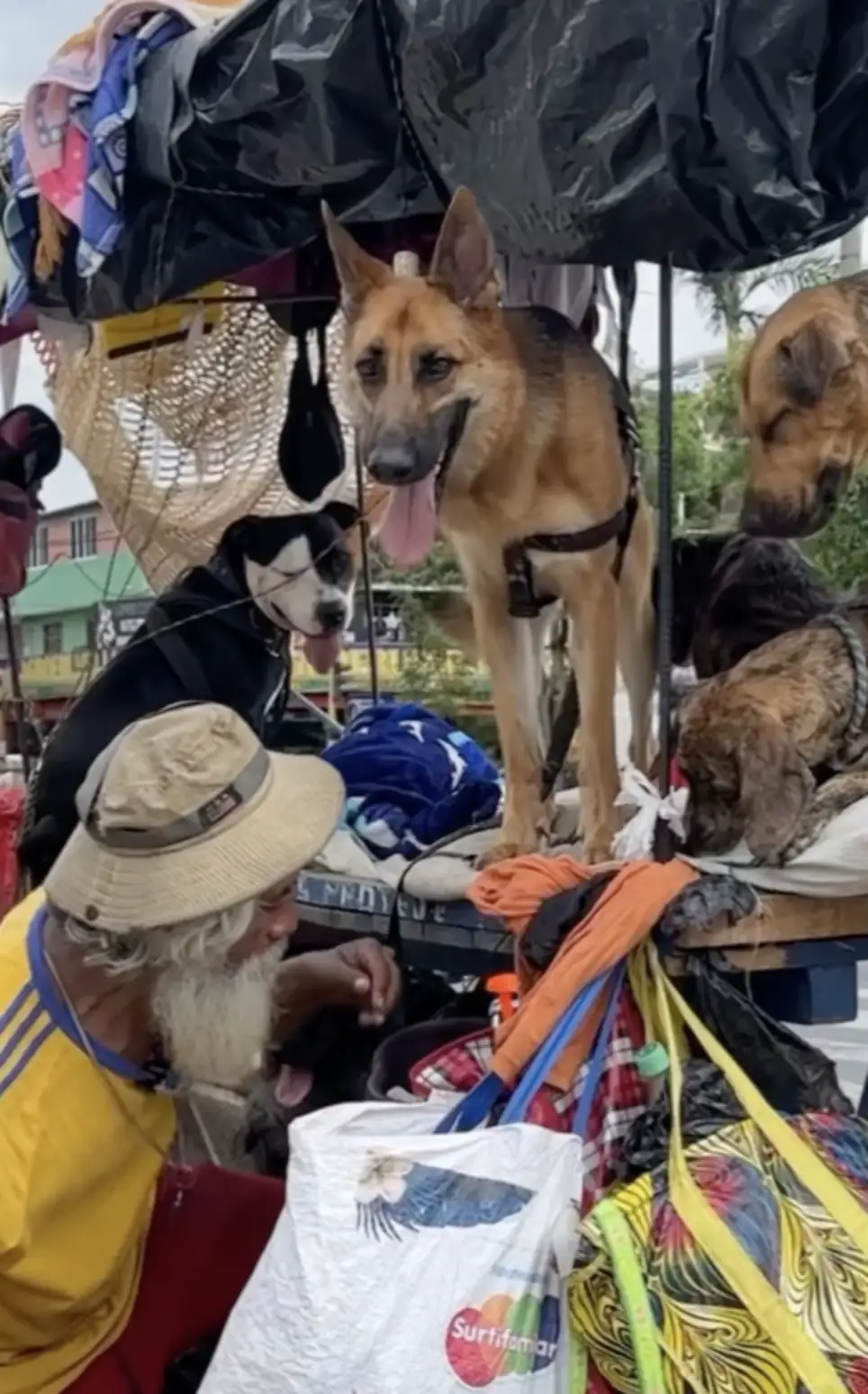
They say that home is where the heart is, and that couldn’t be more true for a man named Rubén and his pack of rescued dogs.
Despite not having a home of his own, Rubén, who goes by Noé, is dedicated to sharing his space and resources with every homeless dog in his Colombian city. Whether they’ve been left behind at a stop light or abandoned in an apartment, Noé believes in giving each dog he meets a second chance at love.
“They are living beings,” Noé said in an interview with IguanaTV. “They are everything to me.”
Noé’s pack is ever-growing, as he readily collects abandoned dogs of all ages and sizes. While it all started with just one dog, his furry family is now large enough to require a double-decker push cart.
Each dog has their own unique backstory, but they’re all loved by Noé just the same.
“This is Rocky. They left him tied up there at that traffic light,” Noé said. “These two girls are named Ears and Cheeks. I’ve had them since they were little. They were also abandoned.”
Rocky, Ears and Cheeks ride on the top level of the push cart with their siblings, a pit bull named Tyson and a German shepherd named Shakira. Below them, senior pups Tembleque, Parkinson and Morochito happily take in the world around them.
“These dogs down below are the oldest,” Noé said. “Little Morochito here was left for me while I was sleeping outside of [the store].”
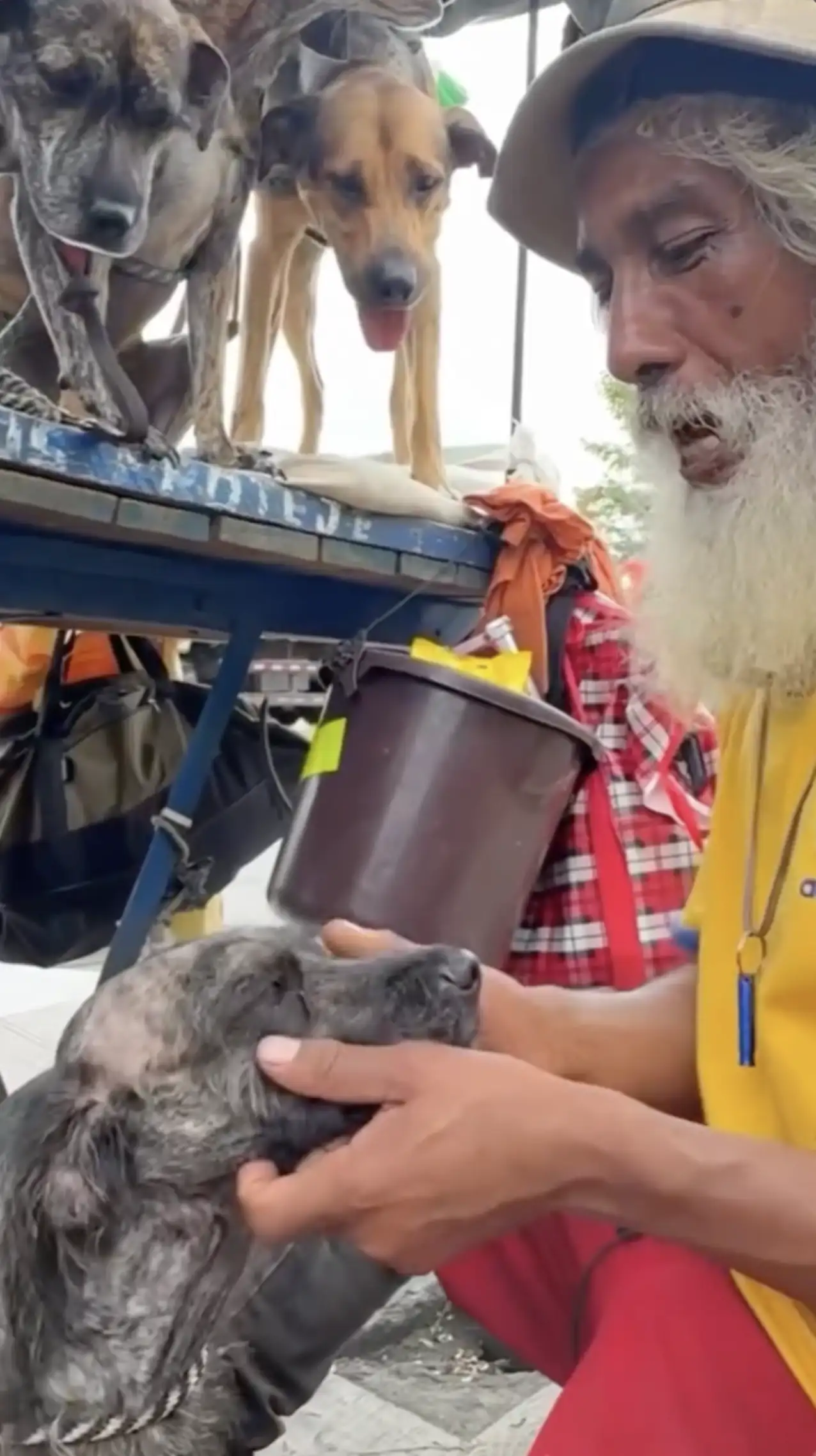
The pups may have heartbreaking pasts, but their sadness has faded since being adopted by Noé. When they’re not actively traveling around the city with their beloved dad, the pack of dogs can usually be found enjoying a fresh meal made by Noé.
“I buy them milk, carrots and oats, and I combine them with ground meat and seeds,” Noé said. “I make them a hearty meal so that they eat well.”
Seeing the pups lap up their meals brings joy to Noé, even when he hasn’t eaten yet.
“They eat first,” Noé said. “My food is less important to me.”
Once the pups have finished eating, Noé usually snacks on an arepa and some coffee before heading off with his pack again. With his dogs by his side, Noé feels a sense of purpose and peace.
“The dogs keep me busy and give me a reason to wake up every day,” Noé said. “They don’t care if I’m bearded, toothless, dirty or clean. They only care that I’m by their side.”
This growing companionship is beyond fulfilling for Noé. Even on his most challenging days, Noé knows he can always lean on his beloved pack of rescued dogs for unconditional support.
“A dog’s love is the best there is,” Noé said.
ooOOoo
The two photographs are presented by INSTAGRAM/@IGUANATV. (And the article is published with the kind permission of The Dodo.)
One can’t do better than repeat that last sentence: “A dog’s love is the best there is,”.
Thinking it through thanks to a recent issue of Skeptical Inquirer.
Melanie Trecer-King is the creator of Thinking is Power and the associate professor of biology at the Massasoit Community College, where she teaches a science course designed to equip her students with essential critical thinking, information literacy, and science literacy skills.
The article was published in the November/December, 2024 issue of the magazine. I believe it is free to share.
ooOOoo
Most people agree that critical thinking is an important skill that should be taught in schools. And most educators think they teach critical thinking. I know I did. After all, I was a science educator, and science is critical thinking. Isn’t it?
For years, I taught general-education biology, a course commonly taken by undergraduates who aren’t science majors. And while I love biology, I grew more and more frustrated with the content. I asked myself: If I had one semester to teach the average student what they need to know about the process of science and critical thinking, what would it look like?
Thankfully, my college allowed me to replace my traditional introductory biology course with a course titled Science for Life, designed to teach critical thinking, information literacy, and science literacy skills (Trecek-King 2022). Since my conversion, I’ve been sharing my new path with anyone who will listen about the value of teaching critical thinking.
Yet conversations with Bertha Vazquez, director of education for the Center for Inquiry, gave me pause. In a recent podcast conversation with the two of us and Daniel Reed (of the West Virginia Skeptics Society), Vazquez was adamant. Educators do teach critical thinking: the Next Generation Science Standards (NGSS) require students to ask questions, plan and carry out investigations, analyze and interpret data, construct explanations, and engage in arguments from evidence.
As a science communicator, I constantly fight misconceptions around certain terms. Theory and skepticism are prime examples. So imagine my surprise (and embarrassment) when I realized that, as a critical thinking educator, I had overlooked an important first step in critical thinking: defining terms. The irony.
What Is Critical Thinking?
While we can all agree that it’s important to teach critical thinking, there’s not always agreement on what we mean by the term.
In his book Critical Thinking, Jonathan Haber (2020) explains how the concept emerged and some of the ways it’s currently defined. John Dewey, in his 1910 work How We Think, proposed one of the first modern definitions of reflective thinking, describing it as an “active, persistent, and careful consideration of any belief” (Dewey 1910, 6).
In his 1941 dissertation, Edward Glaser identified three components of critical thinking: “(1) an attitude of being disposed to consider in a thoughtful way the problems and subjects that come within the range of one’s experiences, (2) knowledge of the methods of logical inquiry and reasoning, and (3) some skill in applying those methods” (Glaser 1941, 5–6). That same year, Glaser and Goodwin Watson published the Watson-Glaser Tests of Critical Thinking (now the Watson-Glaser Critical Thinking Appraisal), a widely used standardized test for assessing critical thinking skills.
Critical thinking’s “big bang” moment, according to Haber, came in the early 1980s when the state of California (Harmon 1980, 3) mandated that all students in its university system complete a course that teaches “an understanding of the relationship of language to logic, leading to the ability to analyze, criticize and advocate ideas, reason inductively and deductively, and reach factual or judgmental conclusions based on sound inferences drawn from unambiguous statements of knowledge or belief.”
And the Delphi Report (Facione 1990, 2), in which Peter Facione worked with critical thinking experts to create a consensus definition, concludes that critical thinking is a “purposeful, self-regulatory judgment which results in interpretation, analysis, evaluation, and inference, as well as explanation of the evidential, conceptual, methodological, criteriological, or contextual considerations upon which that judgment is based.”
From these (and many other) definitions, Haber identifies three interconnected parts of critical thinking: knowledge of critical thinking components, such as logic and argumentation; the skills to put the knowledge to use in real-world situations; and the dispositions needed to prioritize critical thinking honestly and ethically.
This problem-solving view of critical thinking forms the basis of many of the current educational standards, including the NGSS and Common Core, which ask students to think deeply within a specific domain. And it is one scientists themselves use when trying to understand issues.
These are worthy educational goals to be sure. However, in my experience teaching general-education biology, I’ve come to realize that this approach is incomplete.
If critical thinking requires deep knowledge, then our ability to analyze topics is limited to areas in which we possess sufficient expertise. Pedagogy that encourages “independent” thinking outside these areas can have the unintended consequence of teaching students to overestimate their abilities. The best minds know they can’t know everything. Even experts rely on other experts and sources.
Additionally, in the classroom, students are provided with reliable content from which to critically analyze. In the “real world,” these guardrails are nonexistent. Not only is misinformation ubiquitous, disinformation purveyors exploit our biases and emotions to manipulate our reasoning.
And finally, we can’t address science misinformation, from evolution to vaccines to climate change, by giving students more content knowledge. We don’t fall for science denial and pseudoscience because we don’t have the facts but because of our emotions, desires, identities, and biases.
I now have a better understanding of what my colleague and friend Andy Norman means when he says that critical thinking suffers from a branding problem.
Yes, And …?
Using the above definition(s), I was teaching my biology students how to think critically. For example, I didn’t just ask them to memorize the stages of mitosis but to explore the mutations that could disrupt the cell cycle and lead to cancer. But to what end? If (or when) my former students are touched by cancer, will they remember how proto-oncogenes and tumor suppressor genes can lead to unregulated cell growth? Is that even what they need to know? I argue that, especially for students who aren’t going to be scientists, it’s far more important to teach students how and why the process of science results in reliable knowledge … and how to find it.
My Science for Life course and my Thinking Is Power resource are both based on the same premise. Knowledge may be power, but there’s too much to know. Even more, knowledge is a process; it’s not just what we know but how we know. It’s not just a noun but a verb. When we need reliable knowledge, can we find it and use it to make wiser decisions? And how do we know what information to ignore?
As a science educator, I want my students to understand how the process of science produces knowledge and why it’s reliable. Why aren’t comments such as “it worked for me” or “I know what I saw” sufficient evidence? I’ve come to realize that an essential—and often overlooked—ingredient is why we need science in the first place.
Richard Feynman famously said, “The first principle is that you must not fool yourself, and you are the easiest person to fool.” Science is how we correct for this tendency toward self-deception. That’s why I spend the first third of the semester exploring how we come to our beliefs, the limits of our perception and memory, the importance of skepticism, the cognitive biases that can lead our thinking astray, and the logical fallacies we use to convince ourselves (and others) that our conclusions are justified.
Influential voices in the skeptical community played a crucial role in shaping the ingredients of critical thinking I use in Science for Life and Thinking Is Power, which include the following:
Being aware of our limitations: Understanding that our perception and memory are flawed, and the biases and heuristics our brains rely on to make fast and easy decisions can lead us astray.
Arguing with evidence and logic: Using arguments that are well-structured and supported by evidence. This includes understanding how the different types of arguments work (i.e., deductive, inductive, and abductive) and avoiding logical fallacies.
Thinking about our thinking (metacognition): Actively examining and questioning our own thought processes—including the source of our knowledge, assumptions, intuitions, motivations, emotions, and biases—and how they might influence our judgments.
Embracing nuance and uncertainty: Avoiding the black-or-white thinking that can lead to oversimplified conclusions and accepting that our knowledge is never perfect or complete.
Seeking objectivity: Actively working to counter the limitations that prevent us from accurately understanding the world. This includes seeking diverse perspectives, separating our identity from our beliefs, and prioritizing accuracy over ego.
Having curiosity and open-mindedness: Possessing a desire to learn and understand by asking questions and seeking out information, even if it contradicts what we want to believe.
Maintaining healthy skepticism: Balancing gullibility and doubt and proportioning our beliefs to the available evidence. And remembering that claims made without evidence can be dismissed without evidence and extraordinary claims require extraordinary evidence.
Exhibiting intellectual humility: Recognizing the limitations of our knowledge, being open to the expertise of others, and being willing to change our minds with evidence.
In my experience, giving students this foundation is essential for helping them become better consumers of information and science. Without an awareness that our emotions and existing beliefs can drive our reasoning, search engines and low-quality sources become tools to confirm our biases. And without an understanding of how our identities and worldviews can alter our standards of evidence, pseudoscience and science denial provide cover for what we want or don’t want to believe.
The logic of science’s practices, from carefully controlling experimental variables to making the findings available to other experts for scrutiny and replication, falls into place once students understand the problems it’s addressing. Simply put, science is our shield against self-deception.
Now instead of asking students to think critically about the biology of cancer, I teach them how to evaluate sources to find reliable information, how to recognize pseudoscientific “treatments,” and how their need for hope and answers makes them vulnerable to misinformation.
The Take-Home Message
I have no doubt that most educators teach critical thinking. But for pedagogical and communication purposes, it would be beneficial to clarify what we mean—and just as importantly to ask ourselves what we want our students to learn.
The dominant view of critical thinking in education is problem-solving in specific domains, which is absolutely a valuable skill. However, many skeptics view critical thinking as good thinking in a broader sense. My own teaching shifted toward this latter framework after I realized that problem-solving skills are insufficient without a foundation in better thinking. We may be born with the ability to think, but we must be taught to think well, and our primate brains aren’t adapted to today’s tidal wave of misinformation.
I’m grateful to the skeptical community for challenging my assumptions about critical thinking and my friend Bertha Vazquez for encouraging me to think more deeply about the good work science educators do in their classrooms every day. This article is the result of my attempt to reconcile what critical thinking means to educators and what it means to skeptics, and my hope is that it opens a conversation about how we can better serve our students. Maybe it will even start a critical thinking revolution, especially in science education.
Let the critical thinking revolution begin!
Acknowledgments
My thanks go to those on this brief list of skeptical thinkers/authors who’ve influenced my understanding of critical thinking: James Alcock, Timothy Caulfield, John Cook, Brian Dunning, Julia Galef, Adam Grant, David Robert Grimes, Jon Guy, Harriet Hall, Guy Harrison, Daniel Kahneman, David McRaney, Steven Novella, Carl Sagan, Michael Shermer, and Carol Tavris.
Special thanks to Bertha Vazquez, Daniel Pimentel, Andy Norman, Daniel Reed, and Jon Guy for their helpful feedback on this article.
References
Dewey, John. 1910. How We Think. Lexington, MA: D.C. Heath and Company.
Facione, Peter A. 1990. Critical Thinking: A Statement of Expert Consensus for Purposes of Educational Assessment and Instruction—The Delphi Report. Millbrae, CA: California Academic Press.
Glaser, Edward M. 1941. An Experiment in the Development of Critical Thinking. New York, NY: Teachers College, Columbia University.
Haber, Jonathan. 2020. Critical Thinking. Cambridge, MA: The MIT Press.
Harmon, Harry. 1980. Executive Order No. 338: General Education-Breadth Requirements. The California State University and Colleges.
I hope others have read this fascinating article and repeat the statement: ‘While we can all agree that it’s important to teach critical thinking, there’s not always agreement on what we mean by the term.’
We live on a profoundly ancient and beautiful planet.
I follow the photographic website Ugly Hedgehog and have been doing for some time. There has been a post recently from the section Photo Gallery and ‘greymule’ from Colorado called his entry ‘A Couple of Desert Scenes’ and I will display just one of his images from that post.
It makes a wonderful connection to today’s post which is from The Conversation.
ooOOoo
Evidence from Snowball Earth found in ancient rocks on Colorado’s Pikes Peak – it’s a missing link
Rocks can hold clues to history dating back hundreds of millions of years. Christine S. Siddoway
Around 700 million years ago, the Earth cooled so much that scientists believe massive ice sheets encased the entire planet like a giant snowball. This global deep freeze, known as Snowball Earth, endured for tens of millions of years.
The Snowball Earth hypothesis has been largely based on evidence from sedimentary rocks exposed in areas that once were along coastlines and shallow seas, as well as climate modeling. Physical evidence that ice sheets covered the interior of continents in warm equatorial regions had eluded scientists – until now.
In new research published in the Proceedings of the National Academy of Sciences, our team of geologists describes the missing link, found in an unusual pebbly sandstone encapsulated within the granite that forms Colorado’s Pikes Peak.
Earth iced over during the Cryogenian Period, but life on the planet survived. NASA illustration
Solving a Snowball Earth mystery on a mountain
Pikes Peak, originally named Tavá Kaa-vi by the Ute people, lends its ancestral name, Tava, to these notable rocks. They are composed of solidified sand injectites, which formed in a similar manner to a medical injection when sand-rich fluid was forced into underlying rock.
A possible explanation for what created these enigmatic sandstones is the immense pressure of an overlying Snowball Earth ice sheet forcing sediment mixed with meltwater into weakened rock below.
Dark red to purple bands of Tava sandstone dissect pink and white granite. The Tava is also cross-cut by silvery-gray veins of iron oxide. Liam Courtney-Davies
An obstacle for testing this idea, however, has been the lack of an age for the rocks to reveal when the right geological circumstances existed for sand injection.
We found a way to solve that mystery, using veins of iron found alongside the Tava injectites, near Pikes Peak and elsewhere in Colorado.
A 5-meter-tall, almost vertical Tava dike is evident in this section of Pikes Peak granite. Liam Courtney-Davies
Iron minerals contain very low amounts of naturally occurring radioactive elements, including uranium, which slowly decays to the element lead at a known rate. Recent advancements in laser-based radiometric dating allowed us to measure the ratio of uranium to lead isotopes in the iron oxide mineral hematite to reveal how long ago the individual crystals formed.
The iron veins appear to have formed both before and after the sand was injected into the Colorado bedrock: We found veins of hematite and quartz that both cut through Tava dikes and were crosscut by Tava dikes. That allowed us to figure out an age bracket for the sand injectites, which must have formed between 690 million and 660 million years ago.
So, what happened?
The time frame means these sandstones formed during the Cryogenian Period, from 720 million to 635 million years ago. The name is derived from “cold birth” in ancient Greek and is synonymous with climate upheaval and disruption of life on our planet – including Snowball Earth.
University of Exeter professor Timothy Lenton explains why the Earth was able to freeze over.
The Tava found on Pikes Peak would have formed close to the equator within the heart of an ancient continent named Laurentia, which gradually over time and long tectonic cycles moved into its current northerly position in North America today.
The origin of Tava rocks has been debated for over 125 years, but the new technology allowed us to conclusively link them to the Cryogenian Snowball Earth period for the first time.
The scenario we envision for how the sand injection happened looks something like this:
A giant ice sheet with areas of geothermal heating at its base produced meltwater, which mixed with quartz-rich sediment below. The weight of the ice sheet created immense pressures that forced this sandy fluid into bedrock that had already been weakened over millions of years. Similar to fracking for natural gas or oil today, the pressure cracked the rocks and pushed the sandy meltwater in, eventually creating the injectites we see today.
Clues to another geologic puzzle
Not only do the new findings further cement the global Snowball Earth hypothesis, but the presence of Tava injectites within weak, fractured rocks once overridden by ice sheets provides clues about other geologic phenomena.
Time gaps in the rock record created through erosion and referred to as unconformities can be seen today across the United States, most famously at the Grand Canyon, where in places, over a billion years of time is missing. Unconformities occur when a sustained period of erosion removes and prevents newer layers of rock from forming, leaving an unconformable contact.
Unconformity in the Grand Canyon is evident here where horizontal layers of 500-million-year-old rock sit on top of a mass of 1,800-million-year-old rocks. The unconformity, or ‘time gap,’ demonstrates that years of history are missing. Mike Norton via Wikimedia, CC BY-SA
Our results support that a Great Unconformity near Pikes Peak must have been formed prior to Cryogenian Snowball Earth. That’s at odds with hypotheses that attribute the formation of the Great Unconformity to large-scale erosion by Snowball Earth ice sheets themselves.
We hope the secrets of these elusive Cryogenian rocks in Colorado will lead to the discovery of further terrestrial records of Snowball Earth. Such findings can help develop a clearer picture of our planet during climate extremes and the processes that led to the habitable planet we live on today.
The other day, volunteer dog rescuer Mary Nakiso was driving through California’s Orange County when she passed someone cowering on the side of the street. The creature was large, hairy and alone. With a sinking feeling in her stomach, Nakiso slammed on her brakes to investigate.
As she approached the animal, Nakiso realized just how massive and afraid he was.
“He is literally 75 pounds and so big but so scared,” Suzette Hall, founder of Logan’s Legacy 29, wrote on Facebook.
Suzette Hall
The giant dog was petrified, which Nakiso soon learned was the result of being “thrown out” by his family a few minutes earlier.
“When he first got thrown out, he was so confused [and] running in circles in traffic,” Hall wrote. “A huge jeep with huge tires literally went over him …”
Suzette Hall
The pup, later named Benji, had no idea where his family had gone. He roamed the busy streets frantically, hoping to find his way home. After a while of running around in circles and dodging cars, Benji eventually disappeared.
Nakiso called Hall to notify her about Benji, and the two started monitoring local social media groups for any sightings of him. Later that day, someone posted about seeing a giant matted dog in their neighborhood.
Suzette Hall
Hall couldn’t make it back to the neighborhood fast enough due to traffic, so she messaged three more of her trusted friends who lived nearby.
The group of volunteers immediately agreed to help.
“I sent a message to Nuñez Aky, Yamileth and Karla,” Hall wrote. “When they got there, he was running back and forth so fast. So they waited for him to settle down.”
Suzette Hall
Hall stayed glued to her phone for updates while the team of volunteer rescuers hatched a plan to corner the flighty dog once and for all.
Then, she finally received the news she’d been hoping to hear all day.
“[B]ecause they are so amazing, they got him into a yard and shut the gate,” Hall wrote. “My heart was so happy. The fear and terror he had been through was over, and this big hunk of pure love was finally safe.”
Suzette Hall
The rescuers showered Benji with love and praise before carrying him to their car. They drove him straight to Camino Pet Hospital, where the shaggy pup received a long-overdue makeover.
“All the layers of his past [have] been shaved away,” Hall wrote in a Facebook update. “He literally had dreadlocks.”
Suzette Hall
Benji’s makeover was just the first of many steps to get him the home of his dreams. He’s since been neutered, and after a few more days of healing, he’ll finally be able to meet his new foster family next week.
It’s hard to know what Benji’s life was like before he was rescued, but his future is certain thanks to Hall and her team of volunteers. As Hall sees it, Benji will soon receive all the love and attention he’s always deserved.
“Benji is the sweetest, most loving dog I have ever met,” Hall told The Dodo. “[He’s] truly a miracle.”
—-
You can inquire about adopting Benji by emailing Suzette Hall at Info@loganslegacy29.com.
To help pups like Benji get the care they need, you can donate to Logan’s Legacy 29 here.
ooOOoo
That is a most beautiful story and one that should inspire many readers to look after, and care for, dogs where ever they are.
Many congratulations to Suzette for rescuing Benji.
Dogs are so close to humans, as has been reported many times in many places. This guest post from Lorna explores the very latest in scientific thinking.
ooOOoo
Busting Myths: Do Dogs Really Understand Human Language?
By Lorna Dikoff
Dogs are often seen as more than pets. They are companions, loyal protectors, and, for many like me, family members.
Many people think dogs understand our words like we do. This idea has been around for a long time. But is it true?
Let’s look at what science tells us about how dogs communicate. Also, let’s think about what our bonds with dogs teach us. These bonds teach us about trust and loyalty. They also reveal a deeper form of connection.
The Science of Canine Communication
Dogs have been our companions for thousands of years. During this time, they have become very good at understanding human behavior.
In 2016, researchers in Hungary made an interesting discovery. They found that dogs process words and tone similarly to humans. Dogs use different parts of their brains to recognize words and emotional sounds.
But, this doesn’t mean dogs understand language like we do. Instead, they learn to connect certain sounds (words) with specific actions or results. For example, a dog might know that the sound of a leash means a walk is coming. They recognize patterns rather than understanding language.
So while dogs are good at figuring out what we do and say, they don’t understand language the same way humans do. They’ve learned to pick up on our signs, but in their own special way.
But does this mean they understand the full meaning behind those words? The answer is no.
Dogs are great at reading people. They watch our body language, listen to our tone, and look at our faces. Dogs pay more attention to these signs than to our words.
This doesn’t mean dogs are less smart. It shows that they excel in a different type of communication.
The Myth of Full Language Comprehension
People often think dogs understand human language. We want to believe our pets understand us like other people do. It’s a nice idea, but it’s not quite true.
Dogs can learn some words and follow orders. But they don’t understand language. They remember patterns and connect words with actions. It’s not the same as how we understand each other when we talk.
This myth doesn’t make our bond with dogs any less special. It actually shows something even more extraordinary. Dogs are great at connecting with us without words. They tune into our feelings and pick up on how we act. This makes our relationship with them pretty amazing.
Dogs don’t need words to sense when we are sad, anxious, or excited. Their ability to “read” our emotions is what makes their companionship so special.
Trust and Loyalty: The Real Language of Dogs
Dogs and humans have a special bond that is far more profound than language. It’s about trust and loyalty.
These things are at the heart of what we can learn from dogs. Dogs show us how to be honest and true. They teach us about connecting with feelings, not only with words.
Dogs don’t need a large vocabulary to express their loyalty or unconditional love. Instead, they show it through actions. They sit with us when we’re sad and guard us when we’re weak. And they always get super happy to see us, even if we’ve only been gone for a bit.
This speaks to a deeper truth that dogs teach us: communication isn’t only about words. It’s about the trust we build through consistent, reliable actions.
In a world where words can sometimes mislead or fall short, dogs show us a better way. Dogs remind us of the importance of honesty and integrity in our interactions.
The Lesson from Dogs
So, do dogs understand human language? The answer is no, at least not in the way we hope. But their understanding of us is something far more profound.
Dogs teach us that we don’t always need words to talk. They teach us that our actions often speak louder than language. Their loyalty, intuition, and emotional intelligence. makes our bond with them special, more than words can explain.
We often overcomplicate communication, but dogs keep it simple. They show up and act the same way every day.
This teaches us that real connections come from trust and love. Dogs prove that understanding each other is about more than using words.
About the Author:
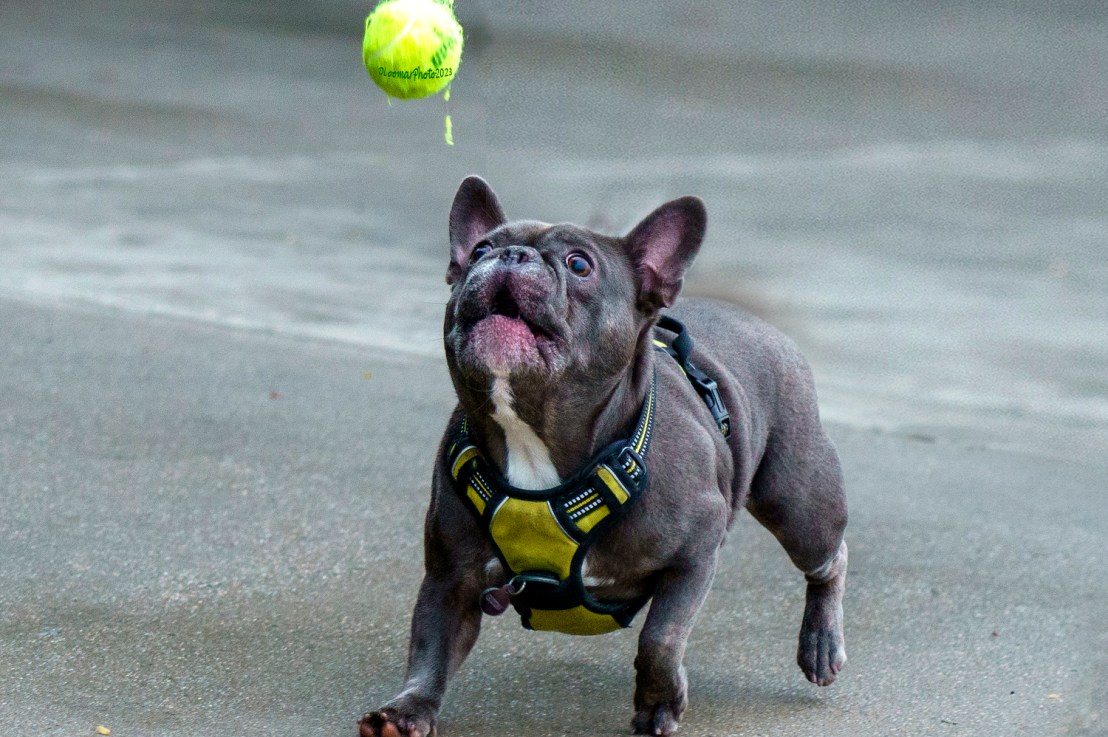
Lorna is the founder of Furry Friends Advisor. She is a passionate and experienced long-time dog owner with a deep love for animals. Lorna’s commitment to understanding and caring for dogs led her to spend countless hours researching and learning about canine health, behavior, and care. When not immersed in writing for her site, she is pampering her French Bulldog name Lucy. Her mission is to give advice about dog care and nutrition accessible to everyone.
ooOOoo
Thank you, Lorna.
There is no question that a dog’s actions speak so much louder than words.
Trust and loyalty; they are the supreme qualities of dogs and it is a pity that in some quarters these qualities are not seen in humans.
Global efforts to tackle climate change are wildly off track, says the UN, as new data shows that warming gases are accumulating faster than at any time in human existence.
Current national plans to limit carbon emissions would barely cut pollution by 2030, the UN analysis shows, leaving efforts to keep warming under 1.5C this century in tatters.
The update comes as a separate report shows that greenhouse gases have risen by over 11% in the last two decades, with atmospheric concentrations surging in 2023.
ooOOoo
What the jet stream and climate change had to do with the hottest summer on record − remember all those heat domes?
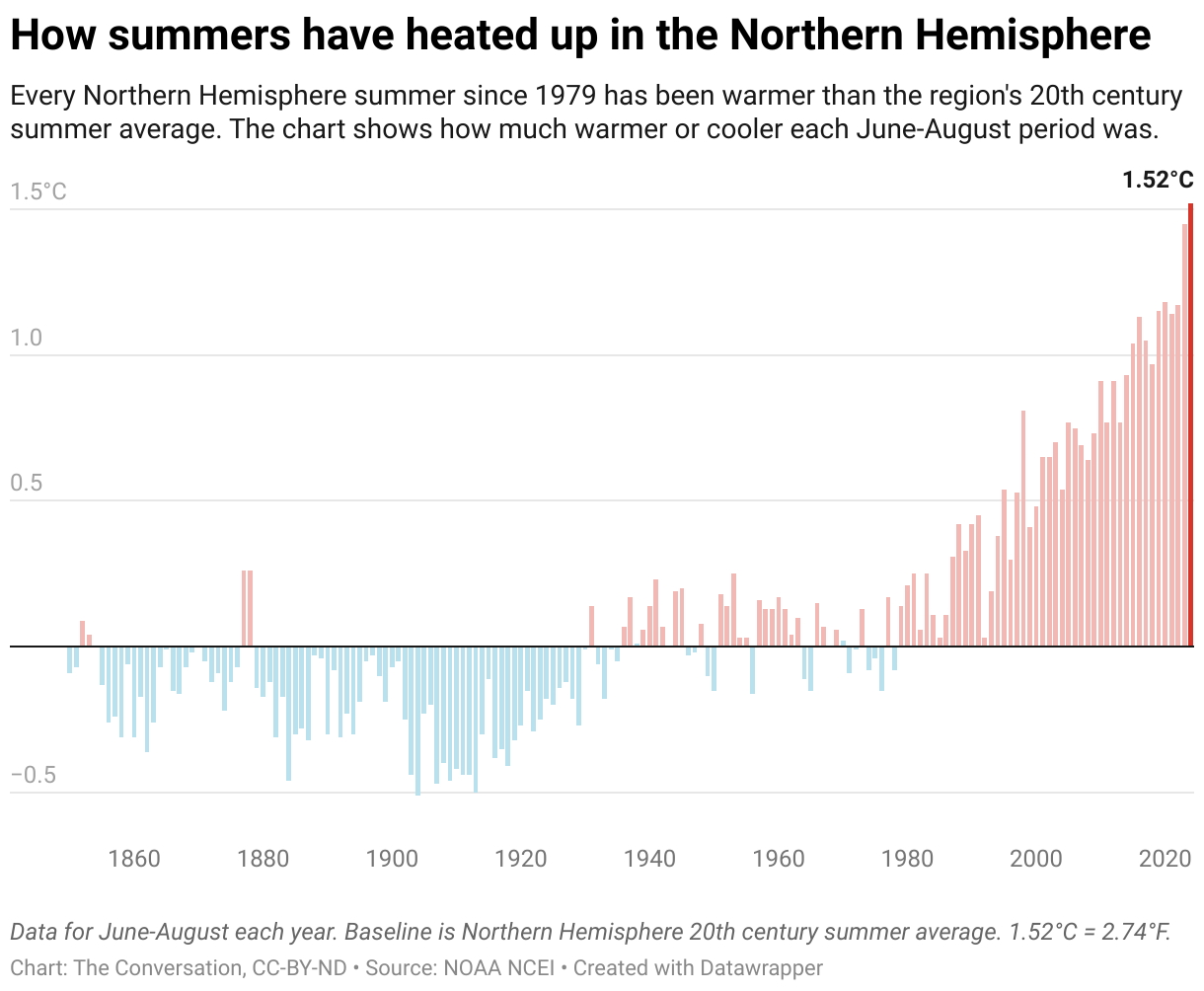
Summer 2024 was officially the Northern Hemisphere’s hottest on record. In the United States, fierce heat waves seemed to hit somewhere almost every day.
That might seem small, but temperature increases associated with human-induced climate change do not manifest as small, even increases everywhere on the planet. Rather, they result in more frequent and severe episodes of heat waves, as the world saw in 2024.
The most severe and persistent heat waves are often associated with an atmospheric pattern called a heat dome. As an atmospheric scientist, I study weather patterns and the changing climate. Here’s how heat domes, the jet stream and climate change influence summer heat waves and the record-hot summer of 2024.
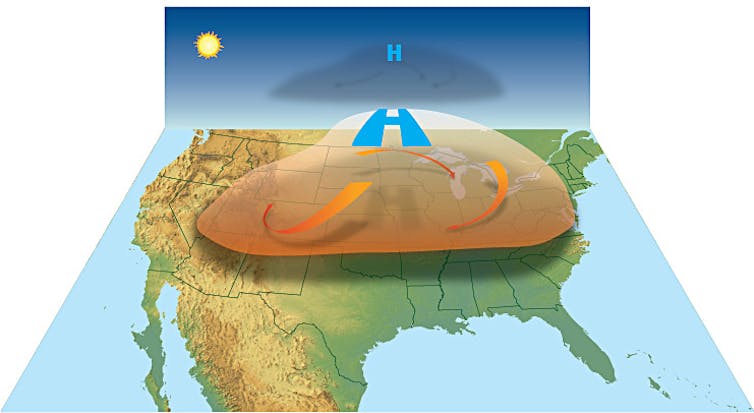
A heat dome is a persistent high-pressure system over a large area. A high-pressure system is created by sinking air. As air sinks, it warms up, decreasing relative humidity and leaving sunny weather. The high pressure also serves as a lid that keeps hot air on the surface from rising and dissipating. The resulting heat dome can persist for days or even weeks.
The longer a heat dome lingers, the more heat will build up, creating sweltering conditions for the people on the ground.
High pressure in the middle layers of the atmosphere acts as a dome or cap, allowing heat to build up at the Earth’s surface. NOAA
How long these heat domes stick around has a lot to do with the jet stream.
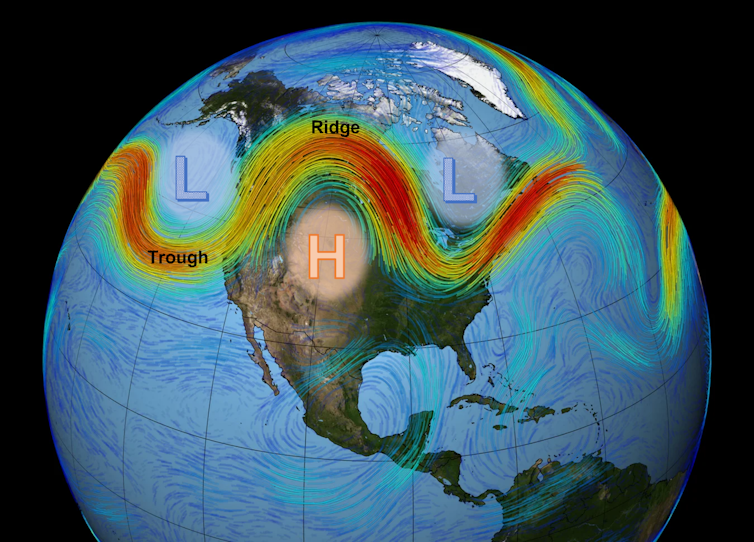
The jet stream is a narrow band of strong winds in the upper atmosphere, about 30,000 feet above sea level. It moves from west to east due to the Earth’s rotation. The strong winds are a result of the sharp temperature difference where the warm tropical air meets the cold polar air from the north in the mid-latitudes.
The jet stream does not flow along a straight path. Rather, it meanders to the north and south in a wavy pattern. These giant meanders are known as the Rossby waves, and they have a major influence on weather.
Where the jet stream arcs northward, forming a ridge, it creates a high-pressure system south of the wave. Where the jet stream dips southward, forming a trough, it creates a low-pressure system north of the jet stream. A low-pressure system contains rising air in the center, which cools and tends to generate precipitation and storms.
Most of our weather is modulated by the position and characteristics of the jet stream.
How climate change affects the jet stream
The jet stream, or any wind, is the result of differences in surface temperature.
In simple terms, warm air rises, creating low pressure, and cold air sinks, creating high pressure. Wind is the movement of the air from high to low pressure. Greater differences in temperature produce stronger winds.
For the Earth as a whole, warm air rises near the equator, and cold air sinks near the poles. The temperature difference between the equator and the pole determines the strength of the jet stream in each hemisphere.
However, that temperature difference has been changing, particularly in the Northern Hemisphere. The Arctic region has been warming about three times faster than the global average. This phenomenon, known as Arctic amplification, is largely caused by the melting of Arctic sea ice, which allows the exposed dark water to absorb more of the Sun’s radiation and heat up faster.
Because the Arctic is warming faster than the tropics, the temperature difference between the two regions is lessened. And that slows the jet stream.
As the jet stream slows, it tends to meander more, causing bigger waves. The bigger waves create larger high-pressure systems. These can often be blocked by the deep low-pressure systems on both sides, causing the high-pressure system to sit over a large area for a long period of time.
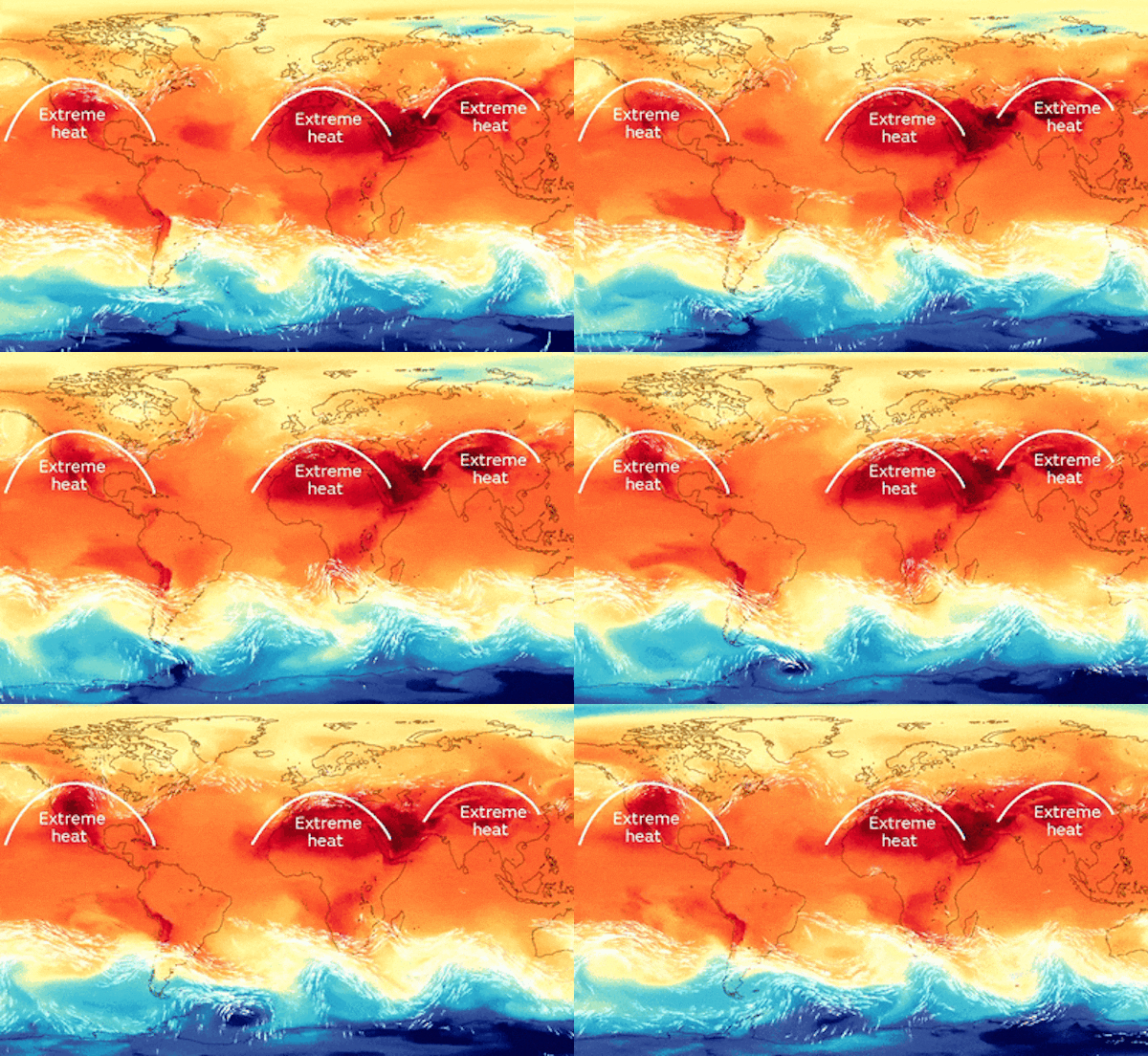
A stagnant polar jet stream can trapped heat over parts of North America, Europe and Asia at the same time. This example happened in July 2023. UK Met Office
Typically, waves in the jet stream pass through the continental United States in around three to five days. When blocking occurs, however, the high-pressure system could stagnate for days to weeks. This allows the heat to build up underneath, leading to blistering heat waves.
Since the jet stream circles around the globe, stagnating waves could occur in multiple places, leading to simultaneous heat waves at the mid-latitude around the world. That happened in 2024, with long-lasting heat waves in Europe, North America, Central Asia and China.
Jet stream behavior affects winter, too
The same meandering behavior of the jet stream also plays a role in extreme winter weather. That includes the southward intrusion of frigid polar air from the polar vortex and conditions for severe winter storms.
Many of these atmospheric changes, driven by human-caused global warming, have significant impacts on people’s health, property and ecosystems around the world.
I maybe approaching my own end of life but millions of others are younger than me. When I see a woman with a young baby in her arms I cannot stop myself from wondering what that generation is going to do.
Vision to Reality: Building a Profitable Vet Clinic
Launching a veterinary clinic is a significant endeavor that requires meticulous planning and strategic decision-making. This venture combines a passion for animal care with the intricacies of managing a successful business. Aspiring clinic owners must navigate several critical steps to lay a strong foundation and ensure operational excellence. Starting your own clinic promises not only to fulfill a dream of helping animals but also to establish a thriving enterprise in the community.
Build a Strong Foundation with an Effective Marketing Strategy
A robust marketing strategy is essential to attract potential clients in the digital era. Establishing a professional online presence through a user-friendly website that details your services, team, and location builds trust among pet owners. Engage actively on social media with regular updates and client testimonials to showcase your expertise and commitment to animal care. Forge partnerships with local pet-related businesses to increase visibility and drive traffic to your clinic, enhancing both your and your partners’ customer bases.
Craft a Clear and Detailed Business Plan
A well-constructed business plan acts as your clinic’s roadmap, detailing your mission, services offered, and the specific target market. Identify your niche early—whether it’s specializing in certain animals or treatments—to attract the appropriate clientele. Include comprehensive financial projections and a marketing budget in your plan to ensure financial preparedness and support your clinic’s promotional activities.
Enhance Your Business Knowledge by Pursuing an MBA
Running a veterinary clinic demands a blend of clinical and business expertise. Pursuing a master’s of business administration online can boost your proficiency in key business areas such as strategy, management, and finance. An MBA not only deepens your understanding of business operations but also enhances leadership skills and self-assessment capabilities. These competencies are essential for balancing the medical and business demands of your clinic, ensuring its long-term success.
Safeguard Your Business with Proper Insurance
Operating a veterinary clinic comes with inherent risks, making comprehensive insurance coverage essential. Essential policies include malpractice insurance to handle legal issues and general liability insurance for accidents on your premises. Property insurance is crucial to protect your clinic’s infrastructure and equipment against unexpected events. Consulting with an insurance expert can ensure that you have thorough coverage to protect against potential financial setbacks.
Invest in High-Quality Veterinary Equipment
Providing top-tier care necessitates investing in high-quality veterinary equipment. Essential tools like X-ray machines, surgical instruments, and lab equipment should be of the highest standard to ensure accurate diagnoses and treatments. Modern technologies, such as digital imaging systems, not only enhance patient care but also improve operational efficiency. While the initial cost may be higher, investing in quality equipment pays off in the long run by boosting efficiency and minimizing errors.
Secure the Necessary Funding for Your Clinic
Securing sufficient funding is critical when starting a veterinary clinic. Estimate your startup costs accurately to understand your financial needs, including equipment, premises, staffing, and marketing. Explore diverse financing options, such as bank loans, private investors, and specialty medical practice loans that might offer favorable terms. Adequate initial funding prevents cash flow problems and supports your clinic’s growth trajectory.
Choose the Right Location for Your Clinic
The location of your clinic is pivotal to its success, necessitating a spot with a high demand for veterinary services. Conduct thorough market research to choose a community rich in pet owners who need your services. Select a location that is accessible, visible, and has ample parking to ensure convenience for your clients. Proximity to complementary services like pet groomers or dog trainers can further enhance client traffic and provide expansion opportunities.
Opening a veterinary clinic is both challenging and rewarding, demanding a careful blend of dedication and strategic foresight. Success in this field not only enhances the well-being of pets but also contributes positively to the local community. It requires ongoing commitment to adapt and grow in a dynamic environment. Ultimately, the fulfillment of running a successful veterinary clinic comes from both the impact on animal health and the achievement of entrepreneurial goals.
Discover the timeless wisdom that dogs offer at Learning from Dogs, where integrity and living in the present are celebrated. Dive into our content and embrace the lessons from our four-legged friends.
ooOOoo
This is a skilled summary of the needs of opening a vet’s clinic. And thank you, Penny, for your last paragraph. It has been a pleasure!