A really clever and innovative idea – the gravity light.
Saw this item on the Australian Permaculture Research website on the 18th.
Lighting in much of the ‘developing’ world is provided via expensive and polluting kerosene. Kerosene lamps are dangerous, require constant replenishment, and come with significant negative health impacts.
So, for the potential benefit of millions of people, London based designers, Martin Riddiford and Jim Reeves, have spent four years working on an inexpensive, safe and health-neutral alternative — a gravity powered LED light! It’s clever, and well intentioned. Nice!
Martin and Jim initially looked at creating a light that would be powered by solar, as would most of us. But the idea of utilising gravity took hold of them — where the end user can do away with the need for expensive solar panels and batteries, which use a lot of resources in their manufacture — and the gravity light was born. The gravity light will work whether it’s day or night, sunny or cloudy.
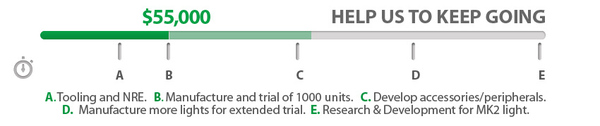
At time of writing, Martin and Jim’s Indiegogo campaign to raise funds has already surpassed its basic goal of $55,000, but if you wish to donate it’ll help them further their goal of refining the design to make it even more useful, efficient and inexpensive.
Then it was only a moment to track down the project on a website called Indiegogo, from which one reads,
GravityLight is a revolutionary new approach to storing energy and creating illumination. It takes only 3 seconds to lift the weight which powers GravityLight, creating 30 minutes of light on its descent. For free.
Following the initial inspiration of using gravity, and years of perspiration, we have refined the design and it is now ready for production. We need your help to fund the tooling, manufacture and distribution of at least 1000 gravity powered lights. We will gift them to villagers in both Africa and India to use regularly. The follow-up research will tell us how well the lights met their needs, and enable us to refine the design for a more efficient MK2 version. Once we have proved the design, we will be looking to link with NGOs and partners to distribute it as widely as possible. When mass produced the target cost for this light is less than $5.
Why GravityLight?
Did you know that there are currently over 1.5 billion people in the World who have no reliable access to mains electricity? These people rely, instead, on biomass fuels (mostly kerosene) for lighting once the sun goes down.
Go here and read the information in full and admire the photographs. But I will include this from the end of the item.
Credentials
We are Martin Riddiford and Jim Reeves, London based designers who have spent 4 years developing GravityLight as an off-line project. We work for therefore.com, which has over 20 years of experience in designing and developing hand held computing and communication products for a host of pioneers including Psion, Toshiba, NEC, TomTom, Inmarsat, ICO, Sepura, Racal Acoustics, Voller Energy, FreePlay and SolarAid.
We’re using a tried and tested manufacturer who has the right expertise to make GravityLight. We have some links to partner organisations in Africa and need to do the same for India. If you’re part of an organisation and would like to get involved then please contact us. We are particularly looking for contacts in South America.
Maybe the power of open communications is our only way forward.
A number of disparate ideas have flown into my ‘in-box’ and left me with these thoughts.
The first was the last essay on TomDispatch. This one from the hands of Mr. Engelhardt himself. I’m referring to Tomgram: Engelhardt, The Washington Straitjacket. As many of you know, Tom has been generous in granting me blanket permission to republish his posts and I frequently so do; as yesterday’s post written by Professor Michael Klare demonstrated.
Let me give you a idea of where Tom was coming from with this personal essay,
The Barack Obama Story (Updated) How a Community Organizer and Constitutional Law Professor Became a Robot President
By Tom Engelhardt
President Barack Obama
The White House
1600 Pennsylvania Avenue, NW
Washington, D.C. 20500
Dear President Obama,
Nothing you don’t know, but let me just say it: the world’s a weird place. In my younger years, I might have said “crazy,” but that was back when I thought being crazy was a cool thing and only regretted I wasn’t.
I mean, do you ever think about how you ended up where you are? And I’m not actually talking about the Oval Office, though that’s undoubtedly a weird enough story in its own right.
The next paragraph opens, thus:
After all, you were a community organizer and a constitutional law professor and now, if you stop to think about it, here’s where you’ve ended up: you’re using robots to assassinate people you personally pick as targets.
Then there’s a comprehensive description of all the outcomes that have taken place in the last few years as in this paragraph,
Still, who woulda thunk it? Don’t these “accomplishments” of yours sometimes amaze you? Don’t you ever wake up in the middle of the night wondering just who you are? Don’t you, like me, open your eyes some mornings in a state of amazement about just how you ended up on this particular fast-morphing planet? Are you as stunned as I am by the fact that a tanker carrying liquid natural gas is now making a trip from Norway to Japan across the winter waters of the Arctic? Twenty days at sea lopped off an otherwise endless voyage via the Mediterranean Sea, and the Indian and Pacific Oceans. Did you ever think you’d live to see the opening of the Northeast Passage in winter? Don’t you find it ironic that fossil fuels, which helped burn that oceanic hole in the Arctic ice, were the first commercial products shipped through those open waters? Don’t you find it just a tad odd that you can kill someone in distant Yemen without the slightest obstacle and yet you’ve been able to do next to nothing when it comes to global warming? I mean, isn’t that world-championship weird, believe-it-or-not bizarre, and increasingly our everyday reality?
Tom’s essay comes to this conclusion,
And don’t you ever wonder whether a labyrinth of 17 (yes, 17!) major agencies and outfits in the U.S. “Intelligence Community” (and even more minor ones), spending at least $75 billion annually, really makes us either safe or smart? Mightn’t we be more “intelligent” and less paranoid about the world if we spent so much less and relied instead on readily available open-source material?
I mean, there are so many things to dream about. So many ghostly possibilities to conjure up. So many experimental acts that offer at least a chance at another planet of possibility. It would be such a waste if you only reverted to your community-organizer or constitutional-law self after you left office, once “retirement syndrome” kicked in, once those drones were taking off at the command of another president and it was too late to do a thing. You could still dream then, but what good would those dreams do us or anyone else?
It’s a very powerful analysis that I really encourage you to read.
Then thanks to a mailing from the WordPress team, I was drawn to a recent account of life by Ruth Rutherford. In an essay from the 13th November, Ruth writes about living in the dark, as this sample evocatively describes,
Dating in the dark
Just got back from visiting my ol’ stomping grounds in New Jersey where I spent the weekend with my parents and grandparents, just talking, eating and enjoying good company. And all this was done in the dark. Yep, that’s right. Even nearly two weeks after Hurricane Sandy unleashed her fury, the Garden State is still struggling to recover. And let me tell you: Living without power for that long will quickly make you appreciate the little things.
Like walking into a dark room and then transforming it with just the flip of a switch. Or turning on a faucet and seeing water actually pour out. Or pulling into a gas station on any day you choose, not just the days you’re allowed to based on the numbers on your license plate. Or just using the bathroom without strategically planning your “number twos” based on how much water is in the tank. Or not having to wake up at two o’clock in the morning to wander outside in your pajamas to fill the generator with gas. (Okay, fine. My dad did that part. But still…)
When you’re without electricity for a while, your mind tends to do a lot of thinking. There are no reality shows to turn your brain into mush, no hair dryers to block out the noise of everyday life, and no steaming hot baths to drown your worries in. Basically, it’s you, alone, with a candle, a flashlight and your thoughts. So I spent the time brain blogging.
At the heart of this essay is the concept that ‘dating’ as in finding one’s life partner has become too complex. This is how Ruth concludes her ideas.
Yep, I’m telling you to be shallow.
Forget the deep end, folks. Jump, cannonball style, into the shallow end and let the fun begin!
Shared interests. Favorite movies. Local hot spots. Interesting hobbies. Recent vacations. Current music playlists. Boring work stories. Embarrassing childhood memories. Stupid jokes. Mutual attraction. Sparks. Chemistry.
Because if you can’t relate on these basic levels, then who the heck cares if you both want two boys, one girl and a yellow Labrador named Minnie?
Start small. Start simple. Grab a lantern and meet during a power outage. It’s amazing what you’ll find out about your date in the dark. (With your clotheson, people! Get your minds out of the gutter.)
~Ruth
Finally, closer to home. Patrice Ayme and Martin Lack have been exchanging views in comments to my recent post Unintended Consequences. Patrice ended a comment with this: ” If goodness is to win, it has to be smarter than the enemy.”
So what’s this all coming to? According to WordPress there are over 500,000 people blogging about the world as they see it. The number of others who read all those words must be well into many, many millions. Even humble old Learning from Dogs received over 45,000 viewings in November alone bringing the total viewings to over 785,000!
As the saying goes, “the only thing required for evil to win, is for good people to do nothing.”
The article in The New York Times tells the story of students, faculty and alumni around the country who are demanding divestment from fossil fuels. On a few campuses, like Swarthmore, they’ve been at it for semesters — but all of a sudden, as the article says, they find themselves “at the vanguard of a national movement. In recent weeks, college students on dozens of campuses have demanded that university endowment funds rid themselves of coal, oil and gas stocks. The students see it as a tactic that could force climate change, barely discussed in the presidential campaign, back onto the national political agenda.”
The picture that accompanies the article comes from our Minneapolis roadshow last Friday night, and the article concisely lays out the demands and the strategy of the campaign. It’s precisely the boost we need. So please, go read it here: www.nyti.ms/SESrfr
We’re quickly getting traction, but we can get more if we have your help.
So, first things first: please email the article by clicking the “E-Mail” button on the New York Times website — if we can get it on the newspaper’s “most emailed list”, we can help make sure it goes as far as possible, as fast as possible.
For full instructions on how to email the article, click here: www.350.org/nyt
I sense that we, as in the peoples on this planet, are well into a period of such change that even by the end of 2013, a little over 50 weeks away, the precipice for humanity will be within sight. I hold out zero hope that any time soon our leaders and politicians will stop ‘playing games’ and focus on doing what’s right. The time for truth, for integrity, for sound debate is NOW!
The sharing of ideas, thoughts and emotions that this ‘virtual’ world of blogging offers (despite me regarding the word ‘blogging’ as ugly) is going to be the only tool, the only channel to carry sufficient weight and power for the wishes and desires of the ‘common man’ to live peacefully and safely to the end of this century and beyond!
That pesky ‘law’ regarding the power of unintended consequences.
As many of you are aware, last week was an unusual format for Learning from Dogs in that the whole of the week was dedicated to republishing Dr. Samuel Alexander’s essay The Sufficiency Economy – Envisioning a Prosperous Way Down. If you missed that, the first chapter was a week ago today under the title of Where less is so much more.
Moving on. Many living in Northern California and South-West Oregon will have had a timely reminder that nature is tapping mankind on the shoulder in new and challenging ways. I’m referring to the massive storm that was featured in a recent Climate Crocks article that delivered over a foot of rainfall in recent days. Here in Southern Oregon we received over 10 inches! Hence the growing awareness that we have to do something!
So with those musings in mind, read the following essay written by Gail Tverberg of the website Our Finite World. Gail describes herself, thus:
I am an actuary interested in finite world issues – oil depletion, natural gas depletion, water shortages, and climate change. The financial system is also likely to be affected.
I’m very grateful to Gail for so promptly giving me written permission to republish her work. It is very relevant to all of us.
World leaders seem to have their minds made up regarding what will fix world CO2 emissions problems. Their list includes taxes on gasoline consumption, more general carbon taxes, cap and trade programs, increased efficiency in automobiles, greater focus on renewables, and more natural gas usage.
Unfortunately, we live in a world economy with constrained oil supply. Because of this, the chosen approaches have a tendency to backfire if some countries adopt them, and others do not. But even if everyone adopts them, it is not at all clear that they will provide the promised benefits.
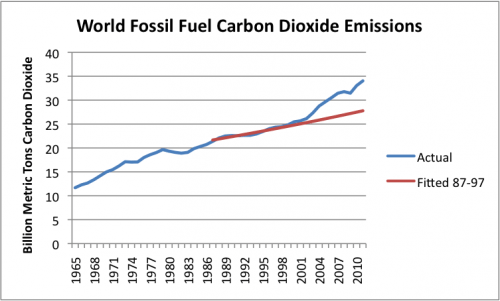
Figure 1. Actual world carbon dioxide emissions from fossil fuels, as shown in BP’s 2012 Statistical Review of World Energy. Fitted line is expected trend in emissions, based on actual trend in emissions from 1987-1997, equal to about 1.0% per year.
The Kyoto Protocol was adopted in 1997. If emissions had risen at the average rate that they did during the 1987 to 1997 period (about 1% per year), emissions in 2011 would be 18% lower than they actually were. While there were many other things going on at the same time, the much higher rise in emissions in recent years is not an encouraging sign.
The standard fixes don’t work for several reasons:
1. In an oil-supply constrained world, if a few countries reduce their oil consumption, the big impact is to leave more oil for the countries that don’t. Oil price may drop a tiny amount, but on a world-wide basis, pretty much the same amount of oil will be extracted, and nearly all of it will be consumed.
2. Unless there is a high tax on imported products made with fossil fuels, the big impact of a carbon tax is to send manufacturing to countries without a carbon tax, such as China and India. These countries are likely to use a far higher proportion of coal in their manufacturing than OECD countries would, and this change will tend to increase world CO2 emissions. Such a change will also tend to raise the standard of living of citizens in the countries adding manufacturing, further raising emissions. This change will also tend to reduce the number of jobs available in OECD countries.
3. The only time when increasing natural gas usage will actually reduce carbon dioxide emissions is if it replaces coal consumption. Otherwise it adds to carbon emissions, but at a lower rate than other fossil fuels, relative to the energy provided.
4. Substitutes for oil, including renewable fuels, are ways of increasing consumption of coal and natural gas over what they would be in the absence of renewable fuels, because they act as add-ons to world oil supply, rather than as true substitutes for oil. Even in cases where they are theoretically more efficient, they still tend to raise carbon emissions in absolute terms, by raising the production of coal and natural gas needed to produce them.
5. Even using more biomass as fuel does not appear to be a solution. Recent work by noted scientists suggests that ramping up the use of biomass runs the risk of pushing the world past a climate change tipping point.
It is really unfortunate that the standard fixes work the way they do, because many of the proposed fixes do have good points. For example, if oil supply is limited, available oil can be shared far more equitably if people drive small fuel-efficient vehicles. The balance sheet of an oil importing nation looks better if citizens of that nation conserve oil. But we are kidding ourselves if we think these fixes will actually do much to solve the world’s CO2 emissions problem.
If we really want to reduce world CO2 emissions, we need to look at reducing world population, reducing world trade, and making more “essential” goods and services locally. It is doubtful that many countries will volunteer to use these approaches, however. It seems likely that Nature will ultimately provide its own solution, perhaps working through high oil prices and weaknesses in the world financial system.
Elastic Versus Inelastic Supply
It seems to me that many bad decisions have been made because many economists have missed the point that crude oil supply tends to be very inelastic, while other fuels are fairly elastic. Let me explain.
Elastic supply is the usual situation for most goods. Plenty of the product is available, if the price is high enough. If there is a shortage, prices rise, and in not too long a time, the market is well-supplied again. If supply is elastic, if you or I use less of it, ultimately less of the product is produced.
Coal and natural gas usually are considered to be elastic in their supply. To some extent, they are still “extract it as you need it” products. Supply of natural gas liquids (often grouped with crude oil, but acting more like a gas, so it is less suitable as a transportation fuel) is also fairly elastic.
Crude oil is the one product that is in quite short supply, on a world-wide basis. Its supply doesn’t seem to increase by more than a tiny percentage, no matter how high the price rises. This is a situation of inelastic supply.
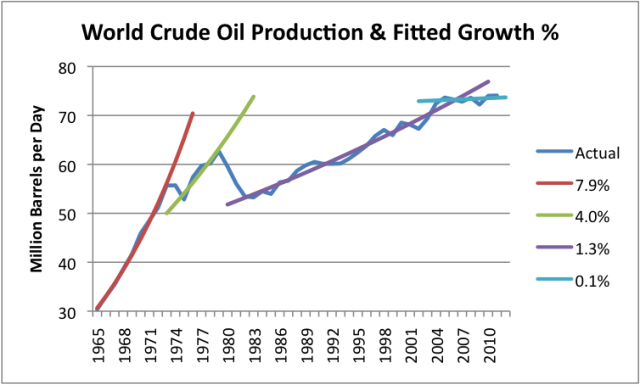
Figure 2. World crude oil production (including condensate) based primarily on US Energy Information Administration data, with trend lines fitted by the author.
Even though oil prices have been very high since 2005 (shown in Figure 3, below), the amount of crude oil has increased by only 0.1% per year (Figure 2, above).
Figure 3. Historical average annual oil prices, (“Brent” or equivalent) in 2011$, from BP’s 2012 Statistical Review of World Energy.
In the case of oil, both supply and demand are quite inelastic. No matter how high the price, demand for oil doesn’t drop back by much. No matter how high the price of oil, world supply doesn’t rise very much, either.1
In a situation of inelastic supply, the usual actions a person might take appear to work when viewed on a local basis, but backfire on a world basis, if not everyone participates. When one country tries to conserve crude oil (whether through a carbon tax, gasoline tax, or higher automobile mileage requirement), it may reduce its own consumption, but there are still plenty of other buyers in the market for the oil that was saved. So the oil gets used by someone else, perhaps at a slightly lower price. World oil production remains virtually unchanged. Thus, a reduction in oil usage by an OECD country can translate to more oil consumption by China or India, and ultimately more development of all types by those countries.
Adding Substitutes Adds to Carbon Emissions
If we don’t have enough crude oil, one approach is to create substitutes. Because crude oil supply is inelastic, though, these substitutes aren’t really substitutes, though. They are “add ons” to world oil supply, and this is one source of our problem with increasing world emissions.
What do we use to make the substitutes? Basically, natural gas and coal, and to a limited extent oil (because we can’t avoid using oil). The catch is, that to make the substitutes, we need to burn natural gas and coal more quickly than we would, if we didn’t make the oil substitutes. Since the supply of coal and natural gas is elastic, it is possible to pull them out of the ground more quickly. Thus, making the substitutes tends to increase carbon dioxide emissions over what they would have been, if we had never come up with the idea of substitutes.
The increased use of coal and natural gas is pretty clear, if a person thinks about coal-to-liquids or gas-to-liquids. Here, we need to first build the plants used in production, and then with each barrel of substitute made, we need to use more natural gas or coal. So it is very clear that we are extracting a lot of additional coal and natural gas, to make a relatively smaller amount of oil substitute. There is often a substantial need for water to make the process work as well, adding another stress on the system.
But the same issue comes up with biofuels, and with other renewables. These too, are add-ons to the world oil supply, not substitutes. While theoretically they might produce energy with less CO2 per unit than fossil fuel systems, in absolute terms they lead to natural gas and coal being pulled out of the ground more quickly to be used in making fertilizer, electricity, concrete, and other inputs to renewables.2
Carbon Taxes and Competitiveness
Each country competes with others in the world market place. Adding a carbon tax makes products made by the local company less competitive in the world marketplace. It also signals to potential coal users that the countries adopting the carbon taxes are willing to a leave a greater proportion of world coal exports to those who are not adopting the tax, thus helping to keep the cost of imported coal down.
Asian countries already have a competitive edge over OECD countries in terms of lower wages and lower fuel costs (because of their heavy coal mix), when it comes to manufacturing. Adding a carbon tax tends to add to the Asian competitive edge. This tends to shift production offshore, and with it, jobs.
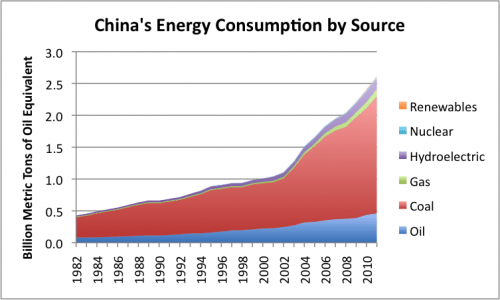
Figure 4. China’s energy consumption by source, based on BP’s Statistical Review of World Energy data.
China joined the World Trade Organization in 2001. Figure 4 shows clearly that its fuel consumption ramped up rapidly thereafter. It seems likely that the number of Chinese manufacturing jobs and spending on Chinese infrastructure increased at the same time.
Economists seem to have missed the serious worldwide deterioration in CO2 emissions in recent years by looking primarily at individual country indications, including CO2 emissions per unit of GDP. Unfortunately, this narrow view misses the big picture–that total CO2 emissions are rising, and that CO2 emissions relative to world GDP have stopped falling. (See my posts Is it really possible to decouple GDP growth from energy growth and Thoughts on why energy use and CO2 emissions are rising as fast as GDP. See also Figure 1 at the top of the post.)
Figure 5. Employment is the total number employed at non-farm labor as reported by the US Census Bureau. Energy consumption is the total amount of energy of all types consumed (oil, coal, natural gas, nuclear, wind, etc.), in British Thermal Units (Btu), as reported by the US Energy Information Administration.
There are several reasons why a connection between energy consumption and the number of jobs is to be expected:
(1) The job itself in almost every situation requires energy, even if it is only electricity to operate computers, and fuel to heat and light buildings.
(2) Equally importantly, the salaries that employees earn allow them to buy goods that require the use of energy, such as a car or house. (“Energy demand” is what people canafford; jobs allow “demand” to rise.)
(3) The lowest salaried people can be expected to spend the highest proportion of their salaries on energy-related services (such as food and gasoline for commuting). The wealthy spend their money on high priced goods and services, such as financial planning services and designer clothing that require much less energy per dollar of expenditure.
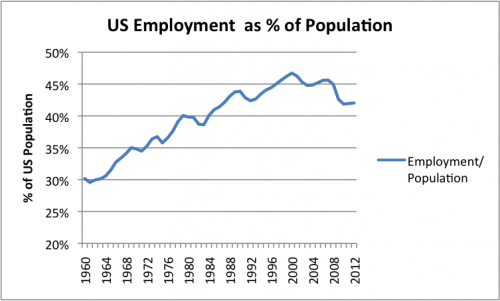
The thing I find concerning is the close timing between the ramp-up of Asian coal use and thus jobs using coal, and the drop-off of US employment as a percentage of US population, as illustrated in Figure 6 below. Arguably, the ramp up in world trade is just as important, but some aspects of programs that are intended to save CO2 emissions also seem to encourage world trade.
Figure 6. US Number Employed / Population, where US Number Employed is Total Non_Farm Workers from Current Employment Statistics of the Bureau of Labor Statistics and Population is US Resident Population from the US Census. 2012 is partial year estimate.
Of course, the US did not sign the Kyoto Protocol or enact a carbon tax, and it is its jobs that I show falling as a percentage of population. It is more that the CO2 solutions act as yet another way to encourage more international trade, and with it more “growth”, and more CO2.
Using More Biomass is Not a Fix Either
Burning more wood for fuel and creating “second generation” biofuels from biomass seems like a fix, until a person realizes that we are reaching limits there, as well.
In June 2012, twenty noted scientist published a paper in the journal Nature called Approaching a State Shift in the Earth’s Biosphere. This report indicates that humans have already converted as much as 43% of Earth’s land to urban or agricultural uses. In total, 20% to 40% of Earth’s primary productivity has been taken over by humans. The authors are concerned that we may now be reaching a tipping point leading to a state shift, because of loss of ecosystem services as use of biological products increases. With this state change would come a change in climate. Simulations indicate that this tipping point may occur when as little as 50% of land use is disturbed. This tipping point may be even lower, if world-wide synergies take place.
On Our Current Path – Lacking Good Solutions
While this list of problems relating to current proposed solutions is not complete, it gives a hint of the problems with reducing CO2 emissions using approaches suggested to date. There are many issues I have not covered.
While the problems noted in these articles are probably solvable, the cost of these solutions has not been built into energy balance analyses. Energy balances (or EROEI estimates) as currently reported do not vary with the proportion of intermittent renewables added to the grid. If energy balance analyses were adjusted to reflect the high cost of adding an increasing proportion of wind or solar PV to the grid, they would likely show a rapidly declining energy balance, above a certain threshold. This would indicate that while adding a little intermittent renewables (as we have done to date) can be a partial solution, adding a lot is likely to have serious cost and energy balance issues.
Another issue that is difficult to deal with is the fact that we are not dealing with a temporary problem with CO2 emissions. The idea is not to slow down the burning of fossil fuels, and burn more later; what we really need to do is to leave unburned fossil fuels in the ground for all time. This is a problem, because there is no way that we can impose our will on people living 10 or 50 years from now. The Maximum Power Principle of H. T. Odum would seem to indicate that any species will make use of whatever energy sources are available to it, to the extent that it can. Even if we temporarily defeat this tendency with respect to humans’ use of fossil fuels, I don’t see any way that we can defeat this tendency for the long term.
Considering all of these issues, it does not appear that most of the “standard” solutions will really work.3 What other options do we have?
Nature’s Solution
The Earth has been handling the problem of shifting conditions for over 4 billion years. The earth is a finite system. Nature provides that finite systems, such as the Earth, will cycle to new states of equilibrium over time, as conditions change. While we would like to defeat Earth’s tendency in this regard, it is not at all clear that we can. Part of this cycling to a new state is likely to be a change in climate.
A state change is a cause for concern to humans, but not necessarily to the Earth itself. The Earth has moved from state to state many times in its existence, and will continue to do so in the future. The changes will bring the Earth back into a new equilibrium. For example, if CO2 levels are high, species that can make use of higher CO2 levels (such as plants) are likely to become dominant, rather than humans.
Exactly how this state change might occur is subject to different views. One view is that changing CO2 levels will be a primary driver. The Nature article referenced previously suggested that increased disturbance of natural ecosystems (as with greater use of biomass) might force a state change. My personal view is that a financial collapse related to high oil price may be part of Nature’s approach to moving to a new state. It could bring about a reduction in world trade, a scale back in CO2 emissions, and a general contraction of human systems.4
However the change takes place, it could be abrupt. It will not be to many people’s liking, since most will not be prepared for it.
Steps That Might Work to Slow CO2 Emissions
It would be convenient if we could slow CO2 emissions by working to produce energy with less CO2. This option does not seem to be working well though, so I would argue that we need to work in a different direction: toward reducing humans’ need for external energy. In order to do this, I would suggest two major steps:
(1) Reduce the world’s population, through one-child policies and universal access to family planning services. This step is necessary because rising population adds to demand. If we are to reduce demand, lower population needs to play a role.
(2) Change our emphasis to producing essential goods locally, rather than outsourcing them to parts of the world that are likely use coal to produce them. I would suggest starting with food, water, and clothing, and the supply chains necessary to produce these items.
Changing our emphasis to producing essential goods locally will have a multiple benefits. It will (a) add local jobs, and (b) lead to less worldwide growth in coal usage, (c) save on transport fuel, and (d) add protection against the adverse impact of declining world oil supply, if this should happen in the not too distant future. It should also help reduce CO2 emissions. The costs of goods will likely be higher using this approach, leading to less “stuff” per person, but this, too, is part of reaching reduced CO2 emissions.
It is hard to see that the steps outlined above would be acceptable to world leaders or to the majority of world population. Thus, I am afraid we will end up falling back on Nature’s plan, discussed above.
Notes:
[1] Michael Kumhof and Dirk Muir recently prepared a model of oil supply and demand (IMF working paper: Oil and the World Economy: Some Possible Futures). In it, they assume a long run price-elasticity of oil supply of 0.03, and remark that a paper by Benes and others indicates a range of 0.005 to 0.02 for this variable. The long term price elasticity of oil demand is assumed to be .08 in the Kumhof and Muir analysis.
[2] I would argue that standard EROEI measurements are defined too narrowly to give a true measure of the amount of energy used in making a particular substitute. For example, EROEI measures do not consider the energy costs associated with labor (even though workers spend their salaries on clothing, and commuting costs, and many other good and services that use fossil fuels), or with financing costs, or of indirect impacts like wear and tear on the roads by transporting corn for biofuel.
Other types of analysis have ways of dealing with this known shortfall. For example, when the number of jobs that a new employer can be expected to add to a community is evaluated, the usual approach seems to be to take the number of jobs that can be directly counted and multiply by three, to estimate the full impact. I would argue that with substitutes, some similar adjustment is needed. This adjustment which would act to increase the energy use associated with renewables, and reduce the EROEI. For example, the adjustment might divide directly calculated EROEI by three.
A calculation of the true net benefit of renewables also needs to recognize that nearly the full energy cost is paid up front, and only over time is recovered in energy production. When renewable production is growing rapidly, society tends to be in a long-term deficit position. Typically, it is only as growth slows that society reaches as net-positive energy position.
[3] I obviously have not covered all potential solutions. Nuclear power is sometimes mentioned, as is space solar power. There are new solutions being proposed regularly. Even if these solutions would work, ramping them up would take time and require use of fossil fuels, so it is wise to consider other options as well.
[4] The way that limited oil supply could interfere with world trade is as follows: High oil prices cause consumers to cut back on discretionary goods. This leads to layoffs in discretionary sectors of the economy, such as vacation travel. It also leads to secondary effects, such as debt defaults and lower housing prices. The financial effects “concentrate up” to governments of oil importing nations, because they receive less tax revenue from laid-off workers at the same time that they pay out more in unemployment benefits, stimulus, and bank bailouts. (We are already at this point.)
Eventually, countries will find that deficit spending is spiraling out of control. If countries raise taxes and cut benefits, this is likely to lead to more lay offs and debt defaults. One possible outcome is that citizens will become increasingly unhappy, and replace governments with new governments that repudiate old debt. The new governments may have difficulty establishing financial relationships with other governments, given that most are major debt defaulters. Such issues could reduce world trade substantially. With the drop of world trade would come much more limited ability to maintain our current systems, such as electricity and long distance transport.
oooOOOooo
Reminds me of that old saying, “The best laid plans of mice and men …” Or as Robbie Burns wrote in 1785,
But Mousie, thou art no thy lane,
In proving foresight may be vain:
The best-laid schemes o’ mice an’ men
Gang aft agley,
An’ lea’e us nought but grief an’ pain,
For promis’d joy!
Attention all UK-based Learning from Dogs readers: I received this email today and felt compelled to publish it on my blog – and now here as well (thanks Paul).
For the benefit of new readers (thank you – and welcome – to you all), when you read the email appended below, please bear in mind that I am (or at least have been) a supporter of the Conservative Party. However, I am very upset by the way in which the Coalition government’s position regarding the Climate Change Act (and our commitments to invest in renewable power generation technologies of all kinds) is being undermined by climate change sceptics who have been encouraging people like John Hayes (Energy Minister) and George Osborne (Chancellor) to question the sense of investing in the Green Economy.
It is also worth pointing out that I do not agree with Greenpeace’s attitude to GMOs or Nuclear Power but, that does not prevent me from supporting them in their attempts to publicise the failure of our politicians to take a strategic long-term decision (to lessen our dependence on fossil fuels) and stick to it. I therefore hope you will consider adding your name to the online petition to the Prime Minister to get him to face-down the sceptics in his own party; and stick to his election manifesto pledge to lead “the greenest ever government”.
I don’t normally email you, but this campaign you’re part of is making headlines.
It’s been front page of the newspapers for two days now and over 35,000 of us have told David Cameron to weed out the climate saboteurs in his party.
But we need many more in our movement if we are to overcome this new anti-climate ‘Tea Party’ trend infecting UK politics.
Please forward the email below to one person you know who will join us. If we all do that, we’ll be 70,000 strong by tomorrow.
Right now we have the opportunity to define our future. If the government does the right thing, we could be getting our energy from renewable sources which would create new jobs, stabilise our bills and help protect the rapidly melting Arctic.
But all that is in danger now as highlighted by our undercover investigation.
If we want a green and a peaceful world the most important thing we can do is source our energy in a way that doesn’t harm the environment. Our only choice is clean energy – let’s demand it from the government.
Please forward the email below to at least one person who will join us.
Over 20,000 people have already told David Cameron to stop Osborne sabotaging progress on climate change.
If these Conservatives have their way, we’ll have more dirty, expensive gas power stations written into the Energy Bill. The bill is crucial in shaping the way our electricity is generated for the next 30 years.
Osborne wants to hand the Energy Bill – and our future – to the gas companies, allowing them to build dozens of new gas power stations. This dash for gas could lead to decades of unrestricted carbon emissions and increasingly volatile household bills, plunging more people into fuel poverty.
A clean Energy Bill would mean almost zero carbon emissions from electricity generation by 2030, a new wave of clean energy and a thriving green economy with tens of thousands of new jobs.
A majority of us – 64% of the British public – want renewable energy powering our lives.
Osborne knows he’s in the minority, and recent investigations shows he’s positioning climate sceptics and anti-wind MPs in key government roles – like pieces on a chessboard – to undermine the progress we’ve made.
But Osborne still answers to the prime minister.
It now falls to David Cameron to respond to the scandal we’ve uncovered and decide where his party – and our country – is going.
At the last election when looking for our votes, Cameron rebranded the Conservative party with the environment at its heart. Our undercover investigation shows he has a fundamental question to answer: will he side with the majority of the British public, or the dirty energy faction led by George Osborne?
Southwest forests are already in the early stages of a mega drought brought on by climate change.
Southwest forests are already in the early stages of a mega drought brought on by climate change that will result in massive tree die-offs and sweeping changes in Rim Country forests, according to an analysis published in the scientific journal Climate Change.
Severe drought will dominate much of this century, creating stresses on forests not seen for more than 1,000 years, according to the research that used tree ring samples from 13,000 trees, historical rainfall records and computer projections of future climate change.
The shifts will likely dramatically shrink the world’s largest ponderosa pine forest in northern Arizona, replacing pines with junipers at elevations like Payson and replacing junipers with chaparral and cactus at lower elevations.
The article concludes,
Unfortunately, the team’s climate prediction models suggest that within the next 40 years the region will fall deep into mega drought conditions. The models predict that even the wettest, coolest years in the late 21st century will exceed mega drought levels. In that case, the drought conditions of the past decade will prove the new normal rather than a bad stretch.
Williams noted that while winters in the past decade haven’t been exceptionally dry, summer temperatures have soared. As a result, the stress on the trees in the past 13 years has exceeded mega drought levels about 30 percent of the time — conditions not matched for the previous 1,000 years.
One of the clean little secrets about dealing with climate change, is that if we make our cities more efficient, and reduce their carbon footprint, we will also make them more resilient, quieter, more comfortable, more human scaled, more inviting, and more fun.
As global temperatures rise, urban areas are facing challenges in keeping their infrastructure and their residents cool. Chicago is tackling that problem with a green design makeover. This report is part of our Coping with Climate Change series.
A republication of a post first shown on 28th October, 2009 which still seems relevant as British Summer Time is due to end in a couple of days time.
oooOOOooo
An ancient idea may have run it’s course?
What is the purpose of “Daylight Saving”? [Interesting history of Daylight Saving on Wikipedia. Ed.]
This week we are in a particularly interesting situation as we are in the middle of a one week separation between the dates when Europe and US change their clocks back to “normal” winter time. I.e. Europe changed their clocks back at 2am last Sunday and most, but not all, US States change their clocks back at 2am this coming Sunday.
This is even more confusing than normal. But why are we doing this at all?
Is it to save fuel, to save lives, to save time or to save something else?
In my humble opinion it is all nonsense!
“Time management” is a myth
Time is time! People say that they do not have enough time to do this or that, as if they have ways to make some more; and, of course, there is much talk about “time management”. Yet we all have the same amount of time and no amount of management will change that!
We are certainly able to manage the things that we try to fit into the available time. That is, we can manage tasks, effort and so on. But, in everyday (Newtonian rather than Einsteinian) regimes, time is an inelastic independent variable. Fiddling about with the clocks and trying to “manage time” have no effect on the stuff whatsoever. Let it be!
There must be a better way!
Yes, I know! Some people make claims of wasted daylight or of the dangers to schoolchildren walking to or from school in the dark. These are valid areas of concern. If adjusting the times of business operations or schooling helps to deal with them, then by all means do so. But, for goodness, let’s not pretend the time is different.
A fascinating item recently published by Yale University.
Apologies, time pressure allows me little more than to repeat this in full. But still no less interesting.
oooOOOooo
Nearby super-Earth likely a diamond planet
Illustration of the interior of 55 Cancri e — an extremely hot planet with a surface of mostly graphite surrounding a thick layer of diamond, below which is a layer of silicon-based minerals and a molten iron core at the center. (Image by Haven Giguere)
October 11, 2012
New research led by Yale University scientists suggests that a rocky planet twice Earth’s size orbiting a nearby star is a diamond planet.
“This is our first glimpse of a rocky world with a fundamentally different chemistry from Earth,” said lead researcher Nikku Madhusudhan, a Yale postdoctoral researcher in physics and astronomy. “The surface of this planet is likely covered in graphite and diamond rather than water and granite.”
The paper reporting the findings has been accepted for publication in the journal Astrophysical Journal Letters.
The planet — called 55 Cancri e — has a radius twice Earth’s, and a mass eight times greater, making it a “super-Earth.” It is one of five planets orbiting a sun-like star, 55 Cancri, that is located 40 light years from Earth yet visible to the naked eye in the constellation of Cancer.
The planet orbits at hyper speed — its year lasts just 18 hours, in contrast to Earth’s 365 days. It is also blazingly hot, with a temperature of about 3,900 degrees Fahrenheit, researchers said, a far cry from a habitable world.
The planet was first observed transiting its star last year, allowing astronomers to measure its radius for the first time. This new information, combined with the most recent estimate of its mass, allowed Madhusudhan and colleagues to infer its chemical composition using models of its interior and by computing all possible combinations of elements and compounds that would yield those specific characteristics.
Star map showing the planet-hosting star 55 Cancri in the constellation of Cancer. The star is visible to the naked eye, though better through binoculars. (Image by Nikku Madhusudhan; created using Sky Map Online
Astronomers had previously reported that the host star has more carbon than oxygen, and Madhusudhan and colleagues confirmed that substantial amounts of carbon and silicon carbide, and a negligible amount of water ice, were available during the planet’s formation.
Astronomers also thought 55 Cancri e contained a substantial amount of super-heated water, based on the assumption that its chemical makeup was similar to Earth’s, Madhusudhan said. But the new research suggests the planet has no water at all, and appears to be composed primarily of carbon (as graphite and diamond), iron, silicon carbide, and, possibly, some silicates. The study estimates that at least a third of the planet’s mass — the equivalent of about three Earth masses — could be diamond.
“By contrast, Earth’s interior is rich in oxygen, but extremely poor in carbon — less than a part in thousand by mass,” says co-author and Yale geophysicist Kanani Lee.
The identification of a carbon-rich super-Earth means that distant rocky planets can no longer be assumed to have chemical constituents, interiors, atmospheres, or biologies similar to those of Earth, Madhusudhan said. The discovery also opens new avenues for the study of geochemistry and geophysical processes in Earth-sized alien planets. A carbon-rich composition could influence the planet’s thermal evolution and plate tectonics, for example, with implications for volcanism, seismic activity, and mountain formation.
“Stars are simple — given a star’s mass and age, you know its basic structure and history,” said David Spergel, professor of astronomy and chair of astrophysical sciences at Princeton University, who is not a co-author of the study. “Planets are much more complex. This ‘diamond-rich super-Earth’ is likely just one example of the rich sets of discoveries that await us as we begin to explore planets around nearby stars.”
In 2011, Madhusudhan led the first discovery of a carbon-rich atmosphere in a distant gas giant planet, opening the possibility of long-theorized carbon-rich rocky planets (or “diamond planets”). The new research represents the first time that astronomers have identified a likely diamond planet around a sun-like star and specified its chemical make-up. Follow-up observations of the planet’s atmosphere and additional estimates of the stellar composition would strengthen the findings about the planet’s chemical composition.
The authors of the paper are Madhusudhan, Lee, and Olivier Mousis, a planetary scientist at the Institut de Recherche en Astrophysique et Planetologie in Toulose, France.
The paper is titled “A Possible Carbon-rich Interior in Super-Earth 55 Cancri e.”
The research was supported by the Yale Center for Astronomy and Astrophysics (YCAA) in the Yale Department of Physics through Madhusudhan’s YCAA postdoctoral prize fellowship.
This came in from Suzann, Su to her friends, a few days ago. Suzann is Dan Gomez’s sister and if Dan’s name is familiar it’s because he, too, sends in items for Learning from Dogs, the recent Tad too much cabin pressure being an example. It was Su that invited me out to San Carlos, Mexico for Christmas 2007 which resulted in me meeting Jean, a long-time friend of Su, and, as they say, the rest is history! OK, to the article from Su.
oooOOOooo
Here’s a question?
Think about railroad (railways in ‘English’!) tracks. The US standard railroad gauge (distance between the rails) is 4 feet, 8.5 inches. That’s an exceedingly odd number.
Why was that gauge used? Because that’s the way they built them in Scotland, and Scots expatriates designed the US railroads.
Why did the Scots build them like that? Because the first rail lines were built by the same people who built the pre-railroad tramways, and that’s the gauge they used.
Why that gauge then? Because the people who built the tramways used the same jigs and tools that they had used for building wagons, which used that wheel spacing.
Why did the wagons have that particular odd wheel spacing? Well, if they tried to use any other spacing, the wagon wheels would break on some of the old, long-distance roads in Scotland, because that’s the spacing of the wheel ruts.
So who built those old rutted roads? Imperial Rome built the first long distance roads in Europe (including Scotland) for their legions. Those roads have been used ever since. [And rarely repaired! 😉 Ed. ]
And the ruts in the roads? Roman war chariots formed the initial ruts. Which forever more everyone else had to match for fear of destroying their wagon wheels.
Since the chariots were made for Imperial Rome, they were all alike in the matter of wheel spacing. Therefore the United States standard railroad gauge of 4 feet, 8.5 inches is derived from the original specifications for an Imperial Roman war chariot.
Bureaucracies live forever….
So the next time you are handed a specification or a procedure or process and wonder ‘What horse’s ass came up with this?‘, you may be exactly right. Imperial Roman army chariots were made just wide enough to accommodate the rear ends of two war horses.
Now, the twist to the story. When you see a Space Shuttle sitting on its launch pad, there are two big booster rockets attached to the sides of the main fuel tank. These are solid rocket boosters, or SRBs. The SRBs are made by Thiokol at their factory in Utah.
The engineers who designed the SRBs would have preferred to make them a bit fatter, but the SRBs had to be shipped by train from the factory to the launch site. The railroad line from the factory happens to run through a tunnel in the mountains, and the SRBs had to fit through that tunnel.
The tunnel is slightly wider than the railroad track, and the railroad track, as you now know, is about as wide as two horses’ behinds.
oooOOOooo
Just a fabulously interesting account of something we all take for granted, or had done until now! Thank you so much, Su, for sharing that with everyone.
Hopefully, you were able to watch the Amory Lovins talk in yesterday’s post? If not, then do find time to watch how Professor Lovins sets out the powerful argument that the USA could soon, relatively speaking, be energy self-sufficient.
So on top of the Lovins presentation, I wanted to draw your attention to an item on Climate Crocks last October 5th.
One of the great stories untold in the American media is the ongoing revolution in one of the world’s most advanced economies – as Germany undertakes a bold and serious transition from powering a great engine of prosperity on fossil fuels, to plentiful and inexhaustible renewable energy.
Listening to Mitt Romney double and triple down on the bogus Fox/Fossil narrative about “clean coal” and failed renewables, it might be well to consider how one of our toughest manufacturing competitors is going all-in on the high stakes renewable energy revolution of the new century.
The article is a detailed analysis of how Germany is powering ahead, pardon the pun, in the provision of non carbon-based power, as this reference illustrates,
German use of coal to generate electricity has declined steadily from 1990 to 2011, according to readily available statistics on the German electricity system. The percentage of coal-fired electricity in German electricity generation has fallen from 56.7% in 1990 to 43.5% last year–a decrease of more than 10% despite a increase in total electricity generation during the same period of about 10%. At the same time the share of renewable energy in the electricity mix has increased from 3.6% to 19.9%, mostly due to the rapid development of wind energy and biomass.
Here is one for you- http://www.solarroadways.com/intro.shtml – the idea is totally leftfield, but it fulfils certain issues such as distribution, decentralisation of power and offers a recharge network for electric cars and it has received a big chunk of government funding. It is so out there that I wonder if it could possibly be the answer but you never know.
Very quickly one finds that Solar Roadways are involved in something VERY interesting, namely,
Years ago, when the phrase “Global Warming” began gaining popularity, we started batting around the idea of replacing asphalt and concrete surfaces with solar panels that could be driven upon. We thought of the “black box” on airplanes: We didn’t know what material that black box was made of, but it seemed to be able to protect sensitive electronics from the worst of airline crashes.
Suppose we made a section of road out of this material and housed solar cells to collect energy, which could pay for the cost of the panel, thereby creating a road that would pay for itself over time. What if we added LEDs to “paint” the road lines from beneath, lighting up the road for safer night time driving? What if we added a heating element in the surface (like the defrosting wire in the rear window of our cars) to prevent snow/ice accumulation in northern climates? The ideas and possibilities just continued to roll in and the Solar Roadway project was born.
Now watch this!
and then watch this, as nearly 1.5 million others have!
The Solar Roadways project is working to pave roads with solar panels that you can drive on. Co-founder Scott Brusaw has made some major steps forward since our first visit back in 2007, so we visited him again for an exclusive update on the project, including the first ever video recorded of the Solar Roadways prototype! For more information visit http://www.solarroadways.com . This Solar Roadway project is highlighted as one of many planet-friendly solutions in the feature film by YERT – Your Environmental Road Trip. To learn more about YERT, visit http://yert.com .
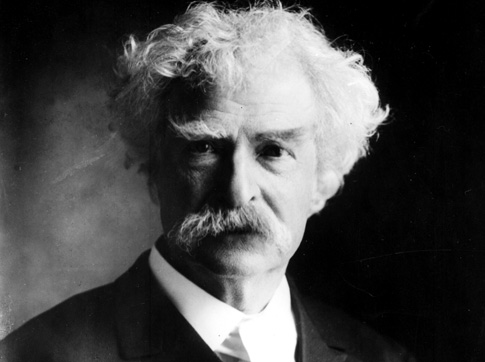
Mark Twain quotation after hearing that his obituary had been published in the New York Journal.
Mistaken publications of obituaries aren’t as rare as you might expect. A recent example is of Dave Swarbrick, the British folk/rock violinist, who was killed off mistakenly by the Daily Telegraph in April 1999 when they reported that his visit to hospital in Coventry had resulted in his death. He did at least get the opportunity to read a rather favourable account of his life, not something we all get to do, and to deliver the gag “It’s not the first time I have died in Coventry”.
So why have I opened with this quote from Mark Twain? Read on and I hope all will be clear.
Integrity is always about getting to the truth!
A little under a week ago I published a couple of posts that proposed that the United States of America is an empire in decline. The first was What goes up? and the second Might just come down! As a Brit I well know that aspect of British history!
However a recent conversation with a friend of many years back in England, who has also been a shrewd and wise entrepreneur for longer than I care to remember, argued that the evidence for the ‘end of the USA’ could be challenged.
He cited five reasons why he thought the USA would remain, more or less, in its dominant position. They were:
Spirit of innovation
Relaxed labour laws
The importance of Mexico
The uncertainty of China in terms of the next ’empire’
The likely energy self-sufficiency for the USA in the near-term.
So let me expand on each of those points.
Spirit of innovation
Let me quote from an article in TIME Magazine of the 5th June, 2011,
Innovation is as American as apple pie. It seems to accord with so many elements of our national character — ingenuity, freedom, flexibility, the willingness to question conventional wisdom and defy authority. But politicians are pinning their hopes on innovation for more urgent reasons. America’s future growth will have to come from new industries that create new products and processes. Older industries are under tremendous pressure. Technological change is making factories and offices far more efficient. The rise of low-wage manufacturing in China and low-wage services in India is moving jobs overseas. The only durable strength we have — the only one that can withstand these gale winds — is innovation.
Now there are plenty to argue both ways in terms of the future innovation potential for the USA, as a recent article in The Atlantic does, see American Innovation: It’s the Best of Times and the Worst of Times. But the spirit of innovation will be a powerful economic potential for the USA for many years to come.
Relaxed labour laws.
Definitely an area that I have little knowledge of except for the subjective notion that compared to many other nations, the laws in the USA are much less of a restraint on economic productivity than elsewhere.
The importance of Mexico.
Importance in the context of providing the USA with a source of cheaper manufacturing facilities. My English friend thought that this was a significant competitive advantage for the USA. Now, as it happens, we had a couple staying with us over the week-end of the 6th/7th October. The husband is a senior manager of Horst Engineering, an American firm based in Guaymas, Sonora County, Mexico. Here’s a picture from their website,
We are a contract manufacturer of precision machined components and assemblies for aerospace, medical, and other high technology industries. Our core processes include Swiss screw machining, turning, milling, thread rolling, centerless grinding, and assembly. Our extensive supply chain offers our customers a full service logistics solution for managing their precision product requirements. We are ISO9001:2008 and AS9100 registered and proud of our 66 year, three-generation legacy of quality and performance.
I was told that many American and British firms were using Mexico rather than China for a number of reasons. Not least because Chinese suppliers require full payment before shipment. Plus that taking into account that financial aspect together with shipping costs and other logistical issues, China wasn’t as ‘cheap’ over all. Here’s a recent announcement from Rolls Royce,
Rolls-Royce plans new Sonora hub
The burgeoning aerospace industry in Guaymas had its efforts validated recently when the venerable Rolls-Royce chose it as the site for its newest global purchasing office.
Surrounded by several of its aerospace manufacturing suppliers, London-based Rolls-Royce will move into a Guaymas industrial park owned by Tucson-based The Offshore Group to develop a supply hub for commercial jets and military aircraft around the globe.
“Rolls-Royce has very robust booking orders for the next 10 years,” said Joel Reuter, director of communications for Rolls-Royce in North America. “We need to double our production.”
Because a number of Rolls-Royce suppliers already operate in Guaymas, the city was a logical choice, Reuter said.
The uncertainty of China in terms of the next ’empire’
The point made in terms of China taking over ’empire’ status from the USA, as Simon Johnson argues over at Baseline Scenario, is countered by the fact that politically China is an unknown quantity. Until China endorses some form of democratic process, that unknowingness is not going to disappear.
The likely energy self-sufficiency for the USA in the near-term.
I can’t do better than to ask you to watch this video! Just 27-minutes long, it is a very interesting review of the energy future of the USA.
As the TED website suggests in terms of why you should listen to Amory Lovins,
Amory Lovins was worried (and writing) about energy long before global warming was making the front — or even back — page of newspapers. Since studying at Harvard and Oxford in the 1960s, he’s written dozens of books, and initiated ambitious projects — cofounding the influential, environment-focused Rocky Mountain Institute; prototyping the ultra-efficient Hypercar — to focus the world’s attention on alternative approaches to energy and transportation.
His critical thinking has driven people around the globe — from world leaders to the average Joe — to think differently about energy and its role in some of our biggest problems: climate change, oil dependency, national security, economic health, and depletion of natural resources.
So, don’t know about you, but I found those five points deeply convincing. How about you? Are the reports of the death of the USA greatly exaggerated? Do leave a comment.




 This week we are in a particularly interesting situation as we are in the middle of a one week separation between the dates when Europe and US change their clocks back to “normal” winter time. I.e. Europe changed their clocks back at 2am last Sunday and most, but not all, US States change their clocks back at 2am this coming Sunday.







 Learning from Dogs