A warning of the dangers of cell phones and the like!
Yesterday, I simply ran out of time to write to write a more personal post for today. So I looked at some of the news items that I had collected recently and two jumped out as being both deeply connected and worthy of posting.
The first was an item that was seen on Natural News a little more than a couple of months ago. It had the title of EMF exposures destroy health and well-being, claims panel of top international scientists. The link to that article is here. It opens, thus:
(NaturalNews) Nearly 8 million people worldwide die from cancer on an annual basis. Cardiovascular disease is the number one cause of death, killing almost 17 million people in 2011; both of these statistics are spiraling out of control. Now three top scientists, Dr. Panagopoulos of the University of Athens , Associate Prof. Johansson of the Karolinska Institute, and Dr. Carlo of the Science and Public Policy Institute, are sounding the alarm bell.
Leaders in their respective fields, Panagopoulos, Johansson, and Carlo, claim electromagnetic field (EMF) exposures significantly below international safety levels exposures are destroying the public’s health and well-being.
Recent study findings
This latest study concluded the present standard of measuring EMFs, Specific Absorption Rate (SAR), to be totally inappropriate. SAR measures the heating effect of EMF based technologies like microwave ovens, cell phones, cordless phones, Wi-Fi and the like. But countless studies have brought to light adverse biological effects at radiation levels significantly below levels where a thermal effect is detected.
Please do go here and read the full article. Because as one reads from the closing advice, as below, whom these days isn’t being affected?
Basic EMF protection
Reducing personal exposure to EMFs is a fairly easy endeavor. Basic EMF protection can be achieved by:
• Texting instead of talking with cell phones
• Setting cell phones on airplane mode when not in use
• Clearing the bedroom of electrical devices
• Replacing Wi-Fi with a hard-wired connection
Taking these simple steps is well worth the effort; the power to reduce EMF exposure and the adverse health effects that stem from them are truly right there at your fingertips.
Multifocal Breast Cancer in Young Women with Prolonged Contact between Their Breasts and Their Cellular Phones
Abstract
Breast cancer occurring in women under the age of 40 is uncommon in the absence of family history or genetic predisposition, and prompts the exploration of other possible exposures or environmental risks. We report a case series of four young women—ages from 21 to 39—with multifocal invasive breast cancer that raises the concern of a possible association with nonionizing radiation of electromagnetic field exposures from cellular phones. All patients regularly carried their smartphones directly against their breasts in their brassieres for up to 10 hours a day, for several years, and developed tumors in areas of their breasts immediately underlying the phones. All patients had no family history of breast cancer, tested negative for BRCA1 and BRCA2, and had no other known breast cancer risks. Their breast imaging is reviewed, showing clustering of multiple tumor foci in the breast directly under the area of phone contact. Pathology of all four cases shows striking similarity; all tumors are hormone-positive, low-intermediate grade, having an extensive intraductal component, and all tumors have near identical morphology. These cases raise awareness to the lack of safety data of prolonged direct contact with cellular phones.
It’s easy to underestimate just how powerful the brain can be.
Last Friday’s post was called Instinctive behaviours and explored the notion of instinct, coming to the conclusion that almost everything the brain does is a result of learning rather than genetics. Yet acknowledging the vast amount of brain activity that runs in ‘background’ mode or subconsciously.
That was brought home to me in spades as a result of being introduced to the flying of gliders, or sailplanes in American speak. The year was 1981 and working near to me in my offices in Colchester, Essex was a gentlemen running his own company, like yours truly. His name was Roger Davis and we were sharing a beer one day when the subject of flying came up. It piqued my interest so, as my logbook declares, on the 7th June, 1981 I had the first of two flights in a glider with Roger at the controls. The place was Rattlesden Airfield, an old wartime airfield near Felsham, Bury St. Edmunds in Suffolk. The gliding club was Rattlesden Gliding Club.
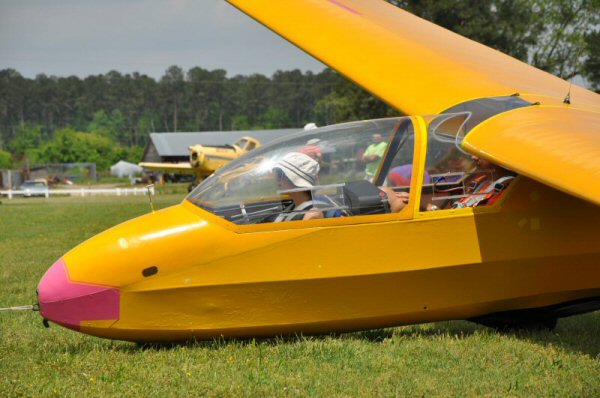
The glider we were in was known as a K-7, a high-wing, two-seater (naturally!) glider with the instructor sitting behind the student.
A K-7 typical of the glider I first flew in at Rattlesden GC.
Anyway, some 43 flights later, I was signed off to conduct my first solo flight in the K-7. The date was 5th September, 1981 and my flight time was just 4 minutes! I was hooked.
In over 10 years of flying amounting to more than 1,400 flights I had the great fortune to experience much of the magic of flying relying on nothing more than the currents of air.
Ahh! Memories! Over 10 years of glider flying, amounting to more than 200 hours of flight-time, 17 different types of glider. Longest flight was 5 hours, 16 minutes including a climb to over 6000 feet above sea-level on the 7th July, 1985 in a single-seater LS4 glider type.
So what’s this got to do with subconscious thinking? Simply this.
One quickly learnt that once the decision had been made to land, most frequently because one was unable to find further, or any, rising air currents the brain had a major computing task in hand. As the aircraft descends, the air currents change and the direction and velocity of the wind changes. There is no engine to allow one to abort the landing; to do a ‘go round’!
One of the key visual judgments was determining the point of touchdown: not too early that might risk a ground contact before the start of the runway, and not too late which might risk running out of landing space.
Thus the brain was operating clearly in two modes. Consciously, computing second by second where the touch-down point was going to be and, subconsciously, the flying of the glider as in operating the joystick and rudder pedals in support of the touch-down ‘computations’.
Moving on.
In last Friday’s post, I also wrote this: “Plus something that could just possibly be the key to mankind having a long-term sustainable future on this planet: The Power of Thinking.”
That ‘something’ was me reflecting on an article in the October 7th edition of FORTUNE magazine. Not something I read on a normal basis but just happened to come across that edition – and glad I did. Because there was an article about IBM’s new supercomputer Watson. The link to the summary is here, from which I republish this:
Dr. Mark Kris is among the top lung cancer specialists in the world. As chief of thoracic oncology at Memorial Sloan-Kettering (MSK) Cancer Center in New York City, he has been diagnosing and treating patients for more than 30 years. But even he is overwhelmed by the massive amount of information that goes into figuring out which drugs to give his patients — and the relatively crude tools he has to decipher that data. “This is the standard for treatment today,” he says, passing me a well-worn printout of the 2013 treatment guidelines in his office. We choose a cancer type. A paragraph of instructions says to pair two drugs from a list of 16. “Do the math,” he says. It means more than 100 possible combinations. “How do you figure out which ones are the best?”
It’s a huge problem. More than 230,000 Americans will be diagnosed with lung cancer this year. Almost all of them will receive chemotherapy. As crude as the existing guidelines are, says Kris, they won’t be followed more than half the time. If we bumped up adherence by just 10% to 20%, he says, as many as 30,000 people might live longer. Never mind curing cancer — shouldn’t we be able to get the best available combinations of medications to sick people now?
That’s the question that led Kris to IBM. He saw that more information was not the answer. What doctors needed was a better brain — one that could instantly vacuum up facts, draw deeper connections between data points, and remember everything. They needed Watson.
Just read that last paragraph again. That it’s not about information, it’s about offering humanity computing power that can see things that humans might not easily see.
Thus, I mused that when mankind gets to the point where there is total and complete commitment to finding a non-carbon-burning way ahead for every living thing on this planet we won’t have the luxury of countless years working out the new journey directions. Maybe, just maybe, computing power a la Watson might just be our saving grace.
Curious to learn more about IBM Watson? Then here’s the relevant website.
As is the way of things, my post yesterday, The growth of empathy, unwittingly set the scene for today’s post. Here’s why!
In yesterday’s post I mentioned Fukushima and the power of blogging in connecting so many all across the world. Maurice Barry, who writes his own blog, left a comment:
Regarding Fukashima I’m still left wondering whether the real problem is the lack of social conscience in the top level leaders or the apathy of ordinary people like you and I who let them carry out their plans.
To which I replied, “Maybe just the power of 20:20 hindsight?”
So to today’s post.
One of the items in yesterday’s Naked Capitalism Links was the headline: Is there a media blackout on the fracking flood disaster in Colorado?That caught my eye and in a moment I had gone across to the blogsite: Bluedaze Drilling Reform.
This is what I read:
Is there a media blackout on the fracking flood disaster in Colorado?
I will update this post as residents send me pictures and video.
We need the national news stations to go cover the environmental disaster that’s happening in Colorado right now.
This picture taken by a resident is from yesterday.
From an email.
I see you’ve noticed the underwater wells in Weld County, Colorado. Amazing; we’ve emailed the Denver TV stations, other media, and state and local politicians. We’ve sent pictures that our members have taken. It’s like the media and politicians have been TOLD not to say anything about it. There has been no mention of the gas wells on the Denver newscasts either last night or this evening although all stations have had extensive and extended flood coverage. You can see underwater wells in the background of some of the newscast videos, and yet the reporters say absolutely nothing.
Here’s a picture one of our members took yesterday in Weld County, Colorado. We’ve got tons more on our website. Check it out. The tanks are tipping and, in some cases, have fallen over. They have to be leaking toxins into the flood waters. There have to be hundreds if not thousands of underwater well pads in Weld County as a result of the flooding.
Please publicize this in Texas since our media people and politicians have gone silent!
The reason I called today’s post ‘Questions without answers’ was because there are so many complex issues today. So many issues that cannot be understood in simple ‘question and answer’ ways. But one hope of finding answers to the complex questions of these times is through the sharing, caring ways of communicating that so many can access. No more passionately demonstrated than by TXSharon in her About section of her blog.
Finally, I shall leave you with another great dog picture from Chris Snuggs. So beautifully appropriate to the complex world we live in.
Warning! Today’s post has almost nothing to do with dogs plus if you are not into computing then you may want to come back tomorrow! 😉
A little over a week ago I ordered an Apple Mac computer.
So what, I hear you say.
Well one way or another, I have been associated with personal computing for too many years and with the Microsoft Windows operating system equally for a long time.
Here’s that history and, be warned, I do go on a tad!
In 1970 I joined the Office Products (OP) Division of IBM in the United Kingdom. I joined as an office products salesman and after my initial training was based at IBM OP’s London North branch in Whetstone in the London Borough of Barnet. I loved both the job (remember the Selectric ‘Golfball’ typewriter?) and the company and conspired to win the prize of top UK salesman for the year 1977. By that time, IBM was selling dedicated word-processing (WP) machines. They offered powerful benefits for companies of many sizes and, as an experienced WP salesman, I was enjoying the fruits of that success. Thus it was that in 1978 I attended IBM’s Golden Circle celebrations for 1977 country winners from all around the world. The Golden Circle celebrations were held in Hawaii!
I returned from Hawaii with the clear idea in my mind that this was the time to move on; my ego didn’t like the idea of not being number one again! So within a couple of days of returning to my sales branch, I announced to my manager, David Halley, that I wished to give three months notice. I can still recall David’s rather shocked response with him saying, “But I always thought Golden Circle was an incentive event!”
In those days New Scientist magazine was a regular read for me. During my time of working out my notice I read in the magazine about this new personal computer from Commodore Business Machines that had been launched in the UK. It was called the Commodore PET (Personal Electronic Transactor) and had been unveiled in 1977 at the US West Coast Computer Faire. I was captivated by what I had read.
I had casually mentioned it to Richard Maugham; a good friend and fellow office-products salesman working for Olivetti UK. Richard said that coincidentally a close friend of many years had just been appointed sales manager for CBM UK Ltd. That friend was Keith Hall and on making contact with Keith, I was invited to go and meet him and learn more about this funny device. What I hadn’t bargained for was that Keith was yet another smart salesman; Keith and Richard had met when they were both salesmen working for Olivetti.
When I asked Keith the retail price of the ‘PET”, his immediate reply was, “Well why don’t you become a dealer and I can sell you one for 30% less!” Like most salesmen, I was always a sucker to a good sales pitch! I signed the necessary paperwork. (It is very sad to say that Keith died a few years ago, at far too young an age.)
So it was that towards the end of 1978, I became the sixth Commodore computer dealer in the UK, opening my small store in what had once been a Barber’s shop in Church Street, off Head Street in the centre of Colchester, Essex. I called my business Dataview Limited.
Frankly, I hadn’t a clue as to what I was doing! If it hadn’t been for a gigantic stroke of luck I would not have lasted long!
That piece of luck was meeting someone who was a programmer for a large, traditional computing company, ICL, who had bought himself a Commodore PET and, just out of fun, was writing a word-processing program. Now if I didn’t know about computers, personal or otherwise, I certainly knew about word-processing. When I looked at what Peter D. had written I practically wet myself. Because, I was looking at a program that even incomplete already offered three-quarters, give or take, of the functionality of a £20,000 IBM Word Processor.
I offered to guide Peter in refining and honing his software which he graciously accepted. Then a few weeks later Peter casually asked me if I would like to sell the software. I jumped at the opportunity and in due course Wordcraft was launched under the Dataview umbrella. (And do see my footnote!)
But back to my Windows journey.
In 1981 IBM announced the release of their own personal computer.
IBM PC
With my love affair with IBM not even dimmed, becoming an IBM PC dealer was a must. An IBM PC version of Wordcraft was developed by Peter and now things were really rocking and rolling. Then in 1983 Microsoft announced the development of Windows, a graphical user interface (GUI) for the operating system MS-DOS. MS-DOS was the existing operating system on the IBM PC.
By the time I sold Dataview in 1986, Windows was well on its way to evolving into a full personal computer operating system and ever since that time my own PCs have been Windows based. (Difficult to imagine now how in those early years Windows didn’t achieve any popularity!)
OK, fast forward 27 years to my present machine running Windows 7, Google Chrome web browser and all the fancy ‘cloud’-based applications of today.
Much of my time spent writing and blogging relies on me being online. Like so many others, as soon as I turn on my computer it becomes an online PC. On average, I am working in front of my PC for about 3 to 4 hours per day. However, slowly but surely over the past few months I have become aware of a number of strange occurrences, the most annoying of which is the regular ‘hanging’ of my Chrome browser. This was happening at least on a daily basis and required the complete rebooting of my PC – a right pain in the posterior!
Muttering about this to friends who know a lot more about computing than I, raised my awareness that the privacy and security of one’s computer was no longer to be assumed. Then just recently, I read online,
“A Special Surveillance Chip”
According to leaked internal documents from the German Federal Office for Security in Information Technology (BSI) that Die Zeit obtained, IT experts figured out that Windows 8, the touch-screen enabled, super-duper, but sales-challenged Microsoft operating system is outright dangerous for data security. It allows Microsoft to control the computer remotely through a built-in backdoor. Keys to that backdoor are likely accessible to the NSA – and in an unintended ironic twist, perhaps even to the Chinese.
The backdoor is called “Trusted Computing,” developed and promoted by the Trusted Computing Group, founded a decade ago by the all-American tech companies AMD, Cisco, Hewlett-Packard, IBM, Intel, Microsoft, and Wave Systems. Its core element is a chip, the Trusted Platform Module (TPM), and an operating system designed for it, such as Windows 8. Trusted Computing Group has developed the specifications of how the chip and operating systems work together.
Its purpose is Digital Rights Management and computer security. The system decides what software had been legally obtained and would be allowed to run on the computer, and what software, such as illegal copies or viruses and Trojans, should be disabled. The whole process would be governed by Windows, and through remote access, by Microsoft.
Then a few paragraphs later:
It would be easy for Microsoft or chip manufacturers to pass the backdoor keys to the NSA and allow it to control those computers. NO, Microsoft would never do that, we protest. Alas, Microsoft, as we have learned from the constant flow of revelations, informs the US government of security holes in its products well before it issues fixes so that government agencies can take advantage of the holes and get what they’re looking for.
Now I’m using Windows 7 so imagine my angst when I then read:
Another document claims that Windows 8 with TPM 2.0 is “already” no longer usable. But Windows 7 can “be operated safely until 2020.” After that other solutions would have to be found for the IT systems of the Administration.
That did it for me – time to move on from Windows.
Many Apple-user friends said that I should switch to the Apple Mac; that it was the only logical way to go. I checked that all my important software applications that I used under Windows were compatible with the Apple Mac Operating System and thankfully they were. I was speaking of Open Office, WordPress, Scrivener, Picasa, Skype. Then I started to browse the Apple website. I was clear about wanting a desktop machine, an iMac, and pretty soon realised that my change of personal computing was going to cost me around $1,500, perhaps a little more.
Then Dan Gomez, both long-time friend and Apple user, in browsing the web came across the Mac mini. He called me and I took a look. For well under half the price of an iMac, I could get a great alternative to my Windows PC and use many of my existing peripherals.
A quick conversation with Zachary of the Apple Mac mini sales team and the deed was done! So all that remained was the great transition!
The box arrived last Wednesday.
Surely too small for a full-blooded personal computer?
I resisted opening the box until last Friday when I had some decent spare time.
This is a long, long way from the Commodore PET!
Plugging it all together was easier than I feared.
Just screen and keyboard/mouse and we are good to go!
Then the acid test. Could I even understand how to operate it? I put that off until Saturday!
The new Mac mini system on the right, all ready for me to play with!
I have to say that first impressions, especially of the elegance of the display and the icons, were great.
But this had to be a fully functional machine for me. Where to start? By downloading and installing the most critical of my software needs: Scrivener, my writing software.
Imagine my great pleasure and huge relief when less than a couple of hours later, not only had I downloaded and installed Scrivener for Apple Mac OS but had passed the latest backup file across from my Windows PC and accessed it on the Apple.
My (very) draft book file installed and running on the Mac mini!
So, all in all, despite this being very early days, it’s starting to look like a great change.
However, I mustn’t close without thanking a few people:
Dan Gomez and John Hurlburt, friends and Apple users, and in John’s case experienced on both Windows and Apple systems. Guys, I couldn’t have made the decision to change without your kind, generous and supportive advice.
Zachary Brown of Apple sales, Mac mini team. Zach, I know it’s your job but nonetheless you did and said all the right things. (And the new screen is much better than my existing one!)
Last but not least, my dearest wife Jean, who just let me get on with things and even though I knew she didn’t have a clue as to what I kept muttering on about, never let on.
Footnote:
Earlier on I wrote about launching Wordcraft, the word-processing software for personal computers. That was in early 1979 and later that year I was invited to present Wordcraft at an international gathering of Commodore dealers held in Boston, Mass.
During my presentation, I used the word ‘fortnight’ unaware that Americans don’t know this common English word. Immediately, someone about 10 rows back in the audience called out, “Hey, Handover! What’s a fortnight?”
It released the presenter’s tension in me and I really hammed my response in saying, “Don’t be so silly, everybody knows the word fortnight.” Seem to remember asking the audience at large who else didn’t know the word. Of course, most raised their arms!
Now on a bit of a roll, I deliberately started using as many bizarre and archaic English words that came to me. Afterwards, the owner of the voice came introduced himself. He was Dan Gomez, a Californian based in Costa Mesa near Los Angeles and also involved in developing software for the Commodore.
Dan became my US West Coast distributor for Wordcraft and was very successful. When Dataview was sold, Dan and I continued to see each other regularly and I count him now as one of my dear friends. Through knowing Dan I got to know Dan’s sister Suzann and her husband Don. It was Su that invited me to spend Christmas 2007 with her and Don at their home in San Carlos, Mexico. Jean also lived in San Carlos and was close friends with Su. Together they had spent many years rescuing feral dogs from the streets of San Carlos and finding new homes for them.
Thus it was that I met Jean. Both Jean and I were born 20 miles apart in London!
So from ‘Hey, what’s a fortnight’ to living as happily as I have ever been in the rural countryside of Oregon. Funny old world!
The ‘voice’ Dan Gomez – Best Man at the marriage of Jean and me, November 20th 2010.
Frustrated by not being able to sing two notes at the same time, musical inventor Beardyman built a machine to allow him to create loops and layers from just the sounds he makes with his voice. Given that he can effortlessly conjure the sound of everything from crying babies to buzzing flies, not to mention mimic pretty much any musical instrument imaginable, that’s a lot of different sounds. Sit back and let the wall of sound of this dazzling performance wash over you.
The TED Talk link was sent to me by friend, Lee Crampton.
Published on Jun 11, 2013
In a robot lab at TEDGlobal, Raffaello D’Andrea demos his flying quadcopters: robots that think like athletes, solving physical problems with algorithms that help them learn. In a series of nifty demos, D’Andrea show drones that play catch, balance and make decisions together — and watch out for an I-want-this-now demo of Kinect-controlled quads.
There’s more on Raffaello here where you can read this:
My work is focused on the creation of systems that leverage technological innovations, scientific principles, advanced mathematics, algorithms, and the art of design in unprecedented ways, with an emphasis on advanced motion control.
By their very nature, these creations require a team to realize. Many are enabled by the research I conduct with my graduate students. Many are also the fruit of collaborations with architects, entrepreneurs, and artists.
My hope is that these creations inspire us to rethink what role technology should have in shaping our future.
Raffaello D’Andrea
and where you can also find this further video – Zurich Minds – doubly fascinating.
The full description may be read here, but I have taken the liberty of republishing this extract:
Earth, which is 898 million miles (1.44 billion kilometers) away in this image, appears as a blue dot at center right; the moon can be seen as a fainter protrusion off its right side. An arrow indicates their location in the annotated version. The other bright dots nearby are stars.
Now it doesn’t take too much imagination to put that minute speck of light, our Planet Earth, into its scale of meaning and importance vis-a-vis the universe. You get my message, I’m sure.
The second event was a comment left by long-term reader and supporter of Learning from Dogs, Patrice Ayme. The comment was on yesterday’s post, The meaning of wildness, and I quote:
Excellent article. Clearly primary temperate rain forest, nearly gone everywhere except in the American North west, has to be reintroduced.
Sheep ought not to be removed by man, but be removed by wolf, bear, felids. Cows would feel whole, having to fight off lions. And man’s sense of what nature means, vital to insure our survival, would blossom in this hour of need, when we have arisen as the planet’s gods. gods of evil, or gods of wisdom? That is the most important question.
“gods of evil, or gods of wisdom?”
To everybody I say this. (And I am most certainly not excluding me.) When you next look at yourself in the mirror will you make a decision? Will you be a god of evil or a god of wisdom?
Dan sent me an email with a link to a most astounding video. But before we get to that, just take a look at these images. Here are the first three from the set of eight.
Eight breathtaking images of baby stars
1. Beautiful newborns
In a universe of fantastic images, a newborn star is a mystical masterpiece. Cradled within the dusty arms of a nebula, a baby star seems to blink its way to a new life. The lifespan of a star is a series of sequences. A star may spend most of its life in a “main sequence phase” where nuclear fusion of hydrogen into helium is happening in its core. But before this happens, it lives as a protostar, or baby star.
Thanks to NASA’s advanced infrared space telescopes such as Hubble and Spitzer, we are able to view these star births as never before. Pictured here are newborn stars peeking out “from beneath their natal blanket of dust” in the Rho Ophiuchi dark cloud as seen by the Spitzer Space Telescope. (Text: Katherine Butler)
2. Young stars in Serpens
Here the Spitzer Space Telescope reveals the Serpens South star cluster, in which 50 or so young stars exist. They are seen as the “green, yellow, and orange-tinted specks sitting atop the black dust lane.” A supernova or galaxy collision can cause a star to form when huge clouds of hydrogen and helium collapse under mutual gravity. As the cloud collapses, it heats up and starts to spin. Since protostars are covered in dust, they can be seen only through infrared telescopes like Hubble and Spitzer. As Universe Today writes, “After about 100,000 years or so, the protostar stops growing and the disk of material surrounding it is destroyed by radiation.” Then this star, now called a T Tauri or pre-main sequence star, is visible from Earth.
3. Bubbly little star
We are used to images of babies blowing bubbles, and it looks like the infants of the cosmos do the same. This image, taken by the Spitzer Space Telescope, shows the HH 46/47 baby star blowing bubbles into space via powerful jets of gas. Located about 1,140 light-years from Earth, HH 46/47 is the bright white star at the middle of the image. Two bubbles reach out in opposite directions and are formed when the jets collide with the dust and gas surrounding the star. As Universe Today reports, “Astronomers think that young stars accumulate material by gravitationally pulling in gas and dust. This process ends when the star gets large enough to create these jets. Any further material is just blown away into space.”
Go and view the remaining five stunning images here.
Now to what was sent by Dan.
Check out this mind-bending video that talks about the “Hubble Ultra Deep Field” image captured by NASA astronomers nearly a decade ago — a photograph that some call “the most important image ever taken.”
It all started back in 1996 when a group of astronomers pointed the Hubble Space Telescope at an empty patch in the sky close to the Big Dipper in hopes of seeing something, anything. At the time, it was considered to be a risky move, given that demand for use of the telescope was so high. What if the experiment yielded no results? What if nothing but an empty image was the final result?
After ten full days of exposing the telescope’s CCD camera sensor to this seemingly vacuous patch of sky, a breathtaking image was produced. Over three thousand galaxies appeared in one image — some as dots, others as spirals. It was a visual reminder of just how big our universe really is. The photo is called the “Hubble Deep Field“:
In 2004, astronomers pointed Hubble near constellation Orion and opened the shutter for a whopping 11 days. Using sensitive detectors and specialized filters, the telescope was able to capture an image with over 10,000 galaxies. This image became known as the “Hubble Ultra Deep Field.”
Scientists later used redshift calculations of the galaxies to turn the photograph into a “fly-thru” view of the photo:
It didn’t end there. Last year, NASA scientists created the Hubble Extreme Deep Field, which has an equivalent exposure time to 23 days and features. It’s the “deepest image of the sky ever obtained” that reveals “the faintest and most distant galaxies ever seen”:
And just think: scientists created these photos by pointing their mega-camera at a tiny speck of the night sky that appears to be completely devoid of visible stars!
oooOOOooo
“… a tiny speck of the night sky that appears to be completely devoid of visible stars!”
Dan said in his email, “Are we really here? What are the chances?”
You really have to wonder! Incredibly long odds. Both to us being here and to us being the only conscious, intelligent species in the universe.
Now I did say this was going to be an odd assortment of posts for a few days!
Back in my ‘previous’ life in SW England and together with a group of friends we formed an online aviation briefing company, called AvBrief rather unimaginatively! The UK Met Office have their headquarters in Exeter, Devon and AvBrief had a commercial relationship with the Met Office.
Although no longer resident in the UK, I still subscribe to the UK Met Office blog and find many of their posts interesting. Such as this one that came in yesterday.
oooOOOooo
Cyclone twins form in the Indian Ocean by Dave Britton
11th May, 2013
April to June each year usually sees the transition from the southern to the northern hemisphere tropical cyclone season.
During this time it is possible to see cyclones in both hemispheres simultaneously. Furthermore, cyclone ‘twins’ sometimes develop at approximately the same longitude either side of the equator.
For the first time since 2009 cyclone twins have developed in the Indian Ocean.
This was caused by a strong burst of westerly winds along the equator about a week ago. A large mass of clouds located in the same area initially moved eastwards with the wind.
The clouds furthest from the equator then started to curl northwards in the northern hemisphere and southwards in the southern hemisphere due to the earth’s rotation. Over time these cloud masses have consolidated and started to rotate to produce twin tropical storms.
The southern hemisphere storm has been named Jamala and is currently not expected to affect any land areas.
The northern hemisphere storm has been named Mahasen and there is a stronger likelihood of this making landfall next week on one of the Bay of Bengal’s coastal regions.
The Met Office routinely supplies predictions of cyclone tracks from its global forecast model to regional meteorological centres worldwide, which are used along with guidance from other models in the production of forecasts and guidance.
You can keep up to date with tropical cyclones around the world on our website or follow us on Twitter.
You can see the latest image of Tropical Storms Jamala and Mahasen at:
Yesterday, I reposted 12 stunning photographs of the world we live on that had been published on Mother Nature Network on the 19th.
Coincidentally, I also saw something on the 19th that was just as breathtaking as those pictures of Planet Earth. Here’s the picture that took my breath away.
Copyright: ESA/Herschel/PACS, SPIRE/N. Schneider, Ph. André, V. Könyves (CEA Saclay, France) for the “Gould Belt survey” Key Programme
Description: Stunning new view from ESA’s Herschel space observatory of the iconic Horsehead Nebula in the context of its surroundings. The image is a composite of the wavelengths of 70 microns (blue), 160 microns (green) and 250 microns (red), and covers 4.5×1.5 degrees. The image is oriented with northeast towards the left of the image and southwest towards the right.The Horsehead Nebula resides in the constellation Orion, about 1300 light-years away, and is part of the vast Orion Molecular Cloud complex. The Horsehead appears to rise above the surrounding gas and dust in the far right-hand side of this scene, and points towards the bright Flame Nebula. Intense radiation streaming away from newborn stars heats up the surrounding dust and gas, making it shine brightly to Herschel’s infrared-sensitive eyes (shown in pink and white in this image).To the left, the panoramic view also covers two other prominent sites where massive stars are forming, NGC 2068 and NGC 2071.
Extensive networks of cool gas and dust weave throughout the scene in the form of red and yellow filaments, some of which may host newly forming low-mass stars.
Don’t know about you but I found that description a little dry, so to speak.
By Jonathan Amos, Science correspondent, BBC News.
Europe’s Herschel space telescope has imaged one of the most popular subjects in the sky – the Horsehead Nebula – and its environs.
The distinctively shaped molecular gas cloud is sited some 1,300 light-years from Earth in the Constellation Orion.
It is in a region of space undergoing active star formation – something Herschel has been most keen to study.
The Hubble space observatory has also returned to the Horsehead scene, to celebrate 23 years in orbit.
Together, these two great facilities give scientists a much broader insight into what is taking place in this familiar patch of the heavens.
“You need images at all scales and at all wavelengths in astronomy in order to understand the big picture and the small detail,” said Prof Matt Griffin, the principal investigator on Herschel’s SPIRE instrument.
“In this new Herschel view, the Horsehead looks like a little feature – a pimple. In reality, of course, it is a very large entity in its own right, but in this great sweep of a picture from Herschel you can see that the nebula is set within an even larger, molecular-cloud complex where there is a huge amount of material and a great range of conditions,” the Cardiff University, UK, researcher told BBC News.
To provide a sense of scale, the Horsehead Nebula, also known in the catalogues as “Barnard 33”, is about five light-years “tall”.
Hubble’s new view of the Horsehead Nebula, a large cloud of hydrogen laced with dust.
Hubble sees the Horsehead in near-infrared light. Herschel, on the other hand, goes to much longer wavelengths. This allows it to see the glow coming directly from cold gas and dust – the material that will eventually collapse under gravity to form the next generation of stars.
Scientists are particularly keen to understand the mechanisms that drive the production of the biggest stars – objects much more massive than our own Sun that form relatively fast, burn bright but brief lives, and interact strongly with their environment, influencing the next round of star formation.
Anyway, that’s more than enough to copy directly from that BBC article. Read the rest by going here. All I will add is Jonathan’s last sentence, “A scholarly paper describing Herschel’s investigation of the Orion Molecular Cloud Complex has been published in the journal Astrophysical Journal Letters.”
Oh, and ponder on how far away from Earth is that Constellation Orion. Remember it was stated as 1,300 light-years.
Well, one light-year is just under 10 million, million kilometres (or about 6 million, million miles). Apparently defined by the IAU, or to give its the full name, the International Astronomical Union, a light-year is the distance that light travels in a vacuum in one Julian year.
So brace yourself! 1,300 light-years is just under 13,000,000,000,000,000 kilometres or in old money, 7,800,000,000,000,000 miles.
Rather puts pottering to the shops in Grants Pass into perspective!