Category: Technology

Slowing down.

Of space and meditation.

In yesterday’s post, I wrote about using a biofeedback device promising to explain more today.

Also yesterday, I touched on the benefits of meditation and how the video from quantum physicist John Hagelin PhD seemed so interesting.

So let’s start with that sixteen-minute talk from John Hagelin.

In this intro video, quantum physicist and certified TM teacher John Hagelin, PhD explains the Transcendental Meditation technique and its benefits from a scientific perspective.

Now while I had been aware of transcendental meditation, seemingly for years, I had never really taken steps properly to understand exactly what it is all about. Clearly, John Hagelin does an excellent job in that video in giving one a good basic understanding of TM.

However, a quick trip across to the TM Organisation’s website soon fixed that. There’s a great amount of information. Including sections such as: Stress Relief & Stress Management.

OK, moving on to the biofeedback unit.

Ultra_Side_transp2-700x500

The picture is taken from the company’s website where, as one might expect, there are many glowing reports about its effectiveness. But the key benefit to my mind is that it is a, “FDA-cleared, non-drug, non-invasive hypertension treatment device”.

I purchased it, for $99 plus S&H, because I was aware of having an elevated blood pressure and it came recommended by long-term friend, Dan Gomez. I have been using it now for about 8 weeks.

Essentially, one clips an elasticated strap incorporating a strain gauge around one’s midriff, inserts the ear-pieces into the ears and settles back somewhere comfortable in a quiet room.

While my blood pressure is still too high, the unit most definitely has an incredible calming effect and in approximately twenty minutes my breathing rate drops from about ten breaths per minute (BPM) to five or even just below five BPM. The calming effect stays around for quite some time afterwards.

That why the item about deep breathing from Val Boyco referred to yesterday seemed so apt. No less apt that the comment left by blogger Raj.

Deep breathing exercise also insists on holding the deeply inhaled breath, and releasing it in gradual phases, with a pause between each release, till entire air is exhaled; followed by three to four cycles of same process… One of the purposes of this structured format is to keep the mind in the now and thereby relax the practitioner… Best wishes… Raj.

Not sure what else to add other than be very happy to answer any questions – assuming I know the answer!

In these modern times, when we are bombarded by so much from so many directions, the benefits of deep meditation, of slowing down so naturally, as our dogs demonstrate every single day, could be of tremendous value.

Just watch this short video of the Maharishi Mahesh Yogi, speaking at Lake Louise, Canada in 1968.

Uploaded on Apr 3, 2009

The Transcendental Meditation technique uses the natural tendency of the mind to go toward greater happiness, so the mind effortlessly transcends to its most silent state.

Avro Vulcan XH558 – a tribute!

Not only to the aircraft but to all the many individuals who made it happen!

As I mentioned in yesterday’s post Nostalgia with wings, today I was going to write about a particular aircraft: The Avro Vulcan.

Vulcan

I chose the image above because it resonated so strongly with the comment left by Hariod Brawn that I included in yesterday’s post. Namely:

I took my father [who test-piloted the Vulcan and Victor. PH] to see Vulcan XH558 fly what was then thought to be its final flight (it subsequently was overhauled and took to the skies again). It flew along the length of the runway at a 45 degree angle with its bomb bay doors open. On the inside of the doors in huge letters was the single word ‘farewell’. It was really quite an emotional experience both for my father and myself.

There’s a lengthy item on WikiPedia about this aircraft. I will repost a couple of parts of that article.

Avro Vulcan XH558 (civil aircraft registration G-VLCN) The Spirit Of Great Britain is the only airworthy example of the 134 Avro Vulcan V bombers that were operated by the Royal Air Force from 1953 until 1985. Vulcan XH558 served with the RAF between 1960 and 1985 in the bomber, maritime reconnaissance and air-to-air refuelling roles. The RAF operated XH558 as a display aircraft from 1986 until 1992, when budget cuts forced its retirement.

It is operated by the Vulcan to the Sky Trust as a display aircraft, funded entirely by charitable donations and the UK Heritage Lottery Fund. It is registered with the United Kingdom Civil Aviation Authority as G-VLCN but has an exemption to fly in Royal Air Force markings as XH558.

Restoration to flight
The engineering staff of the Vulcan Operating Company (the engineering arm of Vulcan to the Sky Trust, owners of XH558) worked to return Vulcan XH558 to flight, with the first test flight taking place on 18 October 2007. They were supported by the “Vulcan to the Sky” club, a supporters and fundraising organisation. Though the website carried an announcement on 1 August 2006 that the project was in danger of being abandoned due to lack of finance, the target of raising the remaining £1.2m was achieved on 31 August 2006, thanks to a high-profile publicity campaign orchestrated by the supporters club, Vulcan to the Sky Club (formerly Vulcan 558 Club).

Time had almost run out for XH558 when Sir Jack Hayward, a British philanthropist, donated £500,000, which topped off the £860,000 already raised by Vulcan to the Sky Club and Friends. Although the aircraft restoration was nearly complete, the aircraft was not ready for the flypast down The Mall in London for the 25th Anniversary of the Falklands conflict on 17 June 2007 or the RAF Waddington Airshow and the Royal International Air Tattoo (RIAT).

It was intended that the Vulcan would fly during at least one UK airshow during the 2007 season, but due to delays in returning the aircraft to flight, mainly down to delays in the return of refurbished flight-critical components, the aircraft was not ready for the display season.

On 16 August 2007, the aircraft started engine testing on the airfield at Bruntingthorpe. On the next day, XH558’s No.3 Rolls-Royce Olympus 202 jet engine was run for the first time in over 20 years. This is a different engine from that used by XH558 during its final season with the RAF’s Vulcan Display Flight in 1992, with all four of the Vulcan’s original Olympus 202 engines having been replaced by zero-hour units which had been stored since 1982. The VTS Team also has another four fully inhibited engines in stock. The removed engines were either scrapped, sectioned for display or passed on to VRT’s XL426 at Southend. Another milestone in the restoration project was achieved on 22 August 2007, when all four of XH558’s Olympus engines were run at nearly full power settings, for short intervals.

The first post-restoration flight, which lasted 34 minutes, took place on 18 October 2007.

What a great project!

Now to a couple of videos. (There are many to chose from on YouTube, by the way.)

The first is a 45-minute documentary that I have only watched for the first few minutes, but it looks a good one.

and the second is much shorter but reveals to great effect the wonderful sound of the Vulcan’s engines.

Published on Oct 28, 2012
When the engines exceed 92% power, the Vulcan makes this cool howl sound.

On to New Year’s Eve!

The family flight!

A most unusual formation flight!

(and trust me, it’s highly watchable even for non-aviation bods!)

Dan Gomez recently sent me a link to a news item and video of a quite extraordinary formation flight. It concerns the fleet of five development A350 XWB development aircraft.

The Airbus A350 XWB
The Airbus A350 XWB

This picture was taken from a Press Release in 2013 on the Airbus website announcing the first flight:

14 June 2013

A new chapter has opened in Airbus’ 43-year history as the first A350 XWB, the world’s most efficient large twin-engined commercial aircraft, powered aloft this morning for its maiden flight at Blagnac in Toulouse, France at 10.00 hours local time. Equipped with Rolls-Royce Trent XWB turbofans, the A350 XWB first flight is taking place over south-western France.

An international crew of six is on board, comprising two Flight Test Pilots, one Test Flight Engineer and three Flight Test Engineers. At the controls of the A350 XWB’s first flight are Peter Chandler, Airbus’ Chief Test Pilot, and Guy Magrin, Project Pilot for the A350 XWB. Accompanying them in the cockpit is Pascal Verneau, the A350 XWB Project Test Flight Engineer. At their flight test stations in the main aircraft cabin and monitoring the progress of the flight via an extensive array of flight test instrumentation are the three flight test engineers: Fernando Alonso, Head of Airbus Flight & Integration Test Centre; Patrick du Ché, Head of Development Flight Tests; and Emanuele Costanzo, lead Flight Test Engineer for the Trent XWB engine.

This first flight marks the beginning of a test campaign totaling around 2,500 flight hours with a fleet of five development aircraft. The rigorous flight testing will lead to the certification of the A350-900 variant by the European EASA and US FAA airworthiness authorities, prior to entry into service in the second half of 2014 with first operator Qatar Airways.

Anyway, moving on to the video. Here it is:

Published on Dec 2, 2014

The five test and development A350-900s took to the skies for a formation flight in September 2014, bringing together all of the aircraft used for Airbus’ successful campaign leading to certification of this latest Airbus wide-body jetliner.

(Interesting to note that the video has already been watched approaching 1.7 million times!)

Apologies.

For the lack of a post this morning. It was just that by the time that Jean and I arrived back from our neighbours’ wonderful Thanksgiving dinner late yesterday afternoon, then fed the dogs and horses, it was early evening. Only for me to find there was no internet connection and an hour later I still hadn’t worked out why. So it was an early night. Then at 5am I awoke thinking I knew what the problem was.  It’s coming up to 5:30 and, as you can see, my hunch was correct. Next chapter of the book being published in under an hour!

The beauty of flight.

Not, perhaps, in quite the way you might be anticipating!

A couple of weeks ago, I forwarded an item to my son, an airline Captain for some years now, that I read on the Big Think website. It was an item called The Accidental Beauty of Flight Paths.

The Accidental Beauty of Flight Paths
by FRANK JACOBS NOVEMBER 5, 2014

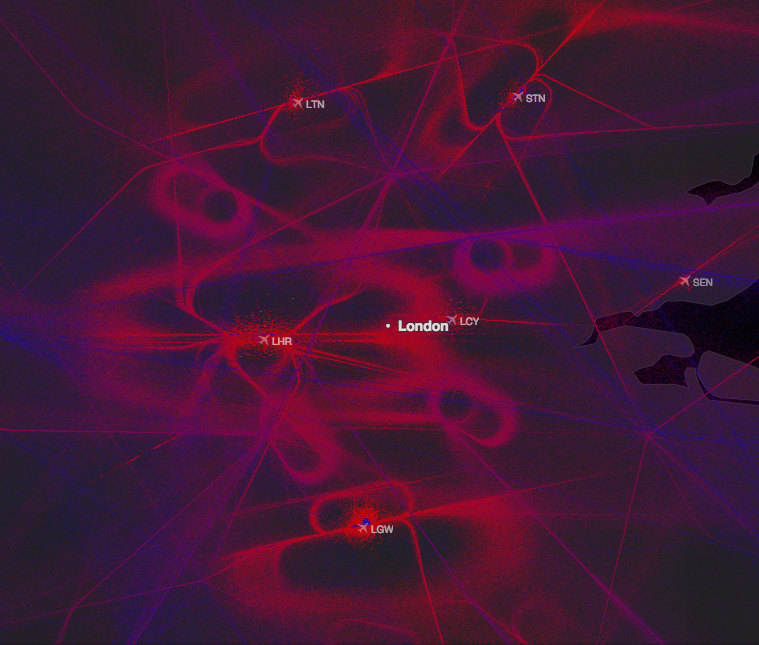
There is more between heaven and earth than bird migrations and weather fronts. These maps capture the poetic beauty of something utterly mundane and usually invisible: the flight patterns of the planes that bring us from airport A to airport B.

We live in the age of mass air travel. At any given moment, there are about 10,000 commercial planes airborne, carrying an estimated half a million passengers across the skies. We also live in the era of Big Data. Which means that the movements of those thousands of planes can be followed in real time on websites such as Plane Finder and Flightradar24.

London and the pretty holding patterns around its airports: Heathrow (LHR), Gatwick (LGW), City (LCY), Luton (LTN), Stansted (STN) and Southend-on-Sea (SEN).

You can read the full article here.

Alex, my son, then replied with a link to this item on the UK NATS website: Take a guided tour around UK airspace.

The skies above the UK have been brought to life like never before in a video showing a day of air traffic in less than three minutes.

Created from actual radar data showing over 7,000 flights, the video graphically illustrates the daily task facing air traffic controllers and the airspace features that help make it all work.


It finishes with an overview of the structure of UK airspace, highlighting the major air routes and showing how this ‘invisible infrastructure’ helps underpin the entire operation.

Matt Mills, NATS Head of Digital Communications, said: “We’ve made data visualisations in the past, but we wanted to now take people on a deeper journey into what makes UK airspace work and some of its important features.

Airspace might be the invisible infrastructure, but it is every bit as important as the airports and runways on the ground.

Created by air traffic management company, NATS, the video takes viewers on a unique tour of some of the key features of UK airspace – from the four holding stacks over London and the military training zones above Wales, to the helicopters delivering people and vital supplies to the North Sea oil and gas rigs.

It is a fascinating video.

The book! Part Three: Population and Energy.

Why a chapter on population and energy?

Because in a very real sense it is the measure of how many live on this planet and how much energy is used for our own purposes that brings into stark consideration the fundamental, inviolate rule: that we cannot sustain an existence that isn’t in balance with what our planet can provide for us. ‘Us’ of course meaning every living thing on the planet.

The story of our energy use is scary to the extreme. By using the term ‘our energy use’ I am offering it as a label, so to speak, for the number of people multiplied by the energy each person is using.

So, first let us start with global population.

The world did not reach a population of one billion until 1800. One hundred and twenty-three years later, in 1927, that global population figure passed two billion persons. That, in itself, isn’t remarkable. But what was remarkable was the continuing growth.

Thirty-three years later, in 1960, the global population reached three billion.
Twenty-four years later, in 1974, the population reached four billion.
Thirteen years later, in 1987, the world population is up to five billion.
Twelve years on, in 1999, up to six billion persons in the world.
Then just another thirteen years on for the population to reach, in 2012, seven billion.

Now that is not a cast-iron guarantee that the growth will continue on and on in a similar fashion. Recall that old saying, “I can predict anything except those matters involving the future!”

Indeed, the UN’s Economic & Social Affairs Department, in a report issued in 2013, under the title of World Population Prospects – 2012 Revision, offered in Figure 1. Population of the world, 1950-2100 (Page XV of the summary.), four possible outcomes, “according to different projections and variants.” Those being Medium; High; Low and Constant-fertility. Just to pick the extremes projected, a Constant-fertility growth would bring the global population in 2100 to twenty-eight billion persons, and a Low growth future delivering more or less today’s global population of seven billion persons.

What is the maximum carrying capacity of the planet? A number of estimates of the carrying capacity have been made with a wide range of population numbers. A 2001 UN report said that two-thirds of the estimates fall in the range of 4 billion to 16 billion (with unspecified standard errors), with a median of about 10 billion. More recent estimates are much lower, particularly if resource depletion and increased consumption are considered.

Now if seven billion people might be (and I do stress ‘might be’) more than Planet Earth can sustain today, then don’t even start to go to future population levels of the order of sixteen billion (High) or twenty-eight billion (Constant-fertility)!

However, this is a chapter on population and energy, not just population per se. Population growth is only one part of a complex energy nightmare. A huge nightmare. We must look at the other factor: our energy use. It is both a cause and a consequence of the population numbers.

The energy used by each person, measured in kilowatts on an annual basis, remained pretty constant right up to the middle of the Industrial revolution. For example, in 1800, the energy use per person was less than two kilowatts (A kilowatt is a thousand watts) of power a year. Today, that low figure from 1800 is almost beyond imagination in terms of the energy used today!

The Industrial revolution changed everything; irrevocably. By the end of that century, 1900, while the energy use per person was slightly up, the global population was steadily increasing; as explained a few paragraphs back. Thus the total energy being used in 1900 was the sum of energy used per person times the number of persons worldwide.

As it logically is the same total calculation used coming forward to the year 2000; where the energy use per person is up to three or four kilowatts a year (the chart being used was difficult to read precisely) and the population is now around seven billion! Seven billion people using three to four kilowatts of power produces a global use of energy of fifteen terawatts (The terawatt is equal to one trillion watts!) That’s fifteen trillion watts of energy!

Once more, looking into the future is challenging; to say the least. The awareness and uptake of solar electricity panels is expanding; the idea of cars being powered by other means than petroleum fuels is becoming a reality but the broader picture of total energy used across the world reveals an intense dependency of energy for some time. Indeed, we can use the UN’s forecast of population growth out to 2050 to construct a prediction of future energy needs, again on an energy per person energy equivalent.

This shows total global energy use peaking about now (2015), to the tune of 80 gigajoules per year (The equivalent of 22 megawatt-hours per year), of which 80 percent is from the use of fossil fuels, then slowly declining by 2050 to 30 gigajoules per year, of which nearly 70 percent would be from the use of non-fossil fuels.

Indeed, you may have heard about recent declines in energy consumption in both Europe and the US, but these declines have been more than offset by increases in energy consumption in China, India, and the rest of the “developing” world.

To put this into some form of historical perspective, using the assumptions chosen, the world per capita energy consumption in 2050 would be about equal to what the world per capita energy consumption was back in 1905.

Assuming we haven’t trashed the planet before then!

930 words. Copyright © 2014 Paul Handover

Ambition; the film.

Striving to achieve what is humanly possible.

A day almost exclusively devoted to writing left me wondering what to post for today.

Then in my ‘blog’ folder was this recent item from the blog site EarthSky.

It is republished here as it was received by me.

ooOOoo

Exciting Rosetta space mission inspires a magical short film

A very good 7-minute film, called Ambition. It’s not like any film about space exploration you’ve ever seen. The Rosetta comet mission lies at its heart.

Everything about the European Space Agency’s Rosetta mission – which, in August, caught up to Comet 67P/Churyumov–Gerasimenko and began moving in tandem with it – has been fantastic so far. For us space buffs, this mission has gone a long way toward fulfilling our fantasies about what might be accomplished in outer space. It’s caused us to remember why we got so excited about space exploration in the first place. And now – just weeks before Rosetta will send a lander to the surface of its comet – ESA and Platige Image have released a very good short film, called Ambition. It’s not a space documentary, or like any film about space exploration you’ve ever seen. It doesn’t focus so much on the mission itself – although the Rosetta mission does lie at the heart of the film – as on why we need to go into space.

The film features an apprentice magician and her master, talking about the making of solar systems.

I won’t tell you more; you should watch the film. It might touch your heart in ways you’ve forgotten, as the Rosetta mission itself has touched mine.

Tomek Baginski directed the film Ambition, which stars Aiden Gillen – who played Littlefinger in Game of Thrones – and Aisling Franciosi. Its producers shot Ambition on location in Iceland and produced it primarily in Poland. Its first public screening was October 24, 2014 during the British Film Institute’s celebration of Sci-Fi: Days of Fear and Wonder, at the Southbank, London.

By the way, Tim Reyes at UniverseToday.com has written a very good essay about the film Ambition, and what it means in the context of U.S. and European space efforts, and in the larger context of our striving to meet challenges in the world today. He also says you should watch the film. Because it’s about what it means to want to know what’s possible.

In the film Ambition, a young magician tries to build a solar system … but fails.
Did you assume this was an artist’s concept? It’s not. It’s a real image. It’s the Rosetta spacecraft’s selfie with comet 67P/Churyumov–Gerasimenko, imaged Sunday, September 7, 2014. Image via ESA/Rosetta/Philae/CIVA

Bottom line: A very good 7-minute film, called Ambition. It’s not like any film about space exploration you’ve ever seen. The Rosetta comet mission lies at its heart.

ooOOoo

And here is that film.

Published on Oct 24, 2014
Ambition is a collaboration between Platige Image and ESA. Directed by Tomek Bagiński and starring Aidan Gillen and Aisling Franciosi, Ambition was shot on location in Iceland, and screened on 24 October 2014 during the British Film Institute’s celebration of Sci-Fi: Days of Fear and Wonder, at the Southbank, London.

Spying and security: Further thoughts.

My follow-up to yesterday’s post.

Yesterday, the central theme of my post was the essay from Tom Engelhardt where he interviews Laura Poitras on the back of the recent release of her film Citizenfour. You will recall that I closed the post as follows:

On first reading the TomGram I found myself nodding vigorously, metaphorically speaking, with the whole thrust of the essay.

Then what appeared to be small uncertainties started appearing in my mind.

Those will be the subject of tomorrow’s post.

To set the background to what follows, you need to know a little about my own military experiences; which is not saying very much!

I was born in London six months to the day before WWII ended; at least the European side of things. When I got to the age of being vulnerable to a call-up if circumstances so dictated, I thought I would influence things by volunteering to join the United Kingdom’s Royal Naval Reserve or the RNR.  The world in the early 60’s especially in Europe was far from stable.  Thus, I signed up with London Division, RNR that was headquartered on HMS President, moored on the River Thames in the centre of London.

HMS President.
HMS President.

I served as a Radio Operator in the RNR from 1963 to 1968.  Inevitably, as a radio operator I was security cleared and, in time, as I was promoted up the ranks, allowed to handle traffic up to but not including “Top Secret: Captain’s Eyes Only”.

In 1968 I decided to emigrate to Australia and resigned from the RNR.  The parting advice was that the knowledge I had acquired prevented me, for my own safety, from entering any country hostile to NATO for a period of a further 5 years. Including the Soviet Union; naturally.

At the end of 1970, living and working in Sydney, I was planning to attend Expo70 in Japan and then travel on to Helsinki, Finland.  One look at the atlas made it clear that a wonderful way of travelling westwards was via the Russian Trans-Siberian express.

So off I trotted to the British Embassy in Sydney to seek advice about entering Russia in this fashion.  One of the military guys, on hearing about my concerns, laughed his head off and said, “The Russians will know more about you than we do!”  Then, becoming more serious, he added: “My friend, if you ever find yourself in a difficult corner anywhere in a country hostile to the West, just find a way of transmitting your RNR Service Number to us and we’ll take care of things”.  To this day, well over 40 years later, I still remember my service number.

Returning to the subject of the American security ‘apparatus’, Laura Poitras answered a question from Tom Engelhardt that seems very pertinent.

TE: To ask the same question another way, what would the world be like without Edward Snowden? After all, it seems to me that, in some sense, we are now in the Snowden era.

LP: I agree that Snowden has presented us with choices on how we want to move forward into the future. We’re at a crossroads and we still don’t quite know which path we’re going to take. Without Snowden, just about everyone would still be in the dark about the amount of information the government is collecting. I think that Snowden has changed consciousness about the dangers of surveillance. We see lawyers who take their phones out of meetings now. People are starting to understand that the devices we carry with us reveal our location, who we’re talking to, and all kinds of other information. So you have a genuine shift of consciousness post the Snowden revelations.

What struck me was the point about a changed consciousness.  That is healthy. Without doubt.

The technology available to the governments of countries with regard to the gathering of all sorts of data represents a place where we haven’t been before.  Inevitably, learning how best to govern that data, with both a small ‘g’ and a large ‘G’, is going to be a traveled road where some wrong turnings are made from time to time.

If the Edward Snowden affair has accelerated that learning process, then that seems nothing but good.

Mind you, not everyone applauds Mr. Snowden.

Fred Kaplan, a serious political scientist, published a critical article, Sins of Omission, recently on the Slate web news site from which I quote:

If all I knew about Edward Snowden were his portrait in Laura Poitras’ documentary, Citizenfour, I’d probably regard him as a conscientious, brave young man, maybe an American hero. But Poitras, a very talented filmmaker who flipped from journalist to collaborator in this story long ago, has chosen to leave a lot out.

Snowden’s claim as a whistleblower, exposing the National Security Agency’s violations of civil liberties, rests on some of the documents that he leaked, which reveal that the NSA’s domestic surveillance was far more extensive than anyone had imagined—and, in a few instances, conducted in defiance of orders from the Foreign Intelligence Surveillance Court.

However, many other documents—which he downloaded at the NSA facility in Hawaii and turned over to Poitras and the Guardian’s Glenn Greenwald in Hong Kong—go far beyond exposures of spying on Americans.

Judging from Snowden-derived stories in the Guardian and the Washington Post, some of these documents also detail NSA intercepts of email and cellphone conversations by Taliban fighters in Pakistan; assessments of CIA assets in several foreign countries; and surveillance of cellphone calls “worldwide” that (in the Post’s words) allows the NSA “to look for unknown associates of known intelligence targets by tracking people whose movements intersect.” In Snowden’s first interview abroad, with the South China Morning Post, he disclosed that the NSA routinely hacks into hundreds of computers in Hong Kong and China. Just last week a story co-authored by Poitras in Greenwald’s new publication, the Intercept, revealed—again, based on Snowden-supplied documents—that the NSA has undercover operatives in Germany and China.

Whatever you think about foreign intelligence operations, the NSA’s core mission is to intercept communications of foreign governments and agents. If Snowden and company wanted to take down an intelligence agency, they should say so. But that has nothing to do with whistleblowing or constitutional rights.

As the Mission Statement on the NSA website explains, in part,:

The National Security Agency/Central Security Service (NSA/CSS) leads the U.S. Government in cryptology that encompasses both Signals Intelligence (SIGINT) and Information Assurance (IA) products and services, and enables Computer Network Operations (CNO) in order to gain a decision advantage for the Nation and our allies under all circumstances.

The Information Assurance mission confronts the formidable challenge of preventing foreign adversaries from gaining access to sensitive or classified national security information. The Signals Intelligence mission collects, processes, and disseminates intelligence information from foreign signals for intelligence and counterintelligence purposes and to support military operations. This Agency also enables Network Warfare operations to defeat terrorists and their organizations at home and abroad, consistent with U.S. laws and the protection of privacy and civil liberties.

I read, “to gain a decision advantage for the Nation and our allies under all circumstances” as meaning maintaining a positive security for the Nation.  My home nation as it happens.

While the scale may be beyond comparison, the principle of maintaining a secure nation or home strikes me as no different as locking the doors of our house when we go off somewhere.  And that’s even with nine dogs in the house!

Given that what any ex-head of GCHQ might say, the recent words from Sir Iain Lobban, as reported by the BBC, were not extreme; far from it.

Sir Iain Lobban.
Sir Iain Lobban.

A dimly lit bunker beneath Whitehall – perhaps a suitable venue for a man to say farewell to a 31-year career in what had been one of the most secret parts of the British state.

Sir Iain Lobban was joined by an assortment of spies and securocrats including former heads of GCHQ and the current chief of MI6. It was a venue not chosen by chance.

As he leaves his position as director of GCHQ, Sir Iain used his speech to try to connect the work of today’s GCHQ with its predecessor at Bletchley Park which supplied vital information to Sir Winston Churchill who, from the same bunker, directed Britain’s wartime efforts.

Then, the mission was intercepting and breaking the Enigma code used by the German military to communicate. Dealing with today’s threats, Sir Iain argued, involved going online.

“Those who would do us harm don’t want to be found. They choose certain routers or applications to hide in the darkest places of the internet. We have to enter that labyrinth to find them. We work to crack their defences,” he told the audience.

Sir Iain took aim at those who saw spy agencies polluting a free internet. “We all now know that the beautiful dream of the internet as a totally ungoverned space was just that – a beautiful dream.

“Like all utopian visions, it was flawed because it failed to account for the persistence of the worst aspects of human nature.

“Alongside the blessings – the comprehensive information, the communities of interest, the commercial opportunities and efficiencies – there are the plotters, the proliferators and the paedophiles.”

Being reported later on as saying:

“The people who work at GCHQ would sooner walk out the door than be involved in anything remotely resembling ‘mass surveillance’.” he asserted.

“Secret does not have to equal sinister,” he went on to say, blaming the idea partly on the portrayal of intelligence in popular culture.

Finally, in an article by Jill Serjeant over on Yahoo News, she offers:

Poitras hopes the documentary will allow audiences to reach their own conclusions about Snowden, who is wanted in the United States on charges brought under the Espionage Act and is viewed as either a traitor or a hero.

Only time will tell if the USA is overdoing the ‘mass’ aspect of surveillance, or if it’s right for this age in the affairs of man.

That nothing can be constructed perfectly the first time around is a truism for life at all scales. Thank goodness I’m living in a country where I feel able to offer these thoughts.

Thank you WordPress!

Recognising the incredible contribution made to the world of modern communications.

This blog runs using software called WordPress. The WordPress community is vast. “Over 409 million people view more than 15.8 billion pages each month. Users produce about 43.7 million new posts and 58.8 million new comments each month.”  Millions and millions of websites run under WordPress.

No mistake it is a community in every sense of the word.  I feel fortunate and humbled to have made so many friends across the ‘bloggersphere’ despite not having met a single person face-to-face.  I just can’t imagine a life without my circle of followers and without me, in turn, following so many other bloggers.

Thus it seems entirely appropriate to publish in full a news item sent to all WordPress bloggers in the last twenty-four hours.

ooOOoo

Engaged, Inspired, and Ready to Build a Better Web

One week every year, the entire Automattic staff gets together to connect, work, and laugh. And then, of course, we blog about it! Could you be blogging about your experience with us in 2015?

Automattic is a distributed company — we all work from wherever we are. Right now, “where we are” is 197 cities around the world: New Orleans, USA. Montevideo, Uruguay. Tokyo, Japan. Vilnius, Lithuania.

Once a year, we get together somewhere in the world to meet, work alongside, learn from, and laugh with one another in an exhilarating, exhausting week called the Grand Meetup. This year, 277 Automatticians descended on Park City, Utah, for seven days in mid-September.

Chris Hardie @ChrisHardie
I flew across the country to spend time in a mountain lodge with a bunch of strangers I met on the Internet. And they are wonderful.

We introduced ourselves to new colleagues, reconnected with coworkers we haven’t seen since last year, and worked on ways to make WordPress.com even better. And of course, lots of us blogged about the experience, in words and images.

We were blown away by the brilliance and generosity of our colleagues…

I’m grateful to have met so many Automatticians from around the world who brought such kindness, curiosity, patience, fierce intelligence, creativity and humor to the time we had together. I’m grateful to have learned about their hobbies, families, personal journeys, quirks, pet peeves, amazing skills, unmitigated geekiness, and brilliant senses of humor.

– VIP Wrangler Chris Hardie

We marveled at the range of conversations we had, from the sublime to the absurd…

Here are some of the things I talked about this week:

  • Scottish independence
  • Taylor Swift
  • Goats
  • Sexism
  • My children
  • Other people’s children
  • Infertility
  • Tattoos
  • Swing dancing
  • Whiskey
  • Javascript
  • Waffles (lack thereof)
  • VideoPress
  • Houston
  • Leadership
  • Fake morning talkshows
  • Mario Kart

Happiness Engineer Zandy Ring

We soaked in the natural beauty of Utah…

Early morning takeoff, by yours truly.

And some of us got up close and personal with the wide Utah sky…

Happiness Engineer Jeremey DuVall realizes he’s just jumped out of an airplane.

We learned from one another, and had fun doing it…

I learned how to analyze data in Python with Carly, and went skydiving with Prasath. After discussing common security vulnerabilities with Anne, Cami and I plotted a podcast about absolutely nothing, and recorded part of our first episode…

If you asked me four years ago if I thought it were possible to enjoy working, I’d be dubious. If you asked me whether one could ever genuinely love and respect all their coworkers, I’d hesitate.

Over the past four years, the people of Automattic have demonstrated to me that it’s possible to do work you love with people you love. It’s not common — not yet — but it’s possible.

– VaultPress Eclectic Happiffier Chris Rudzki

We burned the midnight oil…

We worked, we played, we ate, we drank, we slept very little. We tried to make the world a better place, and if you think that’s me being dramatic you don’t know the people I have the honor of working with.

– Dot Organizer Cami Kaos

We took a lot of photos

On the final day, Automattic founder Matt Mullenweg led us in a toast that summed up the reason we’re all here…

I’m really grateful that I get to work with the people I do, and on the problems that we work on together. It’s far from easy, in fact each year brings new challenges and I make mistakes as often as not, but it is worthwhile and incredibly fulfilling. A few hours ago I gave a closing toast and teared up looking around the room. So many folks that give their passion and dedicate themselves to jobs both large and small, visible and unseen, to help make the web a better place.

– WordPress co-founder and Automattic CEO Matt Mullenweg

And when the week was over, heading home was bittersweet…

This morning was filled with so many hugs (and maybe a tear or two). I told myself that I was looking forward to returning home. To my own bed (although the sleep I got in the silence of the Park City night was the best I may have ever experienced). To regular exercise and home cooking. To the routine of my everyday life. And I was looking forward to that. And even though I knew I would miss my colleagues (it’s happened every time I return from a trip), the weight of the fog of sadness still surprises me when it descends.

I read their blogs. I like their Facebook posts. I retweet their Tweets. And I miss them.

– Happiness (w)Rangler Lori McLeese

If you think you might want to work with this motley crew and join us in 2015’s mayhem…

2014-company-animated

we’re hiring. (And yes, you’ll get to make up your own job title, too.)

ooOOoo

Seriously, if you think there is any way you can contribute to the success of WordPress, then do go across to this page – from where I note the following employee benefits:

BENEFITS

  • Open vacation policy (no set number of days per year). We encourage our employees to take the time they need to take vacation, develop interests, and spend time with friends and family.
  • Health, dental, & vision insurance for US and Canadian employees, their spouses or domestic partners, and children.
  • 401(k) plan and match for US employees and RRSP matching plan for Canadian employees.
  • We cover all costs of company travel.
  • We happily provide or reimburse hardware and software you’ll need, as well as books or conferences that promote continued learning.
  • Home office setup stipend, and co-working office allowance.

Well done the team!