Category: Technology

KAJO author interview

Would love you to listen to this.

kajo_2015

In exactly twenty-four hours from now, you will have the opportunity to listen to Kyle Dunlap of the radio station KAJO interviewing me about my book: Learning from Dogs.

The interview, that was pre-recorded on the 23rd November, is part of KAJO’s community broadcasts where they speak to local authors. As a newbie author, I was delighted and flattered to be asked to participate.

Anyway!

The broadcast is a little after 12:45 Pacific Standard Time on Tuesday, 8th December. If you are not in the USA, you can check the equivalent time easily at The World Clock website.

It is being broadcast live on KAJO’s website

You will see the On Air button to click just to the right of the KAJO 1270am logo. Here is the “Click to Listen Live” button grabbed from the KAJO website at 3:20pm yesterday.

on_air_rain

It will have Kyle Dunlap’s name on it when you “tune in” at 12:45 tomorrow.

If you do listen to the interview do leave a comment below – good or bad! 😉

The power of dog’s spit!

What clues does your dog’s spit hold for human mental health?

This is not a spoof. Apparently the closeness of the relationship between dogs and humans holds real scientific value.

Just my way of introducing a most fascinating and interesting item that recently appeared on The Conversation blogsite. (And see my note at the end of today’s post.)

ooOOoo

What clues does your dog’s spit hold for human mental health?

December 2, 2015

Elixir Karlsson, Assistant Professor of Bioinformatics and Integrative Biology, University of Massachusetts Medical School

There goes some precious DNA…. Graeme Bird, CC BY-NC-ND

Dogs were the first animals people domesticated, long before the earliest human civilizations appeared. Today, tens of thousands of years later, dogs have an unusually close relationship with us. They share our homes and steal our hearts – and have even evolved to love us back. Sadly, they also suffer from many of the same difficult-to-treat psychiatric and neurological diseases we do.

I learned this firsthand about six years ago, when my sister Adria adopted Beskow, a beautiful,

Beskow, in fine spirits. Elinor Karlsson, CC BY-ND

boisterous, black and white mutt. Beskow became my constant companion on my morning runs along the Charles River. Her joy in running was obvious to everyone we passed, and she kept me going mile after mile.

When not running, though, Beskow suffered from constant anxiety that left her stressed and unhappy – on edge around other dogs and prone to aggressive behavior. Beskow had trouble even playing outdoors, since she was compelled to attend to every sound and movement. Working one-on-one with skilled behaviorists and trainers helped immensely, but poor Beskow still never seemed able to relax. Eventually, Adria combined the intensive training with medication, which finally seemed to give Beskow some relief.

Beskow’s personality – her intelligence, her focus and her anxiety – was shaped not only by her own life experiences, but by thousands of years of evolution. Have you ever known a dog who would retrieve the same ball over and over again, for hours on end? Or just wouldn’t stay out of the water? Or wasn’t interested in balls, or water, but just wanted to follow her nose? These dogs are the result of hundreds of generations of artificial selection by human beings. By favoring useful behaviors when breeding dogs, we made the genetic changes responsible more common in their gene pool.

When a particular genetic change rapidly rises in prevalence in a population, it leaves a “signature of selection” that we can detect by sequencing the DNA of many individuals from the population. Essentially, around a selected gene, we find a region of the genome where one particular pattern of DNA – the variant linked to the favored version of the gene – is far more common than any of the alternative patterns. The stronger the selection, the bigger this region, and the easier it is to detect this signature of selection.

In dogs, genes shaping behaviors purposely bred by humans are marked with large signatures of selection. It’s a bit like evolution is shining a spotlight on parts of the dog genome and saying, “Look here for interesting stuff!” To figure out exactly how a particular gene influences a dog’s behavior or health, though, we need lots more information.

To try to unravel these connections, my colleagues and I are launching a new citizen science research project we’re calling Darwin’s Dogs. Together with animal behavior experts, we’ve put together a series of short surveys about everything from diet (does your dog eat grass?) to behavior (is your dog a foot sitter?) to personality (is your dog aloof or friendly?).

Any dog can participate in Darwin’s Dogs, including purebred dogs, mixed breed dogs, and mutts of no particular breed – our study’s participants will be very genetically diverse. We’re combining new DNA sequencing technology, which can give us much more genetic information from each dog, with powerful new analysis methods that can control for diverse ancestry. By including all dogs, we hope to be able to do much larger studies, and home in quickly on the important genes and genetic variants.

A beagle considers making the saliva donation. Stephen Schaffner, CC BY-ND

Once an owner has filled out the survey, there’s a second, crucial step. We send an easy-to-use kit to collect a small dog saliva sample we can use for DNA analysis. There’s no cost, and we’ll share any information we find.

Our plan is to combine the genetic data from many dogs and look for changes in DNA that correlate with particular behaviors. It won’t be easy to match up DNA with an obsession with tennis balls, for instance. Behavior is a complex trait that relies on many genes. Simple Mendelian traits, like Beskow’s black and white coat, are controlled by a single gene which determines the observable characteristic. This kind of inherited trait is comparatively easy to map. Complex traits, on the other hand, may be shaped by tens or even hundreds of different genetic changes, each of which on its own only slightly alters the individual carrying it.

Adding to the complexity, environment often plays a big role. For example, Beskow may not have been as anxious if she’d lived with Adria from puppyhood, even though her genetics would be unchanged.

Darwin’s Dogs team member Jesse McClure extracts DNA from a sample. Elinor Karlsson, CC BY-ND

To succeed, we need a lot of dogs to sign up. Initially, we’re aiming to enroll 5,000 dogs. If successful, we’ll keep growing. With bigger sample sizes, we’ll be able to tackle even more complex biological puzzles.

This is a huge effort, but could offer huge rewards. By figuring out how a genetic change leads to a change in behavior, we can decipher neural pathways involved in psychiatric and neurological diseases shared between people and dogs. We already know these include not just anxiety, but also PTSD, OCD, autism spectrum disorders, phobias, narcolepsia, epilepsy, dementia and Alzheimer’s disease.

Understanding the biology underlying a disease is the first step in developing more effective treatments – of both the canine and human variety. For example, genetic studies of narcolepsy in Doberman pinschers found the gene mutation causing the disease – but only in this one dog population. Researching the gene’s function, though, led to critical new insights into the molecular biology of sleep, and, eventually, to new treatment options for people suffering from this debilitating disease.

Darwin’s Dogs is investigating normal canine behaviors as well as diseases. We hypothesize that finding the small genetic changes that led to complex behaviors, like retrieving, or even personality characteristics, like playfulness, will help us figure out how brains work. We need this mechanistic understanding to design new, safe and more effective therapies for psychiatric diseases.

And Beskow? Six years later, she is as wonderful as ever. While still anxious some of the time, the

Beskow with one of her loving family members. Adria Karlsson, CC BY-ND

medication and training have paid off, and she enjoys her daily walks, training and playtime. She still gets very nervous around other dogs, but is a gentle, playful companion for my sister’s three young children.

We are now sequencing her genome. In the next few months, we should have our first glimpse into Beskow’s ancestry. We know she is a natural herder, so we’re curious to find out how much her genome matches up to herding breeds, and which genes are in that part of the genome.

Of course, we can’t figure out much from just one dog – if you are a dog owner, please enroll your dog today!

ooOOoo

This is an incredibly interest research project with far-reaching implications for us humans. I have written to Professor Karlsson to double-check that anyone who reads this can participate, even if living outside the USA, and will update this post as soon as I hear back from her.

Do share this as far and wide as you can for the benefits for us humans are clear and obvious.

Not a week goes by without me gaining more and deeper understanding of just how wonderful and fabulous our dogs are.

Changes to the Blog

No! It’s not your eyes! 😉

I should have sent this out earlier to you all.

For a few hours ago the WordPress theme I am using on Learning from Dogs was changed.

The change is necessary to allow a number of eCommerce features to be added to the blog in connection with me being able to sell my book, both in paperback and eBook formats, directly to you good people.

Plus there’s a real bonus.

This theme is mobile friendly.

In other words, everything on Learning from Dogs will be much, much easier to read on tablets and smartphones.

Finally, if anyone is within reach of Grants Pass then you have a warm welcome to come along on Saturday, December 12th. There will be some specials available to visitors only.

Layout 1

What a show of fireworks this would be!

Asteroid 2015 TB145 will pass by Planet Earth – just!

Back in my old country, Halloween is not celebrated in the same style that it is here in America. The Brits tend to favour the evening of November 5th and Guy Fawkes Night. That evening, Bonfire Night, sees fireworks parties in many places.

nov5th

However, if one starts to think of the dimensions and distances of outer space then our planet is just being spared the firework show to beat all other shows.

I’m referring to Asteroid TB145, a huge asteroid, that will pass Earth at 310,000 miles (498,896 km) or 1.3 times the Earth-moon distance.

asteroid20151021

UPDATE OCTOBER 30, 2015. A newly found asteroid of notable size – known as asteroid 2015 TB145 – will safely pass Earth on October 31, 2015, according to clocks in North America. It should be visible moving in front of the stars, with the help of a telescope, tonight (October 30). It is the biggest known asteroid that will come this close to Earth until 2027. The asteroid – found as recently as October 10 – will fly past Earth at a safe distance, or about 1.3 times the moon’s distance. Closest approach to Earth will be October 31 at 1 p.m. EDT (1700 UTC). Translate to your time zone here.

Paul Chodas, manager of the Center for Near Earth Object Studies at NASA’s Jet Propulsion Laboratory, Pasadena, California, said:

The trajectory of 2015 TB145 is well understood. At the point of closest approach, it will be no closer than about 300,000 miles – 480,000 kilometers or 1.3 lunar distances. Even though that is relatively close by celestial standards, it is expected to be fairly faint, so night-sky Earth observers would need at least a small telescope to view it.

So how big is this asteroid?

Scientists are continuing to estimate the size at 1,300 feet (400 meters) wide.

If the size is correct, the new found asteroid is 28 times bigger in diameter than the Chelyabinsk meteor that penetrated the atmosphere over Russia in February, 2013. An incoming asteroid’s potential to do damage on Earth depends on various factors, including its size, its angle of entry, and the point on Earth over which it enters the atmosphere. The shock wave from the 2013 Chelyabinsk meteor broke windows and did other damage to some 7,200 buildings in six Russian cities. Some 1,500 people were injured seriously enough to seek medical treatment, mainly from broken glass from windows.

For those of you that want to catch a glimpse of TB145, then:

TB145at350amET0750UT10312015-e1446201004409

Asteroid position at 3:50 a.m. ET (0750 UTC) Point a Go To computerized telescope to HIP 24197 or SAO 94377) a naked-eye star with a magnitude of 5 in Orion. At 3:50 a.m. ET on October 31 (Saturday morning), the space rock passes close to this star. The asteroid will appear as a slowly moving ‘star’ passing very close to this star. By this time the asteroid should appear to move faster because it will be closer to Earth than earlier on the night of October 30. This illustration shows a half degree field of view (about the size of a full moon). A pair of double stars visible in this area should confirm you are pointing at the correct direction. Alternatively, you can point your telescope to these coordinates: RA 05h 11m 41.6s / DEC +16º 02′ 44.5″. Illustration by Eddie Irizarry using Stellarium.

Full details and answers to most of your questions may be found here.

All I can say is I hope the number crunchers have got their sums right!

If not, then it’s goodnight from her and goodnight from me.

o-NASA-ASTEROIDS-facebook

It was nice knowing you all!

P.S. If you think this is all a bit far-fetched, then this video sent to me by Dan Gomez will bring you down to earth.

The changing North Atlantic.

The vastness of the seas and the immensity of their influence over all of us.

This is an introduction, a rather long one I’m warning, to a republication of a recent post by Patrice Ayme. An introduction that offers a deeply personal memory of the Atlantic ocean.

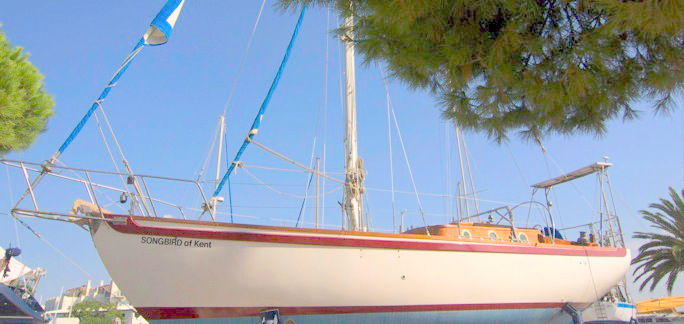
Many years ago, I spent 5 years living on a boat; a wonderful heavy-displacement ocean-going yacht of a type known as a Tradewind 33.

Tradewind 33 - Songbird of Kent.
My home for five years – Tradewind 33:  Songbird of Kent.

There is a place in my mind to which I can so easily travel; a memory of a dark night out in the Atlantic ocean one time in the Autumn of 1969. But first let me set the scene from almost fifty years ago.

The call of the open ocean

Those first few hours were utterly absorbing as I went through the whole business of clearing the yacht harbour at Gibraltar and heading out to the South-West hugging this unfamiliar coastline of Southern Spain. It was tempting to move out to deeper waters but the almost constant flow of large ships through the Straights of Gibraltar soon quashed that idea. Thankfully, the coastal winds were favourable for me and my single-masted sailing yacht.

After such a long time sailing in the relatively confined waters of the Mediterranean, it was difficult for me to imagine that in a few hours time the southern-most point of Spain would pass me by and the vastness of the Atlantic ocean would be my home for the next few weeks.

Soon the city of Tarifa was past my starboard beam and the Spanish coastline was rapidly disappearing away to the North-West. The horizon ahead of me was already approaching 180 degrees of raw, open ocean.  There was just a flicker of a thought that whispered across my mind: “Oh Paul, what have you gone and done” as slowly but persistently the coastlines of Spain to the North and of Africa to the South became more and more distant and fuzzy.  It was at 15:30 that I made an entry in my yacht’s log: “No land in sight in any direction!

Now was the time to make sure that my bunk was made up, flashlights to hand, and my alarm clock ready and set. Alarm clock? Set to go off every twenty minutes during the night! For this was the only way to protect me and my yacht from being hit by one of those gigantic container ships that seemed to be everywhere. It took at least twenty minutes from the moment a ship’s steaming lights appeared above the horizon to crossing one’s path!

It was in the early hours of my first morning alone at sea, when once again the alarm clock had woken me and I was looking around an ocean without a single ship’s light to be seen that more of Les’ words (see footnote) came to me. I remembered asking Les: “What’s the ­appeal of sailing?” Les replied without a moment’s hesitation: “It’s the solitude. When you’re out at sea on your own, there’s no government or bankers to worry about. You’re not ­responsible to anyone but yourself.

Yes, I could sense the solitude that was all around me but it was an intellectual sense not an emotional one. That would come later. Inside, I was still afraid of what I had let myself in for.

Remarkably quickly however, the pattern of solo life aboard a thirty-three-foot yacht became my world. Frankly, it staggered me as to how busy were my days. Feeding myself, navigating, trying to forecast the winds, staying in touch with other yachties via the short-wave radio, keeping the boat tidy and a zillion other tasks meant the first few days and nights just slipped by.

But it was a sight on my fourth night at sea that created the memory that would turn out to remain with me for all my life. The memory that I can go to anytime in my mind.

That fourth night I was already well into the routine of waking to the alarm clock, clipping on my harness as I climbed up the three steps that took me from my cabin into the cockpit, scanning the horizon with my eyes, checking that the self-steering had the boat at the correct angle to the wind and then, if no ships’ lights had been seen, slipping back down into my bunk and sleeping for another twenty minutes. Remarkably, I was not suffering from any long-term tiredness during the day.

It was a little after 3am that fourth night when the alarm clock had me back up in the cockpit once again. Then it struck me.

Songbird was sailing beautifully. There was a steady wind of around ten knots from the south-east, almost a swell-free ocean, and everything set perfectly.  Not a sign of any ship in any direction.

Then I lifted my eyes upwards. There was not a cloud in the night sky, not a single wisp of mist to dim a single one of the million or more stars that were above my head. For on this dark, moonless night, so far removed from any shore-based light pollution, the vastness, yet closeness of the heavens above was simply breath-taking. I was transfixed. Utterly unable to make any rational sense of this night splendour that glittered in every direction in which I gazed. This dome that represented a vastness beyond any meaning other than a reminder of the magic of the universe.

This magic of the heavens above me that came down to touch the horizon in all directions. Such a rare sight to see the twinkling of stars almost touching the starkness of the ocean’s horizon at night. A total marriage of this one planet with the vastness of outer space.

I heard the alarm clock go off again and again next to my bunk down below. But I remained transfixed until there was a very soft lightening of the skyline to the east that announced that another dawn was on its way.

I would never again look up at the stars in a night sky without being transported back to that wonderful night and the memory of a lonely sea and sky.

I did warn you it would be a long introduction!

ooOOoo

Non-Linear Cold Blob Rising Over North Atlantic

The reason life survived on Earth for so long, and blossomed into animals, and now mind, is that the planet is equipped with homeostatic mechanisms (homeo means similar in Greek, and stasis, standing still). However, those mechanisms tend to be geological.

Human civilization is now having an impact on the biosphere of a violence probably never seen before. The changes are faster than what geology, or even life, can accommodate.

Some will brandish the impact of the Yucatan asteroid, and claim that was worse; however that’s just a theory: the biosphere was clearly under stress at the time from the Deccan Traps eruptions, and had been under that stress for hundreds of thousands of years, if not millions. At its worst, the Asteroid was just the straw which broke the Camel’s back.

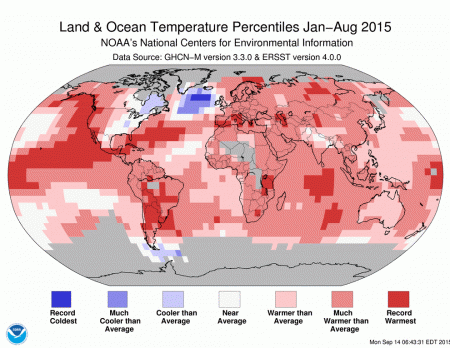
2015 will be the warmest year since the end of the Eemian, 115,000 years ago. So why are record low temperatures appearing just south of Iceland? Yes, record lows, lower than ever recorded.

While The Rest Of Planet Is At Record Warmth, Off Iceland, Record Colds Are Achieved!

That was fully expected, and a demonstration of Non-Linearity of the incipient global warming. A phenomenon is linear when it looks like a line. Global warming is not going up like a line, as some places are warming at a rate ten times higher than the average, and some regions are cooling (and some are cooling spectacularly, off Iceland and some seas around Antarctica, for reasons related to warming).

The Dryas events were extremely fast and pronounced cooling events which happened several times during the period 10,000 years to 15,000 Before Present. Some lasted around a millennium, others, just a century. They vanished as fast as they came. They are named after a tundra flower, the Dryas. In Scandinavia forests were replaced by tundra graced with Dryas (hence the name). In Britain, average temperature collapsed to minus 5 degree Celsius, and glaciers formed at elevation.

These spastic events of drastic cooling, while, overall, de-glaciation was going on, long remained a mystery. Overall, the great glaciation which had brought glaciers down to New York, was on its way out, the planet was globally, irresistibly warming. So why would temperatures collapse in some places around Greenland by 15 degrees Celsius? The solution to the Dryas events’ spastic glaciation riddle? The same as always! Warming is non-linear.

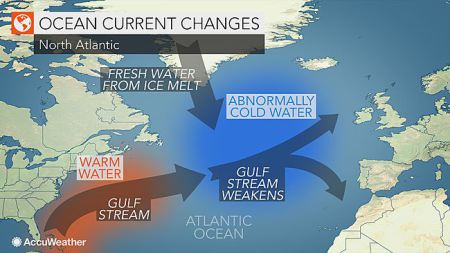
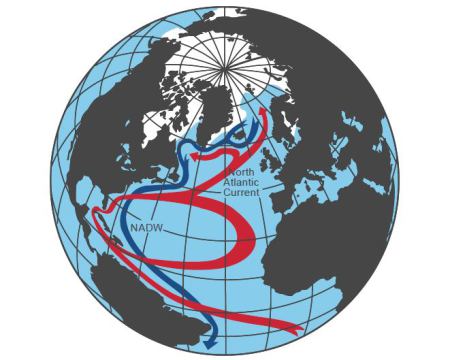
What’s the theory? The details are uncertain, but we know that the Gulf Stream (aka the North Atlantic “Conveyor”) shorted, literally: analyses of deep sea sediments have shown this. The conveyor sends an enormous current of warm tropical waters northward.

When the warm tropical waters become very cold between Iceland and Spitzbergen, they sink to the bottom of the sea, and head south. This sinking, plus the pushing by trade winds in the tropics, is what provides the energy of the Gulf Stream.

However, if the warm tropical waters are capped by a very cold, but light sweet(er) water lid, they will get cold early, and sink before Iceland. This is what happened in the Dryas events.

And It Is Happening Again, Albeit On A Smaller Scale.

Was it in response to a sudden influx of fresh water from Lake Agassiz and deglaciation in North America, and Greenland? Sudden freezing there would have removed the freshwater lid, hence the brutal switchback to warming after the brutal cooling. By the way, the sea level rising speed responded quickly, by a factor of three. After the typical Dryas cooling, oceanic rise rebounded to 18 millimeter per year right away (this shows that those who expect a slow rise of sea level rise are deluding themselves, or, more to the point, are trying to delude us!)

Nowadays a Dryas-like mechanism would have to rest on the melting of Greenland alone (that’s the only place with significant ice). This is, of course, insufficient, but summer 2015, cool and rainy over the northern North Atlantic is evidence that the effect is on. Scientific analysis confirms it. See: “Exceptional Twentieth Century Slow Down of Atlantic Ocean Overturning Circulation” (Nature, 23 March, 2015).

The exact nature of what is going on at this point is a matter of debate among experts. What is sure is that something is going on.

The Atlantic Conveyor Is A Subtle Thing, Yet Dominates Glaciation In The Arctic.

A similar situation beckons in Antarctica, where ice shield melting creates a freshwater lid all around which in turn freeze, extending the ice cap in the Austral winter.

When considering nonlinearity, subtlety and surprises are of the essence. This is true in physics, as it is in psychology, history, or politics.

And the morality in all this? The USA has played god. The European Union made a honest to goodness effort to reduce CO2 emission, while the USA, paying lip service to the opposite of what it was doing went right ahead, with its factory, the Plutocratic Republic of China, to use and abuse fossil fuels as never before.

So now what? Is god still American, as usual? At first it seems so: the USA started to frack massively and massive amounts of fossil fuels were extracted from the USA’s generous soil. When American companies tried the same in Poland, it failed: the underground god (Pluto?) did not cooperate: Polish soil is adverse to fracking.

Here comes the punchline: sea level has been rising fast along the Eastern seashore of the USA. Actually, three to four times faster than the world average. That’s more than one centimeter per year.

Why? Imagine a traffic jam. Or rather a crash ahead: things come to a halt, cars, water piles up behind. Maybe the Washington politicians will soon have to learn to swim, and not just against the tide of world public opinion.

The USA is going to be punished with its own instruments. Meanwhile 20 countries formed the V20, a group of twenty countries whose existence is immediately threatened by global warming, although they caused it not.

A Two Degree Celsius rise of temperature is indeed way too much: nonlinearity is upon us. Evil is always nonlinear.

Patrice Ayme’

ooOOoo

Footnote: The Les referred to is Les Powells, the yachtsman who sailed solo three times around the world. He and I became good friends when we met up at Larnaca Marina in Cyprus.


Les Powells book


A revisit to earlier times.

How time flies!

Last Monday, Jean and I had been living here in Merlin, Oregon for three years.

Why I am explaining this is because my day yesterday ended up being so busy that I ran out of time to focus on writing a fresh new post for you good people.

Thus, I decided to repost something that I published that first week we moved in to our Merlin home. Namely, a post published on the 16th October, 2012 under the heading of The death of the USA?.

So my apologies for you dear readers that recall this from three years ago, and welcome to the many new followers of this place that have signed up since then.

ooOOoo

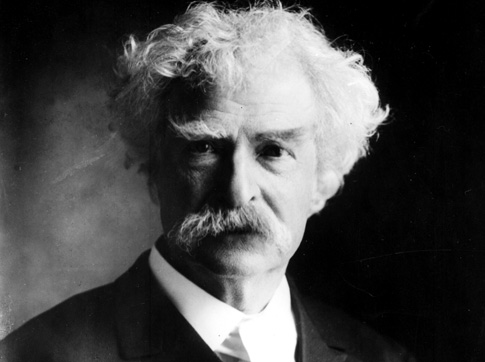
“The reports of my death are greatly exaggerated!” Mark Twain.

Mark Twain

The Mark Twain quotation after hearing that his obituary had been published in the New York Journal.

Mistaken publications of obituaries aren’t as rare as you might expect. A recent example is of Dave Swarbrick, the British folk/rock violinist, who was killed off mistakenly by the Daily Telegraph in April 1999 when they reported that his visit to hospital in Coventry had resulted in his death. He did at least get the opportunity to read a rather favourable account of his life, not something we all get to do, and to deliver the gag “It’s not the first time I have died in Coventry”.

So why have I opened with this quote from Mark Twain?  Read on and I hope all will be clear.

A little under a week ago, I published a couple of posts that proposed that the United States of America is an empire in decline.  The first was What goes up? and the second Might just come down! As a Brit, I well know that aspect of British history!

However a recent conversation with a friend of many years back in England, who has also been a shrewd and wise entrepreneur for longer than I care to remember, argued that the evidence for the ‘end of the USA’ could be challenged.

He cited five reasons why he thought the USA would remain, more or less, in its dominant position.  They were:

  1. Spirit of innovation
  2. Relaxed labour laws
  3. The importance of Mexico
  4. The uncertainty of China in terms of the next ’empire’
  5. The likely energy self-sufficiency for the USA in the near-term.

So let me expand on each of those points.

Spirit of innovation

Let me quote from an article in TIME Magazine of the 5th June, 2011,

Innovation is as American as apple pie. It seems to accord with so many elements of our national character — ingenuity, freedom, flexibility, the willingness to question conventional wisdom and defy authority. But politicians are pinning their hopes on innovation for more urgent reasons. America’s future growth will have to come from new industries that create new products and processes. Older industries are under tremendous pressure. Technological change is making factories and offices far more efficient. The rise of low-wage manufacturing in China and low-wage services in India is moving jobs overseas. The only durable strength we have — the only one that can withstand these gale winds — is innovation.

Now there are plenty who would argue both ways in terms of the future innovation potential for the USA, as a recent article in The Atlantic does, see American Innovation: It’s the Best of Times and the Worst of Times.  But the spirit of innovation will, nonetheless, be a powerful economic potential for the USA for many years to come.

Relaxed labour laws.

Definitely an area that I have little knowledge of except for the subjective notion that compared to many other nations, the laws in the USA are much less of a restraint on economic productivity than elsewhere.

The importance of Mexico.

The importance in the context of providing the USA with a source of cheaper manufacturing facilities.  My English friend thought that this was a significant competitive advantage for the USA.  Now, as it happens, we had a couple staying with us over the week-end of the 6th/7th October.  The husband is a senior manager of Horst Engineering, an American firm based in Guaymas, Sonora County, Mexico.  Here’s a picture from their website,

We are a contract manufacturer of precision machined components and assemblies for aerospace, medical, and other high technology industries. Our core processes include Swiss screw machining, turning, milling, thread rolling, centerless grinding, and assembly. Our extensive supply chain offers our customers a full service logistics solution for managing their precision product requirements. We are ISO9001:2008 and AS9100 registered and proud of our 66 year, three-generation legacy of quality and performance.

I was told that many American and British firms were using Mexico rather than China for a number of reasons.  Not least because Chinese suppliers require full payment before shipment.  Plus that taking into account that financial aspect together with shipping costs and other logistical issues, China wasn’t as ‘cheap’ over all.  Here’s a recent announcement from Rolls Royce,

Rolls-Royce plans new Sonora hub

The burgeoning aerospace industry in Guaymas had its efforts validated recently when the venerable Rolls-Royce chose it as the site for its newest global purchasing office.

Surrounded by several of its aerospace manufacturing suppliers, London-based Rolls-Royce will move into a Guaymas industrial park owned by Tucson-based The Offshore Group to develop a supply hub for commercial jets and military aircraft around the globe.

“Rolls-Royce has very robust booking orders for the next 10 years,” said Joel Reuter, director of communications for Rolls-Royce in North America. “We need to double our production.”

Because a number of Rolls-Royce suppliers already operate in Guaymas, the city was a logical choice, Reuter said.

The uncertainty of China in terms of the next ’empire’

The point made in terms of China taking over ’empire’ status from the USA, as Simon Johnson argues over at Baseline Scenario, is countered by the fact that politically China is an unknown quantity.  Until China endorses some form of democratic process, that unknowingness is not going to disappear.

The likely energy self-sufficiency for the USA in the near-term.

I can’t do better than to ask you to watch this video!  Just 27-minutes long, it is a very interesting review of the energy future of the USA.

As the TED website suggests in terms of why you should listen to Amory Lovins,

Amory Lovins was worried (and writing) about energy long before global warming was making the front — or even back — page of newspapers. Since studying at Harvard and Oxford in the 1960s, he’s written dozens of books, and initiated ambitious projects — cofounding the influential, environment-focused Rocky Mountain Institute; prototyping the ultra-efficient Hypercar — to focus the world’s attention on alternative approaches to energy and transportation.

His critical thinking has driven people around the globe — from world leaders to the average Joe — to think differently about energy and its role in some of our biggest problems: climate change, oil dependency, national security, economic health, and depletion of natural resources.

More on Reinventing Fire may be found here.

So, don’t know about you, but I found those five points deeply convincing.  How about you?  Are the reports of the death of the USA  greatly exaggerated? Do leave a comment.

ooOOoo

Now some three years later on, these five factors still seem to be valid.

What a funny lot we all are!

We must constantly remind ourselves that we are the servants of Nature, not the other way around!

There is only one species of creature on this planet that has the power to destroy its own species, and much else: Homo sapiens!

It’s such an obvious reflection, yet it is also such an incredibly difficult commitment to make. I am speaking of the commitment to do more than “tut, tut” but to make a real difference in how each of us live, ensuring that we are making real changes year by year.

I am being little more than a “smart arse” in saying we should learn from dogs to live in harmony with our planet because, in truth, this is the one key area where we can’t learn from our dogs: we each have to learn for ourselves and influence others to do the same.

All of which is my way of introducing a very recent essay from Tom Dispatch. It now follows, but be aware that there were simply too many links to recreate in my republished version. It is republished with the very kind permission of Tom Engelhardt.

ooOOoo

Tomgram: Michael Klare, Tipping Points and the Question of Civilizational Survival

Posted by Michael Klare at 8:00am, October 8, 2015.

In mid-August, TomDispatch’s Michael Klare wrote presciently of the oncoming global oil glut, the way it was driving the price of petroleum into the “energy subbasement,” and how such a financial “rout,” if extended over the next couple of years, might lead toward a new (and better) world of energy. As it happens, the first good news of the sort Klare was imagining has since come in. In a country where the price of gas at the pump now averages $2.29 a gallon (and in some places has dropped under $1.90), Big Oil has begun cutting back on its devastating plans to extract every imaginable drop of fossil fuel from the planet and burn it. Oil companies have also been laying off employees by the tens of thousands and deep-sixing, at least for now, plans to search for and exploit tar sands and other “tough oil” deposits worldwide.

In that context, as September ended, after a disappointing six weeks of drilling, Royal Dutch Shell cancelled “for the foreseeable future” its search for oil and natural gas in the tempestuous but melting waters of the Alaskan Arctic. This was no small thing and a great victory for an environmental movement that had long fought to put obstacles in the way of Shell’s exploration plans. Green-lighted by the Obama administration to drill in the Chukchi Sea this summer, Shell has over the last nine years sunk more than $7 billion into its Arctic drilling project, so the decision to close up shop was no small thing and offers a tiny ray of hope for what activism can do when reality offers a modest helping hand.

As Klare makes clear today, when it comes to the burning of fossil fuels, reality — if only we bother to notice it — is threatening to offer something more like the back of its hand to us on this embattled planet of ours. He offers a look at a future in which humanity, like various increasingly endangered ecosystems including the Arctic, may be approaching a “tipping point.” Tom

Welcome to a New Planet

Climate Change “Tipping Points” and the Fate of the Earth

By Michael T. Klare

Not so long ago, it was science fiction. Now, it’s hard science — and that should frighten us all. The latest reports from the prestigious and sober Intergovernmental Panel on Climate Change (IPCC) make increasingly hair-raising reading, suggesting that the planet is approaching possible moments of irreversible damage in a fashion and at a speed that had not been anticipated.

Scientists have long worried that climate change will not continue to advance in a “linear” fashion, with the planet getting a little bit hotter most years. Instead, they fear, humanity could someday experience “non-linear” climate shifts (also known as “singularities” or “tipping points”) after which there would be sudden and irreversible change of a catastrophic nature. This was the premise of the 2004 climate-disaster film The Day After Tomorrow. In that movie — most notable for its vivid scenes of a frozen-over New York City — melting polar ice causes a disruption in the North Atlantic Current, which in turn triggers a series of catastrophic storms and disasters. At the time of its release, many knowledgeable scientists derided the film’s premise, insisting that the confluence of events it portrayed was unlikely or simply impossible.

Fast forward 11 years and the prospect of such calamitous tipping points in the North Atlantic or elsewhere no longer looks improbable. In fact, climate scientists have begun to note early indicators of possible catastrophes.

Take the disruption of the North Atlantic Current, the pivotal event in The Day After Tomorrow. Essentially an extension of the Gulf Stream, that deep-sea current carries relatively warm salty water from the South Atlantic and the Caribbean to the northern reaches of the Atlantic. In the process, it helps keep Europe warmer than it would otherwise be. Once its salty water flows into sub-Arctic areas carried by this prolific stream, it gets colder and heavier, sinks to lower depths, and starts a return trip to warmer climes in the south where the whole process begins again.

So long as this “global conveyor belt” — known to scientists as the Atlantic Meridional Overturning Circulation, or AMOC — keeps functioning, the Gulf Stream will also continue to bring warmer waters to the eastern United States and Europe. Should it be disrupted, however, the whole system might break down, in which case the Euro-Atlantic climate could turn colder and more storm-prone. Such a disruption might occur if the vast Greenland ice sheet melts in a significant way, as indeed is already beginning to happen today, pouring large quantities of salt-free fresh water into the Atlantic Ocean. Because of its lighter weight, this newly introduced water will remain close to the surface, preventing the submergence of salty water from the south and so effectively shutting down the conveyor belt. Indeed, exactly this process now seems to be underway.

By all accounts, 2015 is likely to wind up as the hottest year on record, with large parts of the world suffering from severe heat waves and wildfires. Despite all this, however, a stretch of the North Atlantic below Iceland and Greenland is experiencing all-time cold temperatures, according to the National Oceanic and Atmospheric Administration. What explains this anomaly? According to scientists from the Potsdam Institute for Climate Impact Research and Pennsylvania State University, among other institutions, the most likely explanation is the arrival in the area of cold water from the Greenland ice sheet that is melting ever more rapidly thanks to climate change. Because this meltwater starts out salt-free, it has remained near the surface and so, as predicted, is slowing the northern advance of warmer water from the North Atlantic Current.

So far, the AMOC has not suffered a dramatic shutdown, but it is slowing, and scientists worry that a rapid increase in Greenland ice melt as the Arctic continues to warm will pour ever more meltwater into the North Atlantic, severely disrupting the conveyor system. That would, indeed, constitute a major tipping point, with severe consequences for Europe and eastern North America. Not only would Europe experience colder temperatures on an otherwise warmer planet, but coastal North America could witness higher sea levels than those predicted from climate change alone because the Gulf Stream tends to pull sea water away from the eastern U.S. and push it toward Europe. If it were to fail, rising sea levels could endanger cities like New York and Boston. Indeed, scientists discovered that just such a slowing of the AMOC helped produce a sea-level rise of four inches from New York to Newfoundland in 2009 and 2010.

klarepbk2012

In its 2014 report on the status of global warming, the IPCC indicated that the likelihood of the AMOC collapsing before the end of this century remains relatively low. But some studies suggest that the conveyor system is already 15%-20% below normal with Greenland’s melting still in an early stage. Once that process switches into high gear, the potential for the sort of breakdown that was once science fiction starts to look all too real.

Tipping Points on the Horizon

In a 2014 report, “Impacts, Adaptation, and Vulnerability,” Working Group II of the IPCC identified three other natural systems already showing early-warning signs of catastrophic tipping points: the Arctic, coral reefs, and the Amazonian forest. All three, the report suggested, could experience massive and irreversible changes with profound implications for human societies.

The Arctic comes in for particular scrutiny because it has experienced more warming than any other region on the planet and because the impact of climate change there is already so obvious. As the report put it, “For the Arctic region, new evidence indicates a biophysical regime shift is taking place, with cascading impacts on physical systems, ecosystems, and human livelihoods.”

This has begun with a massive melt of sea ice in the region and a resulting threat to native marine species. “For Arctic marine biota,” the report notes, “the rapid reduction of summer ice covers causes a tipping element that is now severely affecting pelagic [sub-surface] ecosystems as well as ice-dependent mammals such as seals and polar bears.” Other flora and fauna of the Arctic biome are also demonstrating stress related to climate change. For example, vast areas of tundra are being invaded by shrubs and small trees, decimating the habitats of some animal species and increasing the risk of fires.

This Arctic “regime shift” affects many other aspects of the ecosystem as well. Higher temperatures, for instance, have meant widespread thawing and melting of permafrost, the frozen soil and water that undergirds much of the Arctic landmass. In this lies another possible tipping-point danger, since frozen soils contain more than twice the carbon now present in the atmosphere. As the permafrost melts, some of this carbon is released in the form of methane, a potent greenhouse gas with many times the warming potential of carbon dioxide and other such gases. In other words, as the IPCC noted, any significant melting of Arctic permafrost will “create a potentially strong positive feedback to accelerate Arctic (and global) warming.” This, in fact, could prove to be more than a tipping point. It could be a planetary catastrophe.

Along with these biophysical effects, the warming of the Arctic is threatening the livelihoods and lifestyles of the indigenous peoples of the region. The loss of summer sea ice, for example, has endangered the marine species on which many such communities depend for food and the preservation of their cultural traditions. Meanwhile, melting permafrost and coastal erosion due to sea-level rise have threatened the very existence of their coastal villages. In September, President Obama visited Kotzebue, a village in Alaska some 30 miles above the Arctic Circle that could disappear as a result of melting permafrost, rising sea levels, and ever bigger storm surges.

Coral Reefs at Risk

Another crucial ecosystem that’s showing signs of heading toward an irreversible tipping point is the world’s constellation of coral reefs. Remarkably enough, although such reefs make up less than 1% of the Earth’s surface area, they house up to 25% of all marine life. They are, that is, essential for both the health of the oceans and of fishing communities, as well as of those who depend on fish for a significant part of their diet. According to one estimate, some 850 million people rely on coral reefs for their food security.

Corals, which are colonies of tiny animals related to sea anemones, have proven highly sensitive to changes in the acidity and temperature of their surrounding waters, both of which are rising due to the absorption of excess carbon dioxide from the atmosphere. As a result, in a visually dramatic process called “bleaching,” coral populations have been dying out globally. According to a recent study by the Worldwide Fund for Nature, coral reef extent has declined by 50% in the last 30 years and all reefs could disappear as early as 2050 if current rates of ocean warming and acidification continue.

“This irreversible loss of biodiversity,” reports the IPCC, will have “significant consequences for regional marine ecosystems as well as the human livelihoods that depend on them.” Indeed, the growing evidence of such losses “strengthens the conclusion that increased mass bleaching of corals constitutes a strong warning signal for the singular event that would constitute the irreversible loss of an entire biome.”

Amazonian Dry-Out

The Amazon has long been viewed as the epitome of a tropical rainforest, with extraordinary plant and animal diversity. The Amazonian tree cover also plays a vital role in reducing the pace of global warming by absorbing vast amounts of carbon dioxide from the atmosphere during the process of photosynthesis. For years, however, the Amazon has been increasingly devastated by a process of deforestation, as settlers from Brazil’s coastal regions clear land for farming and ranching, and loggers (many operating illegally) harvest timber for wood products. Now, as if to add insult to injury, the region faces a new threat from climate change: tree mortality due to a rise in severe drought and the increased forest fire risk that accompanies it.

Although it can rain year-round in the Amazon region, there is a distinct wet season with heavy rainfall and a dry season with much less of it. An extended dry season with little rain can endanger the survival of many trees and increase the risk of wildfires. Research conducted by scientists at the University of Texas has found that the dry season in the southern Amazonian region has grown by a week every decade since 1980 while the annual fire season has lengthened. “The dry season over the southern Amazon is already marginal for maintaining rainforest,” says Rong Fu, the leader of the research team. “At some point, if it becomes too long, the rainforest will reach a tipping point” and disappear.

Because the Amazon harbors perhaps the largest array of distinctive flora and fauna on the planet, its loss would represent an irreversible blow to global biodiversity. In addition, the region hosts some of the largest assemblages of indigenous peoples still practicing their traditional ways of life. Even if their lives were saved (through relocation to urban slums or government encampments), the loss of their cultures, representing thousands of years of adaptation to a demanding environment, would be a blow for all humankind.

As in the case of the Arctic and coral reefs, the collapse of the Amazon will have what the IPCC terms “cascading impacts,” devastating ecosystems, diminishing biodiversity, and destroying the ways of life of indigenous peoples. Worse yet, as with the melting of the Arctic, so the drying-out of Amazonia is likely to feed into climate change, heightening its intensity and so sparking yet more tipping points on a planet increasingly close to the brink.

In its report, the IPCC, whose analysis tends, if anything, to be on the conservative side of climate science, indicated that the Amazon faced a relatively low risk of dying out by 2100. However, a 2009 study conducted by Britain’s famed Meteorological (Met) Office suggests that the risk is far greater than previously assumed. Even if global temperatures were to be held to an increase of 2 degrees Celsius, the study notes, as much as 40% of the Amazon would perish within a century; with 3 degrees of warming, up to 75% would vanish; and with 4 degrees, 85% would die. “The forest as we know it would effectively be gone,” said Met researcher Vicky Pope.

Of Tipping Points and Singularities

These four natural systems are by no means the only ones that could face devastating tipping points in the years to come. The IPCC report and other scientific studies hint at further biomes that show early signs of potential catastrophe. But these four are sufficiently advanced to tell us that we need to look at climate change in a new way: not as a slow, linear process to which we can adapt over time, but as a non-linear set of events involving dramatic and irreversible changes to the global ecosphere.

The difference is critical: linear change gives us the luxury of time to devise and implement curbs on greenhouse gas emissions, and to construct protective measures such as sea walls. Non-linear change puts a crimp on time and confronts us with the possibility of relatively sudden, devastating climate shifts against which no defensive measures can protect us.

Were the Atlantic Meridional Overturning Circulation to fail, for example, there would be nothing we could do to turn it back on, nor would we be able to recreate coral reefs or resurrect the Amazon. Add in one other factor: when natural systems of this magnitude fail, should we not expect human systems to fail as well? No one can answer this question with certainty, but we do know that earlier human societies collapsed when faced with other kinds of profound changes in climate.

All of this should be on the minds of delegates to the upcoming climate summit in Paris, a meeting focused on adopting an international set of restrictions on greenhouse gas emissions. Each participating nation is obliged to submit a set of measures it is ready to take, known as “intended nationally determined contributions,” or INDCs, aimed at achieving the overall goal of preventing planetary warming from exceeding 2 degrees Celsius. However, the INDCs submitted to date, including those from the United States and China, suggest a distinctly incremental approach to the problem. Unfortunately, if planetary tipping points are in our future, this mindset will not measure up. It’s time to start thinking instead in terms of civilizational survival.

Michael T. Klare, a TomDispatch regular, is a professor of peace and world security studies at Hampshire College and the author, most recently, of The Race for What’s Left. A documentary movie version of his book Blood and Oil is available from the Media Education Foundation. Follow him on Twitter at @mklare1.

Follow TomDispatch on Twitter and join us on Facebook. Check out the newest Dispatch Book, Nick Turse’s Tomorrow’s Battlefield: U.S. Proxy Wars and Secret Ops in Africa, and Tom Engelhardt’s latest book, Shadow Government: Surveillance, Secret Wars, and a Global Security State in a Single-Superpower World.

Copyright 2015 Michael T. Klare

ooOOoo

Just to repeat myself in that if you find this essay from Michael Klare one that you want to refer to again, then go across to the version published on TomDispatch so you can follow up the many links in that essay.

The Reno Gun Show

A delightful story from Lynda Demsher.

I have referred previously to AIM, the authors’ group based in nearby Grants Pass, OR. Lynda is a published author who is one of the AIM members. The other day, Lynda sent me the following:

Paul, I know you’ve been busy so I sent you this if you need something for your blog if it’s the kind of thing you use. Might be timely as well given the latest talk about guns. It is somewhat about my dog and how I ended up at one of the biggest gun shows in the west while looking for dog training equipment. This was published in “Invisible Memoirs,” a Bay Area journal.

So with no further ado, here is Lynda’s story. It is about dogs!

ooOOoo

The Gun Show

If not for my youngest hunting dog, the one my husband calls “the idiot,” I might have missed it. Instead, I put on my best leather vest and dressiest black jeans (known as “wedding jeans” where I lived in Modoc County) and joined the hundreds of people streaming into the Reno Gun Show set up in the basement of the Grand Sierra Resort and Casino. The entrance yawned like a dim and secretive man-cave, beckoning lines of mostly men to enter, after forking over a $10 fee of course. I wondered if I needed a password or a special handshake as well. The furtive restlessness of the crowd suggested this was a place with protocols. I was in line with my husband and two of his hunting buddies so I asked what they were. I got the look men give when they think a woman asks a stupid question. Women are allowed of course, when the show opens for its three-day run in November, but few attend. Women whisper that gun shows are the equivalent of hanging out at your brother’s scout meeting. No one tells you to leave but they wish you would.

The Idiot happens to be an odd little bird dog I rescued from the pound who needed some work for this year’s hunting season, so I decided to tag along with my husband and his friends, even though the trip was their annual guy-getaway. They made the mistake of telling me the show had “all kinds of hunting stuff” so I decided to see for myself. My young German wirehaired pointer was the laughing stock of my husband’s hunting group last season when he insisted on carrying his favorite toy into the field. He’s a bit gun-sensitive and feels more secure with something in his mouth. He does hunt when the excitement kicks in, but a dog pointing a bird with a big red Frisbee in his mouth isn’t taken all that seriously where I lived until recently. In that rural high-desert county, way out in the northeast corner of California, bordering both Nevada and Oregon, you don’t escape a good razzing if your hunting dog is a clown.

I was certain a place featuring guns would have the latest in gun dog supplies too, since guns and dogs go together like soda and pop. I have to admit though, curiosity was also a motivation. My husband has attended these shows for years even though the guns in his safe far outnumber his annual critter kill. He rarely purchases anything, but he always brings back entertaining observations about the characters floating around in the gun galaxy.

I had a camera in my vest and was anxious to record some of these characters, or possibly the appearance of a film star or political figure also known to attend. But when the guys and I inched forward toward the ticket booth I noticed a large sign with bold black letters saying photographs were prohibited. A stern-looking armed guard wearing combat fatigues stood nearby. Darn. I really did want to sneak a picture of the woman just ahead of us. Her general appearance suggested biology had advanced to the point where it was possible to mix warthog and human DNA. Dressed in baggy camouflage sweats, she rolled toward the entrance like an Abrams tank. Completing her ensemble was a large red button with black letters pinned to her chest. As I got a closer to her, I realized it said “Obama Scares Me.” Now I knew what to do in case she decided to have me for lunch. I could just wave my arms over my head and yell “Obama!”

My husband, tall and thin, with wire-rimmed glasses, was wearing a v-neck sweater over a button-down shirt and tan khakis. He looked more like a college professor emeritus than a gun enthusiast in this crowd. I could tell where he was in the room while his stockier friends, wearing the more standard uniform of white t-shirt, forest-green down vest and sagging blue jeans, quickly melted into the browsing crowd.

Left alone, I felt like a migrant in an alien universe, even though guns are not alien to me. I lived within walking distance of a duck blind and my house was full of shabby hunting lodge décor, including 30 or 40 antique duck decoys, old shotguns, ammunition boxes, and deer horns, while back issues of Gun Dog and other hunting magazines littered my end tables. Outdoor supply catalogues were required bathroom reading. Hunting season in the fall is my favorite time of year, but I don’t shoot much anymore. Shooting is a precise sport, requiring hours of ear-blowing, shoulder-banging practice. Without a lot of practice, you could end up killing your brother-in-law. Since hunters are morally obligated to eat what they kill, I do most of my shooting with a camera now. I have yet to come across a good brother-in-law marinade.

My role in hunting is mainly working the dogs and I’ve trained a couple of generations of them. From my point of view, hunting isn’t really about the guns, or even the game, it’s primarily about the dogs. Guns are tools to get the game, which requires a gourmet cooking degree to render edible. And unless you hunt on a club, or hunt ducks down on the river, finding wild upland game birds usually requires a before-dawn trip out into nowhere land and then a bone-rattling drive over 30 miles of volcanic rock followed by a shin-bruising hike up a steep brushy hill. The dogs, however, make it all worthwhile. Upland game birds, such as mountain grouse, quail and chucker seldom welcome a hunting party so it’s the dogs’ job to find their hiding places. The pointers put on a field ballet in their pursuit, leap-flying over rocks and brush, dancing across icy streams and twirling to follow a backtracked scent that says “bird this way.” The dog locating the flock stretches into a steady point with foreleg curled and tail straight out. Others in the hunting pack quietly honor his point by staying slightly behind and perfectly still. The dogs stay motionless because the birds, having bird brains, think no one can see them in the bushes if they stay perfectly still. On command the dog leans in slightly, setting off a whirring explosion of blurred brown wings. Guns go off and the dogs track falling birds with their internal geometry, then race to find them in the brush. Some bird dogs are trained to bring the game back to hand, some drop it in front of their hunter, but all prance back with their birds, undeniably proud.

My little wirehair was on the verge being left out of the next hunt because of his eccentricities, but I had hope of finding him some help, possibly in the form of new training technology, realistic training birds and game scent for saturating them, or even a field rope that wouldn’t tangle up on itself. Something, anything, that would get him past the silly juvenile stage in the field.

After browsing the floor for a while and getting blank stares when inquiring if anyone in the room had dog gear, I realized this was not a hunters’ expo but a raw display of powerful arms, some just happening to be for wild game. Rows and rows of gunmetal under florescent light made everything look eerily green and iridescent. Gun hammers clicked empty threats throughout the chamber as vendors demonstrated the bolt action, trigger sensitivity, and firing pin mechanisms of their wares. From the hum of the hype, I’d swear testosterone was being dispersed through the air conditioning to mingle with the ambient odor of sweaty socks.

The room I was in could have housed the first floor of a department store in the mall nearby where the wives of my husband’s friends were enjoying a shopping spree. I counted at least 50 gun sellers with their wares spread neatly on folding metal tables. “Cowboys” in western dress had a row of tables along one wall, where they leaned their folding chairs back as far as they could, trying their best to look like they’d just come in from ropin’ and wranglin’ on the range These vendors also displayed saddles and horse tack along with some rusty cast iron cookware for effect. Other tables had a few duck decoys, old metal signs, antique weaponry and Native American artifacts made in China mixed in for color. One vendor had a nice selection of silver and turquoise jewelry, indicating some purchases here would require softening up the wife back home.

Toward the rear of the area was a cordoned off space stacked with cases of ammunition. Men with hand-trucks stood patiently in line, waiting their turn to purchase as much as they could pile onto their rolling devices. I stood near the line for a while, admiring the craftsmanship of some wooden boxes housing the more expensive ammo. The men around me weren’t there for the boxes though. They were convinced the government was trying to make ammunition scarce as a form of gun control. That’s why they were stocking up. The ammo sellers loudly agreed, while their cash registers sang a money song.

After wandering around and getting bored by the monotony of gun metal and noise, I almost ditched the place for the mall. But then I remembered the woman I saw at the entrance and decided I couldn’t leave without at least one story about a gun-show character. I didn’t see her anywhere, but I did notice a stream of people heading toward a big double-door at the back of the room. I decided to explore.

Turns out, there was a second room of vendors, nearly as large as the first. That room was accessible only through the Refreshment Station where three men in black from their hats to their boots, resembling worn out old villains from a 1948 John Wayne movie, leaned against a bar drinking beer with whisky shooters. Each of them had a scruffy beard and a long-barreled pistol in a holster strapped to a leg. While I have a strong appreciation for the peculiar, I’m very wary of guns in the vicinity of alcohol, so I hoped these guys were just for show. When they caught me looking at them though, none cracked a smile. I felt like a Martian at a rodeo. I quickly ducked between a passing group of men in big hats and entered an arsenal that would put a Syrian rebel in a jealous rage.

It wasn’t just an arsenal though. It was an education. If I hadn’t stumbled in here I never would have learned about Apocalyptic Zombies.

Only one vendor in the room had guns actually meant for shooting animals, probably a last-minute booking, and there was no sign of anything related to hunting dogs. The rest of the 30 or 40 vendors seemed to display an unsettling urgency to scare up business, literally. The place looked like a war zone Wal-Mart. There were a few women in this room but they hardly fit the description of the one I saw at the entrance. One was a tall blond in a low-cut blouse with a holstered gun strapped to a bare leg. Not to be outdone, another vendor had his own buxom blond parading around in a Daisy Mae outfit, showing off AK-47s. The third woman was a tired-looking grandmother playing a game on a tablet computer. She seemed to be in charge of a cash box.

Even though Christmas decorated the outside world this time of year, in here it was Fourth of July. American flags along with red, white and blue streamers were everywhere. It all seemed very patriotic until a closer look revealed the joyful colors swirling into stacks of T-shirts, bumper-stickers, posters and even baby bibs featuring clownish pictures and boorish sayings about the President of the United States. Although I usually keep myself in observation mode in jarring places, my curiosity gnawed. Finally, I asked one vendor why he had so much Obama stuff for sale, since the President had won a second term and election season was over.

“I just like the humor, it’s just humorous,” he said with a hiss. I looked for the lemon he must have been sucking on just before I got there. Of course, his tone made it irresistible for me to ask my next question:

“Aren’t you afraid of losing business by offending someone who might actually like the President?”

He shot me a definite NO! and said he didn’t have anything more to say.

Two booths past the gun-show humorist I came across a display of Nazi paraphernalia for sale under a large poster warning “What worked for Hitler will work for Obama!!” I wondered what would work for both Hitler and Obama. Obviously not a twitter account. The table under the sign had a full-length glass case displaying a collection of what appeared to be old Nazi war souvenirs. Almost everything had a swastika on it. There were tattered leather wallets, worn pistol holsters, moth-eaten wool gloves, yellowed ID cards, heavy gold watches, pistols, money clips, buttons, key chains, belt buckles, helmets, worn but well-polished boots, , ammunition holders, cups, silverware and unidentifiables with wires sticking out. The black velvet lining of the cases made the rather creepy items look important. Some did not look like original Nazi war items though, especially the cell phone cases. I walked over to the vendor, hoping to ask him where this stuff came from. He was bent over something in his lap, looking like the kind of old, green-aproned shoemaker you see in foreign films. He did not look up at me. Was he trying to sell this stuff, or just make a statement? I didn’t find out what would work for both Hitler and Obama until I browsed the next display down.

Six long tables, three on each side, were shoved together and piled with books. I picked up one with a swastika on it. Skimming through it I quickly learned the perils of a “gun-less society” and how disarming citizens would allow government to “go wild” and start hauling off defenseless people to be enslaved in work camps or tortured in some hideous way before being thrown in a ditch and shot. Hitler had taken everyone’s guns away before the Holocaust, the book noted, and signs that the U.S. government was headed in that direction were becoming evident. Gun control was part of a bigger plan by our sneaky president and his socialist supporters to abolish the Constitution and end Democracy. The book was published in 2011. I hid that book under the pile it came from.

Then, from other books in the selection, I learned the world is on the verge of destruction, society is about to break down, and we’ll all have to defend ourselves against those who did not have the foresight to prepare for the Apocalypse. So much for the return of Hitler. These books indicated I had bigger things to worry about. The word “Apocalypse,” always capitalized, peppered these publications, but few foretold much of a cause beyond some vague hint of world-wide economic collapse caused by Obamacare. One book mentioned we might be hit by a giant meteorite and had the distinction of being the only one I skimmed that didn’t blame the impending disaster on the President, although I didn’t read the whole thing.

Selecting another book, I discovered that preparing for “The Apocalypse” not only involves stockpiling long-lasting packs of food and water, conveniently for sale at the gun show, but learning to kill, gut and skin your pets for food, and how to harvest and cook weeds and certain kinds of dirt (the kind with animal poop in it) in case the Apocalypse lasts longer than your supplies. I imagined how someone reading that book might just double or triple his order of archival food buckets being sold at the booth down the aisle to avoid eating his beagle or the equivalent of cat litter during dire circumstances.

For city dwellers there were books on how to fix up your car so you could escape to the wilderness and live in it when you run out of gas. In the back of these books were web sites where you could order overpriced canning jars, all kinds of knives, and archery equipment, as you don’t really want to run into people you know while stockpiling at a local shopping center. The books tell you not to let on you’re prepared for survival, or you might be overrun by your starving friends and neighbors, referred to as the Apocalyptic Zombies, who will be desperate and not above killing you for your stash. And, of course, to complete your survival package, readers were advised to get at least one high-powered assault weapon and teach every member of the family to shoot after accumulating enough ammunition to hold off three battalions of U.S. Marines.

Moving on from the dire warnings, I noticed more signs, posters and even targets picturing the dreaded Apocalyptic Zombies tacked up behind the assault weapons vendors. These warned that I would be at the mercy of monsters unless I owned a big black gun. Who knew the awful Zombies coming to get me would look exactly like the walking dead from old horror movies, complete with purple skin and bloody faces. I thought they’d look more like the lady I saw at the entrance, the one with the Obama button.

Emerging from the book table I wondered if they had a psychiatrist’s booth around where I could pay a dollar to have my paranoia removed. Looking up at the whole of the room, my world was suddenly full of glistening gun barrels jutting in the air like millennial symbols of manhood. I expected a worship dance to begin anytime. The air felt thick and smelled of gun oil and the ever-present dirty socks. I looked for something to hide behind until someone I knew came along. I picked the biggest gun in the show. This gun was a cannon-like affair on a shooting stand, set up on a sturdy table with an ammunition clip flowing to the floor. It was outfitted with a computerized night-vision contraption advertised as something the military uses to find terrorists in Afghanistan. The whole package cost more than $6,000. I hadn’t seen anything like it anywhere else at the show. I thought about sneaking a picture of it.

“What do you use it for?” I asked, after actually admiring the technology on the thing.

A very serious dark-haired man in his early 30s who was seated at the table directed his icy blue eyes toward me, squinted, and said flatly “chicken-stealing coyotes.” I started to laugh but held back when the man continued to stare at me like a vampire who senses his favorite blood type. The guy even had a widow’s peak. Had he seen my camera? I slowly took my hand off it in my pocket and pulled away, saying “nice gun, nice gun.”

To catch my breath and get a better sense of perspective, I continued exploring from there, stopping to have a chat with a grandfatherly-type who made ink pens out of spent bullet casings, and a wiry old codger who tried to sell me a leather purse featuring an opening along the back seam for my handgun, so it would be within easy reach if I suddenly needed to shoot a mugger. I don’t think he realized the featured convenience on the shoulder bag would also put the gun within easy reach of a nosy little kid who’s exploring hands might find Grandma’s toy while standing in line with her at the bank. After politely refusing the purse offer, I stopped at a booth where a vendor assured me his “miracle” canvas bag, which resembled a diaper for a three-legged toddler, would keep food frozen for two weeks. Then, at a booth selling pistols, I watched with growing anxiety as a salesman pitched a pocket-sized weapon to a short, baggy-eyed man with bed-hair who seemed to be contributing most of the dirty-sock smell. The guy looked like he could really use a psychiatric booth, but that didn’t seem to concern the enthusiastic salesman telling him he was running a special that day – free membership in the National Rifle Association (NRA) for a year with every purchase. That was odd because the NRA table out front was hawking free memberships to anyone who’d fill out a form.

Finally, I ran into a pair of vendors violating an apparent rule against having fun at a gun show. They were the only non-Caucasian sellers, young men of Asian descent, who were happily booking “Full Auto Shoots” for “that special occasion.” They had a couple of M-16s on display, but they weren’t selling them. They were “renting” them at a gun club so people could shoot their hearts out at steel targets. Why steel? “People like to hear the pling,” one of the men told me with a wink. These two guys beamed with their clever idea. For $50 a clip you could unleash your inner killer without harming anyone, they explained. I asked him who the typical customer might be. He showed me a video on his smart phone of a bachelor party and said he gets a lot of requests for these.

“You can film these kinds of bachelor parties,” he said, “and the brides-to-be love it because the men can have fun without getting drunk with naked women!”

He also said they did birthday parties. “Eleven-year-olds love to shoot, and we have special padding on the guns for them,” he said. “Moms love it because it’s something different!”

About that time my husband caught up with me, and became very interested in the rent-a-machine-gun idea. Might bring tourists out to our economically challenged community, he remarked. I told him I was ready to ditch this place as the only thing I found here having any connection to dogs was a book that gave instructions on how to skin and eat them. He said he was ready for lunch but I couldn’t think of eating until I got the image of dog snout stew out of my head. We left, but not before I finally spotted the woman with the Obama button on our way out. She was examining a nice little AR-15. When she looked up at us with that gun in her hands I knew we were all doomed. The Apocalyptic Zombies were buying guns here as well.

ooOOoo

Will leave it there as have a host of things to do before leaving to go to Medford Airport and welcome Jean back from her trip to Mexico. (As of yesterday afternoon!)

The power of hope!

It really is about good people refusing to let evil dominate our world.

The response to yesterday’s post was incredible and very gratifying.

For I was conscious that many would simply reject the proposition that I saw in John Zande’s book, namely that, “there was an evil origin to the universe and, more directly, that the deep, and growing, suffering of the pinnacle of evolution, us humans, can be traced back to that evil origin.”

The emotional challenge, of which I am acutely aware, is recognising that core proposition, that as we humans evolve so too does the capacity for human suffering, yet not wanting to give up on my personal core belief that better times ahead are possible, given sufficient people sharing that power of hope. Echoing what Sue wrote as a response to yesterday’s post that motivated me to reply, in part, thus:

If there was one sentence of yours that struck me as spot on, it was your declaration that what we think is what we create. Or as I often reflect, we are what we think.

Jean and I last night watched the latest BBC Panorama report about the migrant/refugee crisis in Europe. It was profoundly upsetting for reasons that many will understand.

George Monbiot’s essay that follows shortly is also profoundly upsetting.

But if hope is to be translated into a determination to make a difference, then it demands that we don’t ignore the pain but use our anger to fuel our passion to behave appropriately: We are what we think! Or in the much more eloquent words of Albert Einstein:

Learn from yesterday, live for today, hope for tomorrow. The important thing is not to stop questioning.

George Monbiot is to be saluted for his commitment to questioning and I am privileged to have his permission to republish the following.

ooOOoo

Inhospitable Planet

29th September 2015

There may be water on Mars. But is there intelligent life on Earth?

By George Monbiot, published in the Guardian 30th September 2015

Evidence for flowing water on Mars – this opens up the possibility of life; of wonders we cannot begin to imagine. Its discovery is an astonishing achievement. Meanwhile, Martian scientists continue their search for intelligent life on Earth.

We might be captivated by the thought of organisms on another planet, but we seem to have lost interest in our own. The Oxford Junior Dictionary has been excising the waymarks of the living world. Adders, blackberries, bluebells, conkers, holly, magpies, minnows, otters, primroses, thrushes, weasels and wrens are now surplus to requirements.

In the past four decades, the world has lost 50% of its vertebrate wildlife. But across the latter half of this period, there has been a steep decline in coverage. In 2014, according to a study at Cardiff University, there were as many news stories broadcast by the BBC and ITV about Madeline McCann (who went missing in 2007) as there were about the entire range of environmental issues.

Think of what would change if we valued terrestrial water as much as we value the possibility of water on Mars. Only three percent of the water on this planet is fresh, and of that two-thirds is frozen. Yet we lay waste to the accessible portion. Sixty percent of the water used in farming is needlessly piddled away by careless irrigation. Rivers, lakes and aquifers are sucked dry, while what remains is often so contaminated that it threatens the lives of those who drink it. In the UK, domestic demand is such that the upper reaches of many rivers disappear during the summer. Yet still we install clunky old toilets and showers that gush like waterfalls.

As for salty water of the kind that enthralls us when apparently detected on Mars, on Earth we express our appreciation with a frenzy of destruction. A new report suggests that fish numbers have halved since 1970. Pacific bluefin tuna, that once roamed the seas in untold millions, have been reduced to an estimated 40,000, yet still they are pursued. Coral reefs are under such pressure that most could be gone by 2050. And in our own deep space, our desire for exotic fish rips through a world scarcely better known to us than the red planet’s surface. Trawlers are now working at depths of 2000 metres. We can only guess at what they might be destroying.

A few hours before the Martian discovery was announced, Shell terminated its Arctic oil prospecting in the Chukchi Sea. For the company’s shareholders, it’s a minor disaster: the loss of $4 billion. For those who love the planet and the life it sustains, it is a stroke of great fortune: it happened only because the company failed to find sufficient reserves. Had Shell succeeded, it would have exposed one of the most vulnerable places on Earth to spills that are almost inevitable, where containment is almost impossible. Are we to leave such matters to chance?

At the beginning of September, two weeks after he granted Shell permission to drill in the Chukchi Sea, Barack Obama travelled to Alaska to warn Americans about the devastating effects that climate change, caused by the burning of fossil fuels, might catalyse in the Arctic. “It’s not enough just to talk the talk”, he told them. “We’ve got to walk the walk.” We should “embrace the human ingenuity that can do something about it.” Human ingenuity is on abundant display at Nasa, which released those astounding images. But when it comes to policy, the search for intelligent life goes on.

Let the market decide: this is the way in which governments seek to resolve planetary destruction. Leave it to the conscience of consumers, while that conscience is muted and confused by advertising and corporate lies. In a near-vacuum of information, we are each left to decide what we should take from other species and other people; what we should allocate to ourselves or leave to succeeding generations. Surely there are some resources and some places – such as the Arctic and the deep sea – whose exploitation should simply stop?

All this drilling and digging and trawling and dumping and poisoning – what is it for anyway? Does it enrich human experience, or stifle it? A couple of weeks ago, I launched the hashtag #extremecivilisation, and invited suggestions. They have flooded in. Here are just a few of the products my correspondents have found. All of them, as far as I can tell, are real.

An egg tray for your fridge, that syncs with your phone to let you know how many eggs are left. A gadget for scrambling them – inside the shell. Wigs for babies, to allow “baby girls with little or no hair at all the opportunity to have a beautifully realistic hair style”. The iPotty, that permits toddlers to keep playing on their iPads while toilet training. A £2000 spider-proof shed. A snow sauna, on sale in the United Arab Emirates, in which you can create a winter wonderland with the flick of a switch. A refrigerated watermelon case on wheels: indispensable for picnics. Or perhaps not, as it weighs more than the melon. Anal bleaching cream, for … to be honest, I don’t want to know. An “automatic watch rotator” that saves you the bother of winding your luxury wrist candy. A smart phone for dogs, with which they can take pictures of themselves. Pre-peeled bananas, in polystyrene trays covered in clingfilm. Just peel back the packaging …

Every year, clever new ways of wasting stuff are devised, and every year we become more inured to the pointless consumption of the world’s precious resources. With each subtle intensification, the baseline of normality shifts. It should not be surprising to discover that the richer a country becomes, the less its people care about their impacts on the living planet.

Our alienation from the world of wonders with which we evolved has only intensified since David Bowie described a girl stumbling through a “sunken dream”, on her way to be “hooked to the silver screen”, where a long series of distractions diverts her from life’s great questions. The song, of course, was Life on Mars.

www.monbiot.com

ooOOoo

David Bowie’s track Life on Mars from the album Hunky Dory was released in 1971. Courtesy of YouTube, here it is again:

http://www.youtube.com/watch?v=v–IqqusnNQ

Never stop fighting for a better world.

Protecting our right to breathe good, clean air.

robertgreeningersoll118442

Fundamentally, today’s post is not about dogs. But it is about the qualities that we can see in our dogs: trust, honesty, openness, and the core quality that inspires my writings about dogs: integrity.

I’m speaking of the disgusting news that has been headlined in the world’s media in recent days, no better summarised than by this extract from a current (1pm PDT yesterday)) BBC news report:

Volkswagen chief executive Martin Winterkorn has resigned following the revelation that the firm manipulated US diesel car emissions tests.

Mr Winterkorn said he was “shocked” by recent events and that the firm needed a “fresh start”.

He added that he was “not aware of any wrongdoing on my part” but was acting in the interest of the company.

VW has already said that it is setting aside €6.5bn (£4.7bn) to cover the costs of the scandal.

The world’s biggest carmaker admitted last week that it deceived US regulators in exhaust emissions tests by installing a device to give more positive results.

The company said later that it affected 11 million vehicles worldwide.

As ever, the voice of George Monbiot speaks a little clearer than most, and I am referring to his recent essay published both on his blog and in The Guardian newspaper.  I am very pleased to have Monbiot’s permission to republish his essay here on Learning from Dogs.

ooOOoo

Smoke and Mirrors

22nd September 2015

Pollution, as scandals on both sides of the Atlantic show, is a physical manifestation of corruption.
By George Monbiot, published in the Guardian 23 September 2015

In London, the latest figures suggest, it now kills more people than smoking. Worldwide, a new study estimates, it causes more deaths than malaria and HIV-Aids together. I’m talking about the neglected health crisis of this age, that we seldom discuss or even acknowledge. Air pollution.

Heart attacks, strokes, asthma, lung and bladder cancers, low birth weight, low verbal IQ, poor memory and attention among children, faster cognitive decline in older people and – recent studies suggest – a link with the earlier onset of dementia: all these are among the impacts of a problem that, many still believe, we solved decades ago. The smokestacks may have moved to China, but other sources, whose fumes are less visible, have taken their place. Among the worst are diesel engines, sold, even today, as the eco-friendly option, on the grounds that their greenhouse gas emissions tend to be lower than those of petrol engines. You begin to wonder whether any such claims can still be trusted.

Volkswagen’s rigging of its pollution tests is an assault on our lungs, our hearts, our brains. It is a classic example of externalisation: the dumping of costs that businesses should carry onto other people. The air that should have been filtered by its engines is filtered by our lungs instead. We have become the scrubbing devices it failed to install.

Who knows how many people have paid for this crime already, with their health or with their lives? In the USA, 200,000 deaths a year are attributed to air pollution. For how many of those might Volkswagen be responsible? Where else was the fraud perpetrated? Of what proportion of our health budgets has this company robbed us?

The fraud involves the detection of nitrogen oxides (NOx), of which diesel engines are the major source in many places. This month, for the first time in our history, the UK government estimated the impact of NOx emissions on public health, and discovered that they are likely almost to double the number of deaths from air pollution, adding 23,000 to the 29,000 attributed to particulates (tiny particles of soot).

The government released this discovery, alongside its useless proposals for dealing with the problem, on Saturday 12 September, a few minutes before Jeremy Corbyn’s election as Labour leader was announced. How many government press releases are published on a Saturday? How many are published on a Saturday during an event on which everyone is focused? In other words, as a Labour press officer once notoriously advised, this was “a good day to bury bad news”. Not only was the number of deaths buried by this means, but so was the government’s consultation on its feeble plans for reducing this pollution: a consultation to which it evidently wanted as few respondents as possible. Liz Truss, the environment secretary, has some explaining to do.

She has her reasons for keeping us in the dark. In April, the Supreme Court ruled that the UK is in breach of the European air quality directive, and insisted that the government draw up a plan for compliance by the end of this year. Instead, Truss produced a plan to shed responsibility. Local authorities, her consultation suggests, should create clean air zones in at least eight cities, in which diesel engines are restricted or banned. But she has given them neither new money nor new powers. Nor has she offered an explanation of how this non-plan is going to address the issue in the rest of the country, as the ruling demands.

Already, the UK has missed the European deadline by six years. Under Truss’s proposals, some places are likely still to be in breach by 2025: 16 years after the original deadline. I urge you to respond to the consultation she wanted you to miss, which closes on November 6.

The only concrete plan the government has produced so far is to intensify the problem, through a new programme of airport expansion. This means more nitrous oxides, more particulates, more greenhouse gas emissions.

Paradoxically, the Volkswagen scandal may succeed where all else has failed, by obliging the government to take the only action that will make a difference: legislating for a great reduction in the use of diesel engines. By the time this article is published, we might know whether the company’s scam has been perpetrated in Europe as well as North America: new revelations are dripping by the hour. But whether or not this particular deception was deployed here, plenty of others have been.

Last week the Guardian reported that nine out of ten new diesel cars break European limits on nitrous oxides – not by a little but by an average of sevenfold. Every manufacturer whose emissions were tested had cars in breach of the legal limit. They used a number of tricks to hotwire the tests: “stripping components from the car to reduce weight, using special lubricants, over-inflating tyres and using super-smooth test tracks.” In other words, the emissions scandal is not confined to Volkswagen, not confined to a single algorithm and not confined to North America: it looks, in all its clever variants, like a compound global swindle.

There are echoes here of the ploys used by the tobacco industry: grand deceptions smuggled past the public with the help of sophisticated marketing. Volkswagen sites advertising the virtues of “clean diesel” have been dropping offline all day. In 2009, the year in which its scam began, the TDI engine at the centre of the scandal won the Volkswagen Jetta 2.0 the green car of the year award. In 2010, it did the same for the Audi A3.

There’s plenty that’s wrong with corporate regulation in the United States, but at least the fines, when they occur, are big enough to make a corporation pause, and there’s a possibility of guilty executives ending up in prison. Here, where corruption, like pollution, is both omnipresent and invisible, major corporations can commit almost any white-collar crime and get away with it. Schemes of the kind that have scandalised America are, in this country, both commonplace and unremarked. How can such governments be trusted to defend our health?

www.monbiot.com

ooOOoo

I found myself having two emotional reactions to Monbiot’s essay. The first was that for many years, when I was living and working in England, I drove diesel-powered cars on the (now false) belief that they were better for the environment.

My second reaction was to Monbiot listing the likely impacts from air pollution,”Heart attacks, strokes, asthma, lung and bladder cancers, low birth weight, low verbal IQ, poor memory and attention among children, faster cognitive decline in older people and – recent studies suggest – a link with the earlier onset of dementia. . . “, for the reason that at the age of 70, I am already noticing the creeping onset of reduced verbal IQ, cognitive decline, and worry about the onset of dementia. To think that my earlier decisions about what cars to drive might be a factor in this is disturbing.

I am going to close this post by highlighting how fighting for what we want is important, critically so. By republishing an item that was posted on AmericaBlog just over a year ago, that fortuitously is a reward for living in the State of Oregon.

ooOOoo

Climate win: Appeals court in Oregon rules state court must decide if atmosphere is a “public trust”

6/16/14 10:00am by Gaius Publius

Two teenagers from Eugene, Ore. filed suit against Governor Kitzhaber and the State of Oregon for failing to protect the “atmosphere, state waters, and coast lines, as required under the public trust doctrine.”

They lost the first round, where the state court said that climate relief was not a judicial matter. But they won on appeal. The case goes back to the original court, which now has orders to decide the case on its merits and not defer to the executive or legislature.

The gist of the appeals court decision:

Their lawsuit asked the State to take action in restoring the atmosphere to 350 ppm of CO2 by the end of the century. The Oregon Court of Appeals rejected the defenses raised by the State, finding that the youth could obtain meaningful judicial relief in this case.

That’s quite a nice victory. Here’s the full story, from the Western Environmental Law Center (my emphasis throughout):

Keeling-curve_CO2_ppm_Mauna_Loa_Carbon_Dioxide_Apr2013.svg_-300x201

In a nationally significant decision in the case Chernaik v. Kitzhaber, the Oregon Court of Appeals ruled a trial court must decide whether the atmosphere is a public trust resource that the state of Oregon, as a trustee, has a duty to protect. Two youth plaintiffs were initially told they could not bring the case by the Lane County Circuit Court. The trial court had ruled that climate change should be left only to the legislative and executive branches. Today, the Oregon Court of Appeals overturned that decision.

Two teenagers from Eugene, Kelsey Juliana and Olivia Chernaik, filed the climate change lawsuit against Governor Kitzhaber and the State of Oregon for failing to protect essential natural resources, including the atmosphere, state waters, and coast lines, as required under the public trust doctrine. Their lawsuit asked the State to take action in restoring the atmosphere to 350 ppm of CO2 by the end of the century. The Oregon Court of Appeals rejected the defenses raised by the State, finding that the youth could obtain meaningful judicial relief in this case. …

In reversing the Lane County trial court, the Oregon Court of Appeals remanded the case ordering the trial court to make the judicial declaration it previously refused to make as to whether the State, as trustee, has a fiduciary obligation to protect the youth from the impacts of climate change, and if so, what the State must do to protect the atmosphere and other public trust resources.

The implications of this are broad, and similar cases are pending in other states, as the article describes.

Make no mistake; decisions like this matter. It places the court squarely in the mix as a power player in the climate war, the fight for “intergenerational justice” as James Hansen puts it — or the war against intergenerational betrayal, as I put it.

This is a cornerstone decision from the Oregon Court of Appeals in climate change jurisprudence. The court definitively ruled that the question of whether government has an obligation to protect the atmosphere from degradation leading to climate change is a question for the judiciary, and not for the legislative or executive branches. The Court did not opine as to how that question should be answered, only that it should be answered by the judiciary.

We can win this; it’s not over. If we reach 450 ppm and we’re still not stopping with the CO2, then it’s over and I become a novelist full-time. But we’re not there yet, and please don’t surrender as if we were.

The courts are now a powerful tool, as is divestment. James Hansen has a way to restore the atmosphere to 350 ppm CO2 in time to stop slow feedbacks from kicking in. It’s a doable plan, but we’ll need to use force. Using the courts, as with using divestment campaigns, counts as force. Stay tuned.

(Want to use force at the national level? Find a way to challenge Obama publicly to stop leasing federal land to coal companies. He’s a hypocrite until he stops federal coal from being mined and sold abroad. A simple and obvious challenge for him. You too can be the activist.)

GP

Twitter: @Gaius_Publius
Facebook: Gaius Publi

(Facebook note: To get the most from a Facebook recommendation, be sure to Share what you also Like. Thanks.)

ooOOoo

 Never forget that you, me and every other good-minded person on this planet can make a positive difference. Need inspiration? Gain it from our dogs! Let’s use the liberty we enjoy to make a difference.