Category: Spirituality

Getting to know oneself

The journey inwards is the most challenging and yet the most rewarding of all!

This post is essentially a reposting of an item that I published nearly three years ago. It came to me as a result of some delightful exchanges following my post last Thursday: How well our dogs read us!

Tomorrow I will go into more details of that fateful event in my past:  December 20th, 1956.

ooOOoo

Further musings on dogs, women and men.

Published on Learning from Dogs, August 6th, 2015

A few weeks ago, I read a book entitled The Republican Brain written by Chris Mooney and to quote WikiPedia:

The Republican Brain: The Science of Why They Deny Science — and Reality is a book by the journalist Chris Mooney that is about the psychological basis for many Republicans’ rejection of mainstream scientific theories, as well as theories of economics and history.

On page 83, Chris Mooney writes (my emphasis):

Here also arises a chief liberal weakness, in Lakoff’s view (*), and one that is probably amplified by academic training. Call it the Condorcet handicap, or the Enlightenment syndrome. Either way, it will sound very familiar: Constantly trying to use factual and reasoned arguments to make the world better and being amazed to find even though these arguments are sound, well-researched, and supported, they are disregarded, or even actively attacked by conservatives.

When glimpsed from a bird’s eye view, all the morality research that we’re surveying is broadly consistent. It once again reinforces the idea that there are deep differences between liberals and conservatives – differences that are operating, in many cases, beneath the level of conscious awareness, and that ultimately must be rooted in the brain.

(*) George Lakoff, Berkeley Cognitive Linguist and author of the book Moral Politics.

What Chris Mooney is proposing is that the difference between liberals and conservatives could be genetically rooted, at least in part.

That underlines in my mind how each of us, before even considering our gender differences, is truly a complex mix of ‘nature and nurture’ with countless numbers of permutations resulting.

That there are deep differences, apart from the obvious ones, between man and woman goes without saying. In earlier times, these differences were essential in us humans achieving so much and leading to, in the words of Yuval Noah Harari from yesterday’s post., ” … few would disagree that humans dominate planet Earth; we’ve spread to every continent, and our actions determine the fate of other animals (and possibly Earth itself).”

Speaking of earlier times, let me turn to dogs, for it is pertinent to my post, and I would like to quote an extract from what Doctor of Veterinarian Medicine, Jim Goodbrod, writes in the foreword of my forthcoming book:

But what exactly is this human-dog bond and why do we feel such an affinity for this species above all others? My feeling is that it may be associated with our deep but subconscious longing for that age of simple innocence and innate human goodness that we supposedly possessed before we became truly “human”: that child-like innocence or what Rousseau referred to as the “noble savage”, before being corrupted by civilization, before we were booted out of the Garden of Eden. We humans, for better or worse, somewhere along that evolutionary road acquired consciousness or so-called human nature and with it we lost that innocence. What we gained were those marvelous qualities that make us uniquely human: a sense of self-awareness, an innate moral and ethical code, the ability to contemplate our own existence and mortality, and our place in the universe. We gained the ability to think abstract thoughts and the intellectual power to unravel many of the mysteries of the universe. Because of that acquired consciousness and humans’ creative and imaginative mind we have produced the likes of Shakespeare, Mozart, and Einstein. We have peered deep into outer space, deciphered the genetic code, eradicated deadly diseases, probed the bizarre inner world of the atom, and accomplished thousands of other intellectual feats that hitherto would not have been possible without the evolution of our incredible brain and the consciousness with which it is equipped.

No other living species on this planet before or since has developed this massive intellectual power. But this consciousness was attained at what cost? Despite all the amazing accomplishments of the human race, we are the only species that repeatedly commits genocide and wages war against ourselves over political ideology, geographic boundaries, or religious superstition. We are capable of justifying the suffering and death of fellow human beings over rights to a shiny gold metal or a black oily liquid that powers our cars. We are the only species that has the capability to destroy our own planet, our only home in this vast universe, by either nuclear warfare, or more insidiously by environmental contamination on a global scale. Was it worth it? No matter what your or my opinion may be, Pandora’s Box has been opened and we cannot put the lid back on.

What can we do now to reverse this trend and help improve the quality of life for humanity and ensure the well-being of our planet? I think, if we recognize the problem and look very critically at ourselves as a unique species with awesome powers to do both good and bad, and put our collective minds to the task, it may be possible to retrieve some of the qualities of that innocence lost, without losing all that we have gained.

Dogs represent to me that innocence lost. Their emotions are pure. They live in the present. They do not suffer existential angst over who or what they are. They do not covet material wealth. They offer us unconditional love and devotion. Although they certainly have not reached the great heights of intellectual achievement of us humans (I know for a fact that this is true after having lived with a Labrador retriever for several years), at the same time they have not sunk to the depths of depravity to which we are susceptible. It could be argued that I am being overly anthropomorphic, or that dogs are simply mentally incapable of these thoughts. But nevertheless, metaphorically or otherwise, I believe that dogs demonstrate a simple and uncorrupted approach to life from which we all could benefit. I think the crux of Paul’s thesis is that, within the confines and limitations of our human consciousness, we can (and should) metaphorically view the integrity of the dog as a template for human behavior.

“Dogs demonstrate a simple and uncorrupted approach to life …”

I closed yesterday’s post with these words, “It is my contention that humankind’s evolution, our ability to “cooperate flexibly in large numbers”, is rooted in the gender differences between man and woman.”

The premise behind that proposition is that until, say one hundred years ago, give or take, that co-operation between large numbers of humans was critically important in so many areas: health; science; medicine; physics; exploration; outer space and more. (And whether one likes it or not: wars.)  My proposition is that it is predominantly men who have been the ‘shakers and movers’ in these areas. Of course not exclusively, far from it, just saying that so many advances in society are more likely to have been led by men.

But (and you sensed a ‘but’ coming up, perhaps) these present times call for a different type of man. A man who is less the rational thinker, wanting to set the pace, and more a man capable of expressing his fears, exploring his feelings, defining his fear of failure, and more. I don’t know about you but when I read Raúl Ilargi Meijer words from yesterday, “And if and when we resort to only rational terms to define ourselves, as well as our world and the societies we create in that world, we can only fail.”, it was the male of our species that was in my mind. As in, “And if and when we [males] resort to only rational terms to define ourselves …”.

Staying with Raúl Meijer’s words from yesterday (my emphasis), “And those should never be defined by economists or lawyers or politicians, but by the people themselves. A social contract needs to be set up by everyone involved, and with everyone’s consent.”

Dogs demonstrate a simple and uncorrupted approach to life but that doesn’t extend to them making social contracts. Women do understand social contracts, they are predominantly caring, social humans. Less so for men. But for that social contract to be successfully set up by everyone it must, of course, include men. And that requires men, speaking generally you realise, to find safe ways to get in touch with their feelings, to tap into their emotional intelligence, using positive psychology to listen to their feelings and know the truth of what they and their loved ones need to guarantee a better future. What they need in terms of emotional and behavioural change. And, if I may say, sensing when they might need the support of subject experts to embed and sustain those behavioural changes.

It was the fickle finger of fate that led me to the arms, metaphorically speaking, of a core process psychotherapist back in Devon in the first half of 2007. That counselling relationship that revealed a deeply hidden aspect of my consciousness: a fear of rejection that I had had since December, 1956. That finger of fate that took me to Mexico for Christmas 2007 and me meeting Jean and all her dogs. That finger of fate that pointed me to the happiest years of my life and a love between Jeannie and me that I could hitherto never ever have imagined.

However, as much as I love and trust Jean, wholeheartedly, it comes back to dogs.

For when I curl up and wrap myself around a dog and sense that pure unconditional love coming back to me, I have access to my inner feelings, my inner joys and fears, in a way unmatched by anything else.

Where learning from dogs is a gateway to learning from me.

Pharaoh – more than just a dog!

ooOOoo

I will never be able to look at those eyes of Pharaoh, looking into my eyes, without feeling terrible pangs of loss. For he was the most amazing, the most wise, the most deep-thinking dog that I have ever known. Correction: that Jean and I have ever known!

Managing change

Following on from yesterday’s post.

I paused yesterday’s post by writing this:

In addition, Dr. Lee said to always THINK BIG! Big in voice, big in attitude, big in stature.

Finally, let me share with you what was posted on the Visible Procrastinations blog back in 2009. Reposted with the author’s permission.

Change.

Change is unavoidable for everyone one of us. Some changes are certainly wonderfully positive ones. Others not quite so. But the thing about change is that whatever the reason in one’s life for having to experience change it has a disruptive effect.

Today’s post leans heavily on that Visible Procrastinations (VP) post but the main theme is fully endorsed by yours truly!

ooOOoo

My Change Journey

Some notes from My Change Journey: This workshop is designed to help you understand your emotional and psychological needs during times of change and strategies you can use to take control of your own change journey. It also focuses on creating opportunities and seeing possibilities in the new world of work.

change – an event that occurs when something passes from one state or phase to another;

transition – the act of passing from one state or place to the next

Seeing the Big Picture

Many times we do not always see the bigger picture.

There are two examples of that; the first is this rather delightful 5-minute video that is just a bit of fun to watch. The second comes along shortly.

Experiencing Transitions

When change is implemented at any level in an organisation or personally, people typically respond by moving through a series of phases. People will spend different times in each phase. This is a crucial thing to understand and is at the heart of why change is always disruptive and frequently unsettling.

Take a few moments to reflect on the next item; this three-phase framework.

Bridges (1995)William Bridges (1995) Bridges’ three-phase transition framework: The first phase, the Ending phase, is about letting go of an old identity, an old reality or an old strategy. The Neutral Zone is akin to crossing the wilderness between the old way and the new. The final phase is making a new beginning and functioning effectively in a new way.

I am going to reinforce this message because it underpins everything to do with us understanding the business of change. Especially when we have to deal with unsettling events!

Ending – Letting go of what has been.

Neutral Zone or The Bridge – yes, it does feel like a ‘wilderness’ in some circumstances. Give it time!

Starting – Embracing the new way and making it work really well for you.

The key is to allow each phase plenty of time to take effect; frequently much longer than one senses!

The Process of Transition

John Fisher’s model of personal change – The Transition Curve – is an excellent analysis of how individuals deal with personal change.
J.M.Fisher’s ‘transition curve’

(More may be read here:  http://www.businessballs.com especially here: http://www.businessballs.com/personalchangeprocess.htm )

Influencing and exploring options

“You should only worry about things that are within your sphere of influence.”

This is such a key message. So take a long hard look at the things that make you anxious or worry you. Then clearly identify those things over which you have no or very little control. Then walk away from them!

There’s a great book: The Seven Habits of Highly Effective People, from which is taken:

You should only worry about things in your “sphere of influence.” If you have no control over certain aspects of your life, why bother worrying about them?

circle of concern

Mental Models: our way of seeing the world

(NB. This includes the second example of seeing the bigger picture)

Mental models are usually tacit, existing below the level of awareness. Another way of thinking about them is as a paradigm. This is a big topic and I am going to return to it by way of a separate post, probably one day next week.

But this second example of not seeing the bigger picture is also stirring the deeper waters of one particular personal paradigm.

Take 1000
add 40 to it
Now add another 1000
Now add 30
Add another 1000
Now add 20
Now add another 1000
Now add 10
What is the total?
Did you get 5000? The correct answer is actually 4100.

P.S. The number of times I did this, adding it up in my head, and finding it came to 5000. Then I did it on a calculator and it came to 4100. Talk about the eyes looking but not seeing!!

But there’s an important message. If you, as me and Jeannie did first time around, made it 5000 then you are demonstrating that what your eyes see, interpreted by your brain, isn’t necessarily correct.

So if it’s important: Give it a coating or two of thought!

Moving on!

The Fifth Discipline Fieldbook by Peter M. Senge

References

Amado, G., & Ambrose A. (Eds.) (2001) The Transitional Approach to Change. London: Karnac

Amado, G., & Vansina, L. (Eds.) (2004) The Transitional Approach in Action. London: Karnac

Bridges, W. (1998) Managing Transitions: Making the Most of Change London: Nicholas Brealey.

Bridges, W. & Associates (online resources to articles and assessment tools for ‘Managing Transitions’) www.wmbridges.com

Bunker, K. (2008) Responses to Change: Helping People Make Transitions San Francisco: Jossey-Bass

Covey, S.R. (1990) The Seven Habits of Highly Successful People Melbourne: The Business Library

Duck, J. (1993) Managing Change: the art of balancing Harvard Business Review, 71 (Nov/Dec): pp.109-118

Ethical work and life learning (Free online education for ethical work, business, career and life learning; training materials for entrepreneurs, organizations, seflf-development, business management, sales, marketing, project management, communications, leadership, time management, team building and motivation) www.businessballs.com

Fischer, P. (2008) The New Boss: How to Survive the First 100 Days. London: Kogan Page.

Johnson, S. (1999) Who Moved My Cheese? An amazing way to deal with change in your work and in your life London: Vermillion

O’Hara, S. & Sayers, E. Organizational change through individual learning. Career Development International, 1 (4): pp. 38-41

Rogers, C.R. & Roethlisberger, F.J (1991) Barriers and gateways to communication. Harvard Business Review (Nov-Dec): pp.105-111

Stuart, R (1995) Experiencing organizational change: triggers, processes and outcomes of change journeys Personnel Review, 24 (2): pp.3-88

Vansina, L. & Vansina-Cobbaert, J-M (2008) Psychodynamics for Consultants and Managers: From Understanding to Leading Meaningful Change. Chichester: John Wiley & Sons

Williams, D (1999, 2008 update) Transitions: Managing Personal and Organisational Change.

ooOOoo

Tomorrow I cover the specifics of what took Jeannie (and me) to OHSU in Portland and the consultation with Dr. John Nutt and what flowed from that!

I so hope you found in today’s post some nuggets of personal gold for you!

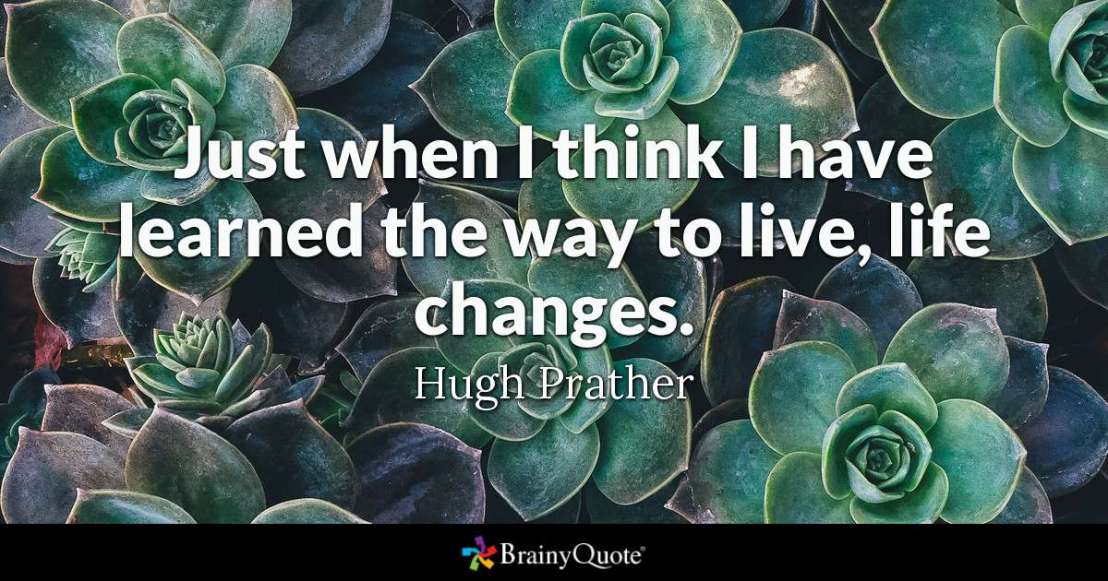
I will close with a quote from the BrainyQuote site:

Gentle souls

This was the post that I had planned for the 20th.

But a power failure across quite a large area of Oregon rather stopped things in their tracks. Nevertheless, it’s a wonderful post and I ‘borrowed’ the photograph to close Colette’s story last Monday. Here’s a repeat of that close:

Colette’s story didn’t come with a photograph. So I thought I would do a quick web search and find a picture that fitted Colette’s story well.

In fact, the article that included this photograph may be republished and I will be doing that tomorrow!

The article was seen here and I trust may be republished in this place!

ooOOoo

Everyone Else Walked Past This Homeless Guy And His Dog, But One Guy Didn’t. This Is Heartbreaking.

In my city (Paris, France) there is a homeless man…

Every day he is begging, always at the same place. Despite ‘his situation,’ he is always smiling and says “hello” or “have a good day” even to people who don’t donate to him.

This man has a dog who is as gentle as he is. It never barks or shows its teeth. Many people say this man is dumb, having a dog when he can barely feed himself. Despite being summer in France, mornings are often cold.

One morning, I was walking and I saw him with his dog. He was hugging him tightly. They were very cold.

It was so cold, seeing those two felt like a knife to the heart. I thought about them all day, even though I don’t have a lot of money, I decided to do something.

The next morning I told my boss I was taking the morning off. I took one of my blankets, bought a whole box of food for the dog, and as much food for the man as I could carry.

I bought two coffees and asked if I could sit and talk with him for a few minutes. He agreed.

I asked him why he was there and he asked me why I was speaking to him.

So I told him “Every day I walk to work. And every day everyone around me seems so sad except for you. You are always smiling. You always seem so happy despite your living conditions and every day you warm my heart. Every day I tell myself that even if it’s a bad day and I am not as happy as I want to be, here’s this man living on the street who seems happier than I am despite that he has nothing.”

He stopped me and said “I have something, something that you can’t value. It’s this little boy in my arms (the dog).”

I asked him how he found this dog and he told me:

“One day I asked myself why I was still living if I was just going to be begging for my survival. I had no one to think about, and no one who would miss me if I died. So it was two years ago when I was on the bridge when I was about to commit suicide and then this little guy came, barking at me and even biting my cloths, preventing me from jumping. So I gave him the last cookie I had in my pocket. He was so happy that I cried and decided not to jump. Since that moment, he’s all I have and he is like my child. Sometimes he goes off for a walk and returns with something for both of us to eat (piece of cake, half eaten sandwich, etc…). He always wants to sleep next to me.”

I asked him if he had ever found a place at a homeless shelter and he told me something that brought me to tears. “8 months ago, I was offered a place to sleep, something to eat and a warm place to stay. Thing is, dogs were not allowed. So I declined the offer. This guy is all I have left and I would rather die than abandon him. When I thought that I had nothing, this little boy taught me love and gave me something to live for. I can never thank him enough for that. When people give me money, I always buy food for him. I only buy human food when I have everything he needs. I sometimes hear people telling me that I am dumb for having him, and I say to them ‘maybe he’s an animal, but he’s given me more love than any human I have ever met and for that, I will never let him go hungry.’”

Hearing that, I gave him the blanket and the food. He thanked me like no one ever has. He said that thanks to me, Bobby (the dog) would eat well and never be cold again.

And then for reasons I still can’t explain, I gave him a piece of paper, wrote my address on it, tied it to the dog’s collar and said “you don’t have to worry anymore. If someday something bad happens to you, I will take care of Bobby. He will never be alone.”

Then he cried. That day I saw the happiest man in my life and I wish you could have seen the same.

Story originally sourced here.

ooOOoo

I’m speechless!

(But will only underline how much we can learn from our dogs!)

The year after!

I make no apologies for turning in on myself.

Pharaoh, who is still so badly missed by Jeannie and me, died on June 19th, 2017.

I published my thoughts The Day After on mid-summer’s day 2017. I cannot think of a more apt article to publish today than what was shared a year ago.

Here it is. If you recall this from a year ago then my apologies – please come back tomorrow!

ooOOoo

The Day After.

By Paul Handover, June 21st. 2017

Trying to cope.

This is a very personal, possibly rather mixed-up, set of reflections of how the day after Pharaoh died felt for me. Some of you may prefer not to read this or view the photos.

I sat down to write this, late morning Tuesday, as it was becoming too hot to stay outside. I felt inspired to be 100% honest about my feelings and the photographs are, in essence, copies of the pictures that are in my head.

I woke early yesterday, a little after 4am, and started listening to BBC Radio Four using ear-phones plugged into my tablet while Jeannie slept on.

But I couldn’t get the images of Monday out of my head. Such that it seemed unreal to think that less than thirty-six hours previously Pharaoh was sleeping quietly near his bed, albeit unable to walk on his own.

Then, in what seemed like the flick of a finger, Jeannie was offering Pharaoh my dinner plate Monday evening.

For every evening, unless we had eaten a very spicy meal, Pharaoh always licked my plate clean.

A routine that had gone on for years.

I lay there in bed as 1pm arrived in England (5am PDT) and BBC Radio 4 was broadcasting The World At One. Despite the gloomy headlines still focusing on that terrible fire at the Grenfell Tower in London (not three miles from where I was born in 1944), the images of Monday kept thundering into my consciousness.

How dear friend, Jim Goodbrod, and I had driven into Allen Creek Veterinary Hospital, where Jim is a visiting DVM each week, to collect the required amount of euthanasia drug (apparently just 1 c.c. for every 10 lbs of animal weight – looking at it in the syringe it seemed such a small amount of fluid to bring an end to Pharaoh’s life.)

Then over breakfast, as in Tuesday morning, Jean said how difficult it was watching Pharaoh yesterday (Monday) when Jim and I were away getting the meds because it seemed to her that Pharaoh sensed something was happening outside the run of a normal morning.

Continuing with Monday. When Jim returned, accompanied by his wife, Janet, and knelt down to examine Pharaoh his analysis was that the time was right. Pharaoh had lost massive amounts of muscle tissue from his rear legs and hips.

It was time. Jean and I settled down sitting on the floor alongside Pharaoh’s bed. Pharaoh shifted his body and placed his wonderful, furry head across my outstretched legs. It was time.

Jim injected Pharaoh with an anesthetic. Slowly, gently Pharaoh fell fast asleep. Jim shaved a patch of fur from Pharaoh’s front, right lower leg.  Janet pinched a vein in Pharaoh’s leg and moments later, Jim injected the euthanasia drug. Jean and I continued to stroke Pharaoh’s forehead but frequently looked down to where the rise and fall of Pharaoh’s lungs was visible.

Then at 11:57 PDT Monday, June 19th., there was no more breathing. Jim took out a stethoscope and confirmed that there was no heart-beat. Jim closed Pharaoh’s eyelids while Jean and I sat quietly just holding on to Pharaoh. A few minutes later, Jean and I had wriggled out from under Pharaoh and then Jim slipped a plastic sack over the rear half of Pharaoh’s still body.

Pharaoh had died without pain and in the most gentle way imaginable.

Back to Tuesday, as in early yesterday morning, and now Jean and I were awake and I was reading every comment and response to the post Adieu, Mon Brave.

I must tell you that the love and compassion extended by every single one of you, including the numerous emails sent to me, is the most precious, special recognition of what Pharaoh meant to me, to my Jeannie, and to you all.

Thank you! Thank you so much!

Time then for a call into England and to let Sandra Tucker know that Pharaoh had died. For Pharaoh had been born at Jutone, the GSD breeding kennels run by Sandra Tucker, and Jim, in Hennock, Devon.

Pharaoh’s legacy will live on forever. What he stood for. What he represented. What I learned from Pharaoh. What he inspired in me. That inspiration that will live with me until it’s my turn to take my last breath.

Then it was time, as in yesterday, to get up and try and stay occupied. But I didn’t warrant for seeing Pharaoh’s empty bed as I walked out of the bedroom into the living-room.

It looked so empty, so lonely.

I burst into tears.

I turned on my heels and went out to feed the horses and the wild deer. As is done every morning.

Walking back to the house, I stepped up on to the rear deck and looked up at the line where the tops of the forest trees on the hills to the East meet the morning sky. It was a clear, cloudless sky.

The sun was within seconds of rising above that skyline. I took a photograph and then the sun had risen. It was 06:24 am. Fifteen hours to the minute before the exact moment of the Summer Solstice this evening (21:24 PDT).

I don’t know what it all means other than in some mysterious, natural fashion, everything is connected.

Dear, sweet, noble Pharaoh.

ooOOoo

I will close by sharing a photograph that I included in my post of June 19th, 2017.

For this photograph underscores what a loyal and faithful friend Pharaoh was to me.

Taken on the 26th July, 2006 at Watchfield Aerodrome in Devon. The aircraft is a Piper Super Cub.

Shit Happens!

A very inspirational essay from George Monbiot.

It is said that there are only two certainties in life: Death and Taxes.

I think that is one short: The Unexpected. As in Death, Taxes and The Unexpected!

As evidence of The Unexpected, one could put falling off one’s bike or being diagnosed with Parkinson’s Disease. Or the many other ‘hiccups’ that are an attribute of the real world that we humans live in. Put in the words of the street: Shit Happens!

Now read this very inspirational essay from George Monbiot. Republished here with Mr. Monbiot’s very kind permission.

ooOOoo

Unprostrated

16th March 2018

I have prostate cancer, but I’m happy. Here’s how.

By George Monbiot, published in the Guardian 14th March 2018

It came, as these things often do, like a gunshot on a quiet street: shocking and disorienting. In early December, my urine turned brown. The following day I felt feverish and found it hard to pee. I soon realised I had a urinary tract infection. It was unpleasant, but seemed to be no big deal. Now I know that it might have saved my life.

The doctor told me this infection was unusual in a man of my age, and hinted at an underlying condition. So I had a blood test, which revealed that my prostate specific antigen (PSA) levels were off the scale. An MRI scan and a mortifying biopsy confirmed my suspicions. Prostate cancer: all the smart young men have it this season.

On Monday, I go into surgery. The prostate gland is buried deep in the body, so removing it is a major operation: there are six entry points and it takes four hours. The procedure will hack at the roots of my manhood. Because of the damage that will be caused to the surrounding nerves, there’s a high risk of permanent erectile dysfunction. Because the urethra needs to be cut and reattached to the bladder, I will almost certainly suffer urinary incontinence for a few months, and possibly permanently. Because the removal of part of the urethra retracts the penis, it appears to shrink, at least until it can be stretched back into shape.

I was offered a choice: radical surgery or brachytherapy. This means implanting radioactive seeds in the parts of the prostrate affected by cancer. Brachytherapy has fewer side effects, and recovery is much faster. But there’s a catch. If it fails to eliminate the cancer, there’s nothing more that can be done. This treatment sticks the prostate gland to the bowel and bladder, making surgery extremely difficult. Once you’ve had one dose of radiation, they won’t give you another. I was told that the chances of brachytherapy working in my case were between 70 and 80%. The odds were worse, in other words, than playing Russian roulette (which, with one bullet in a six-chambered revolver, gives you 83%). Though I have a tendency to embrace risk, this was not an attractive option.

It would be easy to curse my luck and start to ask “why me?”. I have never smoked and hardly drink; I have a ridiculously healthy diet and follow a severe fitness regime. I’m 20 or 30 years younger than most of the men I see in the waiting rooms. In other words, I would have had a lower risk of prostate cancer only if I had been female. And yet … I am happy. In fact, I’m happier than I was before my diagnosis. How can this be?

The reason is that I’ve sought to apply the three principles which, I believe, sit at the heart of a good life. The first is the most important: imagine how much worse it could be, rather than how much better.

When you are diagnosed with prostate cancer, your condition is ranked on the Gleason Score, which measures its level of aggression. Mine is graded at 7 out of 10. But this doesn’t tell me where I stand in general. I needed another index to assess the severity of my condition, so I invented one: the Shitstorm Scale. How does my situation compare to those of people I know, who contend with other medical problems or family tragedies? How does it compare to what might have been, had the cancer had not been caught while it is still – apparently – confined to the prostate gland? How does it compare to innumerable other disasters that could have befallen me?

When I completed the exercise, I realised that this bad luck, far from being a cause of woe, is a reminder of how lucky I am. I have the love of my family and friends. I have the support of those with whom I work. I have the NHS. My Shitstorm Score is a mere 2 out of 10.

The tragedy of our times is that, rather than apply the most useful of English proverbs – “cheer up, it could be worse” – we are constantly induced to imagine how much better things could be. The rich lists and power lists with which the newspapers are filled, our wall-to-wall celebrity culture, the invidious billions spent on marketing and advertising, create an infrastructure of comparison that ensures we see ourselves as deprived of what others possess. It is a formula for misery.

The second principle is this: change what you can change, accept what you can’t. This is not a formula for passivity. I’ve spent my working life trying to alter outcomes that might have seemed immovable to other people. The theme of my latest book is that political failure is, at heart, a failure of imagination. But sometimes we simply have to accept an obstacle as insuperable. Fatalism in these circumstances is protective. I accept that my lap is in the lap of the gods.

So I will not rage against the morbidity this surgery might cause. I won’t find myself following Groucho Marx who, at the age of 81, magnificently lamented, “I’m going to Iowa to collect an award. Then I’m appearing at Carnegie Hall, it’s sold out. Then I’m sailing to France to pick up an honour from the French government. I’d give it all up for one erection.” And today there’s viagra.

The third principle is this: do not let fear rule your life. Fear hems us in, stops us from thinking clearly and prevents us from either challenging oppression or engaging calmly with the impersonal fates. When I was told that this operation has an 80% chance of success, my first thought was “that’s roughly the same as one of my kayaking trips. And about twice as good as the chance of emerging from those investigations in West Papua and the Amazon”.

There are, I believe, three steps to overcoming fear: name it, normalise it, socialise it. For too long, cancer has been locked in the drawer labelled Things We Don’t Talk About. When we call it the Big C, it becomes, as the term suggests, not smaller, but larger in our minds. He Who Must Not Be Named is diminished by being identified, and diminished further when he becomes a topic of daily conversation.

The super-volunteer Jeanne Chattoe, whom I interviewed recently for another column, reminded me that, just 25 years ago, breast cancer was a taboo subject. Thanks to the amazing advocacy of its victims, this is almost impossible to imagine today. Now we need to do the same for other cancers. Let there be no more terrible secrets.

So I have sought to discuss my prostate cancer as I would discuss any other issue. I make no apologies for subjecting you to the grisly details: the more familiar they become, the less horrifying. In doing so, I socialise my condition. Last month, I discussed the remarkable evidence suggesting that a caring community enhances recovery and reduces mortality. In talking about my cancer with family and friends, I feel the love that I know will get me through this. The old strategy of suffering in silence could not have been more misguided.

I had intended to use this column to urge men to get themselves tested. But since my diagnosis, we’ve discovered two things. The first is that prostate cancer has overtaken breast cancer to become the third biggest cancer killer in the UK. The second is that the standard assessment (the PSA blood test) is of limited use. As prostate cancer in its early stages is likely to produce no symptoms, it’s hard to see what men can do to protect themselves. That urinary tract infection was a remarkably lucky break.

Instead, I urge you to support the efforts led by Prostate Cancer UK to develop a better test. Breast cancer has attracted twice as much money and research as prostate cancer, not because (as the Daily Mail suggests) men are the victims of injustice, but because women’s advocacy has been so effective. Campaigns such as Men United and the Movember Foundation have sought to bridge this gap, but there’s a long way to go. Prostate cancer is discriminatory: for reasons unknown, black men are twice as likely to suffer it as white men. Finding better tests and treatments is a matter of both urgency and equity.

I will ride this out. I will own this disease but I won’t be defined by it: I will not be prostrated by my prostate. I will be gone for a few weeks but when I return, I do solemnly swear I will still be the argumentative old git with whom you are familiar.

http://www.monbiot.com

ooOOoo

It appears to be a unique aspect of the human mind. I am referring to our ability to worry about the future, to struggle to break away from ‘habitual’ responses to unanticipated crap coming along, to see the glass as half full as opposed to half empty, and so on, and so on.

Oh, to be like our dear, sweet, wise dogs.

Just let the world roll by!

Saving lives!

Saving the lives of our dogs and their owner/carers!

The Smithsonian website recently featured a dog rescue centre in Costa Rica that has the odd dog or one thousand being cared for!

I kid you not!

This Costa Rican Paradise Shelters Over 1,000 Stray Dogs

A photographer documents scenes from Territorio De Zaguates, a converted farm in the Santa Bárbara mountains that’s giving abandoned dogs a second chance
By Jennifer Billock, smithsonian.com, March 6, 2018

The article also includes a range of incredible photographs. I have ‘borrowed’ a couple to share with you.

oooo

What rescuing a dog means to thousands of gentle-hearted people is no better spoken about than in the words of a poem that Colin published over on his blog A Dog’s Life.

It is republished here with Colin’s very kind permission.

ooOOoo

“A Stray they named Ray”

The following is one of the poems in my book “Just Thinking”, which is available direct from Friesen Press, Amazon, and other on-line book retailers.

https://books.friesenpress.com/store/title/119734000032944229/Colin-Chappell-Just-Thinking

This is such a sweet collection of beautiful thoughts and sentiments and reflections. The people and stories and memories are so real and tangible, easy to connect with, easy to read. For each poem I have read so far, it’s like he is talking about someone I know… or someone I would want to know 🙂 This books explores so many things, takes you on so many journeys.. the good and the bad and the beauty in between. This book was given as a gift, and it’s one I will treasure!” (Amazon review)

 “A Stray they named Ray”

They were found on a farm

Not too far away,

But… where was their home?

Two dogs, frightened, hungry,

So very tired and,

Surviving somehow on their own.

***

The rescue van arrived,

And the crew discussed

How best to capture this pair.

Traps were determined

To be the most humane,

But… so many questions were there.

***

Why were these two dogs

Having to scavenge for food?

Why were they out on their own?

The treats in the traps,

Put an end to all that,

And they were captured, scared… and alone.

***

They had no collars; no tags;

No microchips were found.

They were just two dogs without names.

Their faces were expressionless,

And their fur in poor condition.

Were they siblings? Perhaps their mother was the same?

***

Once back at the shelter

They were caged together,

But then a fight ensued.

Trainers intervened,

And gave them separate cages,

But then had to decide what to do.

***

One (they later named Ray) was not unfriendly,

Although cautious and rather aloof.

He seemed to know he was no longer alone.

He was given a bath and a bowl of food

And, with some loving care (they thought),

He could possibly adapt to a home.

***

He was a sorry sight,

And no doubt a once proud dog.

Clearly a German Shepherd cross,

Just managing to survive,

By eating scraps to stay alive.

To explain him, they were quite at a loss.

***

They tried to find his owners.

They checked the Missing Pets files,

But there only seemed one option.

He now belonged to the shelter

And… as he was neither reported lost, nor stolen,

He would be trained for adoption.

***

Four months later he was ready.

His adoption photo was published,

And all were looking for a sign.

He needed a family,

To love… and be loved by.

This will, hopefully, be his time.

***

Eventually a couple arrived

Who clearly were drawn to him,

And regular walks were arranged.

It was soon to be seen

That his life, as it had been,

Was quickly going to change.

***

His day of adoption came.

The staff all said their farewells.

Smiles, and tears, were all around,

For the life of a stray;

Of a dog they named Ray;

A life almost lost… had been found.

*

ooOOoo

I am finishing today’s post with another photograph from the Costa Rican Paradise Shelter.

Then my final words are those in that Smithsonian article:

Now, more than 1,000 dogs roam the countryside of the Costa Rican estate. They go on daily walks in the mountains and eat roughly 858 pounds of food per day. They’re bathed and treated on-site for illness or injury (though more intense cases go to a specialist vet in San Jose). And most importantly, they’re given a better quality of life than they’d experience on the streets.

“There is a major problem with stray and abandoned dogs in Costa Rica,” Dan Giannopoulos, a photographer who recently visited the shelter, told Smithsonian.com. “The government line on [the] treatment of strays is to destroy them. This is the only shelter of its kind in Costa Rica. It offers a new lease [on] life to the dogs, many of whom have lived terrible lives and have terminal illnesses.”

Read more: https://www.smithsonianmag.com/travel/these-photos-transport-you-dogs-central-american-paradise-180968018/#v9xZpKmRadL5JHeA.99
Give the gift of Smithsonian magazine for only $12! http://bit.ly/1cGUiGv
Follow us: @SmithsonianMag on Twitter

The mists of the mind

Those inner voices inside our heads!

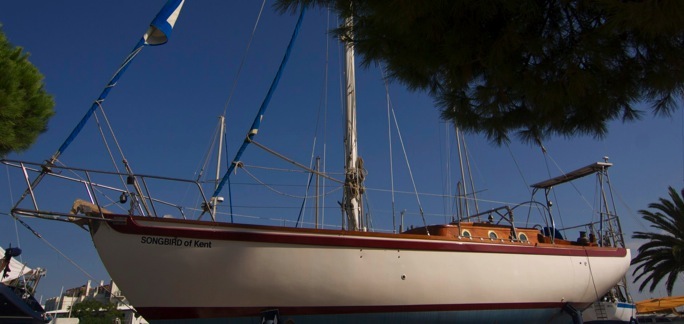
The photograph below is the yacht that I lived on for 5 years, from 1987 though to 1992. My base was Larnaca Marina in the Greek ‘sector’ of the Island of Cyprus although I cruised over much of the Mediterranean during the warm summer months. (Long-term readers, you poor souls, will realise that this isn’t the first time I have spoken of sailing and Tradewinds…)

Songbird of Kent
Tradewind 33 – Songbird of Kent

As I explain over on my ‘author’s’ blog:

During this period Paul became much more aware of the importance of marketing strategy, becoming a Chartered Member of the British Institute of Marketing, and the raft of competencies that deliver entrepreneurial success. In 1986, Paul accepted an offer to sell the Dataview group of companies. (Regrettably, this period also saw the failure of Paul’s marriage to Britta and their subsequent divorce.)

Again, chance intervened in that an Autumn vacation in 1986 to Larnaca in Cyprus resulted in Paul meeting a couple who wanted to sell their yacht, a Tradewind 33, and return to England. Thus very early in 1987, Paul left Essex and became a full-time ‘yachtie’ living on that Tradewind Songbird of Kent in Larnaca marina. Paul was then exposed to the life of an ocean-going sailor returning to Plymouth, Devon via The Azores onboard Songbird of Kent in 1992.

I purchased this Tradewind 33, designed by Englishman John Rock by the way, because somewhere in my soul was a dream to do some solo ocean sailing. Probably inspired by reading too many books written by famous British solo yacht-persons. Such as Robin Knox-Johnston, Chay Blyth, Naomi James, Ellen MacArthur, Pete Goss and the king of them all: Sir Francis Chichester who was the first person ever to sail around the world single-handed.

But it remained a dream for almost all those 5 years. Reason? Because at the start of the summer cruising period each year I slipped out of Larnaca and sailed along the southern coast of Cyprus, up the Western coast and then the open sea crossing to a nearby Turkish harbour, such as Anamur or Alanya. At the end of the summer I would repeat the solo trip in reverse. But I still haven’t said what the core reason was for not being braver and planning a solo ocean voyage.

Because that sailing voyage twice a year, that took me about four days to accomplish, and was undertaken alone, really scared me. I mean scared with a capital ‘S’! For it was impossible to accomplish without many hours of solo sailing at night!

Fast forward a number of years and one day, when I was living on Songbird at Larnaca Marina into the vacant berth next to me came a new visitor to Cyprus. His name was Les Powells and he very quickly explained that he was on his way back to England on his third solo circumnavigation of the world!

imagesInevitably Les and I got chatting over a couple of beers during our evenings together and Les asked me about my sailing ambitions noting that I lived on a yacht that most people purchased for ocean sailing purposes.


I explained my miserable experiences each year going to and fro between Cyprus and Turkey.

Les heard me out and then threw his head back and roared with laughter.

“Paul, what you are experiencing is the adjustment from a land-based life, as in living here in Larnaca, to a water-based life.

I suffer just the same adjustment stress as you have detailed.”

My face conveyed both my amazement and my yearning to learn more.

“Yes, Paul, every time I go to sea solo the first three or four days are hell! I hate them! I only stick with it because there is always a point, (Les really emphasised the word always) usually under a glorious night sky, when I truly become attuned to the life of a solo yachtsman far out from the nearest land and wouldn’t swap it for anything”

“You have to trust this and set out on a solo voyage of more than, preferably much more than, four days sailing.”

Thus in time that’s what happened.

In the Autumn of 1972 I returned to Plymouth in England, via the Azores, sailing solo on Songbird of Kent. Indeed, I was going to republish an article about lighthouses in Oregon but I’m changing tack in mid-stream; so to speak!

I am going to close today’s post by republishing an experience of being alone on the Atlantic Ocean that first graced these blog pages in October 2015. Lighthouses will have to wait.

ooOOoo

There is a place in my mind to which I can so easily travel; a memory of a dark night out in the Atlantic. But first let me set the scene from almost fifty years ago.

The call of the open ocean

Those first few hours were utterly absorbing as I went through the whole business of clearing the yacht harbour at Gibraltar and heading out to the South-West hugging this unfamiliar coastline of Southern Spain. It was tempting to move out to deeper waters but the almost constant flow of large ships through the Straights of Gibraltar soon quashed that idea. Thankfully, the coastal winds were favourable for me and my single-masted sailing yacht.

After such a long time sailing in the relatively confined waters of the Mediterranean, it was difficult for me to imagine that in a few hours time the southern-most point of Spain would pass me by and the vastness of the Atlantic ocean would be my home for the next few weeks.

Soon the city of Tarifa was past my starboard beam and the Spanish coastline was rapidly disappearing away to the North-West. The horizon ahead of me was already approaching 180 degrees of raw, open ocean.  There was just a flicker of a thought that whispered across my mind: “Oh Paul, what have you gone and done” as slowly but persistently the coastlines of Spain to the North and of Africa to the South became more and more distant and fuzzy.  It was at 15:30 that I made an entry in my yacht’s log: “No land in sight in any direction!

Now was the time to make sure that my bunk was made up, flashlights to hand, and my alarm clock ready and set. Alarm clock? Set to go off every twenty minutes during the night! For this was the only way to protect me and my yacht from being hit by one of those gigantic container ships that seemed to be everywhere. It took at least twenty minutes from the moment a ship’s steaming lights appeared above the horizon to crossing one’s path!

It was in the early hours of my first morning alone at sea, when once again the alarm clock had woken me and I was looking around an ocean without a single ship’s light to be seen that more of Les’ words came to me. I remembered asking Les: “What’s the ­appeal of sailing?” Les replied without a moment’s hesitation: “It’s the solitude. When you’re out at sea on your own, there’s no government or bankers to worry about. You’re not ­responsible to anyone but yourself.

Yes, I could sense the solitude that was all around me but it was an intellectual sense not an emotional one. That would come later. Inside, I was still afraid of what I had let myself in for.

Remarkably quickly however, the pattern of solo life aboard a thirty-three-foot yacht became my world. Frankly, it staggered me as to how busy were my days. Feeding myself, navigating, trying to forecast the winds, staying in touch with other yachties via the short-wave radio, keeping the boat tidy and a zillion other tasks meant the first few days and nights just slipped by.

But it was a sight on my fourth night at sea that created the memory that would turn out to remain with me for all my life. The memory that I can go to anytime in my mind.

That fourth night I was already well into the routine of waking to the alarm clock, clipping on my harness as I climbed up the three steps that took me from my cabin into the cockpit, scanning the horizon with my eyes, checking that the self-steering had the boat at the correct angle to the wind and then, if no ships’ lights had been seen, slipping back down into my bunk and sleeping for another twenty minutes. Remarkably, I was not suffering from any long-term tiredness during the day.

It was a little after 3am that fourth night when the alarm clock had me back up in the cockpit once again. Then it struck me.

Songbird was sailing beautifully. There was a steady wind of around ten knots from the south-east, almost a swell-free ocean, and everything set perfectly.  Not a sign of any ship in any direction.

Then I lifted my eyes upwards. There was not a cloud in the night sky, not a single wisp of mist to dim a single one of the million or more stars that were above my head. For on this dark, moonless night, so far removed from any shore-based light pollution, the vastness, yet closeness of the heavens above was simply breath-taking. I was transfixed. Utterly unable to make any rational sense of this night splendour that glittered in every direction in which I gazed. This dome that represented a vastness beyond any meaning other than a reminder of the magic of the universe.

This magic of the heavens above me that came down to touch the horizon in all directions. Such a rare sight to see the twinkling of stars almost touching the starkness of the ocean’s horizon at night. A total marriage of this one planet with the vastness of outer space.

I heard the alarm clock go off again and again next to my bunk down below. But I remained transfixed until there was a very soft lightening of the skyline to the east that announced that another dawn was on its way.

I would never again look up at the stars in a night sky without being transported back to that wonderful night and the memory of a lonely sea and sky.

ooOOoo

Dear, dear Les is still alive and still living on his yacht Solitaire in an English marina. A very close mutual friend, Bob Derham, arranges to visit Les on a very regular basis and take him out for shopping trips and a leisurely pub lunch.

Bob follows this blog and I hope will have the chance to read out today’s post to Les. For my closing sentence is directed to Les, and Les alone: “Dear Les, thank you from the bottom of my heart for the gift you gave me. For it is a rare night when here in rural Oregon when I go outside at the end of the evening and above my head is a clear, black night sky, full of stars, that I am not transported back to that night alone in the Atlantic ocean. I am still rendered speechless in awe of such night skies.”

The deep, dark, wonderful mists of the mind!

The Role of Pets in Depression and Bullying in Kids

Another great guest post from Emily Ridgewell!

Both Emily’s previous guest posts were received very well by you. There was Four-legged Gardening, published here last October 24th, and Return To The Movies that came out on the 4th of that same month.

Now Emily writes about something that is never far away from us these days, irrespective of age: depression. And the strongly positive role of pets. Great guest post but first let me re-introduce you to Emily.

Emily Ridgewell is an arts professional and a pet enthusiast from sunny LA. Emily has a creative energy and an aesthetic sense of living, where everything beautiful is worth sharing. She loves her yorkie Olivia and writes original and fun articles on ways to learn and improve your pet-best friend’s life. She finds exciting new things to explore and experience! Don’t forget to connect with her on Twitter: @ridgewell_j

ooOOoo

The Role of Pets in Depression and Bullying in Kids

Kids today are faced with more stress and worry than ever, and childhood depression is on the rise because of it. Recent studies have shown almost 10% of children and adolescents experience depression. One of the main sources of depression among children is being the victim of bullying. Unfortunately, bullying doesn’t discriminate and can happen to boys and girls of any ethnic, racial, religious, or socio-economic background. Lasting effects of being bullied include having low self-esteem and negative self-image, unhappiness at school and difficulty focusing, and trouble establishing healthy relationships with peers.

Interestingly enough, these side effects are found in the bullies as well as their victims. Both are more likely to experience depressive symptoms than those who have never been involved in bullying. They also are more likely to have coexisting mental health issues, such as Oppositional Defiance Disorder, Attention Deficit Disorder, and Clinical Depression and Anxiety. If left unaddressed, these feeling of depression and low self-worth can lead to chronic levels of mental health issues, isolation, and even suicidal ideation.

The first line of defense for parents is arming themselves with strategies to help their children cope with feelings of depression and address them when they first appear. First and foremost, they need to recognize the signs of depression. Then they need to put their heads together and come up with a plan to help their child combat it. Use resources such as your pediatrician, teachers, and school counselors to help develop a long term plan. In the meantime, one of the most effective and immediate ways to help them at home is by getting a pet.

Pets have several benefits that help combat depression and help your child feel happier, more whole, and well connected. First of all, they offer uncomplicated, unconditional love. They don’t say hurtful things, get angry over petty misunderstandings, or hold grudges. They simply love and express joy every time they see their owners. They also offer constant companionship. Having a pet means never having to feel alone or isolated. Additionally, the act of petting a dog or cat (or any other pet, for that matter) offers physical touch and provides comfort, creating a soothing effect and releasing feel-good endorphins in the brain. In turn, this reduces stress and anxiety and helps your child feel calmer and more emotionally balanced.

Further, having a pet means your child will have an added responsibility. Contrary to what you may originally think, a new responsibility provides a distraction and offers a positive focus instead of what’s bothering him.. Plus, he’ll feel good about himself for taking care of something that needs him. He will feel capable, and this bolsters self-esteem and causes a ripple effect in all aspects of her life. It’s a win-win situation.

If you opt for a dog, part of the responsibilities will be walking it. This earns another point in the fight against depression for a couple of reasons. It will make your child be physically active, a well-known tool for negating depressive symptoms. It also is an excellent way to increase social interaction. People are always wanting to touch a puppy, and this leads to a natural conversation when they ask permission. Even if your child is anxious about talking to new people, dogs and pets are automatic ice breakers. Talking about their pet can easily guide the conversation with very little pressure on your child to generate small talk. If they are engaging in conversation, they are less likely to feel isolated and will benefit mentally from the interaction.

Of course, pet ownership isn’t something you should jump into lightly. Be sure to choose the right pet for your child and teach him the right way to handle and care for it. With care and supervision, your child and her pet will become fast friends in no time. While there is no quick fix for depression, owning a pet has multiple benefits which will show their impact quickly. Having an unconditional friend to love can work wonders for building confidence and self-esteem and combatting the negative effects of bullying and depression.

ooOOoo

Emily is spot on. Pets, especially dogs, are the epitome of loving us humans unconditionally and that connection is precious beyond words. Being able to hug or cuddle a dog, frequently as an ad-hoc impulse, is about as comforting a place that us humans, well certainly this human, can get.

Sitting in front of the television of an evening and having a cat snuggle up next to one and start purring is a very close second-best!

Great post from Emily!

This is home!

It continues to feel very special!

Last Wednesday I was signed off in terms of being over my medical challenge and the good doctor said I was clear to return to driving; I drove home that afternoon from Eugene to Merlin.

I wanted to offer you good people a sense of what being home, more or less compus mentus , feels like.

I offer you this YouTube video.

It is a very beautiful world!

Get lost in one’s dreams!

A very beautiful photograph.

I’m sure I have mentioned previously the fun, education and sheer enjoyment that I, and many, many others, get from the photography forum Ugly Hedgehog.  I drop into the forum several times a day.

Thus it was that yesterday morning I went to an item posted by Kalina. It was called Moonset in Greenland.

This is the photograph that Kalina had shared on the forum:

And how that photograph was described by Kalina.

This is a moon, not a supermoon, not a fancy moon, not even a full moon, just a moon rising outside of Scoresby Sound, Greenland. What a magical place..

Later on, as I was seeking, and being given, permission to share the image with all you good people, Kalina answered my question as to what had brought her to Greenland. Her answer:

I love the absolute raw beauty in Greenland. I was on a schooner built in 1909 sailing through the largest fjord system in the world, words cannot describe the beauty. We never encountered another soul the entire time, there is no evidence of humans..polar bears and musk ox but no people. I will add that this image is not photoshopped..

Just go back to that image and get lost in it.

Get lost in one’s dreams!

Then when you return to your real world, go across to WikiPedia and read more about this magical place. Here’s an extract from that WikiPedia entry.

ooOOoo

Scoresby Sound

Scoresby Sund (Danish: Scoresby Sund, Greenlandic: Kangertittivaq) is a large fjord system of the Greenland Sea on the eastern coast of Greenland. It has a tree-like structure, with a main body approximately 110 km (68 mi)[2] long that branches into a system of fjords covering an area of about 38,000 km2 (14,700 sq mi). The longest of the fjords extends 340–350 km (210-216 mi) inland from the coastline.[1] The depth is 400–600 m (1,310-1,970 ft) in the main basin, but depths increase to up to 1,450 m (4,760 ft) in some fjords.[1] It is one of the largest and longest fjord systems in the world.[3][4][5]

On the northern side of the mouth of the Scoresby Sund stands Ittoqqortoormiit, the only permanent settlement in the region, with a population of 469 (in 2010). The name of the sound honours English explorer William Scoresby, who in 1822 mapped the fjord area in detail.

ooOOoo

Plus wanted to share another photograph of Scoresby Sund taken by Hannes Grobe, seen on that WikiPedia page.

Dr. Hannes Grobe 20:10, 16 December 2007 (UTC) – Own work

More details of Dr. Hannes Grobe may be read here.