Category: Spirituality

The book! Part Five: Forgiveness.

Dogs offer a multitude of examples of forgiveness that many of us probably don’t see. Well, do not see that quality of forgiveness of dogs in such a clear, specific way. Yet think of dogs that are treated cruelly, often over months or years, and then find a new, loving home. Think of dogs that have spent weeks and months in confinement at the local humane centre. Or more terrible to comprehend are those dogs that have simply been abandoned; just thrown away by a so-called human.

We take it totally for granted, when dogs find that new loving home, that they will adjust quickly and easily. For example, one of the dogs that we have here at home is Casey. He was found in the local dog rescue unit down in Payson, Arizona, when we were living in that part of America. Casey had been confined in the dog rescue unit for coming up to a year, and probably hadn’t found a new home because he was a Pit Bull mix, and looked it. Two weeks before he was due to be ‘put down’, classified as being unadoptable, Jean brought him home.

The speed at which he settled in to his new home including, not too much later, a house move from Payson to Southern Oregon, was just wonderful. Casey never for a moment displayed any cautiousness or nervousness towards Jean and me, or, even more importantly, didn’t reveal any anti-social inclinations towards visitors who came to the house. Casey has a wonderful temperament and is a happy, lively, affectionate dog. Clearly, Casey harbours no grudges from past experiences. His forgiveness of the way his life had been dominated by the actions of humans is flawless.

With Payson in mind, there’s another example of how a dog so quickly puts past experiences behind them and embraces their new life.

For in Payson we knew the author, Trish Iles, who has the blog Contemplating Happiness[1]. Here is a lovely story from Trish, in her own words:

What the dog knew!

I was pondering the eternal question: why does two weeks of relaxing vacation seem like so much more time than two weeks of working like my pants are on fire, here at my desk? My sweet husband and I talked about it a little bit, but came to no definitive answer. I chatted with friends about it. No insights. Google had no opinion, either.

Chloe came to us from a rescue organization. I think sometimes about what her experiences have been in her young life. She started out as an abandoned puppy on a reservation in New Mexico and was soon in the pound where she was on the euthanasia list. A kind woman rescued her and took care of her until she found us: just when Chloe was becoming at home with the rescue lady, she was uprooted again and sent home with two new people. What must she have been thinking?

Chloe didn’t close her heart to us, though. She watched for a few days. When she decided we weren’t going to make dinner out of her and that she was really staying with us, she threw her whole being into becoming one of the family. She let herself trust us.

I’m not sure I would have had the courage to trust a new set of people again. I’m doubly not sure that I give a rat’s patootie what those new people thought of or wanted from me. Chloe was willing not only to trust us, but to love us. She forgave us immediately for ripping her from the home she knew, and she adopted us right back.

Chloe was born knowing. She knows about joy. She knows about living a life in balance. She knows about forgiveness, trust, exuberance, a passion for learning and the power of a good nap. I think that when I grow up, I want to be just like her.

Chloe knows about forgiveness.

Moving on. Much too late to make me realise the inadequacies of my own parenting skills, I learnt an important lesson when training Pharaoh, a German Shepherd, who came into my life as a puppy back in 2003; the first dog I had ever had. What I learnt was that putting more emphasis into praise and reward for getting it right ‘trains’ the dog much more quickly than telling it off. The classic example being scolding a dog for running off when instead there should be lots of hugs and praise for the dog returning home. The scolding simply teaches the dog that returning home isn’t pleasant whereas praise reinforces the belief in the dog that home is the place to be. Summed up by a phrase that I read somewhere: “Catch them in the act of doing right!

Like so many things in life, so very obvious once understood! There is no doubt in my mind that this approach, this philosophy, works with youngsters in just the same positive way.

Let’s focus now on the nature of forgiveness in people; in us humans.

There are, essentially, two options that we can choose to act out when we are hurt by someone. We can hang on to those feelings of anger and resentment, and possibly have thoughts of revenge, or respond with forgiveness. The first leads to wounds of anger, bitterness and resentment. The second leads to healing, to the rewards of peace, hope, gratitude and joy.

H’mm – deciding upon the best option could be tough decision! Apologies, I couldn’t avoid that flippancy!

The powerfully positive outcome from acting with forgiveness is that the act that caused the hurt loses, or is denied, any real emotional force upon one. You quickly put it behind you and focus on other, more positive parts of your life. That’s not to say that a significant act of hurt is forgotten, possibly not so for some time, it’s just that it lessens its grip on us, often significantly so. Indeed, quite often, forgiveness can give birth to feelings of understanding, empathy and compassion for the one who hurt us.

Moreover, forgiveness doesn’t mean that you are blind to, or deny, the other person’s responsibility for causing you to be hurt, nor does it minimise, let alone justify, the wrongness of the act. The person can be forgiven, without excusing the act. Forgiveness brings a kind of peace that helps you and I get on with our lives.

Actually, the benefits of forgiveness are even more tangible than the subjective meaning of peace.

There is real evidence to show that the letting go of grudges and bitterness, of offering forgiveness can lead to:

◦ Healthier relationships
◦ Greater spiritual and psychological well-being
◦ Less anxiety, stress and hostility
◦ Lower blood pressure
◦ Fewer symptoms of depression
◦ Stronger immune system
◦ Improved heart health
◦ Higher self-esteem

Beats a few bottles of pills in spades!

Now, as I read back over those last few sentences it struck me as having the slight tone of a Sunday sermon. That what needs to be added to those stirring ideas is how does one learn to forgive, learn to forgive in a practical manner.

Psychotherapists, and others from similar backgrounds, say that forgiveness is the result of change; or more accurately put, a commitment to a process of change.

To put some flesh on the bones of that last idea, that forgiveness is the commitment to a process of change, what now follows are five recommendations. Resist the temptation to read on without pause, indeed just say to yourself that after you have read each of the five recommendations coming up, you will reflect for sufficient time for your head to embrace the meaning of each recommendation, and still remaining paused, give your heart time to engage with your head. I hope that’s clear.

Bring up in your mind an episode where someone else caused you hurt. It can be a recent episode or one from long ago that still has the potential to hurt you. Dwell on it for a while.

So to the first recommendation: Consider the values of forgiveness to you, not at a theoretical level, but to you in terms of where you are at this point in your life, and by implication, how important those values of forgiveness are to you at this given time.

Stop! Look away from the page! Reflect on what that means. Think it with your head, feel it with your heart.

So to number two: Reflect on the situation, the real facts of what happened, how it came about, how you reacted, and to what degree the situation has affected your life, health and well-being; or has the potential to so do.

Stop! Look away from the page! Reflect on what that means. Think it with your head, feel it with your heart.

Here is the third recommendation: Actively choose to forgive the person who hurt you. Possibly by re-reading this chapter down to this point. Actively chose to forgive that person now!

Stop! Look away from the page! Reflect on what that means. Think it with your head, feel it with your heart.

Number four, the penultimate recommendation: Stop seeing yourself as a victim of the hurtful event. Understand that by continuing to feel victimised, you are unable to release the control and power that the offending person, and/or the situation, has over you.

Stop! Look away from the page! Reflect on what that means. Think it with your head, feel it with your heart.

The final recommendation; number five: As you let go of the pain, of the hurt, of your grudges, your life is now no longer defined by how you have been hurt. Better than that, the letting go opens your heart to finding compassion and understanding for the other person.

Think it with your head, feel it with your heart.

There is no question that forgiveness can be challenging at times, especially if the person who’s hurt you doesn’t admit wrong or doesn’t ever speak of his or her sorrow. But never allow yourself to become stuck. Reflect on the times when you have hurt others and when those others have forgiven you. Share your burden of finding forgiveness, such as writing in a journal, or through pray or guided meditation; even better open up to someone you’ve found to be wise and compassionate, such as a spiritual leader, a mental health provider, or an impartial loved one or friend. Nearly forgot: share your burden with your dog! They are such great listeners!

Never forget that finding forgiveness is a process and even small hurts may need to be forgiven over and over again.

In the vast majority of cases, forgiveness can lead to reconciliation. Especially so when the hurtful event involved someone whose relationship you really value; for example someone emotionally close to you. However, there is one case where reconciliation is impossible. That is the case where the person who hurt you has died. However, even if reconciliation isn’t possible, forgiveness always is.

A quick afterthought tells me that there is a second case where reconciliation is impossible: when the person who hurt you refuses to communicate with you. As they say, it takes two to tango, and you always have the choice to walk away, to move on, to reflect that someone who hurts you and then stands in the way of reconciliation may possibly be better off disconnected from you; temporarily or permanently.

Never forget to respect yourself, to keep an open heart and mind and do what seems best for you in the specific situation.

The final thought for this chapter on forgiveness is not to think that it is about the other person needing to change; that isn’t the point of forgiveness. Forgiveness is about us, how it can change our lives through bringing peace, happiness, and emotional and spiritual healing. It also helps, enormously so, in allowing us to recognise our own faults, our own mistakes, and the times when we have hurt others, so that we can offer our apologies in an open and honest manner.

Forgiveness is one of the many precious qualities that we can learn from dogs.

2,036 words Copyright © 2014 Paul Handover

[1] http://contemplatinghappiness.blogspot.com/p/my-books.html

One clever man and his dog!

A reposting of a fascinating item regarding Ra Paulette.

As is the way of our interconnected world, I clicked on a link in a recent post over on Sue Dreamwalker’s blog that then took me to an item on a new blog site from Vision Keeper called World Metamorphosis. The item was about an American, Ra Paulette, who …

The American artist Ra Paulette has spent the last 10 years carving wondrous creations in the walls of a cave located in Northern New Mexico. For many years now, Paulette has walked to work into the hot desert, with only his faithful dog by his side. After much hard work, Paulette has finally allowed the public to view the incredible masterpiece he has been working on all of this time.

It all began with a mile long walk into the wilderness where Paulette discovered the cave. He has since transformed the everyday limestone walls into gorgeous hallways and spaces that are surprisingly full of light. Learn more about the man behind the carvings and check out the magnificent cave artwork here! (Source: Phoenix is Risen)

Caves1


Then it was a ‘hop, skip and a jump’ to go across to Ra Paulette’s website, where one reads such glorious details as:

Process

Process

Manual labor is the foundation of my self expression. To do it well, to do it beautifully, is a “whole-person” activity, engaging mental and emotional strengths as well as physical strength.

When digging and excavating the caves I break down all the movements into their simplest parts and reassemble them into the most efficient patterns and strategies that will accomplish the task while maintaining bodily ease. Like a dancer, I “feel” the body and its movement in a conscious way.

I’m fond of calling this “the dance of digging”, and it is the secret of how this old man can get so much done.

Then words that are more poem than anything else:

The Present

LUMINOUS CAVES
the world within the earth and ourselves

My final and most ambitious project is both an environmental and social art project that uses solitude and the beauty of the natural world to create an experience that fosters spiritual renewal and personal well being. It is a culmination of everything I have learned and dreamed of in creating caves.

A mile walk in the wilderness becomes a pilgrimage journey to a hand dug, elaborately sculpted cave complex illuminated by the sun through multiple tunneled windows. The cave is both a shared ecumenical shrine and an otherworldly venue for presentations and performances designed to address issues of social welfare and the art of well being.

In social art, creating the work of art is not the objective in itself, as in an exhibit, but is a means to bring about social change. The response to the artwork is not merely left to its audience as an endpoint in the process but is an element in a larger encompassing creative process. In the analogy of art being one of the colors on the social artist’s palette, the canvas would be society itself, its social conditions in a particular location. In using the aesthetic to address societal suffering, social art is not content with merely decorating the world; its intent is to change it.

Changing the world is a tall order. Art doesn’t attempt to force change through direct action but to catalyze it by affecting the emotional basis from which change can occur.

Begging the question, “How can we change what we do before we change how we feel?” Its underlying premise is that when through wonder and the sense of beauty we move from the emotional realm of our desires and fears to the more expansive and deeper feelings of thanksgiving and appreciation of life with a sense of its sacredness, our actions will automatically be modified, creating a better world – ‘like magic’.

This is the magic of art, music, theatre, and of the beauty of the natural world. We need for that magic to play a more direct role in our lives.

Please, please read the rest of these wonderful thoughts and ideas

Will close with another photograph of Ra working inside the caves.

Cave2

The book! Part Four: The Brahma Viharas

Time to reflect on the previous five chapters: Of change; Hope; Self-compassion; Goodness; Finding Happiness.

However, it wouldn’t be surprising if my opening sentence didn’t raise the odd question or two. Such as why a chapter that wants to round off the messages of change in thoughts and deeds is entitled The Brahma Viharas? What are the Brahma Viharas?

Let me offer my answers.

Long before I started into this book, I drew up a document that I called a Statement of Purpose (SoP). Writing such a document was prompted by an experienced author who made a link with me when I wrote the draft first half of this book, Part One: Man and Dog, under the umbrella of NaNoWriMo 2013. Or to give the organisation its full name: The National Novel Writing Month. I should explain for those unfamiliar with NaNoWriMo that each November, NaNoWriMo offers budding authors a compelling reason to sit down and write 50,000 words in one month. I should hasten to add that the word Novel is flexible and that non-fiction attempts are equally encouraged. Guess that’s pretty self-evident!

Back to my SoP. The purpose behind such a document is to provide a framework of what it is that you wish to say before plunging headlong in to the writing. My SoP included an Introduction, my intended Reading Audience, the themes of the five Sections and intended chapter headings.

Once I had that documented, I showed it to some close friends seeking reactions and recommendations. I included Jon Lavin. It was Jon who suggested that I include the Brahma Viharas.

As I researched the topic, I was moved by how relevant it was to what I was trying to say. This is what I discovered.

Firstly, from the website of the Brahma Viharas organisation I read this explanation:

The four brahma-viharas represent the most beautiful and hopeful aspects of our human nature. They are mindfulness practices that protect the mind from falling into habitual patterns of reactivity which belie our best intentions.

Also referred to as mind liberating practices, they awaken powerful healing energies which brighten and lift the mind to increasing levels of clarity. As a result, the boundless states of loving-kindness, compassion, appreciative joy and equanimity manifest as forces of purification transforming the turbulent heart into a refuge of calm, focused awareness.

Those two short paragraphs are laden with wonderful ideas, all of which resonated with the theme of Part Four of this book. However, I still was looking for something that spelt out just exactly what are the four brahma-viharas. A further web search brought me to a site described as The Dhamma Encyclopedia and thence to Page Four from where I read: “The four Brahma Viharas are considered by Buddhism to be the four highest emotions. The word brahma literally means ‘highest’ or ‘superior.’

A few sentences later, reading:

The Brahma Viharas are also known as the Four Divine Emotions or The Four Divine Abodes. They are the meditative states, thoughts, and actions to be cultivated in Buddhist meditation. They are the positive emotions and states that are productive and helpful to anyone of any religion or even to the one with no religion. The result will be a very nice and good person, free from hate and ill-will. Those who cultivate the brahma viharas are guaranteed to happiness. Those who further cultivate equanimity, may reach insightful states and wisdom of enlightenment experiences.

The Four Divine Emotions

1. Metta (Loving-kindness)
2. Karuna (Compassion)
3. Mudita (Joy with others)
4. Upekkha (Equanimity)
(from Anguttara Nikaya 3.65)

Loving-kindness, Compassion, Joy with others and Equanimity. A pathway to freedom from hate and ill-will. Who wouldn’t want to journey along such a pathway!

Yet it still didn’t envelope me in the way that I was expecting, so I continued with the research, and came across an essay by a Derek Beres under the title of The Trauma of Everyday Life. The essay had been published on The Big Think website and the opening lines tickled my interest; very much so. But first to find out a little more about the author: Derek Beres.

Derek Beres, a Los Angeles-based journalist and yoga instructor, looks at a range of issues affecting the world’s various spiritual communities in an attempt to sift through hyperbole and find truly universal solutions to prevalent issues facing humanity in the 21st century.

The opening lines of the essay answered an immediate question that was in my mind: “Like all major religions, there exists numerous ideas of what Buddhism is and how to practice it. Perhaps the hardest part about explaining Buddhism is that it’s nowhere near being a religion in the first place.”

Then me immediately warming to: “Rather it is a way of engaging and grappling with yourself and the world you live in, sans metaphysics and dogma.”

The essay then described much of the Buddha’s early days and his quest for a deep, inner meaning to life.

In Derek Beres’ words: “And so the Buddha set off, studying yoga and practicing extreme forms of asceticism, including nearly starving himself in hopes of transcending his body.” This eventually leading him to recognise, “ … trauma as a means of enlightenment, not a hindrance on the spiritual path. Awakening does not mean an end to difficulty; it means a change in the way those difficulties are met.

… a change in the way those difficulties are met.” What better way than that to round off this theme of change in thoughts and deeds. Me wanting to say straightaway that these chapters have been a wonderful pathway of exploration for me and, so too, I hope they have been for you. There can be no doubt in my mind, and I know this is shared by countless others, that the future for mankind, if we continue on the same ways of recent times, is clear and obvious: massive levels of extinction of man and many other higher species.

This is the time for change. Not tomorrow; not some day; but now.

1016 words Copyright 2014: Paul Handover

Maybe this is how it started?

I mean the first meeting between man and wolf.

Again, another long day of hammering away at the keyboard.

One of the items that I incorporated into ‘the book’ was a story told to me back in 2009.  I had forgotten just how wonderful this true story was.

So it is repeated today. You will love it; of that I have no doubt!

oooo

An amazing true story of a relationship between a wild wolf and a man.

This is a story of a particular event in the life of Tim Woods told to me by his brother, DR.  It revolves around the coming together of a man sleeping rough, with his dog, on Mingus Mountain, and a fully grown female Grey Wolf.  Mingus is in the Black Hills mountain range between Cottonwood and Prescott in Arizona, USA.

DR and his brother, Tim, belong to a large family; there are 7 sons and 2 daughters.  Tim had a twin brother, Tom, and DR knew from an early age that Tim was different.

As DR explained,

Tim was much more enlightened than the rest of us.  I remember that Tim and Tom, as twin brothers, could feel each other in almost a mystical manner.  I witnessed Tom grabbing his hand in pain when Tim stuck the point of his knife into his (Tim’s) palm.  Stuff like that!  Tim just saw more of life than most other people.

The incident involving the wolf was when Tim was in his late 40s and, as mentioned, was living in a rough shack on the mountain.  The shack was simply a plywood shelter with an old couch and a few blankets for the cold nights.  The dog was companion, guard and a means of keeping Tim in food; the dog was a great hunter.  But Tim was no stranger to living in the wild.

DR again,

Tim was ex-US Army and a great horseman.  There was a time when he was up in the Superstition Mountains, sleeping rough, riding during the day.  At night Tim would get the horse to lay down and Tim would sleep with his back next to the horse for warmth.

Anyway, Tim was up on Mingus Mountain using an old disk from an agricultural harrow as both a cook-pan and plate.  After he had finished eating, Tim would leave his ‘plate’ outside his shack.  It would be left out in the open over night.

Tim became aware that a creature was coming by and licking the plate clean and so Tim started to leave scraps of food on the plate.  Then one night, Tim was awoken to to the noise of the owner of the ‘tongue’ and saw that it was a large, female gray wolf.

The wolf became a regular visitor and Tim became sure that the wolf, now having been given the name Luna by Tim, was aware that she was being watched by a human.

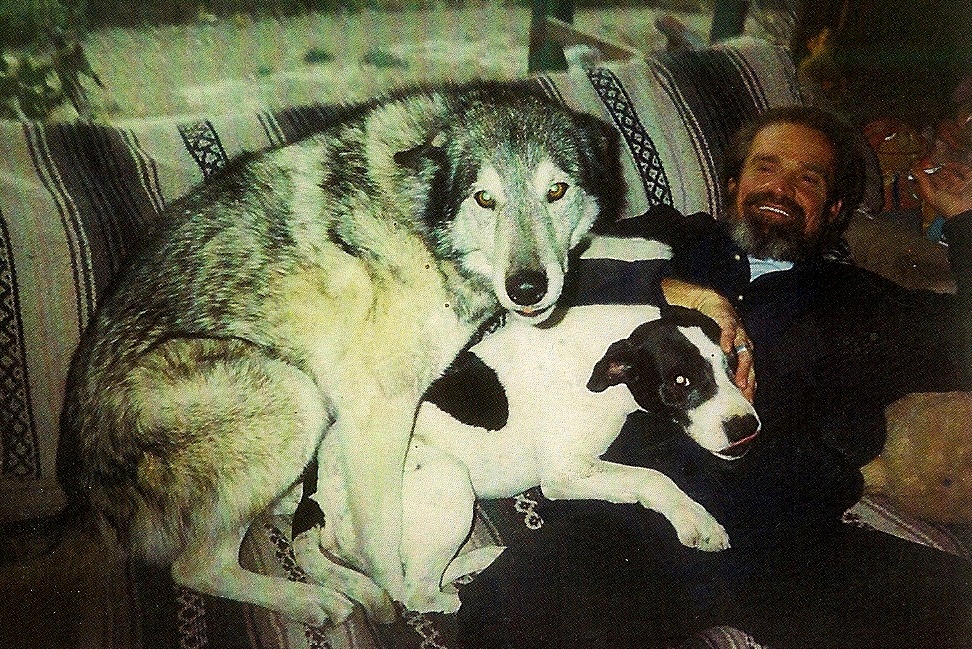
Over many, many months Luna built up sufficient trust in Tim that eventually she would take food from Tim’s outstretched hand.  It was only now a matter of time before Luna started behaving more like a pet dog than the wild wolf that she was.  The photo below is a scan from a traditional photograph and is unaltered.

Luna, the wild wolf, taken in 2006.

From now on, Luna would stay the night with Tim and his dog, keeping watch over them.

DR also recalls,

I remember Tim being distraught because, without warning, Luna stopped coming by. Then a few months later back she was. Tim never did know what lay behind her absence but guessed it might have been because she went off to have pups.

Unfortunately, this wonderful tale does have a sad ending.

About two years ago, Tim lost his dog. He was awakened to hear a pack of coyotes yelping and his dog missing.

Then tragically some 6 months later Tim contracted a gall bladder infection. Slowly it became worse.

By the time he realised that it was sufficiently serious to require medical treatment, it was too late. Despite the best efforts of modern medicine, Tim died on June 25th, 2009, just 51 years young.

So if you are ever out on Mingus Mountain and hear the howl of a wolf, reflect that it could just be poor Luna calling out for her very special man friend.

With very grateful thanks to DR for sharing such a special story.

A small step to inner peace.

That journey towards stillness.

I didn’t intend this to be a theme for the week but sometimes one gives in to the forces of fate!

For after Monday’s post about making that inner journey to better know oneself, itself prompted by Rick Hanson’s Power of Stillness, came yesterday’s post on the power of love between a dog and his elderly owner.

So I was wondering what to write for today and wandering around the web looking for inspiration and, serendipitously, came across the blogsite The Commoner Princess.  I had never heard of it before but there on the home page was a post published on the 21st October: Unlocking inner peace: forgiveness.

Here’s a flavour of that post.

Unlocking inner peace: forgiveness

POSTED ON 21 OCTOBER 2014

What hurts the most in life? Trying to make everybody happy. I think this is one of the ultimate life lessons. I remember having a specific unease when someone close to me wasn’t happy for some reason. Things got even more dramatic when I knew I was the cause in one way or another. Time taught me that this perspective wasn’t exactly the healthier approach to life. It is more than normal to care for the wellbeing of your loved ones, to stand by them in need or to try to have a zen relationship with them at all times. But oh boy, this is one of the hardest things to achieve. Detachment is hard enough when you are not directly involved, but when there are emotional ties, becoming the observer takes a lot of mindfulness, awareness, compassion and most importantly, a loooooot of restraint.

Even better, the post concluded like this:

Here is a beautiful meditation to send love and peace to the entire world. Sit in easy pose or any comfortable position of your choosing. Place your arms against your ribs, forearms in horizontal position, palms facing upwards. Start by taking long deep breaths. Breath in through the nose, exhale through your mouth. You can try the 5-5-5 technique as I call in. 5 seconds breathing in, 5 seconds holding, 5 seconds breathing out. Keep this cycle of breath for as long as you feel comfortable with it or until the end of the meditation.Thank you gabbyb.tv for your teachings.

May this be of service to you all!

Then closed with this video that you have to play in the background as you just think of stillness.

Wonder what tomorrow will bring?

The love of a dog – big time.

As post sequels go, it doesn’t get much better than this!

I was so pleased at how yesterday’s post was received and, serendipitously, the ‘add-ons‘ that appeared as comments to that post.

So how to follow that today?

Chris Snuggs came to the rescue in sending me a link to a recent item in the UK newspaper The Daily Telegraph: Touching moment sick elderly man is reunited with his dog.

Luckily, rather than republish the Telegraph item without permission, the video and background information were over on YouTube.

Here it is:

Watch heart-melting moment stricken patient makes shock recovery after being reunited with pet dog.

Published on Oct 18, 2014

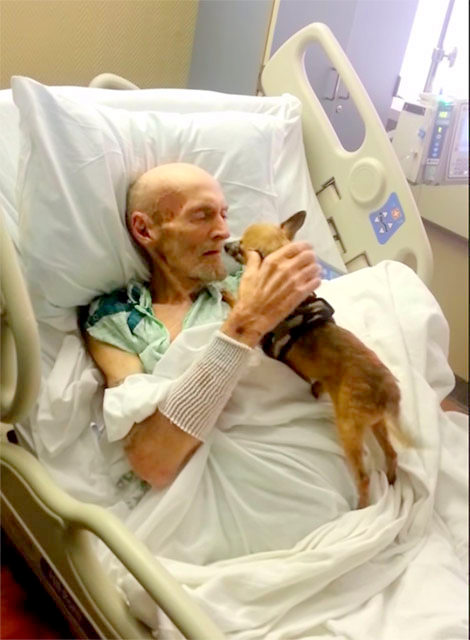
James Wathen, 73, and his beloved one-eyed Chihuahua, Bubba, both stopped eating for six weeks after they were separated.

This is the heartwarming moment a seriously ill elderly patient made a “tremendous recovery” thanks to an emotional reunion with his pet dog.

James Wathen, 73, looked doomed when his condition – related to an unknown illness – deteriorated after six weeks at Baptist Health Corbin hospital in Kentucky.

The pensioner was so ill he could barely speak and had stopped eating.

However, all that changed when he managed to whisper to nurses that he was missing his one-eyed Chihuahua Bubba.

His revelation sparked a desperate search for the beloved dog, which was being kept at the Knox-Whitely Animal Shelter.

Pets are banned at the hospital, but nurses managed to sneak Bubba in and then filmed the emotional reunion.

There wasn’t a dry eye in the room,” the hospital’s chief nursing officer Kimberly Probus told WKTV. In a further twist, Mary-Ann Smyth, from the animal shelter, said the dog had also stopped eating when the pair were separated.

They didn’t think James was going to make it,” she told NBC. “He [Mr Wathen] has done a complete turnaround. He’s speaking, he’s sitting up, he’s eating.

He doesn’t look like the same guy, and the dog is eating and doing better now, too.”

The hospital has allowed Bubba to visit his owner several times since, with staff saying they have both made a “tremendous recovery”.

It’s what this blog is all about. There is no limit to what our dogs offer us; love being at the top of the list.

James Wathen and his beloved dog Bubba.

The one journey we should take before we die.

I’m referring to the journey within.

Last Friday I offered a post under the title of The power of stillness.  It was founded on a recent essay seen in the newsletter called Just One Thing published, freely, by Dr. Rick Hanson.  Here’s the closing paragraph of that essay:

 Wherever you find it, enjoy stillness and let it feed you. It’s a relief from the noise and bustle, a source of clarity and peace. Give yourself the space, the permission, to be still – at least in your mind – amidst those who are busy. To use a traditional saying:

May that which is still
be that in which your mind delights.

There’s a very strong correlation between finding that stillness within and having the self-awareness and peace that comes from knowing who one is.  Seems such an easy ‘walk in the park’ to know ourselves but most times it is far from that.  Many are the ways that we hide who we really are! 😉

However the rewards are everything.  Knowing and liking oneself offers the richest scenery of any journey.

All of which constitutes my way of introducing a truly wonderful poem from Sue Dreamwalker, a great friend of this blog.

ooOOoo

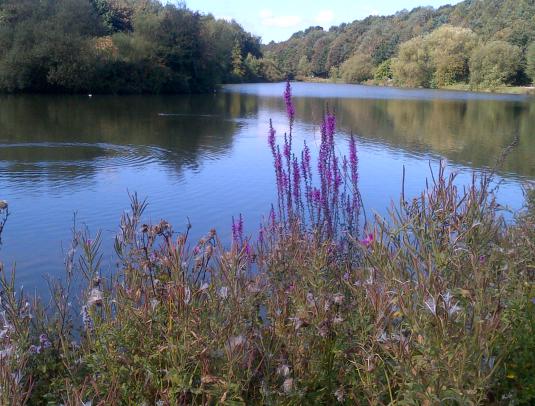
Vicar’s Water. A Sanctuary for wild life.

Journey Within..

Come with me on a journey it starts inside my head

Create a place to dwell from all the Fear and dread

Close your eyes and behind them create a perfect vision

Build a garden full of beauty get ready for your transition

~

Sit upon the grass as sky lark sings above

Hold out your hand to feed the many cooing Doves

See the babbling stream as the young fawn drinks her fill

And listen to the Woodpecker’s distant woodland drill

~

Watch the tiny fishes as the light glistens from their scales

You’re now adrift in the ocean, as you watch the Humpback Whales

You listen to their song a lament as old as time

Each breath takes you deeper as your Spirit begins to climb

~

Now you are on a mountain its top all crisp and white

You fly among the Eagles suspended in effortless flight

Thermals take you higher as you travel within its ring

Higher yet you travel, more peace to feel and bring

~

Through the clouds you break into outer-space you speed

Looking back at a Blue Planet which provided all your needs

Weightless and suspended no longer feeling Form

You fly around the heavens exploring each star born.

~

Filled up now with knowledge no mortal Words could speak

You return back to your garden upon your grassy seat

A new sense of Peace surrounds you as you open up your eyes

You can return in an instant, just open up your mind.

We can travel anywhere we wish when we just close our eyes and allow our mind to relax in a meditation.. Breathe deep and create your perfect space…. The above poem I wrote last week as I recollected part of a meditation.. The view I have included is one taken on a regular walk we often take..Have a fabulous week.

Thank you for Reading

Sue

ooOOoo

What can one say? All that comes to mind is stay on your own journey and never stop enjoying the views.

Is it really the age of loneliness?

Much as I respect Mr. Monbiot’s views, I hope he is wrong in this respect.

I have long admired the writings of George Monbiot and, as often as not, have republished his essays in this place.

But an essay by George that was published in the UK Guardian newspaper yesterday portrays a frightening picture of modern-day Britain.  It was called Falling Apart and is republished, with George’s permission, today.

I want to offer a personal response to the essay, that immediately follows George’s piece.

ooOOoo

Falling Apart

October 14, 2014

Competition and individualism are forcing us into a devastating Age of Loneliness

By George Monbiot, published in the Guardian 15th October 2014

What do we call this time? It’s not the information age: the collapse of popular education movements left a void now filled by marketing and conspiracy theories(1). Like the stone age, iron age and space age, the digital age says plenty about our artefacts but little about society. The anthropocene, in which humans exert a major impact on the biosphere, fails to distinguish this century from the previous twenty. What clear social change marks out our time from those that precede it? To me it’s obvious. This is the Age of Loneliness.

When Thomas Hobbes claimed that in the state of nature, before authority arose to keep us in check, we were engaged in a war “of every man against every man”(2), he could not have been more wrong. We were social creatures from the start, mammalian bees, who depended entirely on each other. The hominims of East Africa could not have survived one night alone. We are shaped, to a greater extent than almost any other species, by contact with others. The age we are entering, in which we exist apart, is unlike any that has gone before.

Three months ago we read that loneliness has become an epidemic among young adults(3). Now we learn that it is just as great an affliction of older people. A study by Independent Age shows that severe loneliness in England blights the lives of 700,000 men and 1.1m women over 50(4), and is rising with astonishing speed.

Ebola is unlikely ever to kill as many people as this disease strikes down. Social isolation is as potent a cause of early death as smoking 15 cigarettes a day(5); loneliness, research suggests, is twice as deadly as obesity(6). Dementia, high blood pressure, alcoholism and accidents – all these, like depression, paranoia, anxiety and suicide, become more prevalent when connections are cut(7,8). We cannot cope alone.

Yes, factories have closed, people travel by car instead of buses, use YouTube rather than the cinema. But these shifts alone fail to explain the speed of our social collapse. These structural changes have been accompanied by a life-denying ideology, which enforces and celebrates our social isolation. The war of every man against every man – competition and individualism in other words – is the religion of our time, justified by a mythology of lone rangers, sole traders, self-starters, self-made men and women, going it alone. For the most social of creatures, who cannot prosper without love, there is now no such thing as society, only heroic individualism. What counts is to win. The rest is collateral damage.

British children no longer aspire to be train drivers or nurses, more than a fifth now say they “just want to be rich”: wealth and fame are the sole ambitions of 40% of those surveyed(9). A government study in June revealed that Britain is the loneliness capital of Europe(10). We are less likely than other Europeans to have close friends or to know our neighbours. Who can be surprised, when everywhere we are urged to fight like stray dogs over a dustbin?

We have changed our language to reflect this shift. Our most cutting insult is loser. We no longer talk about people. Now we call them individuals. So pervasive has this alienating, atomising term become that even the charities fighting loneliness use it to describe the bipedal entities formerly known as human beings(11). We can scarcely complete a sentence without getting personal. Personally speaking (to distinguish myself from a ventriloquist’s dummy), I prefer personal friends to the impersonal variety and personal belongings to the kind that don’t belong to me. Though that’s just my personal preference, otherwise known as my preference.

One of the tragic outcomes of loneliness is that people turn to their televisions for consolation: two-fifths of older people now report that the one-eyed god is their principal company(12). This self-medication enhances the disease. Research by economists at the University of Milan suggests that television helps to drive competitive aspiration(13). It strongly reinforces the income-happiness paradox: the fact that, as national incomes rise, happiness does not rise with them.

Aspiration, which increases with income, ensures that the point of arrival, of sustained satisfaction, retreats before us. The researchers found that those who watch a lot of television derive less satisfaction from a given level of income than those who watch only a little. Television speeds up the hedonic treadmill, forcing us to strive even harder to sustain the same level of satisfaction. You have only to think of the wall-to-wall auctions on daytime TV, Dragon’s Den, the Apprentice and the myriad forms of career-making competition the medium celebrates, the generalised obsession with fame and wealth, the pervasive sense, in watching it, that life is somewhere other than where you are, to see why this might be.

So what’s the point? What do we gain from this war of all against all? Competition drives growth, but growth no longer makes us wealthier. Figures published this week show that while the income of company directors has risen by more than a fifth, wages for the workforce as a whole have fallen in real terms over the past year (14). The bosses now earn – sorry, I mean take – 120 times more than the average full-time worker. (In 2000, it was 47 times). And even if competition did make us richer, it would make us no happier, as the satisfaction derived from a rise in income would be undermined by the aspirational impacts of competition.

The top 1% now own 48% of global wealth(15), but even they aren’t happy. A survey by Boston College of people with an average net worth of $78m found that they too are assailed by anxiety, dissatisfaction and loneliness(16). Many of them reported feeling financially insecure: to reach safe ground, they believed, they would need, on average, about 25% more money. (And if they got it? They’d doubtless need another 25%). One respondent said he wouldn’t get there until he had $1 billion in the bank.

For this we have ripped the natural world apart, degraded our conditions of life, surrendered our freedoms and prospects of contentment to a compulsive, atomising, joyless hedonism, in which, having consumed all else, we start to prey upon ourselves. For this we have destroyed the essence of humanity: our connectedness.

Yes, there are palliatives, clever and delightful schemes like Men in Sheds and Walking Football developed by charities for isolated older people(17). But if we are to break this cycle and come together once more, we must confront the world-eating, flesh-eating system into which we have been forced.

Hobbes’s pre-social condition was a myth. But we are now entering a post-social condition our ancestors would have believed impossible. Our lives are becoming nasty, brutish and long.

http://www.monbiot.com

References:

1. http://www.autodidactproject.org/other/hj1.html

2. http://oregonstate.edu/instruct/phl302/texts/hobbes/leviathan-contents.html

3. http://www.theguardian.com/lifeandstyle/2014/jul/20/loneliness-britains-silent-plague-hurts-young-people-most

4. http://www.independentage.org/isolation-a-growing-issue-among-older-men/

5. http://www.campaigntoendloneliness.org/threat-to-health/

6. http://www.theguardian.com/science/2014/feb/16/loneliness-twice-as-unhealthy-as-obesity-older-people

7. http://www.theguardian.com/lifeandstyle/2014/jul/20/loneliness-britains-silent-plague-hurts-young-people-most

8. http://www.campaigntoendloneliness.org/threat-to-health/

9. http://www.telegraph.co.uk/news/newstopics/howaboutthat/11014591/One-in-five-children-just-want-to-be-rich-when-they-grow-up.html

10. http://www.telegraph.co.uk/news/politics/10909524/Britain-the-loneliness-capital-of-Europe.html

11. http://www.campaigntoendloneliness.org/wp-content/uploads/downloads/2014/05/FINAL-Age-UK-PR-response-02.05.14.pdf

12. http://www.campaigntoendloneliness.org/loneliness-research/

13. http://boa.unimib.it/bitstream/10281/23044/2/Income_Aspirations_Television_and_Happiness.pdf

14. http://www.thetimes.co.uk/tto/news/uk/article4234843.ece

15. http://www.theguardian.com/business/2014/oct/14/richest-1percent-half-global-wealth-credit-suisse-report

16. http://www.theatlantic.com/magazine/archive/2011/04/secret-fears-of-the-super-rich/308419/

17. http://www.independentage.org/isolation-a-growing-issue-among-older-men/

ooOOoo

Our lives are becoming nasty, brutish and long.

As closing sentences go, that’s about as tough as it gets.

Nevertheless, I’m going to offer a perspective, something that George doesn’t mention.  That is the importance of community.

Back in 2008 BBC Timewatch screened a programme about the revelations that came from the latest archaeological dig at Stonehenge, near Amesbury in Wiltshire in England.  I wrote about the programme over four years ago: Stonehenge – a place of healing.

Stonehenge is one of Britain’s most famous historical sites, deservedly so because Stonehenge was one of the most important places in ancient Europe.

Stonehenge

But evidence from a dig that was authorised in 2008 has shown that not only is Stonehenge a much older site of human habitation but that it’s purpose is altogether different to what has been assumed.  It was, indeed, a healing place, possibly the most important in Europe.

Professors Tim Darvill and Geoff Wainwright are the world-renowned archaeologists who believe they have cracked the conundrum of Stonehenge’s original purpose.

If you would like to watch that Timewatch episode, and it is highly recommended, then someone has neatly uploaded it to YouTube.

The programme clearly offers evidence from the carbon-dating of seeds buried under the famous blue stones that dates this settlement to some 9,000 years BP. The detailed examination of ancient humans buried nearby indicates they came to Stonehenge with a range of diseases, many terminal in nature.

So back to George Monbiot’s essay and the element that screams out at me.

We have lost sight of the huge healing benefits that come from old-fashioned, shoulder-to-shoulder communities.

Not to mention the healing properties of a loving dog or two in one’s life!

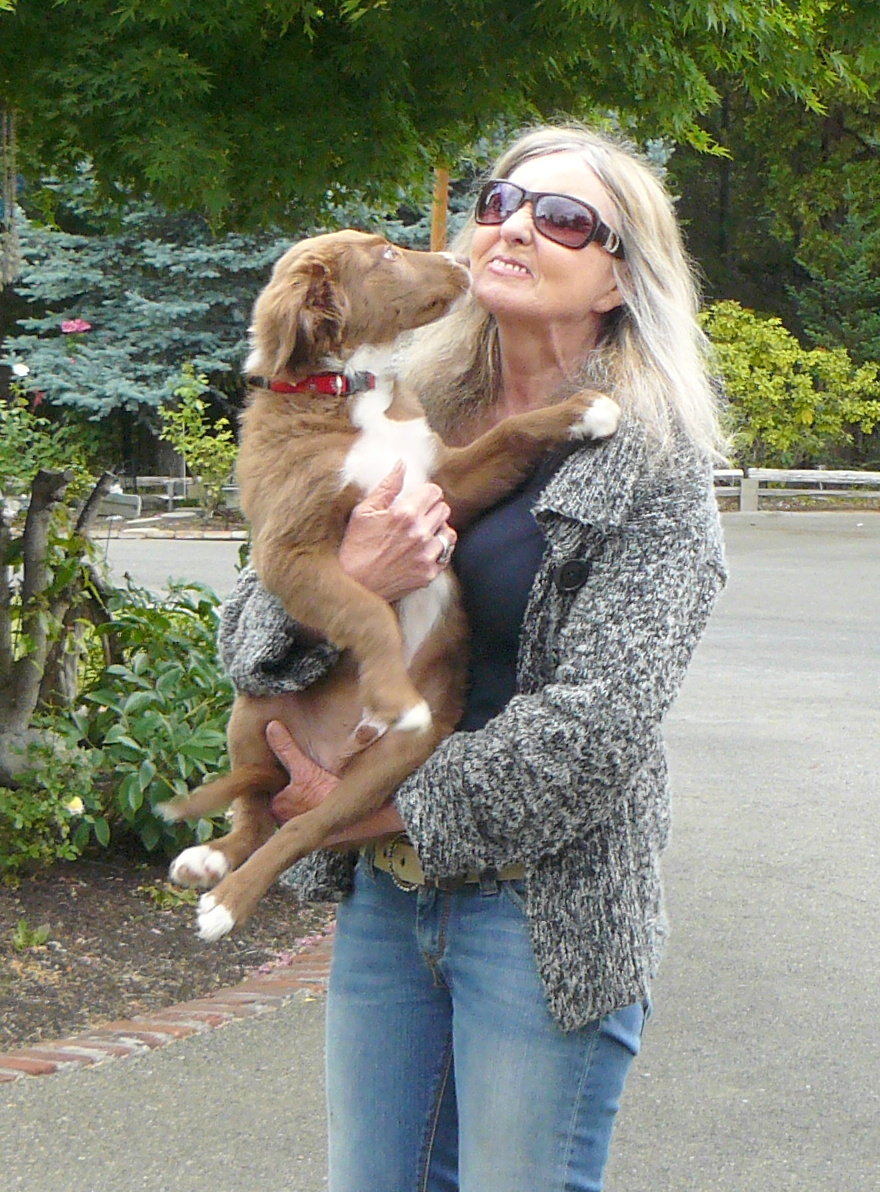
Loving each other: woman and dog!

Never lose sight of what’s really important.

A wonderful message from Sue of Sue Dreamwalker. Reders will recall that last Saturday, under the post title of And we’re back!, I offered a beautiful story told by the coal-mouse bird about the power of change.  It included this sentence: “You see, it takes just one snowflake to make a difference.” In a very real sense, an example of that power of one snowflake was perfectly conveyed in Sue’s post a few days previously. Just read it, republished here with Sue’s blessings, and you will understand.

ooOOoo

illusion-2

Illusion.

What do you see in this Reality?

Do not your eyes view what is real to see?

Can you not touch the tangible fusion?

Or do we gaze into the ethers of illusion,

What trickery mocks us as we take in the lies

Binding our thoughts in roots of indoctrination

Following the herd, bleating like sheep Held captive, half asleep.

What happened to the land of the Free?

Conform or suffer, or pay the penalty

What is your reality?

Come, let me walk you through the misty vale.

To where this illusion significantly pales

We are magnificent magicians whose thoughts cast their magic

Where all is possible, where to doubt is tragic

Seek and Find, let go of fear

Dance in joy as Light penetrates your sphere

For you have forgotten our Time’s lost spell

As into the abyss of darkness you dwell.

Open your eyes and open your hearts.

Let the Light dispel all dark

Fear nothing, hate less, and embrace ALL

Seek a new illusion before you fall.

Stop following blindly, grasp hold of Love today

Remember your tomorrows, forget your yesterdays

Reach for the memory held high up in the stars

And heal from within, let go of all your scars

Sit in the silence; begin to know who you are

As illusion drifts away revealing Ancient Stars

Your time is but a moment, live each moment well,

For soon the illusion shatters, broken like a spell.

© Sue Dreamwalker 2010-2014 All rights reserved.

I resurrected this poem which I published 4 years ago.. As it seems we are bombarded on all sides from the negative energies which are being put out..

Detach and spend some time in your Quiet zones of thought.. Bring in the Peace around you, and know that we are Magnificent BEings who have remarkable powers..

The Power of Thought!

What we Think we Create

We are the ones creating the chaos… So choose to create Peace.. Don’t allow yourselves to get caught up within the Fear being put out..

Know your time is but a moment, Live each moment well

For soon the Illusion shatters,

Broken like a Spell.

Enjoy your week

Blessings

Sue

ooOOoo

Whatever is going on in the world, whatever has the power to create fear in our minds, in the end it comes down to another power, the power of thought, and our choice of the behaviors that we offer the world.

That is why dogs are so important. Because they almost predominantly love sharing and living their lives in the company of humans.

Do you remember when puppy Oliver came to live with us?

Pharaoh, age 88 years in human equivalent, passing on his wisdom to Oliver, age 3 in human terms.
Pharaoh passing on his wisdom to young Oliver.

Another picture of Oliver sitting on the lap of yours truly taken in the last couple of days.

How time passes by! For both of us in the picture!

The real you!

I am delighted to present the following guest post from Ruth Nina Welsh.

We seem to be on a bit of a roll in terms of seeking a better self-understanding.

Last Thursday I offered up some thoughts and reflections on meditation Quietening one’s self down and then the following day presented the film Inner worlds, Outer worlds, the wonderful film by Canadian film maker, musician and meditation teacher Daniel Schmidt. Daniel described his film “as the external reflection of his own adventures in meditation.” (And did you read the fascinating comments by ‘R’?)

Anyway, to today.

I forget how Ruth and I made contact with each other but that’s immaterial to today’s guest post. What is material is that we did make contact and through Ruth’s website I became aware of her talents. In her own words:

BE YOUR OWN COUNSELLOR & COACH shares psychology, memoirs and creativity to help and inspire you to live a happier, more fulfilling and purposeful life.

****

WHO AM I? – I’m a freelance writer, specialising in lifestyle, wellbeing and self-help; a former counsellor & coach and an erstwhile musician. I have a diverse educational Ruth-Profile-Photobackground – with degrees in arts and law – but psychology is my passion. You can find out more about me on my personal site.

  • As a singer-songwriter, I released my debut acoustic album – As I Breathe – in 2000.
  • As a counsellor and coach, I was in private practice from 2008-2011.
  • As a freelancer in the publishing field, I’ve been involved as an editor, formatter, copy-editor, proofreader and I’ve also managed book projects and manuscript submissions.
  • Now, as a freelance writer, I write articles and guest posts, and continue to build this free online self-help resource.

So back to the connection between Ruth and me.

A couple of weeks ago, Ruth asked me if I would like to publish an essay from her.

I read it and replied without hesitation that I would be honoured to publish said essay.

Thus with no further ado here it is. (And do read to the end to be informed about a very generous free offer from Ruth.)

ooOOoo

The Struggle To Be Authentic

Introduction

Of all the challenges we face in life, the struggle to be authentic is a vital one. It’s not always recognised that being authentic – being true to ourselves – is essential for our own wellbeing and happiness. We struggle with authenticity because it’s often hard to reveal the truth about how we feel. And, as strange as it may seem, sometimes we don’t even know how we truly feel. It can be painful and difficult to begin to speak from a place of truth and to unmask hidden feelings which may be covered over by years of denial, trauma and people pleasing.

How we learn to be authentic in childhood

Being authentic and true to ourselves is not innate; it’s something we learn how to do. We learn from those close to us as we grow up. As children we observe our parents, or others who care for us. We notice how truthful and genuine they are. We also learn that there is power in the gap between how we feel and what we actually reveal to others. During our childhood we sometimes find that it can be unwise to say what we honestly feel or think, it can get us into trouble. Bruising judgements from our parents can mean we stay quiet rather than speak up. If a parent constantly criticises and mocks us it’s likely that we’ll modify our behaviour around them. We’ll try to please them and avoid unnecessary pain by saying what they want to hear – even if this is not our own truth. Not being true to ourselves can also follow a traumatic event where we may feel the need to hide our feelings or bury painful grief. All of these things and more mean that, piece by piece, we can lose connection with ourselves and how we truly feel.

The struggle to be authentic in adulthood

As we leave childhood behind us we take the lessons we learn from it into our adult lives. If we felt unable to speak up truthfully when younger then this usually doesn’t change when we become an adult. We can find ourselves unable to speak up within an intimate relationship, downtrodden in our work life and unable to fully connect in our friendships. Over time, if we keep speaking the words only others want to hear – words that are not our own truth – we can lose touch with what we actually feel. We can lose touch with our true selves, our true desires and our true needs and wants. Having been a spokesperson for others for so long we can find ourselves lost and adrift, not knowing how we truly feel about anything, not knowing who we really are. And this can lead us to a treacherous place – living behind a mask, fearing disapproval, and not connecting at a genuine level with anyone. This damaging cycle will continue unless, or until, we see the need for change and realise that being authentic is vital for our own happiness and wellbeing.

Learning to be authentic

It’s difficult to be authentic when this has not been our normal way of being. We may have been used to white lies, outright untruths, or just unconsciously denying our own thoughts and feelings. We may have lived in a family where half-truths and masks were the norm. We may have had to hide our own feelings to survive. This is then our problem: without a template of truth-telling and speaking out in a genuine way, we often struggle to be authentic. We may even have to learn how to be honest and authentic from the bottom up.

Two steps to authenticity

As a starting point, our task is two-fold and can be seen in two distinct steps. Firstly, to find out how we actually feel about things and, secondly, to begin to reveal how we feel to others. This sounds straightforward but doing these two things can be intensely challenging. We are often beaten down by life, our words may have been ridiculed, our self-esteem may be low. We can feel worthless and feel that what we have to say doesn’t matter. If you are in this place, then the most important thing to understand, as a given, is that what you have to say does matter and you have a right to say it. Whatever you have learned in the past and whatever you have been told, know these vital, universal truths:

Each of us has value, has a voice, and we are entitled to speak out and have our own precious, individual opinions heard.

First Step: How do you feel?

With that as your starting point – that your true, individual voice matters – you can begin the first step: to find out how you actually feel. This can be easier said than done. You’ve spoken the words others wanted to hear for so long now that you may not actually know how you genuinely feel. To begin to make inroads into this takes time, an effort of will, and an increase in your own self-awareness. One of the easiest ways to begin this process is to record your thoughts, feelings and opinions down on paper. In a private way, in your own journal, you can start to look and search inside yourself for how you actually feel about things – what you believe, what your opinions are, what you want from life. You can uncover what your own personal likes and dislikes are – not to please others, but to please yourself. With time and patience your awareness will increase and you’ll begin to hear your own inner voice speak out. It may be a whisper at first, but, if nurtured, this will develop. Gradually you will begin to connect with your true self and start to know how you truly feel.

Second Step: Share how you feel

As you begin to know how you feel you can start to embark on the second step on the road to being authentic and true to yourself – revealing and sharing how you feel. You can begin to speak up for yourself and share your own beliefs and opinions. Your voice does not need to be loud or demanding, but with calm authority you can learn to speak out. This can be a difficult process at the beginning but try starting this process by speaking out in safe emotional surroundings. Find friends who are supportive and then begin to honestly and truthfully share your thoughts and feelings with them. As you begin to know how you feel, and start to voice your own opinions, you can create more meaningful relationships. You can connect at a deeper emotional level – from a place of truth and honesty.

Conclusion

It sounds simple, being true to ourselves, but it is a continual struggle and it is fraught with difficulty. Fraught with judgement, disapproval and fear. But the courageous speak out from a place of truth and in doing this they make deep, meaningful and honest connections. This impacts on all parts of a person’s life: from choices made to the quality of relationships enjoyed. Being authentic becomes a way of being, a way of life. With the voice of authenticity comes true connection and it is well worth the struggle it costs us. For if we are just a spokesperson for others, or a mouthpiece for others – fake, in other words – then what value and meaning can we attach to our own lives and to our relationships? And if we are not being true to ourselves and genuinely authentic in our words and deeds then who are we in this world and what is the point of our life?

© 2014 Ruth Nina Welsh

ooOOoo

So to that special offer.

Ruth asked me to include this invitation for all readers of Learning from Dogs.

Simply if you go across to Ruth’s website Be Your Own Counsellor & Coach and sign up as an email subscriber, you will get the free ebook when it becomes available in the autumn!!  The sign-up box is to the top right-hand corner of the home page, just above the following:

Free Ebook For Subscribers – Coming Autumn 2014

RNW ebook

FREE to Subscribers. The first book in my series will be free to subscribers of this site and also available on Amazon as an ebook.

Subscribe above to receive this free book when it becomes available.

oooo

Being authentic?

Do you share your life with a dog?  Learn!