A closer look at the excellent work undertaken by Dr. Krista Varady.
Back on the 16th I wrote a post that was a follow-up to the previous day’s post about living a long life. My follow-up was called, hardly surprisingly, Postscript to Long Life post.
In that follow-up post, I wrote this,
Over on the Healthy Fellow blogsite, there’s an interview with Dr. Varady. The web link of that interview is here and crossing over and reading the full interview is much recommended. Here’s a taste, pardon the pun, of that interview:
JP: Can you help explain the distinctions between alternate day fasting and caloric restriction?
Dr. Varady: Caloric restriction is basically daily calorie restriction where an individual would restrict themselves by about 15% to 40% of their energy needs daily. So basically every single day you’re undergoing the same amount of restriction, whereas alternate day fasting involves a fast day wherein the individual would only eat 25% of their energy needs. So about 500 calories or so and that’s alternated with something called a “feed day” where the individual would eat ad libitum – so as much as they want. However in our studies we show that people end up losing weight because they can’t fully make up for the lack of food on the fast day on the feed day.
I’ve been in touch with JP wondering if I might have permission to republish the full interview. Unfortunately that wasn’t possible. However JP did say that republishing a couple of paragraphs would be fine and I’m going to be cheeky in adding a couple to the one I already published above!
Anyway, before inserting those paragraphs, let me set the scene. A very quick web search comes across the fact that Dr. Varady is an Assistant Professor at the UIC College of Applied Health Sciences. Her research work is described thus,
Research Interests
Dr. Varady, PhD
My research investigates the ability of novel dietary restriction strategies to facilitate weight loss and decrease cardiovascular risk in obese subjects. The most common dietary restriction protocol implemented is daily calorie restriction (CR), which involves reducing energy intake by 15 to 40% of needs daily. Another dietary restriction regimen employed, although far less commonly, is alternate day fasting (ADF). ADF regimens include a “feed day” where food is consumed ad-libitum over 24-h, alternated with a “fast day”, where food intake is partially or completely reduced for 24-h. ADF regimens were created to increase adherence to dietary restriction protocols since these regimens only require energy restriction every other day, rather than every day, as with CR. Recent findings from our lab demonstrate that ADF is an effective means of facilitating weight loss and improving several indicators of cardiovascular disease risk in overweight and obese subjects. Our findings also show that changes in adipose tissue physiology during weight loss may mediate these improvements in vascular health.
Current research activities
Developing novel diet and exercise regimens to facilitate weight loss and decrease cardiovascular disease risk in humans; Examining the intermediate role of adipose tissue in mediating the cardio-protective effects of diet and exercise; Investigating the behavioral factors that influence adherence to dietary restriction strategies.
So this is one lady that ought to understand the effects of what we shovel down our mouths. OK, on to that interview. From Part One, I selected this exchange,
JP: How long does it generally take for people to adapt to this new way of eating?
Dr. Varady: A lot of the subjects were saying that for the first two weeks it was pretty tough to basically change from a 3 meal a day eating pattern to just eating 1 meal a day and then 3 slightly bigger meals the next day. But they said that about after two weeks they totally got used to it and weren’t that hungry on the fast day anymore. They could undergo these really long periods of fasting without really feeling deprived. The other interesting thing that they were telling us was with regard to the feed day. The people didn’t binge. They only ate about 100% to 110% of their calorie needs.
Then from the second part of the interview, JP underlines an important point, “The truth of the matter is that research into ADF is still in its infancy and Dr. Varady is the first person to admit it. ” I then went on to select this exchange between JP and Dr. Varady,
JP: It seems as though ADF provides a very broad array of health benefits. Do you have a theory about why this is possible?
Dr. Varady: In the human data the main thing you see is weight loss. Even if it’s done in normal weight people. The minute you start losing weight you all of a sudden see an improvement in the majority of these factors. A lot of the effects of alternate day fasting are mediated through weight loss. Losing weight is so tightly correlated with your blood pressure, your cholesterol levels and heart rate, etc.
Fasting May Reduce Age-Related Disease Risk Factors
So this is not something of trivial interest, it’s serious research that could have a remarkable effect on the huge problems of obesity and poor diet that affect millions. Do yourself a favour and read the interview now. Part One and Part Two.
Finally, in that post on the 16th, I owned up to having got my weight down to 161.6 lbs (73.30 kgs). Now here we are having completed my third week of 5:2 fasting and last Saturday morning my weight was 159.0 lbs (72.12 kgs). The routine is very comfortable and as Dr. Varady mentioned, there is no sense of wanting to binge after the two days of fasting.
Just about the most fundamental requirement in life!
I subscribe to the Mother Nature Network website and recently in their ’round robin’ was this item, A Breath of Fresh Air. It’s all about the role of plants inside the home for improving the quality of the air we breathe. Thought, dear reader, that you would enjoy this.
15 houseplants for improving indoor air quality
Photo: ivama/Flickr
A breath of fresh air
In the late ’80s, NASA and the Associated Landscape Contractors of America studied houseplants as a way to purify the air in space facilities. They found several plants that filter out common volatile organic compounds (VOCs). Lucky for us the plants can also help clean indoor air on Earth, which is typically far more polluted than outdoor air. Other studies have since been published in the Journal of American Society of Horticultural Science furtherproving the science. Want to see the best flowers? Just click through the buttons above to see all 15 plants. (Text: Julie Knapp)<
The image above is just one of 17, each with details of how they contribute to cleaner, less toxic, air. So don’t delay, click here and read all about them yourself. Here’s an example of the presentation from picture number 16.
Peace lily (Spathiphyllum)
Shade and weekly watering are all the peace lily needs to survive and produce blooms. It topped NASA’s list for removing all three of most common VOCs — formaldehyde, benzeneand trichloroethylene. It can also combat toluene and xylene.
A stark reminder that more of the same will hurt us.
On the 14th August I published a post with the title of From feeling to doing. The post was a 15-minute video presented by David Roberts of Grist showing, in essence, how fundamentally simple was the issue of climate change and how profound the implications if we didn’t halt the rise in the temperature of Planet Earth.
I’m not going to insert that video in this post because you can click on the link above and do that yourself. What I will do is to draw your attention to the accompanying article on Grist under the title of Climate change is simple: We do something or we’re screwed. That article includes the slides that were in the video, such as this one:
So with that in mind, here’s what the BBC published on their news website yesterday morning,
Science advisor warns climate target ‘out the window’
By Pallab Ghosh, Science correspondent, BBC News
One of the Government’s most senior scientific advisors has said that efforts to stop a sharp rise in global temperatures were now unrealistic.
Professor Sir Robert Watson said that the hope of restricting the average temperature rise to 2C was “out the window”.
He said that the rise could be as high as 5C – with dire conseqences.
Professor Watson added the Chancellor, George Osborne, should back efforts to cut the UK’s CO2 emissions.
He said: “I have to look back (on the outcome of sucessive climate change summits) Copenhagen, Cancun and Durban and say that I can’t be overly optimistic.
“To be quite candid the idea of a 2C target is largely out of the window.”
As the BBC points out Professor Watson is a highly respected and world renown scientist on climate change policy and is currently Chief Scientist at the Department for Food and Rural Affairs (DEFRA) and a former Chair of the Intergovernmental Panel on Climate Change. Professor Watson was also with the World Bank and an advisor to former Vice President Al Gore. The BBC item goes on,
Professor Watson, who is due to step down from his role at Defra next month, suggested that the Chancellor, George Osborne, reconsider his opposition to tough measures to reduce carbon dioxide emissions.
Mr Osborne has said that the UK’s ambitious targets for CO2 should be relaxed so as not to drive businesses to countries which have set themselves much lower targets.
“I would say to George Osborne, ‘work with the public sector. Work with the public on behavior change. Let’s demonstrate to the rest of the world that we can make significant progress here” Professor Watson argues that the UK and Germany should continue to take the lead in driving efforts to reach an effective international treaty.
Hurt Poorest
“If we carry on the way we are there is a 50-50 chance that we will get to a 3 degree rise,” he said.
“I wouldn’t rule out a 5 degree world and that would be quite serious for the people of the world especially the poorest. We need more political will than we currently have”.
It shows that the impact on human health, the availability of food and water, the loss of coastlines becomes progressively worse as the average temperature of the planet rises.
The 2C target was agreed at the United Nations Framework Convention on Climate Change meeting in 2010.
The majority of countries though prefer a lower target of 1.5C.
Professor Watson added that deep cuts in CO2 emissions are possible using innovative technologies without harming economic recovery.
“This doesn’t take a revolution in energy technology, an evolution would get us there.”
What I would add to this report that has been widely circulated is that while it’s natural to assume, ‘We need more political will than we currently have‘, that political will flows from the will of the people.
Take the effect of a 4C rise, as David Roberts explains,
Which is described in the Grist article as,
Here’s the edition of the Royal Society journal that came out of the conference on 4 degrees C of warming. Read through it and see if you think “hell on earth” is an exaggeration. Desertification, water shortages, agricultural disruptions, rising sea levels, vanishing coral, tropical forest die-offs, mass species extinctions, oh my. Kevin Anderson, one of the lead scientists involved, was moved to say that “a 4 degrees C future is incompatible with an organized global community, is likely to be beyond ‘adaptation’, is devastating to the majority of ecosystems, and has a high probability of not being stable.”
So come on people, get real! Make sure that the democratic systems work and that our leaders know the sort of change that has to take place. As the wise Professor highlighted, ‘… deep cuts in CO2 emissions are possible using innovative technologies without harming economic recovery.’ Sort of makes sense to me. How about you?
The U.S. leads the world in cutting CO2 emissions — so why aren’t we talking about it?
On the 31st July, I republished a TomGram from William deBuys that showed some pretty frightening aspects of climate change in the South-West USA. Then there was the video on the 10th August, last Friday, that spelt out in very clear ways how the world is in a new, unfamiliar place. It would be so easy to think it’s all going to hell in a handbasket. So a change of tone.
There was an article on Grist by David Roberts about the US leading the world in cutting CO2 emissions. David kindly gave me permission to republish it on Learning from Dogs.
U.S. leads the world in cutting CO2 emissions — so why aren’t we talking about it?
By David RobertsContrary to popular belief, the U.S. is making progress on climate change.We have cut our carbon emissions more than any other country in the world in recent years — 7.7 percent since 2006. U.S. emissions fell 1.9 percent last year and are projected to fall 1.9 percent again this year, which will put us back at 1996 levels. It will not be easy to achieve the reductions Obama promised in Copenhagen — 17 percent (from 2005 levels) by 2020 — but that goal no longer looks out of reach, even in the absence of comprehensive legislation.
Why isn’t this extraordinary story a bigger deal in U.S. politics? You’d think Obama would be boasting about it! Turns out, though, it’s a little awkward for him, since several of the drivers responsible are things for which he can’t (or might not want to) take credit.
Awkward: that whole recession thing
First off there’s the Great Recession, which flattened electricity demand in 2008. It has never recovered — in fact, in part due to 2011′s mild winter, it has even declined slightly:
Click to embiggen.
For obvious reasons, boasting about the environmental benefits of the recession is not something Obama’s eager to do.
Awkward: frack-o-mania
The second big driver is the glut of cheap natural gas, which is currently trading at the 10-year low of about $3 per million British thermal units. This is absolutely crushing coal, the biggest source of CO2 in the electric sector:
The share of U.S. electricity that comes from coal is forecast to fall below 40% for the year, its lowest level since World War II. Four years ago, it was 50%. By the end of this decade, it is likely to be near 30%.
Here’s U.S. electricity generation from 2000-2012. Look how dramatic coal’s recent plunge is:
Click to embiggen.
In April, coal and natural gas both contributed 32 percent to the U.S. electricity mix — equal for the first time since EIA started collecting data in the ’70s. This is, as Alexis Madrigal emphasizes, an extraordinary shift, unprecedented in the history of the U.S. electrical system.
It’s helpful to Obama to be able to point to cheap natural gas when people accuse his EPA of killing coal. And it’s helpful in his effort to claim “all of the above.” But fracking’s potential environmental and health impacts has quickly made it a flash point with his environmental base (and his Hollywood base), so it’s at the very least a fraught subject.
Awkward: Kenyan socialist EPA sharia tyranny
A less significant driver of the switch from coal to natural gas is the EPA’s long overdue rollout of new or tightened clean-air rules on mercury, SO2 and NOx, and CO2. Those rules may do more work later on down the line when/if natural gas prices rise again, but for now the best analysis [PDF] shows that natural gas is doing most of the work killing coal. Nonetheless, EPA regs have proven a source of potent right-wing attacks on Obama and he’s probably not eager to call undue attention to them.
Thus: silence in the political world
So: given the fact that the decline in emissions is driven, at least in the conventional narrative, by an explosion in fossil fuel production, a recession, and a series of EPA regulations, it’s not hard to see why Obama isn’t eager to put it front and center. It’s got a little something for everyone to hate.
And of course the right isn’t eager to talk about it either, since conservative dogma tells us that there’s no way to grow the economy and shrink CO2 emissions at the same time … and yet, uh, that’s what’s happening. At the end of 2012, our economy will be much larger than it was in 1996, yet its carbon emissions will be the same. If conservatives acknowledge that it’s possible to loosen the link between climate pollution and economic growth, they’ll have to explain why we shouldn’t do a whole lot more of it.
Still, while the story has remained largely sub rosa in political media, there are several overlooked details that paint a happier picture than the conventional one above. There’s more to this story than natural gas and recession.
Happy: Coal’s getting its ass kicked by activists
First, it isn’t just natural gas and EPA taking coal out — it’s the kick-ass anti-coal movement! Fighting tooth-and-nail, plant-by-plant, it has blocked new construction and shut down over 100 existing plants.
The campaign has been so disciplined and successful that it’s drawn the support of NYC Mayor Michael Bloomberg, who does not typically invest his own money in feel-good symbolism. He expects accountability and he’s getting it. Like the man said, “Ending coal power production is the right thing to do.”
Happy: Clean energy is happening
Renewable energy still represents a small portion of U.S. electricity generation, but that fact obscures its outsized impact. The U.S. doesn’t need to add a ton of renewables for things to start shaking loose.
Here’s growth over the last decade:
Click to embiggen.
One thing that jumps out is that renewables are growing much faster in some places than others. South Dakota now gets 22 percent of its electricity from wind, Iowa 19 percent. The top two states in total installed wind are Kansas and Texas. The top two for wind jobs are Iowa and Texas. That’s three red states and a deeply purple one — a wedge separating clean energy from the climate culture wars. That portends accelerating changes in the political economy.
Also driving changes in political economy: 29 states and D.C. now have mandatory renewable energy standards.
And renewables don’t have to get that big to start making waves. The sun shines most when the most electricity is being used — “peak demand” — so it serves to sharply reduce peak prices. Turns out that’s where utilities make a lot of their money. U.S. utilities are being forced to crank off coal plants when peak prices drop and then crank them back on afterwards.
It is no fun to turn coal plants on and off — it’s slow, laborious, and kills their economics. More and more, utility managers are turning toward upgraded, smarter grids and more flexible, responsive “mid-load” plants (i.e. natural gas). By hacking off peak prices, renewables will make the dynamics even worse for coal, well before they reach a large proportion of total electricity.
So renewables are a bigger part of this story than they appear, and getting bigger.
Happy: Demand is leveling off long-term
It’s not just the recession that’s bringing down U.S. energy demand — the leveling off of demand is a long-term trend. The U.S. Energy Information Administration (EIA) projects energy use will grow quite slowly through 2035:
Click to embiggen.
And this is almost certainly conservative: EIA doesn’t model policy changes, underestimates the role of technology, ignores rising fossil fuel prices, and is incapable of predicting cultural shifts.
For instance, few projections anticipated the sharp decline in driving in the U.S., which has been driven (ahem) as much by cultural and demographic factors as by economics.
Or consider the dramatic progress in energy use in buildings, which was also not anticipated by EIA. From Architecture 2030 comes this graph, which compares the EIA Annual Energy Outlook (AEO) projections on U.S. building stock from 2005 with the ones from 2012:
Click to embiggen.
The growth in U.S. building stock is slowing (in part — but only in part! — due to the recession), but growth in building energy consumption is dramatically slowing, thanks to advances in energy efficiency technology. EIA now expects CO2 emissions from the building sector to decline by 2035. That’s a pretty big change from going up by over 50 percent!
And that’s just with straight-line projections. If “best available demand technologies” are deployed, it looks like this:
Click to embiggen.
It’s within our reach to reduce the CO2 emissions of the building sector almost 22 percent! Given that building standards are one of the few areas of bipartisan agreement on energy these days, it’s not crazy to think that we’ll get closer to the latter projections than the former.
And the EIA projections for building energy consumption, Architecture 2030 notes, do not incorporate “sustainable planning applications or passive heating and cooling, natural ventilation, daylighting, or spatial configuration and site design strategies,” all of which are gaining in popularity and sophistication.
In short, there’s reason to think the demand-side story is similar to the supply-side story: official projections are dramatically underestimating potential.
Worry, but be happy
To sum up: yes, the explosive growth of natural gas and the Great Recession played a big part in U.S. climate emissions declining in recent years. And either of them could reverse in years to come. But they are not the whole story. There are real transitions underway — seedlings that can be watered and fertilized.
As Brad Plumer notes, America’s modest progress to date still leaves the world on a pathway to climate catastrophe. But it also shows that projections are not destiny. Things can change, and quickly.
Let me just pick out two sentences from near the end, “But they are not the whole story. There are real transitions underway — seedlings that can be watered and fertilized.”
It serves as a very good reminder that many people are voting with their feet, so to speak, and making a difference.
More information about fasting, not about being female!
In yesterday’s post on Learning from Dogs, I wrote that there are two important aspects of living a longer life. The first one was be a female and the second one was about fasting. I propose to expand a little on that second aspect because of the number of people who found the topic so interesting.
Valter D. Longo and students.
In yesterday’s post there was reference to the work that Professor Valter D. Longo of the University of Southern California (USC) has been undertaking. As the USC web reference explains, Valter Longo is the Director of the Longevity Institute, a Professor of Gerontology and Biological Sciences and the Edna Jones Chair of Biogerontology, so if anyone understands how humans tick, it’s likely to be this man! As his research overview states,
He is interested in understanding the mechanisms of aging in organisms ranging from yeast to humans. The focus is on the conserved nutrient signaling pathways that can be modulated to protect against age-dependent oxidative damage and delay or prevent diseases of aging including cancer, diabetes and neurodegenerative diseases.
(Any questions, ask Prof. Longo not me!)
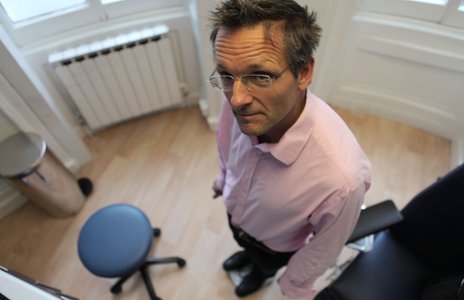
BBC Presenter Michael Mosley with Dr Krista Varady
The other learned person referred to in yesterday’s post was Dr. Krista Varady. This is what was written,
Dr Krista Varady of the University of Illinois at Chicago carried out an eight-week trial comparing two groups of overweight patients on ADF. (ADF = Alternative Day Fasting)
Over on the Healthy Fellow blogsite, there’s an interview with Dr. Varady. The web link of that interview is here and crossing over and reading the full interview is much recommended. Here’s a taste, pardon the pun, of that interview:
JP: Can you help explain the distinctions between alternate day fasting and caloric restriction?
Dr. Varady: Caloric restriction is basically daily calorie restriction where an individual would restrict themselves by about 15% to 40% of their energy needs daily. So basically every single day you’re undergoing the same amount of restriction, whereas alternate day fasting involves a fast day wherein the individual would only eat 25% of their energy needs. So about 500 calories or so and that’s alternated with something called a “feed day” where the individual would eat ad libitum – so as much as they want. However in our studies we show that people end up losing weight because they can’t fully make up for the lack of food on the fast day on the feed day.
Let me add a personal perspective on this. On the morning of the first day after our two-day fast, my weight was 162.5 lbs (73.71 kg), on the morning of the second day after our fasting days my weight was 161.8 lbs (73.39 kgs) and on the morning of the third day after our fasting, my weight was 161.6 lbs (73.30 kgs). Ergo even though we were back to eating normally for three days after our two days of fasting, I continued to lose 0.9 lbs (0.4 kgs).
So if you have any concerns over cardiovascular health or want to explore a realistic way of losing excess weight, then do read the interview. Part One of that interview is here and Part two here.
As is said, we are what we eat and I shall close this postscript with a link to an article on the Mother Nature Network website that was published a little over a year ago: 18 foods that fight common ailments – Try healthy eats that help fight diabetes, heart disease, migraines and more.
OK, a change to the theme of the last few days, to a topic that must cross the minds of practically every single human being at some point; what is our lifespan going to be? Who doesn’t want to live a long and healthy life, and I don’t wish to be insensitive to those who labour under mental and physical troubles, of course.
So a recent couple of fascinating stories have given an insight into just how to live that longer and healthier life.
The first one is easy – be a woman!
Actress Michelle Ryan as the Bionic Woman was destined to live even longer!
OK, a bit of an issue if you are a man like me but did you realise, because I didn’t, that being the female of many species offers a significant advantage. This came from a BBC item published on the 2nd August, from which I quote,
Scientists believe they have discovered a clue to why women tend to live longer than men – by studying fruit flies.
Writing in Current Biology, they focus on mutations in mitochondrial DNA – the power source of cells.
Mitochondria are inherited only from mothers, never from fathers, so there is no way to weed out mutations that damage a male’s prospects.
Then came an extraordinary fact [my italics below],
By the age of 85, there are approximately six women for every four men in the UK, and by 100 the ratio is more than two to one.
And females outlive males in many other species.
If you are of the scientific bent and/or a woman! you can read a fuller account of the research findings on the Science Daily website. As well as that link you can also read the Monash University press release on those research findings.
As a fella’ I think I’m moving on!
The second one is almost as easy – Fasting
Again, this news came from the BBC website, the news about the power of fasting. In an article promoting the showing of a BBC Horizon programme, Michael Mosley wrote this,
Scientists are uncovering evidence that short periods of fasting, if properly controlled, could achieve a number of health benefits, as well as potentially helping the overweight, as Michael Mosley discovered.
I’d always thought of fasting as something unpleasant, with no obvious long term benefits. So when I was asked to make a documentary that would involve me going without food, I was not keen as I was sure I would not enjoy it.
But the Horizon editor assured me there was great new science and that I might see some dramatic improvements to my body. So, of course, I said, “yes”.
I am not strong-willed enough to diet over the long term, but I am extremely interested in the reasons why eating less might lead to increased life span, particularly as scientists think it may be possible to get the benefits without the pain.
For obvious reasons I can’t republish the full BBC article but I encourage you to read it here. And stay with me for some more research links that are most interesting.
But I will just include this part from the BBC item,
The IGF-1 hormone (insulin-like growth factor) is one of the drivers which keep our bodies in go-go mode, with cells driven to reproduce. This is fine when you are growing, but not so good later in life.
There is now evidence suggesting that IGF-1 levels can be lowered by what you eat. Studies on calorie restrictors suggest that eating less helps, but it is not enough.
As well as cutting calories you have to cut your protein intake. Not entirely – that would be a very bad idea. It’s about sticking to recommended guidelines, something most of us fail to do.
The reason seems to be that when our bodies no longer have access to food they switch from “growth mode” to “repair mode”.
As levels of the IGF-1 hormone drop, a number of repair genes appear to get switched on according to ongoing research by Professor Valter Longo of the University of Southern California.
Intermittent fasting
One area of current research into diet is Alternate Day fasting (ADF), involving eating what you want one day, then a very restricted diet (fewer than 600 calories) the next, and most surprisingly, it does not seem to matter that much what you eat on non-fast days.
Dr Krista Varady of the University of Illinois at Chicago carried out an eight-week trial comparing two groups of overweight patients on ADF.
“If you were sticking to your fast days, then in terms of cardiovascular disease risk, it didn’t seem to matter if you were eating a high-fat or low-fat diet on your feed (non-fast) days,” she said.
Michael Mosley explains how he couldn’t manage Alternate Day Fasting and found it was just too impractical.
Instead I did an easier version, the so-called 5:2 diet. As the name implies you eat normally 5 days a week, then two days a week you eat 500 calories if you are a woman, or 600 calories, if you are a man.
The BBC Horizon programme was screened on the 6th August but is available on the BBC iPlayer for UK viewers. Here’s how it was promoted on the BBC website,
Michael Mosley has set himself a truly ambitious goal: he wants to live longer, stay younger and lose weight in the bargain. And he wants to make as few changes to his life as possible along the way. He discovers the powerful new science behind the ancient idea of fasting, and he thinks he’s found a way of doing it that still allows him to enjoy his food. Michael tests out the science of fasting on himself – with life-changing results.
This programme clip will also attract your attention, trust me!
and if you would prefer a more inspiring antidote then here’s another clip from the programme,
Tomorrow, I’m going to link to the scientists behind these new findings because this is very significant research that could revolutionize the future health for millions.
Finally, I’m here to tell you that Jean and I have ‘signed up’ to the 5:2 pattern and had our fast days last Thursday and Friday. They were much easier than I expected and, frankly, will be fun to maintain. Leave a comment if you would like details of the food and calorific values of what Jean served those two days.
Raise your eyes in wonder at the most wonderful annual show from space.
A Perseid meteor streaks across the sky in this Aug. 12, 2008 photo near Rogers Spring in the Lake Mead National Recreation Area in Nevada. (Ethan Miller/Getty Images)
As of August 8, 2012, the zenithal hourly rate (ZHR) of meteors visible in a dark sky has gone up to 21! That’s according to the International Meteor Organization. Clearly the Perseid meteor shower is rising to its peak, as it does every year at this time.
The peak mornings will be August 11, 12 and 13. August 12 might be the best morning. August 11 might be better than August 13. The moon is waning now. And many people are seeing meteors!
The Delta Aquarid and Perseid meteor showers combine in late July and August to create what most consider the best and most reliable meteor display for Northern Hemisphere observers. As always, after midnight is the best time for meteor-watching. The moon will be there, but getting thinner every morning. On the mornings (not the evenings) of August 11, 12 and 13, the moon will be a waning crescent, and the meteors should be flying at a rate closer to their peak of 50 or 60 meteors per hour. As an added treat – on August 11, 12 and 13 – the moon will be sweeping past the brightest planets Venus and Jupiter in the eastern predawn sky. You can’t ask for more!
Well you could ask for more and there is more on that very helpful website, ergo:
August 10/11, 11/12, and 12/13, 2012 Perseids
Meteors are typically best after midnight, but in 2012, with the moon rising into the predawn sky, you might want to watch for Perseid meteors in late evening as well. You can get moonrise times via this custom sunset calendar. As seen from around the world, the waning crescent moon will rise later on August 12 than on August 11, and, on the morning of August 13, although you’re slightly past the peak, the moon will rise later still.
On any of those mornings, moonlight shouldn’t be so overwhelming as to ruin the show. Plus the moon on those mornings will be near the bright planets Venus and Jupiter in the eastern predawn sky. It’ll be a beautiful early morning scene.
The Perseids are typically fast and bright meteors. They radiate from a point in the constellation Perseus the Hero. You don’t need to know Perseus to watch the shower because the meteors appear in all parts of the sky. The Perseids are considered by many people to be the year’s best shower, and often peak at 50 or more meteors per hour in a dark sky.
The Perseids tend to strengthen in number as late night deepens into midnight, and typically produce the most meteors in the wee hours before dawn. These meteors are often bright and frequently leave persistent trains.
Starting in late evening on the nights of August 10/11, 11/12 and 12/13, the Perseid meteors will streak across these short summer nights from late night until dawn, with only a little interference from the waning crescent moon. Plus the moon will be near the bright planets Venus and Jupiter in the eastern predawn sky.
Finally, here’s some fabulously helpful information on the NASA website:
NASA Chat: Stay ‘Up All Night’ to Watch the Perseids!
Escape the heat of the waning days of summer for an evening of sky watching. The Perseid meteor shower peaks on the night of August 11 through the morning of August 12. Perseid rates can get as high as 100 per hour, with many fireballs visible in the night sky. A waning crescent moon will interfere slightly with this year’s show, but viewing should definitely be worth a look!
On the night of Aug. 11-12, astronomer Bill Cooke and his team from the Meteoroid Environment Office at NASA’s Marshall Space Flight Center will answer your questions about the 2012 Perseid meteor shower via an “Up All Night” live chat. To join the chat, simply return to this page and log in. The chat experts will be available to answer questions between the hours of 11 p.m. – 3 a.m. EDT, beginning the evening of Aug. 11 and continuing into the morning of Aug. 12.
Watch the Perseids! Live Video/Audio Feed
On the night of Aug. 11, a live video/audio feed of the Perseid shower will be embedded below (go to here). The camera is mounted at NASA’s Marshall Space Flight Center in Huntsville, Ala. During daylight, you’ll see a dark gray box — the camera is light-activated and will turn on at dusk. At night you’ll see white points, or stars, on a black background.
About the Perseids
The Perseids have been observed for at least 2,000 years and are associated with the comet Swift-Tuttle, which orbits the sun once every 133 years. Each year in August, the Earth passes through a cloud of the comet’s debris. These bits of ice and dust — most over 1,000 years old — burn up in the Earth’s atmosphere to create one of the best meteor showers of the year. The Perseids can be seen all over the sky, but the best viewing opportunities will be across the northern hemisphere. Those with sharp eyes will see that the meteors radiate from the direction of the constellation Perseus.
A futile attempt to explore the concepts of truth, reason, craziness and … (I give up!)
Can’t make sense of this?
Yesterday, I republished an article that Pete Aleshire recently wrote in the Payson Roundup, our local newspaper, on thinking outside the box. Pete entitled his essay, Strange theory reveals secrets of the universe, the logic of sycamore leaves and why even smart people struggle with new ideas.
And it was part of that title that resonated with a mind-bending (literally) essay that Patrice Ayme presented on his blog on the 27th July. The part of the title that ‘clicked’ with me was “why even smart people struggle with new ideas.”
You see what Patrice wrote about on the 27th July was about the proposition “that superior intelligence in a species can only come from an ability to engineer (productive) craziness.”
As Patrice explained,
Two of the creators of modern mathematics and metamathematics, Georg Cantor and Kurt Godel, experienced some craziness. Nietzsche produced some of his best work before he went insane. Van Gogh experienced serious mental difficulties. Bolztman killed himself. All these cases were within a generation. Those may all be unrelated accidents, sure.
Immediately leading on to him writing,
However I will show below that superior intelligence in a species can only come from an ability to engineer (productive) craziness. (Perhaps the reason why chimps and bears are so unpredictable: they are not just clever, but a bit crazy!)
Then after some very detailed reflections on man, Patrice wrote,
Hominids who practiced a bit of craziness were evolutionary advantaged, because they found more readily solutions to logical incompleteness at hand. Craziness allowed to find new, necessary axioms. Thus evolution learned to exploit logical incompleteness.
Typical of Patrice Ayme, the essay is not an easy read but it is brim full of fascinating ideas and well worth the effort. Patrice concludes,
If craziness is so useful to augment those mental powers we need so much to survive as a civilization, how do we survive it? Precisely by augmenting the truth. Thus only craziness compatible with the truth will be able to survive. That is why I have not hesitated to tell various truths about Obama (whom I have intensely supported in all sorts of ways), or Hollande, whom I approved of, until he started to say lies about World War Two (details soon to come).
Truth is my religion. A touch of craziness my sanity. (Latest demonstration: It’s not like I did not know of the danger in advance. I was slightly charged by a large bad mood moose with calf today on an Alaskan trail, where I was nonchalantly running with a bad ankle; after a high speed retreat, as a good predator, I circumvented the difficulty, and anxiety switched sides, the calf nearly spraining its own ankle in the process… . )
There is no truth but the full truth, and a touch of craziness is its prophet.
Now go back to Pete Aleshire and see the harmony between his beautiful prose and the fascinating ideas flowing from Patrice’s mind. This is how Pete concluded his essay,
So Drake [Larson] and I spent the day wandering along the banks of Fossil Creek as he kept trying to come up with metaphors so I could grasp math’s secret within the beauty of Fossil Creek’s sycamore leaves. The well-designed sycamore leaves adhere to the Fibonacci sequence, a mysterious progression of numbers that crops up throughout nature — from the spiral of a nautilus shell to the layout of the ruins of Chaco Canyon.
So I figured I’d just write this — and get earth’s 17 PSI cap for dark energy out there in the time/date/ stamped world.
Oh, yeah: And about Kenny Evans. [Mayor of Payson, AZ]
So that night, I took Drake to the Payson council meeting. Turns out, Drake’s family was growing grapes in the Coachella Valley at the same time Evans was farming 10,000 acres in Yuma. They both managed to survive that tempestuous time when the United Farm Workers union organized agriculture workers.
I introduced them and listened as they recalled events and figured out whom they knew in common.
It was then that I decided to blame Drake for my faith in Evans’ ridiculous conviction that a university will build a campus here in this itty bitty tourist town — complete with a research center and convention hotel. No sensible small-town mayor would risk public ridicule while spending thousands of hours on such an outside-the-box notion … unless he’d learned to gamble on dreams and hard work during all those years as a farmer.
Evans’ notion is almost as silly as a farmer who calculates the amount of dark energy emanating from earth, while credentialed experts scratch their collective heads.
Still, I’m thinking maybe I’ll get a nice suit jacket — something I can wear to both the university’s groundbreaking and the ceremonies in Oslo.
Hey, never hurts to be prepared.
So there, I feel much better now! None the wiser, indeed even more confused, but just grateful there are some out there who have a go at trying to explain ….. whatever it is they are explaining!
Strange theory reveals secrets of the universe, the logic of sycamore leaves and why even smart people struggle with new ideas.
A guest post from Pete Aleshire, Editor, Payson Roundup.
Introduction
The Payson Roundup is our local newspaper here in Payson, AZ. I first saw this article by Pete a couple of weeks ago and was just utterly engrossed by it. Not just the tantalising peek into a physics I know so little about but the beautiful prose. The latter is not surprising because as well as being editor of the paper, Pete also teaches the creative writing course at our local college. Jean and I had the benefit of attending the course, I guess about a year ago, and therefore can speak from experience.
So settle down and enjoy.
oooOOOooo
I finally got Drake Larson together with both sycamore leaves and Payson Mayor Kenny Evans. Moreover, I have been entrusted with a formula that may win me an invitation to Oslo if Drake gets a Nobel Prize.
But even if that don’t work out, I did get to eavesdrop on Drake and Evans. Quite the event, from my bemused point of view, since it shed light on dangerous delights of outside-the-box thinking and the Nature of the Universe.
But wait. You look confused.
Let me back up — and start somewhere closer to the beginning. Be patient with me — by the time we’re done, you’ll realize why God’s a math nerd, one surprising secret of Dark Energy, why farmers become original thinkers and what sycamore leaves tell us about the universe.
But first, I have to explain about Drake.
We grew up together, getting into (and mostly out of) various varieties of trouble. Very early on, I realized that he was much (much) smarter than me. This initially really irritated me, as I was previously inclined to vanity about my intelligence. Turns out, I love learning stuff other people have discovered, but Drake only gets truly excited when he has hold of a completely new idea that no one else can quite grasp. This prepared me, as it turns out, for meeting Kenny Evans — but that’s getting ahead of the story.
Drake and I grew up doing math homework together, before I wandered off into a career in newspapers. He got his degree in mathematics, turned down a job with the RAND Corporation and took up growing table grapes.
But he never quit picking at the lock of the universe.
Years ago when I was the science writer for the Oakland Tribune, he came to me all excited about a set of formulas he had. I did my best to follow the two pages of calculations, but all I can tell you is that they described instabilities of any sphere with uniform density. He predicted that when the Voyager spacecraft reached Jupiter, it would report inexplicable turbulence at a certain depth in the atmosphere. I ran his numbers past various top-level physicists and mathematicians who couldn’t find a flaw in his formulas — but concluded that it had to be wrong since it led to a violation of the keystone laws of conservation of mass and energy.
But I took note some months later when the Voyager spacecraft reported mysterious levels of turbulence deep within the atmosphere of Jupiter.
The years passed. Drake kept growing grapes, flowers, dates and vegetables — and working on his calculations. He wrote a book, “The Cults of Relativity,” in which he described a few of his theories, delighted in the conundrums of mathematics and pondered the curious resistance of even smart people to unconventional ideas.
We got together again recently. I took him down to Fossil Creek, all overhung with sycamores with the rustle of floppy, five-pointed leaves. Drake was his old self on our Fossil Creek tour as he tried to show me math’s beauty around us, although I was but a blind man clutching the tail of his mathematical elephant.
He had now connected his formulas to dark energy, a still hypothetical form of energy invoked by desperate cosmologists to explain the startling observation that the expansion of the universe is actually accelerating. To explain this seeming impossibility, they invented “dark energy” — which they figure pervades the universe and at certain densities creates a repulsive force stronger than the attractive force of gravity.
Anyhow, here’s the point: Drake was in awe that his mathematical wanderings offered a way to calculate dark energy’s cap within earth — it happened to be an “inside is now outside” inversion of Isaac Newton’s simplest integral. No. Please. Don’t ask me to explain that. But earth’s dark energy cannot exceed 17 pounds per square inch at a depth of about 1,500 miles. He’s been working with University of Southern California computer crunching guru professor Barry Boehm, and the University of California at Riverside geophysics professor Shawn Biehler on its implications. Among other things, it could explain the perplexing observation that major earthquakes increase the earth’s rotation rate.
No one knows how to measure such a quantity at present. Someday they will. If it turns out that 17 pounds per square inch is a relevant benchmark for earth’s dark energy, then this column will maybe win Drake the Nobel — and I’ll get to dress up and attend the ceremony.
So Drake and I spent the day wandering along the banks of Fossil Creek as he kept trying to come up with metaphors so I could grasp math’s secret within the beauty of Fossil Creek’s sycamore leaves. The well-designed sycamore leaves adhere to the Fibonacci sequence, a mysterious progression of numbers that crops up throughout nature — from the spiral of a nautilus shell to the layout of the ruins of Chaco Canyon.
So I figured I’d just write this — and get earth’s 17 PSI cap for dark energy out there in the time/date/ stamped world.
Oh, yeah: And about Kenny Evans.
So that night, I took Drake to the Payson council meeting. Turns out, Drake’s family was growing grapes in the Coachella Valley at the same time Evans was farming 10,000 acres in Yuma. They both managed to survive that tempestuous time when the United Farm Workers union organized agriculture workers.
I introduced them and listened as they recalled events and figured out whom they knew in common.
It was then that I decided to blame Drake for my faith in Evans’ ridiculous conviction that a university will build a campus here in this itty bitty tourist town — complete with a research center and convention hotel. No sensible small-town mayor would risk public ridicule while spending thousands of hours on such an outside-the-box notion … unless he’d learned to gamble on dreams and hard work during all those years as a farmer.
Evans’ notion is almost as silly as a farmer who calculates the amount of dark energy emanating from earth, while credentialed experts scratch their collective heads.
Still, I’m thinking maybe I’ll get a nice suit jacket — something I can wear to both the university’s groundbreaking and the ceremonies in Oslo.
Hey, never hurts to be prepared.
oooOOOooo
A big thank-you for the permission to republish this on Learning from Dogs. I have no doubt that many LfD readers enjoyed it as much as I did! Stay with me for tomorrow when the theme of thinking, innovation and craziness is explored a touch more.
I’m writing this as 5.40 am on the 6th. I let our ‘bedroom’ dogs out for their early-morning pee some 20 minutes ago and then jumped back in bed, turned on my Kindle and went to the BBC News website. There I read,
Nasa’s Curiosity rover successfully lands on Mars
The US space agency has just landed a huge new robot rover on Mars.
It will now embark on a mission of at least two years to look for evidence that Mars may once have supported life.
A signal confirming the rover was on the ground safely was relayed to Earth via Nasa’s Odyssey satellite, which is in orbit around the Red Planet.
The success was greeted with a roar of approval here at mission control at the Jet Propulsion Laboratory (JPL) in Pasadena, California.
As David Shukman, Science Editor of the BBC, wrote,
The day I watched Curiosity being built in a clean room at Nasa’s Jet Propulsion Laboratory in Pasadena last year, the rover’s six wheels were lying on one work bench while the chassis stood on another and it was hard to believe the white-suited engineers could make sense of the maze of tubes and cabling.
But what they’ve created now stands on the red soil of Mars – and it’s in one piece. In the hallway of a JPL building we were shown a full-size replica. Walking around it made me realise something difficult to grasp from the pictures and video: this is a beast of a machine, a kind of cosmic Humvee with instruments instead of weapons.
Sometimes Nasa public relations can appear bragging. Today it feels justified. Curiosity is all set to discover something remarkable about our strangest neighbour.
Well said and people from all around the world will echo those sentiments.
When I read what Patrice wrote in my Setting the scene post not so many hours ago,
Well, OK, keeping my fingers, and even my arms, crossed here. Seems to me the “sky crane” is over-complex, and I was not reassured when one of the physicist-engineers boasted that they had run the landing millions of time on simulator. Yeap, OK, how many times for real in Earth’s gravity?
I don’t see why they could not have landed normally, LEM style. Especially as they have wheels and could have rolled away to find undistrubed land.
There are no back-ups…
OK, let’s hope I’m wrong to be suspicious…
PA
I instinctively agreed and hoped his worries were misplaced. They were! The Curiosity rover is down! Good luck to the Rover and all those who made it possible. Well done, the team!





 By Pallab Ghosh, Science correspondent, BBC News









 Learning from Dogs