Category: Science

Food, agriculture, and our climate.

Locavore or vegetarian? What’s the best way to reduce climate impact of food?

With Thanksgiving Day just behind us and Christmas just around the corner, this is the season of feasting.

Just last Monday I published an essay written by George Monbiot, Pregnant Silence, that highlighted the impact on our climate of modern food production. Here are a couple of paragraphs from that essay:

Freshwater life is being wiped out across the world by farm manure. In England, as I reported last week, the system designed to protect us from the tide of crap has comprehensively broken down. Dead zones now extend from many coasts, as farm sewage erases ocean life across thousands of square kilometres.

Livestock farming causes around 14% of the world’s greenhouse gas emissions: slightly more than the output of the world’s cars, lorries, buses, trains, ships and planes. If you eat soya, your emissions per unit of protein are 20 times lower than eating pork or chicken, and 150 times lower than eating beef.

Thus it seemed both timely and appropriate to republish a further essay on the topic. This one published in The Conversation by Elliott Campbell, who is Associate Professor, Environmental Engineering, at the University of California.  It is republished here under the terms of essays published in The Conversation.

ooOOoo

Locavore or vegetarian? What’s the best way to reduce climate impact of food?

November 25, 2015

Elliott Campbell

This year’s Thanksgiving feast falls only a few days before the start of the global climate summit in Paris. Although the connections are not always obvious, the topic of food – and what you choose to eat – has a lot to do with climate change.

Our global agriculture system puts food on the table but it also puts greenhouse gases (GHG) in the air, which represent a huge portion of global emissions. GHG emissions come directly from farms such as methane from cows and nitrous oxide from fertilized fields, while other emissions come from the industries that support agriculture, such as fertilizer factories that consume fossil fuels.

Still other emissions come from natural lands, which have massive stocks of natural carbon stored in plants and soils. When natural lands are cleared to make room for more food production, the carbon in those natural pools is emitted to the atmosphere as carbon dioxide.

Adding all these emissions together makes agriculture responsible for between roughly one fifth and one third of all global anthropogenic, or man-made, greenhouse gas emissions.

How can these emissions be reduced? My own research through the University of California Global Food Initiative has focused on evaluating a wide range of factors from biofuels to local food systems.

Undoubtedly, broad emissions reductions must come from political action and industry commitments. Nevertheless, an enlightened consumer can also help achieve meaningful reductions in GHG emissions, particularly for the case of food. The trick is to understanding what food means for your personal carbon footprint and how to effectively shrink this footprint.

On par with electricity

Zooming in from the global picture on emissions to a single home reveals how important our personal food choices are for climate change. You can use carbon footprint calculators, such as the University of California CoolClimate Tool, to get an idea of how important food is in relation to choices we make about commuting, air travel, home energy use, and consumption of other goods and services.

For the average U.S. household, food consumption will be responsible for about the same GHG emissions as home electricity consumption for the average US household.

Measuring the greenhouse gas impact of different foods is complex but in general, it’s commonly agreed that plant-based diets have a lower carbon footprint. davidwoliver/flickr, CC BY-NC

That’s a significant portion of an individual’s GHG footprint but it could be seen as a blessing in disguise. While you may be stuck with your home or your vehicle for some time and their associated GHG emissions, food is something we purchase with great frequency. And every trip to the grocery store or farmer’s market is another opportunity for an action that has a significant and lasting impact on our climate.

Making concrete decisions, though, is not always straight-forward. Many consumers are faced with a perplexing array of options from organic to conventional foods, supermarkets to farmers markets, and genetically modified organisms to more traditional varieties.

And in truth, the carbon footprint of many food options is disputed in the scientific literature. Despite the need for more research, there appears to be a very clear advantage for individuals to chose a more plant-based diet. A meat-intensive diet has more than twice the emissions of a vegan diet. Reducing the quantity of meat (particularly red meat) and dairy on the table can go a long way to reducing the carbon footprint of your food.

Food miles and water recycling

Local food systems are popularly thought to reduce GHG emissions through decreased food transport or food miles. But in many cases food miles turn out to be a meaningful but small piece of the overall GHG emissions from food.

For example, a broad analysis of the US food supply suggests that food miles may be responsible for less than 10% of the GHG emissions associated with food. This general trend suggests that where you get your food from is much less important than first-order issues, such as shifting to a more plant-based diet.

A little-appreciated way of reducing the carbon footprint of food is to recycle nearby water rather than pump it long distances. The Pajaro Valley Water Management Agency (PVWMA) Water Resources Center in California sanitizes wastewater for direct use or blending with ground (well) water. US Department of Agriculture, CC BY

Where, then, does this leave a rapidly emerging local food movement?

For starters, there are some cases where food miles have greater importance. For example, food miles can play a big part in the carbon footprint of foods when airplanes or refrigeration are required during transport.

There is, however, untapped potential for locally produced food to deliver carbon savings around water and fertilizers.

When water is pumped long distances, it can add to food’s carbon footprint. Re-use of purified urban wastewater for irrigating crops represents one strategy for addressing this challenge but is only economically and environmentally feasible when food production is in close proximity to cities.

Using fossil fuels to produce fertilizers, such as ammonia, can also be a big piece of the carbon footprint of food. Nutrients in reclaimed wastewater and urban compost may provide a low-carbon alternative to fossil fuel-based fertilizers. But similar to water re-use, reusing nutrients is most easily done when there is a short distance between food production and consumption.

To be sure, buying local food doesn’t imply that food or nutrient recycling has happened. But developing local food systems could certainly be a first step towards exploring how to close the water and nutrient loop.

ooOOoo

I am sure many, as with me, tend not to follow through on all the links in an online essay. But there was one that really caught my eye. It was the CoolClimate Calculator on the Berkeley Edu website. It allows one to fill in a number of figures in terms of living, travel, food and more, and determine one’s total tons CO2/year emitted and how that compares with other people in your neighbourhood.  Unfortunately, it only calculates CO2/year for US locations. Does anyone know of similar calculators online in, say, the United Kingdom? Would love to know.

You couldn’t make it up!

However hard one tried to!

LfDFrontCoverebook
In Chapter Eight, Behaviours and Relationships, I speak of how the development of humans has been, unsurprisingly, the result of our human behaviours. Adding that it is likely that our behaviours have been damaging, in varying degrees, to the survival of our species and countless others for a very long time. Continuing:

But 2,000 years ago, the global population of man was only 300 million persons[1]. It took 1,200 years for that global population to become 1 billion persons; in 1800. Now track the intervals as we come forward in time.

In 1927, just 127 years later, the two-billionth baby was born. In 1960, only 33 years on, came the birth of the three-billionth baby. Just 16 years later, in 1974, the four-billionth baby was born. In 1987, now only 13 years later, we have a population of five billion persons. Around October 1999, the sixth-billionth baby was born.
The growth rate of global population is slowing[2] but nevertheless it is trending to a billion additional persons every decade. In other words, a 100-million population growth every year, or about 270,000 more persons every single day.

Combine man’s behaviours rooted in times way back with this growth in population and we have the present situation. A totally unsustainable situation for one basic and fundamental reason. We all live on a finite planet.

[1] http://en.wikipedia.org/wiki/Population_growth
[2] According to UN’s 2010 revision to its population projections, world population will peak at 10.1bn in 2100 compared to 7bn in 2011. A 2014 paper by demographers from several universities and the United Nations Population Division forecast that the world’s population will reach about 10.9 billion in 2100 and continue growing thereafter. However, some experts dispute the UN’s forecast and have argued that birthrates will fall below replacement rate in the 2020s. According to these forecasters, population growth will be only sustained till the 2040s by rising longevity but will peak below 9bn by 2050.

A growth of about 270,000 more persons every single day!

I am sure that I am not alone in seeing this growth in our population as something that is both unsustainable and a critical component of long-term damage to our planet.

But George Monbiot in a recent essay, in true Monbiot style, highlights an aspect of our human population and the damage resulting that would have never previously occurred to me.

Read it and see if you don’t agree likewise. (Again, there are just too many links in George’s essay to reconstruct in this republishing and, as the other day, I have highlighted those phrases that are a link to other material in red. Go here if you wish to further investigate those links.)

ooOOoo

Pregnant Silence

19th November 2015

It’s about time we discussed the real population crisis.

By George Monbiot, published in the Guardian 18th November 2015

This column is about the population crisis. About the breeding that’s laying waste to the world’s living systems. But it’s probably not the population crisis you’re thinking of. This is about another one, that we seem to find almost impossible to discuss.

You’ll hear a lot about population in the next three weeks, as the Paris climate summit approaches. Across the airwaves and on the comment threads it will invariably be described as “the elephant in the room”. When people are not using their own words, it means they are not thinking their own thoughts. Ten thousand voices each ask why no one is talking about it. The growth in human numbers, they say, is our foremost environmental threat.

At their best, population campaigners seek to extend women’s reproductive choices. Some 225 million women have an unmet need for contraception. If this need were answered, the impact on population growth would be significant, though not decisive: the annual growth rate of 83 million would be reduced to 62m (1). But contraception is rarely limited only by the physical availability of contraceptives. In most cases, it’s about power: women are denied control of their wombs. The social transformations they need are wider and deeper than donations from the other side of the world are likely to achieve.

At their worst, they seek to shift the blame from their own environmental impacts. Perhaps it’s no coincidence that so many post-reproductive white men are obsessed with human population growth, as it’s about the only environmental problem of which they can wash their hands. Nor, I believe, is it a coincidence that of all such topics this is the least tractable. When there is almost nothing to be done, there is no requirement to act.

Such is the momentum behind population growth, an analysis in the Proceedings of the National Academy of Sciences discovered, that were every government to adopt the one-child policy China has just abandoned, there would still be as many people on Earth at the end of this century as there are today. If two billion people were wiped out by a catastrophe in mid-century, the planet would still hold a billion more by 2100 than it does now.

If we want to reduce our impacts this century, the paper concludes, it’s consumption we must address. Population growth is outpaced by the growth in our consumption of almost all resources. There is enough to meet everyone’s need, even in a world of 10 billion people. There is not enough to meet everyone’s greed, even in a world of 2 billion people.

So let’s turn to a population crisis over which we do have some influence. I’m talking about the growth in livestock numbers. Human numbers are rising at roughly 1.2% a year. Livestock numbers are rising at around 2.4% a year. By 2050, the world’s living systems will have to support about 120m tonnes of extra human, and 400m tonnes of extra farm animals(2).

Raising them already uses three quarters of the world’s agricultural land. One third of our cereal crops are used to feed them. This may rise to roughly half by 2050. More people will starve as a result, because the poor rely mainly on grain for their subsistence, and diverting it to livestock raises the price. Now the grain that farm animals eat is being supplemented by oil crops, particularly soya, for which the forests and savannahs of South America are being cleared at shocking rates.

This might seem counter-intuitive, but were we to eat soya, rather than meat, the clearance of natural vegetation required to supply us with the same amount of protein would decline by 94%. Producing protein from chickens requires three times as much land as protein from soybeans. Pork needs nine times, beef 32 times.

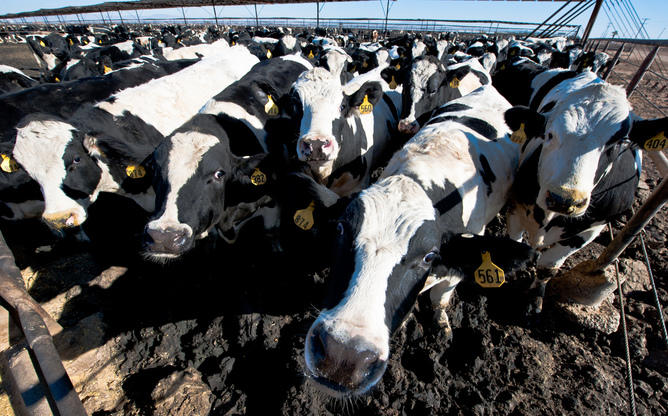
A recent paper in the journal Science of the Total Environment suggests that our consumption of meat is likely to be “the leading cause of modern species extinctions”. Not only is livestock farming the major reason for habitat destruction and the killing of predators, but its waste products are overwhelming the world’s capacity to absorb them. Factory farms in the US generate 13 times as much sewage as the human population. The dairy farms in Tulare county, California produce five times as much as New York City.

Freshwater life is being wiped out across the world by farm manure. In England, as I reported last week, the system designed to protect us from the tide of crap has comprehensively broken down. Dead zones now extend from many coasts, as farm sewage erases ocean life across thousands of square kilometres.

Livestock farming causes around 14% of the world’s greenhouse gas emissions: slightly more than the output of the world’s cars, lorries, buses, trains, ships and planes. If you eat soya, your emissions per unit of protein are 20 times lower than eating pork or chicken, and 150 times lower than eating beef.

So why is hardly anyone talking about the cow, pig, sheep and chicken in the room? Why are there no government campaigns to reduce the consumption of animal products, just as they sometimes discourage our excessive use of electricity? A survey by the Royal Institute of International Affairs found that people are not unwilling to change their diets, once they become aware of the problem, but that many have no idea that livestock farming damages the living world.

It’s not as if eating less meat and dairy will harm us. If we did as our doctors advise, our environmental impacts would decline in step with heart disease, strokes, diabetes and cancer. British people eat, on average, slightly more than their bodyweight in meat every year, while Americans consume another 50%: wildly more, in both cases, than is good for us or the rest of life on Earth.

But while plenty in the rich world are happy to discuss the dangers of brown people reproducing, the other population crisis scarcely crosses the threshold of perception. Livestock numbers present a direct moral challenge, as in this case we have agency. Hence the pregnant silence.

www.monbiot.com

Footnotes:

  1. While the number of unintended pregnancies would fall by 52m (or 70%), this does not mean that the number of babies would fall by the same amount. The Guttmacher/UNFPA report breaks down the outcome thus: “21 million fewer unplanned births; 24 million fewer abortions; six million fewer miscarriages; and 0.6 million fewer stillbirths.”
  2. Additional global meat consumption by this date is estimated to be roughly 200 million tonnes. Boned meat comprises roughly half the weight of a living animal. So total additional livestock biomass will be in the order of 400 million tonnes, or 400 billion kg. The average human weight is 52 kg and the anticipated rise in population by 2050 is 2.3 billion (the median estimate is 9.7 billion by that date). So the additional human weight is likely to be somewhere around 120 billion kg.

ooOOoo

Powerful reasons to turn vegetarian or vegan. And well done if you are already there. Well done, indeed!

Playfulness in dogs!

A perfect follow-on to yesterday’s post.

Those that read my post from yesterday will understand that it was both a busy and wonderful day. Topped off beautifully by arriving home to find four proof copies of The Book!

Four copies of The Book rather hastily assembled under my desk light.

So it was well after 5pm yesterday when I sat down to publish today’s post.

It seemed very appropriate to offer a recent item that appeared on Mother Nature Network and is republished here within MNN’s terms.

(Please note that I didn’t have the time to copy and insert the many interesting links in the original but have coloured the words or phrases to indicate that by going here you can access those links.)

ooOOoo

The science behind how dogs play

When dogs bow or let another dog ‘win’ the wrestling match, there’s a good reason.

By: Laura Moss, October 29, 2015.

If a dog plays too rough, other dogs may exclude him from play. (Photo: Brad Armentor/flickr)

Dogs play by chasing, tackling and nipping at each other, but there’s more to their lively antics than meets the eye. The way dogs interact with one another reveals that dogs have a language as well as a moral code, and they don’t engage in play simply to establish dominance.

Marc Bekoff, professor emeritus at the University of Colorado at Boulder, has been studying animal behavior for more than 40 years. After reviewing four years’ worth of footage of dogs, wolves and coyotes, he discovered that even dogs’ wild relatives play by chasing each other, rolling over and jumping on one another.

“Play is a major expenditure of energy, and it can be dangerous,” Bekoff told The Washington Post. “You can twist a shoulder or break a leg, and it can increase your chances of being preyed upon. So why do they do it? It has to feel good.”

Bekoff and other researchers have conducted numerous studies on how these animals play and what their actions mean. What they’ve found is that dogs’ behavior during play is a language all its own, and every shift of the eyes or wag of the tail is a form of communication.

Play even has a set of rules, and if a dog breaks them — by playing too rough, for example — that dog may be excluded from group play. Bekoff says this response suggests that dogs enforce moral conduct, which means they’re capable of experiencing a range of emotions and even of recognizing these emotions in other canines.

What exactly do their different play behaviors mean?

The bow is a signal for play to commence — but there's more to it than that. (Photo: Mike McCune/flickr)
The bow is a signal for play to commence — but there’s more to it than that. (Photo: Mike McCune/flickr)

Play bow

When a dog lowers the front of its body in a bow-like stance, this is an invitation to play. If your dog often bows to other canines you meet while out on a walk, it’s a good indication that your pup would like a playmate.

However, this stance doesn’t only invite play. It also communicates to other dogs that the jump, nip or roughhousing that follows the bow isn’t an act of aggression. It’s simply a dog’s way of saying, “I’m just playing around.”

See my belly? That has meaning too. (Photo: Eric Sonstroem/flickr)

Rolling over

When a dog rolls over onto its back during play, it’s often considered a submissive gesture; however, research suggests it could mean something else entirely.

Earlier this year, scientists at the University of Lethbridge and the University of South Africa observed 33 play sessions between two dogs, and they also studied 20 YouTube videos of dogs playing together.

While not all the dogs rolled over during play, those that did weren’t necessarily the smaller or weaker of the two dogs, nor were the dogs that rolled over exhibiting submissive behaviors such as decreasing play.

In fact, smaller dogs were no more likely to roll over than larger ones, and the pups that did roll over used the position to evade a nip or to get into position to playfully bite the other dog.

The researchers found that none of the 248 rollovers were submissive during play and concluded that rolling over is actually meant to facilitate play.

There's a lot of communication going on here — though to human watchers it may simply induce giggles. (Photo: WilleeCole Photography/Shutterstock)
There’s a lot of communication going on here — though to human watchers it may simply induce giggles. (Photo: WilleeCole Photography/Shutterstock)

Letting female puppies win

A 2008 study found that male puppies frequently let their female puppy playmates win during play, even when the males were bigger and stronger.

The male dogs would even put themselves in positions that left them vulnerable to attack. For example, the male puppies would occasionally lick their playmates’ muzzles, which provided the female puppies with an opportunity to easily bite in return.

Why? Researchers say the act of playing may be more important to the male dogs than winning.

“Perhaps males use self-handicapping with females in order to learn more about them and to form close relationships with them — relationships that might later help males to secure future mating opportunities,” Camille Ward, lead author of the study, told NBC News.

ooOOoo

How lucky we are in this modern world to read and share such interesting essays.

You all have a lovely weekend.

Feelings – of both humans and animals.

Five years ago Jean and I were married!

So if we are discussing feelings, as we are today, there is no better place to start than by me expressing my feelings of joy and love that I feel for, and still receive from, my gorgeous Jean. I know five years at our stage of life is far fewer than for many married couples but, nevertheless, they have been beautiful years and I wish for many more.

wedding
Diane Jackson, Bridesmaid, Jean and me, my mother and Dan Gomez, Best Man. November 20th, 2010

I had been pondering these last few days as to what I would write for today. For I wanted to celebrate our anniversary yet wanted a broader theme; so to speak.

There couldn’t have been a better answer to that ponder than a recent video that was presented by TED Talks. It was a talk by Carl Safina about what is going on inside the brains of animals: What are animals thinking and feeling? Or in the fuller words of that TED Talk page:

What’s going on inside the brains of animals? Can we know what, or if, they’re thinking and feeling? Carl Safina thinks we can. Using discoveries and anecdotes that span ecology, biology and behavioral science, he weaves together stories of whales, wolves, elephants and albatrosses to argue that just as we think, feel, use tools and express emotions, so too do the other creatures – and minds – that share the Earth with us.

Safina is very qualified to speak on the subject as his bio on that TED Talk page reveals. However, I couldn’t find a YouTube link for that TED Talk but could find two videos that are very good alternatives.

The first is a short video of Safina promoting his book Beyond Words: What Animals Think and Feel.

The second is a much longer video that is Safina’s presentation at the recent Ransom A. Myers Lecture. If you can spare the time, then do watch it. You will not be disappointed.

Published on Oct 9, 2015
8th Annual Ransom A. Myers Lecture in Science and Society. Thursday, October 1st 2015.

Title: Beyond Words: What animals think and feel
Presented by: Dr. Carl Safina, Marine Ecologist/Author, The Safina Centre

Finally, and please forgive my indulgences, I want to close today’s post with some photographs that for me have “feelings” stamped all over them!

Jeannie, Hazel and cat feeling trust for each other.

oooo

One of our local deer trusting Jeannie.
One of our local wild deer trusting Jeannie.

oooo

Oliver and Pedy adoring each other.

oooo

Last but not least! Photograph taken two days ago by yours truly reflecting my feelings of wonder at being alive in this world!
Last but not least! A photograph taken two days ago by yours truly reflecting my feelings of wonder at being alive in this world!

Onwards and upwards!

Our changing climate – what is the truth?

A video on YouTube raises some fundamental questions about our changing climate.

Let me say straight away that my belief in Anthropogenic Global Warming (AGW) is based on instinct, and not on me understanding the science, simply because I am not a scientist; far from it! As I share on this blog:

Paul Handover is a child of the post-war era in Great Britain having been born in London a few months before the end of WWII. After a rather shaky attempt at being educated, including 2 years studying for a Diploma in Electrical Engineering, Paul’s first job was as a commercial apprentice at the British Aircraft Corporation. He then joined the sales desk of British Visqueen, a polythene film and products manufacturer located in Stevenage, Hertfordshire, and part of ICI Plastics Division. In 1968, he travelled out to Sydney, Australia and became part of the sales team at ICIANZ’s Inorganic Chemicals Division.

I am a fundamentally a retired salesman/entrepreneur with a very out-of-date knowledge of electrical engineering and radio communications (G3PUK), and now struggling to be an author. 😉

Plus, my generally sceptical view of how countries are governed, my awareness of a terrible lack of integrity in politicians, plays to those instincts of mine that humanity is, indeed, responsible primarily for our changing climate. And there is no shortage of supporting evidence!

A very quick web search found this NASA site that included the following graph and text (in part):

This graph, based on the comparison of atmospheric samples contained in ice cores and more recent direct measurements, provides evidence that atmospheric CO2 has increased since the Industrial Revolution. (Credit: Vostok ice core data/J.R. Petit et al.; NOAA Mauna Loa CO2 record.)

The Earth’s climate has changed throughout history. Just in the last 650,000 years there have been seven cycles of glacial advance and retreat, with the abrupt end of the last ice age about 7,000 years ago marking the beginning of the modern climate era — and of human civilization. Most of these climate changes are attributed to very small variations in Earth’s orbit that change the amount of solar energy our planet receives.

Scientific Consensus
Ninety-seven percent of climate scientists agree that climate-warming trends over the past century are very likely due to human activities, and most of the leading scientific organizations worldwide have issued public statements endorsing this position.

Click here for a partial list of these public statements and related resources.

However, a dear and close friend of nearly 40 years, Dan Gomez, is sceptical and simply says to me: “Paul, follow the money!” Dan is a very widely-read person and a great thinker.

Plus, among our wonderful neighbours there is a couple, Dordie and Bill, that we get on with extremely well. Bill is a sceptic of AGW and recently sent me the link to the following video.

Please watch it. If you have evidence that all or many of the facts on this video are incorrect then I would love to hear from you.

For this is way too important for the truth not to be widely promoted.

http://www.youtube.com/watch?v=4Ew05sRDAcU

Hug a pet and extend your life!

With seventeen pets here at home Jean and I should live forever!

Another Saturday and another gentle post about the power of our wonderful pets. (Oh, and who, as I did, missed the fact that yesterday was not only a Friday the Thirteenth but the third one this year!)

Anyway, back to the plot!

Last Monday, Mother Nature Network published an item about how good pets are for our health. It seemed the perfect item to share with all of you this Saturday.

ooOOoo

11 studies that prove pets are good for your health

Check out the ways your 4-legged friends enhance your physical and emotional health.

By: Sidney Stevens, November 9, 2015.

Pets strengthen our hearts, calm our nerves and a whole lot more. (Photo: Juanedc.com /flickr)

If you have pets you already know the joy and love they bring to your life. Now science is confirming just how good they really are for you — both mentally and physically.

How do they help? One theory is that pets boost our oxytocin levels. Also known as the “bonding hormone” or “cuddle chemical,” oxytocin enhances social skills, decreases blood pressure and heart rate, boosts immune function and raises tolerance for pain. It also lowers stress, anger and depression.

PHOTO BREAK: 12 astonishing facts about horses

No surprise then that keeping regular company with a dog or cat (or another beloved beast) appears to offer all these same benefits and more. Read on to discover the many impressive ways a pet can make you healthier, happier and more resilient.

1. Pets alleviate allergies and boost immune function

One of your immune system’s jobs is to identify potentially harmful substances and unleash antibodies to ward off the threat. But sometimes it overreacts and misidentifies harmless stuff as dangerous, causing an allergic reaction. Think red eyes, itchy skin, runny nose and wheezing. You’d think that having pets might trigger allergies by kicking up sneeze-and-wheeze-inducing dander and fur. But it turns out that living with a dog or cat during the first year of life not only cuts your chances of having pet allergies in childhood and later on but also revs up your immune system and lowers your risk of eczema and asthma. In fact, just a brief pet encounter can invigorate your disease-defense system. In one study, petting a dog for only 18 minutes raised immunoglobulin A (IgA) levels in college students’ saliva, a sign of robust immune function.

2. Pets up your fitness quotient

This one applies more to dog owners. If you like walking with your favorite canine, chances are you’re fitter and trimmer than your non-dog-walking counterparts and come closer to meeting recommended physical activity levels. One study of more than 2,000 adults found that regular dog walkers got more exercise and were less likely to be obese than those who didn’t walk a dog. In another study, older dog walkers (ages 71-82) walked faster and longer than non-pooch-walkers, plus they were more mobile at home.

Dog owners who take their canine companions on walks tend to be trimmer and fitter than their fellow dog-less peers. (Photo: AMatveev/Shutterstock)

3. Pets dial down stress

When stress comes your way, your body goes into fight-or-flight mode, releasing hormones like cortisol to crank out more energy-boosting blood sugar and epinephrine to get your heart and blood pumping. All well and good for our ancestors who needed quick bursts of speed to dodge predatory saber-toothed tigers and stampeding mastodons. But when we live in a constant state of fight-or-flight from ongoing stress at work and the frenetic pace of modern life, these physical changes take their toll on our bodies, including raising our risk of heart disease and other dangerous conditions. Contact with pets seem to counteract this stress response by lowering stress hormones and heart rate. They also lower anxiety and fear levels (psychological responses to stress) and elevate feelings of calmness.

4. Pets boost heart health

Pets shower us with love so it’s not surprising they have a big impact on our love organ: the heart. Turns out time spent with a cherished critter is linked to better cardiovascular health, possibly due to the stress-busting effect mentioned above. Studies show that dog owners have a lower risk of heart disease, including lower blood pressure and cholesterol. Dogs also benefit patients who already have cardiovascular disease. They’re not only four time more likely to be alive after a year if they own a dog, but they’re also more likely to survive a heart attack. And don’t worry, cat owners — feline affection confers a similar effect. One 10-year study found that current and former cat owners were 40 percent less likely to suffer a heart attack and 30 percent less likely to die of other cardiovascular diseases.

5. Make you a social — and date — magnet

Four-legged companions (particularly the canine variety that pull us out of the house for daily walks) help us make more friends and appear more approachable, trustworthy and date-worthy. In one study, people in wheelchairs who had a dog received more smiles and had more conversations with passersby than those without a dog. In another study, college students who were asked to watch videos of two psychotherapists (depicted once with a dog and once without) said they felt more positively toward them when they had a dog and more likely to disclose personal information. And good news for guys: research shows that women are more willing to give out their number to men with a canine buddy.

A dog can make you appear friendlier and more approachable to others. (Photo: CandyBox Images/Shutterstock)

6. Provides a social salve for Alzheimer’s patients

Just as non-human pals strengthen our social skills and connection, cats and dogs also offer furry, friendly comfort and social bonding to people suffering from Alzheimer’s and other forms of brain-destroying dementia. Several canine caregiver programs now exist to assist at-home dementia patients with day-to-day tasks, such as fetching medication, reminding them to eat and guiding them home if they’ve wandered off course. Many assisted-living facilities also keep resident pets or offer therapy animal visits to support and stimulate patients. Studies show creature companions can reduce behavioral issues among dementia patients by boosting their moods and raising their nutritional intake.

7. Enhances social skills in kids with autism

One in nearly 70 American kids has autism (also known as autism spectrum disorder, or ASD), a developmental disability that makes it tough to communicate and interact socially. Not surprisingly, animals can also help these kids connect better to others. One study found that youngsters with ASD talked and laughed more, whined and cried less and were more social with peers when guinea pigs were present. A multitude of ASD animal-assisted therapy programs have sprung up in recent years, featuring everything from dogs and dolphins to alpacas, horses and even chickens.

Animal-assisted therapy helps kids with autism and other developmental disabilities learn social skills. (Photo: UCI UC Irvine/flickr)

8. Dampens depression and boosts mood

Pets keep loneliness and isolation at bay and make us smile. In other words, their creature camaraderie and ability to keep us engaged in daily life (via endearing demands for food, attention and walks) are good recipes for warding off the blues. Research is ongoing, but animal-assisted therapy is proving particularly potent in deterring depression and other mood disorders. Studies show that everyone from older men in a veterans hospital who were exposed to an aviary filled with songbirds to depressed college students who spent time with dogs reported feeling more positive.

9. Defeats PTSD

People haunted by trauma like combat, assault and natural disasters are particularly vulnerable to a mental health condition called post-traumatic stress disorder (PTSD). Sure enough, studies show that the unconditional love — and oxytocin boost — of a pet can help remedy the flashbacks, emotional numbness and angry outbursts linked to PTSD. Even better, there are now several programs that pair specially trained service dogs and cats with veterans suffering from PTSD.

10. Fights cancer

Animal-assisted therapy helps cancer patients heal emotionally and physically. Preliminary findings of an on-going clinical trial by the American Humane Association shows that therapy dogs not only erase loneliness, depression and stress in kids fighting cancer, but canines can also motivate them to eat and follow treatment recommendations better — in other words participate more actively in their own healing. Likewise, new research reveals a similar lift in emotional well-being for adults undergoing the physical rigors of cancer treatment. Even more astounding, dogs (with their stellar smelling skills) are now being trained to literally sniff out cancer.

11. Puts the kibosh on pain

Millions live with chronic pain, but animals can soothe some of it away. In one study, 34 percent of patients with the pain disorder fibromyalgia reported pain relief (and a better mood and less fatigue) after visiting for 10-15 minutes with a therapy dog compared to only 4 percent of patients who just sat in a waiting room. In another study, those who had undergone total joint replacement surgery needed 28 percent less pain medication after daily visits from a therapy dog than those who got no canine contact.

ooOOoo

When I was setting this post up and copying across all the many links I was aware that there was a mountain of information out there. You may want to take some time and explore those links. For example, the link to HABRI- Human-Animal Research Initiative looks incredibly interesting. Then there was the link to the work being undertaken by the American Humane Association, that link being to this video that I am presenting here to close off today’s post.

Wherever you are in the world look after yourself and care for all those lovely pets out there. Love them so dearly!

Indonesia – another example of kakistocracy?

What is happening in beautiful Indonesia is beyond imagination.

I am indebted to John Zande for introducing me to the word kakistocracy, that he explained means: “government by the worst persons; a form of government in which the worst persons are in power.”

For what is happening in Indonesia could well be an awful example of kakistocracy in action.

Like numerous others I knew that there were fires burning in Indonesia and that it was all somehow caught up in illegal logging, but knew little over and above that. And that is the crux of the title of a recent essay from George Monbiot: Nothing to See Here. It really is a “must read” essay and is republished below with Mr. Monbiot’s very kind permission. As with most of his essays, they are published in the Guardian newspaper. In this case, the Guardian version includes photographs that vividly underline the terrible situation out there. I agonised about copying them from the Guardian article, without explicit permission to so do, but have nevertheless done so on the basis of this story needing to make the maximum impact on readers. The photographs are inserted in Monbiot’s essay very closely to the format that is presented in the Guardian article.

ooOOoo

Nothing to See Here

30th October 2015

'Children are being prepared for evacuation in warships already some have choked to death. Species are going up in smoke at an untold rate.’ Photograph: Ulet Ifansasti/Getty Images
‘Children are being prepared for evacuation in warships already some have choked to death. Species are going up in smoke at an untold rate.’ Photograph: Ulet Ifansasti/Getty Images

In the greatest environmental disaster of the 21st Century (so far), Indonesia has been blotted out by smoke. And the media.

By George Monbiot, published in the Guardian 30th October 2015.

I’ve often wondered how the media would respond when eco-apocalypse struck. I pictured the news programmes producing brief, sensational reports, while failing to explain why it was happening or how it might be stopped. Then they would ask their financial correspondents how the disaster affected share prices, before turning to the sport. As you can probably tell, I don’t have an ocean of faith in the industry for which I work.

What I did not expect was that they would ignore it.

A great tract of the Earth is on fire. It looks as you might imagine hell to be. The air has turned ochre: visibility in some cities has been reduced to 30 metres. Children are being prepared for evacuation in warships; already some have choked to death. Species are going up in smoke at an untold rate. It is almost certainly the greatest environmental disaster of the 21st Century – so far.

[NB: The video that is embedded in the Guardian version is without sound. I have added one that is also a Greenpeace video, with sound, further on in the post.]

And the media? It’s talking about the dress the Duchess of Cambridge wore to the James Bond premiere, Donald Trump’s idiocy du jour and who got eliminated from the Halloween episode of Dancing with the Stars. The great debate of the week, dominating the news across much of the world? Sausages: are they really so bad for your health?

What I’m discussing is a barbeque on a different scale. Fire is raging across the 5000-kilometre length of Indonesia. It is surely, on any objective assessment, more important than anything else taking place today. And it shouldn’t require a columnist, writing in the middle of a newspaper, to say so. It should be on everyone’s front page.

It is hard to convey the scale of this inferno, but here’s a comparison that might help: it is currently producing more carbon dioxide than the US economy. In three weeks the fires have released more CO2 than the annual emissions of Germany.

 ‘The great debate of the week, dominating the news across much of the world? Sausages: are they really so bad for your health?’ Photograph: Abdul Qodir/AFP/Getty
‘The great debate of the week, dominating the news across much of the world? Sausages: are they really so bad for your health?’ Photograph: Abdul Qodir/AFP/Getty

But that doesn’t really capture it. This catastrophe cannot be measured only in parts per million. The fires are destroying treasures as precious and irreplaceable as the archaeological remains being levelled by Isis. Orang utans, clouded leopards, sun bears, gibbons, the Sumatran rhinoceros and Sumatran tiger, these are among the threatened species being driven from much of their range by the flames. But there are thousands, perhaps millions, more.

One of the burning islands is West Papua, a nation that has been illegally occupied by Indonesia since 1963. I spent six months there when I was 24, investigating some of the factors that have led to the current disaster. At the time, it was a wonderland, rich with endemic species in every swamp and valley. Who knows how many of those have vanished in the past few weeks? This week I have pored and wept over photos of places I loved, that have now been reduced to ash.

Nor do the greenhouse gas emissions capture the impact on the people of these lands. After the last great conflagration, in 1997, there was a missing cohort in Indonesia of 15,000 children under the age of three, attributed to air pollution. This, it seems, is worse. The surgical masks being distributed across the nation will do almost nothing to protect those living in a sunless smog. Members of parliament in Kalimantan (Indonesian Borneo) have had to wear face masks during debates. The chamber is so foggy that they must have difficulty recognising each other.

It’s not just the trees that are burning. It is the land itself. Much of the forest sits on great domes of peat. When the fires penetrate the earth, they smoulder for weeks, sometimes months, releasing clouds of methane, carbon monoxide, ozone and exotic gases like ammonium cyanide. The plumes extend for hundreds of miles, causing diplomatic conflicts with neighbouring countries.

Why is this happening? Indonesia’s forests have been fragmented for decades by timber and farming companies. Canals have been cut through the peat to drain and dry it. Plantation companies move in to destroy what remains of the forest to plant monocultures of pulpwood, timber and palm oil. The easiest way to clear the land is to torch it. Every year, this causes disasters. But in an extreme El Niño year like this one, we have a perfect formula for environmental catastrophe.

The current president, Joko Widodo, is – or wants to be – a democrat. But he presides over a nation in which fascism and corruption flourish. As Joshua Oppenheimer’s documentary The Act of Killing shows, leaders of the death squads that helped murder around a million people during Suharto’s terror in the 1960s, with the approval of the West, have since prospered through other forms of organised crime, including illegal deforestation.

They are supported by a paramilitary organisation with three million members, called Pancasila Youth. With its orange camo-print uniforms, scarlet berets, sentimental gatherings and schmaltzy music, it looks like a fascist militia as imagined by JG Ballard. There has been no truth, no reconciliation; the mass killers are still greeted as heroes and feted on television. In some places, especially West Papua, the political murders continue.

Those who commit crimes against humanity don’t hesitate to commit crimes against nature. Though Joko Widodo seems to want to stop the burning, his reach is limited. His government’s policies are contradictory: among them are new subsidies for palm oil production that make further burning almost inevitable. Some plantation companies, prompted by their customers, have promised to stop destroying the rainforest. Government officials have responded angrily, arguing that such restraint impedes the country’s development. That smoke blotting out the nation, which has already cost it some $30 billion? That, apparently, is development.

Our leverage is weak, but there are some things we can do. Some companies using palm oil have made visible efforts to reform their supply chains; but others seem to move slowly and opaquely. Starbucks, PepsiCo, Kraft Heinz and Unilever are examples. Don’t buy their products until they change.

On Monday, Widodo was in Washington, meeting Barack Obama. Obama, the official communiqué recorded, “welcomed President Widodo’s recent policy actions to combat and prevent forest fires”. The ecopalypse taking place as they conferred, that makes a mockery of these commitments, wasn’t mentioned.

Governments ignore issues when the media ignores them. And the media ignores them because … well there’s a question with a thousand answers, many of which involve power. But one reason is the complete failure of perspective in a deskilled industry dominated by corporate press releases, photo ops and fashion shoots, where everyone seems to be waiting for everyone else to take a lead. The media makes a collective non-decision to treat this catastrophe as a non-issue, and we all carry on as if it’s not happening.

At the climate summit in Paris in December, the media, trapped within the intergovernmental bubble of abstract diplomacy and manufactured drama, will cover the negotiations almost without reference to what is happening elsewhere. The talks will be removed to a realm with which we have no moral contact. And, when the circus moves on, the silence will resume. Is there any other industry that serves its customers so badly?

www.monbiot.com

ooOOoo

Here is that Greenpeace video I referred to above.

Published on Oct 30, 2015
URGENT: Forest fires are raging through Indonesia, putting endangered orangutans and human health at risk.

Join the call to stop the fires and prevent them from ever happening again – http://www.greenpeace.org.uk/forestfires

A quick web search will offer endless pictures of this great tragedy but I will leave you with three; two showing the extent of the smoke and one that is much more an intimate photograph of the suffering animals.

indonesia-fire-map

oooo

indonesian_haze

oooo

In this Thursday, March 1, 2012, Indonesian veterinarian Yenni Saraswati, top center, of Sumatran Orangutan Conservation Programme (SOCP) examines the condition of an injured Sumatran orangutan found by environmental activists at a palm oil plantation in Rimba Sawang village, Aceh province, Indonesia. Conservationists say fires in an Indonesian swamp forest may have killed a third of the rare Sumatran orangutans living there and all of them may be lost this year. Binsar Bakkara, Associated Press.
In this Thursday, March 1, 2012, Indonesian veterinarian Yenni Saraswati, top center, of Sumatran Orangutan Conservation Programme (SOCP) examines the condition of an injured Sumatran orangutan found by environmental activists at a palm oil plantation in Rimba Sawang village, Aceh province, Indonesia. Conservationists say fires in an Indonesian swamp forest may have killed a third of the rare Sumatran orangutans living there and all of them may be lost this year.
Binsar Bakkara, Associated Press.

Monbiot wrote: “Those who commit crimes against humanity don’t hesitate to commit crimes against nature.”

One cannot avoid reflecting that this would not have happened if there hadn’t been, “government by the worst persons; a form of government in which the worst persons are in power.”

Welcome to kakistocracy.


Keeping up with yesterday!

Procrastination is the art of keeping up with yesterday.

Can’t claim credit for the sub-heading; it was taken from BrainyQuote.

donmarquis107414

However, the reason I went looking for a quotation on procrastinating was that I’m doing research for a fairly “heavy” post for tomorrow, and was looking for something quick and easy for today.

My blog folder came up with an essay from The Conversation website that is rather fun. It is republished here on Learning from Dogs within the terms of The Conversation.

ooOOoo

The psychological origins of procrastination – and how we can stop putting things off

October 7, 2015

Authors: Elliot Berkman, Assistant Professor, Psychology, University of Oregon, and Jordan Miller-Ziegler, PhD Candidate in Psychology, University of Oregon.

“I love deadlines,” English author Douglas Adams once wrote. “I love the whooshing noise they make as they go by.”

We’ve all had the experience of wanting to get a project done but putting it off for later. Sometimes we wait because we just don’t care enough about the project, but other times we care a lot – and still end up doing something else. I, for one, end up cleaning my house when I have a lot of papers to grade, even though I know I need to grade them.

So why do we procrastinate? Are we built to operate this way at some times? Or is there something wrong with the way we’re approaching work?

These questions are central to my research on goal pursuit, which could offer some clues from neuroscience about why we procrastinate – and how to overcome this tendency.

To do, or not to do

It all starts with a simple choice between working now on a given project and doing anything else: working on a different project, doing something fun or doing nothing at all.

The decision to work on something is driven by how much we value accomplishing the project in that moment – what psychologists call its subjective value. And procrastination, in psychological terms, is what happens when the value of doing something else outweighs the value of working now.

This way of thinking suggests a simple trick to defeat procrastination: find a way to boost the subjective value of working now, relative to the value of other things. You could increase the value of the project, decrease the value of the distraction, or some combination of the two.

For example, instead of cleaning my house, I might try to focus on why grading is personally important to me. Or I could think about how unpleasant cleaning can actually be – especially when sharing a house with a toddler.

It’s simple advice, but adhering to this strategy can be quite difficult, mainly because there are so many forces that diminish the value of working in the present.

The distant deadline

People are not entirely rational in the way they value things. For example, a dollar bill is worth exactly the same today as it is a week from now, but its subjective value – roughly how good it would feel to own a dollar – depends on other factors besides its face value, such as when we receive it.

The tendency for people to devalue money and other goods based on time is called delay discounting. For example, one study showed that, on average, receiving $100 three months from now is worth the same to people as receiving $83 right now. People would rather lose $17 than wait a few months to get a larger reward.

Other factors also influence subjective value, such as how much money someone has recently gained or lost. The key point is that there is not a perfect match between objective value and subjective value.

Delay discounting is a factor in procrastination because the completion of the project happens in the future. Getting something done is a delayed reward, so its value in the present is reduced: the further away the deadline is, the less attractive it seems to work on the project right now.

Studies have repeatedly shown that the tendency to procrastinate closely follows economic models of delay discounting. Furthermore, people who characterize themselves as procrastinators show an exaggerated effect. They discount the value of getting something done ahead of time even more than other people.

One way to increase the value of completing a task is to make the finish line seem closer. For example, vividly imagining a future reward reduces delay discounting.

No work is ‘effortless’

Not only can completing a project be devalued because it happens in the future, but working on a project can also be unattractive due to the simple fact that work takes effort.

New research supports the idea that mental effort is intrinsically costly; for this reason, people generally choose to work on an easier task rather than a harder task. Furthermore, there are greater subjective costs for work that feels harder (though these costs can be offset by experience with the task at hand).

This leads to the interesting prediction that people would procrastinate more the harder they expect the work to be. That’s because the more effort a task requires, the more someone stands to gain by putting the same amount of effort into something else (a phenomenon economists call opportunity costs). Opportunity costs make working on something that seems hard feels like a loss.

Sure enough, a group of studies shows that people procrastinate more on unpleasant tasks. These results suggest that reducing the pain of working on a project, for example by breaking it down into more familiar and manageable pieces, would be an effective way to reduce procrastination.

Your work, your identity

When we write that procrastination is a side effect of the way we value things, it frames task completion as a product of motivation, rather than ability.

In other words, you can be really good at something, whether it’s cooking a gourmet meal or writing a story, but if you don’t possess the motivation, or sense of importance, to complete the task, it’ll likely be put off.

It was for this reason that the writer Robert Hanks, in a recent essay for the London Review of Books, described procrastination as “a failure of appetites.”

The source of this “appetite” can be a bit tricky. But one could argue that, like our (real) appetite for food, it’s something that’s closely intertwined with our daily lives, our culture and our sense of who we are.

So how does one increase the subjective value of a project? A powerful way – one that my graduate students and I have written about in detail – is to connect the project to your self-concept. Our hypothesis is that projects seen as important to a person’s self-concept will hold more subjective value for that person.

It’s for this reason that Hanks also wrote that procrastination seems to stem from a failure to “identify sufficiently with your future self” – in other words, the self for whom the goal is most relevant.

Because people are motivated to maintain a positive self-concept, goals connected closely to one’s sense of self or identity take on much more value.

Connecting the project to more immediate sources of value, such as life goals or core values, can fill the deficit in subjective value that underlies procrastination.

ooOOoo

So there; glad that’s clear for us all.

Cosy-Lists-2

Mustn’t delay – I need to write down a list of all the things I’m not doing today!

What a show of fireworks this would be!

Asteroid 2015 TB145 will pass by Planet Earth – just!

Back in my old country, Halloween is not celebrated in the same style that it is here in America. The Brits tend to favour the evening of November 5th and Guy Fawkes Night. That evening, Bonfire Night, sees fireworks parties in many places.

nov5th

However, if one starts to think of the dimensions and distances of outer space then our planet is just being spared the firework show to beat all other shows.

I’m referring to Asteroid TB145, a huge asteroid, that will pass Earth at 310,000 miles (498,896 km) or 1.3 times the Earth-moon distance.

asteroid20151021

UPDATE OCTOBER 30, 2015. A newly found asteroid of notable size – known as asteroid 2015 TB145 – will safely pass Earth on October 31, 2015, according to clocks in North America. It should be visible moving in front of the stars, with the help of a telescope, tonight (October 30). It is the biggest known asteroid that will come this close to Earth until 2027. The asteroid – found as recently as October 10 – will fly past Earth at a safe distance, or about 1.3 times the moon’s distance. Closest approach to Earth will be October 31 at 1 p.m. EDT (1700 UTC). Translate to your time zone here.

Paul Chodas, manager of the Center for Near Earth Object Studies at NASA’s Jet Propulsion Laboratory, Pasadena, California, said:

The trajectory of 2015 TB145 is well understood. At the point of closest approach, it will be no closer than about 300,000 miles – 480,000 kilometers or 1.3 lunar distances. Even though that is relatively close by celestial standards, it is expected to be fairly faint, so night-sky Earth observers would need at least a small telescope to view it.

So how big is this asteroid?

Scientists are continuing to estimate the size at 1,300 feet (400 meters) wide.

If the size is correct, the new found asteroid is 28 times bigger in diameter than the Chelyabinsk meteor that penetrated the atmosphere over Russia in February, 2013. An incoming asteroid’s potential to do damage on Earth depends on various factors, including its size, its angle of entry, and the point on Earth over which it enters the atmosphere. The shock wave from the 2013 Chelyabinsk meteor broke windows and did other damage to some 7,200 buildings in six Russian cities. Some 1,500 people were injured seriously enough to seek medical treatment, mainly from broken glass from windows.

For those of you that want to catch a glimpse of TB145, then:

TB145at350amET0750UT10312015-e1446201004409

Asteroid position at 3:50 a.m. ET (0750 UTC) Point a Go To computerized telescope to HIP 24197 or SAO 94377) a naked-eye star with a magnitude of 5 in Orion. At 3:50 a.m. ET on October 31 (Saturday morning), the space rock passes close to this star. The asteroid will appear as a slowly moving ‘star’ passing very close to this star. By this time the asteroid should appear to move faster because it will be closer to Earth than earlier on the night of October 30. This illustration shows a half degree field of view (about the size of a full moon). A pair of double stars visible in this area should confirm you are pointing at the correct direction. Alternatively, you can point your telescope to these coordinates: RA 05h 11m 41.6s / DEC +16º 02′ 44.5″. Illustration by Eddie Irizarry using Stellarium.

Full details and answers to most of your questions may be found here.

All I can say is I hope the number crunchers have got their sums right!

If not, then it’s goodnight from her and goodnight from me.

o-NASA-ASTEROIDS-facebook

It was nice knowing you all!

P.S. If you think this is all a bit far-fetched, then this video sent to me by Dan Gomez will bring you down to earth.

New insight into the history of our dogs.

Our dogs have come a very long way.

I feel a little guilty at just dropping this full article in your path, and running away, so to speak, but yesterday was one of those days where Jean and I were “full on” for most of the day, and then out from the house from 4pm onwards.

It doesn’t lessen the interest, in my humble opinion, of this essay, that was recently published by The Conversation, and is republished within their terms.

ooOOoo

New DNA analysis says your pooch’s ancestors were Central Asian wolves

October 20, 2015

Author: Laura Shannon, Postdoctoral Research Associate in Biological Sciences, Cornell University

Dogs’ origin story goes something like this: sometime between 16,000 and 30,000 years ago, there were some stressed-out hungry wolves whose hunting territory had been encroached upon by humans. Luckily, these wolves were resourceful and they noticed human beings have a tendency to leave delicious things lying around. Scavenging leftovers seemed significantly easier than going out and hunting, so they hung around the people.

Wolves make unnerving neighbors. However, some are less unnerving than others. The humans were a lot more inclined to tolerate the proximity of less aggressive, more people-oriented wolves. As an added bonus, other predators are less likely to harass you when you are surrounded by wolves. So the people and the nicest wolves came to an agreement – the people tolerated and fed the tamest and most helpful wolves.

Smart, tame wolves have smarter, tamer wolf cubs, and so over time the wolves became more and more pleasant to have around. Obviously, friendly, helpful wolves hanging around people and eating leftovers aren’t really wolves; we have a word for those things – they’re dogs.

That’s biologists’ reasonable guess for how dogs came about. We have some idea when it all happened, but it’s been harder to figure out where. Who first took in scavenging gray wolves and turned them into dogs?

Dogs still know a good thing when they see it – warmth and food with people ‘round the campfire. Camping image via www.shutterstock.com.
Dogs still know a good thing when they see it – warmth and food with people ‘round the campfire. Camping image via http://www.shutterstock.com.

Investigating this wheredunit

Scientists have looked at DNA inherited exclusively from the mother (called mitochondrial) and DNA inherited exclusively from the father (the Y-chromosome) and suggested that dogs were first domesticated in China, south of the Yangtze River.

However, the oldest dog bones anyone has found are from the other end of Eurasia, all the way in Northern Europe. Furthermore, the mitochondria of modern dogs are closely related to the mitochondria of ancient European wolves.

Finally, Middle Eastern wolves share the most genetic sequences with today’s dogs, which makes it seem like maybe Middle Eastern wolves are the ancestral wolf population.

All these threads of evidence broadly agree that dogs are from somewhere in Eurasia. But my colleagues and I wanted to narrow that down a bit – and to do that, we decided we needed DNA from as many dogs as possible for our new study.

Team members sampling a village dog in the Pacific Islands. Adam Boyko, CC BY-ND

Modern dogs cover the globe

Dogs are found almost everywhere people are, and over time we have bred them to do everything from guarding livestock to going fishing. The breeds we’ve created come in many shapes and sizes, ranging from tiny Chihuahuas to giant Great Danes. The vast majority of these breeds are less than 200 years old and come from Europe. But these purebred dogs or even mixes of these breed dogs are the minority of dogs on the planet.

Most dogs are free-ranging village dogs, which live around and among people but aren’t necessarily what you’d think of as pets. You can learn more about ancient dogs by studying these village dogs (as compared to studying breed dogs) because village dogs have more genetic diversity; the number of different versions of the same genes in village dogs is higher than it is in breed dogs.

All dogs were formed from a select group of wolves, and therefore have a subset of the genetic diversity found in wolves. But breeds were formed from a subset of dogs so they have only a further subset of the diversity found in dogs.

In the cradle of dogkind? Coss and Johanna, CC BY-NC

Tracing the trail through DNA sequences

Members of our lab traveled to collect blood or spit from dogs in a variety of locales, and collaborators sent us fluids from places to which we didn’t manage to travel. Village dogs are fairly easy to find for researchers carrying food. In total, we extracted DNA from the fluids of 549 dogs from 38 countries spanning the majority of the globe as well as 4,676 purebred dogs. Our lab at Cornell is conveniently located in the same building as a veterinary hospital, so most of our purebred dogs were patients.

Once we had our samples, we then determined each dog’s genotype at about 180,000 distinct points in the genome. This is the largest data set anyone has used to address the question of dog origins so far.

We were looking for a very specific pattern of historical genetic diversity. When a select group of wolves became dogs, those dogs contained only the genetic diversity present in that subset of wolves. When people took some of the dogs and moved on to new regions of the globe, or traded dogs with people in other regions, they took only a subset of the total dogs, and by extension a subset of the total diversity.

Therefore, we expect the original population of dogs to be the most diverse. There would be a gradient of decreasing diversity in all populations as they move away from the center of origin.

And this is the pattern we observed when we compared the genetics of dogs from different populations. Dogs from Central Asia, Mongolia and Nepal are the most diverse, with genomes that correspond to the early, original variation in the population right after domestication happened. When we look at the same DNA markers in dogs from neighboring regions, diversity decreases. It decreases further corresponding to the location’s increasing distance from Central Asia. This is the pattern we would expect if the people who first took in scavenging gray wolves and turned them into dogs were located in Central Asia.

Even dogs we sampled in the Pacific Islands traced their forebears back to Central Asia. Adam Boyko, CC BY-ND

Looking at the largest data set of dogs amassed so far, we observe a very clear signal that most dogs alive today descended from dogs in Central Asia. However, we only looked at dogs alive right now. We have no information about historical populations of dogs that have no living descendants. Furthermore, the patterns of diversity we observe are reflective of the origins of dogs but also of everything that has happened to dog populations since domestication.

Other research groups are extracting DNA from bones of ancient dogs, and these sequences will provide exciting new insights from time points closer to domestication. However, ancient DNA studies are limited by the availability of ancient dog bones – which is affected by many factors other than the distribution of historic populations; for instance, some environments are more conducive to the preservation of bone and DNA than others, some regions have been more extensively investigated by archaeologists than others, and so on. If we see similar patterns in ancient and modern dogs, that will add clarity to the history of dogs and the people who love them.

ooOOoo

 Ultimately, it doesn’t matter one hoot, in a non-scientific sense, from where our dogs are descended. Just that they did evolve.

For human life without our dogs would be unthinkable.