One of the many things that we adore about living here in Merlin, Southern Oregon is the closeness of nature. Not just the nature of the slopes and mountains but the nature of the trees, creeks, grasses and wild plants.
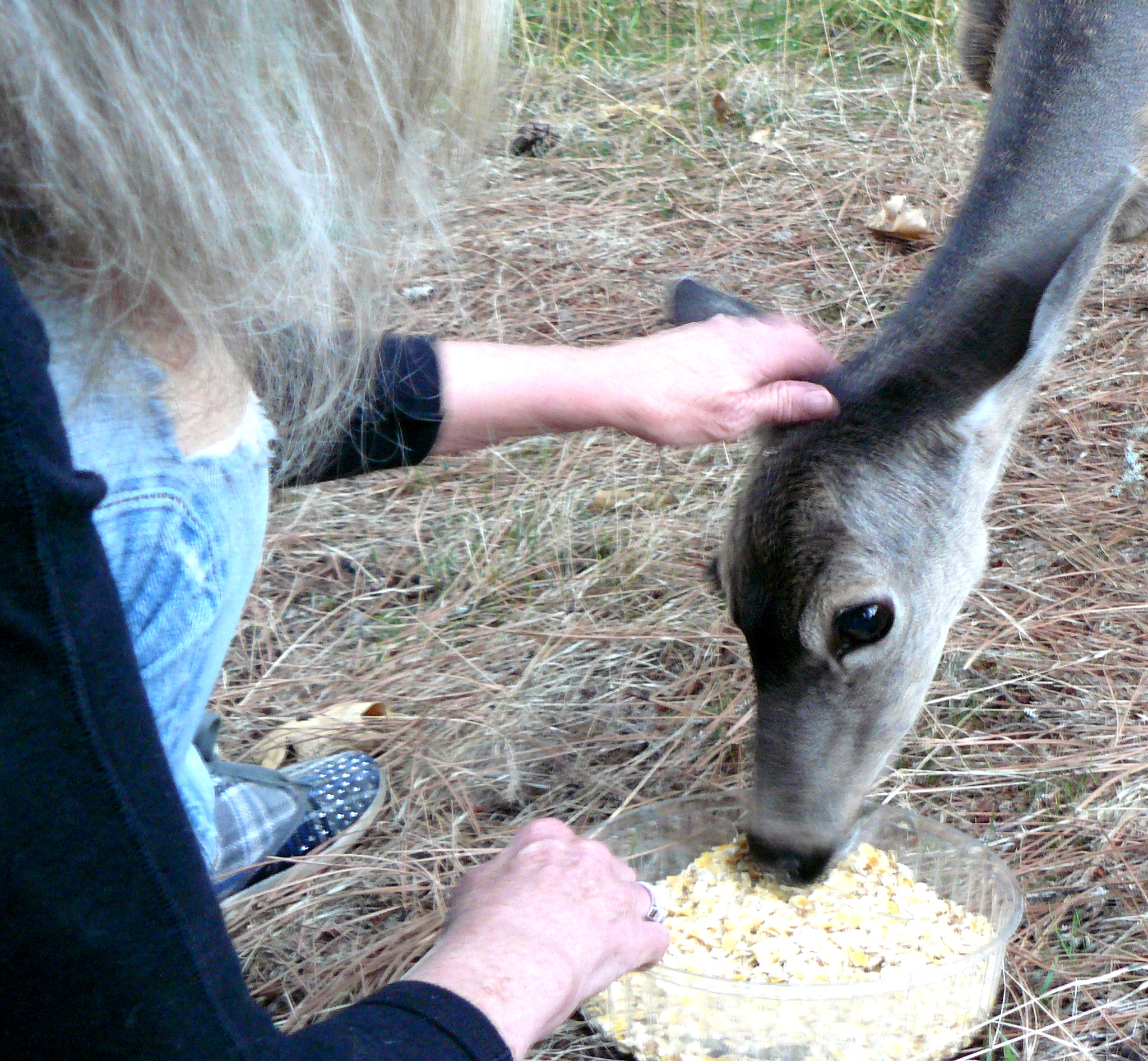
Plus the awareness over the 4+ years that we have been here of how easy it is to gain the trust of wild animals. I will go to my grave holding on to the sweet sensation of a wild deer trusting me and Jean to the point where we could stroke the deer’s neck when we were feeding her.
The trust between the deer and Jean then enabled the deer to feed from Jean’s hand.Then, unbelievably, the wild deer continues feeding as Jean fondles the deer’s ear.
(Both photographs taken in October, 2014 in the area of grassland near to our stables.)
The measure of how we, as in humanity, really feel about the only home we have, as in Planet Earth, is how we regard our planet.
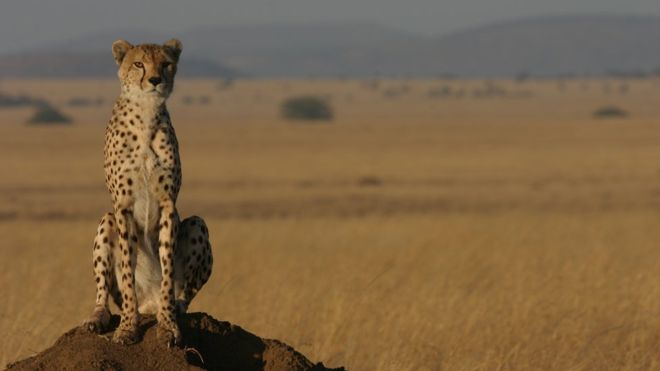
The pain that we feel when we read, as I did yesterday, about another animal species possibly heading towards extinction. In this case, an item on the BBC News website about Cheetahs.
Cheetahs heading towards extinction as population crashes
By Matt McGrath Environment correspondent
Protected parks and reserves for cheetahs are not sufficient as the animal ranges far beyond these areas.
The sleek, speedy cheetah is rapidly heading towards extinction according to a new study into declining numbers.
The report estimates that there are just 7,100 of the world’s fastest mammals now left in the wild.
Cheetahs are in trouble because they range far beyond protected areas and are coming increasingly into conflict with humans.
The authors are calling for an urgent re-categorisation of the species from vulnerable to endangered.
It’s no good tut-tutting; something different has to be done. For otherwise nature will have the last word to say about the future of vast numbers of species especially homo sapiens!
All of which leads me to the main theme of today’s post: holding nature in higher esteem as in higher legal esteem.
Read the following that was published on The Conversation blogsite on October 10th, 2016 and is republished here within their terms. The author is Chip Colwell , Lecturer on Anthropology, University of Colorado, Denver.
ooOOoo
What if nature, like corporations, had the rights and protections of a person?
October 10, 2016 8.16am EDT
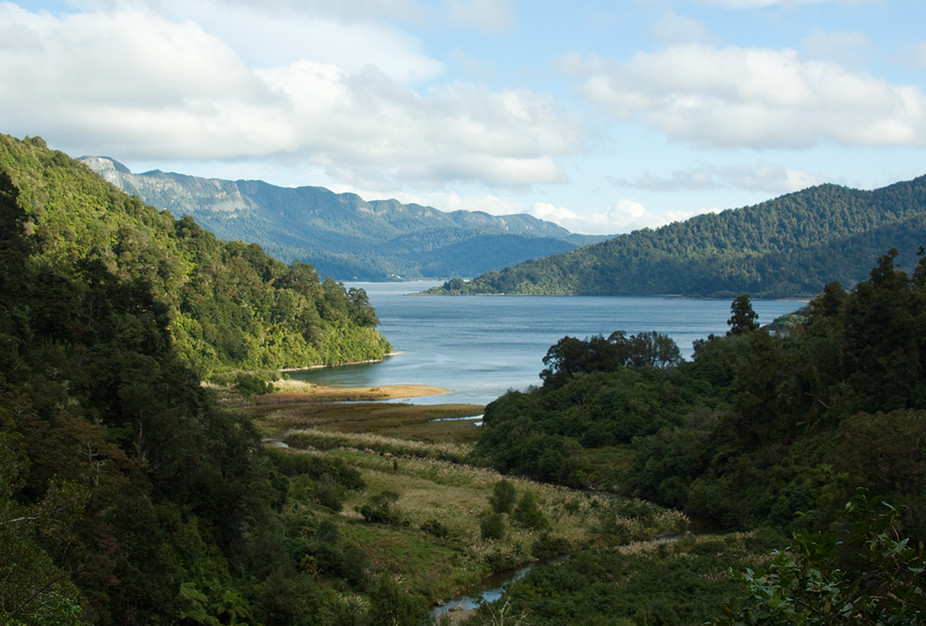
The forest around Lake Waikaremoana in New Zealand has been given legal status of a person because of its cultural significance. Paul Nelhams/flickr, CC BY-SA
In recent years, the U.S. Supreme Court has solidified the concept of corporate personhood. Following rulings in such cases as Hobby Lobby and Citizens United, U.S. law has established that companies are, like people, entitled to certain rights and protections.
But that’s not the only instance of extending legal rights to nonhuman entities. New Zealand took a radically different approach in 2014 with the Te Urewera Act which granted an 821-square-mile forest the legal status of a person. The forest is sacred to the Tūhoe people, an indigenous group of the Maori. For them Te Urewera is an ancient and ancestral homeland that breathes life into their culture. The forest is also a living ancestor. The Te Urewera Act concludes that “Te Urewera has an identity in and of itself,” and thus must be its own entity with “all the rights, powers, duties, and liabilities of a legal person.” Te Urewera holds title to itself.
Although this legal approach is unique to New Zealand, the underlying reason for it is not. Over the last 15 years I have documented similar cultural expressions by Native Americans about their traditional, sacred places. As an anthropologist, this research has often pushed me to search for an answer to the profound question: What does it mean for nature to be a person?
The snow-capped mountain
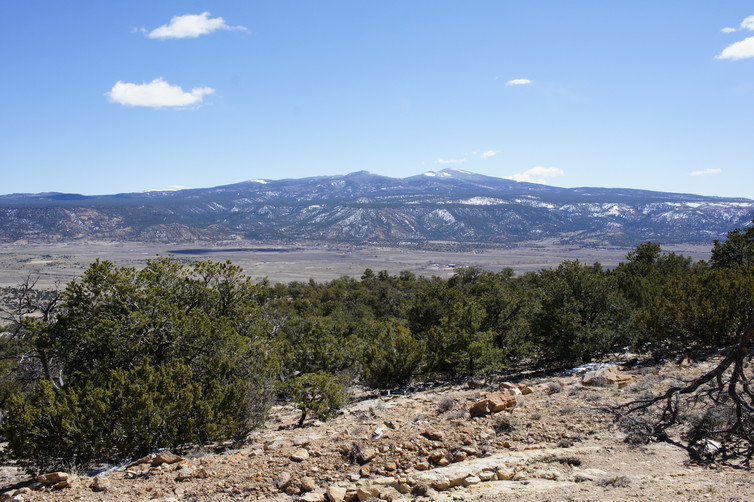
A majestic mountain sits not far northwest of Albuquerque, New Mexico. Like a low triangle, with long gentle slopes, Mount Taylor is clothed in rich forests that appear a velvety charcoal-blue from the distance. Its bald summit, more than 11,000 feet high, is often blanketed in snow – a reminder of the blessing of water, when seen from the blazing desert below.
The Zuni tribe lives about 40 miles west of Mount Taylor. In 2012, I worked with a team to interview 24 tribal members about the values they hold for Dewankwin K’yaba:chu Yalanne (“In the East Snow-capped Mountain”), as Mount Taylor is called in the Zuni language. We were told that their most ancient ancestors began an epic migration in the Grand Canyon.
Mount Taylor in New Mexico, a sacred site to the Zuni who believe it is a living being. Chip Colwell, Author provided.
Over millennia they migrated across the Southwest, with important medicine societies and clans living around Mount Taylor. After settling in their current pueblo homes, Zunis returned to this sacred mountain to hunt animals like deer and bear, harvest wild plants like acorns and cattails, and gather minerals used in sacrosanct rituals that keep the universe in order. Across the generations Dewankwin Kyaba:chu Yalanne has come to shape Zuni history, life, and identity no less than the Vatican has for Catholics.
But unlike holy places in the Western world, Zunis believe Mount Taylor is a living being. Zuni elders told me that the mountain was created within the Earth’s womb. As a mountain formed by volcanic activity, it has always grown and aged. The mountain can give life as people do. The mountain’s snow melts in spring and nourishes plants and wildlife for miles. Water is the mountain’s blood; buried minerals are the mountain’s meat. Because it lives, deep below is its beating heart. Zunis consider Mount Taylor to be their kin.
There is a stereotype that Native American peoples have a singular connection to nature. And yet in my experience, they do see the world in a fundamentally different way from most people I know. Whether it is mountains, rivers, rocks, animals, plants, stars or weather, they see the natural world as living and breathing, deeply relational, even at times all-knowing and transcendent.
In my work with Arizona’s Hopi tribe, I have traveled with cultural leaders to study sacred places. They often stop to listen to the wind, or search the sky for an eagle, or smile when it begins to rain, which they believe is a blessing the ancestors bestow upon them.
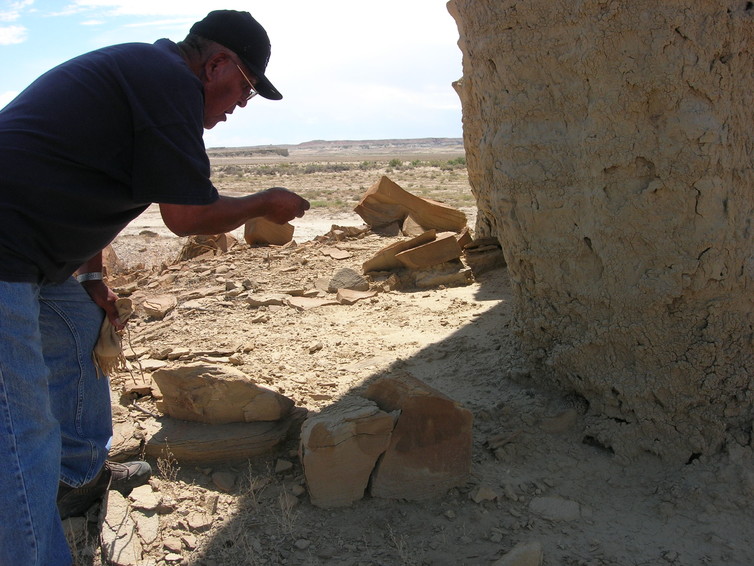
During one project with the Hopi tribe, we came across a rattlesnake coiled near an ancient fallen pueblo. “Long ago, one of them ancestors lived here and turned into a rattlesnake,” the elder Raleigh H. Puhuyaoma Sr. shared with me, pointing to the nearby archaeological site. “It’s now protecting the place.” The elders left an offering of corn meal to the snake. An elder later told me that it soon rained on his cornfield, a result from this spiritual exchange.
Violent disputes
Understanding these cultural worldviews matters greatly in discussions over protecting places in nature. The American West has a long history of battles over the control of land. We’ve seen this recently from the Bundy family’s takeover of the federal wildlife refuge in Oregon to the current fight over turning Bears Ears – 1.9 million acres of wilderness – into a national monument in Utah.
Yet often these battles are less about the struggle between private and public interests, and more about basic questions of nature’s purpose. Do wild places have intrinsic worth? Or is the land a mere tool for human uses?
A Hopi elder making an offering to a snake to protect a sacred space. Chip Colwell, Author provided.
Much of my research has involved documenting sacred places because they are being threatened by development projects on public land. The Zuni’s sacred Mount Taylor, much of it managed by the U.S. National Forest Service, has been extensively mined for uranium, and is the cause of violent disputes over whether it should be developed or protected.
Even though the U.S. does not legally recognize natural places as people, some legal protections exist for sacred places. Under the National Historic Preservation Act, for example, the U.S. government must take into consideration the potential impacts of certain development projects on “traditional cultural properties.”
This and other federal heritage laws, however, provide tribes a small voice in the process, little power, and rarely lead to preservation. More to the point, these laws reduce what tribes see as living places to “properties,” obscuring their inherent spiritual value.
In New Zealand, the Te Urewera Act offers a higher level of protection, empowering a board to be the land’s guardian. The Te Urewera Act, though, does not remove its connection to humans. With a permit, people can hunt, fish, farm and more. The public still has access to the forest. One section of the law even allows Te Urewera to be mined.
Te Urewera teaches us that acknowledging cultural views of places as living does not mean ending the relationship between humans and nature, but reordering it – recognizing nature’s intrinsic worth and respecting indigenous philosophies.
In the U.S. and elsewhere, I believe we can do better to align our legal system with the cultural expressions of the people it serves. For instance, the U.S. Congress could amend the NHPA or the American Indian Religious Freedom Act to acknowledge the deep cultural connection between tribes and natural places, and afford better protections for sacred landscapes like New Mexico’s Mount Taylor.
Until then, it says much about us when companies are considered people before nature is.
I deliberately planned for this post to be published at the precise moment, in Pacific Time that is, when the solstice occurs.
Welcome to the shortest day of 2016.
Winter Solstice at the Stonehenge Monument in Southern England.
I am now republishing much of what appeared on the EarthSky blog a few days ago.
Late dawn. Early sunset. Short day. Long night. For us in the Northern Hemisphere, the December solstice marks the longest night and shortest day of the year. Meanwhile, on the day of the December solstice, the Southern Hemisphere has its longest day and shortest night. This special day is coming up on Wednesday, December 21 at 10:44 UTC (December 21 at 4:44 a.m. CST). No matter where you live on Earth’s globe, a solstice is your signal to celebrate.
Want to know what time it is where you are living?
When is the solstice where I live? The solstice happens at the same instant for all of us, everywhere on Earth. In 2016, the December solstice comes on December 21 at 4:44 a.m. CST. That’s on December 21 at 10:44 Universal Time. It’s when the sun on our sky’s dome reaches its farthest southward point for the year. At this solstice, the Northern Hemisphere has its shortest day and longest night of the year.
This morning I read an interesting set of facts about the Solstice over on the Mother Nature Network. It included this:
The word “solstice” comes from the Latin solstitium, meaning “point at which the sun stands still.” Since when has the sun ever moved?! Of course, before Renaissance astronomer Nicolaus Copernicus (aka “super smartypants”) came up with the ‘ol heliocentric model, we all figured that everything revolved around the Earth, sun included. Our continued use of the word “solstice” is a beautiful reminder of just how far we’ve come and provides a nice opportunity to give a tip of the hat to great thinkers who challenged the status quo.
I have a good understanding of the commercial pilot’s world, both inside and outside of my family. For many years as an active private pilot I held a British Instrument Rating (IR) that allowed me to fly in the commercial airways. Studying for the IR required a good appreciation of the safety culture that was at the root of commercial flying especially surrounding one’s departure and arrival airports.
So when I read a recent item from the Smithsonian Magazine proposing that airline pilots were more depressed than the average American my first reaction was one of disbelief. I forwarded the link to Bob D., an experienced British airline Captain and a good friend for years. Here is that article:
ooOOoo
Think Your Job Is Depressing? Try Being an Airline Pilot
New study suggests pilots are more depressed than the average American
Being a pilot for a commercial airline has its perks—travel to exotic places, a cool uniform and those breathtaking views of the sky. But that job can come with a side of something much more sobering: depression. As Melissa Healy reports forThe Los Angeles Times, the mental health of airline pilots is coming into sharp focus with the revelation that nearly 13 percent of them could be depressed.
A new study of the mental health of commercial airline pilots, recently published in the Journal of Environmental Health, suggests that depression is a major problem for pilots. The first to document mental health for this particular field, the study relied on a 2015 web survey of international pilots that contained a range of questions about their condition over the prior two weeks. Questions included whether they felt like failures, had trouble falling or staying asleep, or felt they were better off dead. (Those questions are part of a depression screening tool called the PHQ-9.) Other questions involved pilots’ flight habits, their use of sleep aids and alcohol, and whether they have been sexually or verbally harassed on the job.
Of the 1,848 pilots who responded to the depression screening portions of the questionnaire, 12.6 percent met the threshold for depression. In addition, 4.1 percent of those respondents reported having suicidal thoughts at some point during the two weeks before taking the survey. The researchers found that pilots who were depressed were also more likely to take sleep aids and report verbal or sexual harassment.
Airline pilot organizations and occupational safety experts assure Healy that airline travel is still safe. But the study continues a conversation about pilot psychology that has been in full swing since a German pilot committed suicide by crashing his plane in 2015—an incident that inspired the current study.
Since then, calls for better statistics on pilot suicide have grown louder. As Carl Bialik notes forFiveThirtyEight, those statistics do exist—and do suggest that the number of actual suicides among pilots are very small. However, limitations in data, the possibility of underreporting, and infrequent data collection all challenge a complete understanding of that facet of pilots’ mental health.
This latest mental health study has its own limitations, including the fact that it relies on self-reporting and a relatively small sample size compared to total pilot numbers worldwide (in the U.S. alone, there are over 70,000 commercial airline pilots). The cause of the reported depression also remains unclear.
But if the depression rate for commercial airline pilots really is nearly 13 percent, it’s almost double the national rate of about seven percent. Though future work is necessary to confirm these results, this study provides an initial glimpse into the health of the people who make the nation’s airlines tick and emphasizes the importance of figuring out ways to improve their mental health and quality of life.
As the article points out the study contains a number of flaws that really reduce it from an erudite analysis to an eye-catching news item. (Better than reading about politics; that’s for sure!)
I know these are busy times for Captain Bob even without it being Christmas. But if Bob finds time to comment on this study then I will publish it later on.
However, Bob did find a moment to forward me copies of some of the many placards that are a necessary part of the flight deck.
Four household products that could be making you sick.
In yesterday’s post I republished an email sent by fellow author Judi Holdeman warning about some brands of peanut butter in terms of potential harm to our gorgeous dogs. Or to be more precise about the dangers of xylitol that is an ingredient in those named brands.
Today, I am delighted to publish a guest post from Charlotte Meier. Charlotte explained to me that she “Operates Home Safety Hub, a site which provides resources on preventing injury and property loss. Her mission is the same as Home Safety Hub’s, which is to help people keep their homes safe. ” Yes, keeping our homes safe includes keeping our dogs safe.
Here is that guest post.
ooOOoo
Four household products that could be making you sick.
We tend to believe that household products such as cleaners or kitchen utensils are good for us. Keeping your house bacteria-free surely can’t have a negative effect on your well-being, right? Unfortunately, as the world becomes more eco-friendly, studies are now showing that your favorite household products could be damaging both you and the planet.
It is critical that you do the research necessary to identify healthy and eco-friendly products. However, that may be easier said than done. Here are a few common household products that could be harmful to your health or the environment.
Nonstick Cookware
Nonstick cookware (such as pots, pans, and baking dishes) was initially celebrated and sought-after, seeming to make cooking simpler and cleanup easy. However, we now know that the nonstick surface is created using Teflon which releases toxic gasses. When you use this cookware at a high temperature, you are essentially poisoning yourself and placing yourself at risk for organ failure, cancer, and other health concerns.
A few healthy alternatives are cast iron, stainless steel, and ceramic coated cookware. Just be certain you do your research on the proper way to care for each type of cookware. For example, cast iron cannot be washed with soap and should be dried immediately after rinsing to avoid rust.
Air Fresheners
Keeping your home smelling fresh with wall plug-ins or sprays is very common. However, many of these products can have a detrimental impact on your health. Furthermore, aerosols are very bad for the environment.
If you want your home to smell wonderful, there are a number of ways you can do so in an eco-friendly and beneficial way. Scented soy candles can be highly effective as can boiling aromatic spices. Recipes for seasonal home scent blends can be found for essential oil diffusers as well.
Garden Insecticides
If you are using insecticides in your garden or on your landscaping, lawn, or potted plants, you are endangering your health and the well-being of the planet. Insecticides are extraordinarily harmful, affecting the nervous system and respiratory system in humans while carrying toxins to water supplies and culling bee populations.
If you have a pest problem, you need to either seek out a home remedy such as vinegar or purchase a genuinely eco-friendly insect control.
Anti-Bacterial Cleaners
Exposure to bacteria is how our immune systems learn and grow. In order do that, you must embrace bacteria in your home. Anti-bacterial products keep your home sterile, leaving your immune system to drop its guard and increase the likelihood of getting sick. When you clean your home, you certainly want to keep it clean, but you do not want it entirely sterile. Anti-bacterial products may do more harm than good.
If you want an eco-friendly cleaner, try utilizing the app ThinkDirty, which rates the safety of household products in terms of their impact on people and the planet. Seventh Generation is one of the best lines of household goods for those seeking eco-friendly options.
Knowing how to best keep yourself and the planet well can be very difficult. False or misleading advertising can trick you into using unhealthy products and knowing what is truthful is no easy feat. However, with a little time, effort, and research, you can make the right decisions with your household products.
There you are good people; another Friday come and gone.
But I do hope that you found value in what Charlotte wrote about. Indeed, I have no doubt that many of you did.
Let me close by sharing the email that Charlotte sent me a couple of weeks ago.
Hi!
Our homes are our safe havens. In fact, the term “homesick” refers to a longing for the comfort and love that we associate with home when we’re away from it.
But many Americans, today, are homesick in a different way. They (and often their pets as well) are suffering from respiratory illnesses, skin irritations, allergies, and in some cases, even cancer, due to factors found in their homes.
As part of my research for my new site, HomeSafetyHub.org, I’ve been studying ways our homes make us sick and what we can do about them. I’d love to share what I’ve learned with your readers in the form of a guest article.
The article will offer tips and advice on what factors to test for, suggestions for easy, environmentally-friendly DIY repairs to eliminate problems, what products or building materials to avoid, and more.
If you’re interested in receiving a guest article, please let me know. No payment necessary, of course, I’d just love the opportunity to share my original content on a great site.
Hope to hear from you soon!
All the best,
Charlotte
Fellow author Judi Holdeman sent me an email that contained a warning that had been in a recent health newsletter from Jeff Reagan. Here’s the essence of that warning (and my emphasis in parts):
If your dog is anything like my dog, they probably love a good scoop of peanut butter.
As I’m writing this, my pup Ellie is actually snuggled up next to my leg and going to town on her peanut butter filled Kong. She’s in heaven…
But I want to warn you about a NEW problem with dogs and peanut butter.
There’s been a number of reports lately of dogs who are winding up dead because of their beloved peanut butter.
How is this happening?
It has to do with a new ingredient being used in certain peanut butters.
That ingredient is xylitol.
Xylitol is an artificial sweetener that you’ll recognize from things like gum and candy.
And while it’s generally “safe” for humans to eat, it can be deadly for dogs. Just a small amount of it can cause severe liver damage and can even kill your dog.
From my research, I’ve found 5 brands of peanut butter that have recently added xylitol to their ingredients. I’m listing these brands below…
– Go Nuts Co
– Hank’s Protein Plus Peanut Butter
– Krush Nutrition
– Nuts N More
– P28
Now luckily most of these are NOT the most popular brands.
These brands are usually sold at specialty shops or health food stores.
But I still wanted to alert you to this…
Because if your dog is anything like mine, they probably love peanut butter.
So make sure you’re staying away from the brands I listed above.
And double-check the label on your peanut butter to make sure it doesn’t have xylitol in it.
Feel free to forward this email on to your friends or family that have dogs so they are aware of this…
– Jeff Reagan. Editor, Patriot Health Alliance
Please, good people, do share this as far and wide as possible.
I included in yesterday’s post the interview with Bill Kotke and his concern that humanity’s greed, and that’s the correct term in my view, focusing on each generation having more, howsoever one defines ‘more’, was utterly at odds with a sustainable future on the only home we have: Planet Earth. A finite planet in a finite solar system.
On Monday I was chatting with Roger D. back in the old country. It was Roger who introduced me to gliding back in the late 70s. Later we were in business together in Colchester, Essex and we still keep in touch.
Anyway, Roger was bemoaning the current state of affairs in the UK regarding Brexit and went on to say that every economic strategy offered by this or that UK Government was about growth. Whether we are talking economic growth, improvement in living standards or population growth why are there no leading figures in any leading government standing up and saying this can’t go on! Because it can’t!
We are presently a global population of 7.5 billion. This year alone, as of today, there have been 56,000,000 deaths. But also, as of today, there have been 133,000,000 births. (I rounded the figures but what difference does it make!) That’s a growth of 77 million persons in this one year. It cannot go on!
Bill Kotke also spoke of soil loss. Just last Sunday there was a Care2 item about soil loss. From which I extract:
Could soil ever actually run out?
Yes. If we continue to harm and degrade topsoil at the current rate, it’s estimated that the world could lose all its topsoil within 60 years.
Topsoil is the uppermost layer of soil on the surface of the earth. It’s the most fertile type of soil that typically contains lots of nutrient-rich organic matter from broken down plants and other organisms. Topsoil is also alive with beneficial microbes, fungi and critters like earth worms, which feed on the organic matter.
The deeper layers of soil beneath the topsoil are not nearly as rich. They are primarily made up of decomposing rock that provides the raw material for future topsoil as well as a substrate for deeply rooted plants to anchor in.
If the delicate ecosystem within topsoil is disrupted, it will essentially die. Plants can’t grow in topsoil that doesn’t have abundant organic matter and thriving populations of microbes.
Yes, there are street protests about this political action or that political action but why aren’t we seeing tens of thousands on the streets protesting about the loss of our topsoil!!
Moving on.
There was a recent essay from Patrice Ayme in which he wrote about the Australian Asthma Thunderstorm. Just read this long extract from that essay:
(November 29th, 2016 Italics are from the story as presented in the New York Times)
Mr. McGann was one of thousands of people in Melbourne having an attack of thunderstorm asthma. About 8,500 people went to hospitals. Eight have died, and one remains in intensive care more than a week after a thunderstorm surged across Melbourne, carrying pollen that strong winds and rain broke into tiny fragments.
Perennial ryegrass seeds were swept up in whorls of wind and carried from four million hectares of pasturelands (about 9.9 million acres) that lie to Melbourne’s north and west. If broken into fragments, they are so fine that they can be inhaled.”
Actually what also lie north and west of Melbourne are giant fields of canola. Consider the following propaganda picture:
Mr. McGann did not end up in the hospital. “Every breath I took made the next breath harder,” he said, adding that he had no family history of asthma. “I just didn’t realize it could have the effect it had.”
Grass pollen is the primary source of allergies in southern Australia, and tracking the data allowed scientists to forecast high levels of grass seeds in the atmosphere on Nov. 21. Still, Ms. Hennessy said, the government was taken by surprise.”
Surprise, indeed, this did not happen before, by two orders of magnitude. How come so much more severity?
My lawyer’s theory is different. It evolved from my own observations and theories of why asthma and allergies, let alone weird cancers, have been augmenting spectacularly. There are around 150,000 artificial, man-made chemical products in use. By medical drug standards, they are untested (in earlier essays, I mentioned 80,000, which is the number brandished in the USA; however, French specialists talk about 150,000 untested chemicals.).
Canola (or rapeseed), Brassica napus, is an oilseed crop which is cultivated for its high quality edible oil used in many foods (eg. margarines and cooking oil) and seed meal (the fibrous material left after the oil pressing process), which has a high protein content. That makes it highly desirable as a stock feed.
In 2010-11, the Australian state of Victoria, where Melbourne is located, produced 476 thousand tonnes of canola with a gross value of $293 million.
Control of weeds, particularly weeds from the Brassicaceae family (broadleaf), through herbicide application during the canola-growing season, significantly improves the quantity of the grain produced. Weeds compete for space, nutrients and sunlight. (African countries have dismissed that the quality of GMO seed is higher, in contradistinction with US propaganda; quite the opposite, they say)
Two genetically modified (GM) canola varieties have been developed in Australia, Roundup Ready® (by Monsanto Australia Ltd) and InVigor® (by Bayer CropSciences Pty Ltd). For maximum effect, each GM variety has been developed to be tolerant to and hence used with, a specific herbicide. The result is the mass poisoning of the planet, horizon to horizon.
The same poisoning trick is used for insecticides. To boot, the poison resistance spreads, demanding even higher doses of poison to be used in the grand outdoors..
In other words, massive quantities of poisons are put in the soil, and from there, are kicked up, in the air.
Exposed to this life destroying poisons, the body reacts by shutting down all pores. Asthma.
It cannot go on!
It is time for you and me and millions of others to be the change we want to see. Whether it’s the little things like recycling, or car sharing, or the bigger things like moving to an eco village we have to make a difference.
We have to learn from those communities that for thousands of years lived harmonious and sustainable lives on the planet. Doing so many thousands of years before farming man came on to the scene
In 1969 I spent a year in the outback of Australia as a correspondent for KotiPosti; a Finnish magazine. While I was out in the wilderness looking for Finns to write about it was impossible not to be drawn into the history of the aboriginal Australian.
ABORIGINAL AUSTRALIANS ARE descendents of the first people to leave Africa up to 75,000 years ago, a genetic study has found, confirming they may have the oldest continuous culture on the planet.
Professor Eske Willerslev of the University of Copenhagen, who led the study, says Aboriginal Australians were the first modern humans to traverse unknown territory in Asia and Australia. “It was a truly amazing journey that must have demanded exceptional survival skills and bravery,” he says.
A century-old lock of hair, given by a West Australian indigenous man to an anthropologist, has led to the discovery that ancestors of Aboriginal Australians reached Asia at least 24,000 years before another wave of migration that populated Europe and Asia.
It was back then that I truly understood the relationship that those early Australians had with the earth; with their planet. Forget religions and churches, the Aborigines had a spiritual relationship with the planet that sustained them.
I will never forget exploring quietly, just me and my wife of those days, the caves and darker recesses around the base of Ayers Rock, better called Uluru, the most amazing monolith right out there in the middle of the desert. The unmistakable signs of so many of those quiet recesses being spiritual places for those ancient people. Uluru, or Ayers Rock, is a massive sandstone monolith in the heart of the Northern Territory’s arid “Red Centre”. The nearest large town is Alice Springs, 450km away. Uluru is sacred to indigenous Australians and is thought to have started forming around 550 million years ago. It’s within Uluru-Kata Tjuta National Park, which also includes the 36 red-rock domes of the Kata Tjuta (colloquially “The Olgas”) formation.
It is just he same for the North American Indians. They have a spiritual relationship with the land.
Back to Bill Kotke’s talk. He spoke of how when each of us was the product of the fertilisation of the egg by the sperm in utero we grow first as a fish, then as a mammal and, finally, emerge as a human: “We are connected to the earth!”
As you all know I am a secular humanist. But that doesn’t mean that I don’t have deep, as in spiritual, feelings for the lands and the oceans and for the wildlife of this planet
So let me close by repeating what I said at that meeting where Bill was presenting. For Bill spoke of being connected, in a heartfelt manner, with the planet. For if one is so connected then it is natural for one to want to love and protect the planet.
This is what I said:
Bill,
In 1991 I departed Gibraltar Harbour solo on my yacht Songbird of Kent heading West out across the Atlantic.
After I had settled in to the routine of being at sea, better described as settling in to being connected to the ocean, I loved watching the dolphins come up to the boat, give it the once over, raise their heads and offer me a brief eye contact and then slip away.
Then I became aware that when I was laying down on my bunk in the cabin I could sense when the dolphins were close to my hull. Each time I had that sense I would come up to the deck, briefly pausing to clip on my safety harness lest I truly joined the dolphins, and one or two of those dolphins were always by my boat.
I called this post What To Say To The Kids. Not just my son and daughter, now both mature adults, but my grandson Morten son to my daughter and her husband.
Because I feel so strongly that waiting for our leaders and politicians to lead humanity in protecting our planet is pointless. They are driven by other values.
It cannot go on!
I want to be measured by my son and my daughter, and by my grandson in due time, as a person who made a difference; even just a small one.
For I truly believe that showing love for our planet will make a difference and that is what I want to say to my kids.
We have to return to community living; a twenty-first century version of such living. Even in the giant populations of big cities we have to reach out and form local communities. Groups of people who are driven by the imperative to curtail population growth, eager to share in as many ways as possible and totally committed to taking no more from the planet than they put in.
Taken in the round I don’t think I’m ageing too badly. But there is one aspect of my world that does drive me bonkers from time to time. That is a decline (and that’s putting it politely) in my short-term memory. Everything from forgetting what it was I wanted to say to Jeannie to still being unsure of finding regularly visited places in Grants Pass, our local city. To put that last point into context we moved here to Merlin, some 12 miles from Grants Pass, back in September, 2012.
Turning to the cognitive skills of our wonderful dogs it is clear to me that we can only go so far in understanding how our dogs think and how much of their world is dealing with the present supported by their memories of previous events. (Frankly, in writing the last sentence I realised how even that premise was more of a guess than a known fact.)
A recent study at Eotvos Lorand University in Budapest about the memories of dogs has been widely referred to across many news outlets. So when it appeared on the Care2 site it was a natural to republish it for all you good people.
My doorbell has been broken for a few years, but every time my 9-year-old dog, Leroy, hears one chiming on a TV show, he looks at the front door.
Many pet owners have similar tales to tell about their dogs being able to remember long-ago experiences and events. And now we have proof that this really is possible. A new study found that dogs may have a more complex form of memory than most other nonhuman animals (sorry, elephants).
“Every move you make, every step you take, I’ll be watching you,” Sting once sang, and these lyrics could apply to our dogs, too. They’re not only watching us, but they’re remembering what they’re observing, no matter how trivial it may seem to us.
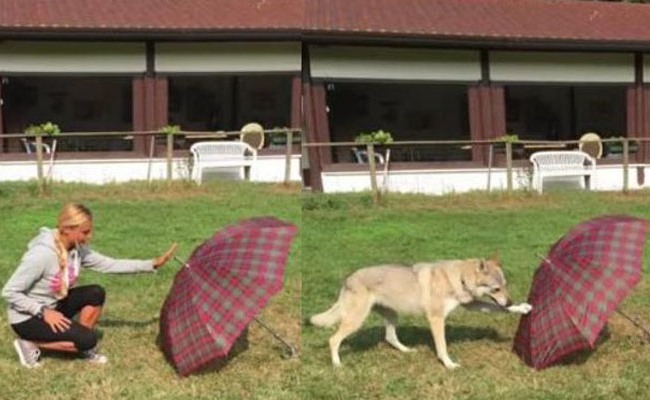
In the study at Eotvos Lorand University in Budapest, published Nov. 23 in Current Biology, 17 dogs were taught a training method called “Do As I Do.” The dogs would watch their owners perform an action. When the dogs were told, “Do it” and imitated their owners’ action, they were rewarded with a treat.
Next, the owners performed various actions but told the dogs to lie down instead of “Do it.” After a while, the dogs began lying down without being told to do so. The study’s authors noted that this showed the dogs had lost the expectation that they would be given the “Do it” command to imitate their owners.
Finally, the owners performed various actions, and when their dogs would lie down, the owners would wait either a minute or an hour and then give them the “Do it” command.
Some of the actions were unfamiliar to the dogs, such as their owners tapping on an open umbrella. The dogs would be led behind a partition, and a minute to an hour later would be led back to the umbrella and given the “Do it” command.
The dogs were able to remember what their owners had done, and tapped the umbrella with their paws.
“We cannot directly investigate what is in the dog’s mind,” psychologist Claudia Fugazza, an author of the study and owner of a Czechoslovakian Wolfdog who participated, told the Washington Post. “So we have to find behavioral evidence of what they expect or not.”
Remembering events in our lives is known as episodic memory. Until recently, only humans were thought to have this ability, but studies have found evidence that rats, monkeys and birds also have it, and so do dogs.
However, the researchers said the dogs don’t have full-fledged episodic memory, which would give them self awareness. Fugazza told NPR she didn’t think there was a method available to test whether dogs are self aware.
Victoria Templer, a behavioral neuroscientist at Providence College who wasn’t involved in the study, told NPR the results could be useful in helping scientists understand how episodic memory developed in humans and how it’s helped us to survive.
One interesting possibility Templer suggested is that “we evolved the ability to relive the past in order to imagine the future.”
ooOOoo
Of course what would be a marvelous aspect of a dog’s memory is being able to take note and remember where his male human companion left items around the house!
We all could easily be drinking in ‘the last chance saloon’.
After I published my book, Learning From Dogs, last December I was invited to a number of book signing events. In each case I gave a short talk of about 20 minutes in which I explained the philosophy behind the book. Perhaps no better articulated than by Dr. Jim Goodbrod’s Foreword to the book. Take this paragraph, for instance, from that Foreword:
Dogs represent to me that innocence lost. Their emotions are pure. They live in the present. They do not suffer existential angst over what they are. They do not covet material wealth. They offer us unconditional love and devotion. Although they certainly have not reached the great heights of intellectual achievement of us humans (I know for a fact that this is true after having lived with a Labrador Retriever for several years), at the same time they have not sunk to the depths of depravity to which we are susceptible. It could be argued that I am being overly anthropomorphic, or that dogs are simply mentally incapable of these thoughts. But nevertheless, metaphorically or otherwise, I believe that dogs demonstrate a simple and uncorrupted approach to life from which we all could benefit.
During my opening talks on each occasion I would ask the audience: “So raise your hands if you are someone who is not worried about the future?”
There was never a raised hand!
My introduction to a recent essay published by George Monbiot that is republished here with Mr. Monbiot’s permission.
ooOOoo
The Drums of War
24th November 2016
The combination of automation, complexity and climate change is dangerous in ways we haven’t even begun to grasp.
By George Monbiot, published in the Guardian 23rd November 2016
Wave the magic wand and the problem goes away. Those pesky pollution laws, carbon caps and clean power plans: swish them away and the golden age of blue-collar employment will return. This is Donald Trump’s promise, in his video message on Monday, in which he claimed that unleashing coal and fracking will create “many millions of high-paid jobs”. He will tear down everything to make it come true.
But it won’t come true. Even if we ripped the world to pieces in the search for full employment, leaving no mountain unturned, we would not find it. Instead, we would merely jeopardise the prosperity – and the lives – of people everywhere. However slavishly governments grovel to corporate Luddism, they will not bring the smog economy back.
No one can deny the problem Trump claims to be addressing. The old mining and industrial areas are in crisis throughout the rich world. And we have seen nothing yet.
I have just re-read the study published by the Oxford Martin School in 2013 on the impacts of computerisation. What jumps out today, to put it crudely, is that jobs in the rustbelts and rural towns that voted for Trump are at high risk of automation; while the professions of many Clinton supporters are at low risk.
The jobs most likely to be destroyed are in mining, raw materials, manufacturing, transport and logistics, cargo handling, warehousing and retailing, construction (pre-fabricated buildings will be assembled by robots in factories), office support, administration and telemarketing. So what, in the counties that voted for Trump, will be left?
Farm jobs have mostly gone already. Service and care work, where hope for some appeared to lie, will be threatened by a further wave of automation, as service robots – commercial and domestic – take over. Yes, there will be jobs in the green economy, more and better than any that could be revived in the fossil economy. But they won’t be enough to fill the gaps, and many will be in the wrong places.
At lower risk is work that requires negotiation, persuasion, originality and creativity. The management and business jobs that demand these skills are comparatively safe from automation; so are lawyers, teachers, researchers, doctors, journalists, actors and artists. The jobs that demand the highest educational attainment are the least susceptible to computerisation. The divisions tearing America apart will only widen.
Even this bleak analysis does not capture in full the underlying reasons why good, abundant jobs will not return to the places that need them most. As Paul Mason argues in Postcapitalism, the impacts of information technology go way beyond simple automation: it is likely to destroy the very basis of the market economy and the relationship between work and wages.
And, as the independent thinker Paul Arbair notes in the most interesting essay I have read this year, beyond a certain level of complexity, economies become harder to sustain. There’s a point at which further complexity delivers diminishing returns; society is then overwhelmed by its demands and breaks down. He argues that the political crisis in Western countries suggests we may have reached this point.
In the same video address on Monday, Trump announced that he will withdraw America from the Trans-Pacific Partnership (TPP). He is right to do so, for the wrong reasons. Like TTIP and CETA, the TPP is a fake trade treaty, whose primary impact is to extend corporate property rights at the expense of both competition and democracy. But withdrawal will not, as he claims, “bring jobs and industry back to American shores”. The work in Mexico and China that Trump wants to reclaim will evaporate long before it can be repatriated.
As for the high-quality, high-waged working class jobs he promised, these are never handed down from on high. They are secured through the organisation of labour. But the unions were smashed by Ronald Reagan, and collective bargaining has been suppressed ever since by casualisation and fragmentation. So how is this going to happen? Out of the kindness of Trump’s heart? Kindness, Trump, heart?
But it’s not just Trump. Clinton and Sanders also made impossible promises to bring back jobs. Half the platform of both parties was based on a delusion. The social, environmental and economic crises we face require a complete reappraisal of the way we live and work. The failure by mainstream political parties to produce a new and persuasive economic narrative, that does not rely on sustaining impossible levels of growth and generating illusory jobs, provides a marvellous opening for demagogues everywhere.
Governments across the world are making promises they cannot keep. In the absence of a new vision, their failure to materialise will mean only one thing: something or someone must be found to blame. As people become angrier and more alienated; as the complexity and connectivity of global systems becomes ever harder to manage; as institutions like the European Union collapse and as climate change renders parts of the world uninhabitable, forcing hundreds of millions of people from their homes, the net of blame will be cast ever wider.
Eventually the anger that cannot be assuaged through policy will be turned outwards, towards other nations. Faced with a choice of hard truths or easy lies, politicians and their supporters in the media will discover that foreign aggression is among the few options for political survival. I now believe that we will see war between the major powers within my lifetime. Which ones it will involve, and on what apparent cause, remains far from clear. But something that once seemed remote now looks probable to me.
A complete reframing of economic life is needed not “just” to suppress the existential risk that climate change presents (a risk marked by a 20°C anomaly reported in the Arctic Ocean while I was writing this article), but other existential threats as well – including war. Today’s governments, whether they are run by Trump or Obama or May or Merkel, lack the courage and imagination even to open this conversation. It is left to others to conceive of a more plausible vision than trying to magic back the good old days. The task for all those who love this world and fear for our children is to imagine a different future, rather than another past.
On my desk in front of me is a small booklet of business quotations that was published by Speedwing Training Ltd, part of the British Airways Group of Companies. I have had it for years. I randomly opened the booklet and there on page 7 is this quotation (and the emboldening is mine):
Our task is not to fix the blame for the past, but to fix the course for the future.
John F. Kennedy
Mr. Monbiot speaks for the millions of people who need that course for the future NOW!
Wherever one is in the world there’s something that will always offer delight, interest and a bit of a weather forecast as a bonus. I’m speaking of clouds.
I have written about clouds before in this place but the reason that I just have to share another post about clouds with you is this image:
Earlier this month, a peculiar ring appeared in the clouds over Warwickshire, England. James Tromans, who photographed the formation, asked what might have caused it. Clearly, this was time for some cloud detective work.
The ring was actually more of a curve, or a ‘U’, as there was no other half to it. It appeared to consist of regular lumps, or lobes, hanging down from the underside of a cloud layer. We wondered if this layer was an Altostratus, but off in the distance to the right of the image there appeared to be showers, like those produced by a storm cloud. This suggested that the cloud layer might in fact have been part of the huge canopy that spreads out at the top of a Cumulonimbus storm cloud.
Sometimes, to the rear of a storm, lobes of cloud known as
1. Could ‘mamma’ be involved? Spotted over Wilton, Wiltshire, UK, by William Saberton,
mamma can be seen
hanging from the underside of the canopy (see image 1). There certainly was a general appearance of mamma in the cloud layer. But could some of these mamma cloud lobes have arranged themselves into this strange, regular curved formation? It seemed unlikely.
There was something decidedly unnatural about the cloud’s appearance – as if it were man-made. Then it occurred to us that the photograph was looking towards Coventry Airport. Might this cloud effect have been in some way caused by an aircraft?
As planes fly through clouds made of ‘supercooled’ water droplets, they can encourage these extremely cold droplets to freeze and fall below, leaving behind a gap, known as a dissipation trail, or ‘distrail’. Such formations are often seen in
2. Or was it to do with an aircraft ‘distrail’, like this spotted over Newcastle, Australia, by Jillian De Martin (Member 12801)?
straight lines where planes ascend or descend through the cloud. But they can also appear in circular shapes when one is flying in a holding pattern as it waits to land (see image 2). James’s cloud wasn’t quite a distrail, but we felt we were getting close.
It was then that we recognised the regular spacing of the lobes. These sometimes appear below aircraft condensation trails (see image 3). They are caused by the interaction between the two swirling vortices produced by the wings. As these rotate in opposite directions in the wake of an aircraft, the two turbulent flows interact and combine to form a periodic pattern of turbulent downdrafts. In the right conditions, they appear as lobes hanging below the condensation trail.
3. The clue was in the turbulence lobes that can appear hanging from an aircraft contrail. You can see these in this strip of contrail spotted over the Smokey Mountains, US, by Gary Smith.
This explained the formation. It was caused by an aircraft, which happened to be flying just above the base of the cloud layer as it turned in a holding pattern above the nearby airport. The plane’s condensation trail was hidden within the cloud layer, but the lobes of cloud descending below it, caused by the turbulence from its wings, appeared extending below the layer.
Phew! With that cleared up, we could finally relax once more.
Turbulence lobes beneath the contrail of an aircraft in holding pattern over Hampton Lucy, Warwickshire, UK, by James Tromans.
ooOOoo
How very interesting and hope I’m not the only one to think so.
Both with animals and with us humans we reap what we sow. Or as I am oft to put it: “Always play with a straight bat for bent bats are practically useless”.
So what has prompted this introspective start to today’s post?
Something that was published on the Care2 blogsite earlier in the month. It was a story about how ex-rescue dogs went on to become dogs that rescued others. It certainly spoke to me and I feel sure that many of you will be inspired by the story.
ooOOoo
Puppy Rescued Day After Italy’s Latest Quake to Become a Rescue Dog
Among the survivors pulled from the rubble of Italy’s latest major earthquake (Oct. 29) was a border collie puppy who was trapped in the town of Norcia for two days.
The puppy was reunited with his owners, who were so grateful for his rescuers’ work that they decided to let the local fire service adopt him.
Now named Terremoto, which is Italian for – you guessed it – “earthquake,” the pup will be trained to pay it forward by becoming a search-and-rescue dog.
Volunteers from the nonprofit ENPA have been helping nearly 1,000 animals rescued after the earthquakes this year in Italy’s central region. ENPA, an acronym for Ente Nazionale Protezione Animali (National Animal Protection Agency), has been around since 1871. It is Italy’s oldest and largest animal rights organization.
After the 6.6-magnitude Oct. 29 earthquake, at least 900 animals have received assistance from the organization, according to the ENPA website. Almost 160 of them required veterinary care, including 59 dogs, 63 cats, 13 chickens, 10 tortoises, four parrots, five canaries, two geese, one hedgehog and a hamster. Amazingly, only one animal died: a dog rescued from the rubble alive but in serious condition in the town of Nottoria.
So far, at least 78 animals have been reunited with their owners. Police in Perugia adopted two rescued puppies, The Local reports.
A video captured rescuers using their hands to dig out another dog, Ulysses, after they saw his legs sticking out of the rubble. Like Terremoto, Ulysses had been buried alive when the 6.5 earthquake struck. And, like Terremoto, despite his terrible ordeal, Ulysses was checked out by a veterinarian and found to be in good condition.
About 50 trained search-and-rescue dogs worked with more than 5,000 rescuers after a 6.2 earthquake struck the same region of Italy in August. Among the survivors the dogs sniffed out were two children who’d been stuck in the rubble at separate locations for about 15 hours.
Like these dogs, Terremoto will be trained to bark if he detects a survivor less than 7 feet below the rubble. The rescuers will then dig out the survivor by hand. If Terremoto or other search-and-rescue dogs do not bark, it indicates there are no survivors below. In these cases, heavy machinery is brought in to clear the debris, with care being taken in case there are bodies buried in it.
Search-and-rescue dogs usually stop barking about three days after a disaster like a major earthquake. The rescue efforts then become recovery efforts, since victims would not be able to survive that long without water.
Here in the United States, the National Disaster Search Dog Foundation trains rescued dogs to become search-and-rescue dogs. The dogs are saved from shelters and rescue groups across the country.
While I’d like to wish Terremoto a successful career as a search-and-rescue dog, I’m really hoping he never needs to put those skills to use.
Founded in 1996, the National Disaster Search Dog Foundation (SDF) is a 501(c)(3) non-profit, non-governmental organization based in Santa Paula, California. Our mission is to strengthen disaster response in America by recruiting rescued dogs and partnering them with firefighters and other first responders to find people buried alive in the wreckage of disasters.

 My dreams of hope!