Category: Science

This is the dog!

Perhaps the loss of a loved dog explains so much!

The posts for the last two days have carried separate and very different stories of terrible cruelty to dogs, the second one involving terrible cruelty to a dog and a bull! As a tradition! Ouch!!

Readers of this place know what they feel about dogs. It is felt deep within their hearts. Those feelings are poured out when, either from me or someone else, there’s a post lamenting the loss of their dog.

Just as a tiny example of that love we all have for our dogs, here’s a response from Marina Kanavaki and, trust me, Marina is far from being alone in this regard.

Oh, no, Paul!!! I’m so sorry my friend! It is hard to believe and not so long ago, Casey. I know words can’t take away the pain but you have my thoughts and I’m sending you both my love and hugs.

So a recent essay published on The Conversation site is a must to share with you today. As usual, it is republished within the terms of The Conversation.

ooOOoo

Why losing a dog can be harder than losing a relative or friend

March 9, 2017
Frank T. McAndrew,   Cornelia H. Dudley Professor of Psychology, Knox College.

Recently, my wife and I went through one of the more excruciating experiences of our lives – the euthanasia of our beloved dog, Murphy. I remember making eye contact with Murphy moments before she took her last breath – she flashed me a look that was an endearing blend of confusion and the reassurance that everyone was ok because we were both by her side.

When people who have never had a dog see their dog-owning friends mourn the loss of a pet, they probably think it’s all a bit of an overreaction; after all, it’s “just a dog.”

However, those who have loved a dog know the truth: Your own pet is never “just a dog.”

Many times, I’ve had friends guiltily confide to me that they grieved more over the loss of a dog than over the loss of friends or relatives. Research has confirmed that for most people, the loss of a dog is, in almost every way, comparable to the loss of a human loved one. Unfortunately, there’s little in our cultural playbook – no grief rituals, no obituary in the local newspaper, no religious service – to help us get through the loss of a pet, which can make us feel more than a bit embarrassed to show too much public grief over our dead dogs.

Perhaps if people realized just how strong and intense the bond is between people and their dogs, such grief would become more widely accepted. This would greatly help dog owners to integrate the death into their lives and help them move forward.

An interspecies bond like no other

What is it about dogs, exactly, that make humans bond so closely with them?

For starters, dogs have had to adapt to living with humans over the past 10,000 years. And they’ve done it very well: They’re the only animal to have evolved specifically to be our companions and friends. Anthropologist Brian Hare has developed the “Domestication Hypothesis” to explain how dogs morphed from their grey wolf ancestors into the socially skilled animals that we now interact with in very much the same way as we interact with other people.

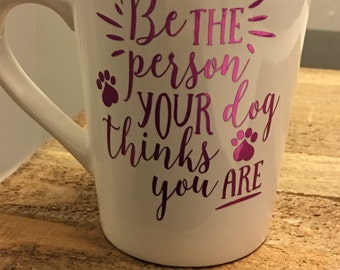
Perhaps one reason our relationships with dogs can be even more satisfying than our human relationships is that dogs provide us with such unconditional, uncritical positive feedback. (As the old saying goes, “May I become the kind of person that my dog thinks I already am.”)

This is no accident. They have been selectively bred through generations to pay attention to people, and MRI scans show that dog brains respond to praise from their owners just as strongly as they do to food (and for some dogs, praise is an even more effective incentive than food). Dogs recognize people and can learn to interpret human emotional states from facial expression alone. Scientific studies also indicate that dogs can understand human intentions, try to help their owners and even avoid people who don’t cooperate with their owners or treat them well.

Not surprisingly, humans respond positively to such unrequited affection, assistance and loyalty. Just looking at dogs can make people smile. Dog owners score higher on measures of well-being and they are happier, on average, than people who own cats or no pets at all.

Like a member of the family

Our strong attachment to dogs was subtly revealed in a recent study of “misnaming.” Misnaming happens when you call someone by the wrong name, like when parents mistakenly calls one of their kids by a sibling’s name. It turns out that the name of the family dog also gets confused with human family members, indicating that the dog’s name is being pulled from the same cognitive pool that contains other members of the family. (Curiously, the same thing rarely happens with cat names.)

It’s no wonder dog owners miss them so much when they’re gone.

Psychologist Julie Axelrod has pointed out that the loss of a dog is so painful because owners aren’t just losing the pet. It could mean the loss of a source of unconditional love, a primary companion who provides security and comfort, and maybe even a protégé that’s been mentored like a child.

The loss of a dog can also seriously disrupt an owner’s daily routine more profoundly than the loss of most friends and relatives. For owners, their daily schedules – even their vacation plans – can revolve around the needs of their pets. Changes in lifestyle and routine are some of the primary sources of stress.

According to a recent survey, many bereaved pet owners will even mistakenly interpret ambiguous sights and sounds as the movements, pants and whimpers of the deceased pet. This is most likely to happen shortly after the death of the pet, especially among owners who had very high levels of attachment to their pets.

While the death of a dog is horrible, dog owners have become so accustomed to the reassuring and nonjudgmental presence of their canine companions that, more often than not, they’ll eventually get a new one.

So yes, I miss my dog. But I’m sure that I’ll be putting myself through this ordeal again in the years to come.

ooOOoo

Just let the messages of this essay reverberate around your heart. I’ll say no more!
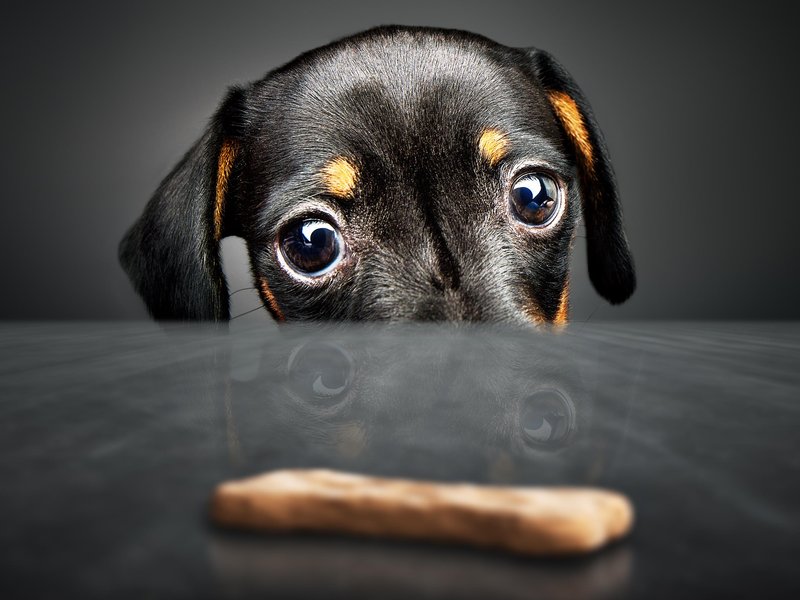
Dogs: Aren’t They Incredible!

The love and admiration for this beautiful animal goes on and on!

It seems as though it is almost on a weekly basis that new and incredible facts about our dear, dear dogs come to the surface.

So what prompted this from me today!

Only a wonderful article that was originally published in New Scientist but then was carried by The Smithsonian. I am hoping that by fully linking this post to both the New Scientist article and the essay in The Smithsonian I am at liberty to republish it for all you good people.

ooOOoo

Dogs Use Deception to Get Treats, Study Shows

When a human partner withheld tasty snacks, the dogs got sneaky

Would these eyes deceive you? New study says yes. (johan63/iStock)

By Brigit Katz     smithsonian.com
March 10, 2017
There is plenty of evidence to suggest that dogs, in addition to looking adorable in sweaters, possess fairly sophisticated cognitive abilities. They recognize emotion, for example, and respond negatively to antisocial behavior between humans. Man’s best friend can also get pretty tricksy when it comes to scoring snacks. As Brian Owens reports for New Scientist, a recent study found that dogs are capable of using deceptive tactics to get their favorite treats.

The study, published in the journal Animal Cognition, was led by Marianne Heberlein of the Department of Evolutionary Biology and Experimental Studies at the University of Zürich. Heberlein told Owens that the idea for the study was born when she observed her pet pooches engaging in deceptive behavior; one sometimes pretends to see something interesting outside, prompting the other to give up his sleeping spot.

To find out if dogs engage in similar shenanigans with humans, Heberlein and a team of researchers paired 27 dogs with two different partners, Stanley Coren explains in Psychology Today. One of these partners would repeatedly go to the bowl of a given dog, fish out a treat, and give it to the pup. The other would show the treat to the dog, and then put it in her pocket. Perhaps unsurprisingly, the dogs began to show a preference for the more generous partners, and would approach them spontaneously.

Once one partner had been established as co-operative, the other as competitive, the dogs were taught to lead their partners to one of two boxes, both containing food, with the command “Show me the food.” And the same pattern was repeated: when the dogs led the co-operative partner to a treat, they got to eat it. The competitive partner withheld the treat.

Researchers then showed the dogs three covered boxes. One contained a sausage, the second contained a less-yummy dry biscuit, and the third was empty. Once again, the process of treat giving and withholding was repeated, but this time with a twist: when the dog was reunited with its owner, the owner asked it to choose one of the boxes. If there was a treat inside the box, the dog was allowed to eat it. But “if the dog chose the box which had been opened before,” Coren explains, “the owner just showed the empty box to the dog.”

Over the course of a two-day testing period, the dogs were repeatedly presented with this conundrum. They had been trained to lead both partners to boxes containing food, but they knew that the competitive partner would not let them eat the snacks. They also knew that if any snacks remained inside the boxes once they were reunited with their owners, they would get a chance to eat them. So the dogs got a little devious.

Researchers observed the pooches leading the co-operative partner to the box containing the sausage more often than expected by chance. They led the competitive partner to the sausage less often than expected by chance. And here’s where things get really interesting: the dogs took the competitive partner to the empty box more frequently than the co-operative partner, suggesting that they were working through their options and engaging in deliberate deception to maximize their chances of getting both treats.

“It is as though the dog is thinking, ‘Why should I tell that selfish person where the best treat [is] if it means that I will never get it?’,” writes Coren.

“These results show that dogs distinguished between the co-operative and the competitive partner,” the authors of the study write, “and indicate the flexibility of dogs to adjust their behaviour and that they are able to use tactical deception.”

Rest assured, dog lovers: your pooches may be sneaky, but they still love you more than cats.

Read more: http://www.smithsonianmag.com/smart-news/dogs-use-deception-get-treats-study-shows-180962492/#5r1vc6gkyLQoIQaL.99
Give the gift of Smithsonian magazine for only $12! http://bit.ly/1cGUiGv
Follow us: @SmithsonianMag on Twitter

ooOOoo

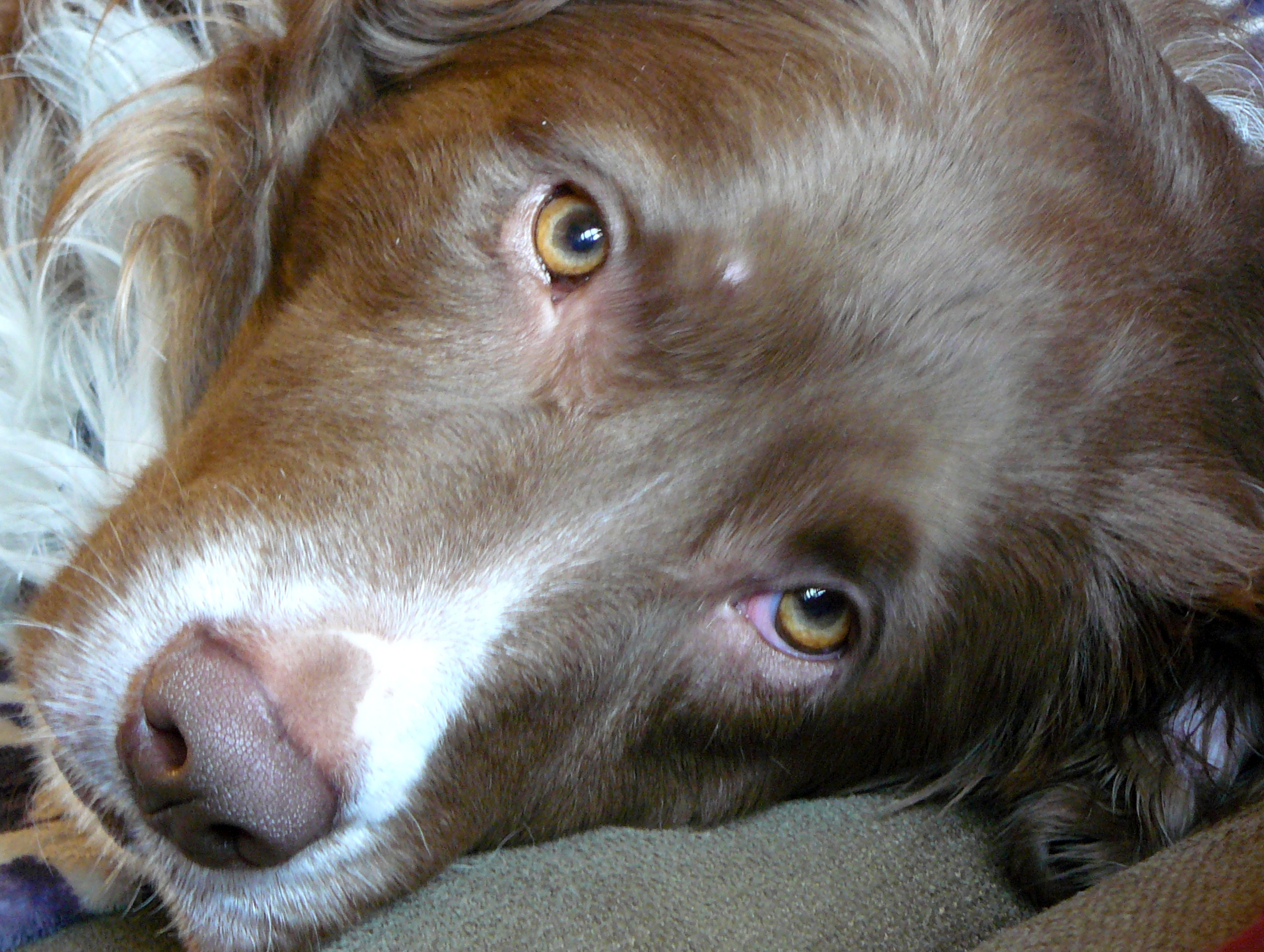
 The article from Brigit opened up with a picture of a pair of eyes; a pair of dog’s eyes.

I don’t know about you but some dogs have eyes that reach out and seem to illuminate one’s soul.

Our Oliver has just that set of eyes. I will close today’s post with a photograph of Oliver’s eyes that was taken yesterday afternoon.

Talk about the power of non-verbal communication!


Smoke and Mirrors

Let me start with a quotation:

I’m not a pessimist, even though I do think awful things are going to happen.

James Lovelock

The author of that quote is fellow Englishman, albeit a tad older than yours truly, Mr. James Lovelock. WikiPedia describes him, thus (in part):

James Ephraim Lovelock CHCBEFRS[2] (born 26 July 1919) is an independent scientist, environmentalist and futurist who lives in Devon, England. He is best known for proposing the Gaia hypothesis, which postulates that the Earth functions as a self-regulating system.[5]

Moving on.

These times in this fine country, The United States of America, are troubling as Rebecca Gordon set out so compellingly in yesterday’s post.

But what is so terrible about these times is the failure to put integrity at the heart of every pronouncement that comes from a Government. And it would be grossly unfair to pick on the present US Government as the only example of this failure.

Because just a few mouse clicks can inform millions of us as to the real issues. Such as the effect that Climate Change is having on our health, as this recent Grist article so aptly put it in the opening paragraphs:

Here are 4 ways climate change is messing with our brains — for the worse.

We might think of climate change as purely physical: wildfires blazing through forests, rising seas lapping at the doors of coastal homes.

But those brutal conditions also affect our mental health, changing how we think and act. Mental health professionals are paying attention to the link between climate change and emotional health — and health insurance companies are, too.

Or take the issue of the state of America’s water. Recently the subject of an important essay just presented by Naked Capitalism:

America’s Hidden Water Affordability Crisis

Yves here. Grist has been doing an admirable job of keeping on top of this important yet oddly still-under-the-radar story. In the US, the big driver of rising water costs is the need to invest in aging, neglected water works. But water is going to become an issue in many places for differing reasons. As we have been saying for years, the natural resource that is projected to come under pressure first is potable water. And please don’t push desalination as a magic bullet. That costs money (both the plants and new transportation infrastructure, uses energy, plus has the not-trivial problem of how to dispose of the salt residues.

By Ciara O’Rourke, a freelance writer and 2015-16 Ted Scripps Fellow in Environmental Journalism at the University of Colorado Boulder. Originally published by Fusion and reproduced at Grist as part of the Climate Desk collaboration

When Elizabeth Mack wondered about a future in which Americans wouldn’t be able to pay for water, a couple of colleagues waved her off. “Don’t be ridiculous,” they said. But the idea niggled at Mack, an assistant professor at the Department of Geography, Environment, and Spatial Sciences at Michigan State University. And in January, in an article published in the science journal PLOS ONE, she asked a new question: Is there a burgeoning water affordability crisis in the United States?

Mack, along with research assistant Sarah Wrase, determined that if water rates increase at projected amounts over the next five years, the percentage of households that can’t pay their water bills could triple from 11.9 percent to more than a third. Nearly 14 million households nationwide already struggle to afford water services. An additional 27.18 million — or 8.5 percent of the country’s population — could soon face the same challenges.

Yes, integrity in politics is more, so much more, than a nice idea from this silly old Brit now living in Oregon. Here’s a post I published some four years ago that says it as clearly as it needs to be said.

ooOOoo

Reflections on Integrity.

Going back to basics.

Many will know the origins of this blog; a chance comment by Jon Lavin back in England in early 2007 that dogs were integrous, (a score of 210 as defined by Dr David Hawkins).

Way back in 2009, I wrote this:

“There is nothing to fear except the persistent refusal to find out the truth, the persistent refusal to analyse the causes of happenings.” Dorothy Thompson.

When I started Learning from Dogs I was initially rather vague but knew that the Blog should reflect the growing need for greater integrity and mindfulness in our planetary civilisation. Here are some early musings,

Show that integrity delivers better results … integrity doesn’t require force … networking power of a group … demonstrate the power of intention … cut through the power of propaganda and media distortion …

Promulgate the idea that integrity is the glue that holds a just society together … urgent need as society under huge pressures …. want a decent world for my grandchildren … for all our grandchildren …. feels like the 11th hour….

But as the initial, rather hesitant, start to the Blog settled into a reliable, daily posting, and as the minuscule number of readers steadily grew to the present level of many hundreds each day, the clarity of the purpose of Learning from Dogs also improved.

Because, while it may sound a tad grandiose and pompous, if society doesn’t eschew the games, half-truths and selfish attitudes of the last, say, 30 years or more, then civilisation, as we know it, could be under threat.

Or, possibly, it’s more accurate to say that our civilisation is under threat and the time left to change our ways, to embrace those qualities of integrity, truth and consciousness for the very planet we all live on, is running out.

Time left to change our ways is running out.

So what’s rattled my cage, so to speak, that prompted today’s reflection? I’ll tell you! (You knew I was going to anyway, didn’t you!)

I’m drafting these thoughts around noon Pacific Standard Time on Sunday, 17th. At the same time, tens of thousands of ordinary good folk (40,000 plus at the latest estimate) are gathering by the Washington Monument ready to march past the White House demanding that President Obama block the Keystone XL pipeline and move forward toward climate action.

Do I trust the US Government to take this action? On balance, no! That hurts me terribly to write that. I really want to trust and believe what the President of my new home country says.

State of the Union speech 2013. AP photo.

Here’s a snippet of what the President did say in his State of the Union speech on February 12th.

Now, it’s true that no single event makes a trend. But the fact is, the 12 hottest years on record have all come in the last 15. Heat waves, droughts, wildfires, floods, all are now more frequent and more intense.

We can choose to believe that Superstorm Sandy, and the most severe drought in decades, and the worst wildfires some states have ever seen were all just a freak coincidence. Or we can choose to believe in the overwhelming judgment of science and act before it’s too late.

A frank admission that the climate is changing in dramatic ways; the overwhelming judgment of science – fantastic!

The evidence that burning carbon-based fuels (coal, oil, gas) is the primary cause of today’s high CO2 levels is overwhelming. As a recent BBC radio programme reveals (being featured tomorrow) huge climate changes going back millions of years are a natural part of Earth’s history. However, as one of the scientists explains at the end of that radio programme, the present CO2 level, 395.55 ppm as of January, is now way above the safe, stable limit for the majority of life species on the planet.

But say you are reading this and are not yet convinced?

Let me borrow an old pilot’s saying from the world of aviation: If there’s any doubt, there’s no doubt!

That embracing, cautious attitude is part of the reason why commercial air transport is among the most safest forms of transport. If you had the slightest doubt about the safety of a flight, you wouldn’t board the aircraft.

If you had the slightest doubt about the future for civilisation on this planet likewise you would do something! Remember, that dry word civilisation means family, children, grandchildren, friends and loved ones. The last thing you would do is to carry on as before!

Which is where my lack of trust of leaders comes from!

Back to that State of the Union speech. Just 210 words after the spoken words “act before it’s too late” (I counted them!) Pres. Obama says, “That’s why my administration will keep cutting red tape and speeding up new oil and gas permits.

Here’s the relevant section:

I will direct my cabinet to come up with executive actions we can take, now and in the future, to reduce pollution, prepare our communities for the consequences of climate change, and speed the transition to more sustainable sources of energy.

Now, four years ago, other countries dominated the clean-energy market and the jobs that came with it. And we’ve begun to change that. Last year, wind energy added nearly half of all new power capacity in America. So let’s generate even more. Solar energy gets cheaper by the year. Let’s drive down costs even further. As long as countries like China keep going all-in on clean energy, so must we.

Now, in the meantime, the natural gas boom has led to cleaner power and greater energy independence. We need to encourage that. That’s why my administration will keep cutting red tape and speeding up new oil and gas permits.

We don’t require any more oil to be used. We are already using a staggering amount of it. Let me refer you to an essay on Nature Bats Last called Math. The scary kind, not the fuzzy kind. Prof. McPherson wrote:

I performed a little rudimentary math last week. A little because even a little pushes my limit for math, these days. And rudimentary for the same reason. The outcome was staggering: We’re using oil at the rate of 5,500 cubic feet per second (cfs).

5,500 cubic feet per second” Don’t know about you but I have some trouble in visualising that flow rate. Try this from later in the essay:

Here’s another shot of perspective: We burn a cubic mile of crude oil every year. The Empire State Building, the world’s ninth-tallest building, towers above New York at 1,250 feet. The world’s tallest building, Taipei 101, is 1,667 feet from ground to tip.

Put those buildings together, end to end, and you have one side of a cube. Do it again, and you have the second side. Once more, but this time straight up, and you have one big cube. Filling that cube with oil takes nearly 200 billion gallons … which is about one-sixth the size of the cube of oil we’re burning every year.

Burning a cubic mile every year! Yes, Mr. President, more oil permits is a wonderful way of taking action before it’s too late!

cubic mile
Image taken from http://www.flashevap.com/bigthings.htm

So let’s see what transpires? Let’s see if integrity is given the highest political focus. As in “adherence to moral and ethical principles; soundness of moral character; honesty.” Because if there’s ever been a time when all of us, from every spectrum of society need honesty about what we are doing to the planet, it’s now!

As the tag on the home page of this blog says, “Dogs are integrous animals. We have much to learn from them.

ooOOoo

Going to close with two more quotations from Mr. Lovelock.

The first:

You never know with politicians what they are really saying. And I don’t say that in a negative way-they have an appalling job.

And the second one to close today’s post:

If you start any large theory, such as quantum mechanics, plate tectonics, evolution, it takes about 40 years for mainstream science to come around. Gaia has been going for only 30 years or so.

The Cave of Crystal Giants

This will take us away from the daily beat of life!

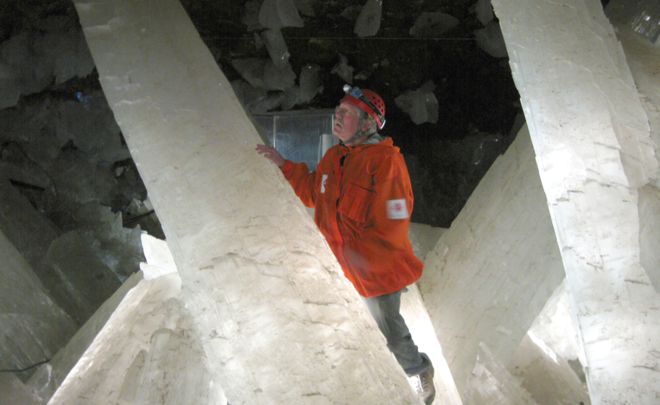
On the 18th. February the BBC News website carried an article that I found incredible. It was the story of Naica’s crystal caves in Mexico.

oooo

Naica’s crystal caves hold long-dormant life

By Jonathan Amos, BBC Science Correspondent, Boston, 18 February 2017.

 The caves were discovered by miners 100 years ago
The caves were discovered by miners 100 years ago. Picture credit: Penelope J. Boston

It is a remarkable discovery in an amazing place.

Scientists have extracted long-dormant microbes from inside the famous giant crystals of the Naica mountain caves in Mexico – and revived them. [Ed: my emphasis]

The organisms were likely to have been encased in the striking shafts of gypsum at least 10,000 years ago, and possibly up to 50,000 years ago.

It is another demonstration of the ability of life to adapt and cope in the most hostile of environments.

“Other people have made longer-term claims for the antiquity of organisms that were still alive, but in this case these organisms are all very extraordinary – they are not very closely related to anything in the known genetic databases,” said Dr Penelope Boston.

The new director of Nasa’s Astrobiology Institute in Moffett Field, California, described her findings here at the annual meeting of the American Association for the Advancement of Science (AAAS).

oooo

I was delighted to find more details in many other places on the ‘web’.

Such as this one on the National Geographic website:

By Victoria Jaggard

PUBLISHED February 17, 2017

Boston, Massachusetts

Creatures that thrive on iron, sulfur, and other chemicals have been found trapped inside giant crystals deep in a Mexican cave. The microbial life-forms are most likely new to science, and if the researchers who found them are correct, the organisms are still active even though they have been slumbering for tens of thousands of years.

If verified, the discovery adds to evidence that microbial life on Earth can endure harsher conditions in isolated places than scientists previously thought possible. (See “Life Found Deep Under Antarctic Ice for First Time?”)

“These organisms have been dormant but viable for geologically significant periods of time, and they can be released due to other geological processes,” says NASA Astrobiology Institute director Penelope Boston, who announced the find today at a meeting of the American Association for the Advancement of Science. “This has profound effects on how we try to understand the evolutionary history of microbial life on this planet.”

Then there’s another article on that NatGeo website: (Apologies for some duplication in the message.)

By Neil Shea, National Geographic Staff
In a nearly empty cantina in a dark desert town, the short, drunk man makes his pitch. Beside him on the billiards table sits a chunk of rock the size of home plate. Dozens of purple and white crystals push up from it like shards of glass. “Yours for $300,” he says. “No? One hundred. A steal!” The three or four other patrons glance past their beers, thinking it over: Should they offer their crystals too? Rock dust on the green felt, cowboy ballads on the jukebox. Above the bar, a sign reads, “Happy Hour: 8 a.m. to 9 p.m.”

This remote part of northern Mexico, an hour or so south of Chihuahua, is famous for crystals, and paychecks at the local lead and silver mine, where almost everyone works, are meager enough to inspire a black market. “Thirty dollars.” He leans in. “Ten.” It’s hard to take him seriously. Earlier in the day, in a cave deep below the bar, I crawled among the world’s largest crystals, a forest of them, broad and thick, some more than 30 feet long and half a million years old. So clear, so luminous, they seemed extraterrestrial. They make the chunk on the pool table seem dull as a paperweight.

Nothing compares with the giants found in Cueva de los Cristales, or Cave of Crystals. The limestone cavern and its glittering beams were discovered in 2000 by a pair of brothers drilling nearly a thousand feet below ground in the Naica mine, one of Mexico’s most productive, yielding tons of lead and silver each year. The brothers were astonished by their find, but it was not without precedent. The geologic processes that create lead and silver also provide raw materials for crystals, and at Naica, miners had hammered into chambers of impressive, though much smaller, crystals before. But as news spread of the massive crystals’ discovery, the question confronting scientists became: How did they grow so big?

It takes 20 minutes to get to the cave entrance by van through a winding mine shaft. A screen drops from the van’s ceiling and Michael Jackson videos play, a feature designed to entertain visitors as they descend into darkness and heat. In many caves and mines the temperature remains constant and cool, but the Naica mine gets hotter with depth because it lies above an intrusion of magma about a mile below the surface. Within the cave itself, the temperature leaps to 112 degrees Fahrenheit with 90 to 100 percent humidity—hot enough that each visit carries the risk of heatstroke. By the time we reach the entrance, everyone glistens with sweat.

That article continues here.
Finally, lose yourself in this video. (If the voice doesn’t get to you!)

How to close today’s post?

Both by embracing the power of the natural order of things, life and death, and by reminding us all that there are in the order of over two billion stars in this universe.

That universe must be teeming with life, current and dormant, and the day when we truly confirm that will put everything into perspective!

oooo

Talk about synchronicity!

For yesterday, around 10am PST, the BBC News website carried this big news item: Earliest evidence of life on Earth ‘found’.

Here’s how that article opens:

Earliest evidence of life on Earth ‘found’

By Pallab Ghosh Science correspondent, BBC News
Scientists have discovered what they say could be fossils of some of the earliest living organisms on Earth.
They are represented by tiny filaments, knobs and tubes in Canadian rocks dated to be up to 4.28 billion years old.
That is a time not long after the planet’s formation and hundreds of millions of years before what is currently accepted as evidence for the most ancient life yet found on Earth.

The researchers report their investigation in the journal Nature.

As with all such claims about ancient life, the study is contentious. But the team believes it can answer any doubts.

The scientists’ putative microbes from Quebec are one-tenth the width of a human hair and contain significant quantities of haematite – a form of iron oxide or “rust”.

Matthew Dodd, who analysed the structures at University College London, UK, claimed the discovery would shed new light on the origins of life.

Do read the full article including viewing some wonderful photographs.

Latest on Casey

The ebb and flow of events.

As many of you have gathered from my post on the 22nd. Casey was in a relatively stable situation. From that post:

For dear, sweet Casey he is facing a very long haul. Dr. Jim, our vet neighbour and close friend, recommended that Casey start taking a steroid and he is now on Prednisone.
p1160892

Indeed, Dr. Jim came by last Friday evening and said that even though there was little sign of a positive change in Casey’s condition it was still very early days.

Then on Saturday morning, when Jean went into the kitchen where Casey is with Ruby and Paloma, there had been an unexpected and sudden turn for the worse. For Casey could not adequately stand because his neck pain was too great and his front legs were giving way.

We rang immediately Southern Oregon Vet Specialty Center (SOVC) and they recommended that we take Casey straight there. SOVC operate 24-hours a day. Or in their words:

At Southern Oregon Veterinary Specialty Center, we understand the special bond between a pet and their human family. Our team of highly trained doctors, certified technicians and support staff partner with your family veterinarian to provide specialized diagnostics, surgery and emergency care for your pet upon a referral or emergency basis. Our clinic is staffed 24 hours-a-day, 7 days a week, to receive emergency cases and to monitor our critical care patients. The clinic’s board-certified veterinary specialists and staff are committed to providing exceptional compassionate care utilizing state-of-the-art technology and treatments.

The relationships we have with partner veterinarians are vital to the success of treating your pet. We will keep them apprised of the patient’s status to provide a smooth and cohesive experience.

SOVC had no doubt that we had done the right thing and that the pain meds we  were giving Casey Tramadol and two muscle-relaxers, just were not strong enough. Their prognosis was that Casey be admitted to SOVC so he could be given more appropriate pain control, via an IV, and that as soon as possible he be scanned using an MRI.
Luckily, not too far away from where SOVC are located, near Medford, there is a specialist animal imaging unit: Sage Veterinary Imaging:

About SVI

Sage Veterinary Imaging was founded in 2007 to provide the highest quality diagnostic imaging services to animals in the Southern Oregon area.  When I moved to the Rogue Valley, I was saddened to hear that animals needing advanced diagnostic imaging had to be driven hundreds of miles to get the care they needed.  Now we provide the only ACVR board-certified veterinary imaging services right here in Southern Oregon, serving patients from Redding, to Eugene.  Our administrative offices are located in Jacksonville and diagnostic services, including MRI, are provided in partnership with imaging centers in communities throughout Southern Oregon.

Even better, Dr. Jim knows Jamie Sage and speaks highly of her.

1505482Jaime Sage, is a veterinarian who is board-certified by the American College of Veterinary Radiology.  She holds a DVM from Texas A&M, an MS from The Ohio State University, and is licensed to practice in Oregon and California. Dr. Sage has issued reports for over 1,000 MRI studies in her career, and has personally performed nearly 100 onsite MRI procedures in Southern Oregon in just the past three years. Dr. Sage also works as a radiologist for MR Vets, founded by WSU Professor Emeritus Patrick R. Gavin, DVM, PhD, DACVR/RO, author of Practical Small Animal MRI, and one of the early pioneers in veterinary MRI.

Thus this morning, as in Monday morning Oregon time, SOVC will have the analysis from Jaime Sage followed by the surgical analysis by Dr. Steve Ferreira, the SOVC surgeon, who would conduct the surgery.

So more news just as soon as we have it.

Thank you all for your care and concern.

ooOOoo

UPDATE as at 12:40 PST

The surgeon, Steve Ferreira, called us to pass on the findings:

  • The MRI showed there to be several lesions that are not disc related,
  • There is an area of large compression, 50%-70% in some spots, in the lower cervical chord,
  • Separately, changes were noted in the C2 vertebra that suggested localised bone inflammation,
  • Lastly, there was an increased density pattern in the muscles associated with the cervix.

Dr. Steve said that the next step was to use a spinal tap to withdraw some spinal fluid. If it was cloudy that might indicate infection that could be treated with antibiotics. If the fluid was clear then it would be sent to an external lab for analysis. Possibilities include infection or cancer or an auto-immune issue, even possibly meningitis.

Apparently, surgery in that lower part of the spine would be very difficult to undertake. Likewise, removing a tumour that would simply regrow.

The cost of the anesthesia for the spinal tap, the insertion of the tap and the analysis would be in the order of several hundred dollars.

(Please accept that my understanding of what Dr. Steve said might not be 100% accurate. So use caution if any of this is relevant for your animal.)

ooOOoo

 UPDATE as at 17:20 PST

Steve Ferreira rang following the drawing of a sample of Casey’s spinal fluid.

  • The fluid “didn’t look too bad”, as in it was clear,
  • In other words, it was not immediately indicating an infectious disease, that would cause the fluid to appear cloudy,
  • Dr. F. will await further results from an external laboratory later this evening,
  • If both the white-cell count and proteins are more-or-less normal, then,
  • It will suggest that the problem is not an infection,
  • And, therefore, most probably related to a tumour on or around C6 where the MRI recorded the excessive compression,
  • Casey is comfortable owing to the strong pain medication being given to him via an IV.

Jean and I will be speaking with Dr. F. in the morning but it is more likely than not that Casey is terminally ill.

This post will, therefore, be updated in the morning.

UPDATE as at 08:40 Tuesday, 28th

Dr. Steve rang us at 08:30 this morning.

  • He started Casey on antibiotics yesterday evening in case the lab came back with evidence of infection in the spinal fluid, but,
  • The lab reported that the fluid was normal in terms of blood-cell counts and protein levels, therefore,
  • the probability is that Casey has a tumour,
  • or possibly an infection  inside the spinal column but outside the spinal fluid.
  • If such an infection, called an “empyema” then the degree of compression to the spine suggests it could be 3 to 4 weeks before Casey would be walking again.
  • More probable is that it is a tumour.
  • Casey is most definitely suffering and very miserable.

Jean and I then quickly, and very sadly, were of the opinion that Casey’s quality of life was too low for it to be fair to Casey for his life to be prolonged. We rang Dr. Steve back and asked that Casey be euthanised, cremated and that the ashes be returned to us.

In that return call, Dr. Steve quietly confirmed his support for our decision.

Casey will be very badly missed. I will be publishing an obituary tomorrow.

Thank you all for your friendship, love and caring!

Roads to recovery.

For Casey and Yours Truly!

At 1pm yesterday, I had an appointment with the medical assistant at the Department of Urology, Three Rivers Hospital, in Grants Pass, following my ten days of ‘wearing’ a catheter.  The good news was that the catheter was removed (and I must now remember I can’t pee anytime I like!).

The more sobering news was that for at least until the end of March, I must not engage in any lifting, pulling or pushing, or any exercise that would run the risk of another bleeding episode. I have an appointment with Dr. Mayer, the urologist, at the end of March and really want to be signed off as fully fit at that time.

So far: so good!

For dear, sweet Casey he is facing a very long haul. Dr. Jim, our vet neighbour and close friend, recommended that Casey start taking a steroid and he is now on Prednisone.

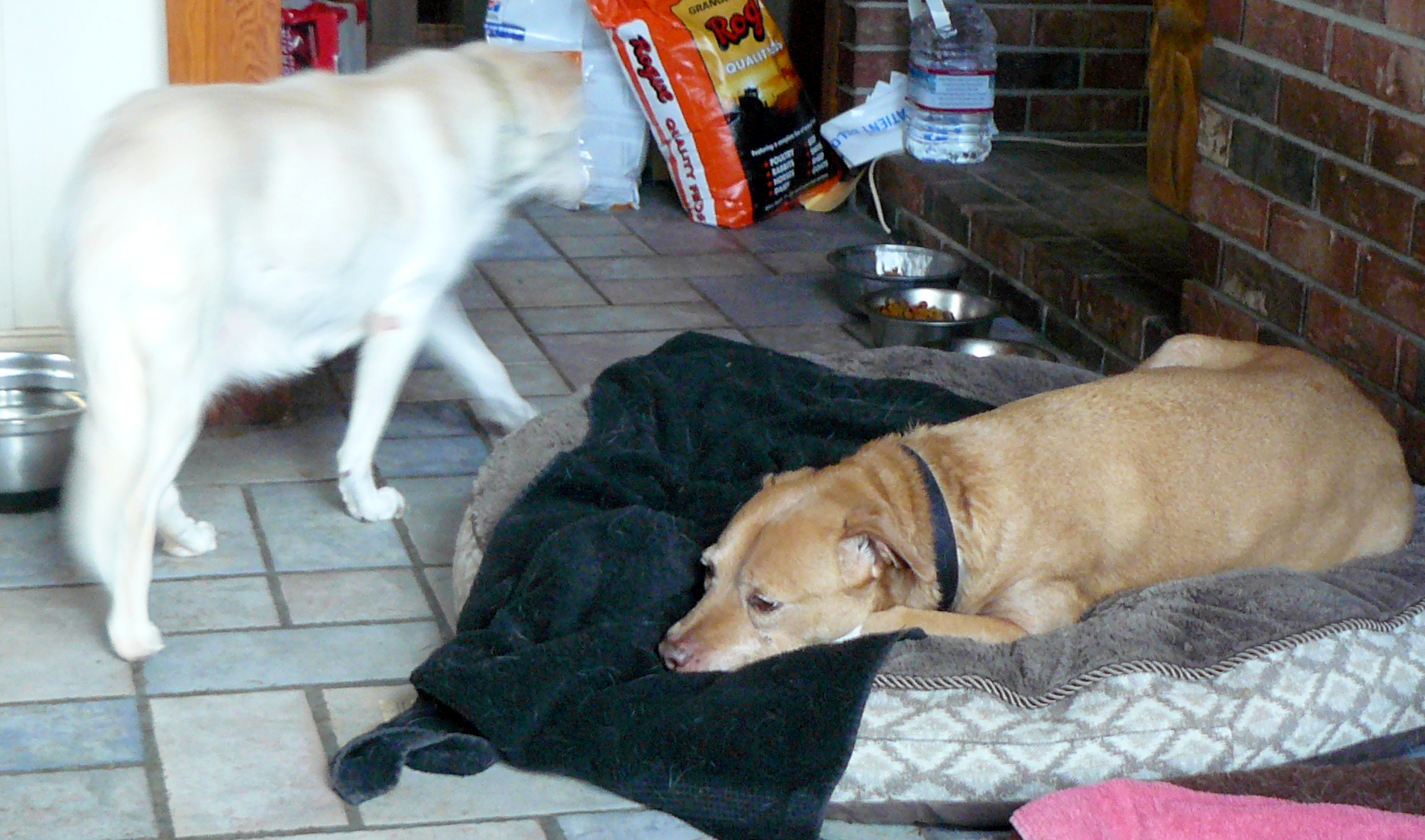
p1160892This has the effect of making Casey very lethargic. No bad thing because the only chance of his spinal disc and pad healing up is that he takes very little exercise. In the picture above you can see Casey avoids lifting his head up when he looks at you.

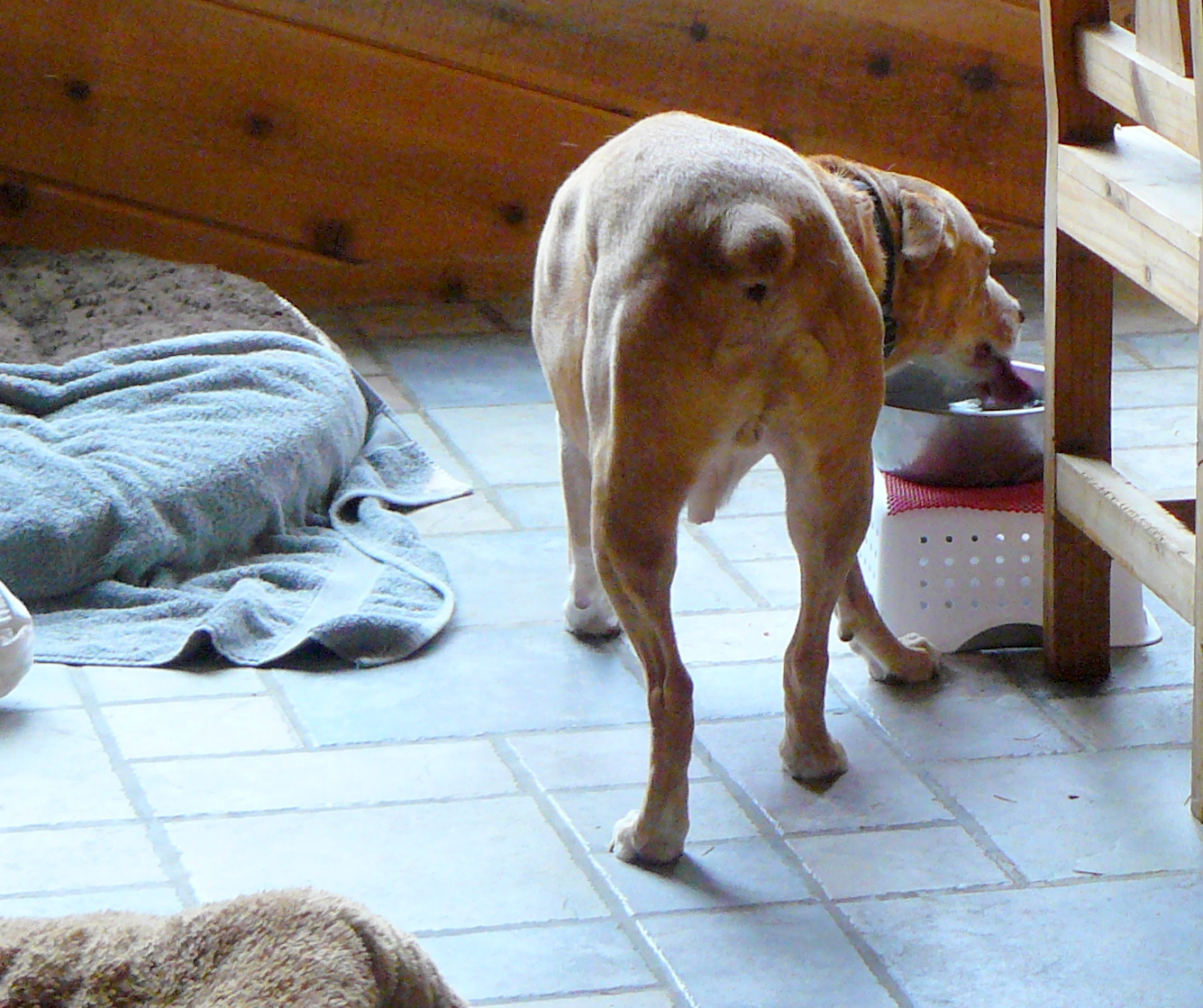
p1160889Jean has also paced Casey’s food bowl on a small stool because Casey found it painful to lower his mouth down to floor level.

Dr. Jim says that there is a very good chance that Casey will heal himself but that we are all looking at quite a few weeks.

So for Casey and me we sincerely hope that the end of March has us both firmly down that road to full recovery.

Paloma cruising past a resting Casey!

Who pulls the strings?

Or, more specifically, do we believe we have free will?

One of the endless benefits of this wired-up, digital world is how easy it is to have one’s mind opened and stretched a little.

Take this, for instance, as an intriguing start to a new day.

Do we have free will?

This isn’t a question I can answer, but what I am interested in is “what happens if we do (or do not) believe in free will?” In other words, does believing in free will matter in your daily life?

Just let one’s mind float around that idea, not only as it applies to us humans but also to the animals that share our human intuition, such as dogs and horses.

So what’s got me bubbling along today? Nothing less than an article that appeared on The Conversation blog-site back last September.

I found it fascinating and hope you do as well. It is republished within the terms of The Conversation site.

ooOOoo

Believing in free will makes you feel more like your true self

September 1, 2016

By Elizabeth Seto, Ph.D. Candidate in Social and Personality Psychology, Texas A&M University .

image-20160830-28235-1xkam7s
Believing in free will makes us feel more like ourselves. Man walking via http://www.shutterstock.com

Do we have free will? This is a question that scholars have debated for centuries and will probably continue to debate for centuries to come.

This isn’t a question I can answer, but what I am interested in is “what happens if we do (or do not) believe in free will?” In other words, does believing in free will matter in your daily life?

My colleagues and I at the Existential Psychology Lab at Texas A&M University study the psychological outcomes of belief in free will. While contemplating my next research project, I realized at some point in our lives, we all want to understand who we are – it’s human nature. So, we decided to explore how believing in free will influences our sense of self and identity.

 One way or another? Feet image via www.shutterstock.com.
One way or another? Feet image via http://www.shutterstock.com.

What is free will?

Free will is generally understood as the ability to freely choose our own actions and determine our own outcomes. For example, when you wake up in the morning, do you hit snooze? Do you put on your workout gear and go for a run? Do you grab a hot cup of coffee? While those are simple examples, if you believe in free will, you believe there are a limitless number of actions you can engage in when you wake up in the morning, and they are all within your control.

Believing in free will helps people exert control over their actions. This is particularly important in helping people make better decisions and behave more virtuously.

For instance, research has found that promoting the idea that a person doesn’t have free will makes people become more dishonest, behave aggressively and even conform to others’ thoughts and opinions. And how can we hold people morally responsible for their actions if we don’t believe they have the free will to act any differently? Belief in free will allows us to punish people for their immoral behaviors.

So, not only is there a value to believing in free will, but those beliefs have profound effects on our thoughts and behaviors. It stands to reason that believing in free will influences how we perceive ourselves.

You might be thinking, “Of course believing in free will influences how I feel about myself.” Even though this seems obvious, surprisingly little research has examined this question. So, I conducted two studies to suss out more about how believing in free will makes us feel.

What believing in free will makes us feel about ourselves

In the first study, I recruited 304 participants from Amazon Mechanical Turk and randomly assigned them to write about either personal experiences reflecting a high belief in free will, like changing career paths or resisting drugs or alcohol, or experiences reflecting a low belief in free will, such as growing up in poverty or working under an authoritative boss. Then, they were all asked to evaluate their sense of self.

Participants who wrote about experiences reflecting low belief in free will reported feeling less “in touch” with their true selves. In other words, they felt like they did not know themselves as well as the participants who wrote about experiences reflecting high belief in free will.

Then, I conducted a follow-up study testing one’s sense of authenticity, the feeling that one is behaving according to their own beliefs, desires and values.

I recruited another group of participants from Amazon Mechnical Turk, and like the first experiment, randomly assigned them to write about personal experiences demonstrating high belief in free will or low belief in free will. Then, they all completed a decision-making task where they had to make a series of choices about whether to donate money to charity or to keep the money for themselves.

Afterwards, participants were asked how authentic they felt while making their decisions. Participants in the low free will group reported feeling less authentic than participants in the high free will group.

 Up and at it. Female runner image via www.shutterstock.com.
Up and at it. Female runner image via http://www.shutterstock.com.

So, what does this all mean?

Ultimately, when people feel they have little control over their actions and outcomes in life, they feel more distant from their true, authentic selves. They are less in touch with who they are and do not believe their actions reflect their core beliefs and values.

We believe this is because belief in free will is linked to feelings of agency, the sense that we are the authors of our actions and are actively engaged with the world. As you can imagine, this sense of agency is an important part of a person’s identity.

The importance of feeling like you are in charge of your life applies to significant actions like moving or getting a new job or pondering the big questions in life. But it also applies to the minor decisions we make throughout the day.

Here’s one simple, though relatable, decision I am faced with every morning. When I wake up in the morning and decide to put on my workout gear and go for a run instead of hitting snooze, I might feel like I am the primary decision-maker for this morning routine. Additionally, I am most likely acting on the part of me that values physical health.

But what if I wake up, and I feel like I can’t exercise because I have to go to work or some other external factor is making it difficult to go? I might feel as if someone or something else is controlling my behavior, and perhaps, less like my true self.

So, do you have free will? Do any of us? Remember, the question isn’t whether it exists or not, but whether you believe it does.

ooOOoo

Now thinking of dogs having their own free will might seem a little bizarre, but I do not intend it to be seen as such. Many of you will have dogs (and horses) that have ‘minds of their own’.

For our family here at home, if there’s one of our dogs that exhibits free will it is our Brandy.

Our Brandy is a Pyrenean Mastiff!

Without warning or any other indication, he will suddenly decide it is time to go ‘walk-about’. Mainly during the day but sometimes at night, whatever the weather, he will disappear. He will always return but can be wandering around our thirteen acres for up to an hour.

Does he have free will?

Does he believe he has free will?

Do we believe he has free will?

What, dear reader, do you think?

Stupendous!

From the sublime to the amazing!

First, the sublime.

As in this stunning picture from the latest Cloud Appreciation Society newsletter.

A cap cloud at sunrise over Mount Rainier, spotted from Seattle, Washington, US, by Elaine Thompson (Member 41974).

“Though outwardly a gloomy shroud,
The inner half of every cloud
Is bright and shining:
I therefore turn my clouds about,
And always wear them inside out
To show the lining.”

[From ‘The Wisdom of Folly’ by Ellen Thorneycroft Fowler in Verses, Wise or Otherwise (1895)]

Then to the amazing!

It’s hard to comprehend the sheer size of objects in space, but take 2 minutes and give it a try!

This video is from the European Southern Observatory (ESO) comparing the sizes of Earth, our sun and stars.

Yet another recall

This time concerning Against the Grain Pet Foods

Against the Grain Dog Food Recall of February 2017

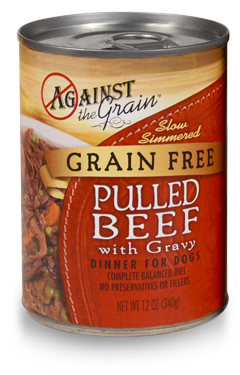
February 14, 2017 — Against the Grain Pet Food is voluntarily recalling one lot of Against the Grain Pulled Beef with Gravy Dinner for Dogs because it may be contaminated with pentobarbital.

against-the-grain-pulled-beef-dog-food

What’s Recalled?

  • Against the Grain Pulled Beef with Gravy Dinner for Dogs
  • 12 ounce can
  • Lot Number: 2415E01ATB12
  • UPC Code (second half): 80001
  • Expiration Date: December 2019

About Pentobarbital

Oral exposure to pentobarbital can cause side effects such as drowsiness, dizziness, excitement, loss of balance, nausea nystagmus (eyes moving back and forth in a jerky manner), inability to stand and coma.

To date, no complaints have been reported to Against the Grain for this single lot number nor any of Against the Grain’s pet foods.

Where Was It Distributed?

The recalled product was distributed (in 2015) to independent pet retail stores in the following states:

  • Maryland
  • Washington

The company has verified that the affected lot is no longer on any store shelves.

What to Do?

Consumers may return any can with the relevant lot number to their place of purchase and receive a full case of Against the Grain food for the inconvenience.

Customers with questions may contact the company at 800-288-6796 between 11 AM and 4 PM Central Time, Monday through Friday.

U.S. citizens can report complaints about FDA-regulated pet food products by calling the consumer complaint coordinator in your area.

Or go to http://www.fda.gov/petfoodcomplaints.

Canadians can report any health or safety incidents related to the use of this product by filling out the Consumer Product Incident Report Form.

Get Dog Food Recall Alerts by Email

Get free dog food recall alerts sent to you by email. Subscribe to The Dog Food Advisor’s emergency recall notification system.

ooOOoo

As ever, do share this important alert.

The history of dogs and humans

The secret life of the dog.

No, that subtitle is wrong. It should be: Science brings to light the wonderful history of dogs and humans!

Approximately seven years ago I published a series of posts. Each post was a segment of a BBC Horizon documentary entitled: The Secret Life of the Dog. Inevitably as so often happens when BBC programmes unofficially find their way on to YouTube those videos have long disappeared from sight.

So imagine the joy when Jean and I were browsing the web site Top Documentary Films to find that the full BBC Horizon episode was available.

The documentary is an hour long and is unmissable viewing for anyone who is interested in the history of mankind back in the days of hunting and gathering. If you are also a lover of dogs and you haven’t seen the programme then, in two words WATCH IT!

Here’s a clip from the Horizon episode. A deeply emotional and moving clip.

Now I can’t insert the Top Documentary video as I can with a YouTube video.

But I can link to it, and republish the written introduction.

Here it is: BBC Horizon: The Secret Life of the Dog

Storyline

secret-life-dogWe have an extraordinary relationship with dogs – closer than with any other animal on the planet. But what makes the bond between us so special?

Research into dogs is gaining momentum, and scientists are investigating them like never before. From the latest fossil evidence, to the sequencing of the canine genome, to cognitive experiments, dogs are fast turning into the new chimps as a window into understanding ourselves.

Where does this relationship come from? In Siberia, a unique breeding experiment reveals the astonishing secret of how dogs evolved from wolves. Swedish scientists demonstrate how the human/dog bond is controlled by a powerful hormone also responsible for bonding mothers to their babies.

Why are dogs so good at reading our emotions? Horizon meets Betsy, reputedly the world’s most intelligent dog, and compares her incredible abilities to those of children. Man’s best friend has recently gone one step further – helping us identify genes responsible for causing human diseases.

Trust me, if you haven’t seen this documentary and you have dogs in your life it will change the way you appreciate and love your wonderful dogs.

I’m going to close this post with a photograph you have seen many times before, via the home page of this blog.

Simply because I know for thousands of you who have dogs in your lives there is nothing more special, nothing more intimate, nothing more magical than the eye-to-eye bond between your dog and you.

Pharaoh - just being a dog!

Pharaoh!

Knowing you is special beyond words!