Category: Science

Picture Parade Two Hundred and Ninety-Four

About as far away from dogs as one can get!

ooOOoo

Best photos of the Mercury-Mars conjunction

Posted by in ASTRONOMY ESSENTIALS | TODAY’S IMAGE June 23, 2019

It was the closest conjunction of 2 planets in 2019, between Mercury and Mars. It happened low in the evening twilight – and was best seen from Earth’s Southern Hemisphere. Check out these photos from EarthSky Community members.

Dr Ski in Valencia, Philippines, caught Mars and Mercury on the day following their conjunction, June 19, 2019. The nearby stars Castor and Pollux in the constellation Gemini are a great comparison. Those 2 stars are noticeable for being bright and close together. Mercury and Mars were much closer! Thanks, Dr Ski!
Wow! You can really see the color difference between red Mars (on the left) and Mercury in this photo from the day of the conjunction – June 18, 2019 – by Peter Lowenstein in Mutare, Zimbabwe. Thanks, Peter!
Here’s a June 17 photo from Jose Lagos in Vaals, Netherlands. He wrote, “This was the last image I could get before June 18, when it was too cloudy near the horizon, but you can see that the conjunction is nearly perfected. It was beautiful to behold even this much of it. Thank you for your time and your great work at Earth Sky.” Thank you for your photo and kind words, Jose!
Gilbert Vancell caught the planets on June 18, too, and wrote: “Mercury (top) and Mars setting behind Comino Tower. Shot from Armier, Malta.”
Helio C. Vital captured in Rio de Janeiro, Brazil, on June 18, 2019. He wrote, “Despite the fact that many clouds were floating over my western horizon this evening, I could get some photos of Mercury and Mars only 14 arcminutes apart over Rio de Janeiro at dusk (from 17:45 to 18:30 UTC-3h, June 18, 2019).Forming a beautiful close pair through binoculars, Mercury was an easy naked-eye target while Mars (4.4 times dimmer) required the use of averted vision to be briefly spotted. Hope my images can help give you an idea of what the interesting event looked like.”

Bottom line: Photos from the night of and around the June 18, 2019, conjunction of Mercury and Mars, closest conjunction of two planets this year.

ooOOoo

I hope a few of you enjoyed today’s Picture Parade.

Here’s to July!

Back to those eyes!

A recent item on Healthy Pets offers some more information.

Yesterday Belinda, who is local to us in Merlin, Oregon, sent me a link to a further article about dogs’ eyes.

In an email to me, Belinda wrote:

I read your blog on a dog’s eyes and now I know why they have such expressive eyes.  I read this and didn’t know if you have any interest in a follow-up to that blog.

Well of course we do! 🙂

The only comment I would make is whether or not Dr. Becker is up-to-date with the latest science.

But here is the article.

ooOOoo

What does it mean when your dog gives you the ‘side-eye’?

by Dr. Karen Shaw Becker

June 25, 2019

Story at-a-glance

  • The term side-eye denotes a greater amount of “white” in a dog’s eyes, which is more pronounced when the dog averts his head slightly, but keeps his eyes fixed on something or someone at the same time
  • Some dogs, particularly brachycephalic dogs (dogs with short muzzles), appear to show the whites of their eyes most of the time, which doesn’t necessarily mean they’re feeling anything in particular
  • The side-eye may be a way for dogs to say “Back off,” and may precede some sort of aggression, especially if they’ve been guarding something like a toy — or food — and suddenly feel threatened
  • In studies of other types of canines, dingoes were found to initiate eye contact with a familiar human more often than wolves, but the duration was found to be shorter than the eye contact between humans and dogs
  • Dogs’ demeanor might appear to be excitement when they bark, whine, pant or pace, so it’s important to know your dog but also assess the situation that might be causing it

It’s been called the “whale eye,” that sidelong glance your dog gives you that communicates very strongly that something’s up. Also called the “side-eye,” it’s when the color white appears in a half-moon shape on either the right or left side of their eyes.

You may have seen dogs and their cute side-eye looks on social media. They can be quite comical, especially when the accompanying expressions match the captions. Nevertheless, it’s wise to know what your dog’s body language is trying to tell you, because as much as dogs might want to speak in human terms, they’re not able to.

So what does the whale eye mean? Trainers are said to use the term to describe a greater amount of “white” in a dog’s eyes as a means to communicate. It’s more pronounced when the dog averts his head slightly, but keeps his eyes fixed on something or someone at the same time.

Some dogs, particularly brachycephalic dogs (dogs with short muzzles), appear to show the whites of their eyes most of the time, which doesn’t necessarily mean they’re feeling anything in particular. Other examples of a dog’s body language, especially if you know what to look for, signify very specific things. Depending on the situation, you might be able to discern what it means fairly quickly.

Side-eye may be a way for dogs to say “Back off,” and usually precedes some sort of aggression, especially if they’ve been guarding something like a toy — or food — and suddenly feel threatened.1 According to Bark Post:

“This is pretty common behavior for dogs to exhibit. Obviously, that doesn’t mean we want them to keep doing it, but it’s important to realize this doesn’t mean you have a defective pup. He’s still the adorable, hilarious, wonderful … little guy or girl you love.

When coming across this sort of behavior, you should definitely give your pup the space they’re asking for. Back up and analyze the situation. Did you get too close to the bone they’ve been hiding for 72 hours?”2

Signs your dog is trying to tell you something

If your dog is giving the side-eye to another person the dog may not be familiar with, experts advise dog owners to be aware of the behavior and try to diffuse it. “Much of what’s required in mitigating this behavior is just removing the cause from the situation.”3

If your dog’s side-eye response is accompanied by a rigid stance or visible tension, it happens more than once and it’s evident it’s not just a sidelong glance, it could be stress-related, and it wouldn’t hurt to contact a positive dog trainer or behaviorist. In many ways, like people, there are a number of ways dogs communicate stress, tension and anxiety.

Sometimes their demeanor might appear to be excitement, such as behavior like barking, whining, panting or pacing. Dogs that feel uncomfortable or nervous might communicate it by hiding, relieving themselves in the house, cowering or shaking. At times, however, the signs may be much more subtle, such as if you notice them blinking, yawning, licking, swallowing or shedding more than usual.

If your pup shows the side-eye or other signs of stress, petting him gently with long, smooth strokes from their chest, shoulder and base of their tail will help relax him.4,5 It helps relieve tension and could even serve as a sort of “maintenance” to help keep them calm in out-of-the-ordinary situations.

How eye contact in other canine species denotes communication

While wolves (Canis lupus) and coyotes (Canis latrans) may not seem to have much in common with domestic dogs (Canis familiaris), experts place them in the same species. That great Danes and Chihuahuas are related to each other, not to mention these feral varieties, seems hard to believe, but domestic dogs came from wolves, and scientists say some wolf varieties may be coyote hybrids.

Dingoes, placed for years in the same canine designation as dogs, wolves and coyotes, have been deemed their own distinct species. They’re now formally called Canis dingo,6 even though they bear a remarkable resemblance to other canines. Over the last few centuries, their scientific names, such as Canis lupus dingo and Canis familiaris dingo, wrongly related them to the others.

Interestingly, a study7 on the origins of dog and human eye contact included all of the above species. It determined that dingoes establish eye contact less often than dogs do, but more often than wolves. In addition, dingoes were found to initiate eye contact with a familiar human more often than wolves, but the duration was found to be shorter than the eye contact between humans and dogs.

While words are the preferred mode of communication between humans, your dog may pay more attention to your posture, gestures and eye contact, possibly because they often use body language to communicate more than any other tool. They’re also in tune with your tone, and pick up from you more of your mindset than you might imagine.

Dogs’ body language changes around humans

Not only do dogs communicate with their humans with body language, they also do so with other dogs, especially when there’s more than one dog or several in a household. But the journal Nature cited a study8 showing that a dog literally “produces” more facial expressions when they’re looking straight at their significant humans. In fact, it:

“Support(s) for the idea that dogs do indeed produce facial expressions to communicate with people — although perhaps just to engage us, rather than to manipulate us. The dogs in the study produced more than twice as many facial expressions (‘puppy dog eyes’ was one of the most common) when a researcher was facing them than when she was turned away …

(It) adds to a growing body of work that shows how sensitive dogs are to human attention. It also provides the first evidence in a non-primate species that facial expressions can be used actively to communicate.”9

Psychology Today affirms that eyes are the “window to the soul.”10 If you’re a dog lover, you know you can share thoughts and feelings just by looking into your beloved pet’s eyes. It’s one of the signs that the bond between you is strong, and communicates mutual respect, as well. One more thing those eyes reveal is that the love your dog has for you is unconditional. Just watch out for those side-eyes.

ooOOoo

The numbered references do not appear to relate to any further details as a footnote to the article. Maybe one has to be a subscriber to gain access to them?

Anyway, the article was of interest and follows on very nicely to the article published on June 22nd: Those Eyes.

32,000 years ago!

A wolf became buried.

This is a wonderful story and one that I shall go straight into. Reason I have software problems that I’m trying to fix today!

This article was first published by The Smithsonian magazine.

ooOOoo

A Perfectly Preserved 32,000-Year-Old Wolf Head Was Found in Siberian Permafrost

Given the head’s state of preservation, researchers are hopeful that they can extract viable DNA and use it to sequence the wolf’s genome.

Screen Shot 2019-06-14 at 11.38.50 AM.png
The specimen is the first (partial) carcass of an adult Pleistocene steppe wolf—an extinct lineage distinct from modern wolves—ever found (Courtesy of Dr. Tori Herridge)
smithsonian.com

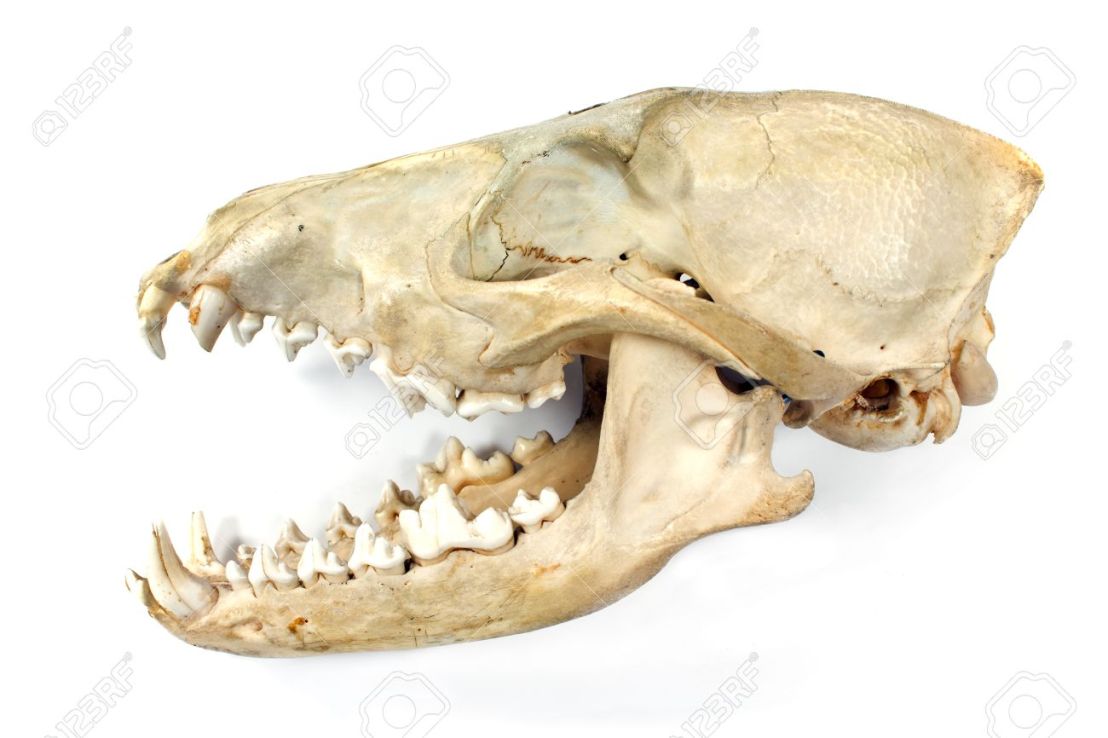
Last summer, a mammoth tusk hunter exploring the shores of the Tirekhtyak River in Siberia’s Yakutia region unearthed the fully intact head of a prehistoric wolf. Preserved by the region’s permafrost, or permanently frozen ground, for some 32,000 years, the specimen is the first partial carcass of an adult Pleistocene steppe wolf—an extinct lineage distinct from modern wolves—ever found.

The discovery, first reported by the Siberian Times, is poised to help researchers better understand how steppe wolves compared with their contemporary counterparts, as well as why the species eventually died out.

As Marisa Iati writes for the Washington Post, the wolf in question was fully grown, likely aged 2 to 4 years old, at the time of its death. Although photographs of the severed head, still boasting clumps of fur, fangs and a well-preserved snout, place its size at 15.7 inches long—the modern gray wolf’s head, in comparison, measures 9.1 to 11 inchesLove Dalén, an evolutionary geneticist at the Swedish Museum of Natural History who was filming a documentary in Siberia when the tusk hunter arrived on the scene with the head in tow, says that media reports touting the find as a “giant wolf” are inaccurate.

“It is not that much bigger than a modern wolf if you discount the frozen clump of permafrost stuck to where the neck would [normally] have been,” Dalén explains to Smithsonian.com.

According to CNN, a Russian team led by Albert Protopopov of the Republic of Sakha’s Academy of Sciences is currently building a digital model of the animal’s brain and the interior of its skull.

David Stanton, a researcher at the Swedish Museum of Natural History who is leading genetic analysis of the remains, tells Smithsonian.com that given the head’s state of preservation, he and his colleagues are hopeful that they can extract viable DNA and use it to sequence the wolf’s genome. This work, expected to last at least another year, will eventually be published in a peer-reviewed scientific journal.

A Russian team is currently building a digital model of the animal’s brain and the interior of its skull
A Russian team is currently building a digital model of the animal’s brain and the interior of its skull (Albert Protopopov)

For now, it remains unclear exactly how the wolf’s head became separated from the rest of its body. Speaking with Smithsonian.com, Tori Herridge, an evolutionary biologist at London’s Natural History Museum who was part of the team filming in Siberia at the time of the discovery, says that a colleague, Dan Fisher of the University of Michigan, thinks scans of the animal’s head may reveal evidence of it being deliberately severed by humans—perhaps “contemporaneously with the wolf dying.” If so, Herridge notes, the find would offer “a unique example of human interaction with carnivores.” Still, she concludes in a post on Twitter, “I am reserving judgment until more investigation [is] done.”

Dalén echoes Herridge’s hesitancy, saying that he has “seen no evidence convincing” him that humans cut off the head. After all, it’s not uncommon to find partial sets of remains in the Siberian permafrost. If an animal was only partially buried and subsequently frozen, for example, the rest of its body could have decomposed or been eaten by scavengers. Alternatively, it’s possible that shifts within the permafrost over thousands of years led the carcass to break into multiple pieces.

According to Stanton, steppe wolves were “probably slightly larger and more robust than modern wolves.” The animals had a strong, wide jaw equipped for hunting large herbivores such as woolly mammoths and rhinos, and as Stanton tells USA Today’s N’dea Yancey-Bragg, went extinct between 20,000 to 30,000 years ago, or roughly the time when modern wolves first arrived on the scene. If the researchers successfully extract DNA from the wolf’s head, they will attempt to use it to determine whether the ancient wolves mated with modern ones, how inbred the older species was, and if the lineage had—or lacked—any genetic adaptations that contributed to its demise.

To date, the Siberian permafrost has yielded an array of well-preserved prehistoric creatures: among others, a 42,000-year-old foal, a cave lion cub, an “exquisite ice bird complete with feathers,” as Herridge notes, and “even a delicate Ice Age moth.” According to Dalén, these finds can largely be attributed to a surge in mammoth tusk hunting and increased melting of permafrost linked with global warming.

Speaking with Smithsonian.com, Stanton concludes, “The warming climate … means that more and more of these specimens are likely to be found in the future.”

At the same time, he points out, “It is also likely that many of [them] will thaw out and decompose (and therefore be lost) before anyone can find … and study them.”

ooOOoo

It’s an ill wind that blows no-one any good. That saying comes to mind when I read about the warming climate and more specimens being found.

Fascinating!

Those eyes!

The science.

This story has been carried by numerous magazines and journals and well it should.

It reveals that the eyes that dogs have are an evolution as a result of their long association with humans.

But let me shut up and let The Atlantic carry on with the account.

ooOOoo

Dogs’ Eyes Have Changed Since Humans Befriended Them

Two specialized muscles give them a range of expression that wolves’ eyes lack.

HALEY WEISS

JUN 17, 2019

English Springer spaniel dog called Twiglet poses on June 30, 2016 in Sydney, Australia. JAMES D. MORGAN / GETTY

Dogs, more so than almost any other domesticated species, are desperate for human eye contact. When raised around people, they begin fighting for our attention when they’re as young as four weeks old. It’s hard for most people to resist a petulant flash of puppy-dog eyes—and according to a new study, that pull on the heartstrings might be exactly why dogs can give us those looks at all.

A paper published today in the Proceedings of the National Academy of Sciences found that dogs’ faces are structured for complex expression in a way that wolves’ aren’t, thanks to a special pair of muscles framing their eyes. These muscles are responsible for that “adopt me” look that dogs can pull by raising their inner eyebrows. It’s the first biological evidence scientists have found that domesticated dogs might have evolved a specialized ability used expressly to communicate better with humans.

For the study, a team at the University of Portsmouth’s Dog Cognition Centre looked at two muscles that work together to widen and open a dog’s eyes, causing them to appear bigger, droopier, and objectively cuter. The retractor anguli oculi lateralis muscle and the levator anguli oculi medialis muscle (mercifully known as RAOL and LAOM) form two short, straight lines, which connect the ring of muscle around a dog’s eye to either end of the brow above.

These researchers have long been interested in the ways dogs make eye contact with humans and, in particular, how they move their eyebrows. In 2017, Juliane Kaminski, the lead author of the new paper, found that dogs moved their eyebrows more often while a human paid attention to them, and less often when they were ignored or given food (which, sorry to say, is a more exciting stimulus for them than human love). That suggested the movement is to some degree voluntary. On our side of these longing glances, research has also shown that when dogs work these muscles, humans respond more positively. And both man and mutt benefit from a jolt of oxytocin when locked in on each other.

This isn’t simply a fortuitous love story, in which the eyes of two species just so happen to meet across a crowded planet. Like all the best partnerships, this one is more likely the result of years of evolution and growth. If dogs developed their skill for eyebrow manipulation because of their connection to humans, one way to tell would be to look for the same capacity in wolves. Because dogs split off from their wolf relatives—specifically, gray wolves—as many as 33,000 years ago, studying the two animals is a bit like cracking open a four-legged time capsule. Divergence between the two species marked the start of dogs’ domestication, a long evolutionary process influenced—and often directly driven by—humans. Today, researchers can identify and study differences between the species to gain an understanding of exactly how dogs have changed over time.

In this case, those eyebrow-raising muscles do appear to be an addition to dogs’ anatomy. In the four gray wolves the researchers looked at, neither muscle was present. (They did find bundles of fibers that could be the precursors to the RAOL and LAOM.) In five of the six breeds of dogs the researchers looked at, both muscles were fully formed and strong; in the Siberian husky, the wolflike, oldest breed of the group, the researchers were unable to locate a RAOL.

Sometimes, the origins of changes like these aren’t immediately apparent. Certain physical dog traits—including floppy ears and short snouts—likely originate from the same set of developmental cells that code for tameness, a preferable trait in household pets, for instance. In the case of this new research, though, the connection between the physical trait and the related behavior is a bit more direct. “Previous work—and much of it by these same authors—had shown that these muscles were responsible for enhancing positive responses in humans,” Brian Hare, the director of Duke University’s Canine Cognition Center and the editor of the paper, told The Atlantic via email, “but the current suggests the origin of these facial expressions is after dogs split from wolves.”

By evolutionary standards, the time since this split has been remarkably short for two new facial muscles to have developed. For a species to change that quickly, a pretty powerful force must be acting on it. And that’s where humans come in. We connect profoundly with animals capable of exaggerating the size and width of their eyes, which makes them look like our own human babies and “hijacks” our nurturing instincts.

Research has already demonstrated that humans prefer pets with more infantlike facial features, and two years ago, the authors of this latest study showed that dogs who made the facial movement enabled by the RAOL and LAOM muscles—an expression we read as distinctly humanlike—were more likely to be selected for adoption from a shelter than those who didn’t. We might not have bred dogs for this trait knowingly, but they gained so much from having it that it became a widespread facial feature. “These muscles evolved during domestication, but almost certainly due to an advantage they gave dogs during interactions with humans that we humans have been all but unaware of,” Hare explained.

Tim Smith

“It’s such a classically human system that we have, the ways we interact with our own infants,” says Angie Johnston, an assistant professor at Boston College who studies canine cognition and was not involved with the study. “A big theme that’s come out again and again in canine cognition and looking at the domestication of dogs is that it seems like they really just kind of dove right into our society in the role of being an infant or a small child in a lot of ways. They’re co-opting existing systems we have.”

The same humanlike facial gestures could also be a dog’s way of simply securing attention in the first place. Eyebrow raising is one of the most well-understood examples of what researchers call ostensive cues, a family of nonverbal signals (often facial movements and expressions) humans send one another to convey their intention to directly communicate. Dogs’ uncanny ability to mimic this human expression likely leads us to project certain human emotions onto them in ways we don’t with other animals, regardless of what they might actually be feeling.

The movement of the RAOL and LAOM muscles is particularly open to interpretation. “In different contexts we’ll call that something different,” says Alexandra Horowitz, a senior research fellow at the Barnard College Dog Cognition Lab. “In one case, I might say it’s sad, but in another case I’ll say, He’s really paying attention. It can look wry, like a questioning or unbelieving look.” According to Horowitz, dogs are the only animals aside from our primate cousins that are expressive in this eerily familiar way. Horses alone share the ability to twist their eyes into the same doleful shape, but their overall expressions don’t strike us as humanlike in the same way that dogs’ do. With dogs, Horowitz points out, we’re so driven to connect that we often search for “smiles” in the shapes of dogs’ mouths. The new research, she says, “makes me think it’s more about being able to move the face in a way that humans move the face. We don’t like unexpressive faces.”

Both Horowitz and Johnston suggested that similar studies looking at populations of dingoes (which Johnston researches) and Siberian foxes could provide yet another time capsule of sorts for understanding eyebrow movements and other evolutionary traits. Both species live near humans and are some of the closest living relatives to the earliest dogs. Why did they stay wild while dogs drifted into domestication? “Anything to do with getting to the bottom of why we as a species picked out this one animal can carry a huge amount of information,” Horowitz says. “In some ways, it’s discovering something about ourselves.”

ooOOoo

There is only one way to close this post!

Reflections on the future

Father’s Day ….

….. was OK in the morning but for some reason I was in a dark mood in the afternoon.

(And if you want to skip today’s post I don’t blame you at all. This is not my usual style albeit it is important.)

I was reflecting on the state of the world. Global population was well in excess of seven billion people. The longevity of those people was increasing. That’s good news. The health standards were increasing. That’s also good news.

However, the pressure on farming is intense. More and more land is required. The natural world is under supreme pressure. Extinction rates of many natural species are soaring.

Planet Earth has far too many people!

OK, maybe in time the population level will come down but right now it is too high.

Then in came Tom Engelhardt’s latest essay. I read it and reflected. Is it too dark to post? Then Jeannie said that if you really want to share it then publish it.

Here it is, published with Tom’s kind permission.

ooOOoo

Tomgram: Engelhardt, Trump Change

Posted by Tom Engelhardt at 4:23pm, June 16, 2019.
Follow TomDispatch on Twitter @TomDispatch.

If Donald Trump Is the Symptom…
Then What’s the Disease?

By Tom Engelhardt
Don’t try to deny it! The political temperature of this country is rising fast. Call it Trump change or Trump warming, if you want, but grasp one thing: increasingly, you’re in a different land and, whatever happens to Donald Trump, the results down the line are likely to be ever less pretty. Trump change isn’t just an American phenomenon, it’s distinctly global. After all, from Australia to India, the Philippines to Hungary, Donald Trumps and their supporters keep getting elected or reelected and, according to a recent CNN poll, a majority of Americans think Trump himself will win again in 2020 (though, at the moment, battleground-state polls look grim for him).

Still, whether or not he gets a second term in the White House, he only seems like the problem, partially because no president, no politician, no one in history has ever gotten such 24/7 media coverage of every twitch, tweet, bizarre statement, falsehood, or fantasy he expresses (or even the clothes he wears). Think of it this way: we’re in a moment in which the only thing the media can’t imagine saying about Donald Trump is: “You’re fired!” And believe me, that’s just one sign of a media — and a country — with a temperature that’s anything but 98.6.

Since you-know-who is always there, always being discussed, always @(un)realdonaldtrump, it’s easy enough to imagine that everything that’s going wrong — or, if you happen to be part of his famed base, right (even if that right isn’t so damned hot for you) — is due to him. When we’re gripped by such thinking and the temperature’s rising, it hardly matters that just about everything he’s “done” actually preceded him. That includes favoring the 1%, deporting record numbers of illegal immigrants, and making war (unsuccessfully) or threatening to do so across significant parts of the planet.

Here, then, is the question of the day, the sort you’d ask about any patient with a rising temperature: If Donald Trump is only the symptom, what’s the disease?

Blowback Central

Let me say that the late Chalmers Johnson would have understood President Trump perfectly. The Donald clearly arrived on the scene as blowback — the CIA term of tradecraft Johnson first put into our everyday vocabulary — from at least two things: an American imperium gone wrong with its never-ending wars, ever-rising military budgets, and ever-expanding national security state, and a new “gilded age” in which three men (Bill Gates, Jeff Bezos, and Warren Buffett) have more wealth than the bottom half of society and the .01% have one of their own, a billionaire, in the Oval Office. (If you want to add a third blowback factor, try a media turned upside down by new ways of communicating and increasingly desperate to glue eyes to screens as ad revenues, budgets, and staffs shrank and the talking heads of cable news multiplied.)

Now, I don’t mean to sell Donald Trump short in any way. Give that former reality TV star credit. Unlike either Hillary Clinton or any of his Republican opponents in the 2016 election campaign, he sensed that there were voters in profusion in the American heartland who felt that things were not going well and were eager for a candidate just like the one he was ready to become. (There were, of course, other natural audiences for a disruptive, self-promoting billionaire as well, including various millionaires and billionaires ready to support him, the Russians, the Saudis… well, you know the list). His skill, however, never lay in what he could actually do (mainly, in these years, cut taxes for the wealthy, impose tariffs, and tweet his head off). It lay in his ability to catch the blowback mood of that moment in a single slogan — Make America Great Again, or MAGA — that he trademarked in November 2012, only days after Mitt Romney lost his bid for the presidency to Barack Obama.

Yes, four years later in the 2016 election, others began to notice the impact of that slogan. You couldn’t miss the multiplying MAGA hats, after all. Hillary Clinton’s advisers even briefly came up with the lamest response imaginable to it: Make America Whole Again, or MAWA. But what few at the time really noted was the crucial word in that phrase: “again.” Politically speaking, that single blowback word might then have been the most daring in the English language. In 2016, Donald Trump functionally said what no other candidate or politician of any significance in America dared to say: that the United States was no longer the greatest, most indispensable, most exceptionable nation or superpower or hyper-power ever to exist on Planet Earth.

That represented a groundbreaking recognition of reality. At the time, it didn’t matter whether you were Barack Obama, Hillary Clinton, or Marco Rubio, you had to acknowledge some version of that formula of exceptionalism. Trump didn’t and, believe me, that rang a bell in the American heartland, where lots of people had felt, however indirectly, the blowback from all those years of taxpayer-funded fruitless war, while not benefitting from infrastructure building or much of anything else. They experienced blowback from a country in which new billionaires were constantly being created, while the financial distance between CEO salaries and those of workers grew exponentially vaster by the year, and the financing of the political system became a 1% affair.

With that slogan, The Donald caught the spirit of a moment in which both imperial and economic decline, however unacknowledged by the Washington political elite, had indeed begun. In the process, as I wrote at that time, he crossed a psychologically taboo line and became America’s first declinist candidate for president. MAGA captured a feeling already at large that tomorrow would be worse than today, which was already worse than yesterday. As it turned out, it mattered not at all that the billionaire conman spouting that trademarked phrase had long been part of the problem, not the solution.

He caught the essence of the moment, in other words, but certainly didn’t faintly cause it in the years when he financed Trump Tower, watched his five Atlantic City casinos go bankrupt, and hosted The Apprentice. In that election campaign, he captured a previously forbidden reality of the twenty-first century. For example, I was already writing this in June 2016, five months before he was elected president:

“In its halcyon days, Washington could overthrow governments, install Shahs or other rulers, do more or less what it wanted across significant parts of the globe and reap rewards, while (as in the case of Iran) not paying any price, blowback-style, for decades, if at all. That was imperial power in the blaze of the noonday sun. These days, in case you hadn’t noticed, blowback for our imperial actions seems to arrive as if by high-speed rail (of which by the way, the greatest power on the planet has yet to build a single mile, if you want a quick measure of decline).

“Despite having a more massive, technologically advanced, and better funded military than any other power or even group of powers on the planet, in the last decade and a half of constant war across the Greater Middle East and parts of Africa, the U.S. has won nothing, nada, zilch. Its unending wars have, in fact, led nowhere in a world growing more chaotic by the second.”

Mind you, three years later the United States remains a staggeringly powerful imperial force, with hundreds of military bases still scattered across the globe, while its economic clout — its corporations control about half the planet’s wealth — similarly remains beyond compare. Yet, even in 2016, it shouldn’t have been hard to see that the American Century was indeed ending well before its 100 years were up. It shouldn’t have been hard to grasp, as Donald Trump intuitively did, that this country, however powerful, was already both a declining empire — thank you, George W. Bush for invading Iraq! Mission Accomplished! — and a declining economic system (both of which still looked great indeed, if you happened to be profiting from them). That intuition and that slogan gave Trump his moment in… well, dare I call it “the afternoon sun”? They made him president.

MTPGA

In a sense, all of this should have been expectable enough. Despite the oddity of Donald Trump himself, there was little new in it, even for the imperial power that its enthusiasts once thought stood at “the end of history.” You don’t need to look far, after all, for evidence of the decline of empires. You don’t even have to think back to the implosion of the Soviet Union in 1991, almost three decades ago in what now seems like the Stone Age. (Admittedly, Russian President Vladimir Putin, a brilliant imagineer, has brought back a facsimile of the old Soviet Union, even if, in reality, Russia is now a rickety, fraying petro-state.)

Just take a glance across the Atlantic at Great Britain at this moment. And imagine that three-quarters of a century ago, that modest-sized island nation still controlled all of India, colonies across the planet, and an impressive military and colonial service. Go back even further and you’ll find yourself in a time when it was the true superpower of planet Earth. What a force it was — industrially, militarily, colonially — until, of course, it wasn’t.

If you happen to be looking for imperial lessons, you could perhaps say that some empires end not with a bang but with a Brexit. Despite all the pomp and circumstance (tweeting and insults) during the visit of the Trump royal family (Donald, Melania, Ivanka, Jared, Donald Jr., Eric, and Tiffany) to the British royals, led by a queen who, at 93, can remember better days, here’s something hard to deny: with Brexit (no matter how it turns out), the Earth’s former superpower has landed in the sub-basement of history. Great Britain? Obviously that adjective has to change.

In the meantime, across the planet, China, another once great imperial power, perhaps the greatest in the long history of this planet, is clearly on the rise again from another kind of sub-basement. That, in turn, is deeply worrying the leadership, civilian and military, of the planet’s “lone superpower.” Its president, in response, is wielding his weapon of choice — tariffs — while the U.S. military prepares for an almost unimaginable future war with that upstart nation, possibly starting in the South China Sea.

Meanwhile, the still-dominant power on the planet is, however incrementally, heading down. It’s nowhere near that sub-basement, of course — anything but. It’s still a rich, immensely powerful land. Its unsuccessful wars, however, go on without surcease, the political temperature rises, and democratic institutions continue to fray — all of which began well before Donald Trump entered the Oval Office and, in fact, helped ensure that he would make it there in the first place.

And yet none of this, not even imperial decline itself, quite captures the “disease” of which The Donald is now such an obvious symptom. After all, while the rise and fall of imperial powers has been an essential part of history, the planetary context for that process is now changing in an unprecedented way. And that’s not just because, since the 1945 atomic bombings of Hiroshima and Nagasaki, growing numbers of countries have come to possess the power to take the planet down in a cataclysm of fire and ice (as in nuclear winter). It’s also because history, as we’ve known it, including the rise and fall of empires, is now, in a sense, melting away.

Trump change, the rising political temperature stirred by the growing populist right, is taking place in the context of (and, worse yet, aiding and abetting) record global temperatures, the melting of ice across the planet, the rise of sea levels and the future drowning of coastlines (and cities), the creation of yet more refugees, the increasing fierceness of fires and droughts, and the intensification of storms. In the midst of it all, an almost unimaginable wave of extinctions is occurring, with a possible million plant and animal species, some crucial to human existence, already on the verge of departure.

Never before in history has the rise and decline of imperial powers taken place in the context of the decline of the planet itself. Try, for instance, to imagine what a “risen” China will look like in an age in which one of its most populous regions, the north China plain, may by century’s end be next to uninhabitable, given the killing heat waves of the future.

In the context of both Trump change and climate change, we’re obviously still awaiting our true transformative president, the one who is not a symptom of decline, but a factor in trying to right this country and the Earth before it’s too late. You know, the one who will take as his or her slogan, MTPGA (Make The Planet Great Again).

Tom Engelhardt is a co-founder of the American Empire Project and the author of a history of the Cold War, The End of Victory Culture. He runs TomDispatch.com and is a fellow of the Type Media Center. His sixth and latest book is A Nation Unmade by War (Dispatch Books).

Follow TomDispatch on Twitter and join us on Facebook. Check out the newest Dispatch Books, John Feffer’s new dystopian novel (the second in the Splinterlands series) Frostlands,Beverly Gologorsky’s novel Every Body Has a Story, and Tom Engelhardt’s A Nation Unmade by War, as well as Alfred McCoy’s In the Shadows of the American Century: The Rise and Decline of U.S. Global Power and John Dower’s The Violent American Century: War and Terror Since World War II.

Copyright 2019 Tom Engelhardt

ooOOoo

I’m 74. I don’t know how long I’ve got.

Part of me wants to live for a long time. That’s why I am vegan and trying to stay as fit as I can. (I’m also aware that Jeannie’s Parkinson’s Disease is a terminal disease and that in the latter stages she will need me to look after her.)

But then again I’m not sure I want to live in a world that continues to degrade especially continues to degrade in natural ways.

What’s the answer?

What do others who are on or around my age think about it?

What is the disease?

Offering a clue

A republication of an earlier post from The Smithsonian

Those who read yesterday’s post will find today’s post highly interesting.

A copy of an article from two years ago in The Smithsonian.

ooOOoo

New Study Has a Bone to Pick With Dog Domestication Findings

Contrary to past research, a new DNA study suggests fido was only tamed once

One wave of domestication or two? The debate rages on. (Dageldog/iStock)

By Jason Daley
smithsonian.com
July 19, 2017

Though dogs are humanity’s oldest and most consistent animal friend, scientists have long struggled to figure out just how Canis familiaris came to be. Though researchers agree dogs are descended from wild wolves, they aren’t sure when and where domestication occurred. And as Tina Hesman Saey at Science News reports, a new study has revived the debate, suggesting that dogs were domesticated one time between 20,000 and 40,000 years ago.

Dog domestication has gotten a lot of attention in recent years. In 2016, researchers looked at the mitochondrial DNA of modern and ancient dog species, determining that dogs come from two different wolf populations, one found in Europe and one found in Asia. That means that wolves would have been domesticated in two different places, with the two lineages eventually mixing in modern dogs.

But this latest research contradicts the double-domestication hypothesis. According to Ben Guarino at the Washington Post, researchers looked at the well-preserved DNA of two ancient dogs found in Germany, one 7,000 years old and one 4,700 years old, as well as the complete genomes of 100 modern dogs and snippets of DNA from 5,600 other wolves and dogs.

They traced the rate of mutations in the over time in the dog genomes. This technique, which creates a “molecular clock,” indicates that dogs diverged from wolves 36,900 years ago to 41,500 years ago in a single domestication event. But they can’t determine exactly where the split occurred. About 20,000 years later, the molecular clock indicates dogs split into European and Asian groups. They published their results in the journal Nature Communications

Not everyone is convinced by the study. Greger Larson, Oxford evolutionary biologist and author of the earlier domestication study, tells Guarino that the latest research does not explain the “ridiculously deep split” between the genetics of ancient European and Asian dogs. He also points out that while ancient dog bones have been found in far eastern Asia and western Europe, the middle of Eurasia seems to be empty of dog bones, suggesting that there were two ancient populations, separated by vast distances.

Krishna Veeramah, a palaeogeneticist at Stony Brook University and author of the new study says he doesn’t anticipate that the paper will put the issue to rest. “More ancient dog DNA from genomes will ultimately solve the problem,” he tells Rachael Lallensack at Nature. Researchers are hoping to find more geographically diverse DNA from dogs as well as samples from different time periods.

Whether it happened once or twice, how and why did domestication occur?

As Veeramah​ tells Helen Briggs at the BBC that it’s likely dogs evolved from wolves that began hanging around human camps, scavenging their scraps. ”Those wolves that were tamer and less aggressive would have been more successful at this,” he says. “While the humans did not initially gain any kind of benefit from this process, over time they would have developed some kind of symbiotic relationship with these animals, eventually evolving into the dogs we see today.”

One early benefit of domesticated dogs may have been that they could help transport meat from carcasses or hunt dangerous game like cave bears and cave lions, Saey writes in an earlier Science News article.

For now, however, exactly when and where Fido first approached humans will remain a mastiff question.

ooOOoo

For my money the origins of the domestic dog are as Krishna Veeramah puts it: ”Those wolves that were tamer and less aggressive would have been more successful at this,” he says. “While the humans did not initially gain any kind of benefit from this process, over time they would have developed some kind of symbiotic relationship with these animals, eventually evolving into the dogs we see today.

When did we come together?

A cache of animal bones 11,500 years old suggests an answer.

Brigit Katz of The Smithsonian wrote an article in January that revealed that dogs and humans hunted together many thousands of years ago.

Here it is:

ooOOoo

Humans and Dogs May Have Hunted Together in Prehistoric Jordan

Bones at a settlement called Shubayqa 6 show clear signs of having been digested—but were much too large to have been eaten by humans

Selection of gazelle bones from Space 3 at Shubayqa 6 displaying evidence for having been in the digestive tract of a carnivore. ( Credit: University of Copenhagen)

By Brigit Katz
SMITHSONIAN.COM
JANUARY 17, 2019

When and where dogs came to be domesticated is a subject of scientific debate, but there is a wealth of research that attests to the long, intertwined history of humans and their best animal buddies. One theory about the early origins of this relationship posits that dogs were used to help early humans hunt. And, as Ruth Schuster reports for Haaretz, a new study suggests that this may have been the case among prehistoric peoples of what is now Jordan.

A team of archaeologists from the University of Copenhagen and University College London studied a cache of animal bones at an 11,500-year-old settlement called Shubayqa 6, which is classified as “Pre-Pottery Neolithic A,” or belonging to the first stage of Neolithic culture in the Levant. In the Journal of Anthropological Archaeology, the researchers write that they found bones from a canid species, though they could not identify which one because the remains were poorly preserved. They also unearthed the bones of other animals that had been butchered. But perhaps most intriguing were the bones of animals—like gazelle, for instance—that bore clear signs of having passed through a digestive tract.

These bones were too big for humans to have eaten, leading the researchers to surmise that they “must have been digested by dogs,” says lead study author Lisa Yeomans, a zooarchaeologist at the University of Copenhagen. And the researchers don’t think this was a case of wild carnivores sneaking into the settlement to grab a bite.

For one, archaeological evidence indicates that Shubayqa 6 was occupied year-round, suggesting that “dogs were allowed to freely roam around the site picking over the discarded waste, but also defecating in the vicinity of where humans were inhabiting,” the study authors write.

There was also a noticeable surge in hare bones around the time that dogs started to appear at the site, and the researchers think this may be because the dogs were helping humans hunt small prey. Previously, the people of Shubayqa 6 might have relied on tools like netting to catch hares and other animals, says Yeomans, but it wouldn’t have been very effective. Dogs, on the other hand, could selectively target elusive prey.

Humans and dogs thus appear to have forged a reciprocal relationship in Jordan more than 11,000 years ago. There is in fact evidence to suggest that dogs were domesticated by humans in the Near East as early as 14,000 years ago, and some of that evidence seems to point to dogs being used during hunts. Rock art from a site near Shubayqa, for instance, seems to show dogs driving gazelle into a trap.

In light of such archaeological finds, “it would be strange not to consider hunting aided by dogs as a likely explanation for the sudden abundance of smaller prey in the archaeological record,” Yeomans says. Among the ancient peoples of Jordan, in other words, the complex history of dog domestication may have been well underway.

ooOOoo

That scientific debate mentioned in the first line of the article has been published in this place before. But I’m going to republish it tomorrow as it so perfectly goes with today’s post.

More on meteorites.

I saw this story very late yesterday.

This was read quickly towards the end of the day, as in yesterday, but I thought it well worthwhile rescheduling my doggie article until Saturday and putting this in for today.

Later on yesterday it was read more thoroughly and it is full of fascinating information such as the weight of meteorites that fall onto Planet Earth each day. I wasn’t aware of that.

Anyway, hope you too find it of interest.

ooOOoo

The tell-tale clue to how meteorites were made, at the birth of the solar system

By

Professor of Astronomy, Wesleyan University

and

Assistant Professor of Earth and Environmental Sciences, Wesleyan University

June 6th, 2019.

April 26, 1803 was an unusual day in the small town of L’Aigle in Normandy, France – it rained rocks.

Over 3,000 of them fell out of the sky. Fortunately no one was injured. The French Academy of Sciences investigated and proclaimed, based on many eyewitness stories and the unusual look of the rocks, that they had come from space.

The Earth is pummeled with rocks incessantly as it orbits the Sun, adding around 50 tons to our planet’s mass every day. Meteorites, as these rocks are called, are easy to find in deserts and on the ice plains of Antarctica, where they stick out like a sore thumb. They can even land in backyards, treasures hidden among ordinary terrestrial rocks. Amateurs and professionals collect meteorites, and the more interesting ones make it to museums and laboratories around the world for display and study. They are also bought and sold on eBay.

Despite decades of intense study by thousands of scientists, there is no general consensus on how most meteorites formed. As an astronomer and a geologist, we have recently developed a new theory of what happened during the formation of the solar system to create these valuable relics of our past. Since planets form out of collisions of these first rocks, this is an important part of the history of the Earth.

This meteor crater in Arizona was created 50,000 years ago when an iron meteorite struck the Earth. It is about one mile across. W. Herbst, CC BY-SA

The mysterious chondrules

Drew Barringer (left), owner of Arizona meteor crater, his wife, Clare Schneider, and author William Herbst in the Van Vleck Observatory Library of Wesleyan University, where an iron meteorite from the crater is on display. W. Herbst

About 10% of meteorites are pure iron. These form through a multi-step process in which a large molten asteroid has enough gravity to cause iron to sink to its center. This builds an iron core just like the Earth’s. After this asteroid solidifies, it can be shattered into meteorites by collisions with other objects. Iron meteorites are as old as the solar system itself, proving that large asteroids formed quickly and fully molten ones were once abundant.

The other 90% of meteorites are called “chondrites” because they are full of mysterious, tiny spheres of rock known as “chondrules.” No terrestrial rock has anything like a chondrule inside it. It is clear that chondrules formed in space during a brief period of intense heating when temperatures reached the melting point of rock, around 3,000 degrees Fahrenheit, for less than an hour. What could possibly account for that?

A closeup of the Semarkona meteorite showing dozens of chondrules. Kenichi Abe

Researchers have come up with many hypotheses through the last 40 years. But no consensus has been reached on how this brief flash of heating happened.

The chondrule problem is so famously difficult and contentious that when we announced to colleagues a few years ago that we were working on it, their reaction was to smile, shake their heads and offer their condolences. Now that we have proposed a solution we are preparing for a more critical response, which is fine, because that’s the way science advances.

The flyby model

Our idea is quite simple. Radioactive dating of hundreds of chondrules shows that they formed between 1.8 and 4 million years after the beginning of the solar system – some 4.6 billion years ago. During this time, fully molten asteroids, the parent bodies of the iron meteorites, were abundant. Volcanic eruptions on these asteroids released tremendous amounts of heat into the space around them. Any smaller objects passing by during an eruption would experience a short, intense blast of heat.

To test our hypothesis, we split up the challenge. The astronomer, Herbst, crunched the numbers to determine how much heating was necessary and for how long to create chondrules. Then the geologist, Greenwood, used a furnace in our lab at Wesleyan to recreate the predicted conditions and see if we could make our own chondrules.

Laboratory technician Jim Zareski (top) loads a programmable furnace as co-author Jim Greenwood looks on, in his laboratory at Wesleyan University. This is where the synthetic chondrules are made. W. Herbst

The experiments turned out to be quite successful.

We put some fine dust from Earth rocks with compositions resembling space dust into a small capsule, placed it in our furnace and cycled the temperature through the predicted range. Out came a nice-looking synthetic chondrule. Case closed? Not so fast.

Two problems emerged with our model. In the first place, we had ignored the bigger issue of how chondrules came to be part of the whole meteorite. What is their relationship to the stuff between chondrules – called matrix? In addition, our model seemed a bit too chancy to us. Only a small fraction of primitive matter will be heated in the way we proposed. Would it be enough to account for all those chondrule-packed meteorites hitting the Earth?

A comparison of a synthetic chondrule (left) made in the Wesleyan lab with a heating curve from the flyby model, with an actual chondrule (right) from the Semarkona meteorite. The crystal structure is quite similar, as shown in the enlargements (bottom row). J. Greenwood

Making whole meteorites

To address these issues, we extended our initial model to consider flyby heating of a larger object, up to a few miles across. As this material approaches a hot asteroid, parts of it will vaporize like a comet, resulting in an atmosphere rich in oxygen and other volatile elements. This turns out to be just the kind of atmosphere in which chondrules form, based on previous detailed chemical studies.

We also expect the heat and gas pressure to harden the flyby object into a whole meteorite through a process known as hot isostatic pressing, which is used commercially to make metal alloys. As the chondrules melt into little spheres, they will release gas to the matrix, which traps those elements as the meteorite hardens. If chondrules and chondrites form together in this manner, we expect the matrix to be enhanced in exactly the same elements that the chondrules are depleted. This phenomenon, known as complementarity, has, in fact, been observed for decades, and our model provides a plausible explanation for it.

The authors’ model for forming chondrules. A small piece of rock (right) — a few miles across or less — swings close to a large hot asteroid erupting lava at its surface. Infrared radiation from the hot lava briefly raises the temperature on the small piece of rock high enough to form chondrules and harden part of that object into a meteorite. W. Herbst/Icarus

Perhaps the most novel feature of our model is that it links chondrule formation directly to the hardening of meteorites. Since only well-hardened objects from space can make it through the Earth’s atmosphere, we would expect the meteorites in our museums to be full of chondrules, as they are. But hardened meteorites full of chondrules would be the exception, not the rule, in space, since they form by a relatively chancy process – the hot flyby. We should know soon enough if this idea holds water, since it predicts that chondrules will be rare on asteroids. Both Japan and the United States have ongoing missions to nearby asteroids that will return samples over the next few years.

If those asteroids are full of chondrules, like the hardened meteorites that make it to the Earth’s surface, then our model can be discarded and the search for a solution to the famous chondrule problem can go on. If, on the other hand, chondrules are rare on asteroids, then the flyby model will have passed an important test.

ooOOoo

Perfect timing!

Funny what falls from the sky!

Mud ball meteorites!

We took a rafting trip down the Rogue River yesterday (the 4th) and when I have finished transferring the photographs from my iPhone to my computer I will write a post on the journey.

But for today’s post I want to republish an item that appeared also yesterday in EarthSky.

And it does involve dogs!

ooOOoo

Mud ball meteorites rain down in Costa Rica

“Mud ball” meteorites – full of clays, organics and water – are unique among space rocks. And a lot of them fell in April 2019 on a small town in Costa Rica, much to the delight of scientists.

This meteorite from the fall at Aguas Zarcas, Costa Rica, in April hit a doghouse. Luckily, the dog – Rocky – was unharmed. Image via Michael Farmer/ASU.

Meteorite falls on Earth are fairly common, but not all meteorites are the same. Some of them are “mud balls,” rich in clays, organic compounds and water-bearing minerals, called carbonaceous chondrites. They are of great interest to scientists, due to their unique composition, and now a bunch more prime specimens have been found, which rained down after a large fireball was seen over Aguas Zarcas, a small town in Costa Rica, on April 23, 2019.

The fireball was a meteor, or space rock, entering the Earth’s atmosphere that broke apart into hundreds of smaller pieces. When the pieces of this rock hit the ground, their name changed to meteorite. One meteorite fragment weighed about two pounds and smashed through the roof of a house, destroying the owner’s dining table. Another one crashed through the roof of a dog house, narrowly missing a sleeping dog. Close calls!

The doghouse with the hole in its roof from the April 2019 meteorite in Costa Rica. The dog, Rocky, was sleeping in the doghouse at the time; he was unharmed, but probably surprised! Image via Michael Farmer/ASU.

Several of the meteorites were collected and sent to Arizona State University (ASU) for study, donated by meteorite collector Michael Farmer. ASU will also be able to purchase additional meteorites from the fall, thanks to a private donor. This is the first time in 50 years that the university has had a chance to analyze such pristine samples of extraterrestrial mud balls. As Laurence Garvie, a research professor at ASU and a curator for its Center for Meteorite Studies, said:

Many carbonaceous chondrites are mud balls that are between 80 and 95 percent clay. Clays are important because water is an integral part of their structure. These had to be collected quickly and before they got rained on. Because they are mostly clay, as soon as these types of meteorites get wet, they fall apart.

Luckily, the researchers were able to collect their samples before it rained again, and they got a nice little haul, too, about 55 pounds (25 kilograms) of the precious space rocks.

A composite element map from one of the meteorites showing the distribution of different minerals. Orange-yellow colors show tochilinite, deep-blue colors represent olivine, and red colors are pentlandite and pyrrhotite. Image via ASU.

Analysis of the meteorites was carried out at ASU’s campus in Tempe, Arizona. According to Garvie:

I was in the lab by 5 a.m. the next morning after picking up the samples to get them ready for the initial analyses. Classification of new meteorites can be like a race with other institutions, and I needed ASU to be first so that we’ll have the recognition of being the collection that holds and curates the type specimen material.

Air-sensitive meteorites like these are kept in special nitrogen cabinets. The nitrogen gas helps to preserve the meteorites, which can degrade easily due to their composition. As Garvie explained:

If you left this carbonaceous chondrite in the air, it would lose some of its extraterrestrial affinities. These meteorites have to be curated in a way that they can be used for current and future research, and we have that ability here at ASU.

This mud ball meteorite fragment from April’s meteorite fall in Aguas Zarcas, Costa Rica, looks a bit like an arrowhead. Image via ASU.

The classification of these meteorites is part of a broader international classification effort. Garvie is also working with Karen Ziegler from the Institute of Meteoritics at the University of New Mexico. They studied the oxygen isotopes of the meteorites, to determine how similar they are to other carbonaceous chondrites.

Sandra Pizzarello, an organic chemist from ASU’s School of Molecular Sciences, is also involved in the studies, focusing on the organic content of the meteorites. These kinds of organics could have provided the material needed for life to begin on Earth.

Additional scientific analysis will follow later, but first the meteorites need to be approved, classified and named by The Meteoritical Society‘s nomenclature committee. This group of 12 scientists is responsible for approving all meteorite samples for study.

These new meteorite samples are currently on display at ASU’s Tempe campus in the Center for Meteorite Studies collection.

So, why are mud ball carbonaceous chondrite meteorites so significant?

They are thought to originate from asteroids that are leftovers from early planetesimals, planets that started to form in the early solar system billions of years ago but now no longer exist. Those planets had organic materials and water, making them places where the chemical precursors to life could have started. In the case of the asteroid that these new meteorites originated from, Garvie said:

It formed in an environment free of life, then was preserved in the cold and vacuum of space for 4.56 billion years, and then dropped in Costa Rica last week.

As CMS Director Meenakshi Wadhwa also said:

Carbonaceous chondrites are relatively rare among meteorites but are some of the most sought-after by researchers because they contain the best-preserved clues to the origin of the solar system. This new meteorite represents one of the most scientifically significant additions to our wonderful collection in recent years.

Because these meteorites contain so much mineral-bound water, they could also be useful in learning how water can be extracted from asteroids, a great resource for future astronauts. According to Garvie:

Having this meteorite in our lab gives us the ability, with further analysis, to ultimately develop technologies to extract water from asteroids in space.

Location of Aguas Zarcas in Costa Rica. Image via Google Maps.

The last time a carbonaceous chondrite meteorite fall similar to this one occurred was in 1969 near Murchison, Australia. Those meteorites were curated by another ASU professor and founding director of ASU’s Center for Meteorite Studies, Carleton Moore.

The meteorites in Aguas Zarcas have also been found to be similar in composition to asteroid Bennu, now being explored by NASA’s OSIRIS-REx spacecraft. Bennu is thought to be a remnant carbonaceous chondrite planetesimal. OSIRIS-REx is carrying ASU’s Phil Christensen-designed Thermal Emissions Spectrometer (OTES) instrument, which is being used to make mineral and temperature maps of the asteroid.

Garvie and other scientists will be studying these mud ball meteorites for years to come, unlocking more secrets as to how our solar system formed and evolved, and how the ingredients of life originated and were spread throughout the solar system, including to Earth.

Bottom line: This new meteorite fall in Costa Rica has provided scientists with a great opportunity to study multiple mud ball meteorites, one of the most unusual kinds of meteorites known to exist, and one that could help answer the question of how life started on Earth.

Via ASU

ooOOoo

I don’t know about you but I found this very interesting indeed. I guess I hadn’t looked at meteorites as different entities, depending on the source, before.

Fascinating!

Must repeat that closing paragraph again: “Garvie and other scientists will be studying these mud ball meteorites for years to come, unlocking more secrets as to how our solar system formed and evolved, and how the ingredients of life originated and were spread throughout the solar system, including to Earth.

America’s lost dogs

A fascinating story.

A wild dog.

I am a member of AAAS, the American Association for the Advancement of Science, and pulled a story from their Science journal and to my amazement found that I did this nearly a year ago.

The article, by Linda Goodman and Elinor K. Karlsson, is unavailable for complete republishing owing to copyright.

But on the AAAS website there is a summary, as follows:

Summary

Few traces remain of the domesticated dogs that populated the Americas before the arrival of Europeans in the 15th century. On page 81 of this issue, Ní Leathlobhair et al. (1) shed light on the origins of the elusive precontact dog population through genetic analysis of ancient and modern dogs. Building on earlier work, they show that American dogs alive today have almost no ancestry from precontact dogs, a monophyletic lineage descended from Arctic dogs that accompanied human migrations from Asia. Instead, the authors found that their closest remaining relative is a global transmissible cancer carrying the DNA of a long-deceased dog. It remains unclear why precontact dogs survived and thrived for thousands of years in the Americas only to swiftly and almost completely disappear with the arrival of Europeans.

From the article I would add:

It is unclear why there is so little evidence today of this thriving precontact dog population. Early European colonists may have discouraged the sale and breeding of native dogs, or even actively persecuted them (10). Yet, cultural preferences alone seem insufficient to explain their rapid decline. Most dogs worldwide are free-breeding scavengers, with minimal human control and high reproductive rates (11); native American dogs were likely similar.

There is a chart in the same article that shows the first human sites in the Americas were about 15,000 years ago with the oldest dog remains, also in America, being about 10,000 years ago.

Fascinating stuff!