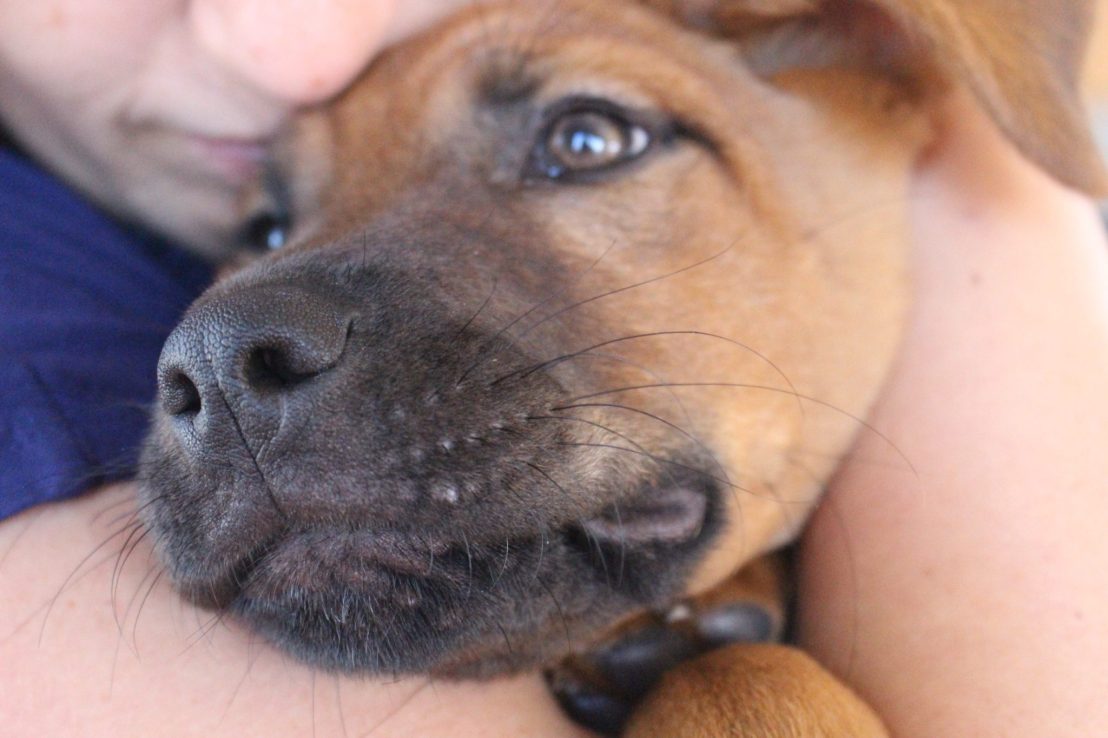
Playing a game of fetch with a dog means they are following a human social cue to recover the ball. But fetch isn’t just for dogs, wolf puppies are down to play too, which means they can also understand human communication cues, according to a new study.
Credit Wikipedia Commons
The findings, published in the journal iScience, were made after researchers put 13 8-week-old wolf puppies from three different litters through a series of tests usually used to assess dog-puppy behavior. Three of the pups were interested in playing fetch with a stranger, which included bringing a ball back when encouraged to.
The discovery was quite a surprise for the team as it was believed that the cognitive abilities necessary to understand communication cues given by a human were presented in dogs only after humans domesticated them 15,000 years ago. Dogs differ from wolves physically, genetically and behaviorally.
“When I saw the first wolf puppy retrieving the ball, I literally got goosebumps,” said Christina Hansen Wheat of Stockholm University in a press release. “I immediately knew that this meant that if variation in human-directed play behavior exists in wolves, this behavior could have been a potential target for early selective pressures exerted during dog domestication.”
Wanting to learn more about the effects of domestication on behavior, Hansen Wheat and her team raised wolf and dog puppies from the age of 10 days and put them through various behavioral tests. In one of them, the pup was thrown a ball by an unknown person, encouraging the wolf to get it and bring it back.
Expectations of the wolf pups catching on weren’t high, with the first two litters showing no interest in the balls, let alone of playing fetch. But everything changed with the third litter. A few of the puppies went for the ball and even responded to the social cues and brought it back.
“It was very surprising that we had wolves actually retrieving the ball,” said Hansen Wheat. “I did not expect that. I do not think any of us did. It was especially surprising that the wolves retrieved the ball for a person they had never met before.”
In the past, other research showed that domesticated and non-domesticated species will follow human gestures if a food reward is given, Hansen Wheat and her team said. But in those cases, the animals were previously trained to follow the cues or knew the person conducting the study.
While the new research has a limitation over the size of its sample, it could reassess our interpretation that understanding human social cues came from domestication. Instead, it could be possible that this behavior can be traced back to an ancestral population before wolves were domesticated into dogs.
ooOOoo
Despite this being the twenty-first century there are still things being discovered that cause us humans to be amazed.
Such as this story about the young wolves, way before they evolved into dogs.
The following was sent to me by Chris Gomez, brother of Dan, who I have known for nearly as long as Dan (and that’s a long time)!
The article appeared on ZME Science was published on the 15th January. It contains material that I, for one, didn’t know and I suspect I’m not the only one.
Have a read.
ooOOoo
Why do dogs have whiskers?
Whiskers allow dogs to “see” things that are literally under their noses.
Many mammals, including canines, have whiskers. Some dog owners think these whiskers are just longer unruly hairs that can be groomed and even snipped off entirely — but this would be a huge mistake. The whiskers, technically known as “vibrissae”, serve important specialized functions that help dogs sense the world around them and coordinate their movement.
Humans sense touch through millions of sensory receptors that line the skin and deeper tissue. Unlike humans, the follicles of the coarse hairs protruding from a dog’s muzzle, jaw and above its eyes are also packed with nerves that relay sensory information.
Essentially, these whiskers allow dogs to sense objects and the world around them as humans do with fingers.
What are a canine’s whiskers good for
Credit: Wikimedia Commons.
The tactile sensation is made possible thanks to Merkel cells, which are specialized skin receptors associated with nerve terminals. A dog’s mouth and snout are very rich in Merkel cells, according to a study published in the journal Veterinary Science.
According to researchers, these tactile hairs serve a variety of functions. For instance, the whiskers allow dogs to gather information from subtle changes in air currents about size, shape, and speed of nearby objects. Ultimately, this allows canines to see their surroundings better, even in dark. It’s well known that vision isn’t a dog’s strong point, so their vibrissae greatly assist them — especially when dealing with close objects (dogs are farsighted). Whiskers beneath the chin allow dogs to “see” objects obstructed by their snouts.
Whisker’s positioned immediately above the eyes are particularly important for vision. When an object or strong airflow causes these whiskers to flex, dogs will reflexively blink in order to protect their eyes.
It’s not clear whether dogs use their whiskers for food acquisition. However, if they’re anything like rats, seals, and walruses — all related species that have been shown to use their whiskers to find food — dogs might very well use their sensing hairs for this purpose, too.
A dog’s whiskers can also serve an important role in communication with other canines or other species. Like many other mammals, when a dog is threatened it will automatically flare its whiskers, pointing them in a forward direction. This signals to predators and other aggressive animals that the dog is ready to defend itself and respond with violence.
Dogs may use their whiskers to also disperse pheromones, keep their head upright when swimming, and monitor their environment.
About 40% of a canine’s visual cortex (the part of the brain responsible for processing vision) is devoted to mapping information from whiskers. They’re that important!
What you need to know about your dog’s whiskers
Credit: Pxfuel.
Although they might look similar, vibrissae are distinct from body hair. The main difference is that a dog’s whiskers are directed by the nervous system and contain nerves.
Unlike cats, which have four rows of whiskers on either side of a cat’s face, the placement of a dog’s whiskers is less predictable. Some have a multitude of vibrissae, others may have few or even none. You should find them above the eyes, on both sides of the muzzle, above the upper lip (pointing down) and beneath the dog’s chin.
According to scientists, there are no breed-specific differences in canine whiskers. An exception may involve hairless breeds, which have no whiskers at all.
That being said, you should never trim your dog’s whiskers. Some pet owners believe their dogs’ whiskers should be groomed and snip them for aesthetic purposes.
This practice won’t hurt the dog, because there are no pain receptors found in whiskers. However, given the multitude of functions they serve, a whisker-less dog will become confused, disorientated, and less able to navigate its spatial surroundings. If you cut your dog’s whiskers in the past out of ignorance, know at least that they will grow back naturally.
In summary, dogs use their whiskers as a sort of radar to detect objects that they cannot properly see with their own eyes.
ooOOoo
Apart from the fact that the photographs are gorgeous there is much material that is good to know. For instance, I never knew there were no breed-specific differences in canine whiskers. Just hadn’t thought about it before.
The first of the New Year but I suspect if will be far from the last.
ooOOoo
Dear Fellow Dog Lover,
I’m pleased to report there have been no dog food recalls issued since September 26, 2019.
Euthanasia Drug Discovered in Adulterated Animal Fat
The FDA recently discovered an animal euthanasia drug (pentobarbital) in test samples collected at a major supplier of animal fat to the pet food industry.
We’re unable to locate any information about which pet food brands may have purchased the affected ingredient.
For this reason, we recommend all dog and cat owners remain alert to the potential for future recalls related to this news.
Click here to read the official FDA Warning Letter sent to the producer.
Dog Food Recall Update
Some pet foods previously recalled may still be on store shelves… or in your own home. So, if you’ve missed any of the 11 recalls we’ve sent since July… be sure to visit our Dog Food Recalls page for full details.
10 Best Dog Food Lists Recently Updated
Over the last 90 days, The Dog Food Advisor has updated the following best dog food pages:
To be honest there are times when I struggle to come up with something original in terms of blogging. And it is at these times of life that I am very grateful for the offer of a guest post. Take Bryony for example. This is not the first time that I have presented her work but I am forever grateful for her so doing.
This is her article on scent dogs.
ooOOoo
The making of a scent dog.
By Bryony Ravate, January 2nd, 2020
If you’ve been lucky enough to be around dogs, you will have probably noticed how their noses are always moving. By possessing a nose up to 15x times more sensitive than our own, with 600,00 neurones, they can sniff out different components in every room. When you’re cooking a meal, you will be able to recognise the smell of a dish. But when your dog smells the meal, he can smell each individual spice and seasoning, the oils, the crockery and even any water.
You can use your dogs’ keen sense of smell for play – laying out different scents for them to explore. But their noses can also be used for working environments– such as in airports, with the police and in search and rescue missions. They can track down suitcases hiding illegal substances, follow the suspect of a crime and sniff out the victims of a snowstorm. To become scent dogs, the canines go through vigorous training. However, although all dogs have an exceptional sense of smell, not all dogs make it through training.
It makes sense to analyse what leads to success and failure in scent dog training. So, a keen researcher at University College Cork, Ireland performed a literature review in which factors behind success and failure in scent dog training were analysed. A literature review is the process whereby you search a database full of information (usually research articles published in reputable journals) and you extrapolate the information to create your own source. Here, I’m going to pull together some of the points I found the most interesting, points you may not think would affect the making of a scent dog.
Personality
Dogs with strong motivation to play or search, dogs which were bold rather than shy, and dogs which can adapt and cope with stressful stimuli are more likely to become scent dogs. High motivation to play or search, makes a dog easier to train. Play can be used as a reward, by allowing the dog to pull on a chew toy after being successful in a trial. Finding scents may be perceived as a game to the dog, increasing his motivation to engage. Bold dogs are less unnerved by new surroundings and situations. A nervous dog may be hesitant about pursuing an unknown scent – but a bold dog will take little hesitation. Adaptable dogs may be able to apply their knowledge to different situations and they will be unphased by commotions and will keep working when faced with distractions.
Housing Standards
Dogs that live in enriched environments throughout their training have increased ability in trials. Like children, the more opportunities you offer your dogs to learn, explore and interact with their environment, the more it allows them to develop and grow. Dogs should feel secure in their home environment when not working; keeping them with other dogs and in bright rooms without using loud cleaning equipment (such as hoovers) will make them less anxious, leading to better accuracy in scent trials.
The Human Partner
Dogs emotions are often intertwined with their handlers. When a dog’s owner gets angry, the stress hormones in the dog increase as a result. If a dog handler is happy, the dogs will perform better. The bond between dogs and their handlers can affect the accuracy of scent trials. If the dog lives at the owners’ home when he’s not working, obedience and accuracy are increased. Although the bond between scent dog and handler is important, they must be independent thinkers. When faced with a problem- solving task, they must be able to manipulate the environment themselves to find a solution, rather than looking at their handler for cues about the answer.
These are some factors which can alter the likelihood of a dog being a successful, as reviewed by Camille A Trosi and her team. What we must keep in mind is that all dogs are individuals. We cannot use this information to ensure all dogs in the future will pass scent dog training. However, we can use this knowledge to give potential scent dogs the best possible start to life; providing enrichment, an affectionate bond with their handler, and a suitable home environment. Canine personalities are not always determined by genetics, and a suitable environment can give a dog a metaphorical push in the right direction to ensure he is the best he can be, whether that be as a scent dog, a guide dog or even a lap dog.
Original Source : Troisi, C. A., Mills, D. S., Wilkinson, A. and Zulch, H. E. 2019. Behavioral and Cognitive Factors That Affect the Success of Scent Detection Dogs. Comparative Cognition & Behavior Reviews, 14, pp. 51-76. doi: 10.3819/ccbr.2019.140007
ooOOoo
Now what I haven’t done before but intend to do straightaway is to reproduce an extract from Bryony’s CV.
I currently hold a Pass with Distinction in MSc Animal Behaviour and Welfare from Queen’s University Belfast. I also have a BSc in Animal Behaviour and Welfare from Plymouth University. As well as holding two degrees relevant to the field, I currently have 2+ years of work experience. I possess the core attributes required when pursuing a career in the scientific industry; dedication, independence and initiative. I am highly passionate and believe that with my unique skillset I can have a valuable impact in the field of Science Communication.
Plus Bryony has her own blog, BrynsteinScience, and is also on Instagram, of the same name.
We wish Bryony much success in her work life and in her caring and interest for animals in general and dogs in particular!
There is an extensive article on Wikipedia in the UK on scent dog and the link to that article is here.
Finally to close with this wonderful photograph of a scent dog.
I have written quite a few times about the eyes of dogs but never the wolf.
This was sent to me by Julie Thomas-Smith, the wife of my best friend, Richard Maugham, and it is just beautiful.
It comes from the Wolf Conservation Center and when one goes across to that website then one reads:
A wolf’s eyes have the power to speak a great language. Did you know that wolves possess certain ocular characteristics that allow them to communicate with other members of their species using their eyes alone? One can guess that this gives a new meaning to the common phrase “puppy-dog eyes!”
Dogs use a part of their brain for processing numbers. But more than that, dogs use a similar brain region to process numbers as we humans do.
I found that fascinating.
This was one the results of reading a very interesting article published by The Smithsonian magazine earlier on in December.
Let me share it with you.
ooOOoo
Dogs’ Brains Naturally Process Numbers, Just Like Ours
Scientists stuck 11 dogs in fMRI scanners to see if their brains had a knack for quantity
How many sheep? (Arbutus Photography / flickr)
Katherine J. Wu, smithsonianmag.com
Dec. 19, 2019,
Sit. Stay. Fetch. Count?
Sort of. A team of scientists has found that dogs naturally process numbers in a similar brain region as humans, reports Virginia Morell for Science. While that doesn’t mean mutts can do math, it seems they have an innate sense of quantity, and may take notice when you put fewer treats in their bowl, according to a study published this week in Biology Letters.
Importantly, while other research has delved into similar stunts that scientists coaxed out of canines by rewarding them with treats, the new study suggests a knack for numbers is present in even untrained dogs—and could have deep evolutionary roots. This supports the idea that the ways in which animals process quantity in their brains may be “ancient and widespread among species,” Michael Beran, a psychologist at Georgia State University who wasn’t involved in the research, tells Morell.
To test pooches’ numerical prowess, a team led by Gregory Berns, a neuroscientist at Emory University, scanned the brains of 11 dogs of different breeds as they gazed at screens serially flashing different numbers of variably-sized dots. As the images flipped rapidly past, the researchers looked for activity in a region of the canine brain called the parietotemporal cortex, analogous to humans’ parietal cortex, which is known to help people rapidly process numbers. In humans, this region lights up on a functional magnetic resonance imaging (fMRI) scanner when numbers start to vary—a sign that cells are working hard to puzzle through the difference.
Something similar seems to apply to canines, the team found. When dogs hopped into the scanner, most of their parietotemporal cortices showed more activity when the numbers of dots flashed onto the screen changed (for instance, three small dots followed by ten big dots) than when they stayed the same (four small dots followed by four large dots).
The behavior wasn’t universal: 3 out of the researchers’ 11 test subjects failed to discern the difference. But it’s not surprising that the rest did, Krista Macpherson, a canine cognition researcher at Western University in Canada who wasn’t involved in the study, tells Morell.
Of course, approximating quantities of dots isn’t the same as solving complex mathematical equations, as our brains are equipped to do. But both behaviors stem from an inherent sense for numbers—something that appears to span the 80-million-year evolutionary gap between dogs and humans, the findings suggest.
Understanding how that basic ability might evolve into “higher” mathematical skills is a clear next step, study author Lauren Aulet, a psychologist at Emory University, says in a statement. Until then, we humans can count on the fact that we have plenty in common with our canine companions.
ooOOoo
An inherent sense for numbers. Wow!
This is yet another aspect of the relationship we have with our pooches that is deeper and closer than I imagined, and I’m sure I don’t only speak for myself.
Science has maybe found a clue to the ancestor of the dog and the wolf.
For an animal that means so much to us humans, the origins of the dog are still uncertain. Indeed, as this interesting article shows, the origins of the wolf are uncertain.
ooOOoo
Was This 18,000-Year-Old Puppy Frozen in Siberian Permafrost the Ancestor of Wolves, Dogs or Both?
DNA tests on the well-preserved remains can’t determine whether the little canine was wild or domestic
(Sergey Fedorov/NEFU)
By Jason Daley, smithsonianmag.com
Dec. 3, 2019, 10 a.m.”>December 3, 2019
Meet Dogor, an 18,000-year-old pup unearthed in Siberian permafrost whose name means “friend” in the Yakut language. The remains of the prehistoric pup are puzzling researchers because genetic testing shows it’s not a wolf or a dog, meaning it could be an elusive ancestor of both.
Locals found the remains in the summer of 2018 in a frozen lump of ground near the Indigirka River, according to the North-Eastern Federal University in Yakutsk. Parts of the animal are incredibly well-preserved, including its head, nose, whiskers, eyelashes and mouth, revealing that it still had its milk teeth when it died. Researchers suggest the animal was just two months old when it passed, though they do not know the cause of death.
The pup is so well-preserved that researchers at the Centre for Palaeogenetics in Sweden were able to sequence the animal’s DNA using a piece of rib bone. The results found that Dogor was male, but even after two rounds of analysis the team could not determine whether he was a dog or a wolf.
“It’s normally relatively easy to tell the difference between the two,” David Stanton, a Centre for Palaeogenetics research fellow, tells Amy Woodyatt at CNN. “We have a lot of data from it already, and with that amount of data, you’d expect to tell if it was one or the other. The fact that we can’t might suggest that it’s from a population that was ancestral to both—to dogs and wolves.”
The find is exciting, regardless of whether Dogor turns out to be a common canine ancestor, an early dog, or an early wolf. Hannah Knowles at The Washington Post reports that Dogor comes from an interesting time in canine evolution, when wolf species were dying out and early dogs were beginning to emerge.
“As you go back in time, as you get closer to the point that dogs and wolves converge, [it becomes] harder to tell between the two,” Stanton tells Knowles.
(Sergey Fedorov/NEFU)
The history of just how and when dogs split from wolves is unresolved. There’s a general agreement among scientists that modern gray wolves and dogs split from a common ancestor 15,000 to 40,000 years ago, explains Brian Handwerk previously for Smithsonian.com. How dogs became dogs, however, is contested. Some research suggests that dogs were domesticated by humans once, while other studies have found dogs were domesticated multiple times. Exactly where in the world wild canines became man’s best friend is also disputed. The origin of the human-animal bond has been traced to Mongolia, China and Europe.
Scientists disagree about how dogs ended up paired with people, too. Some suspect humans captured wolf pups and actively domesticated them. Others suggest that a strain of “friendly,” less aggressive wolves more or less domesticated themselves by hanging out near humans, gaining access to their leftover food.
Dorgor’s DNA could help unravel these mysteries. The team plans to do a third round of DNA testing that may help definitively place Dogor in the canine family tree, report Daria Litvinova and Roman Kutuko at the Associated Press.
ooOOoo
This is incredibly interesting, don’t you think?
Hopefully I will hear of that third round of DNA testing and, if so, will most definitely share it with you.
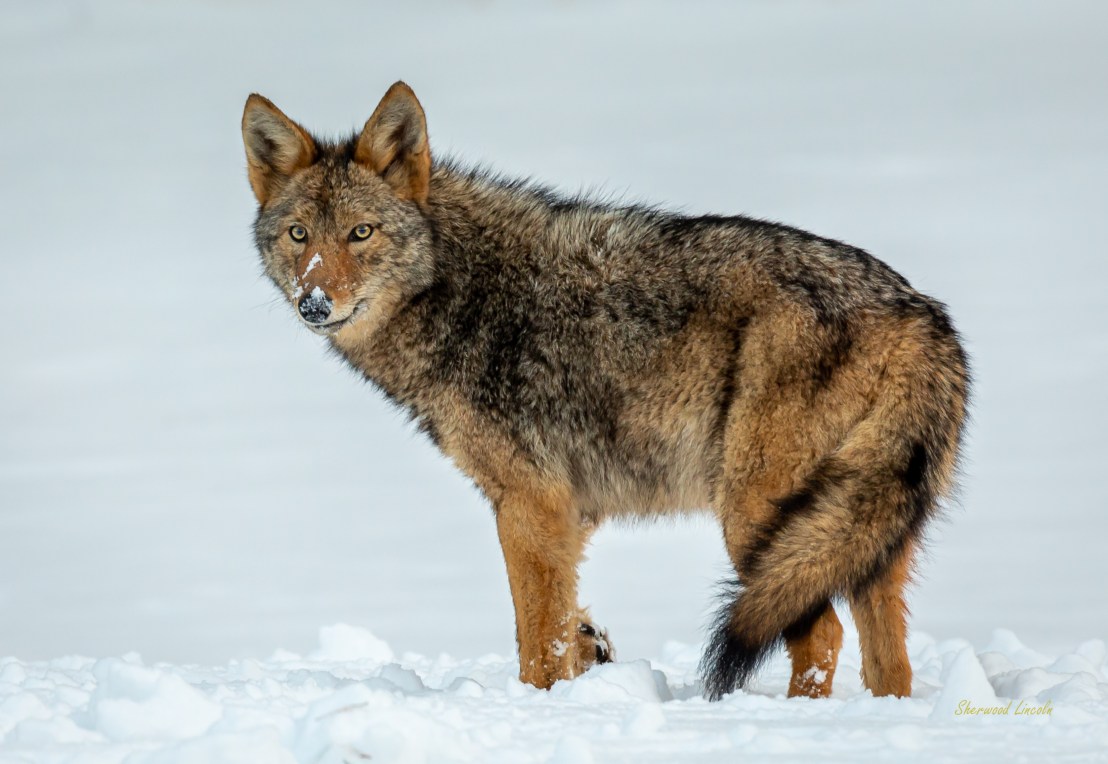
Good boy! Call it what you will; Coydog, Eastern Coyote, or Coymolf. Up close and personal, Taken in East Lyme Ct.
Ecologist and evolutionary biologist Javier Monzón analyzed the DNA of eastern coyotes and found the genes contain all three canids — dog, wolf, and coyote.
According to Monzón’s research, about 64% of the eastern coyote’s genome is coyote (Canis latrans), 13% gray wolf (Canis lupus), 13% Eastern wolf (Canis lycaon), and 10% dog (Canis familiaris).
Later on he added:
All my bird and nature photos are taken in South Eastern Ct. most with a Canon 7D Mark II or 5D Mark IV and Canon 100 to 400II THANK YOU. About 20 yards.
Then followed in response to my request for permission to republish:
Feel free, no problem!
Whatever happens to me in the next year, I truly hope I can continue to share such incredibly photographs with you.
Nature in all her glory!
Tomorrow is Christmas Day and I will be taking a short break, probably back on December 27th.
Posted by Deborah Byrd in Astronomy Essentials | Earth|December 15, 2019
December solstice 2019 arrives on December 22 at 4:19 UTC.
That’s December 21 for much of North America. High summer for the Southern Hemisphere. For the Northern Hemisphere, the return of more sunlight!
Ian Hennes in Medicine Hat, Alberta, Canada, created this solargraph between a June solstice and a December solstice. It shows the path of the sun during that time period.
Late dawn. Early sunset. Short day. Long night. For us in the Northern Hemisphere, the December solstice marks the longest night and shortest day of the year. Meanwhile, on the day of the December solstice, the Southern Hemisphere has its longest day and shortest night. The 2019 December solstice takes place on Sunday, December 22, at 04:19 UTC (That’s December 21 at 10:19 p.m. CST; translate UTC to your time).
No matter where you live on Earth’s globe, a solstice is your signal to celebrate.
When is the solstice? The solstice happens at the same instant for all of us, everywhere on Earth. In 2019, the December solstice comes on December 21 at 10:19 p.m. CST. That’s on December 22 at 04:19 Universal Time (UTC). It’s when the sun on our sky’s dome reaches its farthest southward point for the year. At this solstice, the Northern Hemisphere has its shortest day and longest night of the year.
Just remember: you’re translating from 04:19 UT on December 22. For example, if you live in Perth, Australia, you need to add 8 hours to Universal Time to find out that the solstice happens on Sunday, December 22, at 12:19 p.m. AWST (Australian Western Standard Time).
Day and night sides of Earth at the instant of the December 2019 solstice (December 22, 2019, at 04:19 UTC). Image via EarthView.
What is a solstice? The earliest people on Earth knew that the sun’s path across the sky, the length of daylight, and the location of the sunrise and sunset all shifted in a regular way throughout the year. They built monuments such as Stonehenge in England – or, for example, at Machu Picchu in Peru – to follow the sun’s yearly progress.
But we today see the solstice differently. We can picture it from the vantage point of space. Today, we know that the solstice is an astronomical event, caused by Earth’s tilt on its axis and its motion in orbit around the sun.
Because Earth doesn’t orbit upright, but is instead tilted on its axis by 23 1/2 degrees, Earth’s Northern and Southern Hemispheres trade places in receiving the sun’s light and warmth most directly. The tilt of the Earth – not our distance from the sun – is what causes winter and summer. At the December solstice, the Northern Hemisphere is leaning most away from the sun for the year.
At the December solstice, Earth is positioned in its orbit so that the sun stays below the North Pole horizon. As seen from 23 1/2 degrees south of the equator, at the imaginary line encircling the globe known as the Tropic of Capricorn, the sun shines directly overhead at noon. This is as far south as the sun ever gets. All locations south of the equator have day lengths greater than 12 hours at the December solstice. Meanwhile, all locations north of the equator have day lengths less than 12 hours.
For us on the northern part of Earth, the shortest day comes at the solstice. After the winter solstice, the days get longer, and the nights shorter. It’s a seasonal shift that nearly everyone notices.
Earth has seasons because our world is tilted on its axis with respect to our orbit around the sun. Image via NASA.
Where should I look to see signs of the solstice in nature? Everywhere.
For all of Earth’s creatures, nothing is so fundamental as the length of daylight. After all, the sun is the ultimate source of all light and warmth on Earth.
If you live in the Northern Hemisphere, you can notice the late dawns and early sunsets, and the low arc of the sun across the sky each day. You might notice how low the sun appears in the sky at local noon. And be sure to look at your noontime shadow. Around the time of the December solstice, it’s your longest noontime shadow of the year.
In the Southern Hemisphere, it’s opposite. Dawn comes early, and dusk comes late. The sun is high. It’s your shortest noontime shadow of the year.
Around the time of the winter solstice, watch for late dawns, early sunsets, and the low arc of the sun across the sky each day. Notice your noontime shadow, the longest of the year. Photo via Serge Arsenie on Flickr.Meanwhile, at the summer solstice, noontime shadows are short. Photo via the Slam Summer Beach Volleyball festival in Australia.
Why doesn’t the earliest sunset come on the shortest day? The December solstice marks the shortest day of the year in the Northern Hemisphere and longest day in the Southern Hemisphere. But the earliest sunset – or earliest sunrise if you’re south of the equator – happens before the December solstice. Many people notice this, and ask about it.
The key to understanding the earliest sunset is not to focus on the time of sunset or sunrise. The key is to focus on what is called true solar noon – the time of day that the sun reaches its highest point in its journey across your sky.
In early December, true solar noon comes nearly 10 minutes earlier by the clock than it does at the solstice around December 22. With true noon coming later on the solstice, so will the sunrise and sunset times.
It’s this discrepancy between clock time and sun time that causes the Northern Hemisphere’s earliest sunset and the Southern Hemisphere’s earliest sunrise to precede the December solstice.
The discrepancy occurs primarily because of the tilt of the Earth’s axis. A secondary but another contributing factor to this discrepancy between clock noon and sun noon comes from the Earth’s elliptical – oblong – orbit around the sun. The Earth’s orbit is not a perfect circle, and when we’re closest to the sun, our world moves fastest in orbit. Our closest point to the sun – or perihelion – comes in early January. So we are moving fastest in orbit around now, slightly faster than our average speed of about 18.5 miles per second (30 kilometers per second). The discrepancy between sun time and clock time is greater around the December solstice than the June solstice because we’re nearer the sun at this time of year.
Solstice sunsets, showing the sun’s position on the local horizon at December 2015 (left) and June 2016 (right) solstices from Mutare, Zimbabwe, via Peter Lowenstein.
The precise date of the earliest sunset depends on your latitude. At mid-northern latitudes, it comes in early December each year. At northern temperate latitudes farther north – such as in Canada and Alaska – the year’s earliest sunset comes around mid-December. Close to the Arctic Circle, the earliest sunset and the December solstice occur on or near the same day.
By the way, the latest sunrise doesn’t come on the solstice either. From mid-northern latitudes, the latest sunrise comes in early January.
The exact dates vary, but the sequence is always the same: earliest sunset in early December, shortest day on the solstice around December 22, latest sunrise in early January.
And so the cycle continues.
Solstice Pyrotechnics II by groovehouse on Flickr.
Bottom line: The 2019 December solstice takes place on Sunday, December 22, at 04:19 UTC (that’s December 21 at 10:19 p.m. CST; translate UTC to your time). It marks the Northern Hemisphere’s shortest day (first day of winter) and Southern Hemisphere’s longest day (first day of summer). Happy solstice, everyone!
ooOOoo
Well for many in the Northern Hemisphere the worst of the winter weather is yet to come.
A fascinating article on vegetarian diets for our dogs.
We are non-meat eaters here at home. Have been for a while. Our diet is essentially vegan most of the time with some fish thrown in as well. It seems to be doing us well!
But what does us good is not what does dogs good. Not at all!
You know that dogs need meat but there was a recent article on Mother Nature Network which went into details:
Experts say plant-based diets don’t always give dogs the nutrition they need. (Photo: Stickler/Shutterstock)
More people are forgoing meat in their diets for a whole spectrum of reasons — from environmental to philosophical — and now vegetarians are taking a second look at their dogs’ meat-based diets too. As a result, more owners are putting their dogs on a vegetarian or even vegan diet to bypass the health and ethical dilemmas that come with a side of beef, pork or chicken in their pet’s kibble.
“I’ve been vegan for more than two years now, and I don’t wish to contribute to the slaughterhouse or factory farm industry for my own food nor for my dogs’,” explains Debra Benfer, who together with her husband owns three vegan dogs. “If people really read what ingredients are put in dog food, I believe more people would understand why a vegetarian diet is the way to go.”
Some of those ingredients include meat from animals deemed unfit for human consumption, known in the pet food industry as the 4 Ds — dead, dying, diseased or disabled animals. In addition, many commercial pet foods contain “meat meal” or “byproducts,” which can include various animal parts and slaughterhouse waste that don’t exactly match the idyllic pictures of juicy meat chunks often seen on a bag or can of dog food. Much like commercial meat for humans, meat used in pet food can contain hormones, pesticides and antibiotics, a concern that has led many dog owners to seek alternative diets.
“If someone is saying it’s OK to give my dog these things, I would add a 5th ‘D’ to that equation and say ‘don’t,’” says Jill Howard Church, president of the Vegetarian Society of Georgia. “As a vegetarian, I know what’s in human meat and since the meat that falls below the human standard is what goes into pet food, it gives me cause for concern.”
Church’s two dogs were on a vegetarian diet for their entire lives and lived to be a healthy 15 and 19 years old. Church currently has a 3-year-old black Labrador retriever that’s also thriving on a vegetarian diet.
Church and Benfer’s positive experience with vegetarian dog diets is mirrored in hundreds of testimonials found on the internet from owners who have successfully switched their dogs to a vegetarian diet. Some owners have bypassed the dog food industry altogether by cooking their own wholesome vegetarian dog meals.
“People are taking control of their animals’ diet back into their own hands instead of relying on the pet food industry so much,” says Greg Martinez, author of “Dog Dish Diet: Sensible Nutrition for Your Dog’s Health“. “We’ve all been held hostage by industry a little bit.”
In addition to decreasing a dog’s carbon pawprint (meat production is a major contributor to greenhouse gas emissions), owners say that putting their dogs on a vegetarian diet has resulted in everything from longer life spans and shinier coats to decreased aggression.
‘It is truly unnatural for them’
It would be smart to consult with a veterinary nutritionist before switching to a vegetarian diet for your dog. (Photo: Rasulov/Shutterstock)
However, there are those who worry that vegetarian dogs may not be able to get adequate nutrition from a plant-based diet. Dogs, like humans, are omnivores, meaning they can survive on a diet of either plant or animal origin, but owners must be careful to ensure that their dogs are getting the proper nutrients from plant-based ingredients. (Cats, on the other hand, are strictly carnivores.)
According to the Association of American Feed Control Officials (AAFCO), a non-regulatory industry group that establishes pet food standards, dog food for an average adult dog should contain about 18% protein, an amount deemed necessary for good health and proper growth and development. But since every protein source contains different levels of amino acids, which are protein’s building blocks, all protein is not created equal. Some proteins are better for pets than others. For example, egg and cottage cheese are considered quality sources of protein for dogs.
“Vegetarian proteins tend not to have all the amino acids, so you have to do multiple combinations of varying types of sources of protein to get the right amino acids, which can get a little tricky to manage,” says Dr. Jessica Waldman, a veterinarian who operates a full-time pet rehabilitation clinic in Santa Monica, California. Waldman says she steers her clients away from vegetarian diets because she believes they are unnatural.
“Although I think it would be possible to put a dog on a vegetarian diet, it is truly unnatural for them,” says Waldman. “There are still dogs in the wild and they eat a vast majority of animal protein, so I think that keeping your pet’s diet as close to natural is best for limiting disease and promoting health.”
Other vets disagree, arguing that dogs can successfully be vegetarians as long as their diet is balanced and they are able to get proteins from varying sources.
Dr. Jennifer Larsen, a veterinary nutritionist at the University of California-Davis, says that both commercial and home-cooked vegetarian diets “can be used safely and can provide adequate nutrition if carefully and appropriately formulated” and as long as owners pay special attention to providing their dogs with the proper protein and amino acids.
Commercial vegetarian diets and home-cooked options are prescribed by veterinarians for dogs with specific diseases, but there currently isn’t much extensive research to prove or disprove their healthfulness. One survey conducted by PETA found that 82% of dogs that had been vegan for five years or more were in good to excellent health and that the longer a dog remained on a vegetarian or vegan diet, the greater the likelihood that the dog would have overall good to excellent health.
The study, however, also found that vegetarian dogs may be more prone to urinary tract infections as well as a form of heart disease known as dilated cardiomyopathy, which can be caused by a deficiency of the amino acids L-carnitine or taurine. But as the researchers pointed out, DCM isn’t just a problem for vegetarian dogs since L-carnitine and taurine also can be washed away in the processing of meat in commercial dog food.
To help bypass this problem, some commercial dog food companies like V-dog, a high protein vegan dog food, have added taurine and L-carnitine to their formulas to insure quality health that “exceeds the nutrient profiles established by the AAFCO,” says V-dog President David Middlesworth.
Though putting dogs on a vegetarian diet may remain controversial until further studies are conducted, veterinarians and vegetarian dog owners can agree that people considering putting their dog on a vegetarian diet should first do their own research to determine what’s best for their individual dog’s needs and/or consult their veterinarian.
Jennifer Adolphe, an animal nutritionist at the University of Saskatchewan, told The Washington Post that pet owners should do research. She advises pet owners to do “some homework to find out who is behind the company, if it employs a full-time qualified nutritionist, what kind of quality control measures do they use.”
“It just takes research and the willingness to stick by your reasons for having your dogs on a vegetarian diet,” says Benfer, who often makes homemade dog food for her three vegan dogs. “I get strange looks when I let people know my dogs are vegan, but it’s only because they aren’t educated about dogs being vegetarian and don’t realize how easy and possible it really is to do.”
Editor’s note: This story has been updated with new information since it was published in August 2010.
ooOOoo
Well not much to add from me. This article is completely clear to my mind.