Category: Science

Beauty of flight

Big thank you to Dennis L. for forwarding this video

Will say no more – just watch

And if that gives you a buzz, then you might want to read a Post that I published on the 30th July Free as a Bird reproduced in full below,

The wonderful combination of paragliding and flying with hawks.

Thanks to Dan Gomez for passing me a short video about this amazing activity.  It was a matter of moments to find out the background.  But first a picture.

Copyright Scott Mason

There’s a full description of the history of parahawking, as it is called, on WikiPedia.

Parahawking is a unique activity combining paragliding with elements of falconry. Birds of prey are trained to fly with paragliders, guiding them to thermals for in-flight rewards and performing aerobatic maneouvres.

Parahawking was developed by British falconer Scott Mason in 2001. Mason began a round-the-world trip in PokharaNepal, where many birds of prey – such as the griffon vulturesteppe eagle andblack kite – can be found. While taking a tandem paragliding flight with British paraglider Adam Hill, he had the opportunity to see raptors in flight, and realized that combining the sport of paragliding with his skills as a falconer could offer others the same experience. He has been based in Pokhara ever since, training and flying birds during the dry season between September and March.

The team started by training two black kites, but have since added an Egyptian vulture and a Mountain hawk-eagle to the team. Only rescued birds are used – none of the birds has been taken from the wild.

There’s an interesting website for those that want to take a closer including more details about Scott Mason and his team here.

Now watch this!

Endlessness surrounds us and infinity is within!

Stirring the mental pot for a Friday morning!

Not too long ago, I came across the website The Big Think.  It tickled my curiosity to the extent that I subscribed.  On November 6th an essay was published with the wonderful title of Consciousness: The Black Hole of Neuroscience‘.  Couldn’t resist that!  Here’s how that essay started,

What’s the Big Idea?

“By the word ‘thought’ (‘pensée’) I understand all that of which we are conscious as operating in us.” –Renee Descartes

The simplest description of a black hole is a region of space-time from which no light is reflected and nothing escapes. The simplest description of consciousness is a mind that absorbs many things and attends to a few of them. Neither of these concepts can be captured quantitatively. Together they suggest the appealing possibility that endlessness surrounds us and infinity is within.

That last sentence jumped off the page at me – hence me using it as the title of this post.

If this interests you at all, then do read the full item.  That closes like this …

Hirsch sees it more practically. Though functional imaging has not explained where perception comes from, it has important applications for unconscious patients. “The boundaries have been broken a little bit, clinically,” she says. “As we study patients with disorders of consciousness, we can probe their levels of awareness in ways that other traditional ways of asking them to respond.”

It’s no different than any other aspect of the brain that we cannot presently explain, she says:

For example, we don’t understand how the brain creates colors. That’s a perception that is very private – I don’t know that your perception of blue is like my perception of blue, for example. Smells are another one. I don’t know that your perception of the smell of an orange is like mine. These are the hard problems of neuroscience and philosophy that we haven’t made a great deal of progress on.

What do you think? Is the distinction between “hard problems” and “soft problems” useful, or reductive? Does the brain create consciousness? Will we ever empirically understand where it comes from or how it works?

This post is part of an ongoing series, The 21st Century Brain.

But that’s not the end of it.  Browsing the comments revealed a link to the Blog called NeuroLogica Blog.  The author is Steven Novella, MD.  Here’s a flavour of Steven’s competencies.

Dr. Novella is an academic clinical neurologist at Yale University School of Medicine. He is the president and co-founder of the New England Skeptical Society. He is the host and producer of the popular weekly science podcast, The Skeptics’ Guide to the Universe. He is also a senior fellow and Director of Science-Based Medicine at theJames Randi Educational Foundation (JREF), a fellow of the Committee for Skeptical Inquiry (CSI) and a founding fellow of the Institute for Science in Medicine.

The NeuroLogicaBlog covers news and issues in neuroscience, but also general science, scientific skepticism, philosophy of science, critical thinking, and the intersection of science with the media and society.

Dr. Novella also contributes every Sunday to The Rogues Gallery, the official blog of the SGU, every Monday to SkepticBlog, and every Wednesday to Science-Based Medicine, a blog dedicated to issues of science and medicine.

I couldn’t resist doing a search on Dr. Novella’s blog using the search term ‘consciousness’.  What a rich vein!  Here’s just one example of what came to light,

Subconscious Motivation

Neuroscience research has been increasingly fleshing out the fascinating and complex relationship between the subconscious processing of the brain and our conscious awareness. We all labor under the illusion that our decisions, feelings, and behaviors are all conscious. When we do something, it seems, it is because we wanted to do it. We are very good, in fact, at retrofitting a logical explanation for why we consciously did something.

But much of our brain’s decision making occurs at a subconscious level. When presented with a choice various parts of our brains make a calculation – processing the choice, weighing varying factors based upon some neuro-algorithm, and then present that choice to our conscious mind (the global workspace, if you accept this hypothesis). Research shows that if we change the subconscious algorithm, by suppressing, for example, one part of the brain, the decision-making process is altered. We are not aware of this, and we still are under the illusion that the decision was completely conscious.

Strongly recommend that you read the article in full; it is deeply fascinating.  And then laugh out loud, as I did, when you read the first comment made to that article,

I find this fascinating even though I am not conciously aware of why!

This is rocket science!

A timely video from the International Space Station (ISS)

Little did I realise when I posted yesterday’s item that a couple of subsequent actions would make today’s article easy to write (trust me it isn’t always this easy!).

Mike T., a flying buddy from my old days in England, sent me this link to a 5-minute video made up of a series of films shot from the ISS.  DO WATCH THE VIDEO IN FULL SCREEN MODE!

The details of how the film was taken and much more interesting information is at the very end of this article.

Then Martin Lack who writes the blog, Lack of Environment, submitted a comment with a link to a piece that he had written on the 19th August that I would like to re-publish in full.

Why are we still waiting for the EU to act?

What can we learn from the fact that the EU has still not stopped buying over 90% of Syria’s oil exports? If nothing else, it tells me that we need fossil fuel too much!

But I think the problem of wrong priorities goes much deeper than that… This is because the Limits to Growth argument (which underlies my concern over AGW) is, even though the protestor-in-the-street may not realise it, the root cause of all the problems we are now seeing in Afghanistan, Bahrain, Cairo, Damascus etc., etc… right through to Zimbabwe: Treating the symptoms of food shortages or corruption (or whatever they may be) will not succeed unless we address the root cause, which is the inevitable consequences of perpetual growth in consumption of resources and/or waste production on a finite planet [see E.F. Schumacher’s Small is Beautiful (1973)].

This 5 minute video makes sobering viewing, but it also perfectly summarises everything I have learnt in the last 12 months; and all I have posted on my oldMyTelegraph blog in the last 5 months!

It may not be rocket science, but can we reach Escape Velocity?

This stuff is not rocket science, but it is very unwelcome news to people with a vested interest in the continuance of “business as usual”. Unfortunately, we literally cannot go on the way we are; something has got to change…

The fact that AGW may suffer from issue fatigue, and the fact that I sometimes feel like an old-style street preacher being completely ignored by passers-by, does not change the fact that, on well above the balance of probability, we face an environmental catastrophe if we fail to take significant action within the next 5 years. Furthermore, every year we fail to act, makes taking effective action much, much harder. This is because it is the total (i.e. cumulative) amount of fossilised carbon that we (have and will) put into the atmosphere that will determine the temperature change we will see over the next 50 years or so.

Extract of paper presented by Dr Myles Allen at 4 Degrees and Beyond Conference (2009)

So a big thank you to Mike T. and Martin Lack for a number of lessons:

  • how clever man is in terms of space technology besides much more
  • the beauty of our planet – it’s all we have to live on
  • the amount of electric light that shines into outer space, as seen by the ISS.
  • how much of that lighting might be generated by coal and oil!
  • if we don’t learn to live in harmony, as in sustainably, with this planet of ours, the implications are going to be very serious.

Finally, as mentioned earlier the details of that video on Vimeo.

Time lapse sequences of photographs taken with a 4K-camera by Ron Garan fragileoasis.org/​bloggernauts/​Astro_Ron and the crew of expedition 28 & 29 onboard the International Space Station from August to October, 2011. All credit goes to them, who to my  knowledge shot these pictures at an altitude of around 350 km.  I intend to upload a FullHD-version presently.

HD, refurbished, smoothed, retimed, denoised, deflickered, cut, etc.  All in all I tried to keep the looks of the material as original as possible, avoided adjusting the colors and the like, since in my opinion the original footage itself already has an almost surreal and aestethical visual nature.

Music: Jan Jelinek | Do Dekor, faitiche back2001 w+p by Jan Jelinek, published by Betke Edition janjelinek.com | faitiche.de

Image Courtesy of the Image Science & Analysis Laboratory, NASA Johnson Space Center, The Gateway to Astronaut Photography of Earth eol.jsc.nasa.gov

Editing: Michael König | koenigm.com

Shooting locations in order of appearance:

1. Aurora Borealis Pass over the United States at Night
2. Aurora Borealis and eastern United States at Night
3. Aurora Australis from Madagascar to southwest of Australia
4. Aurora Australis south of Australia
5. Northwest coast of United States to Central South America at Night
6. Aurora Australis from the Southern to the Northern Pacific Ocean
7. Halfway around the World
8. Night Pass over Central Africa and the Middle East
9. Evening Pass over the Sahara Desert and the Middle East
10. Pass over Canada and Central United States at Night
11. Pass over Southern California to Hudson Bay
12. Islands in the Philippine Sea at Night
13. Pass over Eastern Asia to Philippine Sea and Guam
14. Views of the Mideast at Night
15. Night Pass over Mediterranean Sea
16. Aurora Borealis and the United States at Night
17. Aurora Australis over Indian Ocean
18. Eastern Europe to Southeastern Asia at Night

A small step

Fabulous news from The President’s Office re the Keystone XL pipeline.

On the 27th October, I introduced an article about the pipeline, thus,

“Have the courage to say no. Have the courage to face the truth.  Do the right thing because it is right.  These are the magic keys to living your life with integrity.”

The above is attributed to W. Clement Stone, a businessman, philanthropist and author who died in 2002, aged 100.  It seemed an appropriate quotation with which to introduce a recent article by Bill McKibben, on the Grist blog, about the proposed Keystone XL pipeline.

A short time ago (Thursday) I received the following from Bill McKibben, 350.org.

Dear Friends,

Um, we won. You won.

Not completely. The President didn’t outright reject the Keystone XL pipeline permit. My particular fantasy — that he would invite the 1253 people arrested on his doorstep in August inside the gates for a victory picnic by the vegetable garden — didn’t materialize.

But a few minutes ago the President sent the pipeline back to the State Department for a thorough re-review, which most analysts are saying will effectively kill the project. The president explicitly noted climate change, along with the pipeline route, as one of the factors that a new review would need to assess. There’s no way, with an honest review, that a pipeline that helps speed the tapping of the world’s second-largest pool of carbon can pass environmental muster.

And he has made clear that the environmental assessment won’t be carried out by cronies of the pipeline company — that it will be an expert and independent assessment. We will watch that process like hawks, making sure that it doesn’t succumb to more cronyism. Perhaps this effort will go some tiny way towards cleaning up the Washington culture of corporate dominance that came so dramatically to light here in emails and lobbyist disclosure forms.

It’s important to understand how unlikely this victory is. Six months ago, almost no one outside the pipeline route even knew about Keystone XL. One month ago, a secret poll of “energy insiders” by the National Journal found that “virtually all” expected easy approval of the pipeline by year’s end. As late as last week the CBC reported that Transcanada was moving huge quantities of pipe across the border and seizing land by eminent domain, certain that its permit would be granted. A done deal has come spectacularly undone.

Our movement spoke loudly about climate change and the President responded. There have been few even partial victories about global warming in recent years so that makes this an important day. We need to let the president and oil companies know that we’re ready to take action should they try to push this pipeline through in a couple of years. There’s a pledge to take bold action against the pipeline up on our site, and I’ll be keeping your names an emails safely stored away so that you’ll be the first to know about anything we need to do down the road.

Please sign the pledge here.

The President deserves thanks for making this call — it’s not easy in the face of the fossil fuel industry and its endless reserves of cash. The deepest thanks, however, go to you: to indigenous peoples who began the fight, to the folks in Nebraska who rallied so fiercely, to the scientists who explained the stakes, to the environmental groups who joined with passionate common purpose, to the campuses that lit up with activity, to the faith leaders that raised a moral cry, to the labor leaders who recognized where our economic future lies, to the Occupy movement that helped galvanize revulsion at insider dealing, and most of all to the people in every state and province who built the movement that made this decision inevitable.

Our fight, of course, is barely begun. Some in our movement will say that this decision is just politics as usual: that the President wants us off the streets — and off his front lawn — until after the election, at which point the administration can approve the pipeline, alienating its supporters without electoral consequence. The president should know that If this pipeline proposal somehow reemerges from the review process we will use every tool at our disposal to keep it from ever being built; if there’s a lesson of the last few months, both in our work and in the Occupy encampments around the world, it’s that sometimes we have to put our bodies on the line.

In the meantime, since federal action will be in abeyance for a long stretch, we need to figure out how best to support our Canadian brothers and sisters, who are effectively battling against proposed pipelines west from the tar sands to the Pacific. And we need to broaden our work to take on all the forms of ‘extreme energy’ now coming to the fore: mountaintop removal coal mining, deepsea oil drilling, fracking for gas and oil. We’ll keep sending you updates; you keep letting us know what we need to do next.

Last week, scientists announced that the planet had poured a record amount of CO2 into the atmosphere last year; that’s a sign of how desperate our battle is. But we take courage from today’s White House announcement; it gives us some clues about how to fight going forward.

And I simply can’t say thank you enough. I know, because of my own weariness, how hard so many of you have worked. It was good work, done in the right spirit, and it has secured an unlikely victory. You are the cause of that victory; you upended enormous odds.

I’m going to bed tired tonight. But I’ll get up in the morning ready for the next battle, more confident because I know you’re part of this fight too.

Onwards,

Bill McKibben for the 350.org Team

P.S. Victories need to be shared. Let’s make this one fly all over the web: share it on Twitter here and share it on Facebook here.


November 8th birthday update

The passing of an asteroid.

This has been very widely reported but not seen by me until a few moments ago.

Here’s how the BBC is reporting Asteroid 2005 YU55.

Giant asteroid to pass near Earth

Nasa’s Deep Space Network caught a glimpse of the asteroid on Monday

An asteroid that is 400m (1,300ft) wide will pass by the Earth on Tuesday, closer to it even than the Moon.

It poses no danger to the Earth and it will be invisible to the naked eye.

Asteroid 2005 YU55’s closest approach, at a distance of 325,000km (202,000mi), will be at 23:28 GMT. It is the closest the asteroid has been in 200 years.

It is also the largest space rock fly-by the Earth has seen since 1976; the next visit by such a large asteroid will be in 2028.

The aircraft-carrier-sized asteroid is darkly coloured in visible wavelengths and nearly spherical, lazily spinning about once every 20 hours as it races through our neighbourhood of the Solar System.

It will trace a path across the whole sky through to Thursday.

The NASA details may be found here.

And an interesting video on the passing of this rather large rock at 23:28 UTC today, November 8th.

The potential for the USA!

A powerful ‘good news’ story.

I am republishing in full a recent report from the Earth Policy Institute.  It underlines how wringing our hands in the face of so much doom and gloom, while perfectly understandable, can hide the fact that mankind can and does change, frequently for the better.  This EPI report is a tad ‘dry’ but still a great read.  As an incentive, let me show you the final sentence, “If so, the United States could become a world leader in cutting carbon emissions and stabilizing climate.

Here’s the full paper.
NOVEMBER 02, 2011
U.S. Carbon Emissions Down 7 Percent in Four Years: Even Bigger Drops Coming
Lester R. Brown


Between 2007 and 2011, carbon emissions from coal use in the United States dropped 10 percent. During the same period, emissions from oil use dropped 11 percent. In contrast, carbon emissions from natural gas use increased by 6 percent. The net effect of these trends was that U.S. carbon emissions dropped 7 percent in four years. And this is only the beginning.

The initial fall in coal and oil use was triggered by the economic downturn, but now powerful new forces are reducing the use of both. For coal, the dominant force is the Beyond Coal campaign, an impressive national effort coordinated by the Sierra Club involving hundreds of local groups that oppose coal because of its effects on human health.

U.S. Energy-Related Carbon Dioxide Emissions, 1950-2010, with Projection for 2011

In the first phase, the campaign actively opposed the building of new coal-fired power plants. This hugely successful initiative, which led to a near de facto moratorium on new coal plants, was powered by Americans’ dislike of coal. An Opinion Research Corporation poll found only 3 percent preferred coal as their electricity source—which is no surprise. Coal plant emissions are a leading cause of respiratory illnesses (such as asthma in children) and mercury contamination. Coal burning causes 13,200 American deaths each year, a loss of life that exceeds U.S. combat losses in 10 years of war in Afghanistan and Iraq.

The campaign’s second phase is dedicated to closing existing coal plants. Of the U.S. total of 492 coal-fired power plants, 68 are already slated to close. With current and forthcoming U.S. Environmental Protection Agency air quality regulations on emissions of mercury, sulfur, and ozone precursors requiring costly retrofits, many more of the older, dirtier plants will be closed

In August, the American Economic Review—the country’s most prestigious economics journal—published an article that can only be described as an epitaph for the coal industry. The authors conclude that the economic damage caused by air pollutants from coal burning exceeds the value of the electricity produced by coal-fired power plants. Coal fails the cost-benefit analysis even before the costs of climate change are tallied.

In July 2011, New York Mayor Michael Bloomberg announced a grant of $50 million to the Beyond Coal campaign. It is one thing when Michael Brune, head of the Sierra Club, says that coal has to go, but quite another when Michael Bloomberg, one of the most successful businessmen of his generation, says so.

The move to close coal plants comes at a time when electricity use for lighting will be falling fast as old-fashioned incandescent light bulbs are phased out. In compliance with the Energy Independence and Security Act of 2007, by January 2012 there will be no 100-watt incandescent light bulbs on store shelves. By January 2014, the 75-watt, 60-watt, and 40-watt incandescents will also disappear from shelves. As inefficient incandescents are replaced by compact fluorescents and LEDs, electricity use for lighting can drop by 80 percent. And much of the switch will occur within a few years.

The U.S. Department of Energy projects that residential electricity use per person will drop by 5 percent during this decade as light bulbs are replaced and as more-efficient refrigerators, water heaters, television sets, and other household appliances come to market.

Even as coal plants are closing, the use of wind, solar, and geothermally generated electricity is growing fast. Over the last four years, more than 400 wind farms—with a total generating capacity of 27,000 megawatts—have come online, enough to supply 8 million homes with electricity. (See data.) Nearly 300,000 megawatts of proposed wind projects are in the pipeline awaiting access to the grid.

Cumulative Installed Wind Power Capacity in the United States, 1980-2011

Texas, long the leading oil-producing state, is now the leading generator of electricity from wind. When the transmission lines linking the rich wind resources of west Texas and the Texas panhandle to the large cities in central and eastern Texas are completed, wind electric generation in the state will jump dramatically.

In installed wind-generating capacity, Texas is followed by Iowa, California, Minnesota, and Illinois. In the share of electricity generation in the state coming from wind, Iowa leads at 20 percent.

With electricity generated by solar panels, the United States has some 22,000 megawatts of utility-scale projects in the pipeline. And this does not include residential installations.

Closing coal plants also cuts oil use. With coal use falling, the near 40 percent of freight rail diesel fuel that is used to move coal from mines to power plants will also drop.

In fact, oil use has fallen fast in the United States over the last four years, thus reversing another long-term trend of rising consumption. The reasons for this include a shrinkage in the size of the national fleet, the rising fuel efficiency of new cars, and a reduction in the miles driven per vehicle.

Fleet size peaked at 250 million cars in 2008 just as the number of cars being scrapped eclipsed sales of new cars. Aside from economic conditions, car sales are down because many young people today are much less automobile-oriented than their parents.

In addition, the fuel efficiency of new cars, already rising, will soon increase sharply. The most recent efficiency standards mandate that new cars sold in 2025 use only half as much fuel as those sold in 2010. Thus with each passing year, the U.S. car fleet becomes more fuel-efficient, using less gasoline.

Miles driven per car are declining because of higher gasoline prices, the continuing recession, and the shift to public transit and bicycles. Bicycles are replacing cars as cities create cycling infrastructure by building bike paths, creating dedicated bike lanes, and installing sidewalk parking racks. Many U.S. cities, including Washington, D.C., Chicago, and New York, are introducing bike-sharing programs.

Furthermore, when people retire and no longer commute, miles driven drop by a third to a half. With so many baby boomers now retiring, this too will lower gasoline use.

As plug-in hybrid and all-electric cars come to market, electricity will replace gasoline. Ananalysis by Professor Michael McElroy of Harvard indicates that running a car on wind-generated electricity could cost the equivalent of 80-cent-a-gallon gasoline.

With emissions from coal burning heading for a free fall as plants are closed, and those from oil use also falling fast—both are falling faster than emissions from natural gas are ramping up—U.S. carbon emissions are falling.

We are now looking at a situation where the 7 percent decline in carbon emissions since the 2007 peak could expand to 20 percent by 2020, and possibly even to 30 percent. If so, the United States could become a world leader in cutting carbon emissions and stabilizing climate.

Lester R. Brown is president of the Earth Policy Institute and author of World on the Edge.

Copyright © 2011 Earth Policy Institute

The view from the window.

Perhaps ancient man is still alive and well in all of us.

Two delightful events have provided the fuel for today’s post which, I warn you, is much more the personal mental ramble than the usual daily post on Learning from Dogs.  So, health warning, continue reading at your own risk, or be safe and switch off now!

Before getting in to my perambulations, just a word of thanks to you for your support.  Last month, there were 31,291 viewers of Learning from Dogs and 71 of you have chosen to subscribe.  I am humbled by your interest.  Don’t ever hesitate to give me feedback or, if you prefer, comment to a specific post.

OK, to the theme of today.

On Wednesday I had an enjoyable lunch with a friend from here in Payson, Dennis L.  Sitting in the Crosswinds restaurant at Payson airport is one of the most beautiful eating spots in terms of the view from the window.  So it’s a very conducive place to relax and try put the world to rights!  Conversation ranged across a variety of topics but frequently touched on the lunacy of so many things to do with man, especially when it comes to the government of peoples.

Dennis and I also acknowledged that entering politics with a set of passionate ideals, as we were sure many persons did, would quickly run up against the skein of vested interests that must permeate governments from top to bottom.

Yes Minister was a satirical comedy written by Antony Jay and Jonathan Lynn that ran for many years.  It was extraordinarily funny, here’s a 3-minute clip,

That programme underlined, far better than anything else, how governments most probably work in reality.

Dennis and I were clear, as so many millions of other global citizens must be, that the complexity of commerce, politics, national interests, global finance, and more, had created ‘systems’ of decision making that were utterly disconnected with the needs of mankind having a long and stable future on the only finite home around, Planet Earth.

Then today (Thursday), Jean and I attended our regular weekly gardening course at the local college in Payson.  Today’s subject was Arizona’s Climate and the tutor, Mike C., was a professional climatologist and meteorologist.  It was fascinating, indeed, totally absorbing.  Mike’s graphs and slides about the climate, some showing data for the last 1,000 years, underlined the incredible complexity and interconnectedness of the processes that made up the global climate system.

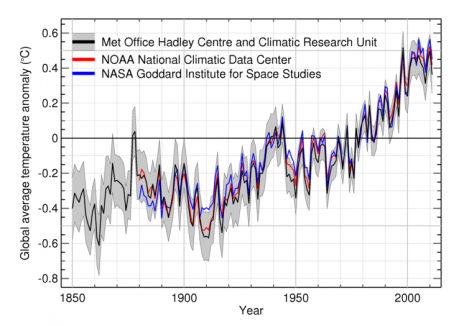
Once again that use of the word ‘complexity’.  He confirmed that there was no scientific doubt that the world was warming as a result of changes to the Earth’s atmosphere, science certain most of it is caused by increasing concentrations of greenhouse gases produced by human activities such as deforestation and burning fossil fuels.

Mike closed the session with an interesting reflection.  He reminded the audience that mankind is still essentially wired, in evolutionary terms, to know how to react to an attacking tiger or similar wild beast, as in the fight or flee response, than know how to deal with such complex, despite intellectually obvious, threats as global climate change, rising sea levels and many other totally unsustainable practices.  Mike held the view that only when man had the threat in his face equivalent to that of the attacking tiger would there be a wholesale change.

On the home page of this blog, I write,

As man’s companion, protector and helper, history suggests that dogs were critically important in man achieving success as a hunter-gatherer.  Dogs ‘teaching’ man to be so successful a hunter enabled evolution, some 20,000 years later, to farming,  thence the long journey to modern man.  But in the last, say 100 years, that farming spirit has become corrupted to the point where we see the planet’s plant and mineral resources as infinite.  Mankind is close to the edge of extinction, literally and spiritually.

In the context of homo sapiens, Latin for “wise man” or “knowing man”, then we know that modern man, anatomically, originated in Africa about 200,000 years ago.  Modern man only evolved from hunter/gatherer to farmer around 10,000 years ago, a tiny proportion of H. sapiens existence and, in evolutionary terms, no time at all.

The DNA of the domesticated dog separated from that of the wolf around 100,000 years ago.  No one knows for sure when man and dog came together but there is archaeological evidence of dogs being buried in mens’ graves around 30,000 years ago.  That’s an association over a huge time period.

Dennis and Mike, between them, triggered in my mind something fundamental.  Perhaps modern society, with all it’s bizarre behaviours and so many totally illogical practises (especially, in terms of a long-term relationship with our planet), could be understood.  Understood from the perspective of our social behaviours, built so much on technology, having raced far on to the point where they are now practically out of sight of our instinctive evolutionary behaviours.  We really don’t know how to change those core behaviours.

In contrast, dogs have remained much more stable with regard to their evolutionary progress and their external world.  Consider that the last big change for the domesticated dog was the association with man and that is at least three times as long ago as man becoming farming man.  No wonder when we curl up with our dog it has echoes of a time thousands of years before we could even spell the word, ‘politician’.  Echoes of a stability that seems now so way beyond reach.

And the view from the window of the Crosswinds ……

Mogollon Rim, North of Payson, AZ., in Winter

The Keystone XL pipeline

“Have the courage to say no. Have the courage to face the truth.  Do the right thing because it is right.  These are the magic keys to living your life with integrity.”

The above is attributed to W. Clement Stone, a businessman, philanthropist and author who died in 2002, aged 100.  It seemed an appropriate quotation with which to introduce a recent article by Bill McKibben, on the Grist blog, about the proposed Keystone XL pipeline.

Bill McKibben

Keystone pipeline’s last defense: Cold, hard cash

What do you do if you’ve lost an argument?

Say you really really want to build a big pipeline from the tar sands of Alberta so that you can sell your bitumen to the world

But 20 of the nation’s top scientists have written to the president to say it’s a terrible idea — and the planet’s leading climatologist says burning the tar sands would be “game over for the climate.” And nine recent winners of the Nobel Peace Prize have condemned the plan. And Robert Redford has just made a video explaining why the plan is an attack on the nation’s heartland. Then, if you’re a poor forlorn oil industry feeling unloved and under assault, what do you do?

There’s really only one answer: Flash your wad.

As we get to the final chapters of the Keystone pipeline saga (the president has said he’ll make his decision by year’s end), money’s the only argument these guys have left.

They managed to buy a favorable environmental review from the U.S. State Department, which helpfully outsourced the job to a company that was a “major client” of TransCanada, the pipeline builder.

And yesterday, they proposed a $100 million “performance bond” to the state of Nebraska, whose Republican governor and senator have come out against the pipeline. The money is apparently designed to pay for damage to the Ogallala Aquifer if the pipeline starts to leak.

Meanwhile, when 33 Democratic representatives sent a letter to the White House demanding a rejection of the plan, lobbyists for TransCanada rounded up their own list of lawmakers from the president’s party to issue a rejoinder. But they only found 22. And what do you know — they included nine of the top 10 Democratic recipients of oil money in the House. On average the signatories received over 4.25 times more oil money than the average House Democrat in the 112th Congress. That would be 325 percent more. That would be how the game is played.

The other side — that is, scientists, Nobelists, and the kind of average people who went to jail in record numbers this summer to block the plan — doesn’t have that kind of money. We’ve had to figure out other currencies to work in: spirit, passion, creativity. We’ve spent our bodies, putting them on the line. The odds are still against us, but the odds are changing; we’re on a roll as we head toward Nov. 6, when we’ll ring the White House with people, exactly one year before the election. (You can sign up here.)

But every once in a while we get to play the money game too! While TransCanada was out there setting the $100 million price on the Ogallala Aquifer, this news story rolled across my screen. It described a big Democratic giver, Barbarina Heyerdahl. She gave 120 grand to Obama and the Democratic National Committee over the last three years, not to mention knocking on doors for the 2008 campaign. But she said Keystone is a bridge too far, that “she won’t be writing any more checks to Obama if he approves the carbon conduit that’s become the focus of the climate-change movement. ‘It’s a baseline issue,’ she says.”

I have no doubt that, even with Heyerdahl and other donors accounted for, the oil industry has all the money they need to win this fight. The Koch brothers are the third and fourth richest men in America, and they filed papers in Canada declaring their “direct and substantial” interest in the project. If money’s the only thing that matters, they’ll carry the day.

But if money’s the only thing that matters, we’re done for anyway. So we’ll keep using science and art and courage. And we’ll hope that Barack Obama hasn’t sold his soul. We’re going to find out in the next few weeks.

Bill McKibben is founder of 350.org and Schumann Distinguished Professor at Middlebury College in Vermont. He also serves on Grist’s Board of Directors.

Bill’s website may be found here.  Also, please PLEASE watch the video made by Robert Redford.  Only 3 mins 25 seconds long, the ink to the video is here.

Finally, a YouTube video from Tars and Action.

All that’s necessary for the forces of evil to win in the world is for enough good men to do nothing.” Edmund Burke

The Sun to our Rescue

Possibly the start of the end of traditional means of generating electricity

A recent item by David Roberts on the Grist website/Blog caught my eye,

Solar is getting cheap fast—pay attention, Very Serious People

That was the headline to the opening, thus,

I hope everyone has read Kees Van Der Leun’s post about the rapidly falling cost of solar PV. I want to draw out one quick point that Kees leaves implicit.

He argues that PV will be the cheapest source of electricity for most of the world some time around 2018, and for the rest of the world soon after. That could be off by a few years in either direction. It depends on whether the cost curve for silicon solar cells continues as it has the past and, as Alan says in his comment, whether the cost curve for “balance of system” costs (steel, glass, installation, etc.) declines as well. Let’s say it could be off by five years either way. Let’s just assume it’s 2023 before solar PV crosses grid parity and becomes cheaper than coal.

The Kees Van Der Leun post, referred to, points out that,

For a long time, the holy grail of solar photovoltaics (PV) has been “grid parity,” the point at which it would be as cheap to generate one’s own solar electricity as it is to buy electricity from the grid. And that is indeed an important market milestone, being achieved now in many places around the world. But recently it has become clear that PV is set to go beyond grid parity and become the cheapest way to generate electricity.

A hundred solar cells, good for 380 watts of solar PV power. Photo: Ariane van Dijk

Whenever I say this I encounter incredulity, even vehement opposition, from friends and foes of renewable energy alike. Apparently, knowledge of the rapid developments of the last few years has not been widely disseminated. But it’s happening, right under our noses! It is essential to understand this so that we can leverage it to rapidly switch to a global energy system fully based on renewable energy.

Working on solar PV energy at Ecofys since 1986, I have seen steady progression: efficiency goes up, cost goes down. But it was only on a 2004 visit to Q-Cells‘ solar cell factory in Thalheim, Germany, that it dawned on me that PV could become very cheap indeed. They gave me a stack of 100 silicon solar cells, each capable of producing 3.8 watts of power in full sunshine. I still have it in the office; it’s only an inch high!

That’s when I realized how little silicon was needed to supply the annual electricity consumption of an average European family (4,000 kWh). Under European solar radiation, it would take 1,400 cells, totaling less than 30 pounds of silicon.

Of course, you need to cover the cells with some glass and add a frame, a support structure, some cables, and an inverter. But the fact that 30 pounds of silicon, an amount that costs $700 to produce, is enough to generate a lifetime of household electricity baffled me. Over 25 years, the family would pay at least $25,000 for the same 100,000 kilowatt-hours (kWh) of electricity from fossil fuels — and its generation cost alone would total over $6,000!

Back to the David Roberts article,

He argues that PV will be the cheapest source of electricity for most of the world some time around 2018, and for the rest of the world soon after. That could be off by a few years in either direction. It depends on whether the cost curve for silicon solar cells continues as it has the past and, as Alan says in his comment, whether the cost curve for “balance of system” costs (steel, glass, installation, etc.) declines as well. Let’s say it could be off by five years either way. Let’s just assume it’s 2023 before solar PV crosses grid parity and becomes cheaper than coal.

Here’s the thing: 2023 isn’t that far off. It feels distant to us in a lot of ways. My kids will be out of college. Fifty versions of the iPhone will have come and gone. We might finally have the jetpacks we were promised.

But in terms of energy infrastructure, 12 years is nothing. It can take half that long or longer to permit and build big coal and nuclear plants, and they are meant to last a long-ass time. The Perry K Steam Plant, which serves downtown Indianapolis, was built in 1938. They didn’t have color TV then. Thirty-six coal plants in the U.S. were built before 1950. If a coal plant built today lasts that long, it will still be belching all over the atmosphere in 2072. My kids will be in their 60s.

This is also true of nuclear plants (the oldest is 42 years) and to a lesser extent natural-gas plants. It’s even true of transmission lines. These are large, long-term investments.

So if solar PV is going to be cheaper than coal in the next decade or so, that seems like the kind of thing utilities, regulators, investors, and political leaders would want to, I don’t know, talk over. Grapple with. Mull. It certainly seems relevant to the investment thesis for large, centralized power infrastructure. Yet it’s all but invisible in the elite U.S. energy conversation, outside of a few voices like FERC Chair Jon Wellinghoff. Very Serious People still see solar PV as an affectation, a kind of charity project.

Hope you are still with me, because this is really an incredibly positive message.  By the time children born today are becoming teenagers, the means of harnessing the sun to deliver clean energy cheaper than carbon-based and nuclear generation will be a reality.  In a little over a decade from now!

It is so easy to see doom and gloom wherever we look.  For good reasons; these are very difficult times as societies pull back from the greed and materialism of recent times to a better, sustainable relationship with our planet, the only one we have.  But technology and innovation are quietly creating the opportunities for a new future for humanity.

Let me finish with an email received recently from good friend, John H., up here in Payson, Arizona.

Greetings from a Mountain Top,

It has been another bright and peaceful day of Indian summer in the Ponderosa pine forests of the Arizona Rocky Mountains. Our annual state-wide church convention last weekend was a metaphorical breath of fresh air.  It was an opportunity to realize where we’ve been and consider how far we have to go.

From the early evening vantage point of an upper porch with a vista of forest, mountains and sky, it appears that we’re facing spiritual, environmental, human and economic bankruptcy caused by top down idolatry, arrogance and ignorance.

It’s deeply disturbing to watch our human heritage destroyed by a corporate-government-military-industrial-intelligence complex with a clear plan to control the world through oppression. This systemic machine continues to increase the drain on the earth’s severely depleted resources.

Our present energy sources can no longer sustain exponential human population growth.  The industrial use of fossil fuels is destroying the earth which sustains us.  It’s time for us to wake up and read the book of life.  It’s time to lighten the human footprint upon the earth while we still have a choice.  Nature doesn’t care about human ambition.

Peace and love, an old lamplighter

Steve Jobs, RIP

The man who put a ding in the universe!

Regular readers of Learning from Dogs know that my pattern is to write a single article each day with a focus on something light and airy over the week-end.  But I’m making an exception this Sunday, for two reasons.  The first was that I spent a couple of hours yesterday catching up on this week’s The Economist and especially liked the tribute to Steve Jobs; a small extract is below with a link to the full article.  The second reason was that friend, Neil K. in South Devon, sent me a lovely graphical tribute that I wanted so much to share with you.

So, first to The Economist article,

Steve Jobs

The magician

The revolution that Steve Jobs led is only just beginning

Oct 8th 2011 | from the print edition

Steve Jobs

WHEN it came to putting on a show, nobody else in the computer industry, or any other industry for that matter, could match Steve Jobs. His product launches, at which he would stand alone on a black stage and conjure up an “incredible” new electronic gadget in front of an awed crowd, were the performances of a master showman. All computers do is fetch and shuffle numbers, he once explained, but do it fast enough and “the results appear to be magic”. Mr Jobs, who died this week aged 56, spent his life packaging that magic into elegantly designed, easy-to-use products.

Read the full article on The Economist website.  The article finishes, thus,

Mr Jobs was said by an engineer in the early years of Apple to emit a “reality distortion field”, such were his powers of persuasion. But in the end he conjured up a reality of his own, channelling the magic of computing into products that reshaped entire industries. The man who said in his youth that he wanted to “put a ding in the universe” did just that.

Copyright © 2011 The Economist

Next, the graphical tribute received from Neil K.,

You may have seen this but what a simple and effective way to celebrate the passing of great man…  N