Category: Politics

Are we awake!

Returning to Earth with a bang!

My posts of the last few days have been in the ‘cuddly, cosy’ vein of life and, as many would say, a long way from the reality of this 21st century.

The reality is tough and scary and many, including me, favour running away from scary places. I’m sure that the urge to flee and hide is a survival behaviour from long time ago. BUT!! But the only hope for us humans is to face the facts full on.

Take, for example, the Ganges River. We have all heard of this famous river (my emphasis below):

The Ganges  is a trans-boundary river of Asia which flows through the nations of India and Bangladesh. The 2,525 km (1,569 mi) river rises in the eastern Himalayas in the Indian state of Uttarakhand, and flows south and east through the Gangetic Plain of North India into Bangladesh, where it empties into the Bay of Bengal. It is the third largest river in the world by discharge.

The source of the Ganges is the Gangotri glacier. Here it is:
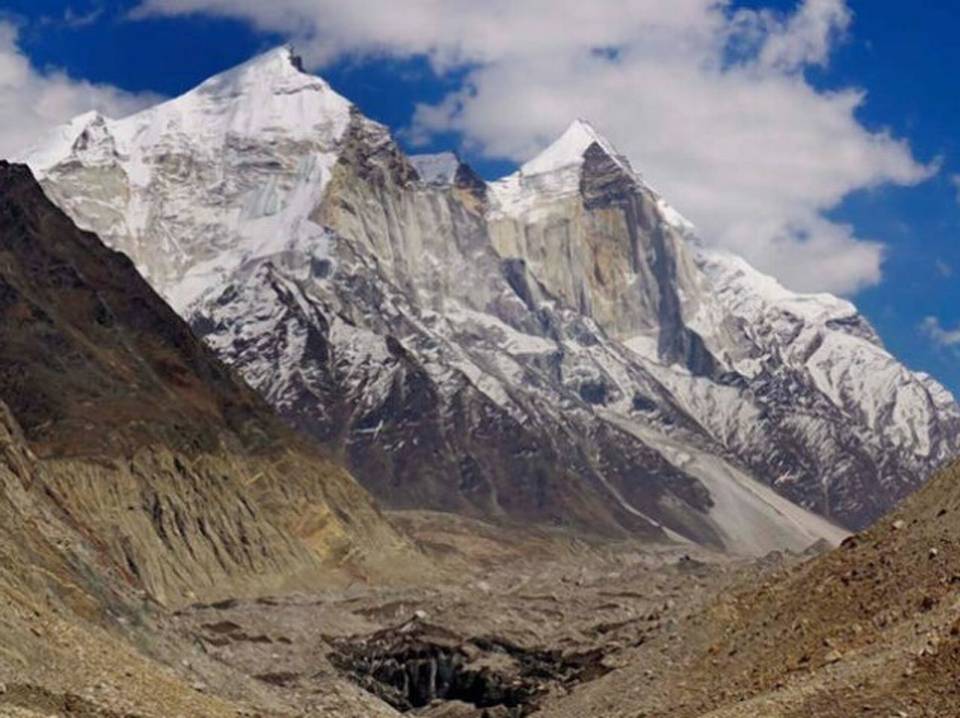
Gaumukh, snout of the Gangotri glacier,surrounded by the Bhagirathi peaks of Garhwal Himalayas, at an altitude of over 4,000 metres. Photo: Vidya Venkat.

The photograph was taken from this article; from which I offer:

Scientists say dwindling snowfall affects volume of water fed to the Bhagirathi, the main source of the Ganga

After a four-hour-long trek from Bhojwasa, the final camping spot in Gangotri, when a brown, fractured pile of rocks finally came into view it was hard to believe that this was the mouth of the glacier from which the ‘holy’ Ganga emerged.

Gaumukh, the snout of the Gangotri glacier, named after its shape like the mouth of a cow, has retreated by over 3 kilometres since 1817, says glaciologist Milap Chand Sharma of Jawaharlal Nehru University.

It was nearly two centuries ago that the retreat of the glacier was first documented by John Hodgson, a Survey of India geologist.

With 10 Indian States reeling under drought and the country facing a severe water crisis after two weak monsoons, the story of retreating freshwater sources such as the Himalayan glaciers is worrying. And though a three-kilometre retreat over a period of two centuries might seem insignificant at first glance, data shows that the rate of retreat has increased sharply since 1971. The rate of retreat is 22 metres per year.

Twenty-two metres or seventy-two feet a year!

Wringing our hands is no good. All of us who care for our Living Planet have to shout out just what is going on. As George Monbiot continues to do. Take his latest essay, for example, that is republished here in full with GM’s very kind permission.

ooOOoo

Insectageddon

The scale and speed of environmental collapse is beyond imagination.

By George Monbiot, published in the Guardian 20th October 2017

Which of these would you name as the world’s most pressing environmental issue? Climate breakdown, air pollution, water loss, plastic waste or urban expansion? My answer is none of the above. Almost incredibly, I believe that climate breakdown takes third place, behind two issues that receive only a fraction of the attention.

This is not to downgrade the danger presented by global heating – on the contrary, it presents an existential threat. It is simply that I have come to realise that two other issues have such huge and immediate impacts that they push even this great predicament into third place.

One is industrial fishing, which, all over the blue planet, is now causing systemic ecological collapse. The other is the erasure of non-human life from the land by farming.

And perhaps not only non-human life. According to the UN Food and Agriculture Organisation, at current rates of soil loss, driven largely by poor farming practice, we have just 60 years of harvests left. And this is before the Global Land Outlook report, published in September, found that productivity is already declining on 20% of the world’s cropland.

The impact on wildlife of changes in farming practice (and the expansion of the farmed area) is so rapid and severe that it is hard to get your head round the scale of what is happening. A study published this week in the journal Plos One reveals that flying insects surveyed on nature reserves in Germany have declined by 76% in 27 years. The most likely cause of this Insectageddon is that the land surrounding those reserves has become hostile to them: the volume of pesticides and the destruction of habitat have turned farmland into a wildlife desert.

It is remarkable that we need to rely on a study in Germany to see what is likely to have been happening worldwide: long-term surveys of this kind simply do not exist elsewhere. This failure reflects distorted priorities in the funding of science. There is no end of grants for research on how to kill insects, but hardly any money for discovering what the impacts of this killing might be. Instead, the work has been left – as in the German case – to recordings by amateur naturalists.

But anyone of my generation (ie in the second bloom of youth) can see and feel the change. We remember the “moth snowstorm” that filled the headlight beams of our parents’ cars on summer nights (memorialised in Michael McCarthy’s lovely book of that name). Every year I collected dozens of species of caterpillars and watched them grow and pupate and hatch. This year I tried to find some caterpillars for my children to raise. I spent the whole summer looking and, aside from the cabbage whites on our broccoli plants, found nothing in the wild but one garden tiger larva. Yes, one caterpillar in one year. I could scarcely believe what I was seeing – or rather, not seeing.

Insects, of course, are critical to the survival of the rest of the living world. Knowing what we now know, there is nothing surprising about the calamitous decline of insect-eating birds. Those flying insects – not just bees and hoverflies but species of many different families – are the pollinators without which a vast tract of the plant kingdom, both wild and cultivated, cannot survive. The wonders of the living planet are vanishing before our eyes.

Well, I hear you say, we have to feed the world. Yes, but not this way. As a UN report published in March explained, the notion that pesticide use is essential for feeding a growing population is a myth. A recent study in Nature Plants reveals that most farms would increase production if they cut their use of pesticides. A study in the journal Arthropod-Plant Interactions shows that the more neonicotinoid pesticides were used to treat rapeseed crops, the more their yield declines. Why? Because the pesticides harm or kill the pollinators on which the crop depends.

Farmers and governments have been comprehensively conned by the global pesticide industry. It has ensured its products should not be properly regulated or even, in real-world conditions, properly assessed. A massive media onslaught by this industry has bamboozled us all about its utility and its impacts on the health of both human beings and the natural world.

The profits of these companies depend on ecocide. Do we allow them to hold the world to ransom, or do we acknowledge that the survival of the living world is more important than returns to their shareholders? At the moment, shareholder value comes first. And it will count for nothing when we have lost the living systems on which our survival depends.

To save ourselves and the rest of the living world, here’s what we need to do:

  1. We need a global treaty to regulate pesticides, and put the manufacturers back in their box.
  2. We need environmental impact assessments for the farming and fishing industries. It is amazing that, while these sectors present the greatest threats to the living world, they are, uniquely in many nations, not subject to such oversight.
  3. We need firm rules based on the outcomes of these assessments, obliging those who use the land to protect and restore the ecosystems on which we all depend.
  4. We need to reduce the amount of land used by farming, while sustaining the production of food. The most obvious way is greatly to reduce our use of livestock: many of the crops we grow and all of the grazing land we use are deployed to feed them. One study in Britain suggests that, if we stopped using animal products, everyone in Britain could be fed on just 3m of our 18.5m hectares of current farmland (or on 7m hectares if all our farming were organic). This would allow us to create huge wildlife and soil refuges: an investment against a terrifying future.
  5. We should stop using land that should be growing food for people to grow maize for biogas and fuel for cars.

Then, at least, nature and people would have some respite from the global onslaught. And, I hope, a chance of getting through the century.

http://www.monbiot.com

ooOOoo

Please do share this as widely as you can. Please do inform others. Please do make whatever changes, however small, you can within your own lives.

Bhagirathi Peaks from the Gangotri Glacier

And, please, please, listen to our Living Planet that is screaming out to us that this cannot go on!

A life on the commons.

The message of common land.

I am far from certain but I have this notion in my head that ‘Common Land’ is an English thing. Here’s a Wikipedia extract:

Common land is land owned collectively by a number of persons, or by one person, but over which other people have certain traditional rights, such as to allow their livestock to graze upon it, to collect firewood, or to cut turf for fuel.[1]

A person who has a right in, or over, common land jointly with another or others is called a commoner.[2]

This article deals mainly with common land in England, Wales and Scotland. Although the extent is much reduced due to enclosure of common land from the millions of acres that existed until the 17th century, a considerable amount of common land still exists, particularly in upland areas, and there are over 7,000 registered commons in England alone.[3][4]

Common land or former common land is usually referred to as a common; for instance, Clapham Common or Mungrisdale Common.

Despite the idea of common land having an English ‘ring’ to it common land is also found in the USA. Back to that Wikipedia reference:

Common land, an English development, was used in many former British colonies, for example in Ireland and the United States. The North American colonies adopted the English laws in establishing their own commons. A famous example is the New Haven Green in New Haven, Connecticut.

When I was living in Devon it was not unusual to take a walk with Pharaoh on some very famous open access land: Dartmoor.

Dartmoor: English countryside at its best.

So where the devil am I going with today’s post?

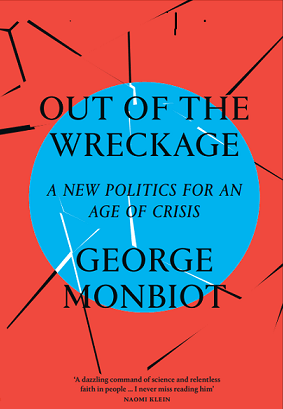
Last Thursday week, the 12th, I published my review of George Monbiot’s valuable book Out Of The Wreckage.

This book struck me as the most important book I have ever read in my lifetime. Why? Because it gets to the heart of what is happening today. But it offers even more than that. For instead of a shrug of the shoulders or eyes turned skywards from a friend when one mutters about the fact that we are living in ‘interesting times’, George Monbiot offers hope and guidance.

The day after I published my review George Monbiot published an article in The Guardian newspaper that threw more light on the commons philosophy and why, as in his book, he “offers hope and guidance”.

It is republished here with Mr. Monbiot’s generous permission. Yes, the focus is on British politics but GM’s core message applies equally to the USA and other countries.

ooOOoo

Labouratory

13th October 2017

We should use the political space being opened by the Labour resurgence to develop a new, participatory economy

By George Monbiot, published in the Guardian 11th October 2017

We are still living in the long 20th Century. We are stuck with its redundant technologies: the internal combustion engine; thermal power plants; factory farms. We are stuck with its redundant politics: unfair electoral systems; their capture by funders and lobbyists; the failure to temper representation with real participation.

And we are stuck with its redundant economics: neoliberalism, and the Keynesianism still proposed by its opponents. While the latter system worked very well for 30 years or more, it is hard to see how it can take us through this century, not least because the growth it seeks to sustain smacks headlong into the environmental crisis.

Sustained economic growth on a planet that is not growing means crashing through environmental limits: this is what we are witnessing, worldwide, today. A recent paper in Nature puts our current chances of keeping global heating to less than 1.5°C of at just 1%, and less than 2° at only 5%. Why? Because while the carbon intensity of economic activity is expected to decline by 1.9% a year, global per capita GDP is expected to grow by 1.8%. Almost all investment in renewables and efficiency is cancelled out. GDP, the index that was supposed to measure our prosperity, instead measures our progress towards ruin.

But the great rupture that began in 2008 offers a chance to change all this. The challenge now is to ensure that the new political movements threatening established power in Britain and elsewhere create the space not for old ideas (such as 20th Century Keynesianism) but for a new politics, built on new economic and social foundations.

There may be a case for one last hurrah for the old model: a technological shift that resembles the Second World War’s military Keynesianism. In 1941, the US turned the entire civilian economy around on a dime: within months, car manufacturers were producing planes, tanks and ammunition. A determined government could do something similar in response to climate breakdown: a sudden transformation, replacing our fossil economy. But having effected such a conversion, it should, I believe, then begin the switch to a different economic model.

The new approach could start with the idea of private sufficiency and public luxury. There is not enough physical or environmental space for everyone to enjoy private luxury: if everyone in London acquired a tennis court, a swimming pool, a garden and a private art collection, the city would cover England. Private luxury shuts down space, creating deprivation. But magnificent public amenities – wonderful parks and playgrounds, public sports centres and swimming pools, galleries, allotments and public transport networks – create more space for everyone, at a fraction of the cost.

Wherever possible, I believe such assets should be owned and managed by neither state nor market, but by communities, in the form of commons. A commons in its true form is a non-capitalist system, in which a resource is controlled in perpetuity by a community, for the shared and equal benefit of its members. A possible model is the commons transition plan commissioned by the Flemish city of Ghent.

Land value taxation also has transformative potential. It can keep the income currently siphoned out of our pockets in the form of rent – then out of the country and into tax havens – within our hands. It can reduce land values, bringing down house prices. While local and national government should use some of the money to fund public services, the residue can be returned to communities.

Couple this with a community right to buy, enabling communities to use this money to acquire their own land, with local commons trusts that possess powers to assemble building sites, and with a new right for prospective buyers and tenants to plan their own estates, and exciting things begin to happen. This could be a formula for meeting housing need, delivering public luxury and greatly enhancing the sense of community, self-reliance and taking back control. It helps to create what I call the Politics of Belonging.

But it doesn’t stop there. The rents accruing to commons trusts could be used to create a local version of the citizens’ wealth funds (modelled on the sovereign wealth funds in Alaska and Norway) proposed by Angela Cummine and Stewart Lansley. The gain from such funds could be distributed in the form of a local basic income.

And the money the government still invests? To the greatest extent possible, I believe it should be controlled by participatory budgeting. In the Brazilian city of Porto Allegre, the infrastructure budget is allocated by the people: around 50,000 citizens typically participate. The results – better water, sanitation, health, schools and nurseries – have been so spectacular that large numbers of people now lobby the city council to raise their taxes. When you control the budget, you can see the point of public investment.

In countries like the UK, we could not only adopt this model, but extend it beyond the local infrastructure budget to other forms of local and even national spending. The principle of subsidiarity – devolving powers to the smallest political unit that can reasonably discharge them – makes such wider democratic control more feasible.

All this would be framed within a system such as Kate Raworth’s doughnut economics which, instead of seeking to maximise growth, sets a lower bound of wellbeing below which no one should fall, and an upper bound of environmental limits, that economic life should not transgress. A participatory economics could be accompanied by participatory politics, involving radical devolution and a fine-grained democratic control over the decisions affecting our lives – but I will leave that for another column.

Who could lead this global shift? It could be the UK Labour Party. It is actively seeking new ideas. It knows that the bigger the change it offers, the greater the commitment of the volunteers on which its insurgency relies: the Big Organising model that transformed Labour’s fortunes at the last election requires a big political offer. (This is why Ed Miliband’s attempts to create a grassroots uprising failed).

Could Labour be the party that brings the long 20th Century to an end? I believe, despite its Keynesian heritage, it could. Now, more than at any other time in the past few decades, it has a chance to change the world.

http://www.monbiot.com

ooOOoo

Muddy rambles by Dartmoor Cross on Dartmoor.

The above photo was first seen on the South Downs Walking website.

All of you and all of your dogs have a wonderful weekend.

Out Of The Wreckage: A Review

This is one powerful book!

(Please note that I am letting this post run until Sunday, 15th Oct.)

For many years I have both read George Monbiot’s writings, especially those published by The Guardian newspaper, and deeply respected his insight, intelligence and analysis of the world in which we now live.

So when I heard of his latest book, published by Verso Books both sides of the ‘pond’, it was ordered immediately. It was a book I badly wanted to read. I was not disappointed.

So what is Mr. Monbiot’s message?

To answer that question let me lean on a forthcoming talk being given by him in Edinburgh in eight days time. For he is speaking at a Scottish Green Party event on October 20th.
Here’s the thrust of what is to be covered at that meeting:

What does the good life—and the good society—look like in the twenty-first century?

A toxic ideology rules the world – of extreme competition and individualism. It misrepresents human nature, destroying hope and common purpose. Only a positive vision can replace it, a new story that re-engages people in politics and lights a path to a better world.

Join us for an evening of discussion with George Monbiot as he talks about his new book: ‘Out of the wreckage: a new politics in an age of crisis‘. New findings in psychology, neuroscience and evolutionary biology cast human nature in a radically different light: as the supreme altruists and cooperators. George argues that we can build on these findings to create a new politics: a ‘politics of belonging’.

So what does this mean for social and environmental justice campaigning in Edinburgh? How do we create a politics of belongings here in Scotland? There will be plenty of opportunity for George Monbiot and the audience to share their insights.

Doors open: 6pm

George Monbiot will speak from 7-7.30pm and there will then be a Q&A, plus a chance buy books, mingle and browse stalls.

This event is jointly hosted by Global Justice Now and the Scottish Green party.

To my mind, this book not only addresses, full on, the madness (my word) of these present times but also offers strong, positive recommendations as to how we, as in the societies of all the major nations, can turn it around and offer a decent future for future generations. That’s why I am so strongly recommending it.

Take this extract from the review of George Monbiot’s book published by the Guardian newspaper on the 14th September this year:

For George Monbiot, neoliberalism should best be understood as a “story”, one that was conveniently on offer at precisely the moment when the previous “story” – namely Keynesianism – fell to pieces in the mid-1970s. The power of stories is overwhelming, as they are “the means by which we navigate the world. They allow us to interpret its complex and contradictory signals”. The particular story of neoliberalism “defines us as competitors, guided above all other impulses by the urge to get ahead of our fellows”.

Or this extract from the review published by The New Statesman:

It should be said at once that we are desperately in need of new ideas for a society and a democracy where trust in all established institutions is at a record low and even a Tory prime minister admits the country doesn’t work for everyone. Monbiot’s ideas are clear, well-reasoned and sometimes compelling. Many will mock his attempt at a “story of hope and restoration”; even some of his Guardian colleagues call him “George Moonshine”. Human beings, his critics will say, are inherently selfish and self-maximising. Give them the opportunity to freeload off others’ efforts and they will take it.

Such objections are easily dismissed. Yes, there’s a self-interested streak in all of us but, as Monbiot observes, we also have instincts for co-operation and sensitivity to others’ needs. Think of the hundreds who volunteer to run food banks and of the thousands more who donate to them. Think of those Europeans who, at great risk to themselves, sheltered Jews from the Nazis during the Second World War. The altruistic instinct can be kindled in almost anybody. It is suppressed, however, in a society that rewards the selfish but penalises – and brands as “mugs” – those who are more mindful of our needs, and the planet’s. That society has led to loneliness, high levels of mental illness and increasingly discordant political discourse. Shouldn’t we at least try developing a society that does more to nurture the better angels of our nature?

Better still, settle down with a cup of tea, put your feet up for fifteen minutes and listen to this:

This book struck me as the most important book I have ever read in my lifetime. Why? Because it gets to the heart of what is happening today. But it offers even more than that. For instead of a shrug of the shoulders or eyes turned skywards from a friend when one mutters about the fact that we are living in ‘interesting times’, George Monbiot offers hope and guidance.

Take the very last two paragraphs from the final chapter of his book.

Coming Home to Ourselves

Through restoring community, renewing civic life and claiming our place in the world, we build a society in which our extraordinary nature – our altruism, empathy and deep connection – is released.

When we emerge from the age of loneliness and alienation, from an obsession with competition and extreme individualism, from the worship of image and celebrity and power and wealth, we will find a person waiting for us. It is a person better than we might have imagined, whose real character has been suppressed. It is one who lives inside us, who has been there all along.

“- our altruism, empathy and deep connection -”

I see these persons every day of my life. Via the pages of this blog.

Yes, I am referring to all of you who wander in and out of this place, who demonstrate your compassion, your love and your dedication to the dogs and all the other animals of this world.

Read this book!

So who is Sam?

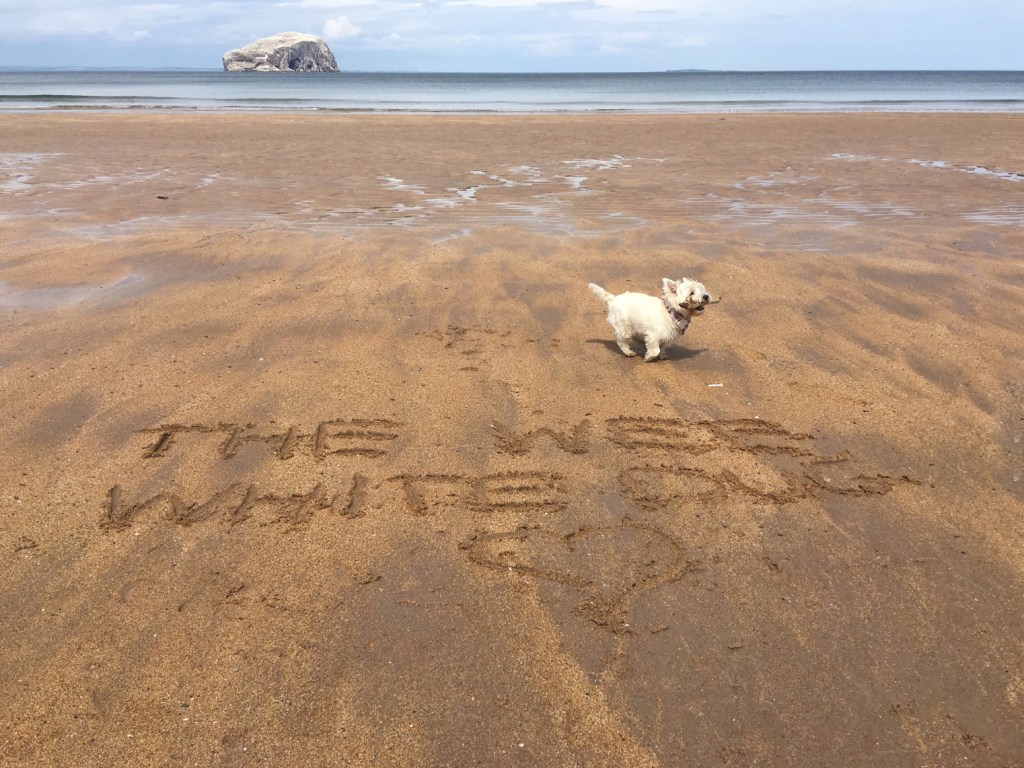
You loved Sam Grant’s photos of Casper and Scotland. Learn more about her.

Last Sunday my Picture Parade was primarily a recent item that appeared on the BBC website.

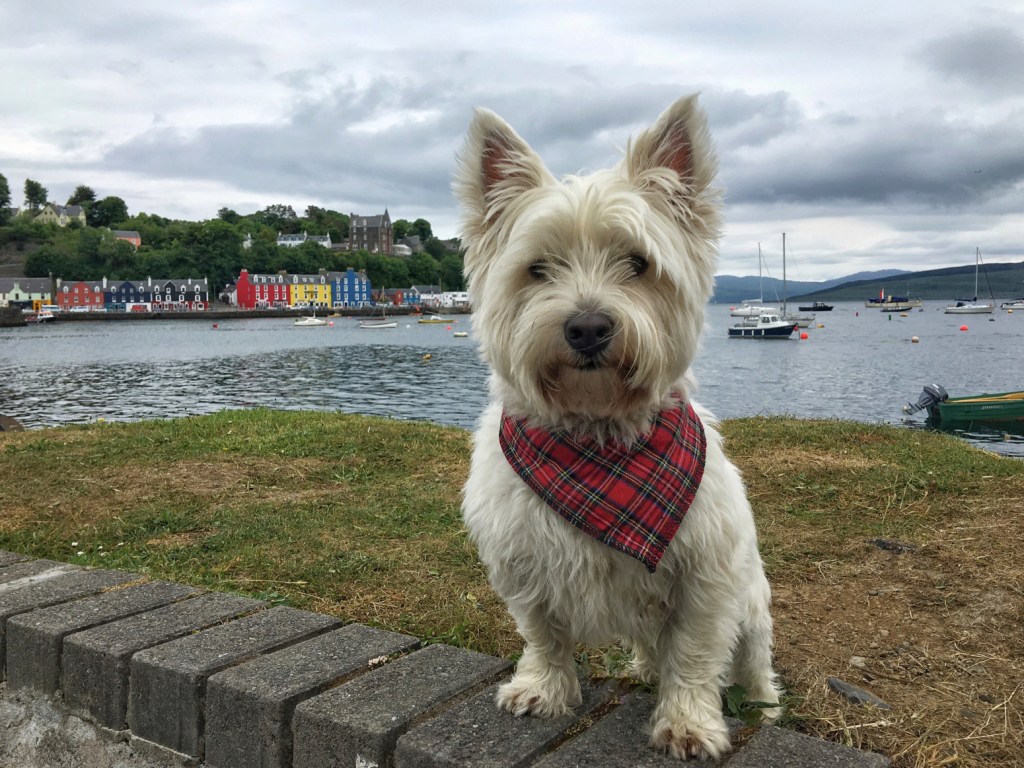
Meet Scotland’s ‘most well-travelled dog’

By Ewan Murrie, BBC Scotland news website, 3rd June 2017

After photographs of her West Highland Terrier received more “likes” on social media than even the most stunning Glencoe landscapes she could capture, Sam Grant conceded that “the wee white dug” should star in her Scottish travel blog.

I went on to republish a wonderful set of photographs that had been taken by Sam. You all loved them and that led me to ask Sam if I could republish her About Me page on her blog. Sam very kindly said that would be fine.

ooOOoo

Scotland with the Wee White Dug

A Scottish travel blog showcasing the best of Scotland. Scotland with the Wee White Dug is a comprehensive and informative guide to Scotland, covering history, outdoor activities, events, visitor attractions, accommodation, eating out and more.

About Me

A little bit about me

Hello and welcome to my Scottish travel blog which I hope you’ll find informative and interesting, but most of all fun.

I’m Samantha but am generally known as Sam, Mrs G or Mum.  I’m married to Alex (Mr G) and we live in Edinburgh with a well travelled wee white dug called Casper.  We also share our home with the The Teen, Casper’s sloth like and gadget obsessed big sister.

All of my free time is spent road-tripping around Scotland.  I’ve travelled extensively throughout the country and never tire of its jawdropping and diverse beauty.

I have a vast knowledge of where to stay, eat and what to do in Scotland. Whether it be an afternoon out, a day trip or an extended tour. I also know all of the best places to go with your four legged friend.

I’m a Visit Scotland Ambassador and I helped launch their online Community in the spring of 2016.  The Community is a Scottish travel forum for sharing insider hints and tips about visiting Scotland.  Visit Scotland’s Ambassadors were selected for their expert knowledge of the country.

In January 2017 I took up the role of resident blogger for East Lothian Council on their Visit East Lothian website.  I write a fortnightly post for their blog, highlighting the delights of East Lothian.

I’m passionate about the history, language, literature, customs and myths of Scotland. I read History at the University of Edinburgh and during my time there I studied Scottish History, Literature and Politics which gave me an excellent understanding of how Scotland became the country that it is today.

I absolutely adore the great outdoors – it’s my happy place.  I love hiking, have been known to summit a Munro or two and am happiest when surrounded by lochs, moors and mountains.

My photography

I’ve been an avid hobby photographer since joining Instagram several years ago.  I’m part of a diverse group of Scottish Instagrammers with a passion for sharing Scotland with the World.

My feed @bean_nighe has appeared on Instagram’s prestigious Suggested User list.  You’ll find the Wee White Dug on Instagram too @theweewhitedug.  His feed is also dedicated to sharing our Scottish travels.

I’ve featured in articles recommending the best Scottish Instagram accounts to follow by The ScotsmanMatador Network and the award winning travel blog Stories my suitcase could tell.

My photos appear regularly on various social media channels including those of Canon UK, BBC, Skyscanners, Scottish Memories Magazine, Scotrail, Historic Scotland, Visit Scotland and The Guardian.

I share my Scottish travels on Facebook and Twitter too so if you’re on those sites stop by and say hello.

I’m passionate about promoting Scotland as a wonderful place to visit.  It’s a country with a rich history and heritage. A country full of stories just waiting to be told.

I appreciate you taking the time to stop by my blog to join me on my travels.  I hope ‘Scotland with the Wee White Dug’ inspires you to visit Scotland, helps you to plan for a forthcoming trip or makes you reminisce fondly about a past visit.

If you’re interested in working with me you can find out more here.

Sam

ooOOoo

Just glorious!

Foreboding times?

Something brooding in the air!

The smoke from the forest fires in Oregon and California has been thick in the air here in Merlin for days.

As can be seen in the photograph below. The photograph is as it was captured by the camera at 7:15 am yesterday morning. No changes by me made at all. The middle tree line is at the Eastern end of our property about a 1/4 mile away.

We are fed up with the smoke and the terrible air conditions.

But what drew me to grab the camera and take the photograph was that the image had some sort of, Oh, I don’t know, some sort of end of the world feeling about it.

It also seemed a most apt image to be an introduction to the latest essay from George Monbiot. It is republished here with Mr. Monbiot’s kind permission.

ooOOoo

Don’t Look Now

2nd September 2017

The media avoids the subject of climate breakdown – to do otherwise is to bring the entire infrastructure of thought crashing down

By George Monbiot, published in the Guardian 29 August 2017

It is not only Donald Trump’s government that censors the discussion of climate change; it is the entire body of polite opinion. This is why, though the links are clear and obvious, the majority of news reports on Hurricane Harvey have made no mention of the human contribution.

In 2016, the United States elected a president who believes that human-driven global warming is a hoax. It was the hottest year on record, in which the US was hammered by a series of climate-related disasters. Yet the total combined coverage for the entire year on the evening and Sunday news programmes on ABC, CBS, NBC and Fox News amounted to 50 minutes. Our greatest predicament, the issue that will define our lives, has been blotted from our minds.

This is not an accident. But nor (with the exception of Fox News) is it likely to be a matter of policy. It reflects a deeply ingrained and scarcely conscious self-censorship. Reporters and editors ignore the subject because they have an instinct for avoiding trouble. To talk about climate breakdown (which in my view is a better term than the curiously bland labels we attach to this crisis) is to question not only Donald Trump, not only current environmental policy, not only current economic policy, but the entire political and economic system.

It is to expose a programme that relies on robbing the future to fuel the present, that demands perpetual growth on a finite planet. It is to challenge the very basis of capitalism; to inform us that our lives are dominated by a system that cannot be sustained, a system that is destined, if it is not replaced, to destroy everything.

To claim that there is no link between climate breakdown and the severity of Hurricane Harvey is like claiming that there is no link between the warm summer we have experienced and the end of the last ice age. Every aspect of our weather is affected by the fact that global temperatures rose by around 4° between the ice age and the 19th Century. And every aspect of our weather is affected by the 1° of global warming caused by human activities. While no weather event can be blamed solely on human-driven warming, no weather event is unaffected by it.

We know that the severity and impact of hurricanes on coastal cities are exacerbated by at least two factors: higher sea levels, caused primarily by the thermal expansion of seawater, and greater storm intensity, caused by higher sea temperatures and the ability of warm air to hold more water than cold air.

Before it reached the Gulf of Mexico, Harvey had been demoted from a tropical storm to a tropical wave. But as it reached the Gulf, whose temperatures this month have been far above average, it was upgraded first to a tropical depression, then to a category 1 hurricane. It might have been expected to weaken as it approached the coast, as hurricanes churn the sea, bringing cooler waters to the surface. But the water it brought up from 100 metres and more was also unusually warm. By the time it reached land, Harvey had intensified to a category 4 hurricane.

We were warned about this. In June, for example, Robert Kopp, a professor of earth sciences, predicted that “In the absence of major efforts to reduce emissions and strengthen resilience, the Gulf Coast will take a massive hit. Its exposure to sea-level rise – made worse by potentially stronger hurricanes – poses a major risk to its communities.”

To raise this issue, I’ve been told on social media, is to politicise Hurricane Harvey. It is an insult to the victims and a distraction from their urgent need. The proper time to discuss it is when people have rebuilt their homes, and scientists have been able to conduct an analysis of just how great the contribution from climate breakdown might have been. In other words, talk about it only when it’s out of the news. When researchers determined, 9 years on, that human activity had made a significant contribution to Hurricane Katrina, the information scarcely registered.

I believe it is the silence that’s political. To report the storm as if it were a entirely natural phenomenon, like last week’s eclipse of the sun, is to take a position. By failing to make the obvious link and talk about climate breakdown, media organisations ensure that our greatest challenge goes unanswered. They help push the world towards catastrophe.

Hurricane Harvey offers a glimpse of a likely global future; a future whose average temperatures are as different from ours as ours are from those of the last ice age. It is a future in which emergency becomes the norm and no state has the capacity to respond. It is a future in which, as a paper in the journal Environmental Research Letters notes, disasters like Houston’s occur in some cities several times a year. It is a future that, for people in countries such as Bangladesh, has already arrived, almost unremarked by the rich world’s media. It is the act of not talking that makes this nightmare likely to materialise.

In Texas, the connection could scarcely be more apparent. The storm ripped through the oil fields, forcing rigs and refineries to shut down, including those owned by some of the 25 companies that have produced over half the greenhouse gas emissions humans have released since the start of the Industrial Revolution. Hurricane Harvey has devastated a place in which climate breakdown is generated, and in which the policies that prevent it from being addressed are formulated.

Like Donald Trump, who denies human-driven global warming, but who wants to build a wall around his golf resort in Ireland to protect it from the rising seas, these companies, some of which have spent millions sponsoring climate deniers, have progressively raised the height of their platforms in the Gulf of Mexico, in response to warnings about higher seas and stronger storms. They have grown from 40 feet above sea level in 1940, to 70ft in the 1990s, to 91ft today.

This is not, however, a story of mortal justice. In Houston, as everywhere else, it is generally the poorer communities, that are least responsible for the problem, who are hit first and hit worst. But the connection between cause and effect should appeal to even the slowest minds.

The problem is not confined to the United States. Across the world, the issue that hangs over every aspect of our lives is marginalised, except on the rare occasions on which world leaders gather to discuss it in sombre tones (then sombrely agree to do almost nothing), whereupon the instinct to follow the machinations of power overrides the instinct to avoid a troubling subject. When they do cover the issue, they tend to mangle it. In the UK, the BBC distinguished itself in customary fashion this month, by yet again inviting the climate change denier Lord Lawson onto the Today programme, in the mistaken belief that impartiality requires a balance between correct facts and false ones. They seldom make such a mess of other topics, because they take them more seriously.

When Trump’s enforcers instruct officials and scientists to purge any mention of climate change from their publications, we are scandalised. But when the media does it, without the need for a memo, we let it pass. This censorship is invisible even to the perpetrators, woven into the fabric of organisations that are constitutionally destined to leave the major questions of our times unasked. To acknowledge this issue is to challenge everything. To challenge everything is to become an outcast.

www.monbiot.com

ooOOoo

Dear people, I sat staring at the screen for 10 minutes and then went off when Jeannie called lunchtime. Returned to the screen a little after 2pm yesterday and still couldn’t come up with a closing thought that merited being shared with you all.

See you tomorrow!

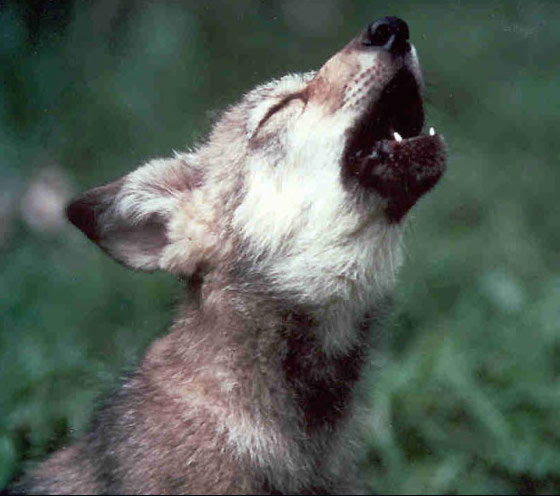
Give the Mexican Wolf a single chance!

Picking up on Annie

Remember Kristin’s guest post just two days ago? Annie’s Second Chance?

I’m sure you do.

Well the reason I am using that connection is because I want to share with you an email that was received yesterday.

Paul

The Mexican gray wolf (also called lobo) is the rarest subspecies of gray wolf in the world.  With just 113 individuals in the wild, this federally endangered species needs your voice now.

Tell the U.S. Fish & Wildlife Service (USFWS) to draft a science-based recovery plan for endangered lobos!

Despite recommendations by the US Fish and Wildlife Service’s own scientists, they have released a highly politicized Draft Mexican Wolf Recovery Plan, which we fear will lead these severally endangered wolves to extinction.

Ask the USFWS to revise their Draft Mexican Wolf Recovery Plan to protect endangered lobos instead of protecting special interests.

The draft recovery plan ignores science, gives special interests controlling power over recovery, and outlines criteria which will prematurely remove Endangered Species Act protections from the wolf.

Already plagued by mismanagement, poaching, and declining genetic diversity, the Mexican wolf needs your help more than ever.  We only have until the close of the comment period on August 29th to generate opposition to this flawed plan. Please submit your comment today to ask the US Fish and Wildlife Service to draft a recovery plan that’s based on science, not politics!

Thank you for your commitment to wildlife and wild places.

Sincerely,

Hailey Hawkins
Southern Rockies Representative
Endangered Species Coalition
www.endangered.org

PS. Links not working? Take action for wolves at this URL: https://actionnetwork.org/letters/comment-on-the-draft-mexican-wolf-recovery-plan-sciencenotpolitics

Of course I wrote in support of the Lobo! And was delighted to notice that Action Network had set a goal of 3,200 letters and, as of yesterday morning, only a further 275 letters were needed to make that goal.

Please, dear reader, add your name. Thank you!

Have a wonderful weekend!

Never taking democracy for granted!

Cold-water shower time again!

All you good people who stick with this blog know that the majority of the posts are to do with dogs or cats in one form or another.

Yet, I am cognizant of the fact that no one can completely hide, metaphorically speaking, in the warm fur of our favourite dog or cat and let the rest of the world go tits up. From time to time I read an article or an essay that touches on something fundamentally important to a civil society and am compelled to share same with you.

That was the case on July 5th when I published a post called The Implications of Inequality.

OK – moving on!

Regulars know that I am a great admirer of the writings of essayist George Monbiot. He is a very regular contributor to The Guardian newspaper. Just a few days ago, Mr. Monbiot published an essay that really does need to be read as widely as possible. It is called Missing Link and is republished here with George Monbiot’s very kind permission.

ooOOoo

Missing Link

21st July 2017
How a secretive network built around a Nobel prizewinner set out to curtail our freedoms

By George Monbiot, published in the Guardian 19th July 2017

It’s the missing chapter: a key to understanding the politics of the past half century. To read Nancy MacLean’s new book Democracy in Chains: the deep history of the radical right’s stealth plan for America is to see what was previously invisible.

The history professor’s work on the subject began by accident. In 2013 she stumbled across a deserted clapboard house on the campus of George Mason University in Virginia. It was stuffed with the unsorted archives of a man who had died that year, whose name is probably unfamiliar to you: James McGill Buchanan. She writes that the first thing she picked up was a stack of confidential letters concerning millions of dollars transferred to the university by the billionaire Charles Koch.

Her discoveries in that house of horrors reveal how Buchanan, in collaboration with business tycoons and the institutes they founded, developed a hidden programme for suppressing democracy on behalf of the very rich. The programme is now reshaping politics, and not just in the US.

Buchanan was strongly influenced by both the neoliberalism of Friedrich Hayek and Ludwig von Mises and the property supremacism of John C Calhoun, who argued, in the first half of the 19th century, that freedom consists of the absolute right to use your property – including your slaves – however you may wish. Any institution that impinges on this right is an agent of oppression, exploiting men of property on behalf of the undeserving masses.

James Buchanan brought these influences together to create what he called “public choice theory”. He argued that a society could not be considered free unless every citizen has the right to veto its decisions. What he meant by this was that no one should be taxed against their will. But the rich were being exploited by people who use their votes to demand money that others have earned, through involuntary taxes to support public spending and welfare. Allowing workers to form trade unions and imposing graduated income taxes are forms of “differential or discriminatory legislation” against the owners of capital.

Any clash between what he called “freedom” (allowing the rich to do as they wished) and democracy should be resolved in favour of freedom. In his book The Limits of Liberty, he noted that “despotism may be the only organisational alternative to the political structure that we observe.” Despotism in defence of freedom.

His prescription was what he called a “constitutional revolution”: creating irrevocable restraints to limit democratic choice. Sponsored throughout his working life by wealthy foundations, billionaires and corporations, he develop both a theoretical account of what this constitutional revolution would look like and a strategy for implementing it.

He explained how attempts to desegregate schooling in the American South could be frustrated by setting up a network of state-sponsored private schools. It was he who first proposed the privatisation of universities and the imposition of full tuition fees on students: his original purpose was to crush student activism. He urged the privatisation of Social Security and of many other functions of the state. He sought to break the links between people and government and demolish trust in public institutions. He aimed, in short, to save capitalism from democracy.

In 1980, he was able to put the programme into action. He was invited to Chile, where he helped the Pinochet dictatorship to write a new constitution, which, partly through the clever devices Buchanan proposed, has proved impossible to reverse in its entirety. Amid the torture and killings, he advised the government to extend its programmes of privatisation, austerity, monetary restraint, deregulation and the destruction of trade unions: a package that helped trigger economic collapse in 1982.

None of this troubled the Swedish Academy, that, through his devotee at Stockholm University, Assar Lindbeck, in 1986 awarded James Buchanan the Nobel Memorial Prize for economics. It is one of several decisions that have turned this prize toxic.

But his power really began to be felt when Charles Koch, currently the seventh richest man in the US, decided that Buchanan held the key to the transformation he sought. Koch saw even such ideologues as Milton Friedman and Alan Greenspan as “sellouts”, as they sought to improve the efficiency of government rather than destroying it altogether. But Buchanan took it all the way.

MacLean says that Charles Koch poured millions into Buchanan’s work at George Mason University, whose law and economics departments look as much like corporate-funded thinktanks as they do academic faculties. He employed the economist to select the revolutionary “cadre” that would implement his programme (Murray Rothbard, at the Cato Institute that Koch founded, had urged the billionaire to study Lenin’s techniques and apply them to the libertarian cause). Between them, they began to develop a programme for changing the rules.

The papers Nancy Maclean discovered show that Buchanan saw stealth as crucial. He told his collaborators that “conspiratorial secrecy is at all times essential.” Instead of revealing their ultimate destination, they would proceed by incremental steps. For example, in seeking to destroy the Social Security system, they would claim to be saving it, arguing that it would fail without a series of radical “reforms”. (The same argument is used by those attacking the NHS over here). Gradually they would build a “counter-intelligentsia”, allied to a “vast network of political power” that would eventually become the new establishment.

Through the network of thinktanks that Koch and other billionaires have sponsored, through their transformation of the Republican Party, and the hundreds of millions they have poured into state congressional and judicial races, through the mass colonisation of Trump’s administration by members of this network and lethally effective campaigns against everything from public health to action on climate change, it would be fair to say that Buchanan’s vision is maturing in the USA.

But not just there. Reading this book felt like a demisting of the window through which I see British politics. The bonfire of regulations highlighted by the Grenfell Tower disaster, the destruction of state architecture through austerity, the budgeting rules, the dismantling of public services, tuition fees and the control of schools: all these measures follow Buchanan’s programme to the letter. I wonder how many people are aware that David Cameron’s free schools project originated with an attempt to hamper racial desegregation in the American South.

In one respect, Buchanan was right: there is an inherent conflict between what he called “economic freedom” and political liberty. Complete freedom for billionaires means poverty, insecurity, pollution and collapsing public services for everyone else. Because we will not vote for this, it can be delivered only through deception and authoritarian control. The choice we face is between unfettered capitalism and democracy. You cannot have both.

Buchanan’s programme amounts to a prescription for totalitarian capitalism. And his disciples have only begun to implement it. But at least, thanks to Maclean’s discoveries, we can now apprehend the agenda. One of the first rules of politics is know your enemy. We’re getting there.

http://www.monbiot.com

ooOOoo

I found it very difficult to write these closing thoughts; as is obvious as you read this sentence!

Looking up quotations online under the headings of fairness or equality brought up many that could have worked here. Yet they seemed too trite, too obvious, too remote from the reality of what Mr. Monbiot describes here today.

So let me leave you with this: US income inequality is the highest it’s been since 1928. (Source: Pew Research.) But worse than that, US wealth inequality is even greater than income inequality. (Source: Pew Research.) (I’m certain that this is not exclusive to the USA.)

That is wrong! Plain and Simple!

The implications of inequality

What on earth has inequality to do with dogs!

A fair question one might think. Because this blog is primarily about what we humans should be learning from our dogs. Well, I do see a connection, a message of learning for us. Stay with me for a while.

But first, here’s how I open up Chapter 18 Sharing in my book – Learning from Dogs.

Here’s a silly story that made me laugh when I first came across it.

A man in a casino walks past three men and a dog playing poker.
“Wow!” he says, “That’s a very clever dog.“
“He’s not that clever,” replies one of the other players.
“Every time he gets a good hand he wags his tail.“

This clever dog couldn’t hide his happiness and had to share it by wagging his tail. OK, it was a little bit of fictional fun but we all recognise that inherent quality in our dogs, how they share so much of themselves in such an easy and natural fashion.

Now if one was being pedantic one would say that sharing is not the same as equality. Yet I see them as two separate seats in life’s common carriage.

Many lovers of dogs know that when they lived a life in the wild, slowly evolving from the grey wolf, they replicated, naturally, the pack characteristics of wolves. As in the pack size was around 25 to 30 animals. Yes, there was a hierarchy in the pack but that really only presented itself in the status of three animals: the female ‘alpha’ dog; the male ‘beta’ dog; the ‘omega’ dog that could be of either gender. Ninety percent of the pack were animals on equal standing. If only that was how we humans lived.

A few days ago there was an essay published on The Conversation blogsite under the title of Why poverty is not a personal choice, but a reflection of society.

It opened with this photograph.

A homeless camp in Los Angeles, where homelessness has risen 23 percent in the past year, in May 2017. AP Photo/Richard Vogel

Let me emphasize this: “A homeless camp in Los Angeles, where homelessness has risen 23 percent in the past year, in May 2017.”

Here are two small extracts from that article:

Research Investigator of Psychiatry, Public Health, and Poverty Solutions, University of Michigan


As someone who studies poverty solutions and social and health inequalities, I am convinced by the academic literature that the biggest reason for poverty is how a society is structured. Without structural changes, it may be very difficult if not impossible to eliminate disparities and poverty.


About 13.5 percent of Americans are living in poverty. Many of these people do not have insurance, and efforts to help them gain insurance, be it through Medicaid or private insurance, have been stymied. Medicaid provides insurance for the disabled, people in nursing homes and the poor.

Four states recently asked the Centers for Medicare and Medicaid Services for permission to require Medicaid recipients in their states who are not disabled or elderly to work.

This request is reflective of the fact that many Americans believe that poverty is, by and large, the result of laziness, immorality and irresponsibility.

In yesterday’s post celebrating July 4th, where I shared that lovely picture sent to me by Neil Kelly from my Devon days, there was an exchange of comments between me and author Colin Chappell. Colin is the author of the book Who Said I Was Up For Adoption.

First, in response to Colin saying “That pic really says it all doesn’t it!”, I replied:

No question. Indeed, one might ‘read’ that picture at many levels. From the level of providing a smile for the day all the way through to a very profound observation on life itself.

Colin then replied to me:

I ‘ll go straight for the profound perspective! As I recently noted on another blog, I cannot recall anybody from history who became famous for their material possessions. In fact, I recently read an article written after an individual had surveyed a few thousand gravestones… and they drew the same conclusion. There was not a single epitaph which alluded to a material possession. Dogs know all that intuitively, so why does our superior (?) mind have trouble grasping such a simple perspective?

I then responded by saying that I thought it would make a fabulous introduction to today’s post. The heart of which I am now coming to.

Here in our local city, Grants Pass, there is a Freethinkers and Humanists group. They meet once a month. Jerry Reed from that group some time ago recommended to me reading the book The Spirit Level authored by Richard Wilkinson and Kate Pickett.

Jerry and I were exchanging emails in the last couple of days and he reminded me of that book.

There it was sitting on my bookshelf with a bookmark in at page 62. For reasons that escape me, I had become distracted and forgotten to stay with the book. Despite me being very interested in the proposition.

I said as much in an email reply to Jerry. He then replied to my email with this:

Hey, that happens to me a lot too, very frequently. So, I frequently settle for a video that might capture the essence of the book in considerably less time, while also maintaining my attention much better.

So, if you want a video about what Wilkinson has to say, here’s the one I recommend:

Here is that video. It is a little under 17 minutes long. Please watch it.

Published on Oct 24, 2011

http://www.ted.com We feel instinctively that societies with huge income gaps are somehow going wrong. Richard Wilkinson charts the hard data on economic inequality, and shows what gets worse when rich and poor are too far apart: real effects on health, lifespan, even such basic values as trust.

I haven’t got anything profound to say by way of closing today’s post.

But what I will say is that if our societies, especially in certain countries not a million miles from home, more closely emulated the sharing and caring that we see in our dogs then that really would be wonderful.

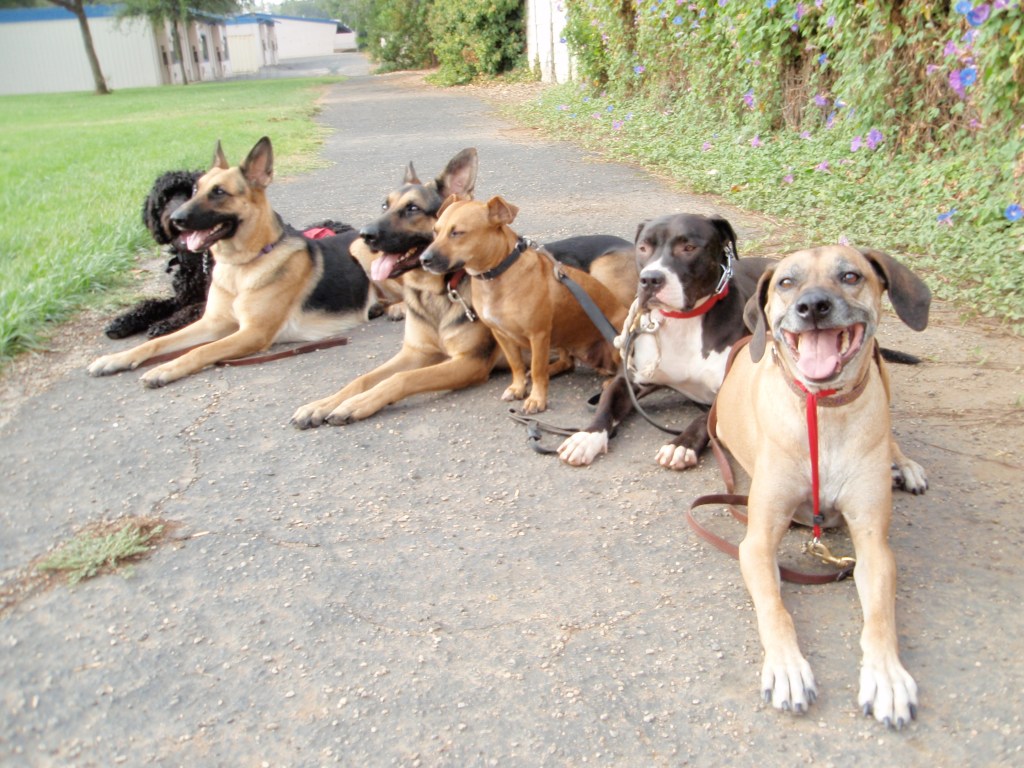
Image seen on this website: http://enlightendogs.com/about/testimonials-2/

Desmond’s Law – more please!

Connecticut shows how it should be done.

Following on from yesterday’s post that highlighted how Switzerland is legally protecting the rights of animals.

Apologies for the brief introduction but our internet service was up and down yesterday and I didn’t know how long I had to get today’s post completed.

A republication of an item seen recently on the Care 2 site.

ooOOoo

Connecticut Gives Abused Animals Their Own Lawyers

By: Susan Bird June 12, 2017

About Susan Follow Susan at @ItsSusanBird

Abused animals in Connecticut now have a voice in court, thanks to a new law passed by the state in late 2016.

Connecticut lawmakers passed “Desmond’s Law” in response to the horrific death of a sweet shelter dog called Desmond in 2012. The man who adopted him, Alex Wullaert, reportedly rarely fed Desmond and often beat him.

Ultimately, Wullaert killed the dog by hanging him, after Desmond made the mistake of urinating on Wullaert’s leg. Then he dumped the body in a garbage bag and left it on the street.

When prosecuted for the crime, Wullaert admitted what he’d done. The prosecutor recommended that he spend time behind bars for this shocking offense. Despite this recommendation, the court gave him nothing more than Accelerated Rehabilitation. That meant upon successful completion of probation, Wullaert’s record would be wiped clean.

That result outraged the animal-loving citizens of Connecticut. And they enacted “Desmond’s Law” to ensure that court decisions offer a better measure of justice following animal-related crimes.

Seven attorneys, a law professor and her law students are part of the program statewide. The law authorizes qualified pro-bono lawyers and volunteer law students to:

[P]rovide investigative insight not readily available to the court, resulting in a more fair and efficient process and more meaningful outcomes in animal abuse cases. It is intended to shine a bright light on the full extent of crimes committed under the animal cruelty statute.

In a nutshell, these animal advocates help the prosecution or defense team with tasks it often has no time for, especially in animal cases. The volunteers investigate, research issues and conduct interviews with veterinarians and other witnesses. As official parties to the case, they also write briefs, make arguments in court and submit recommendations to the judge.

A judge has to approve the participation of the animal advocates, who must be requested by either the prosecution or defense.

“The hope [of the law] was that providing courts with an extra resource to help handle these cases, at no cost, [is] that the cases could be more thoroughly handled,” University of Connecticut law professor Jessica Rubin told the Hartford Courant.

Prosecutors in Connecticut already commend the animal advocates for helping them do a better job in these cases. Often, they barely have time to do much of this legwork for cases involving human victims. We all know that when time is precious, the human cases will take precedence over those involving animals. Now, with professionals in place solely for the animal cases, that won’t be a problem anymore.

“We hope with this law in place, we will start to see much better procedural outcomes [in animal abuse cases],” Annie Hornish,  director for the Humane Society of the United States in Connecticut, told the AP. “We are very excited that judges seem to be taking advantage of it.”

This is an incredible step forward for animal victims. In particular, it helps overburdened courts provide the same level of investigation and consideration to animal victims that they give to human victims.

Connecticut has given animals a legitimate, recognized voice in the state court system. Why can’t every other state do the same thing? From Maine to California, every state has animal-loving lawyers and law students who would be grateful and eager to volunteer their time as animal advocates.

Lawmakers from other states are reaching out to Rubin to request information on how they might be able to pass a similar law. There’s interest out there, and animal activists can help fan this flame.

It’s time for every jurisdiction to pass its own version of Desmond’s Law.

Photo credit: Thinkstock

ooOOoo

Once again everyone: It’s time for every jurisdiction to pass its own version of Desmond’s Law.

Pet happiness in Switzerland.

Protecting the rights of animals.

In the vast majority of countries our pet animals have few, in any, legal rights.

Thus it was a wonderful reminder of another example of how the Swiss government sets the lead in so many ways to read on the Care 2 site how that country looks after their animals. Laura Burge offers the details in this republication of an essay on Care 2.

ooOOoo

10 Reasons Switzerland Is a Great Place to Be a Pet


By: Laura Burge June 10, 2017

About Laura Follow Laura at @literarylaura

Switzerland is a fairly small country, but it stills boasts an estimated seven million pets living there, not including the farm animals that dot the countryside. Although far from perfect, it has a long history of improving the working and living conditions for animals within the country, including landmark legislation in 1992 when it became the first country to include animal rights in their constitution. Specifically, it included a provision that allowed for the protection of animal dignity.

Then, in 2008, Switzerland introduced a bevy of new animal rights regulations that went even further. With that in mind, here are some of the more interesting laws that Switzerland has put in place to improve the lives of animals in their midst.

1. Guinea pigs must live with or have regular playdates with other members of their species. They can get lonely if they don’t have a companion. Since guinea pigs often don’t live the exact same amount of time, matchmaking services have sprouted up in the country to make sure they are not alone.

By Antoine Beauvillain via StockSnap.io

2. The Swiss have your cat’s social life in mind, too — if a cat doesn’t have a feline companion at home, he or she must be able to go outside to socialize with others, or at the very least, be able to see other cats from home.

3. Surprisingly, goldfish must also have friends to swim around with. The Swiss believe it is cruel to have them live alone in a small fish bowl, as they are actually social animals.

4. Rabbits’ enclosures must have a dark area that they can retreat to, if they feel the need. Rabbits are very particular about their space, and having a dark area of their enclosure helps ensure that bunnies are happy and less stressed.

5. Fish must live in aquariums that experience natural day and night cycles, and have at least one opaque side.

By Marvin Meyer via StockSnap.io

6. Before bringing a dog into a new home, a person must provide a certificate of competence demonstrating that they know how to deal with and treat dogs. If they can prove that they’ve already had a dog, though, they’re off the hook.

7. Dogs have to be exercised daily, according to what they need, and, as much as possible, off leash. Everyone knows that different dogs have different levels of energy, so whether someone has a lazy Great Dane who just wants to walk around the block, or a bouncing terrier who needs to run, the law accounts for it.

8. Dogs that are tied up must be able to run around freely for at least five hours a day, and the rest of the time, must be able to move around in at least 20 square meters of space. While this may not seem ideal, since dogs are still allowed to be tied up, it means that there’s a national law on the side of the pet if the owner is using a choke chain or the dog is not getting time to run around freely.

By Isaac Benhesed

9. Parrots, also considered social creatures, are required to have a companion to spend their days with. The legislation can be eye-opening in how many creatures need others of their own kind to have a relaxed and happy life as a companion to people.

10. Clipping the ears or tails of dogs is not allowed. It is considered undue pain and damage, and dogs get to live out their days with their natural floppy ears and wagging tails.

While Switzerland, like most other countries, are far from achieving perfect animal welfare laws and enforcement, they have made some good progress that other countries would do well to keep an eye on.

Photo credit: Laura Burge, author

ooOOoo

Did you spot that four out of those ten laws that were described in the article were for the well-being of dogs!

Fantastic!

And even better than that is a State in the USA that also comes to the rescue, legally, of abused animals. Tune in tomorrow for the full story.