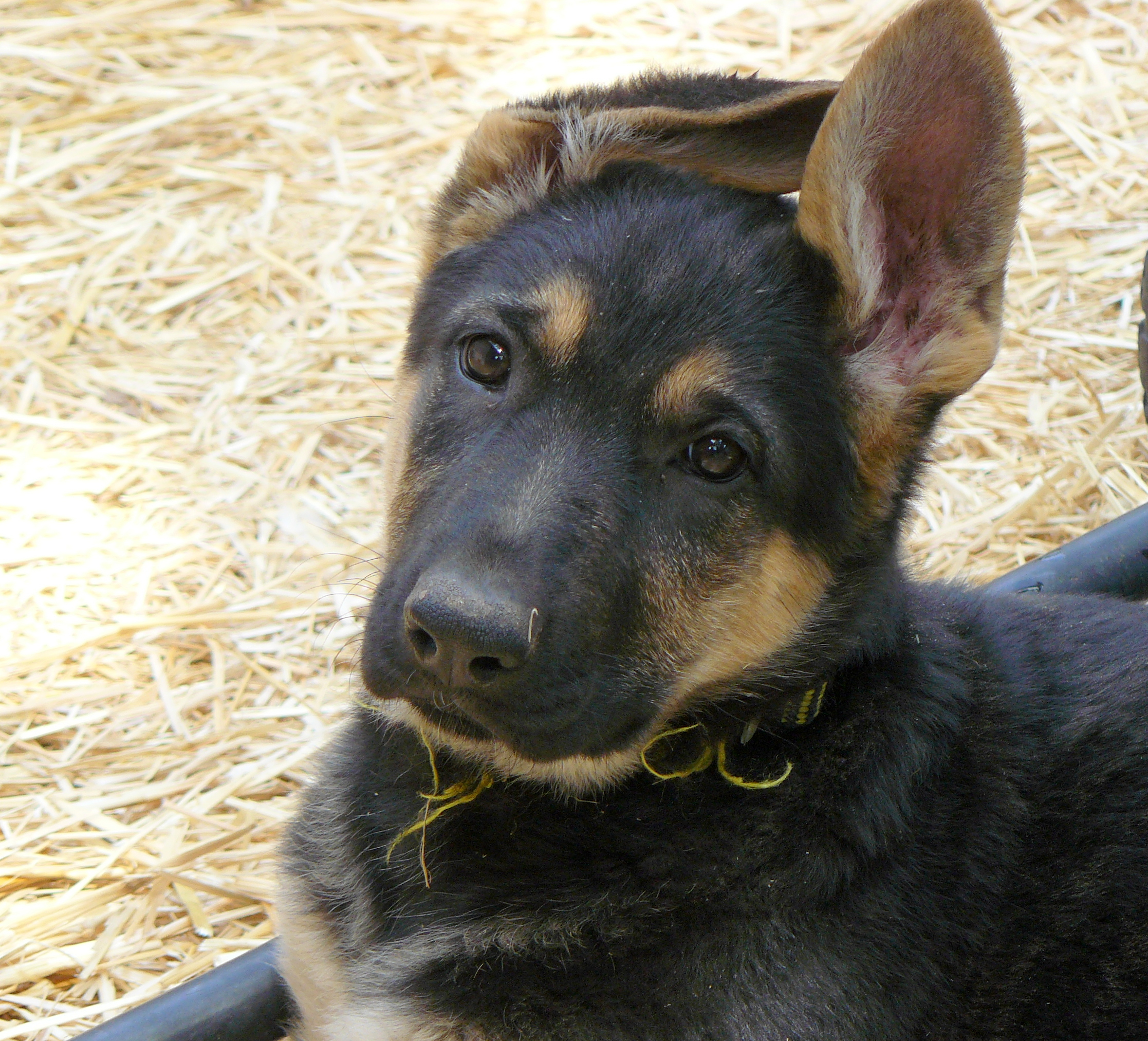
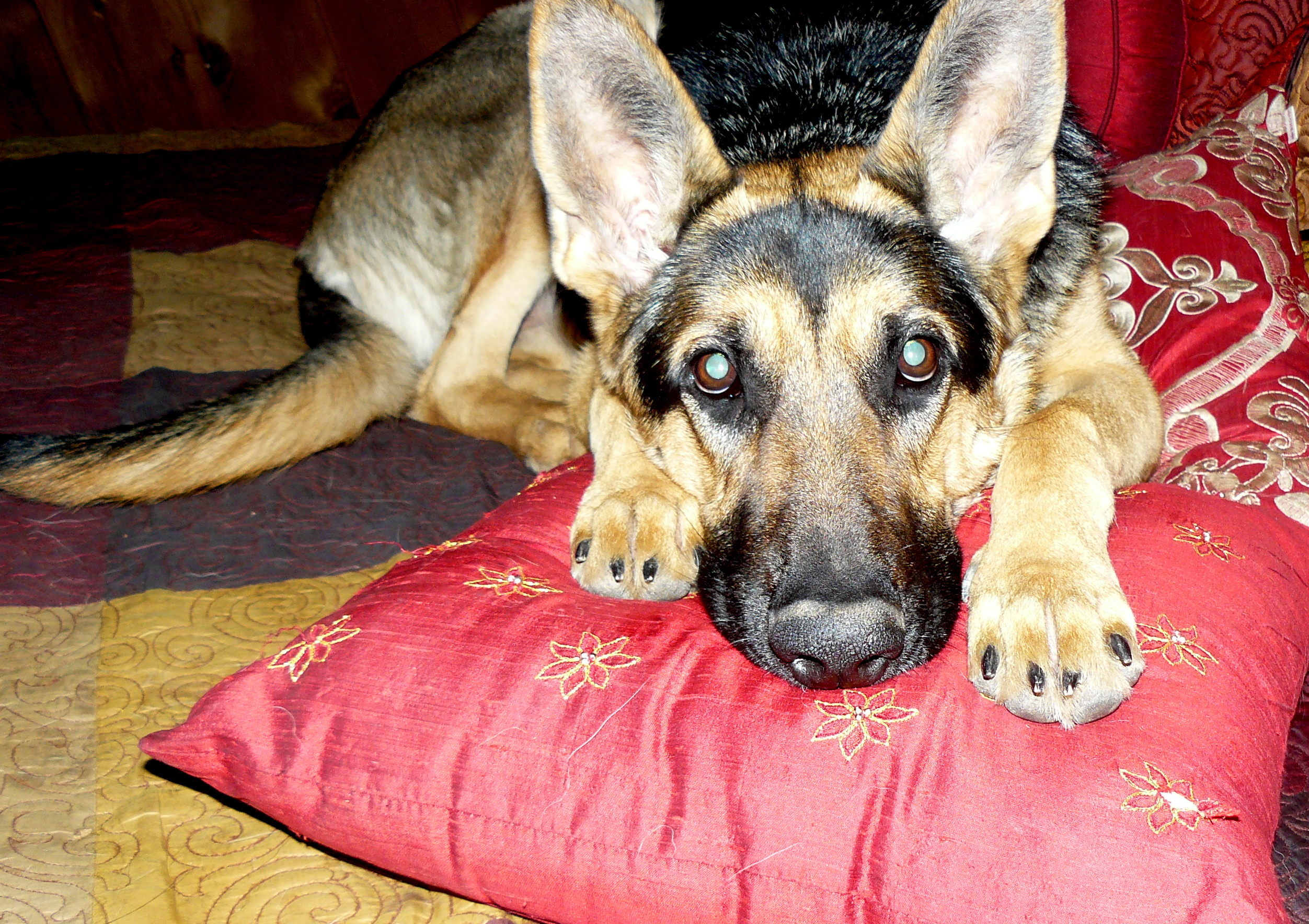
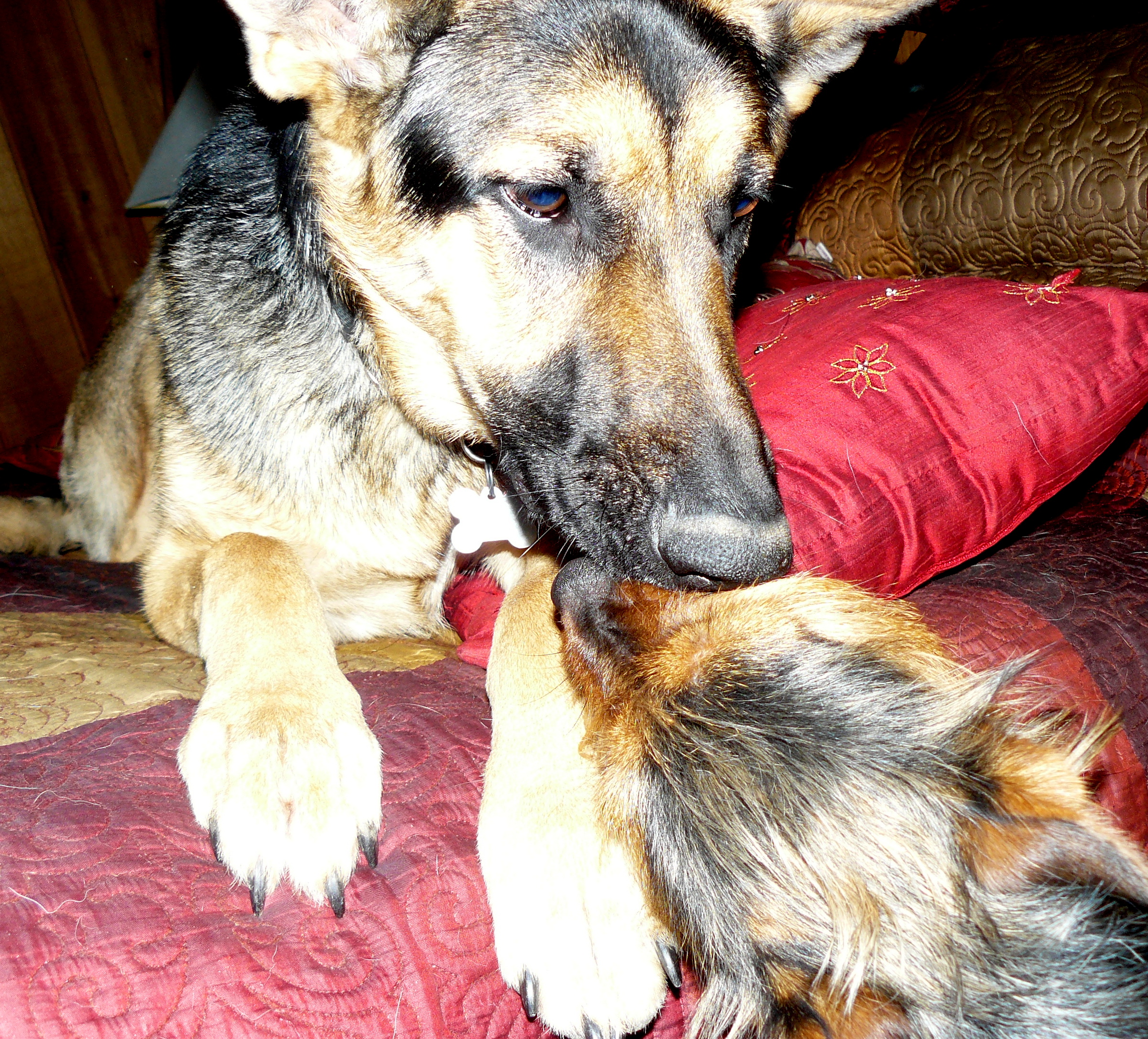
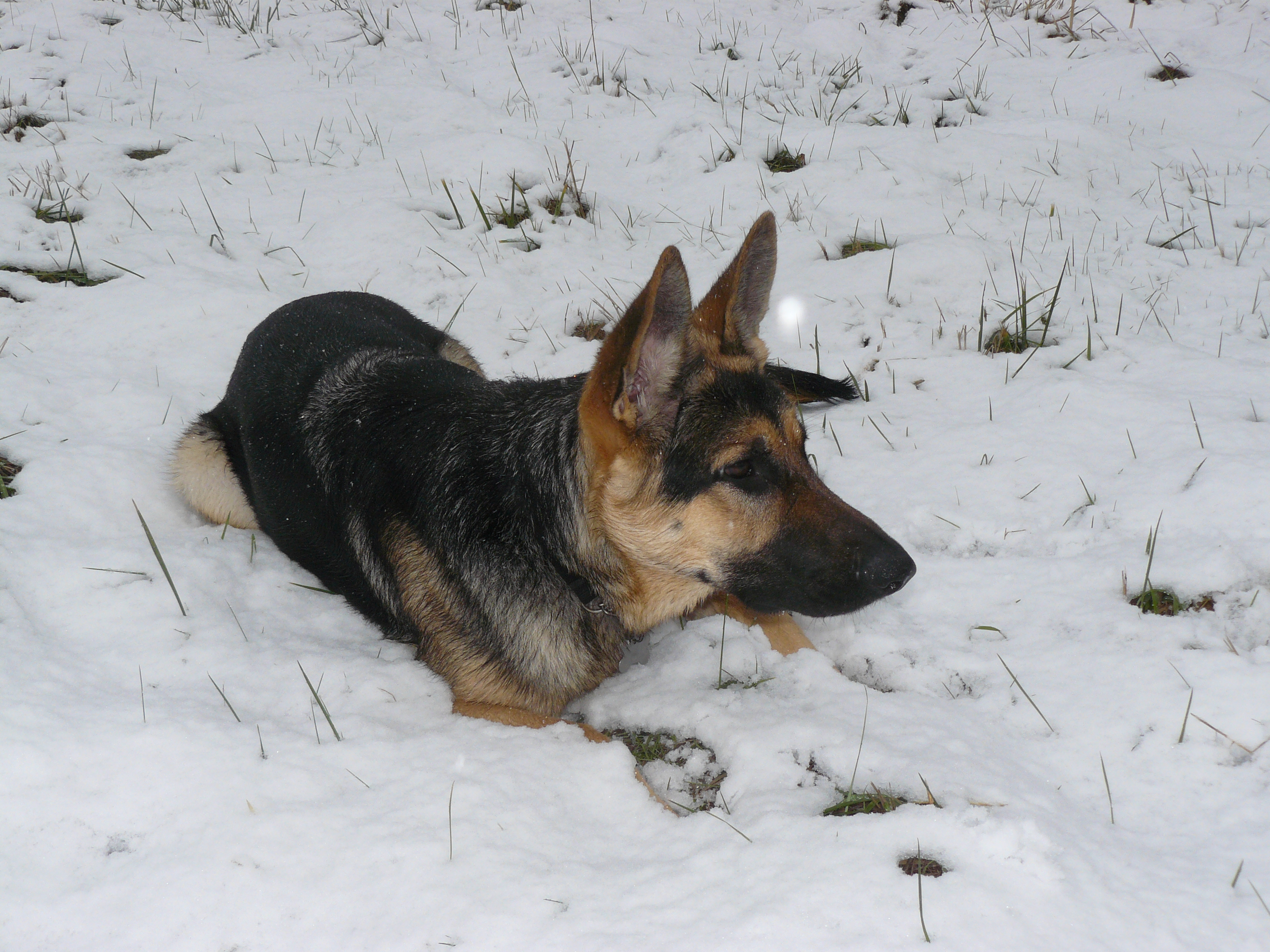
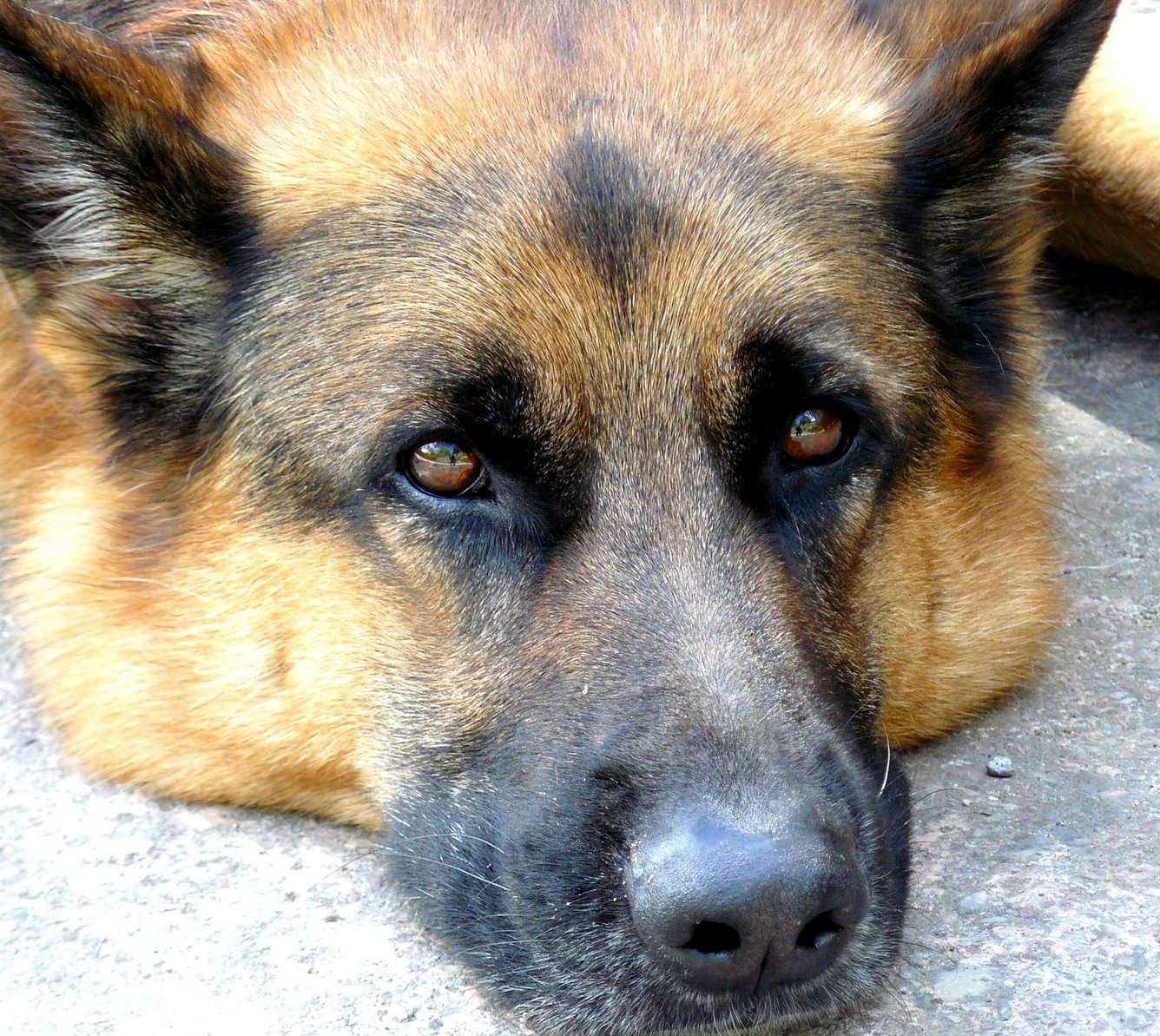
Our beautiful young German Shepherd is one year old today.
How time flies! How life moves on!
On the 8th April, 2012, I wrote a piece about the arrival of Cleo into our home in Payson, Arizona. Then on the 26th April, I added a few more pictures to say how well Cleo was setting in. (I include the links in case you want to look at the pictures in those posts.)
Cleo was born on the 23rd January, 2012. Thus today is her first birthday. She has grown into the most loving, friendly dog and she is adored by all who meet her.
Here’s a picture of Cleo from last year.
Cleo, just 71 days old.
Now two pictures taken this week. This first one showing Cleo lifting her head to the camera.
The next one showing Cleo and Sweeny having one of their frequent ‘kiss ins‘.
Finally, a picture of Cleo enjoying our recent snows.
We are so fortunate to share our lives with these beautiful creatures.
Icebergs calved from Jakobshavn Glacier float to sea near Illulissat. This glacier dumps more ice into the global ocean than any other glacier in the Northern Hemisphere, and is thus Greenland’s single biggest contributor to the global sea level rise of one-eight inch per year. Photograph: James Balog/Extreme Ice Survey
When researching material for that article, I came across the official trailer for the film Chasing Ice. The fact that this film is being shown in cinemas and movie theaters across the world is highly relevant.
Because it demonstrates that there is a public appetite for such a film otherwise it would never had made it as a film project.
But not only that, read some of the reviews mentioned on the Chasing Ice website.
Jeff Orlowski’s documentary begins as a straightforward biographical profile, before shifting up into something more urgent, impassioned and compelling. Its subject, James Balog, is a photographer who goes to extremes to prove the existence of global warming: his latest expedition involves descending Arctic cliff faces to fit time-lapse cameras with which to monitor glacial erosion.
The review concludes, thus:
If any film can convert the climate-change sceptics, Chasing Ice would be it: here, seeing really is believing.
Jeff Orlowski’s first-rate documentary begins with complacently smug anti-global-warming clips from Fox News and from the owner of America’s weather channel. It then introduces the persuasive environmentalist James Balog, a celebrated photographer working for National Geographic, who became fascinated with what glaciers can teach us about our changing planet.
In 2007 he set up the Extreme Ice Survey (EIS), a well-funded project to monitor glaciers in Greenland, Iceland, Montana, the Alps, Canada and Bolivia, and the results – photographed using state-of-the-art time-lapse cameras – are sensational in their beauty, terror and the irrefutable evidence they provide of the rapidity with which age-old ice packs are melting away. It’s like watching our world disappear.
“Chasing Ice” aims to accomplish, with pictures, what all the hot air that has been generated on the subject of global warming hasn’t been able to do: make a difference.
The documentary by Jeff Orlowski follows nature photographer James Balog as he documents melting glaciers, beginning in 2007, in Alaska, Iceland, Greenland and Montana. Called the Extreme Ice Survey, the project works like this: Balog sets up still cameras that have been programmed to take a picture, once every hour, for three years, of the same glacier from a fixed spot.
Concluding:
“Chasing Ice” will make an impact, that’s for sure. Whether it can be said to have been effective remains to be seen. This portrait of a man on a mission moves us, not by showing us what we’ve already lost, but what’s still at stake.
My final dip into the review pot is from America Magazine – The National Catholic Review.
Anyone with a desire to preserve our planet has no choice but to see Chasing Ice, the gorgeous, inventive documentary released last month. As of this writing it has been shown to selected audiences but has yet to reach the popularity of a film like “An Inconvenient Truth.” Give it time, however, and hopefully further promotion, because it is truly revelatory. Produced by Paula DuPré Pesmen and Jerry Aronson and directed by Jeff Orlowski, the film is a unique pictorial about global warming, which left me impressed, thoughtful and sad.
Wil Lepkowski closes with these words,
Take the time to see “Chasing Ice,” even if it is not the type of film you would typically see. These are not typical times. We must begin to act. In the wake of a devastating hurricane on the East Coast of the United States, the United States may finally be taking steps to address climate change. Ordinary citizens must take on a greater role too. We cannot dwell on our sadness, but work to provide hope for our children, who will suffer the most if we continue to ignore the disaster on the horizon.
So you get the message!
Here’s that film trailer. And make a note to go to the website of the Extreme Ice Survey and ponder on what you can do to make a difference. That’s the broad ‘you’ by the way. The one that includes you and me and all those on this planet that want to make a difference.
Back on the 10th we had a few days of cold, overcast weather that brought temperatures down below freezing and some snow.
Here’s a scene looking towards the North-East corner of the property, taken just before 11 am.
Then a few days later, on the 14th, the sun was out while the temperatures remained below freezing. Shown clearly as the sunlight catches the frost on the tree.
A few minutes later I swung the camera to take a picture of Dancer munching away in the morning sunshine, just a day after we collected her and Grace.
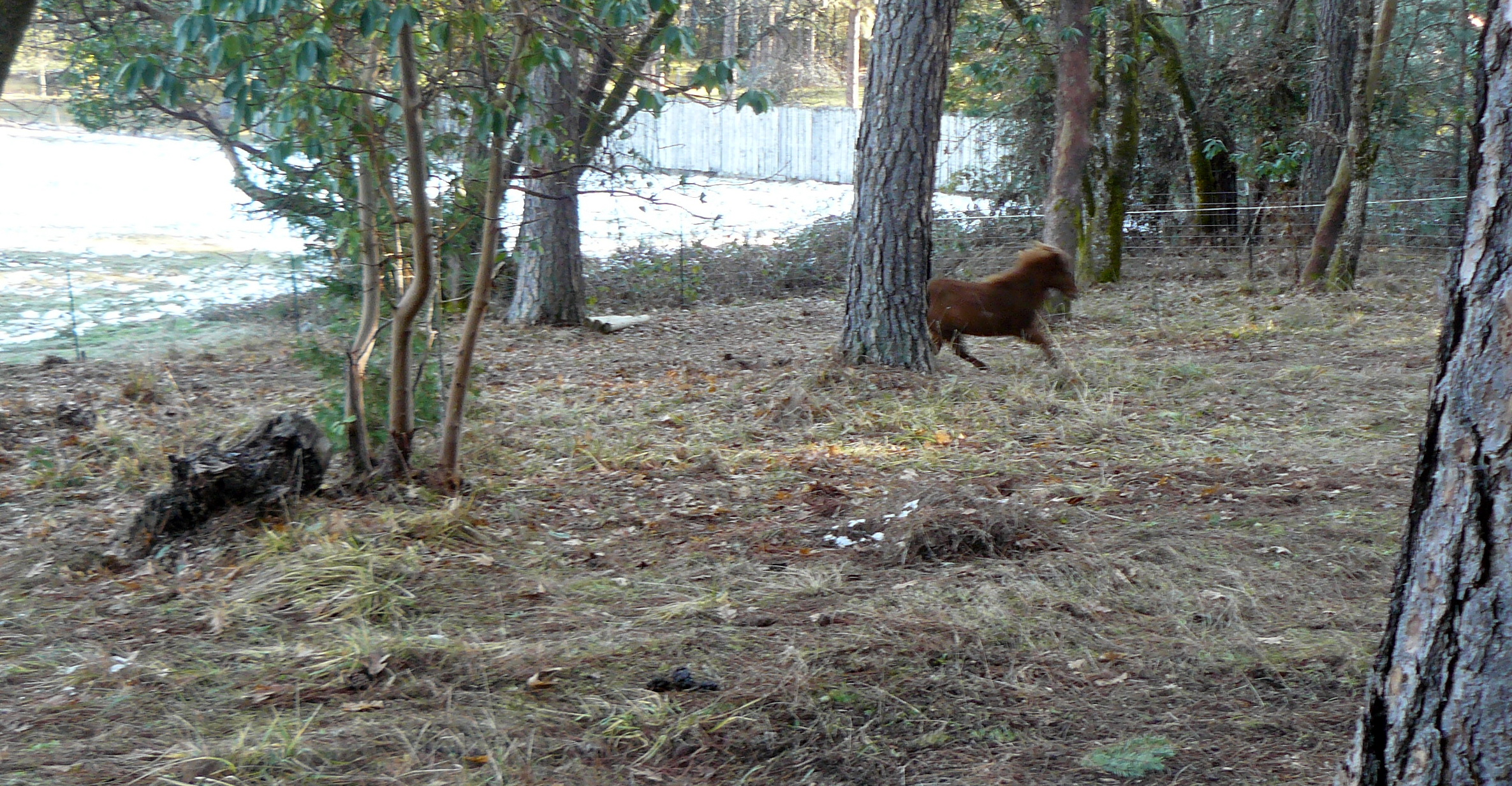
The horses settled in quickly, adapting to the dogs who were very curious.
Grace and Cleo being nonchalant with each other.
Jean unable to get her fill of her new companions.
And in a very different vein, a sneak photograph taken of yours truly who had collapsed in front of the fire early evening last Friday, quickly becoming a cushion for Hazel.
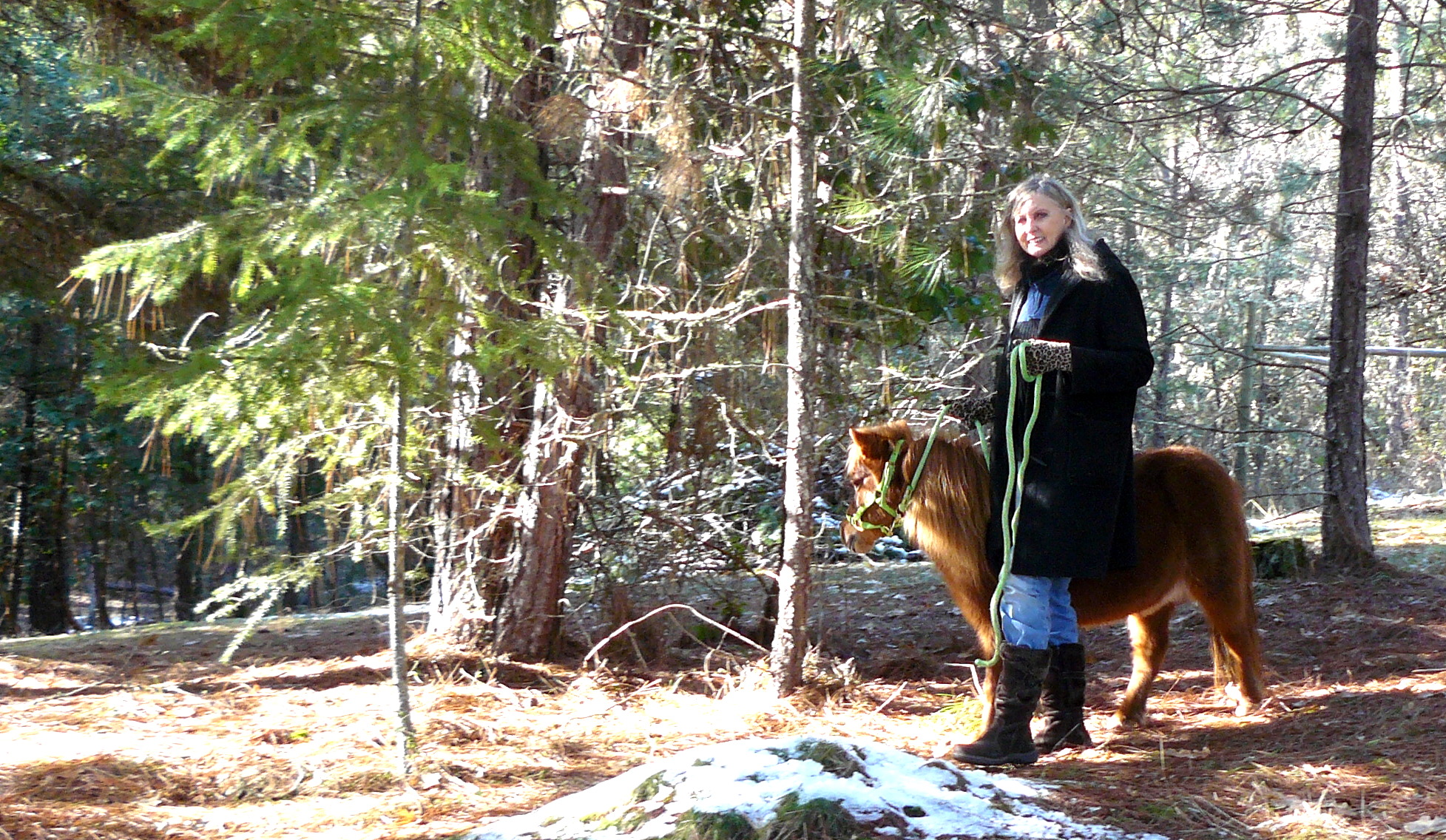
Yesterday, Jean and I went across to our neighbour’s ranch to collect two miniature horses, Dancer and her daughter Grace. Jean was a keen horsewoman many years ago and when we became aware that our neighbour, Margo, was also a keen horse breeder, trainer and coach, the lure of getting two horses was too much! Two miniature horses seemed the perfect idea.
So just a few pictures to share the event.
Ready to leave
Jean is holding Dancer while Grace is waiting by the fence. Our original plans had been to take Dancer’s sister’s foal Allegra, but she was too stressed to leave her mother so soon; she is just six months old. As an interim, we borrowed Grace, Dancer’s last foal, until Allegra is ready to move homes.
Off we go
For Grace especially, the horse being led by Margo, this was quite an adventure, as the next photograph demonstrates.
Mummy, do I really have to cross this stream?
Then before they knew it, their new enclosure beckoned.
Welcome to your new home.
Jean opens her heart to the latest member of the Handover family!
This was sent to me by Dan Gomez. I take great pleasure in offering it to you, dear reader.
oooOOOooo
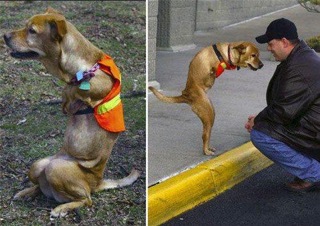
A dog named Faith.
This dog was born in 2002. He was born with 2 legs. He of course could not walk when he was born. Even his mother did not want him.
His first owner also did not think that he could survive and he was thinking of putting him to sleep. But then, his present owner, Jude Stringfellow, met him and wanted to take care of him.
She became determined to teach and train this little dog to walk by himself.
She named him ‘Faith’.
In the beginning, she put Faith on a surfboard to let him feel the movement. Later she used peanut butter on a spoon as a lure and reward for him for standing up and jumping around. Even the other dog at home encouraged him to walk.
Amazingly, only after 6 months, like a miracle, Faith learned to balance on his hind legs and to jump to move forward. After further training in the snow, he could now walk like a human being.
Faith loves to walk around now. No matter where he goes, he attracts people to him.
He is fast becoming famous on the international scene and has appeared on various newspapers and TV shows. There is now a book entitled ‘With a Little Faith‘ being published about him. He was even considered to appear in one of the Harry Potter movies.
His present owner Jude Stringfellew has given up her teaching post and plans to take him around the world to preach that even without a perfect body, one can have a perfect soul.
oooo
oooo
oooo
oooo
oooo
oooo
In life there are always undesirable things, so in order to feel better you just need to look at life from another direction. I hope this message will bring fresh new ways of thinking to everyone and that everyone will appreciate and be thankful for each beautiful day.
Faith is the continual demonstration of the strength and wonder of life.
A small request: All you are asked to do is keep this story circulating.
This second set carries on from yesterday’s selection. You will see from one of the comments from yesterday that blogger Pedantry noticed there was a problem with” the height description on the second through fifth images in this set“. Feedback from others who had this problem would be helpful as I can pass the details back to WordPress.
oooOOOooo
The Grand Canyon Skywalk
The Grand Canyon Skywalk is a transparent horseshoe-shaped cantilever bridge and tourist attraction in Arizona near the Colorado River on the edge of a side canyon west of the main canyon. USGS topographic maps show the elevation at the Skywalk’s location as 4,770 ft (1,450 m) and the elevation of the Colorado River in the base of the canyon as 1,160 ft (350 m).
In other words, the height of the vertical drop directly under the skywalk is between 500 ft (150 m) and 800 ft (240 m).
Commissioned and owned by the Hualapai Indian tribe, it was unveiled March 20, 2007, and opened to the general public on March 28, 2007. It is accessed via the Grand Canyon West Airport terminal or a 120-mile (190 km) drive from Las Vegas, which includes a 10-mile (16 km) stretch of dirt road which is currently under development.
The Skywalk is east of Meadview and north of Peach Springs with Kingman being the closest major city.
Palawan Underground River or St. Paul Subterranean River.
The longest navigable underground river in the world.
This is the most famous cave in the Philippines. The longest underground river was discovered a few years back in Mexico somewhere in the Yucatan.
The St. Paul underground river in Palawan, Philippines may not be the longest underground river in the world anymore, but it is still the world’s longest navigable underground river. The navigable part of the river inside the 4000-acre cave of the St. Paul subterranean river stretches 15 kilometers in length (9.3 miles). St. Paul Cave is the third deepest cave in the country.
The Seven Sisters waterfall in Norway.
Plitvice Lakes National Park in the Lika region of Croatia.
A hotel window view in the United Arab Emirates!
Jasper Park Lodge, Jasper, Alberta, Canada
Villas Vista Hermosa, Costa Rica
Norway!
Sea caves near Benagil Beach, Algarve, Portugal.
Barcelona, Spain.
The village of Hallstatt in Austria.
Victoria Falls, in southern Africa on the Zambezi River at the border of Zambia and Zimbabwe.
Beautiful display of nature’s balance: Predators and Prey.
At Wat Samphran in Nakhon Pathom Province there is a 17 storey building that has a giant dragon climbing to the roof.
The head is at the top where there is a shrine and the tail is on the ground floor. The dragon is hollow and it is possible to walk up some sections of it.
This house was designed by Rudy Ricciotti. The unique architecture includes a pool house, which is like a window in the living room where you can enjoy not only swimming in the water, but the person swimming in it with the effect of the outdoor landscape which is reflected through the window.
The Aiguille du Midi cable car leaves from the centre of Chamonix. It takes visitors up to 3,842m (12,605 feet) for a stunning view of the French Swiss and Italian alps.
Paradise! Jungfrau Mountain Range in Switzerland
HallgrÃmskirkja (244 ft), is the largest church and the sixth tallest architectural structure in Iceland.
The Melisanni Cave, Greece. This beautiful cave, which was discovered in 1951 and is surrounded by forests, features in Greek mythology as the cave of the nymphs.
New Town Hall in Hanover, Germany.
Thermal baths inside a cave – Miskolc Tapolca, Hungary
Piva Canyon, Bosnia and Herzegovina
…
Lake Mellisani on the island of Kephalonia, Greece.
Manarola, Italy.
oooOOOooo
Hope you found these photographs as captivating as I did.
Today, the 4th January, we have been at our new home in Oregon for exactly 72 days. We knew there would be many differences between Payson, Arizona and Merlin, Oregon all of which could be described as objective, factual differences. However, what was unexpected were the deep, complex emotions associated with moving to this rural part of Josephine County, Oregon. We were utterly unprepared for that.
In fact, I have been staring at this screen for some time unable to put any structure or meaning to this post. So I’m not going to try anymore, just offer some photographs and my reflections in the hope that you can sense where I am coming from.
The Winter storm that came in on the 20th December was, according to locals, unprecedented. We lost our power from the 20th until just before Christmas Eve. It caught us unawares in terms of being ready for this type of winter event. But then the sun came out one afternoon and I took this picture.
It shows the flank of Mt. Sexton, the picture being taken from our deck in front of the house. I found it impossible to describe the effect that this natural beauty had on me; being in awe just scratches the surface of my feelings.
Moving on.
We have been working hard preparing stables in readiness for two miniature horses that we have purchased from our neighbours, Margo and Clarence. Last Tuesday, we were busy at this when I saw another breathtakingly beautiful sight.
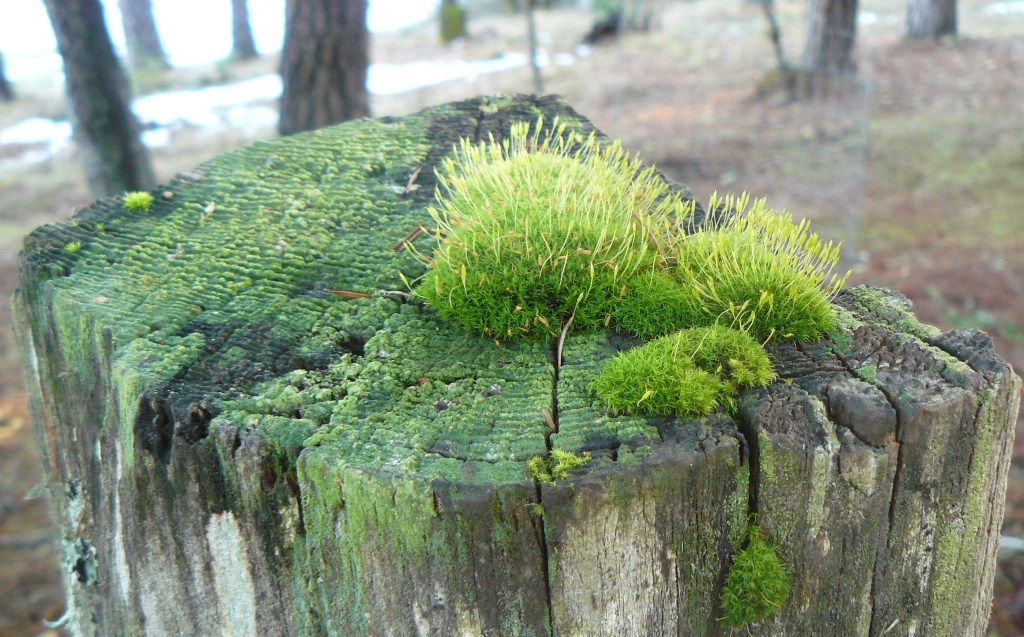
Just some growth on the top of an old fence post. But the words utterly fail the image. Here it is.
Then about an hour ago (yesterday), while struggling to write this post, I heard the dogs barking in the bedroom next door. Went into the room and they were ‘speaking’ to some wild deer grazing our pasture land.
Wish I could wrap this all up with some profound view, some wise observations about life and the meaning of the universe!
But I can’t! Can’t make any sense of it at all. How did we get here? How did I meet Jeannie, this most precious woman, back in Christmas 2007? How did I sell up and walk away from Devon, England, with just Pharaoh by my side, to start this unbelievable new life with Jean and all the dogs?
Note: This post was first published in August, 2010 and has remained a very popular read on Learning from Dogs since then.
So here is that post once again, albeit with a few minor changes.
oooOOOooo
More than a film, a message from dogs to mankind.
Richard Gere and Hachi
We recently watched a film about an Akita dog called Hachi, Hachikō in Japanese, that demonstrates the loyalty that dogs can offer their human companions.
It’s a very moving film. Expect to shed many tears. Even more so when one reflects that the Hollywood film is based, reasonably accurately, on a true story. The details of this story are in Wikipedia from which is quoted:
In 1924, Hidesaburō Ueno, a professor in the agriculture department at the University of Tokyo took in Hachikō as a pet. During his owner’s life Hachikō saw him out from the front door and greeted him at the end of the day at the nearby Shibuya Station. The pair continued their daily routine until May 1925, when Professor Ueno did not return on the usual train one evening. The professor had suffered from a cerebral hemorrhage at the university that day. He died and never returned to the train station where his friend was waiting. Hachikō was loyal and every day for the next nine years he waited sitting there amongst the town’s folk.
Hachikō was given away after his master’s death, but he routinely escaped, showing up again and again at his old home. Eventually, Hachikō apparently realized that Professor Ueno no longer lived at the house. So he went to look for his master at the train station where he had accompanied him so many times before. Each day, Hachikō waited for Professor Ueno to return. And each day he did not see his friend among the commuters at the station.
The permanent fixture at the train station that was Hachikō attracted the attention of other commuters. Many of the people who frequented the Shibuya train station had seen Hachikō and Professor Ueno together each day. They brought Hachikō treats and food to nourish him during his wait.
This continued for nine years with Hachikō appearing precisely when the train was due at the station
Now watch and weep.
Back to the Wikipedia entry:
That same year, another of Ueno’s faithful students (who had become something of an expert on the Akita breed) saw the dog at the station and followed him to the Kobayashi home (the home of the former gardener of Professor Ueno — Kikuzaboro Kobayashi) where he learned the history of Hachikō’s life. Shortly after this meeting, the former student published a documented census of Akitas in Japan. His research found only 30 purebred Akitas remaining, including Hachikō from Shibuya Station.
Professor Ueno’s former student returned frequently to visit the dog and over the years published several articles about Hachikō’s remarkable loyalty. In 1932 one of these articles, published in Tokyo’s largest newspaper, threw the dog into the national spotlight. Hachikō became a national sensation. His faithfulness to his master’s memory impressed the people of Japan as a spirit of family loyalty all should strive to achieve. Teachers and parents used Hachikō’s vigil as an example for children to follow. A well-known Japanese artist rendered a sculpture of the dog, and throughout the country a new awareness of the Akita breed grew.
Eventually, Hachiko’s legendary faithfulness became a national symbol of loyalty.
Hachikō died on March 8, 1935. He was found on a street in Shibuya. His heart was infected with filarial worms and 3-4 yakitori sticks were found in his stomach. His stuffed and mounted remains are kept at the National Science Museum of Japan in Ueno, Tokyo.
Hachiko
A dog offers loyalty, trust and love in exchange for being treated with integrity and compassion.