Category: Philosophy

This COVID-19 pandemic.

How have you and your dogs been affected?

The idea for today’s post came to me from Amanda down in Australia.

We go back years and years and have stayed in contact with each other over that time.

In her latest email she wrote (my italics):

I started some classes at the beginning of the year, a family history research one and a writing one, which had to stop a couple of weeks short courtesy of the virus.  The family history class was essentially finished, but the writing class (How to Read/Write a Biography) is an ongoing thing, with the tutor being a published author.  I signed up for term two of the writing class as the tutor decided to trial conducting it on-line via Zoom.  Many people in the class are either writing a biography or just writing about their lives for their children or grandchildren, so the tutor encouraged us all to write a short piece about this COVID-19 outbreak; observations, feelings, how it’s affected us, or whatever we wanted.  There are only six of us in the class, but it was fascinating to hear the resulting six pieces, so utterly different in tone and content, but all really interesting.

I wonder if you could invite something similar from your readers?  Imagine the different perspectives and experiences of your readers in their different parts of the world!  Just a thought anyway .

So how have you and your dogs been affected. Your feelings, your observations, how it has affected you, and any other thoughts.

And I will close with a photograph that Amanda sent me years ago.


Other inhabited worlds, and the implications of finding one.

This is profoundly important.

Well it is to me and Jean and, I suspect, it will be to many other people.

I am an atheist. So is Jean. We have been all our lives. I think that many of you who follow this blog know that. The love that we have for our dogs, and all our animals, plus the beauty that is all around us in nature is enough. (Now I am not naive enough to realise that there are many, literally millions, that don’t have the same fortune in their lives.)

The Conversation recently republished an essay by David Weintraub that was first published in 2014. It is at the core of our existence and I am delighted to have the permission to republish it for you.

ooOOoo

Is your religion ready to meet ET

By
 Professor of Astronomy, Vanderbilt University

November 5th, 2014

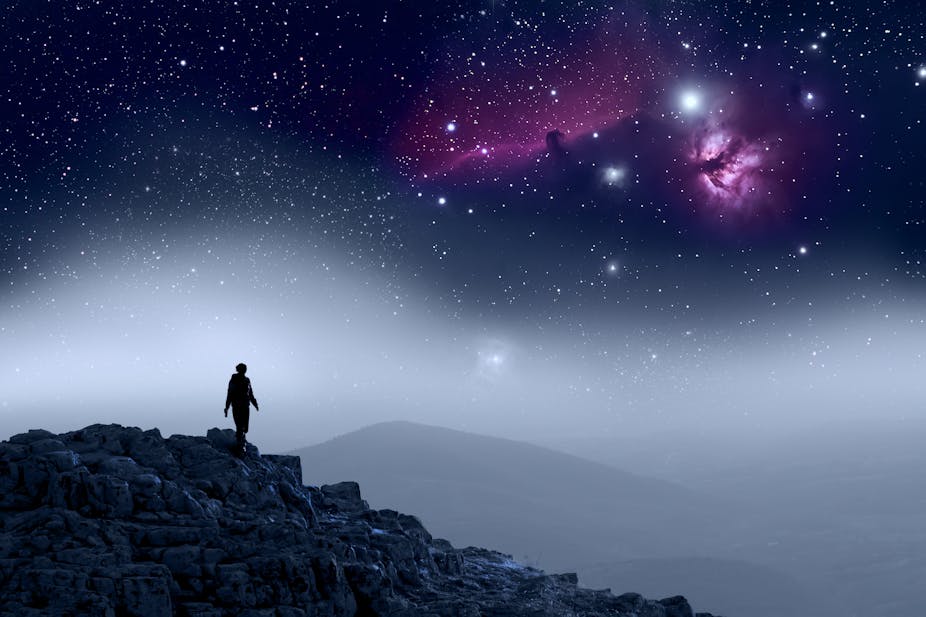
Square away your personal philosophy now; proof of life beyond earth is coming. Stargazing image via http://www.shutterstock.com

How will humankind react after astronomers hand over rock-solid scientific evidence for the existence of life beyond the Earth? No more speculating. No more wondering. The moment scientists announce this discovery, everything will change. Not least of all, our philosophies and religions will need to incorporate the new information.

Searching for signs of life

Astronomers have now identified thousands of planets in orbit around other stars. At the current rate of discovery, millions more will be found this century.

Having already found the physical planets, astronomers are now searching for our biological neighbors. Over the next fifty years, they will begin the tantalizing, detailed study of millions of planets, looking for evidence of the presence of life on or below the surfaces or in the atmospheres of those planets.

And it’s very likely that astronomers will find it. Despite the fact that more than one-third of Americans surveyed believe that aliens have already visited Earth, the first evidence of life beyond our planet probably won’t be radio signals, little green men or flying saucers. Instead, a 21st century Galileo, using an enormous, 50-meter-diameter telescope, will collect light from the atmospheres of distant planets, looking for the signatures of biologically significant molecules.

Astronomers filter that light from far away through spectrometers – high-tech prisms that tease the light apart into its many distinct wavelengths. They’re looking for the telltale fingerprints of molecules that would not exist in abundance in these atmospheres in the absence of living things. The spectroscopic data will tell whether a planet’s environment has been altered in ways that point to biological processes at work.

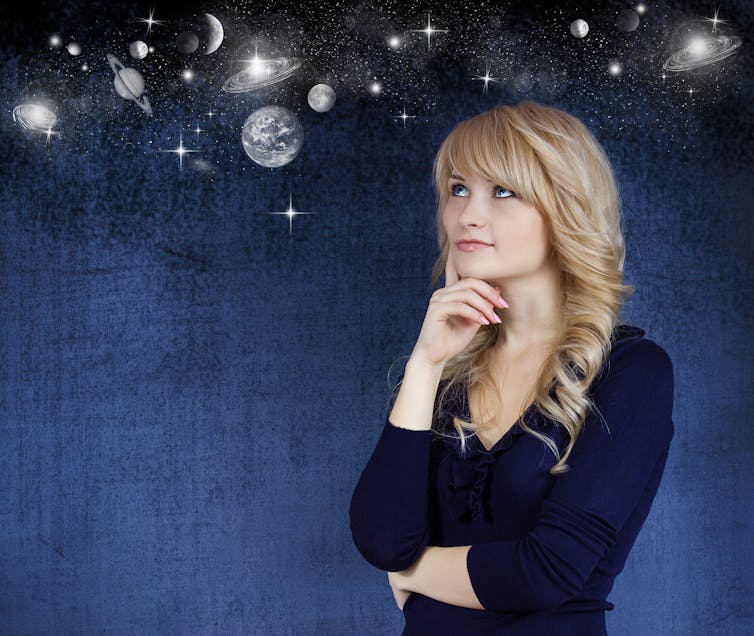
What is our place in the universe? Woman image via http://www.shutterstock.com

If we aren’t alone, who are we?

With the discovery in a distant planet’s light spectrum of a chemical that could only be produced by living creatures, humankind will have the opportunity to read a new page in the book of knowledge. We will no longer be speculating about whether other beings exist in the universe. We will know that we not alone.

An affirmative answer to the question “Does life exist anywhere else in the universe beyond Earth?” would raise immediate and profoundly important cosmotheological questions about our place in the universe. If extraterrestrial others exist, then my religion and my religious beliefs and practices might not be universal. If my religion is not universally applicable to all extraterrestrial others, perhaps my religion need not be offered to, let alone forced on, all terrestrial others. Ultimately, we might learn some important lessons applicable here at home just from considering the possibility of life beyond our planet.

In my book, I investigated the sacred writings of the world’s most widely practiced religions, asking what each religion has to say about the uniqueness or non-uniqueness of life on Earth, and how, or if, a particular religion would work on other planets in distant parts of the universe.

Extrasolar sinners?

Let’s examine a seemingly simple yet exceedingly complex theological question: could extraterrestrials be Christians? If Jesus died in order to redeem humanity from the state of sin into which humans are born, does the death and resurrection of Jesus, on Earth, also redeem other sentient beings from a similar state of sin? If so, why are the extraterrestrials sinful? Is sin built into the very fabric of the space and time of the universe? Or can life exist in parts of the universe without being in a state of sin and therefore without the need of redemption and thus without the need for Christianity? Many different solutions to these puzzles involving Christian theology have been put forward. None of them yet satisfy all Christians.

Mormon worlds

Mormon scripture clearly teaches that other inhabited worlds exist and that “the inhabitants thereof are begotten sons and daughters unto God” (Doctrines and Covenants 76:24). The Earth, however, is a favored world in Mormonism, because Jesus, as understood by Mormons, lived and was resurrected only on Earth. In addition, Mormon so-called intelligences can only achieve their own spiritual goals during their lives on Earth, not during lifetimes on other worlds. Thus, for Mormons, the Earth might not be the physical center of the universe but it is the most favored place in the universe. Such a view implies that all other worlds are, somehow, lesser worlds than Earth.

Bahá’í without bias

Members of the Bahá’í Faith have a view of the universe that has no bias for or against the Earth as a special place or for against humans as a special sentient species. The principles of the Bahá’í Faith – unifying society, abandoning prejudice, equalizing opportunities for all people, eliminating poverty – are about humans on Earth. The Bahá’í faithful would expect any creatures anywhere in the universe to worship the same God as do humans, but to do so according to their own, world-specific ways.

Light years from Mecca

The pillars of the faith for Muslims require the faithful to pray five times every day while facing Mecca. Because determining the direction of Mecca correctly could be extremely difficult on a quickly spinning planet millions of light years from Earth, practicing the same faith on another world might not make any sense. Yet the words of the Qu’ran tell us that “Whatever beings there are in the heavens and the earth do prostrate themselves to Allah” (13:15). Can terrestrial Muslims accept that the prophetically revealed religion of Muhammad is intended only for humans on earth and that other worlds would have their own prophets?

Astronomers as paradigm-shatterers

Philosophers and scientists have forced worldviews to adapt in the past.

At certain moments throughout history, astronomers’ discoveries have exerted an outsized influence on human culture. Ancient Greek astronomers unflattened the Earth – though many then chose to forget this knowledge. Renaissance scholars Copernicus and Galileo put the Earth in motion around the Sun and moved humans away from the center of the universe. In the 20th century, Edwin Hubble eliminated the very idea that the universe has any center at all. He demonstrated that what the universe has is a beginning in time and that, bizarrely, the universe, the very fabric of three-dimensional space, is expanding.

Clearly, when astronomers offer the world bold new ideas, they don’t mess around. Another such paradigm-shattering new idea may be in the light arriving at our telescopes now.

No matter which (a)theistic background informs your theology, you may have to wrestle with the data astronomers will be bringing to houses of worship in the very near future. You will need to ask: Is my God the God of the entire universe? Is my religion a terrestrial or a universal religion? As people work to reconcile the discovery of extrasolar life with their theological and philosophical worldviews, adapting to the news of life beyond Earth will be discomfiting and perhaps even disruptive.

ooOOoo

Now I don’t really want to open up the subject of religion but I will say that WikiPedia have a great entry about the subject. My own view is that a few hundred years ago, when life was a lot more mysterious and uncertain, believing in life after death made some sense.

But we know a lot better now despite death still being a certainty.

Brandy!

Dogs don’t need religion!

A sailing memory, part two.

Again, this is for Pendantry.

I left yesterday’s post with the statement: “However, getting to Gibraltar was not without its challenge for we suffered a knockdown and this scared us both to the core.

This is the account of that knockdown.

ooOOoo

The knockdown

So this was it, the end of life. This is what that end felt like. A lifetime of experiences reduced to this stilled moment; all my hopes, dreams, pleasures, memories, everything shrunk to this tiny moment of now.

I knew, in some trance-like way, that if just one of those foaming, giant waves swept across us, so utterly over-whelmed as we were on our side, it would flood the cabin, and down Dave and I and the yacht would go.

Other sensations came to me. Feelings of quiet, of calm, even of peace. My world now reduced to close, intimate dimensions. To the yacht’s wheel, to which I so grimly hung. To the front edge of the port cockpit seat, now underneath me, against which I braced my feet. To the starboard guardrail, bizarrely above my head, and to those raging seas so very close that seemed to beckon, ‘Give up, give up now and slip away.’

Me and Dave, alone in this Mediterranean storm 10 days West of Cyprus, are going to drown, founder without trace in these vast waves and probably end up not being missed for many days. Our dream of sailing across the Atlantic snuffed out as easily as Songbird of Kent would sink the 5,000 feet down to the seabed. The futility of it all.

It was a strange, detached perspective that hardly registered the gusts coming at us like great padded hammers. This unimaginable gale that had Songbird of Kent, my floating home for the last 5 years, totally pressed down on her port side, even though the yacht offered nothing more to the winds than her bare mast and rigging.

From within the cabin, Dave could do no more than simply watch. Hunkered down outside, I could do no more than simply hang-on. Both of us transfixed in this stillness of life’s imminent ending. Dave would later say no words would ever properly describe what his eyes had seen.

My past life, rather ominously, started running before me. How one year, in the early 1950s, when I was 7 or 8 years old, my parents had rented a holiday villa in the French Atlantic coastal town of Arcachon. What a glorious summer holiday that had been.

Arcachon’s beautifully sheltered bay had enabled me to learn to swim. The buoyant sea-water helping me increase the number of strokes each day, until one afternoon I had swum out to a yacht anchored well off the beach. As I hung on to the anchor chain, panting hard, the owner looked over the guardrail. Next, me being rowed back to the beach in a dinghy and then everyone getting to know Englishman John Calvert, a solo sailor living aboard his yacht, Garrawog.

Next year we had holidayed again in Arcachon and found Garrawog moored in the small yacht harbour. I recalled fond memories of sitting in the cabin with my father and John Calvert, drinking lemonade, eating cream crackers and loving the cosiness of it all.

Then the amazing coincidence when the following year we had holidayed at the French Mediterranean town of Menton and Garrawog had sailed into the harbour. That had led to John taking us sailing along the coast, memories so vivid, all these years later, of helping to haul sails, steer Garrawog, even remembering the gentle nudge of the yacht into the waves.

I was clear how those memories had fuelled my romantic obsession with sailing. How as a young teenager growing up in London I had joined the Welsh Harp sailing club, based at a large lake, well a reservoir, just three miles from home, and learnt to sail a dinghy. All fuelling this fascination with the sea. Yet that romantic obsession didn’t revolve around idyllic meanderings along the Mediterranean coastline. No, my dreams involved ocean sailing. Not even as part of a crew, but sailing, single-handed, across the oceans.

I had devoured every book written by those sailors who, totally alone, had journeyed the vast oceans in a small yacht. Joshua Slocum, who wrote of his solo trip around the world in his yacht, Spray, way back in 1895. Master English navigator, Francis Chichester, who conceived the idea of a single-handed yacht race across the Atlantic ocean, later completing a round-the-world solo circumnavigation in his yacht, Gipsy Moth IV. Eric Tabarly, Chay Blyth, Robin Knox-Johnston and many more.

I reflected how that dream had remained with me for years. All through nearly 20 years as a salesman and entrepreneur to the point when, quite suddenly, on a Monday in the Spring of 1986, uncharacteristically I had nothing in my diary for that day, or for many days ahead. I had just sold my thriving company in Colchester and there was no longer a job to go to!

Then not so long after I had taken a holiday in Larnaca and in wandering around the marina I had seen Songbird of Kent for sale, and had bought it! I had previously read about Tradewind yachts and knew how many had made world circumnavigations. Thus by the end of 1986, my new address had become: Yacht ‘Songbird of Kent’, Larnaca Marina, Cyprus.

A shout from Dave jerked me back to the real world.

Hey, is it my imagination or is that wind easing?

I lifted my head and turned my face into the weather coming full at us. The seas were just as terrible but, yes, something was different, some subtle lowering of the tone of the wind.

Dave, you’re right, it has eased back a bit. We’re not so pressed down, are we?

Don’t think so. What do you reckon?

Not sure what to do, frankly these conditions scare the shit out of me!

In the subtlest way imaginable, Songbird provided the answer. The yacht now showed some response to the waves rather than previously being so overwhelmed. A tiny thought entered my mind, something I hardly dared acknowledge: Songbird is not going to founder.

Those 3 tons of lead at the bottom of Songbird’s keel were, at last, overcoming the wind pressure on her topsides and with seawater cascading down from the mast and rigging, the yacht slowly righted and bestowed on me and Dave the continuation of our lives. A miracle of miracles!

I quickly helmed the bow round to point us downwind, putting the full force of the gale directly aft. Within moments, a wave slowly started to overtake us but I couldn’t do anything other than keep my eyes on the mast-head wind-vane that, against all odds, had stayed intact during the knock-down. Watching the arrow head that absolutely had to keep pointing directly into the wind. We may be upright but one slip of steering, one moment’s loss of concentration and I knew we would slew broadsides to the seas and go over again.

I couldn’t believe the size of this wave that lifted us up and up, as if we were in giant, invisible hands. Up to the foaming crest from which was revealed, all around us, wild, angry, jagged waves, huge crests covered in white foam, an Alpine-like scene of raging hell as far as the eye can see. A vista of utter desolation.

Then the foaming crest moved ahead of us and Songbird slid down that vast lee of the wave, down towards the trough that lay behind us. Our bowsprit pointed directly into the dark green water ahead, water streaked with spume, as down and down we went until the inevitable arrival of the next wave started us up to another foaming crest.

We had survived what we could never have imagined. Hardly believing it, we intuitively knew that surviving that first wave increased the odds of us surviving the next few. Then the next few, and the next few until, against all expectations, we knew we stood a chance of living through it all.

I spotted something in the water and shouted, “Dave, look, look there in the water, just to our left. That bit of sail, surely not from our mainsail?

As we ran before the weather, a scrap of white sail had surged past our side, a piece of sail bearing the number 33 and two palm trees, the symbol of a Tradewind 33 yacht.

Dave laughed, “I can’t believe that, Paul. It’s from the mainsail that blew out when the gale first struck. How amazing! It must be from us, can’t be too many other Tradewind 33s out here!“.

Imagine that, Dave, after all that we have been through these past few hours, we’ve just sailed by a bit of our mainsail, close enough to have grabbed it.

That triggered my mind as to when this terrible experience started. How long ago was that? I didn’t have a clue, though surely it couldn’t have been much more than an hour or so ago. Indeed, I struggled to think what day it was, then realised it was Thursday, October 8th, 1992. Just 24 hours since we had left the dirty, commercial port of Algiers for the last leg of our trip from Larnaca in Cyprus to Gibraltar.

Dave, hand me the log, it’s at the back of the chart table.

I read,

Thursday, 8th October, 1992.

08:20 Sea state terrible.

I recalled how the dawn had revealed banks of low angry clouds, skidding across the tops of a nasty swell, made even worse by a vicious cross-swell. The next entry after that read,

09:00 Sky extremely threatening. Wind NE F4. Just 16 miles east of Greenwich meridian.

Then we had approximately 3 hours of sailing to go before we crossed Greenwich. On to the last entry,

12:00 Sea extremely ugly, Wind NNE F5. Longitude 2 minutes East of Greenwich.

Just 15 minutes from crossing that historical navigational line. I recalled how we had chatted about sharing a glass of something to celebrate ‘crossing the line’! Then how my words had been torn away when, in a seeming instant of time, this huge squall had come out of the North, heralding this vast, cauldron of a storm. The mainsail, even tripled-reefed, was way too much sail. But it was far too dangerous to leave the cockpit to drop the sail, too much to do anything other than hang on.

The mainsail failed, ripped into shreds as it tore away from the mast-track and disappeared into the storm. The sounds of the event obliterated by the screaming noise of a wind that I had guessed was now more than 50 knots. The rain and spray had stung my face so hard that I needed to turn my head away just to breathe. Clearly something had to give; I expected the mast to fail.

But it didn’t! Instead, as the wind force grew and grew, it steadily pressed us further and further over until Songbird ended up fully horizontal to the sea. It seemed a lifetime ago.

I looked at my watch: 5.30pm. To hell and back in so few hours!

Dave, what’s our position?

Dave ducked out of sight to read the GPS, came back out with a slip of paper on which he had written our position: Eight minutes of longitude west of the Greenwich meridian. We were now in the Western hemisphere!

Come on, Dave, you take the wheel. I’m going to fetch a couple of beers.

I reckon a double celebration, Paul, crossing the Meridian and living to tell the tale!

We drank our beers, chit-chatted about nothing much, both aware that we had literally stared into the abyss of a dark watery grave, and sailed on.

Just before 13:00 on Saturday, October 10th, Songbird rounded Gibraltar’s breakwater, briefly rolled in the cross-swell, and slipped into the calm waters of the inner harbour.

Soon we were safe and secure in a marina berth, a few minutes walk from good food and friendly bars. Our experiences rapidly migrated into the private worlds of our minds, as if discussing it openly might replay it all with a different, more tragic, outcome.

I struggled through those first nights of sleep. Again and again I awoke, panic across my chest, clinging to the sides of my bunk, trying to lay all the nightmares to rest. Slowly, those October days resting up in Gibraltar shone a light on this sailing obsession. How, with the sudden death of my father in 1956, those memories of idyllic times in and around Garrawog had buried themselves deep into my hidden emotional world. How dreams of sailing had more to do with keeping the memory of my father alive than with anything else.

That gale expunged the obsession. I never sailed on Songbird again or, for that matter, on any other sailing vessel. Paid crew eventually returned Songbird to England, where she was subsequently sold.

I would never forget the stillness I had experienced in the midst of all that chaos, but one knock-down in a lifetime was more than enough.

ooOOoo

This is absolutely a true account of what happened. Yes, an intimate, personal account of what happened but accurate down to the last detail.

I am so pleased I kept a written account of the knockdown all those years ago for if I was to recall it today then much of the detail would have been lost. Maybe lost as a result of old age or lost as a consequence of not wanting it in one’s mind. Who knows.

Finally, there are no photographs because we just had more important things to look after – keeping ourselves alive!

Out of the mouths of young people!

A young man aged eight asks a very deep question.

Now the answer, that I am about to republish, is written to Tristan, aged 8. But frankly I have no doubt that the answer will be keenly read by persons of all ages. Certainly, this 75-year-old found the answer of great interest.

But to the question:

How can a Big Bang have been the start of the universe, since intense explosions destroy everything? – Tristan S., age 8, Newark, Delaware

And the answer:

ooOOoo

How could an explosive Big Bang be the birth of our universe?

April 30, 2020
By Michael Lam, Assistant Professor of Physics and Astronomy, Rochester Institute of Technology

Pretend you’re a perfectly flat chess piece in a game of chess on a perfectly flat and humongous chessboard. One day you look around and ask: How did I get here? How did the chessboard get here? How did it all start? You pull out your telescope and begin to explore your universe, the chessboard….

What do you find? Your universe, the chessboard, is getting bigger. And over more time, even bigger! The board is expanding in all directions that you can see. There’s nothing that seems to be causing this expansion as far as you can tell – it just seems to be the nature of the chessboard.

But wait a minute. If it’s getting bigger, and has been getting bigger and bigger, then that means in the past, it must have been smaller and smaller and smaller. At some time, long, long ago, at the very beginning, it must have been so small that it was infinitely small.

Let’s work forward from what happened then. At the beginning of your universe, the chessboard was infinitely tiny and then expanded, growing bigger and bigger until the day that you decided to make some observations about the nature of your chess universe. All the stuff in the universe – the little particles that make up you and everything else – started very close together and then spread farther apart as time went on.

Our universe works exactly the same way. When astronomers like me make observations of distant galaxies, we see that they are all moving apart. It seems our universe started very small and has been expanding ever since. In fact, scientists now know that not only is the universe expanding, but the speed at which it’s expanding is increasing. This mysterious effect is caused by something physicists call dark energy, though we know very little else about it.

A visualization of tiny energy fluctuations in the early universe. ESA, Planck Collaboration, CC BY

Astronomers also observe something called the Cosmic Microwave Background Radiation. It’s a very low level of energy that exists all throughout space. We know from those measurements that our universe is 13.8 billion years old – way, way older than people, and about three times older than the Earth.

If astronomers look back all the way to the event that started our universe, we call that the Big Bang.

Many people hear the name “Big Bang” and think about a giant explosion of stuff, like a bomb going off. But the Big Bang wasn’t an explosion that destroyed things. It was the beginning of our universe, the start of both space and time. Rather than an explosion, it was a very rapid expansion, the event that started the universe growing bigger and bigger.

This expansion is different than an explosion, which can be caused by things like chemical reactions or large impacts. Explosions result in energy going from one place to another, and usually a lot of it. Instead, during the Big Bang, energy moved along with space as it expanded, moving around wildly but becoming more spread out over time since space was growing over time.

Back in the chessboard universe, the “Big Bang” would be like the beginning of everything. It’s the start of the board getting bigger.

It’s important to realize that “before” the Big Bang, there was no space and there was no time. Coming back to the chessboard analogy, you can count the amount of time on the game clock after the start but there is no game time before the start – the clock wasn’t running. And, before the game had started, the chessboard universe hadn’t existed and there was no chessboard space either. You have to be careful when you say “before” in this context because time didn’t even exist until the Big Bang.

You also have wrap your mind around the idea that the universe isn’t expanding “into” anything, since as far as we know the Big Bang was the start of both space and time. Confusing, I know!

Astronomers aren’t sure what caused the Big Bang. We just look at observations and see that’s how the universe did start. We know it was extremely small and got bigger, and we know that kicked off 13.8 billion years ago.

What started our own game of chess? That’s one of the deepest questions anyone can ask.

ooOOoo

Before the Big Bang then there was “no space and there was no time.” Michael Lam says that is confusing. I think that’s a gigantic understatement.

There there’s Dark Energy!

I wonder if we humans will ever come to the point where it is all understood!

Is it any wonder we love dogs!

A brilliant yet very touching post to be shared.

This story came out on Mother Nature Network quite recently.

I really cannot add any words at the present time. The article says it all!

ooOOoo

Removed because of an alleged copyright infringement.

ooOOoo

This is a very ’rounded’ story about Tricycle, one that shows that love in the dog community is never very far away. Actually, I would go on to say that we adults who also love our dogs, probably putting them above our own needs, offer something very special.

Time; beyond imagination!

I don’t know what is was that engaged me; to the point that I have written this blog post.

We rise around 4:30 am, thanks to the dogs, and after they have been out we retire to the bedroom and lay on the top of the bed and have a couple of cups of tea. Come 5am, week days, we listen to BBC Radio 4 and the World at One. Then immediately after the World at One, at the moment, is a fascinating series on A History Of The World in 100 objects.

A few days ago, after the end of the programme, I drifted off into some form of introspective gaze about the past. I mean the past big time!

The Universe

When and how did it all start? That seems to be the Big Bang. The Big Bang was an incredibly long time ago, some 14 billion years ago (rounding it up!).

Here’s an extract from Wikipedia:

The current measurement of the age of the universe is around 13.8 billion years (as of 2015[1]) – 13.799±0.021 billion years within the Lambda-CDM concordance model.[2] The uncertainty has been narrowed down to 20 million years, based on a number of studies which all gave extremely similar figures for the age.

That’s 13.8 times 10 to the power of 9!

Our solar system

Again, pretty old by human standards; 4.6 billions years ago.

Again, an extract from Wikipedia:

The Solar System formed 4.6 billion years ago from the gravitational collapse of a giant interstellar molecular cloud. The vast majority of the system’s mass is in the Sun, with the majority of the remaining mass contained in Jupiter. The four smaller inner planets, Mercury, Venus, Earth and Mars, are terrestrial planets, being primarily composed of rock and metal. The four outer planets are giant planets, being substantially more massive than the terrestrials. The two largest, Jupiter and Saturn, are gas giants, being composed mainly of hydrogen and helium; the two outermost planets, Uranus and Neptune, are ice giants, being composed mostly of substances with relatively high melting points compared with hydrogen and helium, called volatiles, such as water, ammonia and methane. All eight planets have almost circular orbits that lie within a nearly flat disc called the ecliptic.

So our solar system came along 9 billion years after the formation of the Universe.

Planet Earth

Our planet formed not long after our solar system. That’s pretty obvious if you ask me.

Thus Planet Earth formed 4.5 billion years ago. Again, thanks to Wikipedia.

Life on Planet Earth

Southampton University have published an extremely interesting chart of the timeline of the human condition. In it is revealed that the earliest atmospheric oxygen was 3.5 billion years ago, a necessary prerequisite to air-breathing life. But it took an extremely long time before monkeys appeared; some 36 million years ago. That’s 36 times 10 to the power of 6, or 383 times shorter than the start of the universe.

The earliest hominins (Australopithecus spp) among the hominids in Africa, bipedal, larger brain came along some 4.2 million years ago.

Among them were humans using stone tools, some 2.5 million years ago. Then 2 million years ago came the earliest direct ancestor of modern humans, Homo erectus (South Africa), co-habiting with Australopithecus and Paranthropus.

Then 40,000 years ago Neanderthals make flutes from bone, then 14,000 years ago the domestication of dogs in China, 7,000 years ago the world population passed 5 million souls, and 3,500 years ago the earliest alphabet (North Semitic, Palestine and Syria).

3,000 years ago the world population passed 50 million.

Come forward to just 195 years ago and the first public railway for steam locomotives (George Stephenson, UK, 1825) came into existence. In 1945, Alan Turing created the world’s first programmable calculator which lead directly to the first computer.

Then just 34 years ago the total population passed 5 billion souls (1986).

This and much more in the timeline which really is a fascinating read. Put together by C. Patrick Doncaster,  7 April 2020, one of the then 7,641,557,720 (rising by 148 per minute, 77 million per year).

But …

The discovery of quarks in 1968 caused us humans to think again about matter.

Wikipedia:

A quark (/kwɔːrk, kwɑːrk/) is a type of elementary particle and a fundamental constituent of matter. Quarks combine to form composite particles called hadrons, the most stable of which are protons and neutrons, the components of atomic nuclei.[1] Due to a phenomenon known as color confinement, quarks are never directly observed or found in isolation; they can be found only within hadrons, which include baryons (such as protons and neutrons) and mesons.[2][3] For this reason, much of what is known about quarks has been drawn from observations of hadrons.

Then there’s antimatter, now that’s really weird.

Again, an extract from Wikipedia:

There is strong evidence that the observable universe is composed almost entirely of ordinary matter, as opposed to an equal mixture of matter and antimatter.[4] This asymmetry of matter and antimatter in the visible universe is one of the great unsolved problems in physics.[5] The process by which this inequality between matter and antimatter particles developed is called baryogenesis.

So, to put it in layman’s terms, the fact that I am sitting here at a computer trying to make sense of it all and failing is just down to luck. The observable universe and my perception of it comes down to matter as opposed to antimatter!

I’ve got a headache!

N.B. It’s a little after 12:30 am (PDT) on the Saturday and I am going to leave this post up as the latest for tomorrow as well. There have been so many wonderful comments.

Hats off to this savior!

Yet another article I want to share from Mother Nature Network.

I really don’t know how Mother Nature Network (MNN) do it! For they have a great deal of stories about dogs and a great many of them deserve sharing with you all.

Take this one. A nine-year-old Pit Bull had about as much chance of being given a loving home as I have of winning the lottery (and I don’t even enter for it!).

But that wasn’t to reckon on Michael Levitt of California. Absolutely wonderful Mr. Levitt. You are a savior!

Christian Cotroneo has the full story.

ooOOoo

Removed because of an alleged copyright infringement.

ooOOoo

I can do no better than to close this post with a repeat of Michael Levitt’s words: “We’re helping Toretto, but Toretto is helping us. Having this beautiful, sentient being in our home — and having to think about somebody besides ourselves — has really helped us get through the scariness of what we’re all dealing with.

Beautiful, sentient beings – our dogs!

Perfect!

It is a very beautiful story.

Being alone!

A repeat of an essay from the 12th October, 2019.

We were truly alone when we went to Utah. (September, 2019.)

But then again, one of the privileges of being on 13 acres, 13 very rural acres, here in Southern Oregon is that being alone is not that far away!

I don’t want to underplay the importance of this posting, republished from The Conversation website (with permission), because we live in so busy times.

Written by three professors, it’s a very wise and profound article.

ooOOoo

Spending time alone in nature is good for your mental and emotional health

June 4th, 2018

By , Professor of Outdoor Education, Montreat College
, Associate Professor and Program Director of Parks and Recreation Management, Western Carolina University

, Associate Professor of Outdoor Education, Montreat College
Today Americans live in a world that thrives on being busy, productive and overscheduled. Further, they have developed the technological means to be constantly connected to others and to vast options for information and entertainment through social media. For many, smartphones demand their attention day and night with constant notifications.

As a result, naturally occurring periods of solitude and silence that were once commonplace have been squeezed out of their lives. Music, reality TV shows, YouTube, video games, tweeting and texting are displacing quiet and solitary spaces. Silence and solitude are increasingly viewed as “dead” or “unproductive” time, and being alone makes many Americans uncomfortable and anxious.

But while some equate solitude with loneliness, there is a big difference between being lonely and being alone. The latter is essential for mental health and effective leadership.

We study and teach outdoor education and related fields at several colleges and organizations in North Carolina, through and with other scholars at 2nd Nature TREC, LLC, a training, research, education and consulting firm. We became interested in the broader implications of alone time after studying intentionally designed solitude experiences during wilderness programs, such as those run by Outward Bound. Our findings reveal that time alone in nature is beneficial for many participants in a variety of ways, and is something they wish they had more of in their daily life.

On an average day in 2015, individuals aged 15 and over spent more than half of their leisure time watching TV. Bureau of Labor Statistics, Americans Time Use Survey

Reflection and challenge

We have conducted research for almost two decades on Outward Bound and undergraduate wilderness programs at Montreat College in North Carolina and Wheaton College in Illinois. For each program, we studied participants’ experiences using multiple methods, including written surveys, focus group interviews, one-on-one interviews and field notes. In some cases, we asked subjects years later to look back and reflect on how the programs had affected them. Among other questions, our research looked at participant perceptions of the value of solo time outdoors.

Our studies showed that people who took part in these programs benefited both from the outdoor settings and from the experience of being alone. These findings build on previous research that has clearly demonstrated the value of spending time in nature.

Scholars in fields including wilderness therapy and environmental psychology have shown that time outdoors benefits our lives in many ways. It has a therapeutic effect, relieves stress and restores attention. Alone time in nature can have a calming effect on the mind because it occurs in beautiful, natural and inspirational settings.

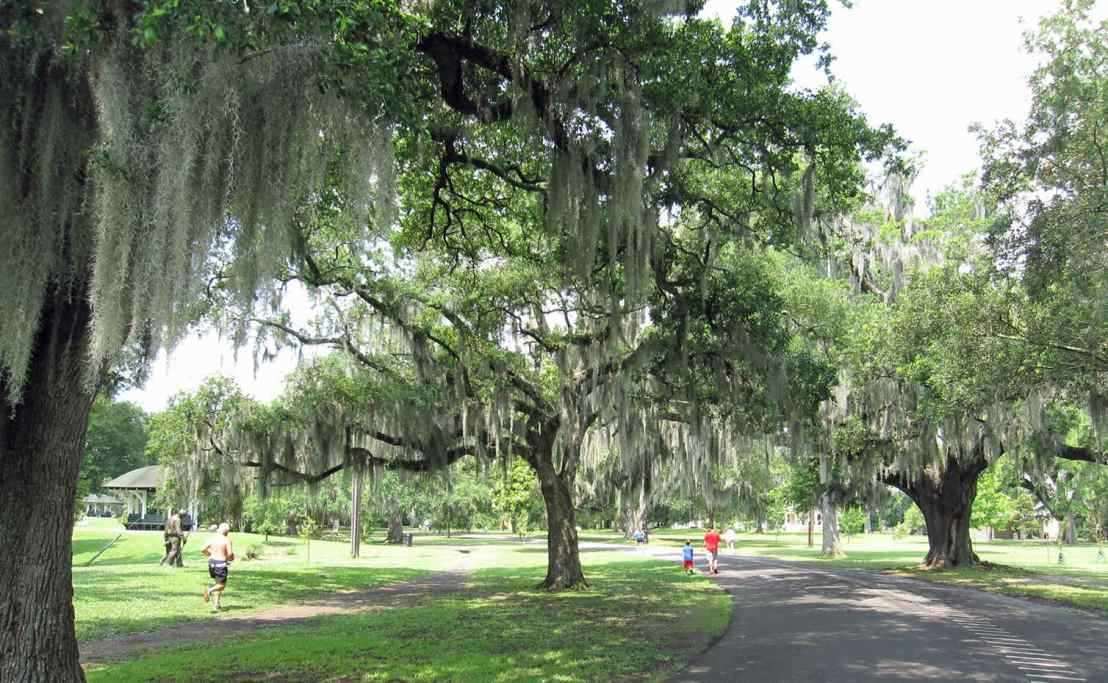
Spending time in city parks like Audubon Park in New Orleans provides some of the same benefits as time in wilderness areas, including reduced stress levels and increased energy levels. InSapphoWeTrust, CC BY-SA

Nature also provides challenges that spur individuals to creative problem-solving and increased self-confidence. For example, some find that being alone in the outdoors, particularly at night, is a challenging situation. Mental, physical and emotional challenges in moderation encourage personal growth that is manifested in an increased comfort with one’s self in the absence of others.

Being alone also can have great value. It can allow issues to surface that people spend energy holding at bay, and offer an opportunity to clarify thoughts, hopes, dreams and desires. It provides time and space for people to step back, evaluate their lives and learn from their experiences. Spending time this way prepares them to re-engage with their community relationships and full work schedules.

Putting it together: The outdoor solo

Participants in programmed wilderness expeditions often experience a component known as “Solo,” a time of intentional solitude lasting approximately 24-72 hours. Extensive research has been conducted on solitude in the outdoors because many wilderness education programs have embraced the educational value of solitude and silence.

Solo often emerges as one of the most significant parts of wilderness programs, for a variety of reasons. Alone time creates a contrasting experience to normal living that enriches people mentally, physically and emotionally. As they examine themselves in relation to nature, others, and in some cases, God, people become more attuned to the important matters in their lives and in the world of which they are part.

Solo, an integral part of Outward Bound wilderness trips, can last from a few hours to 72 hours. The experience is designed to give participants an opportunity to reflect on their own thoughts and critically analyze their actions and decisions.

Solitary reflection enhances recognition and appreciation of key personal relationships, encourages reorganization of life priorities, and increases appreciation for alone time, silence, and reflection. People learn lessons they want to transfer to their daily living, because they have had the opportunity to clarify, evaluate and redirect themselves by setting goals for the future.

For some participants, time alone outdoors provides opportunity to consider the spiritual and/or religious dimension of life. Reflective time, especially in nature, often enhances spiritual awareness and makes people feel closer to God. Further, it encourages their increased faith and trust in God. This often occurs through providing ample opportunities for prayer, meditation, fasting, Scripture-reading, journaling and reflection time.

Retreating to lead

As Thomas Carlyle has written, “In (solitary) silence, great things fashion themselves together.” Whether these escapes are called alone time, solitude or Solo, it seems clear that humans experience many benefits when they retreat from the “rat race” to a place apart and gather their thoughts in quietness.

In order to live and lead effectively, it is important to be intentional about taking the time for solitary reflection. Otherwise, gaps in schedules will always fill up, and even people with the best intentions may never fully realize the life-giving value of being alone.

ooOOoo

I would modify that advice from Thomas Carlyle and that is to include a dog.

For in my experience when one is in the mood for a bit of solitary reflection your dog seems to sense it as well.

Start your day with music – a guest post!

More on mindfulness!

I opened my email box a couple of days ago and there was an email from Sarah.

It said:

Hi there!
I would be honored to be a guest writer for your blog and of course would reciprocate.  I hope you don’t mind that I shared your link in my last post.  I am not totally sure if blogging etiquette.  😀
Sarah Kinneavy
MyAmazing2ndChapter.com

Of course I said yes!

Sarah’s background is sociology and she has a degree in the subject. Just as important she owns a dog walking business. I will let her finish her background:

I believe in living life to the fullest.

My daughter is a Cancer survivor- and as a result of that journey- It put my life into perspective. I learned to never take anything for granted- you never know what’s around the next corner. I am continuing to work on becoming the best version of me, while making the most of each and everyday.

Frankly, I do not really know what it is like to have a daughter, or a son come to it, go down with cancer. The nearest I have come to the disease was when I had just turned 12 and my father died of lung cancer.

So here’s her guest post.

ooOOoo

Start your day with music- not the News! Surviving the Coronavirus with mindfulness Day 2

By Sarah Kinneavy, March 28th, 2020

As I continue to try to stay calm with mass panic happening across the globe 🌎 with this pandemic. As I mentioned in yesterday’s post:

https://myamazing2ndchapter.com/2020/03/27/surviving-the-coronavirus-with-mindfulness/

I am using mindfulness to train my brain in how it reacts to stress. The more we do these exercises the better we get at them.

Start your day with music rather than the news! Borrowed from https://musicoomph.com

Yesterday one of my friends posted on Facebook to start the day off with music – rather than the news! What a great idea!!! So, yesterday, as I got ready for a job interview and I waited until it was late enough in Hawaii to do my daily well check on my daughter there (she is in isolation in a dorm room – I am not sure if she has the dreaded virus or not). I used music as the focal point of this mindfulness exercise. This 15 minutes of focusing on the music- listening to the rhythm helped keep me present. I wasn’t worrying about getting the job or how my daughter was doing. I was just in that moment of getting ready with the accompaniment of music. It was honestly 15 minutes of pure happiness. What a great way to start my day! One thing I have to add – I try to not let myself think about what the words of the songs mean to me, or when I first heard the song. I just listen and enjoy. Okay- I may have danced around my apartment a bit too!

I can tell you – I did not feel anxious going to my interview like I normally would. I didn’t panic about my daughter’s health – I was able to wait until after my interview to check in on her. Mindfulness does not keep me from ever worrying about my kiddo or the world around me. No – I still worry – but It isn’t swallowing me up whole. And this is key!

Heading to my job interview.

I can’t wait to talk to you again tomorrow . How are you coping with all the stress and anxiety?

ooOOoo

That’s a lovely guest post!
And the message is clear and powerful: “No – I still worry – but It isn’t swallowing me up whole. And this is key!

There’s no escaping it!

Getting old is inevitable.

Becoming wiser as one ages less so!

I am minded to start today’s post with that reflection because quite simply it was the way to introduce my republication of Wibble’s post.

The article is about Dexter and is just lovely. It is called Older or wiser.

Enjoy!

ooOOoo

Older or wiser

By Dexter, February 19th, 2020

I’m sitting here and the rain is drizzling down the window. It’s February, its windy, we’ve had two winter storms in quick succession and they are digging up the road outside my house. Do they not know I am trying to sleep. Even more surprising but equally as joyous, Lenny isn’t trying to bite me. Now if you have read some of my recent blogs, you will know I have been somewhat contemplative. If you are hoping for shenanigans in this article, then I fear you will again be somewhat disappointed. Earlier today I was wondering to myself about becoming older and, apparently, wiser.

Being older is a bit obvious really. I have more grey hair, I eat my dinner more slowly and I don’t need to walk as far as I used to. I’ve even missed scenting rabbits and squirrels according to assorted parents I have been attached to when these alleged missed sightings have taken place. I can still play bitey face with Lenny, and give him what for, but I tend to duck out of said prolonged snout jousting after a short time. Being beagles we are docile chaps and even when we are in full cry with sofa covers flying around, furniture being rearranged and rugs being ruffled, we manage to stop for a breather on fairly regular occasions. Sometimes it takes a parent stepping in between us to remind the warring parties that its time for a break but, on the whole, we tend to cease and desist quite readily. I am then happy to retire to one of my six or so beds to snooze. However Lenny seems to have a little extra bounce in his paws although I think that is because he is around eighteen months old and I am, allegedly, going to be ten next birthday. No one truly knows how old I am due to me being a rescue but the wise money is on nearly ten now. I am happy for him to run around a little longer, chew what remains of one of my toys and then fall asleep on the sofa. Usually this is interspersed with trying to bite me but again, being docile, I try and fend him off without sending clear signals that I just want to rest.

Older?

As for being wiser, I don’t really know what that entails. If it means that I have seen things, been places and done stuff, then yes I am wiser. If it means that having done said activities, I have learned from the experiences, then not necessarily. For example I have been on the tube and train to London quite a few times, however I still want to investigate what those wonderful smells are down on the track. Thank goodness for a lead and attached human apparently. Another example, is that I have lived here for seven Christmases and, despite the jolly red faced man delivering me many wonderful things but nothing closely resembling a pizza tasting gift, it is wrapping paper I am still fascinated by. I can’t eat it, I know I can’t, but does it stop me from trying? Of course not. Many winters have I seen here, many dirty puddles have I walked through in a Moses style and many times have I been told “Dex, no, ugh good grief you look like the Creature from the Black Lagoon”. Does it stop me stomping through puddles in the most triumphal fashion? No, of course not. I have stopped chasing pigeons in the garden and that’s not because I am banned from the garden. Far from it, for I merely allow my protege to chase them for me. Young whipper-snapper legs are faster than these old bones of mine. I have stopped chewing my toys to a misshapen soggy jumble of fabric, with an accompanying scene of death and destruction wrought across the rugs. Again I leave the dental lobotomisation of toys to Lenny, as he seems to have picked up the baton fairly quickly and extremely proficiently.

Wiser?

If growing older and wiser means seeing things, going places, enjoying the view, smelling more flowers and generally knowing that I should take my time to appreciate and immerse myself in all the things I rushed to see previously, then I am older and wiser. I still have adventures, I still walk and pull on the lead, stick my head down rabbit holes and try to climb the banks along the lanes and byways I explore. I still look in awe at the beauty of the countryside I visit, gaze at the buildings and people in the city. But I let it sink in now, I actually look at what is in front of me and then usually fall asleep soon after, twitching and dreaming. I am trying to pass on my perceived wisdom to Lenny. He is often too busy bouncing around, trying to sniff everything, meet every fur and being a very lovable pest in as quick a time as possible. I see much in Lenny that I had in my youth and this gives me a warm feeling. I hope I can help him to understand that, at some point, he will sit and watch the world go by, with a peace and calmness that I seem to be achieving more often.

Who knows, maybe that is the secret to being older and wiser.

ooOOoo

Just read that last paragraph again. Especially the first sentence: “If growing older and wiser means seeing things, going places, enjoying the view, smelling more flowers and generally knowing that I should take my time to appreciate and immerse myself in all the things I rushed to see previously, then I am older and wiser.

In my opinion dogs do this so much better than we humans. Yet another lesson to be learned from dogs!

Because both for dogs and their human friends, it’s only a matter of time!