I was born in London before the end of World War II and to a great extent my upbringing was in the times of yesterday. But the world has moved on in many, many ways. It is too easy to say that we live in very strange times.
Thus it was enlightening to come across this talk, under the TED Talks banner, quite recently. I have great pleasure in sharing it with you. Plus, Hannah’s website is here. (From which I have taken the following words!)
(P.S. The YouTube video is just over thirteen minutes long. It automatically runs into the next video so you will have to stop it yourself.)
ooOOoo
The word “sustainability” gets thrown around a lot these days. But what does it actually mean for humanity to be sustainable? Environmental data scientist Hannah Ritchie digs into the numbers behind human progress across centuries, unpacking why the conventional understanding of sustainability is misleading and showing how we can be the first generation of humans to actually achieve it.
Why you should listen
Hannah Ritchie is deputy editor and research lead at Our World in Data, an online publication making data and research on the world’s largest problems accessible and understandable for non-experts. She is a senior researcher at the University of Oxford, where she studies how environmental issues intersect with others like poverty, global health and education. She has also done extensive research into the question of how to feed everyone in the world a nutritious diet without wrecking the planet. Her work has appeared in The New York Times, The Washington Post, Vox, Wired, BBC, Al Jazeera, The Economist and New Scientist.
In 2022, Ritchie was named Scotland’s Youth Climate Champion. She is also an honorary fellow at the University of Edinburgh and Edinburgh Centre for Carbon Innovation, and a fellow at the Energy for Growth Hub, focused on ending global energy poverty. Her forthcoming book,The First Generation, makes an evidence-based case for why we have a meaningful chance to solve global environmental problems for the first time in human history.
But first of all I should pass on a Very Happy Thanksgiving to you all. I apologise for forgetting to write this yesterday when I was preparing this post.
I came across the Dog Training Academy site the other day and found it full of tips. I trust that with the link in place in this post I can republish articles that are found on it.
For example, on July 14th, 2023 Laura Brown published a post on the philosophy of dog training. Here is the article.
ooOOoo
Developing a Effective Dog Training Philosophy: Techniques and Strategies
Dog training philosophy refers to the underlying principles and beliefs that guide how dog owners train and interact with their furry companions. Different dog owners have different philosophies when it comes to training their dogs, and each approach can have a significant impact on the dog’s behavior and well-being.
In this article, we’ll explore the different dog training philosophies and the benefits and drawbacks of each approach.
Positive Reinforcement
Positive reinforcement is a popular dog training philosophy that involves rewarding desired behaviors with treats, praise, or other positive stimuli. The idea is to encourage dogs to repeat behaviors that lead to positive outcomes while discouraging behaviors that lead to negative outcomes.
Positive reinforcement is a humane and effective way to train dogs. It builds trust and strengthens the bond between the owner and the dog. It’s also an enjoyable and rewarding experience for both the dog and the owner.
One potential drawback of positive reinforcement is that it can be time-consuming. Owners must be patient and consistent in rewarding desired behaviors, and it may take longer for some dogs to learn new behaviors than others.
Punishment-Based Training
Punishment-based training is a dog training philosophy that involves punishing undesirable behaviors with negative stimuli, such as physical correction or verbal scolding. The idea is to discourage dogs from repeating behaviors that lead to negative outcomes while encouraging behaviors that lead to positive outcomes.
Punishment-based training can be effective in stopping unwanted behaviors quickly. However, it can also have negative consequences for the dog’s emotional well-being. Dogs that are punished frequently may become fearful or aggressive, and their trust in their owners may be damaged.
Moreover, punishment-based training can result in a negative relationship between the owner and the dog. Dogs may learn to fear their owners, which can lead to a breakdown in communication and a lack of trust.
Dominance-Based Training
Dominance-based training is a dog training philosophy that is based on the belief that dogs are pack animals that instinctively seek to establish a social hierarchy. The idea is to assert dominance over the dog and establish the owner as the pack leader.
Dominance-based training can be effective in certain situations, such as when dealing with aggressive dogs. However, it can also be harmful to the dog’s emotional well-being. Dogs that are subjected to dominance-based training may become fearful, anxious, or aggressive, and their trust in their owners may be damaged.
Moreover, the concept of dominance in dog behavior has been debunked by many dog behaviorists and trainers. While dogs do live in social groups and establish hierarchies, the idea that dogs constantly seek to establish dominance over their owners is not supported by scientific evidence.
Relationship-Based Training
Relationship-based training is a dog training philosophy that is based on the belief that dogs are social animals that thrive on positive interactions with their owners. The idea is to build a strong, positive relationship between the owner and the dog, which will lead to a well-behaved and happy dog.
Relationship-based training is a humane and effective way to train dogs. It emphasizes positive reinforcement and building a strong bond between the owner and the dog. It also encourages owners to understand their dog’s behavior and to communicate effectively with their furry companion.
One potential drawback of relationship-based training is that it can be time-consuming. It requires a significant amount of effort and dedication on the part of the owner to build a strong relationship with their dog. Moreover, some dogs may require more time and effort to establish a strong bond with their owner.
Balanced Training
Balanced training is a dog training philosophy that combines elements of positive reinforcement, punishment-based training, and dominance-based training. The idea is to use a variety of training methods to achieve the desired behavior in the dog.
Balanced training can be effective in certain situations, such as when dealing with complex behavior issues. However, it can also be confusing and overwhelming for dogs. They may not understand what behavior is being rewarded or punished, and their trust in their owner may be compromised.
Moreover, balanced training can lead to a lack of consistency in the training approach, which can confuse the dog and make it difficult for them to learn new behaviors.
Conclusion
In conclusion, there are different dog training philosophies, and each approach can have a significant impact on the dog’s behavior and well-being. Positive reinforcement and relationship-based training are generally considered to be the most humane and effective ways to train dogs. Punishment-based and dominance-based training can have negative consequences for the dog’s emotional well-being and may damage the relationship between the owner and the dog.
Balanced training can be effective in certain situations, but it requires a significant amount of skill and knowledge to implement properly. Moreover, it can be confusing and overwhelming for dogs, and their trust in their owner may be compromised.
As a dog owner, it’s essential to understand the different dog training philosophies and choose the approach that best suits your dog’s needs and personality. It’s also essential to seek the advice of a professional dog trainer or behaviorist if you’re experiencing issues with your dog’s behavior. A trained professional can help you identify the underlying causes of your dog’s behavior and develop a training plan that will address those issues effectively.
In the end, the goal of dog training should be to build a strong, positive relationship between the owner and the dog. When dogs are well-trained, happy, and healthy, they make wonderful companions and enrich our lives in countless ways. By choosing the right dog training philosophy and approach, you can help your furry friend become the best possible version of themselves.
ooOOoo
As I said at the beginning, I hope republishing this text is alright. Because I think it is a very good article from a very useful website.
If you have not registered with the BBC then you will need to do so before the link at the bottom works.
This last time it is wood. Here it is:
In this episode – Wood – we visit the Woodwork for Wellbeing Workshop in Bethnal Green, London where every Tuesday people with mental health issues spend time making things with wood. They find it to be very therapeutic and fun. And Professor Miles Richardson of the University of Derby shares research from Japan which shows that simply touching wood is calming.
This is the last one of this series from the Beeb and if any of you have noticed I chose to present these programmes in a different order to that presented by the BBC.
‘chose‘ is only slightly accurate – the true reason is that I screwed up!
Another broadcast from BBC Radio 4 in this series!
As I said before, so far this has been a fascinating series of programmes and, hopefully, some of you have listened to the episodes.
In Episode 5 – Earth – we visit the Horticultural Therapy Trust allotment in Plymouth and discover how gardening can be soothing for people with severe mental illnesses. We also hear about how putting our hands in the earth can be good for our gut microbiome and potentially our mental health.
Produced and Presented by Helen Needham Research by Anna Miles and Maud Start Original Music by Anthony Cowie Mixed by Ron McCaskill and Malcolm Torrie
A BBC Scotland Production made in Aberdeen for BBC Radio 4
This is about breathing and is something I know about. Because Bruce at our local ClubNorthwest has a session with me when I spend five minutes or so taking in through the nose the deepest breath that I can.
If you have not registered with the BBC then you will need to do so before the link at the bottom works.
In Episode 4 – Air – we visit an infant school in Nottingham where young children regularly learn breathing techniques to reduce stress and anxiety. We also hear about research from Italy showing how slowing our breathing impacts positively on brain activity. Plus breath coach and founder of School Breathe, Aimee Hartley, shares her experience of learning to breathe well.
Produced and Presented by Helen Needham Research by Anna Miles and Maud Start Original Music by Anthony Cowie Mixed by Ron McCaskill and Malcolm Torrie
A BBC Scotland Production made in Aberdeen for BBC Radio 4
Continuing this fascinating series from BBC Radio 4.
Last week the BBC chose to present a programme called An Almanac for Anxiety. There were five episodes: Fire; Wood: Water: Air; Earth.
If you have not registered with the BBC then you will need to do so before the link below works.
The details of each episode were presented on the BBC website:
In Episode 3 – Water – we join a group of socially prescribed outdoor swimmers on Teignmouth Beach in Devon who find joy in immersing themselves in cold water. We also hear why spending time around blue spaces is so effective at promoting a sense of calm from Dr Catherine Kelly of the University of Brighton.
Produced and Presented by Helen Needham Research by Anna Miles and Maud Start Original Music by Anthony Cowie Mixed by Ron McCaskill and Malcolm Torrie
A BBC Scotland Production made in Aberdeen for BBC Radio 4
Last week the BBC chose to present a programme called An Almanac for Anxiety. There were five episodes: Fire; Wood: Water: Air; Earth.
If you have not registered with the BBC then you will need to do so before the link below works.
The details of each episode were presented on the BBC website:
Anxiety is the most common form of mental illness in the UK, with nearly a fifth of people experiencing it over the course of a year. Although it is often treated through medication, there are many alternative ways which are proving to be very effective in reducing anxiety amongst some people. In this series, we explore how connecting with the elemental forces of nature helps people with a range of mental illnesses to feel better. We also learn about the current academic research behind these methods.
In Episode 1 – Fire – we visit an overnight camp on the banks of the River Spey near Aviemore in the Scottish Highlands run by the charity Fire and Peace. According to the participants, – who have a range of mental ill health and addiction issues – the experience of spending time around the fire in nature is transformative when it comes to promoting feelings of connection and wellbeing. We also hear new research which shows how being around a campfire can be calming.
BBC Radio 4
I am going to share the link to the BBC each day this week with a new episode each day. The programmes are 15 minutes long and in my opinion well worth listening to.
Now above we were told: ‘Anxiety is the most common form of mental illness in the UK’ but of course we all know that anxiety affects many millions across the world. That is why I intend to share with you all five programmes.
Republishing a recent article published by The Conversation.
Before I go to this article I want to talk briefly about the book the Myth of Normal or as the subtitle explains TRAUMA, ILLNESS & HEALING IN A TOXIC CULTURE.
Let me pick this closing paragraph of Chapter 20, on page 296:
Disconnection in all its guises – alienation, loneliness, loss of meaning and dislocation – is becoming our culture’s most plentiful product. No wonder we are more addicted, chronically ill, and mentally disordered than ever before, enfeebled as we are by such malnourishment of mind, body, and soul.
the Myth of Normal, Dr Gabor Maté with Daniel Maté
It is a very powerful book albeit not the easiest read in the world but still highly recommended.
Plus there is a YouTube video of Dr. Maté being interviewed in July, 2023 by Tara Westover (also a long video!).
Now to the main purpose of today’s post.
ooOOoo
Keeping your cool in a warming world: 8 steps to help manage eco-anxiety
But amid doom-and-gloom predictions, there is hope. As a therapist and clinical social work professor, I have seen firsthand how paralyzing eco-anxiety can be, and I’m dedicated to finding solutions. Here are a few evidence-based tips to tackle your climate woes.
Caring about the world you live in does not make you a “crazy” alarmist. In fact, growing numbers of people across the globe feel the same way, with two-thirds of Americans reporting being at least somewhat worried about climate change in recent polls.
It makes sense that people would feel nervous when basic needs like safety and shelter are threatened. Give yourself grace, because beating yourself up for these very valid feelings will only make you feel worse.
Participate in the solution
It can be hard to feel empowered when environmental harms are taking a toll on your mental health, but the escalating global crisis still demands urgent attention. Instead of burying your head in the sand, use that mental discomfort as a catalyst for action.
Individual efforts to reduce your carbon footprint matter. Joining larger movements has the potential for even move significant impacts, as well as the potential to buffer anxiety, research shows. Volunteer your own unique passions, talents and skills to advocate for systemic changes that will benefit the planet and humanity.
When you feel anxious, use that energy as fuel for the fight. Harnessing eco-anxiety in this way can reduce your sense of powerlessness.
As a therapist, I often help clients identify and reframe unhelpful thinking patterns. For example, while it is true that there are many environmental problems to grapple with, there is also positive news, so don’t discount it. Recognize and celebrate victories big and small.
Trauma: Process it so you can heal
The climate crisis has been conceptualized as a collective trauma, and many individuals are struggling with eco-grief from climate impacts that have already happened. Processing past trauma from events like weather disasters is a crucial step in enhancing your ability to cope with new experiences.
Even people who have not yet experienced significant climate impacts directly may have signs of pre-traumatic stress, a clinical term for the distress experienced in anticipation of a high-stress situation. A licensed mental health professional can help you process these emotions.
Reduce isolation
It’s no secret that having a strong social support network is a key ingredient for happiness. Surrounding yourself with compassionate, like-minded friends is also key to sustained efforts in doing your part to make a difference.
Consider joining or starting a Climate Cafe or similar group to talk about climate concerns. Visit a 10-step climate grief meeting. Join a local environmental organization. Or simply call up a friend when you need a listening ear.
Go for a quiet walk in the woods and observe nature all around you – it’s a Japanese practice for relaxation known as forest bathing. Spend time gardening. Exercise outdoors or otherwise spend time outdoors in a place that is relaxing and restorative for you.
Self-care is paramount when it comes to managing the emotional toll of eco-anxiety.
Engaging in self-care practices, such as getting adequate sleep, eating healthy and having fun, helps us maintain a sense of balance in the face of overwhelming environmental concerns.
Remember what they teach you on airplanes – you should always put on your own oxygen mask before helping other passengers. Likewise, when we come from a place of wellness, we are better equipped to handle the stresses of eco-anxiety and make a difference in this area.
Mindfulness
Because eco-grief is focused on the past and eco-anxiety is future-oriented, reconnecting to the present moment is a powerful way to combat both.
By cultivating mindfulness – a nonjudgmental awareness of the present moment – people can become more attuned to their thoughts, feelings and bodily sensations in response to eco-anxiety triggers. This heightened self-awareness helps people to acknowledge worries without becoming consumed by them.
In the face of eco-anxiety, these strategies can build resilience, reminding everyone that they have the power to shape a more sustainable and hopeful future.
There’s a powerful reminder that we have the power to stay in the present, or to put it another way by cultivating mindfulness. There are quite a few websites on Mindfulness including this description of what Mindfulness is on the Mayo Clinic website.
Mindfulness is a type of meditation in which you focus on being intensely aware of what you’re sensing and feeling in the moment, without interpretation or judgment. Practicing mindfulness involves breathing methods, guided imagery, and other practices to relax the body and mind and help reduce stress.
Mayo Clinic
Now that is something I should really focus on as I am terrible at being in the moment and nowhere else.
I would not have believed this had I not read it with my own eyes.
I have been an atheist all my life. My mother and father were all those years ago when being an atheist was not something one promoted.
But a recent article from The Conversation told a very surprising account: “These spiritual caregivers can be found working in hospitals, universities, prisons and many other secular settings, serving people of all faiths and those with no faith tradition at all.“
Here’s the full article.
ooOOoo
Religious leaders without religion: How humanist, atheist and spiritual-but-not-religious chaplains tend to patients’ needs
Chaplains talk with anyone, regardless of whether or not the patient has a religious affiliation – and some chaplains themselves are not religious. Jacob Wackerhausen/iStock via Getty Images Plus
In times of loss, change or other challenges, chaplains can listen, provide comfort and discuss spiritual needs. These spiritual caregivers can be found working in hospitals, universities, prisons and many other secular settings, serving people of all faiths and those with no faith tradition at all.
Yet a common assumption is that chaplains themselves must be grounded in a religious tradition. After all, how can you be a religious leader without religion?
Thirty percent of Americans are religiously unaffiliated. Research suggests that people who are atheists or otherwise nonreligious sometimes reject a chaplain out of wariness, or shut down a conversation if they feel judged for their beliefs. But this research has not accounted for a new, increasingly likely situation – that the chaplain might also be nonreligious.
No national survey has been done, so the number of nonreligious chaplains is unknown. But there is plenty of reason to think that as more Americans choose not to affiliate with any particular religion, so too do more chaplains.
Nonreligious chaplains have been a part of hospital systems and universities for years, but they came into the national spotlight in August 2021 when Harvard University’s organization of chaplains unanimously elected humanist and atheist Greg Epstein as president. Humanists believe in the potential and goodness of human beings without reference to the supernatural.
Other recent reporting on humanist chaplains has also focused on school campuses, but nonreligious chaplains are not limited to colleges and universities. Eighteen of the 21 nonreligious chaplains we spoke with in our study work in health care, including hospice. The Federal Bureau of Prisons allows nonreligious chaplains, but we were unable to find any of them to participate in the current study.
Humanist chaplain Bart Campolo, center, and his wife, Marty, right, mingle with students at the University of Southern California in 2015. AP Photo/Jae C. Hong
The idea of a “call” from God is central to many religious vocations: a strong impulse toward religious leadership, which many people attribute to the divine.
Chaplains who are atheists, agnostics, humanists or who consider themselves spiritual but not religious also can feel called. But they do not believe that their calls come from a deity.
Joe, for example, an atheist and a humanist whom we interviewed, has worked as a chaplain in hospitals and hospices. He says that his “light bulb moment” came after a history professor told him that beliefs are the source of a community’s power. While atheists do not believe in God or gods, many do have strong beliefs about ethics and morality, and American atheists are more likely than American Christians to say they often feel a sense of wonder about the universe. Joe’s call was not “from a divine source,” but nonetheless, he says this experience “kind of filled me with a sense of control, and confidence, and presence” in his life that grounded his sense of a calling.
Sunil, another chaplain our team interviewed, was inspired by his college chaplain, whom he calls “a really influential presence.” The chaplain helped Sunil answer questions about identity and values without “necessarily having any religious or spiritual leanings to it,” and encouraged him to go to divinity school.
Today, Sunil tries to help others answer those same questions in his work as a health care chaplain – and to offer deeply thoughtful, meaningful spiritual care to people who aren’t religious.
Education and training
Most chaplaincy jobs require a theological degree. Along with coursework in sacred scriptures and religious leadership, chaplaincy training usually involves clinical pastoral education, where students learn about hands-on, care-oriented aspects of their profession. This involves learning to provide care to everyone, regardless of their religious background.
Although coursework is broadly the same for all students, religious or nonreligious, the actual experience of earning a degree is very different for nonreligious students. In the United States, Christian students are easily able to enroll in a seminary or divinity school that shares their faith identity and spend their years of study learning about their own tradition.
Chaplaincy programs that focus on non-Christian traditions are available, but scarcer, and our team does not know of an overtly nonreligious chaplaincy program. In recent years, more seminaries have welcomed nonreligious students, but nonetheless, nonreligious students often find themselves focusing their study on traditions to which they have no personal connection.
Yet there is a surprising bright side.
‘I am here to support you’
Being deeply immersed in traditions that are not one’s own is one of the reasons that nonreligious chaplains can be so effective.
Artwork posted by a chaplain in a break room in the trauma surgery ICU at Harborview Medical Center in Seattle. David Ryder/Getty Images
For example, our team asked Kathy, a health care chaplain, how she approaches prayer with religious and nonreligious patients. “My goal is to try to meet that person where they are and pray in a way that’s helpful and comforting for them, or meets whatever the need is that’s arisen during the conversation that we’ve had,” she said. Like all chaplains, Kathy is there to accompany, not proselytize. While she herself prays to the “great mystery,” she is comfortable facilitating whatever prayer is needed.
Claire, a chaplaincy student, agreed with Kathy and described her own first experience meeting an evangelical Christian patient. It was easy, she said, because “you’re not trying to fix anything. You’re just trying to meet them where they are. So that’s it.”
Nonreligious chaplains are used to thinking outside the box. Having learned about major world religions, many of them can find overlapping values and beliefs with their patients, such as finding beauty and meaning in the natural world or finding strength in their conviction that human beings are inherently good.
Cynthia works in the palliative care department in a hospital and tells her patients, “I am here to support you in whatever is meaningful to you right now and whatever is most important in your life in this moment.” She asks patients: “What are you struggling with right now? What are your goals? What do you hope for? What are you afraid of?” – trying to “unpack that with a spiritual lens rather than a medical lens.”
Cynthia is an example of why spiritual care by nonreligious chaplains may be surprising, but is likely here to stay. Based on our research, nonreligious chaplains are as capable as religious chaplains of meeting a person in their darkest hour and taking them by the hand.
That last sentence may be opened up even more. In that the article speaks of chaplains, both religious and nonreligious. But as someone who was a counsellor with the Prince’s Youth Business Trust some years ago, now The Prince’s Trust, it is my opinion that anyone who is an active listener can undertake the role.
The article has many fine points including one that I had not considered before. “That American atheists are more likely than American Christians to say they often feel a sense of wonder about the universe.” I am certain that this isn’t confined to Americans.
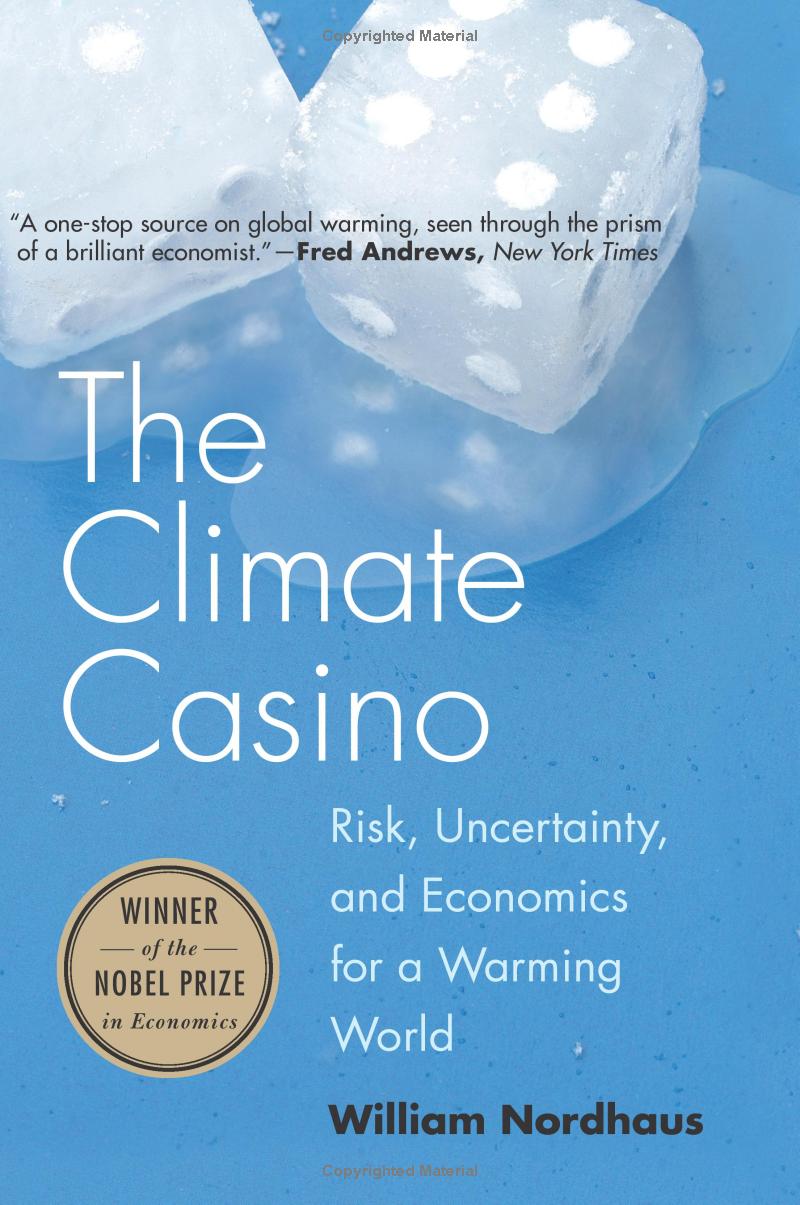
I bought this book from Thriftbooks and was so fired up that I sat down and started reading it almost immediately. For as the back cover explains:
Climate change is profoundly altering our world in ways that pose major risks to human societies and natural systems. We have entered the Climate Casino and are rolling the global-warming dice, warns William Nordhaus. But there is still time to turn around and walk back out of the casino, and in this book the author explains how.
William Nordhaus
William Nordhaus is a brilliant economist as Fred Andrews describes above. Indeed he is the Sterling Professor of Economics at Yale University and he has his website here.
Now I am going straight to two videos.
The first is William Nordhaus receiving the Nobel Prize in 2018.
And the second is that lecture given at the same venue in 2018.









 Learning from Dogs