I make no apologies for providing little of my own words and just going straight to this video and the accompanying text.
ooOOoo
What if the deepest human drive isn’t happiness, survival, or even love, but the need to matter?
Philosopher and MacArthur Fellow Rebecca Newberger Goldstein joins Michael Shermer to discuss The Mattering Instinct, her argument that the desire to feel significant lies at the core of human behavior. That drive helps explain our greatest achievements, from creativity and moral courage to scientific and artistic excellence. It also helps explain some of our darkest outcomes, including extremism, violence, and ideological fanaticism.
Goldstein examines why people will give up comfort, status, and sometimes even their own lives to feel that they matter. She questions why meaning cannot be captured by happiness metrics or self-help formulas, and why the same psychological force can produce saints, scientists, athletes, cult leaders, and terrorists. The conversation moves through free will, entropy, morality without God, fame, narcissism, and the crucial difference between ways of mattering that create order and those that leave damage behind.
Rebecca Newberger Goldstein is an award-winning philosopher, writer, and public intellectual. She holds a Ph.D. in philosophy of science from Princeton University and has taught at Yale, Columbia, NYU, Dartmouth, and Harvard. A fellow of the American Academy of Arts and Sciences, her work has been supported by the MacArthur “Genius” grant and fellowships from the Guggenheim, Whiting Institute, Radcliffe Institute, and the National Science Foundation. She is the author of ten books of acclaimed fiction and non-fiction. Her latest book is The Mattering Instinct: How Our Deepest Longing Drives Us and Divides Us.
Now I am going to republish that site because it is the only way I can think of to spread the word more widely.
ooOOoo
Rebecca also writes for radio. She has been a frequent broadcaster on BBC Radio Four over the years.
Her radio essay ‘Reflections on My Mother’s Kenwood Mixer’, a homage to her mother’s gritty resilience in times of trouble, promoted scores of people on Twitter and Facebook to share stories about Kenwoods and their own steely mothers. Her essay ‘On Waiting’, tells the story of being marooned with her daughters at dusk in a bus-stop in remote Norfolk during a Covid lockdown. Her essay ‘House Clearing’ tells the story of the strangeness of dismantling her mother’s house after she had moved into a carehome. And her final essay for the programme, ‘On Migration’, describes an astonishing ten days in which hundreds of wild geese flew across the skies of her home town, as well the story of the great philosopher Aristotle study of migrating birds whilst himself a migrant in flight for his life on the island of Lesbos.
You’ll find a link to Rebecca’s Private Passions episode here too. A kind of Desert Island Discs without the Desert Island…. and with the extraordinary composer Michael Berkeley in the interview seat.
Also here is her five-part series commissioned by Radio Four in 2025 called Beautiful Strangeness. You can find the link below.
Being the age I am, Rebecca’s Beautiful Strangeness programmes spoke to me in a way that I find difficult to put into words but nonetheless the series did.
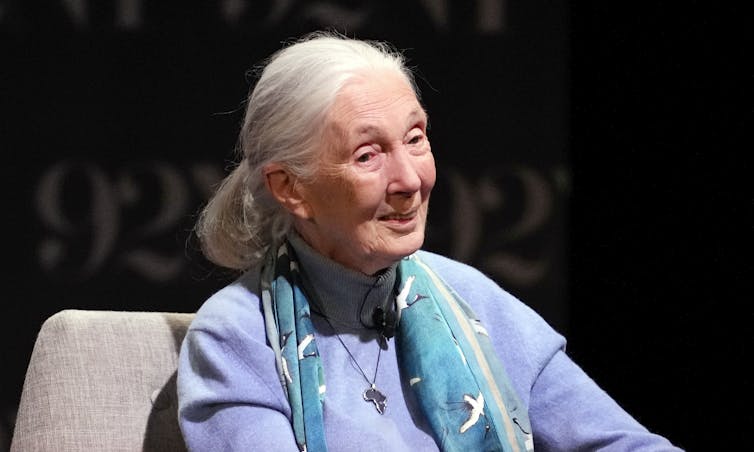
Anyone proposing to offer a master class on changing the world for the better, without becoming negative, cynical, angry or narrow-minded in the process, could model their advice on the life and work of pioneering animal behavior scholar Jane Goodall.
Goodall’s life journey stretches from marveling at the somewhat unremarkable creatures – though she would never call them that – in her English backyard as a wide-eyed little girl in the 1930s to challenging the very definition of what it means to be human through her research on chimpanzees in Tanzania. From there, she went on to become a global icon and a United Nations Messenger of Peace.
Until her death on Oct. 1, 2025 at age 91, Goodall retained a charm, open-mindedness, optimism and wide-eyed wonder that are more typical of children. I know this because I have been fortunate to spend time with her and to share insights from my own scientific career. To the public, she was a world-renowned scientist and icon. To me, she was Jane – my inspiring mentor and friend.
Despite the massive changes Goodall wrought in the world of science, upending the study of animal behavior, she was always cheerful, encouraging and inspiring. I think of her as a gentle disrupter. One of her greatest gifts was her ability to make everyone, at any age, feel that they have the power to change the world. https://www.youtube.com/embed/rcL4jnGTL1U?wmode=transparent&start=0 Jane Goodall documented that chimpanzees not only used tools but make them – an insight that altered thinking about animals and humans.
Discovering tool use in animals
In her pioneering studies in the lush rainforest of Tanzania’s Gombe Stream Game Reserve, now a national park, Goodall noted that the most successful chimp leaders were gentle, caring and familial. Males that tried to rule by asserting their dominance through violence, tyranny and threat did not last.
I also am a primatologist, and Goodall’s groundbreaking observations of chimpanzees at Gombe were part of my preliminary studies. She famously recorded chimps taking long pieces of grass and inserting them into termite nests to “fish” for the insects to eat, something no one else had previously observed.
It was the first time an animal had been seen using a tool, a discovery that altered how scientists differentiated between humanity and the rest of the animal kingdom.
Renowned anthropologist Louis Leakey chose Goodall to do this work precisely because she was not formally trained. When she turned up in Leakey’s office in Tanzania in 1957, at age 23, Leakey initially hired her as his secretary, but he soon spotted her potential and encouraged her to study chimpanzees. Leakey wanted someone with a completely open mind, something he believed most scientists lost over the course of their formal training.
Because chimps are humans’ closest living relatives, Leakey hoped that understanding the animals would provide insights into early humans. In a predominantly male field, he also thought a woman would be more patient and insightful than a male observer. He wasn’t wrong.
Six months in, when Goodall wrote up her observations of chimps using tools, Leakey wrote, “Now we must redefine tool, redefine Man, or accept chimpanzees as human.”
Goodall spoke of animals as having emotions and cultures, and in the case of chimps, communities that were almost tribal. She also named the chimps she observed, an unheard-of practice at the time, garnering ridicule from scientists who had traditionally numbered their research subjects.
One of her most remarkable observations became known as the Gombe Chimp War. It was a four-year-long conflict in which eight adult males from one community killed all six males of another community, taking over their territory, only to lose it to another, bigger community with even more males.
Confidence in her path
Goodall was persuasive, powerful and determined, and she often advised me not to succumb to people’s criticisms. Her path to groundbreaking discoveries did not involve stepping on people or elbowing competitors aside.
Rather, her journey to Africa was motivated by her wonder, her love of animals and a powerful imagination. As a little girl, she was entranced by Edgar Rice Burroughs’ 1912 story “Tarzan of the Apes,” and she loved to joke that Tarzan married the wrong Jane.
When I was a 23-year-old former NFL cheerleader, with no scientific background at that time, and looked at Goodall’s work, I imagined that I, too, could be like her. In large part because of her, I became a primatologist, co-discovered a new species of lemur in Madagascar and have had an amazing life and career, in science and on TV, as a National Geographic explorer. When it came time to write my own story, I asked Goodall to contribute the introduction. She wrote:
“Mireya Mayor reminds me a little of myself. Like me she loved being with animals when she was a child. And like me she followed her dream until it became a reality.”
In a 2023 interview, Jane Goodall answers TV host Jimmy Kimmel’s questions about chimpanzee behavior.
Storyteller and teacher
Goodall was an incredible storyteller and saw it as the most successful way to help people understand the true nature of animals. With compelling imagery, she shared extraordinary stories about the intelligence of animals, from apes and dolphins to rats and birds, and, of course, the octopus. She inspired me to become a wildlife correspondent for National Geographic so that I could share the stories and plights of endangered animals around the world.
Goodall inspired and advised world leaders, celebrities, scientists and conservationists. She also touched the lives of millions of children.
Jane Goodall and primatologist Mireya Mayor with Mayor’s book ‘Just Wild Enough,’ a memoir aimed at young readers. Mireya Mayor, CC BY-ND
Through the Jane Goodall Institute, which works to engage people around the world in conservation, she launched Roots & Shoots, a global youth program that operates in more than 60 countries. The program teaches children about connections between people, animals and the environment, and ways to engage locally to help all three.
Along with Goodall’s warmth, friendship and wonderful stories, I treasure this comment from her: “The greatest danger to our future is our apathy. Each one of us must take responsibility for our own lives, and above all, show respect and love for living things around us, especially each other.”
It’s a radical notion from a one-of-a-kind scientist.
This article has been updated to add the date of Goodall’s death.
That comment by Jane that was treasured by Mireya is so important. “The greatest danger to our future is our apathy. Each one of us must take responsibility for our own lives, and above all, show respect and love for living things around us, especially each other.”
The series is called Naturebang: “Becky Ripley and Emily Knight make sense of what it means to be human by looking to the natural world… Science meets storytelling with a philosophical twist.“
There are 35 episodes. I particularly liked the episode broadcast yesterday about the Clams.
“How do we extract the maximum amount of power from the sun? Becky Ripley and Emily Knight enlist the help of a giant, thousand-year old clam. And end up in the depths of space…
Featuring Professor Alison Sweeney at Yale University, and Mike Garrett from the Jodrell Bank Centre for Astrophysics.
Produced and presented by Emily Knight and Becky Ripley“
Last Sunday morning I listened to a BBC Radio 4 programme The Dark Enlightenment. Here is a summary from the BBC website:
A radical political philosophy founded by a software engineer called Curtis Yarvin is gaining in influence, and said to be shaping Donald Trump’s second term in the White House.
It is on BBC Sounds. Here is the link: BBC Currently.
The plan was simple. It started by retiring all government employees by offering them incentives to leave and never return. To avoid anarchy and keep authority, the police and military would be retained.
Government funds would be seized and the money redirected to more worthwhile pursuits. Court orders pushing back against these measures as “unconstitutional” should be summarily ignored. The press should be massaged and censored as necessary. Finally, universities, scientific institutions, and NGOs should also be snapped off, their funding terminated.
These moves resemble many made (or attempted) in the first 100 days of the second Trump administration. But they were all laid out in 2012 by a single person: Curtis Yarvin.
In the past five years, Yarvin’s reactionary blueprints for governance have found powerful backers in both Silicon Valley and Washington circles.
His ideas have been taken up and repeated in various ways by Peter Thiel (PayPal), Elon Musk (X, Tesla), Alexander Karp (Palantir) and other founders, CEOs and thought-leaders within the broader tech industry. He was a guest at Trump’s Coronation Ball in January.
Yarvin’s current newsletter, Grey Room, now boasts 57,000 subscribers. “Curtis Yarvin’s Ideas Were Fringe,” cautioned a recent article, “Now They’re Coursing Through Trump’s Washington.”
JD Vance has praised Yarvin by name and echoed his ideas, calling for a ‘de-wokification programme’. Bonnie Cash/Pool/AAP
Rebooting the state
Yarvin, a 51-year old computer engineer, has been publishing his thoughts on politics for close to 20 years. His original blog, launched in 2007, introduced his potent blend of “the modern engineering mentality, and the great historical legacy of antique, classical and Victorian pre-democratic thought”. Last week, The Washington Post called it “required reading for the extremely online right”.
Democracy was dead and doomed from the beginning, Yarvin argued in his blog, in quippy, Reddit-style prose. Governance should look to other mechanisms (tech) and modes (monarchism) for inspiration.
The state needs a “hard reboot,” asserted Yarvin. “Democratic elections are entirely superfluous to the mechanism of government” he argued. “A vote for democratic or republican matters a little bit,” he admitted, but “basically if the whole electoral system disappeared, Washington would go on running in exactly the same ways”.
Curtis Yarvin. Wikipedia
For Yarvin, then, it is not just the government that must change – a superficial swap of parties and politicians – but something far more fundamental: the form of government. Democracy was beta tested and failed to deliver. The political operating system must be ripped out and replaced.
While elements (like the term “red pill”) travelled far beyond its pages, Yarvin’s ideas remained on the fringes until recently, with their growing popularity pushing him into the limelight. Last week he hit the headlines due to his debate at Harvard, a place that has become a “symbol of resistance to Trump”, with political theorist Danielle Allen, a democracy advocate.
Allen, who debated Yarvin to provide students with “help thinking about intellectual material”, wrote after the debate that he correctly diagnoses a problem, but not its causes or solutions:
He is right that our political institutions are failing. He is also right that their members have failed to see the depth of our governance problems and their own contributions to them through technocracy and political correctness. […] But Mr. Yarvin leads them astray with his vision of absolute monarchy and racial cleansing.
A technological republic
For Yarvin and others like him, democracy’s fatal flaw is the demos (or, people) itself. Trusting the agency and ability of citizens to govern through representation is naive, Yarvin believes. Alexander Karp, CEO of Palantir, a firm that provides military and intelligence agencies with big data “intelligence”, agrees.
“Why must we always defer to the wisdom of the crowd when it comes to allocating scarce capital in a market economy?” Karp asked in his recent bestseller, The Technological Republic.
For Yarvin, Karp, Thiel and the other elites that embrace these ideas, the people are idiots. A favourite quote (likely apocryphal) is from Churchill, stating the best argument against democracy is a five-minute conversation with the average voter.
If a legacy republic was one by the people and for the people, Karp argues a technological republic will “require the rebuilding of an ownership society, a founder culture that came from tech but has the potential to reshape government”.
In this vision, the state shapeshifts into something sleeker, more successful, more like a startup: the corporation. “A government is just a corporation that owns a country,” Yarvin stresses. Musk has echoed this line: “the government is simply the largest corporation”.
But if this is true, it is a pathetic one, according to its hyper-capitalist detractors: bloated with waste, saddled with debt and slowed by regulation. The state is a dinosaur which makes incremental change and must tread with caution, bending to the needs of its constituents. Founders dictate their commands and impose their will.
Dark enlightenment
“Once the universe of democratic corruption is converted into a (freely transferable) shareholding in gov-corp the owners of the state can initiate rational corporate governance, beginning with the appointment of a CEO,” explains philosopher Nick Land.
“As with any business, the interests of the state are now precisely formalized as the maximization of long-term shareholder value.” In this model, the president becomes the CEO king; the citizen becomes the customer or user.
Land, more than any other, has provided the philosophical cachet around this movement, taking Yarvin’s quippy but fuzzy prose and formalising it into the political and philosophical formation known as neoreaction or the “Dark Enlightenment”, with a sprawling 2014 essay that moves from the death of the west to racial terror, the limits of freedom and the next stage of human evolution.
Nick Land. GoodReads
Land, variously regarded as a cybernetic prophet or scientific racist, has long held anti-humanist and anti-democratic views. “Voice”, or representation – the key tenet of liberal democracy – has been tried and failed, Land argues. The only viable alternative is “exit”: flight from failed governance altogether, into a post-political and post-human future.
To simplify drastically: democracy’s naive belief in equality for all – propped up and policed by the array of humanitarian organisations, government agencies and woke culture warriors that Yarvin sneeringly dubs “The Cathedral” – has held capitalism back from its true potential.
Technological fascism
For Land, Yarvin and others, optimal rule would be both hypercapitalist and hyperconservative: a hybrid political order I’ve begun to research and conceptualise as technological fascism.
Technological fascism gazes to the future and past for inspiration. It couples, in the words of writer Jacob Siegel:
the classic anti-modern, anti-democratic worldview of 18th-century reactionaries to a post-libertarian ethos that embraced technological capitalism as the proper means for administering society.
In this vision, the best form of governance marries reaction and information, Machiavelli and machine learning, aristocracy and artificial intelligence, authoritarianism and technosolutionism.
To revive the glorious traditions of the past, its champions believe, we must leverage the bleeding-edge innovations of tomorrow.
Governing like a monarch
This culture is already infiltrating Washington. Trump is governing like a monarch, making unilateral decisions via hundreds of executive orders, bulldozing through opposition and legislation.
Musk and his DOGE minions stress they need to “delete entire agencies”, commandeering offices and allegedly stealing data under the pretext of eliminating “waste”.
A recent study of over 500 political scientists found “the vast majority think the US is moving swiftly away from liberal democracy toward some form of authoritarianism”.
In the vision laid out by Yarvin – and taken up more and more by a growing political vanguard – government is either a political inconvenience or a technical problem. Increasingly, the authoritarian imperative to impose absolute rule and the Silicon Valley mantra of “moving fast and breaking stuff” dovetail into a disturbing single directive.
A series on Meditation(not the first but this one seems better)
Listen. The first episode, broadcast on the 10th May, 2022, is about the benefits of Meditating. It is a reminder that a short, daily period of Meditation, just ten minutes a day, is so valuable. Here is the link:
The link to the first of the Ten Minute Meditations comes shortly. Here is the description:
Deepak Chopra leads a guided meditation to help us understand how we can adapt to change and make consciously informed choices. Deepak is a physician, world-renowned speaker and author on integrative wellbeing and spiritual intelligence who encourages us to welcome transformation within us. The music that soundtracks Deepak’s guided meditation was composed by Erland Cooper and recorded by the BBC Scottish Symphony Orchestra and violinist Freya Goldmark.
Check out the full episodes of The Music & Meditation Podcast now, the ultimate therapeutic podcast and your self-care toolkit for modern life. Violinist, writer and mum of three Izzy Judd welcomes expert guests to share simple guided meditations, support and advice, all soundtracked by a beautiful mix of classical music. Whether you’re just starting to meditate or you’re a seasoned meditator, this is the perfect podcast for you.
How then do we practice gratitude during such times?
I am a social psychologist who runs the Positive Emotion and Social Behavior Lab at Gonzaga University. I teach courses focused on resilience and human flourishing. I have researched and taught about gratitude for 18 years.
At the best of times, awareness of the positive may require more effort than noticing the negative, let alone in times of heightened distress. There are, however, two simple ways to work on this.
Generally, negative information captures attention more readily than the positive. This disparity is so potent that it’s called the negativity bias. Researchers argue that this is an evolutionary adaptation: Being vigilant for life’s harms was essential for survival.
Yet, this means that noticing the kindnesses of others or the beauty the world has to offer may go unnoticed or forgotten by the end of the day. That is to our detriment.
Gratitude is experienced as a positive emotion. It results from noticing that others − including friends and family certainly, but also strangers, a higher power or the planet − have provided assistance or given something of value such as friendship or financial support. By definition, gratitude is focused on others’ care or on entities outside of oneself. It is not about one’s own accomplishments or luck.
Thus, it may assist in counteracting the negativity bias by helping us find and remember the good that others are doing for us every day − the good that we may lose sight of in the best of times, let alone in times when Americans are deeply stressed.
But it’s also clear that gratitude can be cultivated through practice. People can improve their ability to notice and feel this positive emotion.
One way to do this is to try a gratitude journal. Or, if the idea of journaling is daunting or annoying, perhaps call it a daily list instead. If you have given this a try and dislike it, skip to the second method below.
Gratitude lists are designed to create a habit in which you scan your day looking for the positive outcomes that others have brought into your life, no matter how small. Writing down several experiences each day that went well because of others may make these positive events more visible to you and more memorable by the end of the day − thus, boosting gratitude and its accompanying benefits.
While the negative news − “The stock market is down again!” “How are tariffs going to affect my financial security?” − is clearly drawing attention, a gratitude list is meant to help highlight the positive so that it doesn’t go overlooked.
The negative doesn’t need help gaining attention, but the positive might.
A second method for practicing gratitude is expressing that gratitude to others. This can look like writing a letter of gratitude and delivering it to someone who has made a positive impact in your life.
When my students do this exercise, it often results in touching interactions. For instance, my college students often write to high school mentors, and those adults are regularly moved to tears to learn of the positive impact they had. Expressing gratitude in work settings can boost employees’ sense of social worth.
In a world that may currently feel bleak, a letter of gratitude may not only help the writer recognize the good of others but also let others know that they are making a beautiful difference in the world.
I like the suggestions for practicing gratitude and I am going to reproduce that last sentence from Monica, namely: ‘In a world that may currently feel bleak, a letter of gratitude may not only help the writer recognize the good of others but also let others know that they are making a beautiful difference in the world.
I would add sending an email to that person as well is a good move.
Dogs are so close to humans, as has been reported many times in many places. This guest post from Lorna explores the very latest in scientific thinking.
ooOOoo
Busting Myths: Do Dogs Really Understand Human Language?
By Lorna Dikoff
Dogs are often seen as more than pets. They are companions, loyal protectors, and, for many like me, family members.
Many people think dogs understand our words like we do. This idea has been around for a long time. But is it true?
Let’s look at what science tells us about how dogs communicate. Also, let’s think about what our bonds with dogs teach us. These bonds teach us about trust and loyalty. They also reveal a deeper form of connection.
The Science of Canine Communication
Dogs have been our companions for thousands of years. During this time, they have become very good at understanding human behavior.
In 2016, researchers in Hungary made an interesting discovery. They found that dogs process words and tone similarly to humans. Dogs use different parts of their brains to recognize words and emotional sounds.
But, this doesn’t mean dogs understand language like we do. Instead, they learn to connect certain sounds (words) with specific actions or results. For example, a dog might know that the sound of a leash means a walk is coming. They recognize patterns rather than understanding language.
So while dogs are good at figuring out what we do and say, they don’t understand language the same way humans do. They’ve learned to pick up on our signs, but in their own special way.
But does this mean they understand the full meaning behind those words? The answer is no.
Dogs are great at reading people. They watch our body language, listen to our tone, and look at our faces. Dogs pay more attention to these signs than to our words.
This doesn’t mean dogs are less smart. It shows that they excel in a different type of communication.
The Myth of Full Language Comprehension
People often think dogs understand human language. We want to believe our pets understand us like other people do. It’s a nice idea, but it’s not quite true.
Dogs can learn some words and follow orders. But they don’t understand language. They remember patterns and connect words with actions. It’s not the same as how we understand each other when we talk.
This myth doesn’t make our bond with dogs any less special. It actually shows something even more extraordinary. Dogs are great at connecting with us without words. They tune into our feelings and pick up on how we act. This makes our relationship with them pretty amazing.
Dogs don’t need words to sense when we are sad, anxious, or excited. Their ability to “read” our emotions is what makes their companionship so special.
Trust and Loyalty: The Real Language of Dogs
Dogs and humans have a special bond that is far more profound than language. It’s about trust and loyalty.
These things are at the heart of what we can learn from dogs. Dogs show us how to be honest and true. They teach us about connecting with feelings, not only with words.
Dogs don’t need a large vocabulary to express their loyalty or unconditional love. Instead, they show it through actions. They sit with us when we’re sad and guard us when we’re weak. And they always get super happy to see us, even if we’ve only been gone for a bit.
This speaks to a deeper truth that dogs teach us: communication isn’t only about words. It’s about the trust we build through consistent, reliable actions.
In a world where words can sometimes mislead or fall short, dogs show us a better way. Dogs remind us of the importance of honesty and integrity in our interactions.
The Lesson from Dogs
So, do dogs understand human language? The answer is no, at least not in the way we hope. But their understanding of us is something far more profound.
Dogs teach us that we don’t always need words to talk. They teach us that our actions often speak louder than language. Their loyalty, intuition, and emotional intelligence. makes our bond with them special, more than words can explain.
We often overcomplicate communication, but dogs keep it simple. They show up and act the same way every day.
This teaches us that real connections come from trust and love. Dogs prove that understanding each other is about more than using words.
About the Author:
Lorna is the founder of Furry Friends Advisor. She is a passionate and experienced long-time dog owner with a deep love for animals. Lorna’s commitment to understanding and caring for dogs led her to spend countless hours researching and learning about canine health, behavior, and care. When not immersed in writing for her site, she is pampering her French Bulldog name Lucy. Her mission is to give advice about dog care and nutrition accessible to everyone.
ooOOoo
Thank you, Lorna.
There is no question that a dog’s actions speak so much louder than words.
Trust and loyalty; they are the supreme qualities of dogs and it is a pity that in some quarters these qualities are not seen in humans.
Some of the best evidence for this comes from the behavior of two of the most powerful beings of the Maya world: The first is a creator god whose name is still spoken by millions of people every fall – Huracán, or “Hurricane.” The second is a god of lightning, K’awiil, from the early first millennium C.E.
As a scholar of the Indigenous religions of the Americas, I recognize that these beings, though separated by over 1,000 years, are related and can teach us something about our relationship to the natural world.
Huracán, the ‘Heart of Sky’
Huracán was once a god of the K’iche’, one of the Maya peoples who today live in the southern highlands of Guatemala. He was one of the main characters of the Popol Vuh, a religious text from the 16th century. His name probably originated in the Caribbean, where other cultures used it to describe the destructive power of storms.
The K’iche’ associated Huracán, which means “one leg” in the K’iche’ language, with weather. He was also their primary god of creation and was responsible for all life on earth, including humans.
Because of this, he was sometimes known as U K’ux K’aj, or “Heart of Sky.” In the K’iche’ language, k’ux was not only the heart but also the spark of life, the source of all thought and imagination.
Yet, Huracán was not perfect. He made mistakes and occasionally destroyed his creations. He was also a jealous god who damaged humans so they would not be his equal. In one such episode, he is believed to have clouded their vision, thus preventing them from being able to see the universe as he saw it.
Huracán was one being who existed as three distinct persons: Thunderbolt Huracán, Youngest Thunderbolt and Sudden Thunderbolt. Each of them embodied different types of lightning, ranging from enormous bolts to small or sudden flashes of light.
Despite the fact that he was a god of lightning, there were no strict boundaries between his powers and the powers of other gods. Any of them might wield lightning, or create humanity, or destroy the Earth.
Another storm god
The Popol Vuh implies that gods could mix and match their powers at will, but other religious texts are more explicit. One thousand years before the Popol Vuh was written, there was a different version of Huracán called K’awiil. During the first millennium, people from southern Mexico to western Honduras venerated him as a god of agriculture, lightning and royalty.
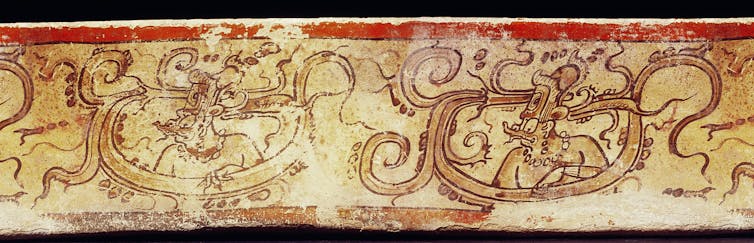
Illustrations of K’awiil can be found everywhere on Maya pottery and sculpture. He is almost human in many depictions: He has two arms, two legs and a head. But his forehead is the spark of life – and so it usually has something that produces sparks sticking out of it, such as a flint ax or a flaming torch. And one of his legs does not end in a foot. In its place is a snake with an open mouth, from which another being often emerges.
Indeed, rulers, and even gods, once performed ceremonies to K’awiil in order to try and summon other supernatural beings. As personified lightning, he was believed to create portals to other worlds, through which ancestors and gods might travel.
Representation of power
For the ancient Maya, lightning was raw power. It was basic to all creation and destruction. Because of this, the ancient Maya carved and painted many images of K’awiil. Scribes wrote about him as a kind of energy – as a god with “many faces,” or even as part of a triad similar to Huracán.
He was everywhere in ancient Maya art. But he was also never the focus. As raw power, he was used by others to achieve their ends.
Moreover, Maya artists always had K’awiil doing something or being used to make something happen. They believed that power was something you did, not something you had. Like a bolt of lightning, power was always shifting, always in motion.
An interdependent world
Because of this, the ancient Maya thought that reality was not static but ever-changing. There were no strict boundaries between space and time, the forces of nature or the animate and inanimate worlds.
Residents wade through a street flooded by Hurricane Helene, in Batabano, Mayabeque province, Cuba, on Sept. 26, 2024. AP Photo/Ramon Espinosa
Everything was malleable and interdependent. Theoretically, anything could become anything else – and everything was potentially a living being. Rulers could ritually turn themselves into gods. Sculptures could be hacked to death. Even natural features such as mountains were believed to be alive.
The illusion is not that different things exist. Rather it is that they exist independent from one another. Huracán, in this sense, damaged himself by damaging his creations.
Hurricane season every year should remind us that human beings are not independent from nature but part of it. And like Hurácan, when we damage nature, we damage ourselves.
For most dogs, their friend groups usually consist of a mix of humans and other dogs. But Lili, a 3-year-old dog who lives on a French Polynesian atoll called Fakarava, isn’t like most other dogs. She prefers friends who have gills and fins. In fact, her very best friend is a shark.
Ever since Lili’s mom, Emmanuelle Larchet, adopted Lili, she’s known that her dog has an affinity for all things aquatic. She started swimming in the lagoon near Larchet’s house when she was only a month old.
“She’s really a water dog,” Larchet told The Dodo.
There are around 100 sharks who live in this lagoon near Larchet’s house. So when Lili swims in the water there, she’s surrounded by them. While many dog parents would be terrified to see their dog swimming amongst sharks, Larchet knows that the sharks Lili swims with are nurse sharks, who are actually very docile creatures.
“We call them sea puppies because [they’re] like dogs, actually … They are very nice,” Larchet said.
Larchet likes to joke that when Lili swims around with her shark friends, it’s sea puppies meeting earth puppies.
Over the years Lili has been swimming in the lagoon, there’s one shark in particular she’s grown especially close with. His name is Sharky, and he and Lili visit each other almost every day. Larchet and Lili are able to recognize Sharky because he has a special marking on one of his fins.
Lili and Sharky like to explore their lagoon together. They enjoy splashing around in the warm, clear water.
“He comes to say hello every time she sees him,” Larchet said.
Even though Lili and Larchet are best friends themselves, Larchet is more than happy to share her Lili with Sharky. And even though Larchet watches Lili hang out with her shark friends all the time, it never gets old seeing them spend time together.
“[When] I see her swimming with Sharky, [I’m] so happy,” Larchet said.