Category: Philosophy

The aesthetic beauty of mathematics!

Sorry! Did you say the beauty of mathematics?

Those of you that read this blog fairly regularly know that from time to time I drift away from all things dog and potter in the garden of simply fascinating ideas.

Such is the case today.

It is an article on mathematics that was sent to me by Jim Goodbrod. He had read it in The New York Times in April.

Read it and see if you, too, find it as fascinating as I did!

ooOOoo

The World’s Most Beautiful Mathematical Equation
When the sun is low in the sky!

What dogs mean to us whatever our age!

I chose the title for today’s post deliberately. Wanting it to act as a metaphor for our senior years, as the dear Americans like to put it, or leaning on my English roots, preferring the metaphor of the sinking sun for the Autumnal years of our lives.

We live in a part of the world where “The median age was 47.3 years.”

Josephine County, Oregon

As of the 2010 United States Census, there were 82,713 people, 34,646 households, and 22,498 families residing in the county.[20] The population density was 50.4 inhabitants per square mile (19.5/km2). There were 38,001 housing units at an average density of 23.2 per square mile (9.0/km2).[21] The racial makeup of the county was 92.4% white, 1.4% American Indian, 0.8% Asian, 0.4% black or African American, 0.2% Pacific islander, 1.5% from other races, and 3.2% from two or more races. Those of Hispanic or Latino origin made up 6.3% of the population.[20] In terms of ancestry, 26.3% were German, 15.6% were Irish, 15.5% were English, 5.5% were Italian, and 5.5% were American.[22]

Of the 34,646 households, 25.5% had children under the age of 18 living with them, 49.2% were married couples living together, 11.0% had a female householder with no husband present, 35.1% were non-families, and 28.3% of all households were made up of individuals. The average household size was 2.34 and the average family size was 2.82. The median age was 47.3 years.[20]

Yet in the rural areas of this County one does see a fair number of people who, as with Jean and me, are the wrong side of 65!!

But one very frequent observation of those ‘senior’ people is that they have a dog in their lives.

On April 10th, I posted a guest article written by Jessica Brody. It was very well received and I closed that post by saying: “I know many will agree with me when I say that it would be good to receive some more articles from Jessica.”

Our wishes have been granted. Here is Jessica’s second guest article.

ooOOoo

The Wonderful Benefits of Pet Ownership for Seniors

by Jessica Browdy. May 3rd., 2017

It’s no mystery that pet ownership can bring joy to people’s lives, but it turns out that having a pet may benefit seniors in ways that reach far beyond the pleasures of companionship. For elderly people who live alone or in senior care facilities, owning a pet can improve mental and physical health, paving the way for longer, healthier, and happier lives. Here are five ways that having a critter companion can benefit senior health.
Pets Improve Senior Mental Health
One of the greatest benefits of pet ownership for people of any age is the unconditional friendship and love that a pet provides. This support is especially important for elderly people, who are prone to loneliness and isolation as they leave the workforce, children move away, and friends and loved ones begin to pass on. Isolation is one of the biggest risks to senior health; isolation can cause depression (and related issues), cognitive decline, and even early death. The company of a beloved pet can help seniors stave off loneliness and preserve their mental health. Caring for a pet can also give seniors something to focus on other than negative thoughts about grief, physical ailments, and aging, thereby reducing their overall stress levels.

Pets Keep Seniors Social

Pets do more than provide a social outlet for seniors — they can actually lead the elderly to be more social with their peers as well. People are naturally drawn to dogs, and a senior who is out walking a pet is more likely to meet new people than if walking alone. Pets can help bring people together in senior living facilities, too. Dogs, cats, and other animals give people a common interest over which they can come together, share stories, and develop friendships.

Pets Reduce Heart Attack Risk

Companion animals like dogs, cats, birds, and even fish can improve heart health by lowering blood pressure. One study showed that being in the presence of your dog can even have a greater impact on your blood pressure than some medications. And by lowering blood pressure, pets can reduce heart attack risk in seniors.
Pets Keep Seniors Active
The daily routine of caring for a pet helps seniors maintain functional mobility. Giving food and water, cleaning a litter box, and letting the dog outside makes a sedentary senior get up and get moving. These simple activities can support an elderly person’s ability to complete the activities of daily living like bending, preparing meals, bathing, and dressing. Older people who own dogs are also more likely to stay active into their later years. Not only do they get out to walk the dog, but they’re also more likely to be involved in other active hobbies like gardening.
Pets Improve Senior Personal Care
A senior who has a daily pet care routine is more likely to adhere to a daily personal care routine. Having a routine gives structure to a senior’s days, making it easier to adhere to medication schedules, meal times, and personal care. Maintaining a daily routine can even help seniors sleep better.

Seniors can be saviors to pets, too. When older people adopt adult or senior pets, they provide a loving, stable home to an animal that may not have found a home otherwise. Dogs and cats aged seven and older are adopted at staggeringly low rates, even though they still have years of love to give. Many shelters and rescues even offer discounts for seniors adopting senior pets, so be sure to ask if you might be able to adopt your new friend at a reduced rate.

Image viaPixabay by marmax

Author: Jessica Brody

ooOOoo

Keep them coming, Jessica. (Well that’s the view from this senior!)

In memory of Zeke

A story about the death of a very dear dog.

This is a guest post coming up today. A reflection on what any dog lover feels when their beloved dog dies. (I don’t even want to think about the end of Pharaoh that can’t be too many weeks off!) But as has been said before it is one the key lessons that we learn from our dogs.

Not too many days ago I received an email from Liz Nelson.

I wanted to submit a synopsis of how our fur babies have dealt with the loss of a friend and the addition of another one to see if you wanted to use it as a guest post.

There was no question that I wanted to publish Liz’s synopsis so it could be shared with you. Here it is.

ooOOoo

The death of Zeke

See footnote for details of this photograph.

A little over a year ago we lost our precious Rottweiler, Zeke, to bone cancer.

Zeke, a rescue who still had remnants of buckshot in his torso from his days living in the woods of Mississippi, was with our family for about 8 years. A gentler giant there never was. He and our cat were friends and Zeke frequently bathed the cat’s head and ears. Zeke and our Chow-mix (Fiona) were also very close. We joked he was in love with her because he let her collect all the toys and win at tug-a-war, despite the size difference.

Losing Zeke was a tremendous blow for our household. Both dogs and our 2 cats were visibly impacted by Zeke’s loss. Fiona took it the hardest. She became listless, fatigued, and generally out of sorts. She wasn’t interested in playing and she became an even pickier eater. She would skip several meals in a row and then eat everybody’s food at one time (including the cats’). She and the other animals refused to touch the dog bed in the living room that Zeke had used. She also refused to chew on a large rawhide we found that had once been Zeke’s. It felt like she was saving his things for when he came back to claim them. We noticed the hair under her eyes starting to go gray. She started to show and act all 9 of her years (she’s a rescue and special needs dog so we’re amazed we’ve had 9 years with her).

The vet said we could explore antidepressants but I wanted to see if we could let her try to work through it without medication. Though they remain an option if needed.

In January, my husband said he was ready to think about getting a puppy and several weeks later we adopted an adorable rescue named Pierce. The rescue told us he was part Husky and part Lab. Now that he’s older we think there’s a hefty dose of hound in there. After a few days of wariness and some growling, the older dogs decided to accept the puppy as part of the household. Fiona regained her energy and she was often seen in the yard with the puppy, teaching Pierce how to play fight or stalk birds. She would chase the puppy until they were both exhausted (which we were grateful for). Sometimes she got annoyed with the puppy but for the most part she took on a big sister role.

Fast forward a few months and the puppy is now the biggest dog in the house. While he really is a good dog, he’s still a puppy. Now when he is too energetic there is a lot more of him bouncing around a room. Fiona spends much of her time reinforcing her dominance by taking his toys and putting them under her chin where Pierce is afraid to attempt to retrieve them. She’s stopped running around the yard to play with him. Perhaps because it hurts when you collide with 45 lbs of speeding, clumsy puppy (just ask my husband)? She has gone back to spending most of her time looking pitiful. She will let me pet her though she acts as if it is an imposition.

We’re hoping that when the puppy matures a little more Fiona will regain interest in playing with him. Or at least his behavior won’t annoy her as much. I know that the puppy can never replace Zeke’s place in the family but I really hope Fiona doesn’t spend the rest of her dog life mourning Zeke and ignoring the new dog!

Liz Nelson

Footnote (re the photo above):

I have a great picture of our family with Zeke and Fiona in it (and my third dog). It’s one of our engagement photos and I’m so glad we included the pups. As you can see Zeke was super cuddly! It’s one of my favorite pictures. You can use any of the information in my about section for an introduction. I don’t have it very detailed (I only started this blog this week) so if there is any additional info you want to include please let me know. I looked around for a more recent photo of myself but all of my recent ones are from Halloweens and involve costumes. Not really an everyday look!

So I guess let’s stick with the family photo. Thank you Paul!

ooOOoo

Liz’s website is Supervising With Social Anxiety. Her About page opens with:

I am a supervisor at a small non-profit agency. I’m also in school part-time working on a doctorate. I’m a social worker so I’ve been working in non-profit agencies since I got my master’s degree around 8 years ago. I’ve been in management for around 5 years. I have had to deal with pretty intense social anxiety for as long as I can remember.

Another great connection if you ask me!!

Natalie exploring the meaning of peace.

Another delightful travel account from Natalie Derham-Weston.

Albeit perhaps travels of a more inward nature.

ooOOoo

Travel Blog: Installment 3: Living on a boat.

Simple Peace

I fancied an interlude this week to share a morning I enjoyed over the weekend. It isn’t often that the chance arises to enjoy our local surroundings without time limits, overdue deadlines or inconvenient meetings. However, I had a day off Saturday; a concept becoming more and more valued having since started a new full-time job, which is quite demanding on my time. I have requested this high load of hours but after months of travelling and not having regular work, it is taking a while for me to adjust to the mental and physical demands.

Anyway, without going into the irrelevant details, I have been spending my time living on a boat in a marina in Lymington, a small sea side town in the New Forest on the South Coast of England. This means my commute to work is a 2 minute walk and although I do not know the first notion about sailing, I have quickly fallen for the lifestyle of boats and water. I have found it to be extremely sociable and relaxing and I have all I need around me. This includes a bicycle, a car, swimming facilities, work, grocery shops and a very modest yet comfortable boat.

So last Saturday, I woke up early, as I was already in the routine of being awake from my work shifts and saw the sun streaming in through the port hole windows. This immediately buoyed me and I pulled the curtains and opened the hatch to let in the fresh air. I had a few items on a to do list but I certainly didn’t intend on wasting the valuable time I had.

I did have an appointment I couldn’t shirk but made it as quick as possible and on the way back picked up some lunch items. Back on the boat, I had a quick tidy and clean as I firmly believe an orderly workspace leads to a clearer mind.

I pre-empt this by saying I am usually accompanied by my father on the boat but this specific day was the first time I had been left in solo charge and this gave me somewhat of an independent free feeling. So my next mission was to cook some eggs which I did on our very small gas camping stove. I took some cushions out on deck and had my lunch in the warm April sunshine. Our pontoon seems to be quite an active mooring site and there were people constantly wandering along it all day, carrying tools, bags and equipment back and forth. So although I was alone, I did not feel isolated.

I then left everything behind on the boat, including my phone and took my bicycle around the headland on a trail I had never been on before. The channel was extremely clear and I had a wonderful view over to the Isle of Wight and watched the bustle of boats going to and fro. I passed lots of families, dogs, bird watchers and couples but kept going at a steady pace along the gravel track headed towards Keyhaven, the next fishing village along.

There is no specific reason why I enjoyed this so much, just the whole atmosphere and surroundings made for a very encompassing uplifting day. I continued along the path, and had no care as to where I was or where I was going. I was confident enough that I knew I’d always find my way back somehow and so without that pre-conditioned feeling of panic, I cycled on along the back roads and hauled my bicycle over fences and gates.

Two hours later I cycled back in to the marina and abandoned the bike next to the boat. The boat is never locked, another aspect I really appreciate. I don’t think this would be possible everywhere, but it allows for a very open way of life. So I grabbed a cushion and headed to the bow of the boat, lying in the sun, drinking a beer, watching the world go by.

This just proved to me how easy it is to be happy sometimes. We need very little but that day will stay in my memory for a long time as a point in time where I was 100% content.

ooOOoo

I had the great fortune of living on a yacht Songbird of Kent, a Tradewind 33, for five years in the late ’80s early ’90s based out of Larnaca on the Greek side of Cyprus. I can fully vouch for the peace that Natalie has written about.

No place for amateurs!

Offering up a tribute to the work of a professional.

Many, many years ago when I was in business on my own account (1978-1986) I had the pleasure of getting to know Frank Tijou. He was running his own very successful business. But more important than that, Frank had this wonderful ability to explain what he had learned over his years of being an entrepreneur. One such learning was stick to what you really know and don’t try and do things that are best left to other professionals. In other words, don’t be an amateur when it comes to important matters.

Thus when some weeks ago I was strongly recommended by some local authors to have an author website, I looked around for a professional. I quickly came to find Christy Kiltz of Design! by Kiltz Internet Solutions.

Talk about finding a true professional.

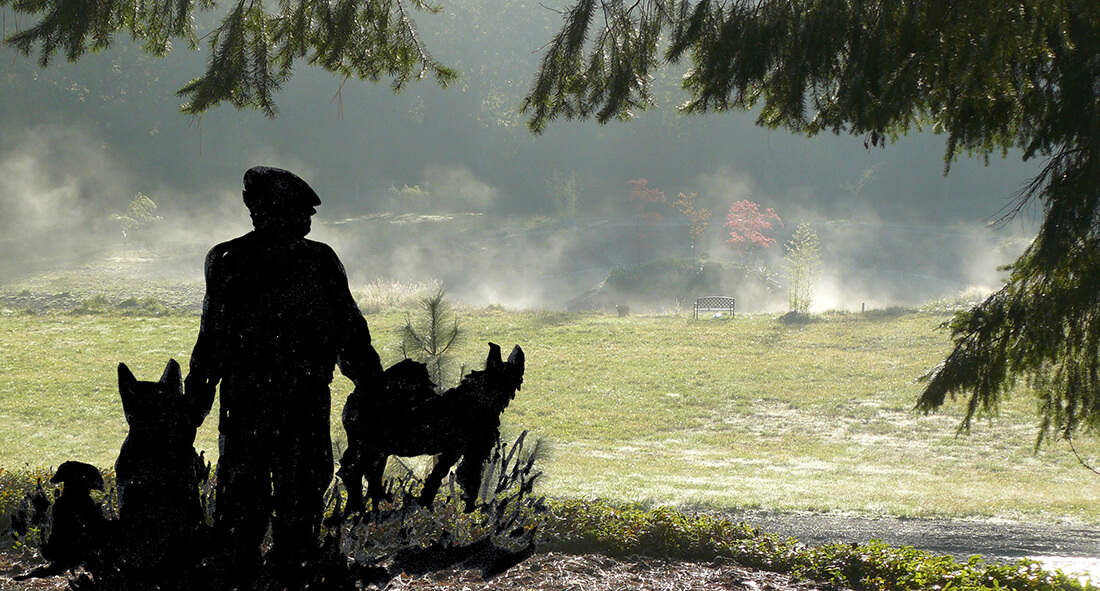
Forgive me, I’m not coming at this in terms of an ego trip. I just want to promote what a wonderful job Christy did. (And not forgetting Emily’s grand design work.) (And most certainly not forgetting my darling Jeannie who did the image of the man in a flat cap with the dogs!)

Please go across to my new website: Paul Handover – Life Traveller.

The home page banner image from my website.

So in the words of American playwright Garson Kanin:

“Amateurs hope, professionals work.”

Thank you, Christy!

In the land of the blind!

On the Problem of Good: A book review.

As is the way of the Internet and Blogging it is inevitable that connections are made in all four corners of the globe. Some connections are transient, others become long-term. The connection between author John Zande and this blog fits the latter description.

If, dear reader, you have read my posts of the last two days, then that connection between John and me will be clear.

So on to John’s latest book: On the Problem of Good.

Now despite the fact that I awarded the book five stars on Amazon I can’t tell you that it is an easy read. Nor, to that fact, is it a comfortable read.

For John’s book played around with my head in so many ways that I am still far from returning to a settled mind. Indeed, I have a sneaky suspicion that On the Problem of Good represents another one of those turnstiles in life where once through the ‘gate’ there is no returning to the past way of seeing things.

It played with my mind in the sense of forcing me, albeit with a very small ‘f’, to truly comprehend the consequences of unanticipated outcomes. You know that old saying: “Never underestimate the power of unanticipated consequences“.

Here’s an example.

In 1889 a total of 26 road deaths were recorded in the United States. By 2013 that number had exploded to approximately 35,500. Globally, the number stands at 1.24 million and the World Health Organisation  predicts the body of carnage will grow to 1.9 million by 2020. (p.44)

That is just one of the many examples that John uses to support his premise that “good simply does not exist”.

But it goes deeper than that. For John reveals the incalculable, unstoppable force of evolution. Going right back to the very origins of matter. How hydrogen fused into the more complex helium that, in turn, fused into the still heavier and more complex carbon, then along came the fusing of helium and carbon to make oxygen. Then the journey of evolution of atoms. From single atoms to simple compounds, binding to produce double compounds and on to molecules. Then the marriage between molecules to produce amino acids, and on and on to proteins and enzymes and … well, you get the idea!

That continuum from simple to complex organisms and on and on to air-breathing animals (including wolves and then dogs!) and all the way to the likes of yours truly sitting in front of a modern computer writing the review of another person’s book.

All the time, since 13.82 billion years ago, the evolutionary force being a one-way street. A one-way street where John, with some degree of persuasiveness, demonstrates that everything that might, at that time, be seen as a good is not fundamentally a good because it is inextricably connected to a resulting evil.

The Problem of Good is a word problem. It is a lexical glitch, a squabble in temporal, fleshy definitions, and nothing more.

There is no disagreement or antipathy because there is no problem.

Good does not exist. (p.29)

See what I mean about this not being a comfortable book to read!

Nevertheless, you are waiting to hear from me as to whether or not you should read this book?

In answer, here’s a part of what I wrote for my review of the book on Amazon:

If you ever pause for a moment and wonder about the meaning of life, better written as The Meaning of LIFE, then this book is for you. More than that. For if you never ponder about the meaning of life then this really, really is the book for you.

Because for most of us, for most of the time, we live in the land of the blind.

So, thank goodness, that from time to time along comes a person who is the one-eyed King.

Thank you, John Zande.

The Owner of All Infernal Names.

A republication of my review of John Zande’s book back in October, 2015.

More than a book review,

a whole new way of looking at you and me, and the rest of humanity.

Back on September 16th, I published the post Of paradoxes, and headaches! It included the fact that I was about 20% of the way through John Zande’s book The Owner of All Infernal Names.

John Zande cover_zpsz7wuq9ccOn Tuesday evening of this week, I finished the book and, without doubt, I shall be publishing a review on Amazon books by the end of the week. First, I wanted to share a longer reflection of Zande’s book with all of you dear readers.

ooOOoo

One of the many five-star reviews of this book that has been published on the relevant Amazon page opens simply: “This is a beautifully written, terribly uncomfortable book to read.” I couldn’t better that summary. This is, indeed, a beautifully written book. Yet it is also a book that will forever change the way you think about species: Homo sapiens.

Zande offers a powerful argument that, “Following then the Principle of Sufficient Reason, the observer concludes with a level of argued certainty that a Creator must exist.” Then sets out to demonstrate that this Creator, far from being an expression of universal love, is fundamentally an expression of universal suffering. Reminding the reader that, “This world was never good. It was never peaceful, and never without suffering.”

For the first time in my life, Zande’s words had cause for me to reflect on something that, hitherto, had never dawned on me. That if there is a God, why have I, and countless others, assumed that this God be necessarily benevolent. The evidence presented in Zande’s book is comprehensive: that there was an evil origin to the universe and, more directly, that the deep, and growing, suffering of the pinnacle of evolution, us humans, can be traced back to that evil origin. Better than that, frequently the book is almost scientific. And in the best of scientific traditions, Zande adopts the position of a neutral witness.

Whether or not you are relaxed about that previous paragraph, and I suspect many readers will not, it is impossible not to be in awe of the beauty, the power, and the eloquence of Zande’s words. Take this opening paragraph of Zande’s chapter titled A SIGHTLESS CREATION.

It is a basal vagary, a question that screams for attention and if left unresolved – if left problematic – could invalidate all practicalities of a functioning Creation lorded by a maximally wicked Creator: Would sentient, attentive, self-respecting life choose to live in a world underwritten by evil? Could self-aware life endure a thoroughly hopeless reality?

Whether one is a believer in a religious god or not, it will also be impossible not to have one’s deepest emotions and beliefs about the nature of humankind stirred very deeply around. No-one who reads this book will be left unchanged.

If you have ever pondered about the way the world is heading, or more accurately put, about the way that we humans are managing our existence on Planet Earth, then you need to read this book. Period!

ooOOoo

So my review of John Zande’s latest book is being published tomorrow.

John Zande

A stirrer of brain cells!

I have just finished reading John’s recently published book On the Problem of Good. I am writing a review of the book that, fingers crossed, I will publish on Friday. But many of you that are recent converts to this blog (you poor, lost souls!) will not remember my review of John’s first book and my reaction to that book when I was only just into it.

So, for both today and tomorrow I am republishing two blog posts. Today, one that was originally published on the 16th September, 2015, and tomorrow the post that was first published on 1st October, 2015.

ooOOoo

Of paradoxes, and headaches!

The interconnectedness of everything – even beyond our wildest imagination.

A while ago John Zande signed up to follow Learning from Dogs. Naturally, I went across to John’s blog to thank him. There I discovered that John is an animal lover and an author. For he states, referring to his book, that, “BUY IT. ALL PROCEEDS GO TO ANIMAL RESCUE AND SHELTER IN BRAZIL”. Fabulous!

John Zande cover_zpsz7wuq9cc

(I did buy the book, am about 20% through it and finding it very stimulating, – if you would like to buy it then click the image of the book on John’s home page.)

Anyway, a few days later we watched the BBC Horizon programme on multiple universes. Here’s how the BBC introduced the programme:

Which Universe Are We In?

Horizon, 2014-2015 Episode 17 of 19

Imagine a world where dinosaurs still walk the earth. A world where the Germans won World War II and you are president of the United States. Imagine a world where the laws of physics no longer apply and where infinite copies of you are playing out every storyline of your life.

It sounds like a plot stolen straight from Hollywood, but far from it. This is the multiverse.

Until very recently the whole idea of the multiverse was dismissed as a fantasy, but now this strangest of ideas is at the cutting edge of science.

And for a growing number of scientists, the multiverse is the only way we will ever truly make sense of the world we are in.

Horizon asks the question: Do multiple universes exist? And if so, which one are we actually in?

Horizon is always great to watch but this episode was incredibly stimulating and interesting. Later, in a exchange of comments to one of John’s posts, where I referred to that programme, John wrote:

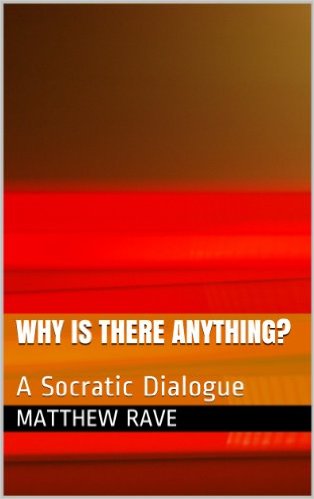
The mulitverse is actually the more reasonable explanation for why there is something, and although I don’t understand the maths, the people who do say its simplistically beautiful. Matt Rave is an associate professor of physics and comments here regularly. He has a great book on it all, Why is There Anything?

raveThat lead me to purchasing Matthew Rave’s book that, likewise, is a most fascinating and unusual approach to this topic. His Amazon author’s page reveals that, “Dr. Matthew Rave is an assistant professor of physics at Western Carolina University, in the mountains of North Carolina. His research interests include interpretations of quantum mechanics, the geometric phase, solid state physics, and physics education.” Matthew Rave’s blogsite is here.

Matthew Rave’s book further illustrates the paradox, to my mind, that comes from thinking about why are we here, are we here and, if so, how do we know we are here?

So if that isn’t enough for you and me, then very recently The Conversation blogsite published the following from Geraint Lewis who is Professor of Astrophysics at the University of Sydney. It is republished here within the terms of The Conversation. Did I mention paradoxes and headaches!

ooOOoo

We are lucky to live in a universe made for us

Geraint Lewis, University of Sydney

To a human, the universe might seem like a very inhospitable place. In the vacuum of space, you would rapidly suffocate, while on the surface of a star you would be burnt to a crisp. As far as we know, all life is confined to a sliver of an atmosphere surrounding the rocky planet we inhabit.

But while the origin of life on Earth remains mysterious, there are bigger questions to answer. Namely: why do the laws of physics permit any life at all?

Hang on, the laws of physics? Surely they are a universal given and life just gets on with it?

But remember that the universe is built of fundamental pieces, particles and forces, which are the building blocks of everything we see around us. And we simply don’t know why these pieces have the properties they do.

There are many observational facts about our universe, such as electrons weighing almost nothing, while some of their quark cousins are thousands of times more massive. And gravity being incredibly weak compared to the immense forces that hold atomic nuclei together.

Why is our universe built this way? We just don’t know.

But what if…?

This means we can ask “what if” questions. What if the electron was massive and quarks were fleeting? What if electromagnetism was stronger than the nuclear strong force? If so, what would that universe be like?

Let’s consider carbon, an element forged in the hearts of massive stars, and an element essential to life as we know it.

Initial calculations of such stellar furnaces showed that they were apparently inefficient in making carbon. Then the British astronomer Fred Hoyle realised the carbon nucleus possesses a special property, a resonance, that enhanced the efficiency.

But if the strength of the strong nuclear force was only fractionally different, it would wipe out this property and leave the universe relatively devoid of carbon – and, thus, life.

The story doesn’t end there. Once carbon is made, it is ripe to be transmuted into heavier elements, particularly oxygen. It turns out that oxygen, due to the strength of the strong nuclear force, lacks the particular resonance properties that enhanced the efficiency of carbon creation.

This prevents all of the carbon being quickly consumed. The specific strength of the strong force has thus resulted in a universe with an almost equal mix of carbon and oxygen, a bonus for life on Earth.

Death of a universe

This is but a single example. We can play “what if” games with the properties of all of the fundamental bits of the universe. With each change we can ask, “What would the universe be like?”

The answers are quite stark. Straying just a little from the convivial conditions that we experience in our universe typically leads to a sterile cosmos.

This might be a bland universe, without the complexity required to store and process the information central to life. Or a universe that expands too quickly for matter to condense into stars, galaxies and planets. Or one that completely re-collapses again in a matter of moments after being born. Any complex life would be impossible!

The questions do not end there. In our universe, we live with the comfort of a certain mix of space and time, and a seemingly understandable mathematical framework that underpins science as we know it. Why is the universe so predictable and understandable? Would we be able to ask such a question if it wasn’t?

Our universe appears to balance on a knife-edge of stability. But why?

We appear to be very lucky to live in a universe that accommodates life. Zdenko Zivkovic/Flickr, CC BY

One of a multiverse

To some, science will simply fix it all. Perhaps, if we discover the “Theory of Everything”, uniting quantum mechanics with Einstein’s relativity, all of the relative masses and strengths of the fundamental pieces will be absolutely defined, with no mysteries remaining. To others, this is little more than wishful thinking.

Some seek solace in a creator, an omnipotent being that finely-tuned the properties of the universe to allow us to be here. But the move from the scientific into the supernatural leaves many uncomfortable.

There is, however, another possible solution, one guided by the murky and confused musings at the edge of science. Super-strings or M-theory (or whatever these will evolve into) suggest that the fundamental properties of the universe are not unique, but are somehow chosen by some cosmic roll of the dice when it was born.

This gives us a possible explanation of the seemingly special properties of the universe in which we live.

We are not the only universe, but just one in a semi-infinite sea of universes, each with their own peculiar set of physical properties, laws and particles, lifetimes and ultimately mathematical frameworks. As we have seen, the vast majority of these other universes in the overall multiverse are dead and sterile.

They only way we can exist to ask the question “why are we here?” is that we happen to find ourselves in a universe conducive to our very existence. In any other universe, we simply wouldn’t be around to wonder why we didn’t exist.

If the multiverse picture is correct, we have to accept that the fundamental properties of the universe were ultimately dished out in a game of cosmic roulette, a spin of the wheel that we appear to have won.

Thus we truly live in a fortunate universe.

The ConversationGeraint Lewis, Professor of Astrophysics, University of Sydney

This article was originally published on The Conversation. Read the original article.

ooOOoo

12963392-An-image-of-a-man-with-a-headache--Stock-Vector-headache-earache-cartoonooOOoo

How to follow that, eh?

Let me give way to Hariod Brawn and part of an extensive comment she left back then:

John Zande is most certainly one of the most thoughtful, perceptive, well-informed and sharp-witted bloggers I have ever come across, and I wish him well with his book, which by the way, appears so far to have been met only with a deluge of 5-star reviews on Amazon. I daresay that you and I will both lengthen that list.

Here! Here!

This is the dog!

Perhaps the loss of a loved dog explains so much!

The posts for the last two days have carried separate and very different stories of terrible cruelty to dogs, the second one involving terrible cruelty to a dog and a bull! As a tradition! Ouch!!

Readers of this place know what they feel about dogs. It is felt deep within their hearts. Those feelings are poured out when, either from me or someone else, there’s a post lamenting the loss of their dog.

Just as a tiny example of that love we all have for our dogs, here’s a response from Marina Kanavaki and, trust me, Marina is far from being alone in this regard.

Oh, no, Paul!!! I’m so sorry my friend! It is hard to believe and not so long ago, Casey. I know words can’t take away the pain but you have my thoughts and I’m sending you both my love and hugs.

So a recent essay published on The Conversation site is a must to share with you today. As usual, it is republished within the terms of The Conversation.

ooOOoo

Why losing a dog can be harder than losing a relative or friend

March 9, 2017
Frank T. McAndrew,   Cornelia H. Dudley Professor of Psychology, Knox College.

Recently, my wife and I went through one of the more excruciating experiences of our lives – the euthanasia of our beloved dog, Murphy. I remember making eye contact with Murphy moments before she took her last breath – she flashed me a look that was an endearing blend of confusion and the reassurance that everyone was ok because we were both by her side.

When people who have never had a dog see their dog-owning friends mourn the loss of a pet, they probably think it’s all a bit of an overreaction; after all, it’s “just a dog.”

However, those who have loved a dog know the truth: Your own pet is never “just a dog.”

Many times, I’ve had friends guiltily confide to me that they grieved more over the loss of a dog than over the loss of friends or relatives. Research has confirmed that for most people, the loss of a dog is, in almost every way, comparable to the loss of a human loved one. Unfortunately, there’s little in our cultural playbook – no grief rituals, no obituary in the local newspaper, no religious service – to help us get through the loss of a pet, which can make us feel more than a bit embarrassed to show too much public grief over our dead dogs.

Perhaps if people realized just how strong and intense the bond is between people and their dogs, such grief would become more widely accepted. This would greatly help dog owners to integrate the death into their lives and help them move forward.

An interspecies bond like no other

What is it about dogs, exactly, that make humans bond so closely with them?

For starters, dogs have had to adapt to living with humans over the past 10,000 years. And they’ve done it very well: They’re the only animal to have evolved specifically to be our companions and friends. Anthropologist Brian Hare has developed the “Domestication Hypothesis” to explain how dogs morphed from their grey wolf ancestors into the socially skilled animals that we now interact with in very much the same way as we interact with other people.

Perhaps one reason our relationships with dogs can be even more satisfying than our human relationships is that dogs provide us with such unconditional, uncritical positive feedback. (As the old saying goes, “May I become the kind of person that my dog thinks I already am.”)

This is no accident. They have been selectively bred through generations to pay attention to people, and MRI scans show that dog brains respond to praise from their owners just as strongly as they do to food (and for some dogs, praise is an even more effective incentive than food). Dogs recognize people and can learn to interpret human emotional states from facial expression alone. Scientific studies also indicate that dogs can understand human intentions, try to help their owners and even avoid people who don’t cooperate with their owners or treat them well.

Not surprisingly, humans respond positively to such unrequited affection, assistance and loyalty. Just looking at dogs can make people smile. Dog owners score higher on measures of well-being and they are happier, on average, than people who own cats or no pets at all.

Like a member of the family

Our strong attachment to dogs was subtly revealed in a recent study of “misnaming.” Misnaming happens when you call someone by the wrong name, like when parents mistakenly calls one of their kids by a sibling’s name. It turns out that the name of the family dog also gets confused with human family members, indicating that the dog’s name is being pulled from the same cognitive pool that contains other members of the family. (Curiously, the same thing rarely happens with cat names.)

It’s no wonder dog owners miss them so much when they’re gone.

Psychologist Julie Axelrod has pointed out that the loss of a dog is so painful because owners aren’t just losing the pet. It could mean the loss of a source of unconditional love, a primary companion who provides security and comfort, and maybe even a protégé that’s been mentored like a child.

The loss of a dog can also seriously disrupt an owner’s daily routine more profoundly than the loss of most friends and relatives. For owners, their daily schedules – even their vacation plans – can revolve around the needs of their pets. Changes in lifestyle and routine are some of the primary sources of stress.

According to a recent survey, many bereaved pet owners will even mistakenly interpret ambiguous sights and sounds as the movements, pants and whimpers of the deceased pet. This is most likely to happen shortly after the death of the pet, especially among owners who had very high levels of attachment to their pets.

While the death of a dog is horrible, dog owners have become so accustomed to the reassuring and nonjudgmental presence of their canine companions that, more often than not, they’ll eventually get a new one.

So yes, I miss my dog. But I’m sure that I’ll be putting myself through this ordeal again in the years to come.

ooOOoo

Just let the messages of this essay reverberate around your heart. I’ll say no more!

Searching for the Truth

Resolving the falsehoods may not be so straightforward as one thinks.

I’m going straight into this last post of my mini-series looking at the state of things. Namely a recent essay published by Professor Ronald Pies:

Professor of Psychiatry, Lecturer on Bioethics & Humanities at SUNY Upstate Medical University; and Clinical Professor of Psychiatry, Tufts University School of Medicine, Tufts University

I am a psychiatrist and ethicist affiliated with SUNY Upstate Medical University, Syracuse, NY; and Tufts University School of Medicine in Boston. I write on a variety of cross-disciplinary topics, ranging from mental health to philosophy of mind to spirituality. Most recently, I have authored the novella, “The Late Life Bloom of Rose Rabinowitz;” and the poetry chapbook, “The Myeloma Year.”

Here is that post, republished within the terms of The Conversation.

ooOOoo

‘Alternative facts’: A psychiatrist’s guide to twisted relationships to truth

March 1, 2017

The phrase “alternative facts” has recently made the news in a political context, but psychiatrists like me are already intimately acquainted with the concept – indeed, we hear various forms of alternate reality expressed almost every day.

All of us need to parse perceived from actual reality every day, in nearly every aspect of our lives. So how can we sort out claims and beliefs that strike most people as odd, unfounded, fantastical or just plain delusional?

Untruths aren’t always lies

First, we need to make a distinction often emphasized by ethicists and philosophers: that between a lie and a falsehood. Thus, someone who deliberately misrepresents what he or she knows to be true is lying – typically, to secure some personal advantage. In contrast, someone who voices a mistaken claim without any intent to deceive is not lying. That person may simply be unaware of the facts, or may refuse to believe the best available evidence. Rather than lying, he’s stating a falsehood.

Some people who voice falsehoods appear incapable of distinguishing real from unreal, or truth from fiction, yet are sincerely convinced their worldview is absolutely correct. And this is our entree into the psychiatric literature.

In clinical psychiatry, we see patients with a broad spectrum of ideas that many people would find eccentric, exaggerated or blatantly at odds with reality. The clinician’s job is, first, to listen empathically and try to understand these beliefs from the patient’s point of view, carefully taking into account the person’s cultural, ethnic and religious background.

Sometimes, clinicians can be wildly mistaken in their first impressions. A colleague of mine once described a severely agitated patient who was hospitalized because he insisted he was being stalked and harassed by the FBI. A few days into his hospitalization, FBI agents showed up on the unit to arrest the patient. As the old joke goes, just because you’re paranoid doesn’t mean they aren’t after you!

As strongly as she believes, it doesn’t make it true. Talking image via http://www.shutterstock.com.

When what you believe is wrong

We can think of distortions of reality as falling along a continuum, ranging from mild to severe, based on how rigidly the belief is held and how impervious it is to factual information. On the milder end, we have what psychiatrists call over-valued ideas. These are very strongly held convictions that are at odds with what most people in the person’s culture believe, but which are not bizarre, incomprehensible or patently impossible. A passionately held belief that vaccinations cause autism might qualify as an over-valued idea: it’s not scientifically correct, but it’s not utterly beyond the realm of possibility.

On the severe end of the continuum are delusions. These are strongly held, completely inflexible beliefs that are not altered at all by factual information, and which are clearly false or impossible. Importantly, delusions are not explained by the person’s culture, religious beliefs or ethnicity. A patient who inflexibly believes that Vladimir Putin has personally implanted an electrode in his brain in order to control his thoughts would qualify as delusional. When the patient expresses this belief, he or she is not lying or trying to deceive the listener. It is a sincerely held belief, but still a falsehood.

Falsehoods of various kinds can be voiced by people with various neuropsychiatric disorders, but also by those who are perfectly “normal.” Within the range of normal falsehood are so-called false memories, which many of us experience quite often. For example, you are absolutely certain you sent that check to the power company, but in fact, you never did.

As social scientist Julia Shaw observes, false memories “have the same properties as any other memories, and are indistinguishable from memories of events that actually happened.” So when you insist to your spouse, “Of course I paid that electric bill!” you’re not lying – you are merely deceived by your own brain.

A much more serious type of false memory involves a process called confabulation: the spontaneous production of false memories, often of a very detailed nature. Some confabulated memories are mundane; others, quite bizarre. For example, the person may insist – and sincerely believe – that he had eggs Benedict at the Ritz for breakfast, even though this clearly wasn’t the case. Or, the person may insist she was abducted by terrorists and present a fairly elaborate account of the (fictional) ordeal. Confabulation is usually seen in the context of severe brain damage, such as may follow a stroke or the rupture of a blood vessel in the brain.

Lying as a default

Finally, there is falsification that many people would call pathological lying, and which goes by the extravagant scientific name of pseudologia fantastica (PF). Writing in the Psychiatric Annals, Drs. Rama Rao Gogeneni and Thomas Newmark list the following features of PF:

  • A marked tendency to lie, often as a defensive attempt to avoid consequences. The person may experience a “high” from this imaginative story-telling.
  • The lies are quite dazzling or fantastical, though they may contain truthful elements. Often, the lies may capture considerable public attention.
  • The lies tend to present the person in a positive light, and may be an expression of an underlying character trait, such as pathological narcissism. However, the lies in PF usually go beyond the more “believable” stories of persons with narcissistic traits.

Although the precise cause or causes of PF are not known, some data suggest abnormalities in the white matter of the brain – bundles of nerve fibers surrounded by an insulating sheath called myelin. On the other hand, the psychoanalyst Helene Deutsch argued that PF stems from psychological factors, such as the need to enhance one’s self-esteem, secure the admiration of others or to portray oneself as either a hero or a victim.

Who cares about facts anyway?

Of course, all of this presumes something like a consensus on what constitutes “reality” and “facts” and that most people have an interest in establishing the truth. But this presumption is looking increasingly doubtful, in the midst of what has come to be known as the “post-truth era.” Charles Lewis, the founder of the Center for Public Integrity, described ours as a period in which “up is down and down is up and everything is in question and nothing is real.”

Are lies becoming our rose-colored glasses? Christian Bucad, CC BY-NC-ND

Even more worrisome, the general public seems to have an appetite for falsehood. As writer Adam Kirsch recently argued, “more and more, people seem to want to be lied to.” The lie, Kirsch argues, is seductive: “It allows the liar and his audience to cooperate in changing the nature of reality itself, in a way that can appear almost magical.”

And when this magical transformation of reality occurs, whether in a political or scientific context, it becomes very difficult to reverse. As the writer Jonathan Swift put it, “Falsehood flies, and the Truth comes limping after it.”

Psychiatrists are not in a position to comment on the mental health of public figures they have not personally evaluated or on the nature of falsehoods sometimes voiced by our political leaders. Indeed, the “Goldwater Rule” prohibits us from doing so. Nevertheless, psychiatrists are keenly aware of the all-too-human need to avoid or distort unpleasant truths. Many would likely nod in agreement with an observation often attributed to the psychoanalyst Carl Jung: “People cannot stand too much reality.”

ooOOoo

With Carl Jung’s words echoing in one’s mind the reaction that does come to me and, undoubtedly, to many others, is that the time for limiting what degree of reality we can take on board is rapidly coming to a close.

Or so much more elegantly conveyed by Maya Angelou.

Back to more gentle and soft ideas tomorrow – and that’s the Truth!