As many of you will know, yesterday I published a post under the heading of Dogs: Aren’t They Incredible. It was the first of three essays that have been published by The Smithsonian about the wonderful ways of the dog.
So when I was wondering just what to share with you today and was browsing ‘stuff’ this story over on the Care2 site struck me as a perfect companion to yesterday’s post.
ooOOoo
Man Hears Barking From Under Pavement and Rescues Buried-Alive Dog
Editor’s note: This post is a Care2 favorite, back by popular demand. It was originally published on October 4, 2015. Enjoy!
A pregnant dog buried alive under paving stones for two days was rescued by local hero Rustam Vadim who heard a soft barking sound as he walked home with family in the Russian city of Voronezh.
Concerned about the dog’s survival, Rustam immediately went to the public utilities office to ask for help in rescuing her but was told that that department had not made the repair to a long-standing large hole in the street and they could not help.
Apparently, workers from a different government agency had made the repair and were unaware of the dog hiding in the hole as they sealed it over with paving stones.
[Ed: This video has a Russian commentary but you don’t need words to understand it!]
“My husband started to hammer to pull out the cobblestone and to hand dig out the sand because he did not have a shovel,” Rustam’s wife explains. “There was a gap that laid between the large cobblestones. My husband removed one stone and saw the face of a dog. He started to slowly pull out the dog as she is pregnant. After rescuing the dog, we recovered the hole so there is no threat to people.”
The dog was reportedly taken to a shelter and is being cared for. How many of you would like a man like Rustam as your friend or neighbor?
In fact, it underlines the truth that despite all the gloom and doom we read about on a daily basis most of the people out there are nice people!
Finally, I was curious as to where Voronezh was in Russia. Thanks to ‘Google’ that question was quickly answered:
Voronezh is a city and the administrative center of Voronezh Oblast, Russia, straddling the Voronezh River and located 12 kilometers from where it flows into the Don. Wikipedia
It appears to be about an eight-hour drive South-south-east of Moscow and here’s a picture of the city.
To take us away from the madness of present times!
The following is republished with the very kind permission of Belas Bright Ideas.
It makes a wonderful alternative to The State of the World as featured the last three days.
ooOOoo
Tributaries
Black is the color of undefined space,
of chasms so large many fear to fall,
inky background behind the night rainbow
void of busy-ness of day,
flowing cleanly down the split shaft
of an old quill pen, seeping deeply
into dimples of vellum;
—
Striking contrast, none or full phases
of lunation, back to black, again
and anon, ebony skin bejeweled
in glorious hues, unruly hair
and wild patterned dress,
cradle of civilization suffused
with damp earthen heat;
—
Unsterile, untamed, U as in unify, more
like u-turn, what did I miss, back to origins,
basics, unity in community, necessitating
complementarity, muting
blinding tonalities of white;
—
Born into a dusky womb, darkness follows
into death, settled now into the earth,
home we take for granted
until breath and water are gone.
Resolving the falsehoods may not be so straightforward as one thinks.
I’m going straight into this last post of my mini-series looking at the state of things. Namely a recent essay published by Professor Ronald Pies:
Professor of Psychiatry, Lecturer on Bioethics & Humanities at SUNY Upstate Medical University; and Clinical Professor of Psychiatry, Tufts University School of Medicine, Tufts University
I am a psychiatrist and ethicist affiliated with SUNY Upstate Medical University, Syracuse, NY; and Tufts University School of Medicine in Boston. I write on a variety of cross-disciplinary topics, ranging from mental health to philosophy of mind to spirituality. Most recently, I have authored the novella, “The Late Life Bloom of Rose Rabinowitz;” and the poetry chapbook, “The Myeloma Year.”
Here is that post, republished within the terms of The Conversation.
ooOOoo
‘Alternative facts’: A psychiatrist’s guide to twisted relationships to truth
March 1, 2017
The phrase “alternative facts” has recently made the news in a political context, but psychiatrists like me are already intimately acquainted with the concept – indeed, we hear various forms of alternate reality expressed almost every day.
All of us need to parse perceived from actual reality every day, in nearly every aspect of our lives. So how can we sort out claims and beliefs that strike most people as odd, unfounded, fantastical or just plain delusional?
Untruths aren’t always lies
First, we need to make a distinction often emphasized by ethicists and philosophers: that between a lie and a falsehood. Thus, someone who deliberately misrepresents what he or she knows to be true is lying – typically, to secure some personal advantage. In contrast, someone who voices a mistaken claim without any intent to deceive is not lying. That person may simply be unaware of the facts, or may refuse to believe the best available evidence. Rather than lying, he’s stating a falsehood.
Some people who voice falsehoods appear incapable of distinguishing real from unreal, or truth from fiction, yet are sincerely convinced their worldview is absolutely correct. And this is our entree into the psychiatric literature.
In clinical psychiatry, we see patients with a broad spectrum of ideas that many people would find eccentric, exaggerated or blatantly at odds with reality. The clinician’s job is, first, to listen empathically and try to understand these beliefs from the patient’s point of view, carefully taking into account the person’s cultural, ethnic and religious background.
Sometimes, clinicians can be wildly mistaken in their first impressions. A colleague of mine once described a severely agitated patient who was hospitalized because he insisted he was being stalked and harassed by the FBI. A few days into his hospitalization, FBI agents showed up on the unit to arrest the patient. As the old joke goes, just because you’re paranoid doesn’t mean they aren’t after you!
We can think of distortions of reality as falling along a continuum, ranging from mild to severe, based on how rigidly the belief is held and how impervious it is to factual information. On the milder end, we have what psychiatrists call over-valued ideas. These are very strongly held convictions that are at odds with what most people in the person’s culture believe, but which are not bizarre, incomprehensible or patently impossible. A passionately held belief that vaccinations cause autism might qualify as an over-valued idea: it’s not scientifically correct, but it’s not utterly beyond the realm of possibility.
On the severe end of the continuum are delusions. These are strongly held, completely inflexible beliefs that are not altered at all by factual information, and which are clearly false or impossible. Importantly, delusions are not explained by the person’s culture, religious beliefs or ethnicity. A patient who inflexibly believes that Vladimir Putin has personally implanted an electrode in his brain in order to control his thoughts would qualify as delusional. When the patient expresses this belief, he or she is not lying or trying to deceive the listener. It is a sincerely held belief, but still a falsehood.
Falsehoods of various kinds can be voiced by people with various neuropsychiatric disorders, but also by those who are perfectly “normal.” Within the range of normal falsehood are so-called false memories, which many of us experience quite often. For example, you are absolutely certain you sent that check to the power company, but in fact, you never did.
As social scientist Julia Shaw observes, false memories “have the same properties as any other memories, and are indistinguishable from memories of events that actually happened.” So when you insist to your spouse, “Of course I paid that electric bill!” you’re not lying – you are merely deceived by your own brain.
A much more serious type of false memory involves a process called confabulation: the spontaneous production of false memories, often of a very detailed nature. Some confabulated memories are mundane; others, quite bizarre. For example, the person may insist – and sincerely believe – that he had eggs Benedict at the Ritz for breakfast, even though this clearly wasn’t the case. Or, the person may insist she was abducted by terrorists and present a fairly elaborate account of the (fictional) ordeal. Confabulation is usually seen in the context of severe brain damage, such as may follow a stroke or the rupture of a blood vessel in the brain.
Lying as a default
Finally, there is falsification that many people would call pathological lying, and which goes by the extravagant scientific name of pseudologia fantastica (PF). Writing in the Psychiatric Annals, Drs. Rama Rao Gogeneni and Thomas Newmark list the following features of PF:
A marked tendency to lie, often as a defensive attempt to avoid consequences. The person may experience a “high” from this imaginative story-telling.
The lies are quite dazzling or fantastical, though they may contain truthful elements. Often, the lies may capture considerable public attention.
The lies tend to present the person in a positive light, and may be an expression of an underlying character trait, such as pathological narcissism. However, the lies in PF usually go beyond the more “believable” stories of persons with narcissistic traits.
Although the precise cause or causes of PF are not known, some data suggest abnormalities in the white matter of the brain – bundles of nerve fibers surrounded by an insulating sheath called myelin. On the other hand, the psychoanalyst Helene Deutsch argued that PF stems from psychological factors, such as the need to enhance one’s self-esteem, secure the admiration of others or to portray oneself as either a hero or a victim.
Who cares about facts anyway?
Of course, all of this presumes something like a consensus on what constitutes “reality” and “facts” and that most people have an interest in establishing the truth. But this presumption is looking increasingly doubtful, in the midst of what has come to be known as the “post-truth era.” Charles Lewis, the founder of the Center for Public Integrity, described ours as a period in which “up is down and down is up and everything is in question and nothing is real.”
Are lies becoming our rose-colored glasses? Christian Bucad, CC BY-NC-ND
Even more worrisome, the general public seems to have an appetite for falsehood. As writer Adam Kirsch recently argued, “more and more, people seem to want to be lied to.” The lie, Kirsch argues, is seductive: “It allows the liar and his audience to cooperate in changing the nature of reality itself, in a way that can appear almost magical.”
Psychiatrists are not in a position to comment on the mental health of public figures they have not personally evaluated or on the nature of falsehoods sometimes voiced by our political leaders. Indeed, the “Goldwater Rule” prohibits us from doing so. Nevertheless, psychiatrists are keenly aware of the all-too-human need to avoid or distort unpleasant truths. Many would likely nod in agreement with an observation often attributed to the psychoanalyst Carl Jung: “People cannot stand too much reality.”
ooOOoo
With Carl Jung’s words echoing in one’s mind the reaction that does come to me and, undoubtedly, to many others, is that the time for limiting what degree of reality we can take on board is rapidly coming to a close.
Or so much more elegantly conveyed by Maya Angelou.
Back to more gentle and soft ideas tomorrow – and that’s the Truth!
James Ephraim Lovelock CHCBEFRS[2] (born 26 July 1919) is an independent scientist, environmentalist and futurist who lives in Devon, England. He is best known for proposing the Gaia hypothesis, which postulates that the Earth functions as a self-regulating system.[5]
Moving on.
These times in this fine country, The United States of America, are troubling as Rebecca Gordon set out so compellingly in yesterday’s post.
But what is so terrible about these times is the failure to put integrity at the heart of every pronouncement that comes from a Government. And it would be grossly unfair to pick on the present US Government as the only example of this failure.
Because just a few mouse clicks can inform millions of us as to the real issues. Such as the effect that Climate Change is having on our health, as this recent Grist article so aptly put it in the opening paragraphs:
Here are 4 ways climate change is messing with our brains — for the worse.
We might think of climate change as purely physical: wildfires blazing through forests, rising seas lapping at the doors of coastal homes.
But those brutal conditions also affect our mental health, changing how we think and act. Mental health professionals are paying attention to the link between climate change and emotional health — and health insurance companies are, too.
Or take the issue of the state of America’s water. Recently the subject of an important essay just presented by Naked Capitalism:
Yves here. Grist has been doing an admirable job of keeping on top of this important yet oddly still-under-the-radar story. In the US, the big driver of rising water costs is the need to invest in aging, neglected water works. But water is going to become an issue in many places for differing reasons. As we have been saying for years, the natural resource that is projected to come under pressure first is potable water. And please don’t push desalination as a magic bullet. That costs money (both the plants and new transportation infrastructure, uses energy, plus has the not-trivial problem of how to dispose of the salt residues.
By Ciara O’Rourke, a freelance writer and 2015-16 Ted Scripps Fellow in Environmental Journalism at the University of Colorado Boulder. Originally published by Fusion and reproduced at Grist as part of the Climate Desk collaboration
When Elizabeth Mack wondered about a future in which Americans wouldn’t be able to pay for water, a couple of colleagues waved her off. “Don’t be ridiculous,” they said. But the idea niggled at Mack, an assistant professor at the Department of Geography, Environment, and Spatial Sciences at Michigan State University. And in January, in an article published in the science journal PLOS ONE, she asked a new question: Is there a burgeoning water affordability crisis in the United States?
Mack, along with research assistant Sarah Wrase, determined that if water rates increase at projected amounts over the next five years, the percentage of households that can’t pay their water bills could triple from 11.9 percent to more than a third. Nearly 14 million households nationwide already struggle to afford water services. An additional 27.18 million — or 8.5 percent of the country’s population — could soon face the same challenges.
Yes, integrity in politics is more, so much more, than a nice idea from this silly old Brit now living in Oregon. Here’s a post I published some four years ago that says it as clearly as it needs to be said.
ooOOoo
Reflections on Integrity.
Going back to basics.
Many will know the origins of this blog; a chance comment by Jon Lavin back in England in early 2007 that dogs were integrous, (a score of 210 as defined by Dr David Hawkins).
“There is nothing to fear except the persistent refusal to find out the truth, the persistent refusal to analyse the causes of happenings.” Dorothy Thompson.
When I started Learning from Dogs I was initially rather vague but knew that the Blog should reflect the growing need for greater integrity and mindfulness in our planetary civilisation. Here are some early musings,
Show that integrity delivers better results … integrity doesn’t require force … networking power of a group … demonstrate the power of intention … cut through the power of propaganda and media distortion …
Promulgate the idea that integrity is the glue that holds a just society together … urgent need as society under huge pressures …. want a decent world for my grandchildren … for all our grandchildren …. feels like the 11th hour….
But as the initial, rather hesitant, start to the Blog settled into a reliable, daily posting, and as the minuscule number of readers steadily grew to the present level of many hundreds each day, the clarity of the purpose of Learning from Dogs also improved.
Because, while it may sound a tad grandiose and pompous, if society doesn’t eschew the games, half-truths and selfish attitudes of the last, say, 30 years or more, then civilisation, as we know it, could be under threat.
Or, possibly, it’s more accurate to say that our civilisation is under threat and the time left to change our ways, to embrace those qualities of integrity, truth and consciousness for the very planet we all live on, is running out.
“Time left to change our ways is running out.”
So what’s rattled my cage, so to speak, that prompted today’s reflection? I’ll tell you! (You knew I was going to anyway, didn’t you!)
I’m drafting these thoughts around noon Pacific Standard Time on Sunday, 17th. At the same time, tens of thousands of ordinary good folk (40,000 plus at the latest estimate) are gathering by the Washington Monument ready to march past the White House demanding that President Obama block the Keystone XL pipeline and move forward toward climate action.
Do I trust the US Government to take this action? On balance, no! That hurts me terribly to write that. I really want to trust and believe what the President of my new home country says.
State of the Union speech 2013. AP photo.
Here’s a snippet of what the President did say in his State of the Union speech on February 12th.
Now, it’s true that no single event makes a trend. But the fact is, the 12 hottest years on record have all come in the last 15. Heat waves, droughts, wildfires, floods, all are now more frequent and more intense.
We can choose to believe that Superstorm Sandy, and the most severe drought in decades, and the worst wildfires some states have ever seen were all just a freak coincidence. Or we can choose to believe in the overwhelming judgment of science and act before it’s too late.
A frank admission that the climate is changing in dramatic ways; the overwhelming judgment of science – fantastic!
The evidence that burning carbon-based fuels (coal, oil, gas) is the primary cause of today’s high CO2 levels is overwhelming. As a recent BBC radio programme reveals (being featured tomorrow) huge climate changes going back millions of years are a natural part of Earth’s history. However, as one of the scientists explains at the end of that radio programme, the present CO2 level, 395.55 ppm as of January, is now way above the safe, stable limit for the majority of life species on the planet.
But say you are reading this and are not yet convinced?
Let me borrow an old pilot’s saying from the world of aviation: If there’s any doubt, there’s no doubt!
That embracing, cautious attitude is part of the reason why commercial air transport is among the most safest forms of transport. If you had the slightest doubt about the safety of a flight, you wouldn’t board the aircraft.
If you had the slightest doubt about the future for civilisation on this planet likewise you would do something! Remember, that dry word civilisation means family, children, grandchildren, friends and loved ones. The last thing you would do is to carry on as before!
Which is where my lack of trust of leaders comes from!
Back to that State of the Union speech. Just 210 words after the spoken words “act before it’s too late” (I counted them!) Pres. Obama says, “That’s why my administration will keep cutting red tape and speeding up new oil and gas permits.”
Here’s the relevant section:
I will direct my cabinet to come up with executive actions we can take, now and in the future, to reduce pollution, prepare our communities for the consequences of climate change, and speed the transition to more sustainable sources of energy.
Now, four years ago, other countries dominated the clean-energy market and the jobs that came with it. And we’ve begun to change that. Last year, wind energy added nearly half of all new power capacity in America. So let’s generate even more. Solar energy gets cheaper by the year. Let’s drive down costs even further. As long as countries like China keep going all-in on clean energy, so must we.
Now, in the meantime, the natural gas boom has led to cleaner power and greater energy independence. We need to encourage that. That’s why my administration will keep cutting red tape and speeding up new oil and gas permits.
We don’t require any more oil to be used. We are already using a staggering amount of it. Let me refer you to an essay on Nature Bats Last called Math. The scary kind, not the fuzzy kind. Prof. McPherson wrote:
I performed a little rudimentary math last week. A little because even a little pushes my limit for math, these days. And rudimentary for the same reason. The outcome was staggering: We’re using oil at the rate of 5,500 cubic feet per second (cfs).
“5,500 cubic feet per second” Don’t know about you but I have some trouble in visualising that flow rate. Try this from later in the essay:
Here’s another shot of perspective: We burn a cubic mile of crude oil every year. The Empire State Building, the world’s ninth-tallest building, towers above New York at 1,250 feet. The world’s tallest building, Taipei 101, is 1,667 feet from ground to tip.
Put those buildings together, end to end, and you have one side of a cube. Do it again, and you have the second side. Once more, but this time straight up, and you have one big cube. Filling that cube with oil takes nearly 200 billion gallons … which is about one-sixth the size of the cube of oil we’re burning every year.
Burning a cubic mile every year! Yes, Mr. President, more oil permits is a wonderful way of taking action before it’s too late!
So let’s see what transpires? Let’s see if integrity is given the highest political focus. As in “adherence to moral and ethical principles; soundness of moral character; honesty.” Because if there’s ever been a time when all of us, from every spectrum of society need honesty about what we are doing to the planet, it’s now!
As the tag on the home page of this blog says, “Dogs are integrous animals. We have much to learn from them.”
ooOOoo
Going to close with two more quotations from Mr. Lovelock.
The first:
You never know with politicians what they are really saying. And I don’t say that in a negative way-they have an appalling job.
And the second one to close today’s post:
If you start any large theory, such as quantum mechanics, plate tectonics, evolution, it takes about 40 years for mainstream science to come around. Gaia has been going for only 30 years or so.
What with one thing and another this has been a bit of a week.
So when recently I came across a wonderful story on the Care2 site of how a Fire Department put so much energy into saving a dog’s life it seemed an automatic action to share it with all you good people out there.
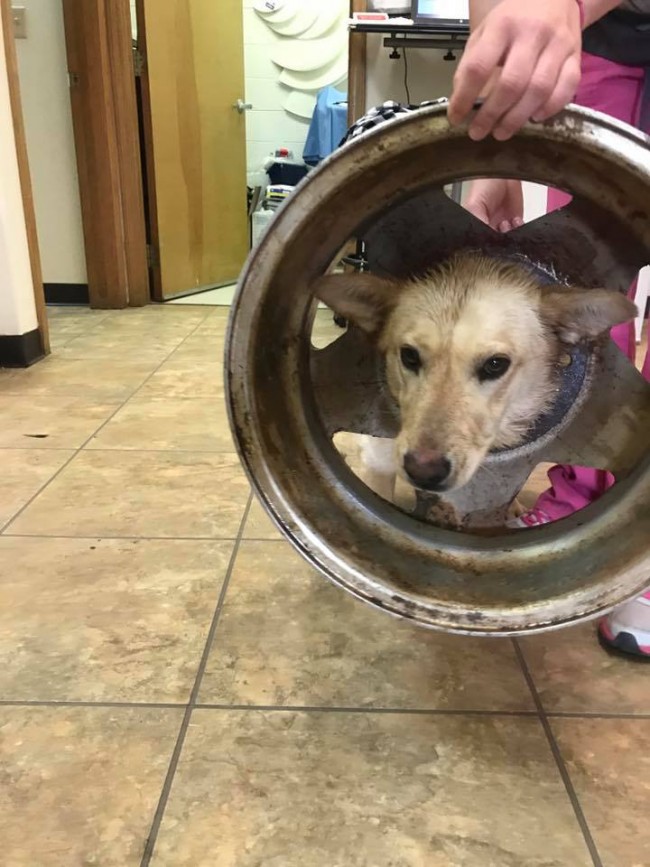
Any fire chief will tell you that a fire department’s role is not just fighting fires, but sometimes helping community members out of a tight spot. And for the McDowell County Rescue Squad in North Carolina, that form of service required a delicate touch last week when they were called upon to free a dog named Sadie from the grips of a truck tire rim.
Sadie’s family told rescuers that they believe she may have been chasing another animal when she got wedged inside the Ford F-350 tire rim.
Credit: Kristi Sisk/ Facebook
Sadie was taken to the Animal Hospital of Marion where she showed everyone her new necklace with her characteristic charm. But for her own safety, Sadie would have to be sedated.
Credit: Kristi Sisk/ Facebook
“The tire rim probably weighed 20 or 30 pounds so she couldn’t even lift her head up when she came in,” hospital staffer Kristi Sisk said.
“We used hydraulic cutters as well as a couple of other power tools,” McDowell County Rescue Squad Captain Jordan Harrell told Fredericksburg.com. “It was a lot of trial and error. It was very big, it was a tough metal, and not the text book type extrication.”
Credit: Kristi Sisk/ Facebook
“Thank you so much McDowell rescue squad and volunteers that showed up, took their time, and put the animals safety first getting this tire rim off!” Sisk said. “Happy to say miss Sadie had a happy ending. Went home tail wagging. I love my job!”
Credit: McDowell County Rescue Squad/ Facebook
ooOOoo
Time and time again, we see how dogs bring out so much good in us!
As many of you have gathered from my post on the 22nd. Casey was in a relatively stable situation. From that post:
For dear, sweet Casey he is facing a very long haul. Dr. Jim, our vet neighbour and close friend, recommended that Casey start taking a steroid and he is now on Prednisone.
Indeed, Dr. Jim came by last Friday evening and said that even though there was little sign of a positive change in Casey’s condition it was still very early days.
Then on Saturday morning, when Jean went into the kitchen where Casey is with Ruby and Paloma, there had been an unexpected and sudden turn for the worse. For Casey could not adequately stand because his neck pain was too great and his front legs were giving way.
We rang immediately Southern Oregon Vet Specialty Center (SOVC) and they recommended that we take Casey straight there. SOVC operate 24-hours a day. Or in their words:
At Southern Oregon Veterinary Specialty Center, we understand the special bond between a pet and their human family. Our team of highly trained doctors, certified technicians and support staff partner with your family veterinarian to provide specialized diagnostics, surgery and emergency care for your pet upon a referral or emergency basis. Our clinic is staffed 24 hours-a-day, 7 days a week, to receive emergency cases and to monitor our critical care patients. The clinic’s board-certified veterinary specialists and staff are committed to providing exceptional compassionate care utilizing state-of-the-art technology and treatments.
The relationships we have with partner veterinarians are vital to the success of treating your pet. We will keep them apprised of the patient’s status to provide a smooth and cohesive experience.
SOVC had no doubt that we had done the right thing and that the pain meds we were giving Casey Tramadol and two muscle-relaxers, just were not strong enough. Their prognosis was that Casey be admitted to SOVC so he could be given more appropriate pain control, via an IV, and that as soon as possible he be scanned using an MRI.
Luckily, not too far away from where SOVC are located, near Medford, there is a specialist animal imaging unit: Sage Veterinary Imaging:
About SVI
Sage Veterinary Imaging was founded in 2007 to provide the highest quality diagnostic imaging services to animals in the Southern Oregon area. When I moved to the Rogue Valley, I was saddened to hear that animals needing advanced diagnostic imaging had to be driven hundreds of miles to get the care they needed. Now we provide the only ACVR board-certified veterinary imaging services right here in Southern Oregon, serving patients from Redding, to Eugene. Our administrative offices are located in Jacksonville and diagnostic services, including MRI, are provided in partnership with imaging centers in communities throughout Southern Oregon.
Even better, Dr. Jim knows Jamie Sage and speaks highly of her.
Jaime Sage, is a veterinarian who is board-certified by the American College of Veterinary Radiology. She holds a DVM from Texas A&M, an MS from The Ohio State University, and is licensed to practice in Oregon and California. Dr. Sage has issued reports for over 1,000 MRI studies in her career, and has personally performed nearly 100 onsite MRI procedures in Southern Oregon in just the past three years. Dr. Sage also works as a radiologist for MR Vets, founded by WSU Professor Emeritus Patrick R. Gavin, DVM, PhD, DACVR/RO, author of Practical Small Animal MRI, and one of the early pioneers in veterinary MRI.
Thus this morning, as in Monday morning Oregon time, SOVC will have the analysis from Jaime Sage followed by the surgical analysis by Dr. Steve Ferreira, the SOVC surgeon, who would conduct the surgery.
So more news just as soon as we have it.
Thank you all for your care and concern.
ooOOoo
UPDATE as at 12:40 PST
The surgeon, Steve Ferreira, called us to pass on the findings:
The MRI showed there to be several lesions that are not disc related,
There is an area of large compression, 50%-70% in some spots, in the lower cervical chord,
Separately, changes were noted in the C2 vertebra that suggested localised bone inflammation,
Lastly, there was an increased density pattern in the muscles associated with the cervix.
Dr. Steve said that the next step was to use a spinal tap to withdraw some spinal fluid. If it was cloudy that might indicate infection that could be treated with antibiotics. If the fluid was clear then it would be sent to an external lab for analysis. Possibilities include infection or cancer or an auto-immune issue, even possibly meningitis.
Apparently, surgery in that lower part of the spine would be very difficult to undertake. Likewise, removing a tumour that would simply regrow.
The cost of the anesthesia for the spinal tap, the insertion of the tap and the analysis would be in the order of several hundred dollars.
(Please accept that my understanding of what Dr. Steve said might not be 100% accurate. So use caution if any of this is relevant for your animal.)
ooOOoo
UPDATE as at 17:20 PST
Steve Ferreira rang following the drawing of a sample of Casey’s spinal fluid.
The fluid “didn’t look too bad”, as in it was clear,
In other words, it was not immediately indicating an infectious disease, that would cause the fluid to appear cloudy,
Dr. F. will await further results from an external laboratory later this evening,
If both the white-cell count and proteins are more-or-less normal, then,
It will suggest that the problem is not an infection,
And, therefore, most probably related to a tumour on or around C6 where the MRI recorded the excessive compression,
Casey is comfortable owing to the strong pain medication being given to him via an IV.
Jean and I will be speaking with Dr. F. in the morning but it is more likely than not that Casey is terminally ill.
This post will, therefore, be updated in the morning.
UPDATE as at 08:40 Tuesday, 28th
Dr. Steve rang us at 08:30 this morning.
He started Casey on antibiotics yesterday evening in case the lab came back with evidence of infection in the spinal fluid, but,
The lab reported that the fluid was normal in terms of blood-cell counts and protein levels, therefore,
the probability is that Casey has a tumour,
or possibly an infection inside the spinal column but outside the spinal fluid.
If such an infection, called an “empyema” then the degree of compression to the spine suggests it could be 3 to 4 weeks before Casey would be walking again.
More probable is that it is a tumour.
Casey is most definitely suffering and very miserable.
Jean and I then quickly, and very sadly, were of the opinion that Casey’s quality of life was too low for it to be fair to Casey for his life to be prolonged. We rang Dr. Steve back and asked that Casey be euthanised, cremated and that the ashes be returned to us.
In that return call, Dr. Steve quietly confirmed his support for our decision.
Casey will be very badly missed. I will be publishing an obituary tomorrow.
Thank you all for your friendship, love and caring!
Or, more specifically, do we believe we have free will?
One of the endless benefits of this wired-up, digital world is how easy it is to have one’s mind opened and stretched a little.
Take this, for instance, as an intriguing start to a new day.
Do we have free will?
This isn’t a question I can answer, but what I am interested in is “what happens if we do (or do not) believe in free will?” In other words, does believing in free will matter in your daily life?
Just let one’s mind float around that idea, not only as it applies to us humans but also to the animals that share our human intuition, such as dogs and horses.
So what’s got me bubbling along today? Nothing less than an article that appeared on The Conversation blog-site back last September.
I found it fascinating and hope you do as well. It is republished within the terms of The Conversation site.
ooOOoo
Believing in free will makes you feel more like your true self
September 1, 2016
By Elizabeth Seto, Ph.D. Candidate in Social and Personality Psychology, Texas A&M University .
Do we have free will? This is a question that scholars have debated for centuries and will probably continue to debate for centuries to come.
This isn’t a question I can answer, but what I am interested in is “what happens if we do (or do not) believe in free will?” In other words, does believing in free will matter in your daily life?
My colleagues and I at the Existential Psychology Lab at Texas A&M University study the psychological outcomes of belief in free will. While contemplating my next research project, I realized at some point in our lives, we all want to understand who we are – it’s human nature. So, we decided to explore how believing in free will influences our sense of self and identity.
Free will is generally understood as the ability to freely choose our own actions and determine our own outcomes. For example, when you wake up in the morning, do you hit snooze? Do you put on your workout gear and go for a run? Do you grab a hot cup of coffee? While those are simple examples, if you believe in free will, you believe there are a limitless number of actions you can engage in when you wake up in the morning, and they are all within your control.
Believing in free will helps people exert control over their actions. This is particularly important in helping people make better decisions and behave more virtuously.
For instance, research has found that promoting the idea that a person doesn’t have free will makes people become more dishonest, behave aggressively and even conform to others’ thoughts and opinions. And how can we hold people morally responsible for their actions if we don’t believe they have the free will to act any differently? Belief in free will allows us to punish people for their immoral behaviors.
So, not only is there a value to believing in free will, but those beliefs have profound effects on our thoughts and behaviors. It stands to reason that believing in free will influences how we perceive ourselves.
You might be thinking, “Of course believing in free will influences how I feel about myself.” Even though this seems obvious, surprisingly little research has examined this question. So, I conducted two studies to suss out more about how believing in free will makes us feel.
What believing in free will makes us feel about ourselves
In the first study, I recruited 304 participants from Amazon Mechanical Turk and randomly assigned them to write about either personal experiences reflecting a high belief in free will, like changing career paths or resisting drugs or alcohol, or experiences reflecting a low belief in free will, such as growing up in poverty or working under an authoritative boss. Then, they were all asked to evaluate their sense of self.
Participants who wrote about experiences reflecting low belief in free will reported feeling less “in touch” with their true selves. In other words, they felt like they did not know themselves as well as the participants who wrote about experiences reflecting high belief in free will.
Then, I conducted a follow-up study testing one’s sense of authenticity, the feeling that one is behaving according to their own beliefs, desires and values.
I recruited another group of participants from Amazon Mechnical Turk, and like the first experiment, randomly assigned them to write about personal experiences demonstrating high belief in free will or low belief in free will. Then, they all completed a decision-making task where they had to make a series of choices about whether to donate money to charity or to keep the money for themselves.
Afterwards, participants were asked how authentic they felt while making their decisions. Participants in the low free will group reported feeling less authentic than participants in the high free will group.
Ultimately, when people feel they have little control over their actions and outcomes in life, they feel more distant from their true, authentic selves. They are less in touch with who they are and do not believe their actions reflect their core beliefs and values.
We believe this is because belief in free will is linked to feelings of agency, the sense that we are the authors of our actions and are actively engaged with the world. As you can imagine, this sense of agency is an important part of a person’s identity.
The importance of feeling like you are in charge of your life applies to significant actions like moving or getting a new job or pondering the big questions in life. But it also applies to the minor decisions we make throughout the day.
Here’s one simple, though relatable, decision I am faced with every morning. When I wake up in the morning and decide to put on my workout gear and go for a run instead of hitting snooze, I might feel like I am the primary decision-maker for this morning routine. Additionally, I am most likely acting on the part of me that values physical health.
But what if I wake up, and I feel like I can’t exercise because I have to go to work or some other external factor is making it difficult to go? I might feel as if someone or something else is controlling my behavior, and perhaps, less like my true self.
So, do you have free will? Do any of us? Remember, the question isn’t whether it exists or not, but whether you believe it does.
ooOOoo
Now thinking of dogs having their own free will might seem a little bizarre, but I do not intend it to be seen as such. Many of you will have dogs (and horses) that have ‘minds of their own’.
For our family here at home, if there’s one of our dogs that exhibits free will it is our Brandy.
Our Brandy is a Pyrenean Mastiff!
Without warning or any other indication, he will suddenly decide it is time to go ‘walk-about’. Mainly during the day but sometimes at night, whatever the weather, he will disappear. He will always return but can be wandering around our thirteen acres for up to an hour.
A cap cloud at sunrise over Mount Rainier, spotted from Seattle, Washington, US, by Elaine Thompson (Member 41974).
“Though outwardly a gloomy shroud,
The inner half of every cloud
Is bright and shining:
I therefore turn my clouds about,
And always wear them inside out
To show the lining.”
[From ‘The Wisdom of Folly’ by Ellen Thorneycroft Fowler in Verses, Wise or Otherwise (1895)]
Then to the amazing!
It’s hard to comprehend the sheer size of objects in space, but take 2 minutes and give it a try!
This video is from the European Southern Observatory (ESO) comparing the sizes of Earth, our sun and stars.
Sorry, folks but still a few days away from being back to normal service.
We awoke yesterday morning with Casey sufficiently unwell that Jim Goodbrod recommended taking him to Southern Oregon Veterinary Services (SOVC) down in Medford. There SOVC said that it does look as though Casey has a failure in one of the spinal discs in his neck. First, we have been advised to up the pain medicine before embarking on an MRI and then, possibly, surgery.
In the middle of all this the tube from my catheter into my drainage bag became blocked, evidenced by pee running down my leg!!
SOVC offered me their very comfortable bathroom where I then unblocked the tube using a syringe and sterile water; luckily all brought with me.
Then it was up to Grants Pass to find a solution to my ‘leaking’ catheter only to find that Southern Oregon Medical Equipment, who we thought were in Grants Pass, had moved a year ago from Grants Pass to …… guess?? ……. yes: Medford!
Plus it was raining for most of the day!
Yes, it was one of those days!!
One of those days where one needs a head for the heights that life can throw at one.
No better demonstrated by the following video sent to me by my loving son: Alex!
So will just close by saying that until my catheter is taken out next Tuesday (fingers crossed) I may be ‘distracted’ from Learning from Dogs at times!
Last December 21st I underwent an outpatient operation for the removal of growth around my prostate. A fairly normal operation for a gent of my age (72).
l was told that it would take about 8 weeks for everything to heal.
Anyway, this morning I noticed a significant amount of blood in my urine and Jean and I went to our local Three Rivers hospital in Grants Pass. I was admitted to ER.
I was sorted out and nothing serious immediately found although the cause of the bleeding was not identified. However a blood test did not find any infection or anything scary. I was recommended to go home.
The blood in urine is called Hematuria and the doctor inserted a Foley catheter to drain the blood & urine from my bladder.
The catheter and the drainage bag will remain attached to me until I have an appointment with the Urologist early next week. I have to keep pretty still until then plus sitting on a normal chair is painful at the moment. I’m laying back on the bed using my tablet to write this.
Sorry, dear people, but that’s how it is just now.
oooo
Update as at 10:30 PST Sunday, 12th
Around 10:30PM last night I awoke with quite a severe pain in my bladder. My body was telling me to hot-foot it back to the Emergency Ward at Three Rivers in Grants Pass. This was where we had gone earlier in the day.
Jean doesn’t drive at night but it was a straightforward journey and I was seen very quickly by the ER staff (Micha, Ann and Trevor: you were all brilliant!) I was told that my decision to drive into ER was spot on. (Trevor at a later point said that listening to our body is so important and that they saw far too many individuals who had let whatever the problem was run on far too long before seeking medical help.)
Micha quickly determined that a blood clot had blocked the catheter hence my inability to pass urine/blood and the rapid build up of pain. Gently syringing the catheter with a saline solution released a huge number of clots; to my obvious relief.
Apparently, the urologist on call was telephoned and he recommended the removal of the existing catheter to then be replaced with a larger catheter (ouch!) that would handle blood clots more efficiently.
Then for approximately an hour I was irrigated so as to completely flush out the remaining clots.
It was 50:50 as to whether I was to be admitted to a ward but again the advice of the on-call urologist was that so long as my body continued to drain blood/urine into the catheter drainage bag then it was OK for me to return home.
I arrived home at 4:30am!
So here we are approximately six hours later and I am still bleeding but, touch wood, no sign of clots and the draining into the bag is still running.
P.S. I have offered these details just in case someone else finds them helpful!
UPDATE 14:15 Tuesday, 14th.
On the afternoon of the 11th I took an afternoon nap having had practically no sleep the previous night.
Around 2pm I awoke with a pain that told me I probably had another blood clot and again said to Jean that I was going to take myself back into the ER department.
Once admitted to ER they made the decision that my bleeding was such that I should be admitted to the General Ward in the hospital. I ended up on Floor E, room 361.
I was then hooked up to a saline drip and stayed that way until 4am this morning, Tuesday 14th! For it took that long for the blood clots to finally stop surfacing and my urine to start looking a normal yellow colour.
From 4am I was then just draining via the Foley catheter and, thank goodness, I continued draining reliably, with no further bleeding or clotting, right through to 11:30 when Dr. Newcomb, the duty doctor, announced that I was fit to return home!
I will write more as soon as I catch up with stuff.












 Learning from Dogs