Category: People

Earth Day!

I simply forgot it was Earth Day yesterday!

I wanted to let the post on Tuesday run for a couple of days because it really made the point about dogs, in particular, being animals who love to love!

But I then forgot, until I woke up on the 22nd, that yesterday was Earth Day.

So what to publish?

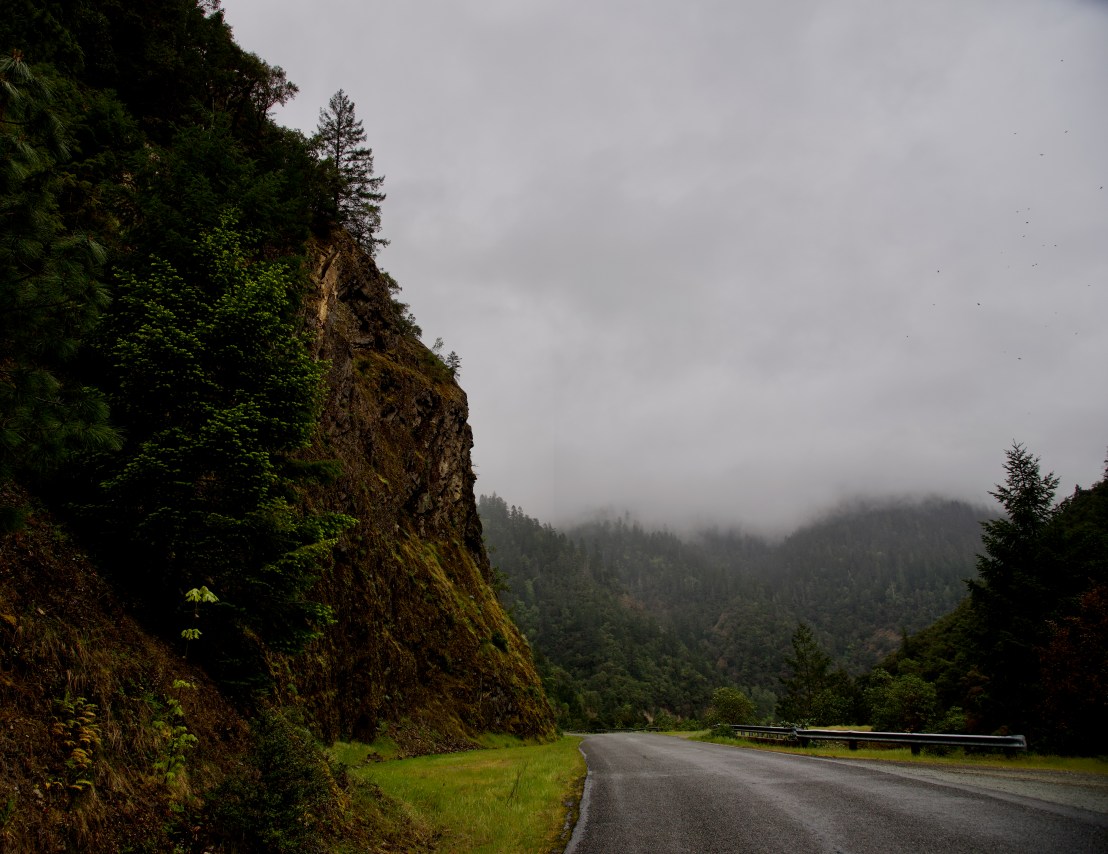
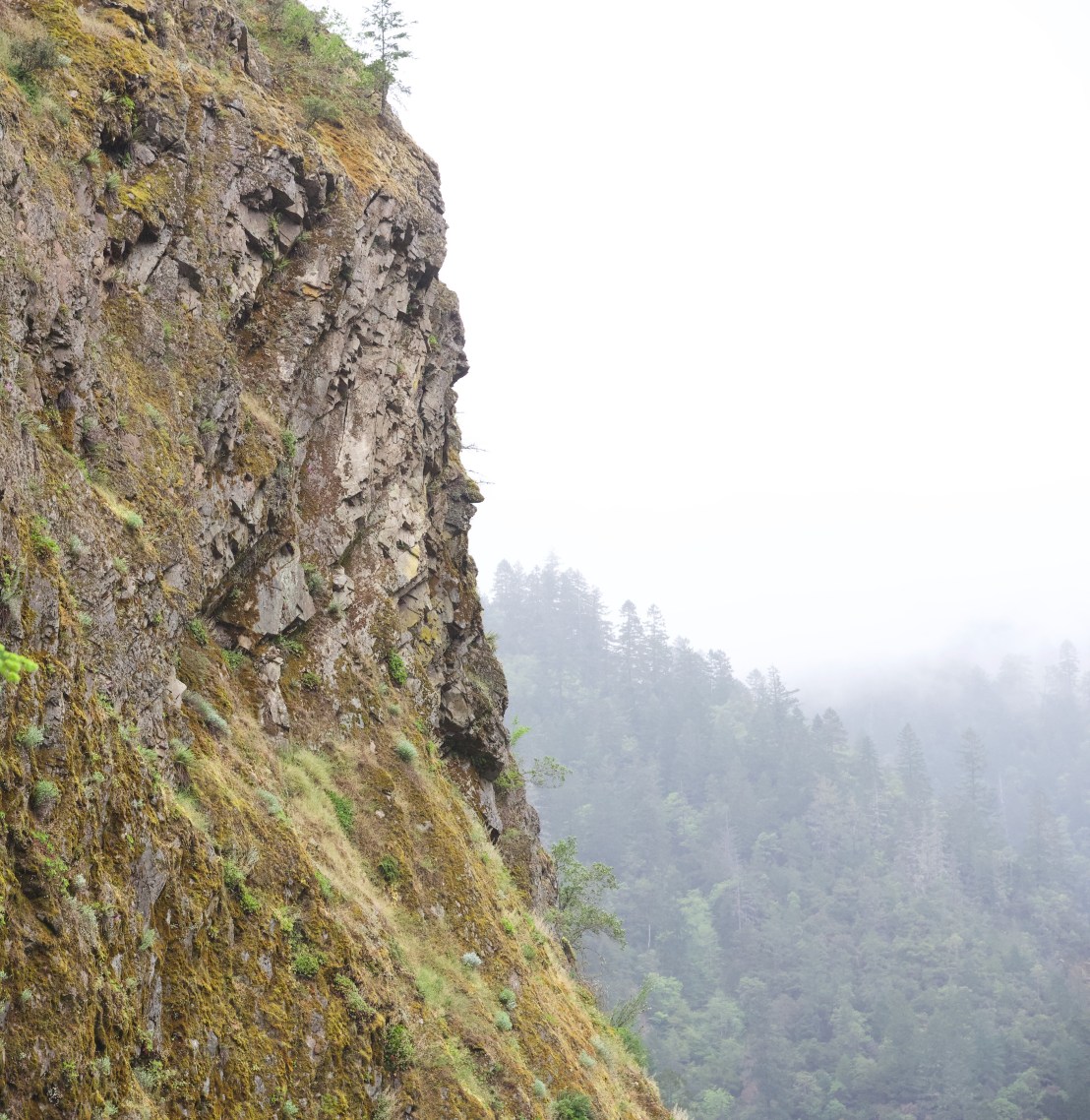
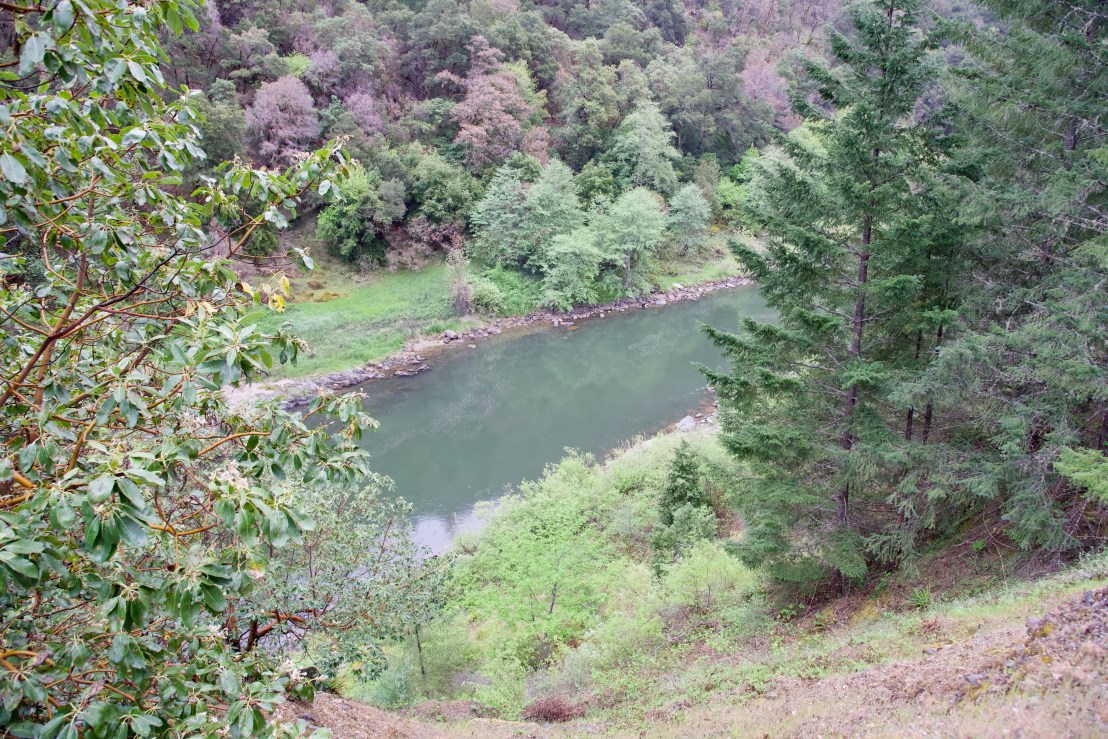
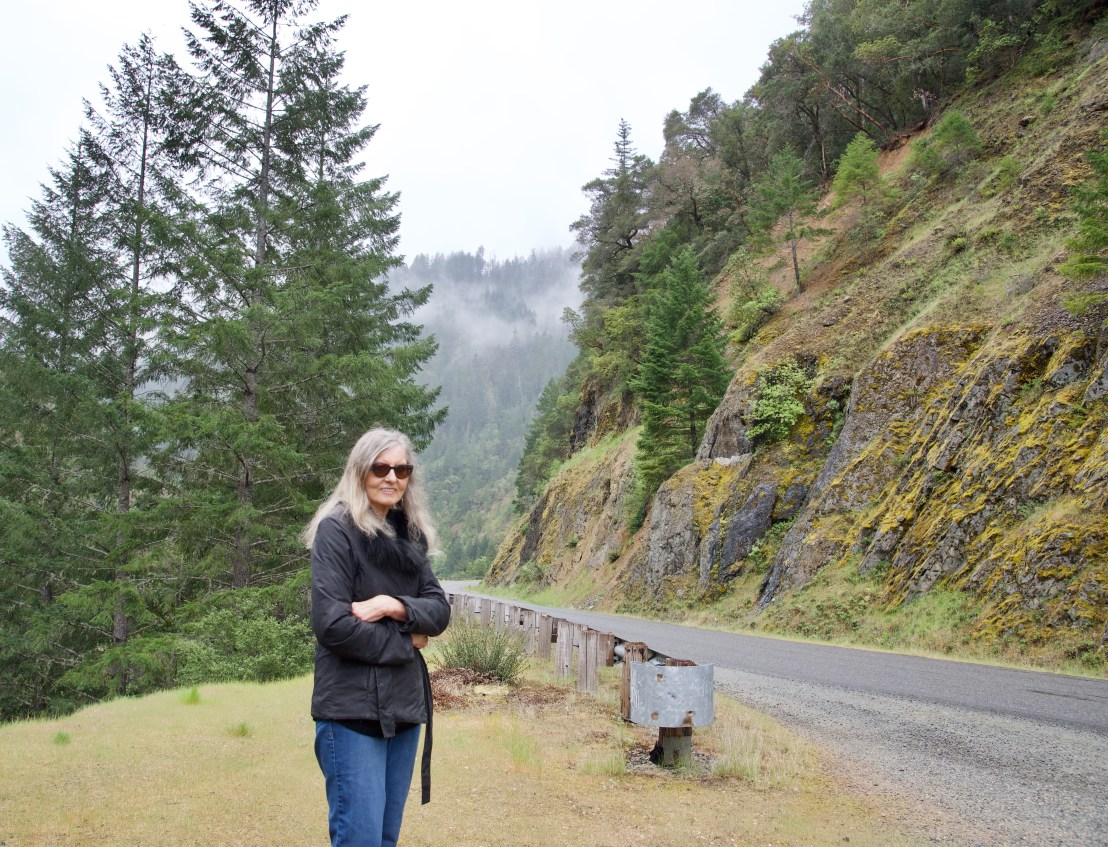
Yesterday in Merlin was a damp day with a steady rain coming down in the morning. About 10am I volunteered the idea that we should drive the shortish distance to Galice; just 10 miles from where we live. Galice is a very small settlement on the Western bank of the Rogue River. Then we drove on for a few more miles. It was incredible scenery. The misty, damp forest and the river running below in the gorge.

I had my camera with me and the following are some of the photographs that were taken.

Just for a change! All within 15 miles of home!
oooo
oooo

oooo
oooo
oooo

oooo

For those interested in learning more, I am publishing the WikiPedia account of the Rogue River.

The Rogue River (Tolowa: yan-shuu-chit’ taa-ghii~-li~’,[7] Takelma: tak-elam[8]) in southwestern Oregon in the United States flows about 215 miles (346 km) in a generally westward direction from the Cascade Range to the Pacific Ocean. Known for its salmon runs, whitewater rafting, and rugged scenery, it was one of the original eight rivers named in the Wild and Scenic Rivers Act of 1968. Beginning near Crater Lake, which occupies the caldera left by the explosive volcanic eruption of Mount Mazama, the river flows through the geologically young High Cascades and the older Western Cascades, another volcanic province. Further west, the river passes through multiple exotic terranes of the more ancient Klamath Mountains. In the Kalmiopsis Wilderness section of the Rogue basin are some of the world’s best examples of rocks that form the Earth’s mantle. Near the mouth of the river, the only dinosaur fragments ever discovered in Oregon were found in the Otter Point Formation, along the coast of Curry County.

People have lived along the Rogue River and its tributaries for at least 8,500 years. European explorers made first contact with Native Americans (Indians) toward the end of the 18th century and began beaver trapping and other activities in the region. Clashes, sometimes deadly, occurred between the natives and the trappers and later between the natives and European-American miners and settlers. These struggles culminated with the Rogue River Wars of 1855–56 and removal of most of the natives to reservations outside the basin. After the war, settlers expanded into remote areas of the watershed and established small farms along the river between Grave Creek and the mouth of the Illinois River. They were relatively isolated from the outside world until 1895, when the Post Office Department added mail-boat service along the lower Rogue. As of 2010, the Rogue has one of the two remaining rural mail-boat routes in the United States.

Dam building and removal along the Rogue has generated controversy for more than a century; an early fish-blocking dam (Ament) was dynamited by vigilantes, mostly disgruntled salmon fishermen. By 2009, all but one of the main-stem dams downstream of a huge flood-control structure 157 miles (253 km) from the river mouth had been removed. Aside from dams, threats to salmon include high water temperatures. Although sometimes too warm for salmonids, the main stem Rogue is relatively clean, ranking between 85 and 97 (on a scale of 0 to 100) on the Oregon Water Quality Index (OWQI).

Although the Rogue Valley near Medford is partly urban, the average population density of the Rogue watershed is only about 32 people per square mile (12 per km2). Several historic bridges cross the river near the more populated areas. Many public parks, hiking trails, and campgrounds are near the river, which flows largely through forests, including national forests. Biodiversity in many parts of the basin is high; the Klamath-Siskiyou temperate coniferous forests, which extend into the southwestern Rogue basin, are among the four most diverse of this kind in the world.
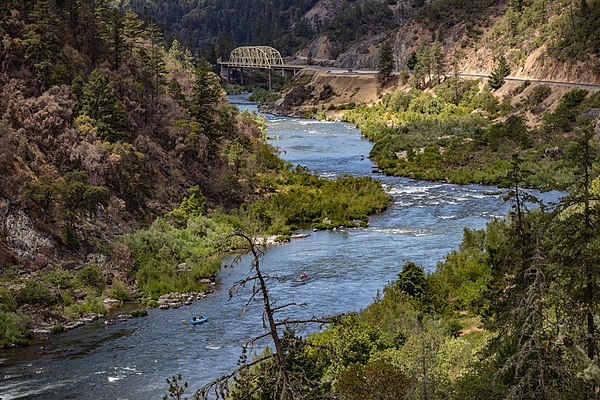
Rogue River from Hellgate Canyon
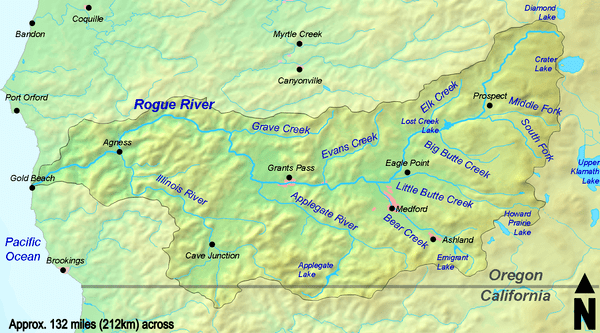
Map of the Rogue River watershed
Location of the mouth of the Rogue River in Oregon

Just to reflect on the fact that people have lived along the Rogue River and its tributaries for 8,500 years!

Being alone!

A repeat of an essay from the 12th October, 2019.

We were truly alone when we went to Utah. (September, 2019.)

But then again, one of the privileges of being on 13 acres, 13 very rural acres, here in Southern Oregon is that being alone is not that far away!

I don’t want to underplay the importance of this posting, republished from The Conversation website (with permission), because we live in so busy times.

Written by three professors, it’s a very wise and profound article.

ooOOoo

Spending time alone in nature is good for your mental and emotional health

June 4th, 2018

By , Professor of Outdoor Education, Montreat College
, Associate Professor and Program Director of Parks and Recreation Management, Western Carolina University

, Associate Professor of Outdoor Education, Montreat College
Today Americans live in a world that thrives on being busy, productive and overscheduled. Further, they have developed the technological means to be constantly connected to others and to vast options for information and entertainment through social media. For many, smartphones demand their attention day and night with constant notifications.

As a result, naturally occurring periods of solitude and silence that were once commonplace have been squeezed out of their lives. Music, reality TV shows, YouTube, video games, tweeting and texting are displacing quiet and solitary spaces. Silence and solitude are increasingly viewed as “dead” or “unproductive” time, and being alone makes many Americans uncomfortable and anxious.

But while some equate solitude with loneliness, there is a big difference between being lonely and being alone. The latter is essential for mental health and effective leadership.

We study and teach outdoor education and related fields at several colleges and organizations in North Carolina, through and with other scholars at 2nd Nature TREC, LLC, a training, research, education and consulting firm. We became interested in the broader implications of alone time after studying intentionally designed solitude experiences during wilderness programs, such as those run by Outward Bound. Our findings reveal that time alone in nature is beneficial for many participants in a variety of ways, and is something they wish they had more of in their daily life.

On an average day in 2015, individuals aged 15 and over spent more than half of their leisure time watching TV. Bureau of Labor Statistics, Americans Time Use Survey

Reflection and challenge

We have conducted research for almost two decades on Outward Bound and undergraduate wilderness programs at Montreat College in North Carolina and Wheaton College in Illinois. For each program, we studied participants’ experiences using multiple methods, including written surveys, focus group interviews, one-on-one interviews and field notes. In some cases, we asked subjects years later to look back and reflect on how the programs had affected them. Among other questions, our research looked at participant perceptions of the value of solo time outdoors.

Our studies showed that people who took part in these programs benefited both from the outdoor settings and from the experience of being alone. These findings build on previous research that has clearly demonstrated the value of spending time in nature.

Scholars in fields including wilderness therapy and environmental psychology have shown that time outdoors benefits our lives in many ways. It has a therapeutic effect, relieves stress and restores attention. Alone time in nature can have a calming effect on the mind because it occurs in beautiful, natural and inspirational settings.

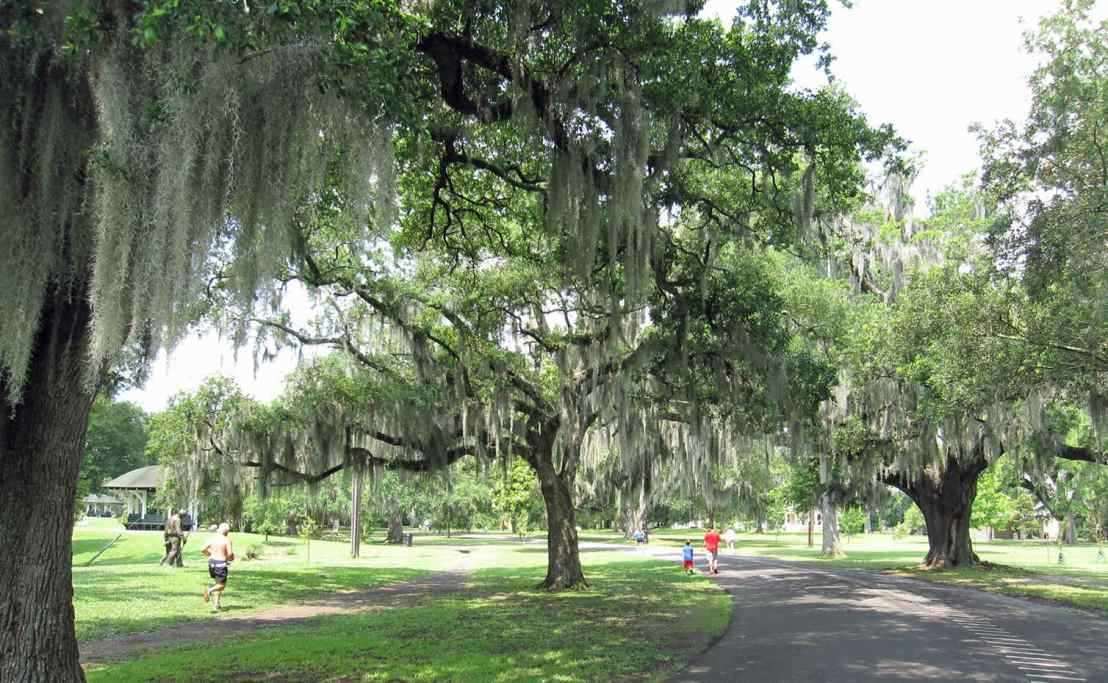
Spending time in city parks like Audubon Park in New Orleans provides some of the same benefits as time in wilderness areas, including reduced stress levels and increased energy levels. InSapphoWeTrust, CC BY-SA

Nature also provides challenges that spur individuals to creative problem-solving and increased self-confidence. For example, some find that being alone in the outdoors, particularly at night, is a challenging situation. Mental, physical and emotional challenges in moderation encourage personal growth that is manifested in an increased comfort with one’s self in the absence of others.

Being alone also can have great value. It can allow issues to surface that people spend energy holding at bay, and offer an opportunity to clarify thoughts, hopes, dreams and desires. It provides time and space for people to step back, evaluate their lives and learn from their experiences. Spending time this way prepares them to re-engage with their community relationships and full work schedules.

Putting it together: The outdoor solo

Participants in programmed wilderness expeditions often experience a component known as “Solo,” a time of intentional solitude lasting approximately 24-72 hours. Extensive research has been conducted on solitude in the outdoors because many wilderness education programs have embraced the educational value of solitude and silence.

Solo often emerges as one of the most significant parts of wilderness programs, for a variety of reasons. Alone time creates a contrasting experience to normal living that enriches people mentally, physically and emotionally. As they examine themselves in relation to nature, others, and in some cases, God, people become more attuned to the important matters in their lives and in the world of which they are part.

Solo, an integral part of Outward Bound wilderness trips, can last from a few hours to 72 hours. The experience is designed to give participants an opportunity to reflect on their own thoughts and critically analyze their actions and decisions.

Solitary reflection enhances recognition and appreciation of key personal relationships, encourages reorganization of life priorities, and increases appreciation for alone time, silence, and reflection. People learn lessons they want to transfer to their daily living, because they have had the opportunity to clarify, evaluate and redirect themselves by setting goals for the future.

For some participants, time alone outdoors provides opportunity to consider the spiritual and/or religious dimension of life. Reflective time, especially in nature, often enhances spiritual awareness and makes people feel closer to God. Further, it encourages their increased faith and trust in God. This often occurs through providing ample opportunities for prayer, meditation, fasting, Scripture-reading, journaling and reflection time.

Retreating to lead

As Thomas Carlyle has written, “In (solitary) silence, great things fashion themselves together.” Whether these escapes are called alone time, solitude or Solo, it seems clear that humans experience many benefits when they retreat from the “rat race” to a place apart and gather their thoughts in quietness.

In order to live and lead effectively, it is important to be intentional about taking the time for solitary reflection. Otherwise, gaps in schedules will always fill up, and even people with the best intentions may never fully realize the life-giving value of being alone.

ooOOoo

I would modify that advice from Thomas Carlyle and that is to include a dog.

For in my experience when one is in the mood for a bit of solitary reflection your dog seems to sense it as well.

Start your day with music – a guest post!

More on mindfulness!

I opened my email box a couple of days ago and there was an email from Sarah.

It said:

Hi there!
I would be honored to be a guest writer for your blog and of course would reciprocate.  I hope you don’t mind that I shared your link in my last post.  I am not totally sure if blogging etiquette.  😀
Sarah Kinneavy
MyAmazing2ndChapter.com

Of course I said yes!

Sarah’s background is sociology and she has a degree in the subject. Just as important she owns a dog walking business. I will let her finish her background:

I believe in living life to the fullest.

My daughter is a Cancer survivor- and as a result of that journey- It put my life into perspective. I learned to never take anything for granted- you never know what’s around the next corner. I am continuing to work on becoming the best version of me, while making the most of each and everyday.

Frankly, I do not really know what it is like to have a daughter, or a son come to it, go down with cancer. The nearest I have come to the disease was when I had just turned 12 and my father died of lung cancer.

So here’s her guest post.

ooOOoo

Start your day with music- not the News! Surviving the Coronavirus with mindfulness Day 2

By Sarah Kinneavy, March 28th, 2020

As I continue to try to stay calm with mass panic happening across the globe 🌎 with this pandemic. As I mentioned in yesterday’s post:

https://myamazing2ndchapter.com/2020/03/27/surviving-the-coronavirus-with-mindfulness/

I am using mindfulness to train my brain in how it reacts to stress. The more we do these exercises the better we get at them.

Start your day with music rather than the news! Borrowed from https://musicoomph.com

Yesterday one of my friends posted on Facebook to start the day off with music – rather than the news! What a great idea!!! So, yesterday, as I got ready for a job interview and I waited until it was late enough in Hawaii to do my daily well check on my daughter there (she is in isolation in a dorm room – I am not sure if she has the dreaded virus or not). I used music as the focal point of this mindfulness exercise. This 15 minutes of focusing on the music- listening to the rhythm helped keep me present. I wasn’t worrying about getting the job or how my daughter was doing. I was just in that moment of getting ready with the accompaniment of music. It was honestly 15 minutes of pure happiness. What a great way to start my day! One thing I have to add – I try to not let myself think about what the words of the songs mean to me, or when I first heard the song. I just listen and enjoy. Okay- I may have danced around my apartment a bit too!

I can tell you – I did not feel anxious going to my interview like I normally would. I didn’t panic about my daughter’s health – I was able to wait until after my interview to check in on her. Mindfulness does not keep me from ever worrying about my kiddo or the world around me. No – I still worry – but It isn’t swallowing me up whole. And this is key!

Heading to my job interview.

I can’t wait to talk to you again tomorrow . How are you coping with all the stress and anxiety?

ooOOoo

That’s a lovely guest post!
And the message is clear and powerful: “No – I still worry – but It isn’t swallowing me up whole. And this is key!

Picture Parade Three Hundred and Thirty.

A young, talented photographer.

My grandson, Morten, who had his birthday yesterday, he is now nine, took some photographs recently. They are fabulous and are republished here with Morten’s permission. Completely untouched by yours truly!

oooo

oooo

oooo

oooo

oooo

oooo

oooo

I think these are fabulous. Morten used the following camera.

A Lumix DMC-TZ10


Wow! What a stupendous sight!

Mars!

I’m not going to do anything other than launch straight into this post. Taken from EarthSky.

ooOOoo

Curiosity rover on Mars snags highest-resolution panorama yet

What on earth are we going to do?

A very powerful essay from George Monbiot.

Today and tomorrow I am posting essays that have nothing to do with dogs! Today, I am sharing George’s gloom about the future, tomorrow I am sharing our human capacity for incredible ingenuity and technology.

Because I sense we are a species of two extremes; the very mad and the very clever!

I don’t have an answer but I can share these two essays.

Today, I give you George Monbiot’s essay Suing For Survival.

ooOOoo

Suing For Survival

Our legal action against the government aims to shut down fossil fuels

By George Monbiot, published in the Guardian 4th March 2020

Our survival is not an afterthought. The defence of the living planet cannot be tacked retrospectively onto business as usual. Yet this is how almost all governments operate. They slap the word “sustainable” on damaging projects they have already approved, then insist this means they’ve gone green. If we are to survive and prosper, everything must change. Every decision should begin with the question of what the planet can withstand.

This means that any discussion about new infrastructure should begin with ecological constraints. The figures are stark. A paper published in Nature last year showed that existing energy infrastructure, if it is allowed to run to the end of its natural life, will produce around 660 gigatonnes of CO2. Yet, to stand a reasonable chance of preventing more than 1.5°C of global heating, we can afford to release, in total, no more than 580 gigatonnes. In other words, far from building new fossil power plants, the survival of a habitable planet means retiring the damaging projects that have already been built. Electricity plants burning coal and gas and oil will not secure our prosperity. They will destroy it.

But everywhere special interests dominate. Construction projects are driven, above all, by the lobbying of the construction industry, consultancies and financiers. Gigantic and destructive schemes, such as the Oxford-Cambridge Expressway, are invented by lobbyists for the purpose of generating contracts. Political support is drummed up, the project achieves its own momentum, then, belatedly, a feeble attempt is made to demonstrate that it can somehow become compatible with environmental promises. This is what destroys civilisations: a mismatch between the greed of economic elites and the needs of society.

But last week, something momentous happened. The decision to build a scheme with vast financial backing and terrible environmental impacts was struck down by the Court of Appeal. The judges decided that government policy, on which planning permission for a third runway at Heathrow was based, had failed to take account of the UK’s climate commitments, and was therefore unlawful. This is – or should be – the end of business as usual.

The Heathrow decision stands as a massive and crucial precedent. Now we must use it to insist that governments everywhere put our survival first, and the demands of corporate lobbyists last. To this end, with the Good Law Project and Dale Vince, the founder of Ecotricity, I’m pursuing a similar claim. In this case, we are challenging the UK government’s policy for approving new energy projects.

On Tuesday, we delivered a “letter before action” to the Treasury solicitor. We’ve given the government 21 days to accept our case and change its policy to reflect the climate commitments agreed by Parliament. If it fails to do so, we shall issue proceedings in the High Court to have the policy declared unlawful. We’ll need money, so we’ve launched a crowdfunding appeal to finance the action.

It’s hard to see how the government could resist our case. The Heathrow judgement hung on the government’s national policy statement on airports. This, the judges found, had not been updated to take account of the Paris climate agreement. New fossil fuel plants, such as the gas burners at Drax in Yorkshire the government approved last October, are enabled by something very similar: the national policy statements on energy infrastructure. These have not been updated since they were published in 2011. As a result, they take no account of the Paris agreement, of the government’s new climate target (net zero by 2050, as opposed to an 80% cut) or of Parliament’s declaration of a climate emergency. The main policy statement says that the European Emissions Trading System “forms the cornerstone of UK action to reduce greenhouse gas emissions from the power sector”. As we have left the EU, this, obviously, no longer holds. The planning act obliges the government to review its national policy statements when circumstances change. It has failed to do so. It is disregarding its own laws.

These outdated policy statements create a presumption in favour of new fossil fuel plants. Once a national policy statement has been published, there is little objectors can do to prevent damaging projects from going ahead. In approving the Drax plant, the secretary of state for business and energy at the time (Andrea Leadsom) insisted that the policy statement came first, regardless of the climate impacts. Catastrophic decisions like this will continue to be made until the statements change. They are incompatible with either the government’s new climate commitments or a habitable planet.

While we are challenging the government’s energy policies, another group – the Transport Action Network – is about to challenge its road building schemes on the same basis. It points out that the national policy statement on road networks is also outdated and incompatible with the UK’s climate commitments. The policy statement, astonishingly, insists that “any increase in carbon emissions is not a reason to refuse development consent“, unless the increase is so great that the road would prevent the government from meeting its national targets. No single road project can be disqualified on these grounds. But the cumulative effect of new road building ensures that the UK will inevitably bust its carbon targets. While carbon emissions are officially disregarded, minuscule time savings are used to justify massive and damaging projects.

Transport emissions have been rising for the past five years, partly because of road building. The government tries to justify its schemes by claiming that cars will use less fossil fuel. But because they are becoming bigger and heavier, new cars sold in the UK now produce more carbon dioxide per kilometre than older models.

The perverse and outdated national policy statement locks into place such damaging projects as the A303 works around Stonehenge, the A27 Arundel scheme, the Lower Thames crossing, the Port of Liverpool access road, the Silvertown tunnel in London and the Wensum Link road in Norfolk. A government seeking to protect the lives of current and future generations would immediately strike down the policy that supports these projects, and replace it with one that emphasised walking, cycling and public transport.

A third action has been launched by Chris Packham and the law firm Leigh Day, challenging HS2 on similar grounds. Its carbon emissions were not properly taken into account, and its environmental impacts were assessed before the government signed the Paris agreement.

Already, the Heathrow decision is resonating around the world. Now we need to drive its implications home, by suing for survival. If we can oblige governments to resist the demands of corporate lobbyists and put life before profit, humanity might just stand a chance.

http://www.monbiot.com

ooOOoo

Now this essay is about the situation in the U.K. but only a fool would think that it’s not relevant to the rest of the planet.

I beseech you to read it!

“Life before profit.” Now there’s a thought!

A coyote for you!

This is delightful.

Coyotes are not dogs but they are cousins to the dog.

All of which made the following story on Mother Nature News one that had to be shared. I just hope that a link to the original story is sufficient for copyright.

This is the story!

ooOOoo

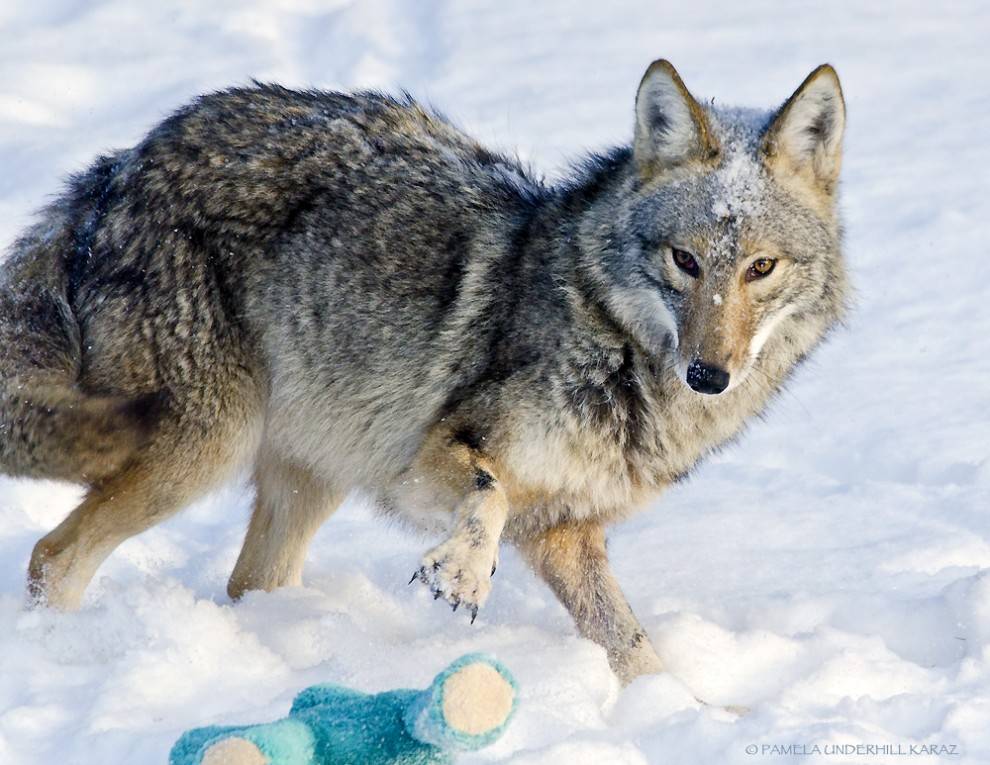
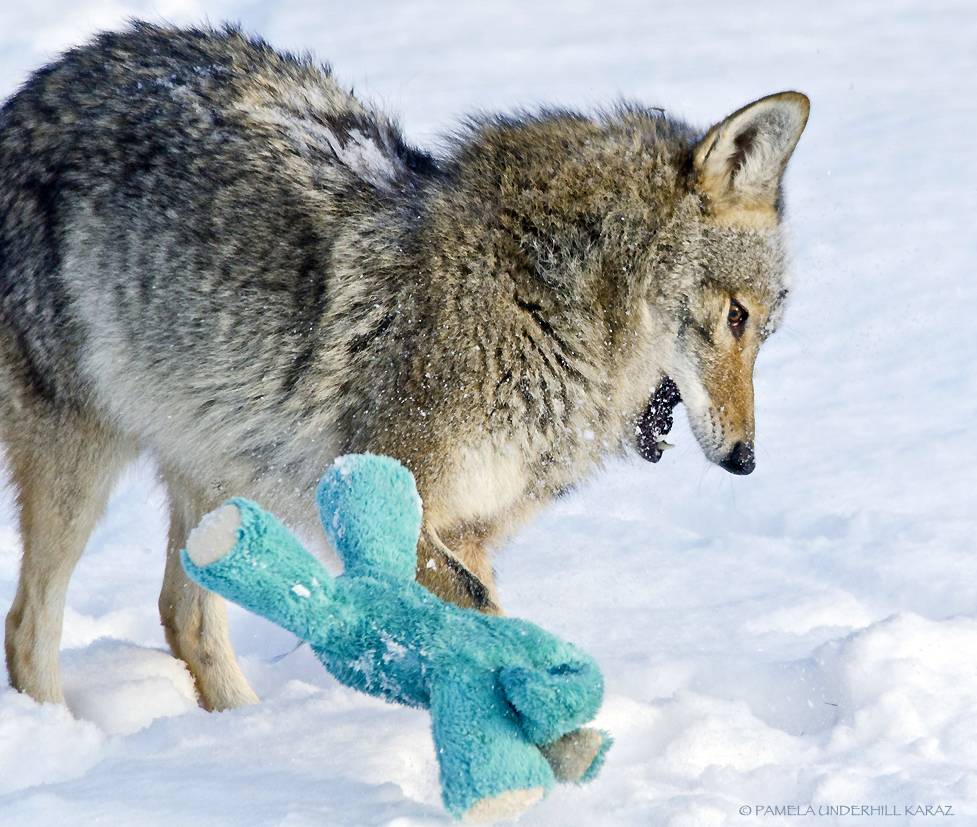
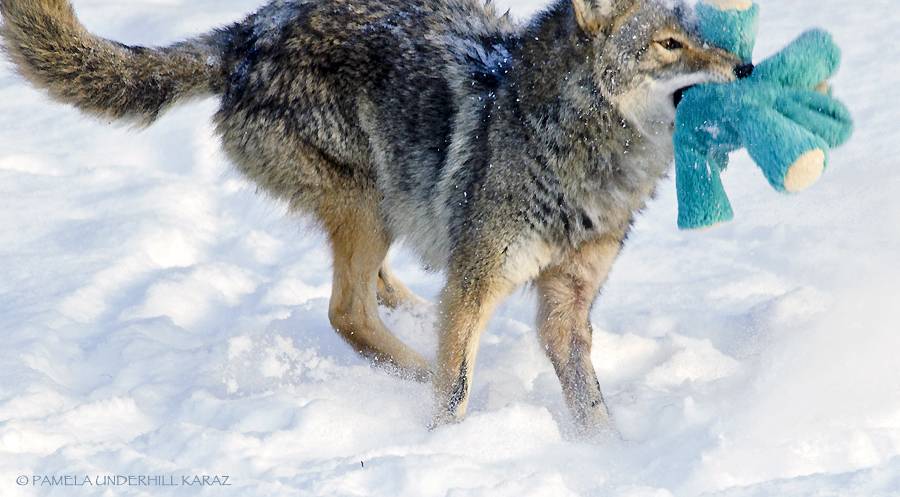
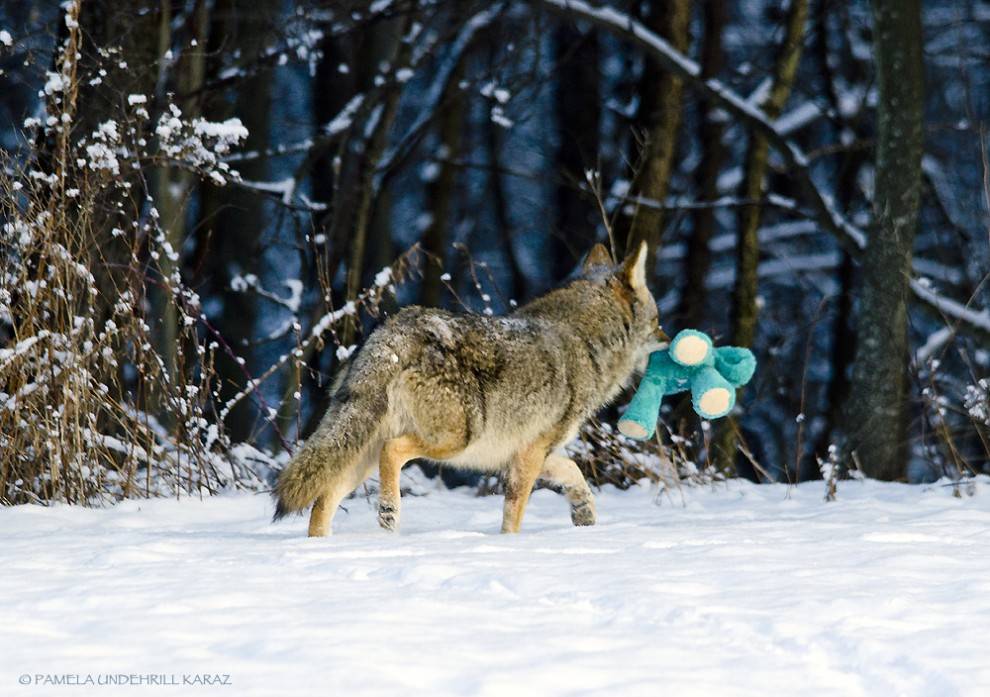
Coyote finds old dog toy, acts like a puppy

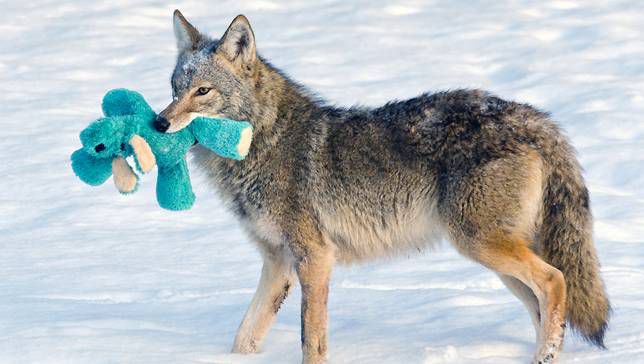
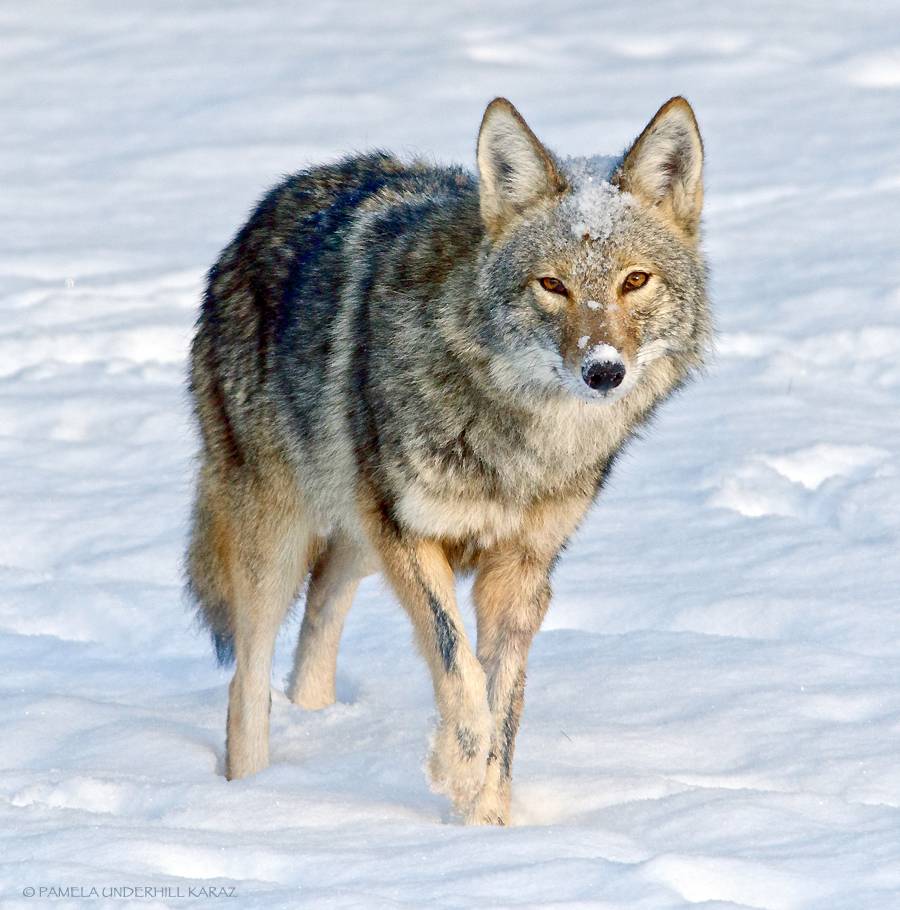
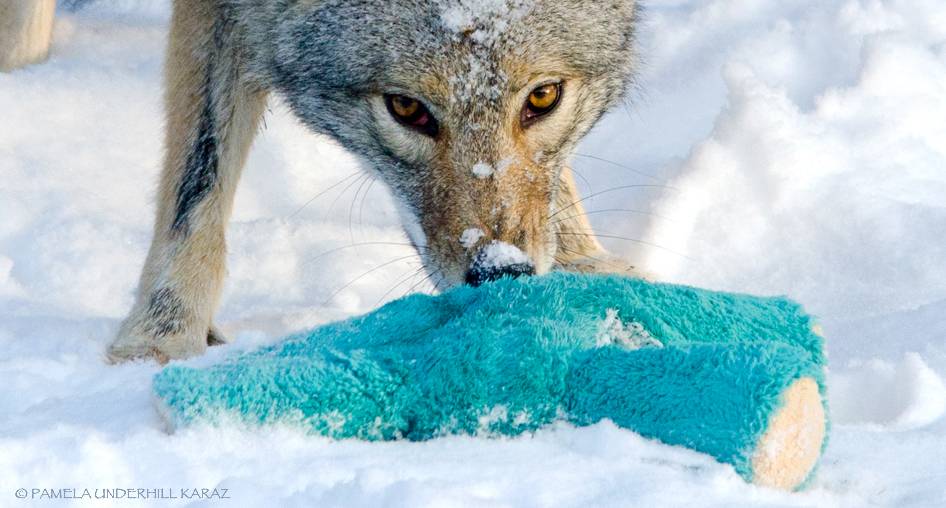
A photographer spotted a coyote as it trotted into her yard and explored a toy left in the snow. What she managed to capture on camera is the beauty of play.

By

Jaymi Heimbuch
Jaymi Heimbuch,   March 6, 2015.

This coyote took a liking to a blue stuffed dog toy and had a playful romp in the snow with it. (All photos: Pamela Underhill Karaz)

Photographer Pamela Underhill Karaz lives in Trenton Falls, New York, in a rural area. Her own property is 48 acres of forest and field, which means she gets to see her fair share of wildlife right in her own backyard. “We’ve had coyotes living around us for years. We hear them mostly during the summer evenings,” she told MNN. But something much more than simply hearing a few coyote howls happened two years ago.

She tells us, “Our driveway is a quarter-mile long and lined with 45-year-old balsam trees. Being a photographer, I’m always on the lookout for wildlife activity. I spotted the coyote while having our morning coffee. He was one-third of the way down our driveway. He went to the middle, looked across then decided to come back up a bit. He left his scent on a downed branch (that’s how I know it was a male), then went into the trees and popped out up at the edge of our yard. Looked around, checked out and sniffed some tracks in our yard and when he was further along he noticed the toy. He made his way over to it, sniffed around it where our dog had rolled, sniffed the toy, picked it up, dropped it, sniffed it again.”

Then that’s when the magic happened. “[He] picked it up then proceeded to toss it up in the air and play with it, just like a dog would toss a toy around. It lasted perhaps five to 10 minutes, from picking up the toy, tossing it in the air, picking it up again and almost bucking around with it … then he just casually trotted off with it.”

Underhill Karaz notes that her dogs often leave their stuffed toys out in the yard and more than one has disappeared before. She guesses that this is perhaps not the first time the coyote had played (and run off with) her dogs’ toys.

Many animal species exhibit play, and yet we humans can’t help but look on in awe when we recognize it in species beyond the domestic dogs and cats we keep as companions. We get so used to thinking of wildlife as efficient and purposeful, wasting no energy. For the young of many species, play is indeed an essential part of growing up. Through play, juveniles learn everything they’ll need for adulthood from how to hunt to how to fight to how to navigate the social structure of their community. So we look on with joy but without much surprise when fox pups romp with each other and bear cubs tumble around together. But when the play carries on into adulthood, that’s when we stare with amazement, remembering we aren’t the only animals who like to inject a little joy into our day with silliness.

“This was such a wonderful reminder that all animals, the wild and the not so wild (our pets) are really not so different,” Underhill Karaz says. “They have personalities, they have feelings, and they do their best to survive in what is sometimes a very unfriendly world. They are not so very different than us.”

Check out more of Pamela Underhill Karaz’s photography on her Facebook page.

ooOOoo

Let me repeat that last paragraph that Pamela wrote:

“This was such a wonderful reminder that all animals, the wild and the not so wild (our pets) are really not so different,” Underhill Karaz says. “They have personalities, they have feelings, and they do their best to survive in what is sometimes a very unfriendly world. They are not so very different than us.”

I would just add that like dogs coyotes are creatures of integrity!

Enough said!

A leap into the unknown!

A slight tongue-in-cheek title to today’s post.

Because it is a leap day!

So I’m going back a long time.

I was born towards the tail end of 1944; six months before the end of WWII in Europe.

As such I was in my early twenties when NASA came to the wider attention of millions of people with their effort to put a man on the moon. It was enthralling to look up at the night sky when a moon was present and think that in time there would be a man standing on the moon’s surface.

Now that I am 75 many things have changed. But one of them has not: Staring up at the night sky and getting lost in thought. Luckily we live in a rural location without artificial light anywhere nearby and the night skies are very clear.

All of which takes me back to my days of sailing. From 1986 until 1991 I lived on a deep-water ketch, a Tradewind 33, based in Larnaca, in Cyprus. Each Spring, I would solo across to the Turkish coast, or the Greek coast, and meet up with friends, or my son and daughter, and go coastal cruising. Then in the last year I sailed for England. I well recall seeing the night sky all around me with the stars practically down the watery horizon.

But more of that some other day. Now back to the moon.

All of which is to republish this post and I do hope you will be able to read it fully.

ooOOoo

NASA video reconstructs the harrowing lunar journey of Apollo 13

By Michael d’Estries, February 26, 2020

NASA’s reconstruction of the moon’s far side is based off images received by its Lunar Reconnaissance Orbiter spacecraft. (Photo: NASA/Snapshot from video/YouTube)

On April 15, 1970, NASA astronauts Jim Lovell, Jack Swigert and Fred Haise aboard Apollo 13 set a Guinness World Record for the highest absolute altitude attained by a crewed spacecraft at a distance of 248,655 miles from Earth. Nearly 50 years later, that unplanned record still stands as part of a mission beset by technical glitches and saved by engineering heroism.

“We didn’t slow down, unlike the others, when we got to the moon because we needed its gravity to get back, so we hold the altitude record,” Lowell told the Financial Times in 2011. “I never even thought about it. Records are only made to be broken.”

Gliding by the moon’s far side at an altitude of only 158 miles, the crew of Apollo 13 were, at the time, one of only a handful of humans to ever gaze upon this strange and relatively-unknown terrain of our closest neighbor. Because the moon is tidally locked, a phenomenon in which an orbiting body takes just as long to rotate around its own axis as it does to revolve around its partner, only one side ever faces the Earth.

Using imagery collected by its Lunar Reconnaissance Orbiter spacecraft, NASA has recreated views observed by Apollo 13 during the crew’s harrowing 25-minute journey around the moon’s far side.

“This video showcases visualizations in 4K resolution of many of those lunar surface views, starting with earthset and sunrise, and concluding with the time Apollo 13 reestablished radio contact with Mission Control,” the agency said in a release. “Also depicted is the path of the free return trajectory around the Moon, and a continuous view of the Moon throughout that path. All views have been sped up for timing purposes — they are not shown in ‘real-time.'”

This video uses data gathered from the Lunar Reconnaissance Orbiter spacecraft to recreate some of the stunning views of the Moon that the Apollo 13 astronauts saw on their perilous journey around the farside in 1970. These visualizations, in 4K resolution, depict many different views of the lunar surface, starting with earthset and sunrise and concluding with the time Apollo 13 reestablished radio contact with Mission Control. Also depicted is the path of the free return trajectory around the Moon, and a continuous view of the Moon throughout that path. All views have been sped up for timing purposes — they are not shown in “real-time.” Credits: Data Visualization by: Ernie Wright (USRA) Video Produced & Edited by: David Ladd (USRA) Music provided by Universal Production Music: “Visions of Grandeur” – Frederick Wiedmann

According to Lowell, despite the astronauts’ extremely close proximity, the moon was not the most awe-inspiring scene outside the spacecraft window.

“The impression I got up there wasn’t what the moon looked like so close up, but what the Earth looked like,” he said.

“The lunar flights give you a correct perception of our existence. You look back at Earth from the moon and you can put your thumb up to the window and hide the Earth behind your thumb. Everything you’ve ever known is behind your thumb, and that blue-and-white ball is orbiting a rather normal star, tucked away on the outer edge of a galaxy. You realize how insignificant we really all are. Everything you’ve ever known — all those arguments and wars — is right behind your thumb.”

ooOOoo

Did you watch the video? It’s amazing and is literally the dark side of the moon!

I will close by republishing a Wikipedia entry for Apollo 13.

Apollo 13 was the seventh crewed mission in the Apollo space program and the third meant to land on the Moon. The craft was launched from Kennedy Space Center on April 11, 1970, but the lunar landing was aborted after an oxygen tank in the service module (SM) failed two days into the mission. The crew instead looped around the Moon, and returned safely to Earth on April 17. The mission was commanded by Jim Lovell with Jack Swigert as command module (CM) pilot and Fred Haise as lunar module (LM) pilot. Swigert was a late replacement for Ken Mattingly, who was grounded after exposure to rubella.

Accidental ignition of damaged wire insulation inside the oxygen tank as it was being routinely stirred caused an explosion that vented the tank’s contents. Without oxygen, needed both for breathing and for generating electric power, the SM’s propulsion and life support systems could not operate. The CM’s systems had to be shut down to conserve its remaining resources for reentry, forcing the crew to transfer to the LM as a lifeboat. With the lunar landing canceled, mission controllers worked to bring the crew home alive.

Although the LM was designed to support two men on the lunar surface for two days, Mission Control in Houston improvised new procedures so it could support three men for four days. The crew experienced great hardship caused by limited power, a chilly and wet cabin and a shortage of potable water. There was a critical need to adapt the CM’s cartridges for the carbon dioxide removal system to work in the LM; the crew and mission controllers were successful in improvising a solution. The astronauts’ peril briefly renewed interest in the Apollo program; tens of millions watched the splashdown in the South Pacific Ocean by television.

An investigative review board found fault with preflight testing of the oxygen tank and the fact that Teflon was placed inside it. The board recommended changes, including minimizing the use of potentially combustible items inside the tank; this was done for Apollo 14. The story of Apollo 13 has been dramatized several times, most notably in the 1995 film Apollo 13.

Day Eight of Tom and Chica’s walk

Now it gets very interesting!

This is a longer post and with great interest.

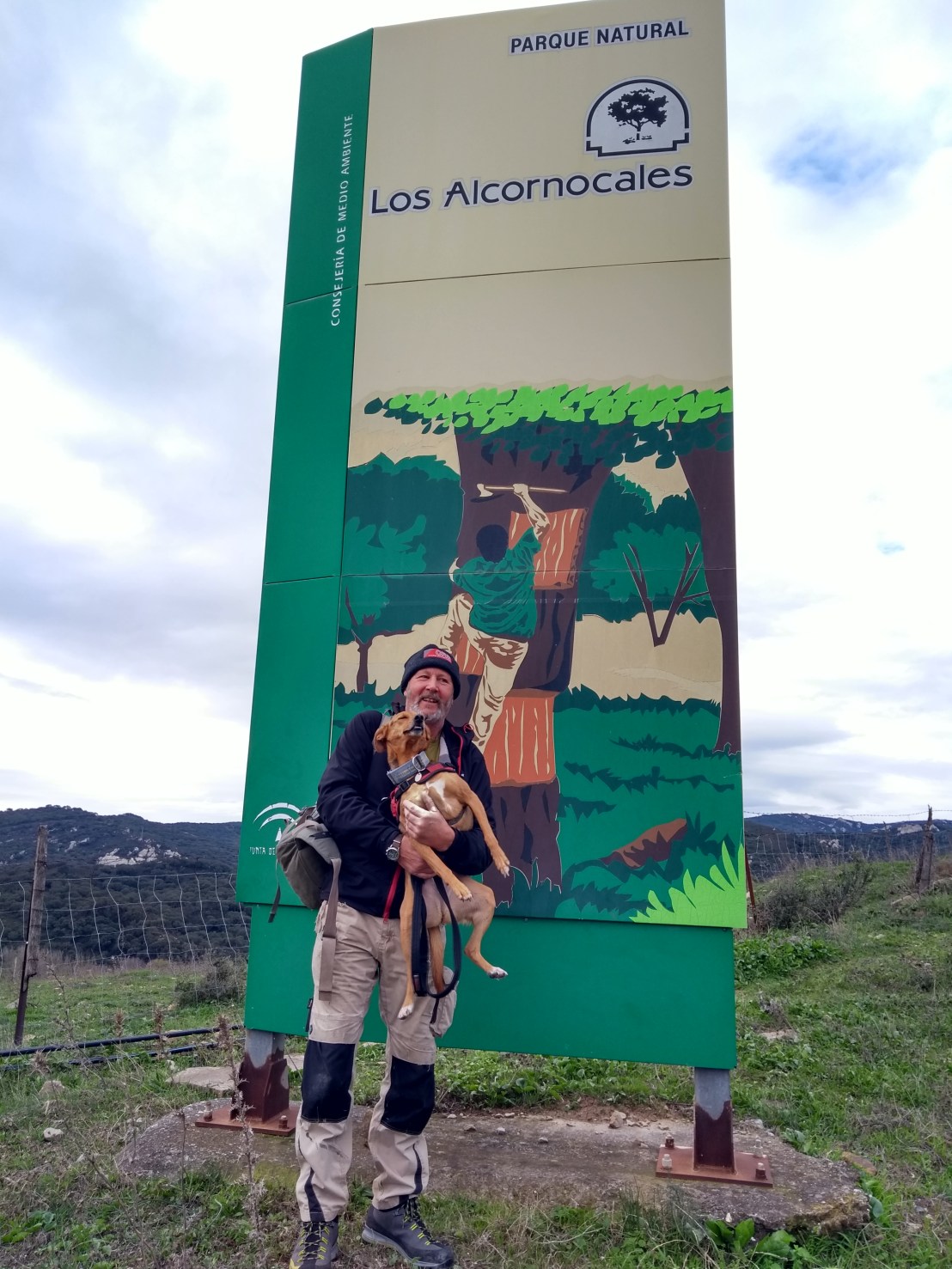
For it covers the Park at Los Alcornacales as well as the Spanish cork industry.

As always, the post is a republication of the original and is gratefully offered to my readers.

ooOOoo

Los Alcornacales – cork and pork and much, much more.

By Tom and Chica, 24th January, 2020

Written by Tom’s wife.

So far, during this part of the walk, Tom and Chica have been travelling through the unique habitat of Los Alcornacales. We fell in love with this beautiful area the first time we visited back in 2013. As we are rained off at the moment, I thought I’d take the opportunity to research more about the area, especially the amazing cork oaks which comprise large areas of the forest.

 Granted natural park status in 1989, Natural Park Los Alcornacales occupies a protected area of 170,025 hectares in Andalusia. Soil, moisture and traditional uses have been the main factors in the conservation of the largest productive area of cork trees anywhere on the Iberian Peninsula. Located in the province of Cadiz and part of Malaga (mainly in the municipality of Jimena de la Frontera, where we have just been walking), it runs from the mountains down to the recently created Estrecho Nature Park on the coast and is home to a variety of landscapes, flora, fauna, history and folklore.
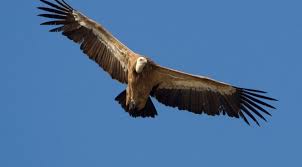
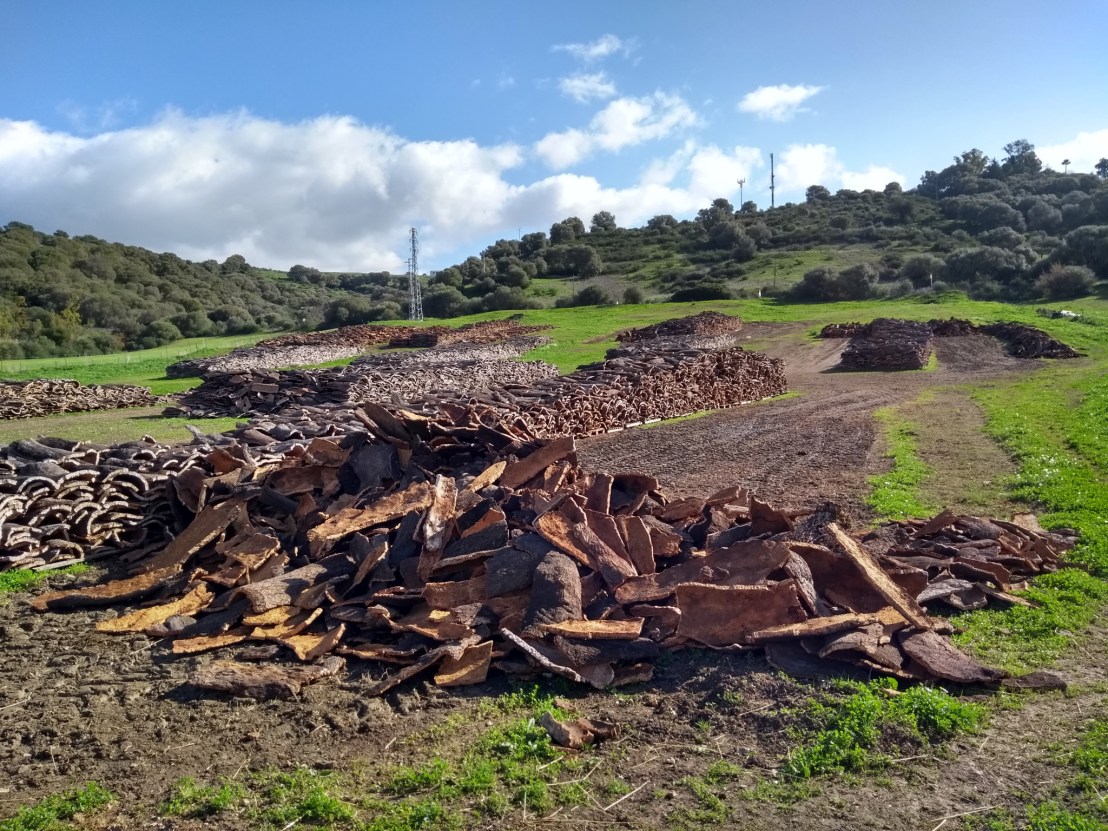
This rich diversity is mainly due to the many rivers, streams and reservoirs but also the moisture that comes from the coast. This latter accumulates to form banks of mist in the deep, narrow gorges known as ‘canutos’. In these conditions, the ancient laurel forest flora has flourished. Characterised by smooth, bright leaves, it can make the most of the moisture and limited light that penetrates the alders growing on the edge of the gorges. So, amidst the scent of laurel and the beauty of flowering rhododendrons, you can walk through this dense forest accompanied by the sound of dippers, kingfishers, blackcaps and finches.

Egyptian mongoose
Griffon vulture

In the more clay-rich areas lower down you can see the wild olive tree, cleared from time immemorial to make way for pasture for the region’s most typical livestock, the brown Retinta cow. On the valley sides, the Mediterranean scrub of rockrose, heather, lavender, daphne and hawthorn is perfect for Andalusian deer, as well as buck, roe deer and carnivores such as genets, badgers and also the Egyptian mongoose – the largest population anywhere on the Iberian Peninsula.

Cork production

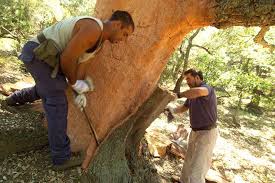
Los Alcornacales and the surrounding areas are home to the Iberian cork industry. As well as its most well-recognised use as bottle-stoppers, cork is also found in many products from car construction to aeroplane insulation.

The cork oak, quercus suber, is a native of both the northern and southern shores of the Mediterranean. Its age is unknown, but quercus suber or its ancestors have been around for at least 147 million years. It is a prophyte, ie a species adapted to survive fire. While other species rely on seed propagation to survive fires, the cork layer protects the stem of the tree so it only has to regenerate branches. This makes it very well adapted to the fire-prone forest of southern Spain.

Archaeologists have found evidence of tribes actively working with cork oak in northern Africa before 6,000 BC. Early man would have used the various species of oak for fire wood, tools, weapons; and for building as the hunter-gatherers began to settle. Similar evidence has been found in Andalucía and other parts of southern Spain dating back 4,000 years BC or more.

However, it would take a few thousands more years before the special sealant qualities of cork would be utilised. This property is due solely to the presence of one particular constituent: suberin. Suberin is a fatty substance found in the cells of the denser forms of cork which stops the passage of air or liquid.

Cork was probably first used as a sealant in containers by the Greeks and Phoenicians, for wines and other liquids in pottery containers but it would take the invention of the glass bottle, a fairly recent innovation in historical terms, for cork to finally meet glass. Legend claims that Friar Perignon, a French monk, discovered this use for cork on a slender glass bottle neck in the seventeenth century. As news of its efficacy spread, so a new industry appeared.

Cutting the cork is a highly skilled task and requires two years training. It is unusual for a tree to survive ring barking (the bark being removed around the complete circumference) and it needs to be done with care and at the right time. The cutters’ experience tells them how far to cut up the tree to avoid harming it.  Cutting is only legally permitted between 15 June and 15 August which is when gangs roam the oak forests, each of the usually five members having a specific role, from chief cutter to lowly carrier.

These gangs traverse the forest in a nine-year cycle, allowing the trees they cut to regenerate the cork in the intervening period. Their mules roam free in the forest except for the two month harvest period when they trek back and forth between harvest site and cork factory. So expert is their knowledge of the routes that, once loaded, a tap on the back will send them off unaccompanied. The town of Cortes de la Frontera actually holds burro-loading contests at its annual summer feria, with a prize for the most ingenious loading of a burro.

What we see lying curled on the ground is still many stages away from fitting into the neck of a bottle. At the factory the cork is boiled in a vast, deep pool of water, which renders it malleable for flattening and then processing by machine. The cork then goes through several levels of compression, depending on its destination. It emerges as very thin sheets of varying sizes, perhaps thinner than a child’s little finger. It is then checked for quality – the oak trade has five levels, from excellent to poor – and the oak is assigned to an appropriate use.

Most interestingly, however, is how it does reach the bottles we uncork. Bottle corks are stamped out by machines at different widths for wine, champagne and cognac (Spanish cork is treasured by French brandy producers). When they pile up in the dumpers beneath the pressing machines, they look like big wooden pennies. These are graded by quality, and then carefully fed into further compressing machines. Cork makers reckon that it would be a waste of good cork to use it throughout a wine or champagne cork, so lower quality cork is placed in the middle, highest quality at either end, where the cork meets both wine and outside air. These layers are then compressed so tightly we do not even notice that a cork we pull is not one single unit but a compression of up to eight layers crushed together. The finished corks are then dispatched to bottling plants across Europe and beyond.

There have, of course, been concerns about the rise of the plastic cork. Its proponents say that it prevents a bottle being ‘corked’, ie, spoiled, by air penetrating the old-fashioned cork. Its detractors argue that, beyond the aesthetics of levering a wad of white plastic out of your favourite wine, it doesn’t allow the alcohol to breathe naturally. (French brandies breathe so profusely that the distilleries are wreathed in fumes which promote fungi on the roofs and keep nearby cattle happily sozzled year-round.) Yet with even the British supermarket buyer seemingly moving upmarket in their choice of corked drinks, and the Spanish and French keeping their noses in the air over plastic stoppers, it seems the Iberian peninsula can hold on to its two billion euro cork industry yet.

Other uses for cork include flooring. We have some of this in our bathroom at home. A long way from the basic dull cork tiles of old, now it comes in stunning patterns and looks beautiful. It is also sustainable, provides excellent insulation and is lovely and warm to walk on. If I could, I’d floor the whole house with this.
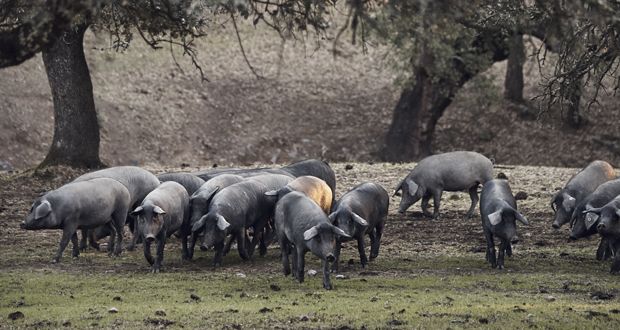
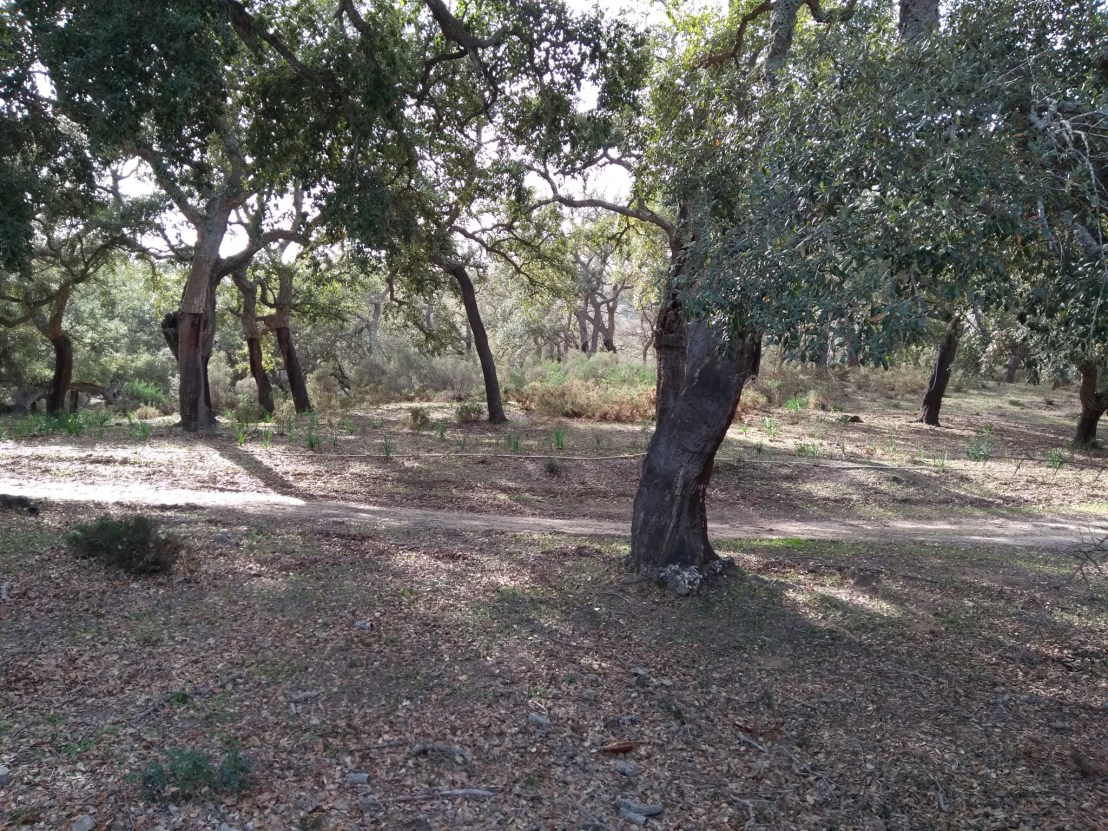
Iberian pigs

The Iberian pig is a traditional breed of the domestic pig (Sus scrofa domesticus) that is native to the Iberian Peninsula and is currently found in herds clustered in the central and southern part of Portugal and Spain. Its origins can probably be traced back to the Neolithic, when animal domestication started.

The most commonly accepted theory is that the first pigs were brought to here by the Phoenicians from the Eastern Mediterranean coast, probably along the old droving tracks one of which our route, the GR7, roughly follows. They interbred with wild boar and this cross gave rise to the ancestors of what are today’s Iberian pigs.

Prized Iberico ham

The production of Iberian pork is deeply rooted to the Mediterranean ecosystem. It is a rare example in world pig farming where the pig contributes so decisively to the preservation of the ecosystem. The Iberian breed is currently one of the few examples of a domesticated breed which has adapted to a pastoral setting where the land is particularly rich in natural resources, in this case acorns from the holm oak, gall oak and cork oak.

The numbers of the Iberian breed had been drastically reduced since 1960 due to several factors such as the outbreak of African swine fever and the lowered popularity of animal fats. In the past few years, however, the production of pigs of the Iberian type has increased to satisfy a renewed demand for top-quality meat and cured products. Now, though, there is controversy over the providence of the highly prized Iberico ham as breeders cash in on the market and produce a similar but much less sustainable product more cheaply, thus threatening this ancient livelihood.

The Iberian pig can be either red or black or in between. In traditional management, animals ranged freely in sparse oak forest (dehesa in Spain, montado in Portugal).  They are constantly on the move and therefore burn more calories than confined pigs. This, in turn, produces the fine bones typical of this kind of jamón ibérico. At least a hectare of healthy dehesa is needed to raise a single pig. True dehesa is a richly diverse habitat with four different types of oak that are crucial in the production of prime-quality ham. The bulk of the acorn harvest comes from the holm oak (Quercus ilex) but also the Pyrenean oak (Quercus pyrenaica) and Portuguese or gall oak (Quercus lusitanica) and the late cork oak season, which extends the acorn-production period from September almost to April.

Some recent research from Cordoba university concluded {the translation isn’t perfect but you get the idea}:

‘The couple Iberian pig and dehesa has proved to be very effective; so much [so] the Iberian pig is called the dehesa jewel, but the first needs this agro-ecosystem to reach its highest quality properties (organoleptic and nutritional ones); and the second needs a clear commercial differentiation for Iberian pork and cured products in order to receive a high price to maintain and conserve the dehesa. Spanish authorities should be responsible for protecting this traditional system from fraud and unfair competition. In this way, farmers economy could be enough to conserve this unique ecosystem and its values for the whole society.’*

Whether you eat pork or not you may still believe as I do, that this traditional and sustainable way of producing it is better for the ecosystem and the pigs than intensive farming on a huge scale. And we love seeing the black pigs snuffling through the forest. I hope it can be protected along with the rest of this remarkable and stunningly beautiful area.

ooOOoo

Well I must say that this is a tremendous post and a privilege to be able to republish it.

Gilliwolfe did an incredible job in composing the post and inserting all the photographs. Well done!

Well done!


A further word about natural supplements

Stick to the major brands and you should be alright!

Following my republication of the article in The Conversation two days ago, I have now come to a conclusion. That is that if one sticks to major brands or supplements made in the USA then one should be perfectly safe.

Margaret of Tasmania made a recommendation to use ConsumerLab.com and it appears a brilliant suggestion.