Yesterday, a Post was published a Post about Greg Craven. It made the point that social media was becoming a very real force in influencing opinions and how that threatened traditional politics. Here’s an extract:
I was doing some research for an earlier Post about Copenhagen and came across a YouTube video created by Greg. More details and links later after making a more fundamental point.
This video of Greg’s has had 2,704,000 viewings! The information on that YouTube ‘page’ has had over 7,500,000 viewings. Greg has now written a book and so on, and so on.
Now I want to return to the core subject of how we deal with very complex issues that have the power to decimate humanity, e.g. global warming.
The fact is that the majority of people who think about such issues as global warming don’t have the skills and knowledge to determine what to do for the best. It comes down to determining risks, which was the theme of an earlier Post acknowledging the work of Peter L Bernstein.
That’s also the theme of Greg Craven’s video on YouTube. It’s a noble effort by a concerned citizen of Planet Earth. Watch it.
For those readers who are not regular BBC television viewers, the Beeb has for many years run an excellent factual/science & nature series under the name of Horizon. Just recently there was a programme with the title of How Many People Can Live on Planet Earth?
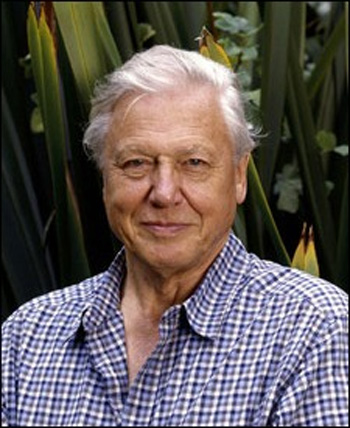
Sir David Attenborough
It was presented by that familiar face on the BBC in terms of the natural world, Sir David Attenborough. It was an appropriate and worthy person to present the information.
But before getting into some of the details underpinning the programme, there seems to been an enormous and unspoken omission at Copenhagen – why no debate about global population trends?
Luckily the media noticed the rather obvious exclusion. Here’s the UK Daily Telegraph newspaper (online version) of the 8th December, 2009. An extract:
Population growth is the one issue accused of causing driving climate change that no one at the Copenhagen climate summit dares to talk about.
The argument is that more people consume more resources, therefore producing more greenhouse gases that cause global warming.
The global population is currently at 6 billion and could rise to 11 billion by 2050 if fertility rates continue, not only threatening the climate, but food shortages and conflict as well.
Organisations like the Optimum Population Trust, that is backed by Sir Jonathan Porritt, Dame Jane Goodall and Sir David Attenborough, advocate birth control as a way of slowing climate change.
As Sir David has said: “I’ve never seen a problem that wouldn’t be easier to solve with fewer people, or harder, and ultimately impossible, with more.”
A study by the London School of Economics found contraception is almost five times cheaper as a means of preventing climate change than conventional green solutions such as investing in green technology.
There’s a new power on the streets and it may make politicians feel very uncomfortable!
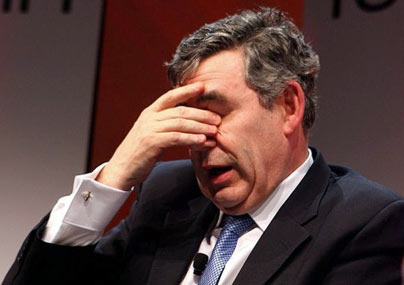
The Rt Hon Gordon Brown
Like me, you probably haven’t heard of Greg Craven. I hadn’t until about 24 hours before starting to write this Post (that would be Friday afternoon, Mountain Time, on the 11th December).
I was doing some research for an earlier Post about Copenhagen and came across a YouTube video created by Greg. More details and links later after making a more fundamental point.
This video of Greg’s has had 2,704,000 viewings! The information on that YouTube ‘page’ has had over 7,500,000 viewings. Greg has now written a book and so on, and so on.
In other words, the personal message that Greg is conveying has reached an unbelievable number of people. That would have been impossible without the power and reach of modern social media software systems: YouTube, Facebook, Linked-In, Twitter, MySpace, Digg, at al.
In the past, information has flowed outwards in a much more ‘top down’ way. Hierarchical, as it is called. That has suited those that wish, in some way, to control the message. While individuals would always chatter and gossip with their peers, there was a finite limit to that before “Send reinforcements, we are going to advance” morphed into “Send three and fourpence, we are going to a dance”!
The example of Greg Craven shows only too well how information can now flow. Out of anyone’s control, spreading virally.
Having made my point, I want to return to the subject matter that Greg is championing – but will include that in a separate Post.
Politicians! Be very careful what you say. We are all listening now, in one way or another, and ready to pounce if we don’t trust your words!
Will we ever know the truth, the whole truth, and nothing but the truth?
It’s a week since the start of The United Nations Climate Change Conference – Copenhagen, 2009 and it’s clearly been a media success if nothing else.
My instinct has, for many years, been the assumption that mankind behaves in many ways that harm our environment and that, ultimately, harming the very planet upon which our survival depends could happen. Stupid, yes! But in line with some of the more strange behaviours of homo sapiens.
But like millions of people, I do not have either the scientific background or the time available to test the statements made by so many governments and other ‘wise’ bodies as to whether the science of climate change, global warming or whatever, is real and irrefutable. One thinks that would be relatively easy to do and that after all the years and millions of dollars spent on climate research, the proof would be there. Cause and effect were perfectly understood.
As I visit some of my clients, I am becoming aware of an unusual phenomenon – I think some people are actually becoming less selfish. We are used to hearing stories of institutions reaching heights of greed and selfishness during this recession but not many that are about the other way round.
I don’t go to supermarkets very often because I’m usually out working when my wife goes but by a fluke, I kept her company recently. We have been trying to support the local farmer’s markets in the area but this is proving difficult as it’s much quicker to do a one-stop visit to a supermarket than lots of small visits since we both run our own businesses.
It is of course cheaper at the supermarket as they have systematically forced food prices down to a level that prohibits most small food producers from supplying them.
Anyway, I digress. In our local supermarket works an ex colleague and friend of mine. He was made redundant just over a year ago for the second time and decided that he would go for the stress-free, safe option. He used to organise procurement for a large, global communications company so he has his head screwed on around organising things. I guess the supermarket job means that he can just switch off away from work, something he could never do before.
I saw him with a large trolley, checking shelves and we stopped for a chat. He was fine and generally enjoying his work. He asked about mine and I mentioned that things were a bit tight at the moment. We got talking about how training is carried out at his work and how they work with developing employee’s interpersonal and communications skills. He mentioned that there was a new HR manager at the branch, or is it “in branch?”, and would I like an introduction as they were always recruiting new people and they needed training?
I was flabbergasted as we weren’t necessarily that good friends and he didn’t need to say or do anything but went out of his way to be helpful.
I have also noticed this phenomena in other companies from time to time, in the form of clients arranging meetings and spending time, something previously they really didn’t have time for. Maybe we get more of what we notice and by focusing on the positive, we attract more of the positive into our lives?
Is it because when the going gets really tough, for example, in times of national crisis or great hardship, that we remember that we are all interconnected?
While dealing with children and their little models I can spend hours making and mending small plastic and wooden pieces to give them a few hours of fun and assist them in understanding what machinery is made up of.
Recently I saw a model of a galleon made by a prisoner of war. He would obviously have had many hours with which to spend his time, making a work of art, but now prepare to have your jaw dropped.
For a long time, it has seemed to me that we confuse crimes and accidents.
This is such a substantial issue that more posts might flow from this, depending on the level of interest. Also, I should point out that I am no lawyer, so this is a personal, not a professional, view.
In both directions
When crimes are treated as accidents, criminal behaviour is appeased and no deterrent effect generated. Attempts to learn lessons are likely to be fruitless. So behaviour does not change and the crimes continue.
When accidents are treated as crimes, blame is allocated inappropriately and lessons are not learned. Innocent participants are punished for no purpose. So behaviour does not change and the accidents continue.
Issues
There are issues of causation, intent, blame and so on.
There are so many examples of this, that I am not sure where to begin. So, I won’t … yet!
A small challenge to a Nobel prize winner in Economics!
In a recent New York Times op-ed, Paul Krugman continues his boundless quest to become the “it” guy in the world of economics. I have taken issue with his command of basic economic facts in the past — a gutsy, if not insane thing to do given the man was awarded a Nobel Prize in Economics.
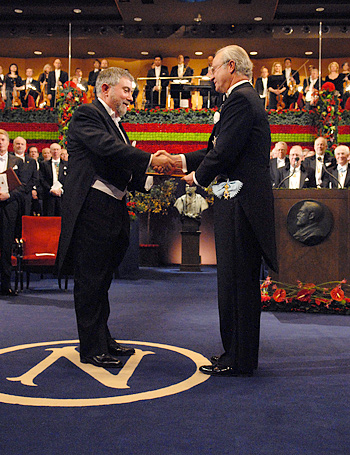
Krugman accepting the Nobel Prize
This post is more about ego than economics, however.
In this op-ed, Mr. Krugman says (and I kid you not),
…But after the debacle of the past two years, there’s broad agreement — I’m tempted to say, agreement on the part of almost everyone not on the financial industry’s payroll — with Mr. Turner’s assertion that a lot of what Wall Street and the City do is “socially useless.” And a transactions tax could generate substantial revenue, helping alleviate fears about government deficits. What’s not to like?
Well, I disagree with the idea that what Wall Street does is socially useless. And I am not on the financial industry’s payroll.
Nope, I’m just a simple economist, using my head, training, and experience to consider this idea, map out the pros and cons, and analyze the logical end-game of such a tax. I conclude that it is a really bad idea.
Why? There are lots of reasons, but I will mention only two.
One, raising taxes reduces private economic activity, which will curtail growth, reduce tax revenues and increase the deficit.
Two, taxes distort the price signal between suppliers and demanders of goods and services, including financial capital, reducing economic efficiency.
His reasons? Other than citing one academic study (while ignoring the many others that reach a different conclusion), he gives no economic reasons for his views. Instead, he make claims. He claims, for example, that “socially damaging behavior … caused our current crisis.” He says that the financial services industry is “bloated” and needs to be cut down to size. He says that the new tax is okay because it raises revenues for the government which, he claims, should make us all feel better about the deficit and, apparently, the size and nature of government spending under Obama. And, the lamest of all, for no other reason than to hide behind their skirt, he claims the existence of some phantom majority, apparently to create the impression that anyone with a different view is clearly in the minority. A tactic that should be beneath a Noble Prize winner, but one that runs through his work with increasing frequency over time.
But, Mr. Krugman, I so disagree with you. And even in an op-ed piece — perhaps especially in an op-ed piece – I believe that one needs to reign in an ego that would parade claims as facts, especially when each of those claims is disputed by your fellow economists, none of whom stooped so low as to imply that you were paid for your views.
Communicating effectively means being totally mentally connected.
I have been working with a client recently through a very tough performance improvement plan.
As part of the plan, my client had to be videoed working with people in his workplace. I had to observe the video and then give feedback on it.
He seemed very efficient and made notes whilst he worked with each person. Occasionally though, something didn’t seem to be quite right. When I watched more closely I realised what was wrong. He wasn’t present. He wasn’t really connecting with the people he was working with.
It made me reflect on how much more effective he would have been if he had been able to connect with these people? I wondered if he was even able to understood about being present and what that meant?
A summary of the different collections is listed here, many of them wartime photographs that bring a multitude of emotions to the surface: incredible bravery of the pilots; photographic standards of 70 years ago, man’s inhumanity to man; and so on.
I pondered a bit about writing this Post because, well ….. well…, see what you make of it!
Author's Mum
Being born in England in the early part of November, 1944, World War 2 still resonates within me.
Early home in an industrial part of West London meant that my mother and father had a ring-side view of the German V1 and V2 rockets that were being visited on London at that time.
My mother, 90, still recounts her enormous sense of relief when VE Day was announced (May 8th, 1945) because she then thought that her son’s future life was more or less assured.
So back to these aerial photographs held in those collections.
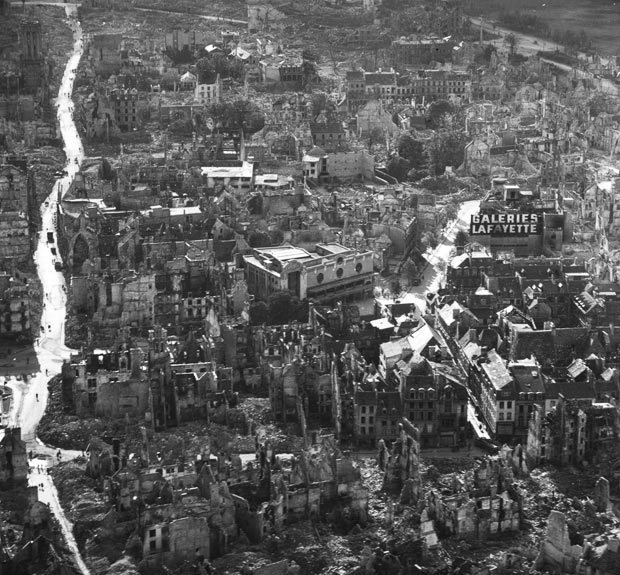
Here’s a picture of the visitation of war on the beautiful French town of Caen.
Linger a while and look at the damage, mostly to private homes. The photograph was taken just slightly more than a month before I was born.