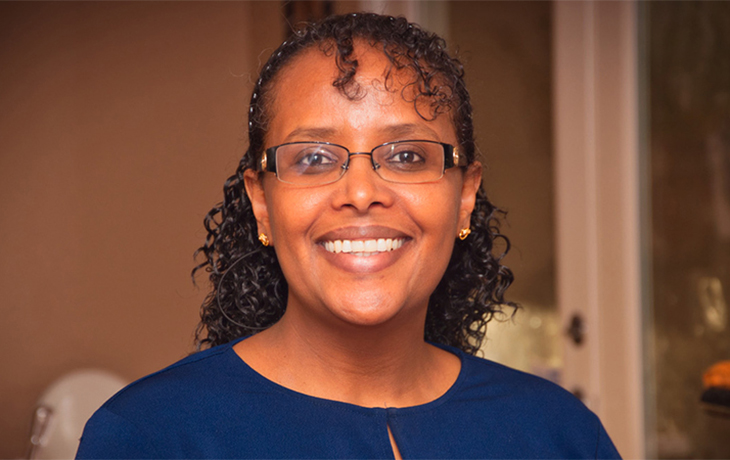
There have been so many disastrous activities on climate change, and I am not belittling them, but it was amazing to come across a TED Talk last Saturday that I watched. But first the speaker, Asmeret Asefaw Berhe, who was born in Asmara, Eritrea. Her bio (in part):
From WikiPedia:
ooOOoo
Asmeret Asefaw Berhe is a soil biogeochemist and political ecologist who is the current Director of the Office of Science at the US Department of Energy. She was previously the Professor of Soil Biogeochemistry and the Ted and Jan Falasco Chair in Earth Sciences and Geology in the Department of Life and Environmental Sciences; University of California, Merced.[1] Her research group worked to understand how soil helps regulate the Earth’s climate.
Advocacy and global impact work
Berhe’s work at the intersection of soil, climate change, and political ecology lends itself well to a number of global issues. During her graduate career, she was a member of the working group that produced the Millennium Ecosystem Assessment, which was called for by the United Nations Secretary Kofi Annan to assess the impact of humans on the environment. She was one of the lead authors on the 2005 report’s chapter on “Drivers of Change in Ecosystem Condition and Services.”[19] The Assessment received the Zayed International Prize for the Environment in 2005.[20]
In 2018, Berhe was selected as part of the inaugural National Academies of Sciences, Engineering, and Medicine New Voices in Sciences, Engineering, and Medicine cohort, as an early career leader working to advance the conversation around key emerging global issues and communicate the evidence base around those challenges.[21]
An advocate for women in science, Berhe is currently a co-Principal Investigator of ADVANCEGeo, which is working to transform the workplace climate of the geosciences to increase retention of women in the field and develop a sustainable model that can be transferred to other scientific domains. Currently, the Earth Science Women’s Network (ESWN), the Association for Women Geoscientists, and the American Geophysical Union (AGU) have partnered to address the issue of sexual harassment in the earth, space and environmental sciences.[22] The program led by Erika Marín-Spiotta and is run with support from a four-year $1.1 million grant from the National Science Foundation.[23]
She currently serves as an advisory board member of 500 Women Scientists, a grassroots organization working to make science open, inclusive, and accessible, and is on the leadership board of the Earth Science Women’s Network.
Earth’s soil can store vast amounts of carbon. Biogeochemist Asmeret Asefaw Berhe says soil could be a powerful tool for fighting climate change – if only we stopped treating it like dirt.
About Asmeret Asefaw Berhe
Asmeret Asefaw Berhe is a soil biogeochemist and President Biden’s nominee to lead the Department of Energy Office of Science. She is a professor of soil biogeochemistry at University of California, Merced. Her research group works to understand how soil helps regulate the earth’s climate.
Berhe’s work exists at the intersection of soil, climate change, and political ecology. During her graduate career, she was a member of the working group that produced the Millennium Ecosystem Assessment, which was called for by the United Nations to assess the impact of humans on the environment.
Berhe received a B.Sc. in Soil and Water Conservation at the University of Asmara in Eritrea. She has an M.Sc. in Political Ecology from Michigan State University and a Ph.D. in Biogeochemistry from University of California, Berkeley.
This segment of the TED Radio Hour was produced by Matthew Cloutier and Sylvie Douglis and edited by Rachel Faulkner and Katie Simon. You can follow us on Facebook @TEDRadioHour and email us at TEDRadioHour@npr.org.
Now that positive TED Talk:
We wish Asmeret the very best of fortune in bringing about these changes.
The challenge with writing posts, albeit not so often, about the global environment, especially when I am a non-scientist, is that one relies entirely on the words of others. In the case of a recent article, published by The Conversation, the authors are claimed to be specialists, and I do not doubt their credentials.
The three authors are René van Westen who is a Postdoctoral Researcher in Climate Physics, at Utrecht University, Henk A. Dijkstra who is a Professor of Physics, also at Utrecht University, and Michael Kliphuis, a Climate Model Specialist, again at Utrecht University.
So, here is their article:
ooOOoo
Atlantic Ocean is headed for a tipping point − once melting glaciers shut down the Gulf Stream, we would see extreme climate change within decades, study shows
Superstorms, abrupt climate shifts and New York City frozen in ice. That’s how the blockbuster Hollywood movie “The Day After Tomorrow” depicted an abrupt shutdown of the Atlantic Ocean’s circulation and the catastrophic consequences.
While Hollywood’s vision was over the top, the 2004 movie raised a serious question: If global warming shuts down the Atlantic Meridional Overturning Circulation, which is crucial for carrying heat from the tropics to the northern latitudes, how abrupt and severe would the climate changes be?
In a new study using the latest generation of Earth’s climate models, we simulated the flow of fresh water until the ocean circulation reached that tipping point.
The results showed that the circulation could fully shut down within a century of hitting the tipping point, and that it’s headed in that direction. If that happened, average temperatures would drop by several degrees in North America, parts of Asia and Europe, and people would see severe and cascading consequences around the world.
We also discovered a physics-based early warning signal that can alert the world when the Atlantic Ocean circulation is nearing its tipping point.
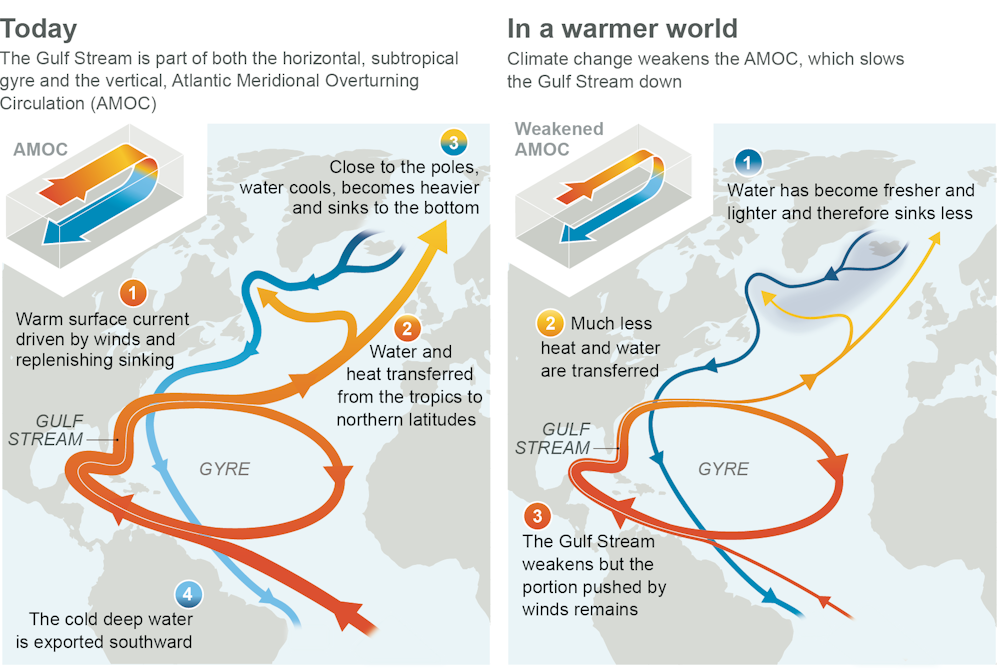
In the Atlantic Ocean circulation, the relatively warm and salty surface water near the equator flows toward Greenland. During its journey it crosses the Caribbean Sea, loops up into the Gulf of Mexico, and then flows along the U.S. East Coast before crossing the Atlantic.
This current, also known as the Gulf Stream, brings heat to Europe. As it flows northward and cools, the water mass becomes heavier. By the time it reaches Greenland, it starts to sink and flow southward. The sinking of water near Greenland pulls water from elsewhere in the Atlantic Ocean and the cycle repeats, like a conveyor belt.
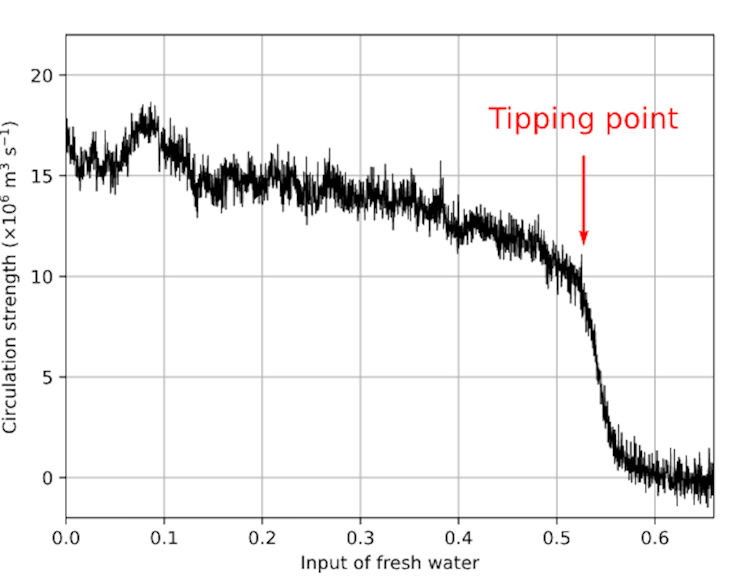
This is where our study comes in. We performed an experiment with a detailed climate model to find the tipping point for an abrupt shutdown by slowly increasing the input of fresh water.
We found that once it reaches the tipping point, the conveyor belt shuts down within 100 years. The heat transport toward the north is strongly reduced, leading to abrupt climate shifts.
The result: Dangerous cold in the North
Regions that are influenced by the Gulf Stream receive substantially less heat when the circulation stops. This cools the North American and European continents by a few degrees.
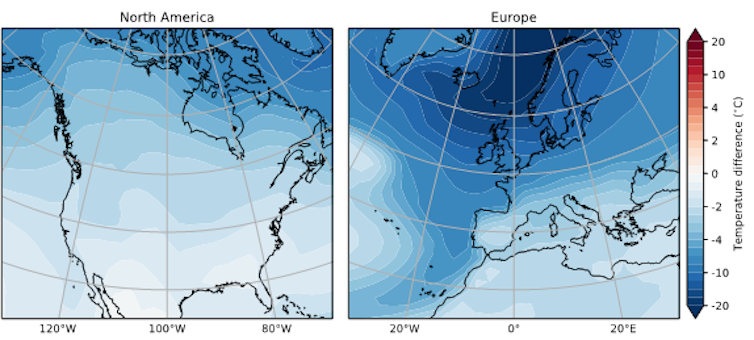
The European climate is much more influenced by the Gulf Stream than other regions. In our experiment, that meant parts of the continent changed at more than 5 degrees Fahrenheit (3 degrees Celsius) per decade – far faster than today’s global warming of about 0.36 F (0.2 C) per decade. We found that parts of Norway would experience temperature drops of more than 36 F (20 C). On the other hand, regions in the Southern Hemisphere would warm by a few degrees.
The annual mean temperature changes after the conveyor belt stops reflect an extreme temperature drop in northern Europe in particular. René M. van Westen
These temperature changes develop over about 100 years. That might seem like a long time, but on typical climate time scales, it is abrupt.
The conveyor belt shutting down would also affect sea level and precipitation patterns, which can push other ecosystems closer to their tipping points. For example, the Amazon rainforest is vulnerable to declining precipitation. If its forest ecosystem turned to grassland, the transition would release carbon to the atmosphere and result in the loss of a valuable carbon sink, further accelerating climate change.
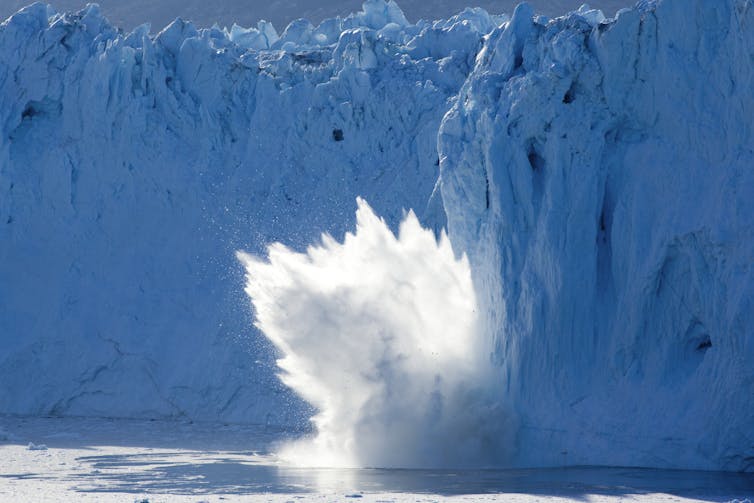
The Atlantic circulation has slowed significantly in the distant past. During glacial periods when ice sheets that covered large parts of the planet were melting, the influx of fresh water slowed the Atlantic circulation, triggering huge climate fluctuations.
So, when will we see this tipping point?
The big question – when will the Atlantic circulation reach a tipping point – remains unanswered. Observations don’t go back far enough to provide a clear result. While a recent study suggested that the conveyor belt is rapidly approaching its tipping point, possibly within a few years, these statistical analyses made several assumptions that give rise to uncertainty.
Instead, we were able to develop a physics-based and observable early warning signal involving the salinity transport at the southern boundary of the Atlantic Ocean. Once a threshold is reached, the tipping point is likely to follow in one to four decades.
A climate model experiment shows how quickly the AMOC slows once it reaches a tipping point with a threshold of fresh water entering the ocean. How soon that will happen remains an open question. René M. van Westen
The climate impacts from our study underline the severity of such an abrupt conveyor belt collapse. The temperature, sea level and precipitation changes will severely affect society, and the climate shifts are unstoppable on human time scales.
It might seem counterintuitive to worry about extreme cold as the planet warms, but if the main Atlantic Ocean circulation shuts down from too much meltwater pouring in, that’s the risk ahead.
This article was updated to Feb. 11, 2024, to fix a typo: The experiment found temperatures in parts of Europe changed by more than 5 F per decade.
I am 79! I like to think that whatever is coming down the wires, so to speak, will be after my death. But that is a cop out for a) I have a son and a daughter who are in their early fifties, b) I have a grandson, my daughter and son-in-law’s young man, who is a teenager, with his birthday next month, and c) I could possibly live for another twenty years.
The challenge is how to bring this imminent catastrophic global change in temperature to the fore. We need a global solution now enforced by a globally respected group of scientists and leaders, and, frankly, I do not see that happening.
All one can do is to hope. Hope that the global community will eschew the present-day extremes of warring behaviour and see the need for change. That is NOW!
So that the Hollywood movie, The Day After Tomorrow, remains a fictional story. And for those that have forgotten the film or who have never seen it, here is a small slice of a Wikipedia report:
The atmospheric river in California is reaching up to Southern Oregon
After we had the thick end of twelve inches of rain in January, February has kept up the downpours; as of yesterday morning we had had 0.52 inches (1.32 cm) for the month and it was still raining. (And 0.8 in at 08:00 this morning.)
Here’s an item from yesterday about the situation in California.
Plus the BBC News had an item on the California flood.
So it seemed opportune to present this article on atmospheric rivers.
ooOOoo
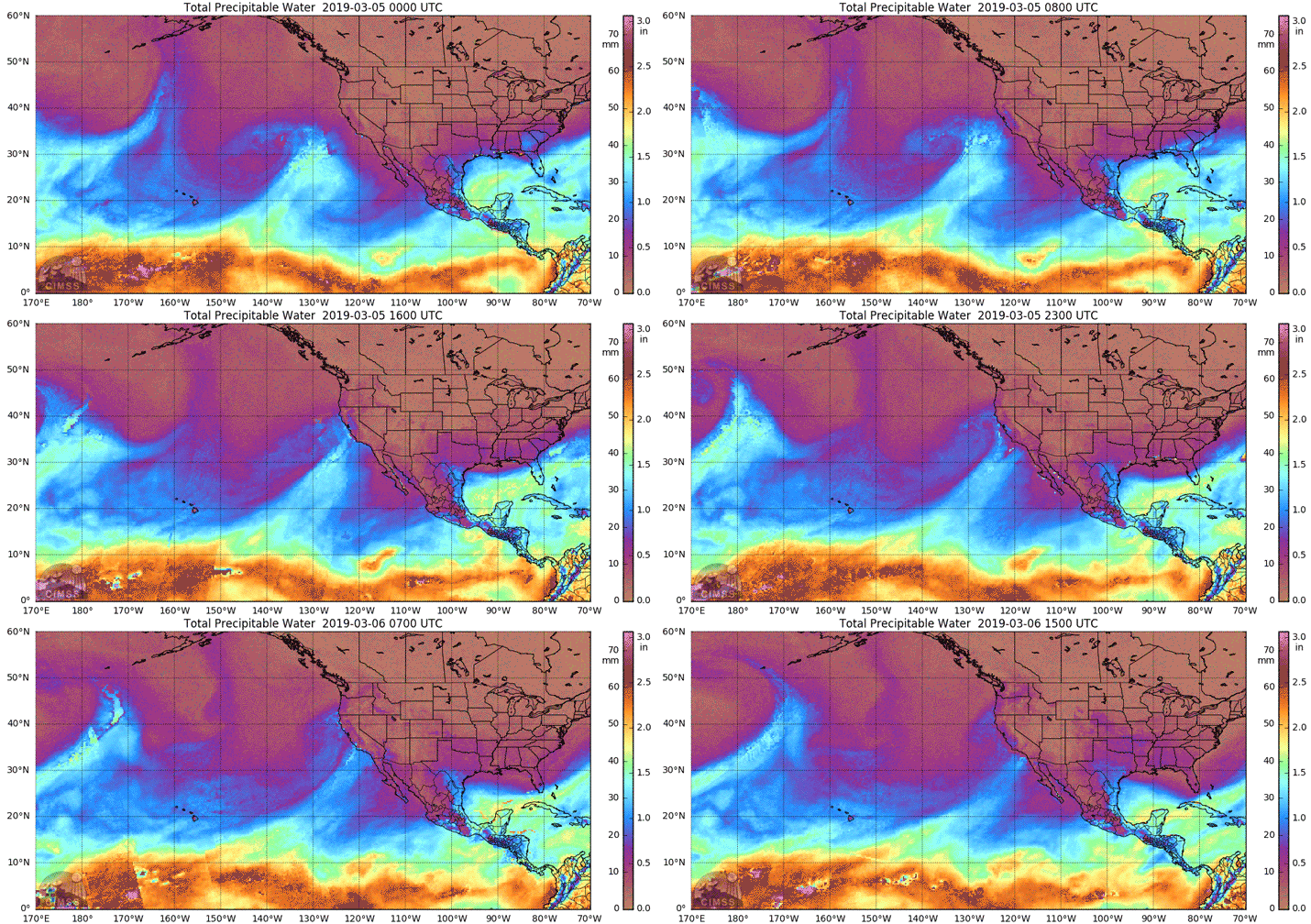
What is an atmospheric river? A hydrologist explains the good and bad of these flood-prone storms and how they’re changing
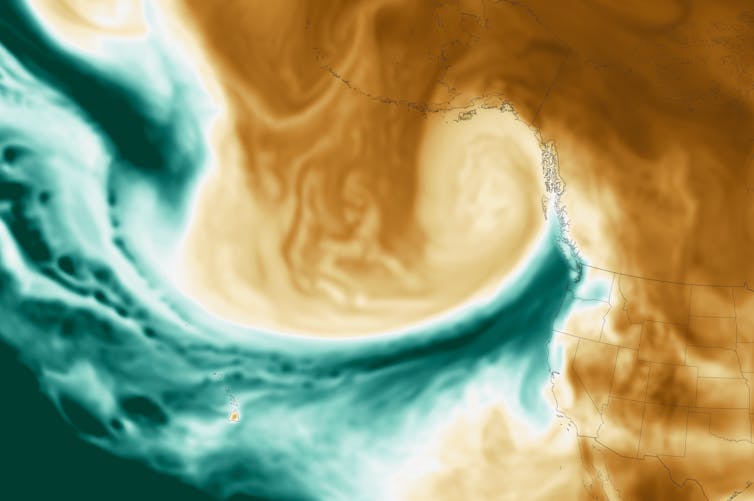
A satellite image shows a powerful atmospheric river hitting the Pacific Northwest in December 2023. Darker greens are more water vapor. Lauren Dauphin/NASA Earth Observatory
A series of atmospheric rivers is bringing the threat of heavy downpours, flooding, mudslides and avalanches to the Pacific Northwest and California this week. While these storms are dreaded for the damage they can cause, they are also essential to the region’s water supply, particularly in California, as Qian Cao, a hydrologist at the University of California, San Diego, explains.
What are atmospheric rivers?
An atmospheric river is a narrow corridor or filament of concentrated water vapor transported in the atmosphere. It’s like a river in the sky that can be 1,000 miles long. On average, atmospheric rivers have about twice the regular flow of the Amazon River.
When atmospheric rivers run up against mountains or run into local atmospheric dynamics and are forced to ascend, the moisture they carry cools and condenses, so they can produce intense rainfall or snowfall. https://www.youtube.com/embed/w3rtYM0HtIM?wmode=transparent&start=0 A satellite view of atmospheric rivers.
Atmospheric rivers occur all over the world, most commonly in the mid-latitudes. They form when large-scale weather patterns align to create narrow channels, or filaments, of intense moisture transport. These start over warm water, typically tropical oceans, and are guided toward the coast by low-level jet streams ahead of cold fronts of extratropical cyclones.
Along the U.S. West Coast, the Pacific Ocean serves as the reservoir of moisture for the storm, and the mountain ranges act as barriers, which is why the western sides of the coastal ranges and Sierra Nevada see so much rain and snow.
Why are back-to-back atmospheric rivers a high flood risk?
The first heavy downpours saturate the ground. As consecutive storms arrive, their precipitation falls on soil that can’t absorb more water. That contributes to more runoff. Rivers and streams fill up. In the meantime, there may be snowmelt due to warm temperatures, further adding to the runoff and flood risk.
California experienced a historic run of nine consecutive atmospheric rivers in the span of three weeks in December 2022 and January 2023. The storms helped bring most reservoirs back to historical averages in 2023 after several drought years, but they also produced damaging floods and debris flows.
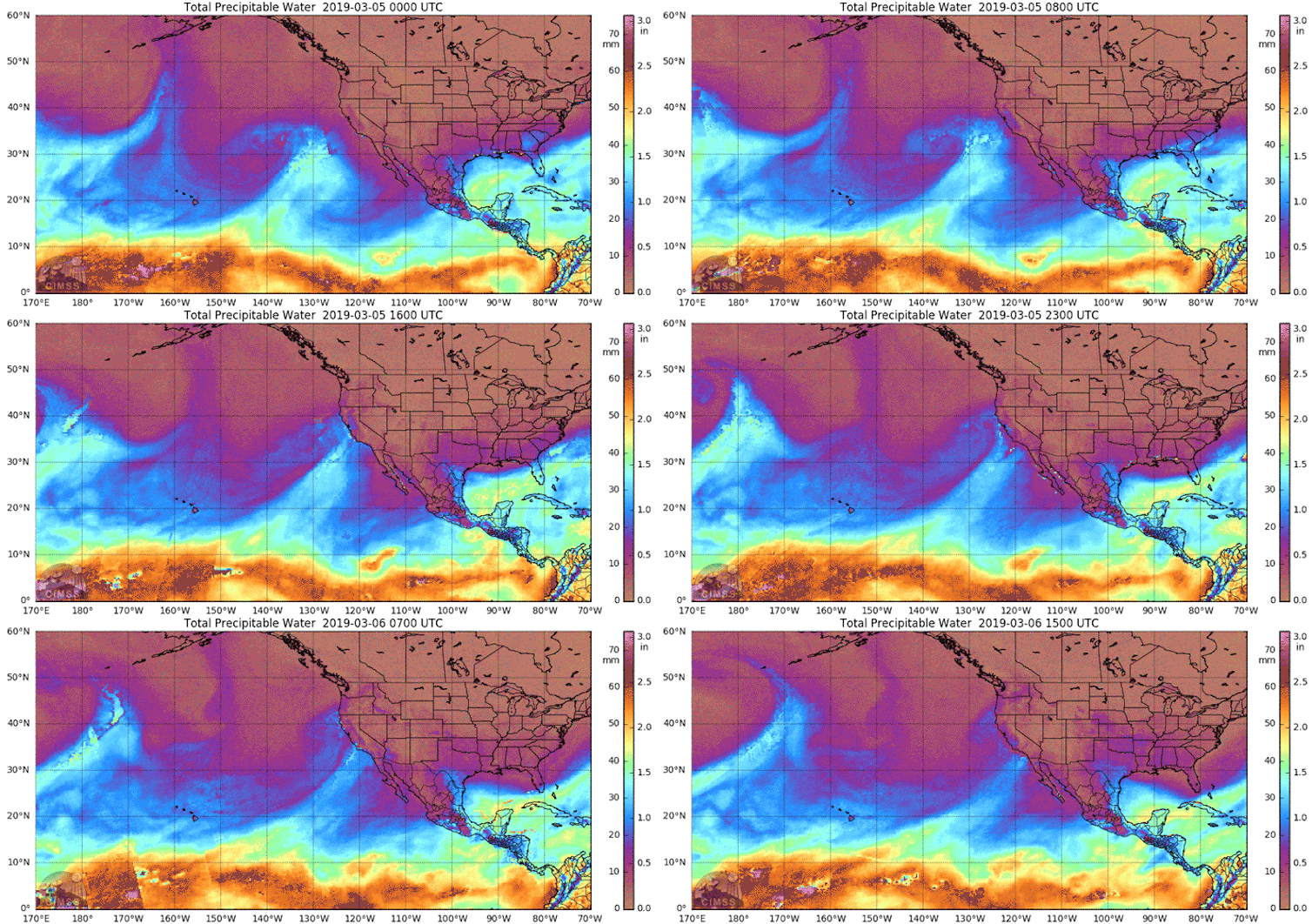
Atmospheric rivers forming over the tropical Pacific Ocean head for the U.S. West Coast. NOAA
The cause of AR families is an active area of research. Compared with single atmospheric river events, AR families tend to be associated with lower atmospheric pressure heights across the North Pacific, higher pressure heights over the subtropics, a stronger and more zonally elongated jet stream and warmer tropical air temperatures.
Large-scale weather patterns and climate phenomena such as the Madden-Julian Oscillation, or MJO, also play an important role in the generation of AR families. An active MJO shift occurred during the early 2023 events, tilting the odds toward increased atmospheric river activity over California.
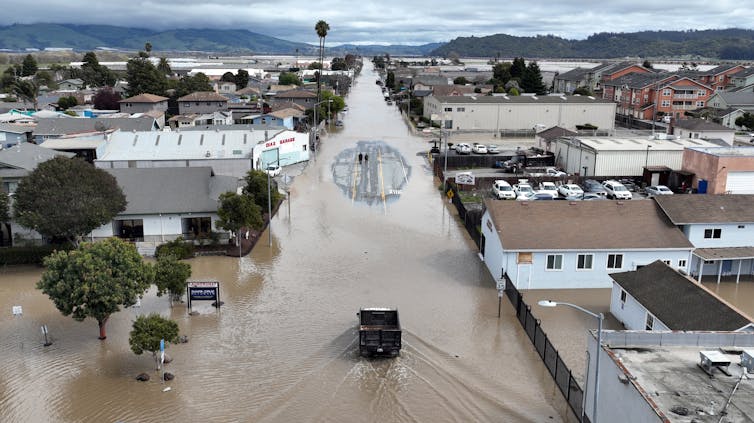
An aerial view shows a flooded neighborhood in the community of Pajaro in central California on March 11, 2023, after a series of atmospheric rivers. Josh Edelson/AFP via Getty Images
A recent study by scientists at Stanford and the University of Florida found that storms within AR families cause three to four times more economic damage when the storms arrive back to back than they would have caused by themselves.
How important are atmospheric rivers to the West Coast’s water supply?
I’m a research hydrologist, so I focus on hydrological impacts of atmospheric rivers. Although they can lead to flood hazards, atmospheric rivers are also essential to the Western water supply. Atmospheric rivers have been responsible for ending more than a third of the region’s major droughts, including the severe California drought of 2012-16.
They also contribute to the snowpack, which provides a significant portion of California’s year-round water supply.
In an average year, one to two extreme atmospheric rivers with snow will be the dominant contributors to the snowpack in the Sierra Nevada. Together, atmospheric rivers will contribute about 30% to 40% of an average season’s total snow accumulation there.
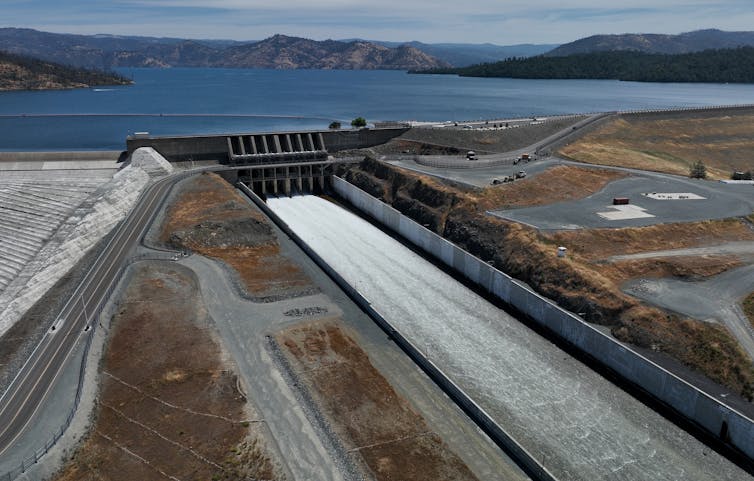
After several winter storms brought record snowfall to California’s Sierra Nevada in early 2023, Lake Oroville, California’s second-largest reservoir, was at 100% capacity. The previous year, much of the state had faced water restrictions. Justin Sullivan/Getty Images
That’s why my colleagues at the Center for Western Weather and Water Extremes at the Scripps Institution of Oceanography, part of the University of California, San Diego, work on improving atmospheric river forecasts and predictions. Water managers need to be able to regulate reservoirs and figure out how much water they can save for the dry season while still leaving room in the reservoirs to manage flood risk from future storms.
How is global warming affecting atmospheric rivers?
My research also shows that more atmospheric rivers are likely to occur concurrently during already wet conditions. So, the chance of extreme flooding also increases. Another study, by scientists from the University of Washington, suggests that there will be a seasonal shift to more atmospheric rivers earlier in the rainy season.
There will likely also be more year-to-year variability in the total annual precipitation, particularly in California, as a study by my colleagues at the Center for Western Weather and Water Extremes projects.
Patrice Ayme is a writer who lives in France and is a person of extreme breadth of knowledge, and very clever to boot.
He writes blog posts on a variety of topics. His latest post is breathtakingly powerful and could be the way we all go over the future years. Read it for yourself online or as follows:
ooOOoo
How Solar System Colonization Will Save Earth
By Patrice Ayme
Saving Earth and colonizing the Solar System are basically the same problem and have the same solution: much more advanced technology [1].There is no contradiction, far from it. There is complementarity, as technology that will have to be developed for space will be found to be useful for Earth. For psycho-political reasons those technologies won’t be developed directly for Earth. So those who complain about space, while claiming we should focus on Earth, get it only half right.
Colonizing Mars with present technology is not going to happen anymore than the technology of the 1960s enabled to colonize the Moon. A visit from a human crew on Mars with the technology SpaceX wants to develop is imaginable… Barely. And those will just be visits, multi-year commitments full of lethal radiation and worse living accommodations than the highest maximum security prison: basically what was done on the Moon in the 1960s, but much more daunting.
It’s much more feasible to establish bases on the Moon. First, there is plenty of oxygen and hydrogen (so water) on the Moon, imprisoned in rocks: one only needs energy to extract them, and the Moon has plenty of that (solar panels!) Second, the gravity well of the Moon is also half that of Mars. Third, the Moon is close by and one can go there all the time (whereas Mars can be visited with present fossil fuel tech only every two years, when the planets align; serious commuting of goods and people between Earth and Mars will require nuclear propulsion).Monitoring robots on the Moon is possible, whereas on Mars, with up to twenty minutes delay, one will have to use advanced, autonomous AI. Fixing problems caused by dust in robots on the Moon with roaming human crews… A solution that won’t exist on Mars, for decades.
Thus AI is the first order solution: AI just needs energy, not shelter, air, water and food. AI colonies on the Moon, and then, later, Mars could build environments that humans could then inhabit. Say pressurized lava tubes…
Skeptics could object that I didn’t roll out specific techs. But space colonization, especially if robot and AI driven, will require much higher tech. For example solar energy, which works wonderfully, was led by its usage in space… where it has long worked splendidly. The solar cells used in space have an efficiency more than twice that of the ones used on the ground… from using more advanced (but expensive) materials, like Gallium… That has invited researchers and companies to boost the efficiency of the silicon and now perovskites cells used on the ground. SpaceX uses Reliable Reusable Rockets (RRR), lowering the cost of space access… That is revolutionary, but actually follows the tech used to land on the Moon in the first place. But the first landing rockets, the LEMS, were Lunar Exploration Modules… They showed the way…
Technology is impossible without wisdom, and wisdom impossible without technology. One can’t grow without the other. The quest for tech is a quest for wisdom.
We don’t need AI on Earth, at least so many “leaders” will think (and they would be very wrong)… However, for space colonization, clearly, we need AI. Space AI will then bring in the Earth AI we need to solve countless problems, including the ones we didn’t think we had.
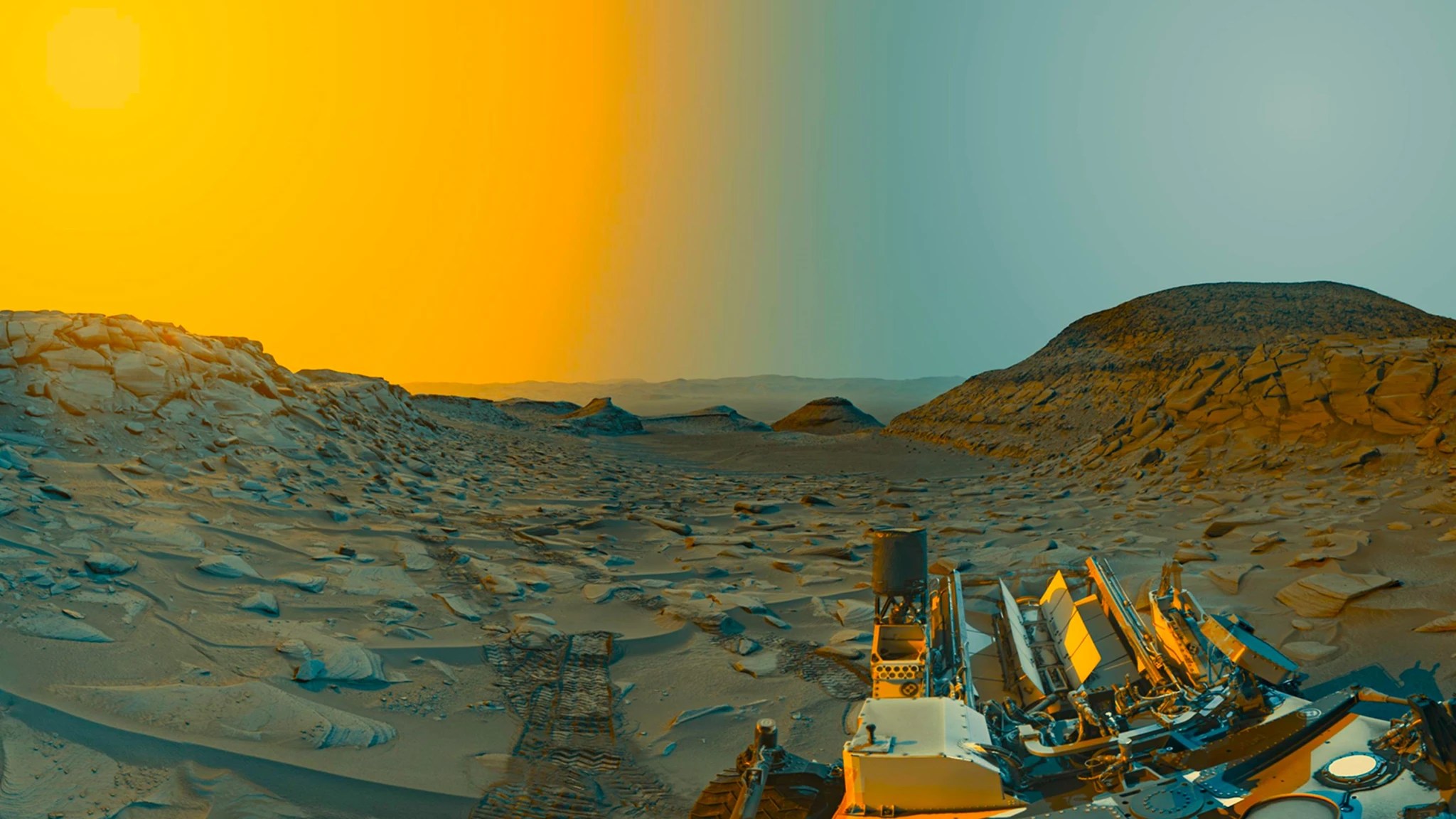
NASA picture from Curiosity rover on a rather barren, poisonous, irradiated, dusty and dry Mars
P/S: Scifi novels are an old genre: The Birds of Aristophanes, making fun of the colonies Athens established everywhere, by establishing one in the sky, preceded the space colonization of Lucian by seven centuries…
***
[1] The European solution to the Earth Crisis has been Mathusianism: use less energy. This weakens Europe and encourages its dictatorial enemies. Actually the best solution is rather the opposite: to use more ABSOLUTE WORTH ENERGY. Use, much more EFFICIENT energy. In particular, we have to leverage fossil fuels to get out of them… using the energy they provide to invent new science and tech….
ooOOoo
Yet another masterpiece from Mr. Ayme. I cannot add anything to this post except to applaud it.
First of all, let me quote the opening two paragraphs from the WikiPedia entry on ‘intellectual humility’:
Intellectual humility is the acceptance that one’s beliefs and opinions could be wrong. Other characteristics that may accompany intellectual humility include a low concern for status and an acceptance of one’s intellectual limitations.
Mark Twain apocryphally said, “I’m in favor of progress; it’s change I don’t like.” This quote pithily underscores the human tendency to desire growth while also harboring strong resistance to the hard work that comes with it. I can certainly resonate with this sentiment.
I was raised in a conservative evangelical home. Like many who grew up in a similar environment, I learned a set of religious beliefs that framed how I understood myself and the world around me. I was taught that God is loving and powerful, and God’s faithful followers are protected. I was taught that the world is fair and that God is good. The world seemed simple and predictable – and most of all, safe.
These beliefs were shattered when my brother unexpectedly passed away when I was 27 years old. His death at 34 with three young children shocked our family and community. In addition to reeling with grief, some of my deepest assumptions were challenged. Was God not good or not powerful? Why didn’t God save my brother, who was a kind and loving father and husband? And how unfair, uncaring and random is the universe?
This deep loss started a period where I questioned all of my beliefs in light of the evidence of my own experiences. Over a considerable amount of time, and thanks to an exemplary therapist, I was able to revise my worldview in a way that felt authentic. I changed my mind, about a lot things. The process sure wasn’t pleasant. It took more sleepless nights than I care to recall, but I was able to revise some of my core beliefs.
I didn’t realize it then, but this experience falls under what social science researchers call intellectual humility. And honestly, it is probably a large part of why, as a psychology professor, I am so interested in studying it. Intellectual humility has been gaining more attention, and it seems critically important for our cultural moment, when it’s more common to defend your position than change your mind.
What it means to be intellectually humble
Intellectual humility is a particular kind of humility that has to do with beliefs, ideas or worldviews. This is not only about religious beliefs; it can show up in political views, various social attitudes, areas of knowledge or expertise or any other strong convictions. It has both internal- and external-facing dimensions.
Within yourself, intellectual humility involves awareness and ownership of the limitations and biases in what you know and how you know it. It requires a willingness to revise your views in light of strong evidence.
Interpersonally, it means keeping your ego in check so you can present your ideas in a modest and respectful manner. It calls for presenting your beliefs in ways that are not defensive and admitting when you’re wrong. It involves showing that you care more about learning and preserving relationships than about being “right” or demonstrating intellectual superiority.
Another way of thinking about humility, intellectual or otherwise, is being the right size in any given situation: not too big (which is arrogance), but also not too small (which is self-deprecation).
I know a fair amount about psychology, but not much about opera. When I’m in professional settings, I can embrace the expertise that I’ve earned over the years. But when visiting the opera house with more cultured friends, I should listen and ask more questions, rather than confidently assert my highly uninformed opinion.
Four main aspects of intellectual humility include being:
Open-minded, avoiding dogmatism and being willing to revise your beliefs.
Curious, seeking new ideas, ways to expand and grow, and changing your mind to align with strong evidence.
Realistic, owning and admitting your flaws and limitations, seeing the world as it is rather than as you wish it to be.
Teachable, responding nondefensively and changing your behavior to align with new knowledge.
Intellectual humility is often hard work, especially when the stakes are high.
Starting with the admission that you, like everyone else, have cognitive biases and flaws that limit how much you know, intellectual humility might look like taking genuine interest in learning about your relative’s beliefs during a conversation at a family get-together, rather than waiting for them to finish so you can prove them wrong by sharing your – superior – opinion.
It could look like considering the merits of an alternative viewpoint on a hot-button political issue and why respectable, intelligent people might disagree with you. When you approach these challenging discussions with curiosity and humility, they become opportunities to learn and grow.
Why intellectual humility is an asset
Though I’ve been studying humility for years, I’ve not yet mastered it personally. It’s hard to swim against cultural norms that reward being right and punish mistakes. It takes constant work to develop, but psychological science has documented numerous benefits.
First, there are social, cultural and technological advances to consider. Any significant breakthrough in medicine, technology or culture has come from someone admitting they didn’t know something – and then passionately pursuing knowledge with curiosity and humility. Progress requires admitting what you don’t know and seeking to learn something new.
For example, intellectually humble people are more accepting of people who hold differing religious and political views. A central part of it is an openness to new ideas, so folks are less defensive to potentially challenging perspectives. They’re more likely to forgive, which can help repair and maintain relationships.
Finally, humility helps facilitate personal growth. Being intellectually humble allows you to have a more accurate view of yourself.
When you can admit and take ownership of your limitations, you can seek help in areas where you have room to grow, and you’re more responsive to information. When you limit yourself to only doing things the way you’ve always done them, you miss out on countless opportunities for growth, expansion and novelty – things that strike you with awe, fill you with wonder and make life worth living.
Despite these benefits, sometimes humility gets a bad rap. People can have misconceptions about intellectual humility, so it’s important to dispel some myths.
Intellectual humility isn’t lacking conviction; you can believe something strongly until your mind is changed and you believe something else. It also isn’t being wishy-washy. You should have a high bar for what evidence you require to change your mind. It also doesn’t mean being self-deprecating or always agreeing with others. Remember, it’s being the right size, not too small.
Researchers are working hard to validate reliable ways to cultivate intellectual humility. I’m part of a team that is overseeing a set of projects designed to test different interventions to develop intellectual humility.
Some scholars are examining different ways to engage in discussions, and some are exploring the role of enhancing listening. Others are testing educational programs, and still others are looking at whether different kinds of feedback and exposure to diverse social networks might boost intellectual humility.
Prior work in this area suggests that humility can be cultivated, so we’re excited to see what emerges as the most promising avenues from this new endeavor.
There was one other thing that religion taught me that was slightly askew. I was told that too much learning could be ruinous; after all, you wouldn’t want to learn so much that you might lose your faith.
But in my experience, what I learned through loss may have salvaged a version of my faith that I can genuinely endorse and feels authentic to my experiences. The sooner we can open our minds and stop resisting change, the sooner we’ll find the freedom offered by humility.
So here we are, 2024, and the year when I become 80! However, I still have eleven months before that happens. Like an amazing number of people, I do not really think long about this New Year but there are plenty that do.
Here is an article that explains much more. It is from The Conversation.
ooOOoo
What winter solstice rituals tell us about indigenous people
On the day of winter solstice, many Native American communities will hold religious ceremonies or community events.
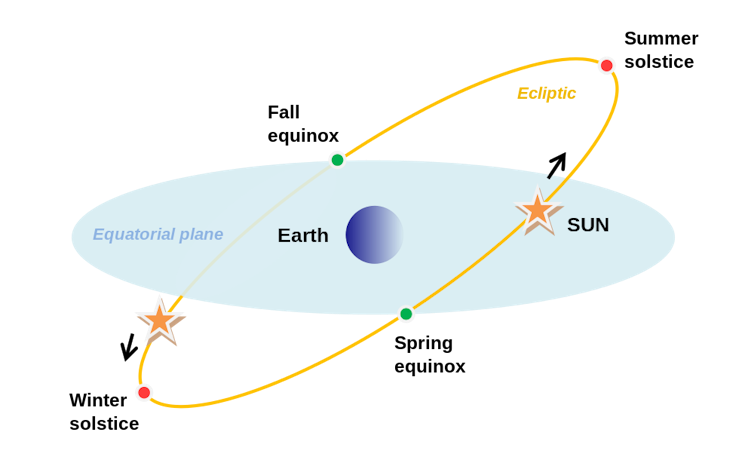
The winter solstice is the day of the year when the Northern Hemisphere has the fewest hours of sunlight and the Southern Hemisphere has the most. For indigenous peoples, it has been a time to honor their ancient sun deity. They passed their knowledge down to successive generations through complex stories and ritual practices.
As a scholar of the environmental and Native American religion, I believe, there is much to learn from ancient religious practices.
Ancient architecture
For decades, scholarshave studied the astronomical observations that ancient indigenous people made and sought to understand their meaning.
One such place was at Cahokia, near the Mississippi River in what is now Illinois across from St. Louis.
In Cahokia, indigenous people built numerous temple pyramids or mounds, similar to the structures built by the Aztecs in Mexico, over a thousand years ago. Among their constructions, what most stands out is an intriguing structure made up of wooden posts arranged in a circle, known today as “Woodhenge.”
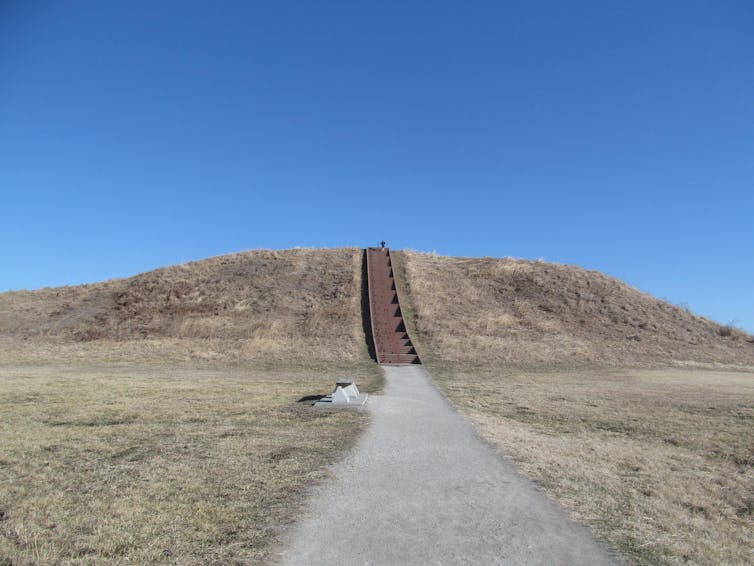
To understand the purpose of Woodhenge, scientists watched the sun rise from this structure on winter solstice. What they found was telling: The sun aligned with both Woodhenge and the top of a temple mound – a temple built on top of a pyramid with a flat top – in the distance. They also found that the sun aligns with a different temple mound on summer solstice.
Archaeological evidence suggests that the people of Cahokia venerated the sun as a deity. Scholars believe that ancient indigenous societies observed the solar system carefully and wove that knowledge into their architecture.
Scientists have speculated that the Cahokia held rituals to honor the sun as a giver of life and for the new agricultural year.
Complex understandings
Zuni Pueblo is a contemporary example of indigenous people with an agricultural society in western New Mexico. They grow corn, beans, squash, sunflowers and more. Each year they hold annual harvest festivals and numerous religious ceremonies, including at the winter solstice.
At the time of the winter solstice they hold a multiday celebration, known as the Shalako festival. The days for the celebration are selected by the religious leaders. The Zuni are intensely private, and most events are not for public viewing.
But what is shared with the public is near the end of the ceremony, when six Zuni men dress up and embody the spirit of giant bird deities. These men carry the Zuni prayers for rain “to all the corners of the earth.” The Zuni deities are believed to provide “blessings” and “balance” for the coming seasons and agricultural year.
As religion scholar Tisa Wenger writes, “The Zuni believe their ceremonies are necessary not just for the well-being of the tribe but for “the entire world.”
Winter games
Not all indigenous peoples ritualized the winter solstice with a ceremony. But that doesn’t mean they didn’t find other ways to celebrate.
The Blackfeet tribe in Montana, where I am a member, historically kept a calendar of astronomical events. They marked the time of the winter solstice and the “return” of the sun or “Naatosi” on its annual journey. They also faced their tipis – or portable conical tents – east toward the rising sun.
They rarely held large religious gatherings in the winter. Instead the Blackfeet viewed the time of the winter solstice as a time for games and community dances. As a child, my grandmother enjoyed attending community dances at the time of the winter solstice. She remembered that each community held their own gatherings, with unique drumming, singing and dance styles.
Later, in my own research, I learned that the Blackfeet moved their dances and ceremonies during the early reservation years from times on their religious calendar to times acceptable to the U.S. government. The dances held at the time of the solstice were moved to Christmas Day or to New Year’s Eve.
Today, my family still spends the darkest days of winter playing card games and attending the local community dances, much like my grandmother did.
Although some winter solstice traditions have changed over time, they are still a reminder of indigenous peoples understanding of the intricate workings of the solar system. Or as the Zuni Pueblo’s rituals for all peoples of the earth demonstrate – of an ancient understanding of the interconnectedness of the world.
“The Future of Democracy” is, for me, incredibly interesting.
I haven’t a clue as to how long I have been listening to the annual Reith Lecture on BBC Radio 4. It has been many years.
As Wikipedia explains:
The Reith Lectures is a series of annual BBCradiolectures given by leading figures of the day. They are commissioned by the BBC and broadcast on Radio 4 and the World Service. The lectures were inaugurated in 1948 to mark the historic contribution made to public service broadcasting by Lord Reith, the corporation’s first director-general.
Reith maintained that broadcasting should be a public service that aimed to enrich the intellectual and cultural life of the nation. It is in this spirit that the BBC each year invites a leading figure to deliver the lectures. The aim is to advance public understanding and debate about issues of contemporary interest.
Wikipedia
From the BBC’s History of the BBC.
As the BBC explains on the BBC Sounds website:
Released On: 29 Nov 2023
Available for over a year
This year’s BBC Reith Lecturer is Ben Ansell, Professor of Comparative Democratic Institutions at Nuffield College, Oxford University.
He will deliver four lectures called “Our Democratic Future,” asking how we can build a politics that works for all of us with systems which are robust to the challenges of the twenty first century, from climate change to artificial intelligence. In this first lecture, recorded at New Broadcasting House in London in front of an audience, Professor Ansell asks whether we are in a ‘democratic recession’, where longstanding democracies are at risk of breakdown and authoritarianism is resurgent. And he examines how resilient democracies are to the challenges of artificial intelligence, social media and if they can effectively address core challenges from climate change to inequality.
The Reith Lectures are presented by Anita Anand and produced by Jim Frank. The Editor is China Collins. Reith Co-ordinator is Brenda Brown. The series is mixed by Rod Farquhar and Neil Churchill.
Welcome to my website. I am Professor of Comparative Democratic Institutions at Nuffield College, University of Oxford. My work focuses on a variety of issues in political economy, including both comparative politics and international relations.
I am also co-editor (with David Samuels) of Comparative Political Studies.
My 2010 book, From the Ballot to the Blackboard, published by Cambridge University Press, is available here. My 2014 book (with David Samuels), Inequality and Democratization: An Elite-Competition Approach, published by Cambridge University Press, is available here.
This site contains a variety of working papers, syllabi, my biography, and other information about my academic work. My CV is available here.
This is a change of subject for today’s Picture Parade.
I have been for some time complimenting my son on his brilliant photographs. I have been admiring them on Instagram but, of course, one cannot copy them from there. So Alex sent me the following by email.
Plus, Alex has rightly copyrighted these photographs and also states that his Instagram profile is @Alex_handover_photography. There are more of Alex’s photographs to admire over on Instagram.
oooo
oooo
oooo
oooo
oooo
These are fabulous and just endorses the care and attention that Alex puts into his photography.
I was born in London before the end of World War II and to a great extent my upbringing was in the times of yesterday. But the world has moved on in many, many ways. It is too easy to say that we live in very strange times.
Thus it was enlightening to come across this talk, under the TED Talks banner, quite recently. I have great pleasure in sharing it with you. Plus, Hannah’s website is here. (From which I have taken the following words!)
(P.S. The YouTube video is just over thirteen minutes long. It automatically runs into the next video so you will have to stop it yourself.)
ooOOoo
The word “sustainability” gets thrown around a lot these days. But what does it actually mean for humanity to be sustainable? Environmental data scientist Hannah Ritchie digs into the numbers behind human progress across centuries, unpacking why the conventional understanding of sustainability is misleading and showing how we can be the first generation of humans to actually achieve it.
Why you should listen
Hannah Ritchie is deputy editor and research lead at Our World in Data, an online publication making data and research on the world’s largest problems accessible and understandable for non-experts. She is a senior researcher at the University of Oxford, where she studies how environmental issues intersect with others like poverty, global health and education. She has also done extensive research into the question of how to feed everyone in the world a nutritious diet without wrecking the planet. Her work has appeared in The New York Times, The Washington Post, Vox, Wired, BBC, Al Jazeera, The Economist and New Scientist.
In 2022, Ritchie was named Scotland’s Youth Climate Champion. She is also an honorary fellow at the University of Edinburgh and Edinburgh Centre for Carbon Innovation, and a fellow at the Energy for Growth Hub, focused on ending global energy poverty. Her forthcoming book,The First Generation, makes an evidence-based case for why we have a meaningful chance to solve global environmental problems for the first time in human history.
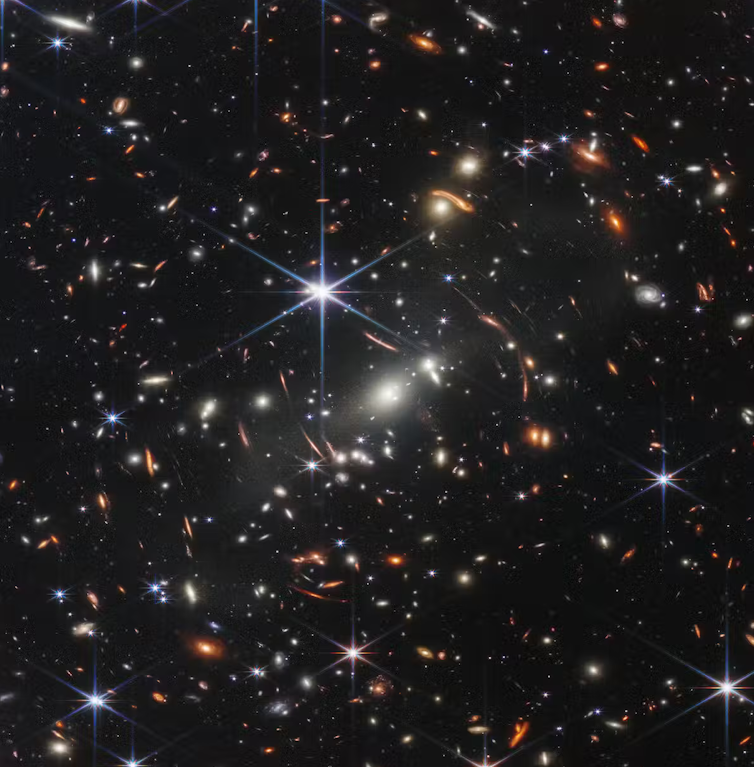
Astronomers have known for decades that the universe is expanding. When they use telescopes to observe faraway galaxies, they see that these galaxies are moving away from Earth.
To astronomers, the wavelength of light a galaxy emits is longer the faster the galaxy is moving away from us. The farther away the galaxy is, the more its light has shifted toward the longer wavelengths on the red side of the spectrum – so the higher the “redshift.”
Because the speed of light is finite, fast, but not infinitely fast, seeing something far away means we’re looking at the thing how it looked in the past. With distant, high-redshift galaxies, we’re seeing the galaxy when the universe was in a younger state. So “high redshift” corresponds to the early times in the universe, and “low redshift” corresponds to the late times in the universe.
But as astronomers have studied these distances, they’ve learned that the universe is not just expanding – its rate of expansion is accelerating. And that expansion rate is even faster than the leading theory predicts it should be, leaving cosmologists like me puzzled and looking for new explanations.
Dark energy and a cosmological constant
Scientists call the source of this acceleration dark energy. We’re not quite sure what drives dark energy or how it works, but we think its behavior could be explained by a cosmological constant, which is a property of spacetime that contributes to the expansion of the universe.
Albert Einstein originally came up with this constant – he marked it with a lambda in his theory of general relativity. With a cosmological constant, as the universe expands, the energy density of the cosmological constant stays the same.
Imagine a box full of particles. If the volume of the box increases, the density of particles would decrease as they spread out to take up all the space in the box. Now imagine the same box, but as the volume increases, the density of the particles stays the same.
It doesn’t seem intuitive, right? That the energy density of the cosmological constant does not decrease as the universe expands is, of course, very weird, but this property helps explain the accelerating universe.
A standard model of cosmology
Right now, the leading theory, or standard model, of cosmology is called “Lambda CDM.” Lambda denotes the cosmological constant describing dark energy, and CDM stands for cold dark matter. This model describes both the acceleration of the universe in its late stages as well as the expansion rate in its early days.
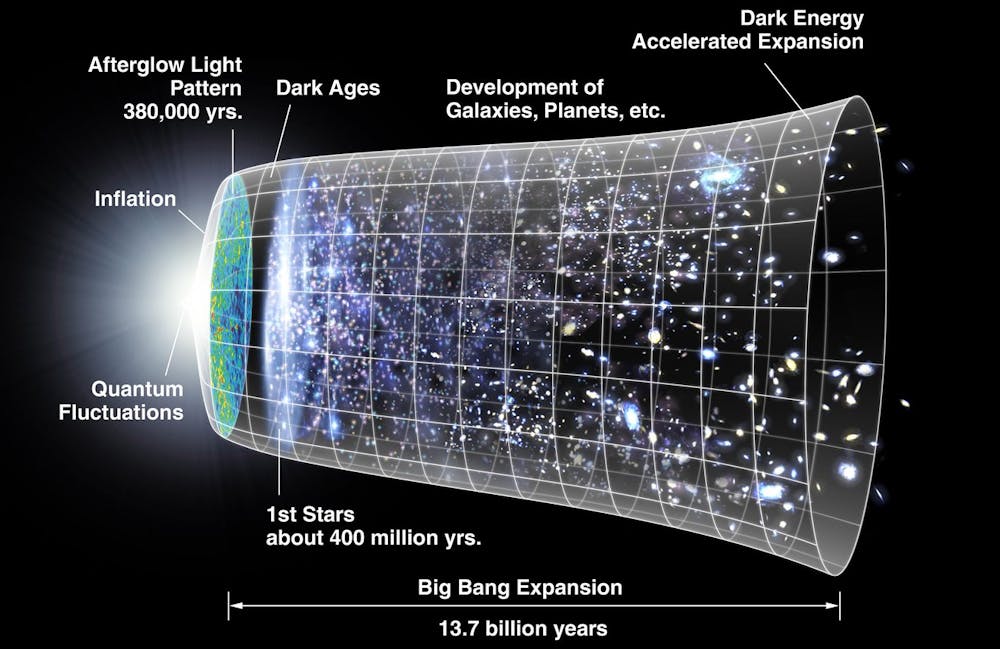
Specifically, the Lambda CDM explains observations of the cosmic microwave background, which is the afterglow of microwave radiation from when the universe was in a “hot, dense state” about 300,000 years after the Big Bang. Observations using the Planck satellite, which measures the cosmic microwave background, led scientists to create the Lambda CDM model.
Fitting the Lambda CDM model to the cosmic microwave background allows physicists to predict the value of the Hubble constant, which isn’t actually a constant but a measurement describing the universe’s current expansion rate.
But the Lambda CDM model isn’t perfect. The expansion rate scientists have calculated by measuring distances to galaxies, and the expansion rate as described in Lambda CDM using observations of the cosmic microwave background, don’t line up. Astrophysicists call that disagreement the Hubble tension.
The universe is expanding faster than predicted by popular models in cosmology. NASA
The Hubble tension
Over the past few years, I’ve been researching ways to explain this Hubble tension. The tension may be indicating that the Lambda CDM model is incomplete and physicists should modify their model, or it could indicate that it’s time for researchers to come up with new ideas about how the universe works. And new ideas are always the most exciting things for a physicist.
One way to explain the Hubble tension is to modify the Lambda CDM model by changing the expansion rate at low redshift, at late times in the universe. Modifying the model like this can help physicists predict what sort of physical phenomena might be causing the Hubble tension.
For instance, maybe dark energy is not a cosmological constant but instead the result of gravity working in new ways. If this is the case, dark energy would evolve as the universe expands – and the cosmic microwave background, which shows what the universe looked like only a few years after its creation, would have a different prediction for the Hubble constant.
But, my team’s latest research has found that physicists can’t explain the Hubble tension just by changing the expansion rate in the late universe – this whole class of solutions falls short.
Developing new models
To study what types of solutions could explain the Hubble tension, we developed statistical tools that enabled us to test the viability of the entire class of models that change the expansion rate in the late universe. These statistical tools are very flexible, and we used them to match or mimic different models that could potentially fit observations of the universe’s expansion rate and might offer a solution to the Hubble tension.
The models we tested include evolving dark energy models, where dark energy acts differently at different times in the universe. We also tested interacting dark energy-dark matter models, where dark energy interacts with dark matter, and modified gravity models, where gravity acts differently at different times in the universe.
But none of these could fully explain the Hubble tension. These results suggest that physicists should study the early universe to understand the source of the tension.











 Learning from Dogs