Category: People

From Environmentalism to Ecologism, Part One.

A guest essay for today and the next two days.

A few days ago, I remarked that for the time being posts on Learning from Dogs were frequently going to be based on the material of others.  It was the only way that I could keep this blog going yet at the same time edit (code for re-write!) a 60,000-word novel that was completed, as a first pass, last November.

Martin Lack is one major step ahead of yours truly.  Not because he, too, writes a blog but because, unlike yours truly, he is a published author!  His book is called The Denial of Sciencehe blogs under the name of Lack of Environment.
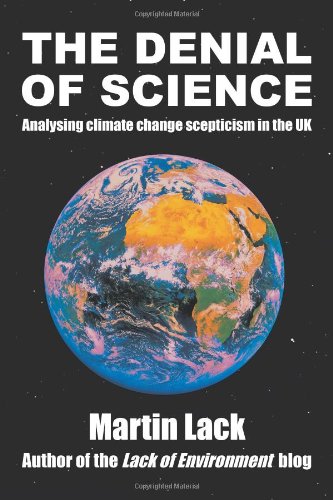
DenialofScience

Thus I was extremely grateful when a short while ago, Martin offered a major essay of his as a guest post for Learning from Dogs.  Better than that, Martin happily accepted my recommendation to send me his essay in three parts.

It may not be the easiest read out in the ‘blogosphere’ but, trust me, Martin’s essay is profoundly important.

ooOOoo

Can ecologism be regarded as an ideology in its own right? (Part 1)

Introduction

Although it might well be assumed that one does not have to define what is meant by ‘socialists’ or – in UK terms at least – ‘conservatives’, it is certainly necessary to define ‘ecologism’: For the purposes of answering the above question, therefore, the latter should be understood as including thinking, behaviour, and the pursuit of policies that are concerned with the environment; but which are not merely or predominantly anthropocentric (i.e. those concerned with human needs and interests).

In a way, the question is nonsensical because use of the term ‘ecologism’, as coined by Andrew Dobson, appears to pre-suppose that ecological politics is indeed a “new political ideology” (2000: 163). If so, to respond to the above question by saying, in effect, ‘just because both socialists and conservatives (can) lay claim to ecological politics does not change the fact that ecologism is a distinctive political ideology in its own right’, would clearly be tautological. Therefore, to provide a defensible answer “Yes” to the above question – as is the intent herein – it is necessary to explain how and why:

  1. both socialists and conservatives can lay claim to ecological politics;
  2. the majority of both socialists and conservatives do not do so; and
  3. the ‘ecologism’ that both find so challenging must therefore be considered as a distinctive political ideology in its own right.

The Socialist claim

One does not have to be an eco-socialist in order to believe or appreciate that there is a great deal of common ground shared by socialist and environmental politics. Socialism is a broad left-of-centre church that, it could be argued, includes everything from social democrats to communists. However, if socialism can be summed-up in the tripartite “Liberté, égalité, fraternité” motto of France (with its origins in the French Revolution of 1789-99), whose English translation would be “Freedom, equality, and brotherhood”, then it is not hard to see why socialists would find common cause with those whose goal is, in effect, to seek equal rights for the environment.

The “four pillars” of ecological politics are – as cited by Neil Carter – those devised by the German Green Party in 1983: ecological responsibility, grassroots democracy, social justice, and non-violence (Carter 2007: 48). Clearly, grassroots democracy and social justice are part of the socialist agenda. Therefore, despite the global dominance of free-market economics, Mary Mellor has asserted that far from being a challenge to socialism, “ecology greatly enhances the case for a redefined and refocused socialism” (Mellor 2006: 35).

The Conservative claim

Although by no means a monolithic entity, environmental politics is usually seen as being a predominantly left-of-centre entity (e.g. Carter 2007: 78); and it is often seen as being easier to define what it opposes than to define what it seeks. If so, ecological politics is essentially a reaction against anthropocentric thinking and the selfish pursuit of individual gain without regard for others or the environment. However, some philosophers such as Roger Scruton have therefore tried to distinguish between such selfish, libertarian, goals and those of traditional conservatives who, as their name suggests, seek the preservation of the status quo for the benefit of both the current generation and those that will follow (Scruton 2006: 7-8). Indeed, as early as 1993, in the wake of the Rio Earth Summit, Scruton was advocating the need for a radical re-think of right-wing politics:

Conservatives need to explore, with greens and others, as yet unthought-of dilemmas of life in societies which are no longer buoyed up by the prospect of incessant economic growth or by modernist pseudo-religions of endless world improvement” (Scruton 1993: 173).

However, in 1993, the idea that there might be limits to growth was hardly new; being based on Garrett Hardin’s Tragedy of the Commons article (1968); the Massachusetts Institute of Technology (MIT) Limits to Growth report for the Club of Rome (Meadows et al., 1972); E. F. Schumacher’s highly influential book Small is Beautiful (1973). For example:

The illusion of [mankind’s] unlimited powers, nourished by astonishing scientific and technological achievements, has produced the concurrent illusion of having solved the problem of production… based on the failure to distinguish between income and capital where this distinction matters most… A businessman would not consider a firm to have solved its problems of production and to have achieved viability if he saw that it was rapidly consuming its capital… (Schumacher 1974: 11).

Therefore, although the dilemmas were not “as yet unthought-of”, Scruton had, nevertheless, identified the source of the challenge that does indeed, it is here argued, begin to transform ecological politics into the distinctive political ideology that is ecologism.

Limits to Growth – a political and economic challenge

Although much disputed (by those that point to the fact that commodity prices have generally fallen over time, or that dire predictions have not yet come true), the Limits to Growth argument is based on the reality of the physical constraints of the planet on which we live.

For example: “Infinite growth is impossible in a closed system. With continued growth in production, the economic subsystem must eventually overwhelm the capacity of the global ecosystem to sustain it” (Daly & Farley 2004: 64). However, this is merely a comparatively recent re-statement of (former World Bank economist) Herman E Daly’s longstanding belief in the need for steady-state growth.

Furthermore, Daly and Farley cite Rudolf Clausius has having “coined the term ‘entropy’ for the Second Law [of Thermodynamics], derived from the Greek word for transformation, in recognition of the fact that entropy was a one-way street of irreversible change; a continual increase in the disorder of the universe” (Daly & Farley 2004: 65).

This is a fundamental tenet of modern physics; one that Daly has been repeating (like a “voice in the wilderness” proclaiming a message that nobody wants to hear) for a long time: It was over 35 years ago that he began an article entitled ‘The Economics of the Steady State’ with a quote from the famous scientist Sir Arthur Eddington, who once said, “But if your theory is found to be against the Second Law of Thermodynamics, I can give you no hope; there is nothing for it but to collapse in deepest humiliation” (as cited in Daly 1974: 15).

With this in mind, perhaps, the Union of Concerned Scientists (UCS) issued the “World Scientists’ Warning to Humanity” on 18 November 1992, from which the following excerpt is taken:

The earth is finite. Its ability to absorb wastes and destructive effluent is finite. Its ability to provide food and energy is finite. Its ability to provide for growing numbers of people is finite. And we are fast approaching many of the earth’s limits. Current economic practices which damage the environment, in both developed and underdeveloped nations, cannot be continued without the risk that vital global systems will be damaged beyond repair (UCS 1992).

Today, we are now well beyond these limits. According to the Global Footprint Network (GFN), humanity is now using the resources of at least 1.5 Earth’s (GFN, 2010). The most recent update to the Limits to Growth report was produced in 2005 and, in a section entitled “why technology and markets alone can’t avoid overshoot”, the authors suggested that:

…the more successfully society puts off its limits through economic and technical adaptations, the more likely it is in the future to run into several of them at the same time… the [model] does not run out of land or food or resources or pollution absorption capacity, it runs out of the “ability to cope” [i.e. too much industrial output has to be diverted to solving problems]… Given enough time, we believe humanity possesses nearly limitless problem solving abilities. [However] exponential growth… shortens the time for effective action. It loads stress on a system faster and faster, until coping mechanisms that have been adequate with slower rates of change finally begin to fail (Meadows et al 2005: 223).

Arguably, it could be said that the evidence for this is already becoming clear in the form of widespread social unrest around the globe, as a result of the increasing cost of – or difficulty in gaining access to – food, water, and energy.

For Robyn Eckersley, the reality of limits to growth and the magnitude of the ecological challenge is something from which we need to be emancipated; and it is also the raison d’être for environmentalism:

The environmental crisis and popular environmental concern have prompted a transformation of Western politics… Whatever the outcome of this realignment… the intractable nature of the environmental problems will ensure that environmental politics… is here to stay (Eckersley 1992: 7).

The latest UN projections for global population (published on 3 May 2011) suggests that stabilisation at about 10 billion by 2100AD is still most likely; but use probabilistic methods to account for the uncertainty in future fertility trends. Therefore, depending on changes in fertility rates in differing countries, the press release also indicates that global population could also peak at 8 billion in 2050 and then fall to 6 billion in 2100, or reach 10 billion by 2050 and continue to rise to 15 billion by 2100 (UN 2011: 1).

The key question the UN press release does not address is, “How many humans is too many?” Furthermore, although it depends on average rates of resource consumption, it is quite probable that there are already too many. However, this raises philosophical and/or ethical issues that form the other main aspect of ecological politics, which ensures that ecologism is a distinct political ideology in its own right.

From Environmentalism to Ecologism – the philosophical and ethical challenge

What’s in a name?

In the introduction above, ‘ecological politics’ was, in effect, defined as being environmentally-friendly and ecocentric (i.e. ecologism). For the avoidance of any doubt, therefore, it should be noted that this implies that it is possible to be concerned for the environment but be anthropocentric (i.e. environmentalism). It is precisely because the two things are not the same that Dobson has asserted that “…environmentalism and liberalism are compatible, but ecologism and liberalism are not” (2000: 165). The reason for this is examined below. (Ed. As in tomorrow!)

References

Carter, N. (2007), The Politics of the Environment (2nd edition). Cambridge: Cambridge University Press.

Daly, H. & Farley, J. (2004), Ecological Economics: Principles and Applications. Washington DC: Island Press.

Daly, H. (1974), ‘The Economics of the Steady State’, The American Economic Review, 64(2), pp.15-21.

Dobson, A. (2000), Green Political Thought, (3rd edition). London, Routledge.

Eckersley, R. (1992), Environmentalism and Political Theory. London: UCL Press.

GFN (2010), Living Planet Report 2010: Biodiversity, Biocapacity, and Development. [Online] GFN. Available at http://www.footprintnetwork.org/en/index.php/GFN/page/2010_living_planet_report/> [accessed 18 April 201].

Hardin, G. (1968), ‘The tragedy of the commons’, Science, 168, pp.1243-8.

Meadows D, et al (1972), The Limits to Growth. New York: Universe Books.

Meadows D, et al (2005), Limits to Growth: the 30-Year Update, London: Earthscan.

Mellor, M. (2006), ‘Socialism’, in Dobson, A. and Eckersley, R., Political Theory and the Ecological Challenge. Cambridge: Cambridge University Press, pp.35-50.

Schumacher, E.F. (1974), Small is Beautiful: A study of Economics as if Small People Mattered, London: Abacus.

Scruton, R. (1993), Beyond the New Right. London: Routledge.

Scruton, R. (2006), ‘Conservatism’, in Dobson, A. and Eckersley, R., Political Theory and the Ecological Challenge. Cambridge: Cambridge University Press, pp.7-19.

UCS, (1992), World Scientists’ Warning to Humanity. [Online] UCS. Available at <http://www.ucsusa.org/about/1992-world-scientists.html> [accessed 14/04/2011].

UN (2011), World Population Prospects: The 2010 Revision – Press Release. [Online] UN. Available at <http://esa.un.org/wpp/index.htm> [accessed 11/05/2011].
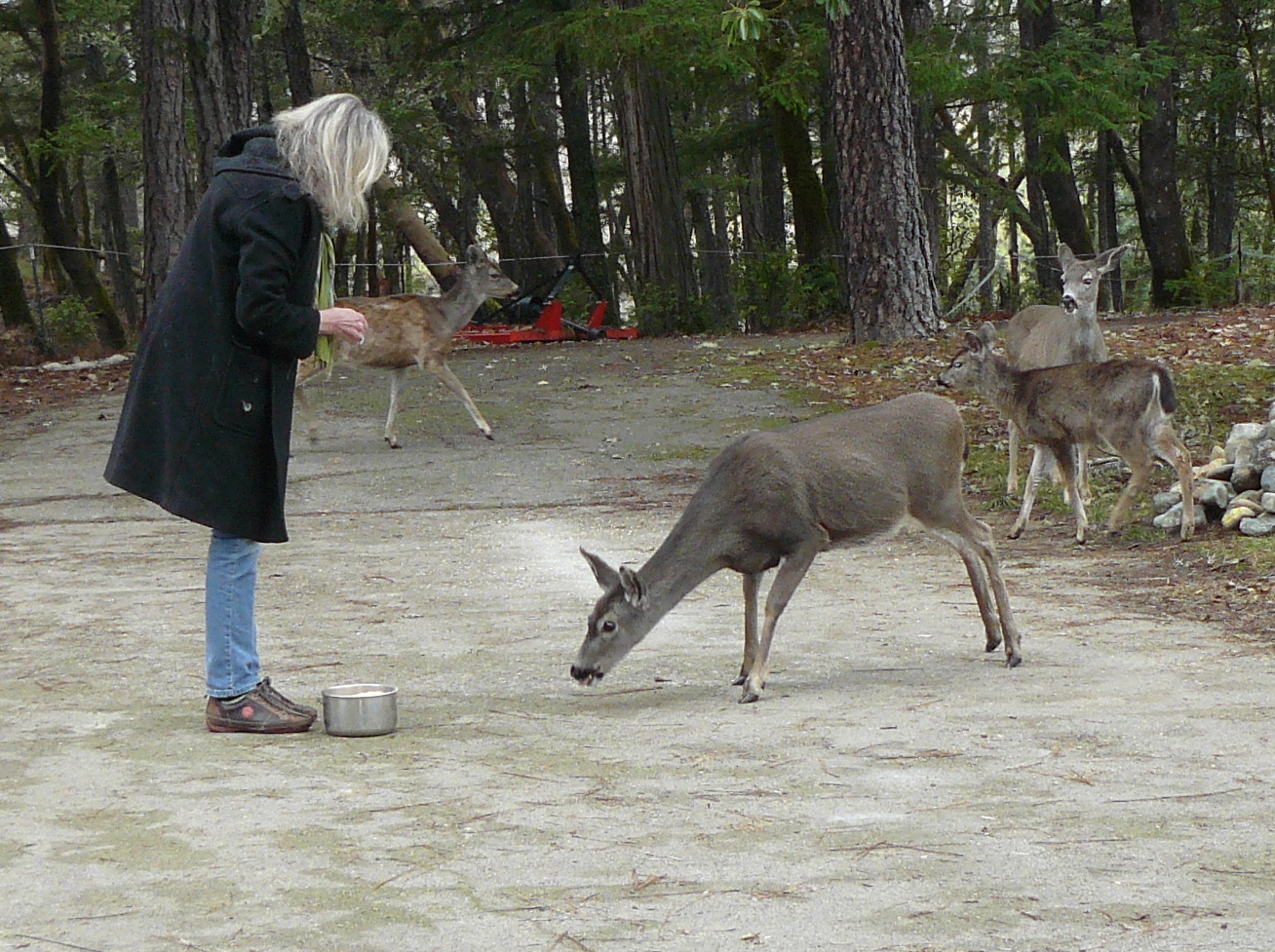
Picture parade twenty-seven.

Yes, I know it isn’t a Sunday!

But it is a National Holiday for the USA, Martin Luther King Jr. Day, and these images taken two days ago seemed an appropriate ‘holiday’ post.

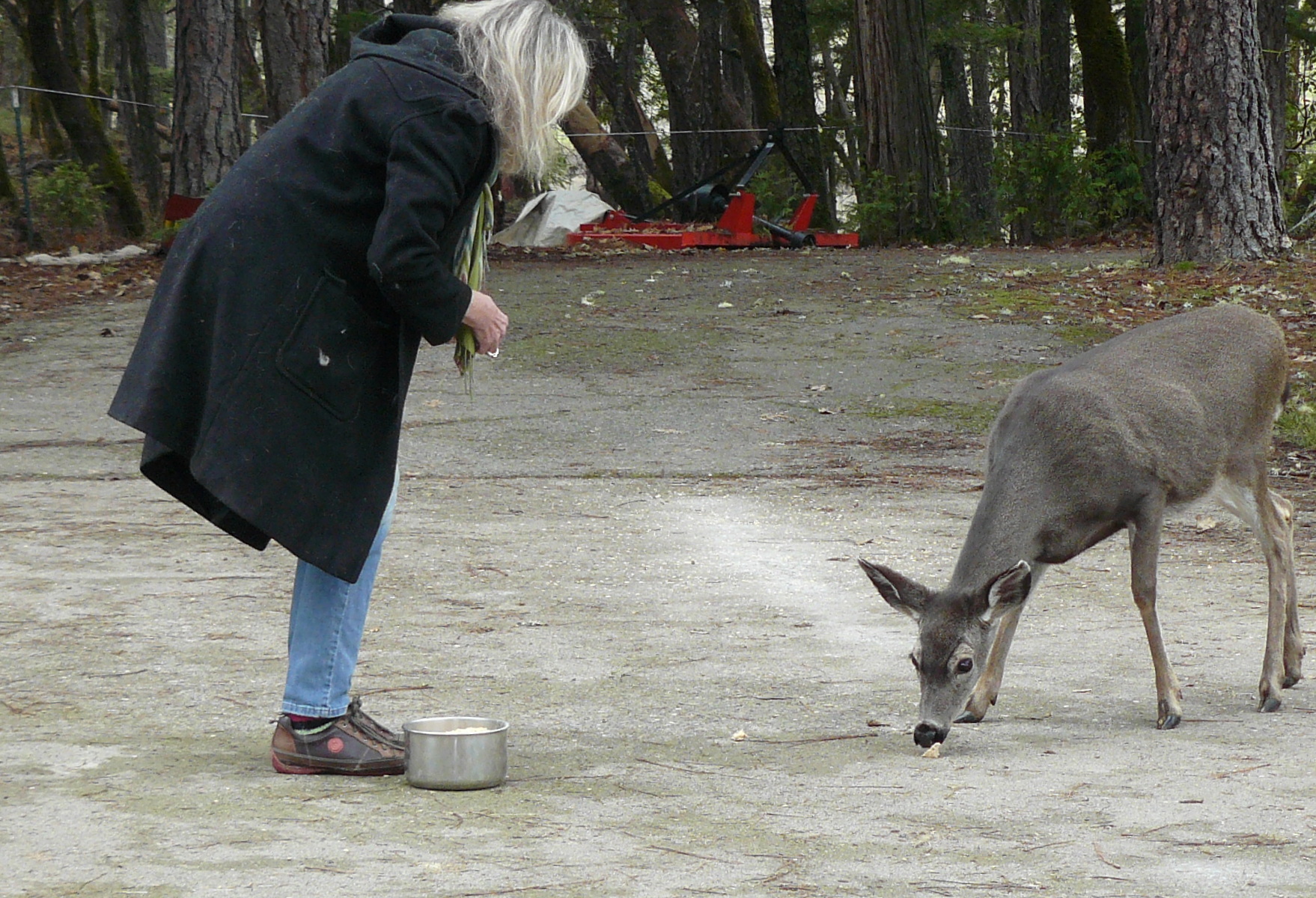
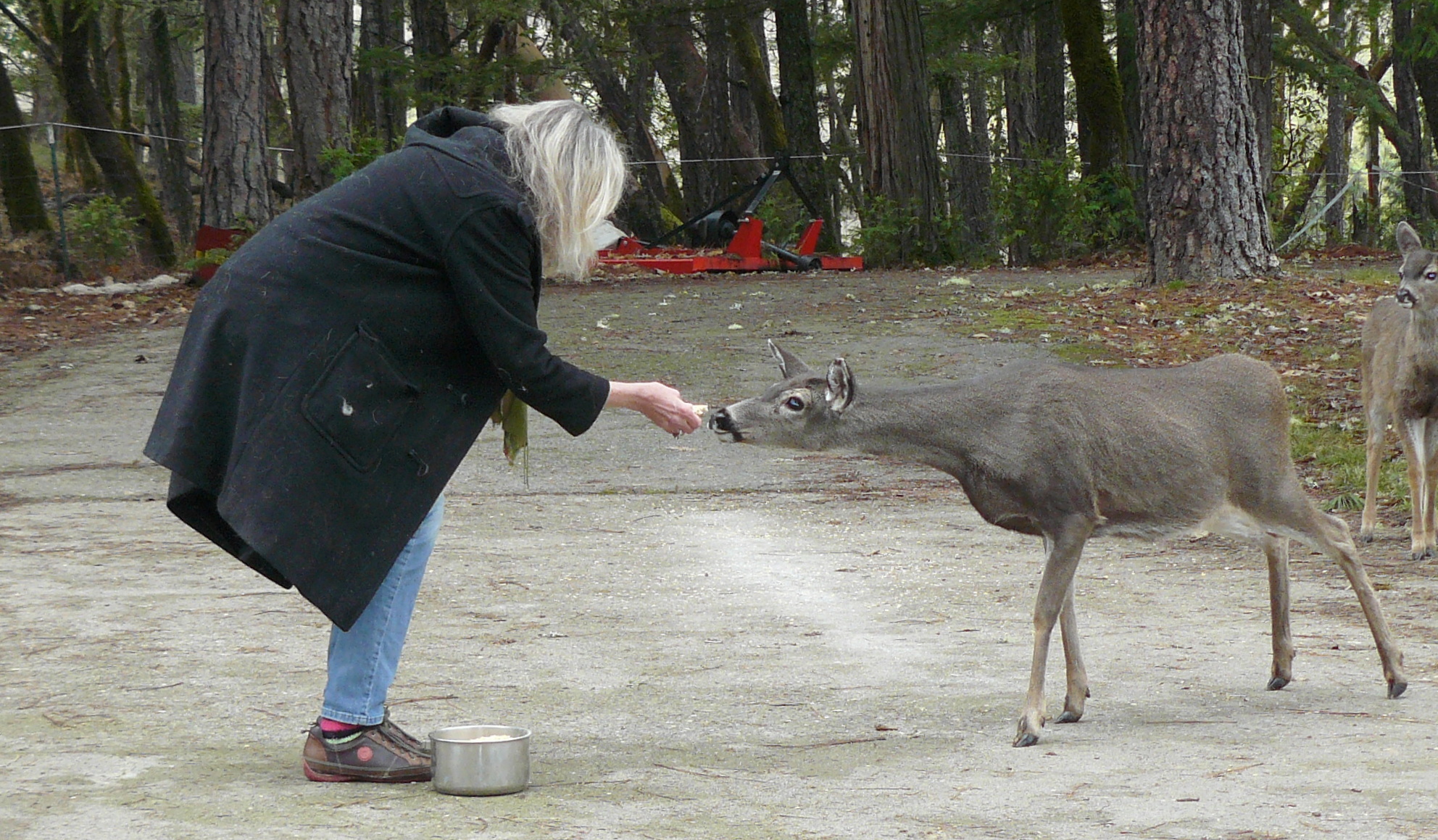
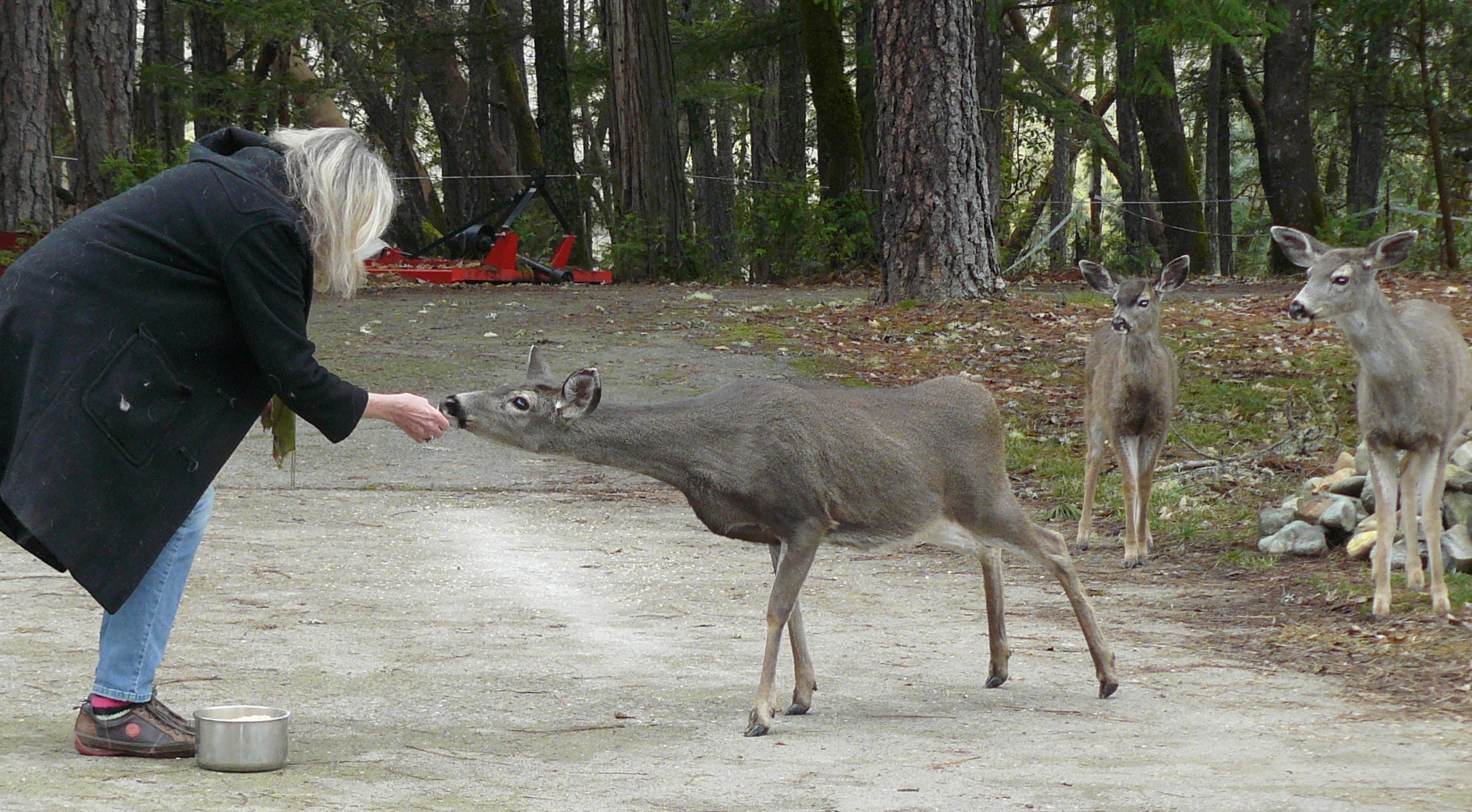
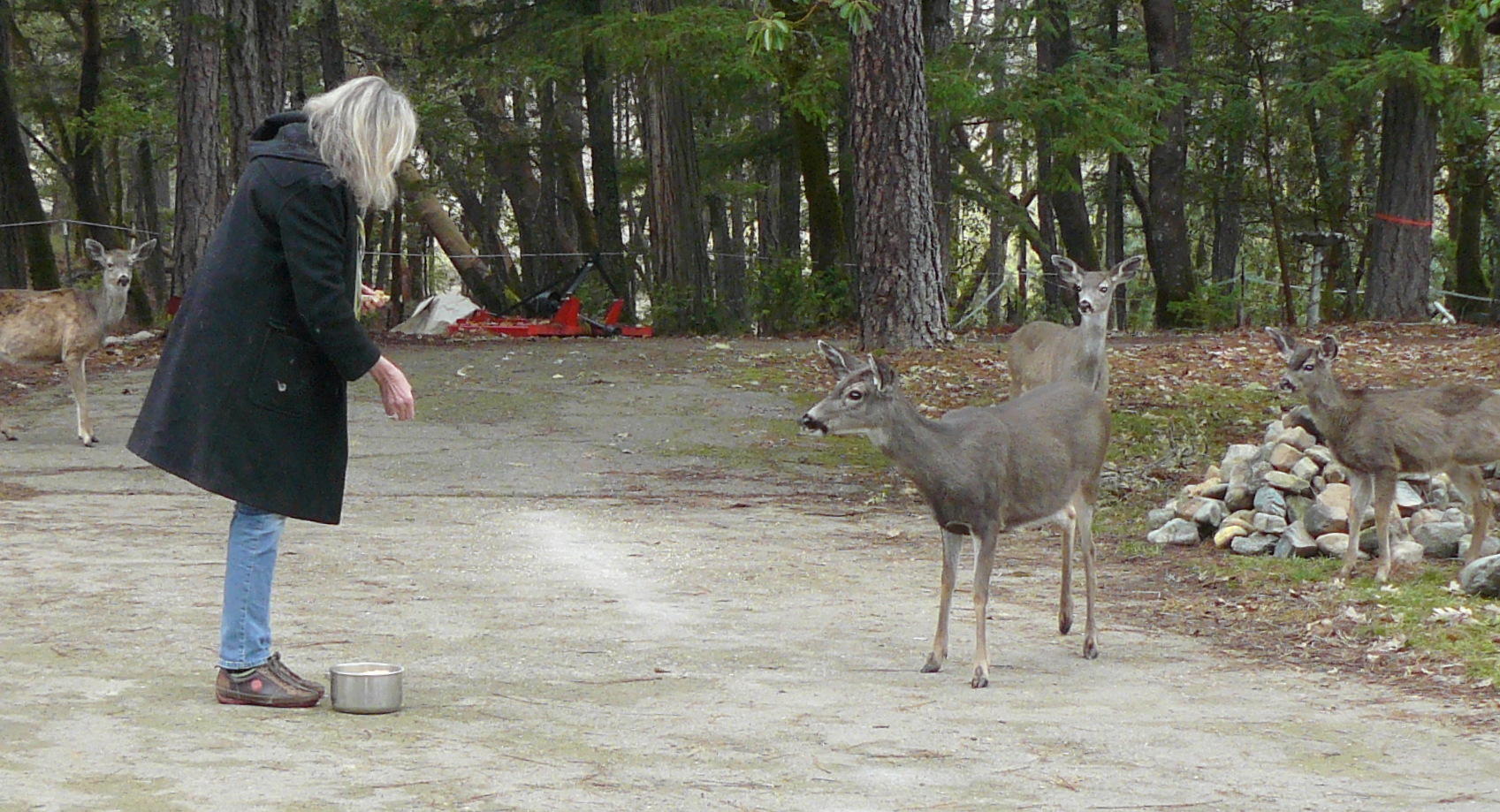
Follows of Learning from Dogs will remember that back on the 15th December I devoted a Sunday post, Picture parade twenty-one, to pictures of deer cautiously coming to feed when Jean was in their presence.

Now, some five weeks later, one of those deer has overcome fear to the point of taking a piece of bread from Jean’s hand.  Here is the sequence of photographs taken last Saturday afternoon.  N.B. We do not feed the deer bread as a routine; it’s not good for them.

P1140238

oooo

P1140239

oooo

P1140240

oooo

P1140241

oooo

P1140242

oooo

Greetings, one and all, this day.

Picture parade twenty-six.

Yet more fabulous pictures from Bob D.

Derham18

oooo

Derham17

oooo

Derham16

oooo

Derham15

oooo

Derham14

oooo

Derham13

oooo

Derham12

oooo

Derham11

oooo

Derham10

oooo

If you missed the first set or just fancy looking at the pictures again, then click here.

One couldn’t make it up!

Stop the world, I want to get off.

Cars travel through flood water in Helston, south-west Cornwall - Daily Mail August, 2013
Cars travel through flood water in Helston, south-west Cornwall – Daily Mail August, 2013


You can tell, undoubtedly, from the title and sub-title to today’s post that I am feeling somewhat forlorn about the way that we humans work things out!  As the old saying goes, “Question: Why has Planet Earth never been visited by an alien species? Answer: Because they have seen no signs of intelligent life!

This feeling is a result of reading a recent essay from George Monbiot, Drowning in Money.  It is republished here within his terms of sharing.

Now before you read it, if you are not living in the UK it would be easy to reject the messages as being only relevant to the United Kingdom.  But when you do read it, you will agree that this level of government policy stupidity is not the sole reserve of the UK.  The ‘virus’ is alive and well elsewhere!

ooOOoo

George Monbiot
George Monbiot

Drowning in Money

January 13, 2014

The hidden and remarkable story of why devastating floods keep happening.
By George Monbiot, published in the Guardian 14th January 2014.

We all know what’s gone wrong, or we think we do: not enough spending on flood defences. It’s true that the government’s cuts have exposed thousands of homes to greater risk, and that the cuts will become more dangerous as climate change kicks in (1).  But too little public spending is a small part of problem. It is dwarfed by another factor, which has been overlooked in discussions in the media and statements by the government: too much public spending.

Vast amounts of public money – running into the billions – are spent every year on policies that make devastating floods inevitable. This is the story that has not been told by the papers or the broadcasters, a story of such destructive perversity that the Guardian has given me twice the usual space today in which to explain it.

Flood defence, or so we are told almost everywhere, is about how much concrete you can pour. It’s about not building houses in stupid places on the floodplain, and about using clever new engineering techniques to defend those already there (2). None of that is untrue, but it’s a small part of the story. To listen to the dismal debates of the past fortnight you could be forgiven for believing that rivers arise in the plains; that there is no such thing as upstream; that mountains, hills, catchments and watersheds are irrelevant to the question of whether or not homes and infrastructure get drowned.

The story begins with a group of visionary farmers at Pontbren, in the headwaters of Britain’s longest river, the Severn. In the 1990s they realised that the usual hill farming strategy – loading the land with more and bigger sheep, grubbing up the trees and hedges, digging more drains – wasn’t working. It made no economic sense, the animals had nowhere to shelter, the farmers were breaking their backs to wreck their own land.

So they devised something beautiful. They began planting shelter belts of trees along the contours. They stopped draining the wettest ground and built ponds to catch the water instead. They cut and chipped some of the wood they grew to make bedding for their animals, which meant that they no longer spent a fortune buying straw. Then they used the composted bedding, in a perfect closed loop, to cultivate more trees (3).

One day a government consultant was walking over their fields during a rainstorm. He noticed something that fascinated him: the water flashing off the land suddenly disappeared when it reached the belts of trees the farmers had planted. This prompted a major research programme, which produced the following astonishing results: water sinks into the soil under the trees at 67 times the rate at which it sinks into the soil under the grass (4). The roots of the trees provide channels down which the water flows, deep into the ground. The soil there becomes a sponge, a reservoir which sucks up water then releases it slowly. In the pastures, by contrast, the small sharp hooves of the sheep puddle the ground, making it almost impermeable: a hard pan off which the rain gushes.

One of the research papers estimates that, even though only 5% of the Pontbren land has been reforested, if all the farmers in the catchment did the same thing, flooding peaks downstream would be reduced by some 29% (5). Full reforestation would reduce the peaks by around 50% (6). For the residents of Shrewsbury, Gloucester and the other towns ravaged by endless Severn floods, that means, more or less, problem solved.

Did I say the results were astonishing? Well, not to anyone who has studied hydrology elsewhere. For decades the British government has been funding scientists working in the tropics, and using their findings to advise other countries to protect the forests or to replant trees in the hills, to prevent communities downstream from being swept away. But we forgot to bring the lesson home.

So will the rest of the Severn catchment, and those of the other unruly waterways of Britain, follow the Pontbren model? The authorities say they would love to do it (7). In theory. Natural Resources Wales told me that these techniques “are hard wired in to the actions we want land managers to undertake.” (8) What it forgot to say is that all tree planting grants in Wales have now been stopped. The offices responsible for administering them are in the process of closing down (9). If other farmers want to copy the Pontbren model, not only must they pay for the trees themselves; but they must sacrifice the money they would otherwise have been paid for farming that land.

For – and here we start to approach the nub of the problem – there is an unbreakable rule laid down by the Common Agricultural Policy. If you want to receive your single farm payment – by the far biggest component of farm subsidies – that land has to be free from what it calls “unwanted vegetation” (10). Land covered by trees is not eligible. The subsidy rules have enforced the mass clearance of vegetation from the hills.

Just as the tree planting grants have stopped, the land clearing grants have risen. In his speech to the Oxford Farming Conference, made during the height of the floods, the environment secretary Owen Paterson boasted that hill farmers “on the least-productive land” will now receive “the same direct payment rate on their upland farmland as their lowland counterparts.” (11) In other words, even in places where farming makes no sense because the land is so poor, farmers will now be paid more money to keep animals there. But to receive this money, they must first remove the trees and scrub that absorb the water falling on the hills.

And that’s just the start of it. One result of the latest round of subsidy negotiations – concluded in June last year – is that governments can now raise the special mountain payments, whose purpose is to encourage farming at the top of the watersheds, from €250 per hectare to €450 (12). This money should be renamed the flooding subsidy: it pays for the wreckage of homes, the evacuation of entire settlements, the drowning of people who don’t get away in time, all over Europe. Pig-headed idiocy doesn’t begin to describe it.

The problem is not confined to livestock in the mountains. In the foothills and lowlands, the misuse of heavy machinery, overstocking with animals and other forms of bad management can – by compacting the soil – increase the rates of instant run-off from 2% of all the rain that falls on the land to 60%(13).

Sometimes, ploughing a hillside in the wrong way at the wrong time of the year can cause a flood – of both mud and water – even without exceptional rainfall. This practice has blighted homes around the South Downs (that arguably should never have been ploughed at all). One house was flooded 31 times in the winter of 2000-2001 by muddy floods caused by ploughing (14). Another, in Suffolk, above which the fields had been churned up by pigs, was hit 50 times (15). But a paper on floods of this kind found that “there are no (or only very few) control measures taken yet in the UK.” (16)

Under the worst environment secretary this country has ever suffered, there seems little chance that much of this will change. In November, in response to calls to reforest the hills, Owen Paterson told parliament “I am absolutely clear that we have a real role to play in helping hill farmers to keep the hills looking as they do.” (17) (Bare, in other words). When asked by a parliamentary committee to discuss how the resilience of river catchments could be improved, the only thing he could think of was building more reservoirs (18).

But while he is cavalier and ignorant when it comes to managing land to reduce the likelihood of flooding, he goes out of his way to sow chaos when it comes to managing rivers.

Many years ago, river managers believed that the best way to prevent floods was to straighten, canalise and dredge rivers along much of their length, to enhance their capacity for carrying water. They soon discovered that this was not just wrong but counterproductive. A river can, at any moment, carry very little of the water that falls on its catchment: the great majority must be stored in the soils and on the floodplains.

By building ever higher banks around the rivers, by reducing their length through taking out the bends and by scooping out the snags and obstructions along the way, engineers unintentionally did two things. They increased the rate of flow, meaning that flood waters poured down the rivers and into the nearest towns much faster. And, by separating the rivers from the rural land through which they passed, they greatly decreased the area of functional floodplains (19, 20, 21).

The result, as authorities all over the world now recognise, was catastrophic. In many countries, chastened engineers are now putting snags back into the rivers, reconnecting them to uninhabited land that they can safely flood and allowing them to braid and twist and form oxbow lakes. These features catch the sediment and the tree trunks and rocks which otherwise pile up on urban bridges, and take much of the energy and speed out of the river. Rivers, as I was told by the people who had just rewilded one in the Lake District – greatly reducing the likelihood that it would cause floods downstream – “need something to chew on” (22, 23).

There are one or two other such projects in the UK: Paterson’s department is funding four rewilding schemes, to which it has allocated a grand total of, er, £1 million (24). Otherwise, the secretary of state is doing everything he can to prevent these lessons from being applied. Last year he was reported to have told a conference that “the purpose of waterways is to get rid of water” (25). In another speech he lambasted the previous government for a “blind adherence to Rousseauism” in refusing to dredge (26). Not only will there be more public dredging, he insists: but there will also be private dredging: landowners can now do it themselves (27).

After he announced this policy, the Environment Agency, which is his department’s statutory adviser, warned that dredging could “speed up flow and potentially increase the risk of flooding downstream.” (28) Elsewhere, his officials have pointed out that “protecting large areas of agricultural land in the floodplain tends to increase flood risk for downstream communities.” (29) The Pitt Review, commissioned by the previous government after the horrible 2007 floods, concluded that “dredging can make the river banks prone to erosion, and hence stimulate a further build-up of silt, exacerbating rather than improving problems with water capacity.” (30) Paterson has been told repeatedly that it makes more sense to pay farmers to store water in their fields, rather than shoving it off their land and into the towns.

But he has ignored all this advice and started seven pilot projects in which farmers will be permitted to drag all that messy wildlife habitat out of their rivers, to hurry the water down to the nearest urban pinch point (31). Perhaps we shouldn’t be surprised to discover that Paterson has demanded massive cuts at the Environment Agency, including many of the staff responsible for preventing floods (32).

Since 2007, there has been a review, a parliamentary enquiry, two bills, new flood management programmes (33), but next to nothing has changed. Floods, because of the way we manage our land and rivers, remain inevitable. We pay a fortune in farm subsidies and river-mangling projects to have our towns flooded and homes and lives wrecked. We pay again in the form of the flood defences necessitated by these crazy policies, and through the extra insurance payments – perhaps we should call them the Paterson tax – levied on all homes. But we also pay through the loss of everything else that watersheds give us: beauty, tranquility, wildlife and, oh yes, the small matter of water in the taps.

In the Compleat Angler, published in 1653, Izaac Walton wrote this. “I think the best Trout-anglers be in Derbyshire; for the waters there are clear to an extremity.” (34) No longer. Last summer I spent a weekend walking along the River Dove and its tributaries, where Walton used to fish. All along the river, including the stretch on which the fishing hut built for him by Charles Cotton still stands, the water was a murky blueish brown. The beds of clean gravel he celebrated were smothered in silt: on some bends the accretions of mud were several feet deep.

You had only to raise your eyes to see the problem: the badly-ploughed hills of the mid-catchment and above them the drained and burnt moors of the Peak District National Park, comprehensively trashed by grouse shooting estates. A recent report by Animal Aid found that grouse estates in England, though they serve only the super-rich, receive some £37m of public money every year in the form of subsidies (35). Much of this money is used to cut and burn them, which is likely to be a major cause of flooding (36). Though there had been plenty of rain throughout the winter and early spring, the river was already low and sluggish.

A combination of several disastrous forms of upland management has been helping Walton’s beloved river to flood, with the result that both government and local people have had to invest heavily in the Lower Dove flood defence scheme (37). But this wreckage has also caused it to dry up when the rain doesn’t fall.

That’s the flipside of a philosophy which believes that land exists only to support landowners, and waterways exist only “to get rid of water”. Instead of a steady flow sustained around the year by trees in the hills, by sensitive farming methods, by rivers which are allowed to find their own course and their own level, to filter and hold back their waters through bends and braiding and obstructions, we get a cycle of flood and drought. We get filthy water and empty aquifers and huge insurance premiums and ruined carpets. And all of it at public expense.

www.monbiot.com

References:

1. https://www.foe.co.uk/blog/camerons-claims-flood-defences-dont-stack

2. http://www.architecture.com/SustainabilityHub/Designstrategies/Water/1-3-2-5-SUDS.aspx

3. Coed Cadw and Coed Cymru, no date given.The Pontbren Project
A farmer-led approach to sustainable land management in the uplands. http://www.coedcymru.org.uk/images/user/5472%20Pontbren%20CS%20v12.pdf

4. M. R. Marshall et al, 2013. The impact of rural land management changes on soil hydraulic properties and runoff processes: results from experimental plots in upland UK. Hydrological Processes, DOI: 10.1002/hyp.9826. http://onlinelibrary.wiley.com/doi/10.1002/hyp.9826/abstract

5. Howard Wheater et al, 2008. Impacts of upland land management on flood risk: multi-scale modelling methodology and results from the Pontbren experiment. FRMRC Research Report UR 16. http://nora.nerc.ac.uk/5890/1/ur16_impacts_upland_land_management_wp2_2_v1_0.pdf

6. As above.

7. See for example Natural England, Environment Agency, Defra, Welsh Government et al, 2012. Greater working with natural processes in flood and coastal erosion risk management. http://a0768b4a8a31e106d8b0-50dc802554eb38a24458b98ff72d550b.r19.cf3.rackcdn.com/geho0811buci-e-e.pdf

8. NRW, 9th January 2014, by email.

9. I talked to one of the employees over the weekend: everyone is being made redundant as all funding has ceased.

10. Official Journal of the European Union, 31st January 2009. Council Regulation (EC) No 73/2009 of 19 January 2009, establishing common rules for direct support schemes for farmers under the common agricultural policy and establishing certain support schemes for farmers, amending Regulations (EC) No 1290/2005, (EC) No 247/2006, (EC) No 378/2007 and repealing Regulation (EC) No 1782/2003. Annex III. http://eur-lex.europa.eu/LexUriServ/LexUriServ.do?uri=OJ:L:2009:030:0016:0016:EN:PDF

This rule remains unchanged in the current round.

11. https://www.gov.uk/government/speeches/opportunity-in-agriculture

12. European Commission, 26th June 2013. CAP Reform – an explanation of the main elements. http://europa.eu/rapid/press-release_MEMO-13-621_en.htm

13. Natural England, Environment Agency, Defra, Welsh Government et al, 2012. Greater working with natural processes in flood and coastal erosion risk management. http://a0768b4a8a31e106d8b0-50dc802554eb38a24458b98ff72d550b.r19.cf3.rackcdn.com/geho0811buci-e-e.pdf

14. John Boardman and Karel Vandaele , 2010. Soil erosion, muddy floods and the need for institutional memory. Area (2010) 42.4, 502–513 doi: 10.1111/j.1475-4762.2010.00948.x http://onlinelibrary.wiley.com/doi/10.1111/j.1475-4762.2010.00948.x/pdf

15. R. Evans, 2010. Runoff and soil erosion in arable Britain: changes in perception and policy since 1945. Environmental Science and Policy 13, pp 1 4 1 – 1 4 9. doi:10.1016/j.envsci.2010.01.001

16. John Boardman and Karel Vandaele , 2010. Soil erosion, muddy floods and the need for institutional memory. Area (2010) 42.4, 502–513 doi: 10.1111/j.1475-4762.2010.00948.x http://onlinelibrary.wiley.com/doi/10.1111/j.1475-4762.2010.00948.x/pdf

17. http://www.theyworkforyou.com/debates/?id=2013-10-10b.289.1&m=40459

18. Owen Paterson, 2013. In evidence to the Environment, Food and Rural Affairs Committee. Managing Flood Risk, Volume I. http://www.publications.parliament.uk/pa/cm201314/cmselect/cmenvfru/330/330.pdf

19. I am grateful to Dr Richard Hey and to Charles Rangely-Wilson for the discussions we had about these issues.

20. Natural England, Environment Agency, Defra, Welsh Government et al, 2012. Greater working with natural processes in flood and coastal erosion risk management. http://a0768b4a8a31e106d8b0-50dc802554eb38a24458b98ff72d550b.r19.cf3.rackcdn.com/geho0811buci-e-e.pdf

21. Sir Michael Pitt, 2008. Learning lessons from the 2007 floods. The Pitt Review.

Click to access pitt_review_full%20pdf.pdf

22. See http://www.wildennerdale.co.uk/

23. I hope before long to write up the extraordinary story I was told by a representative of United Utilities about the sharply differing responses of the rewilded River Liza in Ennerdale and the still-canalised St John’s Beck in Thirlmere
to the famous 2009 downpour.

24. Natural England, Environment Agency, Defra, Welsh Government et al, 2012. Greater working with natural processes in flood and coastal erosion risk management. http://a0768b4a8a31e106d8b0-50dc802554eb38a24458b98ff72d550b.r19.cf3.rackcdn.com/geho0811buci-e-e.pdf

25. http://anewnatureblog.wordpress.com/2014/01/07/have-we-reached-peak-paterson/comment-page-1/

26. http://www.policyexchange.org.uk/modevents/item/improving-the-environment-and-growing-the-economy-can-we-have-it-all

27. http://charlesrangeleywilson.com/2013/04/26/a-storm-cloud-for-rivers/

28. Judy England and Lydia Burgess-Gamble, August 2013. Evidence: impacts of dredging. https://dl.dropboxusercontent.com/u/72349203/Evidence%20-%20impacts%20of%20dredging%20-%20August%2013%20%282%29.pdf

29. Environment Agency, 2009. River Severn Catchment Flood Management Plan.
Summary Report.

Click to access gemi0909bqym-b-e.pdf

30. Sir Michael Pitt, 2008. Learning lessons from the 2007 floods. The Pitt Review.

Click to access pitt_review_full%20pdf.pdf

31. https://www.gov.uk/government/news/river-maintenance-pilots-begin

32. http://www.theguardian.com/environment/2014/jan/07/england-floods-budget-cuts

33. Defra and the Environment Agency, 2011. Understanding the risks, empowering communities, building resilience: the national flood and coastal erosion risk management strategy for England. http://www.official-documents.gov.uk/document/other/9780108510366/9780108510366.pdf

34. Chapter XVII.

35. Animal Aid, 2013. Calling the Shots: the power and privilege of the grouse-shooting elite. http://www.animalaid.org.uk/images/pdf/booklets/callingtheshots.pdf

36. See also the Upper Calder Valley Ban the Burn campaign. http://www.energyroyd.org.uk/archives/tag/ban-the-burn

37. https://www.gov.uk/government/case-studies/flood-defences-south-derbyshire-residents-help-protect-their-homes

ooOOoo

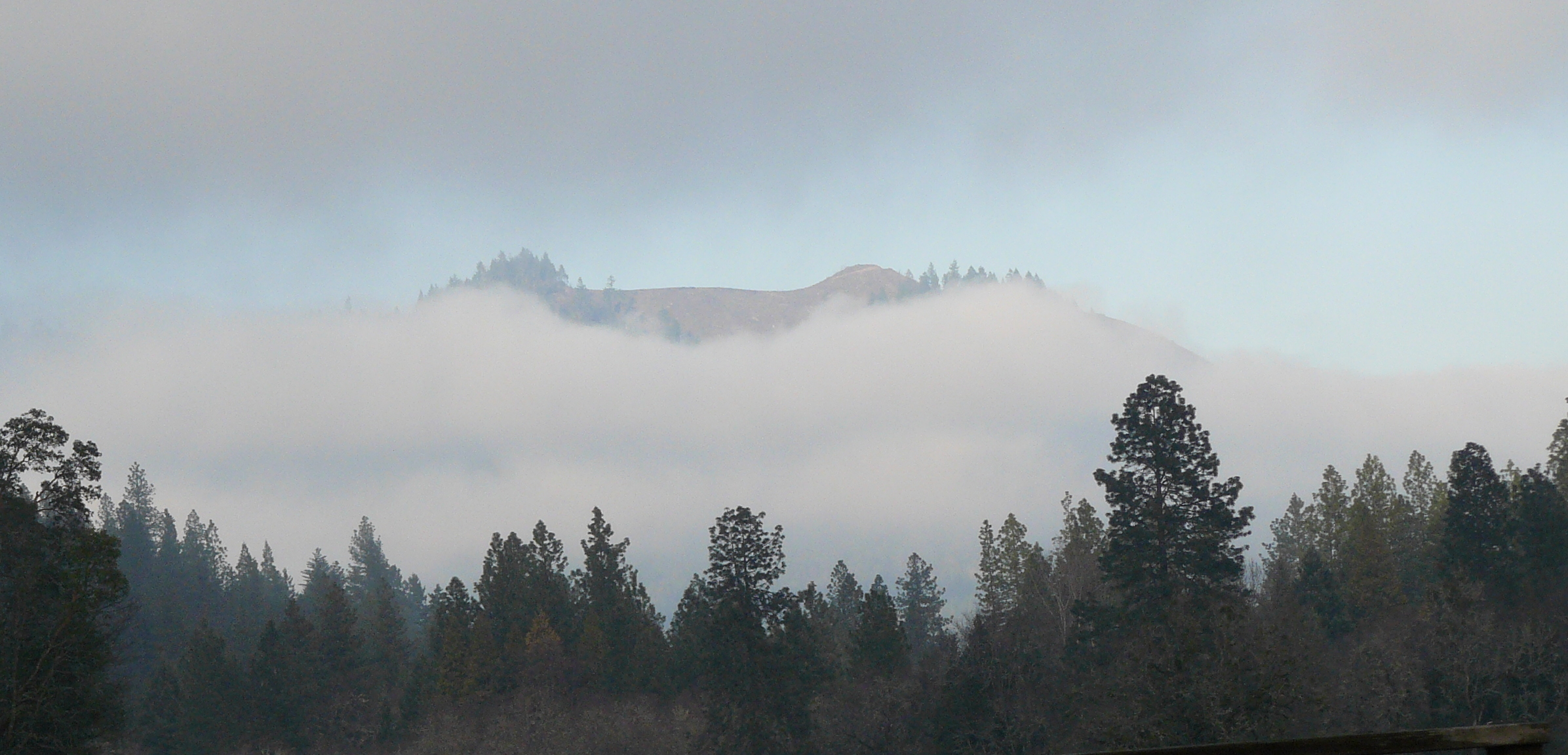
Just to underline that message of it not being only the UK with crazy policies, the photograph below is of a forest ridge within sight of the house here in Oregon.

A local ridge demonstrating 'clear-cutting' mania poking above the valley mist.
A local ridge demonstrating ‘clear-cutting’ mania poking above the valley mist.

Rather underlines the message contained in last Saturday’s post about rewilding: Restore large carnivores to save struggling ecosystems

The long heist!

Suddenly, it all makes sense!

Washing one’s hands of the conflict between the powerful and the powerless means to side with the powerful, not to be neutral.” –Paulo Freire

Dear neighbours, Dordie and Bill, lent us a documentary video to watch on Sunday night.  It was called “HEIST: Who Stole the American Dream?

As the film’s website explains:

HEIST: Who Stole the American Dream? is stunning audiences across the globe as it traces the worldwide economic collapse to a 1971 secret memo entitled Attack on American Free Enterprise System. Written over 40 years ago by the future Supreme Court Justice Lewis Powell, at the behest of the US Chamber of Commerce, the 6-page memo, a free-market utopian treatise, called for a money fueled big business makeover of government through corporate control of the media, academia, the pulpit, arts and sciences and destruction of organized labor and consumer protection groups.

But Powell’s real “end game” was business control of law and politics. HEIST’s step by step detail exposes the systemic implementation of Powell’s memo by BOTH U.S. political parties culminating in the deregulation of industry, outsourcing of jobs and regressive taxation. All of which led us to the global financial crisis of 2008 and the continued dismantling of the American middle class. Today, politics is the playground of the rich and powerful, with no thought given to the hopes and dreams of ordinary Americans. No other film goes as deeply as HEIST in explaining the greatest wealth transfer of our time. Moving beyond the white noise of today’s polarizing media, HEIST provides viewers with a clear, concise and fact- based explanation of how we got into this mess, and what we need to do to restore our representative democracy.

It’s an incredibly interesting film, but more of that later.  For me, what was stunningly enlightening was at last understanding the powerful forces at work since Lewis Powell published ‘the memo’ back on August 23, 1971.  Because for me over in Britain, the era of the ’70s’ and ’80s’ were incredibly fulfilling.  First, as a salesman for IBM UK – Office Products Division, from 1970 through to 1978, and then forming and managing my own company through to 1986 when I succumbed to an attractive purchase offer.  Then, when my company was sold, taking a few years off cruising a sailboat in the Mediterranean; based out of Larnaca, Cyprus.

Thus I was immune to the global money and power plays, albeit enjoying rising house prices!  Only Lady Luck protected me from the collapse of 2008 in that I had sold my Devon home in early 2007 and was renting.  Then Lady Luck arranging for me to meet Jean in Mexico, Christmas 2007 (we were born 23 miles apart in London) and subsequently moving out to Mexico with Pharaoh in September, 2008, to be with Jean and all her dogs.  Lady Luck’s magic continued in that we came to Merlin, Oregon because we were able to take advantage of a bank-owned property; moving there in October, 2012.

Of course, the scale of the downturn was obvious and there were many instances of people that I knew losing jobs or homes, or both, and generally having a very rough time.

So back to the film.  Here’s the official trailer.

Uploaded on Feb 17, 2012

Please watch the newly updated trailer for “Heist: Who Stole the American Dream?,” the new, explosive documentary from Frances Causey and Donald Goldmacher exposing the roots of the American economic crisis and the destruction of the American dream. Visit www.Heist-TheMovie.com for more information on how to see the feature film and how to Take Action in restoring democracy and economic justice in the United States.

But here’s another thing that now makes sense: The legitimate anger of so many people, especially those who have some insight into what had been taking place.  No, amend that!  What is still taking place!

Just one example of that legitimate anger, that of Patrice Ayme. Just go across and read his blog post of two days ago: American Circus.

My strong recommendation is that you take an evening off and watch the film. Here’s another preview:

Frances Causey, Co-producer & co-director-Heist & Donald Goldmacher, Co-producer & co-director-Heist join Thom Hartmann. Corporate America is the biggest Welfare reciepient in the country – but that wasn’t always the case. The makers of Heist will tell you how organized money has been able to pull off the biggest “Heist” of the American Dream!

The film also concludes by offering many ways in which individuals can take back control of their lives, reinvigorate local communities, actively show that people-power is unstoppable. As it always has been and always will be.

This post started with a quote and I’m going to close with another.

The day the power of love overrules the love of power, the world will know peace.” -Mahatma Gandhi

The Big Edit!

The start of phase two of ‘The Book’!

Back on the 1st November, I started out on the journey to write, before the end of November, a novel of a minimum of 50,000 words.  It was part of the NaNoWriMo annual encouragement for new writers.  To my amazement, I completed a first draft.

However, now comes the hard work!  For as Stephen King explains in his book, On Writing,

When you write a story, you’re telling yourself the story, when you rewrite, your main job is taking out all the things that are not the story. (p. 57)

Or as I read somewhere else: Your first write is for you, your rewrite is for your readers.

Either way it doesn’t get around the fact that for the next several weeks I need to be spending hours rewriting the first draft.

Which is my way of saying that until that rewrite is complete I won’t be able to spend so much time writing posts for Learning from Dogs.  In other words, there will be more republication of other articles and essays that catch my interest, repeat posts back from the earlier days of the blog and the publication of essays that you, dear reader, have sent me (hint!!).

TED Talks is an amazing resource that thousands use.  Not infrequently, a TED Talk finds its way to these pages; as indeed one on dieting will be offered tomorrow.

For today, however, enjoy this wonderful, and powerful, TED Talk by Benjamin H. Bratton.

Picture parade twenty-five.

More wonderful pictures courtesy of Capt. Bob Derham.

Derham27

oooo

Derham26

oooo

Derham25

oooo

Derham24

oooo

Derham23

oooo

Derham22

oooo

Derham21

oooo

Derham20

oooo

Derham19

oooo

Possibly, some of these pictures have appeared previously on Learning from Dogs; but so what!  They are so gorgeous they warrant multiple viewings.

An echo in the hills!

Patterns in the ether.

On Monday and Tuesday of the week I posted Legitimate Anger and Legitimate Hope.  (And please see the footnote to today’s post)

Patrice Ayme left the following comment to the Legitimate Hope post:

It’s hard to live with elephants, especially in poor, crowded conditions. I remember bathing in Africa as a child with a bull elephant 200 meters away, on the other side of a stream, and being extremely worried, with all in attendance.

Europe used to have elephants, and North America, two species. Time to reintroduce them, and live according to our discourse.

Rewilding Euramerica can be done, and should be done, for the deepest philosophical and emotional reasons, and will create new, very productive jobs.
PA

Then on Friday came an email from reader and blogger Martin Lack:

Hi Paul,
I saw this on The Conversation website – ‘Restore large carnivores to save struggling ecosystems’ (by Oregon State University’s Prof. William Ripple ) –  and thought of you.

Cheers,

Martin Lack

Author of Denial of Science: Analysing climate change scepticism in the UK; and of the Lack of Environment blog.   Follow me on Twitter @LackMartin

It was but a moment to go across to The Conversation website (rather liked what I saw, by the way) and find the article that Martin linked to. It is republished here within the terms of The Conversation site.

ooOOoo

Restore large carnivores to save struggling ecosystems

By William Ripple, Oregon State University
We are losing our large carnivores. In ecosystems around the world, the decline of large predators such as lions, bears, dingoes, wolves, and otters is changing landscapes, from the tropics to the Arctic. Habitat loss, persecution by humans and loss of prey have combined to inflict great losses on these populations.

In fact more than 75% of the 31 largest carnivore species are declining, and 17 species now occupy less than half their former ranges. Southeast Asia, southern and East Africa, and the Amazon are among areas in which multiple large carnivore species are declining. And with only a few exceptions, large carnivores have already been exterminated from much of the developed world, including areas of Western Europe, and the eastern United States.

Top dogs keep ecosystems in order

Many of these large carnivore species are endangered and some are at risk of extinction, either in specific regions or entirely. Ironically, they are vanishing just as we are learning about their important ecological effects, which is what led us to write a new paper in the journal Science to document their role.

From a review of published reports, we singled out seven species that have been studied for their important ecological role and widespread effects, known as trophic cascades. These are the African lion, leopard, Eurasian lynx, cougar, gray wolf, sea otter and dingo.

Based on field research, my Oregon State University co-author Robert Beschta and I documented the impact of cougars and wolves on the regeneration of forest tree stands and riverside vegetation in Yellowstone and other national parks in western North America. Fewer predators, we found, lead to an increase in browsing animals such as deer and elk. More browsing disrupts vegetation, reduces birds and some mammals and changes other parts of the ecosystem. From the actions of the top predator, widespread impacts cascade down the food chain.

Similar effects were found in studies of Eurasian lynx, dingoes, lions and sea otters. For example in Europe, absence of lynx has been closely tied to the abundance of roe deer, red fox and hare. In Australia, the construction of a 3,400-mile dingo-proof fence has enabled scientists to study ecosystems with and without dingoes which are closely related to gray wolves. They found that dingoes control populations of herbivores and exotic red foxes. The suppression of these species by dingoes reduces predation pressure, benefiting plants and smaller native prey.

In some parts of Africa, the decrease of lions and leopards has coincided with a dramatic increase in olive baboons, which threaten crops and livestock. In the waters off southeast Alaska, a decline in sea otters through killer whale predation has led to a rise in sea urchins and loss of kelp beds.

Predators are integral, not expendable

We are now obtaining a deeper appreciation of the impact of large carnivores on ecosystems, a view that can be traced back to the work of landmark ecologist Aldo Leopold. The perception that predators are harmful and deplete fish and wildlife is outdated. Many scientists and wildlife managers now recognise the growing evidence of carnivores’ complex role in ecosystems, and their social and economic benefits. Leopold recognised these relationships, but his observations were ignored for decades after his death in 1948.

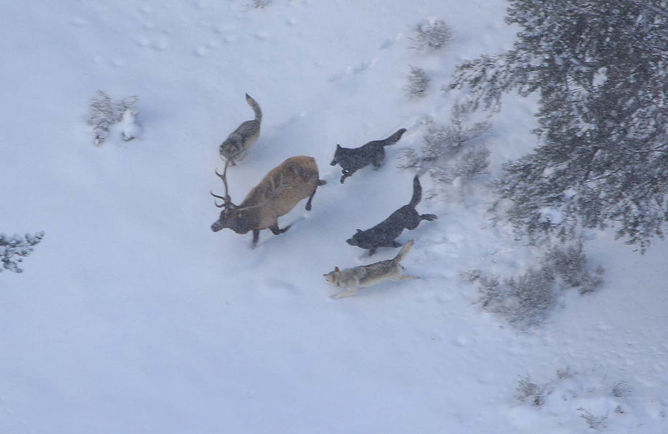
op carnivores, at work keeping things in check. Doug Smith
Top carnivores, at work keeping things in check. Doug Smith

Human tolerance of these species is the major issue. Most would agree these animals have an intrinsic right to exist, but additionally they provide economic and ecological services that people value. Among the services documented in other studies are carbon sequestration, restoration of riverside ecosystems, biodiversity and disease control. For example, wolves may limit large herbivore populations, thus decreasing browsing on young trees that sequester carbon when they escape browsing and grow taller. Where large carnivore populations have been restored – such as wolves in Yellowstone or Eurasian lynx in Finland – ecosystems appear to be bouncing back.

I am impressed with how resilient the Yellowstone ecosystem is, and while ecosystem restoration isn’t happening quickly everywhere in this park, it has started. In some cases where vegetation loss has led to soil erosion, for example, full restoration may not be possible in the near term. What is certain is that ecosystems and the elements of them are highly interconnected. The work at Yellowstone and other places shows how species affect each another through different pathways. It’s humbling as a scientist to witness this interconnectedness of nature.

My co-authors and I have called for an international initiative to conserve large carnivores in co-existence with people. This effort could be modelled after a couple of other successful efforts including the Large Carnivore Initiative for Europe, a non-profit scientific group affiliated with the International Union for the Conservation of Nature, and the Global Tiger Initiative which involves all 13 of the tiger-range countries. With more tolerance by humans, we might be able to avoid extinctions. The world would be a scary place without these predators.

William Ripple does not work for, consult to, own shares in or receive funding from any company or organisation that would benefit from this article, and has no relevant affiliations.

The Conversation

This article was originally published at The Conversation.
Read the original article.

ooOOoo

Footnote – Please help the elephants

Tuesday’s Legitimate Hope included this:

Also what needs to be highlighted are the organisations that are actively working on behalf of the elephants.

The Independent Newspaper have their own elephant campaign.

Elephant Crisis

In 2011, more African elephants were killed than any other year in history. The figures for 2012 and 2013 are not yet known, but are likely to be even higher. At current rates, in twelve years, there will be none left.

It is a familiar cause, but it has never been more urgent. Poaching has turned industrial. Armed militia fly in helicopters over jungle clearings, machine gunning down entire herds. Their tusks are then sold to fund war and terrorism throughout the continent and the wider world. Ivory is still illegal, but as China booms, it is more popular than ever.

This campaign will raise money to support rangers on the ground to protect Kenya’s elephants from armed poachers, together with Space for Giants’ longer term work to create new wildlife sanctuaries where elephants will be safe, forever. More can be found about the charity at Space for Giants

The article above includes two videos.  A shorter one that can be viewed on the paper’s campaign website. Then there is a longer, five-minute, video also on YouTube and included below.

Offering a donation to help is only a click away.

Jean and I wanted to make a donation but found that without a UK bank account/UK Visa card it wasn’t possible.  We contacted Space for Giants and received the following email from Amy.

TUSK

Hi Paul

Sorry for the difficulties and thank you for your perseverance!
You can donate in USD through our CrowdRise page at www.crowdrise.com/spaceforgiants1. These funds are sent to TUSK USA who will then allocate them to us.
Alternatively, you can make out a cheque to ‘TUSK USA’  and send to TUSK USA, 40 East 94th Street, Apt 3A, New York, NY 10128 – please attach a covering note confirming that you would like your donation to be used to support the work of Space for Giants.
Many thanks,
Amy.
So if there’s anyone else out there not in the UK who would like to donate, here’s another option.
Please, for all our sakes, help these beautiful creatures.

Synchronicity of minds, part two

“There IS very intelligent life, but somehow it can’t seem to achieve dominance over the other kind.” Chris Snuggs.

In yesterday’s Part One, I offered three independent essays, about the USA, the UK and Europe, that contained a common message.  A message of “the abject failure of modern nation-state democracy — not only in Europe, but across the globe.“ (In the words of one of the essayists: Don Quijones.)

As with Part One, Part Two brings together disconnected commentators offering an interconnected theme.

One of the commentators was Chris Snuggs who writes the blog Nemo Insula Est.  It was his post about the slaughter of elephants for their tusks that I featured last Tuesday: Legitimate anger.  Chris and I recently exchanged emails on the curious issue of why those who are charged with governing our democratic societies so often fail to do so in a fair and balanced manner; to put it mildly.

Here’s some of that exchange from Chris:

My theory is that intelligent people are too nice. Take you, for example – someone so intelligent, informed and civilised should be in government, but you are not ruthless, nasty and/or ambitious enough!!!

Another way to put it is that people like you – and I on a more modest, brutish and disorganised level – are doing their bit to spread civility in general, but we have NO POWER because we are too nice.

A related theory is that most people are in fact basically nice but that the rest have a disproportionate influence, both because a greater proportion of them have power and because of the “rotten apple” theory – one apple rots the barrel eventually.

I should open a school to teach nice and intelligent people how to be more nasty to nasty people! ………. Indeed, it is our duty to be more ruthless to stand up to the bad guys.

Moving swiftly over the flattery of yours truly, there is a strong message from Chris.  The message that nice people are not being sufficiently active in registering their disgust over what is being done in the supposed name of the people.

The next item, as part of this theme, was a recent article on Permaculture News.  The article was called Majority Voting is Inadequate and was based around an interview with Peter Emerson.  I hadn’t heard of Mr. Emerson before but very quickly established that Peter Emerson is the director of the de Borda Institute in Belfast, Northern Ireland. He is a leading authority on voting systems for use in both decision-making and elections.

Here is a flavour of that interview.

Marcin Gerwin (Poland): There are many divisions and even hostility in the Polish parliament. The ruling coalition currently has 232 votes in a parliament with 460 seats. This slight majority allows them to run all the ministries, and they can pass almost any bill they want. Do you think that creating an all-inclusive government, where all parties have their representatives, could help to tone down the atmosphere and create a more cooperative environment?


Peter Emerson

Peter Emerson: In a word – yes. However, I think I should argue the other point first. There is no justification for majority rule. When I was in Russia, it was quite interesting, because when Gorbachev started perestroika, all sorts of experts rushed over to Moscow, to tell him what to do to be democratic. They advised the system that we have here in Northern Ireland and that you now have in Poland and pretty well everyone else has as well – and that is that you elect your parliament by one of many electoral systems, apparently they all are democratic, even though some are bad and some are worse. But when it comes to what happens in parliament, nearly every parliament in the world debates things and then takes a majority vote.

These experts talked in Russia about majority rule but Mikhail Sergeyevich doesn’t speak English, so they had to use the Russian word. And the Russian word for majoritarianism is bolshevism. It comes from the Russian word for majority which is bolshinstvo, so the member of the majority was a bolshevik and a member of the minority was a menshevik. The decision to split into bolsheviks and mensheviks was taken in 1903 in London by the mathematical accident of just one vote. The whole thing was nonsense. But God, such a dangerous one.

MG: If not a majority vote, what are the other ways that decisions can be made?

PE: There are lots of voting methodologies – Borda countCondorcet…. One of these could be used. And in fact Dublin City Council recently took a vote by means of a Borda count, which is brilliant. It was partly because they had more than two options on the agenda, so you almost have to move beyond majority voting.

And when you look at it, the majority vote is actually the most inaccurate measure of collective opinion ever invented. It’s over two thousand years old, it was used by the Greeks and the Chinese. But there is no justification to for its use today because it’s so inaccurate.

You did register what Peter said in that last paragraph? “the majority vote is actually the most inaccurate measure of collective opinion ever invented.

If you have only the slightest curiosity about better methods of voting then do read the interview in full.  For the interview contains links to other voting systems, most of which I hadn’t heard of before.  There is the Borda count, the Condorcet method, the Ranked voting system (otherwise known as Preferential voting), and the proportional voting process known as the Matrix vote.

Moving on.

The final coincidence was John Hurlburt sending me the following essay, that is published with his permission.

ooOOoo

Apocalypse and Epiphany

Apocalypse, n. [Gr. apokalypsis, from apokalypto, to disclose and to discover.] Revelation; discovery; disclosure.  (The New Webster Encyclopedic Dictionary)

Apocalypse is a word which describes a human awakening to change.  Change is a constant. Our species has been living through apocalypse for fourteen million years.  Conservative groups deny change.  For example financial interests spent 14 million dollars to refute the scientific reality of climate change during 2013.  We are in the midst of worldwide financial wars, energy wars, cultural wars, and political wars.  Has there been progress in emerging human species intelligence?

Perhaps more importantly, has there been progress in human morality?   We’ve been around as a species for roughly 14 million years.  Have we truly learned anything in the process?   For the last two hundred years we’ve been industrially poisoning the environment which sustains our existence at a steadily increasing rate.

We’re needlessly killing ourselves and a significant portion of the life on our shared garden planet in the pursuit of artificial symbols of trust we call money.   No one knows for sure how deep and how devastating an impending economic, cultural, political and geophysical collapse may become.

We’ve reached a critical tipping point between species survival and a severely diminished quality of human life. We’re in the process of falling off the edge.  The good news is that we know what needs to be done and we know how to do it.  So why don’t we do what we know needs to be done?

There are a variety of reasons.  The seven deadly sins are a starting point for systemic corruption.  The seven deadly sins are pride, greed, lust, anger, gluttony, envy and sloth.  Add ignorance, denial and indifference.  Serve bread and circuses for dessert.  In terms of action, compete more than cooperate.  Rush ever faster without reflection, contemplation or meditation.  As a final touch, become consumed by “now” without regard for the future.

Epiphany, n. [Gr. epiphaneia, appearance; from epiphanio, to appear] an appearance or a becoming manifest. (The New Webster Encyclopedic Dictionary)  Epiphany provides us a way to deal with apocalypse.  As what’s going on is revealed, we realize that something needs to be done about it and that we are capable of creating and implementing solutions in concert with Nature.

To paraphrase Shakespeare’s “Hamlet”, “The fault, Dear Brutus, lies not in our stars but in ourselves.” What do we need to personally change both spiritually and practically?  Today is the tomorrow – we imagined yesterday.

Considering our steadily increasing demographic and our systemic global failure, it’s half past time to clean house.  We begin with our “self”.  We take inventory.  We honestly look at our thoughts and actions.  What do we personally have to offer that’s useful and productive in terms of a resilient tomorrow?  What’s standing in our way today?

We accept that we are a very young consciously aware species on a fragile garden planet that’s 14 Billion years old in a universe that’s roughly 33 billion years old.  We accept that we are a species component of the matter and energy of Creation. We accept responsibility for sustaining our being and by extension responsibility for the being of life on earth.

We realize our purpose as stewards of Creation.

an old lamplighter

ooOOoo

So put those three perspectives together and the message is clear.  This is a period of significant change and, as with previous periods in history, change only comes along when there is dissatisfaction with the present.  Ergo, there is widespread acceptance that the present way of life is not working for millions and millions around the world.

Reinforced only this morning (Thursday) by a recent announcement from Gallup regarding the voting intentions of Americans.

January 8, 2014

Record-High 42% of Americans Identify as Independents

Republican identification lowest in at least 25 years

by Jeffrey M. Jones

PRINCETON, NJ — Forty-two percent of Americans, on average, identified as political independents in 2013, the highest Gallup has measured since it began conducting interviews by telephone 25 years ago. Meanwhile, Republican identification fell to 25%, the lowest over that time span. At 31%, Democratic identification is unchanged from the last four years but down from 36% in 2008.

Let me include this section:

Fourth Quarter Surge in Independence

The percentage of Americans identifying as independents grew over the course of 2013, surging to 46% in the fourth quarter. That coincided with the partial government shutdown in October and the problematic rollout of major provisions of the healthcare law, commonly known as “Obamacare.”

gallup

The 46% independent identification in the fourth quarter is a full three percentage points higher than Gallup has measured in any quarter during its telephone polling era.

Taking everything into consideration, from yesterday’s evidence and what is presented today, it’s hardly surprising to read in that Gallup report [my italics]:

The rise in political independence is likely an outgrowth of Americans’ record or near-record negative views of the two major U.S. parties, of Congress, and their low level of trust in government more generally.

The increased independence adds a greater level of unpredictability to this year’s congressional midterm elections. Because U.S. voters are less anchored to the parties than ever before, it’s not clear what kind of appeals may be most effective to winning votes. But with Americans increasingly eschewing party labels for themselves, candidates who are less closely aligned to their party or its prevailing doctrine may benefit.

Fascinating times!  Thank goodness there’s always a dog to remind us of how to cope!

Cleo dealing with stress!
Cleo coping with these fascinating times!

Synchronicity of minds, part one.

A collection of essays and ideas that unite in a common theme.

Back in those times before dogs became the domesticated friends of man, the leader of the pack, the alpha female, had two key pack roles.  One of them was having first pick of the males, for mating purposes, and the other was knowing when their territory was no longer conducive to her pack’s interests.  When that happened the ‘boss lady’ was the one to signal that the pack had to find another, more beneficial, homestead.

While mankind is in desperate need of learning so many of the qualities of dogs the one example that is beyond us is finding a new homestead. This planet is the only homestead we have.

This basic and fundamental concept seems to be missing from the minds of leaders and power-brokers.  Missing big time!

Coincidentally, over recent days there have been three essays from three different authors that scream out the madness, to put it nicely, of the way of our world just now. Let me dip into those three essays.

First, to a recent essay from Tom Engelhardt over at TomDispatch.

American Jihad 2014 
The New Fundamentalists 
By Tom Engelhardt

In a 1950s civics textbook of mine, I can remember a Martian landing on Main Street, U.S.A., to be instructed in the glories of our political system.  You know, our tripartite government, checks and balances, miraculous set of rights, and vibrant democracy.  There was, Americans then thought, much to be proud of, and so for that generation of children, many Martians were instructed in the American way of life.  These days, I suspect, not so many.

Still, I wondered just what lessons might be offered to such a Martian crash-landing in Washington as 2014 begins.  Certainly checks, balances, rights, and democracy wouldn’t top any New Year’s list.  Since my childhood, in fact, that tripartite government has grown a fourth part, a national security state that is remarkably unchecked and unbalanced.  In recent times, that labyrinthine structure of intelligence agencies morphing into war-fighting outfits, the U.S. military (with its own secret military, the special operations forces, gestating inside it), and the Department of Homeland Security, a monster conglomeration of agencies that is an actual “defense department,” as well as a vast contingent of weapons makers, contractors, and profiteers bolstered by an army of lobbyists, has never stopped growing.  It has won the undying fealty of Congress, embraced the power of the presidency, made itself into a jobs program for the American people, and been largely free to do as it pleased with almost unlimited taxpayer dollars.

The expansion of Washington’s national security state — let’s call it the NSS — to gargantuan proportions has historically met little opposition.  In the wake of the Edward Snowdenrevelations, however, some resistance has arisen, especially when it comes to the “right” of one part of the NSS to turn the world into a listening post and gather, in particular, American communications of every sort.  The debate about this — invariably framed within the boundaries of whether or not we should have more security or more privacy and how exactly to balance the two — has been reasonably vigorous.  The problem is: it doesn’t begin to get at the real nature of the NSS or the problems it poses.

If I were to instruct that stray Martian lost in the nation’s capital, I might choose another framework entirely for my lesson.  After all, the focus of the NSS, which has like an incubus grown to monumental proportions inside the body of the political system, would seem distinctly monomaniacal, if only we could step outside our normal way of thinking for a moment.  At a cost of nearly a trillion dollars a year, its main global enemy consists of thousands of lightly armed jihadis and wannabe jihadis scattered mainly across the backlands of the planet.  They are capable of causing genuine damage — though far less to the United States than numerous other countries — but not of shaking our way of life.  And yet for the leaders, bureaucrats, corporate cronies, rank and file, and acolytes of the NSS, it’s a focus that can never be intense enough on behalf of a system that can never grow large enough or be well funded enough.

It’s a long, deeply thoughtful essay that deserves your full read.  This is how it closes:

After 12 long years in Afghanistan and an Obama era surge in that country, the latest grim National Intelligence Estimate from the U.S. intelligence community suggests that no matter what Washington now does, the likelihood is that things there will only go from bad enough to far worse.  Years of a drone campaign against al-Qaeda in the Arabian Peninsula hasstrengthened that organization; an air intervention in Libya led to chaos, a dead ambassador, and a growing al-Qaeda movement in northern Africa — and so it repetitively goes.

Similarly, intelligence officials brag of terrorist plots — 54 of them! — that have been broken up thanks in whole or in part to the National Security Agency’s metadata sweeps of U.S. phone calls; it also claims that, given the need of secrecy, only four of them can be made public.  (The claims of success on even those four, when examined by journalists, have proved less than impressive.)  Meanwhile, the presidential task force charged with reviewing the NSA revelations, which had access to a far wider range of insider information, came to aneven more startling conclusion: not one instance could be found in which that metadata the NSA was storing in bulk had thwarted a terrorist plot. “Our review,” the panel wrote, “suggests that the information contributed to terrorist investigations by the use of section 215 telephony meta-data was not essential to preventing attacks.” (And keep in mind that, based on what we do know about such terror plots, a surprising number of them were planned or sparked or made possible by FBI-inspired plants.)

In fact, claims of success against such plots couldn’t be more faith-based, relying as they generally do on the word of intelligence officials who have proven themselves untrustworthy or on the impossible-to-prove-or-disprove claim that if such a system didn’t exist, far worse would have happened.  That version of a success story is well summarized in the claim that “we didn’t have another 9/11.”

In other words, in bang-for-the-buck practical terms, Washington’s national security state should be viewed as a remarkable failure.  And yet, in faith-based terms, it couldn’t be a greater success.  Its false gods are largely accepted by acclamation and regularly worshiped in Washington and beyond.  As the funding continues to pour in, the NSS has transformed itself into something like a shadow government in that city, while precluding from all serious discussion the possibility of its own future dismantlement or of what could replace it.  It has made other options ephemeral and more immediate dangers than terrorism to the health and wellbeing of Americans seem, at best, secondary.  It has pumped fear into the American soul.  It is a religion of state power.

No Martian could mistake it for anything else.

Tom Engelhardt, a co-founder of the American Empire Project and author of The United States of Fear as well as a history of the Cold War, The End of Victory Culture, runs the Nation Institute’s TomDispatch.com. His latest book, co-authored with Nick Turse, is Terminator Planet: The First History of Drone Warfare, 2001-2050.

Follow TomDispatch on Twitter and join us on Facebook or Tumblr. Check out the newest Dispatch Book, Ann Jones’s They Were Soldiers: How the Wounded Return From America’s Wars — The Untold Story.

Copyright 2014 Tom Engelhardt

Now let’s move from the USA to the UK.  George Monbiot penned an essay on the 6th January about the growing loss of freedoms in my old home country.  He opens:

Dead Zone

January 6, 2014

A shocking new bill threatens to make this country feel like a giant shopping mall.

By George Monbiot, published in the Guardian 7th January 2014

Until the late 19th Century, much of our city space was owned by private landlords. Squares were gated, streets were controlled by turnpikes. The great unwashed, many of whom had been expelled from the countryside by acts of enclosure, were also excluded from desirable parts of town.

Social reformers and democratic movements tore down the barriers, and public space became a right, not a privilege. But social exclusion follows inequality as night follows day, and now, with little public debate, our city centres are again being privatised or semi-privatised. They are being turned by the companies that run them into soulless, cheerless, pasteurised piazzas, in which plastic policemen harry anyone loitering without intent to shop.

Streetlife in these places is reduced to a trance-world of consumerism, of conformity and atomisation, in which nothing unpredictable or disconcerting happens, a world made safe for selling mountains of pointless junk to tranquilised shoppers. Spontaneous gatherings of any other kind – unruly, exuberant, open-ended, oppositional – are banned. Young, homeless and eccentric people are, in the eyes of those upholding this dead-eyed, sanitised version of public order, guilty until proven innocent.

Then a few paragraphs later, the essay continues:

The existing rules are bad enough. Introduced by the 1998 Crime and Disorder Act, anti-social behavour orders (Asbos) have criminalised an apparently endless range of activities, subjecting thousands – mostly young and poor – to bespoke laws. They have been used to enforce a kind of caste prohibition: personalised rules which prevent the untouchables from intruding into the lives of others.

You get an Asbo for behaving in a manner deemed by a magistrate as likely to cause harassment, alarm or distress to other people. Under this injunction, the proscribed behaviour becomes a criminal offence. Asbos have been granted which forbid the carrying of condoms by a prostitute, homeless alcoholics from possessing alcohol in a public place, a soup kitchen from giving food to the poor, a young man from walking down any road other than his own, children from playing football in the street. They were used to ban peaceful protests against the Olympic clearances.

Inevitably, over half the people subject to Asbos break them. As Liberty says, these injunctions “set the young, vulnerable or mentally ill up to fail”, and fast-track them into the criminal justice system. They allow the courts to imprison people for offences which are not otherwise imprisonable. One homeless young man was sentenced to five years in jail for begging: an offence for which no custodial sentence exists. Asbos permit the police and courts to create their own laws and their own penal codes.

All this is about to get much worse. Tomorrow the Anti-social Behaviour, Crime and Policing Bill reaches its report stage (close to the end of the process) in the House of Lords. It is remarkable how little fuss has been made about it, and how little we know of what is about to hit us.

The bill would permit injunctions against anyone of 10 or above who “has engaged or threatens to engage in conduct capable of causing nuisance or annoyance to any person.” It would replace Asbos with Ipnas (Injunctions to Prevent Nuisance and Annoyance), which would not only forbid certain forms of behaviour, but also force the recipient to discharge positive obligations. In other words, they can impose a kind of community service on people who have committed no crime, which could, the law proposes, remain in force for the rest of their lives.

The bill also introduces Public Space Protection Orders, which can prevent either everybody or particular kinds of people from doing certain things in certain places. It creates new dispersal powers, which can be used by the police to exclude people from an area (there is no size limit), whether or not they have done anything wrong.

Please read the original essay in full as well as refer to background links that were included in that original.  I will offer the closing paragraphs.

The Home Office minister, Norman Baker, once a defender of civil liberties, now the architect of the most oppressive bill pushed through any recent parliament, claims that the amendments he offered in December will “reassure people that basic liberties will not be affected”(11). But Liberty describes them as “a little bit of window-dressing: nothing substantial has changed.”(12)

The new injunctions and the new dispersal orders create a system in which the authorities can prevent anyone from doing more or less anything. But they won’t be deployed against anyone. Advertisers, who cause plenty of nuisance and annoyance, have nothing to fear; nor do opera lovers hogging the pavements of Covent Garden. Annoyance and nuisance are what young people cause; they are inflicted by oddballs, the underclass, those who dispute the claims of power.

These laws will be used to stamp out plurality and difference, to douse the exuberance of youth, to pursue children for the crime of being young and together in a public place, to help turn this nation into a money-making monoculture, controlled, homogenised, lifeless, strifeless and bland. For a government which represents the old and the rich, that must sound like paradise.

www.monbiot.com

The last of the three essays was about Europe, being an essay on Naked Capitalism two days ago.

Written by Don Quijones, a freelance writer and translator based in Barcelona, Spain who also publishes the blog Raging Bull-Shit, the essay was originally posted at Testosterone Pit.

Death By A Thousand Cuts: The Silent Assassination Of European Democracy

As is gradually dawning on more and more people across the old continent, the European Union is riddled with fatal flaws and defects. Chief among them is the single currency which, rather than serving as the Union’s springboard to global dominance, could well be its ultimate undoing.

Another huge problem with the EU is its acute lack of transparency. Staggering as it may seem, in the last 20 years the Union has not passed a single audit. Indeed, so opaque is the state of its finances that in 2002 Marta Andreasen, the first ever professional accountant to serve as the Commission’s Chief Accountant, refused to sign off the organization’s 2001 accounts, citing concerns that the EU’s accounting system was “open to fraud.” After taking her concerns public, Andreasen was suspended and then later sacked by the Commission.

However, by far the EU’s greatest — and certainly most dangerous — structural flaw is its gaping democratic deficit. To paraphrase Nigel Farage, the stridently anti-EU British MEP, not only is the EU undemocratic, it is fundamentally anti-democratic.

Yet again, the essay must be read in full.  As with the others, I will include the closing paragraphs:

Of course none of this would be possible if it weren’t for the abject failure of modern nation-state democracy — not only in Europe, but across the globe. As Mair wrote in the first paragraph of his book, although the political parties themselves remain, “they have become so disconnected from the wider society, and pursue a form of competition that is so lacking in meaning, that they no longer seem capable of sustaining democracy in its present form.”

The European elites have masterfully exploited this crisis of representative democracy and the resultant voter disaffection and apathy to enshrine a new system of rule by bureaucrats, bankers, technocrats and lobbyists (as I reported in Full Steam Ahead For the EU Gravy Train, Brussels is home to the second biggest lobby industry in the world, just behind Washington). If anything, we can expect this trend to accelerate in 2014 as the Eurocrats seek to consolidate their power grab through the imposition of EU-wide banking and fiscal union. Once that’s done, the quest for the holy grail of full-blown political union will begin in earnest.

Whether the EU is able to pull of this ultimate coup de grace in its decades-long coup d’état will depend on two vital factors: its ability to continue preventing economic reality from impacting the financial markets; and the willingness of hundreds of millions of European people to be herded and corralled into a new age of technocracy.

oooo

the abject failure of modern nation-state democracy — not only in Europe, but across the globe.

Don Quijones wrote that with a focus on Europe.  But also a recognition that right across the world the rights and safeguards of everyday citizens are being dangerously undermined.  I will return tomorrow with Part Two and an insight into the growing power of those everyday citizens.