Category: People

Picture parade thirty.

We interrupt your life to bring you a moment of beauty, part two.

Last week I published the first set of pictures sent across by John Hurlburt.  Here is the second set (but do look at the postscript).

John11

oooo

John12

oooo

John13

oooo

John14

oooo

JH15

oooo

JH16

oooo

John17

oooo

John18

oooo

John19

oooo

John20

oooo

Now a bonus.

I was reading Naked Capitalism earlier on Saturday and came across the link to a story in Huffington Post about a young man who jumped into a swollen river in Bangladesh to rescue a young fawn in danger of being swept away to it’s death.  This how that story opens:

Courageous Teen Risks His Life To Save Drowning Baby Deer

This is pretty incredible.

A wildlife photographer visiting Noakhali, Bangladesh, was able to witness — and document — an amazingly courageous teen risk his own life to save a drowning fawn, Caters News Service reports.

The boy waded into the fast current of a surging, swollen river in Noakhali, holding the deer above his head, even as he, himself, disappeared beneath the water at times.

The link in the last sentence takes you to the article as it appeared in The Daily Mail newspaper (online version).

Two of the photographs from that article.

PIC FROM HASIB WAHAB / CATERS NEWS (Pictured: DEER RETURNED SAFELY) - A brave boy fearlessly risked his own life - to save a helpless baby deer from drowning. The boy, believed to be in his early teens, defiantly held the young fawn in one hand above his head as he plunged through the surging river. During the ordeal onlookers were unsure whether the boy was going to appear again. When he finally made it to the other side the locals cheered as the deer was reunited with its family. The incident took place in Noakhali, Bangladesh, when the young fawn became separated from its family during torrential rain and fast-rising floods.
PIC FROM HASIB WAHAB / CATERS NEWS (Pictured: DEER RETURNED SAFELY) – A brave boy fearlessly risked his own life – to save a helpless baby deer from drowning. The boy, believed to be in his early teens, defiantly held the young fawn in one hand above his head as he plunged through the surging river. During the ordeal onlookers were unsure whether the boy was going to appear again. When he finally made it to the other side the locals cheered as the deer was reunited with its family. The incident took place in Noakhali, Bangladesh, when the young fawn became separated from its family during torrential rain and fast-rising floods.

oooo

PIC FROM HASIB WAHAB / CATERS NEWS (Pictured: DEER) - A brave boy fearlessly risked his own life - to save a helpless baby deer from drowning. The boy, believed to be in his early teens, defiantly held the young fawn in one hand above his head as he plunged through the surging river. During the ordeal onlookers were unsure whether the boy was going to appear again. When he finally made it to the other side the locals cheered as the deer was reunited with its family. The incident took place in Noakhali, Bangladesh, when the young fawn became separated from its family during torrential rain and fast-rising floods.
PIC FROM HASIB WAHAB / CATERS NEWS (Pictured: DEER)

Here’s that article in The Daily Mail newspaper.

OK, I know I have a tendency to get a little sentimental but here’s my closing thought.  That is that while there are people in the world such as young Belal who will not hesitate to rescue a vulnerable creature then there’s hope for all of mankind.

… from helping the mustangs.

If you can help these beautiful animals in any way, read on.

Yesterday, in a post called Wild horses wouldn’t stop me …. I outlined the situation in Nevada where “the Nevada Farm Bureau is suing the Bureau of Land Management because they want the federal agency to round up what’s left of America’s wild horses and send them to slaughter.” The post included the commitment from Jean and me to adopt two of these horses.

In the hope that this post touches others who would also like to adopt a horse or know someone else that would, then here are the details that we have collected in the last twenty-four hours. (NB: please double-check yourself because much, if not all, of this is new to me and I am far from being an authority on the subject.)

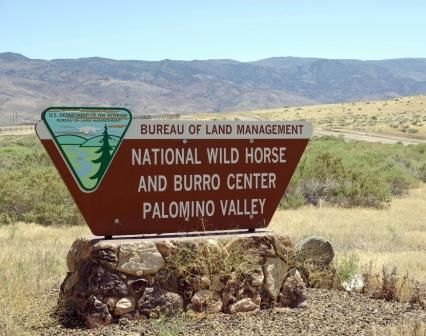
The starting point seems to be Palomino Valley National Adoption Center.  Their website is here.  On the home page of that website, one reads:

palomino_valley_center.

The National Wild Horse and Burro Center at Palomino Valley (PVC) is the largest BLM preparation and adoption facility in the country and serves as the primary preparation center for wild horses and burros gathered from the public lands in Nevada and other near-by states. Nevada is home to more than 50 percent of the Nation’s wild horses and burros with approximately 83 herd management areas throughout the state.

Adoption Details

The majority of animals at PVC are available for adoption 6 days a week. To schedule an appointment to adopt a wild horse or burro at PVC, please call 775-475-2222. Appointments for viewing/adopting are limited to a maximum of one hour. The majority of animals are available for adoption, however, some are not due to the time involved in the preparation process. If you have questions about our adoption requirements, click here to go to our Adoption page.

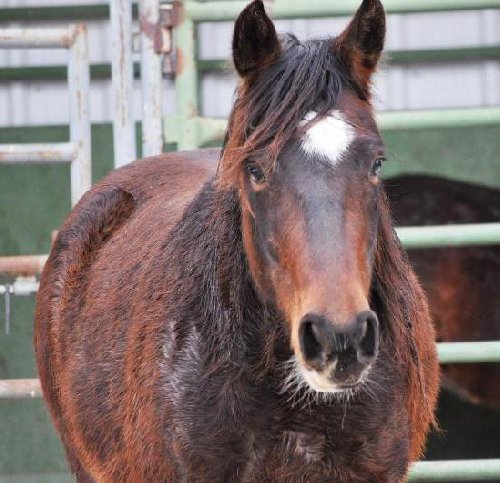
When I called that office number yesterday afternoon, the person who helpfully answered a number of my questions recommended the BLM Adopt-A-Horse website.  That website offers a number of useful links that anyone wanting to learn more should explore, including how to adopt via the internet. Plus a link to an online gallery where there are many pictures of beautiful horses, such as this one:

Horse 2249

Sex: Mare Age: 5 Years   Height (in hands): 15.0Necktag #: 2249   Date Captured: 08/28/12

Color: Brown   Captured: Paisley Desert (OR)

Notes:
#2249 – 5 yr old brown mare, captured Aug 2012 from the Paisley Desert Herd Area, Oregon.

This horse is currently located at the Corral Facility in Hines, Oregon. For more information, contact Patti Wilson at email pwilson@blm.gov or Tara at tmartina@blm.gov.

Pick up options (by appt): Burns, OR; Salt Lake, UT; Elm Creek, NE; Pauls Valley, OK; Piney Woods, MS; Mequon, WI.

Other pick up options: West Monroe, LA (Mar 21), Archdale, NC (Apr 18) and Springfield, OH (Apr 25).

Adoption confirmation for this animal must be finalized no later than Feb 6. After this date, all unclaimed animals will be available for in-person walk up adoption ONLY.

Some other useful websites now follow:

Ever After Mustang Rescue in Maine.

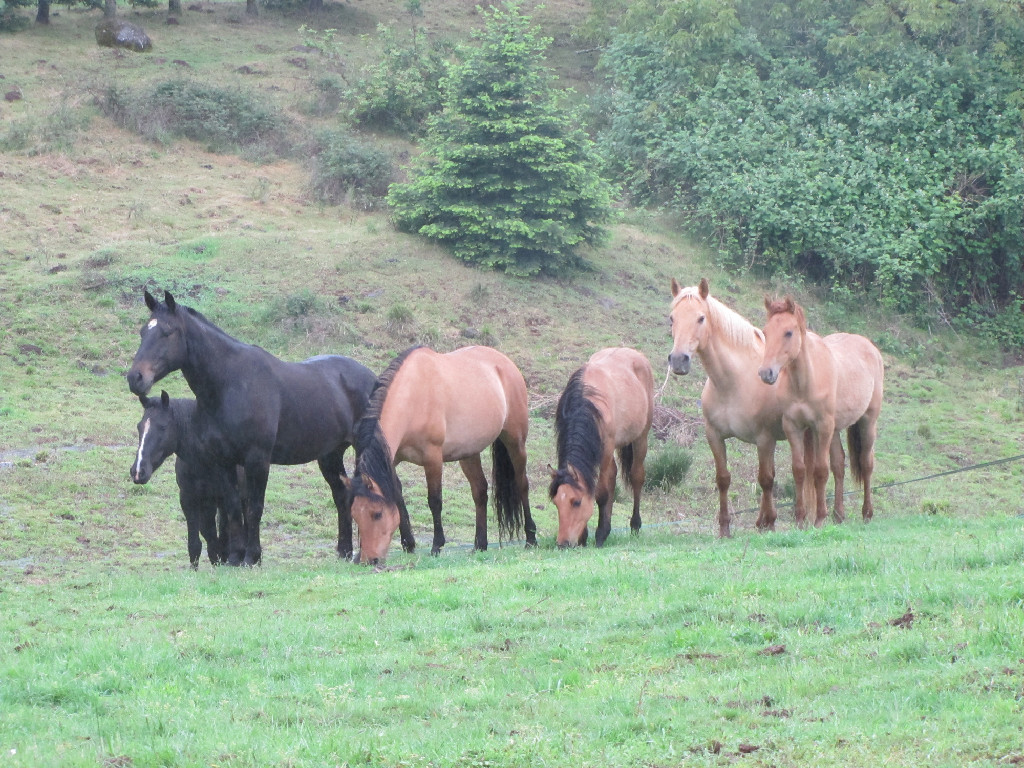
Wild Horse Mountain Ranch in Sherwood, Oregon (South-West of Portland).  From which I have taken the following photograph.

Wild Horse Mtn

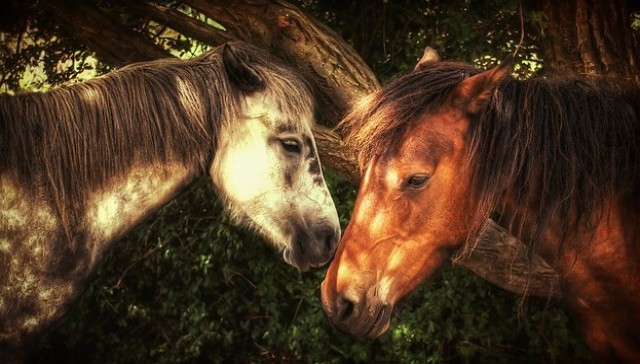
and, finally, MUSTANGS 4 US that has a plethora of information and good advice. Take this link, for example: Adopt A Mustang (Oregon). Plus there’s a very useful page on Where To Adopt. This photograph also came from the Mustangs 4 Us website.

AdoptHorse

Fingers crossed this has been of interest to many and of direct value to some.  Jean and I have much to learn and as we work our way towards being better informed and being ready to take on two horses, all the details will be shared with you.

An Act Of Congress
“Congress finds and declares that wild free-roaming horses and burros are living symbols of the historic and pioneer spirit of the West; (and) that they contribute to the diversity of life forms within the Nation and enrich the lives of the American people …”
(Public Law 92-195, December 15, 1971)

Wild horses won’t stop me …

From alerting you to the potential catastrophe of the Mustangs in Nevada.

Relationships across the internet, especially across the world of blogging are, oh, I don’t know, different! (OK, I hear some saying I could have chosen a more apt word; such as weird, self-indulgent, vain, and so on.)

Melinda Roth is an author. Her ‘goodreads’ page is here; her Amazon Books page is here; her website is here.  Melinda has started reading posts on Learning from Dogs and, likewise, I have read posts over at Anyone Seen My Horse?

Seven days ago, Melinda published a post under the title of Oh, yum.  This is the opening paragraph.

I ran across this recipe while doing a little research on horse slaughter (the Nevada Farm Bureau is suing the Bureau of Land Management because they want the federal agency to round up what’s left of America’s wild horses and send them to slaughter) so… thought I’d share:

When I read that I felt a mixture of anger, confusion, puzzlement; surely this can’t be the case?  Then I read on, skipping the recipes that Melinda included in her post.

Now, you might have to go to Canada or Mexico to get the horse meat, but we ship those countries about 150,000 of our unwanted equines for slaughter anyway, so your meat will probably be home grown in the USA. No worries.

That is, as long as you’re not too concerned about the unregulated administration of numerous chemical substances to horses before slaughter, which according to official reports “are known to be dangerous to humans, untested on humans, or specifically prohibited for use in animals raised for human consumption.”

If travel is out of the question, however, you can always buy imported horse meat online.

Check out My Brittle Pony, which is horse meat jerky seasoned with “Guinness, onions, garlic, fresh herbs and Soy Sauce and is guaranteed to contain no horse substitute such as beef.”

It costs £3.50… and you can pay with Pay Pal.

But if the Nevada Farm Bureau has its way, we won’t have to travel or use currency converters to buy horse meat. A majority of the country’s last wild horses live in Nevada, and that state seems ready to cash in on one of its most popular natural resources.

Anyone who knows anything about Jean and me knows that we love animals and we adore our own animals. Thus as I read Melinda’s post the pain and anguish building in me was indescribable; and I’m only half-way through the post. Yes, there’s worse to come.

According to reports published in the last week, the Nevada Farm Bureau and the Nevada Association of Counties want the BLM to round up just about as many remaining wild horses as they can. The BLM argues that it’s already housing about 50,000 wild horses it’s already captured and can’t afford to take in many more.

The Nevada Farm Bureau has an answer, however: The BLM should “destroy” horses that are deemed unadoptable.

I shall include one more paragraph from her post:

The Nevada Farm Bureau argues that there are too many wild horses on public lands. But there are only about 30,000 wild horses left, and since public lands seem perfectly able to support 1.75 million head of livestock (that belong to private ranchers), what exactly is the problem?

There’s more you should read so please do so.  Especially not forgetting to communicate your feelings to NVFB via the address listed on their web site – nvfarmbureau@nvfb.org

I wrote a comment to Melinda’s post endeavouring to explain what I was feeling. Melinda then pointed me to an essay by Andrew Cohen.  It was beautiful and it seemed in order to share it with you.  So here is Andrew Cohen writing about horses.

ooOOoo

Cohen horses

Why I Write About Wild Horses

 By Andrew Cohen 

29 January 2014

I write about wild horses. I write an awful lot about wild horses. And it’s not just because I cherish the animals or admire all that they have done through the centuries to ease our burden here in North America. I sometimes get grief about my focus upon the nation’s herds, and I know that many people who don’t “get” horses, or who have never been near a horse, cannot fathom the depth of passion the animals engender among their human supporters. What can I say? I can’t help it and I won’t stop.

I write about wild horses for many of the same reasons that I write about mentally ill prisoners who are abused in their cells or about indigent defendants who cannot afford a lawyer or anyone else who has a voice, and rights, but who cannot be properly heard or who cannot have those rights acknowledged. Mordecai Richler, the late, great Canadian writer, long ago captured the essence of what I try to do with all my writing: “The novelist’s primary moral responsibility is to be the loser’s advocate,” he said. The actor Ricky Gervais said pretty much the same thing the other day, without the literary flair, when he said: “Animals don’t have a voice. But I do.”

I have a voice and I’ve chosen to speak out for these horses, which are being rounded up by the tens of thousands from our public and private lands and sent to holding pens in the Midwest — or sold into slaughter even though that is against the law. The government and the ranchers say these roundups must happen because there is no room for the herds, or because they graze too heavily upon the land, but ample evidence exists suggesting that this simply isn’t so. The truth is that there is plenty of room out West for these horses and there are plenty of ways in which the herds may be properly managed to ensure their survival without forcing them into cruel conditions or slaughter.

Why that isn’t happening is a story everyone ought to care about. So I write about wild horses because I think their treatment over the past four decades, since the passage of the federal law designed to protect them, reveals a great deal about American politics and the nature of the bureaucratic state. The Interior Department, which has stewardship over the herds, is little more than a straw man for the industries it is supposed to regulate. And those industries, which receive enormous federal benefits in the form of welfare ranching, and which in turn send millions of dollars and boatloads of lobbyists to Washington, want the horses off the public lands no matter what anyone else says.

I write about wild horses because last year the National Academies of Science issued a report scathing in its criticism of the Bureau of Land Management’s scientific approach to the herds. Before the report was issued, federal officials assured advocates that its conclusions would be respected (or at least publicly discussed). But it’s been seven months now since the report was issued and federal officials have done almost nothing about it. That’s just not unjust to the horses, and unfair to their human advocates, and perhaps a violation of federal law, it’s also terrible policy, as a general rule, for bureaucrats to ignore the findings of a report they themselves commissioned and paid for.

I write about wild horses because the last Secretary of the Interior was a rancher who did not even try to conceal his disdain for federal obligations to the horses and because the current Secretary of the Interior, herself a former engineer, has shown no interest in the herds or in addressing the concerns raised by the NAS report. Only the Interior Department, the backwater of all Washington beats, could engender so little muckracking when so much money, and so much else, is on the line. I write about wild horses because their story is the story of every other small interest without political power in Washington or the statehouses of this nation.

They are persecuted. They have rights but no remedies. And their fate isn’t going to get better unless more people come to understand the injustice of what’s happening to them — and how far the gulf is between the noble image we have given them in our national psyche and the reality of their perilous existence. That’s why I write about wild horses and it’s why I am grateful when anyone happens to read what I’ve written.

ooOOoo

Now I don’t know one end of a horse from the other.  But Jean does.  In previous years, Jean was a keen horse-woman.  But me not speaking horse doesn’t mean that I am not passionate about doing something to help these poor wild horses. Even if what we do is only something tiny, as the old saying goes, by the inch it’s a cinch.  Jean is just as passionate about wanting to help as I.

Not only do we have two miniature horses here in Oregon, we have sufficient pasture to accommodate two of these Mustangs.  We want to adopt two horses or burros that, otherwise, would be slaughtered.

Tomorrow I will share how we are researching how one goes about adopting a mustang or a burro.  Because if only one extra horse is adopted as a result of the Melinda Roth – Andrew Cohen – Learning from Dogs sequence then that’s one less horse destined for slaughter.

Lovely what comes out of relationships!

Saturday smile!

Yet another wonderful opportunity to chuckle at the world.

Sent to me by dear Cynthia Gomez.

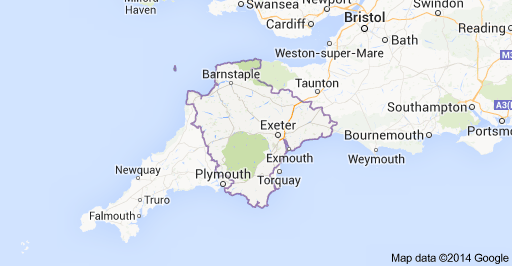
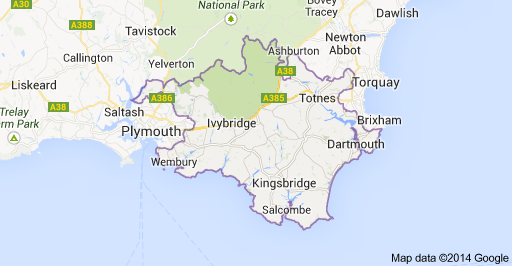
This wonderful collection of sayings from America’s ‘South’ reminded me of the incredibly rich local accents that one experienced all over Britain.  Despite being born a Londoner, I spent many of the years before switching home countries from England to America living in the County of Devon in the South-West of England.  Here are two images to show those unfamiliar with England where I was living.

Devon
County of Devon. Cornwall to the West. Somerset to the East.

oooo

Home used to be in the village
Home used to be in the village of Harberton, 3 miles South-West of Totnes.

Thus anyone born and bred in this part of Devon frequently had a strong South Devon accent.  My brother-in-law, John, used to chat to some old Devon fella’s in the local pubs that had accents impossible to understand by such newcomers as me.

So with no further ado, enjoy the following.

ooOOoo

Florida

A Florida senior citizen drove his brand new Corvette convertible out of the dealership. Taking off down the road, he pushed it to 80 mph, enjoying the wind blowing through what little hair he had left. “Amazing,” he thought as he flew down I-95, pushing the pedal even more.

Looking in his rear view mirror, he saw a Florida State Trooper, blue lights flashing and siren blaring. He floored it to 100 mph, then 110, then 120. Suddenly he thought, “What am I doing? I’m too old for this!” and pulled over to await the trooper’s arrival.

Pulling in behind him, the trooper got out of his vehicle and walked up to the Corvette. He looked at his watch, then said, “Sir, my shift ends in 30 minutes. Today is Friday. If you can give me a new reason for speeding — a reason I’ve never before heard — I’ll let you go.

“The old gentleman paused then said: “Three years ago, my wife ran off with a Florida State Trooper. I thought you were bringing her back.

“Have a good day, Sir,” replied the trooper.

Georgia

The owner of a golf course in Georgia was confused about paying an invoice, so he decided to ask his secretary for some mathematical help.

He called her into his office and said, “Y’all graduated from the University of Georgia and I need some help. If I wuz to give yew $20,000, minus 14%, how much would you take off?”

The secretary thought a moment, and then replied, “Everthang but my earrings.”

Louisiana

A senior citizen in Louisiana was overheard saying … “When the end of the world comes, I hope to be in Louisiana .”When asked why, he replied, “I’d rather be in Louisiana ’cause everythang happens in Louisiana 20 years later than in the rest of the world.”

Mississippi

The young man from Mississippi came running into the store and said to his buddy, “Bubba, somebody just stole your pickup truck from the parking lot!”

Bubba replied, “Did y’all see who it was?”

The young man answered, “I couldn’t tell, but I got the license number.”

North Carolina

A man in North Carolina had a flat tire, pulled off on the side of the road, and proceeded to put a bouquet of flowers in front of the car and one behind it. Then he got back in the car to wait.

A passerby studied the scene as he drove by, and was so curious he turned around and went back. He asked the fellow what the problem was.

The man replied, “I got a flat tahr.”

The passerby asked, “But what’s with the flowers?”

The man responded, “When you break down they tell you to put flares in the front and flares in the back. I never did understand it neither.”

Tennessee

A Tennessee State trooper pulled over a pickup on I-65. The trooper asked, “Got any ID?”

The driver replied, “Bout whut?”

Texas

The Sheriff pulled up next to the guy unloading garbage out of his pick-up into the ditch. The Sheriff asked, “Why are you dumping garbage in the ditch? Don’t you see that sign right over your head.”

“Yep,” he replied. “That’s why I’m dumpin’ it here, ’cause it says: ‘Fine For Dumping Garbage.’

ooo

“Y’all kin say whut y’all want ’bout the South, but y’all never heard o’ nobody retirin’ an’ movin’ North.

Have a great week-end.

Science and understanding

Our weather systems are entirely driven by the laws of science.

Come forth into the light of things, let nature be your teacher.

So wrote William Wordsworth.

The last twelve months has been a period of untypical weather in many parts of the world.  It’s easy to scratch one’s head with puzzlement and blame it on the most convenient and fashionable theory of the moment.  Unusual jet stream pattern; polar vortex; aliens! You get the idea! However, the principle behind what is happening to the weather systems across our planet is very straightforward.  Our weather systems are described by the laws of science.

Thus it is a great pleasure to offer the following guest post from a scientist: Martin Lack.  Martin should be no stranger to readers of Learning from Dogs; his most recent contribution was the major three-part essay From Environmentalism to Ecologism.

Martin is the author of the blog Lack of Environment and this essay was first published there on the 11th July, 2012.

ooOOoo

Conserving mass, water, and energy

I must admit that I am rather fond of quoting Sir Arthur Eddington as having once said, “…if your theory is found to be against the Second Law of Thermodynamics, I can give you no hope; there is nothing for it but to collapse in deepest humiliation.” Without quibbling over the detail, the Law of Conservation of Mass is pretty darn close; but what, you may ask, has this got to do with climate change denial?

Conservation of mass of water
Well, consider for a moment that scientists seem to agree that there has been a 4% increase in the average moisture content of the Earth’s atmosphere since 1970. That being the case, I am bound to say that this extra 4% is making its presence felt in the UK at the moment! This year we have had the wettest 3 months (April – June) in over 100 years; the wettest June on record; the rain is still falling (sometimes as much as 80mm in a day); and – we are now being told – there is no change anticipated in coming weeks. So, if you’re coming over for the Olympics, expect to get wet!

However, whilst the UK suffers from near Biblical levels of flooding, if the Law of Conservation of Mass is to be upheld and – all other things like terrestrial ice volume remaining equal(!) – the volume of water in the oceans is to remain constant, then it must be failing to rain somewhere else. If so, is there any evidence to support this theory Law? Well, funnily enough, there is: Whilst the UK continues to receive more rain than it wants or needs (all hose pipe bans and drought restrictions have now been lifted), many parts of the World continue to suffer from persistent drought (in sub-Saharan West Africa) and/or record-breaking temperatures (in most of North America).

Sadly, none of this seems to stop self-confessed scientifically-illiterate English graduates such as James Delingpole from ridiculing the entire notion of global warming simply because it is raining a lot here at the moment. It may seem that he has just got a nasty case of tunnel vision and/or short-term memory loss but this is what the fake sceptics always do; they never look at the big picture: Rather than look at daily, monthly, or even annual average temperatures over multi-decadal periods to determine significant long-term trends; they just cherry pick data to reach fallacious conclusions such as “global warming stopped in 1998″.

I am therefore left hoping that the 57% of the British adult population that seem to fall for this kind of nonsense will soon decide that it is time to stop running down the up escalator and, by embracing the reality of what is happening, decide to become part of the solution rather than being part of the problem. If not, climate change denial may well lead to a failure to conserve mass; with the mass in question being the sustainable number of humans this planet can support in the long-term.

Conservation of mass of carbon
If the Law of Conservation of Mass explains why anthropogenic global warming climate disruption is not invalidated by any amount of cold weather or torrential rainfall in one place; can it be used to validate concern regarding a 40% increase CO2 in the Earth’s atmosphere? Funnily enough, it can: Since the Industrial Revolution began in the mid-18th Century, a vast amount of fossilised carbon has been burnt; with the carbon it contained combining with oxygen in the air to form CO2. Note here that the oxygen was in the air anyway; whereas the carbon had been out of circulation for hundreds of millions of years. All this new carbon has to go somewhere and, given that it will be many more millions of years before any of it gets taken back out of circulation by nature, it is either making the atmosphere warm-up or it is reducing the pH of seawater (just enough to make life very difficult for corals and shellfish).

So then, what is the human response to all this? Shall we stop burning the fossil fuels now we know we’re causing a problem? It doesn’t look like it! It seems far more likely that we shall gamble the future habitability of all the planets diverse ecosystems on finding a way to defeat the Law of Conservation of Mass by artificially removing this carbon from the biosphere: Carbon Capture and Storage (CCS). And do you know what I find most astonishing about CCS? It is the fact that our governments are spending huge sums of money on long-term tests to simulate the effects of CO2 leaking from a submarine CCS repository – to see if it has any noticeable effects on marine life?

Errr, hello-oh? If any CO2 ever escapes from any CCS repository, the entire exercise will have been a complete waste of time and money! The CO2 will be back in circulation and the Law of Conservation of Mass will have won (again). If the genie will not stay in the bottle we will all be in big trouble: Rather than being likely to“collapse in deepest humiliation”; such a failure to defeat the Law of Conservation of Mass will probably result in the collapse of the entire planetary ecosystem; because of our other big problem – the Law of Conservation of Energy: The reason the atmosphere is warming up in the first place; more energy is coming in from the Sun than is getting out into Space!

Conclusions
So, this year’s weather should be a wake-up call to all of us: Irrespective of the actual kind of extreme weather being experienced in any one place, the impacts on agriculture seem to be equally destructive and spiralling food costs the inevitable end result: All just as was predicted by people dismissed for decades as doomsayers: People like Garrett Hardin, Paul Ehrlich, Dennis Meadows, E.F. Schumacher, William Ophuls, Mathis Wackernagel, Ernest Callenbach, and Lester Brown… It looks like that darn ‘wolf’ finally showed up!

Funnily enough, it turns out that a doubling in the size of the global human economy every 50 years is not sustainable after all; and worshipping at the Temple of the God of Growth has got us in some serious trouble; otherwise known as a global debt crisis (see the short video embedded below). We thought we could just lend imaginary money to each other indefinitely but someone blinked and the spell was broken. Sadly, it turns out the Emperor was naked after all; it’s just a shame that by the time we realised this we were all completely sold on the latest fashion ourselves: The New Clothes are everywhere; and we have all been left looking for fig leaves to cover our genitals.

Just as The Limits to Growth (Meadows et al) predicted all those years ago, the Earth is running out of the ability to cope with the effects of our chronically dysfunctional mis-management of it. This was why, as I pointed out six months ago, the failure of food harvests in 2010 led to the Arab Spring of 2011… Are you, like me, wondering what is going to happen this time around? My prediction is that some economist such as Tim Worstall will get himself on TV and tell everyone that the Second Law of Thermodynamics is a load of old rubbish; and that technology will save us from the consequences of our selfish pursuit of profit at any cost; and from our failure to recognise that we humans are not superior to nature – we are part of it – and we cannot survive without it. Or, to put it another way, as a Native American tribal leader once did:
When all the trees have been cut down, when all the animals have been hunted, when all the waters are polluted, when all the air is unsafe to breathe, only then will you discover you cannot eat money.

ooOOoo

I can add nothing to the above other than to thank Martin for giving me the opportunity to republish his post.

Synchronocity!

Funny how things go around!

According to the online version of the Merriam Webster dictionary, one of the two definitions of synchronicity is:

:  the coincidental occurrence of events and especially psychic events (as similar thoughts in widely separated persons or a mental image of an unexpected event before it happens) that seem related but are not explained by conventional mechanisms of causality —used especially in the psychology of C. G. Jung

That seems sufficiently apt to warrant the choice of title for today’s post.

Here’s why!

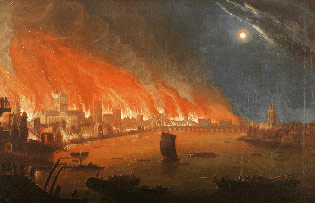
Yesterday, Chris Snuggs left a comment to my post Unconditional love. Essentially, Chris made the argument that much of what we see as wrong with the world is not new; not new at all [my insertion of the image of and link to the Great Fire of London].

Great Fire of London. September 2nd-5th, 1666.

What I mean is, the danger of thinking that today’s events are somehow special and different in kind than throughout history, a feeling generated by the fact that WE are living NOW. However, is it not true that ALL ages of Mankind have seen disasters, wars, dangers, catastrophes, including natural ones? How must those have felt who lived through the 30 Years War, the plague, the Great Fire of London, Stalin’s purges and of course the holocaust?

Even in these present times, Chris doubted that mankind had not been here before [my emphasis]:

WHAT then is special about OUR era? Well, Patrice is and rightly very concerned about the kleptocracy. The staggering statistic that emerged the other day about 85 individuals having as much wealth as 3,5 BILLION people was yet another wake-up call, especially as history seems to tell us that A) there have ALWAYS been kleptocracies and B) they ALWAYS end in revolution, dictatorship or social collapse. But the point is, this is nothing NEW. On the contrary, it has in many societies been the normal progression of things for millenia.

So what about Global Warming, as in man-caused? Chris wrote:

No, all my uncertainties lie in the area of GW. It’s pretty clear that there Is global warming, but A) Is it our fault? B) What should we DO about it? and C) Is it too late anyway?

The notion that it is too late to prevent widespread, major consequences from the heating of our planet is widely shared; I sing the siren’s song myself.

So when an item came along yesterday from Transition Network’s blog courtesy of Rob Hopkins pointing out that Chris, me and many others may be wrong to sing the ‘doom and gloom’ song, it naturally caught my eye.  A quick call to the Transition Network team in Totnes, Devon gave me permission to republish on Learning from Dogs, so here it is. Thanks TN team.  (My thoughts follow the TN piece.)

ooOOoo

Lipkis on Holmgren: “Our job is to make viable the alternative and have it ready”

You know how sometimes someone will just put something you were thinking far more eloquently and clearly than you would have been able to? On Thursday we’ll be posting an interview with Andy Lipkis of TreePeople in Los Angeles. When I talked to Andy last week, it was 80°F, and a state of drought emergency had just been declared (in LA, not Totnes, it was raining here, as usual). At the end of the interview, I asked for his thoughts on the recent debate sparked by David Holmgren’s Crash on Demand article. I asked him “Can we achieve the action on climate change that we need within the existing paradigm, or do we need to deliberately bring the economy down, to deliberately crash it?”.  Here’s what he told me.

Andy Lipkis
Andy Lipkis

“This system is so armoured to defend itself from a deliberate crash that much of our resources and intelligence networks are focused on exactly stopping that. On the flip side, the crash is already happening. We don’t have to engineer it: it’s already been engineered into the system. Check it out: Infrastructure systems are in breakdown in major cities around the world, with severe climate exceeding the designed capacity for storms, floods, water shortages, heat events resulting in increasing numbers of people being dislocated, injured or killed.  In the US, taxpayers are unwilling or unable to pay for the rapidly inflating costs for upgrading and climate-proofing the outmoded infrastructure systems, all the while, climate change denial campaigns prevent communities from preparing for and protecting themselves from the impacts.

I think our job is to make viable the alternative and have it ready. If we’ve really done our homework, we could scale this thing in a flash in California right now because this crash is upon us. And I hope we’re going to be able, perhaps within months…I invented a cistern that could replace the backyard fence or wall, that could hold 5,000 – 20,000 gallons and could be manufactured locally. The City’s going “hey, maybe we should do that now”. Now. Because it’s going to rain again, even if this drought lasts some years, we could deploy them quickly, just as they did in Australia’s 12 year drought.

I think we’ve been trained to spend time on these battles, on the negativity, and we lose people.  We’ve lost precious decades. The crash is on its way. We don’t have to do anything. We need the time to convert people and move people. We need to use examples of Australia and what’s happening now in California to tell those stories, because I agree, denial, defending the system is keeping it pumping.  But as you saw from Snowden and all the evidence, for those of us who went through the ‘60s and ‘70s in protest, I don’t think that’s going to succeed. If we focus on that our best leaders are going to end up in jail for too long.

When you look at how fast people change when you add inspiration, when you add attraction, people change on a dime! When we were growing up, there were – I don’t know if you had The Munsters?  One of the only people who we all knew who was doing yoga and eating yoghurt was Uncle Fester. But when we started seeing beautiful, sexy male and female bodies doing that, it started selling, moving people by the millions and then billions to choose these lifestyles.

I’m not saying the marketplace is the only answer, I’m just saying that if we choose attraction and inclusion we can create those markets, as you’re starting to do. Your stories over and over again on what’s happening with local currency – it’s time to tell the stories better and use those market forces, because people will choose those because they’re less painful and more attractive. And to be smart, to say wow, yeah.

The Bush administration was ready for all Americans to be protesting to try to stop the Iraq war. They expected that, they built that into their design. I was so amazed that they could say they didn’t care what the people said, that I had to think through why they did not care about that. How did they make it resilient?  Because all they cared about was as long as people kept consuming, especially petroleum, their objective was being met. They were counting on no-one changing lifestyles.

The most radical thing sometimes that you can do is actually vote with your feet and vote with your dollars. I was going – “wow, yeah, they’re counting on people complaining”. Protesting and not changing. I started thinking that even the Obama administration is still using the same metrics as the Bush administration was, saying people won’t change on energy. “It’s going to take 35 years to reduce our energy use by 30%”. Well that’s bullshit, because we can choose to do that in a week.

So, I decided that I was going to show that that’s possible even in my own lifestyle. I drive a Prius which is especially fuel efficient, but I’m going to stop driving that car two or three days a week. I told my secretary to book meetings downtown where I could get the bus to. I got out of the car, took the bus, and it actually became a really cool thing. I started investing my dollars in the local bus system. I did it for over two years.  I blogged about it. A lot of other people stopped full time car use,  and right at the right time as gasoline prices were spiking, a proposal came out to build a new transit system. It’s always been rejected in LA, but the voters at that moment chose to fund 40 billion dollars to build a new subway system in Los Angeles so we could get out of our cars. It’s a radical move, but it’s starting to happen.

So maybe that’s a long complicated answer, but we’ve built the right foundation. Our happiness, our health is the answer. It’s infectious. Our job is to be that much more infectious and inclusive. And don’t put up barriers of titles. Don’t put up barriers of shame and blame. Be open to learning fast and welcoming people in. We’re hacking the system and making it so much better. If we invite that kind of creativity, the generation that’s inheriting this right now is really ready to take this home.

ooOOoo

Don’t know about you but I find that compelling. It’s far too easy to wait for others to fix the problems. Too easy to see the issues as insurmountable. Each of us has the ability and the common-sense to make a change in our lives. Whether it is a small, medium or large change in your behaviour, you will make a difference.

So if you have been inspired by this, as Jeannie and I have been, commit to making a difference.

Picture parade twenty-eight.

The third set from Bob D.

Derham9

oooo

Derham8

oooo

Derham7

oooo

Derham6

oooo

Derham5

oooo

Derham4

oooo

Derham3

oooo

Derham2

oooo

Derham1

oooo

Thanks Bob.

Now a bonus of one other picture that crossed my screen, so to speak, that I wanted to share with you.  (Think it was from Naked Capitalism.)

cool-girl-elephant-photo-black-white

oooo

You all have a good week.

20:20 self-awareness.

How something so fundamental as humans talking with each other can so often be mysterious.

When I composed this sub-heading, I wasn’t sure of what word to use to end the sentence.  Some of the words that sped through my mind were: complex, distorted, difficult, obtuse and …. well, you get the message.

The single biggest problem in communication is the illusion that it has taken place.” George Bernard Shaw is reputed to have once said!

Today’s essay on the challenges of speaking clearly to another, perhaps better described as communicating in a clear and unambiguous fashion, came out of a recent conversation with Jon Lavin, a good friend from my Devon days.  (Jon offers services for business owners and entrepreneurs under his business banner of The People Workshop.)

Jon was explaining that the number one hurdle for businesses that are managing change, and for so many businesses managing change is practically a constant, is having clear communications within the team.

Seems clear enough to me! 😉

Yet, what we hear and what we say are both modified, frequently unconsciously, by past events, experiences and trauma.  That being the case, then it is key, critically so, that we achieve the best possible self-awareness.  Because it is only through an understanding of our past that we come to learn of our sensitivities and our associated ‘tender spots’ and their potential for ‘pulling our strings’.  Here’s a personal story.

In 1956, when I was 12, I experienced a trauma that was interpreted by my consciousness as emotional rejection.  By the age of 14 that sensitivity to rejection had descended into my subconscious.  For fifty years, that sensitivity remained hidden yet continued to influence my life in many unseen ways, not all of them negatively by a long measure. In 2007 a period of counselling revealed that hidden emotional rejection; brought it to the surface.  It changed beyond imagination how I felt, how I behaved, how I was.  Nonetheless, that sensitivity to rejection is still there, albeit now visible.  Thus when I hear or experience something that tickles that sensitivity I still react.  But because I can now see and feel myself reacting, I can sidestep the emotional strings.

The following is a short, twenty-minute, documentary film about fear.  Do watch it.  The message that we are so profoundly a product of our past is beautifully presented.

From Environmentalism to Ecologism, Part Three.

The concluding Part Three of Martin Lack’s guest essay.

Part One is here: Part Two is here.

ooOOoo

Can ecologism be regarded as an ideology in its own right? (Part 3)

Therefore, having now surveyed all the relevant “territory”, we shall now consider the third and final part of the answer to the question as proposed in the Introduction.

Ecologism – Neither left nor right, but out in front?

According to Philip Shabecoff, it was members of the European Green parties that were the first to assert that they are “neither left nor right but out in front” (2000: 109).

For this to be true, ecologism would have to represent a new paradigm that rejects (or at least challenges) beliefs central to conventional politics (of any orientation). This, it is here argued, is indeed the case: In a discussion of the libertarian ideas of John Locke and Adam Smith, William Ophuls observed that they “…have not gone unchallenged, but with very few exceptions, liberals, conservatives, socialists, communists, and other modern ideologies have taken abundance for granted and assumed the necessity of further growth” (Ophuls 1977: 145).

What is the problem with modernity?

As suggested by Anthony Giddens, modernity encompasses “…modes of social life or organisation which emerged in Europe from about the seventeenth century onwards and which subsequently became more or less worldwide in their influence” (Giddens 1991: 1).

The problem is that the accumulation of personal wealth has become the sole objective of many people in modern society; and perpetual growth is posited as a means whereby even the poorest might achieve it.

Karl Marx (as cited by Jon Elster) coined the term “money fetishism” to describe the belief that money (and/or precious metals) have intrinsic (use) value rather than just instrumental (exchange) value, which Marx felt was as misguided as the religious practice of endowing inanimate objects with supernatural powers (Elster 1986: 56-7).

However, whereas Karl Marx saw capitalism as the problem, the ideology that he gave his name to is just as guilty of Daly’s “growthmania”. For example, whereas Jack Goody accepts that capitalism has been “…connected with the growth of rationality and of secularisation; more recently with urbanisation and industrialisation”, he also notes that for Marxist regimes “…modern meant industrialisation without capitalism” (Goody 2004: 6).

The terms “use value” and “exchange value” were first put forward by Aristotle (384-322 BC) who, according to Daly, also recognised the danger of focusing on the latter (i.e. whereby the accumulation of wealth becomes an end in itself) and, alluding to Marx’s criticism, Daly suggested that the paperless economy (where no useable commodities actually change hands) is the logical end-point for money fetishism (Daly 1992: 186).

Finally, on the subject of the consequences of “the problem”, although the centrally-planned economies of the former USSR and China would appear to have had their day, the flaws of the capitalist system they seem so keen to embrace have also revealed themselves in recent time. For example, when John Gray came to write the introduction to the second edition of his book “False Dawn: The Delusions of Modern Capitalism”, he included the following comment:

In the first edition of this book, published in March 1998, I wrote: ‘Today’s regime of global laissez-faire will be briefer than even the belle époque of 1870 to 1914, which ended in the trenches of the first world war’… Not much more than a decade ago this seemed outlandish, but there have since been many signs that global capitalism was heading for a fall (Gray 2009: xii).

Does ecologism provide the answers?

The starting point for ecologism is the concept of carrying capacity (the maximum population of a species) that an ecosystem can support in perpetuity (Dryzek 2005: 27). In this instance, the species is Homo sapiens and the ecosystem is the planet Earth. Therefore, in 1968, Hardin suggested that these limits exist and must be faced. In 1993, frustrated by the absence of discussion on population growth in international politics, he pointed out that:

Two centuries of intermittent wrestling with population problems have produced useful insights about the reality and nature of limits… Four centuries of sedation by the delusion of limitlessness have left humanity floundering in a wilderness of rhetoric… From this it must be inferred that someday political conservatism will once again be defined as contented living within limits. The limitless world view will have to be abandoned (Hardin 1993: 5-6).

In 1968, his solution had been “...mutual coercion, mutually agreed upon by the majority of the people affected” (Hardin 1968: 1247). However, in an apparent reference to the work of an array of scholars including Malthus, Hardin, Meadows, Ehrlich and others, Daly lamented that:

Anyone who asserts the existence of limits is soon presented with a whole litany of things that someone once said could never be done but subsequently were done… Continuing to study economies only in terms of the [exchange value of money] is like studying organisms only in terms of the circulatory system, without ever mentioning the digestive tract. (Daly 1992: 185-186).

Much more recently, Daly has reminded us that, “Ecological limits are rapidly converting ‘economic growth’ into ‘uneconomic growth’-that is throughput growth that increases costs by more than it increases benefits, thus making us poorer not richer” (Daly 2007: 39).

So, it would seem that the challenge of living “within our planet’s means” remains significant; one that few politicians are willing to discuss (because there are no votes to be gained in doing so). It is this fact that the environment cannot speak for itself (i.e. it is disenfranchised) that led Goodin to the conclusion that “nature has interests… as deserving of protection as anyone else’s, which must be ‘encapsulated’ as part of a discursive participatory democracy” (Goodin 1996: 835).

Similarly, whereas Goodin used the term “encapsulated interests” (to describe how one party’s interests are incorporated in those of another), Dobson suggested that non-human animals and future generations of humans (and maybe even other species) are “new environmental constituencies” requiring human representatives to look after their interests (Dobson 1996: 125).

All that needs to be decided is who we shall admit into the “community of justice” (i.e. how radical you want to be).

Citing Low and Gleeson (1998) and Baxter (1999), Derek Bell therefore distinguishes environmental and ecological justice as follows: Environmental justice concerns the distribution of environmental benefits and burdens among human beings. Whereas ecological justice is concerned with justice between human beings and the rest of the natural world (Bell 2006: 208). Furthermore, Bell also spells out the importance of this distinction (just in case any reader has not appreciated it yet) as follows:

Advocates of environmental justice merely insist that the instrumental value of the environment to humans should be recognised in a theory of social justice or justice among humans. Ecological justice makes the much more radical claim that justice extends beyond relations among humans so that we can talk about ‘justice to nature’ (Bell 2006: 208).

Conclusions

The question that has been addressed herein is whether or not ecologism can or should be regarded as a political ideology in its own right given that both socialists and conservatives can lay claim to some aspects of ecological politics.

In order to provide a defensible answer to this question, it was necessary to define what is meant by ecological politics (i.e. the pursuit of policies that are concerned with the environment; but which are not merely or predominantly anthropocentric) and ecologism (i.e. the pursuit of environmental policies that are biocentric or ecocentric). This therefore highlighted the fact that the two are not the same thing; and that ecological politics also includes anthropocentric environmentalism.

However, it has been demonstrated that, rather than being a simple dividing line within the field of ecological politics, anthropocentrism and ecocentrism represent opposite ends of a spectrum along which it is possible to adopt a variety of philosophical positions. Furthermore, although it has also been demonstrated that it is very difficult to be entirely one thing or the other, when faced with difficult policy decisions, almost everyone (both socialists and conservatives included), tends to favour self-preservation. Therefore, the default position of all humans tends to be towards the anthropocentric end of the spectrum.

Nevertheless, to avoid the tautological response to the question (“ecologism must be regarded as a distinctive political ideology in its own right because it is!”), it was deemed necessary to demonstrate how and why both socialists and conservatives can lay claim to ecological politics (although the majority of both socialists and conservatives do not do so) and, therefore, how and why the ecologism that both find so challenging must be regarded as a political ideology in its own right.

In so doing, it has been shown that some socialists find common cause with those that seek equal rights for the environment; whereas some conservatives may do so in pursuit of maintaining the status quo. However, both generally assume the necessity of further growth (Ophuls); what Daly called ‘growthmania’. Furthermore, capitalism is fixated upon the inherent value of things we may consume; whereas Marxism (an extreme form of socialism) is fixated upon the inherent value of things we may produce. However, ecologism insists that nature has inherent – if not intrinsic – value in and of itself; independent of our finding a use for it.

Ecologically-minded scientists and economists have pointed out that the Earth is finite and its capacity to accommodate humans is finite; whereas the evidence of at least the last 40 years is that many prefer to refuse to accept this reality and, as Schumacher pointed out, are spending environmental capital as if it were income. Therefore, because ecologism demands justice that is ecological (ecocentric) – not just environmental (anthropocentric), it represents a fundamental challenge to conventional politics and, as such, must be regarded as a distinctive political ideology in its own right.

References

Baxter, B. (1999), Ecologism: An Introduction. Edinburgh: Edinburgh University Press.

Bell, D. (2006), ‘Political Liberalism and Ecological Justice’ [online], Analyse & Kritik 28, pp.206-22. [Paper originally presented at ECPR General Conference, Marburg, 18–21 September 2003]. Available at <http://analyse-und-kritik.net/2006-2/AK_Bell_2006.pdf> [accessed 18 April 2011].

Daly, H. (1992), Steady State Economics (2nd edition). London: Earthscan.

Daly, H. (2007), Ecological Economics and Sustainable Development, Selected Essays of Herman Daly. Cheltenham: Edward Elgar.

Dobson, A. (1996), ‘Representative democracy and the environment’, in Lafferty, W. and Meadowcroft, J (eds), Democracy and the Environment: Problems and Prospects. Cheltenham: Edward Elgar, pp.124-39.

Dryzek, J. (2005), The Politics of the Environment (2nd edition). Oxford: Oxford University Press.

Ehrlich, P & Ehrlich, A. (1996), Betrayal of Science and Reason. New York: Island Press.

Elster, J. (1986), An Introduction to Karl Marx. Cambridge: Cambridge University Press.

Giddens, A. (1991), The Consequences of Modernity. Cambridge: Polity Press.

Goodin, R. (1996), ‘Enfranchising the earth, and its alternatives’, Political Studies, 44, pp.835-49.

Goody, J. (2004), Capitalism and Modernity: The Great Debate. Cambridge: Polity Press.

Gray, J. (2009), False Dawn: The Delusions of Modern Capitalism, 2nd edition. London: Granta.

Hardin, G. (1993), Living Within Limits: Ecology, Economics, and Population Taboos. Oxford: Oxford University Press.

Low, N. and Gleeson, B. (1998), Justice, Society and Nature: An Exploration of Political Ecology. London: Routledge.

Malthus, T. (1798), An Essay on the Principle of Population. London: J Johnson.

Ophuls, W. (1977), Ecology and the Politics of Scarcity. San Francisco: Freeman & Co..

Shabecoff, P., (2000), Earth Rising: American Environmentalism in the 21st Century, Washington DC: Island Press.

ooOOoo

I know a good number of readers have followed Martin’s essay since Tuesday and I would like to thank Martin, on my own account and on behalf of all LfD readers, for giving me the opportunity to republish the essay.

From Environmentalism to Ecologism, Part Two

Part Two of the three-part guest essay by Martin Lack.

The background to this major essay was covered yesterday, in the introduction to Part One.

ooOOoo

Can ecologism be regarded as an ideology in its own right? (Part 2)

A question of values

According to Carter (2007: 14-15), there is no consistent use of terminology regarding the value ascribed to different entities, so it would seem sensible to use that which he outlines:

  • Instrumental value: The value which something has for someone as a means to an end (also known as utility value).

  • Inherent value: The value which something has because it is considered desirable (e.g. precious metals such as silver, gold and platinum).

  • Intrinsic value: The value which something has because of what it is – typically essential for the existence of life (e.g. sunlight, clean air, and clean water).

As Carter points out (2007: 15), as well as being inconsistently applied to individual entities by those doing the valuing, these terms are not mutually exclusive (i.e. “being valuable in one way does not preclude being valuable in another way”). However, what is clear is that the value judgements that any individual makes will determine their attitude towards consumption and/or pollution of the Earth’s natural resources.

In setting out his “Green Theory of Value”, Robert Goodin boldly acknowledged that, ideally, it should “tell us both what is to be valued and why” (Goodin 1992:19). However, before explaining his own theory of value, Goodin identifies the two main alternatives as capitalist (consumer-based) value; and Marxist (producer-based) value (Goodin 1992: 23-4). Goodin’s green theory of value is thus distinct from both of these because the value-imparting properties are neither those of the consumer nor producer; they are (or at least should be) “natural resource based”; although he specifically does not claim that his theory “is correct utterly to the exclusion of all others” (Goodin 1992: 25-6).

Applying Carter’s typology of value (above) to Goodin’s argument, capitalists would appear to be focussed upon the inherent value of things they consume; and Marxists upon the instrumental value of the things they produce. In contrast to both of these, Goodin seeks to justify the assertion that nature itself should always be considered, independent of the presence or activity of humans, to have inherent – if not intrinsic – value. However, he seems to shy away from the logical conclusion of his argument; that all nature has intrinsic value that does not require the presence of valuers (Goodin 1992: 42-45). This is presumably part of an appeal to reason, which such an extreme view would probably not have.

A question of perspective

If anthropocentrism is a way of thinking “…that regards humans as the source of all value and is predominantly concerned with human interests”, then, in simplistic terms, ecocentrism is one “…that regards humans as subject to… ethical, political and social prescriptions… equally concerned with both humans and non-humans” (Carter 2007: 14). However, as with most things in life, it is not as simple as these definitions imply. For example, from an anthropocentric perspective, it is possible to be concerned about the welfare of individual domesticated animals; and yet not be concerned about the survival of entire endangered species.

Equally, one of the biggest debates in ecological politics may revolve around how one defines “moral persons” (Rawls, 1972: 504-5); or legitimate “recipients of justice” (Garner 2003: 11), although many would probably agree with what Jeremy Bentham (1748-1832) said: “The question is not, can they reason? Not, can they talk? But, can they suffer?” (cited in Dobson 2006: 220-1). However, the contentious and unresolved nature of this debate has led to the appearance of terms such as “shallow” and “deep”; which may be applied to anthropocentrism and ecocentrism alike (with “deep” denoting a more extreme position in either case). Therefore:

Rather than define different perspectives according to which side of the ecocentric/anthropocentric divide they lie, they can be located along a continuum, which moves from ecocentrism through various gradations of anthropocentrism to ‘strong anthropocentrism’ (Carter 2007: 36).

Once it is recognised that there is a range of possible positions that may be adopted (rather than a choice that has to be made), it is possible – as Eckersley has done – to characterise at least five different positions, which are as follows:

  1. Resource conservation – the wise use of natural resources for human benefit: Eckersley suggests that the conservation movement was founded upon the Judeao-Christian notion of humans having “dominion” over the Earth; rather than any duty of “stewardship”, as exemplified by Gifford Pinchot (the first chief of the US Forest Service) (Eckersley 1992: 35).

  2. Human welfare ecology – an appeal to enlightened self-interest: Eckersley cites Barry Commoner’s “four laws of ecologyas (1) everything is connected to everything else; (2) everything must go somewhere; (3) nature knows best; and (4) there’s no such thing as a free lunch (Eckersley 1992: 37-8).

  3. Preservationism – seeking the aesthetic preservation of wilderness areas: Whereas Gifford Pinchot wanted to preserve nature for development (i.e. maximise the utility of natural resources for human benefit), John Muir (of the Sierra Club) wanted to preserve nature from development (i.e. minimise the human impact on the natural environment) (Eckersley 1992: 39).

  4. Animal liberationism – the prevention of cruelty to certain animals: A comparatively modern, radical, development; which can trace its heritage back to “humane” societies formed in the eighteenth and nineteenth centuries, such as the RSPCA (Eckersley 1992: 42).

  5. Ecocentrism – seeking the preservation of nature for its own sake (Eckersley, 1992: 46).

With regard to the latter, given that Eckersley recognised the fact that these positions lie upon a “wide spectrum of differing orientations towards nature”, whose end-points are anthropocentrism and ecocentrism (1992: 33), this could be better defined as deep ecocentrism. However, even using these five labels, it is not hard to see why it is difficult to categorise people: For example, the human welfare ecologists could be regarded as quite ecocentric (if they recognise the validity and/or importance of each and every one of Barry Commoner’s “four laws of ecology”); whereas animal liberationists could be regarded as quite anthropocentric (if they are only concerned about domesticated pets and/or individual animals).

The ecocentric end of the spectrum has also been described as that of “deep ecology” (Devall and Sessions 1985: 70), and “biospherical egalitarianism” (Naess 1989: 170). However, whilst preferring the term “biocentric egalitarianism” for the latter, Carter points out that – as indeed was conceded by Naess (1989: 28) – food is an essential requirement for life and, therefore, an entirely egalitarian position is untenable:

Certainly, any principle along the lines of biocentric egalitarianism would be impossible to implement. Taking it to the extreme, how could a human justify killing any animal or fish, or consuming a vegetable, bean or berry? All involve some restraint on another entity’s capacity to live and flourish (Carter 2007: 36).

So, it would seem that an entirely ecocentric position is hard to maintain, but can the same be said for an entirely anthropocentric position? This, as we shall now see, has been the subject of much debate.

A question of justice

When someone says, “I want justice!” it is normally because they feel they have been wronged in some way; and want what they feel they deserve (i.e. fairness). Hence, Paul Sterba opens his chapter in “Political Theory and the Ecological Challenge” on this subject by saying, “Justice requires giving what is deserved” (Sterba 2006: 148). However, within the sphere of environmental politics, when faced with difficult choices, human beings tend to ‘circle the wagons’ and protect their own kind.

In the introduction to his book “Theory of Ecological Justice”, Brian Baxter uses the example of Sir David Attenborough’s response to the prospect of humans causing species extinctions (i.e. “Surely, it is sad indeed that our descendants should inherit a natural world that is more impoverished than the one we inherited?”) to suggest that all humans are almost incapable of being anything other than anthropocentric (Baxter 2005: 1). However, Attenborough was probably deliberately making the question rhetorical; just as Baxter was probably being provocative in order to retain the interest of readers. Nevertheless, in a wide-ranging consideration of the subject, Baxter discusses the work of numerous authors, to advocate the case for “moral consideration” to be given to sentient non-humans (Baxter 2005: 45).

This would appear to be in accordance with Bentham’s conclusion that it is the ability to suffer that should confer the right to fair treatment. Indeed, one such author Baxter considered, David DeGrazia, proposed the principle of “equal consideration” for all sentient non-humans but pointed out that this could not guarantee justice; merely a fair hearing. He also pointed out that granting equal consideration would not automatically confer upon them the right to moral consideration, but it would be revolutionary; because much animal experimentation (he uses the term “exploitation”) would then seem to be unjustifiable (DeGrazia 1996: 37-38).

Dobson has written a great deal on the subject of justice. In a characteristically thought-provoking contribution to a recent collection of essays on the subject (regarding the difficulties of combining social justice and environmental sustainability; in effect asking “What is to be sustained and for whose benefit?”), he discusses who should be the legitimate “recipients of justice”; and what should be the consequential scope of the “community of justice” thus determined (Dobson 2003: 87-94).

Baxter sees the three main principled objections to the notion of ecological justice as being that justice need only be distributed to (1) those able to voluntarily co-operate to produce and/or preserve environmental benefits; (2) those with property rights; and (3) those capable of reciprocity (Baxter 2005: 77). Baxter deals with the first and last of these reasonably easily, as follows: (1) bacteria are beneficial and slaves were not volunteers (2005: 78-9); and (3) mentally-incapacitated people do not cease to be human because they cannot interact with their surroundings or respond to stimuli (2005: 77-8). However, objection (2) seems a little more intractable (2005: 86). Finally, Baxter concludes that if these objections can indeed be rejected, ecological justice represents a fundamental challenge to the laissez-faire attitude of liberalism (2005: 94).

However, for now, the final word on the question of justice will be given to Dobson, who almost seemed to be responding to Baxter, by saying: “Just who is throwing down the gauntlet here? Is political ecology a challenge for citizenship, or is citizenship a challenge for political ecology?” (Dobson 2006: 216). Whilst acknowledging the historical existence of at least two types of citizenship; namely liberal and civic republican (stressing right-claiming and responsibility-taking respectively), Dobson highlights at least two fundamental challenges to any notion of citizenship (i.e. feminism and cosmopolitanism) (2006: 217-8). However, much more space is given to the ways in which the notion of citizenship is a challenge to ecological politics. Again, this is indicative of the fact that ecologism should be regarded as a distinctive political ideology in its own right.

References

Baxter, B. (2005), A Theory of Ecological Justice. London: Routledge.

DeGrazia, D. (1996), Taking Animals Seriously: Mental Life and Moral Status. Cambridge: Cambridge University Press.

Devall, B. and Sessions, G. (1985), Living as if Nature Mattered. Layton UT: Peregrine and Smith.

Dobson, A. (2003), ‘Social justice and environmental sustainability: ne’er the twain shall meet?’, in Agyeman, J., Bullard, R., and Evans, B. (eds.), Just Sustainabilities: Development in an Unequal World. London: Earthscan, pp.83-95.

Dobson, A. (2006), ‘Citizenship’, in Dobson, A. and Eckersley, R., Political Theory and the Ecological Challenge. Cambridge: Cambridge University Press, pp.216-231.

Garner, R. (2003) ‘Animals, politics and justice: Rawlsian liberalism and the plight of non-humans’, Environmental Politics, 12 (2), pp.3-22.

Goodin, R. (1992), Green Political Theory. Cambridge: Polity Press.

Naess, A. (1989), Ecology, Community and Lifestyle. Cambridge: Cambridge University Press

Rawls, J. (1972), A Theory of Justice. Oxford: Oxford University Press.

Sterba, P. (2006), ‘Justice’, in Dobson, A. and Eckersley, R., Political Theory and the Ecological Challenge. Cambridge: Cambridge University Press, pp.148-64.

ooOOoo

The final part, Part Three, will be published tomorrow.