Category: People

The book! Part Four: Faith in goodness.

The roots of all goodness lie in the soil of appreciation for goodness.” So said the Dalai Lama.

In the previous chapter, Compassion for self, I quoted Professor Neff saying that in her view self-compassion consisted of three elements: self-kindness, recognition of our common humanity and mindfulness.

That second element, the recognition of our common humanity, provides a wonderful link from that chapter across to this one. For one very simple reason: The reason being that people are generally good. Now I’m not going to throw statistics around, even if I had them to hand, to support my proposition; that there are more good people in the world than not. For the very straightforward reason that I have enjoyed a wide range of wonderful experiences from many; friends and strangers alike. Backed up from my experience of having been around for a while (I’m way the wrong side of 50!), from having travelled extensively in the last forty years, from having lived in four countries over those same forty years, and from having very, very few letdowns from others over that time.

But there’s more. From those many friends and acquaintances over those forty years, again in many parts of the world, I have found it extremely rare to hear of someone speak of knowing another person who they believed was intrinsically nasty.

So, reflecting that this chapter is called faith in goodness, that my experiences support and affirm a faith in the widespread goodness of people, that us human beings are fundamentally loving and good, and will help and care for each other when given the chance, it is easy to see this faith under the banner of another word: trust. Trust in human beings being fundamentally good! (And to make it clear as to where I am coming from, I use the word faith not with any religious or spiritual connotations.)

Now it is time to be firm with myself and remember that this is a chapter in a section of the book about change: change in thoughts and deeds. It is not a chapter about goodness in and of itself, however commendable such a chapter might be.

What is the link, therefore, between goodness and change? Put better, what is the power of goodness in bringing about change?

I guess one way of answering that question is to remind ourselves that whatever we believe about the local circumstances, our local world in which we live, becomes a self-fulfilling prophecy. If we trust that those around us are fundamentally good and we offer goodness out to those around us then we all create a local zone of peace.

Ergo, by extension, if we really want to create a global world of peace, and who would eschew that dream, we truly have to believe that it is possible. Not only possible, we have to believe in the certainty that simply by impacting another person’s life in a positive way, thence, just one person at a time, that one other person becomes a stone of change spreading ripples of peace across the waters of the world.

Margaret Wheatley, the author of a number of books on the human condition, offers in an essay Relying on Human Goodness, this pertinent view: “Noticing our beliefs about human goodness is not a philosophical inquiry. Our beliefs are critical influences for what we do in the world. They lead us either to action or retreat.

In other words, what we believe, how we see ourselves, holds real power of change. Those critical influences in Margaret Wheatley’s words. Such is the importance of our faith in goodness as being an agent of change.

The other fundamental message that comes out from Margaret Wheatley’s essay is that, “Oppression never occurs between equals. Tyranny always arises from the belief that some people are more human than others. There is no other way to justify inhumane treatment, except to assume that the pain inflicted on the oppressed is not the same as ours.

The old saying of only treating others as you would wish yourself to be treated sums it up: perfectly!

So why oh why does the reality of the human condition, almost as far back as one can look, seem so ghastly at times? Maybe, just maybe, because we only get to hear of all the things that are wrong and that this has been a weakness of mankind since time immemorial.

For one core reason, one ancient truth, one very significant challenge to seeing goodness in all directions. I am referring to the fact that bad news sells! As in spreads like wildfire!

It’s common knowledge that since the days of early man, our survival has depended on great sensitivity to danger. We instinctively pick up on danger, on any danger, on anything that we interpret, often half-consciously, as threatening to us and our loved ones. And these are times when we seem to be faced with a plethora of ‘threats’ to us and our loved ones and our immediate community.

The news media; TV, newspapers, radio and, now the internet, offer us on an almost hourly basis torrents of evidence of the harm, the great harm, that some people seem so easily to do to other people. So many examples of anger, distrust, deceit, greed, ethnic hatred, frequent genocide, terrorism and violence, apparently committed daily in the world. Of the 196 independent countries  (The figure varies depending on the reference source being used, but the number is within the range of 189 to 196) or so in the world, sixty-four are at war. Nearly a third of all the countries on this planet are at war (and don’t even start to think of the hundreds of militias, guerrillas and separatist groups involved in fighting!).

Thus it would be so easy to despair, to turn inwards and metaphorically hug oneself in a dark corner, to allow oneself to become more withdrawn and distrustful than ever, to let our worst natures prevail, but a strong, resolute faith in goodness prevents that. Indeed, the more we see examples, primarily from the world’s media, of the worst in mankind, the more essential it is to believe, to have trust, to have faith, in the goodness of people.

To hold in one’s heart, like a glowing beacon of hope, all those wonderful aspects of our fellow humans. The creativity, the caring, the generosity, the open-heartedness and the love; yes the love. Behaviours that are exhibited on a daily basis. Just look around at your friends and neighbours, notice the people you come across in your daily lives, often complete strangers, and you will see so many who, just like you, are offering goodness, being friendly, trying to be useful to others; metaphorically, leaving a clean wake.

So spread the word. For your faith in goodness will bring about the change all of humanity needs.

1130 words Copyright © 2014 Paul Handover

The God of Growth.

A grim reminder of these mad times.

I am conscious that in thirty minutes, my latest draft chapter of the book of the same name as this blog is published. Published under the heading of Faith in goodness.

It seems entirely at odds with the theme of today’s post, the reposting of a recent essay from George Monbiot.  But in a sense the two posts are compatible. Because what George Monbiot writes about, so elegantly in my opinion, is a window into the lives of those in power, politics, and in money.  Whereas, down at street level, so to speak, down where ordinary people lead ordinary lives, one finds a huge gap between the ambitions of the ‘top table’ and decent, everyday folk who are basically good people.

So with that in mind, on to George Monbiot’s essay of the 18th November, published in this place with his kind permission.

ooOOoo

The Insatiable God

The blind pursuit of economic growth stokes a cycle of financial crisis, and wrecks our world.
By George Monbiot, published in the Guardian 19th November 2014

Another crash is coming. We all know it, now even David Cameron acknowledges it (1). The only questions are what the immediate catalyst will be, and when it begins.

You can take your pick. The Financial Times reports today that China now resembles the US in 2007 (2). Domestic bank loans have risen 40% since 2008, while “the ability to repay that debt has deteriorated dramatically”. Property prices are falling and the companies that run China’s shadow banking system provide “virtually no disclosure” of their liabilities. Just two days ago, the G20 leaders announced that growth in China “is robust and is becoming more sustainable” (3). You can judge the value of their assurances for yourself.

Housing bubbles in several countries, including Britain, could pop at any time. A report in September revealed that total world debt (public and private) has reached 212% of GDP (4). In 2008, when it helped to cause the last crash, it stood at 174%. The Telegraph notes that this threatens to cause “renewed financial crisis … and eventual mass default.” (5) Shadow banking has gone beserk, stocks appear to be wildly overvalued, the Eurozone is bust again. Which will blow first?

Or perhaps it’s inaccurate to describe this as another crash. Perhaps it’s a continuation of the last one, the latest phase in a permanent cycle of crisis, exacerbated by the measures (credit bubbles, deregulation, the curtailment of state spending) which were supposed to deliver uninterrupted growth. The system the world’s governments have sought to stabilise is inherently unstable, built on debt, fuelled by speculation, run by sharks.

If it goes down soon, as Cameron fears, in a world of empty coffers and hobbled public services, it will precipitate an ideological crisis graver than the blow to Keynesianism in 1970s. The problem that then arises – and which explains the longevity of the discredited ideology that caused the last crash – is that there is no alternative policy, accepted by mainstream political parties, with which to replace it. They will keep making the same mistakes while expecting a different outcome.

To try to stabilise this system, governments behave like soldiers billeted in an ancient manor, who burn the furniture, the panelling, the paintings and the stairs to keep themselves warm for a night. They are breaking up the post-war settlement, our public health services and social safety nets, above all the living world, to produce ephemeral spurts of growth. Magnificent habitats, the benign and fragile climate in which we have prospered, species that have lived on earth for millions of years, all are being stacked onto the fire, their protection characterised as an impediment to growth.

David Cameron boasted on Monday that he will revive the economy by “scrapping red tape” (6). This “red tape” consists in many cases of the safeguards defending both people and places from predatory corporations. Today, the Small Business, Enterprise and Employment Bill is passing through the House of Commons (7), spinelessly supported, as ever, by Labour. The bill seeks to pull down our protective rules to “reduce costs for business”, even if that means increasing costs for everyone else, while threatening our health and happiness. But why? As the government boasted last week, the UK already has “the least restrictive product market regulation and the most supportive regulatory and institutional environment for business across the G20.” (8) And it still doesn’t work. So let’s burn what remains.

This bonfire of regulation is accompanied by a reckless abandonment of democratic principles, not least of equality before the law. In the House of Commons on Monday, Cameron spoke for the first time about the Transatlantic Trade and Investment Partnership (9). If this treaty between the EU and the US goes ahead, it will grant corporations a separate legal system to which no one else has access, through which they can sue governments passing laws that might affect their profits. Cameron insisted that “it does not in any way have to affect our national health service” (10). (Note those words “have to”.) Pressed to explain this, he cited the former EU trade commissioner, who claimed that “public services are always exempted” (11).

But I have read the EU’s negotiating mandate(12), and it contains no such exemption, just plenty of waffle and ambiguity on this issue. When the Scottish government asked Cameron’s officials for an “unequivocal assurance” that the NHS would not be exposed to such litigation, they refused to provide it(13). This treaty could rip our public services to shreds for the sake of a short and (studies suggest (14,15)) insignificant fizzle of economic growth.

Is it not time to think again? To stop sacrificing our working lives, our prospects, our surroundings to an insatiable god (16)? To consider a different economic model, which does not demand endless pain while generating repeated crises?

Amazingly, this consideration begins on Thursday. For the first time in 170 years, parliament will debate one aspect of the problem: the creation of money (17). Few people know that 97% of our money supply is created not by the government (or the central bank), but by commercial banks in the form of the loans they issue (18). At no point was a democratic decision made to allow banks to do this. So why do we let it happen? This, as Martin Wolf has explained in the Financial Times (19), “is the source of much of the instability of our economies”. The parliamentary debate won’t stop the practice, but it represents the opening of a long-neglected question.

This, though, is just the beginning. Is it not also time for a government commission on post-growth economics? Drawing on the work of thinkers like Herman Daly, Tim Jackson, Peter Victor, Kate Raworth, Rob Dietz and Dan O’Neill, it would investigate the possibility of moving towards a steady state economy: one that seeks distribution rather than blind expansion; that does not demand infinite growth on a finite planet. It would ask the question that never gets asked: why?

Why are we wrecking the natural world and public services to generate growth when that growth is not delivering contentment, security or even, for most of us, greater prosperity? Why have we enthroned growth, regardless of its utility, above all over outcomes? Why, despite failures so great and so frequent, have we not changed the model? When the next crash comes, these questions will be inescapable.

http://www.monbiot.com

References:

1. http://www.theguardian.com/commentisfree/2014/nov/16/red-lights-global-economy-david-cameron

2. http://www.ft.com/cms/s/0/e13e2cf8-6e48-11e4-bffb-00144feabdc0.html#ixzz3JP5QF3et

3. G20, November 2014. Brisbane Action Plan. http://bit.ly/1xk6mLR

4. Luigi Buttiglione et al, September 2014. Deleveraging? What Deleveraging? Geneva Reports on the World Economy 16. http://www.voxeu.org/content/deleveraging-what-deleveraging-16th-geneva-report-world-economy

5. http://www.telegraph.co.uk/finance/economics/11129108/Mass-default-looms-as-world-sinks-beneath-a-sea-of-debt.html

6. http://www.theguardian.com/commentisfree/2014/nov/16/red-lights-global-economy-david-cameron

7. http://services.parliament.uk/bills/2014-15/smallbusinessenterpriseandemployment.html

8. G20, November 2014. Comprehensive Growth Strategy – United Kingdom. http://bit.ly/1yPuIv7

9. http://www.theguardian.com/commentisfree/2014/nov/04/british-government-leading-gunpowder-plot-democracy-eu-us-trade

10. http://www.publications.parliament.uk/pa/cm201415/cmhansrd/cm141117/debtext/141117-0001.htm#14111713000002

11. http://www.bbc.co.uk/news/health-29181332

12. http://bit.ly/1xYr3L6

13. http://www.scotsman.com/news/uk/scottish-government-demands-nhs-ttip-guarantees-1-3589393

14. http://www.theguardian.com/commentisfree/2013/jul/15/us-trade-deal-with-europe-hype

15. http://www.newscientist.com/article/mg22429932.800-ttip-beware-the-treatys-empty-economic-promises.html

16. http://pollystreaming.com/South-Park-Season-13-Episode-3-Margaritaville_v5905

17. http://www.positivemoney.org/2014/11/uk-parliament-debate-money-creation-first-time-170-years/

18. https://www.positivemoney.org/wp-content/uploads/2014/11/Backbench-Briefing-Note.pdf

19. http://www.ft.com/cms/s/0/7f000b18-ca44-11e3-bb92-00144feabdc0.html#ixzz2zsutuZis

The book! Part Four: Compassion for self.

That one can not truly love another until you love yourself is a truism that is well-known.

If only it was that simple!

As an earlier chapter, The process of change, illustrated, albeit in a anecdotal manner, loving who one is rests fundamentally on knowing who one is and that, for a sizeable chunk of people, I don’t doubt, is a significant journey of self-awareness.

Stepping lightly over that last sentence, for this section is about change in thoughts and deeds, and focussing on the title to this specific chapter, compassion for self, leads one to pause and ask two questions: exactly what do we mean by self-compassion, and how is self-compassion different to self-esteem?

To be perfectly honest, until I started thinking about the answers to those questions, the differences between self-esteem and self-compassion had previously never occurred to me in the many (too many) years of my life. Yet another surprise that has been visited upon me as a result of writing this book!

But, of course, as soon as one thinks about it, there is a difference between self-esteem and self-compassion! Almost as though the former is an outward-looking perspective of oneself and the latter is the diametric opposite; an inward-looking perspective

Or as Kristin Neff, an associate professor in human development and culture at the University of Texas, Austin, puts it in an article published online by the The Greater Good Science Center, University of California:

Most of us are incredibly hard on ourselves when we finally admit some flaw or shortcoming: “I’m not good enough. I’m worthless.”

And of course, the goalposts for what counts as “good enough” seem always to remain out of reach. No matter how well we do, someone else always seems to be doing it better. The result of this line of thinking is sobering: Millions of people need to take pharmaceuticals every day just to cope with daily life. Insecurity, anxiety, and depression are incredibly common in our society, and much of this is due to self-judgment, to beating ourselves up when we feel we aren’t winning in the game of life.

So if self-esteem is the judgement or evaluation of oneself, self-judgment in other words, and may only be measured, by definition, through comparing oneself to others, then what is self-compassion?

An article published in February, 2011 by Tara Parker-Pope of The New York Times offers an insight that isn’t immediately obvious to one. It opens:

Do you treat yourself as well as you treat your friends and family?

That simple question is the basis for a burgeoning new area of psychological research called self-compassion — how kindly people view themselves. People who find it easy to be supportive and understanding to others, it turns out, often score surprisingly low on self-compassion tests, berating themselves for perceived failures like being overweight or not exercising.

Tara Parker-Pope then refers to Professor Kristin Neff; as follows:

But Kristin Neff, a pioneer in the field, says self-compassion is not to be confused with self-indulgence or lower standards.
I found in my research that the biggest reason people aren’t more self-compassionate is that they are afraid they’ll become self-indulgent,” said Dr. Neff, an associate professor of human development at the University of Texas at Austin. “They believe self-criticism is what keeps them in line. Most people have gotten it wrong because our culture says being hard on yourself is the way to be.

Fear of becoming self-indulgent restrains people from being more self-compassionate! I find that counter-intuitive but readily admit that it had never crossed my mind. The article then continues:

Imagine your reaction to a child struggling in school or eating too much junk food. Many parents would offer support, like tutoring or making an effort to find healthful foods the child will enjoy. But when adults find themselves in a similar situation — struggling at work, or overeating and gaining weight — many fall into a cycle of self-criticism and negativity. That leaves them feeling even less motivated to change.

Self-compassion is really conducive to motivation,” Dr. Neff said. “The reason you don’t let your children eat five big tubs of ice cream is because you care about them. With self-compassion, if you care about yourself, you do what’s healthy for you rather than what’s harmful to you.

Now that started to make sense to me. Still, if at this point in my learning journey I had been challenged to define precisely what I understood by self-compassion, I would have been bound to display some lingering uncertainties.

Therefore, how does one understand self-compassion in a clear and easily understood manner? Thank goodness for more guidance from the good Professor Neff. Back to that article published by the University of California.

As I’ve defined it, self-compassion entails three core components. First, it requires self-kindness, that we be gentle and understanding with ourselves rather than harshly critical and judgmental. Second, it requires recognition of our common humanity, feeling connected with others in the experience of life rather than feeling isolated and alienated by our suffering. Third, it requires mindfulness — that we hold our experience in balanced awareness, rather than ignoring our pain or exaggerating it. We must achieve and combine these three essential elements in order to be truly self-compassionate.

Self-kindness, recognition of our common humanity and mindfulness. Wow! What a trio of wonderful components.

I took a writing break at this point and went across to our living-room where some of our dogs were larking around. To my eyes, the group of five dogs, from old man Pharaoh, he of the front cover, down to young Oliver of less than a year old, were displaying kindness for themselves, an obvious recognition of their common doggyness and what seemed to me as mindfulness!

Then when I returned to ‘the book’, I couldn’t resist Kristin Neff’s concluding words from the above-mentioned article:

An island of calm

Taken together, this research suggests that self-compassion provides an island of calm, a refuge from the stormy seas of endless positive and negative self-judgment, so that we can finally stop asking, “Am I as good as they are? Am I good enough?” By tapping into our inner wellsprings of kindness, acknowledging the shared nature of our imperfect human condition, we can start to feel more secure, accepted, and alive.

It does take work to break the self-criticizing habits of a lifetime, but at the end of the day, you are only being asked to relax, allow life to be as it is, and open your heart to yourself. It’s easier than you might think, and it could change your life.

Relax, allow life to be as it is, and open your heart to yourself.

Those words should be framed and hung on the walls of every house in the land.

For they provide passionate reasons for changing how we think and, inevitably, how we act.

1,185 words. Copyright © 2014 Paul Handover

No apologies for airing this advertisement!

Because it’s wonderful – just pure joy.

The official advertisement for the Fiat 500X (already viewed over 4.9 million times!)

Thanks Dan for sending it on to me.

Removing the fear of the unknown

This was a post from Jon Lavin back in 2011.

I thought it would be nice to republish it today.

oooo

Removing the fear of the unknown

Seeing the light

I’ve been working with most of my clients recently through painful transformations brought about by the economic downturn.

An interesting metaphor really because since the first wave of uncertainty triggered panic, first noticed in the UK banking system, I have been picking up on that uncertainty that feels like it’s stalking the globe and has been for some time. Recent stock market crashes have simply exacerbated this and that, coupled with the riots taking place in major cities in the UK, make for pretty disturbing reading.

Interestingly, I, too, have been aware of an underlying fear that was difficult either to name or source.

It has been rather like a deep river in that whilst the surface feels slow-moving, currents are moving things powerfully below.

So this ‘fear’ has caused a few household changes.

1) We now are the proud owners of 12 chickens. Our youngest son and I have dug up the back lawn and planted vegetables and built a poly tunnel.

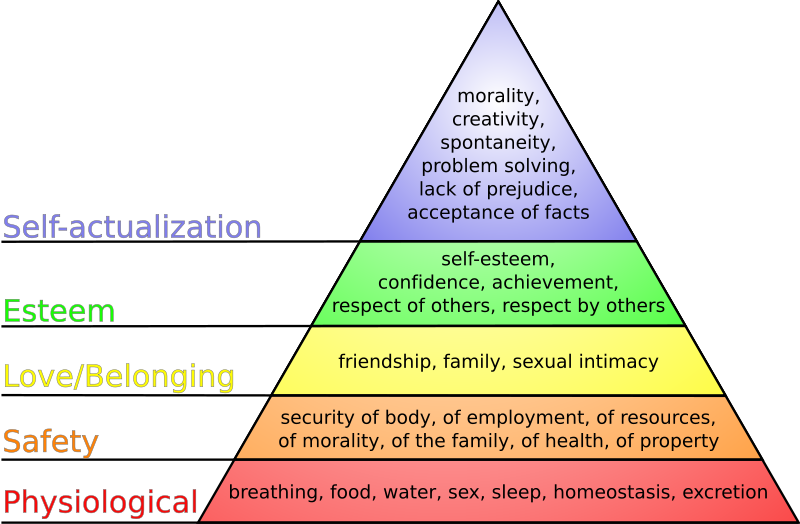
2) We have also installed a wood burning cooker. Right back down to the base of Maslow’s triangle really!

Maslow’s triangle of needs

These feelings have brought about such change everywhere and I wonder seriously whether we will ever return to what was; indeed would we want to?

I might not have mentioned it in previous blogs but as well as an engineering background, in latter years, I have focused on how success in business is linked directly to aspects of relationships and how we are in our relationships with others, so things like integrity, self-awareness and the ability to see the point of view of others, and modify our approach appropriately.

To inform this, some 7 years ago, I embarked on an MA in Core Process Psychotherapy, primarily to work on myself so that I could be the best I could be in my relationships, in and out of work.

The point I’m trying to make is that the same panic I notice in many of the companies I work in, and in me, is based on fear of the unknown and on a lack of trust in all its forms.  I’ve deliberately underlined that last phrase because it is so incredibly important.

The truth is that we get more of what we focus on.

So we can choose to focus on the constant news of more difficulties, hardship and redundancies, or we can focus on what is working.

In the workplace this positive focus has been pulling people together across functions and sites and pooling resources and ideas.

When we realise we’re not doing this alone it’s amazing how much lighter a load can feel and how much more inspired we all feel.

I also notice how humour begins to flow and what a powerful antidote for doom and gloom that is.

Transformation is never easy but the rewards far exceed the effort put in ten fold.

So what is it going to be? Are we all going to bow down to the god of Doom & Gloom, fear and anxiety, heaping more and more gifts around it, or are we going to start noticing and focusing on the other neglected god – that of relationship, joy, trust, abundance and lightness?

Whatever the future holds for us all a belief in our inherent ability to adapt and change and focus on the greater good rather than fear, anxiety, greed and selfishness is the only sustainable way forward.

By Jon Lavin

The book! Part Four: The process of change.

They didn’t bring us here to change the past!

That opening quote to this chapter comes from the blockbuster film Interstellar that was drawing in the crowds when I was up to my neck in the first draft of the book. Jean and I had taken an afternoon off, together with neighbours, Dordie and Bill, to go and watch it. It was the middle of November, 2014.

I’ll resist the temptation to include a review of the film in this place; this is meant to be a book about what we can learn from dogs! But there were two spoken lines that really jumped off the screen at me; one of them being the opening quote to this chapter.

Why did that opening quote strike me so forcibly?

Simply because when it comes to making deep, fundamental changes in who we are, how we see ourselves and, flowing from that, how we behave, or better put, how we wish to change how we behave, we have to change the past.

Sorry, I was being ‘tricky’; we can’t change the past in any real sense! But what we can change is our understanding of our past and how it made us the person we are; at this present moment in our life. That self-understanding is paramount before we set out along any journey of personal change. That was my motivation in recounting, in the opening chapter of Part Four, my discovery of my fear of rejection that for so many years had remained out of sight; albeit not quietly so within me.

Before continuing, I am minded to issue a ‘health’ warning. My writings and my conclusions are purely and solely my personal view of my life and the world as I see and experience it. Don’t empower me with talents and skills that I don’t have! Phew!

Moving on.

Anyone who has attempted a change in their behaviour, from a New Year’s Resolution, to a metaphorically large slap on the wrist for being dumb about some aspect of their life, will appreciate the difficulty of achieving a lasting change in behaviour. Changing our behaviour is rarely simple, straightforward or even, surprisingly, logical. Very often it requires a major commitment of time, effort and, perhaps most importantly of all, an emotional commitment.

The other vital thing to appreciate is that what works for one person, in all likelihood, will not work for another. Even trickier than that; what worked for you one time, may not work another time! That, just for the avoidance of doubt, is not me downgrading the need for change, when your intuition is saying to you that a change or two wouldn’t do any harm at all! Not at all!

So don’t worry about it not ‘speaking’ to you clearly in the first instance, in the sense of you not being clear as to how it is that you need to change, just embrace the fact that it is a process of trial-and-error, and keep reminding yourself why it is that you wish to change an aspect or two of your behaviour.

This important aspect of being relaxed about achieving change for yourself is more easily understood, as in understood rationally, when one takes an overview of the models (note the use of the plural) of change as used by therapists, physicians, and teachers. The researchers, that therapists and others base their knowledge and understanding upon, have multiple theories to explain how change occurs.
One of these theories, a popular one known as the Stages of Change model, demonstrates that change is rarely easy and often requires a gradual progression of small steps toward a larger goal.
In other words, only through understanding the elements of change, the stages of change, and the ways to work through each stage, can help one achieve a lasting behavioural change.

I’m not going to go much further because I’m conscious of potentially over-stepping boundaries. This is a book about learning from dogs, not an amateur self-help manual on change!

But I do want round off with the following; the product of my research and from speaking to a couple of professionals in the field of change.

Apparently, about 20 years ago, two researchers into alcoholism, Carlo C. DiClemente and J. O. Prochaska, proposed a multi-stage model of change. Their aim was to help professional ’change consultants’ understand their clients who had problems of addiction and how to motivate those clients to change. It was a model that was not based on theories but on the observations by DiClemente and Prochaska into how people tackled problem behaviours such as smoking, overeating and excessive drinking.

The multiple stages of the model were called: precontemplation; contemplation; determination; action; maintenance and termination. Six stages in all.

I’m only going to dip into that first stage: Precontemplation.

Precontemplation

Individuals in the precontemplation stage of change are not even thinking about changing their drinking behavior. They may not see it as a problem, or they think that others who point out the problem are exaggerating.

There are many reasons to be in precontemplation, and Dr. DiClemente has referred to them as “the Four Rs” —reluctance, rebellion, resignation and rationalization:

Right that’s enough from me. But for anyone that would like to read the full article by M. Gold (2006) Stages of Change, there’s a footnote [APA Reference Gold, M. (2006). Stages of Change. Psych Central.] that includes a link to a website that can offer you more detailed information about this multi-stage approach to change; indeed has the full article from Mark Gold, MD.

It’s never too late to change.

Oh, nearly forgot! I noted that the film Interstellar offered “two spoken lines that really jumped off the screen at me”, using one, “They didn’t bring us here to change the past!”, as the opening line of this chapter. The second spoken line couldn’t be more appropriate to close a chapter entitled: The process of change.

We all want to protect the world, but we don’t want to change.”

999 words. Copyright © 2014 Paul Handover

Scottish blood in ma veins.

Share a smile with me!

Another long day of writing left me with little time to do anything other than go through my blog folder and pick out something delightful for today.  I didn’t have far to go, for dear friend, Bob Derham, recently sent me the following:

An Arab Sheik was admitted to Hospital for heart surgery, but prior to the surgery, the doctors needed to have some of his blood type stored in case the need arose.

As the gentleman had a rare type of blood, one that couldn’t be found locally, so, the call went out. Finally a Scotsman was located who had the same rare blood type. The Scot willingly donated his blood for the Arab.

After the surgery, the Arab sent the Scotsman, as appreciation for giving his blood, a new BMW, a diamond necklace for his wife and $100,000 US dollars.

A couple of days later, the Arab had to go through a corrective surgery procedure. Once again, his doctor telephoned the Scotsman, who was more than happy to donate more of his blood.

After the second surgery, the Arab sent the Scotsman a thank-you card and a box of Quality Street chocolates. The Scotsman was a little disappointed that the Arab did not reciprocate his kind gesture of more donated blood as he had the first time around.

He decided to telephone the Sheik and asked him: “I thought you would be generous again, that you would give me another BMW, diamonds and money, but you only gave me a thank-you card and a box of Quality Street chocolates.

There was a pause and then the Arab replied: “Aye laddie, but I now have Scottish blood in ma veins“.

oooo

Don’t blame me! I just published it! 😉

The book! Part Four: Of change in thoughts and deeds

Setting the scene

Well done for getting through Part Three: Mankind in the 21st century, and a number of the challenges of our present times! I don’t mean that to come over in a flippant manner but it must have been tough reading; it certainly was tough writing for this scribe! Then again, from way back yonder from my days of selling during the 70s and 80s, comes that old saw about not being able to embrace a new idea if one doesn’t really understand the issues, as in the strengths and weaknesses, of the existing situation.

Change is a fascinating subject and one that even the briefest trawl through the internet reveals a wealth of material. But the theme of change here in Part Four is about change at an individual level and not anything to do with organisations; let alone countries. And as such, in terms of how we understand the need for change as individuals, it seemed pertinent to offer this personal anecdote as a way of setting the scene.

You will recall that in Part One – Man and Dog, there was a chapter headed Unsettled times. In that chapter I wrote about learning that my previous wife informed me that she was having an affair with another man, this revelation taking place on December 20th, 2006, fifty years to the day of my father’s death on December 20th, 1956.
I also mentioned that earlier on in 2006 I had started mentoring a Jon Lavin as he was going through a major transition in his counselling practice. Jon was living a few miles from where I was living in South Devon and was, and still is, a psychotherapist, or to put it more accurately, a UKCP accredited therapist and NLP Practitioner.

Thus in a state of some emotional turmoil, I rang Jon early on in 2007 and asked if I might be his client! Jon was initially reluctant to agree to that, simply because he and I had started developing a relationship in another context, within a completely different perspective, as in me coaching him in the ways of developing his own business. As Jon made clear, he was worried that our existing relationship might get in the way of a very different relationship; one where I was trying to understand the catastrophe that had just taken place in my private life.

I was pretty insistent on wanting, needing, to see Jon; as you might imagine. Thankfully, Jon did agree after giving it some thought but on the strict understanding that if he was concerned about how the counselling relationship was progressing that I had to agree, agree before we started our sessions, that he had the right to terminate the relationship. Of course, I agreed. Without a moment’s hesitation.

Thus Jon and I started my personal counselling relationship soon after.

Naturally, Jon wanted to learn more about my emotional background and gently, when it felt right, asked me to explain the circumstances of my father’s death back in 1956. That was easy for me for the memories of that time had never dimmed.

That I had turned twelve back in November, 1956 and had started that previous September at my new secondary school; Preston Manor Grammar School. At the time of my birthday in November, 1956, I was only vaguely conscious of my father having been ill for a while. Not ill for months and months but bedridden for a few weeks. My father was fifty-five years old and had always been a gentle, caring father to me and my younger sister, Elizabeth.

Then just a few weeks further on, on the evening of the 19th December, when I was tucked up in bed, next door to my parent’s bedroom, my mother came into my bedroom to say goodnight to me; a perfectly ordinary and routine event. But on this particular evening, there was an unmistakeable sadness about her and rather than promptly coming up to me and kissing me goodnight, she sat down on the edge of my bed, just where my knees were under the sheet and bedspread.

I could still recall so clearly Mum giving a deep sigh, a sigh that seemed to confirm what I feared and, somehow, knew in my heart: that his illness might be serious. Mum turning and reaching out with her right hand so that she could hold my right arm that lay on top of the bedspread. “Paul, you do know that your father is not very well, not very well at all. I’m sorry to tell you that he may not live for very much longer.” Words that have never left me.

Mum then leaning forward, kissing me goodnight, and leaving my bedroom, turning the light out as she closed the door. Me falling asleep within moments of the closing of that bedroom door.

My father died that same night: my mother calling the doctor who attended, confirmed the death, issued the death certificate and arranged for my father’s body to be removed from our home.

It all taking place before daybreak. It all taking place as I slept on.

In the morning, my father was no longer part of my life.

As one could easily imagine, the following days were surreal, yet all of my life I have had no recollection of any emotions at all.

Going back to the death of my father, it was thought that my father’s funeral, a cremation, would be too upsetting for me and my sister so we didn’t attend the funeral.

The only other recollection from those times was being teased and bullied at my new school, the one that I had started a few months previously, because I was prone to bouts of crying. I also recall that one day in the playground, surrounded by a group of jeering and taunting boys, I had snapped and gone for the ring leader in a wild frenzied physical attack. Both he and I receive the cane from the headmaster but at least the teasing was brought to an end.

So all of this was spoken of to Jon in those early days of 2007!

Jon gently explored my feelings, wondering what were my emotional echoes from over fifty years ago. I’m not sure I voiced anything particularly revealing.

Then, in a change of tack, he asked me how my own son might have felt if he, my son, had endured the same tragedy at the same age and experienced the death of me, his father, in a similar fashion, and, in addition, not been able to go to the funeral.

It was a straightforward question but one that had me disappearing into my own inner thoughts for some time, Jon sitting quietly in his armchair just next to me, me only half aware that time seemed to have come to a halt. As if for the first time in my life since that dreadful day in 1956 I had the courage to listen to my deep inner voice, to sense my most inner feelings.

I stuttered, “My son would be angry, angry that one of the key events in the life of any person, the death of a parent, no more than that, the death of a son’s father, no that’s still not right; the death of his father, had been denied him.

Jon looked at me, in a way that seemed to connect with me very strongly. Then he quietly asked, “What other feelings might you expect your son possibly to have?

Again, another long silence, and then I said, feeling strongly that something very important was about to happen: “He would feel left out. Overlooked. Denied the experience of something irreplaceably important. He would feel emotional rejection; in spades!

As those last words, quietly and clearly, left my lips, the most incredible sensation overtook me, both without and within me, encompassing me totally, the awareness that for the first time in my life, with me now sixty-three-years old, something that had been emotionally and psychologically hidden from me for fifty-one years, was now out in the open.

The clear knowledge that the circumstances surrounding my father’s death and my subsequent decline in my school performance had left me with a long-term psychological ‘dysfunction’; a certainty that I had been emotionally rejected way back in the Winter of 1956-57. A certainty, for sure, yet an understanding of myself that, hitherto, had been out of sight of my conscious mind, hidden deep inside of me, until this moment, this precious moment, in time.

Jon remained still and quiet as I continued to turn over in my mind this inner discovery. The realisation that, incredibly, for fifty years, my emotional response to my father’s death had remained totally out of my consciousness yet, nonetheless, had influenced me in very real and tangible ways; ways both negatively and positively that came to me almost immediately.

That the negative influence was that I was drawn to any woman who offered me love and affection and, therefore, I was emotionally unable to understand, to judge as it were, whether she had the potential to be a match as a life-long partner, however good a person she might be. I was doing anything to avoid emotional rejection!

The positive influence was that I tried very hard to please others (still do) so as to avoid their rejection, and had successful careers in selling for IBM UK, later starting and building a successful business in the early days of personal computing and, then, when my company was sold in 1986 becoming a freelance journalist and business coach.

So it took a chance association with Jon in those early weeks of 2007 to make me understand a fundamental lesson, one that had its roots fifty years previously, back in those early weeks of 1957. The lesson that we may only fully embrace change when we fully know just who we are. In other words, if there’s the tiniest voice inside you telling you that there may be some hidden nooks and crannies within you, psychologically and emotionally speaking, then some time spent with the appropriate ‘mentor’ will be the best investment you ever made.

There was a second reward from that self-awareness that arose in 2007. Namely, that in the December of that year, while the guest of dear Californian friends, enjoying a Christmas vacation in their holiday home in San Carlos, Mexico, I met Jean. Jean had been married to an American, Ben, for many years, latterly the two of them living permanently in San Carlos. Ben had died in 2005. Jean was born an Englishwoman, born in Dagenham in Essex. I had been born in Acton, North London. As the crow flies, the distance from Dagenham to Acton is twenty-three miles.

Jean and I met on December 15th, 2007. I was now emotionally unencumbered and able to give my full love to her and receive her full love for me. Jean and I were married in Payson, Arizona on November 20th, 2010. Now we live in a rural part of Oregon with our dogs and horses. It is a life together that is everything that any man could ever dream of.

The power of change!

1877 words Copyright © 2014 Paul Handover
oooo

It is only right for me to mention that the above is entirely my own work and while it is my best recollection of a series of true events, the chapter has not been previously seen or endorsed by Jon.

The beauty of flight.

Not, perhaps, in quite the way you might be anticipating!

A couple of weeks ago, I forwarded an item to my son, an airline Captain for some years now, that I read on the Big Think website. It was an item called The Accidental Beauty of Flight Paths.

The Accidental Beauty of Flight Paths
by FRANK JACOBS NOVEMBER 5, 2014

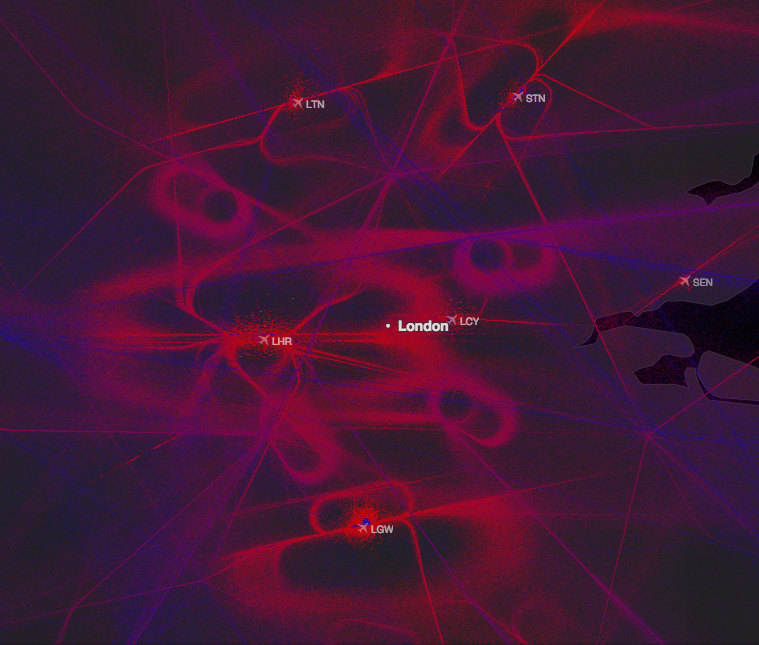
There is more between heaven and earth than bird migrations and weather fronts. These maps capture the poetic beauty of something utterly mundane and usually invisible: the flight patterns of the planes that bring us from airport A to airport B.

We live in the age of mass air travel. At any given moment, there are about 10,000 commercial planes airborne, carrying an estimated half a million passengers across the skies. We also live in the era of Big Data. Which means that the movements of those thousands of planes can be followed in real time on websites such as Plane Finder and Flightradar24.

London and the pretty holding patterns around its airports: Heathrow (LHR), Gatwick (LGW), City (LCY), Luton (LTN), Stansted (STN) and Southend-on-Sea (SEN).

You can read the full article here.

Alex, my son, then replied with a link to this item on the UK NATS website: Take a guided tour around UK airspace.

The skies above the UK have been brought to life like never before in a video showing a day of air traffic in less than three minutes.

Created from actual radar data showing over 7,000 flights, the video graphically illustrates the daily task facing air traffic controllers and the airspace features that help make it all work.


It finishes with an overview of the structure of UK airspace, highlighting the major air routes and showing how this ‘invisible infrastructure’ helps underpin the entire operation.

Matt Mills, NATS Head of Digital Communications, said: “We’ve made data visualisations in the past, but we wanted to now take people on a deeper journey into what makes UK airspace work and some of its important features.

Airspace might be the invisible infrastructure, but it is every bit as important as the airports and runways on the ground.

Created by air traffic management company, NATS, the video takes viewers on a unique tour of some of the key features of UK airspace – from the four holding stacks over London and the military training zones above Wales, to the helicopters delivering people and vital supplies to the North Sea oil and gas rigs.

It is a fascinating video.

The book! Part Three: Greed, inequality and poverty

Note:

I read this out aloud to Jeannie last night, as I do with every post that is published, and found this chapter really didn’t flow.  I’m making the mistake of including too many words of direct quotations, many of which are not easy to follow.

So just wanted to let you know that if this strikes you the same way, you are not alone! 😉

It is, of course, just the first draft, but nonetheless …. wanted you to read this first.

oooo

Greed, inequality and poverty

Just three words: greed; inequality; poverty.

Just three words that metaphorically come to me like a closed, round, wooden lid hiding a very deep, dark well. That lifting this particular lid, the metaphorical one, exposes an almost endless drop into the vastness of where our society appears to have fallen.

That this dark well, to stay with the metaphor, is lined with example after example of greed, inequality and poverty is a given.

One might conclude that examining any of those examples is pointless, not in terms of the reality of our world, but in terms of influencing the views of a reader. If you are a reader who is uncertain about the current levels of greed, inequality and poverty then it’s unlikely that a few examples, or a few hundred examples, are going to change minds. (One might argue that you wouldn’t be reading this book in the first place!)

Thus when I was digging around, looking for insight into how and why we, as in society, are in such times, I was looking for core evidence. Very quickly, it struck me that the chapter title really should simply have been: Inequality. Because inequality, by implication, is the result of greed and results in poverty.

In November, 2014, at the time I was drafting this book, a new report was issued by the Center of Economic Policy Research (CEPR) on the latest (American) Survey of Consumer Finances. It painted a picture very familiar to many: the rich becoming richer while those with less wealth are falling further and further behind.

David Rosnick of the CEPR, and one of the report co-authors, made this important observation:

The decline in the position of typical households is even worse than the Consumer Finances survey indicates. In 1989, many workers had pensions. Far fewer do now. The value of pensions isn’t included in these surveys due to the difficulty of determining what they are worth on a current basis. But they clearly are significant assets that relatively few working age people have now.

Sharmini Peries, of The Real News Network, in an interview with David Rosnick, asked:

PERIES: David, just quickly explain to us what is the Consumer Finance Survey. I know it’s an important survey for economists, but why is it important to ordinary people? Why is it important to us?

ROSNICK: So, every three years, the Federal Reserve interviews a number of households to get an idea of what their finances are like, do they have a lot of wealth, how much are their house’s worth, how much they owe on their mortgages, how much they have in the bank account, how much stocks do wealthy people own. This gives us an idea of their situations, whether they’re going to be prepared for retirement. And we can see things like the effect of the housing and stock bubbles on people’s wealth, whether they’ve been preparing for eventual downfalls, how they’ve reacted to various economic circumstances, how they’re looking to the long term. So it’s a very useful survey in terms of finding out how households are prepared and what the distribution of wealth is like.

PERIES: So your report is an analysis of the report. And what are your key findings?

ROSNICK: So, largely over the last 24 years there’s been a considerable increase in wealth on average, but it’s been very maldistributed. Households in the bottom half of the distribution have actually seen their wealth fall, but the people at the very top have actually done very well. And so that means that a lot of people who are nearing retirement at this point in time are actually not well prepared at all for retirement and are going to be very dependent on Social Security in order to make it through their retirement years.

PERIES: So, David, address the gap. You said there’s a great gap between those that are very wealthy and those that are not. Has this gap widened over this period?

ROSNICK: It absolutely has. As, say, the top 5 percent in wealth, the average wealth for people in the top 5 percent is about 66 percent higher in 2013, the last survey that was completed, compared to 1989. By comparison, for the bottom 20 percent, their wealth has actually fallen 420 percent. They basically had very little to start with, and now they have less than little.

PERIES: So the poorer is getting poorer and the richer is getting extremely richer.

ROSNICK: Very much so.

To my way of thinking, if in the period 1989 through to 2013 “the average wealth for (American) people in the top 5 percent is about 66 percent higher” and “for the bottom 20 percent, their wealth has actually fallen 420 percent” it’s very difficult not to see the hands of greed at work and a consequential devastating increase in inequality.

In other words, the previous few paragraphs seemed to present, and present clearly, the widening gap between the ‘haves’ and the ‘have-nots’, comparatively speaking, and that it was now time for society to understand the trends, to reflect on where this is taking us, if left unchallenged, and to push back as hard as we can both politically and socially.

I wrote that shortly before another item appeared in my email ‘in-box’ in the middle of November (2014), a further report about inequality that, frankly, emotionally speaking, just smacked me in the face. It seemed a critical addition to the picture I was endeavouring to present.

Namely, on the 13th October, 2014, the US edition of The Guardian newspaper published a story entitled: US wealth inequality – top 0.1% worth as much as the bottom 90%. The sub-heading enlarged the headline: Not since the Great Depression has wealth inequality in the US been so acute, new in-depth study finds.

The study referred to was a paper released by the National Bureau of Economic Research, Cambridge, MA, based on research conducted by Emmanuel Saez and Gabriel Zucman. The paper’s bland title belied the reality of the research findings: Wealth Inequality in the United States since 1913.

As the Guardian reported:

Wealth inequality in the US is at near record levels according to a new study by academics. Over the past three decades, the share of household wealth owned by the top 0.1% has increased from 7% to 22%. For the bottom 90% of families, a combination of rising debt, the collapse of the value of their assets during the financial crisis, and stagnant real wages have led to the erosion of wealth. The share of wealth owned by the top 0.1% is almost the same as the bottom 90%.

The picture actually improved in the aftermath of the 1930s Great Depression, with wealth inequality falling through to the late 1970s. It then started to rise again, with the share of total household wealth owned by the top 0.1% rising to 22% in 2012 from 7% in the late 1970s. The top 0.1% includes 160,000 families with total net assets of more than $20m (£13m) in 2012.

In contrast, the share of total US wealth owned by the bottom 90% of families fell from a peak of 36% in the mid-1980s, to 23% in 2012 – just one percentage point above the top 0.1%.

The report was not exclusively about the USA. As the closing paragraphs in The Guardian’s article illustrated:

Among the nine G20 countries with sufficient data, the richest 1% of people (by income) have increased their income share significantly since 1980, according to Oxfam. In Australia, for example, the top 1% earned 4.8% of the country’s income in 1980. That had risen to more than 9% by 2010.

Oxfam says that in the time that Australia has held the G20 presidency (between 2013 and 2014) the total wealth in the G20 increased by $17tn but the richest 1% of people in the G20 captured $6.2tn of this wealth – 36% of the total increase.

I find it incredibly difficult to have any rational response to those figures. I am just aware that there is a flurry of mixed emotions inside me and, perhaps, that’s how I should leave it. Nonetheless, there’s one thing that I can’t keep to myself and that this isn’t the first time that such inequality has arisen, the period leading up the the Great Depression of the 1930s comes immediately to mind, and I doubt very much that it will be the last.

Unless!

Unless the growing catalogue of unsustainable aspects of this 21st century, a few of which have been the focus of this Part Three, brings about, perhaps in many different ways, a force for change that is unstoppable.

But before that is explored in Part Four, there is the one final element of the greed, inequality and poverty theme of this chapter that must be aired; the issue of poverty.

Contrary to my anticipation, the figures for poverty trends can be read in many ways and don’t give a clear-cut uniform picture. Nevertheless, it does’t take a genius to work out that the future, especially for young people, could be alarming.

Today, the poor people are the young. Today, the young are heading into a future that has many frightening aspects.

Take the present population numbers, the mind-boggling scale of the use of energy in these times, not to mention the levels of debt across so many countries (on the 14th November, 2014, the Federal Debt of the USA was about $18,006,100,032,000), possible unsustainable global climate change trends, and is it any wonder that those born in the period 1928 to 1945 (I was born in 1944), the generation that has been called the Silent Generation, must be wondering what the future holds for their children and grandchildren and what they or anyone can do today and tomorrow, to prevent these future generations sinking into oblivion.

I came across a quotation from Simon Caulkin, the award winning management writer: “It’s all the product of human conduct!”

Yes, Simon is right. Only human conduct will find that sustainable, balanced relationship with each other and, critically, with the planet upon which all our futures depend. Yet, something nags at me; a half-conscious doubt that starts with the word ‘but!’ Not that it doesn’t all come down to human conduct; not a moment’s hesitation on that one. But there’s still that half-conscious doubt. A doubt that starts to take shape on the back of that wonderful quotation from Einstein: “Insanity: doing the same thing over and over again and expecting different results.

Then from that half-conscious place in one’s head comes another word. The word: Faith. Faith in us, as in faith in humanity. Faith that not only can we change our relationship with ourselves, with our communities and, above all, with our planet, but that we will. Faith that we, as in mankind, will embrace the many beautiful qualities of the animal that is so special to so many millions of us: our dogs. Not just embrace but pin our future on the premise that adopting the qualities of love, trust, honesty, openness and more, qualities that we see daily in our closest animal companions, is our potential salvation.

Thus comes the end of this set of depressing aspects of our 21st century. Time to move on in this story of learning from dogs and envelope ‘Of change in thoughts and deeds’; the title of the next section of this book. For we truly need a change to a better future.

1923 words Copyright © 2014 Paul Handover