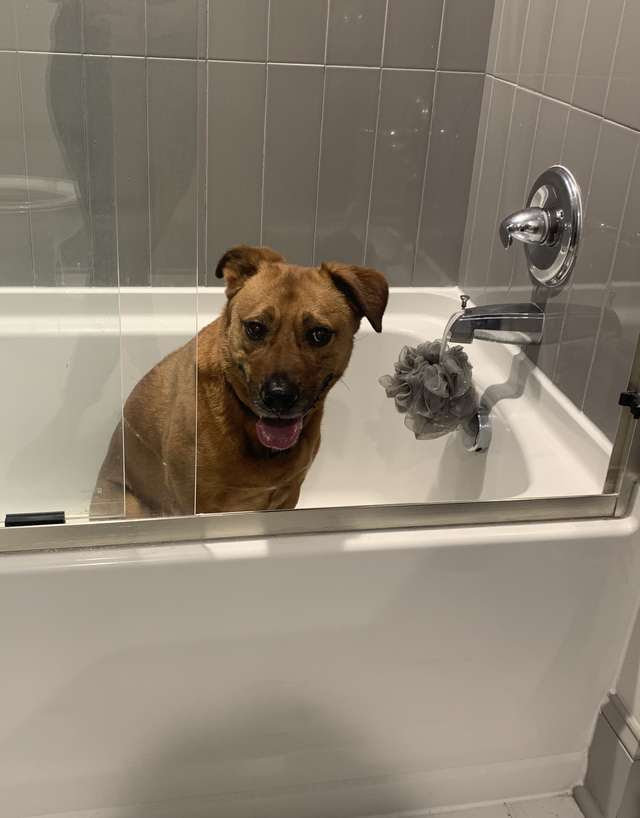
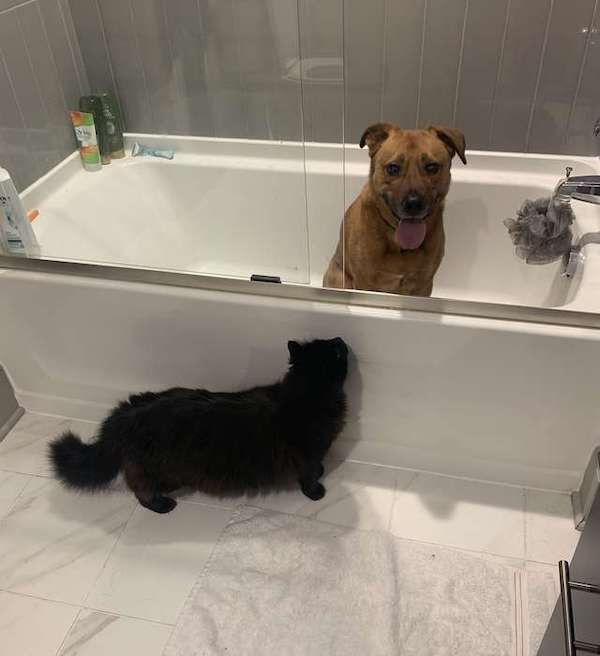
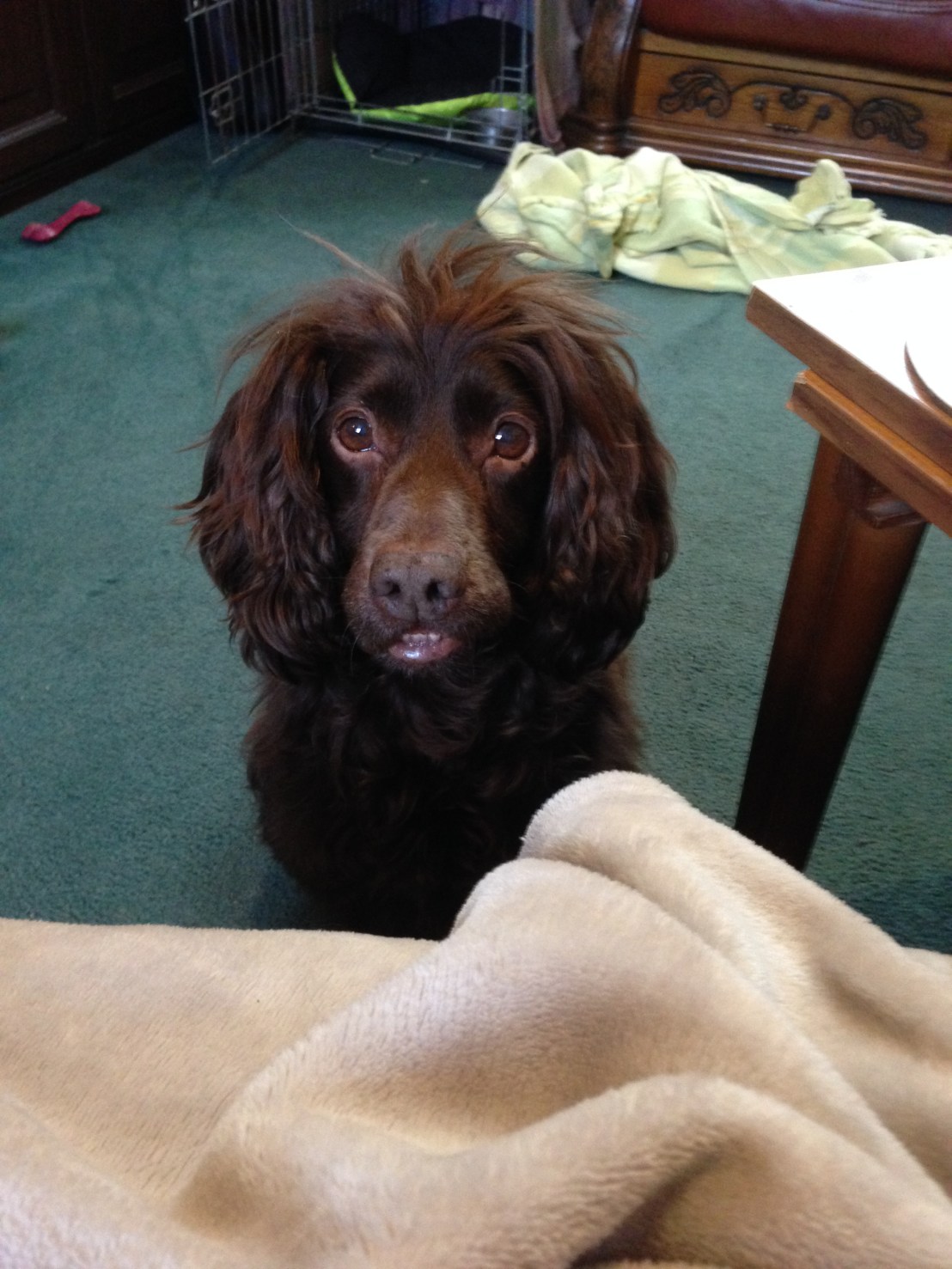
Just a few weeks ago new neighbours moved in to the property that adjoins us to the South.
They are Mike and Hannah Mills and they have three children; Hunter, Scarlet and Clover. Hunter is the eldest and he will be 9 on May 27th. When we went across to meet them I very quickly learnt that Hunter is a budding writer. Just as quickly I offered to publish a story from him in this place.
He used the following picture as a writing prompt.
Here is his story!
ooOOoo
A Big Dog
By: Hunter Mills, May 2020.
It was a cloudy morning.
A man was walking on the street and all of a sudden a big, big, big, big dog appeared out of the clouds.
The man was so cold, but he had to run! He ran fast, so he had to stop and rest and he stopped to rest, and hid. He got a little breath but the dog had a super good nose so he sniffed out the man and he had to run away again.
The dog was so fast it caught up to the man and it only licked him! The dog licked him again and the man ran away to a nearby building.
The man thought the dog was mean, but it was just trying to snuggle the man.
He went to the dog store and bought some dog treats and a big, big, big, big leash for the dog. He bought a new house so the dog could fit in the house.
So the next time a big, big, big, big dog starts to run after you, you should see if he wants to eat you or snuggle you.
If he lays down next to you, keep him. If not, run for your life!!
ooOOoo
I have not changed a single word of Hunter’s story. All I have done is to alter the formatting so that it is easier on the eye.
This is Hunter with his two dogs Soldier and Hank.
Hunter is already a good writer and it’s a delightful work of fiction.
Hopefully, this is the first of many that I may have the privilege of publishing!
May I ask a favour? That is that if you ‘Like’ this post you also say so in a comment. For I am sure Hunter will be along to see what you all thought of his creative juices! Thank you.
Dry Skin Dogs: Three Steps You Can Easily Do Right Now At Home
I am delighted that Roger Brooks’ submission of guest posts is becoming a regular feature.
Here is his latest.
ooOOoo
Dry Skin Dogs: Three Steps You Can Easily Do Right Now At Home
By Roger Brooks,
4th May, 2020
An itchy dog with dry, flaky skin is worrisome for you and your dog alike. There could be several potential causes for your dog’s skin-related ailment – ranging from seasonal allergies to more severe disorders. In the latter case, you are highly recommended to rush to a vet and get some over-the-counter medication, as such conditions may soon become an incurable medical disorder. The seasonal allergies, cracked skin, redness, dandruff, or scaling may be treated at home by adopting few dietary changes or incorporating dog supplements for dry skin in its regular diet.
Read on to find our three at-home and easy to follow steps to provide natural and instant relief to your dry skin dog!
1. Chamomile Oil and Green Tea Bath
Owing to their age-old healing properties, chamomile oil, and green tea provide immediate relief to the itchy patches on your dog’s skin.
All you are to do is fill a big plastic tub or sink with 10 liters of lukewarm water and put 5-6 caddies of green tea into it. Let them sit well and dissolve their juices into water. It will take 4-5 minutes. Squeeze the tea bags well and take them out of water. Then add a teaspoon of chamomile oil. After mixing it gently with warm water, let your dog lay in and enjoy its soothing hot bath for about 10 minutes.
Alternatively, for relatively small-sized patches, you may choose to prepare this liquid in a glass by one or two green tea bags in warm water. Or preferably boil the tea bags in water for about one minute. Let it cool. Now, you may choose to rinse or spray this water on to your dog’s skin or dip a sponge into this balmy water and apply this water on to any visible redness, rashes on your dog’s skin. You will notice that your dog feels instantly relieved after it.
2. Adding Supplements to Diet
Multiple pieces of research back the fact that whatever your dog eats directly affects its skin. It means dry skin symbolizes that something essential is missing in the diet. Therefore, it is always useful to add coconut and fish oils like omega-3 fatty acids to your dog’s homemade diet. You will find that by feeding your dog with these oils in moderate quantity cures dry skin more quickly as compared to massaging with the same oils.
You might be thinking that the dog food you bought from the market already has omega-3 fatty acids in it. But let me tell you that those processed foods carry a few of these acids in them, which is not enough to resolve the skin issue of your pooch. The reason for this low amount of omega-3 acids in the commercial diet is that they are quite expensive, and the commercial sellers add omega-6 fatty acids instead, which do not cure dry skin. Therefore, it is always wise to add fresh salmon or sardines to your dog’s regular diet. But remember, use them in moderation as excess may lead to diarrhea.
While most of the skin-related issues of your dog will be solved by adding Omega-3 fatty acids in the diet, a few hardcore allergies might require vitamin E, yogurt, or coconut oil, as all of them combat well against skin issues. Yogurt being a natural moisturizer keeps your dog’s skin moist. An additional benefit of adding a little yogurt in your dog’s diet is that it keeps its stomach safe from bacteria and doesn’t cause digestion issues.
Coconut oil and vitamin E possess a high level of antioxidants. Since science says, free radicals cause much of the damage to your dog’s skin. The right amount of coconut oil and vitamin E helps release free radicals and keep your dog’s coat smooth and moist.
3. Set-up a Humidifier
This can also help a great deal in curing your canines’ dry skin and keeping them moist and fresh.
What happens in the chilly cold is that you start keeping your dog mostly indoors to keep it warm. Unfortunately, this makes an entirely feasible condition for your dog’s dry skin as the centrally heated system of your home interior sucks all the moisture away, leaving a sterile environment that makes your dog more vulnerable to skin ailments. This is why outdoor dogs are less prone to skin issues.
Statistics, however, prove there is no significant relation between winter and dried dog skin. Therefore, the fact is established that irrespective of weather and dog breed, skin issues persist in millions of dogs because they are naturally more sensitive.
Setting a humidifier for your dog throughout the year can lessen its trouble with skin by keeping the environment moist and fresh.
In all, let’s not forget that a humidifier alone can do no good to your dog’s dried skin, it should be combined with a nutritious homemade diet, rich in omega-3 fatty acids, Vitamin E, yogurt and other oils as that is fundamental to get fresh and dandruff free skin of your dog.
ooOOoo
John writes with an authority that comes from knowing his topic.
How many others found this post to be of help or of great value.
In the last twenty-four hours I was in communication with a person in Essex, England about dog training (and hopefully there will be a guest post from him) and it caused me to think of Angela Stockdale.
I then did a search on my blog for posts where I had mentioned Angela and came across quite a few in the early days of blogging. Then I thought it would be nice to republish one of them; Four Years Old.
So here it is again.
ooOOoo
How time flies!
Four years ago this day, the first post was published on Learning from Dogs. Here it is again:
Parenting lessons from Dogs!
Much too late to make me realise the inadequacies of my own parenting skills, I learnt an important lesson when training my GSD (who is called Pharaoh, by the way). That is that putting more emphasis into praise and reward for getting it right ‘trains’ the dog much quicker than telling it off. The classic example is scolding a dog for running off when it should be lots of hugs and praise for returning home. The scolding simply teaches the dog that returning home isn’t pleasant whereas praise reinforces that home is the place to be. Like so many things in life, very obvious once understood!
Absolutely certain that it works with youngsters just the same way.
Despite being a very dominant dog, Pharaoh showed his teaching ability when working with other dogs. In the UK there is an amazing woman, Angela Stockdale, who has proved that dogs (and horses) learn most effectively when being taught by other dogs (and horses). Pharaoh was revealed to be a Beta Dog, (i.e. second in status below the Alpha Dog) and, therefore, was able to use his natural pack instinct to teach puppy dogs their social skills and to break up squabbles within a pack.
When you think about it, don’t kids learn much more (often to our chagrin!) from other kids than they do from their parents. Still focusing on giving more praise than punishment seems like a much more effective strategy.
As was read somewhere, Catch them in the act of doing Right!
By Paul Handover.
As it happens, it feels a little like ‘what goes around, comes around’. Why do I say that?
Because just last Saturday, I sent off a selection of pictures and videos to Angela Stockdale. Stay with me for a while as to the reason why.
Angela trades under the name of The Dog Partnership and, frankly, what she doesn’t know about the behaviour of dogs isn’t worth bothering about!
Just take a peek at the page on her website under the heading of Teaching Dogs. Here’s a little of what Angela writes:
I consider myself so lucky for dogs alone to have been my teachers. I learnt from watching how my own dogs responded to another dog’s body language and vice versa their language. Watching, learning and working with Teaching Dogs was the only way I knew.
I was and always will be in awe of a Teaching Dog’s dogs ability to consciously adapt their body language in accordance to how the other dog was feeling. The result being, they could relax nervous dogs but at the same time maintain control of a problem situation. Remember, dogs talk dog far better than we do.
It came as quite a shock to me when I learnt about other approaches. It seemed foreign for people to have so much input in resolving what were described as ‘ behavioural’ issues. For me, working with these dogs was far more than resolving a behavioural issue. It was about improving the quality of lives of dogs who were not coping with everyday life. If they found dogs or people worrying, sometimes this was shown in displays of aggression. It is important to understand, these dogs were not aggressive, they simply displayed aggressive behaviour.
Now, I would like to introduce you to the world of Teaching Dogs and how these special dogs change the lives of less fortunate dogs, who never had the opportunity to really understand how to communicate with their own species.
Back to why those photographs and videos had been sent to Angela. A couple of weeks ago, we enjoyed an evening meal with friends of friends, so to speak. This other couple owned a beautiful-looking male German Shepherd dog: Duke. Duke was 4-years-old. Our hostess remarked that he was very boisterous and had nipped a couple of strangers who had called at the house. She added that he seemed difficult to control. Duke had been there for about a month and he was a rescue so they had little or no knowledge of past behaviour.
Well, I’m no expect with dogs, that’s Jean’s domain. But there was something about Duke that captivated me. Something in the way he looked at me, his eyes linking so directly with mine, allowing me to see a dog that offered an honest openness.
More or less on impulse I stood up, held my right arm up at 45 degrees, looked Duke in the face and said, “Duke! Sit!”
Duke held my gaze and sat back on his haunches.
I moved my arm in a complete circle, around to the right, and said, “Duke! Lie down!” Duke lay down.
H’mm, I thought. Fascinating. This dog has been professionally trained at some point in the past, using the same ‘command’ system of voice and arm signalling as I had learnt with Pharaoh way back in 2003/2004.
The food was now on the table. I grabbed a small piece of meat off my plate and returned to Duke who had, of course, resumed his pottering around the room. “Duke! Here boy!” Duke came over to me. “Duke! Lie down!” Duke did so. I placed the piece of meat on the wooden floor about three feet in front of him. Duke’s eyes were riveted on the meat. “Duke!” Duke’s eyes reluctantly engaged with mine. “Duke! Stay!” I repeated the Stay command a couple more times as I backed away about 6 or 8 feet.
“Go on, Boy. Take the meat!” Duke gleefully grabbed the piece of meat. Gracious, I thought, this dog is magnificent. I wonder ……..
I took another piece of meat, “Duke! Sit!” “Duke! Stay!” I then backed off that 8 feet again, got down on my knees and placed the piece of meat just between my lips. I knew this was potential madness with a dog I had only met some 30 minutes previously, but there wasn’t an ounce of doubt in my mind. I voiced in my throat for Duke to fetch the meat. Duke came straight over and confidently and carefully removed the meat from my lips.
What a truly fabulous dog! It was a wonderful evening and once home both Jean and I were eulogising about Duke.
Then two days later, our dinner hostess rang me. “You know, I have decided we can no longer keep Duke. He is too strong a dog, I can’t control him. Is there any chance of you finding a new home for Duke?”
Without question, Jean and I would have offered Duke a new home; in a heartbeat. The only thing stopping that was me wondering if this strong-willed, male German Shepherd might be a Beta dog, as Pharaoh was. Or just might be too dominant a male dog to fit in comfortably with our dogs, especially Pharaoh who was at the stage of life where the last thing that should happen is for his happiness and contentment to be disturbed.
I hadn’t a clue as to how to answer that question. But I knew someone who would know: Angela Stockdale.
I rang her, caught up on old times and then explained the background to Duke’s situation. Angela said to repeat the exercise that I had witnessed when I took Pharaoh to her all those years ago, when I wondered if Pharaoh was an aggressive dog. My uncertainty with regard to Pharaoh followed a number of times when walking him in a public area with other dogs and he had been very threatening, both in voice and posture, towards some of those other dogs.
This is what Angela arranged. I took Pharaoh up to her place at Wheddon Cross, near Minehead in Somerset. When we arrived, Angela was standing just by a gate into a fenced paddock, maybe a half-acre in size. In the far corner were two dogs.
Angela asked me to bring Pharaoh to the gate and let him off the leash. It was clear that Pharaoh was going to be let into the paddock. I cautioned that Pharaoh could be quite a handful with other dogs and, perhaps, it would be better that I walked him into the area still on his lead. Angela said that wouldn’t be necessary. So as she held the gate open sufficient for Pharaoh to enter the paddock, I slipped the lead off him and backed away, as requested.
Pharaoh had hardly taken 2 or 3 paces when Angela called out, “Paul, there’s nothing wrong with him!”
I was astounded and stammered, “But, er, er, how can you tell so quickly?” “Because my two dogs haven’t taken any notice!”, came the reply.
Later Angela explained that in the paddock were her female Alpha dog and her male Beta dog. Ergo, the two top dogs in terms of status so far as dogs see other dogs.
In fact, Pharaoh was utterly subservient to these dogs, in a way that I had never witnessed before. Later on, as Pharaoh relaxed and started playing, Angela said that she thought that Pharaoh was a Beta dog. Mixing some of her other dogs into the group was later able to confirm that.
So back now to present times and Duke.
Thus last Saturday, as Angela recommended, we selected two of our dogs, Cleo our female German Shepherd and the most socialable of dogs, and Casey, a strong but not aggressive male (he had some PitBull in him).
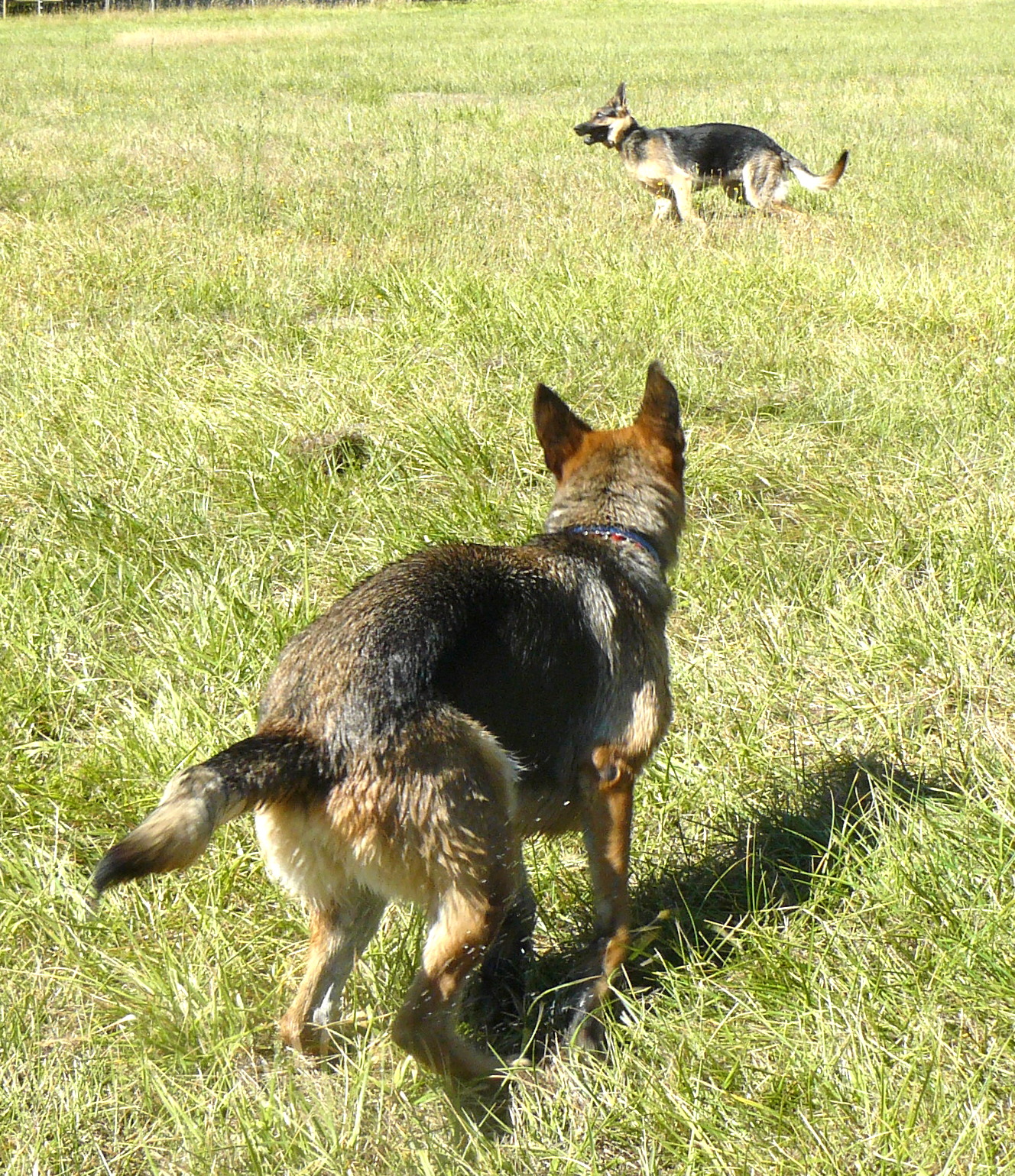
Duke arrived and was allowed freely to nose around the large grassed area some way from the fenced-off horse paddock that we were using for the ‘introduction’.
Duke pottered around and then caught sight of Cleo and Casey in the paddock.
First sighting of Cleo and Casey.
Then the meetings began!
Hello! My name is Duke. Do I smell OK? Mr. Casey?
And play didn’t seem to be too far off the agenda!
You lead, Cleo, I’ll chase!
So all the photographs and videos have been sent to Angela, and we will see what the conclusion is!
As Angela put it, “Remember, dogs talk dog far better than we do.”
ooOOoo
Yes there’s no question that dogs talk dog far better than we do!
Animals, especially dogs, can have a profoundly positive effect on us humans.
We had to go to the local tip yesterday morning and there were a couple of other cars in the ‘recycling’ area that had dogs. Both the drivers of those other cars were allowing their dogs to look out through an open window and, in the course of dumping our stuff in the various piles, I approached the dogs and allowed them to sniff my outstretched arm. What struck me later was how natural that was, with the drivers being so friendly towards their dogs and me, let’s face it, practically a stranger. They were only brief exchanges but they were happy exchanges and that’s the point!
Emma is not really a private guest writer; putting all her material on her website Pawstruck.com.
But the value in what she writes totally justifies in my mind what is being said.
What do you think?
ooOOoo
The Many Ways Owning a Dog Can Change Your Life
True-blue dog owners can attest to the fact that life is never the same without their pet pooch. There’s something innately contagious about a dog’s spirit that nurses and nurtures the human soul.
It’s science!
According to a Finnish study, merely looking at your dog releases a flood of oxytocin in your brain. Also called the love hormone, these neurotransmitters lessen anxiety and promote well-being.
For most dog parents, simply receiving their dog’s unconditional love is enough of a reason to keep pumping love, effort, and money into caring for their pet. Still, there are so many more arguments for why having a dog is an experience everyone should try once in their lives.
Dogs Are Mood Boosters
The jolly temperament, silly mannerisms, and unsinkable enthusiasm of a dog at whatever time of day make them the funniest companions. Simply petting your dog or spending a few minutes of fetch each day releases serotonin and dopamine in the human brain. These neurotransmitters are responsible for keeping you in a good mood.
Constant interaction with your pet is also found to manage the symptoms of depression, according to a 2018 study. In many instances, dogs can provide the kind of genuinely reliable relationship that can rarely be found between humans. This feeling of dependability, it turns out, is vital for humans’ mental wellness.
Dogs Keep You Fit
Being a dog parent is a full-time job. That means ensuring they eat well and exercise right. Even if you own a “lazy” breed, all dogs still need to be exercised at least 30 minutes every day to keep fit.
As a responsible owner, you are obliged to attend to these needs and, in the process, also benefit from the task. A lot of people, despite the clear benefits of exercise, refuse to move for lack of motivation. Dog parents don’t get to choose, and sometimes, that’s a good thing.
Make a routine out of your dog’s walking schedule. This way, your body can get used to the new pace and help turn the practice into a habit.
This, coupled with the mood-boosting benefits of a dog’s presence all contribute to a reduced risk of developing heart problems, which are the leading cause of death among older adults in the US.
Dogs Help You Socialize
One of the biggest contributors and symptoms of depression is social isolation. Living alone can exacerbate the situation and cause you to distance yourself even more from family members and your tightest circle of friends.
Whereas if you have a dog, the responsibility of going out for dog supplies, routine vet visits, and daily walks obliges you to interact with people. For natural introverts, the forced socialization may be hard at first. But it will also help you hone your social skills and find new friends aside from keeping the blues at bay.
Dogs Help You Be Kinder to Yourself and to Those Around You
When someone else’s life depends on you, you learn to be more conscious of your decisions. You encourage yourself to take care of your health because no one else will tend to their needs. You learn to be decisive with your choices, from selecting the perfect dog treats to opting for brands with cruelty-free practices.
You cannot pour from an empty cup, as they say, and once you experience your pup’s absolute love, you will realize that the only way to give love back is to love yourself first.
ooOOoo
I asked Emma, as I do with all my guest bloggers at first, to send me a short bio.
This is what she wrote:
Emma Nolan is a blogger, writer, and dog parent to a dachshund and three adorable black Labradoodles. She likes strolling outdoors with her lovable fur babies when not writing about them. She writes about everything pooch at Pawstruck.
To be honest, I much prefer guest posts, even ones with a commercial aspect to them, than the republication of articles from other blogs.
This is an excellent example of what I mean.
John has written down all the key aspects of treating this, luckily uncommon, trait in a dog. It is his second guest post. The first one is here.
ooOOoo
How to Get Rid of Your Dog’s Aggressive Behavior
By John Brooks.
“Dog: a man’s best friend.”
The quote says it all.
A dog is a very lovable four-legged pet that cares and loves its owners. But what stands out the most is the loyalty of the dog towards its owners. You probably have heard of incidents where dogs have saved their owners from many unwanted threats, and even in some cases, they risk their own lives while doing so.
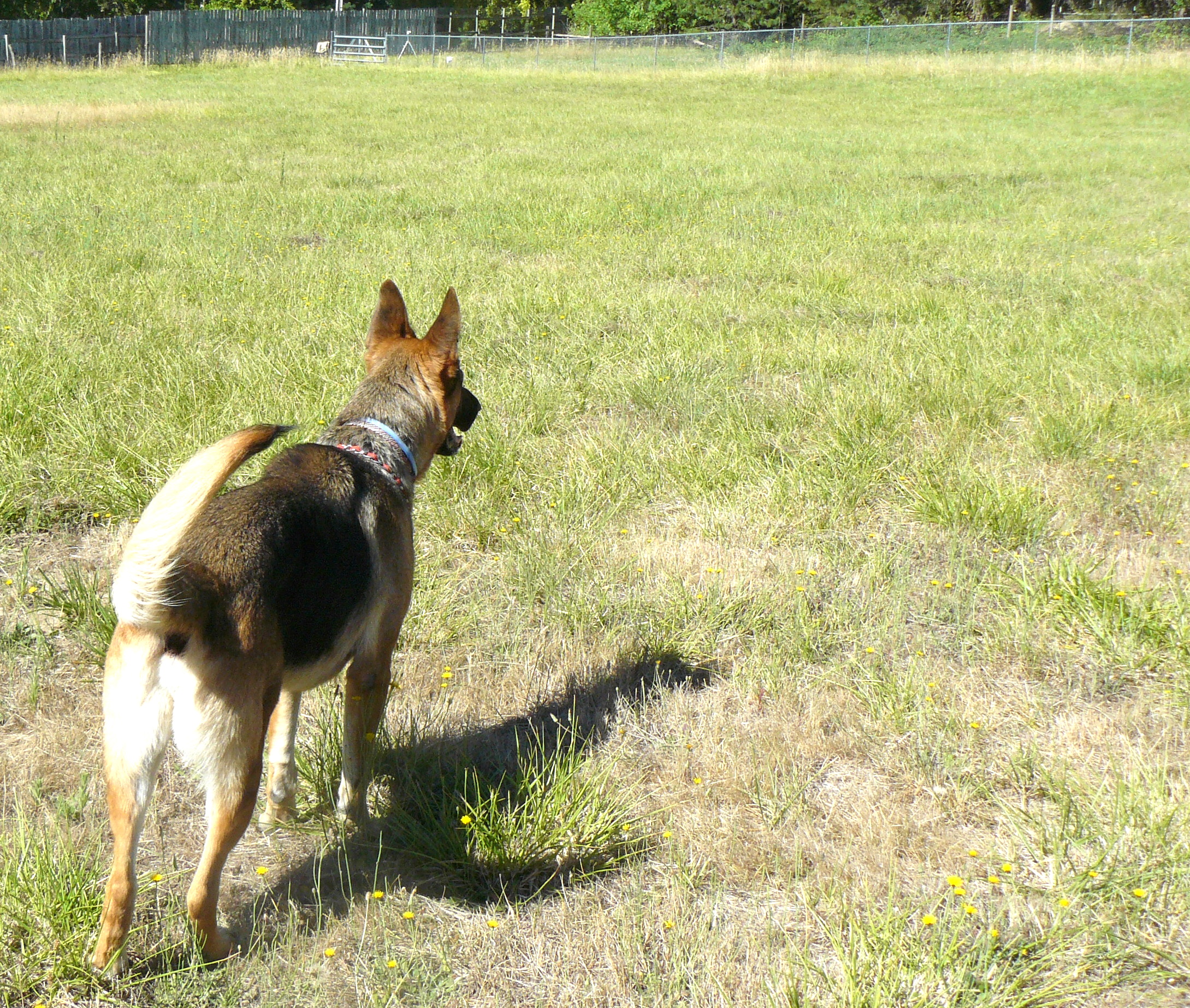
A dog can only do so much for you, so, therefore, it becomes your responsibility too, to take care of your dog as your child. It needs your time and attention, and just like a human being, it can even express emotions of love, sadness, and anger.
But this doesn’t mean that your dog doesn’t like you or anything. Dogs can experience different moods depending on many things. If your dog has been aggressive lately, then you need to find out the right reason and treat the cause immediately rather than just putting up a thick dog collar around its neck.
Reasons for Aggression
First of all, you need to find out why your dog is behaving the way it is. There may be many reasons for the cause like:
He may be Afraid
Fear may very well be one of the reasons why your dog is behaving in such a way. He may have a fear of suddenly seeing a lot of strange people at once. Or children might be poking him and irritating him to the point that he has become afraid and has developed aggression to counter that fear.
Lack of Socialism
If your dog fears crowd places, the chances are that he has not been exposed to a lot of crowds, beforehand and now this has made him anti-social and therefore has developed fear as a result.
Depression
Depression is a real thing not only for humans but also for dogs. Depression may cause your dog to be frustrated internally, and slowly that frustration might creep and turn into aggression later on. The cause of depression can be anything like being beaten up, fear, etc. But these problems should be addressed as soon as possible.
Punishment
Punishment is the last thing you want to do. Beating your dog will drive it to develop fear against you, and this fear will cause it to express in the form of aggression.
Almost in all cases, fear is the one main factor that drives a dog to be aggressive towards its owner or any stranger. It can be a fear of any previous experience when he was a puppy and had to go through any trauma. A fear of anything that he finds unpleasant or unwilling. He may also face fear when he thinks that valuable resources are being taken away or are under threat.
Signs of aggression
You may see some other sign too like the dog may start to crouch with his tail between his legs, or may develop tension around his mouth and jaw. You may notice him becoming stiff and still. Don’t just assume that if your dog is wagging his tail, it means that it is a sign of friendship. A stiff wagging of the tail or a dog wagging tail in crouched position is all signs of him that he is in a state of confusion or fear.
The last stage before attacking will be growling. It is the final stage of warning after which the dogs are sure to strike if the irritating factor is not removed.
How Do you Counter such Aggressive Behavior?
There are many ways you can do to prevent the aggressive behavior of your dog.
Remove the Cause
Immediately remove the cause of its aggression or the thing that is making him frighten or take your dog away from that situation as soon as possible.
Do not Punish him for Being Aggressive
Punishing your dog for being aggressive in the form of beating, yelling or any other bold tone manner will only make the dog more frightened and more aggressive the next time and may directly bite. The proper way to do this is just to show him that you don’t approve of such behavior either by shrugging your shoulders or by leashing only slightly. This behavior makes your dog believe that the owner doesn’t accept its action.
Train Him
You should train him to face his fear in a more fun and less aggressive way. Train him to be less violent and manage his stress. Try to play with him, hang out, and spend time so that he knows that his owner is always there with him so that he can have more confidence when next time he is around stressful situations.
Consult a Professional Dog Trainer or Veterinarian
Sometimes, even with the hardest of your efforts, things don’t work out and then it is time for you to visit the professionals who have been doing this for so long. They can guide you in many ways and help your dog to be better again.
ooOOoo
John’s bio is as follows:
John Brooks is the Professional Content Marketer. He writes a lot of articles on his carrier. Last one year he is working with Orbeen.com as a digital marketing expert. The company provides various types of Digital Marketing services i.e, Search Engine Optimisation (SEO), Search Engine Marketing (SEM), Social Media Optimization (SMO), Web design & development, Link Building, Content Marketing & blogger outreach.
I found this a most useful article. I hope you did as well.
It never fails to amaze me at the potential for friendship between cats and dogs.
This comes from The Dodo website. It’s one of a number of sites that I follow. I should really say more but am lost for words so here it is!
ooOOoo
Cat Makes Sure His Dog Friend Is OK During Thunderstorm
Photo Credit: Mary Barnes
When things get scary, we all need a friend to let us know that everything’s going to be OK.
For a pittie mix named Moose, that friend is a cat named Marvin.
Mary Barnes rescued Marvin six months ago, hoping that the fearless kitty would become a playmate for her 7-year-old dog.
“I didn’t know how Moose and Marvin would get along because Moose had never really interacted with cats, but she’s the absolute sweetest and most gentle girl so I had faith,” Barnes told The Dodo.
Photo Credit: Mary Barnes
“They very quickly became best friends,” she added. “Marvin has the personality of a dog so they nap and play together all day.”
When Barnes moved into an apartment in downtown Detroit, she began to notice that Moose was becoming more and more sensitive to loud noises. Every time the pup heard fireworks or thunderstorms, she would immediately tremble and hide.
“I try to give her treats and keep her busy when it’s storming but she usually ends up going into the bathroom and hiding in the shower,” Barnes said. “She’s always hidden in the shower — it’s her safe place.”
Photo Credit: Mary Barnes
Marvin doesn’t have the same fear of thunder shaking the windows. But Barnes never could have guessed the loving cat would step up and comfort Moose in her time of need.
“Last night was the first really big, long storm we’ve gotten in Detroit since Marvin has been with us,” Barnes said. “He was very curious and concerned about his big sister.”
Marvin knew Moose was suffering and he wasn’t going to let her sit alone.
Photo Credit: Mary Barnes
“He went back and forth to her in the shower to check in,” Barnes said. “It distracted [Moose] from the storm for a little bit because she leaned down to give him kisses!”
The storm eventually passed, and Moose and Marvin quickly got back to playing and relaxing together.
If there’s one thing they both know, it’s that having a best friend can make getting through hard times a whole lot easier.
ooOOoo
The thing about this story is that our pet dogs and cats have a number of emotions and they recognise the need to comfort other animals in the same house.
I suspect that a wide range of animals also have a number of emotions.
I allowed myself to do a quick web search on the subject – there’s loads!
Emotion is defined as any mental experience with high intensity and high hedonic content.[1] The existence and nature of emotions in animals are believed to be correlated with those of humans and to have evolved from the same mechanisms. Charles Darwin was one of the first scientists to write about the subject, and his observational (and sometimes anecdotal) approach has since developed into a more robust, hypothesis-driven, scientific approach.[2][3][4][5]Cognitive bias tests and learned helplessness models have shown feelings of optimism and pessimism in a wide range of species, including rats, dogs, cats, rhesus macaques, sheep, chicks, starlings, pigs, and honeybees.[6][7][8]Jaak Panksepp played a large role in the study of animal emotion, basing his research on the neurological aspect. Mentioning seven core emotional feelings reflected through a variety of neuro-dynamic limbic emotional action systems, including seeking, fear, rage, lust, care, panic and play.[9] Through brain stimulation and pharmacological challenges, such emotional responses can be effectively monitored.[9]
Emotion has been observed and further researched through multiple different approaches including that of behaviourism, comparative, anecdotal, specifically Darwin’s approach and what is most widely used today the scientific approach which has a number of subfields including functional, mechanistic, cognitive bias tests, self-medicating, spindle neurons, vocalizations and neurology.
While emotions in animals is still quite a controversial topic it has been studied in an extensive array of species both large and small including primates, rodents, elephants, horses, birds, dogs, cats, honeybees and crayfish.
There’s much more and it is a comprehensive article.
This is a dear YouTube that is just over a minute and a half long. It was sent to me by Bob.
It shows a chihuahua copying a human perfectly. I don’t think the video is a fake.
It reminds me of our Oliver who is the best of our six dogs when it comes to observing us and copying certain actions. Mind you, Oliver is not the only one of our six dogs to copy us but he is the best.
As the person who posted the video wrote: “Here is the dog doing yoga with his owner Nic. Such a special connection that he’s able to perfectly repeat his moves.” That’s Nic Bello.
I really cannot add any words at the present time. The article says it all!
ooOOoo
Removed because of an alleged copyright infringement.
ooOOoo
This is a very ’rounded’ story about Tricycle, one that shows that love in the dog community is never very far away. Actually, I would go on to say that we adults who also love our dogs, probably putting them above our own needs, offer something very special.
Further emails between Jane and me resulted in the following.
After I published the post about Molly last Thursday, there were further emails between Jane and me.
When I went to bed after I sent you Molly’s story I thought of some other points.
Separation anxiety: presumably the result of, over a period of time, seeing her friends disappear and the family leave her owner. He would feed her, let her out for a run round the garden put her away again. And then leave till some unspecified time.
If – rarely- I’m out for more than a few hours she doesn’t want to know Alan. She waits on the chair by the door looking bereft. Then I come home and …. whoo hoo it’s like the 4th July and she suddenly comes to life; runs and jumps around like a wind-up toy. The obvious joy and relief at seeing me is humbling.
Or if I go out of the room she might follow.
But even letting her out in the garden has been a trauma for her. She rushes out but if I don’t immediately follow she comes back to check where I am – but if she sees me putting my garden shoes on – hey Mum’s coming! and off she scoots. She does go out and stay on her own but likes to know we’re there. That fear of being left is obviously too entrenched to ever leave her.
BUT the most amazing thing is that when my friend boarded her she said she doesn’t bark – they thought they might have heard her bark once. And when we went to look at her, the owner told me ‘she doesn’t bark’.
But she barks now! I talk to her so she talks back! She is a brilliant guard dog. If there’s anyone at the front door she barks and can’t wait to get there. As people often don’t see our bell we wouldn’t have known they were there. And if the phone rings (think the ringtone must hurt her ears) she barks till I answer it.
And despite her traumas she is the nicest little girl I’ve ever known. Not a nasty bone in her body.
Jane x
Jane also sent a further photograph.
Then in a further email that came through shorty afterwords in reply to mine:
That’s wonderful. I may publish an addendum, so to speak, sometime next week and incorporate some of your remarks. (Paul)
Jane asked:
That would be terrific and perhaps I could add the question: Do others have experience of dogs sucking their blanket?
I assume this an anxiety or comfort habit but then again – is it to do with indigestion – considering what she scavenges? It happens when she’s had a feed and is almost like a child sucking their blanket but also reminds me of horses wind-sucking and/or crib-biting.
Obviously she couldn’t do this in her kennel ( she slept on newspaper covered board) but seems to derive comfort from it but does have a penchant for eating paper (my requisition for a chest X-ray to name but one!) and hence the photo of her with toilet roll! Also she had puppies but we don’t know old she was.
Actually the sucking reminds me of cats sucking and kneading.
She will be 11 next month so unlikely to stop now. We got her on 31 December 2016.
Best Christmas present ever.
Can someone answer Jane’s question about dogs sucking their blankets?




 A dog can only do so much for you, so, therefore, it becomes your responsibility too, to take care of your dog as your child. It needs your time and attention, and just like a