Category: People and their pets

This is a good story!

It never fails to amaze me at the potential for friendship between cats and dogs.

This comes from The Dodo website. It’s one of a number of sites that I follow. I should really say more but am lost for words so here it is!

ooOOoo

Cat Makes Sure His Dog Friend Is OK During Thunderstorm

Photo Credit: Mary Barnes

When things get scary, we all need a friend to let us know that everything’s going to be OK.

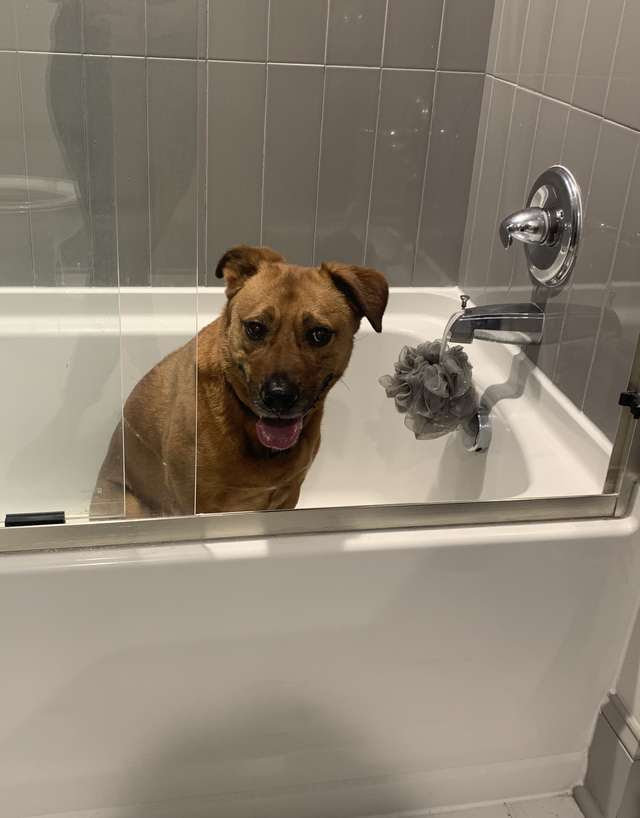
For a pittie mix named Moose, that friend is a cat named Marvin.

Mary Barnes rescued Marvin six months ago, hoping that the fearless kitty would become a playmate for her 7-year-old dog.

“I didn’t know how Moose and Marvin would get along because Moose had never really interacted with cats, but she’s the absolute sweetest and most gentle girl so I had faith,” Barnes told The Dodo.

Photo Credit: Mary Barnes

“They very quickly became best friends,” she added. “Marvin has the personality of a dog so they nap and play together all day.”

When Barnes moved into an apartment in downtown Detroit, she began to notice that Moose was becoming more and more sensitive to loud noises. Every time the pup heard fireworks or thunderstorms, she would immediately tremble and hide.

“I try to give her treats and keep her busy when it’s storming but she usually ends up going into the bathroom and hiding in the shower,” Barnes said. “She’s always hidden in the shower — it’s her safe place.”

Photo Credit: Mary Barnes

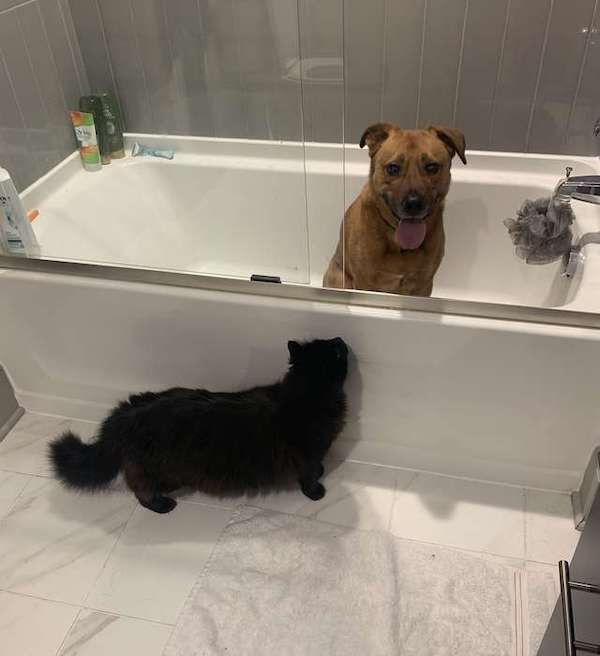
Marvin doesn’t have the same fear of thunder shaking the windows. But Barnes never could have guessed the loving cat would step up and comfort Moose in her time of need.

“Last night was the first really big, long storm we’ve gotten in Detroit since Marvin has been with us,” Barnes said. “He was very curious and concerned about his big sister.”

Marvin knew Moose was suffering and he wasn’t going to let her sit alone.

Photo Credit: Mary Barnes

“He went back and forth to her in the shower to check in,” Barnes said. “It distracted [Moose] from the storm for a little bit because she leaned down to give him kisses!”

The storm eventually passed, and Moose and Marvin quickly got back to playing and relaxing together.

If there’s one thing they both know, it’s that having a best friend can make getting through hard times a whole lot easier.

ooOOoo

The thing about this story is that our pet dogs and cats have a number of emotions and they recognise the need to comfort other animals in the same house.

I suspect that a wide range of animals also have a number of emotions.

I allowed myself to do a quick web search on the subject – there’s loads!

Try this WikiPedia extract:

Emotion is defined as any mental experience with high intensity and high hedonic content.[1] The existence and nature of emotions in animals are believed to be correlated with those of humans and to have evolved from the same mechanisms. Charles Darwin was one of the first scientists to write about the subject, and his observational (and sometimes anecdotal) approach has since developed into a more robust, hypothesis-driven, scientific approach.[2][3][4][5] Cognitive bias tests and learned helplessness models have shown feelings of optimism and pessimism in a wide range of species, including rats, dogs, cats, rhesus macaques, sheep, chicks, starlings, pigs, and honeybees.[6][7][8] Jaak Panksepp played a large role in the study of animal emotion, basing his research on the neurological aspect. Mentioning seven core emotional feelings reflected through a variety of neuro-dynamic limbic emotional action systems, including seeking, fear, rage, lust, care, panic and play.[9] Through brain stimulation and pharmacological challenges, such emotional responses can be effectively monitored.[9]

Emotion has been observed and further researched through multiple different approaches including that of behaviourism, comparative, anecdotal, specifically Darwin’s approach and what is most widely used today the scientific approach which has a number of subfields including functional, mechanistic, cognitive bias tests, self-medicating, spindle neurons, vocalizations and neurology.

While emotions in animals is still quite a controversial topic it has been studied in an extensive array of species both large and small including primates, rodents, elephants, horses, birds, dogs, cats, honeybees and crayfish.

There’s much more and it is a comprehensive article.


Yoga time!

A Chihuahua follows his owner perfectly!

This is a dear YouTube that is just over a minute and a half long. It was sent to me by Bob.

It shows a chihuahua copying a human perfectly. I don’t think the video is a fake.

It reminds me of our Oliver who is the best of our six dogs when it comes to observing us and copying certain actions. Mind you, Oliver is not the only one of our six dogs to copy us but he is the best.

As the person who posted the video wrote: “Here is the dog doing yoga with his owner Nic. Such a special connection that he’s able to perfectly repeat his moves.” That’s Nic Bello.

Enjoy!

Is it any wonder we love dogs!

A brilliant yet very touching post to be shared.

This story came out on Mother Nature Network quite recently.

I really cannot add any words at the present time. The article says it all!

ooOOoo

Removed because of an alleged copyright infringement.

ooOOoo

This is a very ’rounded’ story about Tricycle, one that shows that love in the dog community is never very far away. Actually, I would go on to say that we adults who also love our dogs, probably putting them above our own needs, offer something very special.

More of Molly

Further emails between Jane and me resulted in the following.

After I published the post about Molly last Thursday, there were further emails between Jane and me.

When I went to bed after I sent you Molly’s story I thought of some other points.
Separation anxiety: presumably the result of, over a period of time, seeing her friends disappear and the family leave her owner. He would feed her, let her out for a run round the garden put her away again. And then leave till some unspecified time.
If – rarely- I’m out for more than a few hours she doesn’t want to know Alan. She waits on the chair by the door looking bereft. Then I come home and …. whoo hoo it’s like the 4th July and she suddenly comes to life; runs and jumps around like a wind-up toy. The obvious joy and relief at seeing me is humbling.
Or if I go out of the room she might follow.
But even letting her out in the garden has been a trauma for her. She rushes out but if I don’t immediately follow she comes back to check where I am – but if she sees me putting my garden shoes on – hey Mum’s coming! and off she scoots. She does go out and stay on her own but likes to know we’re there. That fear of being left is obviously too entrenched to ever leave her.
BUT the most amazing thing is that when my friend boarded her she said she doesn’t bark – they thought they might have heard her bark once. And when we went to look at her, the owner told me ‘she doesn’t bark’.
But she barks now! I talk to her so she talks back! She is a brilliant guard dog. If there’s anyone at the front door she barks and can’t wait to get there. As people often don’t see our bell we wouldn’t have known they were there. And if the phone rings (think the ringtone must hurt her ears) she barks till I answer it.

And despite her traumas she is the nicest little girl I’ve ever known. Not a nasty bone in her body.
Jane x

Jane also sent a further photograph.

Then in a further email that came through shorty afterwords in reply to mine:

That’s wonderful. I may publish an addendum, so to speak, sometime next week and incorporate some of your remarks. (Paul)

Jane asked:

That would be terrific and perhaps I could add the question: Do others have experience of dogs sucking their blanket?

I assume this an anxiety or comfort habit but then again – is it to do with indigestion – considering what she scavenges? It happens when she’s had a feed and is almost like a child sucking their blanket but also reminds me of horses wind-sucking and/or crib-biting.
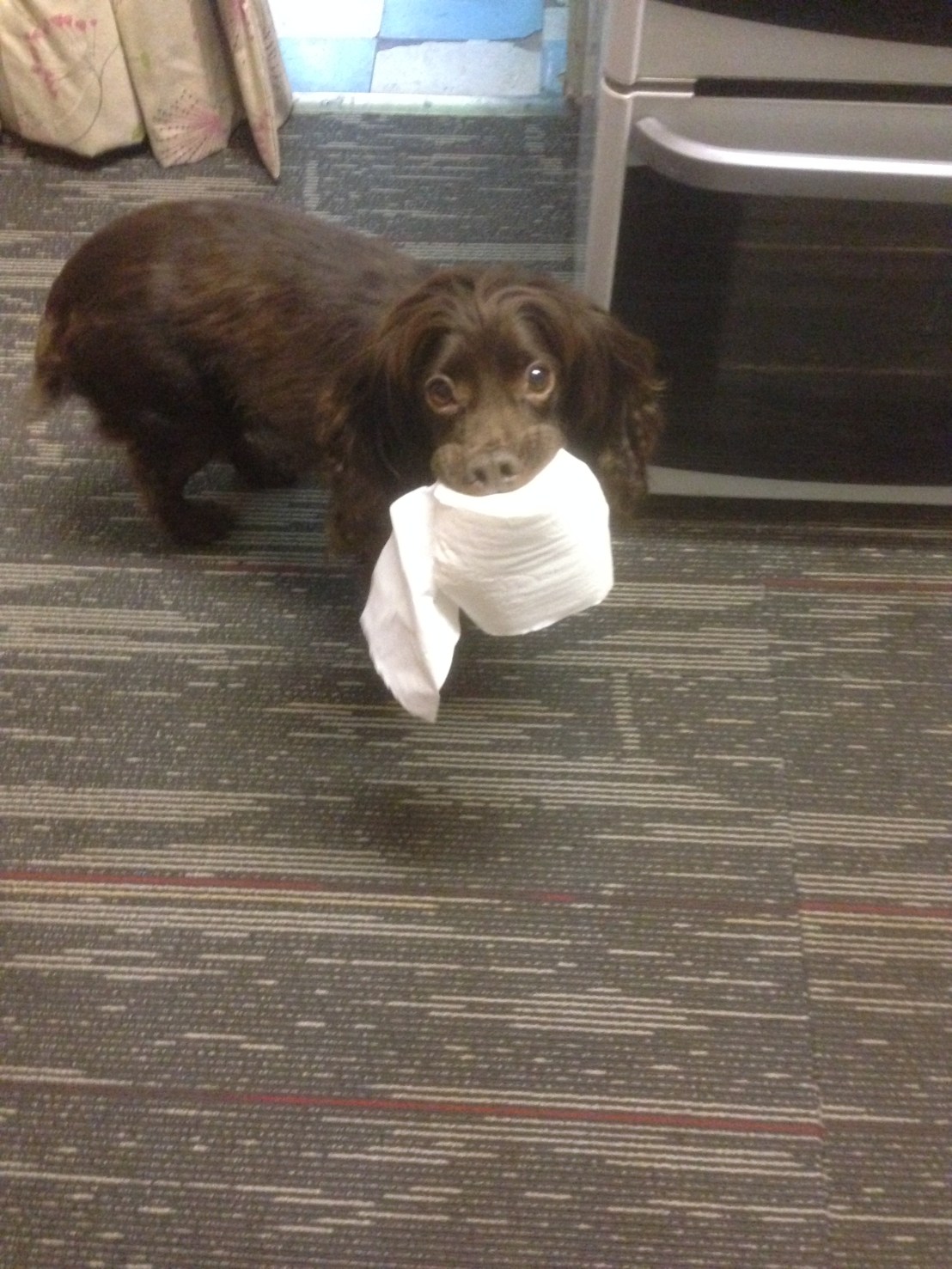
Obviously she couldn’t do this in her kennel ( she slept on newspaper covered board) but seems to derive comfort from it but does have a penchant for eating paper (my requisition for a chest X-ray to name but one!) and hence the photo of her with toilet roll! Also she had puppies but we don’t know old she was.
Actually the sucking reminds me of cats sucking and kneading.
She will be 11 next month so unlikely to stop now. We got her on 31 December 2016.

Best Christmas present ever.

Can someone answer Jane’s question about dogs sucking their blankets?

A blast from the past!

A friend from long ago writes of his dog!

Too many years ago, indeed when I had my own company back in the late 70s, I came in contact with Keith Edmunds. He was a Linux expert; still is!  He runs a company in the U.K., Tiger Computing, based in Monmouthshire.

The other day Keith posted a story about his dog and I asked for permission to republish. Keith very quickly said “Yes”. He added: “With a link to https://www.tiger-computing.co.uk/not-clever/, yes.”

Here it is:

ooOOoo

Rhys!

My wife is deaf. She caught meningitis when she was four years old, and one of the side effects can be deafness.

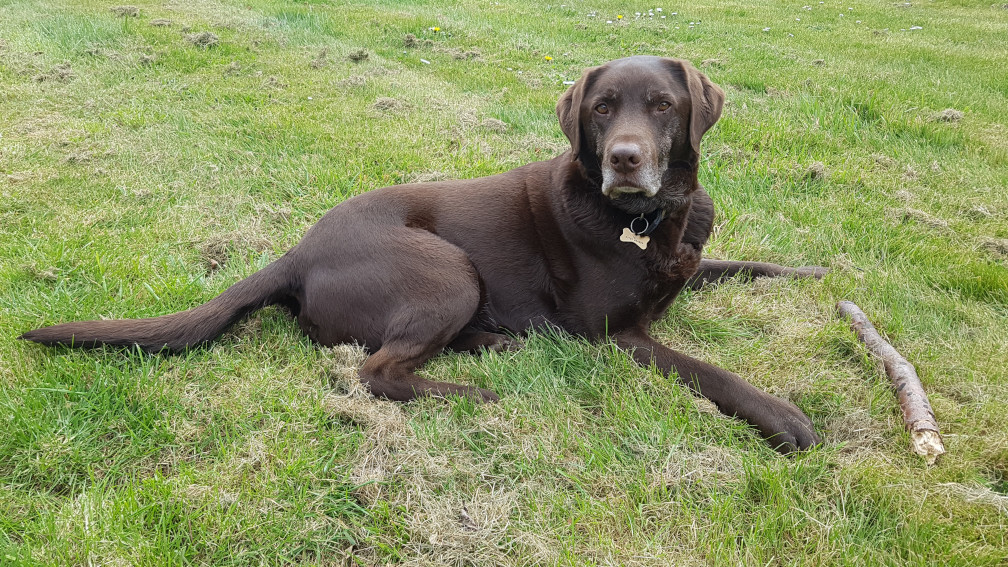
But this isn’t a sob story. It’s a joyful story of a chocolate brown Labrador called Rhys. My wife’s hearing dog.

People often ask what he can do. Well, he alerts Cecilia to the doorbell ringing, the kitchen timer going off, voice commands to “fetch mum” and the smoke alarm.

Some people ask whether he responds to the phone. But the answer is no. Cecilia can’t use the phone (she’s deaf); Rhys can’t use the phone (he’s a dog – he can’t speak). Between them you’d think they’d be able to come up with some kind of plan…but nothing so far.

“He’s very clever!,” people say. But really he’s not. I have, in moments of disrespect, mentioned that if he had an IQ one point higher he’d be a tomato.

You see we mustn’t confuse “highly trained” with “clever”.

Yes, Rhys has learnt how to respond to certain triggers. “If this happens, then do that” – It’s very basic.

If the smoke alarm sounds, then find Cecilia, nudge her, lie down and get a treat.

He doesn’t do it because he’s smart enough to know that the smoke alarm means danger. No. That would be clever.

He does it simply because he’ll get a treat for doing this task. He is a Labrador after all…

Clever is the ability to devise or select an appropriate solution to a problem. Clever – at least in adults – is a combination of intelligence, knowledge and experience.

If we apply this to business, then clever might be knowledge and experience in your domain. Right now, a lot of clever people are investigating a little virus called SARS-CoV-2 (the cause of COVID-19).

But clever can also mean knowing when to pull in the experts.

I’m no expert on immunology or virology so I’m leaving the SARS-CoV-2 problem to the talented (and knowledgeable, experienced and intelligent) bio-scientists.

Rhys is leaving the intellectual challenge of pretty much everything to others.

But I am quite clever when it comes to Linux, so if you need a little help with that then be sure to let me know…

Keith

P.S. If you’ve got a question about how to best use Linux in your business, book a free, 30 minute, no obligation Linux Strategy Call and let’s talk about it.

ooOOoo

Rhys is a lovely looking Labrador! Highly trained, of course. But some, including me, would also say clever!

What a beautiful dog!

Molly!

A tale from a friend of Jean.

Many years ago, when Jean was still in England, she and Jane became good friends. They still stay in touch today thanks to the modern world.

Recently, Jane sent an email that contained a lovely story of her dog, Molly. Or rather I should say Molly, that belongs to her and her husband, Al.

Here is Jane’s story.

ooOOoo

Our beloved Molly. Re-homed, not badly treated but was a working dog. Molly’s owner had a bad accident and his life fell apart.

Got rid of his other dogs and eventually, when boarding her with my friend, asked if she knew a good home for her. We’d just lost our dog and though he’ll never be replaced it’s not a home without a dog. So a friend and I went to see her – fat, scruffy, lived in an outdoor kennel. So, she came home with us.

She’d never set foot in a house so not house trained but SO clever. She quickly learned to toilet outside and now ASKS to go out. Nudges my elbow and if I stand up but don’t act immediately she paws my leg. How clever is that. Quickly learned how to negotiate stairs and not catch birds.

She knows exactly what she’s due – treats, dinner – and you can set your watch by her.

She is the most loving little girl and loves being cuddled. The thought of her being alone in the kennel, no company, frightened in storms, cold, not knowing when she’d see anyone breaks my heart.

The only problem, probably because of erratic feeding, or maybe survival instinct and not leaving scents for predators, is she eats her own poo and out walking I keep constant check or she’ll eat others too.

She had to be spayed and they found cancer last year and that meant a further operation.


She is a scavenger and I watch her constantly to see what she’s got in her mouth – in return for giving it up she expects a reward, she quickly caught on how to get treats!

Well enough, you know all about dogs and their ways – each one unique.
Keep well xxx

ooOOoo

 Dogs are so precious.

Thanks Jane!

The making of a scent dog.

A repeat of the guest post from Bryony Ravate.

Once again, I am having a struggle to come up with something original. Once again it is at these times of life that I am very grateful for the offer of a guest post. Take Bryony for example. This is not the first time that I have presented her work but I am grateful to her.

This is her article on scent dogs.

ooOOoo

The making of a scent dog.

By Bryony Ravate, January 2nd, 2020

If you’ve been lucky enough to be around dogs, you will have probably noticed how their noses are always moving. By possessing a nose up to 15x times more sensitive than our own, with 600,00 neurones, they can sniff out different components in every room. When you’re cooking a meal, you will be able to recognise the smell of a dish. But when your dog smells the meal, he can smell each individual spice and seasoning, the oils, the crockery and even any water.
You can use your dogs’ keen sense of smell for play – laying out different scents for them to explore. But their noses can also be used for working environments– such as in airports, with the police and in search and rescue missions. They can track down suitcases hiding illegal substances, follow the suspect of a crime and sniff out the victims of a snowstorm. To become scent dogs, the canines go through vigorous training. However, although all dogs have an exceptional sense of smell, not all dogs make it through training.

It makes sense to analyse what leads to success and failure in scent dog training. So, a keen researcher at University College Cork, Ireland performed a literature review in which factors behind success and failure in scent dog training were analysed. A literature review is the process whereby you search a database full of information (usually research articles published in reputable journals) and you extrapolate the information to create your own source. Here, I’m going to pull together some of the points I found the most interesting, points you may not think would affect the making of a scent dog.

Personality

Dogs with strong motivation to play or search, dogs which were bold rather than shy, and dogs which can adapt and cope with stressful stimuli are more likely to become scent dogs. High motivation to play or search, makes a dog easier to train. Play can be used as a reward, by allowing the dog to pull on a chew toy after being successful in a trial. Finding scents may be perceived as a game to the dog, increasing his motivation to engage. Bold dogs are less unnerved by new surroundings and situations. A nervous dog may be hesitant about pursuing an unknown scent – but a bold dog will take little hesitation. Adaptable dogs may be able to apply their knowledge to different situations and they will be unphased by commotions and will keep working when faced with distractions.

Housing Standards

Dogs that live in enriched environments throughout their training have increased ability in trials. Like children, the more opportunities you offer your dogs to learn, explore and interact with their environment, the more it allows them to develop and grow. Dogs should feel secure in their home environment when not working; keeping them with other dogs and in bright rooms without using loud cleaning equipment (such as hoovers) will make them less anxious, leading to better accuracy in scent trials.

The Human Partner

Dogs emotions are often intertwined with their handlers. When a dog’s owner gets angry, the stress hormones in the dog increase as a result. If a dog handler is happy, the dogs will perform better. The bond between dogs and their handlers can affect the accuracy of scent trials. If the dog lives at the owners’ home when he’s not working, obedience and accuracy are increased. Although the bond between scent dog and handler is important, they must be independent thinkers. When faced with a problem- solving task, they must be able to manipulate the environment themselves to find a solution, rather than looking at their handler for cues about the answer.
These are some factors which can alter the likelihood of a dog being a successful, as reviewed by Camille A Trosi and her team. What we must keep in mind is that all dogs are individuals. We cannot use this information to ensure all dogs in the future will pass scent dog training. However, we can use this knowledge to give potential scent dogs the best possible start to life; providing enrichment, an affectionate bond with their handler, and a suitable home environment. Canine personalities are not always determined by genetics, and a suitable environment can give a dog a metaphorical push in the right direction to ensure he is the best he can be, whether that be as a scent dog, a guide dog or even a lap dog.

Original Source : Troisi, C. A., Mills, D. S., Wilkinson, A. and Zulch, H. E. 2019. Behavioral and Cognitive Factors That Affect the Success of Scent Detection Dogs. Comparative Cognition & Behavior Reviews, 14, pp. 51-76. doi: 10.3819/ccbr.2019.140007

ooOOoo

Now what I haven’t done before but intend to do straightaway is to reproduce an extract from Bryony’s CV.

I currently hold a Pass with Distinction in MSc Animal Behaviour and Welfare from Queen’s University Belfast. I also have a BSc in Animal Behaviour and Welfare from Plymouth University. As well as holding two degrees relevant to the field, I currently have 2+ years of work experience. I possess the core attributes required when pursuing a career in the scientific industry; dedication, independence and initiative. I am highly passionate and believe that with my unique skillset I can have a valuable impact in the field of Science Communication.

Plus Bryony has her own blog, BrynsteinScience, and is also on Instagram, of the same name.

We wish Bryony much success in her work life and in her caring and interest for animals in general and dogs in particular!

There is an extensive article on Wikipedia in the UK on scent dog and the link to that article is here.

Finally to close with this wonderful photograph of a scent dog.

By Taz80 / SEDIRI Eddy – Personal picture, CC BY-SA 3.0, https://commons.wikimedia.org/w/index.php?curid=15094727

That’s perfect!

Hats off to this savior!

Yet another article I want to share from Mother Nature Network.

I really don’t know how Mother Nature Network (MNN) do it! For they have a great deal of stories about dogs and a great many of them deserve sharing with you all.

Take this one. A nine-year-old Pit Bull had about as much chance of being given a loving home as I have of winning the lottery (and I don’t even enter for it!).

But that wasn’t to reckon on Michael Levitt of California. Absolutely wonderful Mr. Levitt. You are a savior!

Christian Cotroneo has the full story.

ooOOoo

Removed because of an alleged copyright infringement.

ooOOoo

I can do no better than to close this post with a repeat of Michael Levitt’s words: “We’re helping Toretto, but Toretto is helping us. Having this beautiful, sentient being in our home — and having to think about somebody besides ourselves — has really helped us get through the scariness of what we’re all dealing with.

Beautiful, sentient beings – our dogs!

Perfect!

It is a very beautiful story.

Questions; questions; questions!

About the position of our pet dogs and cats in this current pandemic.

So many of us are spending time at home. Lots of time!

And so many are asking questions about CORVID-19 and out pets.

Therefore I think it’s worthwhile to republish this article that appeared on Mother Nature Network yesterday.

ooOOoo

Removed because of an alleged copyright infringement.

ooOOoo

Now it is quite a long article but then again you probably have much more time to read this post! And, frankly, there is a lot of good information contained within it!

So, be safe and look after your pets!

Treasure this dog!

The world of service dogs.

There was a post on The Dodo the last day of March. It was about a service dog that went the extra mile, so to speak.

The dog’s name is Wynn and she is one special dog. I mean special within the fine dogs that make up service dogs in general.

Have a read! It was taken from here.

ooOOoo

Service Dog Comforts The Hospital Workers Who Need Her The Most

Photo Credit: Susan Ryan

Wynn is only a year old, but when she’s old enough, she’ll be trained by Canine Companions for Independence to be an assistance dog for someone with a disability. Until then, she’s being trained and socialized by her puppy handler Susan Ryan — but she still has a very important job to do.

From the moment Ryan met Wynn, she knew she was a special dog. She’s so sweet and playful, and has never met a challenge she couldn’t find a way to tackle.

“I have two of my own Labs at home and she always does surprise attacks on them,” Ryan told The Dodo. “Once her vest is on, though, she is all business.”

Photo Credit: Susan Ryan

Ryan works as an emergency physician at Rose Medical Center in Denver, Colorado, and to help with Wynn’s training and socializing, she started taking the puppy with her to the hospital sometimes. Wynn always loves visiting the hospital — but when the coronavirus epidemic started to become an issue in the U.S., it became clear that Wynn could fill an important role at the hospital.

As the coronavirus outbreak continues, doctors, nurses and all hospital staffers are working around the clock to provide the best care they can. They’re working so hard and could definitely use some support, and Wynn is there for them, acting as a therapy dog specifically for everyone on staff who could use a moment to decompress amid all the chaos.

Ryan works hard at the hospital too, and even though she gets to see Wynn at home, she still took a moment on her shift recently to let Wynn comfort her. The pair sat on the floor of the hospital together and Wynn leaned into her foster mom, as if to thank her for taking such good care of both her and all of the patients in the hospital.

“She comforts us for sure,” Ryan said.

Photo Credit: Susan Ryan

Eventually, Wynn will move on and become an assistance dog for someone else who needs her, but for now, she’ll continue to help out at the hospital with her mom, and everyone is so grateful to have her there.

“When I walk into a shift the staff light up,” Ryan said. “But it’s for Wynn, not me.”

ooOOoo

What a delightful story. Just look at those photographs; the second and last ones in particular!

You heard me say this many times before and, I assume, it will be many other times ahead: Dogs are the most comforting animal bar none. They are so, so precious!